

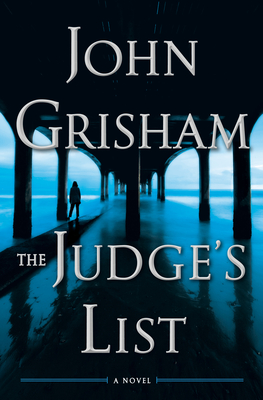
A judge is supposed to know the difference between justice and revenge. In John Grisham’s The Judge’s List, Ross Bannick has spent much of his adult life deliberately erasing that distinction. He presides over criminal proceedings in Florida, commands the respect associated with judicial office, and maintains the appearance of a successful, disciplined professional. Away from the courthouse, he meticulously plans the murders of people who offended or humiliated him years earlier, taking extraordinary precautions to conceal his involvement.
Published in 2021, The Judge’s List is Grisham’s second novel featuring Lacy Stoltz, the Florida judicial investigator introduced in The Whistler (2016). This time, Lacy is approached by Jeri Crosby, a university professor who has spent more than twenty years investigating her father’s unsolved murder. Jeri believes she has identified his killer and connected him to other deaths across the United States. The difficulty is that her suspect is a sitting judge who has become exceptionally skilled at eliminating evidence.
The novel departs from the conventional murder mystery because the reader learns the killer’s identity long before the investigation reaches its conclusion. Its suspense depends instead on the increasingly dangerous struggle between an obsessive private investigator, a reluctant government official, and a murderer accustomed to controlling every detail of his crimes. As the investigation develops, questions about professional responsibility, childhood trauma, revenge, institutional limitations, and the reliability of forensic evidence become inseparable from the pursuit itself.
Spoiler warning: This article explains the complete novel, including the identities and motives of the murderer, the major killings, the kidnapping, the final confrontation, and the ending.
A Mysterious Informant and a Murdered Professor
Lacy Stoltz is approaching forty and has spent twelve years working for Florida’s Board on Judicial Conduct, or BJC, a state agency responsible for investigating complaints against judges. Although her work once offered the prospect of exposing serious judicial misconduct, the office has become an increasingly frustrating place to build a career. Its budget has been repeatedly reduced, staff morale is poor, and Charlotte Baskin, the director whom employees call Cleopatra or Cleo, appears more interested in securing another government appointment than in managing the organization.
Lacy has additional reasons to question her future. In The Whistler, she helped expose a major judicial corruption scheme, but the investigation left her physically injured and emotionally shaken. Her colleague Hugo Hatch was killed, and Lacy remains involved in litigation arising from the attack against her. Despite gaining professional recognition, she has not found the satisfaction she expected from her work. Her relationship with FBI agent Allie Pacheco is serious but uncertain, and neither has committed to a shared future.
Against this background, Lacy receives an unusual telephone call from a woman who refuses to provide her real identity. Calling herself Margie, the woman says that she wants to complain about a judge, but insists on arranging a meeting away from the BJC office. Lacy is accustomed to dealing with unstable or disgruntled complainants and initially suspects that this encounter will be another waste of time.
Their first meeting reinforces the caller’s obsession with secrecy. Margie chooses a public location, avoids revealing unnecessary information, and demonstrates that she has been watching Lacy’s movements. When Darren Trope, a younger BJC investigator, attempts to photograph her discreetly, she notices. Her precautions seem excessive, but she claims to have good reason for them: the judge she wants investigated is a murderer.
At a subsequent meeting, Margie reveals that her real name is Jeri Crosby. She teaches political science at the University of South Alabama in Mobile and has spent decades researching the death of her father, Bryan Burke, a respected constitutional-law professor. Burke was murdered in 1992 near his cabin in South Carolina. His death devastated Jeri, and the failure of the police to identify his killer gradually transformed her grief into a prolonged private investigation.
Jeri has developed a theory about an extraordinary former student of her father. Ross Bannick attended Burke’s law-school classes and endured a humiliating experience when the professor called on him to discuss a case. The encounter became a source of intense embarrassment. Bannick subsequently suffered a breakdown, left the school, and continued his legal education elsewhere.
Jeri believes Bannick eventually murdered Burke as punishment for that humiliation. She has reconstructed enough of his background to suspect that her father was not an isolated victim but part of a much longer pattern.
Her most important discovery concerns the method of killing. Several victims were strangled with an unusual length of marine-grade nylon rope, secured with a double clove hitch. The similarity is distinctive enough to suggest the work of one murderer, especially when combined with historical connections between the victims and Bannick.
Jeri initially identifies six suspected victims. She believes that the earliest was Thad Leawood, a scoutmaster from Bannick’s childhood in Pensacola, murdered in 1991. Burke’s death followed in 1992. Other killings occurred over the following decades, often in locations far removed from Florida.
The intervals between crimes complicate her theory. Conventional investigations usually concentrate on recent disputes, intimate relationships, financial interests, and people with direct access to a victim. Bannick’s alleged crimes involve grievances that sometimes predate the murders by many years. If Jeri is correct, his willingness to wait has allowed him to disappear from the immediate circle of suspicion.
Lacy is intrigued but unconvinced. Jeri has accumulated names, circumstances, photographs, travel information, and connections, yet she has no physical evidence directly identifying Bannick as the killer. She also refuses to reveal everything at once. Her secrecy makes the investigation difficult to evaluate, while her absolute certainty raises doubts about whether her obsession has distorted her judgment.
Nevertheless, Lacy conducts her own research. She identifies Bannick as a successful Florida judge with a legal career and personal history consistent with Jeri’s account. His public record provides no obvious indication that he is capable of murder, but the absence of an ordinary criminal profile does not invalidate the connections Jeri has uncovered.
Lacy agrees to travel to Pensacola, where Jeri gives her a tour of locations significant to Bannick’s life. They visit places associated with his childhood, his scouting activities, his professional development, and his courthouse. Jeri’s knowledge is strikingly detailed. She has studied the physical environment surrounding the suspect so thoroughly that she can describe his movements and historical relationships with considerable confidence.
Thad Leawood’s murder assumes particular importance during these conversations. He had been Bannick’s scoutmaster, and rumors of inappropriate behavior toward boys surrounded his background. Jeri suspects that something in their relationship supplied the motive for the killing, although the precise nature of the grievance has not yet been established.
The investigation also turns toward Danny Cleveland, a reporter whose death Jeri believes is connected to Bannick. She provides files on Cleveland, Burke, and Leawood, allowing Lacy to begin examining the cases independently.
Throughout their meetings, Jeri repeatedly explains the cost of her investigation. She has pursued leads through police records, public databases, newspaper archives, property documents, and private investigators. The work has consumed years of her time and a great deal of money, taking precedence over her academic career and personal relationships.
Her family has largely moved beyond the tragedy, or at least found ways to live without constantly revisiting it. Jeri cannot do the same. For her, learning who murdered her father has become inseparable from understanding what her own life is for.
Lacy’s response remains cautious. She does not want to dismiss a potentially genuine serial-murder investigation, but she knows that her small agency was never intended to undertake an investigation of this scale. Even bringing the allegations to the police could expose Jeri, who fears that Bannick will kill her if he discovers what she has uncovered.
The immediate question is therefore procedural as much as criminal: can Jeri file a complaint that forces an official investigation while remaining anonymous to the dangerous man she believes she has identified?
The Biloxi Murders Force an Official Investigation
While Lacy considers Jeri’s allegations, the narrative reveals what happened during a double murder in Biloxi, Mississippi, the previous October. The episode removes the reader’s uncertainty about whether Bannick is actually a killer and establishes the extraordinary gulf between his public identity and private conduct.
Lanny Verno is a house painter finishing work in a newly constructed home. Near the end of the working day, a man calling himself Butler arrives and claims to be a county inspector. Verno has no reason to question his presence at the construction site. The visitor wears protective gloves and shoe coverings and carries himself with the calm authority of someone conducting routine business.
Once he confirms that Verno is alone, the visitor pushes over the painter’s ladder. Verno falls and suffers a serious head injury. His attacker then strikes him with a concealed telescoping weapon, rendering him helpless before strangling him with the familiar marine rope.
The attack displays Bannick’s preparation and physical training. He has spent years developing the strength and speed required to overpower victims before they can resist. He also understands the importance of approaching them when they are isolated and constructing plausible reasons for his presence.
After completing the strangulation and securing his characteristic knot, Bannick prepares to leave. His plan is disrupted when Mike Dunwoody, the contractor responsible for the property, unexpectedly arrives to deliver Verno’s payment.
Dunwoody sees enough to threaten Bannick’s escape. The judge attacks him with the same blunt weapon and kills him, although this second victim was never part of his original plan. Unlike Verno, Dunwoody is not strangled with the distinctive rope. Bannick regards that form of killing as something reserved for selected victims whose deaths settle old grievances.
The difference is revealing. Bannick ordinarily portrays his murders to himself as calculated punishments for specific offenses, but Dunwoody has done nothing to offend him. He dies because he happens to arrive at the wrong moment. Bannick’s supposedly principled system immediately accommodates the killing of an innocent witness.
Having murdered both men, Bannick manipulates their possessions and phones to confuse the investigation. He eventually leaves the telephones in a package addressed in a way that appears designed to intimidate Sheriff Dale Black through his family. The phones are discovered, as Bannick intends, but the episode diverts police attention toward the apparent message rather than providing an obvious lead.
A witness also reports seeing a gray pickup truck. The observation will become important much later, although investigators initially lack enough information to identify its owner.
When the police examine the crime scene, they encounter two victims with very different backgrounds and no readily apparent shared enemy. The murder weapon used on Verno suggests planning, while Dunwoody’s death indicates that something unexpected occurred. The discarded phones and threatening package add to the impression of a killer who deliberately manipulates investigators.
Jeri learns about the case through her research network. She relies in part on Kenny Lee, a secretive and technically resourceful collaborator who helps her monitor crime reports and find information she cannot easily obtain herself.
She immediately recognizes the significance of the rope and the method used on Verno. The recent murder may provide a connection between Bannick and an old grievance that the police have overlooked.
Jeri hires Rollie Tabor, a private investigator, to examine Verno’s past. His work eventually uncovers an old confrontation involving Verno and Bannick, who was then a practicing attorney. Bannick had hired Verno to perform work on a house, but their relationship deteriorated. A dispute resulted in Verno threatening Bannick with a gun, and police became involved.
The old records are incomplete and misleading. The original dispute was not the kind of event that investigators examining Verno’s murder would naturally discover, especially because it had occurred years earlier in another jurisdiction.
Tabor tracks down Norris Ozment, a retired police officer familiar with the incident. Ozment’s recollections establish that Bannick and Verno had indeed crossed paths and that Bannick had reason to resent the painter. This provides the crucial missing connection between a recent murder and Jeri’s proposed pattern.
Meanwhile, Lacy attempts to bring the allegations to Charlotte Baskin. Baskin is unwilling to allow the BJC to become involved in a serial-murder investigation and argues that the matter belongs with law enforcement. Her position has some practical logic: the BJC lacks the personnel, equipment, and experience required to investigate homicide.
Jeri, however, insists that the board has a statutory responsibility to examine complaints concerning judicial wrongdoing. Her allegation is directed against a judge acting far outside his lawful authority, and she believes the institution cannot simply dismiss it because the possible crimes are unusually serious.
A change in leadership unexpectedly resolves the immediate deadlock. Baskin obtains an opportunity to move into another state position, and the board needs an interim director. Lacy is offered the job.
At first, she hesitates. She has been thinking about leaving the agency altogether, and managing its problems seems an unattractive alternative. The promotion nevertheless offers a salary increase, greater authority, and the ability to reorganize the workplace. More importantly, it would give her control over Jeri’s complaint.
Lacy accepts and quickly begins improving office morale. She relaxes some of the bureaucratic rules, allows greater flexibility, and establishes a more practical management style.
Jeri formally submits her complaint under the assumed name Betty Roe, accompanied by a large collection of research materials. The meeting is emotionally difficult. Jeri understands that placing the complaint in official hands means giving up some control over the work that has defined her adult life.
Lacy forms a confidential investigative team consisting of herself, Darren Trope, and Sadelle, an experienced BJC employee. Darren provides energy and technical assistance, while Sadelle contributes institutional knowledge and a degree of skepticism.
The team reviews Jeri’s files, discusses the possible connections among the victims, and considers what the board can legally and practically accomplish. The investigators are not all convinced that Bannick is guilty, but the patterns are too troubling to ignore.
Their first major external inquiry takes Lacy and Darren to Biloxi, where they meet Sheriff Black and Detective Napier. They demonstrate knowledge of the murder weapon and details that have not been widely publicized.
This gains the officers’ attention. The Biloxi investigators have already recognized that their killer is unusually careful, but they have not identified a plausible suspect. The BJC investigators can offer something missing from the local inquiry: the possibility that Verno’s death belongs to a series extending across several states and decades.
The information does not immediately solve the crime. Lacy still refuses to disclose Jeri’s identity or fully reveal the accusation against Bannick. Nevertheless, the meeting establishes the first meaningful cooperation between the small judicial agency and homicide investigators.
The investigation now has two sources of strength. Jeri has accumulated historical knowledge connecting victims and possible motives, while police possess crime-scene evidence and investigative authority. Neither source alone is sufficient, but the combination creates the possibility of moving beyond suspicion.
The Judge’s Secret Life and the Cold-Case Trail
The investigation next concentrates on Perry Kronke, a successful lawyer whose body was discovered on a boat in the Florida Keys. Kronke’s connection to Bannick stretches back to the judge’s early professional ambitions.
As a young law student, Bannick had worked for Kronke’s firm during the summer and expected to receive an offer of permanent employment. He was devastated when the offer did not arrive. The firm explained that organizational changes had affected its hiring plans, but Bannick interpreted the rejection as an extraordinary personal humiliation.
Years later, he still remembered the disappointment with remarkable clarity. He had never accepted the possibility that the decision was an ordinary professional setback. In his private accounting, Kronke had committed an offense deserving punishment.
The novel reconstructs the murder from Bannick’s perspective. Using an assumed identity, he arranges the circumstances necessary to reach Kronke on the water. Once the lawyer is isolated, Bannick overpowers and strangles him, repeating the marine-rope method that Jeri has recognized in other cases.
The murder demonstrates the extreme patience governing Bannick’s crimes. He has carried a grievance for more than two decades, waiting until he can find circumstances that minimize the chances of detection. The passage of time has not weakened his hostility; it has simply allowed him to prepare more carefully.
Lacy and Darren follow the historical connection between Bannick and Kronke’s law firm while examining the earlier police investigation. The case appears particularly difficult because the physical evidence has aged, possible witnesses have dispersed, and the murder occurred in an environment where reconstructing exact movements is challenging.
Jeri becomes increasingly restless as the BJC takes charge. For years, she has determined which documents to examine, which investigators to hire, and which leads deserve attention. She now has to depend on officials whose patience and priorities differ from her own.
Her unease leads to one of the investigation’s most consequential mistakes. Convinced that Bannick must be frightened into exposing himself, she begins sending him anonymous letters and short poems referring to people he has murdered.
The messages are intended to demonstrate that someone knows his history. Jeri hopes to disturb his confidence and perhaps provoke an action that brings him into the open.
They achieve the first objective but create an obvious danger. Bannick now knows that an unknown adversary possesses information about crimes he believed were securely concealed.
His response exposes the full sophistication of his secret life. Beyond his ordinary residence and courthouse office, Bannick maintains a concealed personal headquarters called the Vault. The space is equipped for his technological operations, including computers, surveillance resources, and access to illegally obtained information.
He uses customized malicious software called Maggotz and a system called Rafe to penetrate digital networks. Through these tools, he monitors police records, government databases, and other information sources that help him identify emerging threats.
The hacking capabilities are extraordinary, and Grisham gives Bannick access to systems that ordinary investigators assume are secure. In the context of the plot, this allows the judge to learn about inquiries almost as soon as officials begin discussing them.
Bannick discovers that people have been examining an old police file concerning Verno. He contacts Norris Ozment and uses a deceptive electronic communication to obtain additional access to information. Through these methods, he traces inquiries back toward Rollie Tabor and begins suspecting that someone is coordinating an investigation of his murders.
His private life provides a striking contrast. Bannick is financially successful, socially connected, and sufficiently respected to maintain friendships among lawyers, judges, and affluent acquaintances. He participates in ordinary gatherings and understands the manners expected of a senior legal professional.
His social confidence is partly calculated. He knows that a prosperous judge with no obvious criminal history is an improbable suspect in a string of interstate murders. Respectability becomes another form of concealment.
The narrative also reveals the motives behind several earlier killings.
Eileen Nickleberry was a woman Bannick knew during his college years. An experience involving her left him feeling sexually humiliated and socially diminished. He carried the resentment for years before killing her in 1998. The narrative establishes that his anger survived long after the relationship or incident had ceased to matter to anyone else.
Ashley Barasso was a woman with whom Bannick became romantically involved during law school. He felt devastated when she ended the relationship and chose another man. His murder of Ashley followed years later, after he had converted the disappointment into an enduring demand for revenge.
Preston Dill had been an early legal client. A dispute over unpaid fees and allegations against Bannick developed into a professional grievance. Although complaints against Bannick were dismissed, Dill’s conduct became another entry in the judge’s mental inventory of people who had insulted or injured him.
Danny Cleveland, a reporter, had investigated and exposed a questionable land transaction involving Bannick. Journalism that might ordinarily be understood as professional scrutiny became, in Bannick’s mind, another unforgivable personal attack.
These cases demonstrate that his victims did not all commit comparable acts. Some were involved in genuinely abusive conduct, others disappointed him professionally or romantically, and still others challenged him while doing their jobs.
The full significance of Thad Leawood emerges through Bannick’s recollections. Leawood sexually abused him when he was a child involved in scouting. Bannick remembers the abuse with enduring hatred and recognizes that he may not have been the only boy victimized.
Unlike the professional disappointments and romantic rejections that later become motives for murder, this grievance originates in severe childhood victimization. It provides essential context for Bannick’s development, although the novel does not establish that abuse made his subsequent killings inevitable.
Bannick’s private records extend beyond the people he has killed. He monitors surviving relatives, acquaintances, and anyone who might retain an interest in a death. He keeps information about their marriages, children, employment, and locations.
His concern is not remorse. He wants to know who might investigate him.
Gradually, the anonymous messages convince him that the source is connected to one of the victims. He examines families and eliminates possibilities, concentrating on those who have both a personal motive and the intellectual ability to reconstruct his history.
His investigation eventually turns toward Bryan Burke’s family.
Burke’s daughter, Jeri Crosby, is a professor in Mobile who has remained intensely involved in her father’s murder. Her privacy, academic background, and geographic connections begin to fit Bannick’s developing theory.
Through contact with a former fraternity brother, Dave Attison, Bannick also learns that someone has been questioning people about Eileen Nickleberry. The information strengthens his belief that a single person has been investigating his earlier life.
By this point, the balance of the story has shifted. Jeri began as the hunter, using Bannick’s history to identify his victims. Now Bannick is using her investigative trail to identify her.
Both possess unusually detailed information about the other, but the danger is unequal. Jeri is attempting to prove criminal wrongdoing through official institutions. Bannick is prepared to eliminate whoever threatens his freedom.
A Fingerprint, Another Murder, and the FBI
As the investigation advances, Bannick increasingly abandons his customary appearance of composure. He begins considering what will happen if police identify him and whether his wealth and legal experience will be sufficient to protect him.
One defensive maneuver involves reporting the anonymous letters and poems as threats. By presenting himself to police as the victim of harassment, he attempts to create an explanation for any investigation involving his name. It is also a way of gathering information about what others know.
He then tells his courthouse staff that he has a serious illness requiring treatment and takes leave from his judicial responsibilities. The claim supplies a respectable explanation for his absences and allows him to travel without inviting the questions that unexplained disappearances might produce.
His secretary, Diana Zhang, has worked closely with him for years and regards him as a dependable employer. She has no reason to know that his medical explanation is fabricated. Bannick’s ability to deceive her illustrates how effectively he separates his professional relationships from his concealed activities.
Meanwhile, the Biloxi investigation produces an important forensic discovery. Investigators have recovered a partial thumbprint from one of the telephones associated with the Verno-Dunwoody murders.
The print is unusual because its pattern appears to have been altered. Detective Napier explains that friction-ridge patterns can sometimes be damaged or changed, although deliberate alteration is difficult and uncommon. Investigators believe that their killer may have modified his fingertips to reduce the chance of being identified.
The discovery represents progress, but it does not yet identify Bannick. Police have a potentially useful impression without a corresponding known print that conclusively connects the judge to the scene.
Lacy recognizes the significance immediately. Bannick’s unusual caution and the apparent alteration of the print fit Jeri’s portrait of a meticulous killer. Yet sharing his identity also risks exposing Jeri and the confidential investigative process that brought the BJC into the case.
The tension between secrecy and official cooperation becomes increasingly difficult to maintain. Lacy has promised to protect her informant, but investigators need information quickly enough to prevent another murder.
Bannick, meanwhile, has not stopped pursuing the people on his list.
His next victim is Mal Schnetzer, a disgraced lawyer who cheated him in a financial arrangement years earlier. Bannick has preserved his resentment and studied Schnetzer’s circumstances, waiting for an opportunity to approach him without revealing his real identity.
Using a fabricated legal matter and an assumed identity, he lures Schnetzer into an isolated trailer in Texas. There, he attacks and murders him.
The killing follows Bannick’s familiar pattern of preparation, impersonation, speed, and cleanup. He avoids unnecessary contact, uses methods intended to frustrate identification, and leaves the area without giving investigators an obvious reason to suspect a Florida judge.
Schnetzer’s death has particular significance because it occurs after Bannick knows that someone is investigating him. Rather than becoming cautious enough to stop killing, he continues acting on his grievances.
His behavior suggests that murder has become integral to his understanding of himself. He can imagine escaping law enforcement, abandoning his judicial career, or assuming another identity, but he has difficulty imagining a life in which his list of wrongs remains unsettled.
Jeri becomes aware of the death and identifies another possible connection. A newspaper story begins bringing the suspected series of murders to wider attention, increasing the pressure on Bannick and reducing the secrecy that has protected him.
The investigation also reaches Jeri’s family life. She visits her daughter Denise in Ann Arbor, where Denise is pursuing graduate studies and building a life of her own.
Their conversations reveal both affection and distance. Denise understands that her mother’s investigation has dominated much of her life, but the young woman’s own relationships, education, and future cannot revolve indefinitely around her grandfather’s murder.
Jeri’s visit briefly exposes what she has sacrificed. Academic work, friendships, romantic possibilities, and ordinary family experiences have repeatedly yielded to her pursuit of Bannick. Even as she approaches the breakthrough she has wanted for decades, she is uncertain what will remain of her identity when the investigation ends.
Lacy seeks professional guidance through Allie, who helps arrange a consultation with retired FBI behavioral specialist Herman Gray.
Gray studies the available evidence and offers an assessment of the suspected killer. The pattern suggests someone capable of extraordinary patience, planning, and social concealment. Bannick does not resemble a stereotypically disorganized predator who kills impulsively and leaves obvious traces.
His offenses involve remembered grievances rather than randomly chosen targets. The long intervals between murders, the recurring method, and the apparent pleasure in preparation indicate a person who experiences control as a central part of the crimes.
Gray also warns that the killer may become more dangerous when he realizes that he is being investigated. The problem has moved beyond collecting evidence about old murders. There is now a substantial risk of further violence against witnesses and investigators.
His advice strengthens the case for federal involvement.
Lacy’s team eventually meets with FBI representatives, Mississippi officers, Florida authorities, and other investigators. Special Agent Clay Vidovich assumes a leading role in coordinating the federal inquiry.
The involvement of the FBI introduces investigative resources that the BJC cannot provide: interstate coordination, specialist forensic analysis, broader databases, and the ability to pursue warrants and organize a criminal investigation across jurisdictions.
For the first time, the authorities begin operating with the scale that Jeri’s allegations require.
Unfortunately, Bannick has spent years compromising precisely the kinds of electronic systems on which investigators depend. His digital surveillance allows him to detect developments that officials believe are confidential.
He learns enough about the growing investigation to understand that his position is becoming precarious. He begins thoroughly cleaning his residence, office, and concealed workspace, attempting to remove records and physical traces that might connect him to his crimes.
At the same time, he locates Jeri’s home and begins monitoring her movements. He eventually places a tracking device on her vehicle, giving him the ability to follow her without remaining visibly behind her.
The investigators have identified a dangerous suspect and are developing a potentially useful forensic lead. Bannick, however, has identified the person responsible for exposing him.
The confrontation is no longer hypothetical. He is preparing to reach Jeri before the authorities can secure her safety.
Jeri’s Abduction and the Trap at the Bayview Motel
Jeri receives a terrifying demonstration of Bannick’s knowledge when a stranger delivers an envelope to her front door late one evening. Her doorbell camera records a disguised man approaching the house, leaving the envelope, and disappearing.
Inside are copies of the anonymous poems she sent to Bannick.
The message requires no explanation. The poems were intended to show that someone knew his crimes. By returning them to her home, Bannick proves that he has identified their author and knows where she lives.
Jeri calls the local police, but the responding officers regard the incident as a possible prank or harassment complaint. They have no knowledge of the larger investigation and cannot appreciate the full implications of the envelope.
Left alone, Jeri becomes convinced that Bannick will return. She arms herself, checks the doors, and struggles with increasing panic. Her usual confidence in research and preparation offers little protection against the prospect of physical attack.
Eventually, she packs a bag and leaves Mobile during the night. She deliberately changes routes, travels through Alabama and the Florida Panhandle, and attempts to determine whether anyone is following her.
She does not realize that Bannick has attached a tracking device to her car. Her unpredictable driving therefore provides almost no protection. He can monitor her location without maintaining the obvious proximity she is watching for.
Exhausted, Jeri stops at the Bayview Motel near Crestview, Florida, and checks in using another assumed name, Margie Frazier.
Bannick follows her to the motel and rents a room across the hallway. He uses his hacking tools to penetrate its electronic systems, gaining access to room information, security controls, lighting, and electronic locks.
The sequence displays the full practical consequences of his technological abilities. A motel room normally offers a tired traveler a measure of privacy and safety, but Bannick can manipulate the systems that guests rely upon to keep strangers outside.
He prepares the materials necessary to incapacitate Jeri and enters her room. She is unable to defend herself, and he removes her from the motel without attracting meaningful attention.
Jeri awakens in a remote cabin with her wrists restrained and her ankles secured. She has been heavily drugged and is physically helpless.
Bannick has finally brought his principal adversary into a situation he controls. He can question her without interruption, determine what she knows, and decide what to do with her.
Their conversation is among the most revealing scenes in the novel.
Jeri confronts him with the history she has reconstructed: Thad Leawood, Bryan Burke, Eileen Nickleberry, Ashley Barasso, Danny Cleveland, Perry Kronke, Lanny Verno, Mike Dunwoody, and the recently murdered Mal Schnetzer, among others.
She describes the circumstances of the killings and the grievances that appear to explain his choice of victims. Bannick listens with a mixture of anger, curiosity, and reluctant admiration.
He is astonished that she connected so many crimes without the benefit of a conventional police investigation. Her persistence has penetrated the elaborate protection he constructed around himself.
Yet he continues to justify his behavior. He regards the people he selected as deserving their deaths because they insulted, rejected, cheated, or humiliated him. When Jeri points out that Mike Dunwoody had done nothing except interrupt a murder, Bannick resists treating him as comparable to the intended victims.
The exchange exposes the emptiness of his moral accounting. He claims authority to determine who deserves punishment, while excluding inconvenient facts that reveal the arbitrary nature of his decisions.
Jeri also refuses to accept his explanation of the crimes as brave acts of revenge. She emphasizes that he attacked people by surprise, chose vulnerable circumstances, and relied on secrecy rather than risking an honest confrontation.
Her defiance is remarkable because she understands that he could kill her immediately. Nevertheless, confronting him has been an ambition throughout her adult life, and she finally has the opportunity to tell him what she thinks.
Bannick’s immediate objective, however, is not simply to hear Jeri’s accusations. He wants to discover how much Lacy knows and whether the authorities possess evidence that could survive his efforts at concealment.
He forces Jeri to call Lacy and arrange a meeting at the Bayview Motel. She is instructed to claim that she possesses new, decisive evidence against Bannick that cannot be discussed over the telephone.
The bait is carefully chosen. Lacy has been pursuing difficult leads and has reason to believe that a major discovery could finally bring the investigation to a conclusion.
Bannick intends to ambush her at the motel and bring her to the cabin for questioning. He leaves Jeri restrained and drugs her again, making it difficult for her to escape or warn anyone.
Lacy receives the call while spending time with her brother Gunther. The conversation sounds sufficiently promising that she agrees to travel, although the situation is unusual.
Gunther, a wealthy businessman and recreational pilot, has already been encouraging Lacy to take advantage of his airplane and spend time away from work. They are enjoying a brief excursion when the alleged breakthrough changes her plans.
Gunther offers to accompany her. His presence is partly a matter of convenience, but his protective instincts become crucial.
The siblings reach the motel after dark. Lacy approaches the room where Jeri is supposedly staying, while Gunther follows separately.
Bannick is waiting across the hallway. He uses his laptop to disable the motel’s lights and security cameras, plunging the area into darkness. Armed with materials intended to incapacitate Lacy, he opens his door and attacks.
Gunther reacts before Bannick can complete the abduction. He charges into the struggle, knocks the attacker away from Lacy, and grapples with him on the floor.
Bannick is physically formidable and lands several painful blows. Gunther is injured, including blows to his ribs and face, but his intervention gives Lacy enough time to escape and summon help.
The unexpected resistance destroys Bannick’s plan. Unable to regain control quickly, he retreats to his room, retrieves his equipment, and flees the motel.
Lacy immediately recognizes the likelihood that they have been ambushed by Bannick. She contacts Vidovich and attempts to reach Jeri, whose absence now appears deeply suspicious.
As police respond to the motel, Bannick drives toward the remote cabin, intending to eliminate Jeri before she can be rescued.
A separate chain of events prevents him from reaching her.
Two teenagers exploring the isolated property notice that someone has been staying in the cabin. Believing it may contain items worth stealing, they break inside after Bannick leaves.
They find Jeri restrained and apparently dead. Terrified, they flee and report the discovery anonymously.
Police arrive and find that Jeri is alive, though severely drugged, dehydrated, and disoriented. She is taken to a hospital in Alabama, where she gradually becomes capable of explaining what happened.
Bannick approaches the cabin but sees police vehicles and emergency lights. He realizes that his remaining opportunity to silence Jeri has disappeared.
Rather than attempt another confrontation, he escapes.
He travels through Alabama, abandons the vehicle he has been using, and rents another car under a false identity. He heads west, taking advantage of the experience he has accumulated during decades of secret travel.
Jeri and Lacy are finally able to speak by telephone. The relief is overwhelming. Both have survived a confrontation with a murderer whose intelligence and preparation nearly allowed him to control their fate.
Jeri later reunites with Lacy, Allie, and Gunther in Tallahassee. The physical danger has temporarily receded, but Bannick remains free.
The FBI searches his home and courthouse office, discovering signs of extensive cleaning and removal of potentially incriminating material. The search produces much less than investigators hoped to find.
The agency now knows whom it is pursuing and what he is capable of, but it still faces the central difficulty that has shaped the investigation from the beginning: identifying Bannick as a likely murderer is not the same as possessing enough reliable evidence to convict him.
Bannick’s Death and the Salvage-Yard Breakthrough
Bannick’s escape takes him to New Mexico, where he enters an expensive addiction-treatment facility, Pecos Mountain Lodge. He presents himself as a man seeking help for alcoholism, continuing his practice of constructing convincing explanations for his movements.
The facility offers privacy and relative isolation. Bannick has enough money to pay for his stay and enough experience with deception to avoid attracting immediate suspicion.
His choice of destination is not part of an ordinary recovery effort. He has concluded that his life as a respected judge is effectively over.
He has lost the freedom to pursue his victims without fear, and the possibility of arrest has become too immediate to ignore. The investigation threatens his public reputation, wealth, independence, and carefully maintained private identity.
For years, he believed he could anticipate almost any danger. The combined efforts of Jeri, Lacy, and federal investigators have demonstrated that his control is no longer absolute.
Bannick begins arranging his death.
He prepares documents giving Diana Zhang responsibility for his estate and making her the beneficiary of a substantial inheritance. Diana has been loyal to him without understanding his crimes, and he trusts her to follow his final instructions.
The arrangements include directions concerning cremation and the handling of his remains. These instructions have an important practical purpose because Bannick is determined to prevent investigators from obtaining identifiable fingerprints.
He takes a lethal quantity of medication and deliberately destroys the skin of his fingers and thumbs with acid. The injuries are severe enough to leave his hands grotesquely damaged.
By the time FBI agents arrive at the facility, he is dead. His body offers no easy opportunity to obtain the fingerprints investigators need.
The suicide prevents a criminal trial and deprives the prosecution of the person against whom the evidence would have been presented. It also allows Bannick to avoid arrest, cross-examination, public exposure in court, and whatever punishment a conviction might have produced.
His final acts are characteristic of his approach to murder. Even while arranging his own death, he attempts to control the evidence that will remain afterward.
The authorities examine his damaged hands and continue investigating, but their searches produce little decisive information. Diana becomes entangled in difficult decisions about his estate and the disposal of his remains, all while federal investigators seek to preserve whatever evidence may still exist.
For Jeri, the news is devastating in ways that survival alone cannot resolve.
She has spent more than twenty years trying to identify her father’s murderer, and she now knows that Bannick was responsible. He has also confronted her directly and displayed intimate knowledge of crimes only the killer could reliably explain.
Yet she has no formal conviction, and the available physical evidence does not establish every murder she has reconstructed.
Bryan Burke’s death remains particularly painful. Jeri began her investigation because she wanted her father to receive justice. Bannick’s suicide makes it impossible to prosecute him for that crime.
Her emotional response is complicated. She feels relief that Bannick is dead and can never stalk or harm her again. At the same time, she struggles with the prospect that decades of work may end without the public confirmation she sought.
Other families face similar uncertainty. The relatives of Eileen Nickleberry, Ashley Barasso, Danny Cleveland, Perry Kronke, Preston Dill, and the remaining victims may never learn the full circumstances of their losses.
Bannick’s death also ends the possibility of obtaining a confession that identifies every victim. His records have been concealed or destroyed, and his private knowledge dies with him.
Jeri eventually returns to Mobile and tries to experience life without constantly fearing Bannick. She considers ordinary activities that she has neglected for years, including cooking, walking, and spending time with people without allowing the investigation to dominate every conversation.
The novel nevertheless gives her one final investigative breakthrough.
Lacy and the remaining BJC team are preparing to close the Bannick matter when Jeri calls with an idea concerning the gray pickup truck associated with the Biloxi murders.
The vehicle had belonged to Bannick but was sold after the killings. Its subsequent owner was involved in an accident, and the truck was declared a total loss by the insurer.
Darren had previously traced its history, but the accident appeared to make the vehicle useless as evidence. Jeri realizes that the truck may still exist in a salvage yard and that Bannick could have left fingerprints inside it years before the investigation began.
Unlike his home, office, or private headquarters, the truck was no longer under his control when he began eliminating evidence. He had disposed of it without knowing that a partial thumbprint recovered from Verno’s phone would later become significant.
Jeri locates the probable destination of the damaged vehicle: Dusty’s Salvage, near Milton in the Florida Panhandle.
She persuades Lacy and Darren to accompany her. The three travel to the enormous salvage yard and, after dealing with employees who are initially reluctant to assist, locate the wrecked gray pickup.
Its condition is discouraging. The vehicle has sustained severe damage, and useful parts have already been removed. Years of exposure and handling also raise doubts about whether any original fingerprints could survive.
Jeri nevertheless searches for objects that Bannick might have touched during his ownership.
The glove compartment becomes the focus of attention. It is damaged and difficult to open, but the investigators eventually recover documents, including an owner’s manual and insurance materials associated with a company through which Bannick had held the vehicle.
The insurance card is especially promising because Bannick would likely have handled it during his ownership, and the smooth surface could preserve an impression.
Lacy contacts the FBI, and technicians examine the recovered items.
The examination produces two clear thumbprints on the insurance card. The prints are submitted for comparison with the unusual impression recovered from Verno’s phone.
The FBI soon confirms a match.
Within the narrative, this establishes that the person whose thumbprint was left on the murder-related phone also handled the insurance card associated with Bannick’s former truck. Investigators accept the comparison as proof connecting Bannick to the killings of Lanny Verno and Mike Dunwoody.
The result is the strongest physical evidence obtained during the entire investigation. Jeri’s final insight succeeds because it identifies a neglected object outside the killer’s control, rather than relying on another reconstruction of motives and historical connections.
Even this breakthrough has limits. Bannick is dead, and there will be no prosecution. The evidence concerns the Biloxi murders, not every killing that Jeri attributes to him.
The conclusion therefore turns toward the surviving families and the complicated question of what they should be told.
Two weeks later, Lacy and Allie travel to the Florida Keys. They visit the family of Perry Kronke, including his widow Jane and their sons Roger and Guff, with a local police official present.
Lacy explains the investigation, the existence of a suspected serial murderer, and the circumstances of Bannick’s death. She discusses the shared method of killing and the possible motive arising from Kronke’s earlier refusal to offer Bannick a permanent position at his law firm.
The family is shocked. Their husband and father may have been murdered because of a professional decision made decades earlier.
They naturally want to know whether Bannick’s guilt has been established. Lacy must explain that there is no conclusive physical evidence linking him to Kronke’s death. She believes he was responsible, and the wider pattern supports that conclusion, but the case will not be tried.
The family struggles to decide whether the information should bring relief or anger. Knowing the likely identity of the murderer does not restore the person they lost, and the absence of prosecution prevents the familiar public acknowledgment associated with a criminal conviction.
Their response gives the novel’s legal resolution an important human dimension. Evidence is meaningful because it can answer questions for survivors, but its value is not uniform when different families receive different degrees of certainty.
The final pages return to Lacy and Allie.
After their visit to the Kronke family, the couple spends time in Key West. During a walk near a beachfront wedding venue, Lacy reveals that she has already reserved the location for their marriage on September 27.
Allie is surprised by her initiative. Rather than waiting for a traditional proposal, Lacy has decided what she wants and taken the necessary steps.
She also announces that she intends to leave the BJC and wants Allie to leave the FBI. She has planned an extended European honeymoon, after which they can decide what kind of life to build together.
Allie accepts.
The novel ends with the couple watching a wedding between strangers, while Lacy begins thinking about the details of her own ceremony.
This is a markedly different form of resolution from the one available to Jeri. Jeri has gained freedom from the murderer who dominated her life but cannot obtain complete justice for her father. Lacy, having survived another dangerous investigation, can make a conscious choice about her future.
Judicial Oversight and the Limits of Police Jurisdiction
The institutional premise of The Judge’s List is unusual because the central investigation begins within an organization that is poorly equipped to investigate murder. Lacy’s BJC handles complaints involving ethical misconduct, improper influence, conflicts of interest, and other failures of judicial behavior. Murder is far beyond its normal workload.
That mismatch explains much of the early resistance to Jeri’s complaint. Charlotte Baskin does not want an underfunded agency to assume responsibility for allegations that properly belong to law enforcement. Lacy and her colleagues understand the danger of confronting a possible serial killer without police authority, forensic resources, or protective personnel.
Jeri’s strategy depends on exploiting the difference between institutional purpose and institutional obligation. She wants the BJC involved because Bannick is a judge and because she believes the agency must consider a properly submitted complaint about him. More importantly, she hopes it can create a confidential route into a criminal investigation without immediately exposing her identity.
The result is an investigation conducted through an institution whose primary responsibilities do not match the seriousness of the alleged crimes. This produces bureaucratic resistance, jurisdictional uncertainty, and concern over who should receive sensitive information.
Grisham makes these problems more credible by giving the BJC an unglamorous workplace. The agency struggles with declining budgets, tired employees, staff turnover, and political appointments. Lacy’s initial frustrations are the ordinary frustrations of government administration rather than the dramatic dangers associated with a thriller.
The distinction matters because the BJC is fictional. Grisham acknowledges this in his author’s note. Florida’s real judicial-discipline institution is the Judicial Qualifications Commission, which investigates allegations of judicial misconduct within a different legal and institutional framework.
The novel should therefore be understood as a fictional treatment of judicial oversight rather than a reliable procedural guide to real Florida law.
Its larger institutional problem, however, extends beyond the BJC.
Jeri believes Bannick has murdered people in several states over many years. Each death has generated its own local investigation, with records held by different departments and officers working within separate jurisdictions.
The circumstances of the crimes also discourage investigators from recognizing a series. Victims differ in age, occupation, background, and location. Their connections to Bannick are often old and obscure.
A detective examining Perry Kronke’s murder may reasonably concentrate on recent financial, family, or personal relationships. A homicide investigator in Biloxi may have no reason to search decades of legal records for an old dispute between Lanny Verno and a Florida attorney.
The repeated rope and knot offer an identifying pattern, but recognizing that pattern requires access to records across different investigations. It also requires someone to recognize the importance of details that may not have appeared in public reports.
Jeri supplies the continuity missing from those fragmented inquiries. She studies each murder as part of a possible series and reconstructs the older relationships that explain victim selection.
The FBI’s eventual involvement changes the available resources, but it does not erase the information problems already present. Bannick has compromised some of the systems investigators use, and his early awareness gives him opportunities to destroy evidence or threaten witnesses.
His judicial status compounds the difficulty. He belongs to the profession associated with enforcing the law, understands criminal procedure, and possesses the social standing that ordinarily encourages people to trust an official.
Grisham’s central institutional irony is that the office responsible for interpreting and administering justice can also become a protective identity for someone violating the law.
The novel does not suggest that legal institutions are uniformly corrupt or that judicial status makes wrongdoing inevitable. Lacy, the local detectives, and the FBI agents are all imperfect, but they take the allegations seriously once meaningful evidence emerges.
The more persuasive criticism is of institutional fragmentation and ordinary assumptions about respectability. Bannick benefits because investigators do not initially think of a judge as a plausible serial murderer and because no single agency has a complete view of his victims.
Lacy Stoltz and the Life She Is Ready to Leave
Lacy is the novel’s professional center. Jeri possesses the deepest knowledge of Bannick, and Bannick provides the immediate criminal danger, but Lacy is responsible for converting private suspicion into an institutional investigation.
Her initial reluctance is essential to understanding her character. She does not enthusiastically embrace Jeri’s claims because she is searching for excitement. She has already endured serious danger through her work, and the consequences of the previous investigation remain part of her life.
Hugo Hatch’s death and her own injuries have taught her that exposing wrongdoing can carry costs far beyond professional inconvenience. She knows the difference between an interesting allegation and a case that can threaten investigators and their families.
Her dissatisfaction with the BJC also reflects an ordinary professional dilemma. She has invested years in the agency, gained expertise, and established herself as a capable investigator. Yet her experience has not translated into lasting fulfillment, and the office’s deteriorating condition makes continued service increasingly difficult to justify.
Lacy’s decision to become interim director is therefore more complicated than a promotion. The additional salary and authority appeal to her, but she also recognizes an opportunity to protect Jeri’s identity and make responsible decisions about the investigation.
Her performance as director illustrates practical leadership. She improves working conditions, reduces needless administrative restrictions, and assembles a small team suited to a confidential inquiry.
The changes are modest rather than revolutionary, which makes them revealing. Lacy understands the agency well enough to distinguish necessary discipline from bureaucratic habits that accomplish little.
Her relationship with Jeri tests that competence. Jeri has information Lacy needs, but she can also be demanding, secretive, and unwilling to accept that official investigators have responsibilities beyond solving her father’s murder.
Lacy repeatedly has to manage Jeri’s expectations while respecting the value of her work. She recognizes both the seriousness of the allegations and the possibility that Jeri’s obsession may lead her to take reckless action.
Lacy is also willing to acknowledge her own limitations. She does not pretend that the BJC can investigate ten murders across several states. When it becomes necessary, she accepts the involvement of professional law enforcement despite the complications this creates for confidentiality.
Her dependence on Darren and Sadelle further distinguishes her from a conventional solitary thriller hero. She succeeds by coordinating people with different skills, using established records, asking questions, and determining when to transfer responsibility.
Outside the investigation, her relationship with Allie is the main expression of her uncertainty about the future.
Allie works for the FBI and is accustomed to the mobility, demands, and professional identity that come with federal law enforcement. Their relationship is affectionate and established, but it has not produced agreement about where they will live, whether they will marry, or how much either is willing to sacrifice professionally.
The weekend at Rosemary Beach illustrates their difficulty. They enjoy being together, yet conversations about marriage, transfers, and career changes reveal that neither has fully decided what comes next.
Gunther provides a contrasting influence. His wealth, confidence, and tendency to offer unsolicited advice sometimes irritate Lacy, particularly when he comments on her personal life. Nevertheless, he cares about her and recognizes that she is approaching a stage when continuing by habit may no longer be satisfactory.
The motel attack changes the significance of their relationship. Gunther’s sudden intervention saves Lacy from Bannick’s attempt to abduct her. The sibling who frequently annoys her becomes the person whose presence makes survival possible.
Lacy’s eventual decision to leave the BJC follows from these experiences, though the marriage announcement itself remains abrupt. She has spent years allowing the institution’s needs, professional obligations, and unresolved litigation to shape her decisions.
By the end, she is unwilling to let the next phase of her life emerge accidentally from another promotion or dangerous case.
Her proposal to Allie is characteristically direct. She reserves the wedding venue, announces the date, and makes clear that she wants both of them to change careers.
The scene can be read as an expression of independence, but it also exposes the controlling side of her personality. She has made several major decisions before involving Allie in the discussion.
Grisham presents his agreement as affectionate and uncomplicated. Whether that makes their relationship more satisfying or less convincing is a legitimate question for the novel’s critical evaluation.
Lacy’s development nevertheless has a recognizable progression. She begins as a capable professional who feels trapped by the work that has defined her. She ends with a willingness to pursue a future whose terms she has chosen herself.
Jeri Crosby and the Cost of a Twenty-Year Obsession
Jeri is the character most responsible for exposing Bannick, and her investigation gives the novel much of its intellectual substance. Without her, the separate murder cases would probably remain unconnected.
Her father’s death profoundly changed her understanding of the world. Bryan Burke was a respected professor whose murder initially appeared incomprehensible. The failure to identify his killer left Jeri with a question she could neither answer nor abandon.
Over time, searching for that answer became the organizing principle of her life.
Her work is methodical rather than intuitive. She studies old newspaper reports, police files, court proceedings, property records, employment histories, personal relationships, and geographic movements. She learns to recognize unusual consistencies among deaths that occurred years apart.
The physical signature of the marine rope and double clove hitch gives her a starting point, but the relationship between victims and suspect requires more complicated reconstruction.
Jeri has to determine whether Bannick knew each person, whether their encounter could have produced a lasting grievance, and whether the murder occurred under circumstances consistent with his movements.
Her competence grows through repetition. She learns how different institutions preserve records, which sources are reliable, and how to pursue information that official investigators may have overlooked.
The Verno inquiry illustrates her strongest abilities. Local investigators do not initially recognize an old dispute between the painter and Bannick as relevant to the murder. Jeri understands that the connection may be hidden in records from years earlier.
She hires Tabor, follows the incomplete documentation, and eventually obtains corroboration from Norris Ozment.
Her approach is expensive, time-consuming, and often frustrating, but it produces results because she is willing to examine possibilities that other investigators have no particular reason to pursue.
Jeri also knows the limits of her position. She cannot compel testimony, execute warrants, or force police departments to coordinate investigations. She must persuade officials who have their own responsibilities and evidentiary standards.
Her decision to approach Lacy reflects that limitation. She needs an institutional partner who can transform research into action, yet she is terrified that an official complaint will expose her.
That fear is not irrational. Bannick has murdered people for much less than attempting to uncover his crimes.
Jeri’s obsession nevertheless interferes with her judgment. After successfully placing the matter before the BJC, she finds it almost impossible to wait for developments.
She has been directing the investigation for so long that allowing someone else to take responsibility feels like surrendering control over her father’s memory.
The anonymous poems are the clearest expression of this problem. Their purpose is emotional as much as investigative. Jeri wants Bannick to know that someone has uncovered his crimes and wants to make him experience fear.
The messages provide little obvious evidentiary advantage. They do, however, give Bannick a reason to identify and confront his pursuer.
Her decision exposes a conflict within her motives. She wants justice for her father, but she also wants personal satisfaction from humiliating the person who murdered him. The second desire threatens the first.
Her life outside the investigation has suffered in less dramatic ways.
Jeri has a daughter, Denise, whom she loves, yet the murder investigation has repeatedly taken precedence over normal family experiences. Jeri’s marriage ended years earlier, and she has not developed a sustained romantic life afterward.
Her academic work continues, but her research and writing have been affected by the energy she devotes to Bannick. She remains professionally capable while acknowledging that the pursuit has prevented her from investing fully in her career.
Her visit to Denise reveals the contrast between their lives. Denise has educational ambitions, a romantic relationship, and expectations about the future. Jeri has organized her existence around an event that occurred before many of those ordinary possibilities had developed.
The novel does not portray her as incapable of affection or enjoyment. It portrays someone whose psychological commitments leave limited room for anything else.
Her confrontation with Bannick at the cabin is therefore more than an episode of physical danger.
For decades, she has known him through documents, photographs, travel records, and imagined explanations. The abduction places her before the actual person.
She discovers that he is capable of listening to her account with something approaching professional curiosity. He wants to know how she identified him and understands that her investigation represents an extraordinary accomplishment.
Jeri, in turn, is finally able to confront the man she believes destroyed her family. She challenges his justifications, reminds him of the victims’ innocence or humanity, and refuses to regard his carefully prepared attacks as courageous.
Her defiance does not mean she is unafraid. She is physically helpless and knows that he can kill her. The conversation becomes powerful precisely because she continues challenging him despite that danger.
After her rescue, Jeri faces a different problem. The person she has pursued for decades is dead, but her father’s murder remains without a conviction.
She initially fears that the investigation has failed. The emotional certainty she possesses cannot substitute for public proof, and she has no way to force Bannick to answer for his crimes.
The final discovery of the salvage-yard truck shows that her investigative abilities remain intact. Once again, she recognizes the significance of an overlooked object and understands where evidence might survive.
This achievement allows her to obtain a form of confirmation that the official investigation had not secured.
Yet the novel does not pretend that the fingerprint match repairs her life. It establishes Bannick’s involvement in two killings, but it does not provide a trial for Bryan Burke’s murder or undo Jeri’s years of isolation.
Her final position is hopeful but unresolved. She is alive, free from Bannick’s threat, and beginning to imagine activities beyond her investigation.
The possibility of rebuilding a life is available to her, but the book does not claim that she can recover everything she sacrificed.
Ross Bannick and the Psychology of Revenge
Ross Bannick is a particularly unsettling antagonist because his murderous behavior exists alongside considerable professional competence and social discipline. He is intelligent, financially secure, technologically sophisticated, physically prepared, and capable of maintaining ordinary relationships.
His crimes do not arise from an inability to function in society. They are carefully concealed within a life that appears successful.
The novel traces part of his psychological history to the abuse he experienced as a child.
Thad Leawood, his scoutmaster, sexually abused him when he was young. Bannick remembers the experience with intense hatred and shame, and he suspects that Leawood may have victimized other boys.
The abuse is an essential part of Bannick’s background. It helps explain why domination, vulnerability, and humiliation occupy such an important place in his thinking.
However, it does not establish that he was destined to become a murderer. His later victims frequently had no connection to the abuse, and their supposed offenses were often ordinary disappointments or conflicts.
Grisham’s characterization becomes most revealing when Bannick applies the same logic of punishment to radically different situations.
Leawood exploited a child under his care. Bryan Burke embarrassed a law student in class. Perry Kronke did not offer a summer employee the job he expected. Ashley Barasso ended a romantic relationship. Lanny Verno was involved in a dispute over work at a house.
Bannick treats these experiences as offenses that grant him the right to kill.
The underlying pattern is his inability or refusal to accept humiliation without converting it into a permanent grievance.
He interprets rejection as deliberate injury, criticism as persecution, and professional setbacks as attacks on his worth. He remembers these incidents with a clarity and resentment disproportionate to their continuing relevance.
The passage of time does not soften his anger. Instead, it gives him opportunities to imagine revenge in increasingly elaborate detail.
His decision to become a judge adds another disturbing dimension. He holds a position associated with the measured application of law, yet privately appoints himself investigator, prosecutor, judge, and executioner in matters concerning his personal pride.
There is no independent standard governing his verdicts. The offense is whatever he regards as an insult, and the sentence is whatever will satisfy him.
The title of the novel captures this private system of judgment. Bannick’s list is his substitute for an impartial legal process.
His treatment of Mike Dunwoody exposes the system’s hypocrisy. Dunwoody never rejected, abused, embarrassed, or cheated him. He simply arrived while Bannick was completing another murder.
Bannick kills him to avoid exposure and then minimizes his place in the moral accounting of the other deaths.
The distinction suggests that the supposed justice of his killings is an explanation he gives himself, not a principle he consistently follows. His primary commitment is to his own desires and safety.
His habits of preparation reinforce this reading.
Bannick trains his body, develops false identities, studies victims’ routines, acquires technological resources, and cultivates methods of eliminating evidence. He takes satisfaction in executing a plan without making mistakes.
The planning is not merely practical. It allows him to experience superiority over people who once made him feel powerless.
A victim who rejected him years earlier may have forgotten the encounter entirely. Bannick, however, has spent years developing circumstances in which he can exercise absolute power over that person.
The violence becomes a way of reversing the remembered relationship.
This obsession with control also shapes his public identity. He has never married and maintains a degree of emotional distance even from acquaintances who consider him a friend. Social relationships are useful, but intimate knowledge of his life would create vulnerabilities.
His wealth and property investments give him independence. He does not depend entirely on his judicial salary, and his financial resources make secret travel, equipment, and private locations possible.
The Vault is the physical expression of his desire to operate beyond ordinary observation. It contains a technological environment in which he can examine other people’s lives while concealing his own.
Despite all this sophistication, Bannick is vulnerable to the same obsession that makes him dangerous.
The anonymous poems upset him because they demonstrate that another person has penetrated his secrecy. Someone has been studying him with the patience he ordinarily directs toward his victims.
His response is driven by the need to identify and dominate that adversary, even though the safest course might be to disappear before investigators gather more evidence.
His murder of Schnetzer after the investigation has become dangerous further illustrates the contradiction. Bannick is extraordinarily careful in the execution of individual crimes but unable to abandon the larger behavior that places him at risk.
His final decisions reveal the limits of his apparent rationality.
He has enough money and knowledge of false identities to contemplate escape. Yet he also understands that he may never recover his former life as a respected judge.
The loss of control is intolerable to him. Rather than accept arrest or a public reckoning, he chooses suicide and attempts to destroy the evidence contained in his own fingerprints.
That choice is consistent with his characterization, but it also raises interpretive questions. It may represent a deliberate final act of evasion, an inability to live without his concealed identity, or a combination of fear and the self-destructive tendencies the FBI profiler suspects.
The novel does not establish a formal psychiatric diagnosis. Its portrait is better understood through Bannick’s observable behavior: extraordinary resentment, lack of remorse, calculated violence, persistent self-justification, and an overwhelming need for control.
What makes him frightening is the ease with which these traits coexist with conventional success. His professional accomplishments are real, but they do nothing to make his private judgments reasonable or his violence defensible.
The Victims and the Difference Between Motive and Justice
The victims of The Judge’s List are connected by Bannick’s interpretation of their behavior rather than by a shared social identity or profession. They include a scoutmaster, law professor, former client, romantic partners, reporter, lawyer, painter, and businessman.
Their variety is central to Jeri’s difficulty. A conventional investigation searches for recognizable relationships between offender and victim, but Bannick deliberately chooses people whose dealings with him may be decades old.
The strongest grievance in his history concerns Thad Leawood. Leawood abused Bannick during childhood, and the harm was serious. It is possible to understand the origin of Bannick’s anger without accepting murder as a legitimate response.
The other cases increasingly expose how little the moral seriousness of an offense matters to him.
Bryan Burke’s classroom humiliation appears to have caused Bannick intense distress. Yet the professor was exercising authority within an academic setting, and embarrassment alone cannot justify the punishment Bannick eventually imposes.
Perry Kronke’s refusal to offer Bannick a job is another example of ordinary disappointment transformed into a supposed injustice. The rejection may have affected Bannick’s career plans, but he later achieved professional and financial success. His continued resentment shows that the desire for revenge survives even when the practical consequences of the original setback have diminished.
Ashley Barasso and Eileen Nickleberry are connected to Bannick’s romantic and sexual vulnerabilities. In these cases, the rejection or humiliation he remembers becomes a permanent indictment of the women involved.
Preston Dill represents a professional grievance. His dispute with Bannick involved legal fees and complaints, and Bannick treated the disagreement as a reason to keep pursuing punishment long after the immediate conflict ended.
Danny Cleveland was a journalist whose reporting exposed conduct Bannick wanted concealed. His work was professionally adversarial, but that does not make it a personal offense deserving violence.
Lanny Verno’s dispute with Bannick similarly arose from a conflict in ordinary life. The confrontation became a grievance that Bannick preserved for years before arranging the painter’s murder.
Mal Schnetzer’s deception involved money and professional dealings. Even where a victim engaged in genuinely dishonest conduct, Bannick’s response remains vastly disproportionate.
Mike Dunwoody stands apart. He was not the intended object of revenge and had no relevant history with Bannick. His murder was an expedient attempt to conceal the killing of Verno.
Dunwoody’s death is especially important because it demonstrates that Bannick’s list does not define the boundaries of his violence. When circumstances demand it, he kills without any grievance at all.
The families also complicate his private accounting. Bannick thinks about his victims primarily as individuals who wronged him, but each death affects spouses, children, parents, siblings, friends, and colleagues.
His murder of Ashley does not merely settle his imagined dispute with a former girlfriend. It deprives her children and family of a person they loved. Kronke’s death similarly continues affecting his widow and sons long after Bannick has regarded the murder as completed business.
Grisham gives some victims more narrative attention than others, partly because certain murders are reconstructed directly while others appear through records or recollections. The disparity should not be mistaken for a difference in their human significance.
There is also an important evidentiary distinction. The narrative shows Bannick committing several crimes and provides strong reasons to believe he is responsible for others. The characters, however, cannot establish every death through legally sufficient evidence.
The fingerprint discovery confirms the Biloxi connection in the investigation’s final account, but it does not automatically prove every murder Jeri has attributed to Bannick.
This difference between what the reader knows and what the surviving families can be told is one of the novel’s most consequential moral tensions.
The Allies and Families Who Shape the Investigation
Although the novel concentrates on Lacy, Jeri, and Bannick, its supporting characters affect both the progress of the investigation and the protagonists’ personal decisions.
Allie Pacheco provides Lacy with a connection to federal law enforcement and a relationship outside the BJC. His professional experience helps her appreciate the difficulties of investigating a suspected serial killer, although she cannot immediately share every confidential detail.
He also represents a continuing personal commitment that Lacy has not fully decided how to formalize. Their conversations reveal affection, familiarity, and differences over career expectations. Allie’s presence allows Grisham to show a life Lacy might choose if she leaves the work that has defined her.
Gunther Stoltz initially appears more as a disruptive sibling than as an essential participant in the mystery. He is wealthy, impulsive, accustomed to making plans, and inclined to tell Lacy what she should do.
Their conversations supply humor and reveal a relationship built on affection and irritation. His unexpected arrival and offer of transportation become decisive when Lacy agrees to meet Jeri at the Bayview Motel.
Gunther’s intervention transforms him from a source of unsolicited advice into the person who prevents Lacy’s abduction. His willingness to confront an unknown attacker in darkness also gives practical meaning to his protective concern for his sister.
Darren Trope supplies a different kind of support. He is younger and more enthusiastic than many of his BJC colleagues, and he enjoys the unusual challenge presented by Jeri’s complaint.
His technical research, travel with Lacy, and participation in the final search help make the investigation possible. He is not portrayed as a brilliant solitary detective, but as a competent colleague whose assistance becomes valuable when the agency undertakes work outside its normal responsibilities.
Sadelle contributes experience and stability. She understands the BJC’s routines and limitations, and her skepticism prevents the team’s enthusiasm from becoming entirely detached from institutional reality.
Charlotte Baskin’s role is briefer but significant. Her unwillingness to undertake the investigation creates the administrative obstacle that initially threatens Jeri’s complaint. Her departure then places Lacy in a position to act.
Sheriff Dale Black and Detective Napier represent investigators who are capable within the limits of their information. Their Biloxi case is not unsolved because they are foolish or indifferent. They confront a murderer whose connection to the victims lies outside the ordinary range of inquiry.
Herman Gray helps the investigators recognize the danger posed by a killer whose crimes are unusually deliberate. His assessment shifts attention from historical evidence toward the possibility that Bannick may attack someone involved in investigating him.
Clay Vidovich and the FBI agents bring coordination and forensic expertise that the BJC cannot supply. Their involvement does not produce an instant solution, but it allows the investigation to operate across jurisdictions with greater authority.
Diana Zhang occupies a distinctive position because she knows Bannick professionally without understanding his criminal identity. Her loyalty and confidence in him illustrate how successfully he deceives people who interact with him regularly.
His decision to make her the beneficiary and executrix of his estate places her in an uncomfortable position after his death. She is forced to manage the consequences of a man whose character she had profoundly misunderstood.
Jeri’s daughter Denise provides one of the novel’s clearest contrasts between ordinary life and obsession. Denise’s future is developing through education, relationships, and personal decisions. Jeri’s future has remained suspended around the unresolved murder of Bryan Burke.
Their relationship demonstrates that grief affects not only the person experiencing it but also the family members who must live alongside that grief for years.
Finally, the Kronke family gives the investigation a human conclusion. Jane, Roger, and Guff are not primarily interested in the technical achievement of matching fingerprints. They want to know what happened to their husband and father, why it happened, and whether the responsible person will ever be publicly identified.
Their questions expose the emotional limitations of a case that investigators can consider substantially solved while the affected family still lacks definitive legal resolution.
The List, the Rope, and Bannick’s Double Life
The novel’s title identifies the organizing principle of Bannick’s private world. His list is a record of people whom he believes have wronged him and whose deaths he has determined to arrange.
The list transforms ordinary memories of conflict into what Bannick imagines as enforceable judgments. Each grievance becomes a case in which he is the only authority permitted to decide guilt and punishment.
His professional position intensifies the significance. A legitimate judge is expected to apply rules that exist independently of personal preference. Bannick’s private judgments depend entirely on resentment.
The list is also connected to memory. Some offenses are so old that the people involved may no longer remember them, yet Bannick preserves the details and allows them to direct his future actions.
His victims do not necessarily know they are being punished for events that occurred decades earlier.
The marine rope and double clove hitch provide a second recurring motif. Bannick repeatedly uses a specific type of rope to strangle selected victims, leaving a pattern recognizable across otherwise unrelated crimes.
For him, the method is part of a carefully controlled ritual. He takes satisfaction in its execution and regards the completed knot as evidence of his skill.
For Jeri, the same physical detail becomes the means of reconstructing his crimes. What the murderer experiences as a private signature becomes the clue that makes his identification possible.
The rope therefore connects his pride to his eventual exposure.
The difference between Verno and Dunwoody strengthens its significance. Verno is deliberately strangled with the rope; Dunwoody, an unexpected witness, is killed with a blunt weapon. Bannick considers the special method appropriate to people he has personally selected.
His distinction is morally meaningless, but it reveals how important the ritual has become to his understanding of the murders.
The Vault symbolizes the separation between Bannick’s respectable identity and his criminal existence. His courthouse office belongs to a public institution, while the concealed technological chamber allows him to act beyond ordinary scrutiny.
Inside that hidden space, he studies people, accesses records, and follows developments that would ordinarily remain inaccessible to him. The environment gives physical form to his belief that he can observe others without being observed himself.
His aliases serve a related purpose. Bannick moves between identities according to the requirements of his crimes, allowing him to rent property, arrange meetings, travel, or approach victims without presenting himself as Judge Ross Bannick.
The disguises make identity appear flexible and controllable. He assumes that if he can manage records, appearances, and physical traces, he can determine which version of himself the world will encounter.
Fingerprints become particularly important because they resist that flexibility. An identifying impression connects a person to a physical action regardless of the name used at the time.
Bannick’s destruction of his fingertips before death is the extreme conclusion of his effort to manage identity through concealment.
The recovered insurance card supplies the opposing image. An ordinary document associated with a truck he owned years earlier preserves evidence he did not anticipate needing to erase.
His ability to control people, institutions, and information is considerable, but it is never complete. The material world retains traces outside his knowledge.
The motifs work because they are integrated into the actual investigation. The rope helps identify the pattern, the aliases complicate the pursuit, the Vault gives Bannick an advantage, and the fingerprints eventually provide confirmation.
Their symbolic meanings develop from their practical roles in the plot rather than existing as decorative literary devices.
Surveillance, Fingerprints, and the Fragility of Evidence
Technology is one of the principal sources of Bannick’s power. His ability to penetrate digital systems allows him to monitor investigations without physically approaching the officers involved.
Through Maggotz and Rafe, he accesses information from government and police networks. He also exploits weaknesses in commercial systems, including the motel infrastructure he manipulates while abducting Jeri and attacking Lacy.
The narrative presents a world in which official agencies depend heavily on digital records but cannot always protect them against a sufficiently capable intruder.
This gives Bannick a dangerous informational advantage. He can monitor inquiries, identify witnesses, learn about meetings, and take countermeasures before investigators know their activities have been compromised.
His use of GPS tracking against Jeri is particularly effective because it defeats the precautions she understands. She changes roads, watches for following vehicles, and travels at unpredictable hours, believing that these actions will help her escape.
The tracker makes much of that effort irrelevant. Bannick does not have to follow visibly when he can determine her location remotely.
At the Bayview Motel, hacking moves from surveillance to direct physical control. By manipulating room access, lighting, and security systems, Bannick creates circumstances in which an otherwise ordinary building becomes part of his attack.
These scenes are effective because the technology has immediate consequences for the characters’ safety.
They also expose a limitation in the novel’s plausibility.
Bannick’s hacking capabilities are extraordinarily broad. He penetrates systems belonging to different organizations, obtains sensitive information, and manipulates physical infrastructure with comparatively little difficulty.
Grisham explains the capabilities through Bannick’s preparation, knowledge, and custom software, but the story often depends on his technological tools functioning almost exactly when the plot requires them.
The convenience is most conspicuous when he gains rapid control of motel systems and uses electronic information to anticipate the authorities. The novel does not always provide enough technical detail to establish that every intrusion would be practical in the real world.
This limitation does not invalidate the suspense, but it changes its character. Bannick sometimes resembles an unusually resourceful criminal operating within recognizable constraints; at other moments, his access approaches the power of a thriller villain whose tools are limited chiefly by narrative necessity.
The physical evidence operates differently.
The partial thumbprint from Verno’s phone is important precisely because it survives Bannick’s otherwise careful procedures. Unlike the electronic records he can monitor, the impression is an unintended trace of physical contact.
The apparent alteration of its ridge pattern suggests that he has taken measures to frustrate ordinary identification. Even so, the partial print remains useful if investigators can find an appropriate comparison.
This creates a difficult evidentiary problem. The investigators have an unidentified impression associated with the murders, but they cannot simply declare that it belongs to Bannick because his background is suspicious.
They need another print that can be connected to him reliably.
Bannick recognizes the danger of physical evidence and attempts to destroy it. He cleans his property, removes materials, and ultimately damages his own fingertips beyond normal identification.
His precautions are formidable but imperfect because evidence does not always remain where the suspect expects it to be.
The former pickup truck illustrates this vulnerability. Bannick sold it before the investigation produced the fingerprint lead and therefore had no reason to treat it as an urgent source of incriminating evidence.
The vehicle passed through other hands, was wrecked, and eventually entered a salvage yard. Its continued existence was outside his immediate control.
Jeri’s insight is to recognize that an old possession may preserve physical traces that newer searches cannot recover.
The insurance card is the crucial object. It is small, ordinary, and much less dramatic than the hidden computer systems or the crime scenes themselves.
Yet it supplies the comparison that the investigation needs.
The novel’s forensic conclusion should be understood within its own evidentiary presentation. Investigators accept the matching prints as establishing Bannick’s responsibility for the Biloxi murders. There is no trial in which a defense lawyer challenges the chain of custody, interpretation, or competing explanations for the impressions.
Even within the story, an FBI agent acknowledges that prosecution might have been difficult if Bannick had survived. The distinction matters because identifying an apparent match is not the same thing as presenting an uncontested criminal case.
The most effective aspect of the forensic resolution is its reversal of Bannick’s assumptions. He has spent years treating technology and physical precautions as systems he can master.
The evidence that survives is something he handled before he knew it mattered and subsequently lost the ability to recover.
Jeri succeeds by understanding the limits of his knowledge, not by acquiring more impressive technology than he possesses.
Shifting Perspectives and Suspense Without a Hidden Killer
Grisham structures The Judge’s List around an unusual allocation of knowledge. The reader learns early that Bannick is responsible for murder, while Lacy and the official investigators must continue determining whether Jeri’s accusation is credible.
This arrangement removes the central question of a traditional whodunit. The novel cannot depend on a late revelation of the murderer’s identity because it has already shown him committing a crime.
Instead, suspense arises from the gap between what the reader knows and what the investigators can prove.
The Biloxi murder chapter demonstrates this method. By showing Bannick kill Verno and Dunwoody, Grisham gives the reader certainty about events the detectives can reconstruct only imperfectly.
When Lacy and Darren later meet the Biloxi investigators, the tension does not come from wondering whether their suspect is guilty. It comes from recognizing how far the available evidence remains from the truth already disclosed.
The method also permits a gradual expansion of Bannick’s character.
At first, he is primarily a suspect reconstructed through Jeri’s research. The reader knows of his public reputation and possible historical connections, but not the full extent of his methods or motives.
The narrative then moves into his perspective, revealing his concealed headquarters, surveillance operations, memories of victims, and efforts to identify his pursuer.
These passages give the reader access to information that the other characters lack. They also create dramatic irony: Bannick understands the investigation’s progress more clearly than the investigators realize.
The shifting perspectives become particularly effective once the pursuit is reciprocal.
Jeri knows that Bannick has murdered people and is trying to prove it. Bannick knows that someone has connected his crimes and is trying to identify that person.
The reader can observe both sides approaching a confrontation, recognizing dangers that neither fully understands.
Grisham develops this suspense through procedural details. Investigators trace old records, interview retired officers, compare vehicle histories, discuss jurisdiction, and consult forensic specialists.
The process is deliberately incremental. A discovery rarely produces an immediate solution; it identifies another question, a possible witness, or a record that must be located.
This gives the investigation a recognizable logic. Jeri’s achievement seems substantial because the reader understands how much work has been required to connect apparently unrelated cases.
The same method sometimes slows the narrative.
The early chapters spend considerable time establishing Lacy’s dissatisfaction, Jeri’s secrecy, BJC politics, and the historical background of the suspected murders. Much of this material is necessary, but the accumulation can feel repetitive before the investigation begins producing direct consequences.
Some conversations repeat information about Bannick’s carefulness, Jeri’s certainty, or the agency’s limited authority. Repetition reinforces the danger, but it can also delay movement toward new evidence.
The novel becomes more urgent when Bannick starts investigating Jeri.
The anonymous poems create a clear turning point because they convert her private research into an immediate threat to the killer’s security. He begins actively trying to identify the person who knows his history, and the two investigations move toward collision.
From that point, the reader’s superior knowledge makes ordinary scenes more threatening. A telephone call, a motel reservation, an electronic message, or a routine journey can become part of Bannick’s plan.
Grisham also contrasts violent episodes with ordinary social and professional life. Bannick attends gatherings and maintains friendships, Lacy argues with her brother about relationships, and Jeri visits her daughter.
These scenes prevent the novel from becoming a continuous sequence of threats. They also illustrate the fact that the characters’ lives extend beyond the investigation, even when they have difficulty maintaining that separation.
The prose is direct and primarily concerned with action, dialogue, and explanation. Grisham favors accessible description over elaborate stylistic experimentation, allowing readers to follow the case without becoming lost in terminology or institutional details.
Dialogue frequently carries exposition, especially when characters explain records, crimes, or forensic developments to one another. This keeps the narrative readable, although some exchanges resemble information briefings more than spontaneous conversation.
The final movement accelerates sharply. Jeri’s flight, the motel abduction, her captivity, Gunther’s intervention, and Bannick’s escape follow in comparatively rapid succession.
The change in pace is effective because the danger that has been discussed for much of the novel becomes immediate and physical.
The ending then returns to a slower procedural rhythm. Bannick’s suicide appears to end the possibility of resolving the investigation, but Jeri’s salvage-yard discovery provides a final evidentiary development.
The structure therefore combines three different sources of suspense: reconstructing a hidden pattern of past murders, anticipating the killer’s retaliation, and determining whether meaningful proof can survive his efforts to destroy it.
Its success depends on the reader being interested in how guilt is established, rather than merely discovering who is guilty.
Why the Ending Proves Guilt Without Delivering a Trial
The ending of The Judge’s List distinguishes several outcomes that conventional crime fiction often combines: identifying a murderer, stopping further killings, proving particular crimes, securing a conviction, and giving surviving families a satisfying explanation.
By the conclusion, Bannick has been stopped. He is dead, and he can no longer select victims, manipulate investigators, or retaliate against witnesses.
Jeri and Lacy have also survived direct encounters with him. Their continued lives are important victories, particularly because Bannick’s careful planning nearly allowed him to murder both women.
The legal outcome is more complicated.
Bannick kills himself before investigators can arrest and prosecute him. His death makes the conventional path toward criminal accountability impossible.
He also attempts to destroy the evidence that might connect him to the murders, most dramatically by using acid to damage his fingerprints.
His intention is clear: he wants to control what investigators can establish even after he is dead.
For a time, the effort appears successful. His homes and offices have been cleaned, his records are difficult to recover, and the authorities cannot obtain ordinary fingerprint samples from his damaged hands.
Jeri knows his identity but fears that her father’s murder will never be officially connected to him.
The salvage-yard discovery changes the evidentiary position.
The insurance card found in Bannick’s former pickup preserves thumbprints that match the unusual impression recovered from the telephone associated with the Biloxi murders.
The FBI treats the comparison as confirmation of Bannick’s responsibility for the deaths of Lanny Verno and Mike Dunwoody.
That result gives the investigation something it previously lacked: physical evidence identifying the suspected killer independently of Jeri’s reconstruction of old grievances.
However, the final match does not establish every crime on Jeri’s list. No similar forensic comparison conclusively links Bannick to Bryan Burke, Perry Kronke, or the other suspected victims.
The reader has witnessed or learned enough of Bannick’s private life to accept his responsibility for the broader series, but the surviving characters cannot convert that knowledge into a conviction.
This creates an important distinction between narrative certainty and legal proof.
Grisham allows readers access to Bannick’s thoughts and actions in a way no prosecutor would possess. The story can tell us that he committed crimes even when investigators cannot present the same certainty in court.
Jeri’s achievement is therefore simultaneously extraordinary and incomplete.
She identifies the man who murdered her father, reconstructs a large pattern of killings, brings the allegations to an official agency, survives his retaliation, and ultimately finds evidence connecting him to two murders.
Yet the original crime that motivated her work remains without a successful prosecution or equivalent forensic resolution.
The visit to Perry Kronke’s family makes this limitation emotionally concrete. Jane Kronke and her sons are grateful to receive information about the man who probably murdered their husband and father, but they cannot regard the case as fully resolved.
Their questions concern proof, exposure, and accountability. They want to know whether the murderer will be publicly named and whether anyone will have to answer for the crime.
Lacy can offer informed conclusions but cannot promise those outcomes.
The scene also prevents the novel from treating Bannick’s death as sufficient punishment. His suicide ends his freedom and life, but it deprives the victims’ families of the opportunity to confront him through the justice system.
There is no trial, no public examination of the complete evidence, and no sentence acknowledging every victim.
The ending leaves open the possibility that some families will learn the truth while others remain unaware of the likely connections.
Jeri’s future remains similarly unsettled. With Bannick gone, she no longer has to organize her life around the danger he presents. But decades of obsessive investigation have shaped her habits, identity, finances, work, and relationships.
Freedom from the murderer does not automatically restore everything she has lost.
Lacy’s ending offers a contrasting possibility.
She has also lived for years under the influence of traumatic investigations, institutional obligations, and professional dissatisfaction. Unlike Jeri, she possesses a relationship and a plausible alternative future that she can actively choose.
Her decision to marry Allie and leave the BJC closes the personal story that began with her uncertainty about remaining in government service.
The contrast does not imply that Lacy has achieved complete wisdom or that Jeri has failed. Their circumstances are different, and the consequences of the investigation have fallen on them differently.
It does suggest that the ability to move forward depends on more than discovering the truth.
Bannick’s final mistake gives Jeri a measure of vindication, but the novel refuses to supply the public legal triumph that might ordinarily conclude a story about a serial murderer and a judicial investigator.
The reader receives a complete explanation of the criminal pattern; the characters receive only the evidence their institutions can actually establish.
That separation is the ending’s most important contribution to the novel.
How Well The Judge’s List Works as a Legal Thriller
The Judge’s List is strongest when Grisham concentrates on the practical difficulty of building a case against someone whose guilt is known to the reader but inaccessible to investigators. The premise creates a different kind of suspense from the courtroom battles and legal conspiracies associated with much of his fiction.
Bannick is a useful antagonist for this purpose because he combines several forms of power. His position as a judge gives him credibility and knowledge of the legal system. His wealth provides independence, his physical preparation enables carefully planned violence, and his technological abilities allow him to monitor the people pursuing him.
The result is a murderer who poses a genuine investigative problem. Lacy and Jeri cannot defeat him merely by identifying his name or establishing a plausible motive. They need evidence that survives his precautions and can persuade authorities who were not present for the events the reader has witnessed.
The novel’s best procedural passages are those in which small discoveries materially change the direction of the inquiry.
The old police file linking Verno to Bannick, Ozment’s recollections, the historical connection to Kronke, the unusual thumbprint, and the final recovery of the insurance card all serve recognizable investigative purposes.
These details give the story its particular identity. The investigation advances through records, overlooked connections, forensic traces, and the persistence of people willing to pursue apparently unpromising leads.
Grisham is also effective at explaining how jurisdictional fragmentation can conceal a series of crimes. The victims’ geographical separation and widely differing backgrounds make the murders difficult to recognize as related.
Jeri’s research is credible in its fundamental logic because she supplies something the individual police investigations lack: a long-term view of Bannick’s life and grievances.
Her characterization is among the novel’s strongest achievements.
Jeri is neither a conventional professional detective nor a helpless witness. She possesses extraordinary investigative knowledge, but her dependence on the case has damaged her judgment and personal life.
The decision to send Bannick anonymous poems is a good example of that complexity. It is reckless, yet consistent with a person whose longing to confront the killer has existed for decades.
Her encounter with Bannick at the cabin is compelling because the emotional confrontation she has imagined finally occurs under circumstances that reveal how dangerous her obsession has become.
Grisham also gives Bannick a sufficiently disturbing psychological pattern to distinguish him from an anonymous killer motivated by excitement or financial gain.
The list of grievances makes his crimes intelligible as actions driven by resentment and wounded pride, without making them morally defensible. His patience is particularly frightening because the people he targets may believe an old conflict was resolved long ago.
The revelation of his childhood abuse introduces a more serious source of psychological damage, though the novel is careful enough to allow the reader to distinguish that experience from the lesser disappointments that later become reasons for murder.
Bannick’s relationship with humiliation supplies a coherent explanation of his victim selection. It also helps explain why his public success does not satisfy him: wealth, status, and professional recognition cannot undo the injuries he has chosen to preserve.
His characterization is less convincing when his technological competence becomes almost unlimited.
The Vault, Maggotz, and Rafe allow Bannick to compromise records, monitor investigators, and manipulate security systems with remarkable ease. These capabilities make him dangerous, but their breadth occasionally weakens the tension by giving him access to whatever information the narrative requires.
A thriller antagonist can possess exceptional abilities, and Bannick’s resources are established rather than introduced only at the climax. Even so, the novel sometimes asks the reader to accept a degree of technical mastery that receives less convincing explanation than the older documentary investigation.
The difference is significant. Jeri’s success is built through specific research steps that the reader can follow, while Bannick’s digital successes sometimes occur through systems whose practical limitations are barely visible.
The pacing presents another limitation.
The early investigation is methodical and contains substantial necessary information, but its movement can be slow. Lacy’s office frustrations, Jeri’s repeated insistence on anonymity, procedural discussions, and explanations of the historical cases delay the more immediate confrontation.
Readers who enjoy investigative detail may appreciate this accumulation. Those expecting continuous danger or frequent reversals may find the first part less involving than the later chapters.
The shift into Bannick’s perspective helps revive momentum. Once he begins reading the anonymous letters and tracing their sender, the pursuit becomes reciprocal, creating suspense that extends beyond the collection of old evidence.
The motel and cabin sequence is the strongest sustained action in the novel. Jeri’s disappearance, Bannick’s manipulation of the motel systems, the forced call to Lacy, and Gunther’s unexpected intervention form a connected chain of decisions and consequences.
The rescue of Jeri also avoids making either woman suddenly capable of defeating a physically formidable killer through implausible combat skills. Survival depends partly on Gunther’s presence and partly on an independent discovery at the cabin.
That reliance on chance is noticeable, particularly because the teenagers who find Jeri arrive for reasons unrelated to the official investigation. Nevertheless, the coincidence fits the novel’s recurring concern with the limits of Bannick’s control. His planning is extensive, but he cannot anticipate every person who might enter a place he considers secure.
Lacy’s characterization is more uneven than Jeri’s.
Her professional judgment, frustration with the BJC, and ability to manage a difficult investigation are convincing. She has a well-established identity, practical limitations, and a plausible reason to hesitate before confronting another dangerous case.
Her personal narrative, however, is less carefully developed than the central investigation. The relationship with Allie receives intermittent attention, and its final resolution depends heavily on Lacy announcing that she has already arranged their marriage and expects both of them to leave their careers.
The scene is lively and consistent with her decisiveness, but it also compresses considerable personal change into a conversation in which Allie offers remarkably little resistance.
Their agreement provides emotional closure more efficiently than it develops the consequences of two established professionals abandoning demanding careers.
This criticism should not obscure the value of their relationship within the novel. Allie gives Lacy a meaningful life beyond the investigation, and their uncertainty helps explain why she begins the story dissatisfied.
The difficulty is that the conclusion treats the practical and emotional complexities of their decision as largely settled once Lacy declares what she wants.
The ending of the criminal investigation is similarly open to competing judgments.
Bannick’s suicide is psychologically consistent with a man obsessed with control and unable to tolerate the prospect of losing his reputation. His destruction of his fingerprints extends the logic of his lifelong precautions.
The decision also prevents the novel from concluding with a conventional courtroom prosecution, which would require a different structure and possibly weaken its focus on the investigation.
Yet the suicide denies readers the confrontation between evidence and legal defense that the premise appears to promise. A sitting judge accused of serial murder is an extraordinary courtroom possibility, and Grisham chooses not to explore it.
That choice is defensible because the novel’s main interest lies in discovering and proving the crimes, but it may disappoint readers expecting a substantial legal proceeding.
The salvage-yard discovery supplies a more satisfying procedural resolution.
Jeri’s final insight emerges from information already established about the gray truck, its connection to the Biloxi murders, and the partial thumbprint. The solution depends on the continued existence of an object Bannick had forgotten or could no longer control.
This is a coherent final reversal rather than the introduction of an unrelated piece of evidence.
At the same time, the survival of suitable prints on the recovered documents and the speed of their identification give the conclusion a degree of convenience. The forensic discovery arrives after Bannick’s death, precisely when the narrative needs a way to provide confirmation without reopening the physical pursuit.
The result works best as a satisfying extension of Jeri’s investigative method. It is less convincing if treated as a substitute for the uncertainties and adversarial testing associated with a real prosecution.
Grisham’s prose remains one of the novel’s practical strengths. His sentences are generally direct, his dialogue is easy to follow, and he makes complicated records and institutional procedures accessible without turning the book into a technical manual.
His courtroom and investigative experience is evident in the attention given to professional habits, bureaucratic limitations, and the difference between knowing a suspect’s guilt and establishing a prosecutable case.
The dialogue occasionally carries too much exposition, particularly when investigators explain information they have already discussed. The novel also repeats certain observations about Bannick’s carefulness and Jeri’s obsession more often than necessary.
These limitations affect pace more than comprehension. The reader rarely loses track of why a particular investigation matters or what the characters are trying to achieve.
Contemporary criticism reflects some of these differences in emphasis. Kirkus Reviews responded favorably to the book’s thriller construction and investigative momentum, while Evelyn Wong’s review for Popzara questioned its pacing, characterization, and resolution.
Both responses identify aspects that materially affect the reading experience. The procedural detail and early disclosure of the killer can be strengths for readers interested in the construction of evidence, while the same choices can reduce excitement for readers who prefer uncertainty about the culprit and a more rapidly developing confrontation.
The most persuasive overall assessment is that The Judge’s List succeeds more completely as an investigative thriller than as a courtroom drama or deeply layered psychological novel.
Its central criminal premise is memorable, the relationship between hunter and hunted develops effectively, and Jeri’s unusual role gives the investigation a distinctive emotional foundation.
The technological conveniences, some repetitive exposition, and the abbreviated personal conclusion prevent the novel from being uniformly convincing. They do not erase the strength of its main narrative mechanism.
The final distinction between proof and prosecution also gives the book a measure of seriousness beyond the immediate suspense. Jeri’s success is real, but the consequences of Bannick’s death prevent the investigation from delivering everything she hoped to achieve.
Readers who enjoy legal institutions, cold cases, forensic evidence, and patient investigative work are likely to find the novel rewarding. Readers primarily seeking courtroom argument, an unknown murderer, or a technically rigorous account of cybercrime may be less satisfied.
Within Grisham’s fiction, the novel is distinctive because the adversary occupies the bench itself. That premise allows him to examine the authority associated with judging while exposing the dangers of a man who mistakes personal resentment for the right to punish.
The Judge’s List is worth reading for the construction of its investigation, the relationship between Jeri and Bannick, and the unresolved questions created by its conclusion. It is not among the most tightly paced or psychologically subtle thrillers, but its central conflict is strong enough to sustain a detailed and often compelling story.
The significance of the title becomes clearest after Bannick’s death. He has spent decades treating his private list as a system of justice, deciding which remembered offenses deserve punishment and arranging murders to satisfy himself. Jeri’s investigation gradually replaces that private system with records, witnesses, physical traces, and institutional scrutiny. The process is imperfect, and even its final achievement cannot produce a trial.
That limitation is what distinguishes the novel’s resolution. The murderer is identified and stopped, and evidence eventually confirms his responsibility for two deaths, but the larger series remains without complete legal accountability. The victims’ families receive different degrees of certainty, while Jeri must confront the possibility that solving her father’s murder will never mean obtaining the judgment she sought.
Lacy’s decision to leave the BJC supplies a more hopeful personal ending, but it does not resolve the injustice at the center of the investigation. Grisham allows his characters to survive and move toward new lives without pretending that every consequence of Bannick’s violence can be repaired. For a thriller built around a judge who has appointed himself the final authority over other people’s lives, the distinction between discovering the truth and securing justice is its most enduring achievement.
Last Updated on October 17, 2026 by Aseem Gupta