
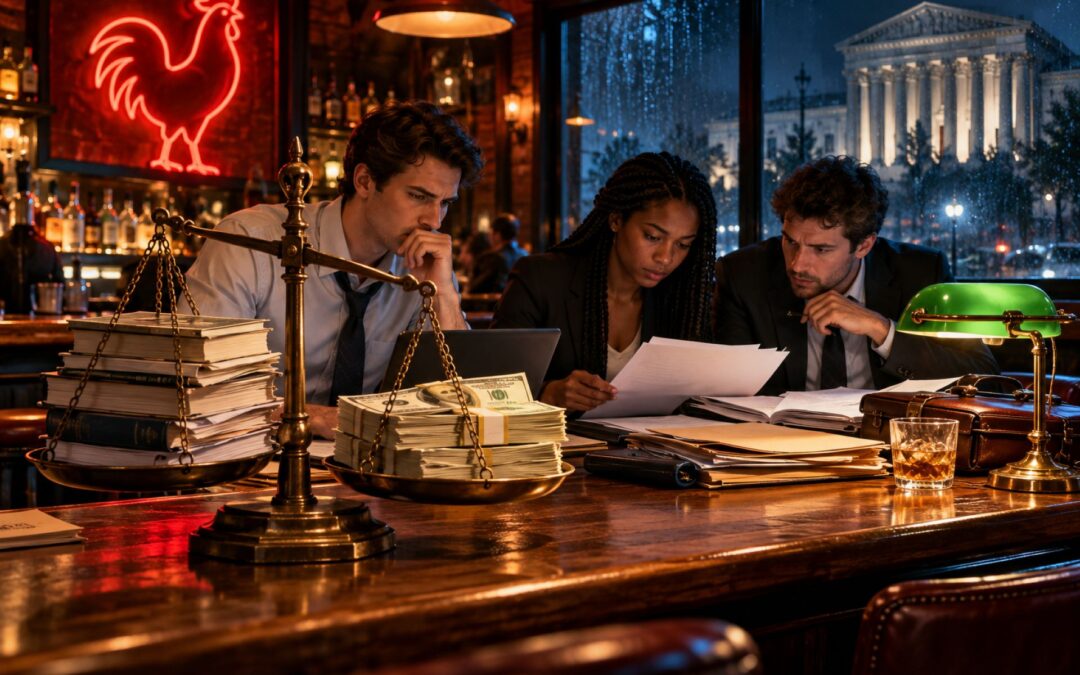
In The Rooster Bar, John Grisham follows three law students who discover that the professional future they have borrowed heavily to secure may never materialize. Mark Frazier, Todd Lucero, and Zola Maal attend Foggy Bottom Law School in Washington, D.C., a struggling for-profit institution where students accumulate enormous debts despite dismal employment prospects. When a personal tragedy destroys their remaining confidence in the school, they abandon their studies and devise an extraordinary alternative: they will become lawyers without graduating, passing the bar examination, or obtaining licenses.
Their decision begins as an act of rebellion against an exploitative educational system. It soon becomes a succession of increasingly serious crimes, involving fraudulent legal representation, a devastating malpractice mistake, fabricated claims against a major bank, and an international escape. Grisham uses the students’ adventures to examine the distinction between professional legitimacy and actual competence, while raising an uncomfortable question about whether people victimized by institutional dishonesty can justify becoming dishonest themselves.
Published in 2017, the novel draws inspiration from real investigations into for-profit legal education and student debt. Its fictional story combines the procedural detail of a legal thriller with the humour of a crime caper, although the shift between those forms creates some of its most significant strengths and weaknesses.
Spoiler warning: This article covers the complete novel, including Gordon Tanner’s death, the financial fraud, the protagonists’ escape, and the ending.

The Four Friends and the Foggy Bottom Trap
The novel begins during the Christmas holidays of 2013, as Mark Frazier approaches the final semester of law school with little enthusiasm for his future. He is visiting his mother in Delaware, where the family situation offers few comforts. His parents have divorced, his father has established another life, and his younger brother Louie is under house arrest while facing drug charges. His mother is financially and emotionally exhausted, and Mark has little prospect of helping her.
Mark’s student debt is already approaching a quarter of a million dollars. He originally entered law school believing that a legal career would provide professional stability and sufficient income to justify the expense. His education at Foggy Bottom has undermined that assumption. The school’s academic reputation is weak, employers are unimpressed by its graduates, and the prestigious firms that once seemed attractive are largely beyond his reach.
His remaining hope is Ness Skelton, a Washington law firm where he previously worked as an intern. Although he has no firm employment commitment, he clings to the possibility of joining the organization after graduation. This uncertainty makes the prospect of another semester of classes particularly depressing.
Todd Lucero approaches the same predicament from a different background. Originally from Baltimore, he studied at Frostburg State before drifting into bartending in Washington. His work at the Old Red Cat exposed him to lawyers and their conversations, encouraging him to imagine a career in the profession. Unlike Mark, however, Todd is already successful at something: he understands customers, remembers names, manages difficult personalities, and enjoys the sociability of bar work.
Law school has offered him little comparable satisfaction. His debts are enormous, his academic prospects are unremarkable, and he is beginning to suspect that his bartending skills may have greater practical value than the expensive education he has purchased.
Zola Maal’s background is more complicated. Her parents, Abdou and Fanta, fled Senegal, lived briefly in South Africa, and eventually entered the United States without authorization. They settled in Newark, where they raised their family while working demanding jobs and trying to avoid immigration authorities. Zola was born in America and is a United States citizen, but her parents and brother Bo remain vulnerable because of their immigration status.
Zola worked hard to obtain an education and improve her circumstances. Her path through college and into law school was shaped by her family’s expectations, her own ambition, and the belief that a professional qualification would provide financial independence. Yet Foggy Bottom has placed her in much the same position as Mark and Todd: deeply indebted, academically disillusioned, and uncertain whether she will ever earn enough to repay what she owes.
The fourth member of their circle is Gordon Tanner, usually called Gordy. Intelligent, energetic, and intensely inquisitive, he has become obsessed with understanding how Foggy Bottom and several other law schools operate. He is also under considerable personal strain, involving his debt, career prospects, mental health, and conflicting romantic relationships.
Gordy is engaged to Brenda Karvey, his longtime girlfriend from home, but has also been romantically involved with Zola. He feels trapped between the life Brenda expects him to lead and the relationship he has developed in Washington. His uncertainty about marriage and employment compounds his already serious emotional difficulties.
When Gordy’s behaviour becomes increasingly erratic, Zola calls Mark and Todd for help. They find him in his apartment, surrounded by research materials, charts, and documents tracing the finances of Foggy Bottom and related businesses. He explains that the school’s poor educational performance is not merely the result of incompetence. In his interpretation, it is part of an extraordinarily profitable system.
At the centre of his investigation is Hinds Rackley, a wealthy New York financier. Gordy has traced a complicated network of investment firms, trusts, holding companies, law schools, and legal businesses that appear to connect back to Rackley’s financial interests. The principal organizations include Shiloh Square Financial, Varanda Capital, and Baytrium Group, which controls Foggy Bottom and other institutions.
Gordy’s research suggests that Rackley’s network has interests in eight for-profit law schools. The schools admit students willing to borrow substantial amounts, collect tuition funded through federal loans, and leave graduates personally responsible for debts that may be impossible to repay. Their owners receive revenue without having to guarantee that students will obtain meaningful legal employment.
The arrangement becomes more disturbing when Gordy describes the network’s associated law firms. According to his research, firms under related financial control employ enough graduates from the schools to improve their reported employment statistics. Those figures help attract new students, who borrow additional money and continue feeding the system.
Gordy also believes Rackley’s financial interests may extend into Swift Bank, a large institution already associated with allegations of improper customer charges and other misconduct. The relationship is difficult to establish because the investments are concealed behind layers of corporate ownership.
Mark, Todd, and Zola are impressed by the investigation, but they are more immediately frightened by their friend’s condition. Gordy is sleeping poorly, behaving unpredictably, and showing signs of a serious manic episode. His elaborate charts contain potentially important information, yet his friends cannot separate the urgency of his discoveries from the medical crisis unfolding before them.
They begin trying to persuade him to seek treatment. What follows changes the direction of all three survivors’ lives.
Gordy’s Final Days and the Loss That Changes Everything
Gordy has previously been diagnosed with bipolar disorder and has received treatment. Zola explains that he has stopped taking his prescribed medication and is increasingly resistant to professional help. The friends decide that someone must remain with him until they can arrange an appointment with his psychiatrist.
The improvised supervision immediately becomes difficult. Gordy resents being watched, rejects the idea that he needs treatment, and repeatedly tries to escape his friends’ attention. His confidence and anger fluctuate, and the others struggle to respond to a situation for which they have little practical preparation.
He eventually leaves the apartment and is arrested for driving under the influence. Mark, Todd, and Zola go to the detention centre to arrange his release, where they encounter Darrell Cromley, an aggressive lawyer who specializes in representing people charged with drunk driving.
Cromley eagerly offers his services, presenting himself as someone who understands the courts, prosecutors, and procedures that make such cases manageable. His salesmanship leaves an impression on the students. They have spent years studying legal principles, but Cromley appears to earn a living by knowing how to attract frightened clients and negotiate routine cases.
The friends retrieve Gordy and resume trying to persuade him to accept medical assistance. Mark spends time with him, discussing his future and attempting to reassure him that the debt, law school, and personal problems can eventually be addressed. Gordy occasionally seems exhausted and emotionally exposed, but he continues to resist treatment.
Their attempts are unsuccessful. Gordy disappears again, leaving messages that alarm Zola. The three friends begin searching Washington, trying to establish where he might have gone and fearing that he intends to harm himself.
They eventually reach Arlington Memorial Bridge, where police vehicles and emergency responders have gathered. Witnesses report that a man has jumped into the Potomac River. The description and circumstances confirm their worst fears.
The immediate aftermath is dominated by shock and uncertainty. The river search continues while the friends wait for confirmation that Gordy’s body has been recovered. Mark must contact Brenda, who has been desperately trying to reach her fiancé. The task forces him to acknowledge both Gordy’s death and the secrets surrounding his personal life.
The arrival of Brenda and the Tanner and Karvey families makes the situation still more painful. The families want explanations for Gordy’s final days, including why his friends did not contact them sooner and whether more could have been done to obtain treatment. Mark and Todd try to describe their attempts to help, but their account cannot provide the certainty everyone wants.
Zola occupies an especially difficult position. She has been romantically involved with Gordy while Brenda remained his fiancée, and her grief is complicated by the relationship’s secrecy. She cannot participate openly in the family’s mourning in the way Brenda can, even though she was among the people closest to him during his final months.
The survivors also struggle with their own doubts. They had recognized that Gordy was seriously unwell, but they had been unable to keep him safe. Their repeated efforts to reconstruct his final decisions provide no satisfying explanation.
While they wait for news about the search, Zola receives another devastating blow. Her parents and brother Bo have been detained by immigration authorities. The family has lived in the United States for years, but its undocumented members now face deportation to Senegal, a country that Zola barely knows and Bo has little meaningful connection to.
The timing leaves Zola overwhelmed. Her boyfriend has died, her educational future appears worthless, and her family faces separation from the only home they have known for much of their lives.
Mark and Todd accompany her to the Bardtown Federal Detention Facility in Pennsylvania. The buildings, security fences, guards, and restrictive visitation procedures make the facility resemble a prison, even though the family’s predicament involves immigration enforcement.
When officials obstruct their attempts to see Zola’s relatives, Mark begins claiming the authority of a lawyer. He threatens legal proceedings, demands information, and insists that the facility respect his supposed client’s rights. Although he is still only a law student, his confident performance eventually helps them gain access.
The visit offers a troubling glimpse of how authority functions in the novel. Officials who initially refuse to cooperate respond differently when someone presents himself as a professional capable of creating legal difficulties. Mark discovers that legal knowledge, assertive language, and a convincing manner can sometimes produce results even without formal qualifications.
The experience also introduces the practical limitations of Zola’s citizenship. She is an American, but that status does not prevent her parents and brother from being detained and removed from the country. Her legal identity and theirs create profoundly different degrees of security within the same family.
During this period, Mark and Todd begin examining the materials Gordy left behind. They become particularly interested in Swift Bank, which is facing mounting allegations of misconduct and potential class-action lawsuits. The bank’s problems appear connected to the financial world Gordy had been investigating.
Eventually, Gordy’s body is recovered. His funeral brings another round of grief, accusations, and discomfort. The three surviving friends return to Washington emotionally exhausted and increasingly alienated from the institution to which they are supposed to return.
For Mark and Todd, continuing their education begins to feel pointless. Zola has even less reason to believe that a final semester at Foggy Bottom deserves her attention.
Gordy’s death does not create their financial problems, but it destroys the routines and assumptions that had made those problems seem temporarily bearable. The friends have watched someone they loved lose hope while exposing an institution that profited from their expectations. Their response will be to abandon the professional future they were working toward.
Dropping Out and Inventing Upshaw, Parker & Lane
The decision takes shape when Mark receives an email from Ness Skelton informing him that his anticipated employment opportunity has disappeared following a corporate merger. The firm no longer needs him. After years of study and mounting debt, even the modest prospect on which he had relied has vanished.
Mark interprets the news as confirmation that another semester at Foggy Bottom will accomplish nothing. Todd shares his frustration. Both have already concluded that their education has little market value, and neither is enthusiastic about sitting through classes, preparing for the bar examination, and confronting repayment demands without a reliable job.
The beginning of the spring semester presents an unexpected opportunity. Federal loan money arrives at Foggy Bottom, which retains the tuition portion and distributes funds intended to cover students’ living expenses. Mark and Todd obtain their money while largely abandoning the classes for which the loans have been issued.
They use the funds to finance a new scheme. Rather than complete law school and obtain professional licenses, they will establish their own legal practice and begin earning fees immediately.
The idea depends on a distinction they have observed in the courts: possessing the formal right to practice law and appearing capable of doing so are not always visibly distinguishable. A person wearing a suit, carrying a briefcase, using professional language, and presenting a plausible business card may be accepted as an attorney in a crowded courthouse where employees have little time to check credentials.
Mark and Todd begin researching the lawyers who handle routine criminal and traffic cases. They observe attorneys such as Preston Kline and study how defendants are approached, how fees are negotiated, and how minor charges are resolved.
Their strategy is deliberately modest. They do not initially intend to handle complicated commercial litigation or appear in major trials. Instead, they plan to represent people facing traffic violations, minor criminal charges, and other routine matters where cases often end through plea agreements or negotiated dispositions.
They invent professional identities and create the Legal Clinic of Upshaw, Parker & Lane. Mark becomes Mark Upshaw, Todd becomes Todd Lane, and Zola is designated Zola Parker. The initials UPL also amuse the founders because they stand for unauthorized practice of law, an accurate description of their enterprise.
The organization acquires business cards, telephone arrangements, bank accounts, and other signs of legitimacy. Mark and Todd adjust their appearances with suits, glasses, and facial hair, attempting to look like ordinary small-firm lawyers rather than students who have recently abandoned their education.
Their headquarters is The Rooster Bar, a modest establishment on Florida Avenue. Its owner, Maynard, needs inexpensive labour and has space available above the business. Mark and Todd arrange to work in the bar while using the upstairs rooms for accommodation and their supposed legal practice.
The arrangement gives them a practical advantage. They reduce their living expenses while gaining an address that can appear on legal stationery. Their work behind the bar also keeps them close to the social environment Todd understands best.
Zola is initially appalled when they reveal the plan. She recognizes the obvious risks, including criminal prosecution, malpractice liability, and the harm they could cause clients. Unlike Mark and Todd, she does not find the prospect of impersonating a lawyer immediately exhilarating.
Nevertheless, she is miserable at Foggy Bottom. Attending classes reminds her of Gordy, and her family’s detention creates an urgent need for money. The apartment associated with Gordy’s death has also become emotionally unbearable.
The others persuade her that the partnership may offer a temporary escape from their circumstances. They propose assigning her to personal-injury cases while Mark and Todd handle courthouse work, reasoning that Zola might be able to recruit clients through hospitals and other sources.
Zola moves into accommodation above The Rooster Bar, and the three begin concealing their new activities from classmates, administrators, creditors, and family members. They invent explanations for missed classes, ignore inquiries, and try to maintain enough distance from their former lives to avoid discovery.
Their plan to evade student-loan repayment is similarly improvised. Collection officials continue contacting them, while Mark studies possible methods of delaying repayment and resisting creditors. None of these evasions resolves the underlying debt, but the friends increasingly regard it as a problem they can postpone indefinitely.
The shift is important because their original decision to leave Foggy Bottom is understandable. They have serious reasons to question whether completing the degree is worthwhile. Their subsequent decision to impersonate attorneys, however, creates obligations to clients who know nothing about the students’ disappointment with their school.
The friends have abandoned one institution they believe operates dishonestly and created another organization whose existence depends entirely on deception.
Inside the D.C. Courthouses and the Ambulance-Chasing Business
Mark and Todd begin working the crowded corridors of Washington’s District Courthouse. The criminal and traffic divisions attract defendants who are frightened, inexperienced, and often unable to afford expensive legal representation.
The atmosphere suits the protagonists’ scheme. Court personnel are busy, lawyers move between proceedings, and many cases are resolved quickly. Defendants frequently want immediate practical help rather than lengthy explanations of legal doctrine.
The students discover that securing clients is harder than they expected. Some defendants already have lawyers, others cannot afford meaningful fees, and many are suspicious of unfamiliar men approaching them in courthouse corridors.
Their initial failures are embarrassing, but they gradually learn how to present themselves. They identify people who appear anxious about their cases, offer reassurances, and negotiate fees that seem affordable compared with those charged by more established attorneys.
One of their early clients is Benson Taper, a young delivery worker facing serious traffic charges. Benson fears that a conviction for reckless driving could cost him his job. Mark takes his case and begins navigating the courtroom as though he were a licensed attorney.
Mark’s performance is initially nerve-racking. He must approach court personnel, identify himself as counsel, and negotiate with prosecutors while concealing his lack of credentials. The ease with which he is accepted gradually increases his confidence.
His relationship with Hadley Caviness, an assistant prosecutor, provides an especially useful opportunity. After meeting her socially, Mark begins a sexual relationship with her while presenting himself as Mark Upshaw. Their familiarity enables him to discuss Benson’s case outside the confrontational atmosphere he had expected.
Hadley agrees to reduce the charge to simple speeding, allowing Benson to avoid the more serious consequences he feared. Mark collects his fee and experiences the satisfaction of having obtained a favourable result for someone who needed assistance.
From Benson’s perspective, the representation appears successful. He has avoided a potentially damaging conviction, and the supposed lawyer has delivered what he promised. The fact that Mark lacks a license remains invisible to him.
Such successes encourage Mark and Todd to expand their activities. They develop routines for approaching defendants, handling paperwork, appearing before judges, and presenting themselves as competent practitioners. The money is relatively modest, but it arrives more quickly than income from ordinary student employment.
Zola’s assignment proves less appealing. Mark and Todd believe that personal-injury cases offer the possibility of much larger fees, particularly when serious injuries might support settlements with insurance companies or defendants.
The group studies local attorneys who aggressively advertise accident representation. Rusty Savage, whose billboards and television commercials are familiar across Washington, exemplifies the commercial side of the profession. His practice treats legal services as a business that must continually attract new customers.
Zola begins visiting hospitals, searching for injured people or families who may need representation. She soon discovers that the market is already crowded with lawyers, recruiters, and intermediaries competing for potentially valuable claims.
An encounter involving the established attorney Frank Jepperson illustrates the danger. Jepperson has his own network for identifying accident victims, and he does not welcome an unfamiliar practitioner approaching people associated with his firm. He begins investigating Zola Parker and the supposed legal clinic.
Zola also dislikes the work itself. Approaching injured or frightened people with the expectation of earning money from their suffering makes her uncomfortable. She sees the activity as predatory, even when the potential client may genuinely need legal assistance.
Mark, meanwhile, encounters what seems to be the firm’s first major opportunity. Benson Taper tells him about a relative, Ramon Taper, known as Digger, whose infant son died after a troubled delivery.
The child’s mother and father had experienced considerable distress following the death, and their relationship subsequently collapsed. Benson believes that the hospital may have been negligent and that Ramon could obtain compensation.
Mark meets Ramon and learns more about the delivery. The possibility of a medical-malpractice action excites him because the financial stakes are much greater than those involved in routine traffic cases.
He persuades Ramon to sign a representation agreement based on a contingency fee. Under the arrangement, the supposed law firm would receive a percentage of any eventual recovery rather than charging its client in advance.
Mark and Todd begin collecting medical records and seeking expert assistance. They obtain an opinion suggesting that the case may have merit and start considering established medical-malpractice lawyers who might take over the litigation in exchange for sharing the fee.
The apparent opportunity changes the partners’ priorities. They begin imagining how a single successful malpractice settlement might provide enough money to transform their circumstances.
Their confidence depends on a dangerous assumption: that understanding the general outline of a lawsuit is equivalent to possessing the professional knowledge needed to handle it responsibly.
The Malpractice Case That Starts to Unravel the Scheme
While the malpractice investigation proceeds, Zola remains preoccupied with her detained family. She and her partners return to Bardtown to visit Abdou, Fanta, and Bo, who face increasingly bleak prospects of remaining in the United States.
Mark also visits his mother and encounters further reminders of his old life. Louie’s criminal problems continue, and his mother’s expectations make it difficult to explain why he is no longer attending school or working toward a conventional career.
These personal difficulties coexist with a new financial temptation. News of Swift Bank’s misconduct has grown increasingly serious, and federal agents raid its corporate headquarters in Philadelphia. Allegations involving improper customer accounts and unauthorized charges generate lawsuits, publicity, and speculation about a large settlement.
The partners begin monitoring the bank closely, but Ramon Taper’s malpractice case remains their most immediate prospect of a substantial fee.
They arrange to present the matter to Jeffrey Corbett, an established attorney whose practice specializes in cases involving injuries during childbirth. His firm’s luxurious offices impress Mark and Todd, giving them a glimpse of the successful legal career they once hoped to enter.
They meet Corbett’s associate Peter and paralegal Aurelia, who carefully review the medical records and expert materials. Unlike the inexperienced students, the professionals examine the chronology of the child’s birth and subsequent treatment in detail.
The review quickly uncovers a catastrophic mistake. The records contain an incorrect date suggesting that the delivery occurred on February 25, 2013. The actual delivery took place on February 25, 2012, a year earlier.
That distinction determines whether the lawsuit can proceed.
Because the alleged negligence occurred in Virginia, Corbett explains that the applicable limitation period in the novel is two years. The deadline therefore expired on February 25, 2014. Mark and Todd had accepted the case before that deadline, but they failed to recognize its significance and did not file an action in time.
Their consultation with Corbett takes place after the deadline has passed. What appeared to be a potentially valuable claim is now procedurally barred.
Corbett is furious. He explains that lawyers handling malpractice claims must understand the relevant limitation periods, verify critical dates, and take protective action when a deadline approaches. The error is especially serious because the students could have preserved the claim by filing before the deadline, allowing further investigation afterward.
He refuses to become involved and warns that Ramon may sue the supposed firm for legal malpractice. The students have also relied on a questionable medical consultant, Dr. Koonce, without properly checking the underlying records.
Mark and Todd leave the meeting humiliated and frightened. Their confidence collapses because this is not a minor mistake that can be corrected by negotiating with a prosecutor. Their failure may have permanently deprived Ramon of the opportunity to obtain compensation for his child’s death.
Mark approaches Edwin Mossberg, an experienced attorney associated with the case, and admits that he and his partners have been operating without licenses. Mossberg recognizes the seriousness of their conduct and has little sympathy for their predicament.
Ramon begins searching for Mark, whom he knows through the false professional identity. He eventually finds The Rooster Bar and confronts Todd, looking for information about the lawyer who has mishandled his case.
The situation becomes more dangerous when Darrell Cromley, the aggressive attorney previously encountered during Gordy’s DUI detention, becomes involved. Cromley recognizes the malpractice claim’s potential value and begins questioning the people who supposedly represented Ramon.
Meanwhile, Hadley Caviness grows curious about the small law firm whose partners she has encountered socially and professionally. Todd also becomes sexually involved with her, creating another connection between the bogus practitioners and someone with access to the real legal system.
Hadley checks the names and credentials of the supposed attorneys and discovers irregularities. Their claimed law schools and bar-registration details do not withstand scrutiny.
Rather than immediately exposing the entire operation, she confronts Todd with what she has learned. Her response includes curiosity and a degree of complicity, but the revelation terrifies the partners because it shows how easily their identities can be investigated.
Frank Jepperson’s suspicions about Zola add another threat. The partners now face scrutiny from established lawyers, potential malpractice claimants, prosecutors, and professional regulators.
Mark and Todd attempt to manage the growing danger through further deception. They avoid difficult conversations, offer excuses, consider returning money to clients, and increasingly restrict their activities.
The supposed firm has accomplished some useful work, but the malpractice disaster exposes the inadequacy of its founders’ training and preparation. Their earlier successes depended heavily on the simplicity of the cases and the failure of others to examine their qualifications.
The friends eventually recognize that their courthouse practice cannot continue. Their elaborate disguises and invented professional histories are no longer sufficient protection.
Instead of abandoning criminal conduct altogether, they concentrate on the Swift Bank scandal, which appears to offer a much larger reward without requiring them to appear regularly before judges.
The Swift Bank Opportunity and Zola’s Journey to Senegal
Swift Bank’s problems have expanded into a major corporate scandal. Customers accuse the institution of opening unauthorized accounts, collecting improper fees, reducing promised benefits, and engaging in other deceptive practices.
The resulting litigation involves large numbers of claimants and several competing class-action groups. Lawyers anticipate that the bank may agree to pay billions of dollars to resolve the lawsuits and restore some measure of stability.
Mark, Todd, and Zola have already been following the proceedings. They study the forms required to join the actions and examine how law firms collect information from potential claimants.
The protagonists initially submit claims of their own, testing the procedures used by the firms handling the litigation. They eventually identify Cohen-Cutler, a large Miami practice, as an efficient organization with the resources to process substantial numbers of cases.
They decide to exploit that efficiency.
Working from their improvised headquarters above The Rooster Bar, the friends begin constructing fictional bank customers. They consult directories for plausible names and addresses, alter details to create identities that appear genuine, and complete the plaintiff information sheets used by Cohen-Cutler.
Their first fabricated claimant, for example, is created by changing the spelling of a name found in a directory. Additional details about the supposed customer’s age, household, accounts, and relationship with Swift are supplied to make the claim appear authentic.
They repeat the process on a much larger scale.
The scheme depends on the assumption that a mass settlement involving enormous numbers of relatively small claims will not involve thorough verification of every claimant. Because lawyers expect to process extensive paperwork quickly, the protagonists believe that plausible information may be enough to secure payment.
The fraud is more ambitious than their earlier misconduct. They are no longer impersonating attorneys to obtain fees from individual clients. They are manufacturing entire groups of people to extract money from a settlement intended to compensate actual victims.
While the students compile these claims, the District Bar Council investigates Upshaw, Parker & Lane. Margaret Sanchez becomes increasingly determined to identify the people behind the firm. Investigator Chap Gronski follows complaints and compares business cards, addresses, and registration information.
The investigation reveals that the apparent lawyers are not members of the bar. Complaints from established attorneys and former clients help reconstruct the operation, including its links to The Rooster Bar.
The partners’ living and working arrangements become increasingly insecure. Maynard resents the attention the supposed firm brings to his premises, while Mark and Todd try to preserve secrecy long enough to complete their new project.
Zola’s circumstances deteriorate even further when her family is deported.
Abdou, Fanta, and Bo are removed from the United States after years of living there. They are transported under restrictive conditions with other detainees and eventually returned to Senegal.
For Abdou and Fanta, the journey returns them to a country they left long ago under difficult circumstances. For Bo, who has spent most of his life in America, it means losing familiar surroundings, employment, relationships, and the possibility of an ordinary future with the people he knows.
Their arrival in Dakar does not bring stability. The legal assistance they expected fails to materialize, and the family encounters officials who exploit their vulnerability.
Abdou is detained, and the family’s efforts to secure his release are complicated by demands for money and the difficulty of navigating local institutions. Fanta and Bo have little protection and limited resources.
Zola decides that she must travel to Senegal herself.
Her decision frightens Mark and Todd, who worry that she may become trapped there or attract further official attention. Zola insists that she cannot leave her parents and brother to confront the crisis alone. As an American citizen with a valid passport, she can travel more freely than her family, although she does not know what awaits her.
She arrives in Dakar, assesses the family’s predicament, and begins searching for effective legal representation. Eventually, she obtains assistance from Idina Sanga, a Senegalese attorney with relevant experience and professional connections.
Zola must navigate an unfamiliar bureaucracy while paying for accommodation, legal assistance, and everyday necessities. Her available money begins disappearing rapidly, increasing her dependence on Mark and Todd.
Back in Washington, the Bar Council investigation produces direct consequences. Police locate Mark and Todd, arrest them, and begin formal proceedings over their unauthorized practice of law.
The pair retain their familiar mixture of arrogance, humour, and evasiveness, but the arrests demonstrate that their old identities and crimes can no longer be concealed.
After securing their release, Mark and Todd move to Brooklyn. They establish new financial arrangements and continue developing the Swift scheme, now under their real names rather than the invented identities associated with the abandoned legal clinic.
They also decide to confront Rackley, the financier whose organization Gordy had investigated.
Using materials inherited from Gordy’s research, they adopt another disguise: investigative journalists preparing an embarrassing story about Rackley’s financial empire.
Their plan is to apply pressure to someone powerful enough to fear adverse publicity. By approaching Rackley directly, they hope to discover more about his operations and possibly use that information to their advantage.
Facing Rackley While the Law Closes In
Mark and Todd arrange a meeting with Hinds Rackley and his legal representatives in Brooklyn. They present themselves as journalists and bring materials tracing the relationships among the investment companies, law schools, and associated legal businesses.
The information originates largely from Gordy’s investigation. Its diagrams and corporate connections give the students something more substantial than ordinary threats or accusations.
They challenge Rackley about the profits generated by the law schools and the structure that permits him to benefit while graduates carry immense debts. They also discuss financial relationships that might connect his business interests to Swift Bank.
Rackley’s response is considerably less vulnerable than the students expect.
He has access to investigators who have examined the backgrounds of the supposed journalists. As the meeting progresses, he reveals that he knows their identities are questionable and that their presentation contains serious inconsistencies.
Mark and Todd realize that a wealthy financier surrounded by experienced lawyers and investigators is not easily intimidated by two former law students.
Nevertheless, they continue presenting their evidence and threatening damaging publicity. The confrontation becomes a contest over information and reputation rather than a straightforward demand for money.
Rackley can afford professional investigators, attorneys, and corporate structures that protect his interests. Mark and Todd possess documents that may embarrass him, but they have neither comparable resources nor unquestionable credibility.
The meeting ends without the decisive victory they wanted. It does, however, establish that Gordy’s research contains information worthy of attention, and it leaves open the possibility that Rackley’s business network may eventually face wider scrutiny.
The Swift litigation meanwhile approaches resolution.
In May, the bank agrees to a proposed settlement involving billions of dollars and a large population of customers. The arrangement divides claimants into categories depending on the nature and seriousness of their losses.
The category most relevant to Mark and Todd involves customers affected by improper fees and reduced interest benefits. Under the fictional settlement, each qualifying claimant in that group is entitled to $3,800.
Attorneys representing those claimants are also entitled to specified fees. Cohen-Cutler, as one of the principal firms handling the litigation, receives an additional percentage for administering and managing claims.
The announcement gives the protagonists a basis for estimating their potential proceeds. They have fabricated more than a thousand claimants, creating the possibility of receiving millions of dollars through a scheme conducted largely through documents and electronic communication.
The prospect also makes their escape plans urgent.
Mark and Todd form York & Orange Traders, a company named after streets associated with their family homes in Delaware and Baltimore. They register the business and extend its arrangements to Barbados, where they hope to establish accounts capable of receiving money transferred out of the United States.
The offshore structure serves a practical purpose within their plan. Once the settlement proceeds arrive in an American account, they intend to move the money to an entity that investigators may find more difficult to access.
Zola’s situation in Senegal adds pressure. Her legal expenses are substantial, and her father’s detention continues. Mark and Todd transfer money to her and promise that the expected settlement proceeds will provide greater security for the entire group.
The pair also return to Washington to confront the consequences of their earlier crimes.
They retain Phil Sarrano, a criminal defence attorney experienced in white-collar cases. He examines the evidence surrounding their unauthorized practice and recognizes that the government’s case is serious.
Mark and Todd hope to delay proceedings rather than prepare for a conventional trial. Their priority is not proving innocence. It is buying enough time to obtain the bank money and leave the country.
Their appearance before Judge Abraham Abbott is particularly humiliating. The court attracts former clients, creditors, and others who recognize the supposed lawyers and resent their conduct.
Ramon Taper makes his anger public, confronting the men whose incompetence destroyed the opportunity to pursue his child’s malpractice case. The scene punctures the fantasy that their former practice was merely a harmless game played against an impersonal bureaucracy.
Mark and Todd are reminded that their actions affected identifiable people. The consequences extend beyond the professional licensing rules they originally considered inconvenient.
The criminal proceedings remain unresolved, but the defendants succeed in maintaining enough freedom to continue their escape preparations. They obtain false passports, coordinate travel arrangements, and wait for Cohen-Cutler to release the settlement proceeds.
By this stage, the friends have effectively abandoned the idea of resuming ordinary American lives. Their expectation of financial independence rests on obtaining the proceeds of an extensive fraud before investigators can intervene.
The Settlement Fraud, Escape, and New Rooster Bar
Todd travels to Barbados using a false passport and meets Rudolph Richard, a banker who specializes in serving foreign clients. He presents York & Orange Traders as a successful business whose owners wish to manage substantial funds internationally.
The bank arrangements appear to work. Todd establishes the necessary relationships and prepares to receive a large transfer from the United States.
Meanwhile, Zola’s efforts in Senegal begin producing results. With Idina Sanga’s help and substantial financial expenditure, she secures the release of her father and brother from detention. The reunion provides relief, but the family remains economically insecure and uncertain about its future.
The American financial investigation also begins moving faster than the protagonists realize.
Federal agents investigating Swift Bank’s settlement discover indications of fraudulent claims. They approach Cohen-Cutler and question its representatives about the large group of claimants associated with Mark and Todd.
The firm’s administrators are reluctant to delay payments without formal authority. The settlement process is already underway, and judicial instructions require funds to be distributed promptly.
This creates the narrow opportunity on which the fraud depends.
Cohen-Cutler processes the group’s claims and informs Mark that the money is being transferred. The fictional firm Lucero & Frazier is listed as representing 1,311 claimants, each entitled to the settlement amount of $3,800.
After Cohen-Cutler deducts its 8 percent administrative share, the payment to the protagonists totals $4,583,256.
Mark waits anxiously for the transfer to appear in the firm’s Citibank account in Brooklyn. Once the money arrives, he begins moving it into the financial structure established with Todd.
The partners expect another $1,048,800 in attorney fees, representing $800 for each of their supposed clients. That payment has not yet been received, but they initially expect it to follow the client proceeds.
Mark also begins settling some of his own financial obligations, including his student-loan debt. The irony is deliberate: the educational borrowing that helped motivate the original rebellion can now be repaid with proceeds from another fraud.
The protagonists’ apparent success is precarious. Their client list consists of fabricated identities, and investigators are already examining the unusual submissions.
The FBI begins connecting the fraudulent settlement activity to the people who operated Upshaw, Parker & Lane. The students have left a trail through their former identities, American banking arrangements, claim documents, and communications with Cohen-Cutler.
Todd urges Mark to leave the United States while travel remains possible. Mark initially hopes to collect the remaining fee payment, but the danger of waiting becomes increasingly obvious.
He leaves through Miami and joins Todd in Barbados. The pair then arrange to transfer a substantial portion of the money to Senegal, where Zola has established a bank account with Idina Sanga’s assistance.
They instruct the Barbados bank to send $3 million to Dakar, withdraw cash, and arrange a route to Africa that avoids returning through American airports.
The men eventually reunite with Zola in Senegal.
For a brief period, their situation resembles a successful retirement. They have access to substantial money, comfortable accommodation, and the possibility of remaining abroad for an extended period.
Yet Zola remains less confident than her partners. She has watched their earlier mistakes accumulate, and her experience with her family’s detention has taught her how dangerous official scrutiny can become.
Her concerns are justified.
The expected attorney-fee payment fails to arrive. News emerges that federal judges have halted additional Swift settlement disbursements while allegations of fraud are investigated.
Rudolph Richard contacts Todd to report that the FBI has made inquiries concerning transfers into the Barbados account. Although he does not disclose information to investigators, the warning confirms that the authorities are following the money.
The friends recognize that they may soon face federal criminal charges.
Zola is particularly exposed because she entered Senegal on her genuine American passport and registered with the United States embassy. Unlike Mark and Todd, who travelled using false documents, she has left an easily traceable record.
The group begins considering more permanent methods of concealment.
Mark proposes leaving Senegal and travelling through Africa to find another refuge. Todd is reluctant to undertake an uncertain journey involving numerous border crossings. Zola rejects the idea because she refuses to abandon her family after their experience of detention and deportation.
Instead, she proposes finding a safer life within Senegal.
The friends travel to Saint-Louis, a historic coastal city north of Dakar. Its quieter atmosphere, colonial-era buildings, beaches, and relative distance from the capital appeal to them. They find a large but deteriorating house that offers privacy and the possibility of establishing a permanent home.
Their legal difficulties continue developing in America.
A newspaper investigation exposes connections between Rackley’s financial interests and the network of for-profit law schools. The report substantially reflects the relationships Gordy identified before his death, giving the surviving friends some satisfaction that his work has reached a wider audience.
The story does not establish the full range of criminal wrongdoing Mark and Todd once suspected, but it creates serious reputational pressure for Rackley.
Shortly afterward, on June 24, a federal grand jury in Miami indicts Mark Frazier, Todd Lucero, and Zola Maal on racketeering charges associated with the Swift Bank settlement fraud.
The indictments turn their temporary stay abroad into a more permanent exile.
Zola has already begun investigating ways of acquiring new identities. Through contacts connected to Idina Sanga, she locates an official willing to arrange Senegalese citizenship documents, identity cards, and passports in exchange for substantial payments.
The price is $200,000 per person.
The arrangement is corrupt, but the fugitives accept it. Their remaining funds have declined significantly, yet the cost appears manageable compared with the possibility of extradition and imprisonment.
Their original identities must be replaced completely.
Mark Frazier becomes Christophe Vidal, usually called Chris. Todd Lucero becomes Tomas Didier, or Tommy. Zola Maal becomes Alima Pene, whom the others begin calling Alice.
Bo retains his original identity because he is not facing the same American criminal charges. His documentation and legal position will require separate attention.
The new identities provide a measure of security, but they also establish that Mark, Todd, and Zola have no realistic plan to resume their former lives. Their families, educational ambitions, and relationships in America have been displaced by a future built on secrecy.
Eventually, the novelty of leisure wears off. Mark and Todd spend their days reading, drinking, visiting beaches, and avoiding unnecessary attention. Their money provides freedom from employment, but inactivity becomes boring.
They begin considering a legitimate business.
Their favourite local bar is operated by a widowed German woman who appears tired of managing the establishment. Todd uses his charm to develop a relationship with her, and the partners eventually persuade her to sell.
They renovate the premises, invest approximately $80,000 in improvements, and expand the bar’s capacity. Their intention is to combine the appeal of an American sports bar with the local food, music, and atmosphere.
The business opens with a division of responsibilities that draws on their actual abilities. Chris and Tomas work behind the bar, Alice manages the dining room, and Bo supervises the kitchen.
The opening is successful, and the friends discover a form of work that requires neither counterfeit legal qualifications nor elaborate schemes against financial institutions.
They name their establishment The Rooster Bar, recreating the Washington refuge where their criminal partnership began.
The closing image is deliberately attractive. The business is busy, the friends have money, Zola’s family is no longer detained, and ordinary work has replaced the elaborate financial schemes that brought them to Senegal.
Yet the federal charges remain unresolved. Their new identities are fraudulent, their wealth comes from stolen settlement funds, and their freedom depends on avoiding detection.
They have achieved the independence they once expected from becoming lawyers, but they have done so by placing themselves outside the legal and professional world they originally hoped to join.
How Foggy Bottom Turns Student Loans into Investor Profits
Foggy Bottom Law School is more than an unappealing educational setting. Its financial structure supplies the grievance that motivates the novel and provides the first example of the difference between institutional legality and ethical responsibility.
The school operates through a model in which access to borrowed money matters more than the professional prospects of graduates. Students are encouraged to accept enormous financial obligations because they believe a law degree will lead to a secure, well-paid career.
The crucial feature is the separation between who receives the money and who bears the risk. The institution collects tuition while the student remains responsible for repayment. Whether the graduate passes the bar examination, finds legal employment, or earns enough to service the debt does not directly determine whether the school receives payment.
This arrangement creates an incentive to maintain or increase enrollment even when the employment market cannot absorb the number of graduates being produced.
Gordy’s investigation adds another level of complexity. He discovers companies that appear to control multiple law schools through layered ownership arrangements, obscuring the ultimate beneficiaries of tuition revenue.
Baytrium Group, Varanda Capital, and associated investment structures are central to his reconstruction. Their relationships illustrate how a business can operate through apparently separate institutions while directing profits toward a concentrated group of investors.
The affiliated law firms are particularly important. If firms controlled by related investors employ graduates from the schools, those employment figures can improve the institutions’ public standing. Prospective students may then interpret the numbers as evidence that graduates have a reasonable chance of entering the profession.
The resulting cycle reinforces itself. Schools obtain students, students obtain loans, tuition reaches the owners, and reported employment outcomes encourage further applications.
Grisham’s underlying concern was informed by a real investigation. In Paul Campos’s 2014 Atlantic article, The Law-School Scam, Campos examined the financing of American legal education, the growth of educational debt, the incentives created by graduate lending, and the discrepancy between law schools’ promises and employment outcomes.
Grisham acknowledges Campos’s reporting as an important inspiration in the novel’s author’s note. The book consequently belongs to a recognizable tradition of fiction that dramatizes social problems through individual characters rather than presenting them exclusively through statistics or institutional analysis.
The fictional arrangement is more concentrated and conspiratorial than the general concerns raised by the real investigation. Grisham gives the students a wealthy antagonist whose corporate connections can be plotted on a wall and traced through named organizations. The technique makes a complicated system easier to understand and gives the novel a potential target for confrontation.
It also simplifies the problem. Educational debt and employment insecurity involve many institutions, incentives, and economic conditions. The novel channels much of its anger toward Rackley’s network, creating a villain who embodies forces that extend beyond any single financier.
The distinction between legality and legitimacy is central to this portrayal. The schools may comply with formal requirements while operating in ways that students experience as exploitative. Their owners may benefit from transactions that impose severe long-term costs on graduates without assuming comparable financial risks.
Mark, Todd, and Zola interpret that imbalance as evidence that the system lacks moral authority. Their conclusion helps explain why they lose respect for professional rules, although it does not establish that violating those rules is a reasonable response.
Foggy Bottom therefore serves two functions. It is a plausible source of institutional criticism, and it establishes the moral environment in which the protagonists begin rationalizing increasingly serious misconduct.
Washington’s Courts and the Limits of Access to Justice
Grisham’s portrayal of Washington’s lower courts presents a legal system in which formal authority coexists with considerable disorder. Judges, prosecutors, clerks, lawyers, defendants, and relatives move through crowded corridors where routine cases must be processed quickly.
For frightened defendants, the most pressing question is often practical. They want to know whether they will lose a job, pay a fine, face imprisonment, or suffer consequences that disrupt their family life. Their ability to obtain assistance depends partly on money and partly on finding someone who understands the system.
The environment creates a market for attorneys who specialize in relatively minor offences. Lawyers such as Darrell Cromley attract clients through visibility, confidence, and familiarity with local procedures. Their work may be entirely legitimate, but the commercial pressure to obtain new business is unmistakable.
Mark and Todd exploit the same conditions.
Their success depends less on advanced legal reasoning than on learning how to approach people, negotiate with prosecutors, recognize standard dispositions, and behave confidently in court. Their impersonation exposes weaknesses in the mechanisms through which professional credentials are assumed rather than verified.
Benson Taper’s case illustrates the attraction of this arrangement. Benson is frightened that a traffic conviction will cost him his job. Mark obtains a reduction to a lesser offence, and Benson receives a result that appears both useful and affordable.
From the client’s perspective, the supposedly qualified lawyer has performed effectively. The absence of a license does not prevent Mark from achieving the immediate objective.
The malpractice case exposes the limitation of drawing conclusions from that success.
Ramon Taper needs more than an intermediary who can appear confident and negotiate routine matters. His claim requires knowledge of medical records, procedural deadlines, expert evidence, and the relationship between different jurisdictions’ legal rules.
Mark and Todd fail at a task that properly trained practitioners should recognize as fundamental. By overlooking the actual date of the child’s birth, they allow the applicable limitation period to expire.
The contrast demonstrates why professional regulation cannot be dismissed simply because some unlicensed individuals occasionally obtain favourable results.
A license is not proof that every lawyer is competent, but the requirement for professional qualifications, supervision, and accountability exists partly to protect clients who cannot independently evaluate legal expertise.
Grisham also shows that licensed practitioners are not immune to ethically questionable conduct. The aggressive marketing of personal-injury services, competition for hospital patients, and attempts to attract vulnerable clients create an environment in which the pursuit of fees can conflict with concern for those receiving representation.
Frank Jepperson’s aggressive client-acquisition practices, Rusty Savage’s advertising, and Cromley’s salesmanship demonstrate the commercial pressures surrounding the profession.
Yet their imperfections do not make Upshaw, Parker & Lane legitimate. The protagonists exploit public uncertainty about professional credentials while taking advantage of people who reasonably assume that someone appearing before a judge has satisfied basic licensing requirements.
The court scenes consequently provide a nuanced form of criticism. The system is crowded, commercial, and sometimes indifferent to the people passing through it. Those weaknesses make the fraudulent practice possible, but they also show why professional competence and enforceable responsibility remain necessary.
Mark Frazier, Todd Lucero, Zola Maal, and Gordon Tanner
The four central characters begin with a common problem, but their circumstances and reactions differ considerably. Their friendship is grounded in years of shared disappointment, yet the choices they make after Gordon’s death reveal different attitudes toward ambition, risk, loyalty, family responsibility, and the possibility of rebuilding their lives.
Grisham gives the group collective momentum while allowing their individual circumstances to shape important decisions. Their partnership works partly because they possess different abilities, but those differences also create unequal exposure to the consequences of their actions.
Mark Frazier: Ambition Turned into Calculated Risk
Mark is the principal organizer of the group’s early rebellion. His decision to abandon Foggy Bottom develops from a combination of intellectual frustration, financial pressure, and the collapse of his remaining employment prospects.
His family background reinforces his insecurity. He has watched his parents’ marriage fail, his brother become involved in criminal proceedings, and his mother struggle financially. The conventional professional career he hopes to enter seems increasingly unlikely to provide the stability he imagined.
Mark possesses enough legal knowledge to understand how routine court proceedings operate, and he learns quickly from observation. His confidence grows after he successfully handles minor cases, particularly Benson Taper’s traffic matter.
That confidence becomes dangerous when he begins treating individual successes as evidence of general competence. He can negotiate a favourable disposition, so he assumes that he can identify and manage a complicated medical-malpractice claim. The mistake involving the child’s birth date exposes the inadequacy of that assumption.
Mark’s principal weakness is his ability to rationalize risk through cleverness. Once he concludes that a system is dishonest, he becomes willing to disregard restrictions that interfere with his plans.
He does not appear motivated solely by personal greed. He wants relief from debt, independence, and the capacity to assist people close to him. He also shows moments of genuine concern for clients and friends.
Nevertheless, those sympathetic motives coexist with serious irresponsibility. His treatment of Ramon Taper reveals that he is capable of placing his own financial expectations above the interests of someone who trusts him.
As the story develops, Mark becomes increasingly calculating. His attention shifts from courtroom improvisation to financial structures, international transfers, and methods of avoiding investigators.
He ultimately secures a new identity and financial security, but the achievement represents a rejection of his original professional ambition. The man who wanted legitimacy through a legal career ends by treating concealment as the necessary condition of freedom.
Todd Lucero: Improvisation, Loyalty, and Recklessness
Todd supplies the partnership with social confidence and an understanding of how people behave in informal commercial environments. His background as a bartender makes him comfortable approaching strangers, building rapport, and adjusting his manner according to the person in front of him.
Those abilities are useful in courthouse corridors, where frightened defendants respond to confidence and reassurance. Todd does not possess Mark’s organizing instincts, but he helps make the fraudulent practice operational.
His attitude toward risk is often more casual. He enjoys the freedom created by abandoning school and finds humour in situations that Mark or Zola experience as dangerous.
Todd’s relationship with Hadley Caviness demonstrates both his social skill and his poor judgment. He becomes involved with a prosecutor whose professional position makes her particularly capable of discovering the partners’ deception. When she reveals that she has investigated their credentials, he attempts to maintain his confidence while recognizing the threat.
His recklessness is not simply carelessness. Todd is intensely loyal to the group and willing to act decisively when circumstances require it. He participates in constructing the Swift scheme, manages important financial arrangements, and travels to Barbados to establish the offshore banking relationship.
That progression gives him a significant practical role in the final stages of the novel. His abilities prove useful beyond the relatively narrow social environment of the original bar.
Yet Todd’s willingness to improvise rarely develops into sustained moral reflection. He often responds to danger by finding the next practical solution rather than reconsidering the decisions that created the problem.
His ending is consequently fitting. Of the three survivors, he is especially well suited to running a bar. The profession he once regarded as insufficiently prestigious turns out to be one in which he possesses genuine talent.
Zola Maal: Grief, Family, and Moral Resistance
Zola has the most complicated obligations of the surviving friends. Her professional ambitions are tied to a family history of migration, poverty, and insecurity, and her personal life is devastated by Gordon’s death.
Unlike Mark and Todd, she cannot treat abandoning law school as a relatively uncomplicated escape. Her parents and brother face deportation, and she feels responsible for helping them navigate legal systems that they struggle to understand.
Her American citizenship creates an important difference between her and her family. She has rights and mobility they lack, but she remains emotionally bound to people whose security is much more fragile.
Gordon’s death adds another layer of distress. Their romantic relationship was complicated by his longstanding engagement to Brenda, leaving Zola unable to mourn openly without exposing details that would cause further pain.
Her relationship with Mark and Todd becomes a source of companionship during this period. They offer practical and emotional support, but they also persuade her to participate in activities she initially recognizes as dangerous.
Zola is particularly uncomfortable with soliciting injured patients. She understands that legal representation can be valuable, but she dislikes treating vulnerable people as opportunities for profit.
This resistance distinguishes her from her partners, although it does not prevent her from participating in their schemes. She joins the fraudulent practice, helps prepare Swift claims, and eventually shares responsibility for the criminal conduct that follows.
Grisham does not portray her as entirely innocent or merely manipulated. Her objections coexist with deliberate decisions, and she ultimately acknowledges that she is responsible for her own participation.
Her development becomes most substantial after she travels to Senegal.
There, Zola must operate without the reassuring presence of her partners. She finds legal assistance, negotiates arrangements, supports her family, manages money, and investigates opportunities for obtaining citizenship and new identities.
She becomes increasingly capable of acting independently. Her knowledge of local circumstances and her growing connections allow her to organize the final solution to the group’s problem of remaining in Senegal.
The new identity she accepts is nevertheless costly. She achieves the immediate goal of keeping her family together while surrendering much of the American future she once expected to build.
Zola’s story therefore complicates the novel’s celebration of freedom. Her family obligations and experiences of displacement make the decision to remain in Senegal different from Mark and Todd’s escape from prosecution.
Gordon Tanner: Discovery, Illness, and the Story’s Moral Catalyst
Gordon is physically absent from most of the novel, but his discoveries and death influence nearly every major decision that follows.
He is intellectually capable, socially energetic, and determined to expose the structure behind Foggy Bottom’s failures. His investigation requires patience and ingenuity, particularly when tracing ownership through companies whose relationships are not immediately transparent.
His apartment becomes a physical representation of that work. Charts, documents, and corporate names cover the walls, allowing him to visualize a system that the school’s ordinary students have little reason to understand.
Gordon also faces profound personal contradictions. He remains engaged to Brenda while pursuing a relationship with Zola, and he struggles to reconcile the life expected of him with the circumstances developing in Washington.
His bipolar disorder is an important part of his characterization, but it does not fully explain his economic discoveries or the pressures affecting him. The novel depicts a serious mental-health crisis involving interrupted treatment, unpredictable behaviour, and resistance to assistance.
His friends attempt to intervene but are unable to prevent his death. Their subsequent guilt remains one of the story’s emotional foundations.
Gordon’s death functions as a turning point, yet he should not be understood simply as a character introduced to motivate the survivors. He possesses distinctive intellectual ambitions, emotional difficulties, relationships, and unfinished work.
The eventual exposure of Rackley’s law-school network gives his research a measure of vindication. His friends recognize that he identified something important, even though the information cannot reverse his death or justify everything they subsequently do.
There is a further irony in his influence. Gordon sought to expose institutional wrongdoing through investigation and public accountability. The surviving friends instead use his discoveries partly to support their own criminal plans.
His legacy therefore divides into two strands: the valuable research that helps illuminate an exploitative system, and the destructive decisions made by people attempting to escape that system after losing him.
Hinds Rackley and the Network of Institutional Power
Hinds Rackley is the novel’s principal institutional antagonist. Unlike many conventional thriller villains, he does not need to threaten people physically or participate directly in the protagonists’ everyday lives.
His influence operates through ownership, financing, corporate relationships, legal representation, and access to information. The students experience the consequences of decisions made within a network whose ultimate beneficiaries are difficult to identify.
Gordy’s investigation gives Rackley a central position in the fictional system. Companies such as Shiloh Square Financial, Varanda Capital, and Baytrium Group create layers between the financier and the schools collecting tuition.
That complexity matters because responsibility becomes difficult to assign. An individual student encounters Foggy Bottom as a school, while the money collected from tuition may travel through multiple organizations before reaching investors.
The structure allows Rackley to benefit from educational activity without maintaining a direct relationship with the students whose borrowing supports it.
His confrontation with Mark and Todd illustrates the unequal resources available to the participants. The students arrive with documents, threats of publicity, and a belief that information will give them leverage. Rackley has lawyers, investigators, money, and the ability to examine their backgrounds before they can effectively challenge him.
He recognizes weaknesses in their invented identities, turning their attempted intimidation into an uncomfortable demonstration of his superior resources.
Yet Grisham does not establish that every aspect of Rackley’s business activity is criminal. The distinction is important because the novel concerns exploitation that can occur through arrangements formally permitted by law.
His financial interests may be concealed behind complicated structures, and his businesses may produce outcomes that are ethically troubling, without every transaction necessarily violating a criminal statute.
The Swift Bank connection is similarly uncertain. Gordy’s work and the protagonists’ investigation suggest relationships worthy of scrutiny, but their suspicions do not prove that Rackley directed the bank’s misconduct or participated in the later settlement fraud.
Rackley is therefore most effective as a representation of concentrated institutional power. He embodies the capacity to collect profits, shape markets, influence reported outcomes, and protect interests through professional resources that individual students lack.
His presence also highlights the imbalance between powerful institutions and their supposed victims. Mark, Todd, and Zola can evade rules for a time, but they cannot reproduce the legitimacy or financial protection enjoyed by someone operating through established organizations.
Debt, Fraud, and the Problem of Moral Permission
The novel’s central ethical conflict develops gradually as the protagonists move from justified dissatisfaction to increasingly deliberate wrongdoing.
Their original grievance is credible. They borrowed enormous sums to obtain a professional qualification and discovered that their school offered poor employment prospects. The resulting financial pressure is real within the story, and their anger at the institution is understandable.
Abandoning the school therefore represents a decision with a defensible basis. They are no longer willing to devote additional time and money to a process they regard as worthless.
The moral problem begins when they extend that reasoning to other activities.
By impersonating licensed attorneys, Mark and Todd assume authority they do not possess. They treat the professional licensing system as another institution undeserving of respect, partly because they have observed incompetent or opportunistic behaviour among legitimate practitioners.
Their early successes encourage the belief that formal credentials are little more than bureaucratic decoration. Benson Taper receives a favourable disposition, and other clients appear satisfied with relatively inexpensive assistance.
The mistake involving Ramon Taper exposes the danger of this reasoning.
Professional responsibility involves more than obtaining a good outcome in a routine case. It requires recognizing obligations, assessing risks, verifying evidence, and understanding procedures whose importance may not be visible to the client.
The students lack both sufficient expertise and the professional accountability that accompanies legitimate practice. Their mistake destroys a possible legal remedy for a family that has already suffered a child’s death.
At that point, their wrongdoing can no longer be presented convincingly as a harmless challenge to institutional rules.
The Swift Bank fraud represents a further moral deterioration.
Swift’s actual customers have grievances against the institution, and the settlement is intended to compensate them. By inventing claimants, the protagonists attempt to take money from a legal process established for people who suffered genuine losses.
Their deception depends on the same imbalance of information they previously criticized. They assume that the settlement’s administrators will trust the documents they submit and will lack the time or resources to investigate every claim.
The friends also begin rationalizing the scheme through the size and behaviour of the bank. Swift has engaged in serious misconduct, so extracting money from it appears less troubling than stealing from an ordinary person.
That reasoning overlooks the purpose of the settlement and the consequences of fraudulent claims. The existence of a dishonest institution does not remove the distinction between a legitimate claim and an invented one.
Their actions also undermine the credibility of the very legal procedures through which genuine victims seek compensation.
The final stages of the novel make the pattern unmistakable. The group establishes offshore accounts, conceals money, acquires false travel documents, and purchases new identities.
These activities are not spontaneous mistakes committed by desperate students. They are planned methods of retaining the proceeds of fraud while avoiding accountability.
Grisham nevertheless keeps the protagonists sympathetic through their friendship, humour, and apparent loyalty. Their willingness to help Zola’s family gives the proceeds an emotionally attractive purpose.
The resulting tension is a defining feature of the book. Readers can understand the original injustice, enjoy the ingenuity of the financial scheme, and hope that Zola’s family survives its ordeal while recognizing that the protagonists have become responsible for serious harms of their own.
The novel never fully resolves that contradiction. Its ending depends on the reader’s willingness to accept the fugitives’ happiness despite the absence of any meaningful legal reckoning.
Immigration, Race, and Unequal Choices
Zola’s family history introduces a set of problems that cannot be reduced to the financial pressures surrounding law school.
Her parents fled Senegal and eventually entered the United States, where they spent years working and raising children without secure legal status. Their family life was established in America, but their continued presence depended on avoiding immigration enforcement.
Zola’s citizenship offers her a degree of protection denied to her parents and brother. She can attend school, travel on an American passport, and pursue a professional career, while family members who have lived in the country for years remain vulnerable to removal.
The difference is particularly significant for Bo. He has grown up within American society, developed relationships, and entered the workforce. Deportation separates him from the familiar environment in which he has built his identity.
The family’s detention is depicted through physical restrictions and bureaucratic procedures. Guards, fences, uncertain visitation arrangements, and limited access to information make the facility intimidating even when the people detained have not been convicted of ordinary criminal offences.
Mark’s decision to impersonate a lawyer during the visit exposes the practical value of professional authority. Officials initially resist the friends’ requests but become more responsive when confronted by someone claiming the ability to bring legal action.
The scene connects the immigration storyline to the novel’s broader interest in institutional legitimacy. The protagonists discover that the appearance of authority can alter outcomes, but the people most affected by official decisions have limited means of challenging them.
The family’s return to Senegal complicates any expectation that deportation simply restores people to their original country. Abdou and Fanta have spent years away, while Bo possesses little adult experience of life there.
Their difficulties in Dakar demonstrate the vulnerability of people without secure resources or reliable professional assistance. Officials exploit uncertainty, and the family faces further detention and demands for payment.
Zola becomes responsible for obtaining help while working within a legal and social environment she barely knows.
Race and nationality also influence the protagonists’ experience of Senegal. Mark and Todd can sometimes move through tourist areas with relative ease as white foreigners, while Zola must navigate the more complicated circumstances of her family’s return.
The contrast is not presented as a comprehensive account of Senegalese society. It is part of the novel’s portrayal of different forms of mobility, institutional attention, and social advantage.
Zola’s eventual decision to remain in Senegal carries greater emotional weight than the comparable choices made by her partners. Mark and Todd are primarily escaping prosecution and the collapse of their American careers. Zola is attempting to remain close to parents and a brother whose lives have been permanently disrupted.
Their shared flight is therefore not experienced equally.
This difference helps explain why Zola eventually assumes a leading role in arranging their future. She has practical reasons to understand local institutions, cultivate relationships, and establish a secure home.
The final purchase of the bar allows Bo to work alongside the others and gives the family a degree of stability. But this outcome cannot erase the cost of deportation or the loss of the American lives they previously occupied.
Grisham’s immigration storyline provides the novel with some of its strongest emotional material, although its connection to the larger financial thriller is not always equally well developed.
The Rooster Bar and the Novel’s Changing Geography
The Rooster Bar is the novel’s most important recurring setting and symbol. Its meaning changes as the protagonists move from ordinary disappointment through deception and eventually toward a new life.
The original Washington establishment is an unpretentious working bar, far removed from the prestigious offices and professional environments the students once expected to inhabit. Its modest surroundings provide a place where Mark and Todd can work, drink, and escape the pressures of Foggy Bottom.
When the friends establish Upshaw, Parker & Lane above the bar, the building becomes their operational headquarters. The contrast between the shabby premises and the legal identities they invent is humorous, but it also reveals the precarious foundation of their supposed professional authority.
Their business has no institutional legitimacy. Its office, stationery, and formal name are props intended to create an impression that the underlying qualifications cannot support.
The bar also gives the students access to a kind of work they understand. Todd is already an experienced bartender, and Mark gradually participates in the practical routine. Unlike their legal practice, serving customers does not require pretending to possess skills or credentials they lack.
Other locations reinforce the novel’s concerns with authority and freedom.
Foggy Bottom represents the failed promise of professional advancement. Its classrooms, tuition payments, and administrative communications continually remind the students that they have purchased an uncertain future at extraordinary expense.
The District Courthouse represents a different kind of professional environment. The crowding and routine nature of many proceedings make it possible for the students to impersonate lawyers, but the same institution eventually becomes the setting in which their deception is exposed.
The Potomac and Arlington Memorial Bridge are associated with Gordon’s death. Their significance is grounded in the story’s most painful event rather than an elaborate recurring symbolic system. The bridge marks the point at which the friends’ former lives become inseparable from loss.
Brooklyn and Barbados serve different purposes. Brooklyn allows Mark and Todd to establish distance from their exposed Washington identities while continuing to operate within American financial institutions. Barbados becomes a place where corporate registration and offshore banking arrangements appear to offer protection from investigation.
Neither location provides permanent security. The protagonists remain dependent on transfers, records, and institutions that can eventually connect their activities to their real names.
Senegal introduces a more complicated possibility.
For Zola’s family, it initially represents forced displacement and bureaucratic vulnerability. For Mark and Todd, it becomes a possible refuge from American prosecution. The same country therefore carries sharply different meanings depending on the characters’ circumstances.
Saint-Louis offers a quieter environment in which the friends can imagine creating a new routine. The purchase of the local bar completes the geographical movement by returning them to an activity familiar from Washington.
Their new identities are important to this transition. Official documents once represented access to professional authority, whether through a bar license, legal stationery, or court records. By the end, passports and citizenship papers become instruments through which the protagonists erase their former identities.
The final Rooster Bar transforms the original setting’s meaning. In Washington, it sheltered a fraudulent legal practice. In Senegal, it provides a comparatively legitimate source of work and income.
The repetition offers narrative closure while preserving the contradiction at the centre of the ending: the friends can now operate an ordinary business only because they have successfully concealed the extraordinary crimes that financed it.
Grisham’s Voice, Pacing, and Shifts in Genre
Grisham writes The Rooster Bar in a direct, accessible third-person style that emphasizes events, conversations, professional procedures, and the decisions characters make under pressure.
The narration moves among Mark, Todd, Zola, and other figures when their activities become important to the developing story. This flexibility allows Grisham to follow simultaneous events in Washington, Brooklyn, Barbados, and Senegal without relying on a single character’s knowledge.
Much of the novel’s momentum comes from procedural detail.
Gordy’s corporate investigation introduces the logic of layered ownership and law-school financing. The early courthouse chapters explain how routine cases are handled. The malpractice episode depends on a specific mistake concerning dates and limitation periods, while the later Swift scheme develops through claim forms, settlement categories, financial transfers, and efforts to avoid investigators.
These details make the protagonists’ plans understandable. Readers can follow the process through which the students identify opportunities and attempt to exploit them, even when the plausibility of their success becomes questionable.
Dialogue performs much of the character work. Mark and Todd frequently communicate through jokes, insults, practical suggestions, and expressions of disbelief at their own circumstances.
Their exchanges prevent the book’s extensive discussion of debt, professional regulation, and financial misconduct from becoming overly solemn.
The humour also affects the reader’s moral relationship with the characters. Their obvious enjoyment of the scheme makes them entertaining companions despite the seriousness of their actions.
Grisham’s tone is often satirical. The descriptions of legal advertising, courthouse entrepreneurship, institutional bureaucracy, and financial professionals expose behaviour that appears absurd without requiring lengthy commentary from the narrator.
The early chapters involving Darrell Cromley, Rusty Savage, and aggressive solicitation practices establish a profession in which business instincts are often as visible as legal expertise.
The novel also changes genre as it progresses.
Its opening is primarily a story of educational disillusionment and personal crisis. Gordon’s death gives the narrative a darker emotional foundation, while the students’ decision to create a fake law firm introduces the structure of a comic caper.
The courthouse chapters are built around the possibility that the protagonists will be discovered in the middle of an ordinary legal proceeding. The suspense comes from their vulnerability to routine questions about credentials and authority.
The malpractice disaster transforms that danger. Their incompetence creates a victim with a genuine grievance, turning the game into a more serious professional and criminal problem.
The Swift Bank scheme then redirects the novel toward financial fraud. Large settlements, corporate ownership, offshore banking, and federal investigators replace the smaller-scale suspense of courthouse impersonation.
Finally, the story becomes an international fugitive narrative involving passports, new identities, and the attempt to establish permanent refuge.
The changes keep the plot moving but also affect its coherence. Gordon’s death and the law-school scandal initially appear central to everything that follows. As the Swift fraud expands, the novel devotes increasing attention to the ingenuity of the scheme and the question of whether the money can be moved before investigators intervene.
The result is entertaining, but the original educational critique becomes less prominent.
The characters themselves also change comparatively little in some respects. Mark and Todd become more skilled at organizing fraud, but their underlying habits of confidence, improvisation, and rationalization remain consistent.
Zola receives a more substantial change in role because the Senegal storyline requires independent decisions and responsibilities. Nevertheless, even her development is frequently driven by immediate practical problems rather than extended psychological reflection.
In his author’s note, Grisham acknowledges the novel’s real-world inspiration while making clear that he has fictionalized important aspects of the legal and institutional environment.
That distinction helps explain the book’s construction. Its procedures are designed to make the story intelligible and entertaining, rather than to provide an exact guide to current legal practice.
The principal stylistic achievement is the clarity with which Grisham translates complicated systems into actions that readers can follow. The principal limitation is that the same commitment to brisk narrative movement sometimes leaves character psychology and institutional complexity less developed than the subject deserves.
What the Saint-Louis Ending Means
The ending gives Mark, Todd, and Zola the material independence they sought when they first considered abandoning Foggy Bottom. They possess substantial money, have escaped the immediate reach of American investigators, and are operating a business that makes use of their actual abilities.
The new Rooster Bar is successful because the friends know how to run it. Todd’s experience as a bartender, Mark’s adaptability, Zola’s organizational capacity, and Bo’s involvement in the kitchen combine to create an enterprise that does not depend on impersonating a regulated professional.
This provides an appealing resolution to one part of the story. The protagonists began by trying to enter a profession that demanded expensive qualifications and offered uncertain rewards. They end by discovering satisfaction in comparatively ordinary work.
The return of the bar’s name also creates continuity between their former and present lives. Its use acknowledges the friendship and experiences that brought them together, including the improvised headquarters where their plans began.
Yet the apparent happiness is inseparable from criminal conduct.
The business is financed by money obtained through fabricated claims against Swift Bank. The protagonists have acquired their new identities through a corrupt arrangement, and federal charges remain outstanding.
They have not demonstrated their innocence, won a lawsuit against Foggy Bottom, or obtained legal recognition that the institutions responsible for their debts acted unlawfully.
Their principal achievement is avoiding accountability.
That distinction creates several possible interpretations of the ending.
One reading treats Saint-Louis as a form of liberation. The friends have escaped a financially destructive educational system, protected Zola’s family, and found work that suits them better than the legal profession ever would.
A more sceptical reading emphasizes the costs of this freedom. They cannot return openly to America, maintain ordinary relationships with their former communities, or live under their real names without risking arrest.
Their wealth provides comfort, but their security depends on secrecy and the continued failure of investigators to locate them.
A third interpretation focuses on the contradiction between their original grievance and their eventual success. The protagonists begin as victims of a system that separates financial reward from responsibility. They end by obtaining a substantial financial reward while avoiding responsibility for their own wrongdoing.
The ending therefore echoes the institutional behaviour that first angered them.
Zola’s circumstances complicate this reading. Her family’s reunification supplies an emotionally legitimate benefit that the original educational and financial institutions failed to provide.
Nevertheless, the benefit does not transform the Swift settlement fraud into a lawful or ethically defensible act.
The concluding image of a thriving bar encourages the reader to enjoy the protagonists’ victory. Grisham offers the pleasures of escape and reinvention without subjecting the friends to the consequences that their actions would ordinarily invite.
Whether that conclusion feels satisfying depends partly on how much importance the reader assigns to the novel’s two competing impulses: sympathy for people trapped by exploitative institutions and concern for the victims of the protagonists’ own deception.
Does the Legal Thriller Deliver on Its Promise?
The Rooster Bar succeeds most consistently when Grisham allows professional systems to generate suspense through their ordinary operations.
The law-school financing structure is an effective foundation because the students’ predicament is both understandable and difficult to resolve. They have invested years of effort and borrowed extraordinary sums, only to discover that their expected opportunities may not exist.
Gordon’s investigation gives their frustration a specific target and prevents the opening from becoming a generalized complaint about educational debt.
The decision to practice law without licenses is the novel’s most original and entertaining premise. It creates immediate dramatic possibilities because the characters can be exposed by seemingly routine events: a question from a judge, a credential check, an irritated client, or an encounter with a real lawyer.
The courthouse scenes benefit from Grisham’s familiarity with legal environments. The conversations among defendants, prosecutors, lawyers, and court employees suggest a professional world shaped by repetition, negotiation, and limited resources.
The characters do not have to win complicated trials to succeed temporarily. They need to understand enough of the system’s everyday habits to appear as though they belong.
That observation gives the early caper a measure of plausibility. In Carrie Dunsmore’s Washington Post review, the attorney-reviewer emphasizes the book’s convincing portrayal of lawyers, courthouse routines, and the students’ exploitation of an overburdened system.
The novel’s best demonstration of its premise is the contrast between Benson Taper’s successful traffic case and Ramon Taper’s ruined malpractice claim.
The first shows how inexperienced practitioners can sometimes obtain results through confidence and familiarity with procedures. The second demonstrates why apparent competence cannot substitute for the training and accountability required in more complicated matters.
The malpractice revelation is especially effective because its consequences arise from a specific, comprehensible mistake. Readers understand how the incorrect date misled Mark and Todd, why the error matters, and why it cannot simply be corrected through another negotiation.
Grisham also handles the growing professional investigation efficiently. Frank Jepperson’s suspicion, Hadley’s discovery, Cromley’s involvement, and the Bar Council’s work create separate lines of danger that gradually converge on the fraudulent firm.
These developments make the initial scheme feel unsustainable. The protagonists can exploit gaps in verification, but each new case creates additional documents, witnesses, and opportunities for their identities to be questioned.
The Swift Bank plot is entertaining for different reasons. Its suspense depends on money moving through institutions faster than investigators can intervene.
The fabricated claims, financial arrangements, settlement categories, delayed attorney fees, and offshore transfers create a sequence in which timing becomes critical. Mark and Todd understand that receiving the first payment is insufficient unless they can move the proceeds and leave the country.
The novel explains these procedures clearly enough that the financial operation remains accessible to readers without specialized legal or banking knowledge.
Its changing settings also help sustain interest. The narrative moves from Washington courthouses to Brooklyn offices, Barbados banks, and Senegalese hotels and coastal towns without becoming difficult to follow.
Grisham’s dialogue keeps the pace brisk, particularly when Mark and Todd confront the absurdity of their own increasingly dangerous situation.
The problem is that the later scheme offers fewer convincing reasons to believe the protagonists will succeed. The scale of the fabricated claims, the rapid movement of money, and their ability to remain ahead of increasingly serious investigations demand greater suspension of disbelief than the original courthouse impersonation.
The novel consequently becomes less convincing as a legal thriller precisely when its criminal stakes become greatest.
Nevertheless, the escalating dangers remain entertaining. Grisham understands how to build a story around practical questions: whether a claim will be accepted, whether a transfer will clear, whether a passport will work, and whether investigators will arrive before the fugitives depart.
For readers who value procedural momentum and accessible storytelling, these elements make The Rooster Bar a consistently readable novel, even when the underlying mechanics become increasingly convenient.
The Novel’s Weaknesses and Its Lasting Value
The most significant weakness of The Rooster Bar is the gap between the seriousness of its subjects and the comparatively light treatment of its protagonists’ moral development.
Gordon’s death, educational exploitation, professional malpractice, immigration detention, and financial fraud provide material for a deeply consequential story. Grisham includes these subjects, but the narrative frequently moves away from their psychological implications to pursue the next opportunity, complication, or escape plan.
This approach is effective when maintaining suspense. It becomes less satisfying when events that should permanently alter the characters’ understanding of themselves produce only limited changes in their behaviour.
Mark and Todd are especially vulnerable to this criticism.
Their friendship provides humour and momentum, but their personalities are sometimes insufficiently differentiated. Both display confidence, cynicism, impatience with institutions, and an increasing willingness to excuse illegal behaviour.
Mark is generally the more calculating organizer, while Todd is the more socially adaptable improviser. Those distinctions matter, but the novel often relies on their shared attitudes rather than exploring deeper differences in conscience, fear, or personal ambition.
The Publishers Weekly review of The Rooster Bar similarly questions the depth of the characterisation despite recognizing the potential of the premise.
The problem becomes more apparent after the malpractice disaster.
Ramon Taper’s claim introduces a serious moral challenge. His infant son has died, and the supposed lawyers may have destroyed his opportunity to pursue compensation. The incident establishes that the protagonists’ conduct has consequences for people who are neither wealthy financiers nor representatives of an exploitative institution.
Yet the narrative soon redirects their attention toward Swift Bank. The consequences of Ramon’s case continue to threaten them legally, but his emotional and material losses receive less sustained attention than the protagonists’ attempts to avoid punishment.
This imbalance affects the reader’s ability to accept their subsequent success as an uncomplicated victory.
Zola offers a more complicated character because her family responsibilities and grief place her in circumstances different from those of Mark and Todd. Her growing independence in Senegal is among the novel’s stronger developments.
However, the immigration storyline sometimes feels only loosely integrated with the legal-education plot.
The detention and deportation of her family introduce powerful material about nationality, belonging, vulnerability, and the limits of legal protection. Those themes connect broadly with the novel’s institutional criticism, but their relationship to the Swift fraud is often practical rather than fully developed.
Zola needs money to help her family, and the fraud provides it. Her experience also makes Senegal a plausible final destination.
The narrative does not always examine the larger ethical implications of using financial crime to solve problems created by unrelated bureaucratic injustices.
The international ending raises similar difficulties.
The protagonists successfully move millions of dollars, escape through multiple countries, and acquire new identities in Senegal. Federal investigators identify their fraud and secure indictments, but the final barriers to their safety are overcome comparatively quickly.
The corrupt acquisition of citizenship documents is especially convenient. It provides a decisive solution to the problem of remaining abroad without requiring the protagonists to confront the long-term consequences of their actions.
Their new business succeeds almost immediately, creating an appealing conclusion that leaves relatively little room for uncertainty about their financial or practical survival.
The ending may be satisfying as the resolution of a crime caper. It is less convincing as the culmination of a novel that began by examining institutional ethics and professional responsibility.
There is also a tension in Grisham’s portrayal of the legal profession. The novel effectively exposes commercial incentives, opportunistic behaviour, and gaps in accountability, but its treatment of professional legitimacy sometimes risks suggesting that the distinction between licensed and unlicensed practitioners is primarily a matter of paperwork.
The malpractice case provides a strong corrective, although the later narrative does not consistently preserve the seriousness of that lesson.
The institutional critique itself remains valuable. The book’s central concern about educational debt and the incentives of tuition-dependent institutions continues to offer a meaningful way to think about professional training and the promises associated with expensive credentials.
Its usefulness should not be confused with the accuracy of every fictional mechanism. Foggy Bottom, Rackley’s network, and the protagonists’ adventures are inventions designed to dramatize the issue.
The novel is strongest when it shows how financial incentives affect individual decisions and weakest when it allows criminal ingenuity to replace sustained moral examination.
Its prose is clear and energetic, and its legal procedures are generally easier to understand than the complicated institutions they portray might suggest. Grisham’s ability to turn bureaucracy into suspense remains one of his principal achievements.
At the same time, readers expecting the psychological depth of a serious literary novel or the rigorous procedural credibility of the most realistic legal fiction may find its later developments unconvincing.
Readers primarily interested in an accessible thriller with a distinctive premise, satirical treatment of professional institutions, and an entertaining international escape are more likely to enjoy it.
The book’s strongest contribution is the original idea of disillusioned law students impersonating lawyers in a system where credentials are not always verified. Its most important limitation is the comparatively easy moral and practical escape it eventually grants them.
These weaknesses do not erase the novel’s entertainment value, but they prevent its institutional criticism from achieving the full force that its opening promises.
The Rooster Bar is worth reading for its inventive premise, brisk storytelling, and examination of the financial pressures surrounding professional education. It is a less successful character study and a morally uneven exploration of the relationship between institutional wrongdoing and individual responsibility.
Its final image captures that contradiction. Mark, Todd, and Zola find satisfaction in work they can genuinely perform, but their independence has been purchased through deception, other people’s losses, and the abandonment of their former identities. Grisham gives them a happy ending while leaving the reader with sufficient evidence to question whether they have earned it.
Last Updated on October 16, 2026 by Aseem Gupta