
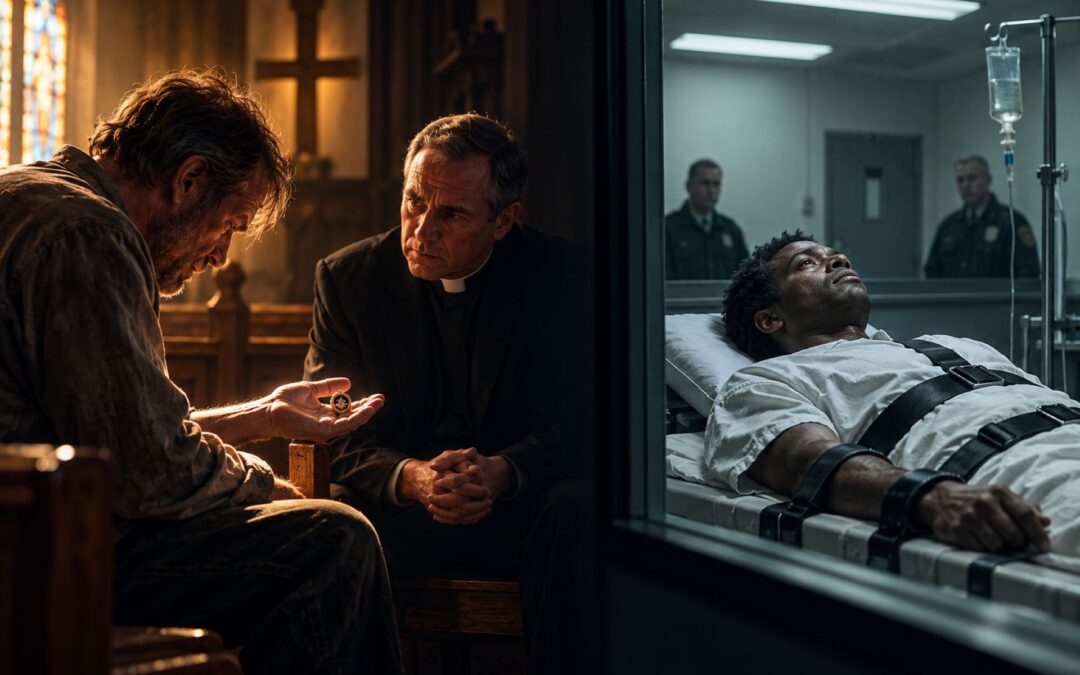
In The Confession, John Grisham tells the story of an innocent man awaiting execution for a murder he did not commit. Four days before the scheduled execution, the real killer approaches a Lutheran minister in Kansas and admits his responsibility. The confession should be enough to stop the execution, but the killer is unreliable, the legal system has spent years defending its original verdict, and almost everyone with the authority to intervene has reasons to distrust the new evidence.
Published in 2010, The Confession uses the familiar machinery of a legal thriller to examine a disturbing possibility: a justice system can follow its established procedures and still produce an irreversible injustice. Grisham reveals the killer’s identity almost immediately. The suspense comes from watching the truth struggle to reach the people who have the power to act on it, while a condemned man’s remaining life is measured in hours.
The novel unfolds in three parts—The Crime, The Punishment, and The Exoneration. That structure is essential to its meaning. Grisham devotes considerable attention to the original investigation, the legal battle, and the execution, but he also follows the consequences long after the state has carried out its sentence. The discovery of the truth does not restore the life that has been taken, and establishing innocence proves easier than persuading powerful institutions to confront their responsibility.
Spoiler Warning: This article covers the complete novel, including Donté Drumm’s execution, the discovery of Nicole Yarber’s remains, the formal exoneration, and the ending.

A Murder, a Confession, and Four Days to Live
The story begins on a freezing morning in Topeka, Kansas, when a disheveled man carrying a cane enters St. Mark’s Lutheran Church. His name is Travis Boyette, and he asks to speak with Reverend Keith Schroeder. Keith is accustomed to troubled visitors seeking money, counseling, or spiritual assistance, but Boyette’s appearance and manner suggest a particularly difficult encounter.
Boyette has recently been released from prison after serving time for sexual offenses. He lives at Anchor House, a halfway facility, and suffers from severe headaches caused by a brain tumor. He tells Keith that his remaining life may be short, and the possibility of dying appears to have awakened a need to confess something he has concealed for years.
Nine years earlier, a teenage girl named Nicole Yarber disappeared from Slone, a small town in East Texas. Her body was never recovered. A young Black man named Donté Drumm was convicted of kidnapping, sexually assaulting, and murdering her, largely because police obtained a confession from him. He has spent years on death row, consistently maintaining his innocence, and his execution is scheduled for November 8, 2007.
Boyette tells Keith that Donté did not kill Nicole. He claims that he abducted, assaulted, and murdered her himself, then concealed her body in Missouri. If his account is true, Texas is about to execute the wrong man.
Keith’s immediate problem is deciding whether to believe him. Boyette is a convicted offender with a history of dishonesty and predatory behavior. His illness may be affecting his judgment, and his manner shifts between apparent distress, self-pity, and disturbing indifference. A confession from such a person cannot automatically be treated as reliable evidence.
Yet Keith finds the disclosure impossible to dismiss. Boyette knows details of Nicole’s disappearance and appears familiar with the case in ways that demand investigation. He also possesses a class ring belonging to Nicole, an object that provides a tangible connection between him and the missing girl.
The ring changes Keith’s attitude. Boyette might have obtained it through theft or another person, but that possibility seems increasingly implausible when combined with his knowledge of the crime. Keith begins to suspect that the man sitting before him may be the only person who can prevent a wrongful execution.
Keith is married to Dana, who helps with the church’s work while they raise two young sons. Their family life is ordinary and settled, organized around school, church responsibilities, and the routines of a modest parsonage. Boyette’s appearance disrupts those routines because Keith’s professional duties offer no simple instructions for handling a murderer who claims that an innocent person is about to die.
Dana begins investigating Boyette’s background. She confirms that he is living at Anchor House and that his medical situation is serious. Keith consults a physician who confirms the existence of the tumor. The illness explains some of Boyette’s physical difficulties, although it cannot establish whether his confession is truthful.
The Schroeders search for information about Nicole and Donté. They discover that the case has remained a major controversy in Slone, where Nicole’s family and many white residents believe that Donté deserves execution. Donté’s family, his lawyers, and many members of the Black community insist that the conviction is a miscarriage of justice.
Two competing public accounts of the crime have developed over the years. One treats Donté’s confession as conclusive proof of guilt; the other regards it as the product of a coercive investigation. Keith and Dana become increasingly absorbed in the defense’s account, particularly the interrogation that transformed a young man with no demonstrated connection to the murder into a condemned prisoner.
Keith visits Boyette again and tests his claims against Nicole’s photograph and the details he has learned. Boyette can be evasive, but he also provides information that would be difficult for a stranger to invent. His familiarity with Nicole’s belongings strengthens Keith’s suspicion.
The difficulty is that Boyette controls the evidence that could confirm his story. He alone knows where Nicole’s remains are buried, and he is neither healthy nor cooperative enough to make obtaining that information straightforward. Even when he seems willing to tell the truth, he remains capable of manipulating the people who desperately need his help.
Keith now faces an extraordinary responsibility. If Boyette is lying, his interference could distract lawyers and authorities during the final days of a legitimate sentence. If Boyette is truthful, refusing to become involved may allow an innocent man to be executed.
How Donté Drumm Became the Wrong Man
To understand the approaching execution, Grisham reconstructs the original investigation through court records, defense materials, memories, and accounts of Donté’s years in prison. The case illustrates how several unreliable pieces of evidence can reinforce one another until an accusation acquires the appearance of certainty.
Nicole Yarber was a popular white high-school student who disappeared in December 1998. Her family was prominent in Slone, and the investigation attracted enormous local attention. The absence of a body made the crime particularly difficult to establish, but it also allowed police and prosecutors to construct a theory that could not readily be disproved by physical evidence.
Donté was eighteen years old when Nicole disappeared. He had been a successful high-school football player and hoped to continue playing in college. Although he had experienced a minor earlier encounter with the law, he had no history remotely consistent with the violent crime of which he would be accused.
He knew Nicole socially, as did many students in Slone, but denied having a romantic relationship with her. On the night she disappeared, he said he was at home with his younger sister, Andrea, while their parents were away at a church convention. Their family’s green Ford van was parked outside the house, and people familiar with the family’s movements supported his account.
The police nevertheless became interested in him. Rumors about Nicole’s relationships, racial anxieties, and a purported sighting of the green van created a story that investigators found compelling. Once Donté became their principal suspect, the investigation increasingly focused on securing his confession rather than independently establishing what had happened.
The Interrogation That Produced a False Confession
On December 22, 1998, Detectives Drew Kerber and Jim Morrissey approached Donté outside a health club where he exercised. They asked him to come to the police station to discuss Nicole’s disappearance. Because he believed he had nothing to hide, Donté agreed and drove himself there.
His cooperation became the first step in a devastating sequence. At the station, officers took his personal belongings, led him into an interrogation room, and asked him to waive his right to remain silent and consult an attorney. Donté signed the form, assuming that answering questions would allow him to return home.
The interrogation lasted fifteen hours and twelve minutes. It began with friendly questions about football, his family, his future, and his acquaintances. As the hours passed, the detectives’ attitude hardened, and they began treating Donté’s denials as evidence of deception.
Kerber repeatedly suggested that Donté had been secretly involved with Nicole and had become violent when she tried to end the relationship. Donté rejected the accusation, but his denials did not cause Kerber to reconsider the theory. Instead, the detective introduced additional claims intended to make resistance appear futile.
The police brought in Torrey Pickett, a friend of Donté’s, for separate questioning. Officers falsely suggested that Torrey had implicated him. Donté was allowed to see Torrey writing a statement, reinforcing the impression that his friend had turned against him, although Torrey had actually denied knowing anything about the crime.
Donté also agreed to a polygraph examination because he believed that proving he was telling the truth would end the interrogation. When the examination did not support the investigators’ accusation, Kerber nevertheless told Donté that he had failed. The detective used the supposed result to intensify the pressure.
Kerber presented himself as someone who understood how ordinary people sometimes committed terrible crimes and then suppressed the memories. According to this account, Donté might have killed Nicole without consciously remembering it. The suggestion undermined the young man’s confidence in his own understanding of events.
The threats then became more explicit. Kerber described the death penalty and encouraged Donté to imagine his mother witnessing his execution. He also suggested that confessing could save him from death, creating the impression that his choices were to admit an invented crime and live or continue denying it and face execution.
Donté’s father, Riley, searched for him during the night but could not secure access to his son. Inside the interrogation room, Donté was exhausted, frightened, isolated, and increasingly uncertain of how to escape the situation.
The detectives gradually supplied elements of their theory: the supposed relationship, the green van, the involvement of another young man, the assault, and Nicole’s alleged disposal in the Red River. The final confession incorporated this framework. Rather than independently providing an account rich in previously unknown details, Donté increasingly repeated the story the investigators had constructed.
The final portion of the interrogation was videotaped. Presented separately from the many hours of pressure that preceded it, the recording appeared to show Donté calmly acknowledging responsibility for Nicole’s death.
The contrast between the recording and the full interrogation would become central to his defense. Donté soon recanted, insisting that he had confessed only because the officers had broken him psychologically. The prosecution nevertheless treated the recording as the strongest evidence in its case.
The Evidence That Reinforced the Conviction
The prosecution’s case was supported by several other claims, none of which established Donté’s guilt independently.
Joey Gamble, a former boyfriend of Nicole’s, claimed to have seen the Drumm family’s green van near the shopping mall around the time she disappeared. His evidence placed Donté’s vehicle near the scene, but his account was inconsistent with his actual movements that evening and emerged after investigators had already developed their theory.
Joey’s relationship with Nicole had been troubled, and her disappearance left him with jealousy, anger, and unresolved feelings. He knew the town’s rumors about Donté and Nicole. Those circumstances made his testimony particularly damaging, because it appeared to connect the defendant with a possible romantic motive.
Investigators also used bloodhounds that supposedly identified Nicole’s scent in the Drumm family’s van. The defense challenged the reliability of the procedure and the handler’s confident interpretation. The dogs’ reactions could not establish when, how, or even whether Nicole had been inside the vehicle.
Another witness, Ricky Stone, claimed that Donté had confessed to him while they shared a jail cell. Stone was a criminal defendant whose cooperation with authorities created obvious questions about incentives. He later recanted, acknowledging that his testimony had been false.
These separate items created a powerful appearance of corroboration. A confession seemed to be supported by an eyewitness, a jailhouse admission, and scent evidence. Yet the apparent agreement concealed serious problems with each source.
The case was prosecuted by Paul Koffee, Slone’s ambitious and combative district attorney, who had built his reputation on convictions and tough punishment. Judge Vivian Grale presided over the trial.
Because the case had attracted enormous publicity, the defense requested a change of venue. Grale allowed the trial to move from Slone to Paris, Texas, but the new location was close enough that many potential jurors already knew about the murder. The change offered limited protection from the publicity and assumptions surrounding the accusation.
Grale admitted the videotaped confession despite the defense’s objections. She also allowed the bloodhound evidence and Stone’s testimony. Robbie Flak, Donté’s outspoken lawyer, repeatedly challenged the prosecution’s methods and the judge’s rulings, sometimes with a confrontational style that created additional friction.
Donté was convicted and sentenced to death in October 1999.
Years later, another damaging fact emerged. Koffee and Grale had been involved in an illicit romantic relationship, creating a serious conflict of interest in a case where the trial judge had repeatedly ruled against the defense. The affair eventually led to public scandal, divorces, and Grale’s resignation.
Robbie challenged Donté’s conviction on that basis, but the appellate courts did not grant relief. The institutions reviewing the case acknowledged concerns about appearances without concluding that the relationship had deprived Donté of a fair trial.
By the time the execution approached, Donté’s conviction had survived years of challenges. For prosecutors and officials, the repeated judicial decisions provided proof that the case had been adequately examined. For Robbie, those same decisions demonstrated how difficult it had become to secure meaningful review of the original evidence.
Donté’s Life on Death Row
Donté entered the prison system as a young man who expected his conviction eventually to be overturned. His first period on death row was at the Ellis Unit near Huntsville, where confinement was harsh but prisoners had somewhat more opportunities for interaction.
A transfer to the Polunsky Unit near Livingston made his circumstances substantially worse. Prison administrators imposed an extremely restrictive routine, confining condemned prisoners to their cells for most of the day. Donté’s world narrowed to a small space, limited exercise, irregular human contact, and brief visits conducted through barriers.
He tried to preserve his identity by remembering his football career. Alone in his cell, he replayed games from high school, imagining himself as a sports commentator and reconstructing the performances of teammates and opponents. These exercises kept him connected to the life he had expected to lead before his arrest.
Gradually, however, the memories began to fade. Donté could no longer recall scores and names that once came effortlessly. He became increasingly depressed, slept for long periods, and feared that prolonged isolation was damaging his mind.
He responded by creating a disciplined physical routine. Push-ups, sit-ups, running in place, reading, and daily schedules helped him impose some structure on a life governed almost entirely by other people.
His emotional attachments suffered as well. He exchanged letters with Millie, a young woman whose correspondence offered companionship and a connection to the outside world. When her letters stopped, he experienced another severe depression and struggled to maintain his routine.
His family continued visiting, but the barriers imposed by the prison prevented normal physical intimacy. His father’s death was especially painful. Donté was not allowed to attend the funeral, and the accumulated losses made his remaining life increasingly difficult to endure.
Robbie remained his most persistent outside advocate. He pursued legal remedies, kept Donté informed, and tried to protect him from despair. Their relationship developed beyond ordinary professional representation, particularly as Robbie confronted the possibility that his client would die despite his innocence.
Donté’s deteriorating mental health eventually became the basis for another attempt to prevent execution. Yet the legal focus on his present psychological condition did not resolve the fundamental question of whether he had committed the crime.
By November 2007, Donté had spent nearly nine years imprisoned for Nicole’s murder. His future had contracted from college, football, relationships, and ordinary adulthood to the few days remaining before his scheduled execution.
The Last Appeal and the Decision to Drive
In Slone, Robbie Flak and his colleagues know that the ordinary appeals process has nearly run its course. Their remaining work consists of urgent petitions, investigations, and efforts to secure evidence that might persuade a court or the governor to delay the execution.
Robbie’s law practice operates from a renovated old train station. The building’s unconventional atmosphere reflects his personality: he is energetic, combative, suspicious of official authority, and willing to make himself unpopular in pursuit of a client. His office becomes the center of a desperate effort that involves lawyers, investigators, paralegals, and supporters across several locations.
One potential breakthrough concerns Joey Gamble. Fred Pryor, an investigator working for Robbie, locates Joey near Houston and confronts him about his testimony. Joey’s life has deteriorated since the trial, and he appears troubled by the possibility that he helped condemn an innocent man.
Nevertheless, admitting that he lied would expose him to personal and legal consequences. He resists signing a sworn recantation, even while acknowledging enough uncertainty to encourage the defense team.
Robbie also pursues an argument concerning Donté’s mental condition. The years of extreme confinement have damaged his psychological health, and his lawyers hope that the courts will recognize a constitutional obstacle to executing him. The argument provides a possible basis for delay, although it does not directly address the wrongful conviction.
Judge Elias Henry, who did not preside over the original trial, becomes increasingly concerned about the case. He reviews the material, understands the significance of the unanswered questions, and considers what political intervention might still accomplish. His willingness to look critically at the conviction distinguishes him from officials who treat earlier rulings as sufficient protection against error.
Meanwhile, Keith investigates Boyette more thoroughly. Dana confirms that Boyette was arrested in Slone in January 1999, shortly after Nicole disappeared. That detail matters because it places him in the relevant area during the aftermath of the crime.
Keith also seeks advice from Matthew Burns, a prosecutor he knows in Kansas. Matthew understands the seriousness of Boyette’s disclosure but emphasizes the practical obstacles. The man has a criminal history, is seriously ill, and may be seeking attention or manipulating Keith. Even if he is telling the truth, the defense needs evidence that a court can examine quickly.
The problem becomes more urgent when Boyette disappears from the hospital. Keith cannot compel his cooperation, and his willingness to confess fluctuates unpredictably. Sometimes Boyette seems frightened by his approaching death; at other times he appears to enjoy controlling people who are desperate for information.
Keith and Dana discuss the possibility of taking him to Texas. The plan is dangerous because Boyette’s release is subject to legal restrictions, and leaving Kansas could violate those conditions. Transporting him might expose Keith to criminal liability and endanger his standing as a minister.
The family risks are equally serious. Dana worries about Boyette’s history of sexual violence, and Keith has little reason to trust him during a long journey. Their sons know only that something unusual is happening at home, while their parents face decisions that could alter their lives.
The larger political situation provides no reassurance. Governor Gill Newton is popular, ambitious, and committed to capital punishment. His advisers view the approaching execution partly through the effects it may have on his reputation and electoral support.
Reeva Pike, Nicole’s mother, publicly demands that the sentence proceed. Her grief has become closely tied to the expectation that Donté’s death will finally bring justice. News coverage amplifies her position, while opponents of the execution organize demonstrations and call attention to the weaknesses in the prosecution.
Slone becomes increasingly tense. Racial divisions that have existed for years are brought into open confrontation as Donté’s execution approaches. Protests, threats, and acts of arson create an atmosphere in which officials become more defensive and public discussion becomes more hostile.
Late on Wednesday night, Boyette contacts Keith again. He is outside Anchor House, drinking and looking for food, and he remains physically unwell. Keith meets him at a diner and realizes that any opportunity to save Donté now depends on immediate action.
Keith agrees to drive Boyette to Texas. He accepts the possibility of punishment because he can no longer reconcile inaction with his religious conscience. The decision is not made from certainty that the plan will succeed; it comes from his belief that refusing to act would make him morally responsible for abandoning an innocent person.
At roughly the same time, Robbie’s team continues trying to obtain Joey Gamble’s recantation. The investigators have recorded troubling admissions, but the material is not yet the sworn evidence required for an effective court filing.
Two fragile possibilities remain: the actual murderer might provide proof, and the witness whose testimony helped secure the conviction might finally acknowledge that he lied. Neither development is within the defense’s full control.
The Race Through Kansas, Oklahoma, and Texas
Keith begins the journey south in his aging Subaru, accompanied by a man he increasingly fears. Boyette is physically unstable, prone to headaches, and emotionally unpredictable. He alternates between silence, disturbing recollections, demands, and comments that make Keith question why he has accepted responsibility for him.
The practical difficulties emerge almost immediately. Keith has limited cash, has barely slept, and must drive through the night to reach Texas before the execution. His exhaustion threatens his ability to concentrate, and the distance between Topeka and Slone suddenly seems enormous.
At one point, Keith struggles to keep his eyes open while driving. He attempts to stay awake with loud music and conversation, but his passenger offers little assistance. A speeding stop in Oklahoma costs additional time and increases Keith’s anxiety about the legal consequences of transporting Boyette.
Boyette speaks about his past in fragments. His descriptions of childhood, violence, and sexual predation create an uncomfortable picture of a man who has repeatedly harmed vulnerable people. Some disclosures appear genuine, while others carry the same evasiveness that has characterized his confession.
Keith discovers that dealing with Boyette as a pastor is different from traveling beside him as an accomplice in a desperate rescue attempt. In the church, Keith could maintain professional distance. Inside the car, Boyette’s body, illness, criminal history, and unpredictable moods become inescapable.
Keith continues contacting Dana and Matthew. Their concern increases because they cannot predict either Boyette’s behavior or the consequences if authorities discover the journey. Keith’s decision has placed his family inside a crisis over which they have little control.
The developments in Texas proceed independently of the car’s progress. Donté’s family spends the night near Polunsky, preparing for the final visit. The approaching execution has transformed ordinary activities into rituals of farewell.
Roberta Drumm and her surviving children must confront a schedule imposed by prison officials. They know when they can visit Donté, how much time they will have, and where they must be when the sentence is carried out. Their grief is shaped by administrative rules that offer almost no accommodation for the possibility of innocence.
Donté himself moves between resignation and hope. He has endured years of disappointments, but each remaining petition offers a reason to believe that the execution might still be postponed. The mental-health challenge and other legal efforts remain active, although time is rapidly disappearing.
In Slone, demonstrations spread through the schools and streets. Students challenge the community’s handling of the case, while officials prepare for disturbances. The racial dimension becomes increasingly visible because many Black residents see Donté’s conviction as part of a longer history of unequal treatment.
Robbie’s office is consumed by legal preparations and incoming information. The defense needs evidence, signatures, affidavits, communication with courts, and transportation between offices and prisons. Every delay becomes consequential because the execution will proceed unless an authority affirmatively intervenes.
When Keith eventually reaches Slone with Boyette, the journey does not produce the immediate breakthrough he has imagined. Boyette’s health is deteriorating, and he remains reluctant to cooperate on the terms the lawyers require.
Robbie and his colleagues need a sworn account that identifies the crime’s true circumstances and allows authorities to find Nicole’s remains. They have little use for an informal confession that Boyette can later deny or modify.
Boyette’s arrival therefore creates a new urgency rather than resolving the existing one. He is physically present, but obtaining legally useful evidence remains difficult. Keith has succeeded in bringing the purported murderer to the people trying to save Donté, yet the most important part of the work still lies ahead.
The Last Hours and the Execution
On November 8, the execution day, Grisham brings the separate narratives into increasingly close contact. Donté’s family prepares to say goodbye, Robbie’s team develops new filings, Boyette describes the murder, protesters attempt to interfere with the prison’s plans, and the governor weighs the political consequences of delaying the sentence.
The chapter sequence becomes particularly important because the legal system does not operate according to the emotional urgency of the people trying to save Donté. Lawyers can discover new evidence, but unless they place it before the appropriate authority in time and obtain a favorable ruling, the execution schedule remains unchanged.
Donté’s final family visit is conducted under the prison’s restrictions. His mother and siblings face the possibility that they are seeing him alive for the last time. Their conversations carry the awkwardness of trying to express years of love and grief in a few officially permitted minutes.
Donté tries to reassure them, but he is frightened and exhausted. He has experienced repeated disappointments whenever a possible avenue of relief appeared to open, and he understands that the remaining possibilities are increasingly remote.
Outside the prison, opponents of the execution organize Operation Detour, a plan intended to delay Donté’s transfer to Huntsville. Students and protesters hope that obstructing the roads will buy enough time for the new evidence to be examined.
The authorities defeat the plan by transporting Donté by helicopter. The route may have been disrupted, but the state retains the resources to continue the execution. The protesters’ efforts demonstrate public opposition without achieving the delay they need.
At Robbie’s office, Boyette provides a fuller account of Nicole’s murder. He explains that he abducted her, sexually assaulted her, and strangled her. He also describes concealing her remains in a metal toolbox in a wooded area of Missouri.
The location matters because it contradicts the prosecution’s original theory that Donté disposed of Nicole’s body in the Red River. Boyette’s information offers a potentially decisive way to test his confession, but the grave has not yet been found.
Robbie and his colleagues prepare a petition incorporating Boyette’s sworn statement. It presents the purported murderer’s detailed account as newly available evidence that undermines the conviction and demands a halt to the execution.
The petition is completed shortly before three in the afternoon and filed with the Texas Court of Criminal Appeals at approximately 3:35. Robbie’s team has succeeded in converting Keith’s extraordinary journey into a formal legal claim.
The court nevertheless denies relief. The judges do not treat Boyette’s affidavit as sufficient reason to halt the execution and investigate further. The defense must continue seeking intervention from other courts.
The governor has already taken a public position in favor of carrying out the sentence. Newton regards Donté as guilty, believes the conviction has been reviewed adequately, and sees the new confession as an attempt to manipulate the system at the last moment.
His political advisers are not entirely united. Some understand that a short reprieve could prevent an irreversible mistake without permanently changing the governor’s position on capital punishment. Others fear that postponement would look like weakness and invite attacks on Newton’s leadership.
The dispute is sharpened by the political importance of executions in Texas. Newton’s position depends partly on his public image as a decisive leader who supports punishment. The approaching execution is therefore both a legal event and a political performance.
While these arguments continue, Joey Gamble finally agrees to recant. His decision is enormously important because his testimony helped place Donté near the crime scene and gave the prosecution a witness who appeared to support its version of events.
Joey’s change of heart comes after years of avoidance and a series of confrontations with Fred Pryor. He has been drinking, hesitating, and trying to avoid the consequences of admitting that he lied. When he finally agrees to sign a statement, very little time remains.
A lawyer in Houston, Agnes Tanner, meets him and secures the affidavit. The document acknowledges that his trial testimony was false, giving the defense a new basis to challenge the conviction.
The lawyers must now get the signed document to Austin, prepare the petition, make the necessary copies, and file everything before the court closes.
Cicely Avis and two paralegals leave for the Texas Court of Criminal Appeals at 4:45 p.m. They warn the court that they are coming with an emergency filing. The clerk nevertheless insists that the office closes at five.
Traffic delays the team. They arrive at 5:07 p.m., seven minutes after closing, and find the doors locked.
This is one of the novel’s most consequential procedural failures. A witness whose testimony helped send Donté to death row has signed a recantation, but the courthouse is closed and the papers cannot be accepted through the ordinary filing process.
The circumstances become even more disturbing in the epilogue, when it emerges that the court had an undisclosed system for assigning a duty judge to handle execution-day emergencies. The defense lawyers were not informed that a judge could be reached, and the existence of that procedure therefore offered them no practical protection.
Meanwhile, Donté has been moved to the execution facility at Huntsville. He faces the familiar sequence of last meal, final visits, religious counseling, and preparation for lethal injection.
These routines are presented with unsettling administrative precision. Prison officials know their responsibilities and follow an established schedule. Their work proceeds even as the outside world argues over whether the condemned prisoner committed the crime.
One of the novel’s ugliest scenes takes place away from the prison, at Paul Koffee’s cabin. The prosecutor gathers supporters to celebrate the approaching execution. The group drinks, eats barbecue, mocks the defense, and treats the sentence as a personal victory.
Koffee makes a grotesque joke about the chicken he is preparing, associating the food with Donté’s name. The scene reveals a professional culture in which a successful execution has become an occasion for triumph rather than reflection.
Keith, who has spent the previous night driving a dangerous stranger across several states, is allowed to meet Donté. Their conversation is awkward at first because they have never met. Keith has participated in an extraordinary effort to save him, yet neither man can know whether that effort has accomplished anything.
Donté is interested in Keith’s faith and in his opposition to capital punishment. The conversation forces Keith to confront the difference between abstract religious arguments and standing beside a man who may soon be killed. His uncertainty about what to say becomes part of the scene’s emotional honesty.
Boyette’s confession is also made public through television coverage. Officials and families who have treated Donté’s guilt as settled now confront a detailed account from another man. Yet the existence of a televised confession does not compel the courts or governor to suspend the execution.
At approximately 5:40 p.m., the United States Supreme Court refuses to hear the petition concerning Donté’s mental condition. Ten minutes later, it also denies relief on the petition based on Boyette’s confession. Both decisions are narrow, but neither changes the outcome.
Robbie now understands that the legal battle has ended. He returns to Donté and explains that no further appeal will save him.
Donté asks Robbie to promise that his innocence will eventually be established. He understands that the person who murdered Nicole may be found after his death, and he wants his family to live without the continuing burden of public accusation.
Robbie makes the promise. Their final exchange reflects years of professional loyalty and personal attachment, but it also reveals Robbie’s helplessness. He can promise to continue fighting for Donté’s reputation, yet he cannot preserve his life.
Governor Newton confronts a final opportunity to intervene. One adviser argues that a temporary reprieve could allow the new allegations to be investigated, while others oppose any delay. Newton ultimately refuses to change his decision.
At 5:59 p.m., he publicly announces that the execution will proceed. He cites the confession, the jury verdict, and the repeated appellate decisions as grounds for confidence.
The execution chamber contains two sets of witnesses. Donté’s family and supporters gather on one side, while Nicole’s relatives watch from another. Their physical separation reflects the opposing narratives that have shaped the case for nearly nine years.
Roberta is overwhelmed when the curtains open and she sees her son strapped to the execution bed. He is restrained, wearing prison clothing, with intravenous lines extending from his arms. The distance between them prevents the comforting contact that any mother would ordinarily seek.
Keith stands nearby, thinking of his family and the routine church activities continuing in Kansas. The contrast makes the execution feel even more extraordinary: normal life is continuing elsewhere while Donté’s remaining minutes are controlled by prison officials.
Robbie watches with a different burden. He reviews the decisions he made as Donté’s lawyer and imagines choices that might have produced a different result. His knowledge that the prosecution was wrong does not relieve him of the sense that he has failed his client.
From the other witness room, Reeva watches a man she believes murdered her daughter. She has spent years anticipating this moment and sees the execution as punishment for Nicole’s suffering.
Before the lethal injection begins, Donté is allowed a final statement. He expresses love for his family, thanks Robbie, offers sympathy for Nicole’s death, and once again insists that he is innocent.
He also condemns the officials he believes responsible for his conviction. His words combine affection, grief, anger, and the determination that his innocence should not disappear with him.
The execution proceeds by lethal injection. The drugs are administered, Donté loses consciousness, and his heart stops. At 6:21 p.m., the warden announces that he is dead.
The state has completed its sentence despite the confession of another man, the recantation of a crucial witness, the absence of Nicole’s body, and the continuing insistence of Donté’s lawyers that the conviction is false.
The central rescue attempt has failed.
A Town in Flames and a Mother’s Grief
Donté’s execution does not settle the controversy in Slone. The news of Boyette’s confession spreads, and the fact that another man has provided a detailed account of Nicole’s murder challenges the certainty that supported the execution.
Reeva initially remains attached to the original verdict. For years she has organized her grief around the belief that Donté was responsible. Accepting Boyette’s confession would mean acknowledging that she helped demand the death of an innocent man while the actual murderer remained free.
Koffee and Kerber face a related but professionally different crisis. Their reputations depend on the legitimacy of the original investigation and prosecution. They have defended the conviction so thoroughly that admitting error would threaten their careers and force them to confront their responsibility.
The prosecutors and police who once celebrated the verdict begin considering what the new evidence might mean. They cannot easily dismiss Boyette without examining his knowledge, yet confirming his account would expose the weaknesses of the case they constructed.
Robbie returns to Slone exhausted and furious. The death of his client has changed the purpose of his work. He can no longer seek to prevent the execution, so he must establish Donté’s innocence and pursue the people whose conduct produced the conviction.
Public anger intensifies. Demonstrations continue, buildings burn, and confrontations threaten to become more violent. National Guard involvement and increased police presence contribute to the impression of a town struggling to contain a crisis.
Grisham does not present these disturbances as the response of every person who believes Donté was innocent. Many residents are grieving, frightened, and determined to avoid further violence. Roberta is particularly insistent that attacks and destruction should stop.
Her position carries weight because she has suffered the greatest loss. She has watched her youngest son executed despite years of protests about his innocence, yet she refuses to treat retaliation as a way of honoring him.
The novel then moves from public confrontation to an intimate scene at Lamb & Son Funeral Home.
Donté’s body has been returned to Slone. Friends and relatives gather outside the building while the family prepares to see him. His brothers, sister, and mother have recently witnessed his execution, but the sight of his coffin makes the loss immediate in a different way.
Roberta enters the preparation room alone and locks the door. Donté lies on a table wearing the inexpensive clothing supplied by the state.
She touches his face and kisses him repeatedly. For years, the prison’s visiting arrangements prevented ordinary physical contact. She recalls the brief embrace she managed when he was taken away after sentencing, and the many visits in which glass and prison rules separated them.
Now she can touch him, but he is dead.
Roberta examines familiar features of his body and remembers the child he once was. A small scar recalls a childhood injury. The faint mark from an old earring brings back his adolescence, when he was a boy with ordinary ambitions, private jokes, and occasional conflicts with his parents.
She dresses him in clothing chosen for his burial. The scene places a mother’s knowledge of her son against the official identity that has defined him for nearly nine years.
To the state, Donté has been a convicted murderer, a prisoner, and finally a completed execution. To Roberta, he remains the boy she raised, whose childhood can be traced through details that no court document could adequately preserve.
The contrast gives the scene unusual emotional force. Grisham does not need another legal argument to establish the scale of the loss. The simple act of preparing Donté’s body shows what the verdict and execution have taken from his family.
Roberta also imagines the life her son might have lived. College, work, relationships, children, and adulthood remain possibilities that can never be tested. The false conviction did not simply occupy nine years of his life; it removed every year that might have followed.
The town continues arguing over evidence and responsibility, but Roberta has already reached a point from which no legal remedy can bring meaningful restoration.
The Body on Roop’s Mountain and the Case Unravels
The day after Donté’s execution, Boyette agrees to lead Robbie, Keith, and members of the defense team to the location where he buried Nicole.
They travel into the Missouri countryside, toward Roop’s Mountain, an area connected to Boyette’s earlier life. The group includes Fred Pryor, Aaron Rey, and others who can assist with locating and documenting the grave.
The expedition is difficult because the murder occurred nearly nine years earlier. Vegetation has grown, landmarks have changed, and Boyette must rely on his memory to identify the precise location.
His illness complicates the search. He is weak, experiences intense headaches, and must repeatedly stop. Nevertheless, his directions become increasingly specific as familiar places bring back details.
Boyette explains that he used a large metal toolbox taken from a construction site to conceal Nicole’s remains. He buried it beneath the ground, leaving no visible indication that a body was hidden there.
The account is disturbing partly because it involves such a practical, ordinary object. A toolbox designed to store equipment became a concealed grave, while an elaborate criminal prosecution proceeded hundreds of miles away on an entirely false explanation of the murder.
The search party eventually identifies an area that matches Boyette’s recollection. Digging reveals the top of an orange metal box.
A combination lock secures the lid. Boyette remembers the combination and opens it, providing another concrete demonstration of his direct knowledge of the concealed remains.
Inside are human skeletal remains, along with hair, clothing, and personal belongings consistent with Nicole’s disappearance. A belt is found near the body, matching Boyette’s account of how he killed her.
The grave also contains identifying possessions, including Nicole’s driver’s license and a credit card. These details make the discovery especially compelling because they connect Boyette’s directions with a real missing person and provide evidence that investigators can examine independently.
Keith responds with prayer. Robbie, whose client was executed less than a day earlier, experiences the discovery as both a breakthrough and a cruel confirmation of the injustice.
The group photographs the scene and contacts the authorities. The grave is now a crime scene, and official investigators must take control of the recovery and identification process.
Boyette’s physical condition deteriorates again. Keith takes him to a hospital, where law enforcement becomes involved, but Boyette manages to disappear.
His escape exposes another risk created by the desperate rescue effort. The man whose information has just transformed the murder case remains a dangerous offender with a history of sexual violence. His role in exposing the truth does not make him safe or trustworthy.
Authorities continue processing the remains. The discovery attracts law enforcement officers, reporters, and national attention, while Robbie considers how the new physical evidence can be used to challenge the prosecution.
The original case rested partly on the assumption that Nicole’s body had been thrown into the Red River. Discovering her remains in Missouri destroys that explanation. It also demonstrates that the confession extracted from Donté incorporated a narrative that did not match the actual crime.
Judge Elias Henry summons Robbie, Koffee, Kerber, and other local officials to a meeting. The atmosphere is hostile because the significance of the discovery can no longer be avoided.
Robbie presents the evidence and demands accountability. Koffee and Kerber are forced to confront the possibility that their prosecution resulted in the execution of an innocent man, while the public confidence surrounding their earlier triumph collapses.
The following day, Robbie holds a major press conference in the Chester County courthouse. He reconstructs Nicole’s disappearance, the interrogation, the unreliable testimony, the trial, and the years of unsuccessful appeals.
His presentation is detailed and accusatory. He identifies the detectives, prosecutors, judicial decisions, and evidentiary failures that allowed the false conviction to survive. He also explains the role of Boyette’s confession and the newly discovered remains.
This event serves several purposes. It informs the public, places the prosecution’s conduct under scrutiny, and transforms Donté’s innocence from a claim made by his defense into a conclusion supported by physical evidence.
The people who contributed to the conviction watch the presentation with different reactions. Joey Gamble understands that his false testimony has become public knowledge and that his long-delayed recantation could not save Donté.
Reeva watches the account unfold while struggling to accept that Nicole’s remains have been found somewhere entirely different from the location described at trial. The discovery forces her to reconsider the story on which her demands for punishment depended.
For Reeva, the revelation brings another form of suffering. She has spent years believing that her daughter’s killer was caught and punished, only to learn that the actual perpetrator remained free and that the executed man was innocent.
Robbie’s address is followed by Roberta’s public appeal. She asks for peace and rejects further violence in Donté’s name.
Her intervention contrasts with the angry rhetoric that has dominated much of the dispute. Robbie speaks as a lawyer determined to expose wrongdoing and secure accountability. Roberta speaks as a mother who refuses to allow her son’s death to become a justification for additional suffering.
By the end of the press conference, the essential facts of the case have changed. Nicole’s body has been found, Boyette’s account has acquired strong physical corroboration, and the original prosecution’s theory has collapsed.
The truth has emerged, but it has arrived after the execution.
The Cost of Exoneration
The discovery of Nicole’s remains produces consequences throughout Slone and beyond, but the response is uneven. Some people acknowledge the miscarriage of justice immediately, while others concentrate on preserving their careers, reputations, and political positions.
Subsequent DNA testing provides stronger confirmation of Boyette’s involvement. What began as the disturbing confession of a convicted sex offender becomes a case supported by physical evidence that the authorities can no longer reasonably dismiss.
For Robbie, this development changes the legal work without ending it. He begins preparing lawsuits and pursuing avenues of accountability against officials whose actions helped produce the conviction and execution.
The potential defendants include people who conducted the interrogation, prosecuted the case, made judicial decisions, and refused to intervene when new evidence appeared. Robbie understands that legal responsibility will not necessarily follow moral responsibility. Government officials can possess protections that make personal liability difficult to establish.
Koffee’s position becomes untenable. His aggressive prosecution, public certainty, and intimate relationship with Judge Grale receive renewed scrutiny. He faces professional collapse as the case that once enhanced his reputation becomes evidence of profound failure.
Kerber must also confront the consequences of his interrogation tactics and investigative decisions. He had built much of his professional identity around solving Nicole’s murder. That achievement is now exposed as a false construction that helped condemn an innocent man.
Governor Newton faces criticism on a national scale. His refusal to grant a reprieve becomes particularly damaging because he was warned about the possibility of innocence shortly before the execution. He nevertheless resists accepting broad responsibility and searches for ways to contain the political consequences.
The story dominates newspapers, television, and public debate. Commentators call for reviews of death-penalty procedures, temporary suspensions of executions, and reform of practices that can produce wrongful convictions.
Within the novel, the discovery acquires special significance because it appears to establish that the state has executed an innocent person. The question is no longer theoretical or limited to the risk of error. The error has occurred, and no subsequent proceeding can reverse its consequence.
The national controversy returns repeatedly to the problem of legal finality. Courts may have reviewed Donté’s case many times, but those reviews did not correct the original mistakes. The fact that the conviction survived appeals now seems less reassuring than it did before the discovery.
A Community Forced to Confront Itself
Slone struggles to resume ordinary life. Schools close temporarily, public gatherings are tense, and the town remains under intense media scrutiny.
The football team becomes an unexpected focus of the conflict. The team’s Black players refuse to participate in an important game as though nothing has happened. They stage a sit-in at midfield, challenging the surrounding community to acknowledge the injustice.
Their white teammates eventually join them in solidarity. The gesture interrupts the game and produces one of the novel’s more hopeful public moments.
Football has long been central to Slone’s identity, and Donté himself was once a celebrated player. The willingness of young athletes to set aside the normal expectations of competition carries symbolic weight because it occurs in a setting where the town usually celebrates collective pride.
The protest does not erase the town’s racial divisions or repair the failures of its institutions. It does, however, suggest that a younger generation may be more willing to recognize shared responsibility than the authorities who controlled the original case.
Other residents seek stability through schools, churches, family gatherings, and ordinary work. They are exhausted by demonstrations, fires, and national attention, but a return to normal life is complicated by the fact that the previous normality included an innocent man’s conviction.
Two Families and Two Funerals
Donté’s family organizes a large public memorial. The expected attendance exceeds the capacity of the church, and the gathering is moved to the high-school gymnasium.
The setting is appropriate because Donté’s interrupted football career remains central to how many people remember him. Former teammates, friends, relatives, community leaders, and supporters gather to honor someone whose public identity was transformed by an accusation that has now been discredited.
The ceremony also serves a purpose beyond mourning. It publicly restores Donté to the community as a son, brother, friend, and former athlete rather than a convicted murderer.
He is buried at Greenwood Cemetery, near his father. The inscription on his grave identifies him as an innocent man wrongfully executed by the State of Texas.
For Robbie, the funeral is inseparable from his promise to Donté. He has continued working to establish the truth, but he cannot provide the vindication in the form his client deserved: freedom during his lifetime.
Nicole’s family must also bury their daughter after years without her remains. The discovery gives them the opportunity for a funeral that had previously been impossible, but it also overturns their understanding of the crime.
Reeva’s grief becomes more complicated because she must mourn Nicole while confronting the possibility that her anger helped sustain an unjust conviction. She has lost the certainty that once gave her suffering a clear target.
Grisham’s decision to follow both families prevents the exoneration from functioning as a simple exchange of sympathy. Nicole was genuinely murdered, and her family has suffered a terrible loss. Donté was innocent, and his family suffered because authorities punished him for that murder. Recognizing one injustice does not make the other grief disappear.
Keith’s Unresolved Responsibilities
Keith returns to Kansas physically and emotionally exhausted. He has witnessed an execution, transported a dangerous offender across state lines, and become involved in a case attracting national attention.
His experience changes his understanding of ministry. Before meeting Boyette, his religious responsibilities were largely organized around his congregation’s ordinary needs. Now he has participated in a struggle that places questions of justice, political power, and religious conscience at the center of his life.
He is also afraid. Boyette has escaped after the discovery of the grave, and Keith knows that the man remains capable of violence. Dana’s safety becomes a particular concern because Boyette knows the family and has behaved unpredictably throughout their encounters.
Keith faces scrutiny from church authorities over his decision to assist Boyette. Even though his actions were intended to prevent an injustice, he knowingly became involved in conduct that violated legal restrictions.
His religious superiors must consider both the moral character of his actions and their consequences for the institution. Their concerns reveal how organized religion can become divided when personal conscience challenges the expectations of law and professional discipline.
Keith also becomes a public figure. His story attracts attention from congregations, journalists, and people interested in the death penalty. The minister who initially doubted whether he should become involved is now associated with a nationally significant wrongful execution.
An opportunity emerges at Unity Lutheran Church in Austin, Texas. The congregation is socially engaged and interested in a minister willing to speak openly about public issues. Its outlook appeals to Keith because his experience has made it difficult to return unchanged to the quieter form of ministry he previously practiced.
Boyette’s Capture and Keith’s New Direction
Boyette remains a serious threat after his escape. His medical condition has deteriorated, but his illness has not removed his predatory impulses.
In Kansas, he attacks a woman named Lilly Reed as she approaches her car outside a shopping mall. He threatens her with what appears to be a firearm and attempts to force her into the vehicle.
A bystander, Enrico Munez, intervenes and subdues him. Boyette is injured, arrested, and subsequently identified. The incident confirms that his earlier participation in locating Nicole’s remains did not represent a dependable moral transformation.
His capture relieves Keith of one immediate fear. The man he transported to Texas can no longer threaten his family in the same way, although Keith’s own legal difficulties remain unresolved.
Keith and Dana later return to Slone for a visit. The town appears calmer, but evidence of the disturbances remains visible, and the significance of Donté’s death continues to shape their conversations.
They meet Robbie and spend time with members of Donté’s family. Keith and Roberta, who shared the experience of witnessing the execution without previously knowing one another, finally have the opportunity to speak.
The visit allows Keith to understand the family beyond the confined, desperate atmosphere of Huntsville. Roberta discusses her grandchildren and ordinary family matters, demonstrating that her life continues even as the loss remains central to it.
Keith and Dana visit Donté’s grave. The inscription makes the state’s responsibility unmistakable, and the simple physical presence of the burial site gives Keith a lasting reminder of the man he tried to save.
The Schroeders then travel to Austin, where Keith gives a sermon at Unity Lutheran. His account of the journey, the execution, and the moral questions surrounding capital punishment is well received.
By the end of the main narrative, Keith has begun moving toward a different kind of ministry. His new direction is shaped by direct involvement in a public injustice rather than by an abstract change in religious opinion.
The Epilogue: Justice on Paper, Executions in Practice
The epilogue provides several resolutions that would normally be considered victories in a legal thriller. Donté is formally exonerated, Boyette is charged with Nicole’s murder, and some of the officials connected to the wrongful conviction experience professional consequences.
Yet these outcomes do not produce a complete triumph. Grisham extends the story far enough to show how limited the effects of an extraordinary miscarriage of justice can be.
On December 22, the ninth anniversary of Donté’s arrest, a grand jury indicts Boyette for Nicole’s abduction, sexual assault, and murder. The date is deliberately chosen to coincide with the history of the wrongful case.
Judge Elias Henry then holds a hearing to consider Robbie’s motion to declare Donté innocent. The state, represented by an interim district attorney, does not contest the evidence.
Robbie summarizes the errors, falsehoods, and misconduct that produced the conviction. Henry issues an order declaring Donté innocent, reversing the conviction, expunging the record, and apologizing to the family.
The hearing fulfills Robbie’s promise to his client. Donté’s innocence is now formally recognized by the same legal system that condemned him.
Nevertheless, the timing makes the achievement painful. The court can change the legal record, but it cannot return Donté to his mother or restore the years he spent imprisoned.
The epilogue also reveals the circumstances surrounding the rejected last-minute recantation. The Texas Court of Criminal Appeals had a system of assigning a duty judge to handle urgent matters outside normal public procedures. Attorneys did not know about the arrangement.
When Cicely Avis arrived with Joey Gamble’s sworn recantation at 5:07 p.m., a judge was supposedly available inside the building. The petition nevertheless went unheard because the filing system provided no usable means of reaching him.
The court subsequently introduces electronic filing, although it denies that the change is a consequence of Donté’s case. A complaint against Chief Justice Milton Prudlowe eventually results in a finding of unprofessional conduct but no removal from office.
Joey Gamble leaves Texas, burdened by guilt. His admission came too late to save Donté, and he struggles with the knowledge that his false testimony helped make the conviction possible.
Keith resolves his own legal exposure in Kansas. He pleads guilty to obstruction of justice, receives a fine and probation, and accepts the consequences of transporting Boyette. He makes clear that he would make the same decision again under comparable circumstances.
His church places him on leave, but he chooses to resign rather than continue under those conditions. He and Dana move to Austin, where he becomes senior minister at Unity Lutheran Church.
Boyette’s legal fate develops separately. Kansas, Missouri, and Texas all have reasons to seek custody of him, and the states dispute where he should be prosecuted. He eventually admits responsibility for Nicole’s murder in Missouri and is sentenced to death.
His fate creates a moral complication. The real killer receives the punishment intended for Donté, yet that outcome cannot erase the wrongful execution. The book has already established the danger of treating execution as an uncomplicated expression of justice.
Koffee is eventually disbarred and leaves Slone. Kerber loses his position, faces financial difficulties, and moves away. Their professional decline acknowledges wrongdoing, but it cannot adequately measure the consequences of their conduct.
Martha Handler, one of Robbie’s associates, publishes a commercially successful book about the case. The resulting disagreement over money damages her relationships with Robbie and the Drumm family, introducing a smaller but revealing complication into the aftermath of a highly publicized tragedy.
The political consequences continue in Austin. Governor Newton eventually calls a special legislative session because public pressure has become difficult to ignore.
Three main proposals are considered: a resolution concerning Donté, a temporary moratorium on executions, and the creation of an innocence commission to investigate wrongful convictions.
The legislature passes a resolution formally recognizing Donté’s innocence and awards his family one million dollars. The original compensation proposal had been far larger, but lawmakers reduce the amount during negotiations.
The proposed two-year moratorium becomes the subject of bitter debate. Supporters argue that executions should stop while the state’s procedures are examined. Opponents resist suspending a punishment they continue to regard as legitimate.
The plan to create an innocence commission faces similar resistance. Such a body would study the causes of wrongful convictions and recommend ways to prevent them.
Both reform proposals fail. The moratorium is defeated in the Senate, and the innocence commission is rejected in the House.
The legislature has acknowledged the wrongful execution and compensated the family, but it has refused to adopt the principal measures intended to prevent comparable errors.
The final scene follows Adam Flores, another condemned prisoner. After twenty-seven years on death row, he is taken to Huntsville and executed on July 1.
Flores has no witnesses, no lawyer actively pursuing his case, and no family members present to claim his body. After his execution, he is buried in the prison cemetery among other unclaimed prisoners.
The novel ends with the state continuing to execute people. Donté’s innocence has been established, his family has received compensation, and the public has witnessed an extraordinary failure, but the institution responsible for his death remains in operation.
Slone, Death Row, and the Institutions That Shape the Story
Grisham’s setting is a recognizable version of contemporary American life, but the novel concentrates on the institutions that control a person’s identity, opportunities, and legal fate. Slone, the Texas prison system, the courts, churches, political offices, and news organizations create a connected social environment in which decisions made by one institution gain legitimacy through the others.
Slone is fictional, yet it is presented with the details of a small East Texas community. High-school football matters enormously, public officials know one another, churches organize significant parts of social life, and influential families possess reputations that extend into local politics.
Racial divisions remain visible despite formal integration in many areas. Black and white residents attend some of the same institutions, but their social experiences and expectations differ considerably. Churches, funeral practices, neighborhoods, and public loyalties reveal boundaries that have survived legal changes.
Donté’s position in this environment is complicated. As a talented football player, he was admired by people who might otherwise have regarded him through racial stereotypes. His athletic achievements gave him a form of public recognition, but that recognition offered little protection once police accused him of murdering a white girl.
Nicole’s background also influences the response to the case. Her family’s prominence and the intensity of public grief make the investigation a major local event. Police and prosecutors operate in an atmosphere where identifying and punishing someone becomes a matter of civic reputation.
Grisham shows how a case can become associated with a town’s understanding of itself. Authorities want to demonstrate competence, the victim’s family wants certainty, and residents who have accepted the official explanation become invested in defending it.
The funeral homes provide another revealing detail. Slone has separate establishments traditionally serving its Black and white populations. The arrangements for Donté’s body and the description of community mourning show how racial history continues to shape intimate experiences even where institutions appear formally integrated.
The legal geography is equally important. Donté’s trial occurs outside Slone, but not far enough away to remove the case from regional publicity. Appeals move through state and federal courts, while the execution is scheduled at Huntsville and Donté remains imprisoned at Polunsky.
The physical separation between prison facilities and legal offices reinforces his lack of control. Lawyers and officials exchange calls, submit papers, and issue rulings, while Donté waits in a confined space for decisions made elsewhere.
His prison conditions deepen that separation. The restrictions at Polunsky eliminate much of the human interaction that once helped him preserve his identity. Exercise, reading, memory, letters, and family visits become essential because ordinary choices are almost entirely unavailable.
The prison’s strict routines contrast with the flexibility available to officials. Judges can decide when to review material, prosecutors can resist reopening a case, and the governor can grant or refuse a reprieve. Donté, whose life depends on those decisions, has little opportunity to influence the process directly.
Huntsville becomes the physical endpoint of the system. Its execution chamber is organized around procedures intended to carry out the sentence efficiently. The people responsible for implementing those procedures do not have to resolve the factual questions that the lawyers have raised.
Grisham’s depiction of the prison system is part of a fictional narrative rather than a complete account of Texas law or correctional practice. Nevertheless, the setting performs an essential dramatic function by showing the imbalance between the institutions exercising power and the individual whose life they control.
The churches provide competing forms of authority. Keith’s congregation in Kansas initially represents stability and ordinary pastoral duty, while Slone’s religious communities become deeply involved in arguments about guilt, punishment, forgiveness, and public protest.
The political setting introduces another source of institutional pressure. Newton’s authority to delay an execution is entangled with electoral calculations, public opinion, and his reputation for decisiveness. The governor’s office treats a question of possible innocence partly as a problem of political management.
Finally, the media connects the institutions to the wider public. Television interviews and websites distribute competing accounts of the case, while national coverage transforms Donté’s execution into a major political controversy.
These institutions do not all behave identically, and some individuals within them try to prevent the injustice. Their combined effect, however, is to make the original conviction extraordinarily difficult to dislodge. Each institution can point toward an earlier decision as grounds for continuing the process.
The People Behind Donté Drumm’s Wrongful Execution
The characters in The Confession occupy different positions within a single miscarriage of justice. Some are directly responsible for the false conviction, some attempt to prevent the execution, and others must live with consequences they did not choose. Grisham gives the greatest emotional attention to people trying to rescue Donté or mourning his death, while several institutional figures are drawn more directly as representatives of professional or political failure.
Donté and Roberta Drumm: Innocence, Grief, and Dignity
Donté begins the story as a condemned prisoner, but the reconstruction of his earlier life makes clear how much has been taken from him. He was an ambitious athlete with ordinary plans for college and adulthood. His arrest transformed him from a young man anticipating new opportunities into someone whose future depended on courtroom decisions.
His psychological development is among the novel’s most significant character arcs. Donté initially expects the truth to emerge, but the rejection of successive appeals erodes his confidence. Isolation makes the problem worse because it deprives him of ordinary human relationships and activities.
The football games he replays in his imagination reveal both resilience and loss. Remembering his athletic achievements allows him to preserve a sense of identity, but the gradual disappearance of those memories shows how deeply confinement has affected him. The very material that once sustained his sense of self becomes harder to recover.
His exercise routine represents another form of resistance. He cannot change his legal circumstances, so he creates discipline within the limited space available to him. The effort is admirable without being presented as a cure for his depression.
Donté’s relationships gradually narrow. His father’s death, the end of Millie’s correspondence, and the restrictions on visits isolate him further. Robbie and his family remain the principal connections preventing his life from becoming entirely defined by the prison.
His final request to Robbie reveals the continuing importance of reputation and family. Donté knows that he may die, but he wants his mother and siblings to live in a world where the accusation against him has been withdrawn. He asks for a kind of future justice that can exist even if he is no longer alive.
Grisham presents Donté sympathetically, but his fear, anger, depression, and despair keep him from being merely an idealized figure of innocent suffering. His final statement includes affection and resentment, reflecting the emotional consequences of being punished for a crime he repeatedly denies.
Roberta’s character is built around an equally difficult contradiction. She has spent years maintaining faith in her son’s innocence, yet she has been unable to protect him from the institution that controls his life.
Her strength is most visible in ordinary interactions. She visits Donté, maintains relationships with her surviving children, and continues functioning while living under the threat of his execution.
The funeral-home scene reveals the private cost of that endurance. Her attention to Donté’s scars, clothing, and childhood memories restores his individuality after years in which public discussion has treated him primarily as a criminal defendant.
Her public appeal for peace extends that dignity into the community. Roberta refuses to endorse violence even when she has compelling reasons for anger, but Grisham does not suggest that restraint makes her grief less severe.
Together, Donté and Roberta supply the emotional center of the novel. Their relationship explains why a formal declaration of innocence can never become an adequate replacement for the life they lost.
Keith and Dana Schroeder: Conscience and Family Responsibility
Keith begins as a conscientious but relatively conventional minister. His responsibilities involve sermons, hospital visits, counseling, and the needs of his congregation. He possesses moral convictions, but those convictions have rarely required him to risk his career or freedom.
Boyette’s confession introduces an unfamiliar kind of pastoral problem. Keith is asked to listen to a man who may be dying and wants to admit a murder. Yet the confession involves a third person whose execution is imminent, making confidentiality, compassion, and obedience to ordinary rules unusually difficult to reconcile.
Keith’s development occurs through practical decisions rather than a sudden transformation in belief. He investigates Boyette’s story, consults others, debates the risks with Dana, and hesitates before deciding to act.
His decision to drive Boyette to Texas is the crucial turning point. He knowingly places himself in legal danger because he believes that respecting every applicable rule would mean abandoning a potentially innocent man.
The journey also exposes Keith’s limitations. He becomes exhausted, frightened, impatient, and increasingly uncomfortable with Boyette. His courage does not remove his fear or make him certain that his actions will succeed.
Witnessing Donté’s execution changes his understanding of capital punishment. The event forces him to confront the physical reality of a practice he had previously considered in moral and theological terms.
Dana’s role is essential because Keith’s decision affects more than his own conscience. She helps investigate Boyette and evaluates the information they obtain, but she also has to consider their children, their marriage, and the danger posed by the man Keith has chosen to assist.
She is supportive without surrendering her judgment. Her concern about Boyette’s violence and Keith’s possible punishment shows the costs of moral action for people who are not making the central decision.
Their marriage becomes an important counterweight to the novel’s public conflict. They discuss the facts, disagree about risks, and adjust to the consequences together.
Keith’s eventual move to Austin reflects a change in vocation rather than an escape from difficulty. He has discovered that his religious commitments require greater involvement in public questions, but he must accept legal punishment and professional disruption to follow that conviction.
Travis Boyette: Confession Without Redemption
Boyette is the novel’s most disturbing and unpredictable character. He provides the information that could save Donté, but he remains a violent offender whose conduct repeatedly contradicts the possibility of genuine moral transformation.
His brain tumor introduces urgency and uncertainty. Boyette experiences severe physical symptoms and believes he may die soon, which gives him a reason to confront his past. Yet illness does not automatically make him remorseful or truthful.
His confession contains details that can be verified, and the discovery of Nicole’s remains ultimately proves his involvement. Nevertheless, the accuracy of his account does not establish the sincerity of every emotion he expresses.
Boyette often behaves as though the confession gives him power over others. Keith and Robbie desperately need his cooperation, and he can delay, bargain, refuse, or change his demands. Even while trying to disclose the truth, he continues manipulating the people around him.
His descriptions of earlier offenses reveal a pattern of predation. He has repeatedly exploited vulnerable people and treated their suffering with disturbing indifference.
At times, Boyette appears troubled by Donté’s approaching execution. The possibility that an innocent man will die for his crime may weigh on him, particularly as he confronts his illness.
But the novel does not allow these moments to become proof of redemption. His escape after the discovery of Nicole’s grave and later attack on Lilly Reed demonstrate that he remains dangerous.
Grisham’s handling of Boyette also raises a literary question. His behavior is deliberately erratic, supplying suspense and obstacles whenever the rescue effort appears close to success. The unpredictability is supported by his criminal history and physical condition, but it sometimes functions so conveniently for the plot that psychological consistency becomes secondary to dramatic necessity.
Boyette’s central significance lies in the distinction between confession and moral reform. He can tell the truth about a terrible crime without becoming trustworthy, repentant, or safe.
Robbie Flak: Advocacy, Anger, and Loyalty
Robbie is the novel’s most energetic legal figure. He possesses considerable experience in death-penalty litigation, understands the weaknesses of the prosecution, and has spent years challenging Donté’s conviction.
His practice is unconventional in appearance and confrontational in method. The renovated train station, informal office culture, and willingness to challenge powerful officials distinguish him from the establishment he opposes.
Robbie’s hostility toward prosecutors and judges is not merely professional theater. He has seen prisoners executed, has encountered unreliable evidence, and believes the legal system frequently protects its own decisions at the expense of defendants.
That experience makes him a committed advocate, but it also contributes to his abrasiveness. He can be impatient, sarcastic, and openly contemptuous of people he regards as corrupt or incompetent.
His relationship with Donté gives the character emotional depth. Robbie has defended him for years, believes him innocent, and understands that his client’s life is gradually being consumed by the appeals process.
The final conversation between lawyer and prisoner is particularly significant. Robbie cannot promise to save Donté, so he promises to clear his name. The change from defending a living client to pursuing posthumous vindication defines his work after the execution.
Robbie’s public reconstruction of the case demonstrates another aspect of his personality. He is an effective communicator who understands the value of evidence, publicity, and emotional force. His ability to command attention helps transform the discovery of Nicole’s remains into a public demand for accountability.
He is not entirely free from self-reproach. After Donté’s death, Robbie revisits strategic decisions and wonders whether different choices might have changed the outcome.
The self-criticism humanizes a lawyer who otherwise risks appearing almost invulnerable in his anger and confidence. It also establishes an important distinction: Robbie may not be responsible for the wrongful conviction, but his personal loyalty makes him feel responsible for failing to defeat it.
Reeva Pike and Nicole Yarber: Grief and Misplaced Certainty
Nicole is physically absent from most of the story because she has been dead for nearly nine years. Readers learn about her through memories, photographs, relationships, the original investigation, and the possessions recovered from her grave.
That absence shapes the novel’s structure. Nicole is the genuine murder victim, but the story concentrates on the additional injustice committed when the authorities punish someone who did not kill her.
Her personal history matters because the prosecution constructs an imagined relationship between her and Donté. Rumors about romance, jealousy, and racial boundaries become part of the accusation. The actual circumstances of her death reveal that this narrative was false.
Reeva’s grief is real, even when her conduct becomes difficult to defend. She lost her daughter to a violent crime, endured years without a body, and depended on the prosecution’s assurances that the murderer had been caught.
Her public behavior becomes increasingly aggressive. She demands execution, attacks those questioning Donté’s guilt, and treats the sentence as the necessary completion of Nicole’s case.
The problem is that Reeva’s need for certainty makes her resistant to contrary evidence. Accepting Donté’s innocence would require her to reconsider years of statements, campaigning, and expectations.
After Boyette’s confession and the discovery of Nicole’s remains, Reeva must confront a double loss. Nicole is still dead, and the version of justice that Reeva believed she had secured is exposed as an error.
Grisham sometimes presents Reeva in exaggerated terms, particularly through her appetite for publicity and punitive rhetoric. Those traits make her an effective representative of vengeful certainty but occasionally restrict the complexity of her characterization.
Her situation nevertheless raises a difficult question about victims’ families. Grief may explain a desire for punishment, but it cannot establish the defendant’s guilt or justify ignoring evidence that contradicts the prosecution.
The Witnesses and Officials Who Sustained the Conviction
Drew Kerber is one of the principal architects of Donté’s conviction. His interrogation techniques transform a cooperative teenager into a suspect who eventually repeats an invented account. Kerber’s professional pride depends on his reputation for solving the case, making later challenges threatening to his identity.
Paul Koffee reinforces the original investigation through aggressive prosecution. His concern with convictions, reputation, and punishment encourages him to treat doubts as attacks on his authority rather than opportunities for reconsideration.
Judge Vivian Grale’s rulings allow the contested confession and supporting evidence to reach the jury. Her undisclosed romantic relationship with Koffee adds a serious conflict of interest to a trial already marked by questionable evidentiary decisions.
Joey Gamble is different because he is neither a police officer nor an elected official. His jealousy, dishonesty, and unwillingness to admit wrongdoing nevertheless become central to the injustice. His eventual recantation demonstrates how a witness’s personal motives can acquire enormous legal significance.
Ricky Stone’s fabricated jailhouse testimony illustrates another mechanism. A prisoner with reasons to seek favorable treatment offers a confession allegedly made by the accused, and that statement gains credibility through the authority of courtroom testimony.
Governor Newton represents the political level of the system. His decision to proceed with the execution depends on his confidence in the existing verdict, but it is also influenced by the need to preserve his public image.
Judge Elias Henry provides an important contrast. Although he cannot prevent the execution, he is willing to examine the evidence critically, challenge other officials, and use his authority to acknowledge the injustice after the truth emerges.
These people occupy different positions and possess different motives. Grisham’s larger point is that a wrongful conviction can persist without every participant consciously agreeing to frame an innocent person. Individual deception, professional ambition, institutional loyalty, political calculation, and the refusal to reconsider earlier decisions can reinforce one another.
False Confessions and the Manufacture of Certainty
Donté’s interrogation is the clearest explanation of how the wrongful conviction began. Grisham devotes substantial attention to the transition from voluntary cooperation to psychological exhaustion because the case depends on an apparent contradiction: an innocent person confessed to murder.
Donté enters the police station believing that the truth will protect him. He has no reason to think that answering questions will be dangerous, so he waives his rights and attempts to cooperate.
The detectives exploit this expectation. They begin with friendly conversation, then gradually shift toward accusation. Donté’s denials are interpreted as resistance, while his uncertainty becomes an opportunity to introduce the investigators’ theory.
Several techniques operate together. Isolation and exhaustion weaken his ability to respond. False claims about witnesses and polygraph results make him believe the police possess evidence against him. Threats of execution create fear, while suggestions of leniency make confession appear to offer a route to survival.
The most important development is the contamination of Donté’s eventual account. The detectives do not simply ask him what happened; they repeatedly describe what they believe happened. Donté eventually incorporates those details into his statement.
Consequently, the apparent specificity of the confession becomes misleading. Details that might otherwise suggest personal knowledge can instead reflect information supplied during questioning.
The final videotaped statement intensifies the danger. A jury watching a short recording does not necessarily see the prolonged pressure that preceded it. The confession can appear coherent and voluntary when separated from the circumstances under which it was produced.
This mechanism is consistent with the broader problems identified in research on false confessions by the Innocence Project, which discusses how coercive techniques, deceptive information, exhaustion, and psychological pressure can contribute to innocent people admitting crimes.
Grisham’s fictional interrogation illustrates these mechanisms through an extended sequence rather than a simple assertion that the police behaved improperly. The reader sees how Donté’s confidence deteriorates and how his effort to escape the immediate situation produces a statement with catastrophic long-term consequences.
The surrounding evidence then strengthens the false account. Joey Gamble’s testimony appears to place Donté near the crime, while the bloodhound evidence and jailhouse confession create additional points of apparent corroboration.
The difficulty is that these sources have their own reliability problems. Joey’s story emerges from a compromised personal situation, the dog-scent evidence is contested, and Stone has reasons to cooperate with prosecutors.
Once the police regard Donté as guilty, they interpret supporting claims generously and dismiss contradictions. His alibi, the absence of Nicole’s body, and the weaknesses in the witnesses’ accounts become obstacles to explain away rather than reasons to reconsider.
The prosecution further consolidates the narrative by presenting the evidence through the formal procedures of a criminal trial. Statements become exhibits, witnesses testify under oath, and judicial rulings determine which challenges the jury may hear.
The verdict then becomes a new source of institutional confidence. Appeals review decisions made within the existing legal record, but repeated review does not necessarily expose the assumptions that shaped the investigation in the first place.
This process explains why the wrongful conviction survives for years. The original accusation becomes embedded in increasingly authoritative decisions, and every subsequent challenge must overcome the presumption that those decisions were legitimate.
The novel’s criticism is strongest when it identifies this progression. The injustice is created through concrete choices by investigators and witnesses, then preserved through the tendency of institutions to defend the conclusions they have already endorsed.
Race, Retribution, and Public Power
Race shapes the original accusation, the trial’s social environment, and the town’s response to the approaching execution. Donté is a young Black man accused of murdering a white girl from a prominent family, and that combination carries particular significance in the fictional community of Slone.
Rumors that Donté and Nicole may have been romantically involved acquire an importance that cannot be separated from local racial attitudes. The suggestion of a secret interracial relationship becomes part of the explanation offered for jealousy, violence, and murder.
Joey Gamble’s conduct is particularly revealing. His bitterness over Nicole’s rejection combines with the suspicion that she may have preferred Donté. Whether consciously or otherwise, his false testimony benefits from assumptions already circulating through the town.
Donté’s status as a former football star provides limited protection. He had been celebrated when his athletic success contributed to the community’s pride, but that recognition does not survive the accusation.
The reaction to the conviction develops along racial lines. Many white residents accept the prosecution’s account and support execution, while many Black residents view the case as evidence of unequal treatment and institutional prejudice.
Grisham does not make every member of either community think alike. There are differences within families, churches, schools, and legal institutions, and the eventual football protest reveals the possibility of solidarity across racial boundaries.
Nevertheless, the novel portrays a town in which official credibility is distributed unevenly. Police and prosecutors receive substantial deference, while Donté’s denials are treated as less persuasive than the statements of witnesses whose conduct should invite skepticism.
Retribution provides another central conflict. Reeva believes that executing Donté will answer Nicole’s murder, and her public demands make punishment seem inseparable from loyalty to her daughter.
But the discovery of Boyette’s guilt exposes the limits of this understanding. Reeva’s desire for punishment was genuine, yet it could not establish whom the state should punish. Her emotional certainty became dangerous when it reinforced a legally unreliable conclusion.
Roberta responds differently after Donté’s death. She has compelling reasons to be angry, but she asks the community to end the violence rather than extend the suffering.
Her position does not require her to forgive every person responsible. She supports the pursuit of truth and accountability while rejecting attacks that would create additional victims.
Governor Newton introduces the relationship between punishment and political power. His confidence in execution is tied to electoral support, public image, and the expectation that leaders should appear decisive.
The final minutes before Donté’s execution reveal the danger of those incentives. Newton possesses the authority to grant a temporary reprieve, but doing so would require him to challenge the institutional certainty on which he has publicly relied.
He chooses to maintain the sentence. His refusal demonstrates how an elected official can treat a life-or-death decision as a test of political consistency rather than an opportunity to reconsider uncertain evidence.
The legislative aftermath extends the criticism. A wrongful execution produces an enormous public controversy, but lawmakers eventually reject the principal reforms intended to prevent future errors.
The novel’s political argument is therefore concerned with institutional incentives as well as individual prejudice. Officials who benefit from appearing tough on crime may face fewer immediate rewards for admitting mistakes, especially when doing so threatens the credibility of earlier decisions.
The book’s treatment of race and public power is forceful, although its villains sometimes lack complexity. It is most convincing when it shows how ordinary social assumptions and professional incentives become part of legal decision-making.
Faith, Conscience, and the Limits of Obedience
Keith’s journey gives The Confession a sustained religious dimension. He begins with a pastoral obligation to listen to Boyette, but that obligation becomes entangled with a question about whether obedience to the law can conflict with the demands of conscience.
As a minister, Keith believes in confession, repentance, and the possibility of moral responsibility. Boyette’s disclosures initially seem to belong within that religious framework, especially because he claims to be approaching death.
Yet the situation differs from an ordinary confession because another person’s life is immediately at stake. Keith cannot treat Boyette’s account solely as a matter between the offender and God.
He must decide what practical action the confession requires. Passing information to the authorities is an obvious beginning, but Boyette’s unreliability and the approaching deadline make passive communication insufficient.
Keith’s decision to transport Boyette exposes the difference between accepting a moral principle and acting on it when the consequences are personally costly. He risks arrest, professional discipline, and his family’s safety because he believes a human life takes priority over the restrictions governing Boyette’s movements.
The novel does not suggest that good intentions remove legal responsibility. Keith eventually pleads guilty to obstruction of justice, acknowledging that his actions had consequences under the law.
His position is that the same choice would remain morally necessary even after those consequences are considered. That conviction reflects the distinction between legality and conscience that governs his character arc.
Other religious figures take different positions. Some emphasize obedience, order, forgiveness, or the traditional authority of punishment. Others challenge the death penalty through their understanding of compassion, human dignity, and the limits of state power.
Reeva’s religious commitments coexist with a fierce desire for execution. Her position reveals how faith can become closely associated with the demand for retribution, particularly when a believer sees punishment as a form of justice.
Roberta’s religious life leads her toward a different response. Her public appeal for peace after the execution reflects a refusal to allow grief to justify further harm.
Keith’s experience of the execution changes the terms of his own beliefs. Watching Donté strapped to the gurney forces him to confront the physical process by which the state kills a prisoner. The moral question becomes inseparable from a particular person’s suffering.
His later conflict with church authorities reveals another form of institutional tension. Religious leaders must consider rules, professional responsibilities, and the church’s reputation, even when they recognize the courage involved in Keith’s actions.
The opportunity at Unity Lutheran offers a resolution consistent with his development. Keith does not abandon religion after the experience; he seeks a ministry more openly connected to social questions and public responsibility.
Grisham’s treatment of faith is most effective when it remains attached to these decisions. The novel does not establish a universal theological answer to capital punishment, but it demonstrates how competing religious convictions can lead people toward sharply different forms of conduct.
Objects, Places, and Images That Carry the Loss
Although Grisham writes in a direct, plot-driven style, several recurring objects and locations carry meanings beyond their immediate practical functions. They connect the crime, conviction, execution, and aftermath through physical details that reveal the distance between official accounts and lived experience.
Nicole’s class ring is one of the first important objects. When Boyette produces it, Keith gains a tangible reason to take the confession seriously. The ring links the murderer to the victim and challenges a conviction that has survived years of legal review.
The ring’s significance lies in its simplicity. It is an ordinary personal possession, yet it has more evidentiary value than the elaborate assumptions surrounding Donté’s confession.
The Red River serves a different function. According to the prosecution’s theory, Donté disposed of Nicole’s body there. The river becomes part of the town’s accepted account of the murder and a place associated with public remembrance.
When Nicole’s remains are recovered in Missouri, that understanding collapses. The river memorial loses its apparent relationship to the physical truth, illustrating how a community can organize mourning around a false narrative.
The buried toolbox provides the strongest contrast. It contains Nicole’s actual remains and possessions, concealed for nine years while courts repeatedly affirmed a conviction based on an incorrect story.
Its discovery turns the physical world against the official account. The truth has remained present in a literal sense, even though the institutions responsible for investigating the crime failed to find it.
Clocks and deadlines recur throughout the rescue attempt. Keith calculates driving time, lawyers monitor filing hours, prison officials follow their schedules, and the governor’s final opportunity to intervene is measured in minutes.
The repeated references to time create suspense, but they also emphasize the asymmetry between legal procedure and human life. Officials can continue working after the execution, but Donté cannot recover the hours lost to delay.
Prison barriers supply another important image. Throughout his imprisonment, Donté is separated from family members by glass, restrictions, and carefully controlled visits.
The funeral-home scene reverses that condition. Roberta can finally touch his face, recognize the marks of his childhood, and dress him herself, but the contact becomes possible only because he is dead.
Football fields carry the memory of Donté’s lost future. He once belonged to the town’s celebrated athletic culture, and his memories of games help him endure prison. The later sit-in by Black and white players transforms the football field from a place of civic competition into a place of protest and recognition.
Churches and fires express different forms of collective life. Churches provide mourning, consolation, religious authority, and disagreement, while fires reveal the destructive consequences of anger that the town cannot contain.
The funerals finally bring together the novel’s two forms of victimhood. Donté’s burial follows a wrongful execution, while Nicole’s funeral follows the recovery of a murder victim whose body was missing for years.
These scenes do not make the losses equivalent. They show that a false conviction can extend the consequences of one murder into another family and another death.
Pacing, Point of View, and Advocacy Fiction
Grisham constructs The Confession through alternating third-person viewpoints. Rather than keeping the reader beside one protagonist, he moves among Keith, Boyette, Robbie, Donté, their families, prosecutors, judges, and political officials.
This arrangement allows the novel to present information that individual characters do not possess. Readers know early that Boyette is likely responsible for Nicole’s murder, while the people controlling Donté’s execution remain committed to the original verdict.
The result is dramatic irony. The suspense does not depend on discovering who killed Nicole; it depends on whether the truth can reach the legal system in time to prevent an irreversible action.
Grisham also uses flashbacks to reconstruct the original investigation. The main narrative begins shortly before the execution, but the history of Donté’s arrest, interrogation, trial, and imprisonment is distributed through earlier case records and recollections.
This structure prevents the background from becoming a single block of exposition. The reader learns why the conviction is unreliable while following the immediate efforts to overturn it.
The interrogation sequence is particularly effective because it temporarily slows the narrative. Instead of offering a brief explanation of how Donté confessed, Grisham reconstructs the progression through friendly questioning, intimidation, deception, exhaustion, and the final recording.
The detailed treatment gives the reader a practical understanding of the evidence on which the entire conviction depends.
The pace accelerates during the journey to Texas and the execution-day chapters. Keith’s physical movement toward Slone is intercut with the lawyers’ preparations, Donté’s last visits, public demonstrations, and the governor’s deliberations.
Short exchanges, urgent telephone calls, shifting locations, and precise times make separate events feel simultaneous. The reader is repeatedly reminded that the clock is moving even when the characters cannot obtain the information or decisions they need.
The execution is the dramatic climax, but Grisham deliberately refuses to end the narrative there. The third part follows the discovery of Nicole’s remains and the growing consequences of the injustice.
That structural decision changes the novel’s genre expectations. A conventional thriller might conclude with a rescue, conviction, or revelation that settles the central mystery. Here, the essential revelation confirms that the rescue has failed.
The extended aftermath allows Grisham to examine questions a shorter thriller might leave unanswered. What happens when authorities are proved wrong? How do the families respond? Can professional penalties compensate for an execution? Will the legal system change?
The novel’s advocacy is unusually explicit. Grisham frequently presents official conduct through morally pointed descriptions, and several characters embody recognizable positions within the debate over capital punishment.
The relationship between his fiction and his concern about wrongful convictions is supported by Grisham’s discussion of criminal justice with The Marshall Project. His work researching wrongful convictions for The Innocent Man helped shape his interest in the failures represented in The Confession.
This background helps explain the novel’s combination of procedural detail and political argument. Grisham is interested in the human mechanisms that produce injustice, but he also wants readers to question the legitimacy of a system capable of carrying out an irreversible sentence.
The effect is mixed artistically. The procedural sequences are often convincing because they develop through specific decisions, documents, and delays. The more overtly political scenes sometimes reduce characters to predictable representatives of an argument.
Nevertheless, the novel’s structure supports its central concern. By resolving the murder after the execution and continuing into the legislative aftermath, Grisham makes the consequences of wrongful conviction the organizing principle of the story.
Why the Ending Refuses to Offer Closure
The ending contains several events that might ordinarily provide satisfaction. Nicole’s real killer is identified, Donté’s innocence is formally recognized, and some officials experience professional consequences. Keith also finds a new direction for his life, while Robbie fulfills his promise to clear his client’s name.
These developments resolve important individual arcs, but the novel does not present them as adequate compensation for the execution.
The exoneration hearing demonstrates the difference between legal truth and lived consequences. Judge Henry can reverse Donté’s conviction and expunge the record, but he cannot restore the years of imprisonment or the life taken in Huntsville.
The apology is sincere, yet its inadequacy is obvious because the person most entitled to hear it is dead.
The compensation award creates a similar contrast. One million dollars represents formal recognition of the state’s responsibility, but the amount cannot be meaningfully equated with the future Donté lost.
Professional penalties also have limited restorative power. Koffee and Kerber suffer serious consequences, and the appellate court changes a procedural practice. Yet none of these developments establishes that the underlying system has been transformed.
The fate of Boyette complicates any simple interpretation of the ending as justice finally prevailing. The real murderer is sentenced to death, but his punishment does not reverse the execution of an innocent man.
Grisham then directs attention toward the legislature. If the wrongful execution could produce lasting reform, Donté’s death might at least become the event that prevents similar disasters.
The political process fails that test. Lawmakers acknowledge the error and compensate the family while rejecting the moratorium and innocence commission intended to examine systemic problems.
The execution of Adam Flores completes the argument. Unlike Donté, Flores is not presented as an innocent man whose conviction is later disproved. His situation is different, and the novel does not require readers to treat the two cases as factually identical.
What matters is the institutional continuity. After the revelation of a wrongful execution, the state returns to its established practice. Flores dies without the public attention, legal mobilization, or family witnesses that surrounded Donté’s case.
The final burial in the prison cemetery emphasizes the routine nature of that continuity. Donté’s case produced a national controversy, but the execution system continues beyond the exceptional moment that briefly threatened its legitimacy.
The ending is therefore deliberately unsatisfying. Individual truths are established and some personal consequences are resolved, but the institutional question that drives the novel remains unanswered in any reassuring way.
Does The Confession Work as a Legal Thriller?
As a legal thriller, The Confession benefits from a clear, urgent premise. A convicted man is approaching execution, another person has confessed to the murder, and the people trying to save him must overcome skepticism, procedural barriers, and a rapidly diminishing amount of time.
The opening is effective because it creates uncertainty without withholding the essential nature of the crime. Boyette’s history and instability make his confession difficult to trust, while the specificity of his knowledge gives Keith a reason to investigate.
The contrast between Boyette’s unreliability and Donté’s approaching execution sustains much of the suspense. The reader must confront the possibility that the only person capable of preventing the injustice is also the least trustworthy person in the story.
Grisham’s legal experience is especially valuable in the description of the defense’s work. Petitions must be prepared, affidavits obtained, documents filed, witnesses contacted, and judicial rulings anticipated. These tasks give substance to the countdown.
The Joey Gamble recantation sequence is one of the novel’s strongest procedural passages. His hesitation, the hurried signing of an affidavit, the race to the courthouse, and the discovery of locked doors at 5:07 p.m. create suspense from administrative events that might otherwise appear mundane.
The episode also gives the book’s criticism of legal procedure a recognizable dramatic form. The defense has obtained important evidence but cannot secure its consideration in time.
Grisham is equally effective when he slows down for scenes that reveal the human consequences of those procedures. Donté’s prison memories, Robbie’s final conversation with him, and Roberta’s visit to the funeral home are more emotionally persuasive than many of the novel’s explicit statements about justice.
The execution scene works because the people present have different relationships to the event. The Drumm family is losing an innocent son and brother, Reeva believes she is watching her daughter’s murderer punished, Robbie is confronting professional defeat, and Keith is experiencing the physical reality of state killing.
The conflicting perspectives create a stronger scene than a simple denunciation would have produced.
The novel’s weaknesses emerge most clearly in its handling of plausibility and characterization. Some developments depend on precisely timed delays, sudden changes of heart, and extraordinary institutional indifference.
Boyette’s erratic conduct supplies numerous obstacles just when the rescue effort appears close to success. His illness and criminal history make unpredictability understandable, but the repeated interruptions sometimes feel arranged to preserve suspense.
The court’s refusal to accept the final filing is powerful as a dramatic episode, yet it also invites scrutiny of the procedures and decisions represented. The hidden duty-judge revelation reinforces Grisham’s criticism but adds another instance in which the institution behaves in exactly the way required to ensure the tragic outcome.
These concerns do not eliminate the narrative’s force. They indicate that the novel prioritizes its moral and political argument over a more restrained account of institutional behavior.
Contemporary critics differed over how successfully that balance worked. In Maureen Corrigan’s favorable review in The Washington Post, the novel’s suspense and engagement with criminal justice received substantial praise.
That positive assessment is understandable because the central narrative remains compelling even after the reader knows the identity of the murderer. Grisham transfers suspense from discovery to prevention, then extends the story into the consequences of failure.
The more difficult question is whether the force of the plot compensates for the simplicity of some of its characters and institutional conflicts.
Where Grisham’s Social Criticism Succeeds and Falters
The strongest achievement of The Confession is its detailed representation of how a wrongful conviction can be constructed and preserved. Grisham does not rely solely on the declaration that Donté is innocent. He explains the interrogation, supporting testimony, trial rulings, appeals, political incentives, and procedural obstacles that allow the conviction to survive.
The interrogation is particularly important because it addresses a problem that many readers may initially find difficult to believe. Why would an innocent person confess to a terrible crime?
By showing Donté’s exhaustion, fear, misplaced trust, and exposure to deceptive information, Grisham provides an answer rooted in events rather than merely asking readers to accept the defense’s claim.
The novel also effectively distinguishes between factual truth and institutional acknowledgment. Boyette’s confession exists before the execution, but its implications are not accepted in time. The discovery of Nicole’s remains establishes the truth, yet it cannot alter what happened in Huntsville.
This distinction allows the novel to extend beyond the familiar story of a lawyer securing justice against overwhelming odds. Robbie’s best efforts fail to preserve his client’s life, and his later successes remain painfully incomplete.
The extended aftermath is another strength. Grisham follows the reactions of witnesses, officials, families, protesters, religious leaders, and lawmakers, showing that a wrongful execution cannot be contained within the original trial.
The treatment of Roberta is especially effective. Her experiences establish the human cost without requiring the reader to accept every political conclusion advanced elsewhere in the novel. The funeral-home scene would remain powerful even in a story less openly committed to opposing capital punishment.
The principal artistic limitation is the simplicity of several characters associated with the prosecution and state government. Koffee, Kerber, and Newton often behave in ways that emphasize their arrogance, self-interest, and indifference.
Such conduct serves the novel’s argument, but it can also make the institutions appear corrupt in an unusually uncomplicated manner. Readers seldom receive extended access to the internal reasoning of officials whose decisions might be wrong for more subtle or conflicting reasons.
The prosecutor’s celebratory barbecue is a clear example. It vividly expresses professional callousness, but its grotesque humor also pushes the scene toward caricature. The characters seem designed to ensure that readers will despise them.
Reeva’s portrayal raises a related problem. Her genuine suffering is recognizable, yet her public behavior sometimes becomes so exaggerated that she risks representing a position rather than existing as a fully developed person.
A more psychologically complex treatment might have made the novel’s criticism more unsettling. Officials who sincerely believe they are acting justly can still produce disastrous outcomes, and exploring that possibility could deepen the account of institutional failure.
Boyette presents a different challenge. He is disturbing and dramatically useful, but his alternating cooperation and manipulation can feel too convenient. The story repeatedly needs him to provide information and then become an obstacle to using it.
The novel’s overt advocacy has therefore attracted understandable criticism. The Publishers Weekly review raises concerns about characterization and the relationship between the thriller’s polemical purpose and its literary execution.
That criticism is persuasive in relation to some of the villains and political scenes. Grisham sometimes tells readers whom to condemn when the events themselves would have made the judgment clear.
The same objection is less convincing when applied to the entire novel. Donté’s prison experience, Keith’s divided responsibilities, Robbie’s private guilt, and Roberta’s mourning provide more substantial characterization than the overtly polemical passages suggest.
The book’s literary achievement is therefore uneven rather than negligible. Its most effective scenes allow actions and consequences to produce the argument; its weaker passages make the argument so explicit that the characters lose some independence from it.
Its representation of legal institutions also requires an important qualification. Grisham builds the fictional case through selected procedures, failures, and abuses. These choices should not be treated as a complete description of how Texas courts ordinarily operate, either in 2007 or today.
That limitation matters when assessing the book’s realism. A compelling fictional example can illuminate a genuine danger without establishing that every institutional detail is typical or representative.
The novel’s moral argument is broader than its evidentiary demonstration. Showing that an innocent man can be executed establishes the irreversible risk of error, but it does not by itself resolve every philosophical question about whether capital punishment is legitimate.
Grisham is entitled to build his fiction around the conviction that this risk makes the death penalty unacceptable. A critical reading should recognize the strength of that position within the narrative while also acknowledging that the story is designed to produce a particular response.
The ending is the clearest expression of both the novel’s achievement and its limitations. The failed legislative reforms and execution of Adam Flores provide a forceful conclusion, but they leave little ambiguity about what readers are expected to think.
For readers who value psychological uncertainty and conflicting interpretations, that directness may weaken the novel. For readers interested in how fiction can dramatize an institutional problem, it gives the story coherence and urgency.
The fairest assessment is that The Confession is a gripping and often emotionally effective legal thriller whose social criticism sometimes comes at the expense of nuance. Its best passages earn their force through precise incidents and human relationships. Its least convincing moments simplify people and institutions to ensure that the argument cannot be missed.
Who Should Read The Confession Today?
The Confession remains worthwhile for readers who enjoy legal thrillers driven by courtroom decisions, evidence, investigations, and urgent moral conflicts. Its strongest suspense comes from following people who know something is terribly wrong but cannot persuade the authorities to act before an irreversible deadline.
It is particularly valuable for readers interested in wrongful convictions and the limitations of criminal justice procedures. Donté’s interrogation, the accumulation of unreliable evidence, and the subsequent appeals provide a detailed fictional illustration of how an apparently conclusive prosecution can rest on serious errors.
The novel also rewards readers who are willing to follow the consequences of a case beyond its dramatic climax. The exoneration, funerals, political disputes, and failed reforms demonstrate why learning the truth is only one part of responding to an injustice.
Readers who prefer morally ambiguous villains, restrained political commentary, or subtle characterization may find Grisham’s approach overly direct. Some officials are portrayed so unsympathetically that their conduct becomes predictable, and certain plot developments appear shaped more by the demands of the argument than by psychological complexity.
Even with those limitations, the book contains several of Grisham’s more effective scenes of personal suffering and institutional conflict. The interrogation, the execution, the funeral-home encounter, and the final legislative decisions give the story a sustained emotional and intellectual direction.
Its lasting force comes from the distinction that governs the entire narrative. Donté’s innocence is eventually established, and the state formally corrects the record, but the correction takes place after his death. Grisham makes that difference impossible to overlook, leaving readers to consider what the authority to execute means in a system that can recognize a fatal mistake only when it is too late.
Last Updated on October 12, 2026 by Aseem Gupta