
Reading Time: 53 Minutes
The Secret of the Nagas, published in 2011, is the second novel in Amish Tripathi’s Shiva Trilogy, following The Immortals of Meluha and preceding The Oath of the Vayuputras. It continues the story of Shiva, a Tibetan tribal chief who has become the Neelkanth, a prophesied saviour expected to identify and destroy evil. Having fought a war between two great Indian civilizations, Shiva now pursues the mysterious Nagas, whom he believes are responsible for the apparent murder of his closest friend, Brahaspati.
His search takes him across kingdoms, rivers, battlefields, and hidden settlements, exposing him to people whose experiences contradict the moral judgments he has inherited. Meanwhile, Sati, his wife, discovers that the history of her own family has been built upon extraordinary deception. Their parallel journeys gradually reveal that the Nagas, feared and rejected because of their physical differences, cannot be understood through the accusations directed against them.
The novel combines military adventure, political intrigue, family drama, and philosophical discussions about justice, duty, prejudice, and the nature of evil. Its defining development is Shiva’s growing recognition that a society can proclaim itself righteous while practising cruelty, and that people condemned as evil may possess greater moral courage than their accusers.
Spoiler Warning: This article covers the complete plot of The Secret of the Nagas, including the identities of the mysterious Nagas, the major family revelations, and the novel’s ending.

Shiva’s Search for the Nagas and the Journey to Kashi
The novel opens with a disturbing memory from Shiva’s childhood. As a boy living near Lake Mansarovar, he witnessed a woman being assaulted by a much stronger man and fled instead of intervening. The incident continues to torment him through nightmares in which the victim becomes a terrifying figure accusing him of abandoning her.
Shiva’s mother tries to console him by explaining that a child could not reasonably have defeated a powerful adult. She argues that survival sometimes requires practical decisions, and that the woman herself did not fight back because resistance might have cost her life. Although Shiva accepts some comfort from his mother’s reasoning, his guilt remains unresolved.
The main narrative resumes in Ayodhya, the capital of the Chandravanshi kingdom of Swadweep. Shiva and Sati are pursuing a mysterious Naga warrior whose unusual appearance and extraordinary fighting ability make him a formidable opponent. Shiva is convinced that the Nagas were involved in the destruction of Mount Mandar and the apparent death of Brahaspati, his brilliant friend from Meluha.
Shiva rushes to protect Sati as she pursues the fleeing warrior through wooded ground. The Naga demonstrates remarkable agility, using his weapons and shield in ways that surprise even Shiva. When the warrior notices Sati’s pregnancy, his response suggests an emotional connection that neither Shiva nor Sati understands.
The Naga ultimately escapes on a stolen horse, but leaves behind a pouch containing gold coins. Shiva notices unusual markings on one of them and retains it as a clue. Although he cannot yet interpret its significance, the coin becomes the first tangible connection between the elusive warrior and a particular region of India.
Shiva subsequently meets Emperor Dilipa and members of the Ayodhyan royal family. The political circumstances are delicate. In the previous novel, Shiva had mistakenly regarded the Chandravanshis as evil and supported Meluha’s war against them. He now understands that the conflict arose partly from mutually hostile beliefs and manipulated perceptions.
Dilipa’s son Bhagirath initially appears proud, impulsive, and resentful of Shiva’s authority. Yet Shiva refuses to judge the prince by his reputation alone. When Bhagirath’s horse bolts towards a dangerous ravine, Shiva rides after him and helps bring the animal under control.
The episode proves more sinister than an ordinary riding accident. Shiva discovers a nail deliberately placed inside the horse’s bridle, suggesting that someone intended to kill Bhagirath. Recognizing the danger surrounding the prince, he requests Bhagirath’s participation in his expedition. The invitation both acknowledges Bhagirath’s abilities and places him under Shiva’s protection.
The mysterious coin supplies the expedition’s geographical direction. Dilipa identifies it as Branga currency, bearing King Chandraketu’s image and a representation of the eastern river system. Shiva learns that Branga lies near the great rivers of eastern India and that its people maintain commercial connections with Kashi. The expedition therefore plans to reach Kashi before proceeding eastward.
The journey also introduces another perspective on the feared Nagas. Away from Shiva’s knowledge, the mysterious warrior encounters Magadhan soldiers attempting to seize a young tribal boy for a dangerous bull-racing contest. Children are valued as riders because their low weight allows the animals to run faster, but the practice exposes them to serious injury or death.
When the boy’s mother resists, the soldiers threaten her. The Naga intervenes with extraordinary violence, ordering his followers to show no mercy. His conduct is brutal, but its immediate purpose is to protect a powerless mother and child from privileged men abusing their authority.
This scene establishes a contradiction that Shiva has not yet discovered. The warrior he imagines as a murderer is also capable of risking his life for strangers. His anger arises from an identifiable injustice rather than an indiscriminate appetite for destruction.
At Magadh, Shiva encounters Prince Surapadman, who also has reasons to pursue the mysterious Naga. Surapadman’s elder brother, the crown prince, has been murdered, and the kingdom is troubled by suspicion and competing political interests. Surapadman believes the Nagas may be involved, but his own interests complicate the apparent alliance.
Shiva also visits the Narsimha Temple and speaks with a Vasudev pandit. The Vasudevs are members of an ancient order who regard the Neelkanth as central to a larger historical and spiritual mission. They possess knowledge that Shiva lacks, but habitually offer him guidance through questions rather than complete explanations.
The pandit contrasts two approaches to civilization. The Suryavanshis, represented by Meluha, organize society around fixed laws and inherited principles. The Chandravanshis emphasize adaptation, personal judgment, and the capacity to respond to changing circumstances.
Neither system is inherently superior. Laws can produce stability and fairness, but may eventually become rigid and oppressive. Flexibility can encourage individual freedom, but may also permit selfishness and inconsistency. Shiva is told that his task requires understanding both approaches rather than embracing one as wholly good and the other as evil.
This discussion anticipates the moral difficulties awaiting him. Shiva is still searching for a particular enemy, but the Vasudevs suggest that identifying evil will require a deeper understanding of human behaviour and institutions.
As the expedition approaches Kashi, Bhagirath recounts the city’s association with Lord Rudra, the legendary Mahadev who fought the Asuras and restricted the use of destructive weapons. Kashi has become a place of religious importance and a refuge for communities displaced from elsewhere.
Its apparent openness conceals serious tensions. The prosperous Brangas maintain a settlement within the city, but other inhabitants resent their wealth, difference, and perceived separateness.
When Shiva finally arrives, King Athithigva receives him with intense devotion. The king’s reverence for the Neelkanth promises cooperation, but the conflict surrounding the Brangas soon tests Shiva’s ability to protect people who are unpopular with the majority.
Violence in Kashi, the Naga Medicine, and Kartik’s Birth
Kashi initially appears to offer Shiva a secure base for his expedition. Athithigva’s respect for Lord Rudra is so profound that he offers to surrender his throne to the Neelkanth, believing Shiva better suited to rule the sacred city. Shiva refuses, insisting that Athithigva should continue governing while he pursues his own mission.
The city’s political problems soon become impossible to ignore. Hostility against the Brangas intensifies into a threatening public demonstration. Many Kashi residents see the wealthy migrants as outsiders who have prospered without becoming acceptable members of the community.
Parvateshwar, Shiva’s trusted Meluhan general, tries to prevent the mob from massacring the Branga inhabitants. His solution involves a troubling compromise: instead of allowing the crowd to attack with deadly weapons, his soldiers will beat the Brangas with police batons. The injuries will satisfy the mob’s demand for punishment while avoiding widespread death.
Parvateshwar knows the arrangement is unjust. Nevertheless, he believes a controlled injury is preferable to a massacre that his limited forces might otherwise fail to prevent. His willingness to accept responsibility for the decision shows that the rigid Suryavanshi general is beginning to recognize situations in which absolute rules offer no satisfactory answer.
The strategy goes badly wrong. The confrontation becomes violent, and Parvateshwar suffers a devastating head injury while attempting to protect the Brangas. His survival is uncertain, and Shiva is confronted with the possibility of losing another close companion.
Ayurvati, the accomplished Meluhan physician accompanying the expedition, struggles to treat him. The needed sanjeevani medicine depends upon a rare plant that cannot be obtained quickly enough through conventional channels. As Parvateshwar’s condition deteriorates, Bhagirath and the Branga representatives reveal that they possess another medicine capable of saving him.
The substance is a reddish-brown paste whose ingredients include sanjeevani and a plant available in Naga territory. When Ayurvati recognizes its effectiveness, she administers it, and Parvateshwar survives.
His recovery changes the expedition’s understanding of the Nagas. Shiva has considered them dangerous outsiders responsible for murder and destruction. Yet the medicine saving his general comes from their territory, and the Brangas appear to maintain an important relationship with them.
Divodas, a prominent Branga representative, explains that his people depend upon this medical supply. The connection is politically sensitive because many believe the Nagas themselves may be responsible for the plague afflicting Branga. Nevertheless, without their medicine, large numbers of Brangas would die.
Shiva now possesses a possible route towards the hidden Naga kingdom of Panchavati. He remains suspicious, however, and begins to wonder why apparently respectable people maintain relationships with those he considers enemies of goodness.
The wider mystery deepens through developments in Meluha. Maharishi Bhrigu, a powerful spiritual authority, confronts Emperor Daksha about Shiva’s growing independence. Their conversations reveal that the emperor is involved in matters he has concealed from the Neelkanth, including the conflict surrounding Brahaspati and the influence of the Vasudevs.
Bhrigu appears particularly concerned that Shiva may escape the control of those who believe they understand his destiny. Daksha, whose authority is weakened by fear and dependence, struggles to satisfy the demands placed upon him.
Against these political uncertainties, Sati’s pregnancy brings a more personal kind of anticipation. Her relationship with Shiva has grown into a warm marriage despite the differences between their backgrounds. Sati retains her Suryavanshi reserve and discipline, while Shiva’s humour and open affection frequently challenge the habits she acquired in Meluha.
Daksha arrives in Kashi shortly before the birth. His attachment to Sati is apparent, but his behaviour also reveals an unsettling preoccupation with the unborn child and the possibility of inherited physical abnormalities.
Sati eventually gives birth to a healthy son. Shiva and Sati name him Kartik, partly in honour of Krittika, their close friend. The birth offers a period of happiness after the violence and uncertainty of the preceding chapters.
Daksha’s response is emotionally intense. He is overjoyed that his grandson appears healthy and urges Shiva to begin administering Somras, the substance associated with Meluha’s exceptional longevity and physical well-being. He brings enough of it to support Kartik’s development far into childhood.
Shiva is uncomfortable with the emperor’s insistence, particularly because Daksha’s concern appears disproportionate. The episode gains greater significance after the novel reveals what Daksha has concealed about Sati’s previous children.
Meanwhile, the Vasudevs continue guiding Shiva. At the Vishwanath Temple, a pandit explains their ability to communicate over long distances through what the novel describes as radio waves. The Vasudevs claim that disciplined training allows them to detect and interpret signals that ordinary people cannot perceive.
Shiva discovers that he possesses a natural aptitude for this kind of communication. He can apparently hear the Vasudevs’ thoughts, and they can respond to him, although they continue withholding information that they believe he is not ready to understand.
This ability gives their order enormous potential influence. They can advise him without being physically present, but Shiva has little way to verify their intentions or the completeness of their explanations.
The celebration surrounding Kartik’s birth also advances several secondary relationships. Anandmayi, Bhagirath’s sister, continues pursuing Parvateshwar, whose strict adherence to duty makes him reluctant to acknowledge his attraction to her.
A dance involving Anandmayi and Uttanka, a performer whose military prospects were destroyed by a physical disability, challenges the audience’s expectations about bodily appearance and personal capability. Uttanka’s commitment impresses Parvateshwar, who eventually recognizes that the young man’s injury does not eliminate his usefulness as a soldier.
Elsewhere, Bhagirath faces another attempt on his life, reinforcing the dangers posed by political rivals within Swadweep.
As the expedition prepares to leave Kashi, Shiva discovers that the Vasudevs also possess the unusual Naga medicine. He reacts angrily, interpreting the discovery as evidence of an alliance between people he trusts and people he considers evil.
Sati urges him to recognize that possession of the same medicine does not establish shared guilt. Shiva remains suspicious, and his inability to obtain a clear explanation from the Vasudevs makes him more frustrated.
The novel then returns to his childhood trauma. Shiva remembers his uncle challenging the comforting explanation offered by his mother. The uncle argues that personal responsibility cannot always be determined by calculating the likelihood of success, and that Shiva must decide what his own sense of duty requires.
His uncle also gives him an unusual medicine, preparing it through a mysterious blood oath associated with the Vayuputras and Lord Rudra. The scene suggests that Shiva’s destiny began long before his arrival in Meluha, although its full implications remain unexplained.
Leaving Sati and Kartik in Kashi, Shiva departs for Branga with Parvateshwar, Bhagirath, Anandmayi, and his companions. He expects to discover more about the Nagas, unaware that Sati will encounter the most important Naga secrets through her own investigation.
The Plague of Branga and the Search for Parshuram
The expedition’s journey east reveals a civilization whose prosperity has been undermined by disease. Branga possesses impressive engineering, maritime technology, fertile lands, and elaborate public buildings. Its commercial success makes it an important regional power, but its inhabitants are living under the continuous threat of a devastating plague.
Shiva’s party approaches through carefully controlled waterways and engineered passages. These defences demonstrate that Branga is neither primitive nor helpless. Its achievements have developed independently of Meluha, challenging the assumption that Suryavanshi institutions represent the only sophisticated way to organize society.
At the Gates of Branga, the visitors encounter resistance from Uma, an officer whose personal circumstances explain her hostility. She has lost her child to the plague and resents the apparent inability of powerful outsiders to understand the suffering of her people.
Her grief changes the emotional meaning of the disease. For Shiva, the plague initially appears as a problem connected to his investigation of the Nagas. For Uma, it represents the loss of a child and the collapse of ordinary family life.
Shiva subsequently arrives at Brangaridai, where King Chandraketu welcomes him with exceptional reverence. The ruler and his subjects believe the Neelkanth may possess the power to end their suffering.
The city’s prosperity survives in its buildings, public spaces, and facilities, but many places designed for recreation and celebration are scarcely used. The constant presence of illness and death has made normal communal life difficult.
Chandraketu explains that Naga medicine provides the only dependable relief. His kingdom has become dependent upon supplies controlled by the same people whom Shiva hopes to confront.
The political situation is complicated by the actions of the Naga Royal Council in Panchavati. The councillors know that continuing to supply medicine to the Brangas places a considerable burden upon their own resources. Some question whether they should maintain the arrangement indefinitely.
The Naga leadership nevertheless decides to continue honouring obligations associated with Bhoomidevi, the revered founder of their society. Their decision demonstrates that the Nagas possess institutions, ethical principles, and a sense of responsibility extending beyond their immediate population.
Shiva does not yet know the complete circumstances of the plague. Divodas suspects that the Nagas caused it, arguing that destroying Panchavati might eliminate the underlying source of the disease. This accusation appeals to Shiva’s existing suspicions, but it has not been proven.
Chandraketu refuses to disclose the route to Panchavati. Even if the accusations were true, destroying the Nagas before an alternative treatment becomes available could condemn the Brangas to death.
His position creates an immediate moral obstacle for Shiva. The king’s duty is to preserve his people, while Shiva believes his own mission requires finding and confronting the Nagas. Neither can simply ignore the possible consequences of the other’s actions.
Unable to obtain the location of Panchavati through Chandraketu, Shiva searches for another source of medicinal knowledge. Divodas suggests Parshuram, a dangerous outlaw operating in the Madhumati region.
Parshuram is reputed to possess knowledge of the elusive medicine and to have connections that might lead Shiva towards the Nagas. His name recalls the legendary sixth Vishnu, but those familiar with the bandit warn that he should not be confused with the revered historical figure.
Shiva decides to capture him. What appears to be another stage in the pursuit of the Nagas soon becomes a confrontation with a man whose violence is rooted in an appalling personal tragedy.
The Battle of Madhumati and Sati’s Fight at Icchawar
Shiva’s expedition proceeds into territory controlled by Parshuram, who understands the surrounding rivers and forests far better than his opponents. The confrontation requires careful military planning because the outlaw commands disciplined fighters and has prepared elaborate defensive measures.
Shiva and his advisers attempt to use surprise and numerical advantage. Parshuram responds by exploiting the terrain, arranging traps, using burning vessels, and forcing the attackers into dangerous positions. His forces demonstrate that they are organized soldiers rather than a disordered group of criminals.
The battle becomes increasingly difficult for Shiva’s men. Parshuram understands how to control movement through restricted waterways and uses that knowledge to undermine the expedition’s conventional tactics.
Parvateshwar eventually recognizes an opportunity to reverse the situation through a daring intervention involving the expedition’s ship. The manoeuvre disrupts Parshuram’s defensive arrangement and helps the Suryavanshi forces regain control.
The fighting remains costly. Drapaku, one of Shiva’s loyal commanders, sustains devastating injuries during the confrontation with Parshuram. His loyalty and determination cannot prevent the damage inflicted upon him.
Anandmayi also intervenes decisively when Parshuram threatens to continue his attack. Her actions prevent further bloodshed and contribute to the outlaw’s capture.
Shiva wins the engagement, but victory provides little satisfaction. His men have suffered serious losses, and Drapaku’s condition is critical. The tactical success has produced consequences that cannot be undone.
While Shiva fights at Madhumati, Sati faces an entirely different conflict in the village of Icchawar.
She has learned that the settlement is being terrorized by man-eating lions. The attacks have become so severe that the villagers struggle to protect themselves, and their willingness to sacrifice the vulnerable reflects the social divisions within the community.
Sati refuses to accept that the weaker inhabitants should simply be abandoned. She travels with a relatively small force and begins organizing a defence.
Her approach depends upon observation and preparation. She studies the animals’ movements, positions her soldiers, arranges protective fires, and uses available buildings to create defensible positions. She also attempts to lure the animals into locations where they can be attacked safely.
The pride is led by an unusually powerful liger, a hybrid of a male lion and a female tiger. Its intelligence, ferocity, and apparent ability to organize the other animals make the attacks especially dangerous.
Initially, Sati believes she faces a manageable number of lions. The situation deteriorates when the liger returns with a much larger group of lionesses than anticipated.
Sati must now defend the villagers against overwhelming odds. She cannot simply withdraw without leaving the people she came to protect exposed to slaughter.
The encounter becomes a demonstration of her courage and military judgment. She attempts to compensate for limited numbers through positioning, disciplined attacks, and the use of fire, but the situation grows increasingly desperate.
At this critical moment, the mysterious Naga warrior intervenes. He fights alongside her against the animals, helping prevent the destruction of the defenders.
His appearance produces consequences far greater than the immediate rescue. The warrior and the Naga queen accompanying him possess an intimate connection to Sati’s past.
Back at Madhumati, Shiva confronts the aftermath of victory. Drapaku dies, and Shiva’s grief turns into overwhelming anger against Parshuram.
He rushes towards the captured outlaw with the intention of killing him. Nandi attempts to restrain Shiva, reminding him that Parshuram is now a prisoner rather than an enemy who may be lawfully slain in battle.
Shiva’s fury nearly overcomes his principles. The incident demonstrates how easily a man devoted to justice can abandon it when revenge becomes personally satisfying.
Parshuram’s connection to the Vasudevs interrupts the confrontation. Shiva recognizes that the prisoner has a history and purpose he does not yet understand.
Parshuram subsequently acknowledges his wrongdoing and performs an extraordinary act of penance, severing his own injured hand. He offers his service to the Neelkanth, marking the beginning of his transformation from an enemy into a follower.
The two battles thus produce different kinds of revelations. Shiva’s victory exposes the limits of revenge, while Sati’s desperate defence brings her face to face with people whose existence will overturn everything she has been told about her family.
Sati’s Discovery of the Nagas
Sati’s changing understanding of the Nagas begins before the battle at Icchawar. While remaining in Kashi, she becomes suspicious of activities at a palace across the Ganga and decides to investigate.
There she discovers that King Athithigva has been secretly sheltering his sister Maya, a Naga woman born with two heads. The king maintains a private family relationship with her while concealing her existence from a society that would condemn him for protecting her.
Sati initially treats the discovery as a violation of established expectations. Having been raised as a Suryavanshi princess, she associates respect for law with moral correctness.
Maya questions that assumption. She challenges Sati to consider whether a social rule deserves obedience when its practical effect is to persecute people for characteristics they cannot control.
Their conversation also touches upon the treatment of vikarma individuals, people regarded by Meluhan society as suffering the consequences of past-life wrongdoing. Shiva has already challenged the injustice of such restrictions, yet Sati has not fully examined how similar prejudice operates against the Nagas.
Athithigva’s devotion to his sister gives the argument personal weight. He has risked his reputation because he recognizes that family loyalty and basic compassion cannot be reduced to society’s judgments about bodily appearance.
The encounter prepares Sati for the far more devastating revelations at Icchawar.
After the fight against the lions, she discovers that the Naga queen Kali is her twin sister. The resemblance between them is unmistakable, although Kali’s unusual physical characteristics have caused her to be classified as a Naga.
Sati had been told that her sister died long ago. Kali has instead survived in exile, separated from the family and social position that should have been hers.
The revelation exposes the cruelty of a system that treats children differently according to the circumstances of their birth. Sati, who developed into a respected princess and warrior, discovers that her twin was denied an equivalent life because she was considered physically unacceptable.
Kali’s response is complicated. She carries years of resentment towards Meluha and the family that abandoned her. Her anger includes suspicion of Sati, who apparently enjoyed the privileges that Kali was denied.
Yet the sisters also recognize the possibility of recovering a relationship that neither was allowed to experience.
Kali then reveals the identity of the mysterious warrior. He is Ganesh, Sati’s son from her marriage to Chandandhwaj.
Sati believed that her first child had been stillborn. She had endured the pain of that loss and subsequently accepted the social consequences associated with her supposed misfortune.
Now she discovers that Ganesh survived and was separated from her because he was born with Naga characteristics. The people responsible for the separation allowed her to grieve a living child.
Ganesh has grown up knowing that he was abandoned. His emotional response to meeting Sati combines longing, hurt, loyalty, and fear that she will reject him again.
For Sati, the discovery is almost unbearable. Her first instinct is to recover the son she has lost, but she also recognizes the scale of the deception committed against them.
She assures Ganesh that he belongs with her and refuses to abandon him because of the judgments society might impose. She makes a similar commitment to Kali, insisting that her sister is entitled to her loyalty.
Sati decides that both should accompany her to Kashi, where they will become part of her present family.
This decision changes the direction of her life. She no longer regards the laws of Meluha as automatically deserving obedience. Her personal experience has demonstrated that a rule can be upheld by respectable institutions and still produce profound injustice.
It also creates a new problem. Shiva, whose relationship with Sati has become the emotional centre of his life, still believes the mysterious Naga warrior murdered Brahaspati.
Sati has recovered her son, but that son is the man her husband is determined to punish.
Parshuram’s Tragedy and the Changing Meaning of Evil
Parshuram’s surrender allows Shiva to discover the history behind his reputation as a brutal outlaw. The man who nearly killed Drapaku was once connected to the Vasudevs and came from a family destroyed by social intolerance.
His father, Jamadagni, was a learned Brahmin, while his mother, Renuka, belonged to a Kshatriya clan. Their marriage crossed boundaries that members of Renuka’s family considered inviolable.
Renuka’s independence also challenged the restrictions imposed upon women in her community. Her determination to work, choose her husband, and establish a life outside conventional expectations made the marriage an enduring source of resentment.
For some time, the couple lived in relative security. That protection collapsed when members of Renuka’s family decided to punish her for supposedly dishonouring them.
They attacked Jamadagni’s school, murdered his students, tortured him, and finally beheaded him. Renuka was forced to witness the violence and left alive so that her suffering would serve as a warning to other women.
When Parshuram returned, he found his father dead and his mother psychologically devastated. Renuka asked him to end her suffering, and he eventually complied.
Parshuram then pursued those responsible for the atrocity and killed them in revenge. His actions violated the principles of lawful justice expected by the Vasudevs, who condemned his refusal to submit the perpetrators to an authorized process.
His subsequent exile and violence cannot be understood without this history. He has experienced a world in which supposedly respectable families justify torture and murder through appeals to honour.
At the same time, the original injustice does not erase the suffering he inflicts upon others. Drapaku’s death remains a consequence of Parshuram’s actions, even if Parshuram’s hatred began with a legitimate grievance.
Shiva must confront both facts. The outlaw deserves compassion for the destruction of his family, but that compassion cannot transform every act of revenge into justice.
Parshuram’s willingness to accept punishment and serve Shiva represents an attempt to rebuild his moral life. His knowledge of Naga medicine and geography also makes him indispensable to the expedition.
He offers a route towards Panchavati that Chandraketu refused to provide, allowing Shiva to continue his search without forcing the Brangas to betray the people keeping them alive.
Parshuram’s story also helps Shiva reconsider the Nagas. The outlaw owes part of his survival to people society regards as monstrous, while the men who destroyed his family acted in defence of respectable social customs.
These discoveries reinforce the argument Shiva has begun hearing from the Vasudevs: evil cannot be reliably identified by appearance, reputation, ancestry, or declared allegiance.
Shiva’s Conflict with Ganesh and the Rescue of Kartik
When Sati returns to Kashi, Shiva knows that she has recovered her sister and discovered that her first child survived. He initially responds with happiness, eager to welcome another son into the family.
Kali receives him ceremonially, and he recognizes the extraordinary resemblance between the sisters. Despite her unusual appearance, he accepts the relationship without the revulsion that others commonly display towards Nagas.
His reaction to Ganesh is very different.
As Shiva approaches the young warrior, he recognizes the eyes and bearing of the man he pursued in Ayodhya. The son he has been preparing to embrace is the same Naga whom he believes responsible for Brahaspati’s death.
His joy disappears into rage. He accuses Ganesh of murdering his friend and refuses to accept him as a member of the family.
Sati is devastated. She has only recently recovered a child she believed dead, and her husband now threatens to destroy the happiness of their reunion.
Ganesh does not aggressively defend himself. His restraint is significant because he possesses the fighting ability and personal authority to respond with force. Instead, he accepts Shiva’s anger and avoids worsening the conflict.
Kali attempts to intervene, but Ganesh prevents her from revealing information that might change Shiva’s judgment. The full explanation remains concealed, preserving the uncertainty surrounding Brahaspati’s apparent death.
Shiva withdraws from Ganesh, creating tension between himself and Sati. His conduct is understandable as grief, but it also demonstrates the persistence of his most serious weakness: once he identifies somebody as responsible for an injury, anger can prevent him from examining the evidence fairly.
Ganesh’s relationship with Kartik develops in a completely different direction. The younger child accepts his elder brother with affection and without the social prejudice that has shaped the adults’ reactions.
For Ganesh, the relationship becomes extraordinarily important. Having spent much of his life excluded from ordinary family intimacy, he discovers the uncomplicated loyalty of a younger brother.
The bond is tested when the surviving liger and lionesses from Icchawar reach Kashi and threaten Kartik.
The animals attack within the palace grounds, overcoming guards and creating panic. Ganesh realizes that Kartik is in immediate danger and rushes to protect him.
He fights with exceptional courage despite facing several powerful animals. His priority is to shield Kartik, even when doing so leaves him exposed to injuries that may prove fatal.
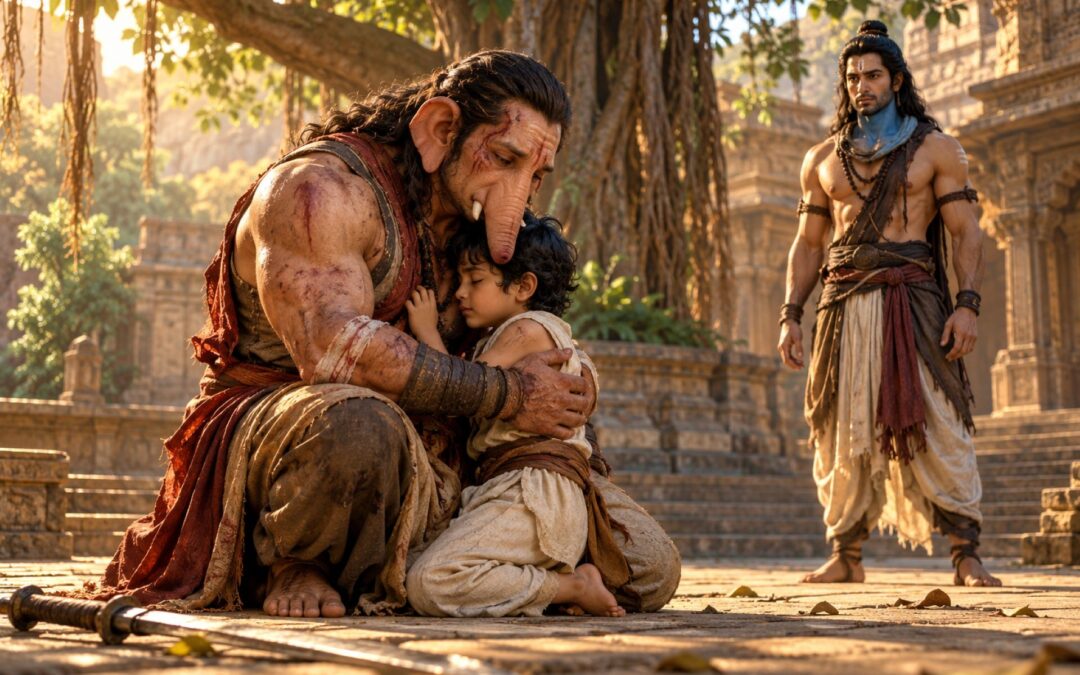
Ganesh manages to keep the child safe but sustains devastating wounds. When Shiva and Sati arrive, they find him near death.
In his weakened condition, Ganesh’s concern remains fixed upon Kartik. He tells Shiva that the boy is safe, addressing him as a father despite the rejection he has recently experienced.
The episode forces Shiva to reconsider his judgment. He has treated Ganesh as an enemy who deserves punishment, yet this supposed enemy has sacrificed himself to protect Shiva’s son.
Ayurvati undertakes the difficult work of saving Ganesh. His injuries are extensive, and recovery requires considerable time.
During his treatment, Sati’s attachment to him deepens. She refuses to allow the circumstances of his birth or the accusations directed against him to determine whether he belongs to her family.
Kartik also remains devoted to his brother. Their relationship becomes a source of emotional pressure upon Shiva, whose hostility increasingly seems inconsistent with what he has personally witnessed.
Shiva does not instantly forget Brahaspati or abandon his suspicions. His change is gradual, shaped by the contrast between Ganesh’s reputation and his conduct.
The rescue demonstrates something that abstract discussions of morality could not accomplish alone. Shiva must decide whether he will judge a person by an accusation that confirms his anger or by the choices that person makes when another life is at risk.
Daksha’s Deception and the Maika Mystery
Ganesh’s recovery brings the history of Sati’s family into sharper focus. Shiva becomes increasingly convinced that the separation of Sati from Kali and Ganesh cannot be explained entirely by impersonal social rules.
The suspicion centres upon Meluha’s Maika system. Established as part of the Suryavanshi effort to create an orderly and meritocratic society, Maika removes children from their biological families and raises them through a centralized institutional process.
The ideal is that children should develop without automatically inheriting the privileges or limitations of their parents’ status. Their future social position is intended to reflect their individual abilities rather than hereditary advantage.
Over time, however, the system has been modified in ways that benefit powerful families. The children of elites receive advantages that undermine the original principles of equality.
Parvateshwar’s family opposed these changes. Their hereditary vow of celibacy developed as a protest against the corruption of the system and continued to influence successive generations long after the original political dispute.
Sati’s experience reveals an even more disturbing failure. The laws governing Naga children have allowed supposedly undesirable infants to disappear from their families, with parents sometimes receiving false accounts of their fate.
Ganesh’s survival suggests that somebody chose to conceal the truth from Sati. Shiva suspects that Daksha may have been personally responsible.
When the emperor unexpectedly arrives in Kashi, Shiva arranges a confrontation. He summons Kali and Ganesh into Daksha’s presence, hoping the emperor’s immediate response will reveal what he knows.
Daksha reacts with shock and hostility. His language exposes his prejudice against the Nagas and his fear of their connection to the royal family.
He attempts to portray Kali and Ganesh as dangerous outsiders, but Sati refuses to accept his characterization. She insists that they are her sister and son and that their relationship to her does not depend upon Daksha’s approval.
Pressed by Shiva and Sati, Daksha admits that he concealed Ganesh’s survival. He claims he acted to protect Sati from the shame and suffering he believed would accompany motherhood of a Naga child.
His explanation reveals the central contradiction in his behaviour. Daksha insists that he loves Sati, but he has denied her the truth about her own child because preserving social respectability mattered more to him than her right to make decisions about her family.
Shiva then raises another suspicion concerning Chandandhwaj, Sati’s first husband. Chandandhwaj supposedly died by drowning around the time Ganesh was born, a coincidence Shiva now considers suspicious.
When Shiva asks whether Daksha arranged the death, the emperor’s terrified response strongly suggests guilt. Although Daksha does not provide a full confession explaining the crime, his reaction convinces Shiva that the deception extended further than the concealment of Ganesh.
For Sati, the implications are devastating. The father whose love and authority helped shape her identity may have been responsible for the destruction of her first marriage as well as the disappearance of her son.
The confrontation escalates into violence. Daksha’s behaviour becomes increasingly desperate, while Kali reacts furiously to the years of rejection she has endured.
Sati nearly attacks her father. Shiva intervenes, preventing her grief and anger from turning into an act she might later regret.
Daksha leaves under Veerini’s protection, but his relationship with Sati has been profoundly damaged. She can no longer reconcile his public devotion to moral order with the suffering caused by his private decisions.
The following chapter supplies important context for Daksha’s personality. Through Veerini’s recollections, the novel reveals that Daksha was humiliated by his father, Brahmanayak, who considered him weak and unworthy of royal authority.
Brahmanayak’s contempt undermined Daksha’s confidence and intensified his dependence on approval from more powerful figures. Veerini once imagined escaping the restrictions of Meluhan royal life, but that possibility was never realized.
The history explains aspects of Daksha’s insecurity without removing his responsibility. His experience of humiliation helps illuminate why he values reputation so intensely, but it cannot justify lying to his daughter or sacrificing vulnerable family members to preserve social standing.
The Maika mystery therefore exposes corruption at several levels. An institution designed to prevent hereditary injustice has been altered to protect hereditary privilege, while a father who claims to act from love has used the institution’s prejudices to destroy his own family.
The Journey Through Dandak and the Attack on the Godavari
After the confrontation with Daksha, Kali invites Shiva to visit Panchavati and discover the Nagas’ secret. Shiva accepts, despite the uncertainty surrounding Ganesh and Brahaspati.
His decision represents a change from his original intention. He no longer approaches Panchavati solely as an enemy territory to be conquered. He is prepared to enter it under Naga protection and examine evidence that may challenge his assumptions.
The expedition includes Shiva, Sati, Kali, Ganesh, Parvateshwar, Anandmayi, Bhagirath, Parshuram, and their companions. Ayurvati accompanies them as physician, while Veerbhadra, Krittika, Nandi, and other trusted followers remain part of the travelling party.
Their route leads through the eastern waterways and into the dangerous Sundarban and Dandak Forest. The journey requires specialized knowledge of geography, river movements, and concealed passages.
At the entrance to the hidden route, Shiva discovers that the Nagas have developed defensive methods unknown to outsiders. Floating trees conceal passages through waterways, while engineered barriers and carefully controlled access points protect the approach to Panchavati.
The surrounding forest is hostile to anyone unfamiliar with its dangers. Kali and Ganesh warn the travellers that attempting to navigate it independently would be exceptionally dangerous.
The expedition eventually reaches the Godavari, where the Nagas maintain an important defensive outpost. Its organization reflects their expectation that outsiders may attempt to attack Panchavati.
A sudden warning reveals that enemy vessels are approaching along the river. The attackers have managed to discover a route that was supposed to remain secret.
The situation becomes immediately dangerous. The expedition has limited time to organize a response, and the enemy ships possess the capacity to inflict serious damage before conventional defenders can assemble.
Ganesh takes command of the counterattack. His experience with Naga defensive systems allows him to respond quickly, deploying specialized vessels known as devil boats.
The defenders use their smaller craft to carry fire towards the attacking ships. The manoeuvre requires courage and precision because the defenders must approach powerful enemy vessels without exposing the larger expedition to destruction.
The attack succeeds more dramatically than expected. The enemy ships explode with extraordinary force after fire reaches the daivi astras they are carrying.
These weapons belong to a class of highly destructive armaments associated with the ancient military traditions that Lord Rudra sought to restrain. Their presence suggests that the attackers possess resources and connections far beyond those of ordinary bandits.
The explosions destroy the enemy vessels, but the defenders suffer casualties and injuries. Ayurvati and the medical personnel struggle to save the wounded while the surviving commanders assess the threat.
The attack raises several disturbing questions. Somebody has discovered the approach to Panchavati, assembled a heavily armed force, and attempted to destroy a party containing the Neelkanth and the Naga leadership.
The identity of this enemy remains uncertain. Suspicion falls upon powerful interests that may have reasons to fear Shiva’s growing independence, but the evidence does not conclusively identify the organizer.
The battle also demonstrates Ganesh’s competence as a military leader. He has already proved his willingness to risk his life for Kartik; now he displays the organizational skill necessary to defend an entire expedition.
Shiva witnesses another example of the supposed monster acting with loyalty, courage, and intelligence. His willingness to continue the journey reflects his growing recognition that he cannot understand the conflict through his earlier assumptions.
Panchavati and the Return of Brahaspati
After surviving the attack, Shiva and his companions continue towards Panchavati. The hidden city is protected by formidable natural barriers and the elaborate precautions developed by its inhabitants.
Its appearance challenges Shiva’s expectations. The capital of the feared Nagas is neither a primitive refuge nor a disorderly settlement of violent outcasts. It is an organized community with public institutions, housing, cultural facilities, and a clear conception of collective welfare.
Panchavati was established under the principles of Bhoomidevi, a mysterious woman who shaped Naga society despite not being a Naga herself. Her origins remain obscure, and her followers honour her memory primarily through the institutions she established.
The city has been designed to provide a basic level of material equality. Houses follow the same general design, including the residence of the Naga queen. Public provision ensures that inhabitants receive fundamental necessities without a hierarchy of wealth determining their entitlement.
This does not mean everybody is required to live an identical personal life. The state provides a common foundation while allowing individuals to make their own choices about work, interests, and personal pursuits.
Shiva also encounters families whose circumstances challenge conventional assumptions about the Nagas. Some parents who give birth to Naga children choose to remain with them rather than surrender them to institutions or abandon them.
Other children have been left behind by families unwilling to accept their appearance. Panchavati provides them with care, and childless Nagas adopt many of these abandoned infants.
The practice gives the city a social purpose beyond protecting people who share visible physical differences. It provides family and security to children who might otherwise be denied both.
The city centre contains educational, religious, and cultural institutions surrounding the legendary banyan trees. There is a temple associated with Lord Rudra and Lady Mohini, a school, public bathing facilities, and spaces devoted to performance and recreation.
Shiva expects the Nagas’ great secret to be concealed in a temple, archive, or other place associated with unusual knowledge. Instead, Kali and Ganesh direct him towards the school.
As the group approaches a classroom, Shiva hears a teacher discussing desire with his students. The lesson begins with a familiar philosophical claim: desire causes attachment, suffering, conflict, and ultimately destruction.
The teacher then challenges the apparent simplicity of that explanation. Drawing upon the Rig Veda, he observes that desire can also be understood as the original impulse that brings creation into existence.
If desire produces both creation and destruction, it cannot be classified as an entirely negative force. Destruction depends upon something having first been created, and creation itself introduces the possibility of eventual loss.
Shiva is intrigued by the reasoning and recognizes something familiar in the teacher’s voice. He assumes that the classroom contains another Vasudev pandit.
Kali explains that the secret is not an object or a written revelation. It is a person.
Ganesh opens the classroom, and Shiva discovers that the teacher is Brahaspati.
His friend is alive.
Brahaspati’s appearance overturns the assumption that has driven Shiva’s investigation since the destruction of Mount Mandar. The man Shiva believed murdered has survived and is living among the Nagas, teaching children in their capital.
The revelation also transforms the apparent meaning of Ganesh’s conduct. Shiva’s belief that Ganesh killed Brahaspati can no longer remain intact in its original form.
Yet the novel stops at the moment of recognition. Brahaspati’s complete explanation, the circumstances surrounding his disappearance, and the wider conspiracy remain unresolved.
The ending gives Shiva the person he most desperately wanted to recover while leaving him with a far more complicated understanding of the mission that brought him there.
The Civilizations and Institutions of Amish’s Ancient India
The fictional India of The Secret of the Nagas is organized around competing models of civilization. These differences affect law, political authority, medicine, education, family life, economic organization, and the treatment of outsiders.
Meluha represents the Suryavanshi ideal of disciplined collective life. Its citizens respect laws associated with Lord Ram, and its institutions seek to create stability through regulation and an emphasis on duty. Public order, sophisticated infrastructure, and the ambition to eliminate hereditary unfairness are among its defining achievements.
The Maika system expresses that ambition especially clearly. By removing children from their families and raising them through a centralized process, Meluha hopes to prevent inherited social position from determining individual opportunity.
The difficulty emerges when the institutional ideal encounters human power. Wealthy and influential families modify rules to preserve privileges for their descendants. The laws remain outwardly respectable even as their application becomes inconsistent with the justice they were supposed to protect.
The treatment of Nagas exposes the same contradiction. A civilization that believes in rational social organization labels children as undesirable because of bodily characteristics and permits practices that separate them from their families.
Swadweep, the Chandravanshi kingdom, offers a contrasting model. Its society allows greater individual freedom and adaptation, but political competition can produce instability, corruption, and personal violence.
Bhagirath’s attempted assassination, the intrigues surrounding Surapadman, and the exploitation of children in dangerous sporting contests reveal the weaknesses of a system in which power and personal ambition can escape effective restraint.
Kashi occupies a different position. Its religious importance and association with Lord Rudra make it a refuge for communities from multiple backgrounds. Its institutions provide opportunities for interaction across the divisions separating the great kingdoms.
Yet Kashi’s cosmopolitan reputation does not eliminate prejudice. The hostility directed against the Brangas shows that coexistence can break down when one group is treated as responsible for another’s grievances.
The city also demonstrates how personal compassion can survive beneath public conformity. Athithigva protects his sister Maya despite belonging to a society that condemns people like her.
Branga contributes a more material dimension to the novel’s world-building. Its waterways, ports, river engineering, fertile lands, and public buildings suggest a prosperous civilization whose achievements developed through geography and trade.
The plague reveals the limits of wealth and technological sophistication. Branga possesses substantial resources but cannot free itself from dependence upon medicine supplied by outsiders.
Panchavati offers a fifth model, organized around the needs of a socially rejected population. Its equal housing, provision of basic necessities, adoption practices, and public institutions embody the Nagas’ commitment to providing a dignified life.
However, the city is introduced under unusually favourable circumstances, and the reader sees comparatively little of its internal disagreements or the practical limitations of its system. Its role is partly to challenge the moral assumptions attached to the word Naga.
The geography of the novel supports these contrasts. Rivers connect communities through commerce and medicine while also serving as routes for invasion. Forests shelter excluded populations but require extraordinary resources to navigate and defend.
Tripathi’s fictional civilization is therefore shaped by the relationship between political ideals and material conditions. The conflicts arise when a society’s claims about justice, freedom, or equality fail to match its treatment of people who possess less power.
Ganesh, Kali, and the Humanity of the Nagas
Ganesh and Kali are central to the novel’s examination of prejudice because their experiences reveal the personal consequences of Meluha’s classifications.
Ganesh is introduced as a frightening warrior whose physical appearance and exceptional abilities make him appear dangerous. His fighting style, disciplined followers, and involvement in secretive activities encourage Shiva to interpret him as an enemy.
The reader, however, receives evidence that complicates this judgment long before Shiva discovers Ganesh’s identity. The rescue of the tribal mother and child demonstrates his hatred of exploitation, while his loyalty to the Brangas establishes his willingness to protect entire communities.
His conduct is not uniformly gentle. He is capable of ruthless violence and gives severe orders when confronting people who abuse the vulnerable.
That contradiction makes him more interesting than a conventionally virtuous victim of prejudice. Ganesh’s compassion and ferocity coexist, and the novel asks readers to judge the circumstances and consequences of his decisions rather than assume that either quality defines his entire character.
His deepest emotional conflict concerns abandonment. Ganesh has grown up believing that his mother rejected him, and the discovery that she was deceived changes his understanding of the separation.
His reunion with Sati is therefore emotionally complicated. He longs for her affection, but the years of deprivation cannot disappear simply because she now welcomes him.
The relationship with Kartik provides a particularly effective expression of Ganesh’s personality. Kartik has not absorbed the social judgments that define adult responses to the Nagas, and he treats Ganesh as his elder brother without reservation.
Ganesh’s defence of Kartik demonstrates how profoundly he values this bond. He risks his own life to preserve a family relationship that society would once have denied him.
His response to Shiva’s hostility also reveals unusual restraint. Ganesh has legitimate reasons to resent being condemned by a man who knows little about him, yet he refuses to retaliate in ways that would deepen Sati’s suffering.
Kali’s personality is more openly confrontational. As the Naga queen, she has spent years protecting people subjected to exclusion and hostility. Her resentment towards Meluha reflects personal injury as well as political responsibility.
She knows that her physical difference has shaped every important aspect of her life. While Sati became a royal daughter and respected warrior, Kali was separated from her family and forced to establish an identity among other rejected people.
Her anger is consequently directed towards institutions and individuals who claim moral superiority while denying dignity to those who differ from them.
Kali nevertheless possesses a strong sense of loyalty. She defends Ganesh, supports the Brangas, honours the commitments associated with Bhoomidevi, and eventually offers Shiva an opportunity to discover the truth about Panchavati.
Her reconciliation with Sati requires more than the discovery of their relationship. She must recognize that Sati’s privileged life was not the result of a deliberate decision to abandon her sister.
Sati, in turn, must accept that Kali’s anger has been produced by genuine suffering. Neither woman can recover the years lost to their separation, but their reunion creates the possibility of a relationship no longer governed by Daksha’s deception.
Together, Ganesh and Kali complicate the traditional distinction between monsters and heroes. Their bodies have been treated as evidence of moral inferiority, although their choices frequently reveal qualities lacking in the supposedly respectable people who condemned them.
The novel does not establish that every Naga action is justified. Kali’s defence of Naga violence depends partly upon her interpretation of those who were targeted, while Ganesh’s treatment of enemies can be severe.
Their humanity lies in their capacity for loyalty, error, anger, tenderness, courage, and moral choice. Those qualities belong to individuals rather than physical categories.
Parvateshwar and Anandmayi: Love Against Duty
Parvateshwar’s relationship with Anandmayi develops as a lighter romantic subplot, but its underlying conflict is closely connected to the novel’s larger ideas about laws and personal responsibility.
Parvateshwar is a disciplined Meluhan general who has devoted his life to duty. His seriousness, loyalty, and commitment to Suryavanshi principles define his identity, leaving little room for a relationship that might place personal happiness above an inherited obligation.
Anandmayi approaches life differently. As a Chandravanshi princess, she is comfortable expressing desire, challenging conventions, and using humour to expose the contradictions in other people’s behaviour.
She is attracted to Parvateshwar precisely because his discipline and integrity distinguish him from the men who ordinarily pursue her. Rather than waiting for him to acknowledge the attraction, she openly challenges his resistance.
The obstacle is his hereditary vow of celibacy. The vow originated in his family’s protest against modifications to the Maika system that privileged the children of powerful families. It was intended as a moral demonstration against institutional corruption.
Anandmayi questions whether continuing the vow indefinitely achieves its original purpose. She does not deny the legitimacy of the protest, but she asks why Parvateshwar must sacrifice his life to honour a political commitment made generations earlier.
The dilemma resembles the Vasudevs’ distinction between fixed laws and changing circumstances. Parvateshwar respects the vow because it represents his family’s integrity; Anandmayi argues that integrity may require reconsidering whether the original obligation remains justified.
Their relationship is also tested through military events. Anandmayi demonstrates courage and intelligence, while Parvateshwar sees that she possesses qualities extending far beyond the playful behaviour with which she initially unsettles him.
His gradual acceptance of their relationship becomes an important personal transformation. He does not abandon his commitment to justice, but begins distinguishing its purpose from rigid obedience to its inherited form.
The pair marry aboard the expedition’s ship after the Battle of Madhumati. Anandmayi refuses to delay the ceremony for the elaborate arrangements appropriate to her royal status, and Shiva gives the union his blessing.
Their marriage offers a comparatively hopeful resolution to the novel’s recurring conflict between duty and desire. Parvateshwar learns that fidelity to principle need not require permanent self-denial, while Anandmayi gains a partner whose sense of responsibility she respects.
Daksha, Bhrigu, and Power Behind the Neelkanth
The political intrigue surrounding Daksha and Bhrigu reveals that Shiva’s mission is being shaped by powerful people who possess information they refuse to disclose.
Daksha begins as the ruler who welcomed Shiva into Meluha and recognized his significance as the Neelkanth. His reverence appears sincere, but his willingness to support Shiva is complicated by fear of losing control.
He is accustomed to operating within a hierarchy where authority and legitimacy depend upon acceptance by powerful figures. Bhrigu exploits this weakness, repeatedly reminding him that Shiva’s growing independence threatens their plans.
Bhrigu’s influence rests upon spiritual status, intellectual knowledge, and institutional power. He operates behind the visible political order, influencing rulers through information and obligations they do not fully control.
His activities suggest that the conflict involving Brahaspati, the Somras, and the Vasudevs belongs to a struggle much larger than Shiva’s personal quest for revenge.
The scenes involving Bhrigu and Daksha are particularly important because they place the supposedly enlightened Meluhan establishment under suspicion. Its leaders know more than they admit, and their willingness to manipulate Shiva conflicts with their claims of moral authority.
Bhrigu also extends his influence into Swadweep, where Dilipa’s vulnerability creates an opportunity for intervention. The resulting political pressure demonstrates how medical dependence can become a source of power over rulers and their kingdoms.
Daksha’s personal history helps explain his susceptibility. His father Brahmanayak treated him with contempt, regarding him as physically weak and unworthy of royal leadership.
The humiliation encouraged Daksha to associate respect with outward strength, family reputation, and political acceptance. His treatment of Kali and Ganesh reflects those anxieties.
He loves Sati, but his love becomes inseparable from his desire to preserve a socially acceptable image of her. Instead of confronting the prejudice that condemns her children, he chooses to conceal them.
His decisions reveal a form of moral weakness different from open cruelty. Daksha repeatedly persuades himself that protecting his family requires actions that deprive its members of autonomy, truth, and love.
Shiva’s growing independence threatens both men. Bhrigu fears the consequences of a Neelkanth who might identify evil differently from the powerful institutions guiding him, while Daksha fears the exposure of his personal crimes.
The novel does not yet disclose the complete scope of Bhrigu’s intentions or establish every connection between the political intrigues. Their importance lies in demonstrating that Shiva is surrounded by competing authorities attempting to determine what he will believe and whom he will fight.
Karma, Justice, and the Meaning of Evil
The philosophical conflict in The Secret of the Nagas begins with Shiva’s childhood guilt and develops through his encounters with increasingly difficult moral choices.
His mother’s response to the assault he witnessed emphasizes the practical limits of responsibility. She argues that a child cannot be expected to overcome an attacker vastly stronger than himself, especially when intervention would probably result in another death.
His uncle approaches the same incident differently. He asks Shiva to consider whether moral responsibility depends entirely upon the likelihood of success or whether individuals must sometimes act according to their principles regardless of personal risk.
These perspectives establish the tension between consequences and duty that recurs throughout the story.
Parvateshwar’s response to the Branga riot provides a concrete example. He authorizes the beating of innocent people because he believes it will prevent a massacre. His decision involves deliberately committing a lesser wrong to prevent a greater one.
The novel does not offer an easy answer to whether his compromise is justified. His motives are protective, but the Brangas are still subjected to punishment they do not deserve.
Sati’s conduct at Icchawar presents another version of the problem. She chooses to protect villagers threatened by lions even after the danger exceeds what she initially anticipated. Her decision reflects the conviction that responsibility cannot simply be abandoned when intervention becomes difficult.
Parshuram’s history introduces a different question: whether a person who has suffered a terrible injustice acquires the right to inflict suffering in return.
The murder of Jamadagni and the devastation of Renuka make Parshuram’s rage comprehensible. Yet his subsequent violence creates victims of its own, and the Vasudevs condemn his refusal to follow lawful processes.
Shiva faces a similar temptation after Drapaku’s death. His desire to kill the captured Parshuram is driven by genuine grief, but carrying out the execution would violate the protections owed to a prisoner.
The incident suggests that revenge can turn even a well-intentioned person away from the principles he claims to defend.
Ganesh’s treatment of Shiva provides a contrasting example. Despite being condemned and rejected, he refuses to retaliate in a manner that would injure Sati. His protection of Kartik further demonstrates his willingness to act from responsibility rather than resentment.
The novel also examines the idea of karma through Shiva’s growing reluctance to judge people by inherited circumstances. Meluhan society associates physical abnormalities and misfortune with wrongdoing in previous lives, but Shiva increasingly questions whether such beliefs can justify present discrimination.
A central distinction emerges between moral responsibility and social punishment. Individuals may be accountable for their choices, but institutions can easily turn claims about karma into excuses for harming people who have committed no demonstrable offence.
Shiva’s journey repeatedly challenges him to distinguish his emotional reactions from justified moral judgment. Anger may alert him to wrongdoing, but it does not automatically reveal who is guilty or what punishment is appropriate.
Laws, Freedom, and the Limits of Moral Certainty
The contrast between Suryavanshi and Chandravanshi civilizations provides the novel with its principal political framework.
The Vasudev pandit at Magadh describes two broad approaches to organizing society. The masculine approach emphasizes fixed rules, consistency, and obedience to an established moral order. The feminine approach emphasizes flexibility, adaptation, and judgment according to circumstances.
These categories describe political and philosophical tendencies within the fictional world rather than biological characteristics.
Meluha embodies the first approach. Its laws provide predictability and encourage citizens to subordinate immediate personal desires to the collective good.
The system is effective when the rules remain consistent with their original purpose. Problems emerge when circumstances change or powerful groups manipulate the law to preserve their own advantages.
The Maika system illustrates the danger. Its original design seeks to prevent hereditary privilege, yet later modifications produce precisely the inequality it was intended to overcome.
The restriction of Naga children and the condemnation of vikarma individuals reveal another weakness. People can remain technically obedient to the rules while participating in an arrangement that violates basic principles of fairness.
Swadweep offers greater flexibility, but its political intrigues show that adaptability without firm restraints may permit corruption and violence.
Neither civilization can therefore claim complete moral superiority.
Parvateshwar’s relationship with Anandmayi expresses the conflict at an individual level. His vow represents loyalty to a family principle, but rigid adherence threatens to turn a historical protest into an unnecessary sacrifice.
Anandmayi’s argument does not require abandoning the principle. It requires asking whether the present action still serves the principle’s original purpose.
This distinction also shapes Sati’s transformation. She begins by assuming that obedience to Meluhan law is a reliable expression of goodness. Her encounters with Maya, Kali, and Ganesh force her to recognize that laws must be judged by their consequences for actual people.
The novel’s philosophical framework is persuasive when demonstrated through such conflicts. It becomes less convincing when expressed as an overly broad distinction between two supposedly fundamental ways of life.
Actual societies combine stable rules with discretionary judgment, and individuals may require both qualities within the same situation. The fictional distinction works best as a tool for understanding particular conflicts rather than a complete account of human civilization.
Shiva’s developing task is to combine respect for justice with the flexibility necessary to recognize when established rules have become unjust.
The Vasudevs, Science, and the Search for Truth
The Vasudevs occupy an unusual position in the trilogy’s imagined world. They are spiritual guides, custodians of historical knowledge, and practitioners of technologies or disciplines that appear extraordinary to outsiders.
Their relationship with Shiva is both supportive and frustrating. They offer insights that help him reconsider his assumptions, yet they habitually refuse to explain the complete circumstances surrounding his destiny.
Their teaching method relies heavily upon questions. Instead of identifying evil directly, they encourage Shiva to examine the principles by which he makes moral judgments.
This approach can promote independence. Shiva becomes more capable of recognizing contradictions in the claims made by kings, priests, and military leaders.
Nevertheless, the Vasudevs also possess considerable influence over what Shiva knows. By controlling the timing and content of their explanations, they can shape the direction of his investigation while appearing merely to guide it.
Their ability to communicate through radio waves illustrates the novel’s attempt to reinterpret seemingly supernatural powers as applications of natural science.
The explanation suggests that disciplined minds can detect signals inaccessible to ordinary people and use them to communicate across long distances. Shiva’s unusual ability allows him to participate without undergoing the training normally required.
The mechanism is speculative fiction rather than a historically established or scientifically demonstrated human capability. Its narrative function is to make the Vasudevs’ apparent omnipresence compatible with the trilogy’s portrayal of ancient technological sophistication.
Medicine serves a similar purpose. Sanjeevani, Naga preparations, and Somras possess extraordinary properties while being discussed through the language of plants, substances, and medical processes.
These details help create a world in which myths associated with divine power may have physical or technological explanations.
The Vasudevs’ secrecy also creates an important contradiction. They insist that Shiva must discover truth through independent judgment, but their refusal to share relevant information sometimes makes that independence difficult.
Shiva’s anger when he discovers their possession of Naga medicine is partly unreasonable, since he has assumed guilt without proof. Yet the order’s unwillingness to explain its connections also contributes to his distrust.
The contrast with Bhrigu is especially significant. Both represent authoritative traditions claiming knowledge about Shiva’s larger purpose, but the novel increasingly encourages suspicion towards those who seek to control how the Neelkanth acts.
Good and Evil as Two Sides of the Same Coin
Shiva begins the trilogy with a relatively simple understanding of evil. He expects the Neelkanth to identify a dangerous enemy and defeat it, thereby protecting the righteous from harm.
His experiences in The Secret of the Nagas make that conception increasingly difficult to sustain.
The Vasudev Gopal encourages Shiva to question whether evil can be located in entire groups of people. Shiva has repeatedly assumed that the Nagas are evil, yet he continues encountering evidence of their loyalty, generosity, and courage.
Gopal develops the discussion by asking whether evil has a purpose within the larger structure of existence.
The idea initially appears disturbing. If evil causes suffering and destruction, why should it possess any legitimate function?
Gopal draws upon teachings associated with Manu to suggest that the universe may contain destructive forces because they perform a necessary role within a changing world. The Mahadev’s responsibility is therefore connected with recognizing when something once useful has become harmful.
This formulation complicates the assumption that evil exists as a permanent characteristic of particular people. A force, institution, or practice may have a beneficial purpose under one set of circumstances and become destructive when those circumstances change.
Meluha’s legal order provides a possible illustration. Its system originally promotes stability and fairness, but alterations and rigid applications produce injustice.
The same distinction appears in the novel’s treatment of desire. The classroom discussion at Panchavati begins with the view that desire creates attachment and suffering, but Brahaspati introduces a competing understanding drawn from the Rig Veda.
Desire also initiates creation. Without the impulse to create, pursue, or preserve something, the world would remain without activity or development.
Creation and destruction are consequently connected. Whatever comes into existence becomes vulnerable to change, loss, and eventual disappearance.
The argument does not establish that every destructive act is justified. It suggests that moral judgment requires an understanding of purpose, context, and consequences rather than reliance upon simple labels.
The relationship between good and evil also appears in characters whose motivations combine admirable and damaging qualities. Daksha loves his daughter but commits acts of cruelty in the name of protecting her. Parshuram seeks justice for his family but becomes responsible for further suffering.
Shiva himself embodies the problem. His desire to destroy evil arises from compassion and responsibility, yet his anger almost leads him to execute a helpless prisoner.
The novel’s philosophical claims should be distinguished from what its narrative actually proves. Gopal’s suggestion that evil serves a cosmic purpose remains part of the fictional system’s developing metaphysics rather than a conclusion demonstrated in every instance.
What the story establishes more convincingly is that moral judgment becomes unreliable when people substitute inherited labels for attention to actual conduct.
The Ending Explained: What the Nagas’ Secret Really Reveals
The revelation that Brahaspati is alive changes the meaning of Shiva’s journey.
For most of the novel, Shiva believes the Nagas are responsible for the destruction of Mount Mandar and the murder of his friend. His determination to find them is therefore inseparable from grief and a desire for revenge.
Ganesh’s identity appears to confirm that the enemy has entered Shiva’s own family. When Shiva discovers that Ganesh is Sati’s son, he must confront the possibility that accepting his family requires tolerating the man who murdered Brahaspati.
Ganesh’s extraordinary courage gradually weakens Shiva’s certainty, but it does not resolve the accusation.
The ending does.
When Shiva enters the classroom at Panchavati, he discovers the supposedly murdered Brahaspati teaching Naga children. The familiar voice, changed appearance, and emotional reunion establish that his friend survived.
This does not immediately explain the destruction of Mount Mandar or prove that every Naga action was innocent. It does establish that Shiva’s central assumption about Brahaspati’s death was false.
The revelation also changes the significance of Ganesh’s earlier silence. Shiva condemned him without possessing all the relevant facts, while Ganesh repeatedly refused to reveal information that might have defended him.
Why Ganesh maintained that silence remains part of the mystery. The second novel does not yet provide the complete account of Brahaspati’s disappearance and the events surrounding it.
The location of the reunion is significant. Shiva expected the Nagas’ secret to be a weapon, document, or source of hidden political power. Instead, it is a living person engaged in education.
Brahaspati’s presence suggests that the Nagas possess knowledge and relationships unavailable to Shiva’s previous understanding of the conflict.
Panchavati itself reinforces this reversal. The city Shiva imagined as an enemy stronghold is revealed as a refuge for people rejected by supposedly enlightened civilizations.
Its inhabitants care for abandoned children, provide medicine to outsiders, and maintain institutions devoted to education and public welfare.
The final classroom discussion adds another layer to the revelation. Brahaspati challenges the idea that desire is only a destructive force, demonstrating that creation and destruction arise from interconnected processes.
Shiva’s journey has exposed a comparable difficulty in moral classification. The people he believed evil have preserved someone he loved, while people he trusted have concealed serious wrongdoing.
Several major questions remain unresolved. The circumstances of Brahaspati’s survival are not yet fully explained, the identity and motives of the attackers on the Godavari remain uncertain, and the larger conflict involving Somras, Bhrigu, and the Vasudevs has not reached its conclusion.
The novel also has not supplied a complete answer to the question of what Shiva must ultimately destroy.
As the middle volume of a trilogy, The Secret of the Nagas is designed to transform the central mystery rather than resolve it. Its ending closes the most immediate emotional uncertainty while opening a more consequential investigation into the institutions and powers that have manipulated Shiva’s mission.
The effect depends upon the reader accepting the deliberate postponement of answers. Brahaspati’s return is an effective reversal because it forces a reinterpretation of the preceding story, but its emotional satisfaction is limited by the absence of an immediate explanation.
The Secret of the Nagas as a Novel: Structure, Prose, and Pacing
Tripathi organizes The Secret of the Nagas through multiple storylines that develop simultaneously before converging around the family revelations.
The principal narrative follows Shiva’s expedition from Ayodhya through Kashi and Branga towards Panchavati. A parallel storyline follows Sati’s investigation of the eastern palace and her confrontation with the lions at Icchawar.
Additional scenes involving Ganesh, Kali, Bhrigu, Daksha, and other political figures provide information unavailable to Shiva. This creates dramatic irony because readers occasionally encounter evidence that contradicts his assumptions before he does.
The early portrayal of Ganesh is an effective example. His rescue of a tribal mother and child demonstrates compassion even while Shiva continues pursuing him as a murderer.
The structure also allows separate incidents to converge at emotionally consequential moments. Shiva’s battle with Parshuram and Sati’s fight at Icchawar appear to be distinct adventures, but each brings the characters closer to understanding the Nagas.
The contrast between military spectacle and private emotional revelation is particularly important. After large battles and elaborate tactical manoeuvres, the discovery that Kali and Ganesh belong to Sati’s family changes the stakes more profoundly than either victory.
Tripathi frequently ends scenes with a surprise, a new piece of information, or a question that encourages readers to continue. The method gives the novel strong forward momentum, especially through its central chapters.
It can also become predictable. The repeated postponement of explanations, sudden interruptions, and cryptic conversations sometimes make suspense appear mechanically imposed rather than organically produced.
The action sequences are ambitious. Parshuram’s river defences, the lion attacks, the engineering of Branga, and the battle on the Godavari provide varied settings and tactical problems.
The battles are most effective when the geography and choices of the participants remain clear. The Madhumati campaign, for example, depends upon Parshuram’s familiarity with the terrain and Parvateshwar’s ability to recognize a way of disrupting his advantage.
At other moments, the lengthy descriptions of combat, injuries, and dramatic reversals can interrupt the movement of the larger mystery.
The prose is deliberately accessible. Dialogue relies upon straightforward modern language, and the characters frequently express their emotions with a directness more familiar from contemporary adventure fiction than from classical epic literature.
This choice allows readers without specialist knowledge of Hindu mythology to follow complicated relationships and institutions. It also permits humour, especially in Shiva’s interactions with friends and Anandmayi’s efforts to unsettle Parvateshwar.
The limitation is that the language occasionally weakens the historical atmosphere the novel attempts to establish. Characters who inhabit an imagined ancient civilization sometimes sound conspicuously contemporary.
The philosophical passages present another structural challenge. The Vasudevs explain ideas through lengthy conversations that clarify the book’s concerns but can interrupt the surrounding action.
These exchanges are strongest when a concrete incident has already made the philosophical question urgent. The discussion of laws and duty gains force from Parvateshwar’s predicament, while Shiva’s reflections upon evil become more persuasive after his encounters with Ganesh and Parshuram.
The novel’s use of recognizable mythological names creates a distinct form of suspense. Readers familiar with the traditional figures may anticipate relationships or symbolic meanings, but Tripathi modifies the characters’ histories within his fictional world.
This familiarity provides an additional layer of interest without requiring the novel to reproduce religious tradition literally.
As a middle volume, the book succeeds in expanding its setting and intensifying the central conflict. Its challenge is that the expansion introduces more mysteries than it resolves, placing substantial responsibility upon the concluding volume.
A Critical Review of the Secret of the Nagas
The Secret of the Nagas is an ambitious and frequently entertaining sequel whose most effective material arises from the collision between inherited moral beliefs and personal experience.
Tripathi understands the appeal of combining recognizable mythological figures with the structures of popular adventure fiction. Shiva’s mission supplies the narrative with urgency, while the progressively disclosed history of the Nagas gives the adventure an ethical dimension extending beyond the defeat of a conventional enemy.
The book’s strongest achievement is its treatment of moral certainty. Shiva begins with a clearly identified target, but nearly every important encounter complicates his understanding of that target.
Ganesh’s defence of the tribal child, the Brangas’ dependence on Naga medicine, Sati’s discovery of Maya, and the revelation of Ganesh’s parentage all undermine the assumption that physical difference or public reputation provides reliable evidence of moral character.
This progression works because the novel offers concrete experiences rather than relying exclusively upon abstract declarations. Shiva must encounter people whose actions contradict what he believes before he can begin reconsidering those beliefs.
The family revelations are particularly effective. Sati’s discovery of Kali and Ganesh connects the social treatment of the Nagas to intimate experiences of parental loss, abandonment, and deception.
Daksha’s betrayal becomes more painful because he is not portrayed as a stranger acting against Sati. He is her father, a man who claims to love her and believes his actions protect the family.
The contradiction between his affection and his cruelty provides the novel with some of its strongest emotional material. His confrontation with Sati also transforms a broad argument about unjust institutions into a personal tragedy.
Ganesh is another successful character. His extraordinary fighting ability could easily have reduced him to a conventional heroic warrior, but his emotional restraint and longing for family complicate the portrayal.
His relationship with Kartik is especially affecting because it develops without the ideological complications surrounding Shiva and Sati. The younger child accepts his brother naturally, making Ganesh’s willingness to protect him both believable and emotionally consequential.
Kali is less extensively developed as an individual, but her anger and political responsibility give her an identifiable personality. She is not simply a symbol of social exclusion; she is a ruler whose decisions affect vulnerable communities dependent upon her protection.
The novel also succeeds in making its imagined world varied. Kashi, Branga, and Panchavati possess different institutions and material conditions, allowing Shiva’s journey to introduce new questions rather than repeat the same conflict in different locations.
Branga’s dependence upon Naga medicine is a particularly effective narrative device. It prevents Shiva from treating the destruction of Panchavati as an uncomplicated military objective, because doing so could endanger the people he claims to protect.
The world-building nevertheless contains limitations. Some institutions are explained with more confidence than their practical mechanisms justify, and the novel occasionally relies upon implausibly sophisticated inventions or convenient discoveries to move the plot forward.
The connection between speculative science and mythology is imaginative, but the explanations are not always convincing. The Vasudevs’ ability to communicate through trained perception of radio waves, for example, is presented through scientific terminology without a persuasive account of how the mechanism could function.
Such inventions are acceptable within fantasy, but the narrative sometimes encourages readers to regard them as rational explanations rather than acknowledging their speculative nature.
Characterization is uneven. Shiva, Sati, Ganesh, and Daksha receive substantial emotional development, while several supporting figures serve primarily to deliver information, assist in battles, or advance particular philosophical arguments.
The Vasudevs are especially susceptible to this limitation. Their cryptic conversations generate suspense, but their repeated refusal to answer direct questions can become a convenient way of postponing information.
Anandmayi and Parvateshwar provide a more successful secondary relationship. Their contrasting personalities generate humour while connecting personal desire to the larger question of whether inherited duties should remain binding when their original purpose has changed.
Their romance can occasionally become exaggerated in its playful exchanges, but Parvateshwar’s gradual willingness to reconsider his vow gives the subplot a coherent emotional direction.
The pacing is similarly uneven. The central discoveries and major battles maintain considerable momentum, but the repetition of political conversations, travel arrangements, and delayed explanations sometimes weakens the narrative’s urgency.
Several action scenes extend beyond what is necessary to establish their consequences. The combat remains readable, but repeated emphasis upon physical injuries and extraordinary martial skills can reduce its impact through familiarity.
The prose is functional rather than particularly distinguished. Tripathi favours direct language, clear emotional signals, and dialogue designed to communicate ideas without demanding specialized knowledge.
This accessibility has been an important part of the trilogy’s appeal. It allows readers to enter an elaborate fictional world without navigating a deliberately archaic style.
The disadvantages are repetition, occasional awkwardness, and an uneven relationship between contemporary speech and the ancient setting.
Early critical responses recognized some of these tensions. In Sudha’s 2011 review of The Secret of the Nagas, the novel’s developing moral complexity receives appreciation alongside reservations about characterization and editing. A separate contemporary review at Winnowed similarly recognizes the accessibility of the mythological reinterpretation while identifying repetitive language in the action writing.
These criticisms are consistent with observable features of the novel, although they do not exhaust its achievements. The energetic plotting and emotional accessibility that sometimes produce stylistic excess also help explain why the narrative remains compelling for many readers.
The philosophical content is interesting but unevenly integrated. The novel raises substantial questions about justice, prejudice, political institutions, and moral responsibility, yet its characters sometimes explain these ideas more directly than the dramatic situation requires.
The distinction between masculine and feminine civilizations is useful as a fictional organizing principle, but it can become reductive when treated as an exhaustive classification of social systems.
Likewise, the claim that evil serves a purpose introduces an important complication to Shiva’s mission, but the novel has not yet provided a complete argument explaining how that purpose should be identified or judged.
Its ethical seriousness therefore lies less in offering definitive philosophical answers than in dramatizing the consequences of judging people through incomplete categories.
The ending is both one of the book’s strongest moments and a significant limitation. Brahaspati’s appearance supplies a genuine reversal, forcing readers to reinterpret Shiva’s assumptions and the actions of the Nagas.
However, the novel closes before providing the explanation that would allow the central mystery to be evaluated completely. Its satisfaction depends partly upon the reader’s willingness to continue into the final volume.
As a standalone work, The Secret of the Nagas would feel incomplete. As the middle installment of a connected trilogy, its function is clearer: it dismantles the initial understanding of evil and prepares the reader for a more consequential conflict.
The book is therefore most successful as an expansive mythological adventure with emotionally important family revelations and a developing moral argument. Its principal weaknesses are stylistic repetition, occasional over-explanation, uneven supporting characterization, and the reliance on withheld information to maintain suspense.
Readers who enjoy reinterpretations of familiar mythology, cinematic adventure, political intrigue, and stories about changing moral beliefs are likely to find it rewarding. Those seeking restrained prose, subtle psychological characterization, or a fully resolved narrative may be less satisfied.
The novel remains worth reading, particularly as part of the complete Shiva Trilogy, because it substantially changes the significance of the story begun in The Immortals of Meluha.
Shiva’s journey through The Secret of the Nagas begins with the belief that he understands whom he must destroy. By the time he reaches Panchavati, he has discovered that the people he pursued have protected the vulnerable, preserved the life of his friend, and endured persecution by institutions he once trusted.
The novel does not resolve every question it raises, and its literary execution is often less refined than its central conception. Its achievement is to make Shiva’s heroic destiny depend increasingly upon his willingness to doubt himself. The most important discovery is not simply that Brahaspati survived, but that Shiva’s certainty about evil has repeatedly prevented him from recognizing the truth.
Last Updated on October 16, 2026 by Aseem Gupta