
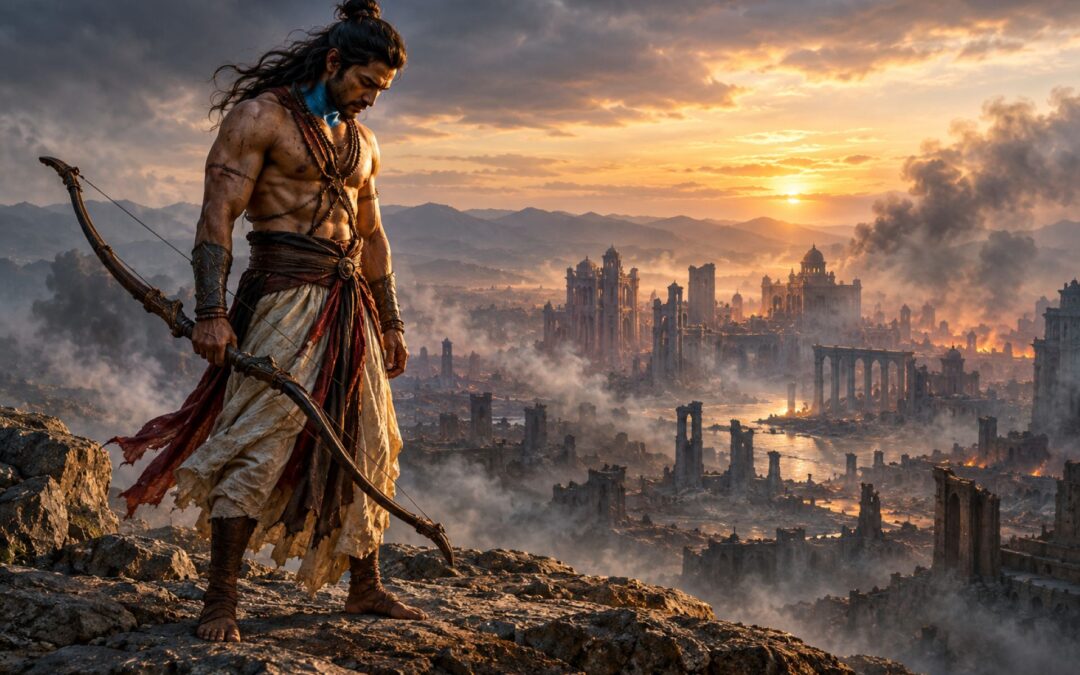
Reading Time: 78 Minutes
The Oath of the Vayuputras (2013) is the third and final novel in Amish Tripathi’s Shiva Trilogy, following The Immortals of Meluha and The Secret of the Nagas. The story brings Shiva’s journey from a Tibetan tribal leader to the revered Neelkanth to its conclusion, revealing the true nature of the evil he has been chosen to destroy and the terrible personal consequences of fulfilling his mission.
The novel begins after Shiva has discovered that Somras, the celebrated medicine responsible for Meluha’s extraordinary prosperity and longevity, is connected to the suffering of the Nagas and the people of Branga. What initially appears to be a struggle against a harmful substance develops into a war between kingdoms, competing moral convictions, and individuals who sincerely believe they are acting in the interests of civilisation. Shiva must confront the possibility that an institution can become evil without its defenders becoming entirely evil themselves.
Amish combines military adventure, political intrigue, speculative science, family tragedy, and reinterpretations of Hindu mythology to bring the trilogy together. Its central conflict becomes especially difficult when Shiva, who repeatedly insists that righteousness must govern both ends and means, faces a loss that threatens to overturn his principles. The result is a conclusion in which destroying evil and acting justly do not necessarily amount to the same thing.
Spoiler Warning: This article contains a complete summary of The Oath of the Vayuputras, including Sati’s death, the destruction of Devagiri, the fates of the major characters, and the ending of the Shiva Trilogy.

Brahaspati Returns and Exposes the Cost of Somras
The novel opens with a glimpse of Shiva’s troubled past, establishing that his extraordinary capacity for violence has always existed alongside his capacity for love and remorse. Memories of his uncle Manobhu and the violence surrounding his childhood anticipate revelations about Shiva’s origins that will become important later. The narrative then returns to the present, where Shiva is reunited with Brahaspati in Panchavati, the hidden city of the Nagas.
Brahaspati had previously been believed dead after the destruction of Mount Mandar, the major Somras manufacturing facility. His apparent death had helped direct Shiva’s anger toward the Chandravanshis and contributed to the conflicts of the earlier novels. Shiva now learns that Brahaspati has been working with the Nagas to investigate Somras and its long-term effects. Their reunion brings relief, but it also forces Shiva to reconsider the assumptions on which many of his earlier actions were based.
Somras has long been regarded as one of the greatest achievements of the civilisation founded upon Lord Ram’s principles. The medicine slows ageing, extends life, and helps its consumers maintain extraordinary physical vitality. Its benefits have shaped Meluhan society so profoundly that abandoning it appears almost unthinkable. Yet Brahaspati explains that the same substance responsible for these benefits has produced consequences that its beneficiaries have ignored.
The first major consequence concerns the Nagas. Brahaspati explains that Somras works partly through processes associated with the regeneration of bodily cells. Under certain conditions, however, these processes can become uncontrolled, producing malignant growths and congenital abnormalities. The Nagas’ physical differences, which have caused them to be feared, rejected, and sometimes treated as cursed beings, are linked to the consumption of Somras by previous generations.
Kali, the Naga queen and Sati’s sister, understands the consequences more directly than anyone else in Shiva’s circle. The abnormalities are not simply unusual physical features. Some produce continuing pain, progressive deformity, and shortened lives. The suffering of the Nagas has been treated as an acceptable cost of preserving a medicine that benefits far more powerful populations.
Brahaspati also explains that the Vayuputras, an influential institution entrusted with safeguarding civilisation, had known about these consequences for centuries. Rather than compel an immediate end to Somras production, they had provided compensation to the Nagas. Their reasoning was that the medicine continued to produce sufficient good to justify tolerating its harmful effects on a smaller population. Kali considers this arrangement an insult because money cannot adequately compensate for generations of suffering.
The second major consequence concerns the Saraswati River. Somras production requires enormous quantities of its water, as well as material from the Sanjeevani tree. When the medicine was produced for a relatively small number of people, the demands placed on the river were manageable. As production expanded to serve millions of Meluhans, however, the extraction of water became extensive enough to threaten the river itself.
This overturns one of Meluha’s established political beliefs. The declining Saraswati had been blamed on Chandravanshi interference, reinforcing hostility toward Swadweep. Brahaspati shows that Meluha is damaging the river through its own dependence on Somras. The civilisation that reveres the Saraswati as its mother is destroying it to sustain the prosperity associated with its most treasured invention.
The third consequence is more devastating. The manufacture of Somras produces highly toxic waste, which the Meluhans have disposed of in a remote region along the Tsangpo River in Tibet. The reasoning behind this decision was that the river flowed away from Meluha and that the dangerous waste would be diluted before reaching inhabited regions. The arrangement appeared safe because observers had not identified widespread disease among the communities near the disposal site.
Brahaspati reveals the geographical mistake underlying this assumption. The Tsangpo turns around the eastern Himalayas and eventually enters India as the Brahmaputra, flowing through Branga. As the water moves into warmer regions, the effects of the waste become more dangerous. Seasonal changes help explain why Branga suffers recurring outbreaks of disease, particularly during the warmer months.
The people of Branga have endured devastating plagues, including the deaths of many children. Naga medicines have offered relief because the Nagas and Brangas are suffering from consequences of the same underlying contamination. What had appeared to be separate medical tragedies are therefore connected to a single industrial system.
The discovery affects Shiva deeply. He has seen the suffering of both communities without understanding that it originated in a product he had once admired. Brahaspati’s evidence reveals that Somras has become beneficial for some people by imposing severe costs on others, with those costs concealed by geography, political prejudice, and institutional authority.
The possibility of an alternative to war is investigated before Shiva commits himself to destroying Somras. The medicine depends on both Saraswati water and the Sanjeevani tree, and Brahaspati considers whether its production can be disrupted biologically. He investigates the possibility of introducing a bacterium capable of making Sanjeevani material decay too rapidly for effective manufacturing. The attempt does not provide a reliable solution.
Simply destroying a manufacturing centre is also inadequate because the knowledge and infrastructure can be rebuilt. Mount Mandar itself is being reconstructed, demonstrating the determination of Somras’s defenders to restore production. The underlying problem is an entire system of manufacture, political protection, and social dependence.
Meanwhile, Maharishi Bhrigu, the principal intellectual defender of Somras, continues coordinating with Emperor Daksha of Meluha and Emperor Dilipa of Ayodhya. Their alliance joins Meluhan military discipline with the immense manpower of Swadweep. Bhrigu regards the continuation of Somras as essential to civilisation and considers Shiva’s emerging opposition an increasingly dangerous threat.
These political preparations unfold alongside quieter developments within Shiva’s family. His sons, Ganesh and Kartik, grow closer, although their personalities remain different. Kartik demonstrates remarkable instincts as a young warrior, including his ability to confront a dangerous rhinoceros with unusual calculation and composure. Ganesh, more reflective and restrained, recognises his younger brother’s talent while remaining attentive to the consequences of violence.
Shiva’s understanding of the problem is now fundamentally changed. Somras cannot be judged solely by the number of years it adds to Meluhan lives. Its wider consequences must be considered, including the lives damaged or destroyed by its continued production.
The Vasudevs Reveal Shiva’s Purpose
Shiva travels from Panchavati toward Ujjain, where he hopes to consult the Vasudevs. The journey moves through territories and routes associated with the Nagas and their allies, gradually introducing the religious and strategic importance of the institution Shiva is about to encounter. The Vasudevs have influenced events throughout the trilogy, but their organisation and responsibilities have remained partly hidden.
Ujjain is a revelation. Its elaborate fortifications, concealed approaches, impressive architecture, and great Vishnu temple demonstrate a civilisation possessing considerable technical and military knowledge. The city combines religious devotion with engineering and disciplined organisation. Shiva discovers that the Vasudevs are far more powerful than a scattered network of spiritual advisers.
At Ujjain, Shiva meets Gopal, the chief of the Vasudevs. Gopal treats him with reverence but also becomes an important friend and adviser. Their discussions explain the relationship between two roles that have shaped Indian civilisation: the Vishnu and the Mahadev.
According to the Vasudev understanding, the Vishnu is responsible for establishing or preserving a system of goodness appropriate to a particular age. Such a system improves society by bringing order, justice, stability, or some other widespread benefit. The Mahadev appears when an institution that was once beneficial has continued beyond its proper time and become destructive.
This distinction is essential because it rejects the assumption that evil must always begin as something obviously wicked. A system may produce tremendous benefits when first introduced, yet eventually become harmful because circumstances change, its scale expands, or society becomes incapable of recognising its costs.
Gopal explains that the Vasudevs had anticipated Somras would eventually become destructive. Their difficulty was determining when the balance had shifted. Destroying a useful institution too early would deprive society of legitimate benefits, while allowing it to continue too long would turn those benefits into a justification for injustice.
Shiva’s role is to make the judgment the institutions themselves have failed to make. He must decide whether Somras has become evil and, if so, remove its influence. The Vasudevs can advise and assist him, but the moral responsibility for the decision belongs to the Mahadev.
The conversations also reveal more about Shiva’s extraordinary identity. He remembers that his uncle Manobhu administered medicine to him during childhood to relieve a burning sensation between his eyebrows. Gopal recognises Manobhu as a former member of the Vayuputra council who had supported action against Somras long before the current crisis.
The Vayuputras possessed a medicine capable of preparing a potential Neelkanth. Its effects could remain dormant until the individual consumed Somras under suitable conditions. Shiva’s childhood treatment therefore provides an explanation for the transformation of his throat when he first arrived in Meluha.
Another unusual feature is the intense activity Shiva experiences in the region between his eyebrows, associated with the third eye and the ajna chakra. Gopal interprets Shiva’s condition through both religious and physiological ideas, suggesting that his rare bodily characteristics made him an exceptional candidate for the role Manobhu anticipated.
Shiva is not entirely convinced by the language of destiny. He suspects that his emergence as the Neelkanth depended upon Manobhu’s deliberate actions and a series of fortunate circumstances. Gopal, by contrast, sees divine purpose operating through those events. Their disagreement remains important because the trilogy repeatedly moves between a world of human causes and a world interpreted through religious belief.
The Vasudevs also reveal their military capabilities. Kartik observes the training of elephants and recognises that animals taught to move and fight in coordinated formations could transform battlefield tactics. Their engineering, transport, and organisational knowledge will become crucial once the war begins.
After considering Brahaspati’s evidence and Gopal’s explanation, Shiva accepts that Somras must be stopped. His decision is neither casual nor enthusiastic. He understands that its removal will threaten powerful institutions and provoke resistance from people who believe their civilisation depends upon it.
Shiva’s first preference is to eliminate the harmful system without unnecessary bloodshed. His advisers nevertheless begin examining the military implications of an assault on Meluha, particularly if Ayodhya supports Daksha. The enemy possesses formidable combined resources, and Shiva cannot rely on the devotion of Meluhan soldiers who still regard their emperor and homeland as legitimate.
Parvateshwar emerges as the most troubling example. The great Meluhan general reveres Shiva, but his commitment to protecting Meluha is deeply rooted. Ganesh understands that Parvateshwar’s loyalty to the Neelkanth does not automatically override his obligations as a soldier and patriot.
The prospect of fighting Parvateshwar reveals the human difficulty behind Shiva’s newly clarified purpose. The war against Somras may require him to defeat people whose honesty, courage, and discipline he respects. His determination to act righteously will be tested by precisely those relationships.
Alliances, Betrayal, and the Choice of Duty
Once Shiva determines that Somras must be eliminated, the conflict becomes a struggle over military alliances, public legitimacy, and the loyalties of individual rulers. Meluha cannot be defeated easily, especially while Ayodhya remains willing to provide soldiers and logistical support. Shiva must therefore build a coalition capable of dividing his opponents and preventing their military advantages from operating together.
Branga becomes an important source of support. Its king, Chandraketu, has direct reasons to oppose the continued manufacture of Somras because his people have suffered from the contaminated Brahmaputra. Bhagirath and Parvateshwar are involved in the negotiations that help bring Branga into the emerging alliance.
The conflict with Magadh is more complicated. Ganesh had previously killed Ugrasen, the father of Surapadman, while intervening to protect an innocent woman and child. Although the killing arose from Ganesh’s defence of the vulnerable, it has created a political grievance that can easily be exploited in a kingdom where dynastic pride and military ambition remain powerful.
Surapadman, who now rules Magadh, is a capable and ambitious politician. Shiva attempts to persuade him that neutrality would be more advantageous than joining Meluha and Ayodhya. Sati and Gopal participate in these diplomatic efforts, recognising that keeping Magadh out of the conflict could prevent an enormous expansion of the war.
Surapadman considers the proposals through the lens of his political ambitions. He is unwilling to forget the killing of his father, but he must also decide whether an alliance with Shiva offers him opportunities unavailable under the prevailing political order. The negotiations reveal a world in which rulers rarely act from a single motive. Honour, resentment, personal advancement, public duty, and strategic calculation all influence decisions.
Bhrigu pursues the opposite objective. His influence over Emperor Dilipa gives him considerable authority within Ayodhya, whose ruler depends heavily on extraordinary medicines and the sage’s guidance. Bhrigu understands that a combined Meluhan-Ayodhyan military force could overwhelm Shiva’s coalition if its components remain coordinated.
Bhagirath, Dilipa’s son, must move through this dangerous environment while concealing his true loyalties. During their encounters, Bhrigu displays an unsettling ability to read subtle reactions and infer another person’s intentions. His intelligence makes him a formidable opponent even when he cannot openly command everyone involved.
The Vasudevs offer an explanation of methods that allow a trained observer to interpret human thought and behaviour. The novel’s speculative account draws upon the idea of electrical activity in the brain, but its immediate narrative function is to make espionage and conversation dangerous. A skilled adversary may discover information without obtaining an explicit confession.
Within Shiva’s camp, the question of Parvateshwar becomes unavoidable. Although the general has fought beside Shiva and honours him deeply, he cannot accept an assault on Meluha. His understanding of duty requires him to defend the nation that gave his life meaning.
Ganesh recognises the danger this creates. A soldier with Parvateshwar’s experience could change the outcome of the coming war if he joined Daksha and Bhrigu. Shiva’s advisers therefore decide that he must be detained, and Parvateshwar is imprisoned in Kashi.
The imprisonment exposes a division within Shiva’s own alliance. Kali and some of the military commanders consider the general’s detention necessary. They believe releasing him would amount to voluntarily strengthening the enemy and endangering thousands of soldiers who have placed their faith in Shiva.
Sati approaches the matter differently. Parvateshwar has not committed a crime by remaining loyal to his country, and imprisoning him merely because he might oppose Shiva threatens the ethical basis of their cause. For her, righteousness cannot be separated from the manner in which a person pursues victory.
Shiva struggles with the consequences. He understands that freeing Parvateshwar may cost lives and might even determine whether his campaign succeeds. Yet he also recognises that defeating evil through actions he considers dishonourable would compromise his claim to moral leadership.
He eventually releases the general. Parvateshwar is astonished by the decision because he understands exactly how much military advantage Shiva is surrendering. Shiva makes clear that the fight must be conducted through righteous means, even when those means create immediate disadvantages.
Anandmayi, Parvateshwar’s wife and a princess of Ayodhya, chooses to accompany him. Their relationship has transformed the once frivolous and unconventional princess into someone capable of deep and sustained commitment, without eliminating her independence. She accepts the danger that comes with her husband’s decision because loyalty to him has become a personal moral choice.
Parvateshwar’s departure gives Meluha the exceptional commander it needs. Shiva loses a friend and military ally, but his decision strengthens the moral distinction he is attempting to maintain between righteous resistance and political coercion.
Shiva’s proclamation against Somras now becomes public. He announces that the medicine has become evil and orders its use discontinued. This is a direct challenge to the social practices of Meluha and to the legitimacy of its emperor.
Daksha attempts to neutralise the announcement by presenting it as fraudulent. Meluhan subjects have been taught to worship the Neelkanth, and many are unwilling to believe that their revered leader would oppose a central institution of their society. Daksha exploits this uncertainty to maintain public support.
The proclamation also tests the loyalty of officials such as Kanakhala, Meluha’s prime minister. Her devotion to law and her emperor is complicated by the growing evidence that her government is deceiving its own people. What begins as a disagreement over a medicine develops into a crisis over the meaning of lawful authority.
As the armies prepare for war, the narrative gives Shiva’s companions moments of intimacy and reflection. Veerbhadra and Krittika return to his circle, old friendships are renewed, and songs evoke the life Shiva left behind in Tibet. These interludes establish what the coming violence threatens to destroy: families and friendships that exist independently of political causes.
Shiva has assembled allies with strong reasons to oppose Somras, but his coalition remains vulnerable. The next stage of the conflict depends on separating enemy forces before they can combine their advantages.
The War Splits Across Ayodhya and Magadh
Shiva’s military strategy depends on exploiting the geographical separation between his opponents. Meluha possesses disciplined troops and strong fortifications, while Ayodhya can provide enormous manpower. If the two armies unite, Shiva’s coalition may not survive a direct confrontation.
Ganesh therefore leads operations against Ayodhya, using a naval siege to restrict the movement of its forces. The siege threatens the kingdom’s ability to support Meluha and forces its rulers to consider the consequences of remaining committed to the alliance. It also serves another purpose: attracting the attention of Surapadman in Magadh.
Surapadman cannot ignore a campaign that may alter the military balance around his territory. Ganesh anticipates that the Magadhan ruler will attempt to intervene and prepares a trap designed to draw his army away from its secure position.
The plan requires cooperation between Ganesh, Kartik, Bhagirath, and their allies. A relatively small force will appear vulnerable along the river near Bal-Atibal Kund, encouraging Surapadman to believe he can destroy it before confronting the main enemy. The battlefield is chosen carefully because the surrounding terrain and waterways can be used to restrict enemy movement.
Kartik takes responsibility for much of the operation on land. Although exceptionally young, he demonstrates a detailed understanding of military psychology. He realises that the Magadhan commander must be persuaded to commit a large proportion of his soldiers before the trap closes.
The defensive force initially appears exposed. Magadhan ships approach, troops begin landing, and Kartik’s men must tolerate the danger of being overwhelmed while waiting for the correct moment. Premature action would alert the enemy and allow it to withdraw.
Bhagirath’s soldiers play a crucial role in holding the attacking forces in place. Their resistance creates the impression of an ordinary battle between a smaller army and a superior invading force. Surapadman continues committing men, convinced that victory is within reach.
Once enough troops have entered the chosen area, Kartik’s hidden forces strike. Cavalry attacks, prepared positions, and coordinated naval movements disrupt the Magadhan formation. Ganesh’s naval forces and Maatali’s ships help close the enemy’s escape routes, turning what Surapadman believed would be a straightforward attack into a battle for survival.
The struggle becomes increasingly destructive. Kartik’s soldiers show little willingness to grant mercy during the engagement, and the Magadhan army suffers catastrophic losses. Surapadman is killed, removing the principal threat posed by Magadh and ending the possibility that its ruler might decisively assist Shiva’s enemies.
Kartik’s conduct wins admiration because of his courage, tactical imagination, and willingness to expose himself to danger. Yet the battle also reveals how comfortable he has become with the ruthless calculations of warfare. The young warrior does not hesitate to accept severe losses when he believes those losses are necessary to defeat the enemy.
Ganesh, although proud of his brother, recognises the disturbing implications of such ability. The world around them is becoming increasingly accustomed to solving political disagreements through organised mass violence. Their conversations raise questions that will become more important when the war reaches its final stage.
The victory changes the entire strategic situation. Magadh’s military power has been broken, and its position along the river system can now be used to restrict movement between Ayodhya and Meluha. Ganesh’s forces gain control of a critical passage, making it harder for the enemy kingdoms to coordinate operations.
Shiva, meanwhile, moves toward Lothal on the western coast of Meluha. There, the governor Chenardhwaj supports him, providing access to territory and resources that will become essential for the invasion. His decision demonstrates that Meluha is not politically united behind Daksha.
The campaigns against Ayodhya and Magadh achieve Shiva’s immediate military objective. Instead of fighting a united enemy coalition, he can increasingly direct his main forces toward Meluha itself.
However, the battles have also demonstrated the cost of victory. Thousands of soldiers have died in a war whose original purpose was to protect human life from an avoidable harm. That contradiction accompanies Shiva’s army as it approaches the heart of Meluhan territory.
Shiva Invades Meluha and Confronts Parvateshwar
The campaign against Meluha begins with a struggle for control of its coastal approaches and river routes. Shiva cannot simply march against Devagiri, the capital, because the Meluhan army possesses strong fortifications and well-developed defensive infrastructure. Control of ports and waterways is necessary to supply his forces and threaten the centres associated with Somras.
At Mrittikavati, Shiva confronts forces commanded by Vidyunmali, a senior Meluhan officer fiercely loyal to the existing regime. Vidyunmali regards Shiva’s campaign as a betrayal of the civilisation that welcomed him and elevated him to the status of Neelkanth. His attitude reflects the effect of Daksha’s propaganda on soldiers who believe they are defending their homeland against an impostor.
The battle requires Shiva’s coalition to attack a fortified city and its associated port facilities. Kali identifies weaknesses in the connecting defences, while Shiva uses the capabilities of the Vasudev elephant corps and his cavalry to disrupt the Meluhan formations. Sati commands forces within the wider operation, contributing her military experience and discipline.
The engagement depends upon coordination rather than numerical superiority alone. Elephants trained for battlefield manoeuvres are directed against enemy chariots, while other units exploit openings created in the defensive line. Shiva’s ability to move rapidly between different points of the battle helps prevent the Meluhans from reorganising effectively.
The Meluhan army is defeated, and Shiva gains control of Mrittikavati and its strategically important naval facilities. The victory gives his coalition access to the Saraswati system and creates the possibility of moving deeper into Meluha.
Shiva treats the defeated soldiers differently from what Vidyunmali expects. Rather than punishing them for obedience to their commanders, he explains why he is fighting and asks them to examine the consequences of Somras. He also challenges the claim that his proclamation was fraudulent.
His address attempts to separate the legitimacy of his mission from the deception practiced by Daksha. Many Meluhans have been told that Shiva is an enemy of their civilisation, yet they now confront a commander who respects their courage and regards their suffering as tragic rather than desirable.
Vidyunmali remains hostile. He insults Shiva and refuses to acknowledge his authority, although Shiva initially insists that the captive should be treated according to the rules of war. The handling of Vidyunmali becomes one of the novel’s less smoothly connected plot developments: the officer is presented as a prisoner, while subsequent events report his return to Meluhan command without a fully dramatised escape.
Information obtained after the battle points increasingly toward Devagiri as the centre of Somras production. Panini contributes important intelligence about Bhrigu’s involvement with advanced weapons and the facilities protecting the medicine’s manufacture. The implications are serious because Bhrigu’s possession of forbidden military technology threatens to widen the conflict beyond conventional warfare.
In Devagiri, Bhrigu and Parvateshwar assess the danger created by Mrittikavati’s fall. The loss of the port and its defences gives Shiva greater access to the river system, but Meluha still possesses the advantage of fighting near its political and logistical centre. Parvateshwar believes that discipline, careful preparation, and a well-chosen battlefield can compensate for the enemy’s recent successes.
Shiva advances toward the capital, where Sati commands a substantial force. Her intention is to maintain a defensible position, avoid unnecessary battle, and wait for the remainder of Shiva’s army. She understands that the Meluhans have a formidable commander and that provoking a confrontation before reinforcement arrives would be dangerous.
Parvateshwar does not offer the kind of conventional assault Sati anticipates. Instead, he prepares a complex operation using animals, fire, smoke, and the psychological vulnerabilities of an elephant corps.
The Meluhans employ oxen and burning material to create confusion. Smoke produced through chilli and other substances unsettles the elephants, while fire and unexpected movement intensify the disturbance. Animals that had been trained to provide Shiva’s forces with overwhelming battlefield power become difficult for their handlers to control.
Parvateshwar’s strategy exploits a fundamental limitation of the technology and training on which his opponents depend. An elephant may be enormously powerful and disciplined under ordinary conditions, but its instincts remain vulnerable to fear and physical distress.
Sati attempts to preserve her formation as the situation deteriorates. Her orders are intended to prevent the army from becoming trapped in a premature offensive, but subordinate decisions and the chaos of the battlefield undermine her preparations. The resulting disorder spreads through the ranks.
The elephant corps becomes a danger to friendly soldiers. Cavalry and infantry must respond to moving animals, burning carts, and collapsing defensive positions. Sati is forced to enter the fighting more directly than she had planned, attempting to contain the disaster and provide her troops with an opportunity to withdraw.
She survives the battle but suffers a serious injury. The loss of her position at Devagiri is both a tactical defeat and a personal humiliation because she believes that better command might have prevented it. Parvateshwar’s victory demonstrates that his reputation as Meluha’s finest general is thoroughly deserved.
The Meluhan leadership celebrates the engagement, but Parvateshwar recognises that it has not ended the war. Shiva still commands significant forces, and his coalition controls strategic positions elsewhere. The coming rainy season further complicates large-scale operations, making an immediate conquest of Devagiri increasingly unlikely.
Shiva is relieved that Sati has survived, yet he understands the seriousness of the setback. His family attempts to reassure her that battlefield defeat does not invalidate her courage or honour. Sati nevertheless insists upon accepting responsibility for what happened, regarding the scar left by her injury as a reminder of an obligation she has not yet fulfilled.
The military stalemate forces Shiva to consider a different approach. Parshuram’s suggestion that the Saraswati could be destroyed or diverted to end Somras production is one possibility, but the environmental and strategic consequences are immense. The more immediate alternative is to seek assistance from the Vayuputras, who possess knowledge and weapons beyond those of the ordinary kingdoms.
Shiva therefore prepares to leave India temporarily. The decision offers hope of ending the war without another prolonged siege, but it also places him far from the people whose safety matters most to him.
Daksha’s Plot and the Journey to Pariha
While Shiva considers the need for Vayuputra support, Daksha begins developing a more personal plan for ending the war. The emperor has become increasingly frustrated with the defensive strategy pursued by Parvateshwar and Bhrigu. He believes that removing Shiva himself will end the resistance to Somras and preserve his authority.
Vidyunmali becomes an enthusiastic participant in the scheme. Unlike Parvateshwar, who insists upon military honour even while opposing Shiva, Vidyunmali is willing to pursue methods outside the accepted rules of war. The pair begin considering the employment of foreign assassins, eventually turning toward the Egyptian cult of Aten.
Their conspiracy is concealed from the more honour-bound members of the Meluhan leadership. This secrecy matters because Daksha understands that Parvateshwar would refuse to participate in a dishonourable assassination. The emperor must therefore exploit opportunities created by the movements of both armies and the absence of people capable of restraining him.
Shiva, meanwhile, departs for Pariha with Gopal. Their journey takes them westward by sea and then across difficult terrain toward the Vayuputra homeland. The expedition expands the geographical scope of the trilogy beyond the kingdoms of India, introducing foreign societies and alternative cultural histories.
The travellers are assisted through Umbergaon and eventually meet Kurush, who guides them toward Pariha. During the journey, Shiva learns about the connections between ancient migrations, the Asuras, and the civilisations that developed beyond India. The novel uses similarities and differences in religious language to suggest that traditions remembered as opposites may share deep historical relationships.
Pariha itself is a remarkable city. Its guarded entrances, concealed defences, architecture, gardens, and sophisticated organisation demonstrate the resources controlled by the Vayuputras. Their society has developed away from the immediate political struggles of Meluha and Swadweep, yet remains deeply involved in the responsibilities inherited from earlier generations.
Shiva discovers that the Vayuputras are divided over his mission. Some support the view that Somras has become evil and must be removed, while others distrust the course taken by the Vasudevs and question whether Shiva should be given the authority he seeks. Their hesitation reflects the same institutional problem that allowed Somras’s harmful consequences to continue for so long.
An unexpected ally appears in Tara, a woman whose importance becomes clear through her connection with Brahaspati. She is the scientist’s lost love, and Shiva reveals that Brahaspati is alive. Their reunion, made possible by Shiva’s mission, introduces a personal consequence of the earlier deception surrounding Mount Mandar.
Tara helps Shiva and Gopal navigate the Vayuputra leadership. Her knowledge of the institution and its internal rules makes her essential to their efforts to secure an audience with the Mithra, one of its highest authorities.
The meeting produces a major revelation. The Mithra is Shiva’s maternal uncle, and the history of Manobhu’s involvement in Shiva’s childhood becomes clearer. Manobhu had recognised that Somras was turning harmful and had attempted to prepare someone capable of undertaking the Mahadev’s responsibilities.
The medicine given to Shiva during his childhood was part of that preparation. His eventual emergence as the Neelkanth, however, was not guaranteed. It depended upon his unusual physiology, his arrival in Meluha, his consumption of Somras, and the choices he subsequently made.
Shiva asks what would have happened had he failed to recognise Somras as evil. The question matters because it challenges the assumption that destiny makes failure impossible. The Mithra’s explanation preserves room for individual judgment, even within a religious framework that treats Shiva’s arrival as extraordinarily significant.
The question of divine weapons now takes centre stage. Shiva hopes to acquire the Brahmastra, a weapon capable of immense destruction. The Mithra refuses to provide it because its effects would be indiscriminate and would endanger populations far beyond the intended target.
Instead, he offers access to the Pashupatiastra, a weapon associated with Lord Rudra. In the novel’s technological framework, it possesses destructive power comparable to the Brahmastra but can be directed with greater precision. Its effects can be concentrated within a defined area rather than spreading uncontrollably across an entire region.
The distinction makes the Pashupatiastra strategically useful. Shiva could threaten the destruction of Devagiri while claiming that neighbouring territories and his own troops would remain safe. Bhrigu, familiar with advanced weapons, would understand the credibility of such a threat.
The Mithra nevertheless insists upon an uncompromising condition: Shiva must not actually use the weapon. It is provided to create pressure for a peaceful resolution, not to authorise mass destruction. The danger remains too great for its deployment to be morally acceptable.
Shiva gives his word. His promise becomes one of the most important obligations in the trilogy because it establishes an explicit moral and institutional boundary that he will later cross.
The Mithra also explains that Somras knowledge must not be eliminated entirely. Although its present use has become harmful, later generations may encounter circumstances in which some aspect of the knowledge becomes beneficial again. Destroying the system that currently abuses the medicine is therefore different from permanently suppressing every discovery associated with it.
With Vayuputra support secured, Shiva prepares to return to India. He intends to use the threat of advanced weaponry to force an end to Somras production without requiring another devastating military campaign.
While he is away, however, Daksha’s assassination plan advances. The Egyptian killers are recruited, Vidyunmali coordinates their involvement, and the Meluhan military situation offers an opportunity to draw Shiva’s defenders away from the capital. The weapon Shiva obtains to prevent bloodshed is about to become relevant under circumstances he could not have anticipated.
A False Peace and Sati’s Last Stand
Parvateshwar launches a naval operation designed to make Shiva’s commanders believe that Meluhan forces are approaching the Narmada and threatening routes associated with Panchavati. Because Panchavati is the home of the Nagas and an important refuge for Shiva’s allies, the possibility of an attack demands an immediate response.
Sati, Kali, Ganesh, Kartik, and their commanders debate the meaning of the enemy movements. Some recognise that the manoeuvre may be deceptive, but they cannot afford to ignore a threat to a territory containing people and institutions they have sworn to protect. Large parts of their available military strength are therefore drawn away from the area around Devagiri.
The operation achieves the separation Daksha’s conspirators require. Sati remains in a position where she may be persuaded to enter Meluhan territory without the full protection of Shiva’s army.
The opportunity arrives through an invitation to a peace conference. The proposal comes under the authority of Kanakhala, Meluha’s prime minister, and appears to respect the rules established by Lord Ram for negotiations between enemies.
Shiva’s advisers are suspicious. Bhagirath questions whether Daksha has suddenly developed a genuine desire for peace, while others warn that a conference might be designed to trap a prominent member of Shiva’s family. Yet the invitation cannot be dismissed without considering the possibility of ending the war.
Sati takes the proposal seriously. She recognises that Meluha contains honourable people who oppose Shiva for reasons they consider legitimate. She also knows that Kanakhala is devoted to the legal and ethical principles of her country. If such a figure has authorised negotiations, there may be a genuine opportunity to reach a settlement.
The argument is strengthened by the apparent restrictions governing a peace conference. Meluhan law protects negotiators and imposes limits on the weapons and forces permitted within the designated area. Violating these rules would be a grave offence against the civilisation’s own ideals.
Sati also understands that Shiva would prefer to avoid further bloodshed. Although she recognises her father’s weaknesses, she believes that an agreement acceptable to the principal authorities might still be possible.
Her decision is controversial. Bhagirath and other commanders remain unconvinced, but Sati insists that the opportunity must be explored. She chooses to attend personally, accompanied by a limited entourage that includes Nandi and other guards.
In Devagiri, Kanakhala discovers the conspiracy. Daksha and Vidyunmali intend to use the peace conference as cover for an assassination, violating the very laws that make Sati willing to attend. Kanakhala is horrified because she recognises the betrayal as incompatible with her understanding of duty.
Daksha attempts to manipulate her obligations by drawing distinctions between his responsibilities as emperor and hers as prime minister. He argues that her oath requires obedience even when the proposed action contradicts the moral principles she has spent her life defending.
Kanakhala tries to warn Shiva’s allies. Her message is intercepted, leaving her unable to prevent the operation through ordinary means. She is trapped between a sworn duty to her ruler and an obligation to protect innocent people from a dishonourable crime.
She takes her own life. The act reflects her despair at being made complicit in a betrayal she cannot stop, although it does not prevent the assassination plot from proceeding. Her death removes one of the remaining representatives of moral restraint within Daksha’s administration.
Shiva returns from Pariha and learns of the proposed conference. He recognises the danger more immediately than some of those who accepted the invitation and attempts to reach Devagiri. Military movements and political confusion delay his response.
Sati arrives at the Meluhan capital before him. She examines the conference arrangements carefully, testing the apparent security of the location and insisting upon the protections guaranteed to negotiating parties. Her attention to detail reinforces that she is not simply walking into danger because of affection for her father.
She then visits Daksha and Veerini. The reunion is emotionally complicated because Sati’s relationship with her parents has been damaged by earlier events, including their treatment of Kali and Ganesh. Her mother greets her with genuine affection, and the conversation provides an opportunity for reconciliation.
Sati’s injury from the Battle of Devagiri becomes a subject of concern. Veerini regrets that her daughter has suffered and wishes for her happiness and safety. Sati, however, regards the visible evidence of her injury as less important than the possibility of restoring peace.
The conversation changes when Sati learns that Kanakhala has died. Daksha’s explanations are evasive, and Sati recognises that something is wrong. Her suspicions are confirmed when the effort to control or restrain her becomes direct.
Sati escapes the attempt to hold her inside the palace. The betrayal is particularly painful because it comes from her father, who has repeatedly claimed that his actions are intended to protect her. Once again, Daksha’s desire to possess and control his daughter has brought danger rather than safety.
Outside the conference area, Sati’s guards are under attack by a large force of assassins. The killers have been disguised to resemble Nagas, creating the possibility that blame for the murder might be misdirected toward people already burdened by public prejudice.
Nandi fights with extraordinary determination, using his size and strength to hold off attackers who outnumber him enormously. His resistance becomes one of the principal obstacles to the assassination plan. Yet the attackers possess specialised weapons and techniques that allow them to inflict terrible injuries even upon a warrior of his ability.
Sati rides toward the fighting instead of fleeing. She recognises that abandoning her guards would contradict the principles by which she has lived. Her intervention places her directly in the path of the Egyptian assassins.
Their leader, Swuth, initially struggles to identify the proper target. The assassination plan was built around assumptions about the Neelkanth and those close to him, and the exceptional strength of Nandi creates confusion. Once Sati becomes the focus of the engagement, the confrontation develops into a series of brutal personal encounters.
Sati demonstrates the skill that has made her a formidable warrior throughout the trilogy. She defeats opponents through disciplined movement, timing, and the ability to exploit mistakes. Even as her injuries accumulate, she refuses to surrender or abandon those she is defending.
The assassins repeatedly underestimate her. Swuth discovers that the woman he faces combines extraordinary physical ability with a commitment to honour that persists even under desperate circumstances. At one point, she refuses an unfair advantage because defeating an opponent dishonourably would violate the standards she holds herself to.
That restraint makes her struggle more difficult. Sati’s enemies have no comparable obligation, and Swuth learns to exploit the injuries that increasingly restrict her movement. Her wounds become severe, particularly on the left side of her body and around her abdomen.
The fight continues well beyond the point at which an ordinary soldier would have collapsed. Sati attempts to rise after repeated failures, using her sword for support as she forces herself to continue. Her determination changes the attitude of those watching, including Swuth, who comes to regard her as a warrior worthy of extraordinary respect.
Respect does not stop him from fulfilling his mission. Sati is mortally wounded, and the assassins finally overcome her after a battle that has cost them heavily.
Daksha and Veerini arrive to confront the consequences of the conspiracy. Daksha is devastated by the sight of his dying daughter, although his grief cannot erase his responsibility for creating the circumstances that led to her death.
Sati’s final concern is not revenge. She asks that her body be returned to Shiva and seeks assurances concerning the people she loves, including Ganesh and Kartik. Her last moments preserve the love and family commitments that have guided her throughout the trilogy.
She dies before Shiva reaches Devagiri.
The event destroys the emotional foundation of Shiva’s life. Sati has been his partner, adviser, moral equal, and the person who helped transform his understanding of family and responsibility. Her death will change the course of the war more decisively than any conventional military victory.
Shiva’s Grief and the Destruction of Devagiri
Shiva reaches Devagiri desperate to find Sati. The behaviour of those waiting for him reveals that something terrible has happened, but he initially struggles to accept what they are trying to communicate. Parvateshwar and Bhrigu, who had no part in planning the assassination, are unable to offer him an explanation that can lessen the truth.
Sati’s body has been preserved within a chamber of ice. Shiva approaches her remains and confronts the fact that the woman he expected to see alive has been killed. His response is devastating because the loss strikes at the centre of a life that has otherwise been defined by continued struggle and responsibility.
He remains beside her body, unable to separate himself from the person he loved. The leaders and companions gathered around him understand that his grief may become dangerous, but they cannot easily approach a man whose authority has been treated as nearly divine.
Ganesh and Kartik respond to their mother’s death differently. Both are overwhelmed by the loss, yet the novel gives them contrasting visionary encounters with her.
Ganesh imagines Sati as a mutilated and furious presence demanding vengeance. The vision reflects his anguish and his fear that failing to punish those responsible would amount to failing his mother. His love becomes entangled with the desire to make others suffer.
Kartik’s vision presents a different Sati. Although he also feels anger, his mother appears whole and guides him toward remembering the values by which she lived. The encounter suggests that honouring a person cannot be reduced to reproducing the anger caused by their death.
The distinction becomes critical when Shiva’s commanders begin debating retaliation. Some argue that Devagiri must be destroyed because its emperor authorised the conspiracy and its people allowed the regime to continue. Kali is particularly furious, having lost the sister whose life had already been shaped by the injustice of Meluhan institutions.
Bhagirath, Chandraketu, and other leaders are drawn toward severe punishment. Their reasoning combines genuine grief with the belief that only overwhelming retaliation can satisfy the demands of justice and prevent further betrayal.
Gopal opposes the use of the Pashupatiastra. He insists that the assassination was planned by a limited group of people and that many inhabitants of Devagiri had neither knowledge of the conspiracy nor responsibility for it. Destroying the city would punish people who were never given an opportunity to oppose the crime.
Brahaspati also recognises the catastrophic implications of deploying a divine weapon. The Pashupatiastra may be more precisely directed than the Brahmastra, but its effects remain immense. The fact that it can be controlled does not make every use of it morally acceptable.
The arguments are intensified by Shiva’s promise to the Mithra. The Vayuputras provided the weapon on the condition that it would serve as a threat rather than actually be used. Deploying it would violate an explicit obligation and undermine the very institutions Shiva has relied upon to define the boundaries of righteous action.
Kartik supports the argument against indiscriminate destruction. He believes those responsible for Sati’s murder must face justice, but he rejects the idea that an entire city should be condemned. His position is striking because the young warrior who accepted terrible casualties at Bal-Atibal Kund now becomes one of the principal defenders of restraint.
Shiva nevertheless orders preparations for the weapon. His instructions are delivered with a frightening calmness that contrasts with the emotional collapse preceding them. He decides that the people of Devagiri may leave, except for those he considers responsible for maintaining Somras or directly participating in Sati’s murder.
This distinction is intended to separate innocent civilians from those implicated in the institutions Shiva seeks to destroy. In practice, it creates another moral problem. The people who studied, manufactured, or defended Somras include individuals whose knowledge may have been used beneficially and who did not participate in the assassination.
The proposed punishment also places responsibility for collective wrongdoing upon people who may have had little power to change the system. Shiva, who previously resisted treating Parvateshwar as a criminal merely for his loyalty, now adopts a far broader definition of culpability.
The army surrounds Devagiri’s principal platforms and supervises the evacuation. The city is divided into Svarna, Rajat, and Tamra, and its inhabitants must decide whether to leave or remain with the institutions they have served.
Some Meluhans choose to depart because they believe the Neelkanth has issued a legitimate order. Others refuse because abandoning their city would violate their understanding of honour and patriotism. Their decisions demonstrate that Shiva’s enemies do not form a single moral category.
Parvateshwar is among those prepared to remain. He has opposed Shiva militarily without participating in Daksha’s conspiracy, and he accepts the consequences of remaining loyal to Meluha. His wife Anandmayi chooses to stay beside him, regarding their shared life as more important than the possibility of escaping alone.
Kartik, Gopal, and Bhagirath secretly organise an effort to preserve the Somras scientists and their research. The operation requires the cooperation of Parvateshwar, whose understanding of the situation now places him in conflict with Shiva’s order. Although he is prepared to die for his country, he recognises that destroying knowledge itself would be an additional tragedy.
The rescue is difficult because many scientists believe their duty requires them to remain in Devagiri. Some are unwilling to acknowledge that Somras has become harmful; others feel that their contributions to its production deserve punishment.
Bhrigu is particularly reluctant to leave. Having finally recognised the consequences of his commitment to Somras, he regards his own death as an appropriate response to the harm he has helped perpetuate.
Kartik confronts this reasoning. He argues that dying will not repair the damage or help future generations avoid similar mistakes. Bhrigu possesses extraordinary knowledge and remains capable of using it constructively. His responsibility is therefore to continue living and perform better actions.
The argument redefines karma as continuing moral responsibility rather than an invitation to escape guilt through death. Bhrigu eventually accepts the possibility of redemption through useful work and agrees to accompany the scientists.
Approximately three hundred people associated with the preservation of Somras knowledge are removed from Devagiri. Their escape ensures that the city’s destruction will not completely eliminate the intellectual achievements of its civilisation.
Other characters make different choices. Veerini recognises that she failed to resist Daksha firmly enough and understands that her passivity contributed to the catastrophe. She does not pretend that Sati’s death can be attributed solely to her husband or to a few murderous conspirators.
Daksha, awaiting death, reflects upon the experiences that shaped his character. Memories of his father, Brahmanayak, reveal a long history of humiliation, resentment, and desperate efforts to secure affection and authority.
The banyan tree becomes associated with this history. Daksha remembers his father’s dominating presence and his own inability to escape it. He also remembers Sati’s childhood courage, including an occasion when she defended an immigrant woman despite the disapproval of those who considered her insignificant.
The memory reveals why Daksha’s love for Sati became possessive. He wanted her admiration to compensate for his own feelings of inadequacy and was threatened whenever she showed independent judgment or affection for someone he resented. His relationship with Shiva intensified these insecurities until he became capable of actions that destroyed the daughter he claimed to protect.
As the preparations near completion, Tara and the others involved in operating the Pashupatiastra confront the practical requirements of launching it. The weapon uses a precisely directed system of missiles intended to destroy the three principal platforms of Devagiri while limiting the effects beyond the target.
Shiva personally initiates the attack using the bow Pinaka, which Parshuram had developed. Its unusual construction provides the strength and accuracy needed for the shot that triggers the weapon’s launch sequence.
The three Pashupatiastras rise toward their targets. They explode above the platforms, releasing a blinding destructive force that overwhelms Devagiri. The devastation includes effects described through the imagery of advanced nuclear-like technology, making visible the immense difference between ordinary warfare and the divine weapons preserved from earlier ages.
At the same time, Shiva is overwhelmed by visions of Sati. He imagines her endangered and calling for his help, and his anguish draws him toward the area of destruction. His companions attempt to stop him, but he is no longer responding to the danger with ordinary judgment.
The pain associated with his third eye becomes intense, and he collapses after experiencing the blast. He sees Sati in a vision that restores the appearance she had when they first met, briefly allowing him to experience the comfort of her presence.
Devagiri is destroyed, and the immediate system of Somras production is brought to an end. Shiva survives, but his victory has been achieved through the use of a weapon he had promised never to employ.
The destruction also kills people whose loyalty, honesty, or affection he had recognised. Parvateshwar, Anandmayi, and Veerini are among those whose deaths become part of his lasting remorse.
Sati has been avenged in the sense that the city associated with the crime no longer exists. Nothing in the victory restores her life or resolves the moral contradiction at the centre of Shiva’s decision.
The World After Devagiri
The final chapter moves forward thirty years to Mansarovar Lake near Mount Kailash. Shiva is now an ageing man whose body bears the effects of time and the harsh Tibetan environment. Although he remains revered, his life has been transformed by grief and self-imposed separation from India.
The years have not erased his memories of Sati. He recalls her constantly, including the events surrounding her cremation and the scattering of her ashes. The recollection makes clear that the destruction of Devagiri did not provide the emotional release that vengeance had seemed to promise.
Shiva had lost consciousness after the Pashupatiastra attack and therefore did not personally witness Sati’s cremation. Ganesh and Kartik performed the necessary rites, and when Shiva recovered, his family gave him an urn containing her ashes.
He later joined Kali in dispersing some of the ashes into the sacred waters. He refused, however, to surrender all of them because he could not bear to give up the final physical connection with his wife.
The aftermath of Devagiri’s destruction brought enormous political and environmental changes. The Meluhan empire, deprived of its central authority, eventually separated into independent kingdoms. The loss of Daksha’s ineffective rule and the dismantling of the centralised system allowed regional societies to develop along different paths.
Shiva also established a protected settlement in Tibet for the Somras scientists who had survived the destruction. The settlement became known as Lhasa and was placed beyond the immediate reach of Indian political conflicts. Its purpose was to preserve knowledge without allowing the harmful system of mass Somras production to resume.
A community drawn from different Indian peoples was organised to protect the settlement. Ganesh and Kartik helped establish this protective force, while traditions associated with its leadership developed into the institution of the Lama.
The decision fulfilled one of the Mithra’s most important conditions. Somras was to be removed from the society it had begun to damage, but the knowledge associated with its development was not to be lost forever. Future generations might discover circumstances in which some of that knowledge could again serve humanity.
The toxic-waste problem also required attention. The waste previously deposited near the Tsangpo was removed and transported to remote regions where it would no longer contaminate the river system supplying Branga. This addressed one of the most serious consequences of Somras production.
Ending production was not sufficient, however, because the Saraswati remained central to the medicine’s manufacture. Shiva concluded that the river system itself had to be altered to prevent the revival of the same industrial process.
With the help of Meluhan engineers and Bhagirath, an ambitious project redirected the Yamuna. Massive engineering works altered the relationship between the Yamuna, Sutlej, Saraswati, and Ganga systems, eventually strengthening the Ganga while weakening the Saraswati’s former importance.
The structures used to regulate the water became associated with the Locks of Shiva. The project also contributed to later religious traditions surrounding the Ganga and the transformation of India’s sacred geography.
These developments reveal a different side of Shiva’s legacy. His campaign ultimately succeeds in removing Somras from widespread use, ending the poisoning of Branga and reducing the environmental danger created by its production. Yet the solution requires enormous alterations to the natural and political order.
Ayodhya undergoes changes of its own. Emperor Dilipa loses authority, and Bhagirath eventually rises to the throne. His leadership becomes associated with the new political arrangements and the great river-engineering projects that reshape northern India.
Gopal remains an important figure in the years after the war. Although he had opposed the destruction of Devagiri, he finds some consolation in the fact that Somras has been removed and its knowledge preserved. His continuing friendship with Shiva does not require him to approve every decision Shiva made.
The Vayuputras are less forgiving. Shiva’s use of the Pashupatiastra violated the promise he gave the Mithra and the rules governing divine weapons. The formal punishment for unauthorised use would have been fourteen years of exile.
Shiva chooses a more severe penalty for himself. Conscious of the deaths of Veerini, Parvateshwar, and Anandmayi, and of the destruction he caused, he remains away from India for the rest of his life.
His companions have continued living and changing. Nandi survives the assassination battle but loses both hands during the attempt to protect Sati. He remains devoted to Shiva, eventually becoming one of the people closest to him in his isolated life.
Ganesh gradually overcomes the overwhelming grief caused by his mother’s death. He becomes widely admired for his intelligence, generosity, and ability to resolve difficulties. Over time, these qualities are transformed into the religious associations of Ganesh as the remover of obstacles, the guardian of auspicious beginnings, and the patron of writers.
Kartik develops an equally remarkable but different legacy. His military brilliance and willingness to assume responsibility for difficult problems take him into southern India, where he helps establish a new Sangam civilisation along the Kaveri.
The novel connects this development with the destruction of an older Tamil civilisation associated with Lord Manu. Kartik’s leadership challenges restrictions on southern migration and creates the foundations for later traditions that revere him as a warrior god.
Kali eventually gives up her position as queen of the Nagas and supports the selection of Suparna as her successor. She settles near the Kamakhya temple in northeastern India, devoting herself increasingly to spiritual life. Her followers establish communities whose later histories become connected with regional traditions.
The family also undertakes the creation of fifty-one Shakti temples across India. Kali persuades Shiva that Sati’s memory belongs to the entire country rather than solely to her husband. Portions of Sati’s ashes are therefore consecrated at the temples, creating a collective form of remembrance.
The fate of the Egyptian assassins is addressed separately. Shiva learns that Kali, Ganesh, Kartik, Parshuram, and Veerbhadra secretly pursued the leaders of the cult of Aten and inflicted revenge upon them. They conceal much of the operation from Shiva, allowing him to remain separated from another cycle of retaliation.
Despite these achievements, Shiva never fully recovers his former happiness. The novel explains that he no longer dances or sings with the joy that once defined him. His love for Sati remains an enduring presence, but that devotion is inseparable from his grief.
The final pages extend the consequences beyond the lifetime of the trilogy’s central characters. Later generations will gradually forget the historical circumstances underlying their traditions. Scientific achievements will be remembered as miracles, and exceptional human beings will become gods in the stories passed down by their descendants.
The narrative anticipates another catastrophic war, eventually remembered as the Mahabharata. Its destruction will further obscure the knowledge and achievements of earlier civilisations, leaving later people to reconstruct the past from fragments.
The book therefore ends by connecting Shiva’s personal story to the emergence of myth. Within Amish’s fictional history, the gods worshipped by later generations began as remarkable human beings whose actions changed civilisation.
Shiva’s greatest achievement is remembered across India, but his final personal reality is much quieter. He remains a grieving husband beside the lake associated with his childhood, unable to recover the ordinary happiness that gave meaning to the life he sacrificed.
Meluha, Swadweep, Pariha, and the Politics of the World
The Shiva Trilogy imagines ancient India as a collection of advanced and highly organised civilisations whose institutions differ in political philosophy, social customs, and religious practice. The Oath of the Vayuputras develops this world by showing how those differences determine the alliances and conflicts surrounding Somras.
Meluha represents a society built upon order, standardisation, and disciplined adherence to law. Its Suryavanshi values emphasise predictability, duty, social responsibility, and the preservation of established systems. The empire possesses impressive infrastructure, strong armies, planned cities, and sophisticated medical knowledge. Its citizens generally believe that their prosperity demonstrates the superiority of their institutions.
These qualities make Meluha exceptionally effective at maintaining stability. They also create a vulnerability: once a practice becomes accepted as a foundation of society, questioning it becomes extraordinarily difficult. Somras receives protection partly because Meluhans cannot imagine their civilisation functioning without it.
Daksha’s administration exploits this reverence for order. By claiming that Shiva’s proclamation is fraudulent, the emperor avoids confronting the substance of the accusation. Citizens who have been taught to trust lawful institutions are encouraged to treat obedience as evidence of righteousness.
Swadweep, associated more closely with Chandravanshi practices, represents a different political and cultural temperament. Its societies are more varied, less rigidly standardised, and more open to individual initiative and competing ambitions. The relative flexibility of this world allows characters such as Bhagirath and Anandmayi to act with a freedom that contrasts with Meluhan discipline.
That flexibility also produces weaknesses. Ayodhya’s political leadership is vulnerable to intrigue, personal ambition, and the influence of powerful advisers. Dilipa’s dependence on Bhrigu demonstrates how easily a ruler can surrender practical authority while retaining the outward symbols of kingship.
Neither system is presented as universally superior. Meluha can maintain discipline but becomes trapped by excessive respect for established authority. Swadweep allows greater diversity but can struggle to coordinate collective action. The strengths of each civilisation become most visible when placed beside the other’s limitations.
The Nagas occupy a different position because their society has developed through exclusion. Their distinctive physical characteristics have made them objects of prejudice and fear, even though they preserve advanced knowledge, effective medical practices, and a deep commitment to the principles associated with Lord Ram.
Panchavati is therefore both a refuge and an alternative political community. Its existence exposes the hypocrisy of societies that celebrate righteousness while rejecting people who suffer because of the very systems those societies defend.
Branga demonstrates the consequences of political distance. Its people have no meaningful control over Somras production, yet they experience the effects of contaminated water. Their suffering reveals that decisions made in a prosperous centre can impose immense costs upon populations outside its political boundaries.
Ujjain and Pariha introduce another dimension of power. Both are associated with institutions capable of guiding civilisation from positions partly removed from ordinary political competition. The Vasudevs possess information, engineering skills, and military resources, while the Vayuputras preserve scientific knowledge and weapons that could transform the balance between kingdoms.
These organisations are not exempt from error. The Vasudevs struggle to persuade others of Somras’s danger, and the Vayuputras tolerate injustice because they continue calculating its consequences against the benefits enjoyed elsewhere.
Geography is central to the novel’s construction. Rivers determine trade, military movement, industrial production, and the location of political power. The Tsangpo’s connection with the Brahmaputra exposes the consequences of inadequate geographical knowledge, while the battles around Magadh and Devagiri demonstrate how control of waterways can decide a campaign.
The world is most convincing when its political and technological systems have consequences. Meluhan discipline influences Parvateshwar’s choices; the centralisation of Somras production makes Devagiri strategically important; and the interaction between river geography and industrial waste transforms a medical discovery into a continental problem.
Its plausibility becomes less secure when the story combines extraordinarily advanced scientific knowledge with social and military conditions borrowed from widely separated historical periods. Amish is creating a speculative civilisation rather than reconstructing a documented past. The world works best when judged according to the internal relationships between its institutions, not as a literal explanation of ancient Indian history.
Somras: Immortality, Contamination, and the Costs of Progress
Somras is the principal organising concept of the novel. Almost every major political, military, and philosophical conflict originates in the discovery that the substance once responsible for Meluha’s prosperity has become destructive.
Its initial benefits are substantial. The medicine extends human life and helps preserve physical vitality, creating possibilities unavailable to ordinary populations. Longer lives allow individuals to accumulate knowledge, develop skills, and contribute more extensively to society. A civilisation enjoying such advantages has understandable reasons to protect the invention.
The novel’s scientific explanation links these benefits to processes of bodily regeneration. Brahaspati describes how the same mechanisms that support longevity can produce uncontrolled cell growth, cancer, and physical abnormalities under certain conditions. The Nagas represent the most visible victims of these consequences.
Importantly, the damage may affect descendants rather than only those who consume the medicine directly. This complicates responsibility because the people who enjoy Somras’s benefits are not necessarily those who endure its consequences. Parents may make decisions that expose their children to suffering without intending harm.
Somras production also requires enormous quantities of resources. The Saraswati provides an essential ingredient, and the Sanjeevani tree supplies another component. As production expands, the scale of resource consumption threatens the river that sustains Meluhan civilisation.
The environmental damage is intensified by toxic waste. Rather than eliminate or safely neutralise it, the manufacturing system transfers it to a remote river. The people responsible assume that distance and dilution will prevent the consequences from returning to populated areas.
The Tsangpo-Brahmaputra connection exposes the failure of this reasoning. A river cannot be treated as an isolated disposal site simply because its downstream geography is poorly understood. The contamination ultimately reaches Branga, where people who derive little benefit from Somras suffer recurring disease.
The relationship between the Nagas and Brangas is especially important. Both communities experience harm from the same technological system, but the causes initially appear unrelated. The Nagas’ physical abnormalities invite social prejudice, while the Branga plagues are blamed on customs and supposed shortcomings of the population.
Such explanations allow powerful societies to avoid responsibility. If suffering is attributed to the victims’ behaviour or karma, there is less pressure to investigate whether a celebrated institution is causing the problem.
Bhrigu’s defence of Somras is built upon an understandable but incomplete calculation. The medicine has benefited millions, and he believes those benefits must be considered when evaluating its harmful consequences. His position becomes morally inadequate because it treats the suffering of particular populations as an acceptable cost without giving those populations meaningful authority over the decision.
The problem is therefore broader than the discovery of a dangerous medicine. It concerns the distribution of benefits and burdens, the authority to define acceptable harm, and the difficulty of correcting an institution that powerful people depend upon.
Amish also develops the problem through differences in scale. A resource-consuming practice may be sustainable when used by a small number of people but destructive when expanded to millions. The qualities that made Somras valuable during one period do not guarantee that it remains beneficial under changed conditions.
This gives the book’s central philosophical proposition a material foundation. Goodness is not treated as a permanent property belonging to an invention. It depends upon consequences, context, and the ability of institutions to respond when circumstances change.
The novel’s biological explanation should nevertheless be understood as speculative fiction rather than a scientifically established account of longevity, heredity, or cancer. Its description of Somras creates a plausible-seeming framework for the story, but the medical mechanisms are simplified and combined in ways that serve the narrative’s needs.
The ethical problem does not depend upon accepting the fictional science as real. It remains intelligible because technological benefits frequently create difficult questions about resource use, unequal exposure to risk, and the responsibilities of those who profit from innovation.
The ending complicates the issue further. Kartik and Gopal resist the destruction of Somras knowledge even after accepting that its present use must end. They recognise that condemning an application of knowledge is not necessarily the same as condemning knowledge itself.
The preservation of the scientists in Lhasa therefore provides a more carefully limited response than Shiva’s decision to destroy Devagiri. Somras is removed from the system that has abused it, while the possibility of future constructive use remains open.
The Vasudevs, Vayuputras, and the Making of a Mahadev
The Vasudevs and Vayuputras are among the most important institutions in the Shiva Trilogy because they provide continuity between different ages of civilisation. Their responsibilities are larger than those of individual kingdoms, and their members possess knowledge that ordinary rulers cannot easily access.
The Vasudevs are associated with the tradition of the Vishnu, the figure responsible for establishing or preserving a beneficial social order. They operate through networks of spiritual guidance, education, and political influence, while retaining technological and military capabilities sufficient to protect their wider responsibilities.
The Vayuputras are connected more directly with the emergence and support of the Mahadev. Their role includes preserving knowledge, overseeing the conditions under which extraordinary intervention becomes necessary, and controlling access to dangerous technologies.
The relationship between the institutions is intended to prevent society from becoming permanently dependent upon any single arrangement. One function establishes or protects a beneficial system, while the other becomes relevant when that system begins producing more harm than good.
In practice, however, this division of responsibility is imperfect. The Vayuputras hesitate over Somras for centuries, accepting compensation for injured populations instead of compelling reform. Their caution reflects an understandable desire not to destroy something beneficial prematurely, but it also exposes the moral danger of institutional delay.
Manobhu’s actions emerge from this failure. Having concluded that Somras required intervention, he prepared Shiva for a role that the established organisation was not yet willing to support. His decision made Shiva’s eventual emergence possible without ensuring that it would occur.
The medicine administered to Shiva during childhood explains his blue throat in the trilogy’s scientific framework. His unusual physiology, including the activity associated with his third eye, makes him an exceptional candidate for the Neelkanth’s responsibilities.
Amish uses this explanation to reinterpret divine designation. Shiva is not presented as an omnipotent supernatural being who arrives already possessing complete knowledge. He is a human being whose physical characteristics and circumstances place him in a position to undertake an extraordinary moral task.
The question of destiny remains unresolved. Gopal and the Mithra are inclined to understand Shiva’s emergence as evidence of divine intention, while Shiva repeatedly considers the possibility that a series of human decisions and accidents produced the same result.
This tension matters because the novel refuses to make divine selection a substitute for moral responsibility. Shiva must still investigate Somras, determine whether it has become harmful, choose his methods, and accept the consequences of his decisions.
His authority grows through actions rather than title alone. The respect he gains from the Nagas, Vasudevs, Meluhans, and other communities arises partly from his willingness to recognise suffering and act against institutions he once admired.
Yet the destruction of Devagiri demonstrates the limits of charismatic moral authority. Shiva’s followers become so devoted to him that many support an act they might otherwise condemn. The belief that he is divine makes it easier to treat his grief-driven decision as inherently righteous.
Gopal’s opposition is therefore significant. His respect for Shiva does not prevent him from questioning the use of the Pashupatiastra. The possibility of disagreement is essential if the institutions are to remain guides to ethical conduct rather than instruments of personal obedience.
The Vayuputras’ response after Devagiri reinforces this distinction. They do not accept the destruction simply because the Neelkanth ordered it. Their rules continue to apply, and Shiva’s violation carries a punishment.
The book’s account of the Mahadev consequently combines extraordinary personal achievement with human fallibility. Shiva can transform civilisation and become the foundation of later worship without being morally incapable of error.
Shiva’s Moral Authority and Its Collapse
Shiva’s development across the novel depends upon the relationship between his extraordinary capacity for action and his determination to use that capacity responsibly. He is a formidable warrior, but his moral authority comes from his willingness to question whether a proposed victory is worth its human cost.
The clearest early example is his response to Parvateshwar’s imprisonment. Shiva understands that releasing the general will strengthen his enemies. Parvateshwar is an exceptionally capable commander whose knowledge of Meluhan warfare may determine the outcome of the campaign.
Despite this danger, Shiva refuses to keep him imprisoned merely because his loyalties differ. He recognises that Parvateshwar’s commitment to Meluha is sincere and that punishing honourable disagreement would make his own campaign morally suspect.
The decision establishes a principle that governs much of Shiva’s conduct. The legitimacy of a cause does not automatically legitimise every means available to achieve it. A person attempting to remove evil must remain accountable for the methods employed.
Shiva applies this reasoning in his treatment of defeated soldiers. After Mrittikavati, he attempts to explain his mission rather than regard every Meluhan opponent as an enemy deserving punishment. His willingness to distinguish individual duty from institutional wrongdoing makes his authority more persuasive.
His meetings with Gopal and the Mithra deepen this ethical framework. He learns that the purpose of the Mahadev is to remove institutions that have become harmful, but he is repeatedly warned against allowing exceptional power to escape moral restraint.
The promise concerning the Pashupatiastra represents the clearest possible expression of that restraint. Shiva is given access to a weapon capable of destroying Devagiri, yet he agrees that its proper function is deterrence rather than deployment.
Sati’s death changes his relationship with these principles. The loss overwhelms his ability to separate the legitimate pursuit of justice from the desire to inflict punishment. He remains capable of issuing precise orders, but the moral judgment behind those orders has become dangerously distorted.
His decision to evacuate parts of Devagiri reveals that he has not abandoned every distinction between innocence and guilt. He attempts to spare civilians who were not involved in the conspiracy. Yet his definition of culpability expands to include people associated with Somras production, even when they did not participate in Sati’s assassination.
This is a reversal of his earlier treatment of Parvateshwar. When the general opposed him, Shiva recognised that an honourable person could serve the wrong side without becoming personally wicked. After Sati’s death, the same generosity is no longer consistently extended to those connected with the institutions he hates.
The contradiction is especially evident in the fate of Parvateshwar, Anandmayi, and Veerini. Shiva knows their personal qualities, yet their deaths become part of the destruction he orders. His grief prevents him from adequately separating the wrongdoing of Daksha and Vidyunmali from the wider population of Devagiri.
Kartik’s intervention demonstrates that another course was possible. The boy who had previously embraced ruthless military tactics now argues for preserving people and knowledge that his father has condemned. His actions embody the restraint Shiva once exercised.
The question is whether the novel fully condemns Shiva’s decision. Its treatment is complex because the destruction does achieve the practical objective of ending the existing Somras system, and Shiva’s later achievements remain enormously important.
At the same time, his violation of the Vayuputras’ oath is not ignored. He accepts responsibility for the deaths and chooses lifelong exile despite the shorter punishment formally prescribed by the institution.
This personal atonement indicates that the novel does not regard his final act as an uncomplicated triumph. The man celebrated as a god continues to judge himself by standards that his followers are sometimes willing to suspend.
His tragedy arises from the interaction of love, overwhelming power, and moral authority. Shiva remains capable of extraordinary good, but the same devotion that makes him courageous becomes destructive when grief overwhelms judgment.
Sati’s Agency, Honour, and the Price of Mercy
Sati is one of the novel’s most important characters because she possesses a moral identity that cannot be reduced to her relationship with Shiva. Although her death becomes the event that determines the final outcome of the war, her earlier choices establish why that death carries such weight.
She is a princess of Meluha, trained in the traditions of discipline, honour, and lawful conduct. Her upbringing gives her a deep attachment to the principles associated with Lord Ram, but it does not prevent her from questioning the behaviour of those who claim to defend them.
Sati’s relationship with her family is complicated by the treatment of Kali and Ganesh. Daksha’s rejection of those who do not conform to his expectations forces Sati to confront the difference between familial loyalty and moral obedience. She increasingly recognises that love cannot require the abandonment of justice.
Her acceptance of Ganesh and her developing relationship with Kartik demonstrate the expansion of her emotional life. She is no longer defined solely by the restrictions imposed upon her as a Meluhan princess. Her family becomes a chosen community built upon affection, respect, and shared responsibility.
Sati is also a capable military commander. At Mrittikavati, she participates in a complex assault alongside Shiva and Kali. At Devagiri, she attempts to preserve a defensive position against Parvateshwar rather than seek glory through an unnecessary attack.
Her defeat at Devagiri becomes an important test of character. She does not excuse the outcome by blaming everyone around her, even though subordinate decisions and the enemy’s ingenuity contribute to the disaster. She accepts responsibility because she believes command includes accountability for consequences.
The scar left by the battle becomes a visible expression of this attitude. Sati refuses to treat it merely as a cosmetic problem. It represents a failure she intends to confront rather than conceal.
Her relationship with Shiva rests partly upon this shared understanding of duty. Shiva admires her independence and ability to challenge him. She can support his mission while questioning decisions that threaten the principles by which he claims to act.
The debate over Parvateshwar’s imprisonment illustrates this influence. Sati argues that keeping an honourable man captive would damage the moral legacy Shiva hopes to establish. Her reasoning helps move him toward the decision to release the general.
Her attendance at the peace conference develops the same principle under more dangerous circumstances. She recognises that negotiations may be a trap, but she also believes that dismissing every possibility of peace would be irresponsible. Her judgment is influenced by trust in Meluhan law and in officials such as Kanakhala.
The assassination exposes the limits of that trust. Daksha and Vidyunmali exploit Sati’s commitment to honour because they have abandoned the principles she expects them to respect.
This does not make her decision meaningless or reduce her character to naïveté. The danger arises from a deliberate betrayal by people who understand exactly why a peace conference should be protected. Sati’s failure is not an inability to recognise violence; it is an expectation that those who claim to uphold a moral order will obey its most fundamental rules.
Her final battle reinforces her independent agency. She returns to protect Nandi and the remaining guards despite overwhelming odds. Her physical courage is extraordinary, but the deeper significance lies in her refusal to abandon those who depend upon her.
The fight with Swuth also reveals the vulnerability created by her ethical convictions. She continues to respect principles of fair combat while facing opponents who recognise no equivalent obligation. Her courage cannot overcome every disadvantage, and the narrative does not spare her from the consequences.
The possibility that honour can become dangerous is one of the novel’s most difficult ideas. Sati’s integrity is admirable, yet the same qualities repeatedly place her at risk in a world where others act dishonourably.
Her final request that Shiva receive her body and that her children be protected reveals the relationships she values most. The emphasis is on love and responsibility rather than a command to destroy those associated with her death.
That distinction matters because Shiva’s later response cannot be treated as the simple fulfilment of her wishes. The violence he unleashes arises from his own grief, while the values Sati consistently defended place serious limits upon retaliation.
Through the Shakti temples established after her death, Sati becomes a figure of collective reverence. The woman who once defended an immigrant stranger against prejudice is remembered as a goddess, and her personal integrity becomes the foundation of a wider religious legacy.
Ganesh and Kartik: Two Responses to Violence
Ganesh and Kartik provide two contrasting approaches to courage, duty, and moral development. Both are devoted to Shiva and Sati, but their different experiences shape how they understand the responsibilities of power.
Ganesh has endured rejection because of his physical appearance as a Naga. His early life has taught him the consequences of prejudice and the importance of protecting people who are treated as inferior. This background contributes to his sensitivity, intelligence, and capacity for empathy.
His killing of Ugrasen arose from an attempt to defend a vulnerable woman and child. The act was morally understandable within its immediate circumstances, yet it created a political grievance that continued to shape relations with Magadh. Ganesh therefore understands that a righteous action can produce consequences extending far beyond the original encounter.
He is a capable military leader, as demonstrated by the siege of Ayodhya and his role in planning the operation against Surapadman. His strength lies particularly in understanding the enemy’s motives and constructing plans that exploit their assumptions.
Kartik’s gifts are different. He possesses exceptional instincts for combat, rapidly absorbing military information and identifying opportunities that more experienced commanders overlook. His capacity for violence is so striking that even his allies occasionally recognise how dangerous he could become.
At Bal-Atibal Kund, Kartik demonstrates extraordinary tactical maturity. He helps create a situation in which Surapadman’s army commits itself to an attack that becomes a trap. His willingness to accept severe casualties contributes to the victory, but it also reveals a troubling comfort with warfare.
Their relationship is affectionate despite these differences. Ganesh admires his younger brother’s courage, while Kartik respects Ganesh’s experience and intelligence. Neither character is treated as the other’s simple moral opposite.
Sati’s death produces a reversal in their apparent roles. Ganesh’s visionary encounter with his mother reflects a desire for vengeance, while Kartik’s vision encourages him to preserve her values rather than remain imprisoned by the violence of her death.
Kartik subsequently becomes one of the principal opponents of using the Pashupatiastra. His resistance shows that familiarity with violence need not lead inevitably to the acceptance of unlimited destruction.
His decision to rescue the Somras scientists provides the clearest evidence of his growth. Kartik understands that Bhrigu has made grave mistakes, but he rejects the argument that those mistakes require the destruction of the sage and everything he knows.
By persuading Bhrigu to continue living, Kartik demonstrates a conception of courage different from battlefield ruthlessness. The harder action is sometimes to preserve a person whose past decisions have caused suffering and insist that he remain responsible for repairing the harm.
Ganesh also develops beyond his grief. The epilogue shows him becoming a widely admired figure associated with intelligence, generosity, learning, and the removal of obstacles.
Kartik’s later achievements in southern India extend his transformation from warrior to civilisational leader. His reputation remains connected with martial power, but that power increasingly serves the creation and preservation of social institutions.
Their eventual mythological identities reflect the differences the novel develops throughout their lives. Ganesh becomes associated with wisdom and auspicious beginnings, while Kartik becomes a warrior god whose strength is joined to purposeful leadership.
Together, the brothers suggest that maturity requires more than becoming capable of defeating enemies. It requires learning when violence is necessary, when it is excessive, and when protecting the future is more important than punishing the past.
Parvateshwar, Anandmayi, and the Conflict of Loyalties
Parvateshwar represents one of the novel’s most compelling moral difficulties. He is a principled and exceptionally capable general whose loyalty to Meluha leads him to oppose a man he sincerely reveres.
His identity has been shaped by the institutions of Meluha. Discipline, duty, lawful conduct, and service to the nation are not abstract principles for him; they are the foundations of his life. He understands himself through the obligations he has accepted.
His respect for Shiva creates a severe conflict because he recognises the Neelkanth’s greatness and does not dismiss the evidence that Somras may have become harmful. Yet he cannot accept that disagreement with his country’s institutions authorises him to abandon its defence.
When Shiva’s advisers imprison him, Parvateshwar does not abandon his convictions to secure freedom. He accepts the personal consequences of his position, even though he understands that remaining with Shiva would offer security and honour.
Shiva’s decision to release him is meaningful because Parvateshwar is capable of appreciating its cost. He recognises that the Neelkanth is choosing principle over immediate advantage. Their separation becomes an expression of mutual respect rather than personal hatred.
On the battlefield, Parvateshwar demonstrates why Shiva’s commanders feared his departure. His strategy at Devagiri exploits the weaknesses of the enemy’s elephant corps and produces a major victory through planning rather than overwhelming numbers.
His loyalty, however, has limits. He opposes the assassination conspiracy and does not treat Daksha’s position as emperor as permission to violate every principle of honour. His response reveals that patriotism need not require unconditional approval of a ruler’s actions.
The conflict becomes most acute when he helps preserve Somras knowledge despite Shiva’s instructions. Parvateshwar recognises that the lives and work of the scientists possess value beyond the immediate political dispute. His willingness to cooperate with Kartik demonstrates that duty can demand resistance to the decisions of both enemies and allies.
Anandmayi’s relationship with him adds another dimension. She has grown from a pleasure-seeking princess into a woman capable of deep commitment without losing her individuality. Her loyalty is not imposed by Meluhan discipline; it is freely chosen.
When Parvateshwar decides to return to Meluha, Anandmayi accompanies him despite the danger. She does not regard marriage as requiring the abandonment of personal judgment, but she does regard their shared life as an obligation she wishes to honour.
Her final decision to remain in Devagiri is therefore tragic without being entirely passive. She understands the consequences and chooses solidarity with her husband rather than safety apart from him.
The deaths of Parvateshwar and Anandmayi make Shiva’s final act morally complicated. They are not equivalent to Daksha or Vidyunmali, and their presence among the condemned demonstrates the impossibility of dividing an entire city neatly into innocent and guilty populations.
Parvateshwar’s story also exposes a limitation within the Meluhan ideal of loyalty. His commitment to duty is admirable, but it places him in the service of a political order that has become harmful. His integrity does not automatically make the institution he defends legitimate.
The novel leaves readers with a difficult distinction between a good person and a good cause. Parvateshwar’s honour survives his political defeat, even though his loyalty contributes to the tragedy that destroys him.
Bhrigu, Daksha, Kali, and the Opposing Claims of Justice
Bhrigu, Daksha, and Kali approach the conflict over Somras from very different positions. Their beliefs and actions reveal why the novel cannot be understood as a simple division between benevolent reformers and malicious defenders of an evil system.
Bhrigu is an intellectual committed to an invention he regards as one of civilisation’s greatest achievements. He understands the scientific and historical significance of Somras and believes that its benefits justify continued use. His confidence is reinforced by the immense authority he possesses within Meluha and Ayodhya.
His most serious moral failure is not ignorance of every harmful consequence. It is his willingness to minimise suffering that falls upon populations outside the principal circle of beneficiaries. He trusts his calculations and institutional judgments more than the testimony of those experiencing the harm.
His position becomes more difficult to defend when the evidence accumulates. The Nagas’ suffering, the contamination of Branga, and the destruction of the Saraswati reveal that Somras’s costs are neither minor nor safely contained.
Yet Bhrigu is not portrayed as a man incapable of remorse. When confronted with the final consequences of his choices, he comes to recognise that his commitment has helped perpetuate evil. His willingness to accept death reflects genuine guilt, although it also offers an escape from the harder task of making amends.
Kartik’s intervention transforms that guilt into a possibility of constructive responsibility. Bhrigu’s knowledge remains valuable, and his future conduct can still benefit others. The novel allows him a form of redemption unavailable to those who refuse to acknowledge their wrongdoing.
Daksha’s failures arise from a different source. Although he possesses the title and authority of emperor, he is insecure, dependent upon stronger advisers, and desperate to preserve his personal image. His public decisions are frequently shaped by fear, resentment, and a need to control those closest to him.
His relationship with Sati exposes these weaknesses. Daksha considers himself a loving father, yet repeatedly confuses love with possession. He cannot tolerate the idea that Sati’s moral judgment may differ from his own or that her affection for Shiva and her family might exist independently of him.
The retrospective in the chapter centred on the banyan tree provides an explanation without absolution. Daksha’s relationship with Brahmanayak left him humiliated and desperate for approval, and he transferred many of those anxieties into his treatment of his daughter.
His final conspiracy is especially destructive because it emerges from his belief that eliminating Shiva will restore control. Instead, it kills Sati and destroys the civilisation he claims to protect.
Kali’s position begins with lived experience of institutional injustice. As a Naga, she has suffered from the prejudice surrounding physical abnormalities whose origins lie in Somras. Her anger is therefore grounded in a harm that powerful societies have ignored or rationalised.
She repeatedly challenges claims that the defenders of Somras are acting honourably. From her perspective, centuries of compensation and polite explanations cannot excuse the suffering imposed upon the Nagas.
Yet Kali is also vulnerable to the expansion of justified anger into destructive vengeance. After Sati’s death, her demand that Devagiri be punished reflects genuine grief, but it risks treating a whole population as responsible for the decisions of its rulers.
The later account of revenge against the Egyptian assassins shows how deeply the desire to punish those responsible continues to shape her actions. Her subsequent withdrawal from political rule and turn toward spiritual life suggest that vengeance does not remain her defining purpose forever.
Kanakhala and Veerini provide important comparisons. Kanakhala’s loyalty to law becomes unbearable when her ruler demands participation in a betrayal. Veerini’s remorse arises from her recognition that she failed to oppose Daksha while she still had an opportunity to do so.
Neither woman’s tragedy is identical to Bhrigu’s or Daksha’s. Kanakhala is destroyed by a conflict between formal obligation and conscience, while Veerini confronts the consequences of prolonged moral passivity.
The novel’s strongest treatment of justice emerges from these differences. A person may cause harm through calculation, insecurity, prejudice, obedience, or the refusal to intervene. Understanding those motives does not erase responsibility, but it makes moral judgment more demanding than assigning everyone to a single category of good or evil.
Rivers, Fire, the Third Eye, and the Book’s Symbols
The novel uses recurring objects and images to connect its speculative history with the religious meanings later associated with Shiva. Some of these symbols are explicitly explained through the narrative, while others acquire significance from their repeated appearance at decisive moments.
The Saraswati is both a practical resource and a symbol of civilisation. Its water sustains Somras production, while its religious importance makes it central to Meluhan identity. The discovery that Meluha is destroying the river reveals a contradiction between public reverence and actual conduct.
The Ganga and its associated river system represent change and continuity. The later diversion of the Yamuna alters the distribution of water and power across India, allowing the novel to connect technological intervention with the emergence of sacred geography. Rivers therefore carry material and symbolic consequences simultaneously.
Fire acquires a more unstable meaning. It appears in warfare through burning carts, arrows, and battlefield devastation, but it also becomes associated with the extraordinary destruction caused by the Pashupatiastra. In these scenes, fire represents a force that humans can unleash without necessarily controlling its moral consequences.
Sati’s cremation changes the emotional meaning of fire. The same element associated with overwhelming destruction becomes part of the rites through which her family attempts to accept her death. Shiva’s later preservation and distribution of her ashes transforms private grief into collective religious memory.
The third eye is associated with Shiva’s unusual physiology and his extraordinary identity. The intense sensations between his eyebrows appear during moments of heightened experience, while the novel connects them with speculative explanations involving the pineal gland and the body’s energy centres.
During the destruction of Devagiri, the pain associated with the third eye intensifies as Shiva experiences visions of Sati. The image becomes linked with unbearable grief and destructive power, anticipating later mythological depictions of Shiva’s terrifying capacity for destruction.
His blue throat functions similarly. The physical transformation caused by the Vayuputra medicine and Somras becomes the visible sign of his exceptional role. What begins as a bodily event acquires religious meaning because communities interpret it as evidence that Shiva has been chosen to act on behalf of civilisation.
The banyan tree acquires a darker personal significance in Daksha’s memories. Its spreading structure and dominating presence become associated with Brahmanayak, whose influence shaped Daksha’s insecurity and emotional dependence. The symbol helps explain how inherited power can become psychologically oppressive.
The Pashupatiastra is the novel’s most consequential object because it concentrates the conflict between capability and restraint. Its precise engineering promises a form of controlled destruction, yet Shiva’s decision to use it demonstrates that technical control cannot substitute for moral judgment.
Sati’s ashes provide a final counterpoint to the weapon. The Pashupatiastra destroys a city in an attempt to avenge one woman, while the Shakti temples preserve her memory through practices of shared reverence. One action expresses the violence of grief; the other gives grief a lasting communal form.
Mansarovar completes the pattern. The lake connects Shiva’s origins, his memories, and his final years, returning him to a landscape associated with a life that existed before the responsibilities of the Neelkanth. Its stillness contrasts with the enormous changes he has brought about elsewhere.
Karma, Free Will, and the Changing Nature of Good and Evil
The novel’s philosophical framework begins with the idea that good and evil are not always permanent properties of people or institutions. A system may begin by improving human life and later become harmful because its consequences change.
Gopal’s explanation of the Vishnu and Mahadev roles places this proposition at the centre of Shiva’s mission. The creation of beneficial institutions is necessary, but those institutions must eventually be reconsidered rather than preserved indefinitely through habit or reverence.
Somras provides the clearest example. Its early benefits justify its creation and explain why it became widely admired. The harm caused by its mass production and long-term use demonstrates that preserving it under changed conditions can become morally unacceptable.
The argument is persuasive when grounded in these consequences. Yet the stronger claim that every good institution must inevitably become evil is more difficult to establish. The story provides one developed example and several philosophical assertions, but it does not demonstrate that harmful transformation is unavoidable in every case.
Institutions might adapt, limit their scale, distribute their benefits more fairly, or correct damage before it becomes catastrophic. The failure of Somras’s defenders to do so reveals the danger of rigidity, but it does not necessarily establish that every beneficial system is destined to become destructive.
The novel also distinguishes karma from the belief that suffering must be deserved. The treatment of the Nagas and Brangas exposes how easily appeals to karma can become excuses for ignoring preventable injustice.
Victims of Somras are often blamed for their condition or treated as people whose suffering reflects some inherited fault. Brahaspati’s evidence undermines that explanation by identifying material causes and decisions for which other people bear responsibility.
Karma becomes more constructive in Kartik’s conversation with Bhrigu. The sage believes that his mistakes justify death, but Kartik challenges the assumption that punishment is the only meaningful response to wrongdoing.
He argues that Bhrigu still has responsibilities to fulfil. His knowledge can assist future generations, and his remaining life offers opportunities to balance past mistakes through beneficial actions.
The resulting conception of karma emphasises continued conduct. A person’s moral identity cannot be reduced to a single action, however serious, because responsibility includes what that person chooses to do afterward.
Shiva’s own decisions raise a more difficult problem. He repeatedly insists that righteous ends must be pursued through righteous means, yet he eventually employs a weapon he promised never to use.
The conflict cannot be settled simply by pointing to his grief. Sati’s death explains why his judgment changes, but it does not demonstrate that the destruction of Devagiri is justified. The novel itself gives Gopal and Kartik powerful arguments against the attack.
Free will is equally important to Shiva’s emergence as the Neelkanth. The medicine administered by Manobhu and the unusual circumstances of his arrival in Meluha make his transformation possible, but they do not determine how he must respond to Somras.
Gopal interprets the sequence as evidence of divine purpose, while Shiva remains interested in chance, preparation, and human choice. The novel permits both understandings to coexist without fully resolving their disagreement.
This ambiguity preserves the importance of responsibility. If Shiva’s choices were predetermined by destiny, his mistakes would be difficult to judge. By allowing him meaningful freedom, the narrative also makes him accountable for the harm he causes.
The relationship between power and moral authority emerges as another central idea. Shiva’s exceptional abilities give him the capacity to transform civilisation, but the legitimacy of his actions depends upon his willingness to accept limits.
The final destruction of Devagiri demonstrates what happens when personal conviction becomes powerful enough to override institutional restraint. Shiva’s followers continue to revere him, and some treat his anger as divine judgment. Gopal’s resistance shows why admiration cannot replace independent ethical reasoning.
The novel therefore contains a tension between reverence for extraordinary individuals and the insistence that righteousness must remain subject to principles beyond personal will.
Its treatment of good and evil is strongest when it remains attentive to consequences and circumstances. The most convincing moral lesson does not arise from a simple claim that good inevitably becomes evil, but from the recognition that people and institutions must continually examine whether the benefits they celebrate are being purchased through suffering they refuse to see.
How the Novel Turns Myth into Speculative History
Amish’s distinctive narrative method is to reinterpret familiar Hindu mythological figures and traditions as the later remembrance of extraordinary human beings and technological achievements. The trilogy does not reproduce scripture as conventional religious retelling. It imagines an alternative history in which the foundations of myth emerge from events understood differently by subsequent generations.
Shiva is the principal example. Rather than beginning as an omnipotent deity, he enters the series as a tribal leader whose courage, compassion, and unusual physiology place him in circumstances of enormous historical importance.
His blue throat is explained through medicine, while the third eye is associated with an exceptional bodily condition. The title of Mahadev describes a role earned through decisive action rather than a supernatural status established before the story begins.
Sati undergoes a comparable transformation. She is presented as a human woman with remarkable courage, intelligence, and moral independence. Her later association with Shakti worship grows from the decision to preserve her ashes across a network of temples.
The fifty-one Shakti temples become particularly important because they explain how private grief can develop into a religious tradition. The woman remembered by Shiva as his wife becomes a figure of collective reverence because her life has acquired meaning for an entire civilisation.
Ganesh’s familiar mythological identity develops from his personal qualities and achievements. His intelligence, generosity, and ability to resolve difficult problems lead people to associate him with auspicious beginnings and the removal of obstacles.
Kartik’s reputation as a warrior god similarly emerges from his military skill and later role in the development of southern Indian civilisation. His connection with the Sangam tradition allows the narrative to link regional religious devotion with the imagined migration and transformation of ancient societies.
Kali’s later life contributes to the establishment of religious traditions around Kamakhya and the northeastern regions. Her progression from Naga queen and fierce opponent of injustice to a figure associated with spiritual practice offers another example of the novel’s movement from personal history to collective memory.
The Vayuputras and Vasudevs also provide a framework for reinterpretation. Their institutions preserve knowledge, influence political developments, and guide exceptional individuals. Religious language becomes a way in which later people remember responsibilities that were originally exercised through human organisations.
The river-engineering projects extend the same method to sacred geography. The redirection of the Yamuna and the transformation of the Saraswati and Ganga systems become the imagined historical basis for traditions associated with Shiva and India’s rivers.
The Pashupatiastra is the most dramatic example of science becoming mythology. Its effects are described through a speculative technological framework resembling extremely powerful advanced weaponry. Future generations, lacking the knowledge necessary to understand such devices, interpret their operation as evidence of divine power.
The final chapter makes this mechanism explicit. Historical memory is damaged by warfare, migration, the destruction of institutions, and the gradual loss of scientific understanding. Later descendants transform extraordinary people into gods and technological achievements into miracles.
The anticipated Mahabharata provides the culminating explanation. Another great war will destroy much of the civilisation’s remaining knowledge, leaving future generations to reconstruct events through fragments, legends, and religious traditions.
This is an imaginative literary technique, not a verified account of the origins of Hinduism or ancient Indian history. Its effectiveness depends upon the reader accepting the novel’s invented world rather than treating its explanations as archaeological or theological evidence.
The approach gives familiar figures recognisably human motivations and relationships. Shiva’s grief, Sati’s integrity, Ganesh’s longing for acceptance, and Kartik’s development become more accessible because the characters act within political and emotional circumstances.
It also carries risks. Explaining many religious traditions through a single imagined history can make the epilogue feel excessively determined to connect every character with a familiar mythological identity. The desire to explain the origins of multiple traditions sometimes competes with the need to preserve uncertainty and complexity.
Nevertheless, the method gives the trilogy its distinctive shape. The reader begins with figures whose names already possess religious significance and gradually encounters an invented sequence of events through which that significance is produced.
Narrative Technique, Dialogue, Pacing, and Battle Writing
The Oath of the Vayuputras uses a broadly accessible third-person narrative that moves between characters, locations, and political factions. The changing perspective allows Amish to explain the intentions of Shiva’s coalition while also following Daksha, Bhrigu, Parvateshwar, and other figures who oppose him.
This structure is particularly useful during the military campaigns. Readers can observe the preparation of an attack, the assumptions of the defending commander, and the consequences when those assumptions prove mistaken. The battles at Bal-Atibal Kund and Devagiri benefit from this movement between opposing sides.
The novel’s battle writing is often strongest when strategy determines action. Kartik’s trap near Magadh requires careful coordination of river positions, concealed troops, and the timing of an enemy landing. Parvateshwar’s use of smoke, fire, oxen, and frightened elephants at Devagiri similarly depends upon the physical characteristics of the battlefield.
These sequences give the violence a cause-and-effect structure. The outcome is not determined solely by the hero’s superior strength, but by planning, logistical preparation, and the exploitation of specific weaknesses.
The political passages work through related techniques. Shiva’s negotiations with Surapadman, Bhagirath’s encounters with Bhrigu, and Parvateshwar’s discussions with Kanakhala show characters attempting to influence one another while concealing or calculating their intentions.
The novel is less consistently effective when it turns to philosophical exposition. Conversations about good and evil, karma, destiny, and institutional responsibility frequently contain direct explanations of the ideas the reader is expected to understand.
Some of these discussions are necessary because the trilogy’s central conflict depends upon a philosophical distinction between an institution’s original benefits and its later harms. Others extend propositions already established through the plot, slowing the narrative without substantially changing the reader’s understanding.
The same problem affects the scientific explanations. Brahaspati’s account of Somras is essential because the causal relationship between the medicine and the suffering of the Nagas and Brangas drives the war. Yet the dialogue sometimes proceeds through a sequence of questions designed primarily to deliver information rather than reveal spontaneous interaction between characters.
Amish’s prose is generally direct and contemporary. This accessibility helps readers follow complicated military movements and philosophical discussions without requiring specialised knowledge of religious terminology or ancient history.
The disadvantage is that some expressions sound noticeably modern within a setting presented as ancient. The language occasionally creates a distance between the elaborate speculative world and the manner in which its inhabitants speak.
The large cast is another source of unevenness. Many commanders, advisers, rulers, and secondary characters serve important functions, but the frequent movement between them can interrupt the emotional continuity of the central story.
Contemporary criticism recognised these problems. In his review for Mint, Aadisht Khanna raised objections concerning editing, anachronistic language, and continuity. These criticisms are significant because they concern identifiable weaknesses in the novel’s execution rather than merely differences in taste.
The handling of Vidyunmali after Mrittikavati provides one example. He is brought before Shiva as a prisoner, but the later narrative reports his escape and renewed activity without giving that transition sufficient dramatic explanation. The resulting gap momentarily weakens the otherwise careful attention paid to military logistics and the movements of important characters.
Pacing also varies considerably. The earlier sections move through research, philosophical conversations, diplomacy, and troop movements before delivering substantial military action. The middle of the book contains several detailed campaigns, while the final chapters devote intense attention to Sati’s death and Shiva’s response.
The emotional climax is more effective because the novel has spent considerable time establishing Sati’s character and relationships. Her final battle is lengthy and physically detailed, allowing readers to experience the increasing exhaustion and difficulty of her resistance.
The epilogue introduces another change in narrative tempo. Decades of political, religious, and cultural transformation are compressed into retrospective explanation. The information is important to the trilogy’s larger design, but the technique sometimes resembles an extended historical account rather than the dramatized storytelling of the preceding chapters.
The novel’s principal stylistic strength lies in its ability to make a large imagined civilisation accessible through action, conflict, and recognisable human motivations. Its principal limitation is the uneven balance between showing events and explaining their intended significance.
What the Ending Says About Justice and Remembrance
The destruction of Devagiri resolves the practical conflict over Somras, but it leaves the moral conflict surrounding Shiva unresolved. The harmful system is dismantled, the principal manufacturing centre is destroyed, and later measures prevent the continuation of widespread contamination. These outcomes fulfil the purpose that brought Shiva into the war.
The means, however, contradict principles he repeatedly defended. He had released Parvateshwar rather than imprison an honourable opponent, respected enemy soldiers who were following their duties, and promised the Mithra that the Pashupatiastra would not be used.
Sati’s death changes his judgment. The destruction of Devagiri becomes an act directed partly against the system responsible for Somras and partly against the people and institutions Shiva associates with the murder of his wife.
The difficulty is that these are not identical objects of punishment. Somras production caused widespread suffering, while the assassination resulted from a conspiracy involving particular individuals. Condemning the city merges the two wrongs and risks assigning guilt far beyond those directly responsible.
Gopal’s opposition makes this distinction explicit. He argues that the majority of Devagiri’s inhabitants were not involved in the assassination and should not be punished as though they were.
Kartik’s rescue of the scientists offers an alternative moral response. Rather than treating past wrongdoing as a reason to eliminate everyone involved, he insists that people can remain responsible for improving the future.
The preservation of Bhrigu and his colleagues consequently becomes one of the ending’s most important acts. It demonstrates that the destruction of a harmful institution need not require the destruction of every person or discovery associated with it.
Shiva’s later exile confirms that the novel does not regard his final decision as free from wrongdoing. Although the Vayuputras prescribe a limited punishment for the misuse of divine weapons, Shiva chooses a permanent separation from India because he recognises the personal responsibility he bears for the deaths of people he respected.
His decision is an act of atonement rather than an attempt to reverse events. He cannot restore Devagiri or recover the lives of Parvateshwar, Anandmayi, and Veerini. He can acknowledge his responsibility and refuse to place himself above the standards he violated.
Yet lifelong exile does not end his influence. The political and environmental changes resulting from the war allow Indian civilisation to develop in new directions. The survival of Somras knowledge preserves the possibility of future benefits, while the removal of its production system ends the immediate harm.
Sati’s memory develops through a different process. The distribution of her ashes across the Shakti temples transforms private loss into a shared religious inheritance.
The act also changes the meaning of Shiva’s attachment to her remains. He initially wishes to preserve the ashes because they are the last physical connection with his wife. Kali persuades him that Sati’s life has significance for people beyond their family, and the temples allow that significance to endure.
The ending therefore distinguishes remembrance from vengeance. Shiva’s destruction of Devagiri cannot restore Sati, while the preservation of her memory creates a continuing relationship between her life and the people inspired by it.
The final portrayal of Shiva is similarly divided. Public memory celebrates his greatness and eventually transforms him into a god, but the man himself continues living with sorrow and regret.
His divine reputation does not erase his humanity. The novel’s final achievement is to make those two dimensions inseparable: the Mahadev changes civilisation through extraordinary acts, while Shiva remains a person whose greatest loss cannot be overcome by the power he possesses.
What the Finale Achieves and Where It Falters
The greatest achievement of The Oath of the Vayuputras is its ability to give the Shiva Trilogy a coherent central conflict. Somras provides a tangible explanation for the suffering, political divisions, and institutional failures that have developed across the three novels. Its transformation from celebrated medicine to destructive system gives Shiva a mission that is both practically understandable and philosophically significant.
The novel is particularly effective in connecting the consequences of technological progress with questions of political responsibility. The suffering of the Nagas and Brangas is not an incidental tragedy inserted to make the enemy appear wicked. It arises from a system whose benefits are real and whose defenders possess understandable reasons for preserving it.
That structure makes Bhrigu more interesting than a conventional villain. His confidence in Somras emerges from genuine intellectual achievement and a belief that civilisation depends upon its benefits. His failure lies in the way he discounts harms that do not affect the populations he principally serves.
The military narrative is another major strength. The battle at Bal-Atibal Kund demonstrates Kartik’s tactical intelligence through the use of terrain, deception, and coordinated forces. The Battle of Devagiri gives Parvateshwar an equally convincing opportunity to demonstrate why he is regarded as Meluha’s finest commander.
These sequences are satisfying because victory depends upon preparation and decision-making rather than merely upon the extraordinary abilities of the principal characters. The physical arrangements of armies, ships, elephants, and defensive positions matter to the outcome.
Sati’s final battle provides the novel’s strongest emotional climax. Her resistance is carefully developed through successive injuries, tactical adjustments, and moments of apparent defeat. The length of the sequence allows the reader to understand both her exceptional skill and the physical limits that eventually overcome her.
The scene is also important because Sati remains the principal actor in her final struggle. Her death does not occur simply as an offstage event designed to motivate Shiva. The novel gives her courage, choices, and suffering direct narrative attention.
Parvateshwar’s relationship with Shiva is another successful element. Their conflict demonstrates that opposing sides in a war may contain honourable individuals, and that loyalty to a country can become tragic when the institution being defended has lost its moral legitimacy.
Kartik’s final development also deserves credit. His transition from a fearsome young commander to someone willing to preserve the lives and knowledge of former enemies gives the concluding chapters a moral alternative to Shiva’s vengeance.
The epilogue is ambitious in a different way. Its account of the Saraswati, Yamuna, Ganga, Lhasa, Shakti temples, Ganesh, Kartik, and the anticipated Mahabharata attempts to transform the trilogy into a complete speculative origin story for major elements of Indian mythology.
That ambition helps distinguish Amish’s work from fantasy built around an isolated invented setting. The reader is invited to recognise familiar names and traditions while encountering an imagined account of how their meanings developed.
The weaknesses are also substantial. The novel carries an enormous amount of narrative responsibility, and the distribution of attention is uneven. Lengthy philosophical conversations, military planning, and explanations of institutional history sometimes interrupt the momentum established by the action.
The prose is generally readable but not consistently polished. Contemporary phrasing can feel inappropriate within the historical atmosphere, while some dialogue exists primarily to communicate information the reader needs for the plot.
The large cast creates further difficulties. Several secondary figures receive enough attention to matter politically without receiving the sustained development necessary to make their personal stories equally memorable. The movement between rulers, generals, advisers, and distant locations can therefore make the middle sections feel crowded.
The continuity gap involving Vidyunmali is a specific example of the editorial weaknesses that become more visible in such a complicated narrative. Because his later role is important to the assassination conspiracy, the unexplained transition from captivity to freedom is more consequential than a minor descriptive inconsistency.
The philosophical argument also has limitations. The claim that every good institution eventually becomes evil is forceful, but the book does not demonstrate its universality. Somras provides a powerful example of a technology whose consequences change with scale and time, yet the broader proposition sometimes receives more confident expression than the evidence within the story warrants.
The novel’s treatment of divine weapons creates a related difficulty. Shiva’s use of the Pashupatiastra is presented as a catastrophic breach of moral restraint, but the narrative also gives it a decisive role in ending Somras production. Readers may reasonably question whether the book fully resolves the tension between the harmful means and beneficial consequences.
The strongest answer offered by the text is Shiva’s subsequent exile. He recognises the wrongdoing and accepts a lasting personal punishment, suggesting that the successful elimination of Somras does not absolve him.
Yet the destruction of Devagiri remains troubling because the narrative’s treatment of collective responsibility is not always as rigorous as the debate preceding the attack. Many inhabitants are offered evacuation, but the categories used to identify culpable people remain broad, and several honourable characters die in the destruction.
This tension gives the ending moral complexity, although it also makes the resolution less completely satisfying than the earlier clarity of Shiva’s principles might lead a reader to expect.
The concluding retrospective is similarly double-edged. It supplies the mythological connections that readers of the trilogy have been anticipating, but it also explains a great deal through compressed narration. Some developments that could have supported substantial dramatic scenes are presented as historical outcomes.
The novel’s reception reflects these competing qualities. In Sanjeev Sanyal’s contemporary assessment for Business Standard, the imaginative settings and narrative energy are recognised as strengths, although the extensive cast creates difficulties. The book’s readability and capacity for large-scale adventure remain important parts of its appeal.
The fairest judgment is that Amish’s imaginative conception is stronger than his sentence-level execution. The novel contains a compelling central idea, several effective battle sequences, genuinely moving character moments, and an ambitious attempt to connect speculative history with mythology. Its sprawling structure, explanatory dialogue, and occasional continuity problems prevent those achievements from producing an equally accomplished work at every level.
Its flaws do not erase the significance of the trilogy’s conclusion. The book succeeds in bringing its principal conflicts together and offering a meaningful account of how Shiva’s extraordinary achievements become inseparable from his human mistakes.
Is The Oath of the Vayuputras Worth Reading?
The Oath of the Vayuputras is worth reading for those who have followed the Shiva Trilogy and want to understand how its central mysteries, political conflicts, and character relationships are resolved. It is especially rewarding for readers who enjoy large-scale mythological fantasy, military strategy, and stories that reinterpret familiar religious figures through human motivations and speculative history.
It is considerably less suitable as a standalone novel. Much of its emotional force depends upon knowledge of Shiva’s earlier experiences, his relationships with Sati and Ganesh, the history of the Nagas, and the political divisions established in the preceding books. Readers who begin with the final volume are likely to understand the immediate conflict but miss the significance of several important decisions.
Those who prefer tightly edited prose, restrained exposition, or historically grounded fiction may find the novel frustrating. Its extensive philosophical conversations, large cast, and sweeping explanations of mythology require a willingness to accept the conventions of Amish’s particular kind of popular fantasy.
The book’s lasting value lies in its central moral contradiction. Shiva identifies a destructive institution and successfully brings its dominance to an end, but the personal loss he suffers causes him to violate the ethical principles that originally gave his mission legitimacy.
The novel does not offer a perfectly resolved answer to whether his final act was necessary, justified, or unforgivable. Instead, it leaves the reader with a distinction between achieving a beneficial result and remaining morally accountable for the means used to achieve it.
That distinction gives the trilogy’s final portrayal of Shiva its emotional weight. He becomes the Mahadev because his actions change the course of civilisation, but the power and reverence he acquires cannot protect him from grief, error, or the consequences of his own choices. His greatness survives in the mythology of later generations, while the man beneath that mythology spends the remainder of his life mourning the person he loved.
Last Updated on October 16, 2026 by Aseem Gupta