

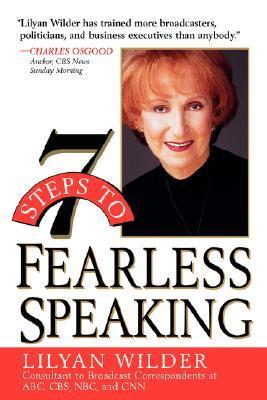
Lilyan Wilder’s 7 Steps to Fearless Speaking is built around a deceptively simple proposition: the way to become less afraid of speaking is not to become better at pretending not to be afraid. It is to become more deeply involved in what you are saying, why you are saying it, and the people to whom you are saying it. Published by John Wiley & Sons in its original 1999 first edition, the book translates more than three decades of Wilder’s teaching and coaching into a cumulative self-training program.
That makes the book different from a collection of presentation tips. Wilder does discuss voice, structure, audience engagement, visual aids, persuasion, meetings, interviews, and emergency speaking, but these are not meant to operate independently. The program moves deliberately from the body and voice, through connection and organization, toward purpose and conviction. By the time the seventh step arrives, Wilder wants the speaker to have stopped treating a speech as a performance test and begun treating it as an act of meaningful communication.
That central insight remains the strongest part of the book. Much of Wilder’s practical coaching still feels useful: prepare, practice aloud, record yourself, work with progressively larger audiences, pay attention to listeners, organize ideas simply, stop hiding behind a script, and have a reason for speaking that matters more than your fear. Other elements need considerably more caution. The book relies heavily on student anecdotes, sometimes makes physiological or psychological claims more confidently than the evidence warrants, carries assumptions about voice and authority that reflect its era, and moves into emotionally intense territory when it adapts acting exercises involving personal memory and trauma.
The result is a book worth taking seriously without treating it as scientifically definitive. Its lasting value lies less in the promise of becoming literally fearless than in its practical answer to a more useful question: what can a frightened speaker do, repeatedly and deliberately, to become capable of speaking anyway?
The Problem Wilder Is Trying to Solve
Wilder begins by treating fear of public speaking as both common and consequential. She cites surveys from the 1990s and stories of famous people who struggled with stage fright, but the more important evidence for her purposes comes from her students. They describe insomnia before presentations, choking sensations, shaky voices, blank minds, career avoidance, elaborate excuses, and the humiliating experience of knowing they have something worthwhile to contribute while remaining silent.
The old polling claims about public speaking being feared even more than death belong to the historical context of the book rather than something that needs to be repeated as timeless fact. Wilder’s deeper point does not depend on them. She is interested in the cost of avoidance: people decline promotions, retreat from leadership, stay quiet in meetings, refuse speaking opportunities, and gradually begin to interpret their inability to speak comfortably as evidence that they are less competent than they really are.
Her alternative to conventional presentation coaching is established immediately. Wilder rejects prescribed gestures, artificial variations in pitch, rigid instructions about eye contact, and fantasies designed to make the audience seem less intimidating. Her objection is not that physical technique is irrelevant—voice training occupies a large part of her program—but that technique becomes empty when it is performed from the outside. She wants the speaker’s body, thoughts, experience, purpose, and audience to form a coherent act of communication.
Two teachers shape this philosophy. Speech professor Lew Sarett taught Wilder to connect excellent speaking with the larger development of an “able person,” someone who has something valuable to say and seeks a productive result through saying it. Acting teacher Lee Strasberg supplied a different influence: techniques for bringing personal experience and emotional reality into performance. Wilder later adapts two of those exercises, the Private Moment and Affective Memory, for the final stage of her speaking program.
The Five Fears
Before teaching the seven steps, Wilder proposes five broad sources of public-speaking fear: career terror, perfectionism, panic, avoidance, and trauma. These are best understood as Wilder’s coaching categories rather than clinical diagnoses. Their usefulness lies in helping readers identify different patterns that can produce similar symptoms.
Career terror occurs when speaking becomes inseparable from one’s sense of professional survival. A promotion, presentation to senior executives, television appearance, unfamiliar technology, hostile colleague, rigid corporate script, or insufficient preparation can make every public statement feel like a referendum on competence. Wilder’s student Rod illustrates the extreme version. When introductions begin moving around a meeting room and his turn approaches, his anxiety becomes so intense that he leaves for the bathroom rather than say a few sentences. He returns knowing that colleagues have noticed, which increases the very professional vulnerability he was trying to avoid.
Perfectionism produces a different trap. Wilder does not object to high standards; she objects to the assumption that communication is successful only when every prepared word is delivered exactly as planned. Dave, a sales executive, is lively and funny when telling personal stories but becomes stiff when speaking about work because he writes and memorizes speeches word for word. The more he tries to guarantee perfection, the less access he has to the personality that makes him engaging. His progress comes when he exchanges the complete script for an outline and discovers that forgetting a minor detail is less damaging than losing all spontaneity.
Panic is Wilder’s name for a self-reinforcing cycle in which anticipatory fear produces bodily reactions, those reactions are interpreted as evidence of impending failure, and the interpretation intensifies the symptoms. Rhonda, a professional photographer, demonstrates the sequence vividly. She begins a presentation by leaning hard against a lectern, restricting her breathing, and speaking so softly that she can barely be heard. Hearing her own failing voice frightens her further; her breathing becomes more difficult, her legs weaken, and she ultimately finishes from a chair. Later, after practicing breathing, voice, and audience interaction, she can discuss the same photographs conversationally because her attention has moved from monitoring her symptoms to explaining the stories behind the images.
Avoidance operates before the speech even begins. Readers procrastinate because preparation makes the future speaking event feel real, but delay leaves them less prepared and therefore more frightened. Jeanette’s story turns this pattern into comedy: instead of preparing a class speech, she cleans her refrigerator, vacuums, mops, cleans the bathroom, and eventually paints it. Her breakthrough comes when she permits herself to produce an imperfect speech rather than waiting until she can produce an ideal one. The episode becomes Wilder’s clearest illustration of preparation as a psychological commitment: once the work exists on paper, the feared event can no longer remain abstract.
Trauma is the most serious and least straightforward category. Wilder argues that humiliation, abuse, loss, harsh criticism, or other painful experiences can become associated with silence and fear of self-expression. She connects this idea to her own life. After her father died when she was thirteen, she withdrew dramatically and spoke only when necessary; acting, education, reading, and relationships later helped her reopen emotionally and recover a sense of voice. Importantly, Wilder acknowledges that deep trauma may require professional counseling rather than a speaking course alone, a boundary that becomes essential when evaluating Step Seven.
The five categories overlap. A perfectionist may procrastinate because preparation exposes the possibility of imperfection; avoidance can produce career terror when repeated silence begins limiting advancement; panic may emerge after a humiliating speaking event; and a speaker can have ordinary nervousness alongside deeper anxiety. Wilder’s classification is therefore less valuable as a scientific taxonomy than as an invitation to stop describing every case simply as “stage fright.”
How the Program Is Supposed to Work
Wilder is unusually explicit that the book cannot work merely by being read. She originally considered a title suggesting seven weeks, but rejected the idea of promising a miracle on an artificially short timetable. Each step is supposed to build on the preceding one, incorporate continuing voice work, culminate in an actual speaking assignment, and end with some form of self-critique.
A reader can work alone or create a self-help workshop. The group version is designed around roughly six people meeting weekly, practicing exercises together, giving progressively harder presentations, and offering feedback. A self-coached reader must recreate those functions through recording, playback, help from friends or colleagues, deliberate speaking opportunities, and disciplined repetition.
The technology makes the book’s age obvious. Wilder talks about cassette recorders, carrying notebooks, clipping articles into physical files, and gradually building presentation resources. The functional advice translates easily, however: record yourself on a phone, maintain notes digitally, save useful examples, and seek real situations in which to speak rather than assuming improvement can happen privately.
The escalating assignment design is one of the book’s most important features. Wilder begins with voice practice, then has readers speak to one person, then several people, then a larger group while adding creativity, persuasion, objective, and conviction. Fear is not addressed by waiting for confidence to arrive. The program repeatedly asks the reader to prepare, speak, listen back, evaluate, adjust, and speak again.
The Seven Steps to Fearless Speaking
The seven steps form a deliberate progression rather than seven independent recommendations. The early stages establish physical and structural stability, the middle stages turn the audience into an active part of the communication, and the final stages make purpose and belief central to the message. Wilder’s underlying assumption is that fear loses some of its power when the speaker has more meaningful tasks demanding attention.
By the end, the sequence can be read as a movement from voice, to listener, to organization, to relationship, to imagination, to action, to purpose, and finally to conviction. Each stage retains the previous ones rather than replacing them.
Step One: Experience Your Voice
Wilder begins with the physical instrument of speech because fear is often experienced bodily before it is understood intellectually. A tense jaw, shallow breathing, tight throat, thin sound, or fading sentence can become part of a feedback loop in which the speaker hears insecurity in the voice and becomes more insecure as a result. Her goal is to give readers a sense that their voices are usable, familiar, and under enough control that they do not become another source of panic.
The chapter opens with the idea that a voice is as individual as a fingerprint. Wilder does not want readers imitating a famous broadcaster or actor; she wants them to discover a fuller version of their own sound. James Earl Jones becomes an important example because his later reputation for vocal authority followed childhood stuttering and long periods of reluctance to speak. Wilder recounts how a teacher challenged him to recite a poem he had written, leading to a powerful experience of hearing his own voice function more freely. She carefully notes that this was not a miraculous cure for stuttering and that Jones continued to work on his speech.
The practical foundation consists of relaxation, breathing, and vocalization. Wilder asks readers to release muscular tension, practice abdominal and diaphragmatic movement while breathing, and then use breath to support sustained sound. Her “AIRobics” exercises add projection, extended vowels, articulation, an open throat, and controlled counting. The exact terminology sometimes reflects older voice-training traditions, but the pedagogical purpose is consistent: make vocal production something practiced rather than something the frightened speaker encounters for the first time under pressure.
Two later stories show what Wilder believes better vocal familiarity can change. Carmen, a retired New York City police officer who moves into corporate security management, becomes self-conscious about her Bronx accent, high pitch, and the authority she believes listeners assign to her voice. Wilder works with pronunciation, pitch, breathing, and resonance until Carmen feels that her professional voice better represents her. The case is useful as a story of increased confidence, but the assumption that a particular accent or lower pitch inherently signals greater authority should be treated as a cultural coaching norm rather than an objective rule.
Ellen Burstein, a former broadcast journalist living with severe multiple sclerosis, offers a different example. Because physical disability makes her voice especially important for communication and computer control, she works deliberately to preserve breathing capacity and vocal strength. Wilder uses the story to reinforce her broader claim that a voice is not merely decorative; for some speakers it becomes one of the most important remaining channels through which agency and identity can be expressed.
Step One ends not with a speech but with a routine. Readers are expected to practice voice work daily, gradually adding exercises from the appendix. Wilder’s insistence on repetition matters more than any single drill: she wants vocal preparation to become familiar enough that a speaker does not have to invent it moments before going on stage.
Step Two: Get a Response and Structure Your Thoughts
With the voice established as a physical base, Wilder turns to the psychological experience of facing an audience. Her answer to isolation is “response”: some observable sign that another person has heard, understood, reacted, or become interested. The idea is important because she wants the fearful speaker to stop thinking of an audience as a silent mass of evaluators and instead experience communication as contact with actual people.
Wilder proposes eight broad ways to seek an early response. A speaker can ask one person a direct question, make a provocative statement, refer to a shared experience, offer timely news, ask the audience to perform an action, use an appropriate anecdote or joke, demonstrate something with a prop, or combine questions with visual material. She strongly prefers devices that arise naturally from the topic rather than canned entertainment.
The direct question receives special emphasis. Wilder believes that if the speaker establishes genuine contact with one person, the rest of the room begins participating indirectly. The claim is occasionally stated too absolutely, but the practical point is sensible: the speaker gains something concrete to respond to instead of interpreting silence as universal judgment.
Response is paired with structure because engagement without direction can become rambling. Wilder’s basic architecture is deliberately simple: a beginning that gains attention and tells listeners where the talk is going, a middle that develops major points with explanations and examples, and an ending that consolidates the message. Preparation begins with the middle because that is where the substantive reason for speaking resides; once the speaker knows the main points, the opening can lead toward them and the ending can reinforce them.
The Step Two assignment is a five-to-eight-minute presentation to one person. The reader chooses a familiar topic, organizes the middle before the beginning, plans a response-getter, practices aloud with an outline, records the rehearsal, gives the real presentation, listens back, and evaluates whether omitted material actually mattered or merely triggered perfectionism. The exercise is small enough to feel manageable but demanding enough to turn theory into behavior.
Step Three: Establish a Dialogue
Step Three extends the first response across the whole presentation. Wilder’s strongest formulation is that many public speakers are technically talking while failing to communicate because they read or recite at an audience rather than remaining responsive to it. Dialogue, in her system, means sustaining a relationship even when the audience is too large for literal conversation.
In a small room, that may involve direct questions and spoken answers. In a larger audience, dialogue includes laughter, facial expressions, applause, nods, confusion, silence, posture, and other visible reactions. The speaker must observe those signals and adapt rather than treating the prepared script as more important than the people receiving it.
Wilder offers numerous devices for maintaining interaction: direct questions, rhetorical questions, stories, dramatized material, photographs and other visuals, verbal signposts that highlight something important, handouts, audience participation, purposeful pauses, and explicit responses to what the speaker notices in the room. The exact technique is secondary to the habit of perceiving the audience continuously.
That requires audience research. Wilder advises speakers to learn why people are attending, what they already know, what concerns or interests they share, and how the circumstances of the event may affect attention. The idea anticipates a broader communication principle: a message does not become audience-centered merely because the speaker says “you.” The examples, assumptions, language, level of detail, and desired response must make sense for the people actually present.
Pam’s speech about Tibetan monk Palden Gyatso demonstrates the method. Her subject involves imprisonment, torture, and political suffering, and she is initially frightened enough that her body shakes. Rather than retreat into a closed monologue, she asks questions, uses photographs and a map, shares her reactions to the story, and allows the audience to participate. Wilder interprets the resulting exchange as the moment when Pam stops being isolated inside her own anxiety and becomes absorbed in a shared subject.
The assignment now expands to at least three listeners. The speaker must maintain dialogue throughout, deliberately use several techniques, practice standing with an outline rather than depending on a lectern, record the talk, and assess where audience interaction strengthened or disrupted the plan. Step Three therefore introduces flexibility without abandoning preparation.
Step Four: Tap Your Creativity
Once the speaker can structure ideas and remain connected to listeners, Wilder asks how the material itself can become more vivid. Creativity, in her view, is not decoration applied to a dull speech after the real work is finished. It is the process of finding forms of expression that make the speaker more deeply interested in the subject and help listeners experience it concretely.
Katherine, a professional whose love of movies is far more animated than her ordinary business presentations, becomes an early example. Wilder encourages her to bring that visual imagination into work-related speaking rather than assuming professionalism requires emotional flatness. The underlying lesson is that speakers already possess creative resources in hobbies, experiences, memories, sensory associations, humor, and language; they simply fail to regard those resources as professionally legitimate.
Wilder encourages deliberate attention to the five senses. A speaker can describe what something looks, sounds, tastes, smells, or feels like rather than speaking exclusively in abstraction. Metaphors, similes, analogies, active verbs, images, rhythm, stories, props, demonstrations, photographs, and slides can translate concepts into experience.
She repeatedly warns that creativity should serve meaning. A prop used merely because it is theatrical becomes a gimmick; a visual that clarifies a difficult comparison may be valuable. The same standard applies to jokes, dramatic gestures, or slides. If a device interrupts the relationship between message and audience, it violates the philosophy of the book even if it makes the presentation superficially more entertaining.
Step Four also addresses business jargon. Wilder pushes speakers to translate statistics, technical processes, and corporate language into examples that show consequences for real people. The goal is not to oversimplify difficult material but to prevent abstraction from becoming a shield behind which the speaker hides.
The assignment becomes a talk of at least eight minutes to roughly five to eight people. Readers are asked to incorporate visual or creative resources, engage each of the senses where appropriate, use descriptive language, record themselves, critique the result, and add another stage of voice work. The growing difficulty is deliberate: the program is gradually making the speaker responsible for more variables while preserving earlier skills.
Step Five: Learn to Persuade
The final three steps form what Wilder calls the heart connection of the program. Step Five asks what the speaker wants listeners to do, Step Six asks why that action matters, and Step Seven asks what experience or belief makes the speaker care so deeply about it. These distinctions give the second half of the book greater conceptual depth than a standard presentation manual.
Persuasion is the what. Wilder does not limit it to sales, debate, or political argument. A presentation may ask listeners to approve a schedule, change a procedure, donate money, reconsider a belief, join an organization, value a relationship, or make a decision. A speech without some desired result can still inform, but Wilder wants the speaker to know whether any particular response is being sought.
Sanjay’s story makes persuasion personal rather than commercial. After failing to gain admission to medical school, he travels and reconnects with family roots in India. The experience helps him clarify both his own direction and the importance he assigns to family relationships. His eventual talk does more than describe the trip; it invites listeners to value family connection deliberately rather than treating it as something that will maintain itself automatically.
Wilder gives speakers four practical questions: Who is listening? What do I want to say? Why do these people need to hear it now? What do I want them to do afterward? Those questions force a speaker to connect audience analysis with outcome rather than simply assembling information.
She also identifies several bases for persuasive support: personal experience, the reported experience of others, research, and reasoning. The distinction is useful because conviction by itself does not establish a claim. Even in Wilder’s system, speakers need material that gives listeners reasons to accept what they are being asked to believe or do.
Anna’s case shows this in a workplace setting. Faced with an unrealistic magazine-production schedule imposed by people who do not understand the process, she structures a presentation around the real sequence of work required to produce the publication. Instead of merely complaining, she explains where time goes and what consequences the proposed timetable will create. The persuasive force comes from converting professional knowledge into a process decision-makers can follow.
Yahron’s technology presentation demonstrates another problem: memorization can preserve words while destroying persuasion. He initially treats the pitch as something to recite rather than a decision another businessperson must make. Wilder pushes him toward a shorter outline, clearer benefits, audience questions, and a more conversational explanation of why the relationship makes sense.
Eleanor’s hospital story reinforces Wilder’s preference for combining narrative and action. A personal incident may make listeners care, but persuasion becomes complete only when the story points toward a specific response. The fifth assignment therefore requires speakers to identify a concrete desired action, gather support for it, use the previous steps, and present the case to a real audience.
Step Six: Achieve Your Higher Objective
If persuasion identifies what the speaker wants, the higher objective identifies why that desired action matters. Wilder borrows the language of acting and motivation: the immediate task is not enough. A speaker becomes more compelling, and in her view less frightened, when the task is connected to a larger value.
The distinction can be practical. A manager may want employees to complete reports on time, but the higher objective could be making the team more reliable. A salesperson may want a client to sign a contract, but the deeper objective could be establishing a durable professional relationship. A parent may want other parents to volunteer for an event because shared activity will strengthen bonds with their children.
Wilder asks readers to identify what genuinely matters to them rather than inventing inspirational language after a speech is written. Family, service, professional integrity, education, community, fairness, security, creativity, and responsibility may all provide higher objectives, but the specific connection has to be real enough that it affects how the speaker thinks about the material.
This becomes particularly important in career terror. Corporate speakers often feel trapped by presentations they did not choose and language that does not sound like their own. Wilder’s solution is not to pretend every assigned topic is personally fascinating. It is to ask what larger professional aim can make the task meaningful: establishing expertise, protecting a project, improving a system, helping a team, representing one’s work accurately, or strengthening a relationship with the audience.
Jacqui, an advertising executive, illustrates the shift. She can perform creatively in her work but becomes less certain when presenting it to clients. Wilder helps her see that her objective is not simply surviving a presentation or displaying a campaign; it is showing the client why her professional judgment deserves trust. That changes the presentation from an ordeal imposed on her into an extension of the role she already wants to occupy.
Kathy Dwyer’s Revlon presentation provides a more elaborate example. She uses market research and observations about changing roles for women to argue that the cosmetics industry must understand consumers differently. The case is valuable for seeing how Wilder connects evidence, persuasion, and professional purpose, but some of the period’s demographic and gender claims should be read as historical presentation material rather than current social science.
Step Six also revisits what Wilder regards as public-speaking myths. She rejects winging a major speech, mechanically timing eye contact, assuming an opening joke is mandatory, reading every word because it feels safer, believing strong speakers are simply “naturals,” or treating one’s present voice as fixed. The unifying objection is the same one introduced at the beginning of the book: techniques become counterproductive when they replace genuine involvement.
Step Seven: Give the Gift of Your Conviction
Step Seven is the emotional and philosophical climax of the book. If Step Five asks what the speaker wants and Step Six asks why it matters, Step Seven asks why the speaker personally believes that “why.” Wilder calls this the because of the message: the experience, value, memory, or identity from which conviction comes.
The chapter also introduces vulnerability explicitly. Wilder argues that people often become formal or impersonal in professional speech because formality feels safer. Speaking from personal conviction exposes the speaker to disagreement and judgment, but she believes that the same exposure can create a more powerful sense of agency because the speaker is no longer hiding from what matters.
To reach that material, Wilder adapts two techniques from Lee Strasberg. The Private Moment originates in acting work designed to help performers behave with the absorbed, unselfconscious quality they have when alone. Wilder does not ask speakers to act out a role. She asks them to remember what it feels like to be completely occupied with an experience rather than monitoring how they appear, and then to carry some of that inward concentration into public communication.
The Affective Memory exercise is more psychologically demanding. Readers recall an emotionally significant event, reconstruct sensory details, and reconnect with the feelings attached to it. Wilder’s purpose is to make personal experience available as a source of truth and energy in a speech rather than leaving conviction at the level of abstract declaration.
Her own experience makes the technique personally meaningful. The early death of her father had contributed to years of silence, and Wilder’s later life in theatre helped her recover both emotional expression and literal voice. When she asks students to examine why certain issues matter to them, she is extending a method that she believes helped her understand herself.
Sam Young’s case demonstrates the resulting vulnerability. Speaking about separation from his children makes the subject emotionally difficult, but the personal stakes give him a kind of authority that would be unavailable if he reduced the experience to generalized advice about family. Wilder sees his willingness to speak honestly as evidence that conviction does not require emotional invulnerability.
Peggy Lynch provides the fullest demonstration of all seven steps developing inside one speaker. Peggy is preparing a keynote for hundreds of educators about including children with disabilities in ordinary classrooms. Initially she relies heavily on a complete script and fears that removing even a sentence will cause her to lose control.
The first sessions work on voice and structure. Peggy identifies the core of her teaching method and plans a beginning around a poem by a student named Tamako, followed by major points concerning ownership, time, and response. She intends to finish with a powerful piece written by another child, giving the speech a clear narrative and emotional arc rather than presenting an abstract argument about educational policy.
As Wilder moves Peggy into dialogue, the script becomes a psychological obstacle. Peggy fears that looking away from the paper will make her lose her place, but Wilder encourages her to trust the material she knows and use the outline as a support rather than a barrier. Pauses, rather than representing failure, become moments in which listeners can absorb what she has said.
Creativity adds student writing and visual material, allowing the children themselves to enter the presentation indirectly. Persuasion then clarifies what Peggy wants: she is not simply describing her classroom. She wants teachers to reconsider the assumption that children with disabilities automatically belong elsewhere.
Step Six forces the mission into a direct statement. Peggy’s higher objective is inclusion: she believes these children should be educated alongside other students and wants the audience to understand what they can contribute. The speech therefore becomes an attempt to change professional behavior rather than a showcase of one teacher’s successful work.
Step Seven reaches the source of that conviction. When Wilder asks why Peggy became a teacher, Peggy recalls being a quiet child whose high, soft voice was mocked by a teacher. The experience made her reluctant to speak in class and helps explain why she cares so strongly about children whose voices, differences, or difficulties make them easy to dismiss. Her professional argument and private history suddenly connect.
That connection also becomes a test. When Peggy is later asked to shorten the keynote, she is willing to cut material but resists removing what she now understands to be the personal core. Wilder treats that decision as evidence that Peggy is no longer merely protecting a script from disruption. She is protecting the meaning of the speech.
The final presentation becomes the book’s clearest model of fearlessness. Peggy has not become a different personality, and Wilder does not suggest that all anxiety magically vanishes. What changes is the hierarchy of attention. The children, the teachers in front of her, the argument for inclusion, and Peggy’s reasons for believing it matter more than continuously checking whether she sounds frightened.
The Seven Steps in Action
After Step Seven, Wilder deliberately avoids ending the book. She wants to demonstrate that the framework can operate as a whole across very different subjects and speakers. Three extended examples—Jerome, Elizabeth, and Julia—show voice, response, structure, dialogue, creativity, persuasion, objective, and conviction functioning together.
The examples also reveal the historical setting of the book more clearly than the earlier chapters. Internet presentations, early PowerPoint culture, downtown revitalization campaigns, and comparisons across decades of women’s education belong unmistakably to the late 1990s, but the communication problems Wilder draws from them remain recognizable.
Jerome and Reuters: Technology Without Losing the Human Speaker
Jerome works in New Media at Reuters during the early expansion of Internet-based news and commerce. His job requires him to explain unfamiliar technology to colleagues and potential users, making him an ideal case for Wilder’s concern that information-heavy presentations often become impersonal precisely when audiences most need orientation.
In ordinary conversation Jerome is lively and clear. Formal presentation turns him into a more cautious speaker, so Wilder’s task is to recover the conversational qualities without sacrificing structure. He begins by involving the audience, uses then-current statistics and examples to establish the scale of the Internet, explains Reuters and its movement into online media, and uses visual material to help people follow a subject that still felt new to many listeners.
The case also lets Wilder criticize presentation technology. PowerPoint and digital projection were becoming symbols of professional sophistication, but she insists that slides cannot assume the speaker’s responsibility for communication. A presentation full of technological effects can still fail if the speaker reads, hides, or stops responding to the room.
Jerome’s conviction comes from genuine excitement about the transformation he is describing. That enthusiasm gives him a reason to persuade listeners that the Internet is not merely another communications channel but a major shift in how information will be distributed. The prediction belongs to its era, yet the broader lesson has aged well: a speaker discussing new technology must remain more human, not less, when the technology itself is absorbing attention.
Elizabeth and the Fight to Save Main Street
Elizabeth’s situation is local rather than technological. A retailer in Connecticut, she sees the commercial health of her town’s Main Street deteriorating and wants fellow Rotarians to participate in revitalizing it. Her speech therefore combines personal economic interest with a civic higher objective.
She does not simply warn that local businesses are struggling. Wilder has her connect the situation to values already important to the audience, particularly community service. That alignment allows persuasion to emerge from shared purpose rather than from a demand that listeners care about Elizabeth’s store simply because she does.
The speech uses concrete examples of what a revived commercial district could look like and proposes events capable of bringing people back into the area. Suggestions include community gatherings, an automobile show, and an art-related event. These ideas turn an abstract problem—declining downtown vitality—into actions listeners can imagine helping organize.
Wilder reports that several of the proposed events subsequently happen. The point is not that one speech single-handedly rescues a town. It is that Elizabeth demonstrates Wilder’s full sequence: she knows what action she wants, understands why the audience might care, gives listeners something practical to do, and connects her business concern with a wider civic conviction.
Julia and Fifty Years of Change at Brown
Julia’s case shifts from community advocacy to personal history. A retired United Nations administrator, she has struggled with speaking fear for many years and is addressing prospective students at Brown University. Her subject becomes a comparison between opportunities available to women when she entered college in 1948 and those available to later generations.
The presentation gains force because Julia does not treat social change as an external history lesson. Her own life becomes evidence of the distance between eras. That lets Wilder combine creativity, perspective, audience relevance, and conviction without requiring a conventionally dramatic story.
The audience is crucial. Prospective students are deciding how to understand the institution and their own possibilities within it, so Julia’s memories function as a bridge between Brown’s past and the futures they are imagining. The speech asks them to value opportunities that once could not be assumed.
For Wilder, the most important transformation is Julia’s. Someone whose history includes long-standing fear becomes capable of using that history publicly. The case therefore closes the integrated examples on the same theme that opened the book: speaking matters because withholding one’s knowledge and experience deprives both speaker and listener of something potentially valuable.
Special Situations, Emergency Speaking, and Everyday Practice
Wilder devotes substantial space to situations that do not resemble the classic prepared speech. Meetings, panels, interviews, conference calls, ceremonies, eulogies, hostile questions, and sudden requests to speak all create different constraints, but she argues that the seven-step logic can still organize them.
The important shift is from memorizing a particular speech format to internalizing a way of thinking. A speaker who routinely asks who is listening, what matters, what result is wanted, how the material should be organized, and where dialogue can occur is better positioned when preparation time disappears.
Meetings, Panels, Recruitment, and Ceremonial Speaking
Brian, a recently promoted vice president at a technology company, discovers that leading a meeting can trigger the same fear as standing at a lectern. His weekly project meetings disintegrate into side arguments while he records the chaos rather than directing it. Wilder diagnoses the problem not simply as weak meeting technique but as lack of personal objective.
Brian identifies a higher goal: he wants to oversee projects effectively, reduce unnecessary costs, and demonstrate his value to the company’s CEO. He then prepares an outline of the issues that must be resolved and uses direct questions to move participants toward decisions. The meeting becomes easier to control because he is no longer waiting passively for other people to determine its shape.
Panel discussions create a different problem. Ellie learns that knowing her subject is not enough when she must compete for attention among multiple speakers. Wilder encourages stronger preparation of openings, examples, anecdotes, visual material, and ways of entering the discussion so that participation does not depend on a perfect invitation from the moderator.
Recruitment brings the method closer to persuasion. Marsha initially approaches prospective recruits as if she needs to deliver information efficiently. Her stronger version begins with personal educational experience, invites questions, relates the organization’s benefits to listeners’ needs, and ends with a clear next step. Recruitment becomes dialogue rather than a brochure spoken aloud.
Introductions, toasts, roasts, and awards receive shorter treatment. Wilder’s advice is consistent with the rest of the book: do not force jokes merely because the occasion seems to demand one. Find something specific that connects the person, event, and audience, and let the meaning of the occasion produce the tone.
Interviews, Conference Calls, and Eulogies
Conference calls are treated as speaking situations rather than casual conversations. Without physical presence, structure and vocal clarity become more important, and participants need explicit ways of checking understanding and maintaining response. The technology has changed dramatically since 1999, but the same principle applies to modern video meetings: mediation increases rather than eliminates the need for deliberate human connection.
Wilder approaches job interviews as a sequence of mini-speeches. Candidates should prepare compact stories and examples about their work, decisions, skills, failures, achievements, and objectives so they are not inventing their professional identity under pressure. This preparation should not become memorized recitation; the goal is to have organized material ready for adaptation.
Media interviews require a related but more strategic skill. Wilder advises interviewees to know their objective before questioning begins and to answer honestly while bridging toward the points they consider important. Without that preparation, the interviewer determines the entire frame and the subject becomes reactive.
Eulogies become an important exception to Wilder’s usual preference for outlines over scripts. Grief can overwhelm even an experienced speaker, so she explicitly recommends writing thoughts out word for word and keeping the complete text available. A personal story can create connection and provide a structure that remains usable under intense emotion.
This exception improves the book because it reveals that Wilder’s anti-script position is not absolute. The governing principle is communication, not ideological loyalty to spontaneity. When a full text protects meaning rather than preventing connection, she is willing to use it.
The First Aid Kit, Emergency Kit, and Ongoing Practice
The First Aid Kit addresses moments when something goes wrong during speaking. A person is unexpectedly called on, goes blank, encounters a hostile question, develops dry mouth, begins shaking, or faces some other disruption that threatens to become the only thing they can think about. Wilder’s immediate remedies generally return to familiar tools: breathe, pause, admit when you do not know an answer, ask for clarification, reconnect with the audience, and return to the central structure.
For off-the-cuff speaking, she recommends developing a habit of knowing what you think about work already underway. If a meeting concerns a project, a responsible participant should have enough understanding of its main issues to organize a brief response around a few points rather than assuming that “unprepared” means “having no thoughts.” A random-topic exercise trains the ability to impose simple structure quickly.
The Emergency Kit is different because some preparation time exists, but not much. Wilder gives a one-to-six-hour sequence. The first hour is devoted to audience, circumstance, objective, possibilities, and research; the second to major points and supporting material; the third to practicing the body of the message aloud and establishing introduction, body, and conclusion. Later hours add creative language and visuals, refine the outline, record and review the talk, rehearse, and prepare for likely questions.
The sequence reveals Wilder’s priorities. Content and objective come before decoration. Visuals appear only after the structure exists, and practice aloud continues throughout. Even under time pressure she does not recommend writing an elegant introduction first and hoping the rest follows.
“Be a Fearless Speaker Every Day” then rejects the idea that completion of the seven steps constitutes graduation. Tom, a graphic artist who rarely gives conventional speeches, learns to see ordinary client interactions as opportunities to practice clarity, persuasion, response, and objective. Debbie, experiencing unemployment, prepares for interviews as speaking assignments and uses volunteer work to maintain communication skills and build new experience.
Wilder encourages readers to seek meetings, classes, community groups, professional organizations, social events, and other situations in which they can keep speaking. Experience is treated as maintenance. Fearlessness, in this sense, is not a permanent possession but a capacity that remains stronger when used.
Appendix A extends that same logic to voice work. The seven exercises begin with relaxation, breathing, and AIRobics, then add projected words and vowels, consonant articulation, changes in emphasis, Gilbert and Sullivan material for rhythm and articulation, Alfred Noyes’s “The Highwayman” for imagery and sound, and Shakespeare for broader expressive range. Wilder wants the exercises accumulated gradually until readers can use a fuller range of voice without consciously assembling each component.
The appendix also contains voice-care and pronunciation advice, some of which should be read as period coaching rather than modern medical guidance. Appendix B is more important because Wilder acknowledges that speaking fear may exceed the boundaries of a self-help program. She advises readers with serious trauma, stuttering, medical problems, or severe anxiety to seek appropriate professional help and mentions counseling and medication as possibilities.
The medical contact information in the 1999 edition is naturally obsolete, and medication should not be self-prescribed on the basis of a public-speaking book. The lasting point is Wilder’s recognition that communication training and clinical care are not interchangeable. Her Selected Readings then returns to the less clinical end of the program by offering poems, plays, and prose that readers can use as material for vocal practice.
The Core Idea Behind the Method: Stop Performing and Start Communicating
The seven steps make the most sense when treated as one sustained attempt to redirect attention. A frightened speaker tends to monitor the self: How do I sound? Are my hands shaking? Did I forget something? Do they think I am stupid? Am I making enough eye contact? Wilder keeps replacing those questions with tasks outside the self: What does this person need to understand? What response am I getting? What is my next point? What do I want them to do? Why does it matter?
That does not mean self-awareness disappears. Step One is highly self-observant, and recordings force readers to confront their voices and habits directly. The difference is that self-observation becomes instrumental. You examine your breathing so you can communicate more effectively; you do not monitor every bodily sensation during the speech as evidence of whether you are succeeding.
This is why response and dialogue matter more in Wilder’s system than conventional “audience engagement” tips. The audience is not simply being entertained. The audience provides evidence that communication exists. Once a speaker sees someone nod, answer, laugh, object, or become curious, the situation changes from solitary exposure to interpersonal exchange.
The same principle explains why Wilder’s advice overlaps naturally with broader ideas about adapting communication to the listener. Effective conversation and effective public speaking are not identical, but both improve when the other person is treated as a participant rather than a target. Wilder’s unusual move is to argue that this audience orientation is not merely better rhetoric; it is also part of the solution to fear.
Her concept of authenticity grows from that relationship. Wilder does not mean that speakers should improvise everything or say whatever comes spontaneously to mind. Her most “authentic” speakers often prepare extensively. Authenticity means that preparation has not separated the speaker from the language, values, experience, and people involved.
That resolves what might otherwise look like a contradiction between practice and naturalness. Wilder repeatedly admires speakers who seem effortless while emphasizing that such ease is normally the result of practice. Preparation creates enough familiarity with structure and content that attention can move outward once the speech begins.
The idea is particularly useful for over-scripted professionals. A full script can become a security object: losing a sentence feels like losing the presentation. Wilder wants the speaker to internalize the logic instead. If you know the point you are making, why it matters, and what comes next, wording can vary without the entire structure collapsing.
There are limits. Some formal occasions require precise language, regulated disclosures, legal wording, translation considerations, or strict timing. Some speakers also need scripts for accessibility or cognitive support. Wilder’s own eulogy advice demonstrates that the book works best when its preference for conversational delivery is treated as a principle to adapt rather than a universal rule.
Why Practice, Exposure, Feedback, and Preparation Matter
Wilder’s practical program was developed from teaching experience rather than as a clinical treatment protocol, but one of its strongest features resembles a principle well established in modern anxiety treatment: avoidance tends to preserve fear, while structured contact with a feared situation can help weaken it. The resemblance does not prove that Wilder’s seven-step system as a whole is scientifically validated, but it helps explain why its progressive speaking assignments are more substantial than generic encouragement to “be confident.”
A meta-analysis of in-vivo and virtual-reality exposure interventions for public-speaking anxiety reviewed 11 studies involving 508 participants and found substantial reductions in public-speaking anxiety. The interventions in that literature differ from Wilder’s program, and the result should not be appropriated as proof of every exercise she recommends. What it does support is the broad principle that actually confronting speaking situations matters.
Wilder’s assignment sequence is notable in this respect. She does not begin by sending the most frightened reader in front of five hundred people. Step Two uses an audience of one; Step Three increases the number; Step Four enlarges the group and adds complexity; later steps add persuasion, values, and higher stakes. The progression resembles graded challenge even though Wilder does not frame it in formal clinical terminology.
The self-critique questionnaires add another useful element. Fearful speakers often remember a presentation globally—“it was terrible”—rather than distinguishing what happened. Wilder asks more specific questions: Did the response-getter work? Did I leave out something essential or am I being perfectionistic? Did interaction improve the speech? Where did I lose structure? What actually happened when I made a mistake?
Recording introduces feedback that can challenge inaccurate self-perception, although it can also become another source of excessive self-monitoring if used obsessively. Wilder’s intention is practical comparison. A speaker listens for clarity, voice, structure, and connection, makes an adjustment, then goes out and speaks again.
Group workshops add social feedback. Participants see that others are frightened, learn that mistakes do not automatically lead to humiliation, and receive reactions to the content rather than having to imagine what everyone thought. The social environment can therefore weaken the assumption that the audience is an unknowable jury.
Preparation performs a related function by reducing avoidable uncertainty. Wilder is not claiming that knowing the material eliminates anxiety. She is arguing that being anxious and unprepared is worse than being anxious while knowing the structure, examples, objective, and likely questions.
Her hostility toward “winging it” is consequently more nuanced than it first appears. She wants the delivery to be responsive, but she wants responsiveness built on preparation. The speaker should be free to depart from wording because the argument is secure, not because there is no plan.
The biggest weakness is that Wilder occasionally describes successful engagement as though fear simply disappears when the speaker is sufficiently involved. That may happen for some people, but it should not be made a condition of success. A more durable interpretation of her own method is that the speaker learns to function while anxious and discovers through repeated experience that anxiety does not have to determine behavior.
Voice and Body: What Is Useful and What Has Aged
Wilder gives the body unusual prominence for a speaking book. Before persuasion, storytelling, or slides, she wants readers to notice muscular tension, breathing, articulation, and the experience of hearing their own voices. That emphasis remains valuable because public-speaking fear is not purely verbal or intellectual; trembling, shortness of breath, dry mouth, vocal instability, and physical constriction are often part of the experience.
Modern research gives some qualified support to regulated breathing as a stress-management practice. A systematic review of breathing practices for stress and anxiety reduction found that many studied interventions reported beneficial effects, while also emphasizing substantial variation in methods and study quality. That is a useful context for Wilder’s breathing exercises, but it does not establish every mechanism or vocal claim in the book.
Her most defensible practical point is that a speaker can benefit from becoming familiar with breathing and vocal production before a high-pressure event. Slow, deliberate preparation may interrupt frantic pre-speech behavior, and repeated vocal practice can make projection and articulation less novel. The book is strongest when it treats this as training.
It becomes weaker when coaching preferences are presented as biological or universal truths. Wilder repeatedly prefers a warm, lower pitch and often treats resonance as inherently more authoritative. A lower voice may be valued in particular broadcasting or corporate cultures, but authority is not reducible to pitch, and encouraging speakers to manufacture a voice outside a comfortable range can conflict with the book’s own celebration of authenticity.
Carmen’s accent-reduction story exposes the same tension. The case accurately captures a real social problem: people are judged by accent, dialect, class markers, ethnicity, and regional speech. Helping a client become more intelligible or gain voluntary control over different speech styles can be empowering. Treating one dialect as intrinsically more educated or authoritative, however, reproduces the social bias rather than merely solving a technical communication problem.
The body-mind-soul framework is similarly best read as Wilder’s coaching language rather than anatomy. “Body” represents sound, “mind” represents words and intention, and “soul” represents accumulated experience and conviction. The model works as rhetoric because it reminds speakers that voice, ideas, and purpose belong together, but it should not be confused with a scientific model of speech production.
Appendix A also contains at least one straightforward anatomical error. Wilder describes the trachea in a way that implies it is involved in the passage of food. Modern anatomical references are clear that the trachea is an airway, while food is transported through the esophagus. The error does not invalidate the speaking exercises, but it illustrates why the book should not be used as a medical authority.
The voice regimen remains more valuable as disciplined warm-up than as doctrine. Reading poetry, playing with pitch and pace, exaggerating emphasis, articulating difficult sounds, and discovering expressive range can make speakers less rigid. The useful lesson is exploration and familiarity, not the assumption that every person should converge on the same ideal professional sound.
Persuasion, Higher Objectives, and the Ethics of Conviction
Steps Five through Seven give 7 Steps to Fearless Speaking its most distinctive architecture. Many public-speaking books explain how to open, organize, and deliver a talk; Wilder keeps asking what the speech is trying to accomplish and why the speaker cares enough to attempt it. The sequence of persuasion, higher objective, and conviction prevents technique from becoming an end in itself.
Persuasion provides direction. A speaker who wants no particular response may still inform or entertain effectively, but once action is desired, the message must be organized around the audience’s decision rather than the speaker’s inventory of facts. Wilder’s business cases repeatedly improve when speakers stop presenting everything they know and begin selecting what another person needs in order to act.
The higher objective adds ethical and motivational depth. It asks why the requested action is worth pursuing. In the best examples, this prevents manipulation because the speaker must articulate the larger value supposedly served by the request. Peggy does not merely want teachers to admire her classroom; she wants children with disabilities treated differently.
Conviction then asks where that value comes from personally. The idea can be powerful because listeners often need to know why the speaker has invested judgment, experience, or identity in the issue. A reasoned argument delivered by someone who visibly understands its human stakes can be more persuasive than the same information delivered as detached recitation.
Yet conviction creates a danger precisely because it is powerful. Sincerity is not evidence. A speaker may believe something deeply and still be wrong, unfair, poorly informed, or manipulative. The emotional force of personal experience can make a weak causal claim feel stronger without actually strengthening its logic.
Wilder partly protects against this by including research, reasoning, and reported experience among the sources of persuasion. The article’s fairest reading is therefore not that belief replaces evidence. Rather, evidence answers whether the argument deserves acceptance while conviction explains why the speaker has chosen to make it.
The ethical test is whether audience engagement remains genuinely reciprocal. Asking listeners questions, appealing to shared values, and telling personal stories can invite participation, but they can also become pressure tactics. A good speaker must respect the possibility that a listener will understand the message fully and still disagree.
The same caution applies to vulnerability. Wilder often treats personal disclosure as a route to stronger communication, and it can be. It should not become a new performance requirement in which speakers feel obligated to reveal private pain in order to seem authentic. A professional can communicate honestly without making every presentation autobiographical.
The best interpretation of Wilder’s final three steps is therefore modest but strong: know what you want, know why it matters, and know why you believe it. Then make sure your reasons are worthy of the confidence with which you express them.
Where Wilder’s Psychology Needs More Caution
Wilder is a communication coach writing from long experience with frightened speakers, not a clinician presenting a diagnostic manual. That distinction matters because the book often crosses from practical observation into psychological explanation. Some of those observations fit comfortably with modern understanding; others require more restraint.
The five fears are a useful coaching map, but they are not recognized clinical categories. Career terror, perfectionism, avoidance, panic, and trauma can certainly contribute to speaking anxiety, yet they differ in level and kind. A person who dislikes presentations after one embarrassing meeting is not in the same situation as someone with severe social anxiety or unresolved trauma.
Modern clinical guidance on social anxiety disorder gives structured cognitive behavioural therapy a strong evidence base, including work on self-focused attention, feared predictions, safety behaviors, and exposure. Some of Wilder’s practical advice happens to move in compatible directions: speak instead of avoiding, examine what actually happened, reduce excessive self-monitoring, and engage the social situation rather than retreating from it.
That compatibility should not be overstated. Wilder’s program was not designed or tested as a substitute for evidence-based treatment of social anxiety disorder. Readers whose fear causes major impairment, panic across many social settings, persistent avoidance, or severe distress may need clinical assessment rather than a harder speaking assignment.
The panic spiral is one of Wilder’s more psychologically plausible observations. A person anticipates failure, notices a physical symptom, interprets the symptom catastrophically, becomes more frightened, and experiences more intense symptoms. Rhonda’s story makes the cycle easy to understand even though Wilder’s physiological explanations are sometimes simplified.
Avoidance is another area where her practical instincts are strong. Jeanette’s procrastination feels comic, but the underlying problem is serious: every avoided task can preserve the belief that the task was unmanageable. Wilder’s answer—prepare something imperfect, then speak—is consistent with the broader principle that direct experience can challenge fearful predictions.
Trauma is more difficult. Wilder deserves credit for telling readers that serious childhood pain may require professional help, yet Step Seven also invites readers to reopen emotionally powerful memories through Affective Memory. That creates tension inside the book: the same personal history that may require therapeutic care is also being treated as speaking material.
Strasberg’s exercises were developed for actors in a particular artistic tradition, not as clinical interventions for anxiety or trauma. A speaker who recalls an emotionally significant but manageable event may find the exercise useful. Someone with severe trauma may experience distress, dissociation, destabilization, or other reactions that a self-help workbook is not equipped to manage.
The Private Moment is less concerning when interpreted simply as a concentration exercise. Remembering the absorbed quality of doing something privately can help illustrate the difference between acting for approval and becoming involved in an activity. Problems arise only if Wilder’s larger claims about personal transformation are treated as guaranteed psychological effects.
Medication needs an equally clear boundary. Wilder mentions beta-blockers in Appendix B but explicitly declines to tell readers whether they need them and directs such decisions toward medical care. Current NHS information on propranolol similarly describes it as a prescription medicine that can help reduce certain physical symptoms of anxiety, such as shaking or sweating, rather than as a general cure for the thoughts and fears underlying anxiety.
The book’s word “fearless” should therefore be interpreted carefully. Wilder sometimes describes fear as evaporating when involvement becomes strong enough, but many competent speakers remain nervous. A better standard is functional freedom: anxiety may still be present, yet the person can prepare, speak, respond, recover from mistakes, and pursue meaningful goals without organizing life around avoidance.
That interpretation actually makes the book stronger. It removes the unrealistic demand that successful speakers must feel no fear and preserves the practical transformation Wilder’s students demonstrate. Rod can stay in the meeting, Rhonda can continue speaking, Dave can abandon the perfect script, and Peggy can address hundreds of educators without requiring proof that each sensation of anxiety has disappeared.
How the Book Is Written and Organized
Wilder announces early that she writes the way she teaches, and the entire book follows that decision. The reader is addressed as a student rather than a detached observer. Instructions, stories, exercises, questions, workshop schedules, self-critiques, and encouragement recur until the book feels less like a conventional argument and more like a course manual accompanied by a coach’s voice.
That structure is one of its strengths. An abstract chapter telling readers to “connect with the audience” would be easy to forget; Wilder gives response-getters, assignments, case studies, rehearsals, and questions to ask afterward. The pedagogy is behavioral and repetitive because she expects readers to practice rather than merely agree.
The student stories perform several roles. They normalize fear by showing competent professionals struggling with it, illustrate concepts in concrete situations, and provide narratives of change. Rod’s escape from a meeting makes career terror visible; Jeanette’s cleaning spree makes avoidance memorable; Peggy’s seven-session progression demonstrates how all the steps accumulate.
The stories are less reliable when Wilder implicitly treats improvement in individual clients as proof of general effectiveness. Coaching anecdotes can show what is possible and clarify how a technique is used, but they cannot establish how often the program works, for whom, or compared with alternatives. The book offers no controlled evidence for the seven-step package.
Repetition also cuts both ways. Wilder continually returns to breathing, response, structure, dialogue, creativity, purpose, and conviction, sometimes restating points a reader already understands. As prose, this can feel excessive. As instruction, however, the repetition helps preserve the cumulative nature of the method: Step Six is not supposed to replace Step Two, and Step Seven still assumes voice practice and structure.
The emotional architecture is particularly deliberate. The book begins with physical sound, moves through interpersonal connection, and gradually asks for more personal meaning. By delaying Affective Memory and deep conviction until Step Seven, Wilder tries to establish practical control before asking readers to expose more of themselves.
Her second-person voice contributes to the sense of coaching but can also make assertions sound more universal than they are. “You” will feel this; fear will disappear; listeners will respond. The certainty is motivating, yet critical readers need to distinguish confidence born from teaching experience from claims demonstrated empirically.
The historical setting is visible everywhere. Cassette recordings, early Internet enthusiasm, corporate presentation culture, landline conference calls, print clippings, period gender assumptions, and now-obsolete contact information make the book unmistakably a product of 1999. Surprisingly little of the central communication framework depends on those details, which is one reason the book survives its technology better than might be expected.
Critical Review: How Well Does 7 Steps to Fearless Speaking Hold Up?
Judged as a practical communication course rather than a scientific treatise, 7 Steps to Fearless Speaking remains unusually coherent. It asks readers to do real work, builds difficulty gradually, and connects technique to meaning. Judged as an account of anxiety, voice science, or treatment, it requires substantially more qualification.
Its fairest evaluation therefore depends on separating the parts of the book that are excellent pedagogy from the parts that rely on anecdote, outdated assumptions, or overconfident explanation. Those differences do not cancel one another, but they do determine how the book should be used today.
What It Does Exceptionally Well
The book’s greatest strength is its progression. Many public-speaking manuals become inventories of eye contact, posture, openings, storytelling, slides, and gestures without explaining what unifies them. Wilder has a clear theory: speakers become more capable when attention moves from self-conscious performance toward prepared communication with real people about something meaningful.
The assignment design turns that theory into action. A reader speaks to one person before several people, gradually adds dialogue and creativity, then learns to persuade, identify a deeper objective, and communicate conviction. Each new demand sits on top of earlier practice rather than appearing as a disconnected trick.
Wilder is also excellent on the relationship between preparation and spontaneity. She understands that frightened speakers often over-script because exact wording feels safe, yet she does not swing to the opposite extreme and recommend improvisation. Her preferred tool is an outline strong enough to free the speaker from memorization without leaving the content unstructured.
The emphasis on audience response remains particularly useful. Advice to “make eye contact” often turns human connection into another performance metric. Wilder asks a more meaningful question: what evidence do you have that the person listening is with you? That encourages speakers to notice actual communication rather than mechanically performing behaviors associated with confidence.
Her treatment of perfectionism is similarly strong. Speakers commonly judge themselves by whether they said everything they prepared rather than whether the audience received the important ideas. Wilder repeatedly asks whether omitted material was actually essential, a question capable of dismantling the false equivalence between exact execution and successful communication.
The emergency material is more practical than the title might suggest. Wilder does not promise that a last-minute speech becomes effortless. She supplies priorities: objective first, then audience, main points, support, structure, rehearsal, creative material, outline refinement, and questions. That order is valuable precisely because pressure often causes speakers to spend too much time polishing the wrong things.
The final three steps are the book’s most original synthesis. Persuasion as “what,” higher objective as “why,” and conviction as “because” is a memorable way to distinguish action, purpose, and personal investment. It gives speakers a framework for deciding not only how to communicate but whether the communication has enough substance to justify attention.
Most importantly, Wilder refuses to treat public speaking as something naturally gifted people can do while everyone else watches. Her speakers practice. They stumble, record themselves, revise, speak again, and sometimes continue feeling nervous. That makes the book more humane than its “fearless” title initially suggests.
What Has Aged Poorly or Needs Qualification
The most significant limitation is evidence. Wilder repeatedly says that her method works because she has seen students improve over decades of teaching. That experience gives her practical credibility, but individual success stories cannot establish efficacy in the scientific sense. The book lacks systematic data about outcomes, attrition, severity of initial fear, long-term maintenance, or comparison with other approaches.
Some of the psychology is also too confident. Career terror, perfectionism, panic, avoidance, and trauma are useful descriptive categories but not a validated diagnostic system. The idea that deep involvement crowds out fear may describe a genuine experience, yet it should not be presented as a dependable mechanism for every anxious speaker.
The voice material contains a similar mixture. Repeated breathing and vocal practice can be useful, but lower pitch, accent reduction, and particular notions of resonance reflect professional norms that were especially powerful in late-twentieth-century broadcasting and corporate culture. They should not be confused with universal requirements for intelligent or credible speech.
The trachea error in Appendix A is a concrete reminder that the book is not a medical reference. Other voice-care claims and simplified descriptions of physiology deserve the same restraint. Readers with persistent hoarseness, pain, swallowing problems, stuttering concerns, or other medical symptoms need qualified professional evaluation rather than more aggressive practice.
Step Seven poses the most important substantive risk. Personal memory can give a speech emotional truth, but using Affective Memory with painful experiences can move a self-help exercise into territory requiring therapeutic skill. Wilder does warn readers to seek professional help for serious trauma, yet the boundary is not developed as carefully as a modern treatment-oriented book would require.
Several examples have also aged. Technology speeches from the dawn of widespread Internet adoption, PowerPoint novelty, old telecommunications practices, contact addresses, and market statistics no longer function as current information. Some period assumptions about gender and professional authority are especially noticeable.
The book can be repetitive. Concepts introduced clearly are sometimes re-explained through several additional stories. Readers looking for a concise manual may become impatient, although the repetition makes more sense when the book is used slowly as the multiweek course Wilder intended rather than read straight through as narrative nonfiction.
Wilder can also idealize personal disclosure. Not every effective professional speech needs to emerge from private pain, and not every audience wants intense intimacy. Authentic communication includes restraint. Sometimes the most responsible speaker is the person who understands the subject well, cares about the outcome, respects the audience, and keeps personal history private.
None of these weaknesses destroys the central method. They change the terms under which it should be trusted. Wilder is strongest when she is acting as a seasoned coach who has watched frightened people practice speaking; she is weakest when that coaching experience is allowed to stand in for clinical psychology, medical science, or universal rules of authority.
Who Should Read It Now
The book is best suited to someone whose speaking fear is real but still compatible with self-directed practice. A professional who avoids presentations, over-prepares scripts, becomes excessively self-conscious in meetings, or wants a structured program for gaining experience can find a great deal of usable material here.
It is also valuable for speakers who are technically competent but disconnected. Wilder’s insistence on response, dialogue, objective, and conviction can expose presentations that contain accurate information yet give listeners no reason to care. Coaches and trainers may likewise find the progressive assignments and case-based teaching useful even if they revise the technology and evidence base.
The book is less appropriate as a stand-alone resource for severe social anxiety, significant trauma, panic across many social situations, persistent medical voice problems, or stuttering requiring specialized assessment. Those readers can still use communication principles from Wilder, but the book should not replace clinical or speech-language care.
Readers seeking a research-heavy account of public-speaking anxiety will also need something else. Wilder does not synthesize experimental psychology, clinical trials, or communication-science literature. Her authority is practical and pedagogical.
Anyone using the book today should therefore preserve its sequence while modernizing its assumptions. Replace cassette tapes with digital recordings, update presentation technology, treat accent and pitch as matters of choice and context rather than inherent authority, keep medical decisions with professionals, and interpret “fearless” as increasing freedom to act rather than literal elimination of anxiety.
Is 7 Steps to Fearless Speaking Still Worth Reading?
Yes, with the right expectations. 7 Steps to Fearless Speaking is not the definitive scientific treatment of public-speaking anxiety, and several of its physiological, psychological, technological, and cultural assumptions show their age. Its strongest claims should be filtered through current evidence, and its work with trauma and medication requires boundaries the book itself only partly supplies.
What remains is a remarkably practical communication philosophy. Wilder understands that fear becomes worse when speaking is treated as an examination of the self. Her program therefore gives the speaker other things to do: breathe, prepare, know the structure, talk to actual people, notice what they give back, explain vividly, ask for something specific, understand why it matters, and practice until these activities become more familiar than avoidance.
The book’s best insight is that authentic speaking is not the opposite of preparation. Peggy’s keynote, Dave’s move away from memorization, Rhonda’s return to her photographs, Brian’s meeting leadership, and Elizabeth’s community advocacy all work because preparation becomes strong enough to support involvement rather than replace it. The goal is not to manufacture spontaneity but to know the material well enough that another human being can finally enter the exchange.
Its most important limitation is the tendency to describe meaning and engagement as if they can reliably make fear evaporate. Some speakers will remain anxious despite excellent preparation, substantial conviction, and repeated practice. That does not mean they have failed. The more useful measure is whether fear still controls their decisions.
Read in that way, Wilder’s title becomes less literal and more valuable. Fearless speaking does not have to mean standing before an audience with no elevated heartbeat, no uncertainty, and no desire to escape. It can mean knowing that those sensations are present and still having enough voice, structure, practice, attention, purpose, and conviction to say what needs to be said.
Last Updated on September 8, 2026 by Aseem Gupta