
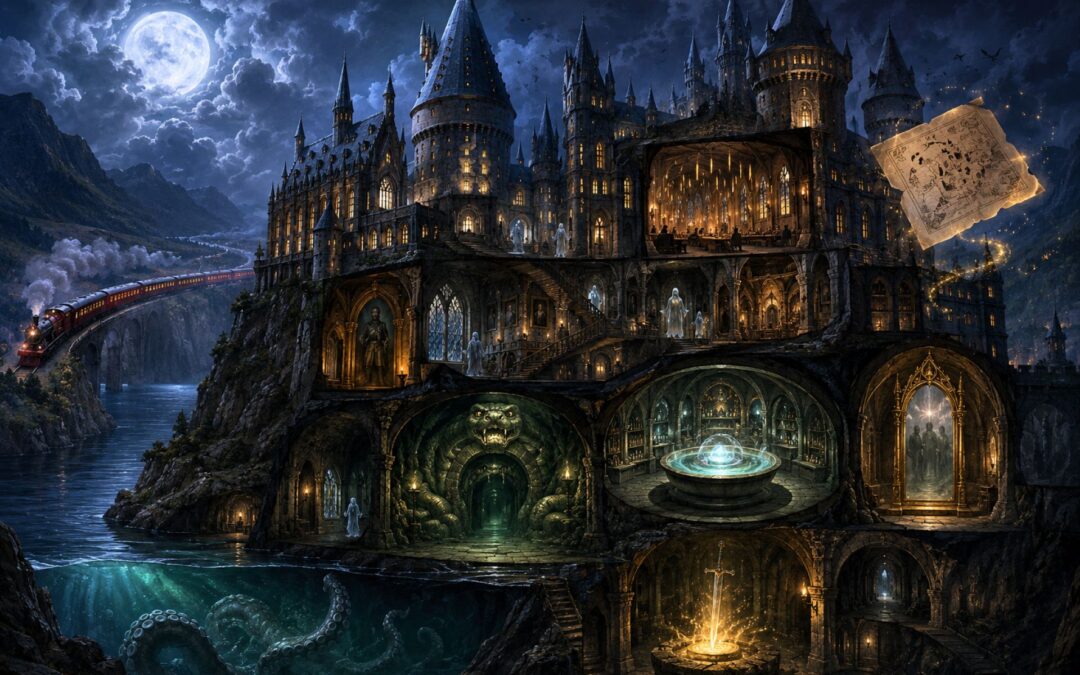
Hogwarts: An Incomplete and Unreliable Guide is one of the most unusual books attached to the Harry Potter series because it is neither a new story nor a conventional encyclopedia. Published in 2016 as part of the Pottermore Presents e-book series, it gathers short pieces about Hogwarts, its history, its inhabitants, its objects and its hidden mechanisms, while also allowing J.K. Rowling to step outside the fictional world and explain how some of those ideas were conceived. Pottermore itself presented the series as supplementary short-form writing drawn from the wider Wizarding World rather than as a continuation of the seven-novel narrative.
That hybrid form is the key to understanding the book. One page may present the Hogwarts Express as though a historian were reconstructing a genuine episode in magical transportation policy, while the next may have Rowling admitting that a particular magical device caused her serious plotting difficulties. The result is a guide to two different things at once: Hogwarts as an imagined institution and Hogwarts as a piece of literary construction.
The title is therefore more revealing than it first appears. The book is “incomplete” because it does not attempt to document every classroom, teacher, corridor, law or historical episode connected with Hogwarts. It is “unreliable” in a more playful sense because Rowling repeatedly distinguishes between established facts, legends, rumours, guesses, disputed stories and possibilities that she herself enjoys imagining without necessarily making them firm parts of the narrative. That uncertainty gives the fictional world texture, but it also requires readers to notice when the book is stating something definite and when it is deliberately leaving room for doubt.
Spoiler warning: This article discusses the entire guide and major events from all seven original Harry Potter novels, including the identities and fates of important characters, the Chamber of Secrets, the Marauders, the Battle of Hogwarts and several magical objects central to the series.
The guide is organised like a gradual journey deeper into Hogwarts. It begins with the practical question of how students reach the school, moves through Sorting, explores the castle and grounds, turns to education and supernatural residents, and ends with some of the most secret and symbolically important objects associated with Hogwarts. That progression gives an otherwise fragmented collection a subtle structure: readers move from the visible machinery of school life toward hidden memory, inherited conflict and magical history.
Chapter One: The Journey to Hogwarts
The first chapter begins before Hogwarts itself is visible. Its subject is transportation, but the larger issue is how the magical world hides itself inside modern Britain. King’s Cross, Platform Nine and Three-Quarters and the Hogwarts Express all demonstrate that Hogwarts does not exist in complete isolation from Muggle society; instead, magical institutions repeatedly borrow, modify and conceal parts of the ordinary world.
King’s Cross Station
The guide explains that King’s Cross became the departure point for Hogwarts because the magical community needed a practical London terminus after the Hogwarts Express became the standard means of transporting students. Rather than constructing a conspicuous wizard-only station, Minister for Magic Evangeline Orpington devised the solution of inserting the magical platform invisibly into an existing Muggle railway station.
This arrangement solves more than a transport problem. It also reflects the demands of the International Statute of Secrecy, which requires the magical population to move through a densely populated Muggle city without exposing itself. Ministry employees therefore have to monitor the station around the beginning and end of Hogwarts terms, when large numbers of magically inclined families converge on the same location and the risk of accidental discovery increases.
Rowling’s personal explanation for choosing King’s Cross is more intimate. Her parents met on a train departing from the station, giving the place an emotional association long before it became part of Harry Potter. It also suited Hogwarts geographically because trains travelling north from London provide an intuitive route toward Scotland.
The entry additionally mentions the legend that Boudicca may have been associated with the King’s Cross area. That detail should be understood as folklore rather than established history, and Rowling makes clear that the association was not the reason she originally selected the station. Its presence is typical of the guide’s method: real places accumulate historical legend, personal meaning and fictional reinterpretation until the boundary between ordinary Britain and magical Britain feels unusually thin.
Platform Nine and Three-Quarters
Platform Nine and Three-Quarters has a simpler origin. Rowling needed the Hogwarts platform to occupy a hidden space between ordinary railway platforms, which naturally suggested using a fractional number rather than a new whole number.
She also plays with the possibility that other fractional platforms might exist elsewhere for magical journeys or special occasions. These suggestions are best read as imaginative extensions rather than evidence of an elaborate transport network that was ever fully developed in the novels. The distinction matters because the guide often invites readers to enjoy possibilities without insisting that every possibility has equal canonical weight.
The platform itself nevertheless captures one of the defining pleasures of Harry Potter’s world-building. A mundane location becomes magical not because it is replaced by something fantastical but because an invisible layer is inserted inside it. The transition through the barrier at King’s Cross therefore becomes a physical version of the series’ larger premise: the extraordinary is concealed within the ordinary.
The Hogwarts Express
The history of the Hogwarts Express is considerably richer because it reveals the practical difficulties of operating a national magical school. Before the railway became compulsory, students arrived by many different means. Some flew on broomsticks, others travelled in enchanted carts, and still others used magical creatures or attempted forms of transportation that were unreliable, conspicuous or dangerous.
Those methods became increasingly untenable once the magical community was expected to conceal itself more systematically from Muggles. Moving hundreds of children toward one secret destination created obvious risks. Portkeys were considered as a possible solution, but they produced logistical problems: students could miss departure times, arrive in the wrong condition or suffer unpleasant physical effects. Connecting Hogwarts directly to the Floo Network would have been efficient, but headmasters resisted opening the castle’s fireplaces to such extensive external traffic because doing so could weaken the school’s security.
Minister for Magic Ottaline Gambol eventually proposed a more radical solution: use a Muggle railway train. The guide treats the acquisition of the locomotive with characteristic comic ambiguity, implying that a huge Ministry operation may have involved appropriating Muggle technology while using memory modifications and concealment to prevent questions about where the train had gone.
The decision also exposes social prejudice inside the magical community. Pure-blood families object to sending their children to school using a conspicuously Muggle invention. The Ministry responds not by creating a competing “pure” magical system but by making train travel effectively mandatory for Hogwarts students. Institutional necessity overrides ideology.
The official archive’s account of the Hogwarts Express makes the same larger point evident: wizarding society is not technologically self-contained. When Muggle infrastructure proves useful, magical authorities are willing to appropriate it, enchant it and then treat it as part of their own tradition.
The Hogwarts Express consequently becomes more than an atmospheric feature of the novels. It represents a historical compromise between secrecy, government regulation, technological practicality and cultural resistance. By the time Harry boards the train, that complicated history has disappeared into routine. One of the guide’s pleasures is showing that many apparently timeless Hogwarts customs are actually the result of earlier disputes, experiments and administrative decisions.
Chapter Two: The Sorting
Once students arrive at Hogwarts, the next important institution they encounter is the Sorting system. The guide uses the Sorting Hat and the phenomenon of Hatstalls to complicate one of the most familiar features of the series: the assumption that every student naturally belongs to one of four neatly defined psychological types.
The Sorting Hat
The Sorting Hat originally belonged to Godric Gryffindor. When the four founders realised that their school would continue long after their deaths, they faced a problem: how could future generations of students be divided according to the founders’ different values when the founders themselves were no longer present?
Their solution was to enchant Gryffindor’s hat collectively. Each founder contributed something resembling his or her own judgment so that the Hat could continue making selections on their behalf. The result is not simply an enchanted object that checks a list of traits. It contains a form of accumulated intelligence derived from the founders and can examine the mind of the student wearing it.
The Hat’s ability is associated with Legilimency, giving it access to qualities, fears, intentions and possibilities that may not be obvious from outward behaviour. It can also communicate directly with the wearer, meaning that Sorting is partly conversational rather than entirely mechanical. Harry’s own Sorting makes this particularly important because he actively resists Slytherin, demonstrating that the Hat takes expressed preference into account.
The guide also links the Hat to the Sword of Gryffindor. In extraordinary circumstances, a worthy Gryffindor can draw the sword from the Hat even when the sword is physically elsewhere. That relationship makes the Hat part of a larger magical inheritance associated with Gryffindor: it does not merely classify students at the beginning of school but can later become a conduit through which a student proves worthy of a founder’s legacy.
One of the most interesting qualities attributed to the Hat is stubbornness. It refuses to admit that it has made a mistaken Sorting even when later behaviour appears to contradict the house assignment. That stubbornness is played partly for humour, but it also prevents the houses from becoming simple moral categories. A Gryffindor can behave cowardly, a Slytherin can act courageously and a brilliant student can belong somewhere other than Ravenclaw without invalidating the entire system.
Rowling’s author commentary is equally revealing. Before inventing the Sorting Hat, she considered more complicated mechanisms, including an elaborate sorting machine and statues of the four founders that would somehow determine placement. The talking hat ultimately solved the problem more elegantly because one object could be ceremonial, mysterious, humorous and psychologically revealing at the same time.
Hatstall
A Hatstall occurs when the Sorting Hat takes more than five minutes to decide where to place a student. Such cases are rare because the Hat usually reaches a decision quickly, but they reveal where the house system becomes genuinely ambiguous.
Hermione Granger nearly becomes a Hatstall because Ravenclaw and Gryffindor both have strong claims on her. Her extraordinary intelligence seems naturally suited to Ravenclaw, yet her courage, loyalty and willingness to act eventually align her with Gryffindor. Neville Longbottom creates a different kind of difficulty because he argues against the Hat’s preferred choice. He fears Gryffindor because he does not believe himself brave enough and would rather enter Hufflepuff, while the Hat perceives qualities he cannot yet recognise in himself.
Minerva McGonagall and Peter Pettigrew are identified as genuine Hatstalls. Pettigrew is the most provocative example because his later betrayal appears difficult to reconcile with Gryffindor’s reputation for courage. Yet the Hat continues defending the decision, effectively suggesting that house membership describes something more complicated than permanent virtue.
The concept therefore undermines the temptation to read Hogwarts houses as deterministic personality tests. Students contain competing qualities, and the traits they later cultivate can matter as much as the characteristics they display at eleven. Sorting gives Hogwarts one of its strongest traditions, but the guide makes clear that the system is interpretive rather than infallibly reductive.
Chapter Three: The Castle and Grounds
The third chapter shifts from institutional ritual to physical space. Its three entries explore a common room, the Marauder’s Map and the Great Lake, but each also demonstrates that Hogwarts contains far more imagined detail than the novels could naturally show through Harry’s experiences.
Hufflepuff Common Room
Harry enters the Gryffindor common room constantly, visits the Slytherin common room under unusual circumstances and eventually sees Ravenclaw Tower, but he never has a narrative reason to enter Hufflepuff’s common room. The guide fills that gap by describing a location Rowling had imagined even though it never became necessary to the plot.
The entrance lies near the Hogwarts kitchens. Rather than requiring a password, riddle or portrait, it is concealed among barrels. A visitor must tap the correct barrel according to the rhythm of Helga Hufflepuff’s name. Someone who gets the sequence wrong is punished by being sprayed with vinegar, making the entrance unusually defensive compared with the relatively forgiving security systems used elsewhere in the castle.
Inside, the room reflects Hufflepuff’s association with earth, comfort and growth. It is low-ceilinged and rounded, with the enclosed warmth of an underground burrow or badger sett. Yellow and black dominate the design, while wood, polished surfaces and abundant plants make the space feel domestic rather than grand.
The windows sit near ground level because much of the room lies below the surrounding terrain. A portrait of Helga Hufflepuff reinforces the house’s historical connection to its founder, while the architecture differs sharply from the elevated towers associated with Gryffindor and Ravenclaw.
Rowling explains that she initially assumed Harry might visit all four common rooms during the series, creating an opportunity to reveal each house’s domestic space. As the novels developed, she realised that there was no convincing plot reason for him to enter Hufflepuff’s. Rather than forcing the location into the story, she left it unseen.
That admission captures one of the guide’s principal functions. World-building can be complete enough to support material that never appears on the page, but storytelling requires selection. The Hufflepuff common room becomes evidence that Rowling’s fictional world was sometimes broader than Harry’s direct experience without implying that every unused idea needed to be inserted into the novels.
The Marauder’s Map
The Marauder’s Map begins with Remus Lupin’s lycanthropy. Because he transforms into a werewolf, his friends James Potter, Sirius Black and Peter Pettigrew face a problem if they want to accompany him safely. They eventually become illegal Animagi, allowing them to take animal forms that can survive proximity to a transformed werewolf more safely than human bodies could.
That decision changes their relationship with Hogwarts. Instead of merely attending classes inside the castle, the group begins exploring both the building and the surrounding grounds during their secret nocturnal adventures. James’s Invisibility Cloak helps them move through forbidden areas, while repeated exploration gives them exceptional knowledge of passageways, rooms and concealed routes.
The map emerges from that accumulated experience. Using advanced magic, the four friends create an artefact that depicts Hogwarts and identifies people moving throughout it. Its importance lies not only in geography but in surveillance: it provides information about who occupies particular locations, turning the castle into a visible network of movement.
The Marauders also give the map a personality. When Severus Snape attempts to investigate it, the object responds with personalised insults from Moony, Wormtail, Padfoot and Prongs. The insults preserve the old hostility between Snape and the Marauders long after their schooldays, so the map contains both practical enchantment and traces of adolescent relationships.
The guide cautiously reconstructs how the Marauders may have lost the map. Argus Filch apparently confiscated it, but the precise event is not firmly established. Fred and George Weasley later steal it from Filch’s office and eventually give it to Harry, reasoning that they no longer need it after years of memorising Hogwarts’ secret routes.
Rowling’s author note makes the entry unusually important because she admits that the map became a storytelling problem. Once Harry owns an object that can reveal the location of people inside Hogwarts, many mysteries become easier to solve. A suspense plot often depends on a protagonist not knowing where another person is, so the Map creates a persistent question: why does Harry not simply consult it?
Rowling therefore sometimes had to separate Harry from the map or limit how effectively he used it. She even acknowledges that she occasionally wished she had removed it permanently from his possession. Yet she kept it because it continued producing useful scenes and because its emotional connection to Harry’s father and his friends made it too significant to discard casually.
The Map therefore occupies two worlds at once. Inside the fiction, it represents friendship, ingenuity, rule-breaking and the accumulated knowledge of four students. Outside the fiction, it demonstrates a basic problem of fantasy writing: once an author gives characters a powerful tool, later stories must continue obeying the implications of that tool.
The Great Lake
The Great Lake broadens Hogwarts beyond architecture. Rowling presents the school grounds partly as a sanctuary where magical creatures can exist away from Muggle interference, making the landscape function as a protected ecosystem as well as school property.
The lake contains Grindylows, merpeople and a giant squid. The merpeople form their own underwater community, while the squid is portrayed as unusually benign. These creatures help establish that Hogwarts exists within a larger magical ecology rather than functioning as an isolated castle surrounded by empty scenery.
Rowling’s author commentary again reveals unused narrative possibilities. The underwater task in the Triwizard Tournament became one of her favourite sequences, but she had considered using the lake much earlier. At one stage, the flying Ford Anglia might have ended up in the water during Chamber of Secrets rather than disappearing into the Forbidden Forest.
She also briefly entertained the idea that the lake might connect magically to other bodies of water, creating a much larger hidden aquatic network. That possibility was abandoned. The entry therefore distinguishes between the fictional world that reached the novels and ideas that remained part of Rowling’s imaginative exploration without becoming established story mechanisms.
Chapter Four: Lessons at Hogwarts
The fourth chapter turns from Hogwarts as a place to Hogwarts as a school. The contrast between its two entries is revealing: one is a compact description of curriculum, while the other examines a magical technology powerful enough to threaten the logic of the entire series.
Hogwarts School Subjects
Students begin Hogwarts with a core curriculum that includes subjects such as Transfiguration, Charms, Potions, History of Magic, Defence Against the Dark Arts, Astronomy and Herbology. First-year students also receive flying instruction, making broomstick handling part of school life rather than knowledge every magical child is automatically assumed to possess.
As students grow older, they choose electives. These include subjects such as Divination, Care of Magical Creatures, Arithmancy, Ancient Runes and Muggle Studies. The system therefore combines compulsory magical foundations with later specialisation.
Some subjects are offered only when enough students show interest. Alchemy, for example, can appear as an advanced option under suitable circumstances rather than as a permanent part of the ordinary timetable. This gives Hogwarts the flexibility of a real institution whose curriculum changes according to staff, demand and educational priorities.
Rowling’s planning notes show that the curriculum evolved during the writing process. Early names and requirements differed from the final system, demonstrating that apparently settled features of Hogwarts were sometimes refined as the novels took shape.
The result is a curriculum that works primarily as narrative infrastructure rather than a rigorously complete educational programme. Readers know enough to understand what students study and why particular teachers matter, while large portions of ordinary schooling remain outside the story because Harry’s adventures do not require a complete timetable.
Time-Turner
The Time-Turner poses a far more serious world-building problem because time travel can easily destroy narrative consequence. If witches and wizards can simply return to the past whenever something terrible happens, death, failure and irreversible decisions become difficult to sustain.
The guide therefore places strict limits around time travel. Moving a few hours backward can be accomplished under controlled circumstances, but longer journeys become increasingly dangerous. The traveller can suffer serious physical consequences, and changes to the past can produce unpredictable effects in the present.
Eloise Mintumble provides the central warning. She attempts to travel centuries into the past, vastly exceeding what magical authorities consider safe. Her journey produces catastrophic consequences. People whose lives depend on altered historical conditions disappear from the present, and ordinary chronology itself becomes distorted, with entire days becoming abnormally long or short.
Mintumble’s own body is also damaged by the journey. Her case establishes that time travel is not simply a matter of turning a device repeatedly until one reaches the desired year. Magical time has limits, and attempts to violate them carry both personal and historical risk.
The Ministry responds by imposing severe restrictions. Time-Turners are carefully controlled, and even legitimate uses are comparatively mundane. Hermione’s exceptional access in Prisoner of Azkaban is therefore meant to be unusual, not evidence that every competent wizard routinely rewinds history.
The Ministry’s stock of Time-Turners is eventually destroyed during the battle in the Department of Mysteries. Within the guide’s logic, this removes a dangerous resource from ordinary circulation and helps explain why the devices do not become an easy solution to later catastrophes.
Rowling is exceptionally candid about the creative reason for these restrictions in her own explanation of the Time-Turner problem. She acknowledges that introducing time travel created too many possibilities. Once characters can alter the past, every later disaster invites the question of why they do not simply travel back and prevent it.
Her response was effectively to tighten the rules around something she had already invented. The consequences of long-range travel became dangerous, Ministry access became exceptional, and the available stock was destroyed. The entry therefore functions almost like an author’s postmortem on a powerful narrative device.
Later official franchise continuity makes that solution less absolute than the guide’s authorial note suggests. The current official Time-Turner fact file includes Harry Potter and the Cursed Child among the object’s appearances. That does not contradict the narrower claim that the Ministry’s known stock was destroyed, but it means the broader hope of removing time travel permanently from future stories did not hold across the entire franchise.
The Time-Turner entry is consequently one of the book’s most revealing pieces. It shows that fantasy rules are not created in a vacuum. A magical ability may produce a wonderful scene in one novel and then become a structural liability for every novel that follows.
Chapter Five: Castle Residents
The fifth chapter asks what it means for Hogwarts to be inhabited across generations. Its ghosts and portraits allow the dead to remain present in different ways, while Sir Cadogan demonstrates how legend itself can acquire a permanent residence inside the castle.
Hogwarts Ghosts
Hogwarts has an unusually large ghost population because it is a place where magical history accumulates instead of disappearing. Students do not merely learn about the past from books; they can encounter people who lived centuries earlier and who continue circulating through corridors, classrooms and communal spaces.
Each house has a ghost. Gryffindor has Nearly Headless Nick, Hufflepuff the Fat Friar, Ravenclaw the Grey Lady and Slytherin the Bloody Baron. Their presence gives the houses another layer of inherited personality beyond founders, colours and values.
The Fat Friar’s death reflects the danger created when magical behaviour appears suspicious in a religious environment. His ability to cure illness and his habit of pulling rabbits from communion cups eventually attract the wrong kind of attention. Even in death he remains cheerful and hospitable, preserving the temperament associated with Hufflepuff.
Nearly Headless Nick carries a more elaborate personal history. His full identity is Sir Nicholas de Mimsy-Porpington, and his failed execution leaves him permanently caught between ordinary beheading and complete decapitation. His comic frustration about being “nearly” headless becomes part of his identity even though the underlying event is brutal.
Moaning Myrtle remains tied to Hogwarts partly because of the circumstances of her death and partly because of her lingering resentment. She originally follows Olive Hornby beyond the school, using ghosthood to torment the girl who had bullied her. Eventually Myrtle is restricted and returns to the bathroom where she died.
Professor Binns represents a different kind of attachment. He is so devoted to his routine that dying barely interrupts it. The joke is that he apparently continues teaching History of Magic after death without noticing much change in his professional existence.
Rowling also recalls ghost concepts discarded during early planning. These abandoned ideas reinforce the sense that Hogwarts’ supernatural population was developed through selection rather than through a single complete scheme established before the first novel.
Ghosts
The following entry expands beyond individual characters and explains what ghosts are in Rowling’s magical system. A ghost is not the complete resurrection of a dead person. It is something more limited: a pale continuation or imprint of a witch or wizard who has chosen not to move fully beyond death.
That choice is usually associated with fear, regret, guilt or an inability to release attachment to the living world. Ghosthood therefore offers persistence at a cost. The dead person remains visible and recognisable but loses much of what made embodied life possible.
Ghosts cannot truly eat or enjoy physical sensation. They can pass through walls and people, affect temperature and create disturbances in water or fire, but their interaction with material reality remains attenuated. Their existence is continuity without full participation.
This is why ghosts possess limited authority when discussing death. They have not returned from whatever lies beyond ordinary life; rather, they avoided proceeding fully into it. Their testimony therefore cannot provide definitive knowledge about the afterlife.
The distinction becomes philosophically important in a series where death is central. Ghosthood is not presented as victory over mortality. It is closer to a refusal to accept mortality, leaving the individual trapped in a diminished state.
That idea gives Hogwarts’ cheerful abundance of ghosts an unexpectedly melancholy foundation. The castle may seem richer because previous generations remain visible, but every ghost also represents someone who was unable or unwilling to complete the transition that death demanded.
The Ballad of Nearly Headless Nick
The comic ballad about Nearly Headless Nick recounts the disastrous events that led to his execution. While alive, Nick encounters Lady Grieve and attempts to improve her teeth with magic. The spell goes catastrophically wrong and causes her to grow tusks instead.
Nick is arrested and condemned. His executioner proves spectacularly incompetent, requiring repeated blows from a blunt axe. The result is the physical condition Nick retains as a ghost: his head remains attached by a small amount of tissue, leaving him unable to claim the distinction of full decapitation.
The ballad turns violence into macabre comedy, consistent with the series’ broader treatment of Nick. The editorial framing also explains that Rowling originally wrote the piece for Harry Potter and the Chamber of Secrets but removed it from the published novel. Its inclusion here therefore preserves a fragment of the series’ discarded material rather than adding a new event conceived specifically for this guide.
Hogwarts Portraits
Magical portraits occupy a different category from ghosts. They can move, speak and imitate the personalities of the people depicted, but they do not automatically contain complete copies of those people’s minds.
A simple portrait learns characteristic gestures, expressions, phrases and behaviours. The more time an artist spends observing a subject, the more convincingly the image can reproduce those outward patterns. This gives portraits an appearance of personality without making every painted figure an exact continuation of the person who lived.
Headmaster and headmistress portraits are more sophisticated because Hogwarts deliberately prepares them. While still alive, a head of school can spend time teaching the portrait about personal experiences, opinions and memories. The portrait therefore becomes progressively better equipped to advise future generations.
This creates an institutional memory system. Dumbledore’s portrait, for example, matters not merely because a painting of Dumbledore hangs in the office but because headmasters can intentionally pass knowledge forward through their portraits. Hogwarts’ leadership is therefore never entirely disconnected from its predecessors.
The concept also carefully avoids making magical portraiture equivalent to resurrection. A trained portrait may provide an impressive simulation of a former headmaster’s judgment, but it remains a constructed representation. That distinction becomes important when the guide’s ghosts, portraits and Pensieve are considered together: all three preserve aspects of a person, yet none simply restores a complete dead individual.
Sir Cadogan
Sir Cadogan belongs to the book’s comic pseudo-history. Wizards regard him as part of the Arthurian world, associating him with Merlin and the Knights of the Round Table, although his legendary status should not be mistaken for ordinary historical documentation.
His defining adventure concerns the Wyvern of Wye. Cadogan confronts the creature with great courage but limited practical success. He is beaten, loses his ordinary mount and returns on a small pony that seems almost comically inadequate for the task.
The eventual victory comes through accident as much as heroism. His damaged wand causes the creature’s internal gases to ignite, destroying the wyvern from within. The absurd triumph produces a wizarding idiom about making the best of an apparently hopeless situation.
Cadogan’s portrait preserves his personality. He remains reckless, eager for combat and permanently prepared to challenge people to duels. The character therefore embodies an exaggerated version of chivalric bravery: courage detached from judgment.
Like many pieces in the guide, his story expands the cultural depth of the Wizarding World without altering the central Harry Potter narrative. Hogwarts becomes a place where magical Britain’s myths, historical jokes and legendary personalities literally hang on the walls.
Chapter Six: Secrets of the Castle
The final chapter turns from visible Hogwarts to objects and places whose significance depends on secrecy. The Mirror of Erised, Pensieve, Philosopher’s Stone, Sword of Gryffindor and Chamber of Secrets all carry histories that exceed the moments in which Harry encounters them.
Mirror of Erised
The Mirror of Erised is among the most psychologically revealing objects in the series because it shows a viewer’s deepest desire rather than ordinary physical reality. Yet the guide emphasises that its origins remain uncertain. Neither its maker nor the complete route by which it came to Hogwarts is known.
Rowling entertains possible histories without treating them as firm facts. That uncertainty suits the object. The Mirror is ancient, powerful and dangerous precisely because it cannot be reduced to a neatly documented school artefact with a known inventor and administrative purpose.
The inscription around its frame encodes its function in reversed language: the Mirror does not show the viewer’s face but the desire of the heart. Harry therefore sees his dead parents and extended family, while another person would see something entirely different.
Dumbledore later modifies the Mirror for a practical purpose. He uses it to conceal the Philosopher’s Stone in such a way that someone can obtain the Stone only if they want to find it without intending to use it for selfish gain. That enchantment transforms the Mirror’s basic property into a moral test.
For readers who want the full narrative surrounding both objects, the complete story of Harry Potter and the Philosopher’s Stone shows how the Mirror moves from an intimate revelation of Harry’s grief to the mechanism that defeats Voldemort’s attempt to acquire the Stone.
The guide suggests that the Mirror was probably destroyed in the Room of Requirement during the Battle of Hogwarts, but this remains inference rather than a directly narrated event. Its uncertain ending mirrors its uncertain origin.
Rowling’s author note focuses less on magical mechanics than on psychology. Harry’s longing for his parents is completely understandable, but remaining before the Mirror indefinitely would turn grief into paralysis. Desire becomes dangerous when the image of an impossible life prevents a person from living the one that remains available.
Pensieve
The Pensieve is one of Rowling’s most sophisticated magical devices because it turns an internal process into something physically explorable. Memories and thoughts can be removed from the mind, stored in the basin and revisited in a form that allows a person to move through them as though entering a reconstructed scene.
The experience is more complex than simply watching a recording. A memory can contain details that the original person was not consciously concentrating on, allowing later examination from perspectives that ordinary recollection would not provide. That makes the Pensieve useful not merely for remembering but for investigating memory.
Rowling also distinguishes between recollection and thought. A person can use the Pensieve to externalise mental material that has become too crowded or difficult to organise, effectively turning a magical object into a tool for intellectual sorting. The name reflects this dual purpose, playing on both “pensive” and “sieve.”
The power obviously creates privacy problems. A person’s memories can contain intimate experiences, secrets or evidence that was never intended for others. Pensieve use therefore carries ethical implications beyond convenience.
Most Pensieves are treated as deeply personal possessions. The guide says they are traditionally buried with their owners, reinforcing the idea that a person’s stored memories belong to that individual rather than automatically becoming public property after death.
Hogwarts is an exception. The school possesses an institutional Pensieve used across generations of headmasters and headmistresses. This transforms personal memory technology into part of the school’s accumulated administrative knowledge.
The object’s precise origin remains uncertain. A legend suggests that the founders discovered it on the site where Hogwarts would later be built, but the guide does not present the story as established fact. The age of the object nevertheless reinforces the impression that Hogwarts is built on magical history older than the institution itself.
The Pensieve therefore sits at the centre of several themes developed throughout the guide. Like portraits, it preserves the past; like the Marauder’s Map, it converts hidden knowledge into something visible; and like the Mirror of Erised, it makes a normally private mental experience materially accessible. Unlike the Mirror, however, it is oriented toward examining what happened rather than imagining what one wishes had happened.
The Philosopher’s Stone
The Philosopher’s Stone differs from many objects in the guide because Rowling did not invent its basic concept. It belongs to the historical tradition of alchemy, where the legendary Stone was associated with the transformation of base metals into gold and with substances that could prolong life.
Rowling adapts both properties for the Harry Potter world. Nicolas Flamel possesses the Stone, uses it to produce the Elixir of Life and becomes extraordinarily old. Voldemort seeks it because the Elixir could restore and sustain him after his first defeat.
The historical material should not be confused with evidence that the legendary Stone ever possessed such powers in reality. Alchemy was, however, a serious intellectual pursuit for important historical figures. The Oxford Newton Project documents Newton’s extensive engagement with alchemy, which helps explain why his name can plausibly appear in a discussion of the historical tradition without implying that alchemical transmutation or immortality was scientifically achieved.
The entry illustrates Rowling’s larger method of borrowing recognisable myths, folklore and intellectual traditions rather than inventing every element of the magical world from nothing. The fictional Stone feels ancient partly because readers inherit a pre-existing cultural memory of alchemy before encountering it at Hogwarts.
The Sword of Gryffindor
The Sword of Gryffindor combines heroic mythology with one of the Wizarding World’s most complicated cultural disputes. It was made by Ragnuk the First, a celebrated goblin craftsman, for Godric Gryffindor.
The disagreement begins because wizard and goblin traditions understand ownership differently. From Gryffindor’s perspective, commissioning and paying for the sword makes it his permanent property. According to the goblin view described in the guide, goblin-made objects remain fundamentally connected to their makers and should eventually return to goblin ownership rather than becoming hereditary wizard possessions.
Ragnuk later wants the sword back and spreads a competing story that Gryffindor stole it. The conflict outlives both men. What begins as a dispute between two individuals becomes part of a much larger history of mistrust between wizards and goblins.
The sword itself has unusual magical properties. It takes into itself substances that strengthen it while resisting contamination from substances that would damage it. When Harry uses it to kill the Basilisk, the blade absorbs Basilisk venom, making it capable of destroying Horcruxes later in the series.
It can also appear to a worthy Gryffindor through the Sorting Hat. This makes access to the sword partly moral rather than merely physical. Neville’s ability to draw it during the Battle of Hogwarts confirms that the weapon responds to demonstrated worthiness rather than simple possession.
Rowling directly connects the sword to heroic mythology. Her discussion of the sword’s mythological and cultural origins evokes Excalibur and the Irish Sword of Nuada while adapting familiar motifs of magical weapons, rightful bearers and inherited authority.
The deeper interest lies in the ownership conflict. Neither side necessarily experiences the disagreement as an ordinary theft. Wizards understand a completed purchase as permanent transfer; goblins can view wizard inheritance of goblin-made objects as the continuing appropriation of work that should return to its makers.
That tension becomes morally important when Harry negotiates with Griphook in Deathly Hallows. Harry needs the goblin’s help but also intends to retain the sword because destroying Horcruxes is essential to defeating Voldemort. Griphook, by contrast, sees the sword through a tradition in which wizard possession is itself questionable.
The guide does not resolve the dispute by declaring one culture obviously correct. Instead, it shows that ownership can depend on competing social conventions. The same object can simultaneously appear lawfully purchased, culturally stolen, heroically inherited and strategically indispensable.
The Chamber of Secrets
The Chamber of Secrets closes the collection by returning to Hogwarts’ founders and revealing how ideological conflict can become embedded in architecture. Salazar Slytherin secretly constructs the Chamber without informing the other founders, making secrecy part of its identity from the beginning.
The guide cautiously suggests that Slytherin may initially have wanted a private space in which to teach forms of magic or ideas that the others opposed. This interpretation remains tentative. What becomes clear later is that his conflict with the other founders, especially over the admission of Muggle-born students, hardens into a much darker project.
By the time Slytherin leaves Hogwarts, the Chamber contains a Basilisk. The creature is intended to be controlled by a descendant capable of speaking Parseltongue, enabling a future heir to purge the school of students Slytherin considered unworthy.
The Chamber therefore becomes more than a secret room. It preserves an ideology after the founder himself has disappeared. Slytherin’s prejudice is literally built into Hogwarts, waiting for a descendant to reactivate it.
Knowledge of the Chamber survives within Slytherin’s bloodline even though generations of headmasters, teachers and historians fail to find it. Parseltongue acts as a form of magical access control: without the ability to speak the language, investigators can search Hogwarts repeatedly and still miss the entrance.
Later physical changes to the castle create a practical continuity problem. Hogwarts acquires modern plumbing long after Slytherin’s lifetime, meaning the original access route could have been exposed or destroyed. The guide explains that Corvinus Gaunt, a descendant of Slytherin, helped preserve the entrance during renovations by ensuring that it remained hidden within the new plumbing system.
That explanation is a good example of retrospective world-building. A feature introduced for the needs of Chamber of Secrets receives a deeper fictional history explaining how it survived centuries of architectural change.
The Chamber is a fitting final entry because it captures the guide’s entire vision of Hogwarts. The school is not a static castle built once and then preserved untouched. It is a layered institution repeatedly altered by founders, descendants, governments, teachers, students and historical accidents. Its secrets survive because the past remains embedded in the present, sometimes literally behind the walls.
The book’s closing editorial note deliberately refuses to turn this final revelation into a claim of completeness. Readers are reminded that the guide has offered only selected corners of Hogwarts and are playfully warned against misusing some of the dangerous objects they have encountered. The conclusion therefore circles back to the title: a school this old, complicated and magical can be explored without ever being exhaustively mapped.
Hogwarts as a Living Institution
The strongest achievement of Hogwarts: An Incomplete and Unreliable Guide is that it makes Hogwarts feel less like a fantasy backdrop and more like an institution with history. Schools in fiction can easily become collections of picturesque classrooms, eccentric teachers and recurring traditions. Rowling’s supplementary material instead shows that Hogwarts has accumulated regulations, technological compromises, architectural alterations, internal customs and inherited administrative systems over centuries.
The Hogwarts Express is the clearest example. Student transportation changes because secrecy law, population movement and Muggle infrastructure change. What Harry experiences as an ancient-looking ritual is actually the product of relatively modern government intervention. The tension between old magical prejudice and practical adoption of railway technology makes Hogwarts feel historically adaptable rather than frozen in an imaginary medieval past.
The school is also shaped by the wider Ministry without being entirely controlled by it. Government regulation determines how students can travel, who can legally use Time-Turners and how magical secrecy is enforced. Yet headmasters can resist proposals such as opening the castle to extensive Floo traffic when they believe Hogwarts’ security is threatened.
This produces a recognisable institutional tension between autonomy and regulation. Hogwarts is independent enough to possess its own traditions and internal systems but still functions within a broader political order. Its isolation in Scotland does not place it outside magical government.
The curriculum strengthens that impression. Hogwarts has compulsory subjects, electives, occasional specialised courses and changing educational priorities. Rowling never develops the school into a complete pedagogical system, but enough detail exists to suggest an institution capable of adapting across generations.
Its architecture behaves similarly. The Chamber of Secrets survives centuries of modification because descendants of Slytherin intervene. House common rooms use different security systems. Secret passages are discovered, forgotten and rediscovered. Hogwarts therefore resembles a historical building whose current form contains accumulated alterations rather than a perfectly designed magical structure that appeared fully complete at one moment.
The castle’s residents turn institutional history into something even more literal. Ghosts preserve personalities from previous centuries. Headmaster portraits transmit advice. The Pensieve externalises memories that can outlive the circumstances in which they were formed. The past is consequently not confined to books in the library; it participates in contemporary school life.
Even the grounds perform an institutional role. The Great Lake and surrounding territory protect magical creatures that could not exist openly in ordinary Britain. Hogwarts is therefore simultaneously a school, sanctuary, archive, political institution, historical monument and magical ecosystem.
This layered identity explains why the book can feel substantial despite its short length. Its individual entries are fragments, but together they imply that almost every Hogwarts tradition has predecessors, arguments and practical reasons behind it. The castle feels old not merely because characters say it is old but because its present continually collides with its past.
Founders, Marauders, Ghosts and Headmasters: The People Behind Hogwarts
The guide rarely provides conventional character arcs because its subjects appear in short historical sketches rather than sustained narratives. Yet people remain essential to its world-building. Hogwarts acquires personality because generations leave pieces of themselves inside its institutions, objects and architecture.
The founders are the deepest layer. Godric Gryffindor survives through the Sorting Hat and sword, Helga Hufflepuff through her house’s domestic culture and common room, and Salazar Slytherin through the Chamber and the ideology concealed within it. The school therefore contains not simply memorials to its founders but active magical systems created by them.
Gryffindor and Slytherin are particularly important because their legacies continue producing moral conflicts. Gryffindor’s sword becomes associated with worthiness, bravery and contested ownership. Slytherin’s Chamber preserves exclusionary ideas that future descendants can reactivate. One founder leaves a mechanism that rewards courage; the other leaves a mechanism designed to enforce inherited prejudice.
Helga Hufflepuff’s presence is quieter but revealing. Her house common room expresses warmth, practicality and security without needing dramatic mythology. The design reminds readers that institutional identity does not always depend on spectacular conflict. Domestic architecture can communicate values just as effectively as legendary weapons.
The Marauders represent a later generation reshaping the school through unofficial knowledge. James Potter, Sirius Black, Remus Lupin and Peter Pettigrew do not inherit institutional authority. They acquire influence through exploration, rule-breaking and friendship, creating a map that later becomes part of Harry’s own experience of Hogwarts.
Their story also prevents nostalgia from becoming simple. The Map is ingenious and emotionally important, but its creators are not morally uniform. Pettigrew later becomes a traitor, Sirius and James could be cruel, and Lupin’s condition places the group in genuine danger. The guide therefore allows Hogwarts history to contain complicated people rather than flawless legendary predecessors.
Ghosts provide yet another form of continuity. Nearly Headless Nick, Myrtle and Binns continue occupying the school after death, but their persistence does not necessarily mean growth. Ghosthood often freezes people inside familiar habits, grievances and identities. The past remains available, though not always wiser.
Headmasters and headmistresses preserve themselves more deliberately through trained portraits. Unlike ghosts, these representations are consciously prepared as tools for future leadership. Their survival is therefore institutional rather than purely personal.
Dumbledore exemplifies the cumulative authority this makes possible. He can inherit knowledge from previous leaders while later leaving a portrait capable of advising his own successors. Hogwarts governance becomes intergenerational in a literal magical sense.
Across these examples, the school begins to resemble a community whose inhabitants continually write themselves into its fabric. Some leave heroic artefacts, some secret monsters, some maps, some portraits and some merely habits that continue after death. Hogwarts feels alive because no generation completely disappears.
The Guide’s Major Themes and Ideas
The collection does not present a single philosophical thesis, but several ideas recur strongly enough to connect otherwise separate entries. Sorting, ghosts, portraits, mirrors, swords and secret chambers all ask variations of the same questions: who determines identity, how much of the past should survive, what people do with knowledge, and whether inherited systems deserve obedience simply because they are old.
Choice, Sorting and Identity
The house system encourages readers to classify people. Gryffindors are brave, Ravenclaws intelligent, Hufflepuffs loyal and Slytherins ambitious. The guide repeatedly complicates those categories.
Hatstalls demonstrate that real personalities do not align neatly with institutional labels. Hermione plausibly belongs in more than one house, while Neville initially resists the identity the Hat perceives for him. Their Sorting decisions make house placement a prediction of potential as much as a diagnosis of present personality.
Peter Pettigrew provides the hardest case. His later betrayal appears to disprove his Gryffindor placement, yet the Hat refuses to concede error. One possible implication is that possessing some capacity for courage does not guarantee that a person will use it well.
Choice therefore operates alongside temperament. Harry’s resistance to Slytherin is meaningful because he does not simply receive an identity passively. The qualities he values influence the person he becomes.
The Sword of Gryffindor develops the same idea differently. It appears to someone who proves worthy rather than merely to anyone bearing the Gryffindor label. Neville’s access to the sword matters because he grows into the courage that he doubted during Sorting.
The guide consequently treats identity as partly inherited, partly perceived and partly enacted. Institutions classify people, but later choices determine whether those classifications become meaningful.
Memory, Desire and Mortality
Several of the guide’s most important magical systems revolve around attempts to preserve or revisit what has been lost. The Pensieve stores memory, portraits reproduce personality, ghosts preserve diminished versions of the dead and the Mirror of Erised reveals the life a person most desperately wishes were real.
These devices differ because they represent different relationships to the past. A Pensieve allows examination. A portrait offers simulation. A ghost preserves continuity. The Mirror creates desire without recovery.
The distinction between the Pensieve and Mirror is particularly important. Both allow a person to encounter something absent from immediate reality, but their psychological effects move in opposite directions. The Pensieve can clarify experience by making memory examinable; the Mirror can imprison someone by replacing present life with an unattainable fantasy.
Harry’s response to the Mirror embodies that danger. Seeing his parents is emotionally understandable because he has almost no ordinary memories of them. Yet the image cannot restore them. Continued contemplation therefore risks transforming love into withdrawal from life.
Ghosts offer another response to loss: refusing to leave. Yet ghosthood is not depicted as successful immortality. A ghost remains recognisable but cannot fully participate in physical existence, making survival itself a reduced condition.
Portraits occupy an intermediate space. They are not living people, but careful preparation can make them powerful vehicles for accumulated experience. Hogwarts uses that limitation constructively by treating portraits as advisory memory rather than pretending the dead have literally returned.
Together these systems suggest that the past should be remembered without being mistaken for the present. Memory becomes useful when it helps the living understand experience; it becomes dangerous when preservation turns into refusal to continue.
Ownership, Cultural Conflict and Inheritance
The Sword of Gryffindor transforms property into a question of culture. Wizards and goblins can participate in the same transaction while understanding what that transaction means in fundamentally different ways.
A wizard who buys a sword assumes permanent ownership and the right to pass it to descendants. A goblin tradition in which goblin-made objects ultimately belong to goblins sees indefinite wizard possession differently. Neither side experiences itself as merely misunderstanding vocabulary; each operates from a distinct moral concept of what craftsmanship creates.
That difference explains why the sword dispute persists across centuries. Legal possession does not automatically erase cultural grievance. Ragnuk’s claim against Gryffindor becomes part of a wider historical relationship in which goblins believe wizards continually retain objects that should eventually return.
Inheritance therefore becomes unstable. To Harry and other Gryffindors, the sword belongs to a heroic tradition extending from their founder. To Griphook, the same tradition may look like centuries of wizard appropriation.
The Chamber of Secrets offers a darker form of inheritance. Slytherin leaves not a disputed object but an ideological weapon for his descendants. The Basilisk allows prejudice to become hereditary infrastructure.
These examples show that inheritance transmits more than possessions. It carries assumptions, conflicts and unresolved moral debts. The past survives because later generations continue acting through structures they did not create.
Secrecy, Knowledge and Institutional Power
Hogwarts is built around controlled knowledge. Students reach it through a hidden platform, enter house spaces through passwords or puzzles, move through secret passages and encounter objects whose powers depend on privileged access.
The magical state also regulates information. The Statute of Secrecy determines how transportation systems can operate. Time-Turners are restricted because access to temporal power is too dangerous to become ordinary.
The Marauder’s Map complicates institutional secrecy because students create their own information network outside official authority. The object reveals movements inside the school in a way administrators themselves may not fully control. Knowledge becomes power precisely because it bypasses ordinary barriers.
The Pensieve performs a similar function at a more formal level. In a headmaster’s office, preserved memory becomes institutional intelligence. Hogwarts therefore contains both official archives and unofficial surveillance technologies.
The Chamber of Secrets represents secrecy at its most dangerous. Knowledge deliberately restricted to one bloodline prevents the institution from understanding a threat hidden inside itself. Repeated searches fail because investigators do not possess the linguistic key required to interpret the architecture correctly.
The collection therefore does not treat secrecy as inherently good or bad. Concealment protects the magical community from Muggles, protects students from intruders and preserves private thoughts, yet it can also shelter prejudice, concentrate authority or leave others dangerously ignorant.
How Rowling Expands—and Repairs—Wizarding World Canon
One of the guide’s most valuable features is that Rowling does not always pretend fictional history emerged effortlessly. Her author notes reveal that world-building developed alongside storytelling, which means some ideas were carefully prepared in advance while others created problems that later required additional rules.
Lore Expansion and Retrospective Explanation
Some supplementary material simply reveals information that the novels never needed. The Hufflepuff common room is the cleanest example. Rowling imagined the location, but Harry never entered it because no convincing scene required him to do so. Publishing the description later expands Hogwarts without changing the logic of earlier events.
The Great Lake contains similar examples. Rowling discusses abandoned uses for the flying Ford Anglia and a possible wider network of magical waterways. Because those ideas never became essential to the published story, they can remain possibilities from the creative process without requiring retroactive explanation.
Other additions actively connect gaps created by later reflection. The Chamber of Secrets is ancient, yet its entrance appears in plumbing installed long after Slytherin’s time. Introducing Corvinus Gaunt as the descendant who preserves the entrance during renovations supplies a historical mechanism that allows the architecture to remain coherent.
That kind of explanation can be read in two ways. It makes the fictional world feel deeper because historical change now has consequences. At the same time, it exposes the fact that some details are being rationalised after the original plot has already been written.
The guide is strongest when it is comfortable with both realities. A fictional history can be satisfying even when readers understand that the author built parts of it retrospectively. What matters is whether the explanation fits established events without creating larger contradictions.
The Marauder’s Map and Time-Turner as Storytelling Problems
The Marauder’s Map demonstrates how a clever magical object can create excessive information. Mystery depends on uncertainty, but the map gives Harry access to the identities and positions of people moving around Hogwarts. Every later plot must therefore account for why he does not consult it at the decisive moment.
Rowling’s admission that she sometimes regretted leaving Harry with the Map is valuable because it reveals the cost of magical convenience. A device introduced to enrich one story remains part of the world’s rules afterward. Authors cannot repeatedly forget their own inventions without weakening reader trust.
The Time-Turner creates the same difficulty at a much larger scale. It does not merely reveal information; it offers the possibility of altering events. If available freely, almost every later death or disaster becomes vulnerable to temporal intervention.
Rowling’s response is essentially regulatory. Time travel becomes dangerous beyond short intervals, the Ministry tightly controls the devices and the known stock is destroyed. These decisions allow the author to preserve the emotional consequences of later novels without pretending the earlier time-travel plot never happened.
The repair works reasonably well within the original seven books because Time-Turners do not become routine solutions to future crises. Later franchise material reopens the issue, but that belongs to the broader continuity rather than to the internal mechanics of the guide itself.
More importantly, Rowling’s candour turns these entries into lessons in fantasy construction. Magic is not narratively free. Every power introduced into a fictional world changes what characters can reasonably attempt later.
What “Incomplete and Unreliable” Really Signals
The title should not be interpreted as a declaration that the book contains false information. Its unreliability is subtler.
Rowling frequently labels claims as legends, rumours, reconstructions or possibilities. The precise history of the Mirror of Erised is uncertain. The founders’ supposed discovery of the Pensieve is unsubstantiated. The exact circumstances under which the Marauders lost their map are reconstructed rather than documented.
These gaps make the Wizarding World resemble real history, where surviving evidence is uneven and later generations disagree about what happened. A fictional universe can paradoxically feel more convincing when not every historical question receives an omniscient answer.
The title also allows Rowling to separate creative speculation from firm world-building. She can imagine additional fractional platforms or discuss discarded ideas without making readers treat every passing possibility as a binding law of the universe.
“Incomplete and unreliable” therefore acts less as a warning against believing the book than as a statement about how knowledge works inside it. Hogwarts contains mysteries even its inhabitants do not fully understand, and the author sometimes chooses to preserve that uncertainty rather than eliminate it.
Myth, Folklore and the Muggle World
Harry Potter’s magical world feels culturally familiar because Rowling builds it from recognisable materials. Ancient myth, British geography, folklore, medieval legend, alchemy and modern technology all enter the fictional system and emerge transformed.
King’s Cross is an obvious example. It is a real London station with ordinary railway history, but Rowling gives it magical infrastructure and adds the possibility of legendary associations around its location. Personal memory, British folklore and fictional transport therefore overlap in one place.
The Hogwarts Express performs a similar transformation on modern technology. Trains are not magical inventions. Wizarding society borrows the technology precisely because it solves a problem better than existing magical transport options. Enchanting a Muggle locomotive is therefore an act of cultural appropriation in the ordinary sense of adopting useful technology from another society.
The Philosopher’s Stone reaches much farther into the past. Rowling uses the historical alchemical tradition as the basis for an actual magical artefact, transforming legendary claims about transmutation and life extension into literal properties inside the Wizarding World.
Arthurian legend receives the same treatment. Sir Cadogan enters an exaggerated magical version of the Round Table tradition, while the Sword of Gryffindor draws on the broader mythology of enchanted weapons and rightful bearers. Excalibur provides an obvious cultural reference point without making Gryffindor’s sword a simple copy.
The Irish Sword of Nuada adds another layer of heroic mythology. By drawing from multiple traditions, Rowling produces objects that feel familiar even when readers cannot identify every source consciously.
The Great Lake grounds fantasy in natural-world imagery as well. Giant squid exist in reality, but placing an unusually friendly specimen in a Scottish magical lake moves a recognisable creature into folklore-like territory without requiring an entirely invented species.
This method helps explain why Hogwarts rarely feels like an independent fantasy planet. Its magic sits inside British and European history rather than replacing them. Real technologies, legends and intellectual traditions are reinterpreted as partial evidence of a hidden magical society.
That approach also requires careful distinctions. Arthurian membership, Boudicca stories and alchemical powers function differently from documented history. The guide is at its best when the fictional and historical layers remain visible rather than being collapsed into one another.
Style, Structure and the Pottermore Form
The guide’s form is unusual because it moves repeatedly between imaginary reference writing and explicit author commentary. The transition can be abrupt, but it also creates the book’s distinctive appeal: readers encounter Hogwarts first as though it were real and then immediately see the workshop in which parts of it were made.
The Voice of an Imaginary Reference Book
Many entries imitate historical or encyclopedic prose. Ministers have policies, magical institutions issue regulations, legends survive through families and historians fail to resolve disputed events. This tone gives invented events the texture of documentary history.
Rowling strengthens the effect through bureaucratic humour. The Ministry worries about transport logistics, pure-blood parents complain about trains, incorrect common-room entry triggers vinegar, and magical governments respond to catastrophic time travel by regulating devices. Fantastical problems are often treated with administrative seriousness.
The technique works because the prose does not constantly announce the joke. A ridiculous magical situation is described using the language of institutional procedure, allowing the contrast to generate humour naturally.
Uncertainty also contributes to the mock-historical voice. Rather than knowing everything, the guide uses qualifiers. Some stories are likely, others traditional, others disputed. The fictional past therefore acquires the same uneven documentation that characterises real historical knowledge.
The short-entry structure makes this mode particularly efficient. Rowling can suggest centuries of magical institutional development through a few carefully chosen incidents without writing a complete history of the school.
The weakness is that the entries vary dramatically in richness. A long piece such as the Time-Turner or Sword of Gryffindor can support substantial interpretation, while a short note on Platform Nine and Three-Quarters primarily explains an imaginative choice. The book feels intentionally miscellaneous because it is.
Rowling’s Author Notes and Editorial Bridges
The first-person notes change the reading experience by dissolving the illusion that Hogwarts is being documented independently of its creator. Rowling explains inspirations, abandoned ideas, personal associations and problems she encountered while writing the novels.
This mode is sometimes more interesting than the lore itself. Learning that the Marauder’s Map became inconvenient or that time travel required increasingly strict limits reveals the tension between imaginative invention and narrative control.
The notes also demonstrate disciplined omission. Rowling did not insert the Hufflepuff common room simply because she had designed it. She abandoned lake ideas that no longer served the story. The guide therefore shows that world-building and storytelling are not identical activities.
At the same time, retrospective explanation can make the constructed nature of the series more visible than some readers prefer. A magical system may feel organic inside a novel but more engineered once the author explains which plot problem a rule was designed to solve.
That tension is inseparable from the Pottermore form. These pieces were not conceived as chapters in a conventional narrative book with a single accumulating argument. They belong to a wider culture of supplementary Wizarding World writing that was later gathered thematically into an e-book.
The collection’s editorial bridges give the pieces a loose journey structure, but the seams remain visible. That is not necessarily a flaw; readers interested in a curated archive may appreciate the variety. It does mean, however, that the book should not be judged by the narrative cohesion expected from a novel or by the comprehensiveness expected from an encyclopedia.
Critical Review: How Well Does the Guide Work?
Hogwarts: An Incomplete and Unreliable Guide succeeds best when treated on its own terms: a compact collection of supplementary lore and creative commentary for readers who already know the Harry Potter novels. It is less successful if approached as the definitive Hogwarts reference book its title may initially suggest.
What the Book Does Best
The strongest entries make Hogwarts feel historical rather than merely decorative. The Hogwarts Express gains political and technological origins. The Sorting Hat becomes a mechanism inherited from the founders. The Chamber of Secrets survives architectural changes because later descendants actively protect it. These details make the school’s present condition feel produced by centuries of decisions.
The guide is particularly good at institutional world-building. Fantasy settings often explain spectacular magic while leaving practical systems vague. Rowling frequently does the opposite here. She asks how hundreds of children reached a secret school before trains, why the Ministry regulated time travel, how headmasters preserve knowledge and how a school containing ghosts treats those ghosts as ordinary residents.
That administrative texture is one reason the Wizarding World remains convincing despite obvious absurdities. Hogwarts does not operate according to a perfectly logical system, but it has enough routines, arguments, historical accidents and bureaucratic compromises to resemble a real human institution.
Rowling’s author notes are another major strength. The admission that the Marauder’s Map caused later plotting difficulties is more illuminating than another list of magical properties would have been. Her discussion of the Time-Turner goes further by showing how one successful story mechanic can threaten the stakes of everything that follows.
Several entries also deepen ideas already present in the novels. The Sorting material clarifies that house identity is not deterministic. The ghost essay reinforces the series’ treatment of death by making ghosthood a diminished refusal rather than a triumphant afterlife. The Mirror of Erised becomes an explicit meditation on the danger of allowing longing to replace living.
The Sword of Gryffindor entry may be the collection’s richest piece because it expands an object without reducing its meaning to magical mechanics. The sword becomes part of heroic mythology, founder history, goblin craftsmanship and a serious conflict over competing concepts of property.
The Pensieve functions similarly well. It explains how the object works while also opening questions about privacy, memory, evidence and institutional continuity. The Hogwarts Pensieve is particularly effective world-building because it makes accumulated memory part of school governance.
The collection’s humour also survives the reference-book format. Ministers solving transportation problems, incompetent executioners, stubborn enchanted hats and recklessly heroic portraits prevent the material from becoming dry lore cataloguing.
For committed readers, convenience itself has value. Gathering Hogwarts-focused material into one thematic volume creates relationships that are less obvious when individual pieces are encountered separately. A ghost essay sits next to portrait lore; the Mirror sits near the Pensieve; institutional transportation precedes school life. The arrangement encourages comparison.
Where the Guide Falls Short
The title accurately identifies the central limitation: the guide is radically incomplete. A reader expecting a comprehensive account of Hogwarts will not receive a systematic history of the school, full architectural description, complete faculty chronology, detailed curriculum, exhaustive founder biography or organised catalogue of magical traditions.
The omissions become especially noticeable because some chosen subjects are so specific. Readers receive a lengthy history of the Hogwarts Express and substantial material about Sir Cadogan, yet vast areas of Hogwarts remain largely untouched. The result reflects the material Rowling happened to develop for supplementary publication rather than a deliberate attempt to cover the school proportionately.
Entry depth is also inconsistent. The Time-Turner, Marauder’s Map, Sword of Gryffindor and Chamber of Secrets support extensive discussion, while Platform Nine and Three-Quarters or the school-subject entry are comparatively slight. Reading the collection from beginning to end therefore produces an uneven rhythm.
That unevenness is partly a consequence of the book’s Pottermore origins. It functions as a curated assembly rather than a fully integrated work conceived from its first sentence to its last. The six-chapter structure improves coherence, but it cannot entirely disguise the fact that the component pieces perform different purposes.
Some entries explain fictional history. Others explain Rowling’s creative process. Others preserve cut material. Others expand mythology. Others are little more than short notes. The variety is enjoyable, but readers looking for a strong single argument or carefully escalating structure will not find one.
Retrospective explanation presents another difficulty. The best additions deepen the fictional world by answering questions that naturally arise from the novels. The weakest risk feeling like patches added after readers have noticed practical problems.
The Chamber’s plumbing history is an instructive example. Corvinus Gaunt provides a plausible explanation for why an ancient entrance survives modern plumbing, but the very need for the explanation draws attention to the underlying continuity problem. Readers vary in whether such detail strengthens immersion or exposes construction.
Time travel creates a more consequential version of the issue. Rowling’s restrictions are sensible, and within the original novels they largely restore narrative stability. Yet the author note also confirms that the rules were shaped partly because earlier possibilities had become inconvenient. The explanation is valuable as craft commentary precisely because it is visibly a repair.
This does not make the original storytelling invalid. Fictional systems often evolve while a series is written, particularly across seven large novels. The limitation lies in presenting retrospective clarification as though every element necessarily formed part of a perfectly pre-planned system from the beginning.
The guide can also make some magic feel less mysterious. The novels often benefit from allowing objects and traditions to appear without exhaustive historical explanation. Supplementary lore inevitably changes that balance by answering questions the narrative did not require readers to ask.
For some fans, explanation increases pleasure. For others, the imaginative space around Hogwarts is part of the appeal, and additional canon can replace productive ambiguity with administrative detail.
The collection’s dependence on readers already familiar with Harry Potter is another limitation, although an intentional one. It mentions characters, events and objects without rebuilding the narrative context around them. Someone reading the guide without the seven novels would understand individual facts but miss much of their emotional significance.
Most importantly, the book cannot substitute for the experience its title superficially promises. Anyone looking for “the guide to Hogwarts” still needs far more information than this volume provides. Its incompleteness is deliberate, but deliberate incompleteness remains incompleteness.
Who Should Read It—and Is It Still Worth Reading?
The ideal reader already knows the Harry Potter novels and wants to spend more time inside the world without necessarily reading another narrative. For that audience, the guide remains rewarding because it supplies concentrated pieces of lore while preserving Rowling’s original explanatory voice.
Readers interested in writing and world-building may gain even more from it than readers interested only in canon. The author notes on the Marauder’s Map, Time-Turner, Hufflepuff common room and abandoned Great Lake ideas show how creative decisions survive, change or disappear as a long series develops.
Readers looking for a complete Hogwarts encyclopedia should adjust expectations. The book cannot answer every question about the founders, school history, architecture, staff or magical education, and it does not attempt to.
It is also not the best entry point for newcomers. The emotional meaning of the Mirror, Pensieve, Chamber and Marauders depends heavily on familiarity with the novels. Reading the companion first would turn major revelations into contextless information.
For established fans, however, the strongest entries still justify the book. The Hogwarts Express acquires a social history, the Sorting Hat becomes more psychologically interesting, the Marauder’s Map exposes the cost of powerful magical inventions, and the Sword of Gryffindor opens a cultural dispute barely visible when the object is considered only as a weapon.
The fairest judgment is therefore that Hogwarts: An Incomplete and Unreliable Guide is a valuable supplement but an inadequate encyclopedia. Its richest material demonstrates why Hogwarts feels larger than the adventures that occur there, while its unevenness reminds readers that this larger world was not documented according to a single systematic plan.
What ultimately makes the guide worth reading is the coexistence of two versions of Hogwarts. One is the ancient school inside the fiction, full of hidden passages, enchanted objects, inherited disputes, ghosts, portraits and secrets that even its headmasters do not completely understand. The other is the Hogwarts being built by a novelist who sometimes plans ahead, sometimes abandons ideas, sometimes discovers that an invention causes trouble and sometimes returns years later to explain a detail that the original story never needed.
Seeing both at once does not diminish the achievement of the setting. If anything, it clarifies how fictional worlds become convincing. They need more than maps, names and magical rules; they need institutions that change, histories that remain disputed, technologies that create unintended consequences and people whose choices continue shaping places after they are gone.
That is why the book’s incompleteness ultimately suits Hogwarts. A completely documented castle would feel smaller than the one Rowling created. This guide offers only selected doors, objects, legends and memories, but the best of them make the unseen parts of the school feel larger rather than less important. For readers already invested in the Wizarding World, it remains a worthwhile companion precisely because it reveals both the secrets inside Hogwarts and the creative machinery behind them.
Last Updated on August 18, 2026 by Aseem Gupta