
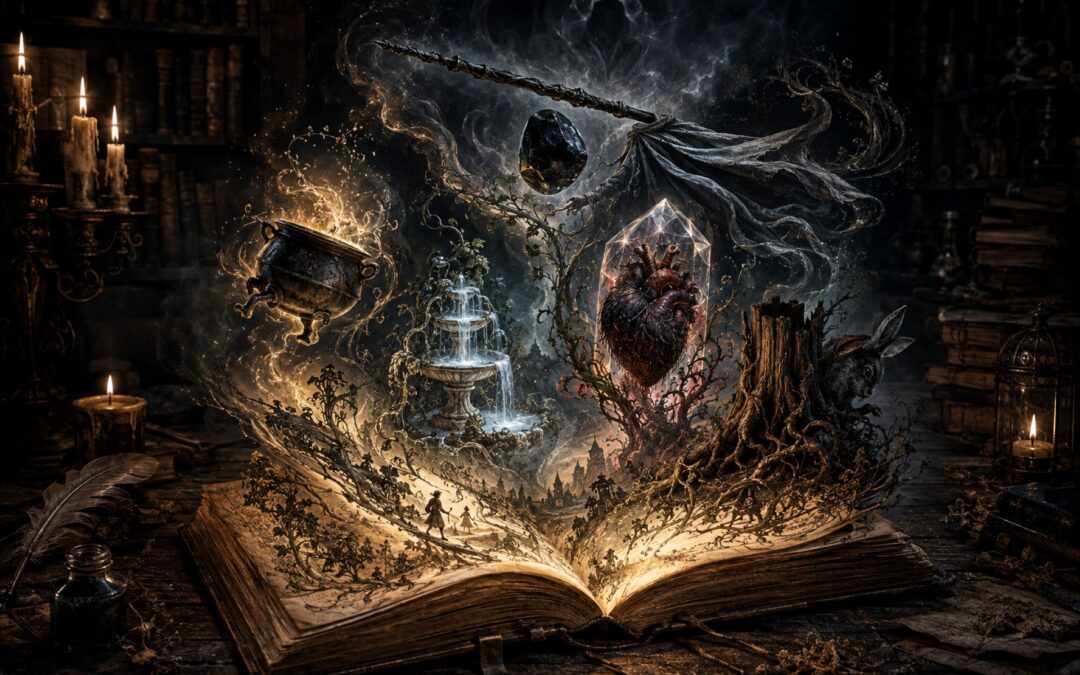
The Tales of Beedle the Bard is an unusual book even by the standards of J.K. Rowling’s Wizarding World. On its surface, it is a short collection of five fairy tales supposedly familiar to generations of magical children. Beneath that surface, however, Rowling constructs a second book around the first: each tale is followed by commentary attributed to Albus Dumbledore, who treats these stories as pieces of wizarding folklore shaped by censorship, prejudice, magical law, historical conflict, superstition, and the ordinary human desire to believe that power can solve what wisdom cannot.
The collection therefore works on two levels at once. The tales themselves are compact moral fables about generosity, luck, love, persecution, power, grief, and death, while Dumbledore’s notes show what happens when cultures interpret those fables according to their fears and ambitions. Across both layers, the same idea repeatedly emerges: magic may alter circumstances, but it does not abolish the fundamental difficulties of being human. Kindness, judgment, vulnerability, humility, and acceptance prove more reliable than magical force.
This article covers the complete book, including the endings of all five tales and the substance of Dumbledore’s commentaries. Full spoilers follow.

What Kind of Book Is The Tales of Beedle the Bard?
The book presents itself as a translated artifact from the Wizarding World rather than as a conventional collection written directly for Muggle readers. The title page claims that Hermione Granger translated the stories from their original runes, while Rowling’s introduction explains that Beedle the Bard was a fifteenth-century wizard whose stories became the magical equivalent of familiar Muggle fairy tales. For wizarding children, the Hopping Pot and the Fountain of Fair Fortune are meant to occupy roughly the cultural space that Cinderella or Sleeping Beauty occupies for non-magical children.
Rowling’s introduction also identifies a major difference between Beedle’s tales and many traditional Muggle fairy stories. In ordinary fairy tales, magic often causes the central problem: a witch poisons an apple, casts a curse, or transforms someone into a beast. Beedle’s protagonists generally already possess magic, yet that advantage does not save them from cruelty, grief, pride, loneliness, fear, or foolishness. Magic can help, but it cannot make character irrelevant.
The witches in Beedle’s stories are also frequently more active than stereotypical fairy-tale heroines. Asha, Altheda, Amata, and Babbitty seek solutions, make decisions, work, resist authority, and shape their own fortunes. Rowling does not turn this into a systematic argument about gender, but the distinction matters because it establishes the collection’s preference for agency over passive rescue.
The fictional Beedle is described as comparatively sympathetic to Muggles, distrustful of Dark Magic, and convinced that the worst wizarding failures arise not from insufficient magical ability but from ordinary defects of character. His successful protagonists tend to possess kindness, ingenuity, courage, or common sense rather than exceptional raw power. That moral orientation becomes the foundation for the entire collection.
Dumbledore’s notes create a second narrative voice. Rowling tells readers that these commentaries were discovered among his papers and were apparently written for a wizarding audience, which is why she occasionally inserts explanatory footnotes for Muggle readers. The result is a layered joke about authorship: Rowling is supposedly presenting Hermione’s translation of Beedle while editing Dumbledore’s commentary for readers who do not belong to the culture being discussed.
The final tale gives that structure special significance. Rowling’s introduction warns that Dumbledore reveals less than he knows about “The Tale of the Three Brothers,” and anyone familiar with Harry Potter and the Deathly Hallows understands why. The story that appears to be an old bedtime fable also describes the Elder Wand, Resurrection Stone, and Invisibility Cloak. Dumbledore discusses them as folklore while being personally entangled with the temptations they represent.
The public history of the real book reinforces its artifact-like character. Before the commercial edition appeared, Rowling produced handwritten and illustrated manuscript copies; the original handwritten project documented by Sotheby’s helped establish the collection as something resembling an object from inside the fictional world rather than a conventional spin-off. The later public edition was published in 2008, and J.K. Rowling’s official description of the collection continues to present it as five wizarding fairy tales accompanied by Dumbledore’s notes.
The 2008 edition also contains Rowling’s own black-and-white illustrations, which strengthen the storybook illusion. Small drawings of the Hopping Pot, the Fountain, the hairy heart, Babbitty’s stump, skulls, trees, and magical objects visually move between whimsy and mortality. The imagery becomes progressively darker as the stories move from comic punishment toward mutilation and death.
The book ends with a real-world message from Baroness Nicholson explaining the charitable purpose associated with the edition and the Children’s High Level Group, the organization that later became connected with Rowling’s continuing charitable work through Lumos. This material is not part of Beedle’s fictional collection, but it explains why the book’s transformation from handcrafted literary object to mass-market publication had a real purpose beyond expanding Wizarding World lore.
The Wizard and the Hopping Pot
The first tale begins with a kindly wizard who regularly uses magic to help his non-magical neighbors. He does not reveal his powers openly. Instead, he pretends that remedies emerge from an ordinary cooking pot, allowing villagers to request cures, antidotes, and practical assistance without fully understanding how their problems are being solved.
When the wizard dies, he leaves everything to his only son. The son has none of his father’s generosity and regards people without magical ability as inferior. He has always resented the old wizard’s willingness to spend time and magic helping Muggles, so inheriting the house gives him an opportunity to end the practice.
Inside the old cooking pot, he finds a small package containing a single slipper and a message from his father expressing the hope that the son will never need it. Rather than treating the object as a warning, he dismisses it as evidence of senility and tosses it back into the pot.
That evening, an elderly woman arrives asking for the treatment the father used to make for her granddaughter’s warts. The son refuses and slams the door. Almost immediately, the cooking pot sprouts a brass foot, becomes covered with warts, and begins hopping noisily around the house.
The young wizard tries to remove, clean, silence, and magically control it, but none of his spells work. The pot follows him everywhere, its brass foot clanging against the floor and stairs, making sleep almost impossible. His superior magical ability offers no protection from the lesson his father has arranged.
The next visitor is an old man whose donkey has disappeared. Without the animal, he cannot take his goods to market, which means his family may go hungry. Again the wizard refuses to help. The pot now adds the braying of a donkey and groans of hunger to its incessant noise.
A third visitor is a young mother whose baby is seriously ill. The wizard rejects her as well. The pot fills with salt water and begins slopping tears across the floor while continuing to hop, clang, bray, groan, and display the earlier symptoms.
Eventually the villagers stop approaching the house, but the pot no longer needs them to deliver their problems. It begins manifesting signs of illnesses and hardships throughout the community, choking and retching, crying like a baby, whining, producing spoiled food, and even disgorging slugs. The young wizard cannot eat, sleep, or escape the accumulated suffering of people he has chosen to ignore.
At last he breaks. He runs into the village promising to help everyone and uses magic in exactly the way his father did. The girl’s warts disappear, the missing donkey is summoned home, the sick baby is treated and recovers, and one household after another receives help.
As the village’s suffering decreases, the pot gradually returns to normal. Its symptoms disappear, its noise fades, and its surface becomes clean again. Finally it produces the small slipper the father had left behind. The son places it over the brass foot, muffling the hopping.
From then on, the wizard continues helping his neighbors. His transformation is morally real, but Beedle gives it a comic edge: generosity has been learned partly through compassion and partly because the wizard remains terrified that the pot might remove its slipper and start hopping again.
Dumbledore’s commentary reveals that this simple moral tale supposedly became controversial in wizarding history. A story in which a Muggle-friendly father is wiser and more admirable than his prejudiced son was politically uncomfortable during periods when magical communities were increasingly withdrawing from non-magical society. As witch persecution intensified, helping Muggles could be interpreted as reckless or even traitorous.
Dumbledore describes a revised anti-Muggle version that preserved the memorable Hopping Pot but inverted the meaning. In that retelling, the pot protects a wizard from hostile neighbors by swallowing them, and the wizard secures peace only after frightening the survivors into promising to leave him alone. The image survives while the original ethic disappears.
That fictional history matters because it establishes one of the collection’s recurring ideas: fairy tales are not culturally neutral. Communities rewrite stories to make inherited narratives agree with current prejudices. The same object—the Hopping Pot—can be turned from an instrument of enforced empathy into an instrument of hostility without losing its entertainment value.
Dumbledore also discusses the prejudice that Muggle-friendly witches and wizards supposedly possessed weak magic. He cites Brutus Malfoy, an anti-Muggle writer who treated sympathy for non-magical people as proof of magical inferiority. The absurdity is obvious to Dumbledore, who casually includes himself among the examples of powerful wizards who reject that prejudice.
His final example is Beatrix Bloxam, who disliked Beedle’s disease, death, unpleasantness, and bodily grotesquerie and attempted to rewrite children’s stories into aggressively cheerful moral confections. Her version of the Hopping Pot replaces uncomfortable suffering with childish sweetness. Dumbledore’s joke is that generations of wizarding children supposedly responded to the sanitized result with disgust.
The commentary therefore expands the first tale beyond charity. The Hopping Pot becomes a story about compassion, but also about censorship, historical revision, prejudice, and the mistaken belief that protecting children requires removing everything frightening or morally difficult from the stories they hear.
The Fountain of Fair Fortune
The second tale begins with a famous magical attraction: the Fountain of Fair Fortune, located high on a hill inside an enchanted garden. Once a year, one person suffering from misfortune may enter the garden, reach the Fountain, bathe in its waters, and supposedly receive permanent good fortune.
Hundreds gather outside the garden on the appointed day. Among them are three witches who share their reasons for seeking the Fountain. Asha suffers from a disease that no healer has been able to cure. Altheda has been robbed of her home, money, and wand by a wicked sorcerer. Amata has been abandoned by a man she loves and believes she will never recover from her grief.
The women pity one another and agree that, if one of them is selected, they will try to reach the Fountain together. When the entrance opens at sunrise, magical creepers reach through the crowd and seize Asha. She grabs Altheda, who grabs Amata, but Amata is tangled in the armor of a miserable non-magical knight.
All four are pulled inside.
The knight is Sir Luckless, a man defined by failure. He possesses neither magical ability nor impressive martial talent, and he assumes immediately that he cannot compete with three witches. He offers to withdraw, but Amata refuses to let him surrender so easily and orders him to draw his sword and accompany them.
Their first major obstacle waits at the base of the hill: an enormous blind white Worm that demands “the proof” of their pain. Sir Luckless attacks with his sword, which breaks. Altheda throws stones. The witches try spells. Nothing works.
Asha eventually begins to cry in despair. The Worm drinks the tears from her face, accepts them as genuine proof of suffering, and moves aside. The first barrier cannot be defeated through magical or physical force because the price is emotional truth.
Halfway up the hill, the travelers encounter another demand: they must provide “the fruit” of their labors. Sir Luckless offers his only coin, but it is worthless to the enchantment. The group continues trying to climb, yet no amount of ordinary movement brings the summit closer.
Altheda refuses to stop. She pushes herself harder and urges the others onward until sweat falls from her forehead onto the earth. That sweat satisfies the requirement. The path opens because the “fruit” of labor is not money but the bodily evidence of effort.
Near the summit, a stream blocks their way and demands “the treasure” of their past. Sir Luckless attempts to cross using his shield and fails. The witches cannot simply jump over the water.
Amata finally understands. Her most treasured possession is also the source of her suffering: the memory of the man who abandoned her. Using magic, she removes the memories of their happy times from her mind and gives them to the stream.
The water carries them away, creating stepping stones. More importantly, the act changes Amata. She has surrendered the idealized past that kept her emotionally imprisoned.
When the group finally reaches the Fountain, Asha collapses. The journey has exhausted her, and she appears close to death. She begs the others not to move her.
Altheda collects herbs growing near the Fountain, mixes them with water in Sir Luckless’s container, and gives the resulting potion to Asha. The remedy cures her illness. Asha no longer needs to bathe in the Fountain because one of her companions has accomplished what she believed only magical destiny could do.
She offers the Fountain to Altheda, but Altheda now recognizes that the knowledge she displayed in curing Asha gives her a way out of poverty. If she can produce effective remedies, she can earn money rather than waiting for fortune to restore what was stolen from her.
Altheda offers the opportunity to Amata. Amata also refuses. Once her idealized memories have disappeared, she can see that her former lover was cruel and faithless. Her problem was not simply that she had lost him; it was that she continued treating the loss as the destruction of her future.
Only Sir Luckless remains. He bathes in the Fountain and believes himself extraordinarily fortunate for having been selected from among so many seekers. He emerges newly confident, falls to his knees before Amata, and asks for her love.
Amata accepts. The four leave together and live long, happy lives.
The final sentence reveals that the Fountain’s waters contain no enchantment at all.
That reversal gives the tale its meaning. Asha is healed because Altheda has learned what she can do. Altheda escapes helplessness because adversity reveals an ability she can use. Amata becomes free because she gives up an attachment to the past. Sir Luckless acts differently because he believes himself fortunate, not because the water has magically rewritten his destiny.
The quest succeeds even though its supposed reward is false.
Dumbledore’s commentary begins far less philosophically, with a story about an attempted Hogwarts Christmas pantomime based on the tale. As a young Transfiguration teacher, Dumbledore was assigned responsibility for magical stage effects while Professor Herbert Beery directed the production.
The show becomes a spectacular disaster. A giant creature used to portray the Worm creates chaos, romantic entanglements among the student cast erupt into dueling, scenery catches fire, people are injured, and the Great Hall is nearly destroyed. The performance ends before the characters ever reach the Fountain, and Hogwarts subsequently bans pantomimes.
The anecdote is comic world-building, but Dumbledore then turns to a more serious controversy. Lucius Malfoy objects to the story because Amata, a witch, forms a romantic relationship with Sir Luckless, a Muggle. He asks for the tale to be removed from Hogwarts on the grounds that it promotes the mixing of magical and non-magical blood.
Dumbledore refuses. His response attacks the mythology of pure blood directly, arguing that families claiming absolute magical purity depend upon omission, denial, and hypocrisy. Wizarding families cannot remain historically sealed from Muggle ancestry simply because some descendants find that fact socially embarrassing.
The commentary therefore turns an optimistic story about self-generated fortune into another example of literature becoming politically contested. Amata’s marriage does not occupy much space in the fairy tale itself, but to a blood-purity ideologue it becomes the most dangerous element in the story.
The tale’s deeper pattern nevertheless remains personal rather than political. All four travelers enter the garden believing good fortune is something external that can be bestowed upon them. The journey gradually reveals that what they need is not magical luck but action, knowledge, emotional release, companionship, and confidence. The Fountain works precisely because it does nothing.
The Warlock’s Hairy Heart
The third tale abandons the warmth of the first two almost completely. Its protagonist is a handsome, wealthy, highly skilled young warlock who observes his friends falling in love and concludes that romantic attachment makes people ridiculous. Love causes them to lose appetite, dignity, independence, and self-control, so he decides that the safest life is one in which he can never experience it.
Because he possesses magic, he does not merely suppress his emotions. He uses Dark Magic to remove his heart.
His family initially assumes his coldness will disappear when he eventually meets the right woman. It never does. He watches friends marry and raise children while congratulating himself for avoiding their apparent foolishness.
The emotional damage reaches beyond romance. When his parents die, the warlock does not grieve them. Their deaths simply give him complete control of the family estate.
He lives alone in the castle, surrounded by servants and material comfort, convinced that other people must envy his freedom. His confidence is shaken when he overhears two servants discussing him. One pities a wealthy man who is loved by no one, while another mocks the fact that someone with so much money has apparently been unable to attract a wife.
The warlock is not suddenly lonely. He is insulted.
His response shows how thoroughly he has converted relationships into questions of status. He decides to marry not because he wants intimacy but because a magnificent wife will demonstrate his superiority. She must be beautiful enough to provoke envy, magically gifted enough to produce impressive children, and wealthy enough that marriage will not reduce his standard of living.
Conveniently, a woman meeting all his requirements soon arrives in the area. She is wealthy, beautiful, and magically talented. The warlock begins courting her.
Everyone else is impressed because he appears to have changed after years of emotional indifference. The woman is less convinced. She recognizes a disturbing emptiness beneath his practiced tenderness.
At a lavish feast, the warlock recites romantic language borrowed from poets, using words whose emotional meaning he does not understand. She finally tells him that she might appreciate his attention if only she believed he possessed a heart.
He decides to prove that he does.
The warlock leads her into a dungeon and reveals his hidden treasure: his own beating heart, preserved inside an enchanted crystal container. Years of isolation have changed it. The heart has shriveled and become covered in long black hair.
The woman is horrified and begs him to restore it to his body. Because pleasing her is necessary to complete his courtship, he agrees.
The restoration does not heal him. Once the heart is reconnected to sight, touch, scent, sound, and physical desire, it encounters sensation after years of deprivation. Its appetite is no longer recognizably human.
The woman embraces him, believing he can finally experience love. Instead, the newly restored heart reacts with a savage hunger for possession. When the other guests eventually search for the absent pair, they find the woman dead on the dungeon floor with her chest cut open.
The warlock crouches beside her holding her smooth heart, intending to exchange it for his own deformed one. Yet his hairy heart now dominates him and refuses to be removed by magic.
He finally takes a dagger and cuts it out himself.
For an instant, he kneels holding both hearts and believes he has mastered the thing that mastered him. Then he collapses across the woman’s body and dies.
Dumbledore calls this the most gruesome of Beedle’s tales and notes that many parents delay telling it to children. Unlike the first two stories, however, it has supposedly survived with relatively little ideological rewriting.
He believes its durability comes from the temptation it addresses: the desire for invulnerability. The warlock is frightened not by love itself but by the possibility that love will expose him to humiliation, dependency, grief, obligation, and loss.
That fear is not irrational in the sense that vulnerability really can cause pain. His mistake is assuming that eliminating the capacity to be wounded can be separated from eliminating the capacity to be human.
Dumbledore compares the warlock’s act to the logic of Horcrux creation without saying that the magical processes are identical. In both cases, a person interferes with something central to the integrity of the self in the belief that division will provide protection. The result is not greater humanity but self-mutilation.
The hairy heart is therefore both literal object and symbol. Separated from ordinary emotional life, it becomes bestial. The warlock’s effort to remain above human weakness turns him into something less than human.
The story also attacks a particular form of control. The warlock does not want to risk loving a real person whose desires, needs, and choices might conflict with his own. Even when he decides to marry, he treats the woman as an acquisition whose beauty, bloodline, wealth, and admiration will improve his status.
Once his emotions return, that possessiveness becomes physically monstrous. He wants her heart because he cannot tolerate the independent life represented by his own.
Dumbledore broadens the discussion by referring to attempts to manufacture love through potions. Such magic may create powerful infatuation, but it does not produce the unconditional bond people actually mean when they speak of genuine love. Whether through emotional removal or chemical control, the attempt to dominate affection destroys the very quality being sought.
The tale’s horror comes from making psychological self-protection physical. A person who spends years ensuring that nothing can touch him eventually discovers that he has also ensured that he can touch nothing humanly.
Babbitty Rabbitty and her Cackling Stump
The fourth story is the collection’s clearest political fable. Its central figure is a foolish king who envies magic and decides that he alone should possess it. His solution is contradictory but perfectly suited to his character: he orders witches and wizards hunted while simultaneously announcing that he needs a magical instructor.
Real magical people naturally remain hidden because presenting themselves at court would mean revealing their identity to a regime actively persecuting them. A non-magical charlatan, however, recognizes an opportunity.
He arrives at the palace pretending to be an enormously powerful wizard and is appointed Grand Sorcerer in Chief and private instructor to the king. He quickly begins extracting wealth from his employer, claiming he requires gold, jewels, precious objects, and other materials for magical purposes.
For actual lessons, he gives the king an ordinary twig and claims it is a wand that will function only when its owner becomes sufficiently worthy. The two spend their mornings waving sticks, performing meaningless movements, and shouting nonsense while the charlatan uses tricks to maintain the illusion that real magic is occurring.
Their performance is observed by Babbitty, an elderly washerwoman who lives near the palace grounds. She laughs so hard at the ridiculous spectacle that the king hears her.
Her laughter humiliates him. The king suddenly realizes that he may look foolish and demands to know when he will be ready to demonstrate real magic to his court.
The charlatan tries to delay matters, but the king announces that a public performance will take place the next day. If the demonstration fails and anyone laughs, the charlatan will be executed.
The fraud now has a problem he cannot solve with stage tricks. While looking for someone to blame, he approaches Babbitty’s cottage and discovers that she is a genuine witch. Her household magic reveals what the king has been unable to recognize: the humble washerwoman possesses the power both men are pretending to understand.
The charlatan immediately blackmails her. He threatens to expose her to the king’s witch-hunters unless she secretly performs the spells the king attempts during his public demonstration.
Babbitty agrees, though she asks what will happen if the king demands magic she cannot perform. The charlatan arrogantly assumes that anything the king can imagine must be possible.
The next morning, the court assembles. The king announces that he will make a noblewoman’s hat disappear. From concealment, Babbitty performs the actual spell, and the hat vanishes.
Encouraged by applause, the king announces that he will make a horse fly. Babbitty does that as well.
The demonstration appears to be a triumph until the captain of the king’s witch-hunting force presents a dead dog. The animal has died from eating a poisonous mushroom, and the captain asks the king to bring it back to life.
The king points his twig at the corpse.
Babbitty does nothing.
The failure is not caused by inability or refusal in an ordinary sense. Raising the dead is impossible within the magical rules the story wants children to learn. The king, however, knows so little about magic that he cannot understand why a supposedly powerful wizard would encounter any absolute limit.
As the court begins laughing, the charlatan reacts exactly as someone whose survival depends upon deception would react: he identifies a scapegoat. He points toward Babbitty’s hiding place and claims that an evil witch is blocking the king’s magic.
Babbitty runs. The king’s brigade releases its hounds and chases her across the grounds.
She disappears near a hedge. When the hunters arrive on the other side, they find only an old tree.
The charlatan, terrified that Babbitty will return and expose him, tells everyone she has transformed herself into the tree. The king orders it cut down.
After the tree falls, the court prepares to leave, but Babbitty’s cackling voice emerges from the stump. She mocks them for believing that cutting a witch in half could kill her and suggests they test the theory on the Grand Sorcerer.
The charlatan immediately collapses and confesses everything. His magical training, wand, spells, and claims of power were all fraudulent.
Babbitty’s voice then tells the king that cutting down a witch has brought a terrible curse on the kingdom. Every act of violence he orders against magical people will supposedly be felt as though an axe is striking his own body.
Terrified, the king promises to end the persecution.
The stump demands one further act of restitution: a statue of Babbitty must be erected as a reminder of the king’s foolishness. He agrees.
After the king and court leave, a rabbit emerges from beneath the stump with a wand held in its mouth. Babbitty has not become the tree at all. She escaped by transforming into an animal, concealed herself beneath the roots, and manipulated the king using his own ignorance about the capabilities of witches.
The kingdom thereafter allows witches and wizards to live in peace.
Dumbledore calls this perhaps the most realistic of Beedle’s stories in magical terms. Its key lesson for wizarding children is that death cannot simply be reversed by waving a wand. Magic may imitate presence, preserve images, animate portraits, produce ghosts, or reanimate corpses through Dark Magic, but it cannot restore a dead person completely to ordinary life.
That principle matters throughout the larger collection. “Babbitty Rabbitty” presents it as a practical magical rule; “The Tale of the Three Brothers” turns the same rule into a philosophical problem.
Dumbledore also uses the tale to explain Animagi. Babbitty possesses the rare ability to transform voluntarily into an animal while retaining her human intelligence. Such transformations require skill and practice and are regulated because they can be extremely useful for concealment.
He speculates that the fictional Beedle may have drawn inspiration from stories surrounding an alleged historical witch, Lisette de Lapin. Dumbledore does not present the connection as certain, which fits the commentary’s mock-scholarly style: wizarding folklore contains disputed origins just as Muggle folklore does.
The story does take one liberty with the magical rules. Babbitty seems capable of speaking while in rabbit form, yet Dumbledore explains that Animagi normally retain human thought but not human speech while transformed. He treats this as either poetic license or evidence that Beedle had heard about Animagi without fully understanding them.
That qualification is important because the book does not insist that every magical feature inside a children’s fable should be read as a technical rule of the wider Wizarding World. Beedle is a storyteller, not a textbook writer.
Dumbledore finally links the stump imagery to broader magical traditions involving wand-quality trees and the risks of interfering with magically protected wood. The commentary thus turns a political story about persecution into one of the book’s densest pieces of world-building.
At the center of the tale, however, is a simpler political insight. The king wants the prestige of magical power while fearing people who actually possess it. Because he understands neither its source nor its limits, he is easily manipulated first by a fraud and then by Babbitty.
Babbitty defeats him not through overwhelming force but through superior knowledge of the world. She understands magic, the king’s psychology, and the political value of making a tyrant fear consequences he cannot verify.
The Tale of the Three Brothers
The final tale begins with three magically skilled brothers traveling along a dangerous road at twilight. They reach a river that ordinarily kills travelers attempting to cross it, but instead of risking the water they use magic to create a bridge.
Halfway across, they encounter Death.
Death is angry because the brothers have escaped a fate that usually provides him with victims. He is also cunning enough to avoid confronting them openly. Rather than admitting hostility, he congratulates them on their magical skill and offers each brother a prize.
The eldest brother is aggressive and proud. He asks for a wand more powerful than any other in existence, one that will always win a duel for its owner. Death takes a branch from an elder tree and fashions the Elder Wand.
The second brother is arrogant in a different way. He wants to humiliate Death by reversing Death’s victories, so he asks for the ability to bring the dead back to life. Death gives him a stone and says it can recall those who have died.
The youngest brother distrusts Death completely. Instead of asking for greater power, he asks for a way to leave without being followed. Death reluctantly gives him his own Cloak of Invisibility.
The brothers continue together for a time and eventually separate.
The eldest travels until he reaches a village where he finds a wizard with whom he has quarreled. Armed with the Elder Wand, he kills his enemy in a duel.
The victory immediately becomes a problem because he cannot resist advertising it. At an inn, he boasts that he possesses an unbeatable wand taken from Death himself.
That night another wizard approaches while he lies drunk and asleep, steals the Elder Wand, and cuts his throat.
Death therefore claims the first brother.
The structure of his downfall is precise. The wand gives him the victory he requested, but the desire that caused him to request it—his hunger for domination and recognition—creates the conditions for his death. The weapon does not betray him. His relationship to power does.
The second brother returns home and uses the stone. He turns it in his hand and summons the woman he had once hoped to marry before she died.
She appears, but the result is not true resurrection. The woman is separated from him by a profound difference in condition. She is present yet does not belong among the living, and her existence beside him becomes increasingly painful.
The brother cannot restore the relationship they would have had if death had never occurred. His attempt to erase grief merely places him permanently beside an image of what he has lost.
Eventually he becomes so desperate to be truly reunited with her that he kills himself.
Death claims the second brother.
The youngest brother behaves differently. He keeps the Cloak and uses it to remain hidden from Death for many years.
He does not believe that he has become immortal. He simply lives.
When he reaches old age, he gives the Cloak to his son. Having completed his life, he removes his protection and meets Death voluntarily.
He greets Death as an old friend, and the two depart together as equals.
The youngest brother’s success is therefore not that he defeats mortality. He succeeds because he refuses to organize his life around the fantasy of defeating it.
Dumbledore’s commentary begins by stating that he loved the story as a child. Its moral, in his reading, is straightforward: people who attempt to conquer death through violence or necromancy will ultimately lose, while the wisest person accepts that avoiding death forever is impossible.
The commentary then introduces the greatest irony in the collection. Wizarding readers have supposedly responded to this cautionary tale by constructing a legend that directly contradicts it.
According to that legend, the wand, stone, and cloak are not merely storybook devices but real magical objects. If one person becomes the rightful owner of all three, that person will become “master of Death.”
The phrase can be interpreted wisely or foolishly. Beedle’s tale suggests that mastery of death means accepting mortality without being psychologically ruled by it. Hallows enthusiasts instead interpret mastery as literal invulnerability or immortality.
Dumbledore examines the three objects separately.
Invisibility Cloaks exist, but ordinary ones deteriorate. They may tear, become opaque, lose magical effectiveness, or be defeated by other forms of magic. Beedle’s Cloak is therefore exceptional because it remains completely effective across generations.
The Resurrection Stone creates a greater problem because established magical knowledge says genuine resurrection is impossible. Dumbledore emphasizes that the second brother’s beloved does not truly return to ordinary life. Her presence is incomplete, estranged, and psychologically destructive.
Dark magic can produce Inferi, but reanimated corpses are not restored people. Ghosts preserve a form of personality but are not resurrected human beings. Magical portraits can move and speak without becoming the people they depict.
The magical world can create many approximations of continued presence. It cannot abolish the boundary itself.
The Elder Wand receives far more attention because wizarding history contains repeated claims about extraordinarily powerful wands, including weapons supposedly made of elder. Dumbledore discusses a chain of violent owners and legends involving figures such as Emeric the Evil, Egbert, Godelot, Hereward, Barnabas Deverill, and Loxias.
These stories blur folklore and magical history. Some owners give their powerful wands grand names and build reputations around their supposed invincibility. Others kill previous owners or are killed by successors.
Dumbledore uses the history to explain wandlore. A wand is not an inert stick that performs identically for anyone who holds it. It develops a relationship with its owner and can absorb tendencies from extended use.
That makes a wand passed through generations of violent Dark wizards potentially unusual even without invoking literal intervention by Death. An object repeatedly transferred through conquest could accumulate associations with dangerous magic.
The legend also contains a fatal contradiction. Every wizard who boasts that the Elder Wand is unbeatable eventually loses it.
If ownership passes through defeat, then every transfer disproves the claim of invincibility. The wand may be exceptionally powerful, but the mythology surrounding it encourages owners to confuse superior capability with absolute security.
Dumbledore’s interpretation returns repeatedly to human desire. People want the wand because power promises safety. They want the stone because grief makes separation unbearable. They want the cloak because disappearance appears to provide escape.
None of these desires is difficult to understand.
That is why the final commentary becomes personal. Dumbledore admits that intelligence would not necessarily protect him from the Hallows’ temptations. His awareness of the story’s moral does not place him above the psychology it describes.
The significance is amplified by Rowling’s introduction, which has already warned readers that Dumbledore knows more about this story than he admits. His commentary can therefore be read simultaneously as literary analysis and self-examination.
The final tale completes the collection because the earlier stories repeatedly show people trying to use magic to avoid ordinary human conditions. The selfish wizard tries to avoid responsibility. The Fountain seekers initially hope to avoid the work of transformation. The warlock tries to avoid vulnerability. The king tries to acquire power without being born magical.
The three brothers confront the ultimate version of the same temptation: avoiding mortality itself.
Only the youngest recognizes the difference between using magic intelligently and expecting magic to repeal reality.
How the Five Tales Build a Wizarding Moral Tradition
Taken individually, the stories are simple fables. Taken together, and especially when read beside Dumbledore’s commentaries, they create a coherent moral tradition in which magical power is never treated as the same thing as wisdom. The collection repeatedly gives characters extraordinary possibilities and then asks what kind of people they become when those possibilities encounter fear, pride, grief, prejudice, or desire.
The stories also grow darker as they proceed. The Hopping Pot uses comic annoyance to teach generosity, while the Fountain replaces external salvation with personal change. “The Warlock’s Hairy Heart” turns emotional avoidance into mutilation, “Babbitty Rabbitty” places magical difference inside political persecution, and “The Tale of the Three Brothers” ends by confronting the permanence of death.
Magic Does Not Remove Human Problems
The central premise of the collection is already announced in Rowling’s introduction: witches and wizards possess magic and still suffer from problems that magic cannot cleanly solve. Each tale then demonstrates a different version of that principle.
The wizard’s son can cure disease and summon missing animals, yet he cannot magically eliminate the ethical demand created by living beside suffering people. The Fountain seekers enter an enchanted garden expecting magical fortune, but the journey changes them through work, friendship, insight, and courage before they ever reach the water. The warlock possesses enough Dark Magic to remove his heart but lacks the wisdom to understand why doing so will destroy him.
The foolish king represents the inverse problem. He believes magic would automatically make him greater, so he wants the appearance of magical power without understanding its nature. His humiliation comes from treating power as performance rather than knowledge.
The three brothers reach the final boundary. Extraordinary magic can win duels, summon something resembling the dead, or conceal a person for decades, but none of those abilities abolishes mortality. The collection consistently refuses the fantasy that sufficient technique can solve every human problem.
Prejudice, Power, and the Treatment of Muggles
Muggle prejudice is not merely background lore in Dumbledore’s commentary. It becomes one of the principal ways the collection examines the cultural misuse of power.
“The Wizard and the Hopping Pot” begins with an individual prejudice: the son believes people without magic are beneath his concern. Dumbledore then turns that prejudice into fictional social history by describing periods when helping Muggles became politically suspect and supposedly demonstrated weak magic.
The anti-Muggle rewrite of the story shows ideology changing folklore itself. Rather than abandoning the popular Hopping Pot, hostile storytellers preserve the entertaining image and reverse its moral. Cultural memory becomes a site of political struggle.
“The Fountain of Fair Fortune” produces a similar conflict when Lucius Malfoy objects to Amata’s relationship with Sir Luckless. The tale’s ending is happy because the characters find new possibilities for life, but blood-purity ideology interprets cross-cultural love as contamination.
“Babbitty Rabbitty” makes persecution explicit. The king envies magical ability, fears those who possess it, and therefore attempts to monopolize what he cannot understand. His witch-hunters represent the political form of the same insecurity that appears more quietly in the earlier commentaries.
Across these examples, the collection treats prejudice as a mixture of fear, ignorance, and status anxiety. Those who insist most loudly on magical superiority are repeatedly shown to understand magic poorly.
Love, Vulnerability, and the Failure of Invulnerability
The collection presents love most positively when characters accept its uncertainty rather than trying to control it. Amata begins “The Fountain of Fair Fortune” trapped by the memory of a man who abandoned her. Her transformation occurs not when she wins him back but when she relinquishes the version of the past that prevents her from seeing him accurately.
Sir Luckless offers a different possibility. He does not possess magical grandeur, but he accompanies the women, survives the journey, and gains enough confidence to approach Amata honestly. Their relationship emerges after both characters have moved beyond the identities that made them feel doomed.
“The Warlock’s Hairy Heart” provides the negative image. The warlock wants emotional life without risk and eventually marriage without vulnerability. He approaches love as something that should enhance his status while leaving him fundamentally unchanged.
That contradiction cannot hold. Love requires another person who remains independent, and therefore it inevitably creates uncertainty. By removing vulnerability, the warlock also removes the conditions that make genuine attachment possible.
His final violence is the logical extreme of possessiveness. Unable to accept a heart that can be affected by someone else, he tries to replace it with the woman’s heart as though intimacy could be achieved through ownership.
Dumbledore’s remarks about love potions reinforce the distinction. Magical infatuation can imitate some outward features of passion, but controlled attachment is not the same as freely given love.
Death, Grief, and the Wisdom of Acceptance
Death becomes increasingly important as the collection progresses. “The Warlock’s Hairy Heart” ends in self-inflicted death, but its primary subject is emotional avoidance. “Babbitty Rabbitty” then establishes the magical rule directly: even genuine witches and wizards cannot simply raise the dead.
“The Tale of the Three Brothers” turns that limitation into the collection’s deepest philosophical problem. The second brother cannot accept the permanent absence of the woman he loved, so he uses the Stone to create an impossible compromise between life and death.
Her return does not heal grief because she does not belong to his world anymore. His attempt to erase separation transforms mourning into obsession.
The youngest brother takes the opposite path. He values life enough to protect it, but not so absolutely that mortality becomes an intolerable insult. When his life is complete, he accepts death without treating acceptance as defeat.
That distinction is central to the collection’s idea of wisdom. Acceptance does not mean passivity. Asha seeks healing, Babbitty resists persecution, and the youngest brother uses the Cloak for decades. The stories do not praise surrender to avoidable suffering.
They instead distinguish between changing what can be changed and destroying oneself against what cannot.
Women, Agency, and Fairy-Tale Reversals
Rowling’s introduction draws attention to the active role of Beedle’s witches, and the pattern is real across the collection. Asha, Altheda, and Amata enter the enchanted garden because they want to change their lives, and each participates in solving the obstacles that stand between the group and the Fountain.
Altheda works relentlessly and later turns knowledge into economic independence. Amata frees herself from a relationship that has become psychologically destructive. Babbitty outmaneuvers a king, survives state persecution, exposes a fraud, and secures protection for the magical population.
The unnamed woman in “The Warlock’s Hairy Heart” occupies a more conventional fairy-tale position, but Rowling deliberately denies her the expected romantic ending. Her belief that restoring the warlock’s heart will restore his humanity proves tragically mistaken.
The collection should not be inflated into a comprehensive feminist program. Its characters remain deliberately archetypal, and several women are defined by fairy-tale roles. Still, Beedle’s heroines are notable for acting upon their circumstances rather than waiting for rescue, which helps distinguish Rowling’s imitation of fairy-tale tradition from simple reproduction of it.
Fairy-Tale World-Building: What the Collection Adds to the Wizarding World
The settings of the five stories are intentionally generic. There are old cottages, kingdoms, castles, gardens, lonely roads, forests, rivers, villages, and enchanted obstacles rather than carefully mapped locations. That lack of geographical specificity is appropriate because the tales imitate traditional folklore rather than realistic historical fiction.
The richer world-building occurs in Dumbledore’s notes. Through commentary that often wanders far beyond the immediate plot, Rowling creates the sense that wizarding society possesses centuries of its own cultural memory.
The Hopping Pot gives Dumbledore an opportunity to discuss changing relations between magical and non-magical communities. Witch persecution supposedly contributes to increasing separation, eventually producing a culture in which association with Muggles can be treated as suspicious. The later anti-Muggle rewrite of the tale shows how political attitudes affect what parents teach children.
Blood ideology appears again in “The Fountain of Fair Fortune.” Lucius Malfoy’s objection to a witch marrying a Muggle demonstrates that books themselves become objects of institutional conflict. Dumbledore’s refusal to remove the story from the Hogwarts library places the school inside the broader political struggle over what magical children are permitted to imagine as normal.
“Babbitty Rabbitty” expands the technical rules of magic. Readers learn that magical ability is innate rather than something an ordinary Muggle can acquire by learning incantations. Animagus transformation requires unusual skill. The Ministry registers Animagi because voluntary animal transformation has obvious uses in concealment and covert activity.
The same commentary also establishes the strongest magical limit in the collection: death cannot be fully reversed. That boundary gives the magical world coherence because it prevents magic from becoming unlimited wish fulfillment.
“The Tale of the Three Brothers” adds an enormous layer of wandlore. Wands develop relationships with users, may absorb tendencies from prolonged use, and do not necessarily perform equally well for every person who holds them. The history of the Elder Wand is therefore interesting not only because the weapon may be unusually powerful, but because ownership becomes entangled with violence and allegiance.
Dumbledore’s commentaries also create an entire fictional literary ecosystem. He mentions banned stories, rewritten tales, anti-Muggle publications, dubious self-help books, academic works, magical historians, folklore, school productions, Ministry regulations, and contradictory popular legends. The effect is similar to encountering footnotes in an old scholarly edition where every reference implies another body of literature beyond the page.
That density is one of the book’s greatest pleasures for readers already invested in the Wizarding World. A five-story children’s book becomes evidence of what magical families teach, censor, joke about, fear, misremember, and argue over.
At times, the world-building threatens to become more interesting than the stories themselves. This is particularly obvious in Dumbledore’s Elder Wand commentary, where the original fairy tale occupies only a small portion of the intellectual space created around it.
Yet that imbalance is also part of the book’s formal idea. A culture’s simplest stories often accumulate histories far larger than their plots. Rowling uses Dumbledore to show not merely what wizarding children read, but what adults have done with those stories after generations of interpretation.
Characters, Archetypes, and Relationships
Because The Tales of Beedle the Bard imitates fairy tales, its characters are not constructed like novel protagonists. They often begin as types: the selfish son, the suffering women, the loveless warlock, the foolish king, the clever witch, the proud brothers. Their simplicity allows the stories to concentrate on moral choices and reversals rather than extended psychology.
The wizard’s son in “The Wizard and the Hopping Pot” is one of the clearest examples. He begins with a complete moral position rather than a complicated personality: magical people matter, Muggles do not. The Hopping Pot forces him to experience the consequences of that belief indirectly until he changes his behavior.
His development is intentionally comic and incomplete. He helps because he understands suffering better, but also because he fears renewed punishment. Beedle does not require perfect moral enlightenment before socially useful behavior becomes valuable.
Asha, Altheda, and Amata are distinguished by the kinds of misfortune they carry. Asha’s problem is bodily, Altheda’s material, and Amata’s emotional. Their journey works because each woman’s crisis eventually becomes connected to something another character can help resolve.
Asha cannot cure herself, but Altheda can. Altheda cannot restore her stolen property, but discovering her practical ability gives her another path to security. Amata cannot force her lover to become faithful, but she can change the relationship she maintains with his memory.
Their friendship therefore matters more than the Fountain. The group succeeds because suffering becomes shared rather than treated as a competition for a single magical prize.
Sir Luckless initially appears almost entirely useless. He is neither a wizard nor a great warrior, and even his name defines him by failure. Yet he contributes persistence and companionship, and his final transformation depends mostly upon self-perception.
The warlock is the collection’s most psychologically developed antagonist because his evil begins in a recognizable fear. He observes genuine vulnerabilities in love and concludes that the rational solution is total immunity.
His error becomes increasingly visible as life strips away the relationships he has rejected. Even then, he does not experience loneliness in a healthy form. The servants’ judgment wounds his pride rather than awakening affection, so he tries to solve reputation through acquisition.
The unnamed maiden has less depth, but her function is important. She recognizes the difference between performed tenderness and genuine feeling. Her tragedy is believing that restoring the warlock’s heart will automatically restore everything that emotional life should contain.
Babbitty is the collection’s most effective trickster. She possesses real magical ability but wins primarily through intelligence, patience, and psychological insight. The king and charlatan repeatedly underestimate her because of her social position as an elderly washerwoman.
The king is foolish because he confuses desire with entitlement. He wants magic because he thinks power should belong exclusively to him, and he believes learning the outward performance of spellcasting will make reality conform to his status.
The charlatan understands the king better than the king understands himself. His fraud succeeds because he tells authority what authority wants to hear. He is defeated only when circumstances demand a result that cannot be faked.
The three brothers are the purest archetypes in the collection. The eldest embodies violent pride, the second grief distorted by arrogance, and the youngest humility combined with caution. Their limited characterization is not a flaw in itself because the structure depends upon contrast.
Death, meanwhile, is less a metaphysical explanation than a fairy-tale personality. He is clever, resentful, patient, and ultimately unavoidable. Whether readers imagine him literally or symbolically, he represents a condition none of the brothers can permanently escape.
Dumbledore is the most complex character in the book even though he never appears inside a tale. For most of the collection, he occupies the secure position of commentator: learned, amused, morally confident, and capable of exposing the prejudices of other witches and wizards.
The final commentary unsettles that position. When he admits his own susceptibility to the Hallows, he becomes one more reader interpreting a story that exposes something uncomfortable about him.
That moment prevents the commentaries from becoming simple lectures. Dumbledore can understand the moral perfectly and still be vulnerable to the desire the moral warns against.
Symbols and Motifs: Pots, Hearts, Fountains, Trees, and the Hallows
The collection repeatedly centers stories on magical objects, but those objects rarely function as simple rewards. Instead, they reveal the character of the people who possess, pursue, or misunderstand them.
The Hopping Pot begins as an ordinary household object associated with the father’s generosity. After his death, it becomes an embodied conscience. Every suffering person the son refuses to acknowledge reappears as a symptom on or inside the pot.
The slipper is equally important. It appears ridiculous when the son first finds it, yet it eventually becomes the device that silences the pot’s brass foot. The father’s final gift is therefore not treasure but a warning that comfort depends upon continued responsibility.
The Fountain appears to be the most obviously magical object in its story, but the ending empties it of supernatural power. Its symbolic function survives precisely because its literal enchantment disappears.
Asha’s tears, Altheda’s sweat, and Amata’s memories are more significant than the Fountain itself. Each trial requires a different kind of payment: authentic pain, sustained labor, and the surrender of an attachment to the past. Their journey transforms intangible human experience into the currency of fairy-tale magic.
The hairy heart is the collection’s most grotesque symbol because metaphor becomes anatomy. Emotional coldness literally turns the warlock’s heart into something shriveled and beastlike.
Its hair matters because the change is not merely absence. The heart has not become empty; it has become feral. Repression produces distorted appetite rather than serene independence.
Tree imagery in “Babbitty Rabbitty” works differently. The stump is a false body that Babbitty uses to manipulate the king’s assumptions. He believes a witch could simply become a tree because he knows so little about magic that he cannot distinguish possibility from nonsense.
The rabbit embodies mobility and disguise, while the golden statue placed on the stump becomes an institutionalized memory of the king’s humiliation. Babbitty turns the site where authority thought it had executed her into a monument to its own ignorance.
The three Hallows are the most powerful symbols because each represents a recognizable human temptation. The Elder Wand offers domination, the Resurrection Stone offers reunion, and the Cloak offers escape.
Their moral meaning depends upon use. The Wand becomes dangerous because power invites display and challenge. The Stone becomes unbearable because grief cannot be solved by suspending someone between presence and absence.
The Cloak is comparatively benign because the youngest brother treats it as a practical tool rather than a promise of metaphysical supremacy. He knows when to relinquish it.
Death imagery intensifies around the final tale, especially in Rowling’s illustrations. Skulls, grave-like compositions, bones, and the lonely road shift the visual atmosphere away from the comic grotesquerie of the Hopping Pot toward memento mori.
Across the collection, repeated tests and bargains serve the same structural purpose. Characters encounter objects that appear to offer solutions, but their real challenge is understanding what those objects can and cannot do.
Magic repeatedly externalizes an internal problem. The question is rarely whether the object is powerful enough. The question is whether the person confronting it possesses enough wisdom to use, refuse, reinterpret, or surrender it.
Rowling’s Double-Voiced Storytelling: Beedle, Dumbledore, Hermione, and the Reader
The most distinctive feature of The Tales of Beedle the Bard is not any single fairy tale. It is the way Rowling builds a fictional history around the act of reading those tales.
Beedle supposedly writes them centuries before the Harry Potter era. Hermione supposedly translates them from runes. Dumbledore writes commentary for magical readers. Rowling then adds explanations for Muggles.
That chain of voices creates distance between story and interpretation. Readers never encounter “Beedle” directly in the way they encounter an ordinary author. They encounter a translation framed by editorial explanation and followed by criticism.
The tales themselves use recognizable fairy-tale language. They begin in generalized times and places, rely on archetypal characters, compress years into sentences, and turn moral choices into physical trials. Their plots move quickly because they are designed to be remembered and retold.
Rowling also preserves the violence common to older fairy tales. A man has his throat cut. Another commits suicide. A woman is murdered and mutilated. A witch is apparently chopped down in tree form. Characters confront disease, persecution, starvation, bodily corruption, and grief.
That darkness is balanced by absurdity. The Hopping Pot grows warts and spews unpleasant substances. Hogwarts pantomime becomes catastrophic farce. Dumbledore’s footnotes wander into ridiculous wizarding anecdotes.
The combination gives the book a tone that is neither purely childish nor solemn. Rowling is interested in the strange fact that frightening stories can be deeply enjoyable to children precisely because they convert abstract dangers into memorable images.
Dumbledore’s notes complicate the morals by giving each story a reception history. “The Wizard and the Hopping Pot” becomes politically rewritten. “The Fountain of Fair Fortune” becomes the subject of censorship. “Babbitty Rabbitty” is examined as though it were evidence in a history of magical practice.
The commentary therefore demonstrates that stories do not stop changing once they are written. Readers reinterpret them, parents sanitize them, political groups censor them, believers literalize them, and institutions turn them into evidence for conflicting worldviews.
“The Tale of the Three Brothers” is the culmination of that idea because its readers interpret the story in exactly the way its moral warns against. Beedle tells them that trying to conquer Death is foolish. Some wizarding readers respond by searching for the magical objects that might allow them to conquer Death.
This is where Dumbledore’s voice becomes especially important. He is usually funny, skeptical, and intellectually superior to the people he describes. He can diagnose Brutus Malfoy’s prejudice, Lucius Malfoy’s hypocrisy, Beatrix Bloxam’s censorship, and the king’s ignorance with effortless clarity.
The Hallows remove that distance.
Dumbledore recognizes the irrationality of seeking mastery over death while acknowledging that he is drawn toward the same fantasy. Interpretation does not automatically free the interpreter from desire.
Hermione’s fictional role as translator adds another layer without demanding much narrative attention. Her name assures Harry Potter readers that the text has passed through a familiar figure associated with scholarship and linguistic competence, while also making the book feel like an artifact preserved inside the fictional world.
Rowling’s footnotes complete the joke by positioning the actual reader as culturally uninformed. Terms obvious to witches and wizards require explanation because Muggles lack basic magical knowledge.
The illustrations perform a similar function. Their handmade quality helps the book resemble a storybook rather than a modern novel, and the recurring decorative imagery creates a visual continuity among stories that otherwise have no shared characters or plots.
This multilayered structure is both the book’s greatest strength and the source of its most obvious imbalance. Several of the stories are extremely simple when isolated from their commentary.
Dumbledore’s notes can become more intellectually entertaining than the fables they explain. A reader interested in wizarding history may remember the discussion of censorship or wandlore more vividly than the events that triggered it.
That does not necessarily mean the stories have failed. Their simplicity creates room for the commentaries to demonstrate how a culture builds complexity around basic narratives.
The book therefore works less like an ordinary short-story collection than like a fictional annotated edition of an old classic. Rowling is not only inventing fairy tales. She is inventing what generations of people have argued those fairy tales mean.
The Tale of the Three Brothers and the Meaning of the Ending
“The Tale of the Three Brothers” receives disproportionate attention because it is both the collection’s philosophical endpoint and its strongest connection to the larger Harry Potter story. Yet its meaning inside Beedle is simpler than the mythology that later grows around the Hallows.
The first brother believes mastery means defeating other people. His wand makes him more dangerous, but it cannot protect him from the consequences of being the kind of person who advertises invincibility.
The second brother believes mastery means defeating loss. His Stone gives him contact with someone dead, but contact without true restoration only deepens the difference between life and death.
The youngest brother does not ask Death to make him stronger or to reverse reality. He asks for temporary protection.
That distinction is why his final meeting with Death is portrayed as equality rather than defeat. He has not become equal because he has acquired power matching Death’s. He becomes equal because Death no longer possesses psychological leverage over him.
He values his life, preserves it, raises a son, grows old, and eventually relinquishes the Cloak voluntarily. Death cannot terrify someone who accepts mortality when its time arrives.
The later Hallows legend transforms this acceptance into a fantasy of ownership. If all three objects can be possessed, perhaps death itself can be mastered technologically.
The contradiction is deliberate. Readers inside the Wizarding World commit the same error the collection repeatedly exposes: they encounter a moral problem and search for a magical device that will eliminate it.
Dumbledore understands that mistake intellectually. His final comments nonetheless reveal that he cannot treat it as a purely academic curiosity.
That self-implication is essential. A less complicated commentator might conclude that foolish people want dangerous objects because they are greedy or ignorant.
Dumbledore knows better. People want them because the desires represented by the Hallows are among the most powerful human desires imaginable: security, reunion, power, escape, and freedom from death.
The Resurrection Stone is especially revealing because grief makes its temptation understandable even when its danger is obvious. A person who has lost someone may know perfectly well that death is irreversible and still desperately wish for one more conversation.
The Elder Wand operates through a different psychology. Its owners repeatedly tell themselves that greater power will create greater safety, yet advertising unmatched power makes them targets.
Its supposed invincibility therefore generates an endless chain of insecurity. Every owner must worry that someone else will want the weapon badly enough to kill for it.
The Cloak comes closest to healthy power because concealment is limited in ambition. The youngest brother does not demand that reality recognize him as superior.
The literal ending of the collection is therefore an argument about proportion. Magic is valuable when it helps people live. It becomes destructive when people expect it to remove the conditions under which meaningful life exists.
Dumbledore’s personal connection deepens the ending because he becomes a demonstration of the difference between knowing a truth and living according to it. Intelligence can identify temptation without eliminating it.
That is why the collection ends more powerfully than it begins. The Hopping Pot teaches a selfish man to help his neighbors by making selfishness uncomfortable. “The Three Brothers” confronts something that cannot be solved by correction or punishment.
No pot can make mortality disappear.
The only meaningful victory is learning how to live without requiring it to.
Critical Review: Does The Tales of Beedle the Bard Work Beyond Harry Potter?
Judged purely as a collection of five independent fairy tales, The Tales of Beedle the Bard is charming, imaginative, occasionally disturbing, and uneven. Judged as a fictional cultural artifact accompanied by Dumbledore’s commentary, it becomes considerably richer.
The strongest individual stories are “The Warlock’s Hairy Heart” and “The Tale of the Three Brothers.” Both possess enough narrative and symbolic force to work even when detached from the wider Wizarding World.
“The Warlock’s Hairy Heart” is memorable because its central metaphor is immediate and disturbing. Emotional repression becomes literal surgery, then bodily corruption, then violence. The story does not need elaborate lore to make its argument comprehensible.
“The Tale of the Three Brothers” is even stronger because of its structural economy. Three characters receive three gifts, make three different choices, and encounter three variations of the same inevitable end.
Its conclusion is clear without becoming simplistic. The youngest brother does not win by being magically superior; he wins by understanding what kind of victory is actually possible.
“The Fountain of Fair Fortune” is probably the warmest story. Its structure is satisfying because each obstacle gradually eliminates one character’s need for the Fountain, and the final revelation retrospectively clarifies the entire journey.
Its weakness is also its charm. The moral is transparent, and the transformations happen with fairy-tale speed. Readers looking for psychological realism will find very little, but psychological realism is not what the form promises.
“The Wizard and the Hopping Pot” is less subtle but highly effective as grotesque children’s storytelling. The escalating symptoms are funny, unpleasant, and easy to remember.
The father’s lesson is ethically blunt, yet the detail that the son continues doing good partly from fear keeps the ending from becoming excessively sentimental. Beedle is satisfied with improved behavior before demanding perfect purity of motive.
“Babbitty Rabbitty and her Cackling Stump” is strongest as a political trickster tale. Babbitty herself is delightful because she defeats both fraud and tyranny without requiring overwhelming force.
The story becomes considerably more interesting through Dumbledore’s commentary, which uses its magical inconsistencies and resurrection scene to explain larger rules of the world. Without that commentary, the tale is entertaining but somewhat more conventional than the collection’s darker entries.
The characters throughout the book remain archetypal. This is appropriate to fairy tale, but it creates a natural limitation. Asha, Altheda, Amata, Sir Luckless, the king, the charlatan, and the brothers are memorable because of their situations and functions rather than because they possess layered inner lives.
The warlock receives the closest thing to extended psychological development, and even he operates primarily as a personification of an idea. Readers expecting the emotional complexity of Rowling’s novels will not find it here.
Dumbledore’s notes compensate by supplying another kind of depth. Instead of deepening every character, they deepen the culture around the characters.
That strategy works particularly well when the commentary reveals how stories have been rewritten or censored. The anti-Muggle Hopping Pot and Lucius Malfoy’s objection to “The Fountain of Fair Fortune” make wizarding prejudice feel embedded in everyday cultural life rather than confined to villains in the main novels.
The commentary on “Babbitty Rabbitty” is similarly effective because it uses a children’s tale to explain what magical children might learn about death, transformation, and the boundaries of their own abilities. World-building emerges through folklore rather than exposition detached from story.
The Elder Wand commentary is simultaneously the richest and most excessive part of the book. Readers fascinated by wandlore and the Hallows may regard it as the collection’s highlight, while readers seeking compact fairy tales may feel that the annotation has swallowed the story.
This tension runs through the volume. The tales are supposed to be simple enough for magical children, while the commentary is written for adults capable of arguing about history, politics, censorship, law, and philosophy.
The two levels do not always feel perfectly balanced.
Yet without Dumbledore, the book would probably be too slight to sustain much interest beyond its novelty. With him, it becomes something more distinctive: a fictional annotated classic from a culture that does not exist.
The humor is crucial to making that construction work. Dumbledore’s learned digressions often collapse into ridiculous personal anecdotes, absurd titles, embarrassing school incidents, or sarcastic footnotes. That prevents the book from becoming a dry lore encyclopedia.
Rowling also deserves credit for refusing to sanitize the fairy-tale form. Disease, grief, murder, suicide, mutilation, execution, persecution, and death appear without pretending that children’s literature must remain free of frightening material.
That darkness can make the collection tonally uneven. “The Fountain of Fair Fortune” concludes with friendship, self-discovery, and romance, while “The Warlock’s Hairy Heart” ends with two mutilated bodies in a dungeon.
The shift is abrupt, but traditional fairy tales have always combined wish fulfillment with cruelty. The contrast therefore feels more like deliberate genre inheritance than careless inconsistency.
The illustrations strengthen the volume as an object. Rowling’s drawings do not attempt polished realism. Their handmade quality makes the book resemble something that could have been copied, inherited, annotated, and read to children inside the fictional world.
For readers with no Harry Potter knowledge, the five stories remain understandable. The central morals do not require familiarity with Hogwarts, Voldemort, the Malfoys, Horcruxes, or wand allegiance.
The commentary is another matter. Many jokes and implications become significantly richer when readers recognize Dumbledore, Lucius Malfoy, the Statute of Secrecy, Hogwarts teachers, Horcruxes, the Hallows, and the wider politics of blood purity.
That dependence limits the book’s independence. Someone who has never encountered Harry Potter can still read Beedle, but much of what makes the annotation entertaining will appear as an unusually dense layer of unexplained invented history.
Its strongest contribution is therefore not that it offers five indispensable fairy tales. Its strongest contribution is that it makes the Wizarding World feel like a culture with childhood literature, censorship controversies, school traditions, political anxieties, scholarly disputes, bad adaptations, popular misconceptions, and inherited moral arguments.
Its greatest limitation is the other side of that achievement. Much of its richness is parasitic on a larger fictional universe. Remove the Harry Potter context and several of Dumbledore’s commentaries lose emotional or comic force.
That does not make the book empty. “The Warlock’s Hairy Heart,” “The Fountain of Fair Fortune,” and especially “The Tale of the Three Brothers” have enough narrative clarity to survive on their own.
What they gain from the larger series is resonance.
The book has also aged well in its central themes. The dangers of ideological censorship, fantasies of purity, attempts to control affection, the desire to avoid vulnerability, and the refusal to accept death are not dependent upon a particular publishing moment.
Its simpler moral architecture may feel more obvious to adult readers than it did to younger ones, but fairy tales gain much of their durability from clarity rather than novelty.
The most interesting critical question is whether Dumbledore’s commentary explains too much. Fairy tales often derive power from ambiguity, and an authoritative voice telling readers what a story means can flatten interpretation.
Rowling avoids that problem partly by making Dumbledore a character rather than an omniscient critic. His commentary contains speculation, bias, personal memories, jokes, institutional knowledge, and eventually self-incrimination.
He is not merely explaining Beedle. He is demonstrating what interpretation looks like when the interpreter has his own history.
That final complexity is what elevates the book beyond companion merchandise. The collection begins by asking what stories magical children hear and ends by showing that even one of the greatest wizards alive cannot remain safely outside the truths those stories contain.
The Tales of Beedle the Bard is therefore most rewarding for readers who already know the Harry Potter series, especially Deathly Hallows, but it is not valuable only as a source of canon trivia. Its best stories have the compact brutality and clarity of effective fairy tales, while Dumbledore’s annotations transform them into an examination of how cultures use stories to teach, conceal, argue, prejudice, remember, and warn.
The collection is small in scale but larger in implication than its length suggests. Again and again, its characters discover that magic cannot remove responsibility, guarantee fortune, make love safe, legitimize tyranny, or permanently defeat death. The people who fare best are not those who possess the strongest magic, but those who understand what magic cannot do.
That is ultimately what makes the book worth reading. Its deepest argument is not that magical power is unimportant, but that power without judgment is insufficient. The Hopping Pot, the empty Fountain, the hairy heart, Babbitty’s stump, and the three Hallows all offer different versions of the same lesson: the most dangerous fantasy is not believing in magic, but believing that enough power can exempt a person from being human.
Last Updated on August 18, 2026 by Aseem Gupta