
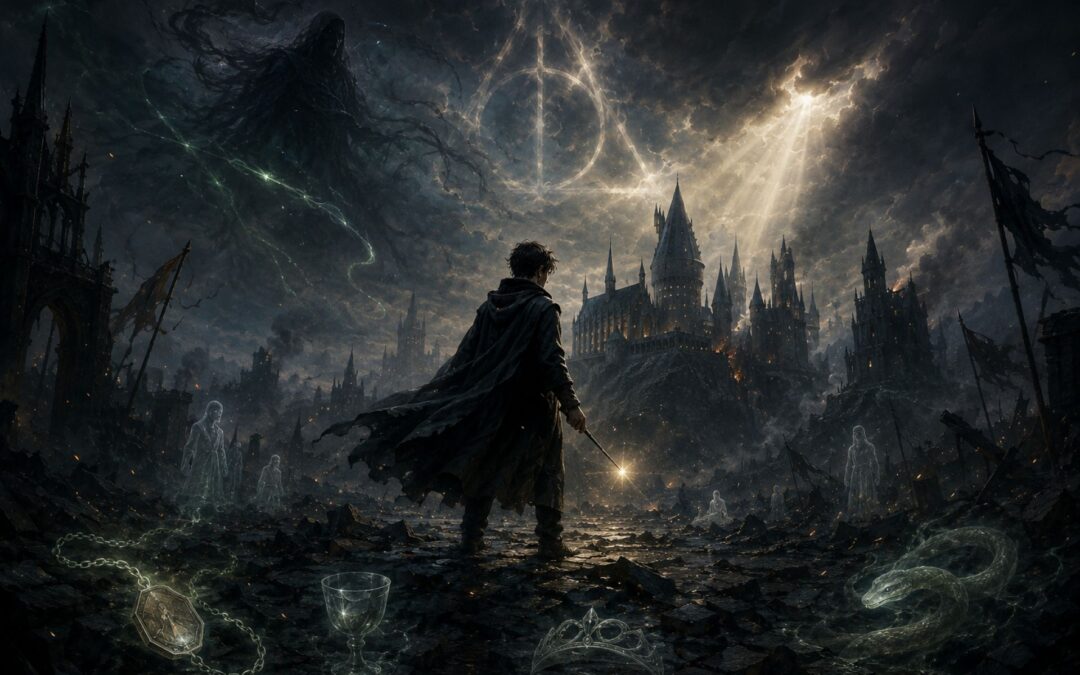
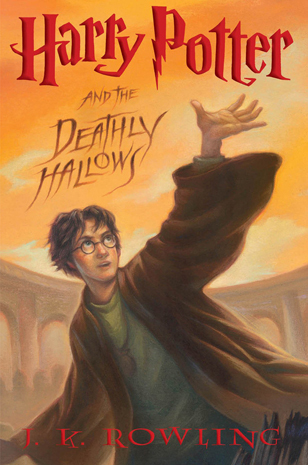
Published on July 21, 2007, as confirmed in Scholastic’s original publication announcement, Harry Potter and the Deathly Hallows is the seventh and final novel in J.K. Rowling’s original Harry Potter series. It begins almost immediately after the events of Harry Potter and the Half-Blood Prince, with Albus Dumbledore dead, Severus Snape apparently revealed as his murderer, Voldemort rapidly extending his control over Britain, and Harry committed to the mission Dumbledore left behind: find and destroy Voldemort’s remaining Horcruxes.
The book also breaks the structural pattern that had governed most of the series. Harry does not return to Hogwarts for another school year. Instead, he, Ron Weasley, and Hermione Granger become fugitives in a country whose government, media, school system, and law-enforcement machinery are falling under Voldemort’s control. Their search for Horcruxes becomes a prolonged journey through safe houses, abandoned landscapes, occupied institutions, family histories, hidden memories, magical legends, and the unresolved secrets of people Harry thought he understood.
At the centre of the novel are two different attempts to overcome death. Voldemort has spent his life trying to make himself impossible to kill, dividing his soul into Horcruxes and treating people and objects as things to possess. Harry gradually encounters another tradition in the Deathly Hallows, three legendary objects associated with mastery over death. Yet his final victory depends on rejecting the idea that survival, possession, or invincibility is the highest form of power. He succeeds only when he accepts that he may have to die, relinquishes the pursuit of absolute control, and acts out of loyalty to people whose lives matter to him beyond his own survival.
Spoiler warning: This article covers the entire novel, including all major deaths, Snape’s memories, Harry’s fate, Voldemort’s defeat, and the nineteen-years-later epilogue.
The War Reaches Harry Before He Leaves Privet Drive
Deathly Hallows opens not with Harry but with the enemy. Severus Snape and the Death Eater Yaxley arrive at Malfoy Manor, where Voldemort has effectively turned the Malfoy family home into his headquarters. The scene immediately establishes how far the balance of power has shifted. Lucius Malfoy, once a wealthy and self-assured supporter of Voldemort, is now humiliated in his own house, while Draco is terrified and Narcissa is concerned above all with protecting her family.
Snape tells Voldemort that the Order of the Phoenix intends to move Harry from Privet Drive before Harry turns seventeen. Yaxley also brings important political news: he has placed Pius Thicknesse, the head of the Department of Magical Law Enforcement, under the Imperius Curse. The Ministry has not officially fallen, but Voldemort’s followers have already penetrated its highest levels. Their strategy is not merely to attack the government from outside but to capture its machinery from within.
Voldemort announces that he will kill Harry personally. His previous encounters with Harry have convinced him that their wands are somehow connected, so he takes Lucius Malfoy’s wand in the hope that using a different wand will bypass the problem. Even this act displays Voldemort’s understanding of power. He assumes that possession is equivalent to mastery: if another person has something useful, he can simply take it.
The meeting ends with the murder of Charity Burbage, Hogwarts’s Muggle Studies professor. Voldemort accuses her of encouraging acceptance of Muggles and Muggle-born witches and wizards, kills her in front of the Death Eaters, and gives her body to Nagini. The scene makes the ideology of blood purity explicit before the Ministry takeover occurs. The coming regime will not merely favour pure-blood families; it will define tolerance itself as corruption.
Harry, meanwhile, is preparing to leave Privet Drive forever. While sorting through his possessions, he finds several objects that pull earlier parts of his life into the final story: the false Slytherin locket containing R.A.B.’s note, Sirius Black’s broken two-way mirror, old school belongings, and photographs. He is not simply packing for another year. He is separating the tools and memories he will carry into adulthood from the remains of a childhood that has effectively ended.
His attention is drawn to two radically different portraits of Dumbledore. Elphias Doge’s obituary presents the dead headmaster as an extraordinary wizard marked by early family tragedy, intellectual brilliance, generosity, and moral courage. A newspaper interview promoting Rita Skeeter’s new biography, The Life and Lies of Albus Dumbledore, suggests something much darker: family secrets, an attraction to the Dark Arts, a complicated relationship with Gellert Grindelwald, and a less innocent past than Harry imagined.
Harry’s anger at Skeeter is partly defensive because he discovers how little he actually knew about Dumbledore. Their conversations had almost always concerned Harry’s past, Harry’s future, Voldemort, or the Horcrux mission. Harry had trusted Dumbledore deeply without knowing basic facts about the man’s childhood, parents, siblings, ambitions, or friendships. That imbalance becomes one of the novel’s most important emotional conflicts.
Before Harry leaves, the Dursleys must also abandon Privet Drive because Voldemort may target them once Lily Potter’s protection over Harry’s childhood home ends. Vernon remains suspicious almost until departure, while Petunia avoids emotional engagement. Dudley, however, surprises Harry by asking why Harry is not coming with them and by telling him that he does not consider him a waste of space.
Dudley’s transformation is limited but meaningful. He does not suddenly become Harry’s friend or understand the magical world, yet he remembers that Harry saved him from the Dementors and has begun reconsidering the person he spent years mistreating. Their awkward handshake provides a more believable resolution than a sentimental reconciliation would have done. Petunia appears to want to say something before leaving but ultimately cannot cross the emotional distance between them.
The Order then arrives to move Harry. Ministry restrictions make ordinary magical transportation dangerous because Pius Thicknesse has prohibited Apparition, Portkeys, and Floo travel around Privet Drive. Harry also still has the Trace, allowing the Ministry to detect magic performed near an underage wizard. Mad-Eye Moody therefore introduces a risky deception: six volunteers will use Polyjuice Potion to transform into Harry, producing seven identical Harry Potters travelling toward seven protected destinations.
Harry hates the plan because other people will be placing themselves in danger specifically because of him, but the others insist that the decision belongs to them as well. Ron, Hermione, Fred, George, Fleur, and Mundungus Fletcher become the decoys, each paired with a protector. The real Harry travels with Hagrid on Sirius’s old flying motorbike.
The deception fails almost immediately because Death Eaters are waiting in the sky. A chaotic aerial battle follows, and Harry suffers his first devastating loss when Hedwig is killed inside her cage. Her death is abrupt and almost incidental to the violence around her, which is precisely why it is effective. Hedwig had been Harry’s companion during his years of isolation at Privet Drive and one of his earliest personal connections to the magical world; her death marks the destruction of another surviving link to childhood.
Harry and Hagrid are pursued by several Death Eaters. When Harry recognises Stan Shunpike among them, apparently acting under the Imperius Curse, he refuses to use an attack that might knock Stan hundreds of feet to his death. Instead he uses Expelliarmus. The choice identifies him because the Death Eaters remember his distinctive reliance on the Disarming Charm, and Voldemort is summoned to the chase.
Voldemort attacks with Lucius’s wand, but Harry’s own wand acts without Harry consciously directing it. Golden fire erupts from it and destroys the borrowed wand. Harry has no explanation for what happened, and the mystery becomes part of Voldemort’s increasingly obsessive study of wandlore.
At the Burrow, survivors return one group at a time. George has lost an ear to Snape’s curse. Bill and Fleur finally arrive with worse news: Mundungus panicked and Disapparated when Voldemort attacked his group, leaving Mad-Eye Moody exposed. Voldemort struck Moody with a Killing Curse, and his body could not be recovered.
The Order immediately suspects that someone leaked the moving date. Harry refuses to begin distrusting everyone around him, even when Remus Lupin warns him that such faith can be dangerous and compares it with James Potter’s disastrous trust in Peter Pettigrew. The disagreement establishes another element of Harry’s character that matters later. His refusal to become Voldemort is not expressed only through grand acts of sacrificial love; it appears in repeated decisions not to make suspicion, ruthlessness, and killing his default methods.
Lupin is particularly disturbed by Harry’s use of Expelliarmus against Stan and tells him that war requires harder choices. Harry understands the practical argument but refuses the implication that he should kill people merely because lethal violence would be safer for him. The book will later complicate this moral position by showing Harry using both the Imperius and Cruciatus Curses, but his fundamental distinction remains: he does not want his enemies’ methods to dictate the kind of person he becomes.
Harry also learns that his inexplicable wand reaction has frightened Voldemort. Through the mental connection created by the fragment of Voldemort’s soul inside him, he sees Voldemort torturing Ollivander and demanding an explanation for why the borrowed wand failed. The problem that Voldemort thought he could solve through simple substitution has become more mysterious.
Dumbledore’s Last Gifts and the Fall of the Ministry
Harry wants to leave the Burrow almost immediately and begin searching for Horcruxes, partly because Moody’s death intensifies his belief that other people are endangered by remaining near him. Ron and Hermione insist that they are going too, while Molly Weasley tries to delay their departure by involving them constantly in preparations for Bill and Fleur’s wedding. Her behaviour is both practical and maternal: she cannot stop three almost-adult young people from making their decision, but she can make it harder for them to disappear into a mission she does not understand.
The trio’s private preparations show that Ron and Hermione have already accepted far more personal risk than Harry fully appreciates. Ron’s family has dressed the ghoul in the attic to resemble him and will claim he has a contagious illness to explain his absence from Hogwarts. Hermione has altered her parents’ memories so that they believe they are different people with a desire to move to Australia, hoping to protect them from Voldemort and from any attempt to use them against her.
Hermione has also prepared extensively for the Horcrux hunt. She has taken books about Horcruxes from Dumbledore’s office and learned more about how they work. A Horcrux cannot be destroyed by ordinary damage because the container must be damaged beyond magical repair. Basilisk venom is one known method, which explains why Harry was able to destroy Tom Riddle’s diary in the Chamber of Secrets.
Harry turns seventeen at the Burrow and finally becomes legally adult in the wizarding world. The Trace disappears, but the birthday is overshadowed by the mission and by his unresolved relationship with Ginny. Harry had ended their relationship because he feared Voldemort would use her against him. Ginny understands the reason even though neither of them has stopped caring, and her private birthday kiss makes clear what Harry is leaving behind: not simply romance but the possibility of an ordinary future.
Minister for Magic Rufus Scrimgeour arrives with Dumbledore’s will. Dumbledore has left Ron the Deluminator, Hermione his copy of The Tales of Beedle the Bard, and Harry the first Golden Snitch Harry ever caught. He also intended to leave Harry the sword of Godric Gryffindor, but the Ministry refuses to transfer it because the sword is considered an important historical object rather than Dumbledore’s private property.
The gifts appear frustratingly obscure. The Deluminator can collect and restore light, but Ron cannot see why Dumbledore specifically chose it for him. Hermione’s book contains children’s stories she mostly knows already, although one tale is marked with an unfamiliar triangular symbol. Harry’s Snitch carries the inscription that it will open “at the close,” yet even when Harry touches it to his mouth, recalling how he caught it in his first Quidditch match, it does not open.
The wedding of Bill and Fleur briefly creates the appearance of normal life. Guests arrive, Harry attends in disguise, and old acquaintances bring rumours about Dumbledore. Viktor Krum becomes angry when he notices Xenophilius Lovegood wearing the same symbol Hermione found in Beedle the Bard, explaining that it was also associated with Grindelwald.
Harry then hears Aunt Muriel and Elphias Doge discussing Dumbledore’s family. Their conversation points him toward Godric’s Hollow, where Dumbledore’s mother and sister lived and where Bathilda Bagshot, an old magical historian, knew the family. The information makes Rita Skeeter’s allegations harder to dismiss because pieces of her story seem to have independent support.
The wedding ends when Kingsley Shacklebolt’s Patronus arrives with a warning: the Ministry has fallen, Scrimgeour is dead, and the Death Eaters are coming. The political transformation that the opening chapter anticipated is complete. Voldemort does not publicly take the title of Minister; instead, Pius Thicknesse becomes the official leader while Voldemort governs through intimidation, infiltration, and loyal subordinates.
Harry, Ron, and Hermione Disapparate to Tottenham Court Road, where they enter a café and are soon attacked by Antonin Dolohov and Thorfinn Rowle. The disturbing question is how the Death Eaters found them so quickly. The trio defeats the attackers and alters their memories but has no explanation for their appearance.
They take refuge at number twelve, Grimmauld Place. Because Dumbledore’s death weakened the Fidelius Charm and Snape knows the location, the house is no longer completely secure, but it offers temporary shelter. Harry explores Sirius’s old bedroom and finds evidence of his mother’s friendship with Snape, adding another unresolved layer to a man he currently believes murdered Dumbledore.
The more important discovery concerns the initials in the false Horcrux locket. Harry realises that R.A.B. was Sirius’s younger brother, Regulus Arcturus Black. Regulus had joined the Death Eaters as a teenager and supposedly died after attempting to abandon Voldemort. What first appeared to be a failed Death Eater’s brief act of rebellion now becomes central to the Horcrux hunt.
Regulus Black, Kreacher and the Ministry Heist
The trio questions Kreacher about Regulus, and his story radically changes their understanding of both master and servant. Years earlier, Voldemort had asked Regulus for the use of a house-elf. Regulus offered Kreacher, not knowing why Voldemort needed him. Voldemort took Kreacher to the seaside cave where the locket Horcrux was hidden, forced him to drink the potion protecting it, placed the locket in the basin, and abandoned the suffering elf to die.
Voldemort made a mistake because he did not consider house-elves important enough to understand their magic. Regulus had ordered Kreacher to return home when his task for Voldemort was complete, and the elf was therefore able to Disapparate out of the cave. When Kreacher told Regulus what had happened, Regulus eventually understood enough about Voldemort’s secret to decide that the locket needed to be removed.
Regulus returned to the cave with Kreacher. He drank the potion himself, ordered Kreacher to replace the real locket with a fake one containing the R.A.B. message, and commanded the elf to escape with the Horcrux and destroy it. Regulus remained behind and was dragged into the lake by Inferi.
The revelation gives Regulus a posthumous character arc. He did not become a public hero, defeat Voldemort in battle, or live long enough to repair his earlier choices. He recognised something monstrous in the leader he had followed and acted against him at the cost of his own life. The tragedy is that Kreacher, despite obeying his final order for years, could not destroy the locket.
The locket later disappeared from Grimmauld Place after Mundungus Fletcher stole possessions following Sirius’s death. Harry’s behaviour toward Kreacher changes during the investigation. Instead of treating him only as a hostile servant, Harry gives him Regulus’s replacement locket as a keepsake and begins showing him consideration. Kreacher’s manner changes dramatically in return.
This transformation is not merely comic relief. Sirius, despite opposing Voldemort’s politics, treated Kreacher with contempt, while Regulus showed the elf enough trust and affection to inspire extraordinary loyalty. Harry’s willingness to recognise Kreacher as a person rather than a tool produces cooperation that force never did.
Remus Lupin soon arrives with news about the new regime. Voldemort’s government has begun restructuring the legal position of Muggle-born witches and wizards, and attendance at Hogwarts will become compulsory so that the state can control magical education. Lupin also shocks the trio by asking to accompany them on their mission.
Tonks is pregnant, and Lupin has fled from her because he fears that his child will inherit lycanthropy and believes he has condemned Tonks to a ruined life. Harry, remembering what it means to grow up without parents, angrily accuses Lupin of abandoning his wife and child. Lupin reacts violently and leaves.
Harry’s delivery is cruel, but the central accusation is correct. Lupin has transformed his shame about being a werewolf into a justification for running away from responsibilities he chose. The confrontation becomes important later when Lupin returns to Tonks and embraces fatherhood instead of defining himself solely through self-loathing.
Kreacher eventually returns with Mundungus, who admits that Dolores Umbridge took the real locket from him. The trio therefore devises a plan to infiltrate the Ministry of Magic. Their goal is not to overthrow the regime but to steal the Horcrux from one of its most powerful officials.
Using Polyjuice Potion, they assume the appearances of Ministry employees. Harry becomes Albert Runcorn, a frightening senior official; Hermione becomes Mafalda Hopkirk; Ron becomes Reg Cattermole, whose wife is a Muggle-born witch facing interrogation. The disguises allow Rowling to show the regime from inside rather than presenting it only through reports from fugitives.
The Ministry still resembles a bureaucracy. Employees go to work, memos circulate, hearings take place, and departments continue functioning. Yet the administrative environment has been reorganised around intimidation and racial hierarchy. A monumental sculpture now depicts witches and wizards enthroned above crushed Muggles under the slogan “Magic is Might.”
Harry also finds Mad-Eye Moody’s magical eye embedded in Umbridge’s office door, where she has been using it to spy on employees. He removes it, later burying it beneath a tree. The gesture cannot recover Moody’s body, but it restores a fragment of dignity to someone whose remains have been turned into office equipment.
The Muggle-Born Registration Commission demonstrates the new regime’s logic most clearly. Muggle-born witches and wizards are accused of having stolen magic because the government has redefined magical ability as something only legitimate bloodlines can possess. Their personal histories are turned into evidence against them, while Dementors make the proceedings physically terrifying.
Umbridge herself wears Slytherin’s locket, presenting it as evidence of her supposed pure-blood ancestry. The irony is deliberate: a relic containing part of Voldemort’s soul has become a bureaucrat’s status symbol within the racial order Voldemort created. Hermione and Harry disrupt the hearing, stun Umbridge, recover the locket, and help prisoners escape.
Their success costs them Grimmauld Place. During the escape, Yaxley grabs Hermione as she Disapparates and is carried inside the protections surrounding the house before she escapes again. Because he has now gained access to the secret, the trio cannot safely return.
They have recovered their first target, but they are now homeless fugitives carrying a Horcrux they still cannot destroy.
Life on the Run, Ron’s Departure and Godric’s Hollow
Harry, Ron, and Hermione begin moving between remote campsites, protected by Hermione’s enchantments but increasingly isolated from the rest of the wizarding world. Their circumstances are unlike almost anything in the previous books. Hogwarts had supplied meals, shelter, teachers, information, and a community; even Grimmauld Place offered walls and a kitchen. On the road, survival becomes monotonous, uncomfortable, and psychologically corrosive.
The trio takes turns wearing the locket because leaving it unattended seems dangerous. Its influence is not portrayed as creating completely new emotions. Instead, it intensifies resentments, fears, and insecurities that already exist. Ron is especially vulnerable because he is injured, frightened about his family, frustrated by hunger, and increasingly convinced that Harry has no real plan.
Harry’s mental connection with Voldemort also provides intermittent glimpses of another quest. Voldemort is searching for the wandmaker Gregorovitch because he wants to understand or acquire a legendary wand. Through Voldemort’s memories, Harry sees a blond young thief stealing something from Gregorovitch decades earlier, though he does not initially recognise the thief.
A major breakthrough in the Horcrux hunt comes when the trio overhears a group of fugitives including Ted Tonks, Dirk Cresswell, Dean Thomas, Griphook, and another goblin. They learn that the sword of Gryffindor displayed at Gringotts is a copy. The real sword had been used by Dumbledore to destroy Marvolo Gaunt’s ring, one of Voldemort’s Horcruxes.
Because goblin-made metal absorbs substances that strengthen it, the sword has taken in basilisk venom from Harry’s encounter with the Chamber of Secrets. It can therefore destroy Horcruxes. For the first time since recovering the locket, the trio has a realistic method of destroying it.
The discovery does not solve their immediate conflict. Ron explodes at Harry, accusing him of lacking a plan and ignoring the danger to everyone else. Some of his anger comes from the locket, but the argument exposes real fears. Harry is famous, Hermione is extraordinarily capable, and Ron has spent much of his life surrounded by siblings whose talents or achievements made him feel ordinary.
Ron also becomes jealous about Harry and Hermione, although nothing romantic has happened between them. When Harry tells him that he can leave if he wants to, Ron does. The decision wounds all three of them precisely because their friendship had previously seemed inseparable.
Harry and Hermione continue alone. Their friendship remains strong, but the atmosphere is bleak. Neither replaces Ron’s role in the trio. Harry misses him; Hermione is devastated but furious; and their journey becomes quieter and less energetic.
At Christmas, they travel to Godric’s Hollow. The village is important to Harry because his parents died there and to the Dumbledore mystery because Dumbledore’s family also lived there. For the first time, Harry sees the graves of James and Lily Potter. Their headstone bears a biblical inscription about death as the last enemy, a phrase Harry initially finds troubling because he associates defeating death with Voldemort’s obsession.
The visit also connects several historical threads. Harry sees the grave of Kendra and Ariana Dumbledore, and Hermione notices the same mysterious symbol on the grave of Ignotus Peverell. A village memorial transforms for magical observers into an image of James, Lily, and baby Harry, confronting Harry with a version of the family life that ended before he could remember it.
They encounter Bathilda Bagshot, or what appears to be Bathilda. Harry follows her into her house, hoping for information about Dumbledore and perhaps the sword. Instead, Bathilda’s corpse has been transformed into a hiding place for Nagini.
The snake attacks Harry while Voldemort approaches Godric’s Hollow. Hermione rescues Harry, but one of her curses accidentally breaks his holly-and-phoenix-feather wand. The loss is devastating because the wand has been with Harry since the beginning of his magical life and has repeatedly behaved in ways connected to Voldemort.
During the escape, Harry experiences Voldemort’s memory of the night his parents died. He sees James killed while trying to delay Voldemort and Lily refusing to move aside when offered the chance to save herself. Voldemort kills her, turns his wand on the infant Harry, and experiences the curse rebounding.
The scene does not reveal everything about Harry’s survival, but it recreates the founding event of the series from the murderer’s perspective. Harry has spent years knowing what happened in outline; now he witnesses the physical sequence through Voldemort’s memory.
Hermione also recovers Rita Skeeter’s biography from Bathilda’s house. Harry reads about Dumbledore’s youth and discovers that the most disturbing claims are substantially grounded in truth. As a brilliant teenager trapped at home caring for Ariana, Dumbledore formed an intense friendship with Gellert Grindelwald, an equally gifted young wizard who dreamed of transforming relations between wizards and Muggles.
The two imagined a world in which gifted wizards would govern supposedly inferior Muggles “for the greater good.” They were also fascinated by the Deathly Hallows. For Dumbledore, the fantasy offered escape from the responsibilities he resented; for Grindelwald, it became part of a genuine political ideology of domination.
Aberforth opposed their plans and confronted Albus over his neglect of Ariana. A three-way duel followed, during which Ariana was killed. No one knew whose spell struck her. Grindelwald fled, and Dumbledore’s life changed permanently.
Harry feels betrayed less because Dumbledore once made terrible mistakes than because Dumbledore never told him. Dumbledore demanded trust from Harry while concealing his own past and while sending Harry toward a dangerous mission whose full meaning he did not explain. Harry begins wondering whether he ever understood the man he loved and admired.
The crisis persists until Harry and Hermione reach the Forest of Dean. One night, Harry sees a silver doe Patronus. It leads him to a frozen pool where the real sword of Gryffindor lies beneath the water.
Harry dives for it, but the Horcrux locket tightens around his neck and begins strangling him. Ron suddenly appears, pulls Harry from the water, and retrieves the sword. His return is not treated as though the abandonment never happened. Ron has to choose to come back, explain himself, and face what he did.
Harry gives him the task of destroying the locket. When Ron opens it with Parseltongue sounds, the Horcrux attacks his insecurities. It produces images and words suggesting that his mother would prefer Harry, that Hermione prefers Harry, and that Ron will always be the least important member of the trio. The hallucination is psychologically effective because it gives supernatural form to fears Ron already carries.
Ron destroys the locket with the sword. He then explains the hidden purpose of Dumbledore’s Deluminator: after leaving, he eventually heard Hermione’s voice through it, and the device guided him back to them. Dumbledore appears to have anticipated that Ron might lose his way, but the gift does not compel his return. It provides a road back only after Ron chooses to look for one.
The Deathly Hallows, Malfoy Manor and Dobby’s Death
With the sword recovered and Ron restored to the group, Hermione turns again to the strange symbol in The Tales of Beedle the Bard. The trio visits Xenophilius Lovegood, hoping he can explain it. His house is filled with eccentric objects and reminders of Luna, who is conspicuously absent.
Xenophilius tells them that the symbol represents the Deathly Hallows. He asks Hermione to read “The Tale of the Three Brothers,” a fairy tale about three travelling brothers who evade a dangerous river and encounter Death. Death supposedly offers each brother a reward.
The oldest brother asks for an unbeatable wand and receives the Elder Wand. His pride in possessing it leads another wizard to murder him and steal it. The second asks for the power to restore the dead and receives the Resurrection Stone, but the woman he calls back remains separated from ordinary life, and his despair eventually leads to his own death.
The youngest brother asks for a way to leave without Death following him. He receives an Invisibility Cloak that truly conceals its wearer. Unlike his brothers, he lives a full life and eventually gives the Cloak to his son before greeting Death voluntarily.
The three objects correspond to the three parts of the symbol: a line for the wand, a circle for the stone, and a triangle for the cloak. Those who believe in the Hallows claim that a person who unites all three becomes the “Master of Death.”
Xenophilius’s explanation fascinates Harry and frustrates Hermione, who treats the story as folklore rather than historical proof. Their disagreement matters because Harry is emotionally ready to believe. He has just discovered that Dumbledore himself was fascinated by the Hallows, that the Peverell symbol appears at Godric’s Hollow, and that he may already possess one of the objects.
The visit turns dangerous when Harry realises that Luna has been kidnapped. Xenophilius has summoned the Death Eaters because he hopes that surrendering Harry will secure his daughter’s release. His betrayal is cowardly but emotionally understandable. The book repeatedly shows that love can motivate courage without guaranteeing moral purity; a desperate parent may betray strangers for the same reason another parent defies a tyrant.
Hermione engineers their escape carefully. She wants the Death Eaters to see Harry so that Xenophilius’s story will be believed and he will not be punished for inventing a false capture. At the same time, she protects Ron’s cover story by ensuring he is not clearly seen.
Harry becomes increasingly obsessed with the Hallows. He concludes that his Invisibility Cloak may be the legendary cloak, that the Resurrection Stone may be connected to the Peverell ring Dumbledore destroyed, and that Voldemort is seeking the Elder Wand rather than another Horcrux-related object. The mysterious young thief in Gregorovitch’s memory is eventually identified as Grindelwald.
For Harry, the Hallows offer several emotional temptations at once. The Stone appears to promise access to the dead people he has lost. The Elder Wand seems capable of making him powerful enough to defeat Voldemort directly. The Cloak suggests that Dumbledore may have been quietly guiding him toward something larger than the Horcrux mission.
His fixation begins distracting him from the work Dumbledore explicitly assigned. Hermione recognises the danger more clearly because the Hallows appeal to Harry’s grief and desire for certainty. Harry begins imagining that becoming Master of Death could provide a shortcut around the exhausting, uncertain task of finding Horcruxes.
The trio temporarily reconnects with the wider resistance through Potterwatch, an underground radio programme hosted by Lee Jordan and supported by people including Kingsley and Lupin. It reports deaths and disappearances that the official media suppresses, encourages resistance, and reminds Harry that the conflict continues beyond the trio’s tent. Lupin publicly affirms his faith in Harry, signalling that he has also reconsidered the argument that drove them apart.
The broadcast is followed by disaster. Harry casually says Voldemort’s name, unaware that the regime has placed a Taboo on it. The spell breaks protective enchantments and reveals the location of anyone who speaks the name, explaining how Death Eaters found the trio in London and how resistance networks have been penetrated.
Snatchers capture Harry, Ron, and Hermione. Hermione quickly disfigures Harry’s face with a Stinging Jinx in the hope that he will not be recognised, but the prisoners are taken to Malfoy Manor. There, Bellatrix Lestrange becomes more concerned about the sword of Gryffindor than about Harry because the sword is supposed to be locked inside her Gringotts vault.
Her panic gives Harry a crucial piece of information. Voldemort has entrusted Bellatrix with something so important that the possibility of her vault being compromised terrifies her. Harry infers that another Horcrux, later confirmed to be Helga Hufflepuff’s cup, is stored there.
Bellatrix tortures Hermione for information about the sword while Harry and Ron are imprisoned in the cellar with Luna, Dean Thomas, Griphook, and Garrick Ollivander. Harry uses the broken mirror shard and sees the familiar blue eye again. He asks for help without knowing who is watching.
Dobby suddenly appears in the cellar. The blue eye belongs not to Dumbledore but to someone who has access to the matching mirror, and that person has sent Dobby to rescue them. The house-elf begins transporting prisoners away.
During the escape, Harry is confronted by Wormtail. Harry reminds Pettigrew that he once spared his life, and Pettigrew hesitates for a fraction of a second. Voldemort’s magical silver hand interprets the hesitation as disloyalty and strangles its owner.
The death completes one of the series’ longest moral chains. Harry’s mercy in Prisoner of Azkaban does not turn Pettigrew into a good man, but it creates an obligation that briefly interrupts his obedience. Voldemort, who designed the silver hand as both reward and control mechanism, cannot tolerate even that instant of mercy.
Harry also physically overpowers Draco and takes Draco’s wand. In the immediate scene, the action looks like nothing more than a practical necessity during escape. It later becomes one of the most important technical events in the ending because wand allegiance does not depend solely on murder or on physically taking the Elder Wand itself.
Dobby transports Harry and the others to Shell Cottage, but Bellatrix throws a knife as they Disapparate. It strikes Dobby, who dies shortly after arriving.
Harry chooses to dig the grave himself without magic. The physical labour quiets the competing impulses in his mind. His grief over Dobby does something that Occlumency lessons never accomplished: it gives him enough emotional clarity to keep Voldemort’s thoughts at a distance and to think deliberately.
This becomes the decisive turning point between Hallows and Horcruxes. Harry knows through his connection with Voldemort that Voldemort is moving toward Dumbledore’s tomb to take the Elder Wand. Harry believes he might still be able to intervene, but he does not go.
Instead, he questions Griphook about Bellatrix’s vault and Ollivander about wands. The Horcrux mission takes priority over obtaining the most powerful wand in existence. Harry chooses Dumbledore’s difficult task over the possibility of becoming invincible.
Ollivander explains that wands possess forms of allegiance that are more complex than legal ownership. A wand may change loyalty when its master is defeated, even when it is not physically seized in the same moment. He also confirms that the Elder Wand has a long and violent history.
Voldemort nevertheless reaches Dumbledore’s tomb and takes the Elder Wand from the dead headmaster’s hands. He believes possession of the legendary weapon will finally give him unquestioned superiority.
At Shell Cottage, Harry makes a bargain with Griphook. The goblin will help the trio enter the Lestrange vault, and in exchange he wants the sword of Gryffindor. The agreement is morally uncomfortable because goblins regard goblin-made objects as belonging ultimately to their creators, while wizards treat purchase as permanent ownership.
Harry plans to give Griphook the sword eventually but not immediately because the trio still needs a Horcrux-destroying weapon. Hermione is uncomfortable with this intended deception. The episode deliberately prevents the protagonists from occupying a perfectly innocent moral position in the goblin–wizard dispute.
Lupin also arrives with news that Tonks has given birth to a son, Teddy. He has returned to his family and asks Harry to become Teddy’s godfather. The man who tried to abandon his unborn child has accepted the risks of being a husband and father, giving his arc a quiet resolution before the final battle.
Gringotts, Hogwarts and the Last Horcruxes
The trio prepares for a break-in at Gringotts. Hermione uses Polyjuice Potion to impersonate Bellatrix, Ron receives a disguise, and Harry and Griphook travel concealed beneath the Invisibility Cloak. Their plan depends on deception, wand magic, and Griphook’s inside knowledge.
The infiltration begins to unravel when bank employees become suspicious. Harry uses the Imperius Curse to control individuals who threaten the operation. The act is significant because the boy who refused to kill an apparently controlled Stan Shunpike now uses one of the three Unforgivable Curses himself.
The novel does not pause to deliver a moral lecture about the contradiction. War has changed Harry’s behaviour, and necessity has widened the range of actions he is prepared to take. His fundamental opposition to Voldemort remains, but he is not preserved in moral innocence.
Inside the Lestrange vault, treasure has been protected with curses that cause objects to multiply and burn anyone who touches them. The trio finds Hufflepuff’s cup amid the rapidly expanding mass. Griphook then seizes the sword of Gryffindor and abandons them, claiming the object he believes rightfully belongs to goblins.
Their escape depends on the enormous dragon kept beneath Gringotts as a security device. Harry, Ron, and Hermione release it and ride it out of the bank. The image turns liberation and escape into the same act: an abused creature used to enforce institutional security becomes the means by which the thieves break free.
Voldemort learns about the robbery and reacts with murderous panic. His greatest advantage has always been that no one else knew the number or location of his Horcruxes. Now he realises that Harry may understand his secret.
Through their mental connection, Harry sees Voldemort reviewing the hiding places. The panic gives Harry information that careful investigation had not supplied. One Horcrux is hidden at Hogwarts, connected with Rowena Ravenclaw, and Nagini is herself a Horcrux.
The trio heads toward Hogsmeade, where the protective regime around Hogwarts nearly exposes them. They are saved by Aberforth Dumbledore, owner of the Hog’s Head. He reveals that he possesses the other half of Sirius’s mirror and that he was the blue-eyed figure watching Harry. He was also the person who sent Dobby to Malfoy Manor.
Aberforth gives Harry a harsher account of Albus’s youth than Harry previously heard. He remembers being the sibling who recognised how vulnerable Ariana was while Albus dreamed of leaving home with Grindelwald. He also remembers the catastrophic duel in which Ariana died.
Aberforth argues that Harry should abandon Dumbledore’s mission because Dumbledore had a habit of withholding information and expecting others to follow him anyway. The argument is stronger than simple anti-Dumbledore bitterness because Harry has independently discovered the same flaw.
Harry’s response shows how his relationship with Dumbledore has matured. He no longer insists that Dumbledore was perfect. He accepts that Dumbledore was secretive, ambitious in youth, capable of serious mistakes, and willing to ask dangerous things of other people. Yet Harry also believes the Horcrux mission is necessary on its own merits.
Aberforth therefore does not restore Harry’s idealised Dumbledore. He helps Harry outgrow the need for one.
A secret passage leads the trio into Hogwarts, where Neville Longbottom has become a leader of student resistance. The school has been transformed under Snape’s headmastership and the Carrows’ discipline. Students are punished through torture, while lessons in the Dark Arts and anti-Muggle ideology turn education into political indoctrination.
Dumbledore’s Army has continued organising without Harry. Neville, Ginny, Luna, and others have resisted the Carrows, and the Room of Requirement has become a refuge for students who can no longer safely live elsewhere. Neville’s transformation is particularly important because he has stopped being a supporting member of Harry’s movement and become a leader in his own right.
Harry believes the Hogwarts Horcrux is Rowena Ravenclaw’s lost diadem. Luna helps him reach the Ravenclaw common room, and Harry eventually speaks with Helena Ravenclaw, the Grey Lady. She reveals that she stole her mother’s diadem out of jealousy and hid it in Albania.
Helena was later pursued by the man who became the Bloody Baron. He killed her when she refused to return with him and then killed himself. Centuries later, Tom Riddle persuaded Helena to tell him where the diadem was hidden.
Riddle retrieved it and later returned to Hogwarts, eventually hiding the transformed Horcrux in the Room of Hidden Things. Harry realises he has actually seen the diadem before while using the room in Half-Blood Prince. Voldemort’s belief that he alone had penetrated the room’s secrets turns out to be another example of arrogance.
Before Harry can search freely, the Carrows discover that he is at Hogwarts. Amycus Carrow spits in Professor McGonagall’s face, and Harry responds with the Cruciatus Curse. Unlike his failed attempt to use it on Bellatrix years earlier, this curse works.
The moment complicates Harry’s moral development. He still refuses Voldemort’s worldview, but he is capable of inflicting pain in rage. The book’s hero is not defined by never crossing any dark line; he is defined more substantially by what he ultimately values, what he refuses to become, and whether cruelty becomes his governing principle.
McGonagall learns that Harry is carrying out Dumbledore’s final instructions and decides to mobilise the school. She confronts Snape, and their duel drives him from Hogwarts. Teachers begin organising defences while underage students are evacuated.
The Battle of Hogwarts brings almost every major strand of the series together. Harry continues searching for the diadem while Ron and Hermione act independently. Ron remembers that basilisk fangs remain in the Chamber of Secrets and imitates the Parseltongue sounds Harry once used to open it.
Hermione destroys Hufflepuff’s cup with a fang. Ron then remembers that the house-elves in the kitchens should be evacuated rather than left to die, and Hermione kisses him. The moment resolves the romantic tension between them, but it also reflects Ron’s growth: concern for creatures Hermione spent years defending has become instinctive enough to enter his thinking during a battle.
Harry finds the diadem in the Room of Requirement, but Draco, Crabbe, and Goyle confront him there. Crabbe releases Fiendfyre, a magically generated inferno powerful enough to destroy Horcruxes but beyond his ability to control. The fire consumes the diadem and kills Crabbe.
Harry, Ron, and Hermione nevertheless risk themselves trying to save Draco and Goyle. Even during a battle, being enemies does not automatically make someone disposable.
Outside the room, the war becomes more personal. Percy Weasley returns and reconciles with his family after years of estrangement. Moments later, Fred Weasley is killed in an explosion.
The timing is cruelly deliberate. There is barely time for reconciliation before death interrupts it, and there is no protected narrative space in which every loss receives an orderly farewell. Hogwarts has become a battlefield rather than the secure setting where earlier adventures could conclude around a hospital bed or end-of-year feast.
Harry eventually sees Voldemort’s location through their mental connection and goes to the Shrieking Shack. Voldemort has become dissatisfied with the Elder Wand because it does not seem to perform for him with the absolute superiority he expected.
He concludes that Snape must be the wand’s true master because Snape killed Dumbledore. Voldemort therefore orders Nagini to kill Snape, believing that Snape’s death will transfer mastery of the wand to him.
After Voldemort leaves, Harry approaches the dying Snape. Snape gives Harry a collection of memories and asks him to look at him before he dies. Harry carries those memories to Dumbledore’s Pensieve, where almost everything he believes about Snape, Dumbledore, and his own mission changes.
Snape’s Memories, Harry’s Sacrifice and Voldemort’s Defeat
“The Prince’s Tale” reconstructs Severus Snape’s life through selected memories. As a child, Snape knew Lily Evans before either attended Hogwarts. He recognised that she was a witch, introduced her to the magical world, and formed a close friendship with her.
Their relationship deteriorated after they entered Hogwarts. Lily was sorted into Gryffindor while Snape entered Slytherin, where he became increasingly involved with students attracted to the Dark Arts and blood-purity ideology. James Potter and Sirius bullied Snape, but the memories do not turn Snape into an innocent victim whose later choices were caused entirely by mistreatment.
Lily repeatedly objects to Snape’s friendships and use of Dark Magic. Their relationship finally breaks when Snape, humiliated after James’s attack, calls Lily a slur used against Muggle-borns. He apologises, but she recognises that the insult reflects a world of attitudes and associations he has chosen rather than a single accidental word.
Snape eventually becomes a Death Eater. While spying on Dumbledore’s interview with Sybill Trelawney, he overhears part of the prophecy about a child with the power to defeat Voldemort and carries the information to his master. Voldemort decides that the prophecy refers to Harry.
Only when Snape learns that Lily is among the people Voldemort intends to kill does he turn to Dumbledore. He first asks Voldemort to spare her and then begs Dumbledore to protect the Potter family. His motive begins as personal love rather than broad moral enlightenment, but Lily’s death permanently changes the direction of his life.
Dumbledore makes Snape a double agent. Snape spends the following years deceiving Voldemort, helping Dumbledore, and protecting Harry in ways Harry rarely understands. His Patronus takes the form of a silver doe because his love for Lily remains central to his emotional life.
The memories also reveal the truth about Dumbledore’s death. Dumbledore’s blackened hand was the result of a curse placed on Marvolo Gaunt’s ring. He had put on the ring because he recognised the Resurrection Stone and, overcome by his own longing to see his dead family, momentarily forgot the danger.
Snape contained the curse but could not reverse it. Dumbledore had roughly a year left to live. When he learned that Voldemort had ordered Draco to kill him, Dumbledore asked Snape to perform the killing instead.
The arrangement served several purposes. It prevented Draco from becoming a murderer if the plan succeeded, allowed Dumbledore to choose the circumstances of his death, and strengthened Voldemort’s trust in Snape so that Snape could continue operating inside the regime. Snape’s killing of Dumbledore on the Astronomy Tower was therefore not the betrayal Harry believed he witnessed.
The memories also show that Snape secretly followed Dumbledore’s instructions after becoming headmaster. The silver doe that guided Harry to the sword belonged to Snape. He placed the sword where Harry could recover it under conditions that demonstrated courage, and he continued working against Voldemort while publicly appearing to be one of his most important servants.
None of this is the most important revelation for Harry. Dumbledore eventually tells Snape that when Voldemort tried to kill Harry as a baby, part of Voldemort’s unstable soul broke away and attached itself to the only living thing in the room. Harry has carried that fragment ever since.
As long as it remains inside him, Voldemort cannot be fully destroyed. The fragment must die, and Dumbledore believes Voldemort himself must be the one to kill it.
Harry emerges from the Pensieve understanding what the mission now requires. He has spent the book trying to destroy Voldemort’s Horcruxes and has discovered that he is one of them in an unusual, unintended sense. Victory appears to require his own death.
He does not tell Ron or Hermione. This is partly strategic and partly emotional: he believes that if he stops to say goodbye, he may not be able to continue. Instead, he walks through the battle-damaged castle and sees the dead, including Fred, Remus Lupin, and Tonks.
The deaths of Lupin and Tonks are especially painful because their son has just been born. Teddy Lupin will grow up without his parents, creating an obvious parallel with Harry. The difference is that Teddy will have a network of people who loved his parents and can give him the sense of belonging Harry lacked in the Dursley household.
Harry briefly tells Neville that if the opportunity arises, he must kill Nagini. He then leaves the castle alone and heads into the Forbidden Forest, where Voldemort is waiting.
On the way, Harry finally understands the Snitch Dumbledore left him. It opens because Harry is approaching “the close”—not merely the end of a game or puzzle but what he believes is the end of his life. Inside is the Resurrection Stone.
Harry uses it and is joined by the shades or presences of James, Lily, Sirius, and Lupin. They do not restore the dead to ordinary physical life. Instead, they accompany him toward Voldemort and make the walk bearable.
The scene completes the lesson embedded in “The Tale of the Three Brothers.” Harry uses the Stone but does not try to keep the dead permanently in the world of the living. He lets the Stone fall in the forest before confronting Voldemort.
Harry does not fight. Voldemort casts the Killing Curse, and Harry experiences what appears to be death.
He awakens in a strange version of King’s Cross station. Dumbledore is there, along with a damaged, helpless creature that represents what remains of Voldemort’s soul fragment that had been attached to Harry. Whether King’s Cross is an objective afterlife, a magical liminal state, an experience inside Harry’s mind, or some combination of those possibilities is deliberately left unresolved.
Dumbledore explains the part of Harry’s survival that neither Harry nor Voldemort had fully understood. When Voldemort rebuilt his body using Harry’s blood, he took Lily’s protective magic into himself. By doing so, Voldemort created a continuing connection between Harry and life for as long as Voldemort’s reconstructed body survived.
The forest curse therefore destroys the soul fragment attached to Harry without necessarily forcing Harry himself to continue into death. Harry is given a choice, represented by Dumbledore as the possibility of going onward or returning to the battle.
King’s Cross also resolves Harry’s crisis over Dumbledore. Dumbledore admits his attraction to Grindelwald’s ideas, his desire for the Hallows, his resentment of family responsibility, and his guilt over Ariana. He does not ask Harry to restore the idealised image that the biography destroyed.
Instead, Harry learns to accept Dumbledore as a morally complicated person: brilliant, loving, manipulative, ashamed, capable of growth, and still vulnerable to the same desire to recover the dead that tempted Harry. Dumbledore’s wisdom came partly from having discovered what he could become when intelligence and power were separated from humility.
Harry chooses to return.
Narcissa Malfoy is sent to examine his apparently dead body. Rather than immediately report what she finds, she quietly asks Harry whether Draco is alive inside Hogwarts. Harry confirms that he is.
Narcissa then tells Voldemort that Harry is dead. Her lie is not a sudden conversion to the anti-Voldemort cause. She wants to enter Hogwarts and reach her son, and she has concluded that continuing to serve Voldemort is less important than Draco’s survival.
Once again, Voldemort fails because he cannot understand forms of loyalty that are not centred on him. He demands obedience but cannot imagine that a follower’s love for another person might outweigh fear of the Dark Lord.
Hagrid is forced to carry Harry’s apparently dead body back to Hogwarts. Voldemort displays him to the defenders and announces that resistance is finished. Neville refuses to submit.
Voldemort places the Sorting Hat on Neville and sets it alight, attempting to turn a symbol of Hogwarts into an instrument of humiliation. In the renewed chaos, Neville draws the sword of Gryffindor from the Hat and cuts off Nagini’s head. The final Horcrux is destroyed.
The battle resumes. Reinforcements arrive, centaurs join the fighting, and house-elves led by Kreacher emerge from the kitchens. The final victory therefore becomes visibly collective. Harry is essential, but Voldemort is not defeated by one exceptional individual acting alone.
Harry moves through the battle under the Invisibility Cloak. Molly Weasley kills Bellatrix after Bellatrix threatens Ginny, and Voldemort reacts with fury. Harry finally reveals that he is alive and confronts him in the Great Hall.
The last confrontation depends on the Elder Wand’s actual chain of allegiance. Voldemort assumed Snape became the wand’s master by killing Dumbledore. That assumption is wrong because Snape never defeated Dumbledore; the killing had been arranged between them.
Before Snape killed him, Draco had disarmed Dumbledore on the Astronomy Tower. The Elder Wand therefore shifted its allegiance to Draco even though Draco never possessed or even touched it. Later, at Malfoy Manor, Harry overpowered Draco and took Draco’s ordinary hawthorn wand.
That defeat transferred Draco’s wand allegiance to Harry, and with it Harry became the person who had defeated the Elder Wand’s previous master. Voldemort has physical possession of the Elder Wand, but the wand recognises Harry.
Harry tells Voldemort what has happened and even urges him to try remorse, the one process the book has established as capable of repairing a damaged soul. Voldemort rejects the possibility.
He casts Avada Kedavra while Harry casts Expelliarmus. The Elder Wand will not kill its true master. Voldemort’s curse rebounds, and he dies as an ordinary mortal body rather than as a mysterious supernatural abstraction.
Harry catches the Elder Wand. After the battle, he uses it to repair his original holly wand, reversing a loss that seemed permanent after Godric’s Hollow. He tells Dumbledore’s portrait that he intends to return the Elder Wand to Dumbledore’s tomb and allow its dangerous history to end if Harry eventually dies without being defeated.
He leaves the Resurrection Stone where it fell in the forest. The only Hallow he keeps is the Invisibility Cloak, the object associated not with domination or reversing death but with living until one is ready to meet death.
Nineteen Years Later
The epilogue moves forward nineteen years to King’s Cross station. Harry and Ginny are married and have three children: James Sirius, Albus Severus, and Lily Luna. Ron and Hermione are married and have Rose and Hugo, while Draco appears at the station with his own family.
The scene deliberately returns to an ordinary September departure for Hogwarts. After a book in which the school became a site of torture and battle, children can once again board the train for education rather than war. The restoration of that routine is itself part of the victory.
Harry’s younger son, Albus Severus, is frightened that he might be sorted into Slytherin. Harry tells him that one of the men for whom he was named belonged to Slytherin and was among the bravest people Harry knew. More importantly, he reminds Albus that the Sorting Hat considers the student’s wishes.
The conversation returns the series to one of its earliest moral ideas: identity is not simply inherited or assigned. Blood, family history, talent, and social labels matter, but choices matter more.
Harry’s scar has not hurt for nineteen years. The final reward is therefore not political office, magical supremacy, or possession of all three Hallows. Harry receives the ordinary domestic future Voldemort’s attack took from his parents and that the war repeatedly threatened to make impossible for him.
The epilogue leaves many political questions unanswered, but emotionally it closes the central wound of Harry’s life. The orphan who spent his childhood unwanted beneath the Dursleys’ stairs becomes a parent sending his own loved and protected child into the world.
The Wizarding World at War: Ministry, Hogwarts and Resistance
Although Harry’s Horcrux hunt supplies the main narrative line, Deathly Hallows is also the series’ fullest portrayal of political collapse. The conflict with the Ministry that became central in Harry Potter and the Order of the Phoenix has evolved dramatically. In the earlier novel, the Ministry denied Voldemort’s return, manipulated information, and persecuted dissidents while still considering itself legitimate. By Deathly Hallows, Voldemort’s movement has captured the same institutional machinery and redirected it toward explicit ideological persecution.
The regime is effective partly because it does not abolish familiar institutions. There is still a Minister for Magic, a legal system, a newspaper, Hogwarts, civil servants, hearings, identification documents, and law enforcement. Voldemort governs without placing himself on the public-facing administrative throne because controlling institutions matters more than formally holding office.
This is one reason the Ministry-infiltration chapters are so important. Rowling does not portray dictatorship only as masked extremists conducting raids in the night. She shows clerks going to work in a building where Muggle-born citizens are interrogated, propaganda is distributed through ordinary channels, and discriminatory assumptions become bureaucratic procedure.
The Muggle-Born Registration Commission changes prejudice into administrative reality. Its premise is intentionally circular: if magic supposedly belongs only to legitimate wizarding bloodlines, a Muggle-born person’s very existence becomes evidence of theft. Once the state controls the definition, proving innocence becomes nearly impossible.
The regime also uses uncertainty strategically. People disappear. Newspapers suppress information. The Taboo turns Voldemort’s name into a surveillance mechanism. Snatchers profit from capturing fugitives, giving opportunistic civilians a material incentive to participate in persecution.
Hogwarts becomes the educational extension of this state. Attendance is compulsory, allowing authorities to identify and control young witches and wizards. The Carrows normalise torture, Dark Arts instruction, and anti-Muggle ideology, demonstrating that Voldemort’s project concerns reproduction of the social order as much as immediate military victory.
Yet resistance also becomes decentralised. Harry is not at Hogwarts directing Dumbledore’s Army, but Neville and others organise anyway. Potterwatch distributes information without official approval. Order members protect Muggles and fugitives. Aberforth maintains an escape route. House-elves and centaurs eventually join the battle.
That decentralisation matters to the novel’s idea of heroism. Harry is the person who must deal with the Horcruxes because of his particular history with Voldemort, but resistance to Voldemort is not exclusively Harry’s possession. Other people acquire responsibilities that do not require his permission.
Neville best represents this shift. Earlier novels often use him as a contrast with more naturally confident students. In Deathly Hallows, he has scars from resisting the Carrows and commands the respect of other students. By the time Harry returns, Neville does not need Harry to teach him bravery.
The final battle extends this collective structure. Professors, students, parents, Order members, centaurs, house-elves, villagers, and others participate. Voldemort repeatedly imagines politics vertically, with himself at the top and everyone else measured by obedience. The resistance operates through overlapping relationships that continue even when leaders are absent or killed.
The political allegory should not be reduced to a one-to-one correspondence with a single historical regime. Rowling draws on recognisable features of racist and authoritarian politics—blood classification, propaganda, forced registration, administrative persecution, detention, controlled education, collaboration, and resistance—but the novel uses those features within its own fantasy society rather than constructing a precise historical model.
One limitation follows from that approach. The story is powerful at showing a society becoming openly tyrannical, but it spends much less time examining the injustices that existed before Voldemort’s takeover. Goblin grievances, house-elf servitude, and the Ministry’s earlier abuses suggest deeper structural problems, yet defeating Voldemort does not automatically answer them.
That distinction becomes important when evaluating the epilogue. Peace has clearly returned, but the book does not explain what political reforms followed. The defeat of a tyrant restores the possibility of ordinary life, but the long-term reconstruction of the wizarding world remains outside the novel’s scope.
Character Analysis: Harry, the Trio, Dumbledore, Snape and Voldemort
The final novel gives Harry’s story priority, but its emotional power depends on how many other characters reach decisive points in their own arcs. Several people Harry had previously understood through simple categories—mentor, enemy, coward, bully, follower—become more complicated once their hidden histories or later choices emerge.
That complexity does not mean every character is equally redeemed or equally guilty. One of the book’s strongest features is that a courageous act can coexist with previous cruelty, love can coexist with selfishness, and moral growth does not require pretending that earlier harm never happened.
Harry Potter
Harry’s central development is the movement from obedience to moral autonomy. At the beginning of the novel, he is following Dumbledore’s instructions partly because Dumbledore gave them. By the time Aberforth challenges him, Harry has learned enough about Dumbledore’s flaws that blind trust is no longer possible.
He continues because he has independently concluded that the mission is right. That distinction is fundamental. Dumbledore’s authority becomes less important at precisely the moment Harry becomes capable of completing Dumbledore’s work.
Harry also faces repeated temptations to define strength as superior magical power. The Hallows offer a particularly attractive version of this fantasy because they appear to promise control over the Elder Wand, communication with the dead, and concealment from enemies. For someone who has repeatedly lost people he loves and has been told that he must defeat the most dangerous wizard alive, the attraction is understandable.
Dobby’s death changes his priorities. Digging the grave by hand brings Harry back to the concrete reality of one individual life and one individual loss. The Elder Wand may promise power, but a dead friend reminds him what the war is actually for.
His moral development is not a story of remaining perfectly innocent. Harry uses Imperius in Gringotts and Crucio against Amycus Carrow. The second act is motivated by anger rather than necessity, and the curse succeeds.
These scenes make Harry’s goodness more credible because it exists within the pressures of war rather than outside them. He can experience hatred and use dark magic without adopting Voldemort’s belief that other people are objects. His strongest decisions repeatedly involve limiting himself: refusing to kill Stan, saving Draco from Fiendfyre, abandoning the race for the Elder Wand, walking voluntarily into the forest, and offering Voldemort the possibility of remorse.
The forest is the completion of Harry’s coming of age. Throughout the series, other adults have died protecting him. In Deathly Hallows, he chooses to become the protector while knowing that there may be no personal reward afterward.
His final relationship with the Hallows shows the result. He uses the Stone and lets it go. He becomes master of the Elder Wand and rejects permanent possession of its power. He keeps the Cloak, which allows ordinary life rather than domination.
Ron Weasley
Ron’s departure is one of the book’s most important character failures because it grows from vulnerabilities established across the entire series. He loves Harry and Hermione, but he also lives beside two people whose identities can make him feel inadequate: the famous Chosen One and the academically exceptional witch who is usually prepared for every crisis.
The Horcrux does not invent these insecurities. It magnifies them while Ron is hungry, injured, frightened about his family, and frustrated by the mission’s lack of visible progress. Leaving is therefore both magically influenced and genuinely his responsibility.
His return matters because he cannot undo the choice simply by regretting it. He has to search for Harry and Hermione, respond when the Deluminator gives him a path, save Harry from drowning, and face the locket’s attack directly.
Destroying the Horcrux forces Ron to strike at a representation of his deepest fears. The images suggest that Hermione wants Harry, that Harry is superior, and that Ron’s own family would prefer someone else. When Ron destroys the locket, he is not proving those fears never existed; he is refusing to let them govern his relationships.
His growth continues at Hogwarts. Ron independently thinks of the basilisk fangs and opens the Chamber of Secrets with an imitation of Parseltongue. More revealingly, he remembers the house-elves during the battle and argues that they should be warned rather than left behind.
Hermione’s kiss follows because the moment demonstrates a change she can recognise. Ron is not merely repeating her beliefs to impress her; concern for beings with less power has become part of his own moral instinct.
Hermione Granger
Hermione enters the novel better prepared for the practical realities of the mission than either of her friends. She has packed supplies, researched Horcruxes, learned protective enchantments, and thought about contingency plans. Her beaded bag becomes an almost portable infrastructure for three fugitives.
The most consequential preparation, however, concerns her parents. Hermione changes their memories and sends them to Australia because she knows her association with Harry makes them vulnerable. The decision reveals how much she has already sacrificed before the trio leaves the Burrow.
Hermione remains the most sceptical member of the trio, particularly about the Hallows. Her resistance is partly intellectual: a children’s story is not sufficient evidence for her. It is also emotional, because she recognises that Harry’s grief makes him susceptible to a theory promising the restoration of the dead.
Her scepticism is occasionally rigid, but it frequently protects the group from Harry’s tendency to interpret incomplete evidence through desire. At the same time, the novel forces Hermione to operate far beyond academic certainty. She repeatedly improvises under pressure, from disguising Harry before the Snatchers capture them to designing the escape from Xenophilius and impersonating Bellatrix at Gringotts.
Malfoy Manor places her courage under direct physical test. Bellatrix tortures her for information, yet Hermione maintains the story that the sword is a copy. The episode is not treated as a triumphant showcase of intelligence; it is frightening because knowledge cannot shield her from cruelty.
Hermione’s relationship with Ron also matures once idealisation becomes impossible. She sees his worst failure, refuses to absolve him immediately, and eventually accepts his return. Their romance is therefore grounded not in compatibility without conflict but in years of argument, loyalty, frustration, growth, and shared danger.
Albus Dumbledore
Dumbledore remains one of the novel’s central characters despite being dead before it begins. His absence creates a vacuum because Harry can no longer ask him questions, and almost every major mystery exposes something Dumbledore either concealed or arranged in advance.
As a young man, Dumbledore was not the serene moral authority Harry knew. He was brilliant, ambitious, resentful of family obligations, fascinated by the Hallows, and receptive to Grindelwald’s idea that exceptional wizards could dominate Muggles for a supposedly benevolent purpose. The fantasy appealed to both his intellect and his desire to escape the responsibility of caring for Ariana.
Ariana’s death permanently changed him. The uncertainty about who cast the fatal spell means Dumbledore cannot convert the tragedy into a clean narrative in which someone else is solely responsible. His later avoidance of political office partly reflects fear of what he might do with institutional power.
This past deepens rather than simply destroys the older Dumbledore. His later defence of Muggles matters more because tolerance was not merely an uncomplicated trait he possessed from birth. He learned, catastrophically, where his own belief in superior wisdom could lead.
His treatment of Harry remains ethically difficult. Dumbledore cares for Harry, but he also withholds information because he believes certain truths must be discovered at the right time. His strategy ultimately asks Harry to walk willingly toward death without having been told for most of his life that this might be required.
Some secrecy has practical justification. Voldemort has access to Harry’s mind, and revealing everything too early could have made the plan impossible. Yet Dumbledore also has a personal tendency toward controlling information, and Aberforth’s criticism prevents the reader from treating every concealment as unquestionably wise.
The best interpretation is therefore neither that Dumbledore manipulated Harry without loving him nor that love automatically absolves his manipulation. He does both: he genuinely loves Harry and strategically shapes his path. His final conversation at King’s Cross works because he admits failure instead of claiming perfect foresight.
Severus Snape
Snape receives the novel’s most dramatic reinterpretation, but the revelation is easily simplified. Learning that he loved Lily and worked against Voldemort does not mean that everything Harry previously experienced from Snape was an act.
Snape genuinely bullied students, showed favouritism, held grudges, and was drawn toward the Dark Arts. He joined the Death Eaters voluntarily and gave Voldemort the portion of the prophecy that caused the Potter family to become targets. His later courage must be understood beside those choices, not substituted for them.
His turning point begins with Lily. When Voldemort threatens her, Snape’s personal attachment becomes stronger than his loyalty to the movement he joined. After her death, guilt and love bind him to Dumbledore’s cause for the rest of his life.
That motive is narrow at first, but his actions expand beyond Lily. He repeatedly risks death as a spy, protects Harry despite personal dislike, works to protect Hogwarts students under Voldemort’s regime, sends the sword to Harry, and accepts the role of apparent traitor after killing Dumbledore according to plan.
His greatest strength is endurance. Harry receives public admiration even when he feels misunderstood; Snape spends his final period hated by almost everyone whose cause he is secretly serving. The role works only if his apparent betrayal is convincing.
The tragedy is that moral courage does not make him emotionally generous. Snape can oppose Voldemort and still mistreat children. He can love Lily deeply while having helped create the danger that killed her. He can save Harry’s life while resenting James in him.
The novel ultimately asks the reader to revise the word “coward” more clearly than the word “good.” Snape is brave, loyal to a difficult promise, and capable of enormous sacrifice. Whether that amounts to complete moral redemption remains more complicated.
Lord Voldemort
Voldemort spends much of the novel offstage, yet his thinking shapes almost every event. His defining feature is not simply cruelty but his inability to understand forms of power that cannot be possessed.
Horcruxes express this worldview perfectly. Voldemort treats his own soul as material he can divide and store in prestigious objects. He believes survival can be engineered through accumulation.
The Elder Wand attracts him for the same reason. When his original wand fails against Harry, he does not reconsider his assumptions about their connection. He searches for a stronger object, takes it from Dumbledore’s tomb, and kills the person he assumes is standing between him and mastery.
He also misunderstands people because he recognises only fear, ambition, and domination as serious motives. Narcissa’s lie therefore escapes his expectations. Snape deceives him for years because Voldemort cannot imagine enduring love for Lily. Harry’s willingness to die is almost incomprehensible to him.
Voldemort is intelligent, magically formidable, and capable of long-term planning, but his emotional limitations become strategic weaknesses. The things he dismisses as sentimental repeatedly contain information about how magic actually works.
His final death completes this pattern. He does not die because Harry becomes more powerful in a conventional duel. He dies because his own curse, cast through a wand whose allegiance he misunderstood, returns to him after every Horcrux has been destroyed.
Neville Longbottom
Neville’s development is especially satisfying because much of it occurs away from Harry. By the time Harry returns to Hogwarts, Neville has already become one of the central organisers of resistance against the Carrows.
His courage is no longer a surprising quality that appears occasionally beneath clumsiness. It has become part of his identity. He accepts punishment, protects younger students, and keeps resistance functioning while Harry is absent.
His destruction of Nagini makes his contribution indispensable to Voldemort’s defeat. Harry identifies the target, but Neville acts at the decisive moment. The scene fulfils the broader implication of the prophecy: Voldemort chose Harry as his rival, but Neville always had the capacity for extraordinary courage.
Draco and Narcissa Malfoy
Draco does not receive a complete redemption arc. He never becomes a member of the resistance, apologises for his earlier beliefs, or deliberately fights Voldemort on Harry’s behalf. What changes is his confidence in the ideology his family once supported.
Living with Voldemort destroys the glamorous image of power that attracted the Malfoys. Draco sees torture and murder at close range, is forced into dangerous responsibilities, and discovers that pure-blood status offers little protection from a tyrant who values only usefulness.
His hesitation at Malfoy Manor matters because he refuses to identify Harry with certainty even when the evidence is strong. The act may come from fear, confusion, or reluctance to become directly responsible for Harry’s death, but it demonstrates that Draco is no longer functioning as an uncomplicated believer.
Narcissa’s development is clearer. Her priority is Draco, and once Voldemort becomes a threat to her son, ideological loyalty becomes secondary. Her lie in the forest is one of the book’s most consequential acts.
The Malfoys survive not because they become heroic but because family loyalty eventually outweighs political allegiance. That is a narrower transformation than moral conversion, and the novel is stronger for preserving the distinction.
Kreacher, Dobby and Regulus Black
Regulus, Kreacher, and Dobby form one of the novel’s most revealing clusters of characters because their stories challenge assumptions about who matters in historical events. Regulus appears for most of the series as a dead minor Death Eater. Kreacher appears as an unpleasant servant. Dobby is often comic and disruptive.
In Deathly Hallows, all three become essential. Regulus discovers the Horcrux secret and dies trying to undermine Voldemort. Kreacher preserves that history and later leads the Hogwarts house-elves into battle. Dobby rescues Harry and the others from Malfoy Manor at the cost of his life.
Their stories are linked by the treatment of house-elves. Voldemort’s failure to understand Kreacher’s magic allows the elf to escape the cave. Sirius’s contempt contributes to Kreacher’s earlier hostility. Harry’s improved treatment produces cooperation.
Dobby represents the strongest contrast. He wants freedom and chooses his loyalties after receiving it. His final act is therefore not obedience to a master but a voluntary rescue of friends.
Lupin, Ginny and the Supporting Resistance
Lupin’s final arc centres on shame. He loves Tonks but believes his condition makes him inherently dangerous and unworthy of family life. His attempt to join Harry’s mission allows him to reinterpret abandonment as heroism.
Harry forces him to confront the distinction. Lupin eventually returns, becomes Teddy’s father, and dies fighting alongside Tonks. His death is tragic partly because he finally accepted the ordinary responsibilities he once thought himself unfit to hold.
Ginny receives less page space because Harry intentionally separates from her, but she remains important as the person associated with the future Harry believes he must relinquish. Their relationship represents a possible life beyond Voldemort: family, attraction, humour, and belonging.
The wider resistance reinforces the same idea. McGonagall, Luna, Kingsley, the Weasleys, Aberforth, Hagrid, Lee Jordan, Dean, the Hogwarts students, and many others continue acting without becoming extensions of Harry’s individual heroism. The final victory belongs to a community.
Friendship, Love, Loyalty and the Cost of Trust
The emotional architecture of Deathly Hallows depends on relationships being both sources of strength and sources of danger. Loving someone creates vulnerability because an enemy can threaten that person, but the book repeatedly rejects the conclusion that safety therefore requires emotional isolation.
Voldemort follows the opposite logic. He has followers, servants, allies of convenience, and a snake he values, but he does not construct relationships based on mutual obligation. That absence looks like strength because no loved person can be used against him. It eventually becomes blindness because he cannot predict people who value another person more than they fear him.
The friendship between Harry, Ron, and Hermione is therefore tested more severely than in any previous volume. Harry initially treats Ron and Hermione’s participation as something he can prevent for their protection. They reject that assumption because friendship gives them agency as well as vulnerability.
Ron’s departure demonstrates that loyalty is not automatic. Years of friendship do not eliminate resentment or fear. The relationship becomes stronger because he fails, returns, apologises through action, and is accepted without the failure being erased.
Hermione’s loyalty takes a different form. She stays with Harry through the most directionless part of the journey, but staying does not mean agreeing with him. She openly opposes his Hallows obsession and challenges interpretations she considers dangerous.
Their disagreement is a form of loyalty because she refuses to tell Harry only what he wants to hear. The trio works precisely because affection does not eliminate intellectual or emotional conflict.
Harry’s relationship with Dumbledore is even more complicated. Harry initially thinks trust should arise from Dumbledore being worthy of unquestioned confidence. The discovery of Dumbledore’s past forces him to confront a harder possibility: one can love and learn from someone without believing that person was always right.
By the time Harry returns from King’s Cross, his trust has become less dependent on idealisation. Dumbledore’s flaws no longer threaten the entire meaning of their relationship because Harry can judge the mission independently.
Snape and Lily offer another variation. Snape’s love becomes the motive for extraordinary resistance, but love does not retrospectively make all his choices loving. His relationship with Lily ended partly because she rejected the world he was entering.
That distinction protects the novel from a simplistic claim that love is inherently moral. Love is powerful, but people remain responsible for what they do with it.
Xenophilius betrays Harry because he loves Luna. Narcissa deceives Voldemort because she loves Draco. Dumbledore nearly destroys himself with the Resurrection Stone because he longs for his dead family. Lupin nearly abandons Tonks because he convinces himself that love requires removing himself from her life.
Love therefore creates motive, not automatic virtue. Harry’s defining difference is that he increasingly learns to combine love with recognition of other people’s autonomy. He cannot save everyone by deciding for them, and he cannot avoid grief by refusing attachment.
The Malfoys provide perhaps the clearest political version of this idea. Voldemort assumes that fear will keep Narcissa obedient because fear is the strongest bond he understands. He does not recognise that her terror for Draco is stronger than her terror of him.
Kreacher and Dobby reveal how trust is shaped by power. A servant compelled to obey may perform tasks without genuine loyalty. When Harry begins treating Kreacher with respect, the relationship changes because the elf’s emotional history is finally acknowledged.
The final battle transforms these private relationships into political force. Voldemort faces not merely Harry but a web of families, friendships, memories, obligations, and chosen loyalties. His hierarchical organisation is powerful while everyone is frightened and isolated; it becomes vulnerable when those relationships generate collective resistance.
Death, Power, Choice and Sacrifice: The Novel’s Major Themes
The novel’s major themes are closely connected, but they should not be collapsed into the vague claim that “love conquers all.” Rowling is more specifically interested in what people do when faced with death, uncertainty, power, guilt, and responsibility. Harry and Voldemort become opposites not because one has emotions and the other does not, but because they make radically different choices about vulnerability.
The Deathly Hallows and Horcruxes provide the most obvious symbolic contrast, while Dumbledore, Snape, Regulus, Ron, Draco, Narcissa, and others show different forms of failure and return. Their stories make moral identity something created through choices over time rather than permanently fixed by one act.
Mastering Death by Accepting It
Voldemort interprets death as the ultimate defeat. Almost every major decision in his adult life follows from the desire to avoid it: studying Horcruxes, splitting his soul repeatedly, seeking legendary magical power, and destroying anyone who threatens him.
The result is paradoxical. The more desperately Voldemort tries to escape death, the less fully human his life becomes. He damages his soul, transforms his appearance, distrusts everyone, and treats relationships as risks or instruments.
Harry is also frightened of death. His acceptance in the forest would mean little if he secretly knew he was guaranteed to survive. He walks toward Voldemort believing that he will die.
The Resurrection Stone helps him not by removing death but by changing his relationship to it. The people he has lost cannot return to ordinary life, yet their love remains part of him. He can therefore move toward death without believing that death has erased every relationship that mattered.
“The Tale of the Three Brothers” encodes these possibilities. The first brother tries to conquer others through invincible power and is murdered. The second cannot accept separation from the dead and destroys himself through grief. The third lives, relinquishes the Cloak when his time comes, and meets death willingly.
Harry temporarily resembles all three. He desires the Elder Wand, longs for the Resurrection Stone, and already owns the Cloak. He becomes “Master of Death” not because the objects turn him immortal but because he eventually understands the lesson represented by the youngest brother.
Dumbledore reaches the same insight only after catastrophic mistakes. His fascination with the Hallows began as a desire for power and later returned as grief when he recognised the Resurrection Stone in Gaunt’s ring. Even decades of wisdom do not make him immune to wanting another moment with his family.
This makes Harry’s decision in the forest more significant. He possesses the Stone and voluntarily drops it before confronting Voldemort. He accepts the support of the dead without trying to imprison them inside his continuing life.
Power, Ownership and the Difference Between Hallows and Horcruxes
Horcruxes and Hallows are often discussed together because they dominate the final book, but they embody different magical ideas. A Horcrux is created through murder and intentional damage to the soul. The Hallows are objects associated with extraordinary magical abilities and a legend about responding to death.
Voldemort’s Horcruxes turn identity into possession. He believes his soul can be made secure by placing fragments in objects and hiding those objects where no one can reach them. His choice of containers also reveals vanity: famous artefacts from Hogwarts founders are more attractive to him than ordinary vessels.
The Hallows initially tempt Harry toward a similar emphasis on possession. If he can own the right three objects, perhaps he can become Master of Death. Dumbledore’s youthful obsession had the same flaw.
The Elder Wand exposes the instability of ownership most directly. Voldemort assumes that stealing the physical object gives him its power. The wand’s allegiance follows defeat rather than simple possession, making ownership relational and historical rather than merely physical.
The sword of Gryffindor raises a related problem. Wizards consider the sword theirs because it passed through wizarding history. Griphook considers it goblin property because goblins regard purchased goblin-made objects as effectively leased for the buyer’s lifetime rather than permanently transferred to descendants.
The novel does not fully resolve the dispute. Harry needs the sword for a morally urgent purpose but plans to delay giving it to Griphook after promising it as payment. His cause is just, yet his conduct participates in the same wizard assumption that goblin claims can be postponed when inconvenient.
By the end, Harry’s strongest relationship with power is relinquishment. He does not keep the Elder Wand as an instrument of permanent superiority. He does not retrieve the Resurrection Stone. He keeps the Cloak because it has always functioned as part of ordinary life rather than as a throne.
Choice, Remorse and Moral Identity
The series repeatedly argues that choices matter more than inherited categories, and Deathly Hallows makes this principle central to its adult characters as well. Several people have committed serious wrongs but are not trapped forever inside their worst decision.
Regulus joins the Death Eaters and later sacrifices himself to undermine Voldemort. Ron abandons his friends and then returns. Dumbledore once dreams of wizard domination and spends much of his adult life opposing exactly that kind of power.
Snape joins Voldemort, contributes to the circumstances that kill Lily, and then spends years deceiving Voldemort. None of these later choices erase the earlier ones. Moral change is not a cancellation of history.
Remorse becomes particularly important because the book treats it as more than regret about consequences. Hermione’s Horcrux research explains that remorse may repair a damaged soul, although the process is agonising. The concept turns emotional responsibility into part of the magical system.
Harry invokes this idea during his final confrontation when he tells Voldemort to try remorse. The offer is remarkable because Voldemort has already killed many of Harry’s loved ones and is still trying to kill him.
Harry is not promising that remorse would erase punishment or reverse the dead. He is recognising that even Voldemort’s final state remains connected to a choice Voldemort refuses to make.
Draco occupies a deliberately less complete version of this pattern. He hesitates, fails to identify Harry with certainty, and no longer seems enthusiastic about Voldemort, but he never develops the sustained moral commitment of Regulus or Snape. The distinction matters because reluctance to commit evil is not identical to actively repairing it.
Narcissa’s forest lie also arises from a limited motive. She does not renounce blood prejudice or declare solidarity with Harry. She chooses Draco over Voldemort. Yet that narrower choice is enough to alter history.
Tyranny, Blood Purity and Collective Resistance
Voldemort’s politics are built around purity, hierarchy, and fear. The concept of blood status existed long before he took power, which allows his government to transform prejudice into policy without inventing an entirely new social vocabulary.
The regime categorises people, rewrites legal presumptions, controls education, manipulates information, and rewards informers. Its violence works because institutions and individuals participate at multiple levels.
Umbridge is especially important because she is not a Death Eater in the conventional sense. She flourishes under the regime because its values magnify tendencies she already possessed: love of hierarchy, cruelty toward vulnerable people, and willingness to use procedure as a weapon.
Resistance likewise takes multiple forms. Harry hunts Horcruxes. Neville organises students. Potterwatch circulates information. Order members protect civilians. Dobby frees prisoners. Narcissa lies. Regulus acts years before the final war begins.
The final battle makes victory impossible to attribute to one heroic body. Hermione and Ron destroy a Horcrux. Crabbe accidentally destroys another. Neville kills Nagini. Narcissa makes Harry’s return possible. Snape supplied essential knowledge. Dumbledore planned. Harry sacrifices himself.
The structure therefore challenges the mythology surrounding Harry even while fulfilling the prophecy centred on him. He is indispensable without being sufficient.
Symbols and Motifs: Hallows, Wands, Mirrors, Graves and the Silver Doe
The novel is unusually dense with objects inherited from earlier books. Many begin as practical magical devices and acquire symbolic meaning because the final story changes how they are understood.
The Hallows symbol is the most obvious new emblem. Its triangle, circle, and line compress the three objects into a single sign, but the meaning changes depending on who sees it. Hermione initially treats it as an unexplained mark, Krum associates it with Grindelwald, Xenophilius treats it as a sign of seekers, and Harry begins reading his own destiny into it.
That instability reflects the Hallows themselves. They can be interpreted as weapons, historical artefacts, fairy-tale objects, temptations, or tools. Their meaning depends partly on the user’s desire.
The Elder Wand symbolises power pursued through conquest. Its history is full of claims, murders, thefts, and misunderstandings. Voldemort believes it will settle the question of superiority permanently, but its allegiance is more unstable than an ordinary weapon’s ownership.
The Resurrection Stone symbolises grief’s desire to undo separation. Its danger is subtler because wanting the dead back is emotionally sympathetic. Both Dumbledore and Harry are tempted by it for reasons rooted in love rather than domination.
The Invisibility Cloak is different. Harry has used it since childhood for adventures, rule-breaking, protection, and exploration. It is extraordinary without demanding worship. Its relative humility is why it fits the youngest brother’s response to death.
Horcruxes provide a dark counter-symbol to the Hallows. Each preserves a piece of Voldemort by damaging the integrity of the whole. The objects promise continuity while producing fragmentation.
Gryffindor’s sword represents worth demonstrated through action rather than possession. It appears to those who show the qualities associated with Gryffindor, absorbs what strengthens it, and changes hands repeatedly. Neville drawing it from the Sorting Hat at the climax repeats Harry’s earlier experience in the Chamber of Secrets while proving that heroic legitimacy is not exclusive to Harry.
The broken mirror begins as a symbol of regret. Sirius gave Harry a means of communication that Harry failed to use before Sirius died. In Deathly Hallows, the surviving fragment becomes an actual lifeline because Aberforth owns the other mirror.
The blue eye Harry sees in it initially encourages his longing for Dumbledore. The eventual revelation that it belongs to Aberforth is appropriate because the book repeatedly replaces idealised expectations with more complicated human realities.
The silver doe connects Lily, Snape, Dumbledore’s plan, Ron’s return, and the sword. Harry initially does not know who produced it. Its beauty and protective guidance encourage interpretations associated with his mother before the Pensieve reveals Snape as its source.
The Patronus therefore becomes one of the strongest symbols of Snape’s hidden continuity. His outward behaviour changes dramatically across different roles, but the form of the Patronus reveals the emotional commitment driving his secret actions.
Graves appear repeatedly around the theme of accepting the dead as dead. Harry visits his parents’ grave, sees the Dumbledore grave, encounters the Peverell symbol on Ignotus’s grave, and digs Dobby’s grave by hand. These scenes slow the quest and force Harry to remain physically present with mortality rather than treating death only as a magical problem to solve.
The Golden Snitch transforms from a symbol of Harry’s first athletic triumph into an object that opens when he accepts death. Dumbledore’s message about “the close” works because Harry initially assumes it refers to solving a puzzle. Its final meaning concerns his willingness to let his own life end.
The forest carries a similar reversal. The Forbidden Forest was frightening when Harry was a child. In the final novel, he walks into it voluntarily because the danger he once feared has become the place where he consciously chooses sacrifice.
King’s Cross completes the pattern of transformed familiar places. A railway station associated throughout the series with beginnings, departures, and transitions becomes the imagined or metaphysical setting in which Harry chooses whether to continue onward or return.
The novel’s two epigraphs prepare these motifs before the story begins. One invokes inherited bloodshed and the hope that children may finally bring resolution; the other imagines friendship and love surviving physical separation by death. Together they anticipate a finale in which Harry inherits an older generation’s conflict but defeats his enemy partly by changing what death means to him.
How Rowling Builds the Finale: Structure, Point of View, Pacing and Payoff
Structurally, Deathly Hallows is the least school-like novel in the series. The previous books usually organised time through terms, lessons, holidays, Quidditch, examinations, and the gradual revelation of a mystery within Hogwarts. The seventh book removes that architecture almost completely.
The result is a quest narrative whose geography changes constantly. Privet Drive, the Burrow, Grimmauld Place, the Ministry, forests, Godric’s Hollow, the Lovegood home, Malfoy Manor, Shell Cottage, Gringotts, Hogsmeade, and Hogwarts form successive stages. Home becomes temporary until the characters finally return to the school they left behind.
Rowling retains close third-person narration centred overwhelmingly on Harry. This means the reader shares his uncertainty about Dumbledore, the Hallows, Snape, and wand allegiance. Information reaches Harry through documents, overheard conversations, memories, legends, visions, testimony, and deductions rather than through an omniscient explanation.
The opening chapter is one of the important exceptions. By beginning among Voldemort’s followers, Rowling allows the reader to see the political and military threat before Harry does. The effect creates dramatic irony while establishing Voldemort’s worldview directly.
Harry’s visions of Voldemort create controlled breaches in the normal perspective. They allow crucial information to enter the narrative while remaining dangerous because Harry cannot always choose when the connection opens or know how much of what he sees is strategically useful.
The book also operates through two interlocking quests. The Horcrux plot comes directly from Half-Blood Prince and has a clear practical objective. The Hallows plot emerges gradually and tempts both Harry and the reader with the possibility of a hidden master explanation that might supersede the tedious Horcrux search.
That competition gives the middle of the book its psychological structure. The protagonists are stuck in tents searching for Horcruxes while Harry increasingly believes the more exciting Hallows mystery may be the real secret Dumbledore wanted him to discover.
The pacing of this section is intentionally frustrating but not always successful. Hunger, repeated relocations, unsuccessful research, and arguments communicate what an actual hidden quest without institutional support might feel like. At the same time, the prolonged lack of progress creates the slowest portion of the novel.
Once Ron returns, the structure accelerates sharply. Xenophilius explains the Hallows, the Taboo leads to capture, Malfoy Manor reveals the cup, Dobby’s death changes Harry’s priorities, Gringotts provides another Horcrux, Voldemort inadvertently reveals the Hogwarts connection, and the story drives toward the castle.
The final Hogwarts sequence then compresses an enormous number of resolutions into a relatively short span. The diadem, cup, Nagini, Snape, Dumbledore, Harry’s soul fragment, the Elder Wand, the Resurrection Stone, the prophecy, and multiple character arcs all converge.
This density is both the book’s greatest technical achievement and one of its vulnerabilities. The amount of retrospective explanation required in “The Prince’s Tale” and “King’s Cross” means that two late chapters must reorganise the reader’s understanding of much of the series.
The Pensieve is especially useful because it converts exposition into witnessed experience. Instead of Snape simply explaining his motives before dying, Harry sees a sequence of memories and must interpret the person he hated through scenes that span decades.
Long-range callbacks are one of the novel’s major strengths. The mirror from Sirius, the sword, the Chamber of Secrets, the Sorting Hat, Harry’s first Snitch, Lily’s protection, Priori Incantatem, Dobby, Kreacher, the prophecy, wand cores, the Room of Requirement, and minor pieces of family history all return with new functions.
That accumulation gives the finale a sense that earlier books mattered beyond their self-contained adventures. Objects that looked like solved details become parts of a much larger structure.
Rowling also keeps humour alive inside the war. Fred and George joke after George loses an ear. Ron and Hermione continue bickering. Kreacher becomes unexpectedly enthusiastic. Hogwarts defenders still sound like themselves even while preparing for battle.
The humour prevents the book from becoming tonally uniform. More importantly, it preserves the ordinary personalities the characters are fighting to protect. Voldemort’s victory would not merely kill people; it would destroy the messy, comic, argumentative social world in which they recognise one another as individuals.
The Ending Explained: Why Harry Lives and Why Voldemort Dies
The ending can seem confusing because several different magical systems converge almost simultaneously. Harry’s survival in the forest, Voldemort’s vulnerability, the destruction of the Horcrux inside Harry, Lily’s protection, Harry’s sacrifice for Hogwarts, and the Elder Wand’s allegiance are related, but they are not one mechanism.
Understanding the climax therefore requires separating the questions. Why does Harry not remain dead after Voldemort curses him in the forest? Why can Voldemort then be killed permanently? Why does the Elder Wand fail against Harry? Each answer involves a different part of the series’ accumulated magical logic.
Why Harry Survives the Forest
Harry’s unusual connection with Voldemort began when Voldemort attempted to kill him as a baby. Lily voluntarily died protecting Harry, and her sacrifice created magical protection that caused Voldemort’s Killing Curse to rebound.
At the same moment, Voldemort’s already damaged soul became unstable enough that a fragment broke away and attached itself to Harry. Harry therefore carried a piece of Voldemort without Voldemort intentionally creating a conventional Horcrux.
The later turning point comes during Voldemort’s resurrection in Goblet of Fire. Voldemort uses Harry’s blood to construct his new body because he believes taking in the blood of an enemy will allow him to overcome Lily’s protection.
Instead, he preserves that protection inside his own living body. Dumbledore’s reaction when Harry tells him about the blood ritual matters because he realises Voldemort may have created a path by which Harry can survive a later confrontation.
When Voldemort casts Avada Kedavra in the forest, the curse kills the piece of Voldemort’s soul living inside Harry. Harry himself enters the King’s Cross state but is not forced to move permanently into death because Voldemort remains alive carrying Harry’s blood and Lily’s protection.
This does not mean Harry is immortal. Nor does merely “being a Horcrux” automatically make him immune to death. The survival depends on the specific combination of Voldemort being the attacker, the soul fragment inside Harry, Lily’s protection, and Voldemort’s earlier decision to use Harry’s blood.
Harry also has to choose to return. King’s Cross presents survival not as automatic triumph but as an available path. He could move onward; he decides to go back because the people at Hogwarts still need protection from Voldemort.
Why Narcissa’s Lie Matters
Narcissa’s role is not magical in the same technical sense, but it is essential to Harry’s survival. Voldemort does not personally check Harry’s body. He delegates the task to Narcissa because he assumes fear guarantees obedience.
Narcissa discovers that Harry is alive. Before reporting anything, she asks whether Draco is alive inside the castle.
Harry says yes, and Narcissa tells Voldemort that Harry is dead. The lie allows Voldemort’s forces to carry Harry back to Hogwarts instead of attacking him again immediately.
Her motive reinforces the novel’s central criticism of Voldemort. He can threaten people into serving him, but fear does not erase their other loyalties. Narcissa’s love for Draco gives her a reason to deceive the most dangerous wizard alive at the moment when Voldemort feels most victorious.
The scene does not require treating Narcissa as morally transformed in every respect. She saves Harry because doing so helps her reach Draco. A limited act motivated by private loyalty nevertheless becomes historically decisive.
Who Truly Owns the Elder Wand
The Elder Wand plot depends on distinguishing physical possession from magical allegiance. Voldemort takes the wand from Dumbledore’s tomb, but stealing the object does not make him its true master.
Voldemort believes the wand passed to Snape because Snape killed Dumbledore. He therefore has Nagini kill Snape, expecting mastery to transfer to himself.
The flaw is that Snape did not defeat Dumbledore. Dumbledore had arranged his death with Snape in advance, and Snape’s killing was part of their plan.
More importantly, Dumbledore had already been defeated in the relevant sense before Snape arrived on the Astronomy Tower. Draco disarmed him.
The Elder Wand therefore recognised Draco as the person who had overcome its previous master. Draco never knew this and never physically possessed the wand, but neither condition was necessary.
Weeks later, Harry physically overpowered Draco at Malfoy Manor and took Draco’s hawthorn wand. Wand allegiance shifted through that defeat, making Harry the person who had defeated the Elder Wand’s master.
Voldemort therefore enters the final duel using an extraordinarily powerful wand whose deeper allegiance belongs to the opponent he is trying to kill. When Harry uses Expelliarmus and Voldemort uses Avada Kedavra, the Elder Wand refuses to destroy its true master.
The Killing Curse rebounds on Voldemort. Because Nagini and every other Horcrux have already been destroyed, there is no surviving soul fragment available to tether him to life.
What Harry’s Sacrifice Does for Hogwarts
Harry’s walk into the forest also echoes Lily’s sacrifice, though the situations should not be treated as mechanically identical in every detail. The key feature is voluntary self-sacrifice.
Harry has the opportunity to continue hiding or fighting. Instead, he allows Voldemort to kill him because he believes his death will protect other people and destroy the soul fragment necessary to defeat Voldemort.
After Harry returns, Voldemort’s spells against the Hogwarts defenders do not hold as effectively as expected. Harry interprets this as a protective consequence of his voluntary death on their behalf.
The parallel completes a long reversal. Voldemort’s first defeat came because he could not understand why Lily would choose death for Harry. His final collapse begins when he again fails to understand someone deliberately giving up survival for other people.
The protection is thematically important because Harry does not defeat Voldemort by discovering a more powerful version of Voldemort’s own logic. He turns the magical principle Voldemort dismissed at the beginning of his conflict with Harry into something collective.
What the Epilogue Means
The epilogue’s primary purpose is emotional closure. It shows that the lives threatened throughout the series have acquired continuity beyond the war. Children inherit names associated with the dead, but they do not inherit the same immediate conflict.
Harry naming his son Albus Severus is deliberately provocative because the two men were deeply flawed. The name signals Harry’s ability to hold complicated memories without reducing either man to his worst action.
His reassurance about Slytherin also matters because the series began with Harry terrified of being sorted there. Adult Harry can separate the house from a predetermined moral destiny. A child may inherit family history, a name, and expectations without being imprisoned by them.
The epilogue is less interested in political reconstruction. It does not tell readers how the Ministry changed, whether house-elf conditions improved, how goblin relations developed, or what institutional reforms followed the war.
That omission can feel unsatisfying because the final novel spends so much time expanding the political world. Yet the emotional logic is clear. Harry’s deepest longing throughout the series was never to govern the wizarding world; it was to belong somewhere without having to earn the right to stay.
The ending gives him that ordinary permanence.
Critical Review: How Well Does Deathly Hallows Finish the Series?
Harry Potter and the Deathly Hallows faces an unusually difficult task. It has to work as a novel with its own momentum while resolving mysteries, relationships, magical rules, political conflicts, and emotional promises accumulated across six previous books. Few individual volumes are required to carry so much inherited narrative weight.
Its success comes less from perfect execution than from the number of separate elements it ultimately brings into one coherent moral conclusion. The Horcruxes, Hallows, Elder Wand, Dumbledore’s past, Snape’s loyalty, Lily’s sacrifice, Draco’s disarming spell, Narcissa’s lie, Neville’s courage, and Harry’s willingness to die can appear like unrelated pieces during the journey. At the climax, they become different expressions of the book’s arguments about mortality, power, loyalty, and choice.
What the Novel Does Exceptionally Well
The strongest achievement is long-range payoff. Details from earlier books return without always feeling like arbitrary trivia retrieved for fan service. Sirius’s mirror, the Room of Requirement, the Chamber of Secrets, wand cores, the first Golden Snitch, Lily’s protection, the Sorting Hat, Dobby, Kreacher, the Gryffindor sword, and the prophecy all acquire final functions.
Catherine Bennett’s contemporary review in The Guardian recognised the importance of this accumulated construction, including the way the magical world opens more fully onto political danger beyond Hogwarts. The finale works best when earlier details feel as though they have acquired additional meaning rather than merely being mentioned again.
The character revelations are similarly effective. Dumbledore and Snape both become more interesting because the book refuses to preserve the versions of them Harry preferred. Dumbledore loses the protection of sainthood; Snape loses the simplicity of villainy.
Neither reversal requires pretending the past did not happen. Dumbledore genuinely made terrible choices in youth and remained secretive later. Snape genuinely mistreated students and once served Voldemort. Their later courage matters alongside rather than instead of those facts.
Harry’s maturation is handled particularly well because it depends on losing certainty. He cannot finish the mission by simply obeying the wise headmaster. He has to discover that Dumbledore was fallible and continue anyway.
The contrast between Horcruxes and Hallows also gives the finale intellectual coherence. Both seem initially to concern defeating death, but they embody different responses. Voldemort fragments himself to preserve life at any cost; Harry ultimately becomes capable of surrendering life without believing that death makes love meaningless.
Dobby’s burial is one of the novel’s finest transitions because it makes that philosophy concrete before the forest scene makes it explicit. Harry’s change of direction occurs not during a lecture about death but while digging a grave for a friend.
The Battle of Hogwarts succeeds because it remains collective. Harry is not transformed into a superhero capable of defeating every enemy personally. Ron, Hermione, Neville, Molly, Narcissa, Snape, McGonagall, Dobby, Kreacher, and many others provide actions without which the ending would fail.
Even some unintended actions matter. Crabbe’s Fiendfyre destroys the diadem. Pettigrew’s moment of hesitation activates the hand Voldemort gave him. Voldemort’s panic exposes the location of his remaining Horcruxes. The enemy’s own choices repeatedly help produce his downfall.
The book also handles grief with unusual variety for a fantasy adventure. Hedwig dies suddenly, Moody disappears without a recoverable body, Dobby receives an intimate burial, Fred dies in the chaos of battle, Snape dies after being misunderstood, and Lupin and Tonks are discovered together among the dead. Death does not arrive in one emotionally standardised form.
The final duel is satisfying partly because Harry does not win by becoming a better killer. His signature spell remains Expelliarmus, the same choice Lupin earlier considered dangerously predictable. The characteristic Voldemort sees as weakness turns out to be consistent with Harry’s final victory.
Where the Finale Is Less Convincing
The middle of the novel is its clearest pacing weakness. The camping sequence has thematic purpose: the trio is isolated, hungry, directionless, and suffering under the locket’s influence. Yet the experience of stagnation can become too successfully stagnant for the reader.
Elizabeth Hand’s contemporary review for The Washington Post identified the exhausting density produced by the finale’s need to resolve so much accumulated story. That pressure is visible in the contrast between the slow central journey and the extraordinary concentration of revelation after the return to Hogwarts.
The Deathly Hallows themselves arrive very late relative to their ultimate importance. Although earlier books contain the Cloak, Dumbledore’s wand, and Gaunt’s ring, readers only receive the framework uniting them in the final volume. The idea is thematically powerful, but its late introduction can make the mythology feel partially retrofitted onto an already elaborate Horcrux plot.
The Elder Wand mechanics create a similar problem. The distinction between killing, defeating, disarming, possessing, and becoming a wand’s master is logically explainable, but the final duel depends on readers understanding a technical chain of allegiance introduced relatively late in the series.
Draco’s disarming of Dumbledore, Harry’s later defeat of Draco, and Voldemort’s mistaken killing of Snape form an elegant chain once explained. During first reading, however, the amount of wandlore required can make the climax feel less emotionally immediate than the simpler question of whether Harry is prepared to die.
“The Prince’s Tale” and “King’s Cross” carry an enormous expository burden. Both chapters are compelling, but much of the series’ deepest explanation arrives in concentrated retrospective form immediately before the climax. The final act therefore alternates between intense action and unusually long revelations.
The treatment of death is emotionally powerful but sometimes too compressed. Fred’s death receives immediate impact, while Lupin and Tonks are almost suddenly discovered among the dead. Their abruptness may realistically reflect battle, yet some readers will understandably wish the novel spent more time on the aftermath.
Harry’s use of the Cruciatus Curse also deserves more examination than the narrative gives it. Earlier books treated the Unforgivable Curses as serious moral boundaries. By the final battle, Harry successfully tortures Amycus after the man spits at McGonagall, and the scene passes with relatively little reflection.
The moment does not destroy Harry’s moral arc, but it complicates a finale otherwise invested in distinguishing his methods from Voldemort’s. The book might have gained from allowing Harry—or the narrative—to consider that contradiction more fully.
The goblin subplot likewise raises questions the ending does not resolve. Griphook’s distrust has historical justification, while Harry genuinely intends to manipulate the timing of their agreement over the sword. The novel recognises prejudice between wizards and goblins but largely leaves the problem behind once Gringotts has been escaped.
House-elf politics receive a warmer resolution through Dobby and Kreacher, yet the underlying institution of servitude is not structurally addressed. Hermione’s earlier activism is partially vindicated by Ron’s concern and by the house-elves’ participation in battle, but individual respect substitutes for broader reform.
Dumbledore’s plan is also less perfectly controlled than some retrospective readings suggest. Many crucial events depend on contingencies Dumbledore could not guarantee: Ron leaving and returning, Snape successfully passing information, Harry learning wandlore, Draco disarming Dumbledore, Harry defeating Draco, Voldemort taking Harry’s blood years earlier, and Harry willingly reaching the forest.
That uncertainty is arguably a strength if Dumbledore is understood not as an omniscient chess master but as a brilliant planner working with incomplete information. It becomes a weakness only when the finale seems to imply that every detail unfolded exactly as he intended.
The epilogue is similarly divisive. Emotionally, it gives Harry the family stability he always wanted and offers closure after years of loss. Politically, it is almost silent about what changed beyond the protagonists’ private lives.
That silence produces a curious tension. Deathly Hallows is the series’ most politically expansive book, yet its final glimpse of the future focuses almost entirely on marriages, children, names, and school houses. Readers interested in institutional transformation receive very little.
Who Should Read It Today
Deathly Hallows remains essential for anyone reading the Harry Potter series because it is not merely an additional adventure after the earlier books. It changes the meaning of several major characters, reveals the logic behind long-running magical mysteries, completes Voldemort’s history, and resolves Harry’s relationship with death.
It is much less effective as a standalone novel. A new reader could follow the immediate plot in broad terms, but the emotional and technical significance of Snape, Dumbledore, Neville, Draco, Dobby, Kreacher, the sword, the Room of Requirement, wand cores, Lily’s sacrifice, and the Horcruxes depends heavily on previous volumes.
Rereading may actually strengthen the book because many apparently incidental details become visible as setup. Knowing Snape’s role changes the interpretation of his scenes, while knowing the Elder Wand chain alters the significance of Draco disarming Dumbledore and Harry taking Draco’s wand.
The novel is also worth revisiting for its refusal to give Harry a simple moral universe at the moment he most wants one. The dead mentor has secrets. The hated teacher has courage. The coward can return. The former enemy’s mother can save the hero. People do not become their best or worst act forever.
Its flaws are real. The middle drags, the end explains a great deal very quickly, and some of its social questions are easier to raise than to resolve. Yet those weaknesses do not undermine the central project.
As a series finale, Harry Potter and the Deathly Hallows succeeds because it understands that the final answer cannot simply be a bigger magical battle. Voldemort has spent his life treating death as the ultimate humiliation and power as the ability to make himself untouchable. Harry defeats him only after discovering that invulnerability is not the same thing as mastery.
By the time Harry walks into the forest, the boy who once survived because his mother chose him has become someone capable of making the same kind of choice for others. He does not know that he will return. That uncertainty is what gives the sacrifice meaning.
The final victory is therefore built from more than wand mechanics, prophecy, or Horcrux destruction. Those mechanisms make Voldemort mortal, but the novel’s deeper resolution concerns what each man does with mortality once confronted by it. Voldemort mutilates his soul, searches for unbeatable weapons, and murders anyone who might possess power he wants. Harry learns to grieve, to relinquish, to trust imperfect people, and ultimately to risk losing everything rather than preserve himself at everyone else’s expense.
That is why the quiet domestic epilogue, whatever its limitations, fits the emotional argument of the novel. Harry does not end as master of the Elder Wand, Minister for Magic, or immortal conqueror of death. He ends as a father at a railway station, watching a child leave for school.
For a story that began with an unwanted orphan sleeping beneath a staircase, that ordinary life is not an anticlimax. It is the form victory was always supposed to take.
Last Updated on August 15, 2026 by Aseem Gupta