
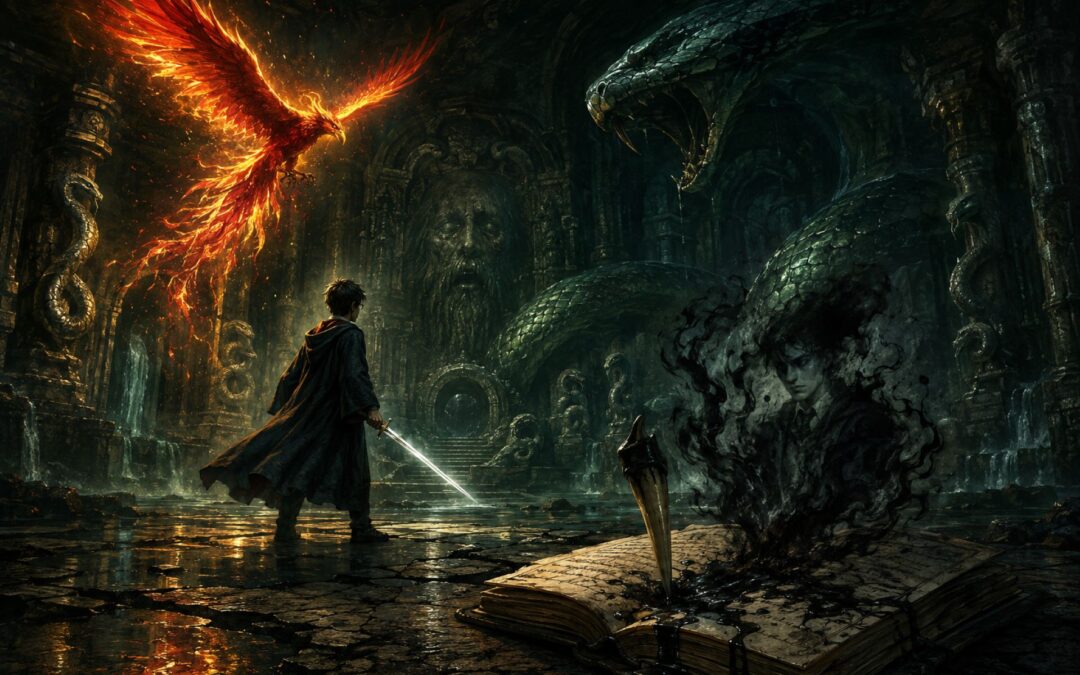
Harry Potter and the Chamber of Secrets begins with a problem that seems almost trivial compared with the danger Harry faced during his first year at Hogwarts: nobody has written to him. After finally discovering friendship, belonging, and a world in which he matters in Harry Potter and the Philosopher’s Stone, Harry spends the summer wondering whether Ron Weasley and Hermione Granger have forgotten him. What follows turns that loneliness into the first clue in a mystery that reaches deep into Hogwarts itself.
The second Harry Potter novel retains the pleasures of the first book—school rivalries, magical lessons, Quidditch, comic disasters, enchanted objects, and friendship—but darkens their context. Hogwarts is no longer simply the wonderful alternative to Privet Drive. Its founders disagreed about who deserved to belong there, an old prejudice survives among powerful wizarding families, and something hidden inside the school is attacking students. The official Bloomsbury edition of Harry Potter and the Chamber of Secrets still presents it as Harry’s second Hogwarts adventure, but the novel is also a carefully constructed mystery about identity, evidence, memory, prejudice, and the difference between possessing a particular ability and choosing what to do with it.
At the centre of the book is a fear that becomes increasingly personal for Harry. He can do something closely associated with Salazar Slytherin and, eventually, discovers unsettling similarities between himself and the person responsible for the Chamber. The mystery therefore asks two questions at once: who has opened the Chamber of Secrets, and what do Harry’s unusual abilities say about who he really is? The climax answers both by distinguishing inherited qualities from moral character. Harry may share talents and circumstances with Tom Riddle, but he does not share Riddle’s loyalties, choices, or treatment of other people.
Spoiler warning: This article reveals the complete plot, the identity of Slytherin’s heir, Ginny’s role, Tom Riddle’s identity, the Basilisk, Hagrid’s innocence, Dobby’s fate, and the ending of Harry Potter and the Chamber of Secrets.
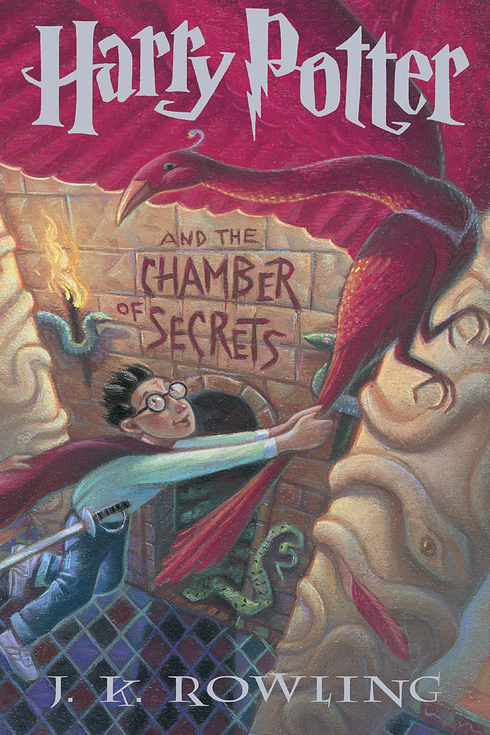
Detailed Plot Summary: The Chamber Opens Again
The mystery begins well before anyone writes a threatening message on a Hogwarts wall. Rowling spends the early chapters placing apparently unrelated objects, habits, people, and accidents into Harry’s path: an obsessive house-elf, a broken wand, an enchanted car, a nervous first-year girl, a vain celebrity teacher, a mysterious diary, Mandrakes, spiders, roosters, a camera, and a voice nobody else can hear. Most seem comic or incidental when they first appear, but the novel gradually turns them into evidence.
The school-year structure also allows the danger to develop slowly. Harry first encounters warnings, then inexplicable attacks, then suspicion, then historical evidence that appears to solve the mystery before proving dangerously misleading. By the time he reaches the Chamber itself, the final revelation depends on information accumulated throughout almost the entire book.
Dobby’s Warning, the Burrow, and Diagon Alley
Harry’s second summer at number four, Privet Drive is miserable in a different way from the years before Hogwarts. He now knows that a better life exists, which makes his forced return to the Dursleys more painful. Vernon Dursley locks Harry’s magical possessions away, Hedwig is confined to her cage, and Harry has received no letters from Ron or Hermione. On his twelfth birthday, the Dursleys are far more interested in Vernon’s business dinner with Mr and Mrs Mason than in Harry, who has been ordered to stay upstairs and pretend that he does not exist.
There Harry meets Dobby, a small, strangely dressed house-elf who insists that Harry must not return to Hogwarts. Dobby knows that dangerous events are being planned but cannot reveal enough information to identify the threat or the people behind it. His behaviour is immediately disturbing because he repeatedly punishes himself whenever he says or does something he believes his masters would forbid. Harry is sympathetic but refuses to abandon Hogwarts, which he considers his true home.
Dobby then reveals why Harry has received no correspondence: the elf has been intercepting his letters. His plan was to convince Harry that his friends had forgotten him so that he would be less determined to return to school. When this fails, Dobby uses magic to ruin Petunia’s carefully prepared pudding during the Dursleys’ dinner. The Ministry of Magic detects the spell and assumes Harry performed it, sending him a warning about underage magic.
The warning gives Vernon valuable information. Once he realises that Harry cannot legally use magic against him, he turns Harry’s bedroom into a prison, placing bars on the window and installing a cat flap through which small portions of food can be passed. The situation makes Dobby’s attempt to “protect” Harry bitterly ironic: by trying to keep him away from Hogwarts, the elf has made his life with the Dursleys substantially worse.
Ron, Fred, and George Weasley eventually arrive in Arthur Weasley’s illegally enchanted Ford Anglia. They attach the car to Harry’s window bars, tear them away, collect Harry and his school possessions, and fly him to the Burrow. The rescue immediately restores the friendship Harry feared he had lost and introduces him to the Weasley family’s home.
The Burrow is almost the opposite of Privet Drive. It is crooked, cluttered, noisy, magical, financially strained, and affectionate. Molly Weasley is furious that her sons stole the car, but her anger exists alongside genuine parental concern rather than Vernon’s hostility. Arthur Weasley is fascinated by Muggle technology and works at the Ministry dealing with enchanted Muggle objects, while Fred and George create constant chaos. Ginny Weasley, beginning her first year at Hogwarts, becomes acutely embarrassed whenever Harry is nearby.
Harry also becomes aware of the Weasleys’ lack of money. He himself possesses a considerable inheritance at Gringotts, while the Weasleys must stretch their resources across school supplies for several children. Ron is embarrassed by his second-hand possessions and worried that Harry might judge his home, but Harry loves the Burrow precisely because it offers something wealthier environments have never given him: warmth, inclusion, and family life.
When the family travels to Diagon Alley for school supplies, Harry’s first attempt to use Floo powder goes wrong. Instead of reaching Diagon Alley, he lands in Borgin and Burkes in the darker Knockturn Alley. There he hides when Draco Malfoy enters with his father, Lucius.
The scene reveals considerably more about the Malfoys than Draco’s schoolyard insults did in the first book. Lucius is a wealthy, influential wizard who openly despises Arthur Weasley’s interest in protecting Muggles and worries that Ministry raids could expose objects at his home. His concern is not moral but reputational: he wants potentially embarrassing Dark-Arts possessions removed before authorities inspect them. Draco, meanwhile, envies Harry’s fame and complains about Hermione Granger outperforming him academically despite coming from a Muggle family.
Harry eventually finds his way out and reunites with the Weasleys and Hermione. At Gringotts he witnesses the difference between his own financial security and the Weasley family’s limited funds, and at Flourish and Blotts the group encounters Gilderoy Lockhart, a bestselling author famous for books describing his supposed victories over dark creatures.
Lockhart immediately turns Harry into part of his publicity event. He poses with him for photographs, publicly announces that he will become Hogwarts’s new Defence Against the Dark Arts teacher, and interprets Harry primarily through the language of celebrity. The encounter establishes one of the novel’s recurring contrasts: Harry possesses fame he never asked for, while Lockhart has built his entire identity around being seen.
The bookstore encounter ends with a confrontation between Arthur and Lucius Malfoy. Lucius mocks the Weasleys’ poverty and Arthur’s sympathy for Muggles, while Arthur condemns Lucius’s values. During the chaos, Lucius slips a small black diary into Ginny’s schoolbooks. Neither Ginny nor Harry understands what has happened, and the moment passes almost invisibly. Only at the end of the novel does it become clear that this apparently minor action set the entire Chamber crisis in motion.
The Flying Car, Lockhart, and the First Signs of Danger
On September 1, Harry and Ron reach King’s Cross with the Weasleys but discover that the barrier leading to Platform Nine and Three-Quarters will not allow them through. Instead of waiting for adults or sending a message, they make an impulsive decision: they take Arthur’s Ford Anglia and fly to Hogwarts while following the train.
The journey begins as an exhilarating act of rule-breaking and becomes increasingly disastrous. The car’s invisibility mechanism malfunctions, Harry and Ron are spotted by Muggles, and by the time they reach Scotland the vehicle is failing. They crash into the Whomping Willow, a violent magical tree on the Hogwarts grounds, and Ron’s wand snaps. The Ford Anglia throws the boys and their luggage out before driving itself into the Forbidden Forest.
Harry and Ron narrowly avoid expulsion. Snape is eager to punish them severely, but Dumbledore and Professor McGonagall settle on detentions and other consequences. Their classmates, meanwhile, treat their dramatic arrival as heroic, creating another example of the gap between reputation and reality: from outside, the incident looks spectacular; from Harry and Ron’s perspective, it was frightening, reckless, and costly.
Ron’s damaged wand becomes a running joke, but it is also one of the novel’s most important pieces of preparation. It sparks, backfires, and performs spells unpredictably, making even ordinary lessons difficult. The book repeatedly reminds readers of the defect until the broken wand becomes essential during the final descent toward the Chamber.
The first classes of the year also introduce a less obvious solution to the attacks before the attacks have even begun. In Herbology, Professor Sprout teaches the students to repot young Mandrakes. Hermione explains that Mandrakes have powerful restorative properties and can return cursed or transformed people to their original state. At first this is simply another inventive magical lesson. Later, mature Mandrakes become the means by which the Petrified victims can be revived.
Lockhart’s lessons are considerably less useful. He repeatedly assumes Harry craves publicity because Lockhart cannot imagine fame as anything other than desirable. His first Defence Against the Dark Arts class includes a long quiz about Lockhart himself, followed by his attempt to teach students about Cornish pixies. When the creatures escape their cage and destroy the classroom, Lockhart cannot control them and leaves Harry, Ron, and Hermione to repair the damage.
A new Gryffindor student, Colin Creevey, provides Harry with another kind of unwanted attention. Colin is Muggle-born and delighted by the magical world. He constantly photographs Harry, asks him for autographs, and treats him as a heroic celebrity. Harry finds the attention embarrassing, especially because Lockhart interprets it as further evidence that Harry is following in his fame-seeking footsteps.
The darker social conflict becomes explicit during a confrontation between the Gryffindor and Slytherin Quidditch teams. Draco Malfoy has become Slytherin’s new Seeker, and Lucius has bought the entire team expensive Nimbus Two Thousand and One broomsticks. Hermione points out that Gryffindor players earned their positions through talent rather than purchases.
Draco responds by calling Hermione a “Mudblood,” a term so offensive that the surrounding students react immediately. Harry and Hermione do not initially understand its significance, but Ron does. He attempts to curse Draco, only for his broken wand to cause the spell to rebound, leaving him vomiting slugs.
At Hagrid’s hut, Ron explains that the insult targets witches and wizards born to Muggle parents. Some families, including the Malfoys, believe so-called pure-blood ancestry makes them superior. The absurdity of the belief is obvious within the immediate scene: Hermione, a Muggle-born student, is one of the most capable young witches at Hogwarts, while blood status has no reliable relationship with intelligence or magical skill.
Soon another problem emerges. During detention with Lockhart, Harry hears a voice that nobody else can hear. It is cold, threatening, and speaks of killing. Harry searches for its source, but the sound appears to move through the castle itself. Lockhart hears nothing.
Harry tells Ron afterward, but they have no explanation. What the reader knows at this point is limited but unsettling: Dobby predicted danger, someone blocked the barrier at King’s Cross, Harry can hear an apparently bodiless voice, and hostility toward Muggle-born students has become explicit.
The Writing on the Wall and the Hunt for Slytherin’s Heir
As Halloween approaches, Harry, Ron, and Hermione attend Nearly Headless Nick’s five-hundredth deathday party instead of the Hogwarts feast. The event expands the world of the Hogwarts ghosts, with rotten food, ghostly music, the Headless Hunt, and a deeply offended Moaning Myrtle, who normally haunts a girls’ bathroom.
After leaving the party, Harry hears the murderous voice again. He follows it through the corridors with Ron and Hermione until they discover a horrifying scene: Mrs Norris, Argus Filch’s cat, is hanging rigid beneath a message written on the wall announcing that the Chamber of Secrets has been opened and warning the enemies of Slytherin’s heir.
The school gathers quickly. Draco reacts with enthusiasm to the threat, reinforcing the trio’s suspicion that he might somehow be involved. Filch believes Harry attacked his cat, but Dumbledore determines that Mrs Norris is not dead. She has been Petrified by an unusually powerful form of magic, and the Mandrakes being grown by Professor Sprout may eventually provide a cure.
The attack transforms school life. Rumours spread about the Chamber of Secrets, and Hermione becomes determined to learn what it is. In History of Magic, she manages to make even the monotonous Professor Binns discuss the legend. Hogwarts, he explains, was founded by Godric Gryffindor, Helga Hufflepuff, Rowena Ravenclaw, and Salazar Slytherin. Slytherin wanted Hogwarts to admit only students from magical families and supposedly constructed a secret chamber containing a monster that his true heir would one day release against those he considered unworthy.
The historical explanation gives the attacks an ideological purpose. The threat is not random violence. If the legend is true, the Chamber exists to continue Slytherin’s exclusion of Muggle-born students.
Harry, Ron, and Hermione return to the corridor where Mrs Norris was found. They notice several apparently minor details: spiders are fleeing from the castle, and water had covered the floor near Moaning Myrtle’s bathroom. Neither clue makes sense yet. What does make sense to them is Draco Malfoy. He is a Slytherin, comes from an old pure-blood family, openly despises Muggle-born students, and seems pleased that the Chamber has reopened.
Hermione proposes an unusually ambitious plan to test the theory. They will brew Polyjuice Potion, transform themselves into Slytherin students, enter the Slytherin common room, and question Draco without revealing their identities. Brewing the potion requires restricted ingredients and weeks of preparation, turning part of the mystery into an extended school-level covert operation.
Before the plan is ready, Harry plays Slytherin in Quidditch. One Bludger behaves abnormally, ignoring every other player and pursuing Harry relentlessly. Harry refuses to leave the match, eventually catches the Golden Snitch, and suffers a broken arm. Lockhart attempts to repair the injury and instead removes the bones from Harry’s arm completely.
During Harry’s overnight recovery in the hospital wing, Dobby appears. He admits that he blocked the barrier at King’s Cross and manipulated the Bludger. His reasoning is grotesque but sincere: he believes seriously injuring Harry is better than allowing him to remain at Hogwarts and face whatever has returned.
Dobby also reveals something much more important. The Chamber of Secrets has been opened before. He knows the present events are a repetition of earlier danger but is magically unable to identify the person responsible.
The night ends with another attack. Colin Creevey is carried into the hospital wing Petrified. His camera is damaged internally, and the film is ruined. The danger has now moved from a caretaker’s cat to students, and the victims fit the ideological pattern implied by the Chamber legend: Colin is Muggle-born.
Parseltongue, Polyjuice Potion, and Harry Under Suspicion
The school responds to the attacks by creating a Duelling Club, presented by Lockhart with Snape assisting. The event quickly reinforces how little practical ability Lockhart possesses. Snape disarms him effortlessly, and the students are paired for practice.
Harry is matched against Draco. During the duel Draco conjures a snake, and when it threatens Justin Finch-Fletchley, Harry instinctively tells the snake to leave Justin alone. From Harry’s perspective, he has simply communicated with it. To everyone else, however, he has produced a sinister series of hissing sounds.
Harry is a Parselmouth: someone capable of speaking with snakes. Ron and Hermione later explain why this is so alarming. Salazar Slytherin was famously able to communicate with serpents, and the talent has strong associations with dark magic. Harry therefore possesses the exact sort of ability people expect Slytherin’s heir to possess.
His reputation changes almost immediately. Students whisper about him, avoid him, and reinterpret previous incidents as evidence. Justin becomes afraid of Harry. Other students speculate that Harry’s unexplained survival of Voldemort’s attack may itself indicate hidden dark power.
Harry’s uncertainty becomes almost as troubling as the rumours. He remembers that the Sorting Hat once considered placing him in Slytherin. He now has an ability associated with Slytherin. The question of the heir is beginning to feel like a question about Harry himself.
When Harry later discovers Justin and Nearly Headless Nick Petrified, the circumstances look terrible. Harry is present at another attack, Justin had openly feared him, and Harry cannot explain what actually happened. Professor McGonagall takes him to Dumbledore.
While waiting in Dumbledore’s office, Harry encounters Fawkes, Dumbledore’s phoenix. Fawkes suddenly bursts into flames, apparently dying, only to emerge as a newborn bird from the ashes. Dumbledore explains the phoenix’s cycle of death and rebirth. Like the Mandrakes and Ron’s broken wand, Fawkes initially appears to be colourful world-building but later becomes essential to Harry’s survival.
Harry also speaks with the Sorting Hat and asks whether it should have placed him in Slytherin. The Hat does not reassure him in the way he hopes; it still believes Harry could have done well there. Dumbledore, however, tells Harry that he does not believe Harry is responsible for the attacks.
At Christmas the Polyjuice Potion is finally ready. Hermione arranges for Crabbe and Goyle to eat cakes containing a Sleeping Draught, and Harry and Ron use hairs from the unconscious boys to transform into them. They enter the Slytherin common room and question Draco.
The plan produces important negative evidence. Draco believes the heir should attack Muggle-born students and repeats information he has heard from Lucius, but he is not the heir and does not know how the Chamber is being opened. The obvious suspect is eliminated.
Hermione’s transformation goes less successfully. The hair she believed belonged to Slytherin student Millicent Bulstrode actually came from a cat. Because Polyjuice Potion is not designed for human-to-animal transformations, Hermione develops feline features and ends up in the hospital wing.
The investigation has therefore produced a strange result. Draco is not responsible, yet the evidence pointing toward Slytherin remains. Harry is increasingly afraid of his own connection to the mystery, while the actual culprit remains invisible.
Tom Riddle’s Diary, Hagrid’s Past, and Aragog
Harry eventually discovers a small black diary in Moaning Myrtle’s flooded bathroom. It belonged to T. M. Riddle and dates from fifty years earlier—the same period in which Dobby said the Chamber was previously opened. At first the diary appears blank, but Hermione becomes interested because Riddle received an award for special services to Hogwarts during that period.
Harry soon discovers that the diary can communicate. When he writes in it, words appear in response, and Riddle eventually offers to show Harry what happened fifty years earlier. Harry is pulled into a preserved memory.
The memory presents a teenage Tom Riddle as a model student worried that Hogwarts might close because of attacks. Riddle confronts a younger Hagrid, who is hiding a giant spider named Aragog. The scene strongly implies that Aragog was the monster, that Hagrid opened the Chamber, and that Riddle saved the school by exposing him.
The apparent solution is painful for Harry because he trusts Hagrid. He knows Hagrid has a reckless affection for dangerous creatures and already knows that Hagrid was expelled from Hogwarts, which makes the story plausible. Hermione remains more cautious, but the diary seems to have given Harry direct access to history.
That appearance of objectivity is one of the novel’s most effective deceptions. Harry has not witnessed the past independently. He has seen a memory selected and framed by Tom Riddle, who controls what the diary reveals.
The diary later disappears from Harry’s dormitory. Because access to Gryffindor Tower is restricted, whoever takes it appears to be someone capable of entering Harry’s own house. The theft gives the object even greater importance: somebody knows what it contains and wants it back.
The crisis then accelerates. Harry hears the hidden voice again. Hermione suddenly seems to understand something and rushes toward the library, but before she can tell Harry and Ron what she has discovered, she and Ravenclaw prefect Penelope Clearwater are found Petrified.
Hogwarts imposes stricter rules, with students escorted between classes. Harry and Ron decide to visit Hagrid under the Invisibility Cloak, but before they can question him properly, Minister for Magic Cornelius Fudge arrives. Fudge does not appear convinced that Hagrid is guilty, yet the Ministry feels pressure to act, so Hagrid is sent to Azkaban as a precaution.
Lucius Malfoy then arrives with another institutional blow. He has obtained signatures from Hogwarts’s governors suspending Dumbledore as headmaster. Dumbledore leaves without open resistance but suggests that help will remain available at Hogwarts to those who remain loyal to him and know how to ask for it.
Before Hagrid is taken away, he gives what sounds like a strange instruction to the apparently empty room: anyone trying to discover the truth should follow the spiders. Harry and Ron understand that he is speaking to them beneath the Cloak.
They eventually follow a trail of spiders into the Forbidden Forest, accompanied by Hagrid’s dog, Fang. The journey leads them to an enormous colony of Acromantulas ruled by the ancient Aragog.
Aragog corrects the story Harry saw in Riddle’s diary. Hagrid did raise him secretly at Hogwarts, but Aragog did not come from the Chamber and was not responsible for the attacks. Hagrid was blamed because he was already associated with a frightening creature and made a convenient suspect. The actual monster was something Aragog’s species feared so deeply that he refuses even to name it.
Aragog supplies one crucial fact: the girl killed during the first opening of the Chamber was found in a bathroom. He then proves that gratitude to Hagrid does not extend to Hagrid’s friends, allowing his offspring to surround Harry and Ron as prey.
At the moment escape seems impossible, Arthur’s abandoned Ford Anglia crashes through the spiders and rescues Harry, Ron, and Fang. The apparently comic flying car from the beginning of the school year returns at precisely the point when its new independence can save them.
Back at Hogwarts, Harry reviews what Aragog has told them and reaches an important conclusion. Hagrid was innocent of opening the Chamber. More importantly, if the girl who died fifty years earlier was killed in a bathroom, she might still be there as a ghost.
The possibility points directly to Moaning Myrtle.
The Basilisk, Ginny, and the Heir of Slytherin
The mystery appears to be approaching a solution even before Harry and Ron can speak to Myrtle. Professor Sprout announces that the Mandrakes have matured and can finally be used to restore the Petrified victims. Once Hermione wakes, she may be able to explain what she discovered before the attack.
Ginny, meanwhile, approaches Harry and Ron looking terrified and tries to confess something. Before she can speak, Percy interrupts. Because Percy becomes unusually defensive, Ron assumes Ginny’s secret concerns something embarrassing about him rather than the Chamber.
Harry and Ron later receive permission to visit Hermione in the hospital wing. Although she remains Petrified, Harry notices a crumpled piece of paper clenched in her hand. It is a page torn from a library book describing the Basilisk, an enormous serpent whose direct gaze causes death. Hermione has written one additional word on the page: “pipes.”
The entire mystery suddenly becomes coherent. The monster is a Basilisk, which explains why Harry hears a voice nobody else hears: he understands the serpent’s language. It moves through Hogwarts using the plumbing, which is why the voice seems to travel inside walls.
The apparently inconsistent attacks also make sense. Nobody has died during the present opening of the Chamber because nobody has looked directly into the Basilisk’s eyes. Colin saw it through his camera. Justin encountered it through Nearly Headless Nick. Nick absorbed the direct gaze but, already being dead, could not die again; Justin received only the indirect effect. Hermione and Penelope were using a mirror to look around corners. Mrs Norris saw the creature reflected in the flooded water outside Myrtle’s bathroom.
Other clues align as well. Spiders flee because the Basilisk is their natural enemy. Hagrid’s roosters were being killed because the crow of a rooster is fatal to a Basilisk. Myrtle’s bathroom is important because it was the location of the original death and is connected to the school’s plumbing.
Harry and Ron are ready to tell the teachers when another emergency is announced. This time the heir has not merely Petrified a victim. A message states that Ginny Weasley has been taken into the Chamber and will die there.
The staff believe Hogwarts may have to close. Lockhart arrives late and discovers that his colleagues have finally decided to take his boasts seriously. For months he has claimed that he could handle the monster and knew what other people were doing wrong. The teachers tell him to enter the Chamber and prove it.
Harry and Ron later visit Lockhart’s office intending to give him the information they have discovered. Instead, they find him packing his possessions and preparing to flee. Cornered, Lockhart finally admits the truth behind his bestselling adventures.
He did not defeat the creatures described in his books. Other witches and wizards performed those feats. Lockhart tracked them down, learned their stories, altered the details to make himself the hero, and used Memory Charms to prevent the real participants from contradicting him. His genuine magical specialty is not heroic combat but erasing other people’s memories.
When he attempts to cast a Memory Charm on Harry and Ron, they disarm him and force him to accompany them. In Moaning Myrtle’s bathroom, Myrtle explains how she died. She had been crying in a cubicle when she heard a boy speaking an unfamiliar language. When she came out, she saw enormous yellow eyes and died immediately.
Harry examines the sinks and finds a small snake engraved on one of the taps. He speaks Parseltongue, and the sink opens to reveal a huge pipe leading beneath the school. Harry decides to enter. Ron goes with him, and they force Lockhart to go first.
Deep below Hogwarts they find a massive shed snakeskin. Lockhart eventually seizes Ron’s wand and attempts to erase the boys’ memories. Because the wand has been broken all year, the spell backfires spectacularly. Lockhart loses his own memory, and the resulting explosion collapses part of the tunnel, separating Harry from Ron.
Harry continues alone because Ginny may still be alive. He reaches a vast underground chamber filled with serpent carvings and dominated by a monumental statue of Salazar Slytherin. Ginny lies unconscious near the statue.
A teenage boy appears: Tom Riddle.
Riddle explains that he is not physically present in the ordinary sense. He is a memory preserved in the diary, but he has become increasingly substantial because Ginny has been pouring herself into it. Lonely, frightened, embarrassed by her family’s poverty, teased by her brothers, and convinced that Harry would never notice her, Ginny treated the diary as a private friend. Riddle answered sympathetically, gained her trust, and learned her fears.
Then the relationship changed. As Ginny gave more of herself to the diary, Riddle became stronger and gained the ability to control her. Ginny opened the Chamber, killed the roosters, wrote the threatening messages, and released the Basilisk without fully understanding what she was doing.
Eventually she became frightened by her missing memories and tried to dispose of the diary in Myrtle’s bathroom. Harry found it. Riddle then used his preserved memory of Hagrid to gain Harry’s trust and misdirect the investigation.
Ginny later saw Harry with the diary and panicked. She stole it back from his dormitory because she feared it might reveal what she had done. By then Riddle had learned enough from Ginny about Harry to become obsessed with him.
Riddle admits that he framed Hagrid fifty years earlier. The actual Chamber belonged to Riddle himself, who had spent years discovering how to open it. When Hogwarts faced closure because one student had died, he needed another culprit and chose Hagrid, whose secret giant spider made him easy to accuse.
Riddle then reveals his true identity. Rearranging the letters of his full name, Tom Marvolo Riddle, he demonstrates that he created another name for himself: Lord Voldemort. He is also a descendant of Salazar Slytherin and therefore the heir who originally opened the Chamber.
The revelation creates a disturbing parallel between Harry and Riddle. Both are half-blood orphans raised among Muggles. Both found Hogwarts after unhappy childhoods. Both speak Parseltongue. Riddle wants to know why Harry survived Voldemort’s attack as a baby when the supposedly more powerful wizard lost his body and strength.
Harry does not have a complete explanation, but he refuses Riddle’s claim to greatness and defends Dumbledore. That loyalty matters. Fawkes suddenly arrives in the Chamber carrying the Sorting Hat.
Riddle mocks Harry’s apparent reinforcements and summons the Basilisk from the mouth of Slytherin’s statue. Harry has to avoid its gaze, but Fawkes attacks the creature and blinds it, removing its deadliest weapon. Harry asks the Sorting Hat for help, and the sword of Godric Gryffindor appears from inside it.
Harry fights the blinded Basilisk and drives the sword into the roof of its mouth, killing it. One of the serpent’s fangs pierces Harry’s arm, however, and the Basilisk venom begins killing him. Fawkes cries onto the wound, and the phoenix’s tears heal the poison.
Riddle prepares to continue the confrontation, but Fawkes drops the diary near Harry. Harry grabs one of the Basilisk’s fallen fangs and drives it into the book. The venom destroys the diary, Riddle’s preserved form disappears, and Ginny begins to recover as the life being drained from her returns.
Harry, Ginny, Ron, and the amnesiac Lockhart escape the underground tunnels with Fawkes’s help. In Professor McGonagall’s office they find Dumbledore, the Weasleys, and McGonagall waiting. Harry recounts the mystery and explains Riddle’s role. Dumbledore immediately understands that Ginny was manipulated rather than willingly responsible and makes clear that she will not be punished.
The Mandrake remedy restores Hermione and the other Petrified victims. Hagrid is released from Azkaban, and Dumbledore returns as headmaster.
Harry still has one unresolved fear. Riddle’s comments about their similarities have affected him, and he tells Dumbledore that he worries the Sorting Hat was right to consider Slytherin. Dumbledore does not deny the similarities. Harry does possess traits Salazar Slytherin valued, including determination, resourcefulness, and Parseltongue. What matters, Dumbledore explains, is that Harry asked not to be placed in Slytherin and has repeatedly acted according to different loyalties. His choices distinguish him from Riddle.
The sword provides a physical confirmation. It belonged to Godric Gryffindor, and Harry was able to draw it from the Sorting Hat when he needed help.
Lucius Malfoy then arrives with Dobby, finally confirming that Dobby belongs to the Malfoy family. Harry understands what happened at Flourish and Blotts: Lucius planted Riddle’s diary among Ginny’s belongings. He intended to cause trouble for Arthur Weasley and rid himself of a dangerous Dark-Arts object, regardless of the risk to Ginny and other students.
Harry cannot prove enough to punish Lucius, but he can help Dobby. He places one of his socks inside the damaged diary and gives it to Lucius. Lucius throws the sock aside; Dobby catches it. Because a house-elf is freed when the master gives it clothing, Lucius has unintentionally released him.
When an enraged Lucius moves against Harry, the newly liberated Dobby protects him with powerful magic. The elf who spent the beginning of the novel hurting Harry in a misguided attempt to save him ends it as a free being capable of choosing openly whom he will defend.
Hogwarts celebrates. Hagrid returns, the victims recover, Lockhart is sent away for treatment, and examinations are cancelled. One final false mystery also collapses: Percy’s secretive behaviour concerned his romance with Penelope Clearwater, not the Chamber.
On the Hogwarts Express, Harry gives Ron and Hermione his telephone number so they can contact him during the summer. The small gesture completes a quiet transformation from the beginning of the novel. Harry started the summer believing his friends had forgotten him. He returns to the Muggle world knowing exactly where he belongs and whom he can trust.
Hogwarts, the Burrow, and the Expanding Wizarding World
The first Harry Potter novel introduces the magical world primarily through Harry’s amazement. Chamber of Secrets begins turning that world into a society. Magic is still delightful, but the places Harry visits now reveal differences in wealth, political power, prejudice, employment, family structure, law, education, and social status. The result is a wizarding world that feels larger precisely because it is less uniformly wonderful.
The Burrow is central to that expansion. Privet Drive is neat, regulated, materially comfortable, and emotionally hostile. The Burrow looks unstable, contains eccentric magical objects, and belongs to a family that worries about money, yet Harry experiences it as the most welcoming home he has known. Rowling uses the contrast to separate material order from emotional security. Harry’s attachment to the Weasleys grows because they include him in ordinary family life rather than treating him either as a burden or a celebrity.
The Weasleys also make economic inequality within the magical world visible. Harry has inherited wealth, Draco receives the newest broomsticks and enjoys Lucius’s social influence, while Ron uses hand-me-down robes, books, and equipment. Ginny begins Hogwarts with second-hand supplies, a fact Riddle later exploits when encouraging her to confide in him. Poverty does not define the Weasleys, but it shapes how Ron and Ginny experience school and how easily richer characters can humiliate them.
Diagon Alley and Knockturn Alley similarly complicate the magical marketplace. Diagon Alley is still exciting, but Harry now sees its financial hierarchy. Knockturn Alley reveals a commercial world built around suspicious and dangerous objects, while Borgin and Burkes demonstrates that Dark magic is not an abstract force existing only in villains. It is bought, sold, collected, inherited, concealed from authorities, and protected by wealthy customers.
Government is also more visible. The Ministry monitors underage magic, regulates enchanted Muggle objects, conducts raids, and can imprison a suspect such as Hagrid even when its own minister admits the evidence is weak. Arthur Weasley’s job demonstrates that wizarding law operates through mundane bureaucracy as well as dramatic magical authority.
Hogwarts itself becomes a historical institution rather than a neutral fantasy school. Its four houses descend from four founders who did not share the same ideals. Salazar Slytherin’s hostility toward Muggle-born students was never fully erased; it survives symbolically in Slytherin House, socially in families such as the Malfoys, and physically in the Chamber hidden within the castle.
That history changes the emotional meaning of the setting. Hogwarts remains Harry’s home, but home is no longer synonymous with perfection. The school contains prejudice, secrets, weak governance, unfair suspicions, and adults who sometimes protect reputations or institutions more effectively than children. Harry’s loyalty becomes more meaningful because it is loyalty to a community he recognises as flawed, not blind worship of an ideal place.
Other social categories broaden the world further. Filch is a Squib—a person born into a magical family without normal magical abilities—and his hidden Kwikspell materials suggest humiliation and insecurity. Dobby introduces house-elves whose powerful magic exists alongside legally and socially enforced servitude. Nearly Headless Nick, Moaning Myrtle, and the Deathday Party show that even ghosts form communities with hierarchies, exclusions, grudges, and traditions.
The magical creatures are likewise embedded into a kind of ecology. Mandrakes mature over time and provide medicine. Acromantulas fear Basilisks. Roosters threaten the Basilisk. Phoenixes regenerate and heal. The Ford Anglia develops what appears to be a will of its own after entering the Forest. These details make magic feel governed by interacting systems rather than appearing whenever the plot needs spectacle.
The result is a more mature version of the world introduced in Book 1. Wonder remains, but every magical institution now has a social dimension. The Burrow shows how magic operates inside a family; the Ministry shows it inside government; Knockturn Alley shows it inside commerce; and the Chamber shows that even Hogwarts has inherited conflicts buried beneath its floors.
Character Analysis
One of the novel’s strongest organising ideas is the unreliability of appearance. Harry looks potentially dangerous because he speaks Parseltongue. Riddle looks trustworthy because he appears intelligent, handsome, polite, and responsible. Lockhart looks heroic because he controls the stories told about him, while Hagrid looks suspicious because his genuine mistakes make false accusations plausible. Character is therefore revealed less through reputation than through decisions made when appearances no longer protect anyone.
This principle also shapes the novel’s relationships. Harry, Ron, Hermione, Ginny, Dobby, Riddle, Dumbledore, and the Malfoys continually make choices about whom to trust, whom to protect, and how to use power. Those decisions ultimately matter more than the talents, ancestry, or public identities they possess.
Harry Potter: Identity, Choice, and Loyalty
Harry begins the novel emotionally dependent on Hogwarts. The silence from Ron and Hermione hurts because friendship is still new enough that he fears it might disappear. Dobby can exploit that vulnerability precisely because Harry has spent most of his childhood without reliable affection. Once Harry learns that his friends did write to him, his commitment to Hogwarts becomes even stronger.
His attachment to the Weasleys also clarifies what he values. Harry has more money than Ron but envies Ron’s family life rather than looking down on his poverty. At the Burrow he responds to noise, disorder, and overcrowding as signs of life. His longing is not primarily for magical status but for reciprocal belonging.
Harry is nevertheless impulsive throughout the book. Stealing the Ford Anglia rather than finding an adult solution is reckless. He investigates dangerous situations with limited information and repeatedly breaks school rules. Even his decision to enter the Chamber is made without adult support, although by that stage the normal structures of authority have failed badly enough that his decision becomes more understandable.
His unwanted fame provides another revealing contrast with Lockhart. Harry is famous because something happened to him as a baby, not because he built a public persona. Colin’s admiration makes him uncomfortable, and Lockhart repeatedly misreads that discomfort because he assumes everybody wants what he wants. The joke becomes thematically useful: reputation tells other people who Harry is supposed to be while Harry is still trying to decide for himself.
Parseltongue intensifies that uncertainty. Harry’s fear is not irrational. The Sorting Hat considered Slytherin, he can communicate with snakes, and Tom Riddle later identifies real similarities between them. The novel does not resolve the anxiety by declaring that Harry has nothing in common with Riddle.
Instead, it makes the similarities part of the point. Both boys experienced childhood without parents. Both entered Hogwarts as unusually significant young wizards. Both are resourceful and determined. Both can speak Parseltongue. Yet Harry builds relationships based on loyalty and mutual protection while Riddle approaches relationships as opportunities for domination.
Harry’s conduct in the Chamber demonstrates the difference before Dumbledore explains it. He goes underground to save Ginny, remains loyal to the falsely accused Hagrid, refuses to accept Riddle’s self-description as the greatest wizard alive, and calls for help rather than pretending he needs nobody. When Fawkes and the sword arrive, they respond to loyalties Harry has already chosen.
Dumbledore’s later explanation therefore does not suddenly create Harry’s identity. It gives language to what the plot has already shown. Harry’s abilities may resemble Riddle’s, but those abilities do not dictate how he uses them.
Tom Riddle and Ginny Weasley: Manipulation, Vulnerability, and Control
Tom Riddle is especially effective because the novel introduces him first as evidence rather than as an obvious villain. His diary appears intimate and private. The preserved memory depicts him as a responsible student trying to stop Hogwarts from closing. Because Harry enters that memory and seems to witness events directly, he assumes he has encountered truth.
Riddle understands that trust is easier to gain when he appears to listen. Ginny’s relationship with the diary makes this explicit. She is eleven years old, starting school in the shadow of several older brothers, wearing second-hand possessions, embarrassed by her feelings for Harry, and dealing with fears she does not know how to express. The diary provides a patient listener who never appears to judge her.
That apparent intimacy is predatory. Riddle responds sympathetically because sympathy gives him access. Ginny reveals more of herself, Riddle grows stronger, and eventually the diary does not merely know her secrets but gains control over her body and memory.
The mechanism makes Ginny’s role in the attacks morally different from Riddle’s. She physically performs many of the actions—opening the Chamber, writing messages, killing roosters, releasing the Basilisk—but she does so under magical domination and increasingly loses awareness of her own behaviour. Her terror and attempts to dispose of the diary show that she is fighting something she cannot understand.
The revelation is powerful partly because the novel hides Ginny from the centre of the narrative. Her nervousness, pallor, disappearing possessions, and attempts to speak are visible but easy to interpret as ordinary first-year anxiety or embarrassment around Harry. The weakness of this strategy is that Ginny receives limited independent development before becoming crucial to the climax. Much of what the reader learns about her inner life comes through Riddle’s retrospective explanation rather than through Ginny’s own sustained viewpoint.
Riddle’s treatment of Ginny also demonstrates his broader psychology. He is interested in other people primarily as material. Hagrid becomes a scapegoat. Ginny becomes a source of emotional energy and a body through which he can act. Harry becomes an intellectual puzzle whose survival threatens Riddle’s belief in his own superiority.
Even Riddle’s name reflects deliberate self-construction. He despises the connection to his Muggle father and creates “Lord Voldemort” as an identity designed to inspire fear. Harry also has reasons to reject his upbringing, but he does not solve that problem by inventing an identity based on domination. Riddle’s self-creation is therefore an extreme counterexample to the novel’s idea of choice: choosing who to become matters, but choices can also produce cruelty.
Ron and Hermione: Friendship as a Method of Investigation
Although Harry performs the final act alone, he does not solve the mystery alone. Ron and Hermione provide different forms of knowledge and courage, and the investigation works because their strengths complement Harry’s.
Ron understands the magical world from inside. He knows immediately that Draco’s insult is serious, recognises the social meaning of Parseltongue, understands wizarding customs that Harry has never encountered, and provides emotional loyalty even when the school turns suspicious. His rescue of Harry from Privet Drive is reckless, but it also establishes how quickly Ron acts when a friend is in trouble.
Ron’s limitations make him useful rather than idealised. He is insecure about money, impatient with schoolwork, dismissive of some things Hermione values, and terrified of spiders. Following Hagrid’s clue into the Forbidden Forest therefore requires genuine courage from him. The Acromantula sequence matters because Ron is not fearlessly confronting a generic danger; he is moving directly toward his established phobia because the investigation requires it.
Hermione’s contribution is more systematic. She extracts the Chamber legend from Professor Binns, devises the Polyjuice plan, identifies the importance of evidence others overlook, and eventually solves the physical mystery of the Basilisk. Even while Petrified, she leaves Harry and Ron enough information to reconstruct the answer.
Her investigation also shows how far she has changed since the earliest part of the series. Hermione remains academically disciplined, but she is now willing to steal restricted ingredients, brew an illicit potion in a bathroom, deceive teachers, and break multiple school rules when she believes doing so is necessary to protect people. Her moral judgement has become more flexible without becoming careless.
The trio’s friendship therefore functions as a method of reasoning. Harry provides intuition, Parseltongue, and willingness to act. Ron provides cultural knowledge and loyalty. Hermione provides research, planning, and synthesis. Remove any one of them and the mystery becomes much harder to solve.
The decision to Petrify Hermione before the climax creates a small structural frustration. She discovers the key answer but cannot participate in acting on it. Yet that absence also prevents the final confrontation from becoming a simple group victory. Harry must eventually internalise what his friends have helped him learn and act when nobody can accompany him further.
Dobby and Gilderoy Lockhart: Protection, Freedom, and False Heroism
Dobby and Lockhart initially seem to belong to completely different parts of the story. Dobby is powerless, frightened, and desperate to prevent Harry from returning to school. Lockhart is wealthy, famous, confident, and constantly explaining how much danger he has supposedly overcome. By the end, they become opposites in a more meaningful sense.
Dobby’s actions are genuinely harmful. He steals Harry’s letters, ruins the Dursleys’ dinner, helps cause Harry’s imprisonment, blocks the station barrier, and manipulates a Bludger that breaks Harry’s arm. Good intentions do not make these choices sensible. Dobby believes he knows what is best for Harry and repeatedly overrides Harry’s wishes in order to protect him.
The novel nevertheless makes his motivation sympathetic. Dobby remembers Voldemort’s period of power as especially terrible for house-elves and regards Harry as a symbol of the Dark Lord’s defeat. Because Dobby lacks freedom within the Malfoy household, indirect interference is one of the few forms of resistance available to him.
His self-punishment reveals the depth of that servitude, though the book sometimes plays the behaviour for slapstick. That tonal choice can be uncomfortable. Dobby hurting himself is funny within individual scenes, yet the underlying reason is that he has been conditioned and magically constrained by an abusive system.
Lockhart represents almost the reverse problem. He possesses social freedom and public admiration but has built both through exploiting others. His adventures are genuine only in the sense that somebody performed them. He takes the experiences of more capable witches and wizards, turns himself into the protagonist, and erases their memories.
His fraud is more serious than ordinary vanity. Lockhart does not merely exaggerate. He destroys other people’s ability to testify about their own accomplishments. His public identity depends on controlling both story and memory.
The final irony is therefore precise. Lockhart’s one genuine specialty is the Memory Charm, and his attempt to erase Harry and Ron’s memories rebounds through Ron’s damaged wand and destroys his own. A man who built his fame by taking other people’s histories loses access to his own.
Dobby receives the opposite ending. He begins the novel unable even to criticise his masters without punishing himself and ends it holding a sock that represents legal freedom. Once liberated, he immediately uses his power openly to protect Harry from Lucius. The character who appeared least free becomes capable of direct choice, while the man most obsessed with controlling his identity no longer knows who he is.
The Malfoys, Hagrid, and Dumbledore: Power, Suspicion, and Trust
Draco Malfoy is an effective suspect because his values really are repellent. He repeats pure-blood ideology, celebrates the attacks, insults Hermione, mocks the Weasleys’ poverty, and openly hopes the heir will remove Muggle-born students. The Polyjuice investigation proves that being morally unpleasant is not the same as being guilty of a particular crime.
Draco’s relationship with Lucius helps explain where those attitudes come from. Lucius possesses wealth, institutional influence, old-family status, and contempt for people he considers socially inferior. He supplies Slytherin’s Quidditch team with superior equipment, pressures Hogwarts’s governors, attacks Arthur’s reputation, and treats Dobby as property. Draco’s prejudice is personal, but it also belongs to an inherited family worldview.
Lucius is more dangerous because he can convert social status into consequences. He does not need to open the Chamber personally. By planting Riddle’s diary among Ginny’s books, he weaponises a Dark object against Arthur Weasley’s family while placing other children at risk. Later he uses influence over school governors to remove Dumbledore during the crisis.
Hagrid occupies the opposite social position. He is visibly unusual, has a history of rule-breaking, loves dangerous creatures, and lacks the polished respectability that protects people like Riddle or Lucius. These real characteristics make a false accusation against him easier to believe.
Riddle understands this perfectly. Fifty years earlier, he needs someone to blame for the Chamber attacks and chooses Hagrid because Hagrid is already hiding Aragog. The accusation succeeds not because the evidence is strong but because it fits expectations.
Dumbledore is one of the few adults who refuses that easy interpretation. He suspects Hagrid was innocent during the original attacks and continues to trust him. He similarly refuses to condemn Harry when Parseltongue and circumstantial evidence make Harry look suspicious.
His authority is nevertheless limited. The Ministry can remove Hagrid, and the governors can temporarily force Dumbledore from Hogwarts. This limitation matters because it prevents Dumbledore from functioning as an all-purpose solution. Moral judgement and institutional power are not identical, and the person who sees most clearly cannot always prevent others from making bad decisions.
Blood Purity, Prejudice, and Belonging
The Chamber mystery would be much less significant if the hidden monster were simply dangerous. What makes it central to the novel is its purpose. Salazar Slytherin supposedly created the Chamber because he wanted Hogwarts reserved for magical families and believed his heir would eventually use the creature inside it to remove Muggle-born students. The attacks therefore transform an old belief about ancestry into physical violence.
Draco’s insult toward Hermione introduces the ideology in personal terms. He believes magical blood makes some families superior even though Hermione is demonstrably more accomplished than he is. Ron’s explanation reinforces how socially entrenched the belief can be while also showing how little sense it makes as a measure of actual ability.
The Weasleys provide an important contrast. They are an old wizarding family but reject pure-blood superiority. Arthur is fascinated by Muggle life, Ron immediately defends Hermione, and the family’s social standing suffers in part because people such as Lucius regard sympathy toward Muggles as disgraceful. The conflict is therefore not simply between Muggle-born and pure-blood characters. It is also a struggle within wizarding society over what ancestry should mean.
Tom Riddle intensifies the contradiction because he is obsessed with Slytherin’s bloodline while despising his own Muggle heritage. Instead of treating mixed ancestry as evidence that blood categories are unstable, he attempts to erase the part of himself he hates. His adoption of the Voldemort identity is partly an effort to distance himself from his Muggle father and align himself with the lineage he considers powerful.
Harry creates another complication. He too exists across magical and Muggle worlds, has suffered badly among Muggles, and discovers a gift associated with Slytherin. The novel could have made his moral goodness depend on possessing some pure counter-identity. It does not. His distinction comes from whom he protects and where he places his loyalty.
Belonging is therefore not treated as something ancestry can settle. Harry belongs with the Weasleys because they love him, not because of blood. Hermione belongs at Hogwarts because she is a witch and a member of the school community, not because her parents are magical. Dobby’s final loyalty belongs to Harry despite legal ownership having tied him to Lucius. Hagrid belongs at Hogwarts despite being repeatedly treated as socially suspect.
The ancestry hierarchy has obvious resonances with real forms of prejudice, but it is more useful to analyse it as the novel’s own fictional system than to force a perfect one-to-one historical analogy. Joan Acocella’s early New Yorker assessment of the Harry Potter series recognised that Rowling’s apparently traditional fantasy world contains substantial social and political material alongside the fairy-tale and mystery elements. That mixture is especially important in Chamber of Secrets, where the villain’s objective depends on deciding that some children are inherently less entitled to education and community than others.
The novel’s strongest answer to that ideology is not merely that Hermione is talented. If worth depended on being exceptional, prejudice against less gifted Muggle-born students would remain unchallenged. The broader argument is that ancestry is not a legitimate basis for deciding whose presence is acceptable in the first place.
Trust, Memory, Reputation, and Institutional Failure
Almost every major mistake in Chamber of Secrets comes from trusting the wrong kind of evidence. Harry sees a memory and assumes it is objective. Hogwarts sees Hagrid’s history with dangerous creatures and assumes guilt. Students see Harry speaking Parseltongue and convert an unusual ability into a moral judgement. Lockhart presents bestselling books and photographs as proof of heroism. Lucius presents social respectability while trafficking in Dark objects.
Riddle’s diary is the most sophisticated example because it gives Harry the sensation of direct witnessing. Ordinary testimony can be questioned because another person is clearly telling a story. Riddle instead places Harry inside a preserved scene, making interpretation feel unnecessary. Harry sees Hagrid with Aragog and believes the mystery has been solved.
The problem is not that the events are entirely fabricated. Hagrid really did hide Aragog. Riddle really did confront him. The deception lies in selection and framing. Riddle withholds his own role, presents the wrong creature as the obvious answer, and allows Harry to draw a conclusion that serves him.
Lockhart manipulates reputation differently. He understands that people usually cannot verify heroic stories firsthand. Once the actual participants lose their memories, publication and celebrity transform Lockhart’s account into public reality. His books demonstrate that a sufficiently polished narrative can overpower truth when the people who know otherwise are unable to speak.
Hagrid’s case reverses the situation. His reputation makes innocence harder to believe. He genuinely loves creatures other people consider monstrous, genuinely broke rules as a student, and genuinely concealed Aragog. Those facts create an easy story in which he must also have opened the Chamber.
Cornelius Fudge’s decision to send Hagrid to Azkaban shows the institutional version of the same problem. He acts not because the evidence has become persuasive but because the Ministry needs to appear responsive. Hagrid becomes a convenient action the authorities can take when they cannot identify the real attacker.
Dumbledore’s suspension exposes a similar vulnerability at Hogwarts. Lucius Malfoy cannot demonstrate that Dumbledore caused the crisis, but he can exploit fear and pressure the governors. Institutional decisions therefore respond to political power at exactly the moment clear judgement is most necessary.
The students behave in miniature versions of the same pattern. Harry’s Parseltongue becomes enough for many of them to treat him as dangerous. Justin’s fear makes sense within the rumour environment, but once Harry is identified as a possible heir, every coincidence reinforces the theory. Evidence is interpreted through an existing conclusion.
The novel repeatedly rewards characters who keep investigating after an explanation becomes socially convenient. Hermione questions the Chamber legend. Harry and Ron test the Draco theory instead of merely assuming it. They follow Hagrid’s clue after he has been arrested. Aragog corrects Riddle’s account. Hermione reconstructs the Basilisk’s behaviour. Truth emerges through accumulation and revision rather than through one authoritative revelation.
There is a narrative convenience here. Hogwarts’s adult institutions fail often enough that twelve-year-olds repeatedly become the most active investigators. Yet those failures are not entirely arbitrary. Each adult system has a specific weakness: the Ministry cares about appearances, governors can be pressured, Lockhart is fraudulent, teachers lack Harry’s access to Parseltongue, and Dumbledore cannot remain in authority against the governors’ formal decision. The children succeed partly because they possess information that never reaches the right adults at the right time.
Symbols and Motifs
The most effective symbolic objects in Chamber of Secrets are not detachable from the plot. The diary, Basilisk, sword, phoenix, cameras, mirrors, and clothing all perform literal magical functions before they acquire larger meaning. Their symbolism works because interpretation grows out of what the objects actually do.
This also keeps the novel from becoming a simple allegory. The Chamber is simultaneously a physical location, a historical secret, and the surviving architecture of an old prejudice. The diary is simultaneously an enchanted object, a deceptive archive, and an instrument of psychological control. Meaning emerges through use.
The Diary and the Power of the Written Word
Riddle’s diary turns private writing into one of the novel’s most dangerous forms of magic. Ginny believes she is confiding in an object that listens without judgement. The more personal the writing becomes, the stronger Riddle becomes.
The diary therefore reverses the usual relationship between writer and page. Ginny thinks she is putting herself into words metaphorically; in magical terms, she is actually giving something of herself away. Riddle’s responses create the illusion of understanding and companionship while steadily making her more dependent.
The diary is also a historical document that lies without simply inventing. It preserves Riddle’s memory of Hagrid, but memory is not neutral evidence. Riddle decides what Harry sees and what he does not.
That makes the object especially appropriate for a novel concerned with reputation and storytelling. Lockhart rewrites other people’s lives in published books; Riddle rewrites the past through a private one. Both understand that whoever controls the story can control how other people assign guilt and heroism.
Destroying the diary therefore does more than defeat a magical object. Harry breaks the mechanism through which Riddle has gained power over both Ginny and the narrative of the past.
The Basilisk, Serpents, and the Hidden Chamber
Serpent imagery links Harry to the mystery before he understands why. Salazar Slytherin’s emblematic association with snakes, the snake-marked entrance, the Basilisk itself, and Harry’s Parseltongue all create the impression that Harry may belong to the same symbolic system as the villain.
That association frightens Harry because symbols often become social identities. Once other students hear him speak to a snake, they do not ask what he said. They react to what the ability represents.
The Basilisk makes that symbolism lethal. It is the hidden instrument of Slytherin’s belief that certain students should be removed from Hogwarts. Riddle can control it because he possesses the language and lineage associated with Slytherin.
Yet Harry can also speak Parseltongue. The same ability opens the Chamber for him, allowing him to enter not in order to continue Slytherin’s project but to stop it. The novel thus refuses to assign a single moral meaning to the talent itself.
The Chamber reinforces the idea. It has existed beneath Hogwarts for generations, invisible yet physically integrated into the school. The prejudice it represents was not eliminated simply because Slytherin left. It remained hidden until someone chose to reactivate it.
The Sword of Gryffindor and Fawkes
Fawkes initially appears in an almost comic scene when Harry watches an ugly, dying bird suddenly burst into flames. Dumbledore explains that phoenixes regenerate, and the episode seems largely designed to surprise Harry. Later, nearly every feature established around Fawkes becomes useful.
The phoenix responds to Harry’s loyalty to Dumbledore, reaches the Chamber, blinds the Basilisk, brings the Sorting Hat, heals Basilisk venom with tears, and ultimately helps everyone escape. Fawkes represents renewal and help, but that symbolism rests on established magical capacities rather than appearing only at the climax.
The sword is even more directly connected to Harry’s identity. He asks the Sorting Hat for help and receives a weapon belonging to Godric Gryffindor. After the battle, Dumbledore identifies Harry’s ability to retrieve the sword as evidence of his connection to Gryffindor.
The sword therefore answers the serpent imagery without pretending the serpent connection never existed. Harry speaks Slytherin’s language but wields Gryffindor’s sword. His identity contains traits that might point in different directions, and his allegiance determines what those traits become.
The rescue mechanisms can still feel remarkably fortunate. A phoenix, a magical hat, and a legendary sword appear when Harry needs them most. The sequence works better than an unprepared miracle, however, because Fawkes, the Hat, Harry’s loyalty to Dumbledore, and Harry’s Gryffindor placement have all been established earlier.
Seeing Indirectly: Mirrors, Cameras, Ghosts, and Misread Evidence
The Basilisk mystery depends on vision. Its direct gaze kills, but indirect sight produces Petrification. Every surviving victim therefore encountered reality through some intermediary: water, a camera, a ghost, or a mirror.
That mechanism is a clever physical puzzle, but it also echoes the novel’s wider preoccupation with indirect knowledge. Harry learns about the past through Riddle’s memory. Hogwarts learns about Harry through rumour. Readers learn most events through Harry’s limited perspective. Lockhart’s audience learns about supposed heroism through books.
The important distinction is that indirect evidence is not necessarily worthless. Hermione survives because she deliberately uses a mirror. Colin’s camera prevents his death even though he does not know the danger exists. Nearly Headless Nick unintentionally shields Justin.
The problem is assuming the intermediary has given a complete picture. Riddle’s diary contains real events but an incomplete interpretation. Harry’s Parseltongue is real but does not prove he is Slytherin’s heir. Hagrid’s Aragog is real but is not the Chamber monster.
The mystery is solved when partial pieces are put into a larger pattern. Seeing indirectly requires interpretation, and interpretation requires enough humility to revise a conclusion when new evidence arrives.
Mystery Construction, Narrative Perspective, Humor, and Style
Chamber of Secrets is structured more overtly as a detective story than its predecessor. Rowling gives Harry a series of clues, suspects, false solutions, and apparently unrelated details, then reveals that many comic episodes have been performing structural work. The reader is rarely given information Harry could not plausibly know, which means the mystery benefits from the limitations of his perspective.
The use of close third-person narration is especially important to the Parseltongue mystery. Harry hears the Basilisk as intelligible speech, so the narration naturally presents it as a voice. Because Harry does not initially know he is hearing a snake, the reader does not either. The solution is hidden not by withholding Harry’s knowledge but by sharing his misunderstanding.
The school-year structure also helps conceal clues. Ordinary lessons provide information that becomes essential much later. Mandrakes are introduced in Herbology long before anyone needs to be restored. Fawkes’s phoenix abilities are shown before the Chamber confrontation. Ron’s wand malfunctions repeatedly before Lockhart attempts the Memory Charm. The Ford Anglia leaves independently before returning to rescue Harry and Ron from the Acromantulas.
Other clues are more explicitly mysterious. Spiders flee Hogwarts. Roosters are killed. Water covers the first crime scene. Colin’s camera is destroyed. Harry hears movement inside the walls. Myrtle’s death occurred in a bathroom. Each fact is memorable enough to exist in the reader’s mind without necessarily revealing its connection to the others.
Draco is the most obvious red herring because he possesses almost every social characteristic expected of the heir without possessing the specific identity. His prejudice is genuine, which prevents the false lead from feeling arbitrary. Hagrid provides a more sophisticated red herring because Riddle supplies apparently direct historical evidence against him.
Lockhart performs a different structural function. His vanity provides comedy through a story that becomes progressively darker, but his obsession with fame also mirrors the book’s concern with false narratives. His classroom disasters are funny in isolation; his eventual confession reveals that the incompetence was evidence.
Humour continually prevents the mystery from becoming uniformly grim. Ron vomiting slugs, Lockhart’s self-obsession, Myrtle’s melodrama, ghostly social life, the Ford Anglia, Polyjuice mishaps, Howlers, and magical bureaucracy keep the school story playful even as students are being attacked.
The tonal balance is not always seamless. Dobby’s self-punishment, for example, is presented with comic exaggeration even though its cause is enslavement and abuse. Lockhart’s vanity is intentionally broad. Some physical descriptions of unpleasant characters rely on associations between unattractiveness and moral contempt that can feel dated.
The middle of the novel can also seem episodic during a first reading. Quidditch, school lessons, detentions, Polyjuice preparation, ghost parties, and magical accidents produce a long series of adventures before the mystery accelerates. On rereading, however, the architecture looks tighter because so many of those episodes plant information or objects used later.
The climax contains a great deal of explanation. Riddle spends substantial time telling Harry how Ginny was manipulated, how Hagrid was framed, why the diary exists, and why he became interested in Harry. This is effective because the information is genuinely important, but it also pauses the immediate urgency of rescuing Ginny so the villain can explain the plot.
That tendency resembles the surprise-heavy dénouements Joan Acocella criticised in her early assessment of Rowling’s series. Her objection—that Rowling sometimes allows revelations to accumulate in long explanatory endings—is fair in structural terms. Chamber of Secrets nevertheless earns more of its final solution than a purely arbitrary twist would because the physical clues have been present for much of the book.
The mystery’s greatest achievement is therefore retrospective coherence. Once the Basilisk is identified and Riddle explains the diary, the reader can mentally travel backward through the novel and see ordinary details become evidence. The solution changes the meaning of earlier scenes rather than simply replacing them.
Ending Explained: Why Harry Is Not Tom Riddle
The final conversation with Dumbledore is necessary because defeating the Basilisk does not solve Harry’s deepest problem. Physically, the danger is over. Ginny is alive, Riddle’s diary is destroyed, the victims can be restored, and the Chamber has been neutralised. Psychologically, however, Riddle has left Harry with a question he cannot dismiss.
The similarities between them are real. Both grew up without their parents. Both experienced childhood among Muggles. Both arrived at Hogwarts with unusual histories. Both possess determination, resourcefulness, and Parseltongue. Harry also knows the Sorting Hat once considered Slytherin.
If the novel simply denied those facts, the identity conflict would have little force. Dumbledore instead acknowledges them. Harry does have qualities Slytherin valued.
The crucial difference lies in what Harry has chosen. When the Sorting Hat offered Slytherin, Harry asked for something else. When Hagrid was accused, Harry searched for the truth instead of accepting a convenient explanation. When Ginny was in danger, Harry entered the Chamber. When Riddle attacked Dumbledore’s reputation, Harry defended the person he trusted. When Dobby remained enslaved, Harry used his ingenuity to free him.
Tom Riddle uses similar capacities in the opposite direction. His intelligence becomes manipulation. His understanding of people becomes exploitation. His dissatisfaction with his origins becomes contempt. His ambition becomes domination. He collects secrets to control others rather than to help them.
The sword of Gryffindor gives the abstract distinction a physical form. Harry does not become a Gryffindor because he lacks Slytherin-like abilities; he demonstrates Gryffindor allegiance while possessing them. The sword emerges when he asks for help and acts to defend someone else.
Fawkes reinforces the same idea. The phoenix comes because Harry remains loyal to Dumbledore even after Dumbledore has been removed from Hogwarts. Help arrives through a relationship Harry chose to preserve.
Ginny’s recovery offers another version of liberation. Riddle’s power depends on convincing her to surrender more of herself to the diary. Destroying the book breaks that control and allows Ginny to return fully to herself. Dumbledore’s refusal to punish her is important because it recognises the distinction between being manipulated into action and willingly choosing evil.
Dobby’s freedom then repeats the liberation theme on a social rather than psychological level. Ginny is freed from Riddle’s control; Dobby is freed from Lucius’s legal ownership. Harry plays a role in both because his instinct is to return agency rather than accumulate it.
Lucius escapes formal punishment for the diary plot, and wizarding society’s deeper inequalities remain. House-elves are still enslaved elsewhere. Pure-blood prejudice has not vanished because one Basilisk has died. Hogwarts’s institutions have demonstrated how easily fear can produce scapegoating and political interference.
The ending is therefore satisfying without pretending every larger problem has been solved. Harry has answered the personal question that mattered most: sharing abilities with Tom Riddle does not mean sharing his identity. What he becomes depends on what he does with those abilities and what relationships he chooses to honour.
Critical Review: How Well Does Chamber of Secrets Hold Up?
As a sequel, Harry Potter and the Chamber of Secrets faces a difficult task. The first novel could rely on discovery because nearly everything was new to Harry and the reader. Book 2 cannot simply repeat Diagon Alley, Hogwarts, classes, Quidditch, and a hidden villain and expect the same sense of wonder. Rowling’s solution is to make familiar places less secure and reveal that the magical world has a history Harry does not yet understand.
The book should therefore be judged on several fronts at once. It is a children’s school story, a fantasy adventure, a detective mystery, a continuation of Harry’s character development, and an expansion of the social world introduced in the first novel. Its strongest moments occur when those functions reinforce one another rather than operating separately.
What the Novel Does Best
The mystery construction is probably the novel’s greatest technical strength. The Basilisk solution does not emerge from one sudden clue. It requires the reader to connect spiders, roosters, plumbing, Myrtle’s death, indirect sight, Harry’s hidden voice, Parseltongue, and the different circumstances of each victim.
The solution is also unusually well integrated with the fantasy setting. A conventional mystery might depend on fingerprints, schedules, or physical access. Rowling builds equivalent evidence from magical rules. Understanding how a Basilisk works becomes the same thing as reconstructing the crime.
The red herrings are similarly effective because they are grounded in truth. Draco really is prejudiced and would welcome the attacks. Hagrid really did conceal a giant spider and was expelled after Riddle accused him. Harry really can speak Parseltongue. Each false conclusion begins with genuine evidence and becomes wrong through overinterpretation.
Tom Riddle’s diary is another major success. It expands Voldemort from an external dark wizard into someone with a history at Hogwarts and introduces the frightening idea that evil can appear charming, academically brilliant, and trustworthy. The diary’s ability to show memory rather than merely describe it makes Harry’s deception understandable.
Riddle’s manipulation of Ginny also gives the magical threat an intimate psychological dimension. The Chamber is physically enormous, but the mechanism that reopens it is a lonely child writing privately. The contrast is effective because it links large-scale prejudice to personal vulnerability.
The Harry-Riddle parallel deepens Harry’s development beyond a simple hero-versus-villain structure. Harry is not morally safe because he possesses the opposite traits from the villain. He is placed in a situation where he must recognise that some of the same traits can lead in different directions.
The Burrow material is another strength. It expands Ron from Harry’s funny best friend into part of a family whose values matter to the series. Molly’s anger, Arthur’s curiosity, Fred and George’s chaos, Ginny’s shyness, and the family’s financial worries make the magical world feel domestic rather than permanently spectacular.
Lockhart is also a memorable comic creation. His vanity is intentionally excessive, but it serves multiple purposes: he irritates Harry, entertains students and readers, satirises celebrity, provides a useless authority figure, and eventually becomes central to the theme of reputation without substance.
The book handles atmosphere particularly well once the attacks begin. Empty corridors, voices inside walls, Petrified bodies, threatening writing, deserted school spaces, the Forbidden Forest, the spider colony, Myrtle’s bathroom, and the subterranean Chamber gradually shift Hogwarts from cosy boarding school into Gothic setting.
The humour prevents that darkness from overwhelming the intended younger audience. Ron’s wand, Howlers, ghost bureaucracy, Lockhart’s photographs, Polyjuice mistakes, and the self-driving Ford Anglia repeatedly release tension.
The story also rewards rereading. On a first encounter, many details feel like imaginative decorations. Once the mystery is known, readers can see the Mandrakes preparing the cure, the roosters indicating the Basilisk, Ginny’s distress reflecting possession, the spiders identifying the monster, Fawkes preparing the rescue, and the broken wand preparing Lockhart’s downfall.
That density of payoff is one reason the novel survives its fairly episodic school-year structure. What initially appears to be a collection of magical incidents increasingly looks like a chain.
Where the Novel Is Weaker or Has Aged Poorly
Ginny is both indispensable and underused. The entire plot ultimately depends on her emotional relationship with the diary, yet readers spend relatively little time with her as an independent character before the reveal. Her shyness around Harry, illness, nervousness, and attempts to speak provide clues, but Riddle explains most of her deeper experience after she has already been taken into the Chamber.
A stronger foregrounding of Ginny could have made the possession even more emotionally powerful. The existing approach benefits the mystery because readers overlook her, but the trade-off is that the central victim receives less interior development than the central villain.
The climax also relies heavily on Riddle explaining events. By the time Harry enters the Chamber, many questions need answers: Ginny’s role, the diary, Hagrid, Riddle’s identity, the previous opening, the new attacks, and Riddle’s interest in Harry. Allowing Riddle to reveal everything is clear and dramatic, but it temporarily makes the villain unusually patient while Ginny is supposedly dying nearby.
Lockhart’s characterization is deliberately broad enough to approach caricature. His vanity is funny and his eventual exposure satisfying, yet there is little ambiguity to him. Once the pattern is established, most Lockhart scenes operate through variations of the same joke: he is convinced of his own importance and drastically less capable than he claims.
Adult ineffectiveness can also feel convenient. Dumbledore is perceptive but removed. McGonagall is competent but never receives the decisive evidence. Fudge chooses appearances over certainty. Lockhart is useless. Other teachers provide security without solving the central problem. This creates space for Harry, Ron, and Hermione to act, but the pattern occasionally makes Hogwarts seem unusually dependent on children for basic crisis resolution.
Dobby introduces an even more complicated tonal issue. His condition is clearly abusive, and Lucius’s treatment of him is condemned. Yet Dobby’s self-punishment is frequently used for comedy. The combination can make scenes uncomfortable because behaviour caused by servitude and fear is staged partly as slapstick.
The book also stops short of a broader examination of house-elf slavery. Freeing Dobby is treated as unquestionably good, but the institution itself is not explored systematically in this volume. The moral problem is personalised through one cruel master rather than developed as a sustained critique of the surrounding social order.
Some of the descriptive humour has aged less gracefully than the central themes. Rowling sometimes links physical unattractiveness, body shape, or unappealing facial features with characters the narrative wants readers to dislike or laugh at. The technique is common in comic children’s literature but can feel crude beside the novel’s more thoughtful argument that outward categories should not determine moral judgement.
The final rescue also depends on a remarkable sequence of magical assistance. Fawkes arrives, blinds the Basilisk, brings the Sorting Hat, the Hat provides Gryffindor’s sword, phoenix tears cure Harry, and Fawkes later transports the group to safety. The groundwork makes these interventions more defensible than a completely unforeseen rescue, but readers sensitive to plot convenience may still feel Harry receives exactly the magical resources he needs.
The school-year middle can seem slower than the opening and climax. Quidditch, detentions, lessons, ghost parties, Polyjuice preparation, and smaller conflicts repeatedly interrupt the central Chamber investigation. The benefit is immersion in Hogwarts and extensive foreshadowing; the cost is that the mystery sometimes advances in bursts rather than continuously.
These weaknesses do not undermine the book’s central achievement, but they explain why its most impressive qualities often become clearer on rereading. The plot is more tightly interconnected than it first appears, even though the experience of reading it can still feel episodic.
Who Should Read It and Why It Still Matters
Readers who enjoyed Philosopher’s Stone but want the series to become more than a repeated sequence of magical discoveries will find Chamber of Secrets an important expansion. The basic Hogwarts rhythms remain, but the setting acquires history, social divisions, political vulnerability, and hidden danger.
Mystery readers may find this installment particularly satisfying because so much of its fantasy world-building doubles as clue construction. The pleasure comes not merely from learning that the monster is a Basilisk but from understanding why every victim survived, how the creature moved unseen, why Harry alone heard it, and why apparently trivial earlier details mattered.
The novel is noticeably darker than the first book. Children are targeted because of ancestry, a student is psychologically controlled, Hogwarts faces closure, Hagrid is imprisoned, Dumbledore is removed, and Harry enters a chamber containing a creature capable of killing him with its gaze. Rowling continues using enough humour and adventure to keep the book within the emotional register of children’s fantasy, but the danger is no longer confined to an end-of-year secret hidden from most students.
Adult rereaders are likely to notice dimensions that can remain secondary for younger readers: the role of institutional reputation, Lucius’s political influence, the ease with which Hagrid becomes a scapegoat, Riddle’s method of grooming Ginny’s trust, and the tension between magical wonder and social hierarchy.
The book can still function as a largely self-contained school-year adventure because the Chamber mystery receives a full solution. Riddle is identified, Ginny is freed, the Basilisk is killed, Hagrid is exonerated, the victims recover, Dobby gains freedom, and Harry receives an answer to his Slytherin fears.
What remains open is not the mystery but the world around it. Pure-blood prejudice survives. Lucius retains social power. Hogwarts still contains institutional weaknesses. Harry knows more about Voldemort but has not resolved the larger conflict associated with him.
That balance makes Chamber of Secrets more than a bridge between a famous beginning and later, larger installments. It has a distinct mystery structure, a specific moral problem, and one of the series’ clearest statements about identity. The reader may enter expecting to discover who opened a hidden room and leave with a more difficult question: how much of a person is inherited, and how much is chosen?
Harry Potter and the Chamber of Secrets ultimately succeeds because it takes the place Harry loves most and makes him question both the institution and himself. Hogwarts contains prejudice in its history, hidden violence inside its architecture, unreliable authority, and people capable of serious misjudgement, yet it also contains friendship, loyalty, learning, and the possibility of asking for help.
Harry’s victory is therefore larger than killing the Basilisk. He learns that resemblance is not destiny. Speaking the same language as Tom Riddle, sharing some of his background, and possessing qualities Slytherin valued do not make Harry another version of him. What matters is the direction in which Harry uses those qualities: toward friendship rather than domination, rescue rather than exploitation, loyalty rather than contempt, and freedom rather than control.
For readers continuing through the series, Harry Potter and the Prisoner of Azkaban follows naturally, but Chamber of Secrets deserves to be remembered as more than the second step toward later books. It is a tightly planted mystery, an expansion of the wizarding world’s moral complexity, and a story in which the frightening question “What if I am like him?” receives a more durable answer than simple reassurance: shared abilities do not determine shared character.
Last Updated on August 15, 2026 by Aseem Gupta