
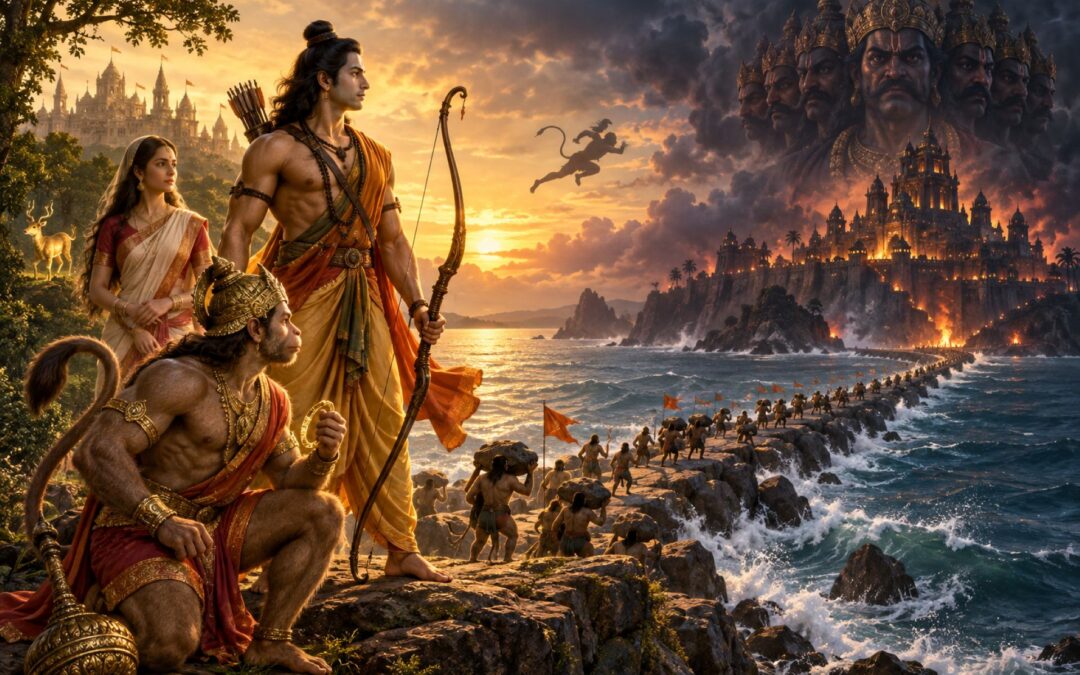
Few works have shaped the imaginative, religious, literary, and moral worlds of South and Southeast Asia as deeply as the Ramayana. Its central story is familiar even to many people who have never read it: Prince Rama loses his kingdom, goes into exile with his wife Sita and brother Lakshmana, discovers that Sita has been abducted by the rakshasa king Ravana, forms an alliance with Hanuman and the vanaras, crosses the ocean to Lanka, defeats Ravana, and eventually returns to rule Ayodhya. Reduced to those events, the Ramayana can look like a straightforward heroic epic about virtue defeating evil.
The complete work is considerably more difficult and more interesting. Rama’s defining commitment is not simply goodness but dharma: acting according to obligations arising from family, promises, kingship, social order, personal honor, and cosmic purpose. Those obligations frequently reinforce one another, but at the decisive moments they collide. The prince who accepts fourteen years of exile because his father’s word must be honored later becomes the king who sacrifices his domestic happiness because he believes a ruler cannot ignore the suspicions of his subjects. What makes Rama exemplary in one situation can make his conduct devastating in another.
Sita’s story creates an equally important counterpoint. She chooses exile rather than separation from Rama, challenges his reasoning when she disagrees with him, resists Ravana throughout her captivity, refuses to let Hanuman simply carry her away, survives a public ordeal after the war, raises her sons outside Ayodhya after being abandoned, and finally refuses to submit endlessly to human judgment. Hanuman, Bharata, Lakshmana, Vibhishana, Tara, Vali, Kaikeyi, Dasharatha, Ravana, and others complicate the moral landscape further by embodying different kinds of loyalty, ambition, grief, resistance, and duty.
Spoiler warning: this article covers the entire seven-book Ramayana, including Ravana’s death, Sita’s fire ordeal and later exile, the stories of Lava and Kusha, Sita’s final departure, Lakshmana’s death, and Rama’s own departure from the world.
The version summarized here is specifically the Ramayana of Valmiki represented by the scholarly Baroda Critical Edition, not a composite assembled from later Sanskrit works, Tulsidas’s Ramcharitmanas, Kamban’s Tamil epic, regional traditions, television adaptations, children’s retellings, or popular folklore. That distinction matters because some scenes now widely assumed to belong to “the Ramayana” are absent from the critical Valmiki text, while portions of the Valmiki epic that are often omitted from popular retellings radically change its ending.

What Text Is This? The Valmiki Ramayana and the Critical Edition
The title Ramayana can misleadingly sound as though it identifies one stable book in the modern sense. In reality, the Rama story has existed in many textual, oral, dramatic, devotional, artistic, and regional forms for centuries. The Sanskrit epic traditionally attributed to Valmiki is foundational, but it is not identical to later versions in Sanskrit or the many Ramayanas composed in Tamil, Awadhi, Bengali, Telugu, Malayalam, Jain, Buddhist, Southeast Asian, and other traditions. The wider scholarly overview of the Ramayana tradition therefore treats Valmiki’s epic as the center of a much larger history of retelling rather than as the only legitimate form of the story.
There is also no meaningful modern-style “publication year” for Valmiki’s Ramayana. The epic emerged in ancient India through a long history of composition, recitation, transmission, redaction, and textual development. Traditional attribution names Valmiki as the poet, and the work itself places Valmiki inside its narrative, but scholarship cannot establish a single moment when one historical author completed and published the exact seven-book text now available. Different portions of the epic also show signs of different compositional histories.
That problem became particularly important because surviving manuscripts do not all contain precisely the same text. Regional recensions preserve additions, omissions, reordered material, and variant readings. In the twentieth century, scholars at the Oriental Institute in Baroda attempted to reconstruct a critically edited text by comparing the manuscript evidence and selecting readings that could most plausibly represent an earlier recoverable form. The result is the Baroda Critical Edition, whose complete electronic Sanskrit text makes all seven books available for direct comparison.
The Critical Edition is therefore not “Valmiki’s original manuscript.” No such manuscript survives. It is a scholarly reconstruction produced by comparing divergent manuscript traditions and separating a critically established text from passages judged later or insufficiently supported. That distinction is essential because the familiar received Ramayana is often said to contain about 24,000 verses, whereas the Critical Edition used here contains 606 sargas, or chapters, and 18,670 shlokas.
For English readers, the principal anchor for this article is The Rāmāyaṇa of Vālmīki: The Complete English Translation, published by Princeton University Press in 2021. Edited by Robert P. Goldman and Sally J. Sutherland Goldman and drawing on the multi-volume scholarly translation project completed over several decades, it presents the unabridged translation of the Critical Edition in one volume. It is particularly valuable because it allows the whole work to be read as one epic while retaining the textual decisions of the critical Sanskrit edition.
Even the Critical Edition, however, does not remove every historical difficulty. Scholars have long regarded significant portions of the Bala Kanda and Uttara Kanda as relatively late layers when compared with the central narrative of Books II through VI. Their treatment of Rama’s divinity, their interest in large genealogical and mythological frameworks, and their structural relationship to the central exile-and-war story contribute to that judgment. Calling them simply “fake,” however, would badly oversimplify the evidence.
Both books are deeply embedded in the transmitted seven-book Ramayana. Bala Kanda explains the composition of the poem, Rama’s birth, his first heroic acts, his marriage to Sita, the history of Vishvamitra, the descent of the Ganga, and the dynastic and divine background to everything that follows. Uttara Kanda supplies Ravana’s history, explains important boons and curses retrospectively, recounts Rama’s reign after the coronation, narrates Sita’s abandonment and final departure, introduces Lava and Kusha as performers of the Ramayana, and carries Rama himself to the end of his earthly life. Removing those books may produce a text closer to one hypothesized earlier narrative stage, but it does not produce the complete seven-book epic reviewed here.
The article therefore follows a simple rule: when the Critical Edition differs from popular memory, the Critical Edition controls the summary. Famous elements from later traditions are not silently imported. Most notably, there is no need to insert a magical “Lakshmana Rekha” around Sita’s dwelling simply because later culture has made the image famous, nor should later devotional embellishments involving Shabari or Hanuman be treated as scenes from Valmiki when they are not present in the selected text.
With that textual boundary established, the Ramayana can be read on its own terms. Its seven books form a movement from the making of the hero, through political catastrophe and forest exile, into abduction, alliance, reconnaissance, war, apparent restoration, and finally a second tragedy that reopens nearly every question the first six books seemed to have resolved.
Bala Kanda: How Rama’s Story Begins
The Ramayana begins not with Rama’s birth but with a question about whether such a man as Rama can exist. The sage Valmiki asks Narada whether there is anyone alive who combines an extraordinary range of virtues: courage, truthfulness, self-command, knowledge, gratitude, adherence to vows, compassion, beauty, strength, and the capacity both to know what is right and to act upon it. Narada answers by naming Rama and gives Valmiki a compressed version of the story that the epic itself is about to expand.
This opening matters because it frames the poem as an investigation of ideal humanity before it becomes a narrative of divine incarnation. Rama is introduced as the answer to an ethical question. The story that follows then tests that answer under conditions in which virtue is rarely as simple as the catalogue of qualities in Narada’s description might suggest.
Soon afterward, Valmiki goes to the Tamasa River with his disciple Bharadvaja. There he sees a pair of krauncha birds together. A hunter kills the male, and the surviving bird cries out in grief. Valmiki, shocked by the needless destruction of a loving pair, spontaneously utters a metrically shaped curse against the hunter. The connection between shoka, grief, and shloka, verse, becomes part of the traditional understanding of how Sanskrit epic poetry begins: suffering is transformed into ordered language.
Brahma then appears and instructs Valmiki to compose Rama’s complete story. The divine guarantee given to the poet establishes that he will know hidden as well as public events. Valmiki composes the epic and later teaches it to the twin boys Lava and Kusha, who perform it in melodious recitation. The poem therefore begins by imagining itself not merely as written narrative but as remembered, taught, sung, and heard.
The political story opens in Ayodhya, capital of Kosala, where King Dasharatha rules successfully but suffers from one dynastic crisis: he has no sons. Without an heir, even an apparently prosperous kingdom faces uncertainty. Ritual specialists advise him to undertake the appropriate sacrifices, including the horse sacrifice and the rite associated with obtaining sons.
At the same time, the gods face a larger crisis. Ravana, the powerful ruler of Lanka, has obtained boons that protect him against many classes of divine and supernatural beings. Secure in this protection, he terrorizes gods, sages, and other beings. Because Ravana did not consider human beings worth including fully within his protections, Vishnu agrees to enter the human world through Dasharatha’s sons.
The sacrificial rite produces a divine preparation that is distributed among Dasharatha’s queens. Kausalya gives birth to Rama, Kaikeyi to Bharata, and Sumitra to the twins Lakshmana and Shatrughna. The brothers form especially strong pairs: Lakshmana becomes intensely attached to Rama, while Shatrughna is closely attached to Bharata. The cosmic struggle with Ravana is thus placed inside a family before any of the princes understands the role he will play.
The gods also arrange the births of powerful vanara heroes who will later become Rama’s allies. The epic’s apparently separate worlds—human kingdoms, divine beings, forest peoples, sages, vanaras, and rakshasas—are therefore connected long before the characters encounter one another. Rama’s future army is, in mythic terms, being prepared alongside him.
Years later the sage Vishvamitra arrives at Dasharatha’s court and asks the king to send Rama to protect a sacrifice disrupted by rakshasas. Dasharatha is appalled. Rama is still young, and the king initially offers himself and his own army instead. Vishvamitra insists, and Vasistha persuades Dasharatha that entrusting Rama to so powerful a sage is not reckless but appropriate.
Lakshmana accompanies Rama, establishing a pattern that will define most of the epic. The princes leave the protected environment of Ayodhya and enter a world in which royal strength, ascetic power, supernatural weapons, and demonic violence overlap. Vishvamitra teaches them sacred knowledge and begins transferring to Rama the abilities needed for the larger destiny that awaits him.
One of Rama’s first major tests is Tataka. Vishvamitra tells him that the dangerous female being must be killed despite Rama’s hesitation about killing a woman. The episode introduces a question that will recur throughout the epic: when an act that normally seems wrong is declared necessary by a higher duty, who has authority to make that determination? Rama accepts Vishvamitra’s judgment and kills Tataka.
Vishvamitra then grants Rama an extraordinary arsenal of celestial weapons, along with the knowledge necessary to summon and dismiss them. Rama and Lakshmana protect the sage’s sacrifice. When Maricha and Subahu attack, Rama kills Subahu and hurls Maricha far away rather than killing him. Maricha survives this encounter and will return much later, when Ravana needs an accomplice capable of separating Rama from Sita.
The journey continues toward Mithila, but Bala Kanda repeatedly interrupts the forward movement with embedded histories. These stories are not arbitrary decorations. They create the mythic and genealogical world into which Rama has been born, while also showing how present landscapes are saturated with earlier acts of violence, sacrifice, asceticism, desire, curses, and restoration.
Vishvamitra’s own history occupies a central place among these digressions. He was originally a king, not a brahmin sage. His encounter and rivalry with Vasistha—especially the conflict over Vasistha’s miraculous cow—reveals that royal force cannot simply overpower ascetic spiritual authority. Humiliated, Vishvamitra turns increasingly toward austerity, but his progress is repeatedly complicated by anger, pride, desire, rivalry, and divine interference.
Stories such as those involving Trishanku, Sunahshepa, Menaka, and Rambha show Vishvamitra gaining immense spiritual power while still struggling to master himself. His transformation into a brahmarshi is therefore not a quick conversion but a long contest between external power and internal discipline. The same epic that celebrates Rama’s physical strength repeatedly insists that the ability to restrain oneself may be more difficult than the ability to defeat an enemy.
Another major embedded cycle concerns King Sagara and the descent of the Ganga. Sagara’s sons, searching for a sacrificial horse, excavate the earth and eventually encounter the sage Kapila, whose fiery spiritual power destroys them when they confront him improperly. Their descendants cannot complete the rites needed for their release until Bhagiratha performs extraordinary austerities to bring the celestial Ganga down to earth.
The descent itself requires mediation. The river’s force would be too destructive if it fell directly, so Shiva receives it in his hair and regulates its passage. Ganga then follows Bhagiratha until her waters reach the ashes of Sagara’s sons, enabling their liberation. The story gives sacred geography a narrative history and shows again how tremendous power—whether royal, ascetic, divine, or natural—must be disciplined if it is to restore rather than destroy.
Near Mithila, Rama encounters Ahalya at the hermitage of Gautama. Her story concerns Indra, sexual deception or transgression, Gautama’s curse, isolation, and eventual restoration when Rama arrives. Different Ramayana traditions and later interpreters have treated Ahalya’s responsibility in very different ways, making the episode one of the story tradition’s enduring sites of debate. For the immediate narrative, Rama’s arrival ends a long state of punishment and restores Ahalya to the social and sacred order associated with her husband and hermitage.
At Mithila, King Janaka introduces a different royal ideal from Dasharatha’s. He explains Sita’s extraordinary origin: she was discovered as an infant while he was ploughing the earth in connection with a ritual, giving her a direct symbolic relationship to the Earth itself. That connection will become decisive only at the end of Uttara Kanda, when Earth again becomes the ultimate witness to Sita’s identity and purity.
Janaka has made Sita’s marriage dependent on the ability to handle a tremendous bow associated with Shiva. Kings and princes have failed even to manage it. Rama lifts and bends the bow so powerfully that it breaks, transforming a marriage test into a spectacular revelation of strength.
Rama marries Sita, but the dynastic alliance extends across both families. Lakshmana marries Urmila, Bharata marries Mandavi, and Shatrughna marries Shrutakirti. The four brothers are therefore joined to four women of Janaka’s extended family, reinforcing the sense that the epic’s great political and cosmic conflicts are rooted in households and marriages.
The journey home produces one final confrontation. Parashurama, the terrifying brahmin warrior associated with the destruction of kshatriya rulers, appears enraged by the breaking of Shiva’s bow and challenges Rama with another divine weapon. Rama accepts the test and demonstrates superiority. Parashurama recognizes the power before him and withdraws.
By the end of Bala Kanda, Rama has already killed dangerous beings, mastered supernatural weapons, protected sages, restored Ahalya, broken Shiva’s bow, married Sita, and surpassed Parashurama. Yet the book has protected him from the hardest kinds of suffering. His great moral trials begin only when the struggle shifts from monsters and tests of strength to parents, promises, inheritance, marriage, and political legitimacy.
Ayodhya Kanda: The Coronation That Becomes an Exile
The scholarly translation and commentary on the Ayodhya Kanda makes especially clear why this book is the political and emotional beginning of the epic’s central narrative. No external villain causes the catastrophe in Ayodhya. Ravana is nowhere near the court. The disaster arises from legitimate institutions—inheritance, marriage, royal promises, paternal affection, and the binding force of a king’s word—becoming impossible to reconcile.
Bharata and Shatrughna have gone to the kingdom of Kekaya with Bharata’s maternal relatives when the aging Dasharatha decides that Rama should be installed as heir. Rama is admired by the people, trusted by the court, and evidently qualified. Dasharatha also feels the urgency of age and ominous signs, so he wants the consecration completed quickly.
Ayodhya erupts in celebration. Rama himself receives the news without triumphant ambition and prepares for the ritual responsibilities of succession. His position seems secure because his fitness is not seriously disputed by the court or population.
The crisis begins with Manthara, Kaikeyi’s hunchbacked attendant. Seeing the city preparing for Rama’s consecration, she persuades Kaikeyi that Rama’s elevation will ultimately reduce Bharata and Kaikeyi’s own status. Kaikeyi initially shows no hostility toward Rama, which makes Manthara’s intervention crucial: resentment must be cultivated before it can become political action.
Manthara reminds Kaikeyi of two boons Dasharatha owes her from an earlier occasion when she aided him. Kaikeyi enters the anger chamber, removes her ornaments, and waits for Dasharatha. The king, alarmed by her condition and eager to satisfy her, renews his promise before learning what she will demand.
Kaikeyi asks for Bharata to be installed as heir and for Rama to be banished to the forest for fourteen years. The second demand is essential. Merely postponing Rama’s coronation would leave him in Ayodhya as an overwhelmingly popular alternative to Bharata. Fourteen years of absence gives Bharata time to establish an uncontested reign.
Dasharatha is shattered. The promises that mark him as a truthful king become instruments of his destruction as a father. He begs, protests, condemns Kaikeyi, and tries emotionally to escape the consequences of his own word, but Kaikeyi insists that a king who has publicly committed himself cannot retreat when the requested payment becomes painful.
Rama is summoned into this scene without initially knowing what has happened. Kaikeyi eventually tells him the conditions when Dasharatha cannot bear to speak them clearly. Rama’s response astonishes nearly everyone around him because he does not treat the demand as an injustice to be contested. If his father’s promise requires his exile and Bharata’s elevation, Rama will go.
That obedience does not mean the political arrangement is fair, wise, or harmless. Rama’s choice arises from his understanding of himself as a son whose duty includes preserving his father’s truthfulness. If he refuses the exile, Dasharatha either breaks his word or must attempt to enforce it against Rama. Rama eliminates that conflict by accepting the burden personally.
Kausalya responds very differently. She grieves, protests, and initially resists the logic that Rama should sacrifice himself for Kaikeyi’s ambition. Lakshmana is even more openly enraged. His loyalty to Rama makes him willing to imagine resistance rather than submission, but Rama restrains him.
The first major complication of Rama’s apparent renunciation comes from Sita. Rama initially intends to leave her in Ayodhya, describing the austerities and dangers of forest life. Sita refuses the arrangement. She argues that a wife’s place and destiny are joined to her husband’s and insists that hardship with Rama is preferable to comfort without him.
Sita’s decision is significant because it prevents her from being understood merely as property passed among male authorities. Rama tells her not to come; she argues back until he accepts her choice. She knows that exile will involve bark clothing, rough food, uncertain shelter, and danger, yet she claims the forest as the place where their marriage will continue.
Lakshmana likewise insists on accompanying Rama and Sita. His exile is voluntary in a different sense from theirs: Kaikeyi’s demand does not require him to go, and he is not Rama’s spouse. He chooses service to Rama above the independent life he could have remained in Ayodhya to pursue.
The preparation for departure reveals the cruelty beneath an abstract phrase such as “Rama accepts exile.” Sita must exchange royal clothing for bark garments. Dasharatha cannot control his grief. Kausalya faces separation from her son, and the people of Ayodhya attempt to follow Rama because they do not accept emotionally what the court has imposed legally.
Rama, Sita, and Lakshmana leave in a chariot driven by Sumantra, but Rama eventually arranges to escape the citizens who have followed. The movement away from Ayodhya gradually strips the exiles of their courtly environment. Crossing rivers becomes a recurrent symbol of leaving one social order for another.
At Shringaverapura they meet Guha, the Nishada ruler and devoted friend of Rama. Guha offers support and hospitality, while Lakshmana remains vigilant. The episode expands Rama’s network of relationships beyond royal courts and shows loyalty operating outside the dynastic hierarchy that has just failed him.
The crossing of the Ganga makes the separation from Ayodhya more decisive. Sumantra must eventually return without Rama, while the three exiles move farther into the forest. They visit the sage Bharadvaja and then establish themselves at Chitrakuta.
Back in Ayodhya, Dasharatha’s grief becomes terminal. His present suffering evokes an act from his youth: while hunting by sound, he once shot a young ascetic whom he mistook for an animal at water. Forced to bring the news to the boy’s blind parents, Dasharatha received a curse or prediction that he too would one day die in anguish caused by separation from a son.
The earlier event gives Dasharatha’s death a larger moral structure without making it emotionally mechanical. He is not merely “punished” and removed from the story. His memory forces him to understand his present loss through the experience of parents whose child he had once taken from them accidentally.
Dasharatha dies calling for Rama. The kingdom now faces a constitutional crisis as well as a family tragedy because the intended heir is in exile, the king is dead, and Bharata—the supposed beneficiary of the plot—is absent and ignorant.
When Bharata returns from Kekaya, ominous signs and the strange silence of Ayodhya alert him that something is wrong. He eventually learns that Dasharatha is dead, Rama has been exiled, and Kaikeyi engineered the arrangement so that Bharata could become king. Instead of responding with gratitude, Bharata is horrified.
His condemnation of Kaikeyi is among the strongest reversals in the book. Manthara and Kaikeyi assumed that political advantage for Bharata would naturally be welcomed by him, but Bharata refuses the moral premise of their scheme. Shatrughna’s rage toward Manthara further demonstrates how completely the intended beneficiaries reject what has been done in their name.
Bharata participates in Dasharatha’s funeral rites and then refuses the throne that has become available to him through Rama’s exile. He decides to find Rama and bring him home. A huge party—including royal mothers, ministers, priests, soldiers, and citizens—travels toward Chitrakuta.
The size of the delegation initially alarms the exiles. Lakshmana suspects that Bharata may be coming to secure his kingdom by eliminating Rama, but Rama refuses to accept that interpretation of his brother. The misunderstanding allows the epic to contrast Lakshmana’s fiercely defensive loyalty with Rama’s confidence in Bharata’s character.
When Bharata and Rama meet, their conflict is the opposite of a conventional succession struggle. Bharata wants Rama to take the kingdom; Rama insists that Bharata should obey the arrangement established through Dasharatha’s promises. Each tries to give power to the other.
Their debate draws in competing theories of duty. Bharata argues from rightful succession, the welfare of the kingdom, family order, and the fact that the demand producing the exile was morally perverse. Rama argues that Dasharatha’s word cannot be invalidated merely because fulfilling it causes suffering and that a son’s obligation to his father survives the father’s death.
Jabali enters the discussion with an unusually skeptical argument. He attacks attachment to inherited religious and familial obligations, urging Rama to treat death and kinship more pragmatically and return to the kingdom rather than sacrifice his life to a dead father’s promise. Rama rejects the position forcefully, after which Vasistha places the question within dynastic and religious traditions of kingship.
The importance of the scene lies partly in the fact that the epic permits these objections to be voiced. Rama’s decision is not presented as the only argument anyone could possibly make. Bharata, Jabali, the royal mothers, and others each reveal costs that Rama’s chosen duty does not erase.
Rama ultimately refuses to return before fourteen years have passed. Bharata then asks for Rama’s sandals. He carries them back as symbols of the rightful king and installs them as the authority under which he will govern.
Rather than rule from the palace as though Rama were gone permanently, Bharata withdraws to Nandigrama and lives austerely while administering the kingdom in Rama’s name. He has found a compromise between two incompatible obligations: Ayodhya cannot remain without government, but he will not present himself as the king who replaced his brother.
The Ayodhya Kanda ends, therefore, without solving the original conflict. Rama remains in exile, Bharata bears a kingship he does not want, Dasharatha is dead, the royal women are bereaved, and the kingdom has been deprived of the accession it celebrated. Yet the brothers’ refusal to turn succession into civil war becomes one of the epic’s clearest images of family loyalty overcoming political incentive.
Aranya Kanda: The Forest and the Abduction of Sita
The Aranya Kanda in the Princeton scholarly translation project moves the epic from political tragedy toward the conflict with Ravana, but it does so gradually. The forest is not simply an empty wilderness waiting for adventure. It contains hermitages, ascetics, dangerous beings, older stories, sacred spaces, competing claims to territory, and moral questions about when Rama has the right or duty to use violence.
Rama, Sita, and Lakshmana leave Chitrakuta and enter the greater Dandaka forest. They encounter the rakshasa Viradha, who seizes Sita and proves difficult to kill because of supernatural protections. Rama and Lakshmana eventually defeat him and dispose of his body in the manner required to release him from the condition in which he has been trapped.
Their movement through the forest brings them among communities of ascetics who describe themselves as victims of rakshasa attacks and look to Rama for protection. This changes the nature of his exile. Although he has renounced the throne and wears the clothing of a forest-dweller, others still recognize him as a kshatriya prince and expect him to perform the protective function of royal power.
Among the important sages they encounter are Sharabhanga, Sutikshna, and Agastya. The hermitages are places of religious practice, but they are also political in the broadest sense because their inhabitants claim protection and expect dangerous beings to be punished. The forest thus becomes a space in which the boundary between ascetic renunciation and royal authority repeatedly breaks down.
Sita recognizes the danger in this transformation. In an important conversation, she cautions Rama against allowing weapons and the warrior mentality associated with them to draw him into unnecessary hostility. Rama has come to the forest because of a vow of exile, not because Dasharatha sent him to conquer it.
Rama answers that he has promised protection to the sages and cannot abandon people who have sought his aid. The exchange does not produce a neat resolution because both positions emerge from recognizable obligations. Sita worries that violence creates its own momentum; Rama believes refusing protection would itself violate duty.
Agastya equips Rama with powerful weapons and directs the exiles toward Panchavati, where they establish a dwelling. There they form a relationship with the aged vulture-king Jatayu, a friend associated with Dasharatha. Jatayu offers to watch over Sita when the brothers are away, and the promise will later cost him his life.
The relative stability at Panchavati ends with Surpanakha, Ravana’s sister. She sees Rama and desires him. Rama deflects her by referring to Sita and jokingly directs her attention toward Lakshmana, who likewise refuses her.
The encounter turns violent when Surpanakha attacks or threatens Sita. Lakshmana mutilates her, cutting off her nose and ears. The scene has enormous later cultural significance, but even within Valmiki’s narrative it is a crucial escalation: an encounter involving sexual desire, mockery, jealousy, and humiliation becomes the immediate cause of wider bloodshed.
Surpanakha seeks help from her rakshasa relatives at Janasthana. Khara sends warriors against Rama and ultimately brings a large force, including Dushana and Trishiras. Rama destroys them in a tremendous battle while Lakshmana protects Sita.
The destruction of the Janasthana force brings Rama to Ravana’s attention in a new way. Reports emphasize both Rama’s extraordinary power and Sita’s beauty. Ravana turns toward a strategy that avoids confronting Rama directly: remove Sita and let emotional devastation accomplish what ordinary battle may not.
Maricha becomes essential because he has already experienced Rama’s power during Vishvamitra’s sacrifice. When Ravana approaches him, Maricha warns repeatedly that abducting Sita will destroy Ravana and Lanka. His fear is not abstract. He remembers the young Rama who hurled him away with a single weapon and understands that the prince has only become more formidable.
Ravana refuses the warning and eventually forces Maricha to cooperate. Maricha assumes the form of an extraordinarily beautiful golden deer and approaches the dwelling at Panchavati. Sita is captivated and asks Rama to capture it for her, alive if possible or at least to bring back its skin.
Lakshmana suspects deception, but Rama pursues the deer. Maricha draws him far away before Rama finally strikes him. As Maricha dies, he uses Rama’s voice to cry out for Sita and Lakshmana.
Back at the dwelling, Sita hears what seems to be Rama in danger and demands that Lakshmana go to him. Lakshmana insists that Rama cannot easily be overcome and recognizes the cry as a possible trick. Sita’s fear then becomes accusation: in her panic she attributes dishonorable motives to Lakshmana and suggests that his refusal may conceal a desire to see Rama dead.
The words wound Lakshmana, but they also achieve what Maricha’s deception requires. He leaves to find Rama. In the selected Valmiki text, the decisive protection lost at this moment is Lakshmana himself; the familiar later image of a magical “Lakshmana Rekha” should not be inserted into the scene as though it were part of this version.
Ravana approaches Sita disguised as a religious mendicant. She extends the hospitality expected toward such a visitor before he reveals his identity and desire. He boasts of himself and Lanka, urges her to accept him, and refuses her rejection.
Sita answers with confidence in Rama and contempt for Ravana’s attempt to make her betray her husband. Ravana abandons persuasion and abducts her by force, carrying her away through the air. Sita cries out to the landscape and to any living beings that might carry news to Rama.
Jatayu hears her and intervenes despite his age. He challenges Ravana, destroys parts of his chariot and fights with remarkable courage, but Ravana ultimately cuts off his wings and leaves him mortally wounded. Jatayu cannot rescue Sita, yet his resistance gives moral weight to an apparently unsuccessful act: loyalty is measured by willingness to act, not only by victory.
As Ravana carries her toward Lanka, Sita drops ornaments in the hope that someone below may see them and later help Rama trace her path. She is eventually imprisoned in Lanka under guard, separated from everyone who might defend her.
Rama and Lakshmana discover the empty dwelling and initially have no idea what has happened. Rama’s response is one of the most important correctives to an overly polished image of him as permanently serene. He searches desperately, questions animals and trees, grieves, rages, imagines catastrophic retaliation, and struggles to regain control.
The brothers find the dying Jatayu and at first briefly suspect him before learning the truth. Jatayu tells Rama that Ravana abducted Sita. Rama mourns him and performs his funeral rites with the respect due to a father-like ally.
The search then produces further encounters that redirect the brothers geographically and narratively. Kabandha, a grotesquely transformed being, is defeated and released from his condition; in restored form he advises Rama to seek an alliance with Sugriva. The exiles also reach Shabari, whose long devotion to her teachers culminates in receiving Rama before she leaves her mortal state.
By the time Rama reaches the region of Pampa, the original terms of exile have become almost unrecognizable. He left Ayodhya to preserve Dasharatha’s promise; now Dasharatha is dead, Sita has been abducted, Rama has destroyed the Janasthana rakshasas, and his only path forward depends on entering a new political world. The story can no longer be solved by endurance alone. Rama needs allies.
Kishkindha Kanda: Hanuman, Sugriva, Vali, and the Search
The scholarly Kishkindha Kanda volume begins with Rama overwhelmed by separation from Sita. The beauty of Lake Pampa intensifies rather than relieves his grief because every attractive feature of the landscape reminds him of the person who is absent. The movement into vanara territory therefore begins with emotional weakness, not military confidence.
Sugriva, meanwhile, is living in fear on Mount Rishyamuka. He has been driven from Kishkindha by his older brother Vali and believes that unfamiliar armed men approaching the region may have been sent to kill him. His first response to Rama and Lakshmana is suspicion.
Hanuman is sent to investigate. Disguised appropriately for diplomatic contact, he approaches the brothers and speaks with such intelligence, control, and refinement that Rama immediately recognizes unusual ability. Before Hanuman performs any of the feats for which he later becomes famous, the epic establishes him as a master of language and judgment.
Hanuman brings Rama and Lakshmana to Sugriva, and the two dispossessed figures recognize their mutual usefulness. Rama needs a network capable of searching vast territories for Sita. Sugriva needs someone powerful enough to defeat Vali. Their alliance is explicitly reciprocal.
Sugriva explains how his relationship with Vali collapsed. A demon named Mayavi once challenged Vali and fled into a cave. Vali pursued him and ordered Sugriva to wait outside. Sugriva remained for a long time, eventually saw blood emerge and heard terrifying sounds, and concluded that Vali had been killed.
Believing the demon might emerge next, Sugriva blocked the cave and returned to Kishkindha. He was installed as king, but Vali had in fact survived and eventually returned. Interpreting Sugriva’s conduct as deliberate betrayal, Vali drove him out and took Sugriva’s wife Ruma, deepening a political conflict into a personal and sexual violation.
Sugriva also explains that he saw a woman being carried through the sky who cried out and dropped ornaments. Rama recognizes the possibility that the woman was Sita. The alliance therefore acquires immediate evidence that Sugriva’s network can connect Rama to the abduction.
Before challenging Vali, Sugriva wants proof that Rama is powerful enough to defeat the brother he fears. Rama demonstrates extraordinary strength, including feats involving the remains associated with the demon Dundubhi and the piercing of multiple sala trees with a single arrow. Sugriva is convinced.
The first challenge to Vali does not go as planned. Sugriva fights his brother while Rama waits to shoot, but the two vanaras look so similar in combat that Rama cannot safely distinguish his ally. Sugriva is badly beaten and escapes furious and humiliated.
Rama explains why he did not shoot and arranges a visible marker so Sugriva can be recognized during a second confrontation. Tara, Vali’s intelligent and politically perceptive wife, warns her husband not to accept the renewed challenge casually. Sugriva’s sudden return after such a decisive defeat strongly suggests that he has acquired powerful support.
Vali refuses to retreat. During the second fight, Rama shoots him from concealment. The act succeeds militarily but immediately creates one of the epic’s most persistent ethical controversies.
The dying Vali does not simply accept that Rama, as the hero, must be right. He challenges Rama’s conduct directly. What quarrel did Rama have with him? Why intervene in a dispute between vanara brothers? Why attack from concealment rather than face him openly?
Rama offers a defense grounded in kingship and moral jurisdiction. He condemns Vali for taking Ruma, Sugriva’s wife, and treats that act as a serious violation. He also presents royal authority as extending beyond Ayodhya’s city boundaries through the Ikshvaku order and argues that punishment need not take the form of a formal duel between equals.
The poem records the defense, but the existence of Vali’s accusation prevents the episode from becoming morally invisible. Rama has restored an ally and punished a ruler whose treatment of Sugriva and Ruma is clearly condemned, yet the method remains troubling enough that later readers have never stopped debating it.
Vali eventually accepts the situation and turns toward the fate of Tara and his son Angada. Tara’s grief is profound, and her earlier political insight gives her lament additional force: she understood the danger but could not stop Vali from walking into it. Sugriva is restored to the throne, and Angada receives an honored position rather than being eliminated as the son of a defeated rival.
The alliance now seems ready to fulfill Rama’s purpose, but the monsoon intervenes. Military movement and long-distance search become impractical. Rama and Lakshmana wait outside Kishkindha while Sugriva returns to royal life.
When the rains end and Sugriva appears slow to act, Rama’s frustration intensifies. Lakshmana goes to Kishkindha in anger, alarming the court. Tara again plays a stabilizing role, helping manage the confrontation and prevent the alliance from collapsing under suspicion and resentment.
Sugriva mobilizes the vanara world on a vast scale and sends search parties in different directions. The search becomes a geographical catalogue, but its narrative function is clear: Sita cannot be found through ordinary local knowledge. The problem requires an organized intelligence network capable of covering the known world.
The southern party includes Hanuman, Angada, Jambavan, and other important vanaras. They search extensively without success and eventually face despair because the time allowed for their mission has been exhausted. Returning without information may mean disgrace or death.
Their breakthrough comes through Sampati, the aged brother of Jatayu. The two bird brothers create a powerful structural link between the abduction and the search. Jatayu sacrificed himself trying to stop Ravana; Sampati, who can perceive over tremendous distances and has his own history of loss, provides the information Jatayu could not live to deliver fully.
Sampati identifies Lanka across the ocean as the place where Sita is being held. The search problem changes immediately. The vanaras now know where she is, but a seemingly impossible physical barrier separates them from her.
The vanara heroes begin estimating how far each can leap. Hanuman does not initially place himself at the center. Jambavan reminds him of powers that have become dormant in his own self-understanding and awakens his confidence.
The book therefore ends not with Rama solving the problem but with another character becoming capable of taking over the narrative. Hanuman has already proved himself an extraordinary speaker and diplomat. He now becomes the one person able to cross the ocean, find Sita, assess Lanka, and return.
Sundara Kanda: Hanuman’s Mission in Lanka
The Princeton Sundara Kanda translation and commentary follows Hanuman so completely that Rama is absent from most of its immediate action. That change in focus is one reason the book feels so distinctive. Hanuman must solve an interconnected series of physical, strategic, psychological, and diplomatic problems without direct guidance from the hero he serves.
Hanuman expands to a tremendous size and launches himself from the mountain toward Lanka. The leap is not a single uninterrupted flight. A sequence of beings tests whether raw strength alone will be enough for the mission.
The mountain Mainaka rises from the ocean and offers Hanuman a place to rest. Hanuman acknowledges the gesture but refuses to delay. Surasa, a serpent-like being sent to test him, demands that he enter her mouth. Hanuman first expands as she expands, then abruptly becomes tiny, enters and exits her mouth, and satisfies the condition through intelligence rather than combat.
Simhika presents a more directly dangerous obstacle by seizing or restraining him through his shadow. Hanuman allows himself close enough to strike and kills her. The three encounters together establish the range of responses that will define his conduct in Lanka: courtesy when courtesy is appropriate, clever adaptation when a contest can be solved without violence, and decisive force when an enemy must be destroyed.
Approaching Lanka, Hanuman reduces himself so that he can enter unnoticed. He encounters the city’s guardian and overcomes her, gaining a symbolic indication that Lanka’s defenses can now be penetrated. He then begins one of the epic’s great reconnaissance sequences.
Lanka is not described as a crude den of monsters. It is magnificent, wealthy, fortified, architecturally impressive, and filled with luxury. Ravana’s moral failure is therefore not explained by material poverty or lack of civilization. He rules an extraordinary capital and possesses immense power, which makes his refusal to govern himself more consequential.
Hanuman searches palaces, chambers, gardens, and sleeping quarters for Sita. The task is more difficult than merely locating a woman because he must identify the specific person he has never met using descriptions supplied by others. His search also forces him to look upon women in intimate settings, which prompts self-scrutiny about whether his mission has caused him to violate his own standards.
At one point beauty and royal appearance create the possibility of mistaken identification, but Hanuman reasons that Sita, separated from Rama and held by Ravana, would not be living in pleasure. His understanding of her character becomes part of the evidence by which he excludes false possibilities.
Eventually he reaches the Ashoka grove and finds a woman whose physical condition, grief, clothing, ornaments, and conduct correspond to what he knows of Sita. She is emaciated by sorrow, surrounded by frightening rakshasi guards, and entirely unwilling to accept Ravana.
Ravana enters and attempts another confrontation. He alternates seduction, self-glorification, threat, and pressure. Sita rejects him. Her physical captivity gives Ravana enormous power over her circumstances, but he cannot obtain the consent that he wants to convert into victory.
Sita’s resistance is verbally forceful as well as emotionally steadfast. She continues to define herself through her relationship with Rama but does not merely wait in silence. She condemns Ravana’s conduct, predicts his destruction, and refuses to let the splendor of Lanka redefine what she values.
After Ravana leaves, the guards continue pressuring Sita. The atmosphere becomes so desperate that death appears preferable to submission. Trijata, however, recounts an ominous dream or vision suggesting Rama’s triumph and Ravana’s defeat, giving the imprisoned Sita a fragile counter-image to the threats surrounding her.
Hanuman now faces one of the hardest problems of the mission. Finding Sita is not enough. He must approach a traumatized woman in enemy territory without frightening her into believing that Ravana has created another disguise or deception.
He begins by speaking of Rama in a way designed to attract her attention and establish shared knowledge. When he eventually reveals himself, Sita remains cautious. Hanuman must prove that he is genuinely Rama’s messenger.
Rama’s ring becomes the decisive token. The object carries more than identification because it gives material form to a relationship that captivity has reduced to memory. Hanuman can say he has seen Rama; the ring makes the connection tangible.
Sita in turn gives Hanuman information and a personal token to authenticate his return. The jewel she entrusts to him and the intimate memories she invokes ensure that Rama will know Hanuman truly reached her. Communication between the separated couple is thus restored through objects carried by the mediator who crossed an impossible distance.
Hanuman then offers a seemingly obvious solution: he can carry Sita back across the ocean immediately. Sita refuses. Her reasons include the physical and moral risks of such an escape, the propriety of contact, the possibility of pursuit, and—most importantly—the public structure of what must happen next.
Ravana did not merely separate Sita privately from Rama; he abducted the wife of a prince and holds her in defiance of Rama’s ability to protect her. For the situation to be truly reversed, Rama must come, defeat Ravana, and recover her openly. A secret extraction could save Sita’s life but would not resolve the conflict as she understands it.
Hanuman could now return with the information he came to obtain, but he chooses to learn more about Lanka’s military response and to make Ravana feel the vulnerability of his own capital. He destroys large portions of the Ashoka grove, provoking successive waves of defenders.
The escalation reveals Hanuman’s terrifying combat power. He kills important rakshasa warriors, including Ravana’s son Aksha, and defeats increasingly formidable forces. The mission that began as stealth reconnaissance becomes controlled provocation.
Indrajit finally uses a powerful divine weapon against him. Hanuman’s relation to divine boons and protections affects what follows, but he also recognizes the strategic opportunity in allowing himself to be captured. Capture brings him directly into Ravana’s court.
Before Ravana, Hanuman speaks not as a helpless prisoner but as an envoy. He identifies himself with Rama and Sugriva’s cause, warns Ravana of the consequences of keeping Sita, and offers him a chance to avoid destruction by returning her.
Ravana wants him killed. Vibhishana intervenes with a legal and political argument: a messenger may be punished in limited ways, but executing an envoy violates accepted norms. Ravana accepts an alternative humiliation and orders Hanuman’s tail wrapped and set on fire.
The punishment misfires spectacularly. Sita learns what is happening and prays for Hanuman’s protection. Hanuman escapes his bonds, uses his burning tail as a weapon, and moves through the city setting structures ablaze.
The triumph is immediately followed by self-doubt. Hanuman realizes that uncontrolled fire may have endangered Sita, meaning his desire to punish Lanka could have destroyed the person he came to save. He refuses to treat successful destruction as automatically wise and seeks reassurance that she has survived.
After confirming Sita’s safety, Hanuman returns across the ocean. The southern party celebrates, and in their exhilaration they descend on the royal Madhuvana grove, consuming its resources and overwhelming its guards. The very fact that they dare such behavior signals to Sugriva that the mission must have succeeded.
Hanuman finally reports to Rama. He has done more than locate Sita. He has established contact, carried proof in both directions, assessed Lanka, tested its defenders, met Ravana, identified Vibhishana as a voice of restraint within the enemy court, demonstrated that the city can be penetrated, and returned alive.
His achievement changes the entire strategic situation. Before Sundara Kanda, Rama knows that Sita was taken south but cannot reach her. After Hanuman’s return, the problem is no longer discovery. It is invasion.
Yuddha Kanda: The War for Lanka, Ravana’s Death, and Sita’s Trial
The scholarly Yuddha Kanda translation is the longest portion of the Critical Edition because victory over Ravana is not accomplished through one decisive battle. The war develops through diplomacy, defection, engineering, reconnaissance, mass combat, supernatural weapons, apparent defeats, recoveries, and the deaths of increasingly important figures on both sides.
Rama receives Hanuman’s account with immense gratitude. The reconnaissance has succeeded beyond expectation, but Hanuman’s description of Lanka makes clear how difficult the next stage will be. The fortress lies across the sea and is protected by a ruler who commands powerful rakshasa armies.
Sugriva mobilizes the vanara forces and the coalition advances south. Meanwhile, Lanka’s internal political crisis deepens. Ravana holds councils in which advisers respond differently to the threat.
Vibhishana repeatedly urges Ravana to return Sita and avoid a war that he believes cannot end well. His position is not cowardice in the ordinary sense; it is a claim that loyalty to a ruler does not require endorsing the ruler’s destructive choices. Ravana increasingly treats disagreement itself as betrayal.
The rupture becomes permanent. Vibhishana leaves Lanka with a small group of supporters and flies to Rama’s camp seeking refuge. The vanara leaders naturally suspect a trap because accepting the brother of the enemy king could expose the entire army.
Rama listens to their arguments but ultimately accepts Vibhishana. His decision becomes one of the epic’s strongest statements about refuge: someone who sincerely comes seeking protection cannot simply be rejected because of previous affiliation. The contrast with Ravana is pointed. Ravana drives away the brother who gives unwelcome but accurate counsel; Rama gains an indispensable ally by accepting him.
The army reaches the sea but has no obvious means of transporting such enormous forces across it. Rama initially attempts supplication and waiting, but when the ocean does not respond, patience gives way to anger. He prepares to compel the sea through destructive force.
The ocean finally appears and explains the nature of the obstacle while directing attention toward Nala, who has the capacity necessary to supervise construction. Under Nala’s leadership, the vanaras build a bridge to Lanka. The crossing represents a shift from miraculous individual heroism to organized collective action: Hanuman could leap the ocean alone, but an army requires infrastructure.
Once the coalition reaches Lanka, diplomacy has not entirely ended. Ravana still has opportunities to return Sita. Intelligence-gathering, spies, envoys, and challenges occur around the opening of battle. Angada, Vali’s son now fighting for Rama and Sugriva, becomes one of the figures who directly confront Ravana’s court.
Ravana refuses compromise. His confidence rests partly on past victories and protections that have made him accustomed to surviving opponents who should have been formidable. The very history that created his greatness has left him psychologically unable to recognize when the conditions supporting that greatness no longer apply.
The war then unfolds through successive waves. Vanaras often fight with trees, rocks, mountains, claws, and bodily strength, while rakshasas employ conventional weapons, magical powers, aerial movement, and supernatural missiles. The contrast makes the battlefield simultaneously archaic, fantastic, and intensely physical.
Important rakshasa commanders fall, but the victories do not make the conflict easy. Ravana’s forces contain warriors capable of changing the battle through extraordinary weapons, especially Indrajit. His name reflects an earlier conquest of Indra, and his battlefield power repeatedly pushes Rama’s coalition toward apparent annihilation.
One of Indrajit’s major attacks binds or incapacitates Rama and Lakshmana through serpent-like divine weaponry. The sight of the brothers apparently defeated spreads despair through the vanara army. Their release requires supernatural intervention associated with Garuda, whose presence breaks the serpentine power.
Ravana himself eventually enters battle and displays the strength that justifies his reputation. He is not a villain kept safely behind subordinates until the last scene. His martial power is real, and defeating him requires the gradual destruction of the network of family members, generals, weapons, and protections that supports him.
The awakening of Kumbhakarna is one of the war’s most memorable episodes. Ravana’s gigantic brother has been subject to an extraordinary sleep connected with the consequences of divine boons. When awakened, he quickly recognizes that Ravana created the disaster by abducting Sita and ignoring good counsel.
Yet Kumbhakarna’s judgment does not lead him to defect as Vibhishana did. He distinguishes between condemning Ravana’s decision and abandoning Ravana in the resulting danger. His loyalty therefore becomes tragic rather than corrective: he fights for a cause he knows has been disastrously led.
Kumbhakarna devastates the vanara army before Rama finally kills him. His death weakens Lanka but also illustrates one of the epic’s recurrent contrasts among brothers. Bharata’s loyalty makes him refuse Rama’s throne; Lakshmana’s loyalty makes him share Rama’s exile; Vibhishana’s ethical loyalty requires leaving Ravana; Kumbhakarna’s familial loyalty requires staying even when he knows Ravana is wrong.
Indrajit remains even more dangerous. He combines martial skill with invisibility, ritual power, deception, and divine weapons. At different stages his attacks leave Rama’s forces incapacitated and force extraordinary recovery efforts.
Hanuman again becomes essential when healing herbs are needed from the distant mountains. Unable to identify the precise plants quickly enough, he carries the relevant mass of the mountain itself back to the battlefield. The episode magnifies his strength, but its narrative function remains service: Hanuman’s greatest feats are repeatedly directed toward enabling others to survive and complete the larger mission.
Vibhishana supplies the knowledge needed to confront Indrajit under conditions where his ritual preparations might otherwise make him nearly impossible to defeat. Lakshmana, accompanied and supported by Vibhishana and others, battles Indrajit and finally kills him.
Indrajit’s death devastates Ravana personally and strategically. Ravana has already rejected Vibhishana, lost Kumbhakarna, and watched major commanders die; now the son who represented Lanka’s most formidable next generation is gone. The consequences of Ravana’s original refusal to return Sita have moved steadily inward from armies to family.
The final phase brings Rama and Ravana into direct confrontation. The battle has cosmic dimensions because divine powers and supernatural weapons converge around the two opponents, but the narrative has also made the duel deeply personal. Rama is fighting the man who abducted Sita; Ravana is fighting after the destruction of the family and military order that his own decision helped bring about.
Ravana is finally killed by Rama. The moment fulfills the divine purpose established in Bala Kanda: the being protected against gods and many supernatural enemies is destroyed through Vishnu’s human incarnation. Yet the epic does not allow Ravana’s death to erase the suffering on the losing side.
Laments follow, including grief from the women of Lanka and from those who loved Ravana despite his actions. Vibhishana must confront the death of the brother he abandoned politically but not emotionally. Rama insists upon appropriate rites rather than treating a dead enemy as outside all human obligations.
Vibhishana is installed as king of Lanka. The political goal of removing Ravana has therefore been completed without annexing Lanka into Ayodhya. Rama’s coalition replaces a ruler, restores Sita, and leaves a legitimate local sovereign in place.
At this point a simpler heroic story would move directly to reunion. Instead the Ramayana creates one of its most disturbing reversals. Sita is brought before Rama after enduring captivity precisely because of her refusal to abandon him, but Rama does not respond only as a relieved husband.
He speaks about public honor and the stain created by her residence in another man’s house. He emphasizes that the war has vindicated his honor and defeated the enemy who insulted him. Sita learns that surviving Ravana has not ended the need to defend herself.
The cruelty of the moment lies partly in the difference between what the reader knows and what public reputation supposedly requires. The narrative has shown Sita resisting Ravana. Hanuman has seen her condition directly. Rama has received evidence of her fidelity. The question is therefore not really whether the story has established her innocence; it has.
Sita responds by condemning the suspicion and ordering a funeral fire prepared. If she has remained faithful in mind and conduct, she calls upon fire to witness the truth. She enters the flames.
Agni returns Sita unharmed. Divine beings appear, and the scene becomes explicitly theological as Rama’s divine identity and larger cosmic role are articulated. Sita’s purity receives supernatural confirmation.
Rama accepts her, explaining his conduct through the necessity that her innocence be publicly demonstrated rather than merely privately known. The explanation has never eliminated the ethical discomfort of the scene. The same problem will return more severely in Uttara Kanda, where public opinion again becomes the justification for separating Sita from Rama despite her already proven fidelity.
With Ravana dead, Vibhishana enthroned, and Sita restored, the victors prepare to return. They use the Pushpaka aerial vehicle, formerly associated with Ravana and Kubera, allowing the journey back to revisit from above many places through which the long exile and search unfolded.
The return also creates a deadline. Fourteen years have passed, and Bharata has been waiting in expectation of Rama’s return. Hanuman is sent ahead to learn the situation and communicate the news.
Bharata has remained faithful to the temporary arrangement established at Chitrakuta. He has not converted custodianship into permanent sovereignty. Rama returns, the brothers are reunited, and the exile finally ends.
Rama is crowned in Ayodhya with Sita beside him. The political order interrupted in Ayodhya Kanda is restored after enormous losses: Dasharatha is dead, the family has endured separation, armies have been destroyed, Jatayu and many allies have died, and Lanka has undergone regime change.
For many retellings, this coronation functions as the natural happy ending. The rightful king returns, the abducted queen is restored, the villain is dead, loyal brothers are reunited, and the celebrated ideal of Rama’s reign can begin. The seven-book Valmiki text refuses to stop there.
Uttara Kanda: Sita’s Exile and the Tragic End of Rama’s Reign
The scholarly Uttara Kanda edition and commentary is indispensable precisely because it destabilizes the triumph at the end of the war. Structurally it is unusual. Instead of simply continuing chronologically from the coronation, it first turns backward and supplies extensive histories of Ravana, the rakshasas, Hanuman, and other figures before returning to Rama’s reign.
Sages come to congratulate Rama after his victory. Their conversations open a long retrospective inquiry: how did Ravana become powerful enough to threaten worlds and require Vishnu’s incarnation as Rama? The answer involves ancestry, boons, austerities, family conflicts, conquest, and the accumulation of curses that prepare the conditions of Ravana’s eventual destruction.
Ravana’s lineage connects him to both brahminical and rakshasa ancestry. His family history links him to Kubera, the wealthy lord associated with Lanka and the Pushpaka vehicle before Ravana’s rise. Ravana’s acquisition of power is therefore not the creation of a kingdom from nothing but the violent reordering of an already significant supernatural and political inheritance.
Ravana, Kumbhakarna, and Vibhishana undertake austerities and receive boons, but the brothers’ desires reveal their different characters. Ravana seeks overwhelming protection and power. Kumbhakarna’s boon becomes entangled with his extraordinary sleep. Vibhishana’s orientation toward righteousness distinguishes him long before his later defection from Lanka.
The retrospective stories also show Ravana conquering enemies, humiliating powerful beings, acquiring the Pushpaka vehicle, and establishing the reputation that later makes warnings about Rama psychologically difficult for him to accept. His confidence in Yuddha Kanda is not baseless. For a long time, aggression has worked.
At the same time, Ravana’s history accumulates limits. Sexual violence, coercion, humiliation of others, and confrontations with powerful beings generate curses and prophecies that narrow his future. The war with Rama can therefore be read both as the direct consequence of abducting Sita and as the eventual convergence of many earlier acts.
Hanuman’s own earlier life receives retrospective development. His childhood power, divine connections, extraordinary capacities, and the circumstances through which awareness of those powers becomes obscured help explain why Jambavan needed to awaken his confidence before the leap to Lanka. Uttara Kanda repeatedly functions in this way: it turns back to supply causes for features the central story has already shown.
The narrative eventually returns fully to Rama’s reign. Rama rewards and dismisses allies from the war, and the new royal order begins. The famous ideal of Rama Rajya is associated with prosperity, justice, order, longevity, and the absence of ordinary calamities under a righteous king.
Yet the very ideal of a ruler responsible to public opinion becomes the mechanism of the next disaster. Reports reach Rama that some subjects question Sita’s place in the royal household because she spent an extended period in Ravana’s captivity. The gossip does not reveal new evidence about Sita’s conduct. It reveals a gap between what Rama knows and what some subjects are willing to accept.
That distinction is crucial. Sita has already resisted Ravana, been located by Hanuman in conditions confirming her loyalty, survived the fire ordeal, and been vindicated by divine witnesses. The narrative does not suddenly discover that Rama has rational grounds to doubt her.
Rama’s concern is reputation. He believes that a king whose household is publicly regarded as dishonorable cannot maintain the moral authority required to govern. His personal knowledge of Sita’s innocence therefore comes into conflict with his conception of public kingship.
Rather than confront the gossip while keeping Sita beside him, Rama chooses the political body over the marriage. He orders Lakshmana to take the pregnant Sita to the forest and leave her near Valmiki’s hermitage. The instruction places Lakshmana in one of the worst conflicts of his life because obedience to Rama now requires harming the woman he has spent years protecting.
Sita initially believes that the journey relates to a desire she had expressed to visit hermitages. Only after they reach the forest does the truth become unavoidable. Lakshmana reveals the abandonment and leaves in anguish.
The repetition is brutal. Sita once freely chose the forest because separation from Rama was unacceptable to her. She now returns to the forest because Rama has chosen separation from her. The first exile affirmed their marriage against political loss; the second makes kingship itself the cause of their separation.
Valmiki receives Sita and knows her innocence. She finds shelter in the ascetic community and gives birth to twin sons, Lava and Kusha. Their upbringing outside Ayodhya produces one of the epic’s deepest ironies: Rama’s heirs grow up under the protection of the poet who composed Rama’s own story.
Valmiki teaches the boys the Ramayana. The framing device from Bala Kanda now enters the chronology of the story directly. The poem the reader has been following becomes an object performed by characters whose own father does not initially recognize them as his sons.
Rama continues to rule, and Uttara Kanda includes episodes designed to explore both the extent and the severity of royal responsibility. Shatrughna, who has occupied less narrative space than Rama, Lakshmana, and Bharata, receives an independent military role through the campaign against Lavana. He defeats the dangerous ruler and participates in the establishment or reordering of royal territory.
Other episodes depict petitioners and crises reaching Rama because a righteous king is expected to be responsible for disorders within the kingdom. The most controversial of these is the story of Shambuka.
A brahmin comes to the king after the premature death of his child. Within the social and cosmological assumptions of the episode, such an unnatural death is interpreted as evidence that some violation of proper order is occurring under Rama’s rule. Rama investigates and discovers Shambuka performing severe asceticism.
Shambuka identifies himself as belonging to a lower social order and describes the goal of his austerity. Rama kills him, after which the disrupted order is restored and the brahmin child revives. The episode presents a social hierarchy in which certain spiritual practices are treated as restricted according to status, and Rama enforces that hierarchy violently.
For many modern readers—and for many readers within the long history of Ramayana interpretation—the episode is morally abhorrent. It cannot responsibly be softened into a generic story about “maintaining dharma.” The specific content of the order being maintained matters, and the story reveals how the epic’s model of righteous kingship can depend upon hierarchical assumptions that modern egalitarian ethics reject.
Rama eventually undertakes an ashvamedha, a great royal horse sacrifice associated with sovereignty. Because Sita is absent, ritual arrangements address the missing queen in symbolic form rather than restoring her immediately to the court. The public ritual of kingship thus continues even while the central royal marriage remains broken.
Lava and Kusha come into the setting of Rama’s sacrifice and perform the Ramayana. Rama hears his own life narrated as epic. The scene collapses distinctions among protagonist, audience, history, poetry, fatherhood, and political memory.
The boys’ resemblance and identity gradually become important. Rama learns that they are his sons and that Sita has been living under Valmiki’s protection. The possibility of public restoration appears, but once again Sita’s truth is made dependent upon public demonstration.
Valmiki brings Sita before the assembly and testifies to her purity. Rama does not need private persuasion; his stated problem remains public acceptance. Sita is therefore placed before yet another audience.
This time she does not enter fire. She calls upon the Earth, her primordial mother, to receive her if she has remained faithful to Rama. The Earth opens, a divine throne or manifestation receives her, and Sita disappears from the human world.
The action is both vindication and refusal. Sita proves what the narrative has already proven repeatedly, but she does so in a way that removes her permanently from the social order demanding proof. Rama cannot simply restore her after the demonstration because the witness has taken her beyond his reach.
Rama reacts with grief and anger, at one point wanting the Earth to return Sita. Divine intervention reminds him of the larger structure of his existence. Yet the emotional result is not undone by theology: Sita is gone.
The epic continues beyond her departure. Rama remains king for an immense period in the mythic chronology, arranges the futures of descendants and territories, and moves toward the end of his own earthly role.
The final catastrophe begins when Kala, Time or Death in personified form, comes to Rama with a message under strict conditions of secrecy. Rama must ensure that no one interrupts their private conversation, and the penalty attached to interruption is severe. Lakshmana is placed at the entrance and charged with protecting the meeting.
Then the sage Durvasa arrives and demands immediate access to Rama, threatening catastrophic consequences if he is denied. Lakshmana now faces an impossible choice. If he allows interruption, the condition governing Rama’s meeting is broken; if he refuses Durvasa, the sage’s curse may destroy many others.
Lakshmana chooses the action that protects the larger community. He interrupts Rama, knowing what that means for himself. The brother whose adult identity has consisted of remaining beside Rama now sacrifices that relationship in obedience to a duty that leaves no harmless option.
Rama must respond to the broken condition. The language surrounding abandonment, renunciation, or death connects political obligation with the destruction of his last intimate companionship. Lakshmana departs and gives up mortal life.
Sita and Lakshmana are now both gone, each in circumstances produced by Rama’s commitment to obligations larger than private attachment. The parallel deepens the tragedy of the final book. Rama’s perfect kingship has not protected him from loss; it has become inseparable from the mechanisms producing it.
Rama decides that his own earthly rule should end. Succession and territorial arrangements are made so that the political order can continue. Bharata and Shatrughna remain tied to him in the final movement, while different allies receive destinies appropriate to their own divine or supernatural identities.
Rama walks toward the Sarayu accompanied by brothers, followers, and beings who choose to depart with him. The final movement is simultaneously royal renunciation, death, apotheosis, and return. Rama’s human life resolves into his divine identity as Vishnu.
The seven-book Ramayana therefore does not end with the coronation that restored everything apparently lost. It ends after restoration itself has been tested and found unable to preserve the domestic happiness of the restored king. Ravana is defeated, but the hardest suffering in Rama’s life does not end with Ravana.
That fact changes the meaning of the whole epic. The central tragedy is no longer only that evil disrupts a good order. It is also that an ideal order, defined through uncompromising obligations, can exact terrible costs from the people most committed to it.
The World of the Ramayana: Kingdoms, Forests, Vanaras, Rakshasas, and Gods
The Ramayana moves across a world in which political geography, sacred geography, and supernatural geography are inseparable. Ayodhya, Mithila, Dandaka, Kishkindha, Lanka, mountains, rivers, hermitages, and oceans are not neutral backdrops. Each environment changes what kinds of authority matter and what forms of conduct become possible.
Ayodhya represents organized royal order. Dasharatha’s court contains queens, priests, ministers, military power, succession customs, ritual specialists, citizens, servants, and dynastic memory. Yet the events of Ayodhya Kanda demonstrate that institutions do not prevent crisis. In fact, promises and succession rules help produce it.
Mithila presents a related but distinct form of kingship under Janaka. Its importance lies partly in its association with Sita and with a ruler strongly connected to religious wisdom in later tradition. In the immediate epic narrative, Mithila is where dynastic marriage transforms Rama’s life and where Sita enters the story as both royal daughter and child of the earth.
The forest initially appears to be the opposite of the city, but it has its own institutions. Ascetics live in organized hermitages, maintain sacrificial fires, observe rules, teach traditions, and exercise forms of supernatural authority capable of rivaling kings. Vishvamitra and Vasistha show that spiritual power can resist or overwhelm ordinary military power.
Dandaka also contains rakshasa populations whose relationship with the ascetic settlements is represented as violent and antagonistic. Rama enters that environment as an exile but is immediately treated as someone still obligated to provide kshatriya protection. The social identity he tries to leave behind follows him into the wilderness.
Kishkindha expands the political world beyond human kingdoms. Sugriva and Vali occupy a recognizably royal framework involving succession, territorial authority, spouses, alliances, ministers, and heirs. The vanaras are fantastical beings capable of extraordinary feats, but their political problems—fraternal rivalry, disputed legitimacy, exile, restoration, and alliance—mirror problems already seen among humans.
Lanka is still more striking because the home of the rakshasas is not represented merely as barbarous chaos. Hanuman discovers immense wealth, beautiful architecture, elaborate fortification, military organization, luxury, ritual activity, family hierarchy, and sophisticated political debate. Ravana rules a civilization.
That complexity matters morally. If Lanka were only monstrous disorder, Ravana’s defeat would require little explanation beyond species conflict. Instead the epic shows a ruler who possesses extraordinary resources, intelligence, learning, courage, relatives capable of ethical argument, and a magnificent capital, yet cannot control the desire and pride that lead him to Sita.
The category “rakshasa” itself should not be treated as though it maps neatly onto a modern racial or ethnic identity. In the epic world it belongs to a supernatural and mythological taxonomy. Rakshasas may change form, fly, employ magical powers, eat humans, fight gods, engage in ritual, govern cities, fall in love, give good advice, act honorably, or act monstrously. Vibhishana alone makes any simple equation of rakshasa identity with evil impossible.
The vanaras likewise resist reduction to zoological realism. Popular English often calls them monkeys, and the epic gives them simian characteristics, but they inhabit a mythic category with divine ancestry, human-like speech, organized kingdoms, vast strength, shape-changing capacities, and intelligence ranging from comic exuberance to Hanuman’s extraordinary diplomacy. Attempts to convert them straightforwardly into a historically identified human tribe move beyond what the literary text itself establishes.
The gods are not remote abstractions. They intervene in births, boons, weapons, tests, cosmic balances, and the final recognition of Rama’s nature. Yet divine intervention does not make the human story emotionally irrelevant. Characters grieve, deliberate, make mistakes, and argue even when the audience is aware of a larger cosmic design.
Boons and curses operate almost like another legal system layered over political reality. A being’s present capacities may be determined by promises or protections granted long ago, while an apparently invincible figure may contain one overlooked vulnerability. Ravana’s relationship to human beings is the decisive example: protections obtained against more obviously powerful classes of enemy leave open the form in which Vishnu can confront him.
Divine weapons create another structure of controlled power. They are not simply upgraded arrows. They come with origin stories, rules, ritual knowledge, appropriate occasions, and sometimes dangerous consequences if misused. Vishvamitra’s transfer of weapons to Rama therefore marks entry into a world in which martial authority depends upon knowledge and discipline, not only physical strength.
Sacrifice links nearly every social level. Dasharatha’s sacrifice produces heirs. Vishvamitra’s sacrifice requires protection. Janaka’s ritual setting is associated with Sita’s discovery. Royal consecration legitimizes kings. Rama’s later ashvamedha displays sovereign authority. Ritual is thus never confined to private spirituality; it is embedded in reproduction, kingship, territory, hierarchy, and political legitimacy.
Nature itself frequently functions as more than scenery. Rivers mark transitions. Mountains become places of refuge, launch sites, repositories of healing plants, and sites of divine power. The ocean seems at first an absolute barrier until Rama’s coalition turns it into a passage. Forests offer both spiritual refuge and mortal danger.
The epic’s world is therefore internally coherent not because every event obeys modern natural laws but because different kinds of power occupy recognizable relationships. Kings have authority, sages have ascetic energy, gods grant boons, vows bind speakers, curses shape futures, ritual affects legitimacy, and uncontrolled desire can bring even a supernaturally protected ruler into conflict with the structure supporting him.
Rama: Ideal Man, Divine Incarnation, and the Burden of Dharma
Rama enters the poem as an answer to Valmiki’s search for a supremely virtuous man. That framing has encouraged centuries of interpretation around the idea of maryada purushottama, the exemplary man who observes proper limits and duties. Yet the narrative becomes most interesting precisely when the requirements associated with such an ideal pull Rama in incompatible directions.
In Bala Kanda, Rama’s virtues appear relatively harmonious. He obeys Dasharatha and Vishvamitra, protects sacrifice, defeats dangerous opponents, respects sages, masters weapons, and wins Sita through strength. The ethical problems are present but do not yet threaten to tear his relationships apart.
Ayodhya Kanda makes self-restraint costly. Rama could plausibly resist Kaikeyi’s demand. He has the population’s support, Lakshmana’s fierce loyalty, Kausalya’s outrage, and later Bharata’s insistence that he return. He chooses instead to preserve Dasharatha’s truthfulness by treating his father’s promise as binding upon himself.
That decision reveals a defining feature of Rama’s morality: he is willing to absorb harm rather than escape an obligation through advantage. The exile deprives him of a kingdom, comfort, status, and eventually his father, yet he refuses to turn personal injustice into political rebellion.
His restraint should not be confused with emotional numbness. When Sita is abducted, Rama does not react as a philosophical ideal untouched by loss. He becomes frantic, grief-stricken, accusatory toward the world, and at times dangerously close to indiscriminate rage.
Those scenes deepen rather than diminish him. Self-control matters because Rama has powerful emotions to control. A hero incapable of anger would gain no moral significance from restraining anger; Rama’s capacity for destruction makes the decision not to unleash it casually meaningful.
The alliance with Sugriva shows another side of his character. Rama can form reciprocal political relationships across cultural and species boundaries. He does not require Sugriva to serve without compensation. He promises to solve Sugriva’s crisis in exchange for help finding Sita.
The Vali episode, however, challenges the idea that Rama’s conduct always appears transparently righteous. Rama kills Vali from concealment while intervening in a conflict that originated inside Kishkindha. Vali’s final accusation is substantial enough that the epic gives Rama space to defend himself.
Rama justifies the act through Vali’s seizure of Sugriva’s wife, through ideas of royal jurisdiction, and through the legitimacy of punishing wrongdoing without the conventions Vali expects from a duel. Readers may find parts of that defense compelling while still judging the method disproportionate or procedurally troubling. The text does not erase the problem merely by allowing Rama the final argument.
His treatment of Vibhishana reveals a more attractive form of political confidence. Other leaders see an enemy prince whose defection could be false. Rama recognizes the danger but gives priority to the obligation created by sincere surrender and refuge.
The decision is strategically brilliant because Vibhishana becomes indispensable, but Rama does not justify it only because the gamble happens to pay off. The moral principle precedes proof of usefulness. That distinction makes the scene important in traditions that read Rama as an ideal protector.
The war with Ravana presents Rama in the role for which the divine plot has prepared him. His martial power is enormous, but the victory requires allies. Hanuman finds Sita, Sugriva supplies armies, Vibhishana provides internal knowledge, Lakshmana kills Indrajit, Jambavan advises, Nala makes the bridge possible, and countless vanaras fight and die.
Rama is therefore central without being self-sufficient. The epic hero succeeds partly because he can become the center of a moral and political coalition. Ravana, by contrast, progressively isolates himself by rejecting precisely the kinds of counsel that might save him.
The most difficult judgment of Rama comes after victory. His response to Sita exposes the difference between heroic rescue and royal reputation. He has fought an enormous war to recover her, yet once she stands before him, he frames the outcome partly as restoration of his own honor.
The fire ordeal is morally troubling because the reader already knows Sita has done nothing that requires proof. Rama’s explanation—that public vindication is necessary—reveals a problem that Uttara Kanda later makes devastating. He allows external judgment to impose demands upon Sita even when his private knowledge should make the truth clear.
The second abandonment is harder still. This time there is no Ravana, no uncertainty produced by battlefield reunion, and no unresolved question after the fire ordeal. Sita is pregnant and living as Rama’s queen when gossip becomes politically threatening.
Rama chooses his understanding of kingship over his duty as husband. From within one theory of royal responsibility, the decision can be represented as extreme self-sacrifice: he gives up the person he loves because a king belongs to the public. From Sita’s perspective, however, the sacrifice is not his alone. She bears the greater material consequence.
This distinction is essential when describing Rama’s “sacrifice.” Powerful people can call an action self-denial even when others suffer most from the decision. Rama loses Sita, but Sita loses her home, husband, public status, security during pregnancy, and the ability to raise her children with their father.
The Shambuka episode complicates the ideal further by showing Rama enforcing a hierarchical social order through lethal violence. The text associates the act with restoration of cosmic and royal correctness. A modern reader need not accept the moral legitimacy of the hierarchy simply because the narrative encodes it within dharma.
The end of Rama’s life intensifies the pattern of competing duties. Lakshmana’s interruption of the meeting with Kala forces Rama into another situation where keeping a condition means losing someone he loves. Lakshmana sacrifices himself, and Rama soon relinquishes his own earthly rule.
The divine dimension complicates all of this without cancelling it. In some layers of the epic, Rama operates overwhelmingly as a human prince whose extraordinary virtue and strength make him exceptional. Elsewhere the identity with Vishnu is explicit and the war is part of a cosmic strategy.
If Rama is read only as a god acting out a predetermined mission, many of the epic’s emotional and ethical debates become strangely empty. Why argue with him, why watch him grieve, and why give Vali or Sita such forceful voices if every decision is simply divine perfection beyond scrutiny? The poem’s literary power depends upon allowing Rama’s conduct to be experienced within human relationships even when theology frames him cosmically.
If he is read only as an ordinary political hero, however, another dimension disappears. The epic repeatedly places Rama within a divine architecture explaining why he exists, why Ravana can be killed by him, why gods intervene, and where Rama returns at the end.
The productive tension is therefore not something to eliminate. Rama is simultaneously the exemplar whose actions invite imitation, the political actor whose decisions invite judgment, the suffering person whose grief invites sympathy, and the divine figure whose life is framed within cosmic purpose.
That combination explains why arguments about Rama have never ended. A morally uncomplicated hero would be easier to praise and easier to forget. Rama remains compelling because the epic pushes the ideal of duty so far that readers are eventually forced to ask whether fidelity to one obligation can itself become injustice toward another.
Sita: Agency, Fidelity, Suffering, and Judgment
Sita is frequently summarized as the ideal faithful wife, but that description becomes misleading if “faithful” is allowed to mean passive or voiceless. Her loyalty to Rama is consistent across the epic, yet she repeatedly expresses that loyalty through decisions, arguments, refusals, judgments, and finally an action that Rama cannot reverse.
Her origin already places her outside ordinary biological structures. Janaka finds her while ploughing the earth, and she is therefore both a royal daughter and symbolically a daughter of Earth. The Ramayana does not need to explain this connection constantly for it to matter. Her final departure in Uttara Kanda makes the beginning retrospectively significant.
Sita’s first great act of agency occurs when Rama tries to leave her in Ayodhya. She refuses to let him define marriage as something that can be suspended for the duration of his exile. If Rama’s destiny is the forest, she argues that hers is with him.
The choice transforms the exile. Rama loses a kingdom involuntarily; Sita voluntarily gives up palace life because she considers separation the greater loss. Her determination is strong enough to overcome Rama’s warnings about hunger, rough sleeping, heat, cold, animals, and danger.
Her forest life also reveals that loyalty does not prevent disagreement. She questions Rama’s commitment to fighting rakshasas on behalf of ascetics and worries about the moral effect of carrying weapons. Her argument shows concern that a warrior role may create violence beyond what the original exile requires.
At Panchavati, desire for the golden deer becomes one of her most consequential mistakes in the causal chain of the plot. The fact that Maricha’s form is deliberately supernatural and enchanting matters: the trap is designed to produce exactly such a response. Yet Sita’s insistence sends Rama away and creates the condition Ravana needs.
Her panic after hearing Maricha’s false cry leads to harsher error. Lakshmana tells her that Rama is not likely to be in danger, but she interprets his refusal to leave as evidence of dishonorable motives. The accusations are unjust and wound one of the people most devoted to her.
A serious character analysis should retain that moment rather than converting Sita into flawless victimhood. Agency includes the capacity to act badly under fear. The epic allows Sita to make a grievous accusation without making that mistake responsible for Ravana’s crime; Ravana remains fully responsible for the abduction he has planned.
Once abducted, Sita’s role changes from traveler to prisoner, but not from actor to object. She calls for help, tries to leave a trail through her ornaments, appeals to Jatayu and the landscape, rejects Ravana, and uses language to resist the psychological power he tries to establish over her.
Lanka intensifies the importance of verbal resistance because Sita lacks physical means of escape. Ravana controls the space, guards, and threat environment. What he cannot force is the transformation of captivity into consent.
The more Ravana displays his magnificence, the more Sita’s refusal undermines the kind of victory he wants. If possession of the most beautiful city, enormous military power, wealth, supernatural abilities, and royal status cannot make her choose him, then his external power is exposed as internally limited.
Hanuman’s arrival gives Sita the first genuine opportunity for immediate escape. Her refusal can look puzzling if the story is treated solely as a rescue problem. Hanuman is powerful enough to cross the ocean; why not leave?
Sita understands the conflict more broadly. She fears practical dangers, including pursuit and the possibility that an aerial escape could go wrong. She also considers the propriety of another male physically carrying her and, most importantly, the public honor involved in Rama’s response to Ravana.
She wants Rama to defeat the abductor who has challenged him and rescue her openly. The choice preserves Rama’s martial and political agency, but it also demonstrates Sita’s own interpretation of what justice requires. She is not simply waiting for someone else to make every decision.
The ring-and-token sequence shows how central memory and recognition are to her identity. Ravana has removed Sita from the people who know her socially. Hanuman restores a chain of authenticated knowledge linking her back to Rama.
After the war, however, the problem changes. Sita has survived Ravana but faces suspicion from the husband whose honor she preserved. Her fire ordeal is often described as a test of purity, but narratively her purity has already been demonstrated to the reader.
What needs validation is public perception. Sita is forced to translate known fidelity into spectacle. Fire becomes a witness because ordinary human knowledge is deemed insufficient.
The episode can be interpreted within the epic’s worldview as triumphant vindication: Sita enters the flames and emerges untouched, while divine beings confirm her innocence. That reading is genuinely present. It should not prevent another observation: the vindication is necessary only because the burden of reputational proof has been placed on her.
Uttara Kanda makes the structural injustice unmistakable. Sita can survive Ravana, resist threats, survive fire, receive divine testimony, return as queen, and still be abandoned when gossip appears. There is apparently no finite quantity of proof capable of permanently protecting a woman from a reputational system willing to treat captivity itself as contamination.
Her pregnancy sharpens the cruelty. Rama’s decision does not affect only spouses. It separates the future heirs from their father and transfers the burden of Sita’s protection to Valmiki’s hermitage.
In the forest, Sita does what she has repeatedly done: survives a situation she did not create. She gives birth to Lava and Kusha and raises them within the ascetic community. Her sons become educated, capable, and central to preserving Rama’s own story.
The final assembly creates a striking reversal. Rama’s public reputation once required Sita to leave; now public restoration requires another proof. Valmiki’s testimony should carry enormous spiritual authority, yet Sita herself must still resolve the issue.
Her appeal to Earth is therefore more than another chastity test. Fire returned her to Rama; Earth removes her from the system of judgment altogether. She does not wait to resume palace life after being vindicated.
The finality matters. Earth receives Sita, Rama grieves, and the social world loses the woman it continually required to prove herself. Her last major act asserts truth while refusing indefinite participation in public suspicion.
That does not make Sita a modern individualist rebelling against every traditional role. She consistently defines herself through marriage, fidelity, family, and a moral vocabulary embedded in the epic’s own world. Reading her as though she simply rejects those commitments would be as distorting as reading her as silent obedience.
Her power lies in the fact that she takes those commitments seriously enough to expose their asymmetry. She follows Rama into exile, resists Ravana for Rama, survives public judgment for Rama, and raises Rama’s children after Rama abandons her. When asked once more to validate herself, she turns to a witness older than the kingdom itself.
Sita therefore becomes one of the strongest reasons the Ramayana cannot be reduced to a celebration of Rama’s righteousness. Her story asks what happens to the ideal king’s wife when public dharma and intimate justice diverge. The epic never fully resolves that tension, and Sita’s disappearance ensures that readers cannot easily pretend it has.
Major Characters and Relationships
Rama and Sita dominate the epic, but the Ramayana is built from contrasting relationships. Brothers respond differently to loyalty, wives advise kings who may or may not listen, allies test whether promises survive changes in power, and even Ravana’s household contains multiple models of what devotion to family can mean. These relationships prevent the story’s moral universe from collapsing into a simple division between Rama’s side and Ravana’s side.
They also reveal character through comparison. Bharata’s response to an unwanted throne illuminates Rama’s response to exile; Vibhishana’s willingness to leave Ravana throws Kumbhakarna’s decision to remain into relief; Tara’s accurate political judgment exposes Vali’s pride; Hanuman’s service contrasts with courtiers who flatter destructive rulers. The epic repeatedly asks not merely whether a person is loyal, but what loyalty requires when the person one loves or serves is wrong.
Lakshmana and Bharata: Two Forms of Brotherhood
Lakshmana and Bharata are both exemplary brothers, but they embody almost opposite forms of loyalty. Lakshmana remains physically beside Rama. Bharata serves Rama most fully by staying away from him and governing the kingdom Rama cannot presently rule.
Lakshmana’s identity is defined by immediacy. He follows Rama into exile even though Kaikeyi has not demanded it, builds shelters, keeps watch, fights enemies, counsels Rama, accompanies him through grief, and becomes indispensable in the war. His service is practical, bodily, and continuous.
His strength also contains a danger. Lakshmana is quicker to anger than Rama and frequently interprets threats more aggressively. When Bharata approaches Chitrakuta, Lakshmana imagines hostile motives that Rama rejects. His love can become suspicion of anyone who might endanger the brother around whom he has organized his life.
His relationship with Sita is similarly intense but strained at a critical moment. He protects her, but her accusations after Maricha’s false cry force him into a choice between Rama’s instruction and Sita’s desperate demand. The result enables Ravana’s abduction.
Later, Rama again places Lakshmana between his command and Sita’s fate by ordering him to abandon her. Lakshmana becomes the executor of a decision that causes him anguish. His loyalty leaves little space in which he can refuse Rama without ceasing to be the brother he has chosen to be.
The final Durvasa episode completes that pattern. Lakshmana must either protect Rama’s private meeting or interrupt it to prevent a wider catastrophe. He chooses the larger good and accepts the personal consequence.
Bharata, by contrast, spends most of Rama’s exile physically separated from him. His loyalty is political rather than military. He refuses to convert Kaikeyi’s success into his own legitimacy.
The sandals become the perfect symbol of Bharata’s role. He governs because Ayodhya needs government, but he refuses to erase Rama’s claim. His austerity at Nandigrama makes kingship a form of custodianship.
The comparison between the brothers undermines any idea that devotion has only one correct outward form. Lakshmana serves by following Rama into the forest; Bharata serves by remaining behind. Both subordinate personal advantage, but the duties produced by their positions differ.
Hanuman: Intelligence, Power, and Devotional Service
Hanuman’s popularity can make his physical feats seem like the whole character: he leaps the ocean, devastates Lanka, survives fire, carries a mountain, and becomes one of the war’s strongest fighters. Yet the Sundara Kanda shows that intelligence is at least as important as strength.
His first major contribution is speech. Rama recognizes immediately that the stranger addressing him on Sugriva’s behalf possesses extraordinary command of language. Hanuman can approach unknown armed princes without provoking them, identify their character, and build trust.
In Lanka, every stage of the mission requires judgment. He changes size according to circumstance, avoids unnecessary delay, distinguishes tests from genuine attacks, infiltrates the city, searches without exposing himself, reasons through false identifications, and approaches Sita only after considering how his appearance might terrify her.
Even his violence is usually strategic. The destruction of the grove is designed partly to test Lanka’s response. His willingness to be captured creates access to Ravana. The burning of Lanka is devastating but followed immediately by concern that he may have endangered Sita, showing that Hanuman judges himself by the purpose of the mission rather than by the spectacular scale of the damage he can cause.
His devotion to Rama is therefore not servility. It makes him more resourceful because his ego is not the primary measure of success. A feat matters insofar as it advances Rama’s cause and protects Sita.
That orientation also explains why Hanuman can become greater without needing sovereignty. Sugriva becomes king, Vibhishana becomes king, Rama returns to kingship, and Angada occupies a princely position. Hanuman’s status comes from service rather than possession of a throne.
Sugriva, Vali, Tara, and Angada
Sugriva and Vali provide one of the epic’s clearest negative mirrors of Rama and his brothers. Both pairs face succession and separation, but the outcomes differ dramatically. Bharata refuses to take lasting advantage of Rama’s exile; Vali interprets Sugriva’s temporary rule as betrayal and destroys their relationship.
Sugriva is not morally spotless. Once restored, he becomes absorbed in royal life and delays the search for Sita until Lakshmana’s anger forces renewed urgency. His lapse matters because it tests whether reciprocal alliances survive after one party has already received what he wanted.
Vali is stronger and more charismatic, but strength intensifies the damage caused by pride. His refusal to listen to Tara before the second challenge becomes another example of accurate counsel dismissed by a powerful man confident in past success.
His dying confrontation with Rama gives him more than the role of obstacle. He articulates a plausible accusation about hidden attack and intervention. Even if Rama’s reply is accepted within the epic’s political framework, Vali’s voice ensures that the ethical cost remains visible.
Tara is among the poem’s most perceptive political characters. She understands that Sugriva would not return without new support and tries to stop Vali from rushing into a trap. After his death, grief does not erase her ability to help stabilize the new order.
Angada carries the conflict into the next generation. He is Vali’s son but serves the coalition that restored Sugriva and killed his father. His honored position demonstrates that regime change does not require his elimination, and his later service in the search and war integrates Vali’s lineage into Rama’s cause.
Ravana, Vibhishana, Kumbhakarna, and Indrajit
Ravana is more compelling than a purely chaotic monster because he possesses qualities that could support great kingship. He is powerful, learned, courageous, determined, and ruler of a magnificent realm. What destroys him is not absence of capacity but failure of restraint.
His abduction of Sita expresses the central flaw. Ravana can conquer cities and defeat supernatural opponents, yet he treats another person’s refusal as something that power should eventually overcome. When Sita continues to reject him and advisers warn him, he interprets resistance as an obstacle to dominate rather than information that should alter his conduct.
Vibhishana responds to the crisis through principled dissent. He tells Ravana what the king does not want to hear and eventually concludes that loyalty cannot require participation in destruction. His departure raises a perennial political question: at what point does service to a ruler become complicity?
Kumbhakarna gives the opposite answer. He recognizes that Ravana has behaved disastrously but decides that the time for argument has passed and a brother must now stand beside a brother in danger. His loyalty is emotionally admirable and politically futile.
Neither brother is a simple coward. Vibhishana risks being regarded as a traitor and must place himself at the mercy of former enemies. Kumbhakarna knowingly goes to a battle likely to kill him. The difference lies in what each believes loyalty ultimately serves.
Indrajit represents Ravana’s dynastic future and the concentrated military strength of Lanka. His death therefore matters beyond the battlefield. When Lakshmana kills him, Ravana loses not merely a warrior but the son most capable of sustaining the order Ravana has built.
The family becomes a study in how powerful households respond to a leader’s wrongdoing. One brother leaves, one brother stays and dies, the greatest son dies defending the regime, and the king refuses the action that could have prevented nearly all of it: returning Sita.
Dasharatha, Kaikeyi, and the Royal Family
Dasharatha’s household demonstrates that tragedy can emerge without malicious intention from everyone involved. He loves Rama deeply and intends to secure an orderly succession. Yet promises from his past create the mechanism through which the succession collapses.
Kaikeyi is more complicated than a figure of pure evil. Before Manthara’s intervention, she does not begin from open hatred of Rama. Fear about Bharata’s future and her own status is cultivated until she converts legitimate royal boons into instruments of exclusion.
Her conduct remains destructive, but the consequences exceed what she seems to imagine. Bharata rejects her plan, Dasharatha dies, she becomes morally isolated, and the throne she tried to secure for her son becomes something he experiences as contamination.
Kausalya and Sumitra provide contrasting maternal responses within the household. Kausalya’s grief is centered on the son being taken from her. Sumitra’s relationship to Lakshmana and her understanding of his devotion to Rama help frame his voluntary exile.
Shatrughna occupies less narrative space but completes the four-brother structure. His attachment to Bharata parallels Lakshmana’s attachment to Rama, and Uttara Kanda eventually grants him a military and royal role of his own.
The royal family’s greatest achievement is that catastrophic succession does not become civil war. Every incentive exists for one. Rama has popular legitimacy, Bharata has legal advantage created by Dasharatha’s promise, Lakshmana is willing to defend Rama aggressively, and armies exist on both sides.
Instead, Rama and Bharata each refuse to seize what the other believes belongs to him. The dynasty survives not because its institutions work perfectly, but because the brothers place relationship and duty above the ordinary logic of political competition.
Dharma, Kingship, and Conflicting Duties
“Dharma” is often translated as duty, righteousness, law, right conduct, moral order, or sustaining order, but no single English word captures all the work it does in the Ramayana. More importantly, the epic does not present dharma as a simple rulebook that always supplies one obvious answer. Its hardest scenes arise because multiple claims can each be called dharmic.
Dasharatha must keep his word, but he also has responsibilities as father and king. Kaikeyi has the right to demand promised boons, but the content of her demand is politically and morally destructive. Rama owes obedience to his father, yet Ayodhya needs the heir most citizens want. Bharata owes respect to his mother’s position but believes accepting the throne would make him complicit in wrongdoing.
No single duty can be fulfilled without damaging another. Rama resolves the first crisis by accepting personal loss, but his choice does not restore Dasharatha, Kausalya, Bharata, or Ayodhya to happiness. Dharma prevents one wrong while allowing other suffering to occur.
The forest extends the conflict. Rama has accepted exile and therefore relinquished ordinary royal life, but ascetics still appeal to his kshatriya duty to protect them. Sita worries that taking responsibility for armed protection may turn renunciation into unnecessary warfare.
Both arguments draw on recognizable moral principles. Protecting vulnerable people is good; avoiding violence that one is not obligated to initiate is also good. Rama chooses the first obligation, and the consequences eventually entangle him more deeply in the forest’s conflicts.
Vali’s death raises the issue of jurisdiction. If Rama retains universal or dynastic royal authority even while exiled, he can interpret Vali’s treatment of Sugriva and Ruma as punishable wrongdoing. If the conflict is treated primarily as an internal Kishkindha dispute, Rama’s hidden attack looks more like politically motivated intervention.
The epic gives Rama an answer but does not prevent readers from questioning the assumptions supporting it. The controversy survives because dharma depends partly on who is recognized as having legitimate authority to interpret and enforce it.
Vibhishana’s surrender supplies a different kind of test. Rama’s followers reasonably worry about espionage and security, while Rama gives priority to the obligation to protect someone seeking refuge. Here moral principle and strategic benefit ultimately align.
That happy alignment should not obscure the courage of the initial choice. Rama cannot know with certainty that Vibhishana will prove trustworthy. The duty of protection matters because it must be honored before the outcome confirms that it was useful.
Kingship amplifies these dilemmas because a king’s choices affect people far beyond himself. Bharata recognizes this when he refuses to let Ayodhya remain ungoverned even though he rejects the moral basis of his accession. He develops a temporary form of sovereignty under Rama’s sandals because private purity cannot justify public collapse.
Rama’s later rule pushes public obligation to an extreme. The gossip about Sita confronts him with a real political problem if royal legitimacy depends upon a ruler being perceived as morally exemplary. Yet his response transforms a problem of public perception into punishment of a person he knows to be innocent.
That is one of the central limits of an ethics built around reputation. Reputation can concern moral reality, but it can also diverge from reality. Once public suspicion becomes authoritative regardless of truth, innocence may provide no protection.
The Shambuka episode reveals a second limit: a social order can be internally coherent while resting on assumptions modern readers reject. Rama restores the order recognized by the episode, but the order itself restricts ascetic practice according to hierarchy. Calling the result “dharma” explains the text’s framework; it does not end moral evaluation.
Rama Rajya therefore deserves more careful interpretation than its use as a generic phrase for perfect government sometimes receives. The epic associates Rama’s reign with prosperity and justice, yet Uttara Kanda places Sita’s exile and Shambuka inside that reign. The ideal is powerful precisely because its complications are part of the same textual tradition.
The final Lakshmana episode shows how relentlessly the poem returns to binding conditions. Rama’s meeting with Kala imposes one obligation; Durvasa’s arrival creates another; Lakshmana cannot fulfill both. He chooses the option that protects others and accepts his own destruction.
The pattern extends back to Dasharatha. Promises, boons, vows, declarations, alliances, curses, and ritual conditions repeatedly outlive the moment in which they are spoken. The ethical world of the Ramayana is a world in which language creates obligations that future selves must pay.
The epic’s most lasting treatment of dharma may therefore be its refusal to make righteousness painless. Characters who care about duty suffer not because duty is meaningless but because human beings occupy several relationships at once. The son is also a prince; the husband is also a king; the brother is also a guard; the ally is also a ruler; the dissenter is also a sibling.
No moral vocabulary becomes serious until it confronts those collisions. The Ramayana endures partly because it gives them narrative form.
Gender, Chastity, Reputation, and Social Hierarchy
The Ramayana emerged from a social world whose assumptions about gender, marriage, kingship, caste, family authority, and sexual reputation differ substantially from modern egalitarian ideals. A responsible reading neither pretends those differences do not exist nor treats historical distance as automatic moral exoneration. The text must first be understood accurately and can then be judged.
Sita’s story makes gendered reputation impossible to ignore. Ravana abducts her against her will, yet the social consequences of captivity fall heavily upon her. Her behavior is scrutinized even though the wrongdoing was committed against her.
The fire ordeal illustrates the asymmetry. The narrative has witnessed her resistance, but public restoration requires her body and truthfulness to be tested spectacularly. Rama’s honor is damaged by what another man did to his wife; Sita must restore that honor by proving what she herself did not do.
Uttara Kanda goes further because even supernatural vindication does not permanently settle the matter. Gossip reopens the issue, and Sita loses her place in the palace. A reputational system organized around female chastity can therefore remain unstable regardless of a woman’s conduct.
Ahalya represents another enduring problem of sexual judgment, though different textual traditions interpret the details differently. Her story combines desire or deception, male divine intrusion, spousal punishment, isolation, and restoration. The fact that later Ramayanas repeatedly reshape her responsibility shows how uncomfortable and generative the episode has remained.
Surpanakha occupies almost the opposite position from Sita. She expresses sexual desire directly rather than within marriage, and her approach becomes comic before becoming violent. Her mutilation then triggers a chain that ultimately reaches the war with Ravana.
Later cultures have interpreted the scene in radically different ways—from justified punishment of a dangerous attacker to an example of gendered humiliation whose consequences are disproportionate. The Critical Edition’s narrative context matters, but so does the fact that the punishment inflicted on her is physically sexualized through disfigurement.
Tara and Mandodari complicate any claim that women in the epic exist only to obey. Tara gives Vali accurate political advice that he ignores. Mandodari’s relationship to Ravana, especially around catastrophe and lament, helps reveal that the people closest to powerful men may understand their failures better than the men themselves.
Kaikeyi has enormous political agency, but she uses it destructively. Her example is important because it prevents the issue from becoming “female agency is good.” Agency is simply the capacity to act consequentially; its moral value depends on what is done with it.
The epic’s social hierarchy extends beyond gender. Kings, brahmins, ascetics, forest communities, vanaras, rakshasas, servants, and figures identified through different social categories occupy unequal positions. Some inequalities are presented descriptively, others normatively.
The Shambuka episode is the sharpest case because lethal royal authority enforces a hierarchy of permitted religious practice. Modern readers who reject caste discrimination should not be told that discomfort simply reflects failure to understand ancient dharma. Understanding the episode makes the source of the discomfort clearer.
At the same time, modern categories should not be projected backward carelessly. The epic’s supernatural beings are not straightforward racial groups, and its social vocabulary comes from an ancient ideological world rather than modern bureaucratic caste classification. Precision helps criticism rather than weakening it.
The most fruitful approach is therefore double vision. One asks what a scene means within the epic’s own moral and social grammar, then asks whether that grammar is persuasive. Historical understanding and ethical judgment are different operations, but neither requires suppressing the other.
Exile, Grief, Love, and Devotion
Grief is present before Rama’s adventures begin. Valmiki’s poetic awakening occurs through witnessing the destruction of a pair of birds, and the traditional association between shoka and shloka makes sorrow part of the epic’s account of its own origin. The poem repeatedly converts separation into speech, lament, memory, and eventually story.
The aesthetic importance of pathos has long been recognized in discussion of the epic, including scholarly attention to karuna rasa, the mood of compassion and grief. Heroism matters in the Ramayana, but heroic action is constantly generated by loss.
Dasharatha dies because separation from Rama becomes unbearable. Bharata’s devotion is expressed through refusal to enjoy a kingdom acquired through that separation. Rama’s grief after Sita’s abduction nearly destroys his equilibrium.
Tara’s lament for Vali and Mandodari’s grief for Ravana prevent military victory from making death emotionally one-sided. Jatayu’s death turns an unsuccessful rescue attempt into an intimate loss for Rama. Even enemies inhabit networks of love.
Exile creates the conditions for many of these relationships to reveal themselves. Sita chooses exile because marriage matters more than palace comfort. Lakshmana chooses it because service to Rama matters more than his independent royal life. Bharata accepts a different kind of exile at Nandigrama rather than live as ordinary king.
Hanuman’s devotion is less defined by suffering than by joyous capacity, but the structure is similar. His powers become meaningful because they are directed toward someone beyond himself. The greatest possible strength becomes service.
This is why the epic’s emotional world cannot be reduced to self-denial. Love motivates enormous sacrifice, but it also produces anger, fear, jealousy, suspicion, despair, and grief. Rama’s relation to Sita is meaningful because losing her destabilizes him, not because he floats above attachment.
The ending darkens the motif. Sita’s second exile is no longer chosen for love, and Lakshmana’s final separation is no longer a voluntary journey beside Rama. Forms of devotion that once held the family together are subjected to political and cosmic conditions that tear it apart.
The Ramayana therefore treats love as both strength and vulnerability. A person without attachment cannot be bereaved, but a person without attachment also cannot become Bharata, Lakshmana, Sita, Jatayu, or Hanuman. The poem does not solve that tension by choosing detachment over relationship. It builds its emotional power from the cost of caring.
Power, Violence, and Moral Authority
The Ramayana contains enormous violence, but it rarely treats force as morally neutral. Characters repeatedly claim that violence is authorized because they protect sages, punish wrongdoing, restore rightful rulers, rescue an abducted woman, defend a kingdom, or preserve social order. The analytical question is whether those justifications succeed.
Tataka establishes the pattern early. Rama hesitates over killing a woman; Vishvamitra identifies her dangerous conduct as overriding the ordinary prohibition. The episode teaches Rama that categories such as gender do not necessarily prevent punitive force, but it also establishes the importance of authorized interpretation.
The Surpanakha episode raises proportionality in a different way. She becomes a physical threat to Sita, so intervention is justified within the scene. Mutilation, mockery, and the subsequent escalation nevertheless make it morally more complex than a generic act of self-defense.
Khara’s attack makes Rama’s military response easier to classify because armed forces directly confront him. The scale of his destructive ability becomes clear, and that demonstration is part of what convinces Ravana to adopt indirect strategy.
Vali’s death remains the most obvious challenge before the Lanka war. Rama believes he is punishing serious wrongdoing and assisting a legitimate ally. Vali objects to hidden attack and external intervention.
The scene asks whether moral authority follows automatically from good ends. Restoring Sugriva and condemning Vali’s seizure of Ruma may be legitimate goals while the method still requires defense. That distinction is one reason the episode remains productive.
Rama’s anger at the ocean demonstrates the danger of power detached from immediate human opposition. The sea is an obstacle, not a villain like Ravana, yet Rama contemplates forcing a solution through devastating weapons. The eventual shift toward bridge-building produces a more constructive mastery of the same problem.
The Lanka war itself fits many elements of a just rescue narrative. Ravana has abducted Sita, refuses repeated opportunities to return her, rules through force, and continues fighting after advisers warn him of the consequences. Rama also seeks the recovery of a specific wronged person rather than conquest for its own sake.
Even so, war expands suffering far beyond Ravana. Kumbhakarna, Indrajit, ordinary rakshasa warriors, vanara fighters, families, and civilians become part of the cost. The epic allows lamentation after victory precisely because a justified cause does not make every resulting death emotionally meaningless.
The Shambuka episode then produces a different problem: violence may be fully authorized by the text’s social ideology and still be morally unacceptable to a reader who rejects that ideology. The question is no longer whether Rama has power to enforce order but whether the order deserves enforcement.
This distinction between power and moral authority runs throughout the epic. Ravana possesses extraordinary power without legitimate authority over Sita. Hanuman possesses the power to carry Sita away but accepts her decision not to leave. Rama possesses the power to take Ayodhya through resistance but chooses exile.
The best uses of strength in the Ramayana tend to involve restraint, protection, or service. Its most troubling uses occur when authority becomes confident that its own interpretation of order is sufficient justification for harming someone whose perspective carries less institutional power.
Symbols and Recurring Motifs
The Ramayana does not depend on a closed allegorical system in which every object has one hidden meaning. Its motifs gain force because they recur in different contexts and accumulate associations through narrative use. Landscapes, weapons, objects of recognition, fire, water, and speech become especially important because the plot repeatedly asks how separation can be created, maintained, crossed, or judged.
Several of these motifs also connect distant books. Sita’s relation to Earth begins with her discovery and ends with her return; the forest first signifies chosen exile and later imposed abandonment; fire moves from sacrificial power to destruction and public witness. Their meanings develop rather than remaining static.
Forest and City
The city represents organized society, but it is not automatically safe or just. Ayodhya produces Rama’s exile through royal promises and palace politics. Lanka combines urban magnificence with Ravana’s moral disorder.
The forest removes characters from ordinary court structures but does not eliminate authority. It contains sages, supernatural beings, violence, hospitality, and alternate communities. Rama loses formal kingship there yet continues acting as protector.
Sita’s two movements into the forest are especially revealing. The first is voluntary and expresses marital solidarity; the second is imposed and expresses royal abandonment. The same landscape can therefore signify freedom from court, danger outside society, spiritual refuge, and the place to which society sends someone it cannot accommodate.
Bows, Weapons, and Martial Power
Rama’s relationship to weapons begins before the central conflict. Vishvamitra gives him celestial weapons; Shiva’s bow establishes his strength in Mithila; later weapons determine battles that ordinary physical force cannot resolve.
The bow is never simply masculine decoration. It signifies the ability to bear and direct dangerous power. Rama’s superiority is repeatedly measured not by possession of weapons alone but by mastery over them.
The epic also shows that weaponry changes moral situations. Sita explicitly worries that carrying weapons into forest life may encourage violent conduct. Power alters what a person notices as a possible solution.
Sandals, Rings, and Recognition Tokens
Small objects frequently carry authority that bodies cannot presently exercise. Rama’s sandals allow Bharata to represent the absent king without claiming kingship for himself. They are ordinary personal objects transformed into political symbols.
Rama’s ring performs a parallel function in Lanka. Hanuman’s words alone might be another deception; the ring authenticates a relationship across distance. Sita’s return token then allows Hanuman to authenticate his own success to Rama.
These objects matter because the epic is full of separation. When the person cannot be present, a material sign carries memory, legitimacy, and trust.
Fire
Fire appears throughout ritual life, but its meanings become increasingly difficult. Sacrificial fire connects humans and gods and structures royal or ascetic rites. Hanuman’s burning tail turns fire into a weapon against Lanka.
Sita’s ordeal gives fire yet another role. It becomes divine witness to a truth disputed by social reputation. Fire does not purify her in the sense of correcting actual impurity; narratively, it demonstrates a fidelity the reader already knows.
The motif is therefore double-edged. Fire can sanctify, destroy, illuminate, and judge. Like power itself, its moral meaning depends on context.
Ocean and Bridge
The ocean represents the epic’s largest physical separation. Sita is visible only through knowledge but inaccessible to Rama’s army because water divides the two worlds. Hanuman overcomes the barrier individually through extraordinary capacity.
The bridge solves a different problem. What one hero can cross alone, a community must cross collectively. Engineering, organization, leadership, and cooperation convert impossible geography into shared passage.
That makes the bridge an appropriate symbol for Rama’s entire coalition. The war is won not by solitary perfection but by creating connections among exiled princes, vanara rulers, a rakshasa defector, scouts, engineers, healers, warriors, and messengers.
Boons, Curses, and Binding Speech
Speech in the Ramayana often behaves like action delayed in time. Dasharatha’s old promise to Kaikeyi destroys the succession years later. Ravana’s boons create the conditions under which he feels invulnerable. Curses explain transformations and future limitations.
Alliances also depend upon speech. Rama promises Sugriva a kingdom; Sugriva promises a search. Vows and declarations create expectations that later behavior must satisfy.
This recurrent motif explains why truthfulness matters so intensely. Words are not treated as disposable descriptions of present intention. They establish structures within which future characters may become trapped.
The epic’s tragedies repeatedly begin when a promise made in one set of circumstances survives into another. The speaker changes, the world changes, and the word remains.
Poetry, Narrative Structure, and the Epic’s Textual Layers
The Ramayana is not only a story about Rama; it is a story about the making and transmission of Rama’s story. Valmiki appears at the beginning as the poet who receives the narrative, and he later appears inside the chronology as Sita’s protector and the teacher of Lava and Kusha. The twins then perform the Ramayana before Rama himself.
That self-reference gives the epic an unusual architecture. The hero becomes an audience for his own life while the sons he has not raised become the voices through which that life is publicly preserved. Storytelling becomes part of the resolution of family history.
The traditional origin of the shloka in Valmiki’s grief over the krauncha bird associates form with emotion. Whatever the philological history behind that tradition, the epic presents poetry as the shaping of suffering into speech. That self-understanding fits a work filled with laments.
The poem also preserves qualities associated with oral and performative transmission. Repetition, formulaic descriptions, recurring epithets, speeches that restate circumstances, catalogues, and episodic structures may feel excessive to readers trained on the compressed conventions of the modern novel. They perform different functions in long-form recitation and epic memory.
Embedded stories greatly expand the temporal world. Vishvamitra’s history, Sagara and Bhagiratha, Ravana’s ancestry, curses, boons, earlier battles, and genealogies continually tell the reader that present action is the visible surface of a much older causal network.
The narrative also changes focal emphasis boldly. Sundara Kanda effectively allows Hanuman to become the protagonist for an entire book because the plot requires an agent capable of acting where Rama cannot. Uttara Kanda spends long stretches narrating Ravana’s past after Ravana is already dead.
Speeches are one of the epic’s most important analytical devices. Vali argues against Rama. Bharata argues against exile. Jabali questions inherited obligation. Sita argues about accompanying Rama, about forest violence, about Ravana, and about her own honor. Vibhishana argues with Ravana. The poem often creates ethical complexity simply by allowing a disputed action to be challenged from within the narrative.
Nature description can slow action dramatically, but it also externalizes emotion. Rama’s experience of Pampa is the clearest example: beauty becomes painful because Sita is absent. Landscapes in the epic frequently acquire meaning through the emotional state of those crossing them.
The seven-book structure itself creates a double arc. Bala prepares the hero, Ayodhya destroys the expected succession, Aranya converts exile into abduction, Kishkindha creates alliance, Sundara discovers Sita, and Yuddha defeats Ravana and restores Rama. That six-book movement can appear complete.
Uttara Kanda refuses completion. By beginning partly with retrospective material and then reopening the marriage after the coronation, it changes the genre from heroic restoration toward dynastic and moral tragedy.
Textual scholarship matters precisely because that shift is so pronounced. The Critical Edition represented in the complete Princeton translation reconstructs the epic through manuscript comparison rather than treating any one familiar regional printing as automatically original. Scholars have nevertheless argued that Bala and Uttara contain relatively later layers compared with much of the central narrative.
The observation should illuminate rather than erase the text. Bala contains theological, mythological, and framing material that helps explain why Rama’s birth and youth feel different from the political realism of Ayodhya Kanda. Uttara contains material whose retrospective structure and social concerns make it feel different from the exile-and-rescue arc.
But later composition does not mean later irrelevance. Texts acquire meaning through the forms in which communities transmit them as well as through hypothetical earlier stages. The seven-book Ramayana has generated interpretation precisely because its ending complicates the apparent triumph.
This layered structure also explains why Rama’s divinity sometimes feels more explicit in certain portions than others. The central books can sustain prolonged attention to Rama’s human grief and ethical deliberation, while framing portions place him more clearly within Vishnu’s cosmic mission.
Rather than forcing every layer into perfect theological uniformity, readers can recognize that the epic has grown through traditions capable of holding several emphases together. Rama can be ideal prince, grieving husband, political ruler, warrior, ethical problem, and divine incarnation because the poem has never been reducible to only one register.
The Ending Explained: Why Uttara Kanda Changes the Ramayana
The end of Yuddha Kanda offers nearly everything a heroic epic seems to promise. Ravana is dead, Sita has been restored, exile is finished, Bharata returns authority, Rama is crowned, and legitimate kingship finally replaces the chaos created by Kaikeyi’s boons. If the story stopped there, its basic moral geometry would be relatively stable.
Uttara Kanda changes that geometry by asking what happens after the hero becomes the ideal king. The answer is not simply prosperity. Kingship creates new obligations powerful enough to reopen the deepest wound of the war.
Sita’s abandonment is the decisive reversal. Ravana once separated her from Rama through criminal force; Rama later separates himself from her through public duty. The causes are morally opposite, but Sita experiences exile in both cases.
That parallel does not equate Rama with Ravana. Ravana abducts Sita because he refuses her autonomy and desires possession. Rama abandons her because he believes royal reputation requires it. Their motives and moral frameworks differ profoundly.
Yet motive does not erase consequence. A major achievement of the ending is that it allows readers to see how harm can result not only from selfish desire but from rigid commitment to an institutionally defined good.
Lava and Kusha deepen the irony. The king who exiles their mother unknowingly creates the circumstances in which his own sons grow up under Valmiki rather than at court. They inherit Rama’s story before they inherit recognition from Rama.
Their performance means the Ramayana becomes a kind of public testimony. Rama hears his life turned into narrative, including events whose meaning he could not fully control while living them. The epic imagines poetry as a form capable of holding rulers accountable to memory.
Sita’s final appearance is therefore not simply a reunion scene. She returns into the same public structure that previously failed her. Valmiki testifies, Rama knows, and yet public proof remains central.
Her appeal to Earth changes the logic. In the fire ordeal, supernatural vindication returns Sita to the marriage. In the earth ordeal, supernatural vindication ends the possibility of ordinary reunion.
The Earth does not merely say that Sita is pure. Earth takes Sita away. The woman discovered from the earth in Bala Kanda returns to it after the human political order has exhausted her.
Rama’s grief after her disappearance matters because the epic does not portray the outcome as a comfortable resolution. The ideal king has preserved his public standards but permanently lost the person whose innocence he never truly needed to discover.
Lakshmana’s later death creates a second version of the same problem. Once again, Rama must honor a binding condition even when doing so destroys an intimate relationship. Once again, the person closest to him bears the cost.
The final departure to the Sarayu therefore completes more than a divine mission. It marks the exhaustion of Rama’s human world. Dasharatha, Sita, Lakshmana, and the life defined by exile and return are gone.
The theological ending restores cosmic order by returning Rama to divine identity. The emotional ending is more tragic. A king can defeat Ravana, establish order, fulfill enormous obligations, and still be unable to construct a human life in which every legitimate claim can coexist.
This is why Uttara Kanda cannot be treated merely as an inconvenient appendix when discussing the complete seven-book epic. Without it, Rama’s story ends with restoration. With it, restoration itself is tested.
The result is not necessarily a rejection of Rama’s ideal. Traditional readers have found devotional and ethical meaning in his willingness to subordinate personal desire to kingship. Others have read Sita’s treatment as a profound indictment of the social pressures encoded in that ideal.
Both responses arise because the ending refuses to make duty costless. Rama becomes the exemplary king, but the price of that exemplary role becomes part of what the reader must judge.
Critical Review: What the Ramayana Achieves—and Where It Remains Difficult
The Ramayana has survived for millennia not simply because its culture declared it important but because it contains an unusually durable narrative engine. Exile, lost inheritance, marital loyalty, abduction, the search for a missing person, unlikely alliances, reconnaissance, war, return, and tragic aftermath generate strong forward momentum even when the poem pauses for genealogy, theology, ethical debate, or embedded myth.
Its cultural influence is so immense that reading the text can be surprising. Familiar icons often become more morally complicated in their original narrative environment. Rama grieves and argues; Sita challenges him; Vali accuses him; Bharata resists the outcome created for his benefit; Vibhishana abandons his brother on ethical grounds; Kumbhakarna knowingly defends a brother he believes has acted foolishly. The epic is full of internal disagreement.
Its greatest strength is therefore not that it eliminates ambiguity through divine authority. It is that a tradition containing powerful claims about righteousness also preserves scenes in which righteousness must defend itself.
Principal achievements
The first achievement is narrative scale without total loss of causal clarity. Kaikeyi’s boons produce exile; exile places Rama in the forest; forest conflict brings him into Surpanakha’s family network; Ravana uses Maricha to abduct Sita; Sita’s abduction brings Rama to Sugriva; Sugriva brings Hanuman; Hanuman finds Lanka; Vibhishana’s dissent strengthens Rama’s coalition; the war destroys Ravana; public concern about Sita then turns victory into a new domestic crisis. The story continually transforms earlier consequences into later causes.
The second achievement is characterization through moral pressure. Rama is memorable not because the narrator repeatedly calls him virtuous but because the story places him where virtues compete. Bharata is defined by what he refuses to take. Hanuman is defined by how he uses ability. Sita is defined by what she refuses to surrender.
The third is emotional range. The epic can move from martial spectacle to domestic grief, from romantic separation to comic vanara exuberance, from mythic genealogy to political debate, and from triumphant return to devastating abandonment. The narrative’s deep association with pathos keeps its supernatural scale connected to recognizable loss.
The fourth is its capacity to create memorable relationships rather than isolated heroes. Rama means something different beside Sita, Lakshmana, Bharata, Hanuman, Sugriva, Vali, Vibhishana, or Ravana. The supporting cast continually tests and reframes the protagonist.
The fifth is its political intelligence. Ayodhya Kanda understands that succession crises are not simply private family arguments. Public legitimacy, promises, ministerial order, dynastic continuity, popular affection, and absence of a recognized king all matter.
The sixth is the use of parallel structures. Rama-Bharata and Vali-Sugriva offer contrasting brotherhoods; Vibhishana and Kumbhakarna offer competing loyal responses to a wrongful ruler; Ayodhya and Lanka are both magnificent capitals whose rulers face crises of self-command; Sita’s two exiles turn the same landscape into opposing moral events.
The seventh is Hanuman. Few supporting characters in world epic take control of such a large narrative movement so completely without displacing the central hero permanently. Sundara Kanda works because Hanuman can sustain an entire book through intelligence, humor, strength, devotion, and adaptability.
The eighth is Sita’s endurance as a literary figure. Later traditions have reshaped her constantly, but the Valmiki narrative already gives her enough voice and decisiveness to resist being reduced to a decorative ideal. Her final departure is one of the epic’s strongest acts because it transforms vindication into irrevocable loss.
The ninth is the epic’s ability to hold heroic, religious, political, domestic, and tragic registers simultaneously. A reader can encounter divine incarnation, military adventure, marriage, kingship, grief, ethical debate, ritual, cosmology, and family conflict without the work becoming only one of those things.
Finally, the seven-book structure gives the epic a remarkable second ending. The coronation provides emotional satisfaction; Uttara Kanda subjects that satisfaction to scrutiny. Whether or not one accepts the later book’s ideology, it prevents the story from closing on an uncomplicated equation between victory and moral completion.
Principal limitations or difficulties
The first difficulty for modern readers is repetition. Epic formulas, repeated descriptions, speeches restating known circumstances, catalogues, and long battle sequences can slow the reading experience substantially. What works within oral or performative epic may feel redundant in silent modern prose.
The second is digressive structure. Embedded myths often enrich the world, but Bala and Uttara can interrupt the forward story for long stretches. Readers primarily interested in Rama, Sita, and Ravana may find genealogies and secondary histories disproportionate.
The third is uneven characterization. Rama, Sita, Hanuman, Bharata, Lakshmana, Ravana, Vali, Sugriva, Vibhishana, and several others gain substantial depth, while many secondary women and warriors function more narrowly. The vast cast inevitably creates variation between psychologically vivid figures and narrative instruments.
The fourth is the treatment of gendered reputation. Sita’s suffering is artistically powerful, but the social logic that repeatedly demands her proof is also deeply troubling. The narrative can expose that cruelty emotionally without always rejecting the structures producing it ideologically.
The fifth is hierarchy. The Shambuka episode is not a minor wording problem that a modern reader can simply translate away. It represents a vision of social order in which royal violence enforces unequal access to ascetic practice.
The sixth is violence presented under the authority of dharma. The epic frequently provides reasons for Rama’s actions, but reasoning is not the same as moral resolution. Vali’s death and Shambuka’s killing remain contested because the authorizing framework is precisely what readers may question.
The seventh is textual unevenness. The composite history visible in the seven books can produce changes in theology, narrative emphasis, characterization, and pacing. Readers seeking the seamless consistency of a single modern novelist may experience those changes as flaws.
The eighth is that divine explanations can occasionally threaten the human complexity the narrative has worked hard to create. If every troubling event is defended simply by saying Rama is divine, ethical debate collapses. The strongest readings resist that shortcut and let the poem’s human arguments remain meaningful.
Strongest contribution
The Ramayana’s strongest contribution is its transformation of ideal conduct into narrative conflict. Many works can state that one should honor parents, protect spouses, keep promises, rule justly, help allies, welcome those seeking refuge, and preserve social order. The Ramayana asks what happens when a person cannot do all those things simultaneously.
Rama’s life gives that question extraordinary scale. His willingness to obey Dasharatha is admirable partly because it costs him a kingdom. His later willingness to place kingship above marriage is much harder to admire because the cost falls heavily on Sita.
The same ethical principle—subordinating private desire to perceived duty—can therefore produce both heroic renunciation and devastating injustice depending on what duty is recognized and who bears the consequences. That is a much richer moral problem than a simple instruction to “follow dharma.”
Most important limitation
The epic’s most important moral limitation is that its vision of social order often distributes the burdens of honor unequally. Sita is the clearest example. Rama’s reputation becomes damaged because Ravana abducts her, yet Sita must repeatedly absorb the costs of restoring that reputation.
The Shambuka episode reveals a similar structural problem from another direction. A hierarchical order is treated as something whose restoration validates royal violence. Readers who reject that hierarchy cannot solve the problem merely by admiring Rama’s willingness to perform an unpleasant duty.
These difficulties do not require dismissing the epic. They require distinguishing between a character’s fidelity to his moral system and the moral adequacy of the system itself.
Does this destroy the work?
No. A literary work does not need to endorse modern moral assumptions in order to remain valuable, and disagreement with a text is not evidence of artistic failure. In fact, the Ramayana’s preservation of disturbing episodes gives modern readers access to the tensions inside its ideal of order rather than presenting a sanitized hero.
Nor should criticism become a competition to prove that an ancient epic is insufficiently modern. Such an approach can be as shallow as devotional refusal to acknowledge any problem. Historical understanding requires allowing the text to be genuinely different.
The better question is whether the work gives readers enough complexity to think through those differences. Often it does. Sita’s suffering, Vali’s accusation, Bharata’s resistance, Vibhishana’s dissent, Tara’s warning, and the tragic structure of Uttara Kanda all prevent uncritical celebration from being the only possible response.
Who should read it
Anyone seriously interested in Indian literature, Hindu traditions, mythology, world epic, political ethics, kingship, narrative structure, or the history of storytelling will gain something important from reading Valmiki’s Ramayana. It is foundational not only because later writers refer to it but because later cultures continually argue with, reshape, translate, perform, and reinterpret it.
It is especially rewarding for readers interested in how stories survive by changing. Knowing the Valmiki text makes later Ramayanas more interesting because differences become visible: an added episode, altered theological emphasis, changed characterization, or new moral interpretation can be understood as a deliberate reworking rather than mistaken for the same story in different wording.
Readers approaching the epic primarily through modern fantasy may also be surprised by how much of its power comes from domestic and political conflict rather than monsters and weapons. The war occupies enormous space, but Kaikeyi’s boons and Sita’s final oath are at least as consequential as Rama’s greatest battles.
Who may struggle
Readers seeking the pace of a contemporary novel may find the epic demanding. Repetition, embedded histories, genealogies, descriptive catalogues, ritual material, and extended battle sequences require patience.
Readers who know the story mainly through television, children’s books, Tulsidas, Kamban, devotional performance, or family storytelling may also encounter moments that feel unexpectedly absent or different. That is not evidence that one version is automatically “wrong”; it reflects the reality that the Ramayana tradition is plural.
Modern readers may struggle most with social hierarchy and Sita’s treatment. That difficulty should not be hidden. Reading an influential work seriously sometimes means remaining in conversation with parts one cannot endorse.
Final judgment
As literature, the Ramayana is uneven in the way enormous inherited epics often are, but its greatest sequences are extraordinarily durable. The collapse of Dasharatha’s household, Rama and Bharata at Chitrakuta, Sita’s abduction, Rama’s grief, Vali’s challenge, Hanuman in Lanka, Vibhishana’s defection, Kumbhakarna’s doomed loyalty, Sita’s ordeal, and her final return to Earth all possess narrative and emotional power beyond the cultural authority surrounding the text.
As an ethical work, it is most valuable when it is not reduced to a collection of exemplary lessons. “Be like Rama,” “be loyal like Sita,” or “serve like Hanuman” captures only fragments of characters placed inside far more difficult situations. The epic itself is richer than those slogans.
As a religious work, it offers a powerful vision of Rama’s relation to Vishnu and of human events participating in cosmic order. Yet its theological importance does not require readers to stop noticing literary or moral complications.
As a political work, it remains fascinated by legitimacy, counsel, reputation, promises, public responsibility, rulers who listen, rulers who refuse to listen, and the danger of treating personal power as moral authority. Ravana falls partly because he will not hear Vibhishana; Dasharatha falls into tragedy because a king’s word cannot be casually withdrawn; Rama suffers because he takes public kingship with devastating seriousness.
As a story about relationships, its strongest insight may be that loyalty has no single form. Bharata refuses a crown, Lakshmana follows into exile, Hanuman crosses an ocean, Vibhishana leaves his brother, Kumbhakarna stays with his brother, Sita chooses the forest and later chooses Earth. Each action asks what one person owes another when love, truth, authority, and consequence pull in different directions.
The Ramayana is therefore worth reading not because every action attributed to its ideal hero should be defended, nor because modern criticism can somehow reduce a vast ancient epic to a case against its values. It remains worth reading because the work is large enough to sustain devotion, admiration, discomfort, argument, grief, and reinterpretation at the same time.
Ravana’s death is the heroic climax, but it is not the deepest resolution of the seven-book story. The harder ending comes when the victorious Rama finally possesses the kingdom he was born to rule and discovers that kingship cannot reconcile every duty that defines him. Sita’s departure and Lakshmana’s loss make that contradiction irreversible.
Valmiki’s Rama begins as Narada’s answer to the question of whether a perfectly virtuous man exists. By the end, the epic has transformed the question. The issue is no longer only whether a person can possess every virtue, but whether a human life can satisfy every demand that virtue creates without causing harm somewhere else.
That is why the complete Ramayana remains more powerful than the simplified story of a prince who defeats a demon and comes home. Its hero does win the kingdom. He does destroy Ravana. He does establish the celebrated reign for which he has been remembered. Yet the epic continues until victory itself has been tested against marriage, public judgment, social order, brotherhood, grief, and mortality.
For a first serious encounter with the work, a complete translation of the Critical Edition is therefore preferable to a retelling that stops after the most famous episodes. The long genealogies, repetitions, difficult social assumptions, and complicated final book require more patience, but they reveal what the shorter heroic outline cannot: the Ramayana is not merely a story about achieving righteousness. It is a story about how difficult righteousness becomes when every choice belongs to more than one relationship, every promise survives its moment, and even an ideal king cannot prevent duty from acquiring a human cost.
Last Updated on September 9, 2026 by Aseem Gupta