
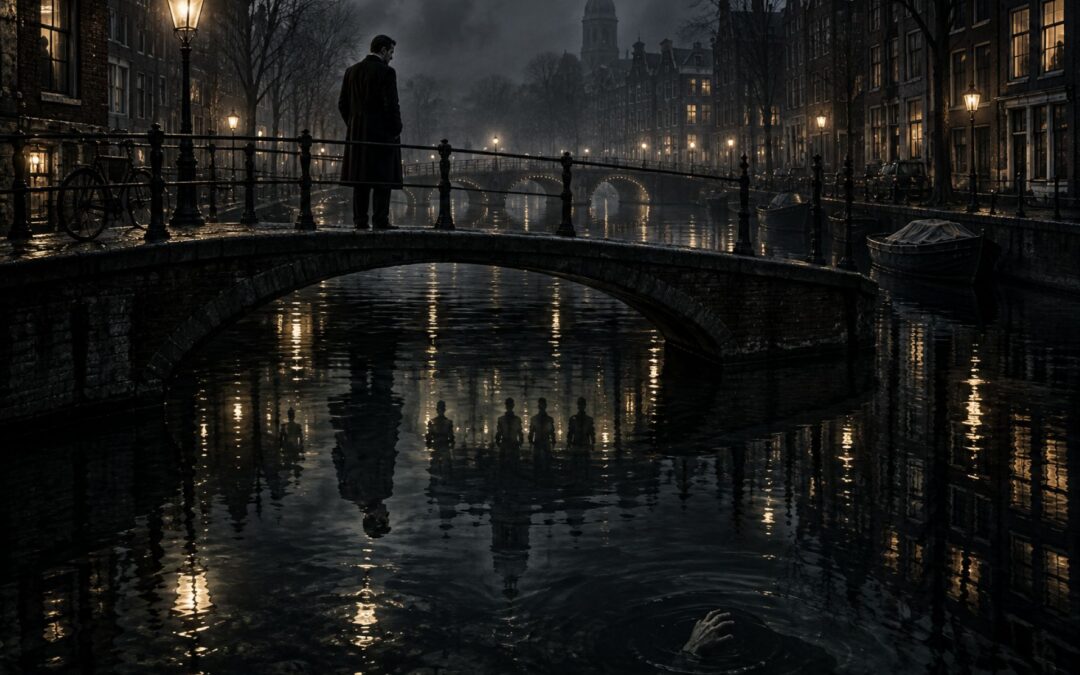
Albert Camus’s The Fall begins with an act of courtesy. In an Amsterdam bar called Mexico City, a cultivated Frenchman notices that a stranger cannot communicate with the Dutch bartender and offers to interpret for him. The gesture seems trivial, even generous, but almost everything that matters in the novel is already present: one man appoints himself another man’s mediator, establishes intellectual superiority through helpfulness, and begins controlling a conversation whose apparent intimacy will eventually become an interrogation.
First published by Gallimard in 1956, La Chute was described in French as a récit, while the Justin O’Brien English translation used here presents it as a novel. Both descriptions capture something important about its unusual form. There is a story, but almost all of it arrives through the voice of Jean-Baptiste Clamence, a former Parisian lawyer who tells an almost entirely silent companion how he went from celebrated defender of the unfortunate to what he calls a “judge-penitent.”
What sounds at first like confession gradually becomes something more disturbing. Clamence has discovered that much of his former virtue was inseparable from vanity, self-love, and a desire to stand above other people, but self-knowledge has not made him humbler in any ordinary sense. Instead, he has learned to confess first, accuse himself completely, and then use the apparent honesty of that confession to implicate everyone listening to him.
This article contains full spoilers, including the woman in the Seine, Clamence’s wartime imprisonment, the missing panel of The Just Judges, the identity of his listener, and the novel’s final revelation. Understanding The Fall requires those details because its philosophical meaning is inseparable from the way Clamence delays them and then uses each revelation to change what his listener thinks the conversation has been about.

Jean-Baptiste Clamence’s Fall: Complete Plot Summary
The Fall is divided into six unnumbered narrative movements rather than conventionally titled chapters. Each movement takes place during a new stage of Clamence’s continuing conversation with the unnamed Frenchman, and each brings the listener closer to the event Clamence most wants to confess without ever allowing confession to become surrender.
The external action is limited, but the internal progression is precise. Clamence first establishes himself as charming and useful, reconstructs the apparently admirable Parisian life he once led, reveals the incidents that destroyed his self-image, broadens his personal guilt into a theory of universal guilt, and finally explains the system through which confession has become his new profession.
The Stranger at Mexico City and the Descent into Amsterdam
Clamence meets the unnamed Frenchman in Mexico City, a sailors’ bar in Amsterdam. The bartender, whom Clamence contemptuously calls an ape, speaks no French, so Clamence offers to interpret the stranger’s drink order. His intervention is practical, but he immediately turns it into an opportunity to speak, observe, classify, and subtly dominate.
He describes the bartender, the clientele, the prostitutes, the city, the Dutch, the French, and eventually the stranger himself. He repeatedly adopts the tone of someone merely sharing perceptions, yet his conversation is full of judgments. Even before he explains his later profession, he behaves like a man unable to encounter another person without placing that person in a moral or psychological category.
Clamence introduces himself as Jean-Baptiste Clamence, though the final section will cast doubt on whether this is his real name. He quickly establishes intimacy by calling the stranger his compatriot and inferring that the man is educated, prosperous, and socially similar to him. This ability to read another person is part charm and part technique: Clamence makes people feel recognized while simultaneously deciding what they are.
Amsterdam becomes an extension of his rhetoric. He describes its concentric canals as resembling circles of hell, with respectable bourgeois life arranged inside an environment that feels sunken, enclosed, and morally ambiguous. The old Jewish quarter also brings the recent European past into the conversation, because the vanished Jewish population evokes the destruction carried out during the Nazi occupation rather than allowing Amsterdam to remain picturesque scenery.
Clamence himself lives in this low country almost as if he has deliberately descended from an earlier life of height and prestige. He notices water everywhere, and his discomfort around bridges appears before its cause is explained. He remarks that he no longer crosses a bridge at night because someone might jump into the water, placing him in the intolerable position of having either to risk himself in a rescue or to refuse assistance.
At this point the remark sounds like morbid wit. Only later will the listener understand that Clamence is describing a situation he has already experienced.
Their first encounter ends without a full confession. Instead, Clamence creates the conditions for another meeting, making himself interesting enough that the stranger will return. His method depends on postponement: he reveals enough to generate curiosity while keeping the most important information under his control.
The Virtuous Lawyer and the Laughter on the Pont des Arts
When the listener asks what a judge-penitent is, Clamence refuses to define the term immediately. To understand that identity, he says, the stranger must first understand the person he used to be. What follows is the portrait of a man who seemed almost perfectly equipped to think well of himself.
In Paris, Clamence had been a successful lawyer known especially for defending widows, orphans, poor defendants, and other people whose cases allowed him to stand visibly on the side of justice. He sometimes worked without charging a fee, behaved courteously in public, helped blind people cross streets, gave up his seat, assisted motorists, offered directions, and cultivated a reputation for spontaneous generosity. His professional and social life confirmed the same image: he was articulate, physically confident, admired, sexually successful, and apparently free from the ordinary resentments that trouble other people.
Nothing in his later confession requires every charitable act to have been fake. That is precisely why his crisis becomes complicated. He really did help people, but he eventually realizes that helping them also gave him intense pleasure because gratitude confirmed his superiority.
His legal profession offered an especially satisfying arrangement. He could defend accused people, criticize judges, pity victims of injustice, and experience himself as more humane than the institutions around him. The courtroom placed him in an elevated moral position while allowing him to tell himself that his only concern was compassion.
The imagery of height runs through his account of this life. Clamence loves balconies, mountaintops, upper decks, open views, and any physical position from which he can look down without feeling constrained by equals. Parisian success gives him the social equivalent of those heights: he is admired by clients, needed by the unfortunate, desired by women, and respected by professional colleagues.
Even friendship serves his self-image. He remembers behaving loyally when loyalty could be noticed and imagining himself as unusually devoted, yet he gradually recognizes how often another person’s suffering became an occasion for him to admire his own response. His benevolence contains genuine action but also a spectator—the inner Clamence watching himself perform nobly.
The crisis begins on a seemingly triumphant evening. Clamence has enjoyed another successful day and walks across the Pont des Arts in a state of profound satisfaction with himself. Paris, his career, his health, and his moral identity appear harmoniously arranged.
Then he hears laughter behind him.
He turns, but no one is there. The laughter seems to come from the water or from some indeterminate place around him, and he hears it again. Nothing visible has happened, yet the experience disturbs him because it introduces a judgment that he cannot identify, answer, impress, or control.
Clamence tries to resume his former life, but something has changed. The laughter has created a crack in the identity he took for granted. It does not explain his guilt; it makes him susceptible to remembering it.
The Return of Memory and the Woman in the Seine
After the laughter, Clamence becomes increasingly uneasy. He avoids the Seine, suffers changes in health and mood, and begins revisiting incidents that previously seemed insignificant. Instead of remembering himself as the hero of his own biography, he starts discovering scenes in which his actual behavior contradicts the character he had believed himself to possess.
One such memory concerns a traffic confrontation. Clamence becomes involved in a dispute with another motorist and imagines himself responding decisively to an insult, but events do not unfold according to his fantasy. He is struck and humiliated, and circumstances prevent the heroic retaliation he later tells himself he would otherwise have delivered.
What torments him is not simply that another man defeated him. The incident demonstrates that the courageous, commanding Clamence he carried in his imagination was partly dependent on never being tested under conditions he could not control. His self-esteem had rested on a hypothetical heroism that reality refused to confirm.
He begins making the same discovery about love. Clamence had enjoyed women and considered himself affectionate, but his retrospective account reveals how often desire was inseparable from conquest. He wanted to be loved even after he had lost interest, resented women who might become independent of him, and valued devotion partly because another person’s attachment certified his importance.
His relationships therefore resemble his charity. They contain real pleasure and perhaps real affection, yet he repeatedly experiences other people through the role they assign him in his own drama. He wants to be generous, desirable, irreplaceable, and free, while avoiding equal dependence on those whose admiration he enjoys.
The most important memory eventually returns from beneath all these lesser humiliations.
Years earlier, Clamence had been walking home at night after visiting a woman. On the Pont Royal, he noticed a young woman dressed in black leaning over the railing toward the Seine. He passed her and continued across the bridge.
After walking some distance, he heard the sound of a body striking the water.
Then he heard cries.
The cries continued and moved downstream. Clamence stopped, but he did not go back. He did not jump into the river, summon help, or even turn around to discover what was happening.
Eventually he walked away.
He later avoided newspapers because he did not want to know whether the woman had died. The uncertainty itself becomes part of his guilt: he preserves ignorance because knowledge might force him into a clearer relationship with what he has done.
This moment changes the meaning of everything that came before it. The celebrated defender of helpless people had encountered a helpless stranger outside the courtroom, without spectators, professional recognition, or a controlled setting, and had chosen his own safety.
The scene does not prove that every earlier act of kindness was fraudulent. It proves something more destabilizing: Clamence’s virtue could coexist with cowardice, and his heroic self-conception could survive only so long as he did not look closely at the moments that contradicted it.
The laughter now acquires a possible meaning. Whether it came from an actual person matters less than the function it performs in Clamence’s mind. It becomes the sound of judgment that returns him to the bridge he has spent years psychologically avoiding.
From Private Guilt to Universal Accusation
Clamence continues his story while taking his companion beyond central Amsterdam toward Marken and the bleak expanse of the Zuider Zee. The landscape becomes flatter, grayer, and less reassuring, and he describes it almost as a negative image of the Mediterranean world he idealizes. The absence of obvious landmarks suits a man whose old moral coordinates have disappeared.
He now claims not to have friends but “accomplices.” The word signals an important transformation in his thinking. If everyone is implicated in the same fraudulence he has discovered in himself, then companionship no longer means mutual affection; it means shared guilt.
His reflections on suicide expose another dimension of his narcissism. A dramatic death might force other people to recognize his suffering and seriousness, but suicide contains a fatal disadvantage: the dead person cannot remain alive to enjoy the effect. Even despair is filtered through the need for spectators.
This is why Clamence cannot be described as someone who has simply lost his appetite for life. He loves life intensely. He wants pleasure, admiration, experience, women, recognition, and continued existence, and he resents death precisely because it threatens to end the consciousness around which he has organized the world.
Once his self-image has cracked, he starts noticing judgment everywhere. He imagines enemies, remembers slights, interprets social interactions defensively, and becomes increasingly convinced that people condemn others in order to protect themselves from condemnation. The person who accuses first, he begins to suspect, gains an advantage.
His earlier modesty now appears to him as another strategy of elevation. By presenting himself as humble, he could invite other people to contradict him and praise him. By defending the unfortunate, he could appear morally superior to judges. By performing generosity, he could become the person entitled to think of himself as generous.
Clamence therefore starts attacking his own respectable identity. Among acquaintances who expect humanitarian or progressive opinions from him, he makes deliberately scandalous statements. He praises what they despise, shocks people whose approval he once sought, and experiments with the destruction of the reputation that had protected him.
The experiment gives him a temporary sense of liberation but no genuine solution. If his former virtue was partly performance, then public wickedness can become another performance. Reversing the role does not free him from the need to act before an audience.
He even imagines turning the courtroom against himself. Instead of allowing the respectable lawyer to accuse the defendant, why not place the lawyer morally on trial? Why not ask what hidden cowardice, vanity, cruelty, compromise, or selfishness the apparently innocent accuser has simply never been forced to display?
The thought contains the seed of the judge-penitent. Clamence has not yet perfected it because straightforward self-accusation leaves him exposed. He wants a form of confession that will condemn him while somehow preserving superiority.
Debauchery, the Little-Ease, and the Birth of the Judge-Penitent
Clamence next describes his attempts to escape judgment through private life. He tries love, apparently hoping that attachment to another person might rescue him from the endless circle of self-consciousness, but he discovers that decades of self-love cannot be overcome simply by deciding to become devoted. His relationships reproduce manipulation, vanity, dependence, and boredom.
He experiments with chastity as well, only to find the resulting moral clarity intolerable. Renunciation does not transform him; it merely deprives him of distraction. What he wants is not purity but relief from the consciousness that has begun prosecuting him.
He finds a more effective temporary anesthetic in debauchery. Alcohol, casual sex, late nights, physical exhaustion, and repetitive pleasure allow him to live without planning, promising, remembering, or judging. By narrowing life to immediate appetite, he can temporarily suspend the moral drama in which every action becomes evidence.
The solution carries an obvious cost. His health deteriorates, his professional life loses coherence, and the pleasure that once confirmed his vitality becomes mechanical. Debauchery suppresses judgment rather than resolving anything.
A voyage at sea destroys even that temporary refuge. Clamence sees a dark object in the water and momentarily thinks it is a drowning person. The perception immediately revives the cry from the Seine, demonstrating that neither distance nor indulgence has erased the central memory.
From there his thinking turns toward punishment. He describes the “little-ease,” a medieval form of confinement supposedly constructed so that a prisoner could neither stand upright nor lie comfortably. The image fascinates Clamence because it converts his psychological condition into architecture: there is no posture in which innocence can be maintained and no position in which guilt can be escaped.
Human life begins to appear to him as an enormous little-ease. People judge one another constantly while lacking an unquestionable standard capable of permanently acquitting anyone. Every person is prosecutor, defendant, witness, and prisoner.
His reflections become increasingly religious. Clamence invokes Christ, the Last Judgment, mercy, innocence, and the Biblical language of condemnation, but he does not adopt conventional Christian repentance. Instead, he provocatively imagines guilt extending even toward the innocent figure of Christ, whose infancy was associated in the Gospel story with the slaughter of other children.
The point is less a theological claim than an expression of Clamence’s inability to tolerate innocence. If everyone can somehow be implicated, then no one can stand above him. Universal guilt becomes psychologically attractive because it abolishes the unbearable distinction between the guilty person and the innocent judge.
Clamence also attacks people who speak the language of mercy while exercising judgment. He sees condemnation concealed beneath humanitarian vocabulary, just as he once discovered vanity concealed beneath his own generosity. The world, as he now describes it, is filled with judges who refuse to admit that they are judges.
His solution is to make the structure explicit.
He calls himself a judge-penitent.
The term combines two positions that seem contradictory. The penitent confesses his guilt; the judge condemns the guilt of others. Clamence’s genius, if it can be called that, is to realize that the first role can become the foundation of the second.
The Prison Pope, The Just Judges, and the Final Trap
The final movement begins with the listener visiting Clamence in his room while Clamence is ill with fever. The more intimate setting appears to promise complete disclosure, but Clamence almost immediately complicates the truth status of everything he has said. He acknowledges that some stories may be difficult to distinguish from invention and suggests that invented episodes can reveal character even when they are not literally factual.
This admission does not make the confession meaningless. It means that Clamence remains in control of the evidence against himself. The listener receives not a sworn deposition but a performance in which autobiography, parable, exaggeration, memory, and manipulation may coexist.
He then recounts a wartime episode. During the German occupation of France, Clamence experienced patriotic impulses but hesitated when confronted with the actual demands and risks of Resistance activity. He eventually left Europe for North Africa and found himself interned in a camp.
Among the prisoners he meets a deeply religious Frenchman whom he calls Du Guesclin. The man is troubled by the institutional Church’s compromises and failures, and the prisoners create a joking alternative papacy. Clamence is chosen to be pope.
Even in imprisonment, therefore, he finds himself elevated. Responsibility once again becomes a form of rank.
The camp also produces another episode of survivor guilt. Clamence participates in the distribution of scarce water and eventually drinks the share intended for another prisoner who later dies. He rationalizes the decision through the belief that his own survival is more useful or important.
The episode echoes the Seine without duplicating it. In Paris he refused to risk himself for a stranger; in the camp he preserves himself at another person’s expense. Both memories contradict the image of a man instinctively devoted to others, yet Clamence continues finding arguments that protect the value of his own survival.
The most theatrical revelation follows when he shows his visitor a painting hidden in his room. It is, he claims, the original panel known as The Just Judges from the Ghent Altarpiece.
Camus grounds the fiction in a real unsolved crime. The panel was stolen from St Bavo’s Cathedral in Ghent in 1934 and remains missing, although Clamence’s story about how it passed through Mexico City and into his possession is fictional.
For Clamence, possessing The Just Judges is almost too perfect. The legitimate judges are hidden in his private room while a copy occupies their public place, and he—the self-appointed judge-penitent—decides whether the original will ever return. His moral situation has become material: he literally keeps the judges under his control.
Only now does he fully explain his method.
He begins by accusing himself of everything. He refuses mitigating circumstances, attacks his own motives, admits cowardice, vanity, lust, manipulation, selfishness, hypocrisy, and the desire for power. By confessing more aggressively than anyone else could accuse him, he deprives ordinary judgment of its surprise.
Then he changes the pronoun.
The “I” becomes “we.”
Clamence describes his own motives so persuasively and so broadly that his listener begins recognizing similar impulses in himself. Vanity, cowardice, resentment, self-interest, sexual pride, fear of death, compromise, and the desire to judge are not unique to one failed lawyer.
At that moment the confession becomes prosecution. Clamence has admitted guilt before the listener, but his admission creates authority rather than equality. He can now tell the other man, in effect, that he knows the truth about them both.
His ideas about freedom follow directly from this system. Clamence argues that genuine freedom is difficult because it leaves people responsible for their choices without a superior authority to absorb the burden. Human beings therefore long for masters, rules, institutions, leaders, punishments, and forms of obedience that relieve them of the unbearable task of judging themselves.
Amsterdam has become the perfect headquarters for this work. Mexico City functions as courtroom, confessional, pulpit, and office, and Clamence seeks strangers who resemble the man he used to be. He listens, speaks, confesses, identifies common motives, and transforms companions into defendants.
The final confirmation comes when the supposedly anonymous stranger reveals enough about himself for Clamence to identify him as another Parisian lawyer. Their affinity was not accidental. Clamence recognized a suitable double.
He now asks the listener for his own story. Somewhere, Clamence assumes, there must be an equivalent of the woman in the Seine: a memory that destroys innocence once properly remembered.
Then Clamence imagines the impossible. What if the drowned woman returned and threw herself into the river again? He could receive another chance. He could finally act differently.
For a moment the fantasy appears to offer redemption.
Then he remembers the practical reality. The water would be cold, and genuine rescue would require actually entering it.
The woman will not return. The original decision cannot be repeated under controlled conditions. Clamence therefore ends with relief as well as regret: it is too late, it will always be too late, and “Fortunately!”
The final word destroys any interpretation of his confession as completed repentance. Clamence understands his failure with extraordinary clarity, but he still prefers the safety of irreversible guilt to the danger of an actual second chance.
Amsterdam, Paris, and the Geography of Judgment
Few novels use geography as economically as The Fall. Amsterdam is not merely the place where Clamence happens to live after leaving France; it externalizes the moral and psychological position from which he now speaks. A man who once loved heights has chosen one of Europe’s most conspicuously low-lying cities, and he repeatedly interprets that physical descent as if it were a map of his own fall.
The concentric canals allow him to imagine Amsterdam through Dantean imagery, as though its inhabitants occupy rings within a civilized inferno. The metaphor suits his worldview because nothing looks conventionally hellish. People drink, work, trade, sleep, desire, and maintain respectable lives while Clamence insists that judgment and guilt operate beneath ordinary surfaces.
Water intensifies the effect. Canals, rain, sea, river, fog, and dampness surround a man whose decisive moral memory involves a woman disappearing into the Seine. Amsterdam permits him to live beside the element he fears while also transforming one particular drowning into an entire landscape.
The city’s Jewish quarter gives that landscape historical weight. Clamence can treat guilt as universal and abstract, but the remnants of Amsterdam’s destroyed Jewish community remind the reader that twentieth-century European guilt also involves specific perpetrators, victims, institutions, and historical crimes. This matters because Clamence’s theory often threatens to blur morally significant differences by insisting that everyone is guilty.
Paris represents the opposite vertical world. There Clamence lived professionally and psychologically above other people: successful lawyer, generous benefactor, admired lover, persuasive speaker. His affection for balconies, mountains, ships’ upper decks, and elevated viewpoints makes the symbolism explicit without reducing it to a simple code.
Height means more than pride. It means freedom from reciprocity. Clamence enjoys looking over others because the elevated position protects him from having to stand beside them as equals.
Amsterdam removes that illusion of elevation, but the descent does not automatically produce humility. Clamence reconstructs superiority at sea level by inventing the judge-penitent. He loses the heights of Paris and creates a new hierarchy through confession.
Marken and the Zuider Zee push the imagery further. The landscape becomes so flat and indistinct that Clamence describes it almost through negation, as if ordinary landmarks have been erased. The environment corresponds to the moral world he now claims to inhabit, where no clear innocence rises above universal culpability.
His idealized Greece functions as a counter-image. Greece, in his rhetoric, represents sun, bodies, clarity, sea, beauty, and a simpler relation between human beings and the world. Whether that ideal has ever existed matters less than the psychological need it serves: Clamence imagines a realm of transparent life precisely because he now inhabits a consciousness in which every motive has become suspect.
Mexico City, despite its name, is the most important interior space. The bar allows Clamence to meet strangers without formal obligations and to reproduce his old profession in disguised form. He no longer pleads before a court, but he still works through speech, confession, accusation, and verdict.
His geography therefore describes a failed transformation. He has descended from Paris, but he has not escaped the need to stand above other people. The new landscape changes the method of superiority, not the desire for it.
Jean-Baptiste Clamence and the Silent Listener
Jean-Baptiste Clamence is compelling because his virtues and vices cannot be cleanly separated. If he were simply lying when he described himself as generous, charitable, courteous, intelligent, and professionally committed to vulnerable people, his moral crisis would be shallow. The disturbing possibility is that he really possessed many admirable qualities while also enjoying them for narcissistic reasons.
His self-analysis therefore begins with a valid discovery. Good actions do not guarantee pure motives, and people often derive status, pleasure, identity, or power from behaving well. Clamence recognizes the ego concealed inside his moral self-image with an acuity that gives his confession genuine force.
The problem lies in what he does with that discovery. Instead of accepting mixed motives as part of morally imperfect human life and continuing to distinguish better actions from worse ones, he begins treating impurity of motive as evidence against innocence itself. Because generosity gives the giver pleasure, generosity becomes suspect; because love contains self-interest, love becomes domination; because courage can fail under pressure, courage becomes vanity waiting to be exposed.
This movement is closely connected to pride. In his scholarly reading of the novel, philosopher Robert C. Solomon treats Clamence through the pathology of pride, and the formulation captures more than ordinary arrogance. Clamence needs his identity to be exceptional even when the basis of exception changes.
At first he is exceptionally virtuous. Later he becomes exceptionally guilty, exceptionally lucid, exceptionally ruthless about his own motives, and exceptionally qualified to expose the guilt of others. Losing innocence does not cure the underlying need to occupy a special position.
His sexual relationships reveal the same structure. Clamence enjoys women but repeatedly describes their value in relation to his own desirability, freedom, and power. He wants attachment without vulnerability and devotion without reciprocal dependence, so intimacy becomes another environment in which he can confirm that he remains the central figure.
His treatment of women is also one of the novel’s limitations. Because nearly every woman reaches the reader through Clamence’s categorizing gaze, they rarely acquire independent interiority. The drowned woman becomes the most morally important figure in the novel precisely while remaining almost completely unknown.
That anonymity is ethically significant. Clamence remembers her clothing, posture, fall, and cries but not a life story, name, desire, or future. She remains the person whose suffering forced him into a decision before he could transform her into an admirer, client, lover, or philosophical example.
His relationship with Du Guesclin similarly tests his self-understanding. In the prison camp, conditions are harsher and more morally ambiguous than in Paris, yet Clamence again finds himself occupying a superior role. The improvised papacy gives him responsibility, but responsibility quickly becomes another justification for privilege.
The bartender at Mexico City provides a smaller but useful contrast. He is opaque, uncommunicative, and difficult for Clamence to absorb into verbal exchange. Clamence compensates by describing and caricaturing him, turning silence into something that can still be mastered through language.
The unnamed listener is far more important because his silence organizes the entire book. We rarely hear his words directly; instead, Clamence repeats, anticipates, or responds to them. This means that even the second participant in the conversation reaches us through Clamence’s voice.
The technique gives Clamence almost total rhetorical control. He can decide which questions deserve answers, reconstruct objections in forms he knows how to defeat, attribute curiosity to his companion, and interpret facial expressions or hesitations without allowing the listener an independent narrative voice.
Yet the listener is not merely passive. His continuing presence matters because Clamence needs someone to convert. A confession delivered alone would not produce the relationship of superiority he seeks.
The final revelation that the listener is also a Parisian lawyer confirms the degree of calculation involved. Clamence has not simply unburdened himself to a random tourist. He has recognized a person sufficiently similar to his former self to make the conversation useful.
That similarity also explains why the reader can feel implicated without being literally identical to the silent man. Clamence’s accusations are broad enough to encourage self-recognition, but the fictional listener remains a particular professional double—a lawyer from the society Clamence abandoned. The reader occupies an unstable third position, hearing both the confession and the attempt to recruit its recipient into guilt.
Clamence’s unreliability makes that position even less secure. In the final section he openly questions the factual status of some stories, which means that readers cannot simply treat the monologue as transparent autobiography. Yet unreliability does not cancel the character study; it deepens it, because the way Clamence chooses to narrate himself is itself evidence.
He may lie about events while telling the truth about his needs. He may exaggerate guilt while accurately revealing his hunger for superiority. He may confess manipulation while manipulating through the confession.
That is why Clamence remains more complex than either a hypocrite or a truth-teller. He understands himself better than the man he once was, but the increased understanding has not altered his deepest structure. He still wants the last word.
The Judge-Penitent: How Confession Becomes Power
The judge-penitent is the novel’s most important conceptual invention because it transforms confession from an act of surrender into a strategy of domination. A conventional penitent admits wrongdoing in the hope of forgiveness, change, reconciliation, or moral repair. Clamence confesses for almost the opposite reason: by condemning himself before anyone else can do so, he tries to establish the authority to condemn everyone.
The method begins with radical self-accusation. Clamence does not defend his intentions, invoke difficult circumstances, or demand recognition for the good he once did. He presents his vanity, cowardice, sexual egoism, selfishness, and failures as comprehensively as possible.
This gives him credibility. A man who attacks himself so mercilessly appears to have abandoned self-interest, which makes the listener more inclined to trust him. His apparent humility becomes a new source of power.
The decisive move occurs when his confession shifts from the individual to the universal. Clamence describes motives that many listeners can recognize—wanting praise, fearing humiliation, enjoying moral superiority, resenting dependency, rationalizing selfish decisions, and judging people more harshly than oneself.
Once recognition occurs, “I” quietly becomes “we.” The listener is no longer observing Clamence’s trial but discovering that the evidence has been collected for his own.
This is why the judge-penitent differs from an ordinary hypocrite. Clamence does not hide his guilt while accusing others; he publicizes it. His confessed guilt becomes the qualification that permits him to judge.
A recent interpretation by philosopher Craig DeLancey emphasizes the broader implications of this strategy, reading the judge-penitent as a form of moral and political authority. That perspective is useful because Clamence’s method extends beyond private psychology: anyone who turns self-accusation into permission to condemn an entire society can reproduce the same structure.
Yet the novel does not require one political key. Clamence’s system works at several levels simultaneously—as personal defense mechanism, social technique, parody of confession, theory of guilt, courtroom strategy, and critique of intellectual moral superiority. Its power comes from the fact that each level reinforces the others.
The system also solves Clamence’s problem with judgment. In Paris, he wanted to be innocent and superior. After the Seine destroyed innocence, he needed a new way to preserve superiority.
The judge-penitent allows him to do exactly that. He is no longer above others because he is better; he is above them because he is the first to admit how bad everyone is.
This is penitence without the ordinary consequences of repentance. Clamence describes his wrongs, understands many of their causes, and can explain their psychological meaning, but he does not make restitution to the drowned woman, the dead prisoner, former lovers, clients, friends, or anyone else. In many cases restitution is impossible, but impossibility becomes convenient because it permits endless confession without the risk of transformed action.
His obsession with the past therefore serves a double purpose. It torments him, but it also protects him from situations in which his morality might again be tested. The woman in the Seine cannot return; the prisoner cannot reclaim his water; the old Parisian identity cannot be restored.
Clamence can consequently achieve certainty about guilt while avoiding uncertainty about action. He knows exactly how to accuse the person he was because the past can no longer surprise him.
The listener is more dangerous because he is still present and capable of responding. That is why Clamence must persuade him that they are essentially alike. If the listener accepted Clamence’s guilt while refusing the universal theory behind it, the judge-penitent would lose his authority.
The entire monologue can thus be understood as a conversion attempt. Clamence is not satisfied to be guilty; he needs company. Accomplices protect him from the existence of judges who might still be innocent enough to condemn him.
His system reaches its purest form with The Just Judges. He keeps the actual judges hidden while presenting himself as the person who understands judgment better than anyone else. Symbolically and rhetorically, he has removed the court and replaced it with himself.
Guilt, Innocence, Hypocrisy, and Moral Superiority
The moral problem of The Fall becomes difficult because Clamence is right about some of the things he discovers. Human motives are often mixed. Generosity can coexist with vanity, public virtue with private cowardice, love with possession, and compassion with the pleasure of feeling compassionate.
Camus does not need Clamence to be wrong about those mixtures for the novel to challenge him. The crucial question is what follows from discovering them.
Clamence moves quickly from “my motives were impure” to something closer to “innocence does not exist.” That leap benefits him enormously. If every morally imperfect motive establishes guilt, then distinctions between degrees and kinds of wrongdoing begin to disappear.
The Seine episode resists such flattening. Whatever vanity Clamence brought to his earlier charity, failing to respond to cries from a drowning woman is not morally identical to enjoying praise for helping someone. His own narrative provides reasons to distinguish failures even as his philosophy tries to erase those differences.
The prison-water episode raises the problem again under harsher circumstances. Scarcity, danger, confinement, and survival pressure complicate judgment, yet Clamence retrospectively incorporates the incident into the same totalizing case against himself. The complexity of circumstance does not interest the judge-penitent as much as the usefulness of culpability.
His attack on innocence therefore protects him from comparison. If no one is innocent, then no one can judge him from outside the shared condition of guilt. The person he fears most is not another sinner but someone capable of making morally relevant distinctions.
This helps explain his hostility toward moral superiority while also revealing his dependence on it. He denounces anyone who stands above others, yet his entire method recreates precisely such a position. The difference is that he now bases superiority on confessed corruption rather than admired virtue.
Hypocrisy is therefore only the first layer of the novel. The young Clamence is hypocritical because he enjoys thinking of himself as selfless while overlooking selfish motives. The older Clamence becomes more dangerous because he knows about the hypocrisy and incorporates that knowledge into a better defense.
His lucidity can even become a substitute for goodness. Because he understands his flaws more deeply than most people understand theirs, he can feel superior to people who are morally better in practice but less sophisticated in self-analysis. Psychological intelligence becomes another height from which to look down.
The novel’s title reinforces the problem without supplying an easy theology. Clamence has fallen from innocence, but the fall also gives him knowledge. Like many myths of the Fall, the loss of innocence produces a heightened consciousness that cannot simply return to its earlier state.
The challenge is what to do with that consciousness. Clamence chooses accusation because accusation allows him to preserve identity through conflict. A more difficult response would require accepting imperfection without making imperfection the final truth about human beings.
The drowned woman remains the strongest counterargument to his theory because she represents another person rather than a concept. Clamence’s obsession centers on his own failure, but the moral reality of the scene lies partly outside him: somebody was in the water.
The distinction matters. Guilt can become narcissistic when the guilty person becomes so fascinated by his guilt that the injured person disappears again. Clamence’s endless confession risks repeating his original failure by keeping his own consciousness at the center.
Freedom, Slavery, and the Desire for Masters
Clamence’s theory of freedom emerges naturally from his theory of guilt. If individuals are free, they are responsible for what they choose, and responsibility exposes them to judgment. Freedom therefore becomes psychologically burdensome rather than simply desirable.
Clamence argues that people often prefer masters because obedience reduces that burden. A command allows the obedient person to claim that someone else established the rules, defined the task, or bore ultimate responsibility. Submission can therefore feel safer than moral independence.
This argument belongs to a wider set of concerns in Camus’s thought. The Stanford Encyclopedia of Philosophy’s account of Camus places his later work within sustained questions about absurdity, revolt, violence, solidarity, justice, and the limits human beings should impose on themselves when transcendent certainty is unavailable.
The Fall approaches those questions differently from a philosophical essay because it puts them in the mouth of a compromised speaker. Clamence’s attack on freedom cannot simply be treated as Camus’s conclusion. The novel asks what this argument looks like when used by someone who wants people to surrender judgment to him.
Clamence’s own life provides the pattern. He dislikes being constrained by others but constantly seeks forms of mastery. He wants lovers to depend on him, clients to need him, audiences to admire him, and strangers to accept his interpretation of their motives.
His supposed defense of slavery is therefore inseparable from personal psychology. A world of masters and servants is attractive because equality is difficult for him. Equal relationships expose him to other centers of value that cannot be reduced to his own needs.
The judge-penitent solves that difficulty through spiritual hierarchy. Clamence announces that everyone is equally guilty, but he retains the privileged role of the person who knows what equality means. The doctrine sounds leveling while preserving a leader.
This tension gives the novel political resonance without turning it into a programmatic political allegory. Movements, institutions, ideologies, and charismatic leaders can all promise relief from the burden of uncertain judgment. The attraction lies not only in coercion imposed from above but in the willingness of individuals to exchange responsibility for certainty.
Clamence understands that willingness because he shares it. He despises masters when they stand over him and becomes one as soon as he discovers a language capable of legitimizing his authority.
His deepest problem with freedom may therefore be its refusal to guarantee innocence. A free person must act without assurance that motives are pure, outcomes predictable, or future judgment favorable. Clamence prefers a system in which universal guilt is already established because certainty about condemnation feels safer than uncertainty about moral choice.
That preference reaches the ending. A second chance at the Seine would restore freedom in its most terrifying form: he would again have to decide what to do. The fact that the opportunity can never return protects him from discovering whether he has truly changed.
Christianity, Judgment, and the Possibility of Redemption
Religious language saturates The Fall, beginning with Clamence’s chosen name. “Jean-Baptiste” evokes John the Baptist, the prophetic figure who announces judgment and prepares the way for another. Clamence similarly presents himself as a voice crying out about guilt, but the gospel he announces offers no stable route to forgiveness.
The novel’s title itself invokes the Fall, the traditional movement from innocence into guilty self-consciousness. Clamence’s story follows that pattern psychologically: he begins in a state of effortless moral confidence, receives knowledge that destroys innocence, and becomes unable to return to his former condition.
Yet his fall does not lead to ordinary Christian repentance. He confesses but does not seek absolution. He pronounces guilt but distrusts mercy. He invokes Christ while resisting the possibility that innocence or grace might interrupt judgment.
His discussion of Jesus is deliberately provocative. Clamence imagines Christ burdened by the knowledge that innocent children died in the attempt to kill him when he was an infant, turning survival itself into a possible source of guilt. The interpretation is not presented as neutral theology; it reveals Clamence’s compulsion to discover complicity even where religious tradition locates innocence.
This compulsion explains his fascination with the story of the adulterous woman and the command that the person without sin cast the first stone. Clamence embraces the destruction of moral self-confidence but does not embrace the mercy that follows. He keeps the first half of the lesson—the exposure of the judges—and turns it into a permanent condition.
The absence of absolution is crucial. A genuinely penitential structure would require the possibility that confession changes the relationship between offender, victim, community, and future action. Clamence instead creates an endless loop in which confession continually renews guilt.
That loop gives him power because a forgiven person could leave the confessional. Clamence needs guilt to remain active so that the listener remains available for judgment.
The religious imagery surrounding The Just Judges sharpens the contradiction. The missing panel belongs to the Ghent Altarpiece, centered on the sacrificial Lamb of God. Clamence hides the judges while living among images of sacrifice, innocence, and redemption that his philosophy cannot comfortably accommodate.
Doves and snow similarly introduce possibilities that his rhetoric cannot entirely master. They can suggest purity, grace, transcendence, or simply the human hunger for those ideas in a world Clamence insists is universally compromised. The novel does not convert those images into a guaranteed theological answer, but their presence prevents his system from becoming completely closed.
Clamence frequently speaks as though innocence were merely childish illusion. Yet his obsession with the drowned woman suggests that he has not succeeded in proving this even to himself. If universal guilt fully satisfied him, one particular failure would not need to return with such force.
Redemption remains possible as an idea precisely because Clamence cannot stop imagining another chance. The tragedy—or perhaps the moral indictment—is that he wants redemption to occur retrospectively, where it cannot demand anything from him.
He can confess yesterday’s cowardice indefinitely. What he fears is tomorrow’s cold water.
Postwar Europe and a Generation on Trial
The Lermontov epigraph placed before the novel warns against treating an immoral central character as merely an isolated monster. The implication is that a disturbing character may concentrate the vices of a wider generation, and Clamence repeatedly encourages exactly that movement from individual portrait to collective diagnosis.
The historical Europe surrounding him gives the accusation seriousness. Amsterdam carries the memory of Nazi occupation and the destruction of its Jewish community; Clamence recalls the Resistance, wartime flight, internment, Franco, prison, and the compromises of institutions that claimed moral authority.
Camus himself was not writing about these matters from a purely abstract position. His Nobel Prize biography records his involvement with the French Resistance newspaper Combat, and his postwar writing repeatedly confronted political violence, justice, rebellion, and the temptation to excuse killing in the name of historical necessity.
That context does not make Clamence a disguised autobiography. His wartime story includes hesitations, evasions, and circumstances that should not be transferred onto Camus himself. The relationship is intellectual rather than biographical: Clamence inhabits a European moral landscape in which innocence had become difficult to claim after occupation, collaboration, resistance, ideological violence, genocide, and postwar political judgment.
The novel also appeared during a period when intellectuals were frequently asked to take public positions on revolution, communism, colonialism, justice, and historical responsibility. Clamence’s suspicion of righteous judges therefore carries a recognizable postwar charge. He knows how political and moral language can become a means of assigning innocence to one camp and guilt to another.
Yet his answer is deliberately dangerous. Universalizing guilt can expose hypocrisy, but it can also dissolve responsibility. If everyone is guilty simply by being human, then the distinction between the compromised observer and the perpetrator of atrocity risks disappearing.
The destroyed Jewish quarter makes that problem impossible to ignore. Historical crimes involve asymmetry. Some people were deported and murdered; others organized, enabled, resisted, ignored, survived, profited, or arrived later.
Clamence’s language of accomplices may help readers question self-righteousness, but it becomes morally inadequate if it erases those differences. The novel’s intelligence lies partly in allowing his rhetoric to become persuasive enough that readers must decide where legitimate self-suspicion turns into evasion.
His prison story works similarly. Clamence’s decision about water takes place under coercive circumstances created by war and imprisonment. Condemning himself without context may sound morally rigorous, yet moral seriousness can require attention to context rather than theatrical refusal of it.
The generation on trial in The Fall is therefore not accused because every person committed the same crimes. It is accused because claims of righteousness after catastrophe became difficult to sustain without examining complicity, cowardice, survival, ideology, and the uses of judgment.
Clamence discovers that truth and turns it into a weapon. The novel leaves readers with the harder task of preserving moral distinctions without restoring complacent innocence.
Laughter, Water, Heights, Doves, and The Just Judges
The symbols of The Fall matter because they recur across Clamence’s narrative before their full significance becomes visible. They do not operate like a code in which each image has one fixed translation. Instead, they accumulate associations as his confession develops.
Laughter is the first major rupture. On the Pont des Arts, it appears without an identifiable source and interrupts a moment of perfect self-satisfaction. Clamence cannot answer it because he cannot determine who is laughing or what accusation the laughter contains.
That indeterminacy gives the sound its power. An ordinary critic could be defeated, dismissed, charmed, sued, or judged in return. The laughter has no visible speaker, so Clamence is forced to supply the judgment himself.
It becomes an internal echo. Once his self-image collapses, he can hear accusation everywhere because the original sound has become inseparable from memory. The laughter exposes how fragile a moral identity can become when it depends on external recognition.
Water carries even more associations. The Seine is the place of the drowning, but canals, sea, rain, fog, and dampness follow Clamence after Paris. Water represents death and memory while also evoking the possibility of cleansing or baptism that never quite occurs.
Clamence does not emerge purified from water. He avoids it, travels beside it, sees imagined bodies in it, and finally fears the coldness of entering it. What might symbolize rebirth in another narrative becomes the element of an action perpetually not taken.
Bridges mark the threshold between observation and intervention. Clamence can stand above the water and witness another person’s danger without entering the same physical space. The moral question begins exactly where the distance between observer and victim could be crossed.
Height and depth extend that structure. Parisian balconies, mountaintops, and upper decks correspond to Clamence’s desire to look down, whereas Amsterdam’s low land represents descent. Yet the symbolism never becomes as simple as “high is bad, low is humble,” because Clamence reconstructs pride in the lowlands.
Janus gives the divided self a classical image. Clamence can face in two directions at once: charitable and vain, penitent and judge, honest and manipulative, self-condemning and self-exalting. His failure is not that one face is real and the other fake but that both can belong to the same person.
The little-ease converts that doubleness into punishment. There is no comfortable posture because neither innocence nor complete self-condemnation allows him to live freely. Every attempt to stand upright creates pressure somewhere else.
Doves and snow introduce a different register. Their associations with purity and transcendence contrast with the damp, gray world of Amsterdam, yet Clamence can never decide whether such images offer genuine hope or merely another opportunity for rhetoric. His suspicion contaminates even symbols of innocence.
Nothing is more perfectly chosen than The Just Judges. The real panel disappeared in 1934 and has never been recovered, allowing Camus to transform an actual art mystery into a moral object of extraordinary precision.
A copy occupies the public place of the missing original while Clamence claims to possess the authentic judges privately. The arrangement echoes his entire life. Public virtue once concealed private corruption; now a public copy conceals a hidden original.
The symbolic irony goes further. Clamence says the judges are missing from the world while behaving as though judgment is everywhere. He hides the image of legitimate judgment and replaces it with universal mutual condemnation.
The panel also gives him a material object over which to exercise discretion. Returning it would mean surrendering control. Keeping it allows him to decide when justice may be seen.
Within the Ghent Altarpiece, the judges belong to a larger religious composition centered on the Lamb. That context quietly challenges Clamence’s obsession because judgment appears alongside sacrifice, worship, and the possibility of redemption rather than as an endless autonomous tribunal.
Clamence can possess the judges, but he cannot make the entire symbolic world of the painting obey his philosophy. That incompleteness resembles the novel itself: his voice dominates almost every page without achieving total interpretive control.
Monologue, Irony, and the Trap Set for the Reader
The formal achievement of The Fall lies in making a philosophical argument inseparable from the experience of being manipulated by the person making it. If Camus had written a conventional essay explaining the judge-penitent, readers could agree or disagree from a safe distance. By placing the theory inside Clamence’s monologue, the novel makes persuasion itself part of the evidence.
The apparent dialogue is one of the key devices. Clamence addresses another man continuously, but readers receive the listener’s contributions indirectly. A question can be inferred because Clamence answers it; a reaction can be inferred because he comments on it.
This structure creates intimacy while preventing equality. Clamence seems conversational, but he controls the representation of both sides. Even resistance enters the text in a form he has already interpreted.
His rhetorical questions deepen that control. They encourage the listener to supply answers internally, often before noticing that the terms of the question were chosen by Clamence. What appears interactive may therefore be another form of guidance.
Delayed revelation works in the same way. Clamence mentions bridges before explaining the Seine, speaks of judge-penitents before defining one, describes his fall before revealing its central event, and establishes confidence before acknowledging that parts of his autobiography may be invented.
Each delay changes earlier material retrospectively. The reader repeatedly discovers that a casual remark was actually evidence.
The effect resembles legal advocacy. Clamence was a lawyer, and he never truly stops practicing. He organizes facts, anticipates objections, manages sympathy, frames motives, and controls when decisive information enters the case.
The difference is that he has merged prosecution and defense. By presenting damaging evidence against himself, he appears more trustworthy than an advocate who concealed it. That trust becomes the foundation for his prosecution of the audience.
Irony operates constantly because Clamence understands some contradictions while remaining trapped inside others. He knows that humility can be vanity, that confession can be performance, that moralists can enjoy judging, and that his judge-penitent system gives him power. His unusual lucidity prevents the reader from exposing him through any easy discovery he has not already made.
This creates the novel’s central interpretive difficulty: how do you criticize a character who has incorporated criticism into his identity? Telling Clamence that he is proud merely confirms a fact he already advertises. Calling him manipulative proves that he successfully made manipulation visible.
The answer cannot be greater cleverness. It requires refusing the assumption that self-awareness automatically validates the conclusions built from it.
Clamence’s most persuasive generalizations begin with recognizable truths. Most people have mixed motives; most people sometimes judge unfairly; fear affects courage; social virtue can feed vanity; freedom can be burdensome. The trap lies in allowing those truths to support the stronger conclusion that universal guilt eliminates meaningful moral distinctions.
The shifting pronouns enact the trap grammatically. Clamence’s “I” invites observation; his “we” demands participation. Once the listener accepts the second pronoun, the conversation has changed jurisdiction.
The unnamed lawyer at the end provides the clearest example. He has listened to another man confess, but Clamence has been preparing him to recognize himself inside the confession. The listener’s professional similarity to Clamence makes the mechanism explicit.
The reader is not simply the lawyer, yet the form invites the same danger. Whenever Clamence describes vanity, cowardice, or judgment accurately enough to provoke recognition, readers may feel that his universal theory has been proved by their discomfort.
Camus thereby creates a rare kind of unreliable narrator. Clamence does not mainly deceive by hiding his defects. He may deceive by telling enough truth about himself that the listener grants him too much authority about everyone else.
That is why the novel’s dark humor matters. Clamence is entertaining. His charm keeps the reader inside a conversation that would become unbearable if delivered as solemn doctrine.
His jokes, paradoxes, social observations, and theatrical self-condemnations generate pleasure even while he describes guilt. The reader’s enjoyment becomes part of the formal tension: Clamence is easiest to resist when he is least charming, but he is rarely least charming for long.
The monologue thus achieves something more interesting than a thesis about hypocrisy. It demonstrates how confession, intelligence, humor, and apparent honesty can become instruments of control.
The Ending Explained: Why It Is Always Too Late
The ending of The Fall resolves the structure without resolving Clamence. By the time the listener visits his room, the major facts are available: the successful Parisian lawyer, the laughter, the Seine, the collapse of self-image, debauchery, wartime imprisonment, the hidden painting, and the judge-penitent method.
What remains is to reveal why this particular listener has been chosen.
The answer is resemblance. The stranger is also a lawyer from Paris, which means Clamence has found a version of the social identity he once inhabited. His apparent generosity toward a compatriot in Mexico City was therefore the opening move of a carefully familiar professional relation.
Clamence now asks the other man to confess in return. Somewhere in the listener’s life, he assumes, there must be an equivalent of the woman in the Seine: a memory capable of puncturing innocence and proving membership in the community of accomplices.
If the listener supplies such a story, Clamence’s method succeeds completely. His own confession will have produced another confession, converting a witness into a defendant.
The final fantasy of the drowned woman is therefore crucial. Clamence imagines her returning and repeating the jump so that he could finally receive the second chance he has spent years desiring. The fantasy appears to express repentance because it imagines the possibility of acting differently.
But then physical reality intrudes.
To rescue her, he would have to enter the water.
It would be cold.
He would again face danger rather than memory.
The moment reveals the difference between wanting a corrected past and accepting a demanding present. Clamence longs to rewrite the story because a successful rescue would restore a version of himself he could admire. What he has not demonstrated is willingness to undergo the risk without guarantees.
His final relief that the opportunity can never recur therefore changes the meaning of everything he has confessed. He may sincerely regret the original failure, but regret coexists with gratitude that history has become irreversible.
“It is too late” functions as both lament and shelter. The past condemns him, yet the finality of the past also protects him from testing whether his self-knowledge has produced courage.
That is why the ending does not simply prove that Clamence has learned nothing. He has learned an enormous amount. He understands vanity, performance, cowardice, judgment, and self-deception with frightening precision.
What he has not achieved is conversion from knowledge into action.
His final “Fortunately!” is therefore one of the darkest jokes in the novel. The man who has built an entire identity around his fall is horrified by the possibility that redemption might require him to stop explaining himself and jump.
Critical Review: What The Fall Achieves—and What Its Confession Cannot Resolve
The Fall is one of those rare philosophical novels in which the philosophy cannot be separated from the dramatic form without losing much of its force. Its ideas about guilt, judgment, confession, hypocrisy, and freedom are memorable, but the deeper achievement lies in making those ideas arrive through a speaker whose use of them is itself morally suspect.
Clamence is the book’s greatest success. He is charismatic enough to sustain an entire novel almost single-handedly, intelligent enough to anticipate simple objections, compromised enough to remain dramatically unstable, and funny enough to prevent the work from becoming a tract.
His psychological complexity depends on resisting easy classification. He is neither merely sincere nor merely fraudulent, neither wholly repentant nor wholly shameless, neither straightforwardly guilty nor trustworthy enough to define the limits of his own guilt. Every category contains its opposite because Clamence has learned to turn apparent weakness into another source of strength.
The narrative architecture is equally controlled. The six movements do not produce suspense through conventional external action; they produce it through reinterpretation. Readers continually discover that something heard earlier—a bridge, laughter, water, judgment, height, Amsterdam—had greater significance than Clamence initially allowed.
The Seine revelation is particularly effective because it arrives only after the reader has spent substantial time inside his flattering self-portrait. Without that preparation, the incident would be a story of cowardice. With it, the scene becomes the collapse of an entire moral identity.
The judge-penitent concept then prevents the novel from ending as a familiar tale of hypocrisy exposed. Clamence adapts. His ability to build a new identity from the ruins of the old one makes him far more unsettling than a character who simply learns that he has been bad.
The novel’s symbols are unusually integrated. Amsterdam’s lowlands, the Seine, bridges, laughter, the little-ease, doves, the Lamb, and The Just Judges all arise from the narrative rather than appearing as decorative intellectual references. The missing panel is especially successful because an actual historical mystery becomes almost impossibly well suited to Clamence’s obsession with concealed judgment.
The religious dimension adds another layer of productive instability. Christian vocabulary surrounds Clamence, but the novel neither accepts his theology nor offers a simple counter-sermon. Confession without absolution, guilt without grace, judgment without secure law, and the desire for innocence all remain in tension.
The treatment of freedom works for similar reasons. Clamence’s argument that people seek masters because freedom burdens them with responsibility contains psychological insight, but the person delivering the argument is himself trying to become a master. The form automatically places pressure on the philosophy.
The comparison with Camus’s earlier novel The Stranger is revealing. Both books revolve around judgment, death, society, and the difficulty of locating stable meaning, but their narrative problems differ sharply. Meursault is judged by a society that interprets him; Clamence is an interpreter who tries to seize control of judgment before anyone else can use it against him.
That shift reflects the broader development often noted in discussions of Camus. The problem is no longer simply what to do in an absurd world but how human beings should judge, revolt, exercise power, and impose limits once metaphysical certainty cannot be assumed. The novel refuses to solve those questions through a reliable spokesman.
Its greatest strength can nevertheless become a limitation. Because Clamence’s voice dominates almost everything, secondary characters remain thin. This is formally appropriate—his inability to encounter other people outside his own needs is part of the characterization—but it also makes the novel intentionally claustrophobic.
Women suffer most from that narrowness. Clamence generalizes about them, remembers them through desire and conquest, and rarely grants them autonomous interior life. The drowned woman possesses enormous symbolic weight but almost no identity beyond the event that transforms Clamence.
A reader can reasonably argue that this limitation belongs primarily to Clamence rather than Camus, but the distinction does not entirely remove its effect on the reading experience. The novel asks secondary figures to bear philosophical significance while giving them little room to become people outside the narrator’s consciousness.
The monologue can also feel dense and airless. Readers expecting a conventional plot may be surprised by how much of the book consists of reflection, anecdote, reinterpretation, and rhetorical argument. Its pacing depends on intellectual escalation rather than external incident.
That density is partly the point. Clamence lives inside language because language is how he controls experience. A more spacious novel with multiple viewpoints might be easier to inhabit but would weaken the trap.
A more serious limitation lies within Clamence’s doctrine of universal guilt. His argument often treats every compromised motive as though it belongs on the same moral continuum, and the brilliance of his rhetoric can tempt readers to accept equivalences the novel itself does not require.
Vanity in charity, emotional selfishness, cowardice before danger, appropriating a prisoner’s water, historical collaboration, and mass political crimes cannot responsibly be collapsed into the proposition that everyone is simply guilty. The existence of mixed motives does not abolish degrees of responsibility.
That limitation, however, may be central to the book’s critical force rather than evidence of philosophical failure. Clamence needs universal guilt because universal guilt serves him. The reader’s task is not to replace one comfortable innocence with his comfortable condemnation.
This is where competing interpretations remain useful. Solomon’s emphasis on pride explains why self-condemnation never frees Clamence from the need for elevation, while DeLancey’s account of the judge-penitent highlights the way self-accusation can become a source of authority over others. Neither interpretation needs to exclude the other because pride and social power are intertwined in Clamence’s method.
The novel has also aged well in its understanding of performative confession. Modern public life provides abundant examples of people preemptively admitting faults, displaying self-awareness, or denouncing their own group in ways that can increase rather than diminish moral authority. The Fall understood long before contemporary media culture that confession can function as reputation management.
Its insight into judgment is equally durable. People still condemn hypocrisy while enjoying the superiority that condemnation provides; they still expose the mixed motives of others while treating their own mixed motives as understandable; they still use claims of universal corruption to excuse particular failures.
What has aged less comfortably is some of Clamence’s treatment of women and the ease with which his masculine sexual experience becomes a generalized account of human relations. Contemporary readers are likely to notice more strongly how much of the supposedly universal human condition is being described by a particular educated, successful European man.
That recognition need not diminish the novel. In some respects it improves the reading because it encourages exactly the resistance Clamence’s universalizing language requires. He speaks as though he has discovered humanity when he has often discovered himself.
The ending remains remarkably effective because it refuses catharsis. A lesser version of the story might allow the confession itself to redeem Clamence. Camus denies him that escape.
Knowledge does not rescue him.
Neither does eloquence.
Neither does suffering.
What would matter is action when another person requires it, and the novel ends by showing that Clamence still prefers the imaginative possession of a second chance to the physical risk it would entail.
For readers interested mainly in plot, The Fall may initially feel narrow. For readers interested in moral psychology, narrative unreliability, existential thought, religious imagery, guilt, and the relationship between confession and power, its concentration is a strength.
It remains worth reading not because Clamence provides a trustworthy diagnosis of humanity but because he makes trustworthy diagnosis difficult. His greatest temptation is the invitation to believe that seeing through everyone is the same thing as understanding them.
The novel’s most important limitation is therefore inseparable from its strongest contribution. Clamence can make universal guilt sound persuasive by beginning with real human weakness, and readers must perform the moral work he avoids: distinguishing self-suspicion from self-hatred, responsibility from theatrical guilt, equality from complicity, and honest judgment from domination.
The Fall ultimately asks what happens after a person discovers that the flattering story he tells about himself is false. Clamence’s answer is to build a darker story in which nobody is better than he is, then use his superior knowledge of that darkness to recover the position he lost.
That is why his fall never truly ends. He descends from the heights of public virtue into confession, but confession becomes another height. He abandons innocence but preserves hierarchy, rejects hypocrisy but perfects performance, admits judgment while claiming the right to judge.
The drowned woman remains the fact his system cannot finally absorb. Whatever philosophical structures he builds around guilt, there was a moment when another person cried from the water and Clamence did not move toward her.
Everything after that moment can explain him, expose him, torment him, entertain him, and give him authority. None of it can perform the action he refused.
That is also why the novel remains more than a clever exercise in existential pessimism. It distinguishes, in its final cruel joke, between understanding morality and doing something moral when action becomes costly.
Clamence would like his confession to prove that no one possesses the right to judge him because everyone shares his condition. Camus leaves the reader with a harder possibility: perhaps nobody is perfectly innocent, but that does not make every choice equivalent, every failure inevitable, or every confession redemptive.
For readers willing to enter a novel driven more by voice and moral argument than by conventional plot, The Fall remains one of Camus’s most concentrated achievements. Its enduring question is not whether Jean-Baptiste Clamence is guilty; he has spent the entire book answering that for us. The more disturbing question is whether recognizing guilt will make anyone act differently the next time somebody cries out from the water.
Last Updated on September 15, 2026 by Aseem Gupta