

Alexandre Dumas’s The Count of Monte Cristo is often remembered in drastically shortened form: a young sailor is falsely imprisoned, finds a fabulous treasure, escapes, becomes impossibly rich, and takes revenge on the men who ruined him. That is the skeleton of the novel, but it leaves out most of what makes the complete book extraordinary. Dumas does not merely give Edmond Dantès the means to punish his enemies. He constructs an enormous network of families, political secrets, financial schemes, marriages, inheritances, disguises, crimes, illnesses, deaths, and resurrected identities in which the past gradually returns to claim almost everyone who believed it safely buried.
The unabridged novel is therefore much more than a revenge adventure. It is also a story about law and its corruption, money and the illusion of control, political opportunism, family guilt, the construction of social identity, the difference between punishment and justice, and the danger of believing that suffering has granted a person the right to become Providence. Edmond’s revenge initially seems so precise that both he and the reader may be tempted to see him as something more than human. The deeper moral movement of the novel comes when his plans begin harming people who did not betray him, forcing him to recognize that even perfect knowledge of past guilt cannot give a human being perfect control over future consequences.
This article covers the complete 117-chapter novel, including all major Parisian subplots and the full ending. It contains complete spoilers, including the identities behind Monte Cristo’s disguises, the fates of his enemies, the poisoning plot, Valentine’s apparent death, Haydée’s role in Fernand’s downfall, and the meaning of the novel’s final injunction to “wait and hope.”
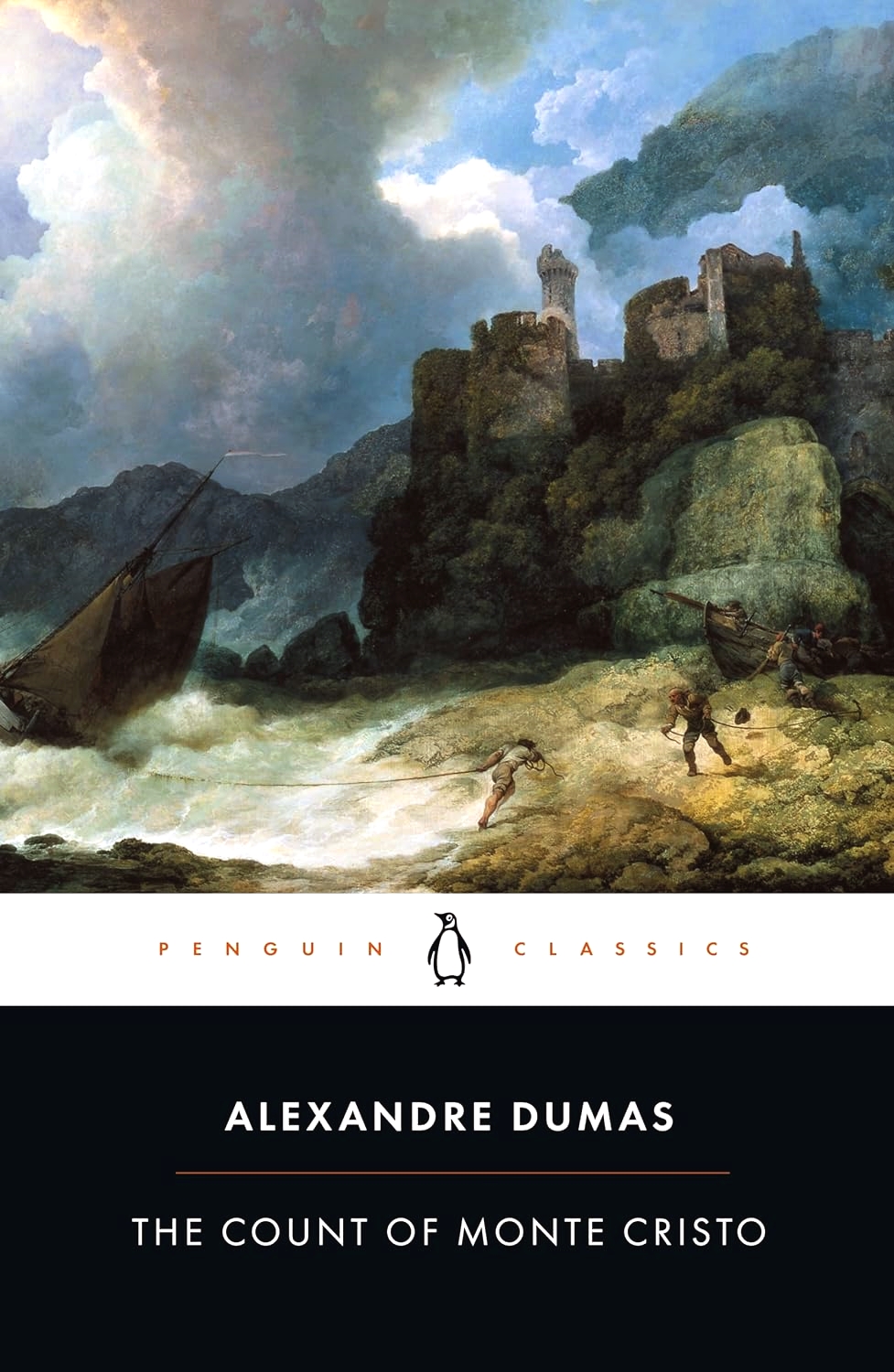
Which Edition of The Count of Monte Cristo This Article Covers
Le Comte de Monte-Cristo first appeared in serialized form between 1844 and 1846, with the Bibliothèque nationale de France’s publication record documenting the novel’s original appearance in Journal des débats. Serialization is not merely a bibliographical detail. It explains the book’s rhythm: spectacular cliffhangers, characters who disappear for hundreds of pages before returning, mysteries that remain unresolved for long stretches, elaborate backstories nested inside the main narrative, and apparently minor details that become decisive much later.
Dumas wrote within the collaborative working system associated with Auguste Maquet, who helped develop scenarios and narrative frameworks for several major Dumas works. The Bibliothèque nationale de France’s account of Dumas’s collaboration with Auguste Maquet is useful because it avoids two equally misleading extremes: pretending Dumas worked entirely alone or reducing him to a name attached to someone else’s writing. Dumas remained the dominant literary personality responsible for the published work’s voice, energy, and dramatic transformation of collaborative material.
For modern English readers, the strongest general recommendation is Robin Buss’s complete Penguin Classics translation. It is explicitly presented as complete and unabridged, uses modern English, and includes explanatory material that helps with the novel’s political, historical, and linguistic context. That distinction matters because The Count of Monte Cristo has circulated in many shortened editions, some of which reduce or eliminate entire secondary plots.
The complete French text of Le Comte de Monte-Cristo preserves the full architecture against which abridgements can be recognized. In a novel of this size, cutting a secondary character may seem harmless until that character becomes the missing link between two revenge plots several hundred pages later. Removing lengthy Parisian material can make the book faster, but it also changes what the book is: Edmond’s revenge stops looking like the activation of an entire corrupt social system and becomes a simpler sequence of punishments.
Readers who know Dumas primarily through The Three Musketeers will recognize the same appetite for cliffhangers, disguise, coincidence, danger, social mobility, and dramatic confrontation. The Count of Monte Cristo, however, is darker and more architecturally obsessive. Instead of following comrades through a succession of adventures, it follows one man who acquires enough knowledge and wealth to convert society itself into the instrument of his revenge.
Edmond Dantès Is Betrayed and Buried Alive
The novel begins by giving Edmond Dantès almost everything he wants and then destroying it within days. That rapid rise and fall is essential because Edmond’s later identity as Monte Cristo can only be understood against the modest future he originally desired. He does not begin as an ambitious man hungry for enormous wealth or domination. His initial hopes are domestic and professional: to command a ship, care for his father, and marry Mercédès.
Marseille, the Conspiracy, and Villefort’s Betrayal
On 24 February 1815, the merchant vessel Pharaon returns to Marseille after a voyage through the Mediterranean. Its captain, Leclère, has died at sea, leaving the young mate Edmond Dantès effectively in command. Edmond is only about nineteen, but he has handled the ship so competently that its owner, Pierre Morrel, is already considering promoting him to captain.
Edmond’s competence immediately creates an enemy. Danglars, the Pharaon’s supercargo, resents both Edmond’s popularity with the crew and his probable advancement. He has also noticed something potentially dangerous: following Captain Leclère’s last instructions, Edmond stopped at the island of Elba, where the deposed Napoleon was living in exile. Edmond delivered a packet to Marshal Bertrand and received another letter that he has agreed to carry to Paris.
Edmond does not regard himself as a political agent. He is obeying what he considers the sacred final command of his captain, and even his brief encounter with Napoleon means little to him beyond its novelty. That innocence is precisely what makes him vulnerable. He understands ships, loyalty, work, and personal honor, but he does not yet understand how political information can become lethal in a society divided between restored royalists and Bonapartists.
Morrel’s approval makes Danglars’s resentment worse. When the shipowner suggests that Edmond may become captain of the Pharaon, the future that Edmond considers an undeserved blessing looks to Danglars like an intolerable promotion. Edmond, by contrast, speaks generously even about the colleague who dislikes him. He distinguishes Danglars’s personal coldness from his professional competence and does not try to have him removed.
Edmond’s second great happiness is Mercédès. Before seeing her, however, he visits his father and discovers that the old man has been living in severe poverty. Edmond had left him two hundred francs, but his neighbor Caderousse demanded repayment of a debt Edmond owed. The elder Dantès paid rather than risk his son’s reputation and survived for months on almost nothing. Edmond is horrified and immediately gives his father what money he has.
Caderousse enters at precisely the wrong moral angle. He is not yet the hardened criminal he later becomes, but envy already distorts his view of Edmond’s good fortune. He resents the young man’s probable captaincy and financial prospects while simultaneously accepting his generosity. Caderousse’s role in Edmond’s fall will ultimately be less active than Danglars’s or Fernand’s, but Dumas establishes his characteristic failure early: he knows enough to recognize wrongdoing and rarely possesses enough courage to prevent it.
At the Catalans, a community near Marseille, another enemy is waiting. Fernand Mondego loves his cousin Mercédès and wants to marry her, but she has repeatedly told him that she loves Edmond. Fernand’s passion has hardened into jealousy. He wants Edmond removed but fears acting openly because Mercédès makes clear that if Edmond dies, her own life will effectively end with his.
When Edmond arrives, Mercédès embraces him with complete joy. Fernand watches the future he desires become impossible. He later encounters Danglars and the drunken Caderousse, creating the combination of motives from which the conspiracy emerges. Danglars wants Edmond’s position. Fernand wants Mercédès. Caderousse envies Edmond and is morally weak enough to remain present while worse men act.
Danglars realizes that Edmond can be removed without being murdered. In front of the others, he demonstrates how an anonymous denunciation might be written accusing Edmond of serving as a Bonapartist courier. He disguises his handwriting and specifies the politically suspicious facts: Edmond stopped at Elba and is carrying a letter to Paris. Danglars then pretends the exercise was merely a drunken joke and throws the letter aside.
Fernand understands what Danglars has made possible. After Danglars and Caderousse leave, he retrieves the denunciation and sends it. The division of guilt is important. Danglars invents the mechanism while maintaining plausible deniability. Fernand performs the decisive act. Caderousse recognizes that something shameful is happening but does not stop it. Dumas will later punish all three differently.
The speed of the conspiracy matters because Edmond’s wedding is equally rapid. Morrel has helped remove administrative obstacles, and Edmond and Mercédès are celebrating with friends before going to complete their civil marriage. Edmond’s father is there, overjoyed. Morrel attends, confirming publicly how highly he values Edmond. Danglars, Fernand, and Caderousse are all present in the same room as the happiness they have helped end.
Officials arrive before the marriage can take place and arrest Edmond in the name of the law. His first response is confusion rather than terror because he cannot imagine what crime he could have committed. He reassures Mercédès that the misunderstanding will soon be corrected. This confidence is one of the cruellest elements of the opening: Edmond enters the machinery of political justice still believing that innocence is relevant enough to save him.
Dumas then moves to another engagement feast. Gérard de Villefort, a young deputy crown prosecutor, is celebrating his betrothal to Renée de Saint-Méran in an intensely royalist household. Villefort’s personal history makes political loyalty especially important to him because his father, Noirtier, is associated with the revolutionary and Bonapartist past. Villefort has even separated his public name from his father’s in an effort to build an impeccable royalist career.
Edmond is brought before him. During the examination, Villefort quickly realizes that the young sailor is not a conscious conspirator. Edmond explains Leclère’s final instructions openly and without political cunning. He describes his love for his father, Morrel, and Mercédès as if those three loyalties exhaust his understanding of public life. Villefort, who has just come from his own betrothal celebration, is briefly moved by the parallel between his happiness and Edmond’s interrupted marriage.
Then Villefort asks to whom the letter from Elba is addressed.
The answer is Noirtier.
At that moment Edmond’s case changes completely. Villefort now knows that releasing him could expose his own father as a Bonapartist conspirator and damage the career, marriage, and political identity he has carefully built. The choice is no longer between justice and severity toward a stranger. It is between justice for Edmond and self-preservation for Villefort.
Villefort burns the incriminating letter in front of Edmond. He tells him to remain silent about it and creates the impression that destroying the evidence is an act of protection. Edmond leaves the interrogation believing that Villefort is his benefactor. In reality, the prosecutor has decided that the safest evidence is not merely a burned letter but a silenced witness.
Edmond is secretly transferred to the Château d’If, an island fortress off Marseille used as a state prison. He expects release until he realizes where the boat is taking him. The sight of the fortress breaks his remaining confidence. He protests that there has been no proper trial and that Villefort promised him protection, but the guards know only their orders.
Meanwhile, the political situation makes Villefort’s betrayal even more profitable. He travels to Paris and warns Louis XVIII that Napoleon’s return is more imminent than the government believes. Napoleon soon lands in France and begins the Hundred Days, briefly reclaiming power before his final defeat. Villefort’s warning makes him appear prescient and loyal.
Morrel tries to help Edmond when Bonapartists temporarily return to power, but the administrative record has been manipulated and the opportunity passes. After the Bourbon Restoration, Edmond disappears once more into the state’s prisons. A private act of self-protection has become a permanent bureaucratic erasure.
Outside the Château d’If, everyone’s life continues. Inside it, Edmond effectively ceases to exist.
Château d’If, Abbé Faria, and the Escape
At first Edmond expects the mistake to be corrected. He demands explanations, appeals to authority, and assumes someone will eventually examine his case properly. As the months and years pass without meaningful response, those expectations become despair.
The prison is not only a physical confinement but an attack on intelligibility. Edmond does not know who accused him, why Villefort betrayed his apparent sympathy, or whether Mercédès and his father still believe him alive. He has no narrative that explains his suffering. Without an explanation, he cannot even transform grief into anger because he does not know where the blame belongs.
An inspection offers momentary hope, but the officials treat prisoners as administrative entries rather than human beings. Edmond’s plea disappears into procedure. He moves from outrage to hopelessness and eventually considers starvation as a means of suicide.
Then he hears scraping inside a wall.
The sound transforms him because it gives him something prison has almost entirely taken away: purpose. Edmond realizes another prisoner is digging a tunnel. He begins excavating from his side, and the two tunnels eventually meet.
The other prisoner is Abbé Faria, an Italian cleric whom the authorities regard as mad because he repeatedly speaks of a fabulous hidden treasure. Faria is physically confined but intellectually enormous. He knows languages, history, politics, economics, mathematics, and science. He has fashioned tools and writing materials out of prison scraps and planned an escape through disciplined reasoning.
His arrival changes Edmond more profoundly than the treasure eventually will. Faria becomes teacher, father, analyst, and intellectual liberator. Edmond entered prison as an intelligent but largely uneducated sailor. Under Faria, he becomes linguistically skilled, historically informed, socially observant, and capable of understanding the systems that once overwhelmed him.
Faria also performs the analysis Edmond could not perform for himself. By reconstructing the circumstances of the arrest, he asks who benefited from Edmond’s removal, who knew about the Elba stop, who loved Mercédès, and what could have changed Villefort’s attitude during the examination. The motives become visible: Danglars wanted the captaincy, Fernand wanted Mercédès, and Villefort needed the letter and its bearer to disappear.
For Edmond, this knowledge is devastating. Before Faria’s reconstruction, he is an innocent man suffering an incomprehensible injustice. Afterward, he becomes a man who can name the people responsible. Knowledge gives meaning to suffering, but it also plants revenge.
Faria continues educating him while the two prepare an escape. Their relationship acquires a familial tenderness that partially replaces what Edmond lost when he was separated from his father. Yet Faria knows his health is failing. He suffers seizures and fears that another attack will leave him permanently incapacitated or kill him before they can escape.
Before that happens, he tells Edmond why the prison authorities consider him mad. Years earlier, he discovered the secret of the Spada treasure, an enormous fortune hidden on the island of Monte Cristo. The clue survives in a partially damaged document whose meaning Faria reconstructed. He names Edmond his heir.
Edmond initially values Faria more than the fortune. When Faria suffers another seizure, Edmond tries desperately to save him rather than use the opportunity to escape alone. Faria dies, leaving Edmond with education, the secret of the treasure, and a second paternal loss.
The death also gives Edmond a terrifying idea. The prison authorities sew Faria’s corpse into a burial sack. Edmond removes the body, takes its place, and drags Faria’s corpse into his own cell so the jailers will believe the prisoner is still there. He expects the sack to be carried outside and buried, after which he can dig himself out.
The Château d’If has a simpler cemetery.
The guards attach a weight to the sack and throw it into the sea.
Edmond plunges into the water enclosed in Faria’s shroud. He cuts through the sack, frees himself from the weight, reaches the surface, and swims away from the fortress that has held him for fourteen years. The escape works simultaneously as action sequence and rebirth ritual. Edmond enters the sea in the wrapping of a dead man and emerges as someone whose original identity has already been socially pronounced dead.
He is no longer the nineteen-year-old sailor who trusted that innocence would protect him. He carries Faria’s knowledge, the memory of fourteen stolen years, the names of those who betrayed him, and the secret of a fortune vast enough to make ordinary social limitations almost irrelevant.
From Prisoner to the Count of Monte Cristo
Escape does not immediately turn Edmond into the Count. Dumas devotes an important transitional movement to showing how the former prisoner re-enters the world, verifies the treasure, learns what happened during his absence, and divides humanity according to what people did when he was powerless. Revenge begins only after investigation.
Treasure, Reconnaissance, and the Truth of the Past
After escaping the Château d’If, Edmond reaches the small island of Tiboulen and is eventually rescued by smugglers. Their reaction to him gives him his first external measure of how much time has passed. He learns that the year is 1829. Fourteen years of his youth have vanished.
He joins the smugglers long enough to regain strength, money, and practical freedom. His old maritime competence remains intact, but his personality has changed. The impulsive young man who once trusted everyone around him now understands concealment. When the smugglers’ route brings him near Monte Cristo, he creates an opportunity to remain alone on the island by pretending to be badly injured.
Faria’s directions lead him to the hidden cave.
The treasure is real.
Dumas makes the discovery deliberately excessive: gold, jewels, coins, and portable wealth accumulated by the Spada family are waiting beneath the island. The improbability is part of the novel’s transformation from political prison story into almost mythic revenge fantasy. Edmond does not merely become comfortable or independently wealthy. He gains resources sufficient to operate above ordinary economic constraints.
Money alone, however, does not create Monte Cristo. Edmond first uses it to acquire mobility, education’s social expression, servants, property, information, and multiple identities. He changes his appearance enough that the people who once knew him will not immediately recognize him. His wealth allows him to become whoever a situation requires.
Before punishing anyone, he investigates.
Disguised as the Abbé Busoni, he visits Caderousse at a poor inn near the Pont du Gard. Busoni claims to have known Edmond Dantès and says the supposedly dead prisoner left a valuable diamond to be divided among the people who had loved him. By presenting himself as an outsider, Edmond can ask what happened without revealing why he wants to know.
Caderousse tells the story.
Danglars prospered. Fernand became a soldier, advanced through war and political opportunity, married Mercédès, and eventually rose into the aristocracy as the Comte de Morcerf. Villefort’s career also advanced. Mercédès waited and suffered before eventually marrying Fernand. Most devastatingly, Edmond’s father died after sinking into poverty and despair.
Morrel alone behaved as Edmond would have hoped. He repeatedly tried to help the elder Dantès, tried to secure Edmond’s release, and remained loyal after there was no practical advantage in doing so. Caderousse also admits enough about the conspiracy for Edmond to confirm Faria’s reasoning.
The conversation establishes the moral categories by which Edmond initially intends to act. Those who remained loyal will be rewarded. Those who betrayed him will be punished. Caderousse occupies an ambiguous middle position because he did not design the conspiracy or send the denunciation, but he knew enough to intervene and remained silent.
Edmond gives him the diamond.
The gift becomes an early warning about the limits of Monte Cristo’s judgments. Caderousse’s poverty does not transform into gratitude or moral reform. The sudden wealth intensifies the greed of Caderousse and his wife, La Carconte. When a jeweller comes to purchase the diamond, money triggers suspicion, violence, and murder; the episode leaves the jeweller and La Carconte dead and ultimately sends Caderousse into the criminal justice system.
Edmond did not command those murders. Yet the diamond he deliberately inserted into Caderousse’s life becomes the catalyst. Long before the Count recognizes the full danger of setting human passions in motion, Dumas shows the reader that consequences exceed intention.
Edmond also investigates the official record. Under another identity, the English Lord Wilmore, he traces what happened to his case and confirms Villefort’s role. The prosecutor did not merely fail to rescue him. He actively ensured that the record remained buried.
By the time Edmond begins acting as Monte Cristo, revenge is therefore based on verified knowledge rather than a sudden emotional impulse. This helps make his project seductive. The guilty are genuinely guilty. The moral problem will not be whether he has identified the right men but whether correct identification gives him the right to exercise unlimited judgment over their lives and families.
The Morrel Rescue and the Turn Toward Revenge
Before Edmond begins destroying his enemies, he saves Morrel.
Morrel & Son has fallen into financial crisis after a series of maritime losses. The honest shipowner remains determined to meet his obligations, but confidence is collapsing around him and creditors are closing in. His business reputation has been built on reliability, so bankruptcy means more to him than material loss. He sees dishonor as the destruction of his identity.
Edmond approaches the problem indirectly through the firm of Thomson & French and other concealed interventions. Morrel receives unexpected extensions on debts. Julie Morrel is instructed to obey messages signed by “Sinbad the Sailor.” The family is given hope without knowing why.
Morrel nevertheless reaches the final day believing he cannot pay everything he owes. Rather than survive public dishonor, he prepares to kill himself. He arranges matters so that his family will be spared as much as possible and waits for the appointed hour.
The rescue arrives at the last possible moment. Debts are paid. Julie finds the means to restore the family’s financial position. Most spectacularly, a new ship named Pharaon enters the harbor carrying the same symbolic identity as the vessel whose loss had helped ruin Morrel.
The emotional force of the scene comes from Edmond’s restraint. He has the power to appear openly and receive gratitude, but he remains hidden. Morrel’s happiness is enough.
This episode is indispensable to the novel’s moral design. It proves that Edmond’s extraordinary power can be used to restore rather than punish. When he later claims to be Providence, the Morrel rescue is part of the evidence that makes the claim psychologically plausible to him. He has saved a good man with almost miraculous precision.
It also establishes the standard against which his revenge will eventually be judged. The same wealth, secrecy, theatrical planning, and ability to manipulate circumstances can create life or ruin it. The moral distinction depends not on the power itself but on how Edmond chooses to use it and whether he can control what his interventions unleash.
Rome: Monte Cristo Creates His Myth
Years pass before the novel fully unveils the Count of Monte Cristo as Paris will know him. Dumas reintroduces Edmond from the outside, making both characters and readers experience him first as a mystery. The Rome sequence therefore functions less as a detour than as the public creation of the Monte Cristo legend.
Sinbad, Vampa, and the Theatre of Power
Franz d’Épinay, a young French aristocrat travelling in Italy, encounters a mysterious host connected with the island of Monte Cristo. He is received in a luxurious underground environment by a man calling himself Sinbad the Sailor. The setting combines hidden wealth, Mediterranean exoticism, drugs, sensuality, secrecy, and absolute hospitality.
Franz cannot easily classify the man. He appears enormously rich yet disconnected from any obvious national or social identity. He speaks and behaves with the confidence of someone who expects ordinary barriers to yield before him. His luxury is not merely consumption. It is performance.
That performance becomes even more disturbing in Rome.
Franz and his friend Albert de Morcerf learn about Luigi Vampa, the celebrated bandit chief who operates around the city. Vampa exists outside legal institutions but possesses his own hierarchy, loyalty system, territorial authority, and code. Monte Cristo’s relationship with him shows that the Count commands influence not only in aristocratic salons but in an extralegal world of smugglers, bandits, and fugitives.
The Count’s fascination with punishment becomes explicit during the Roman execution known as the mazzolata. He has arranged a pardon for Peppino, a man connected to Vampa’s network, while another condemned prisoner remains scheduled to die. Franz is unsettled by Monte Cristo’s intense interest in the psychology of execution and vengeance.
This is an important stage in Edmond’s transformation. He no longer speaks about punishment like an injured victim. He theorizes it. He studies fear, suffering, and retribution as if he has acquired specialist knowledge of moral pain.
The episode also demonstrates selective mercy. Monte Cristo can save Peppino because he chooses to do so, just as he saved Morrel. His power increasingly resembles the prerogative of a ruler who decides who receives grace and who faces punishment.
Carnival, Albert’s Kidnapping, and the Invitation to Paris
Rome’s carnival amplifies the novel’s obsession with masks. Everyone is temporarily disguised, identities become unstable, social boundaries blur, and appearances cannot be trusted. Monte Cristo, who lives permanently through manufactured identities, is perfectly at home in this world.
Albert pursues what he imagines is a romantic adventure and instead falls into the hands of Luigi Vampa. The kidnapping places the son of Fernand Mondego directly inside Monte Cristo’s sphere of influence without Albert understanding the connection.
Franz expects negotiation, ransom, or danger. Monte Cristo simply goes to Vampa.
His authority is sufficient.
Albert is released immediately because Vampa considers Monte Cristo’s word decisive. Albert interprets this intervention as extraordinary generosity and courage. He now owes the Count his freedom and perhaps his life.
That debt gives Monte Cristo precisely what he needs: an invitation into the Morcerf family.
Albert and Franz formally visit him, and Albert promises to receive the Count in Paris. Monte Cristo fixes an exact date and time. The precision is characteristic. He is no longer a man reacting to what others do. He has spent years constructing a timetable in which people believe they are making voluntary choices while moving toward positions he has anticipated.
Rome ends with the avenger invited into the home of one of the men responsible for destroying Edmond Dantès.
Paris: Building the Revenge Machine
The Paris section is where many abridged versions do the greatest damage because the novel changes form. The direct adventure of prison and escape gives way to an enormous social network. Monte Cristo does not arrive in Paris and simply assassinate Fernand, Danglars, and Villefort. He enters their families, studies the weak points already present in their lives, and creates conditions in which their own histories become weapons against them.
Entering the Morcerf, Danglars, and Villefort Households
Albert introduces Monte Cristo to his fashionable circle, including the journalist Beauchamp, the diplomat-connected Lucien Debray, Château-Renaud, and the soldier Maximilian Morrel. Each belongs to a different part of Parisian power: journalism, government information, aristocracy, military prestige, and finance.
Monte Cristo impresses them immediately. He arrives at the exact promised moment, displays enormous wealth, and speaks with the assurance of someone who has travelled everywhere and experienced everything. His stories are so unusual that no one can decide whether to treat him as an eccentric foreign aristocrat, a mystic, an adventurer, or something more dangerous.
Maximilian’s presence has a different effect. Monte Cristo recognizes in him the son of the Morrel family he saved. Here, beneath the Count’s constructed coldness, an older attachment survives. The Morrels remain connected to Edmond’s capacity for love and gratitude.
Albert then introduces the Count to his parents.
Fernand, now the Comte de Morcerf, does not recognize the sailor he helped send to prison. Mercédès does.
The recognition is one of the novel’s most emotionally charged reversals because Monte Cristo has built an identity capable of deceiving almost everyone, yet he cannot erase himself from the woman who loved Edmond. Mercédès does not immediately expose him, and the two enter a painful silent agreement in which each understands more than either openly says.
Monte Cristo simultaneously enters the orbit of Danglars. The former supercargo has become an immensely wealthy banker, and finance now defines his sense of power. Monte Cristo approaches him through exactly that language. Letters of credit establish that the supposedly foreign count can command resources so enormous that even Danglars must take him seriously.
The Count also establishes himself in the Villefort household through a carefully managed sequence involving prized horses and a staged accident. Ali, Monte Cristo’s devoted servant, saves Héloïse de Villefort and her young son Édouard when their carriage is endangered. Gratitude opens the household.
Villefort visits Monte Cristo and finds himself drawn into an extraordinary conversation about justice and superiority. The prosecutor believes in law as an instrument wielded by people like himself. Monte Cristo speaks as though he has transcended ordinary law and belongs to a class of exceptional beings who execute a higher design.
The exchange is crucial because Villefort does not recognize how closely the Count resembles him. Both men believe themselves qualified to judge others. Both maintain public identities that conceal private acts. The difference is that Villefort’s authority comes from the state while Monte Cristo’s comes from wealth, secrecy, and knowledge.
After Villefort leaves, the Count turns toward what he calls the antidote: the Morrels and Haydée.
Haydée lives within Monte Cristo’s household in surroundings explicitly fashioned through nineteenth-century European ideas of Oriental luxury. She is the daughter of Ali Pasha of Janina and has survived political betrayal, the destruction of her family, enslavement, and sale. Monte Cristo purchased her freedom and brought her into his household, where she lives with extraordinary material privilege but also within a relationship marked by dependence.
Her history is not incidental. Fernand Mondego’s greatest crime after betraying Edmond occurred during his military career in the eastern Mediterranean. He betrayed Ali Pasha, profited from the catastrophe, and was involved in the sale of Ali’s wife and daughter. Haydée therefore carries the living evidence that can destroy the Comte de Morcerf.
Monte Cristo does not immediately use it. His revenge works by staging gradual pressure rather than revealing everything at once.
The Morrel family provides another moral atmosphere. Julie, Emmanuel, and Maximilian live without the spectacular wealth or social ambition of the Danglars and Villefort circles, but their household contains genuine affection. They still remember the mysterious Sinbad who saved Pierre Morrel.
Maximilian has also become part of another plot. He is secretly in love with Valentine de Villefort, Gérard Villefort’s daughter by his first wife, Renée de Saint-Méran. Valentine loves him in return, but her family intends her to marry Franz d’Épinay.
Their meetings across a garden barrier create a deliberate counterpoint to the marriages arranged around money, lineage, and social strategy elsewhere in the novel. Maximilian and Valentine have little institutional power, but they possess the kind of reciprocal loyalty Edmond once expected from his life with Mercédès.
Noirtier, Villefort’s aged Bonapartist father, becomes Valentine’s greatest domestic protector. A stroke has left him almost completely paralyzed and unable to speak, yet he communicates through his eyes with extraordinary precision. Valentine has learned his system so thoroughly that their conversations demonstrate one of the novel’s recurring ideas: formal power and genuine agency are not the same thing.
Monte Cristo’s visit to Héloïse de Villefort introduces a much darker mechanism. They discuss toxicology, including the possibility of administering poisons gradually, the development of tolerance, and substances difficult to detect. Héloïse is fascinated.
The Count does not explicitly command her to poison anyone. That distinction matters, but it does not absolve him of moral responsibility. He recognizes her interest and supplies knowledge within a revenge environment he has deliberately entered. Later events will show how dangerous it is for him to assume that he can activate vice without becoming responsible for consequences he did not specifically order.
The Parisian financial world offers another route into Danglars. Monte Cristo observes the relationship between the banker, his wife, and Lucien Debray, whose access to political information can influence speculation. Danglars’s wealth depends partly on confidence, timely intelligence, credit, and the belief that information can be converted into profit.
The Count now understands how to attack all three principal enemies through the identities they created after Edmond disappeared. Fernand’s power depends on honor. Danglars’s depends on money. Villefort’s depends on law and public respectability.
Monte Cristo will not merely take those things from them. He will force each man’s hidden past to attack the foundation of his present identity.
Andrea Cavalcanti, Noirtier, Auteuil, and the Financial Traps
The most complicated revenge mechanism begins with Bertuccio, Monte Cristo’s Corsican steward. Bertuccio reacts with horror when the Count acquires a house at Auteuil. Monte Cristo forces him to explain why.
Years earlier, Bertuccio’s brother had been killed, and Bertuccio sought legal justice from Villefort. The prosecutor refused him. In accordance with Corsican vendetta, Bertuccio vowed personal revenge.
He eventually attacked Villefort at Auteuil and believed he had stabbed him to death. On the same night, Bertuccio witnessed Villefort burying a box in the garden. Inside was a newborn child.
Villefort had been having an affair with Madame Danglars before her marriage to the banker had settled into its present form. The child born from that affair threatened both of them with scandal. Villefort attempted to erase the evidence by burying the infant.
The child survived because Bertuccio found and revived him.
Raised under the name Benedetto, the boy did not grow into a grateful rescued orphan. He became cruel, manipulative, violent, and criminal, eventually becoming associated with the destruction of the woman who raised him. Dumas does not present this as a simple argument that wicked parents biologically produce wicked children, but the plot deliberately turns Villefort’s buried crime into a living consequence.
Monte Cristo now possesses the connection.
He manufactures a new aristocratic identity for Benedetto: Andrea Cavalcanti. To support it, he also hires the supposed father, Major Cavalcanti, creating documentation, money, costume, manners, and a plausible family story. The performance exposes the fragility of aristocratic identity in the novel. Given enough money and correct social signals, a criminal can be accepted as a gentleman.
Andrea is introduced into the circle surrounding Danglars, whose daughter Eugénie is being considered as a wife for Albert de Morcerf. Danglars cares less about romantic compatibility than financial and social advantage. When Andrea appears to possess wealth and noble ancestry, he becomes an increasingly attractive alternative.
Noirtier is fighting a different marriage arrangement. Valentine is still promised to Franz d’Épinay, and Villefort wants the match because it serves his social interests. Noirtier responds first through inheritance, threatening to disinherit Valentine if she marries Franz.
When that does not fully stop Villefort, Noirtier uses history.
He produces a signed account connected to the death of Franz’s father, General Quesnel. The document establishes that Noirtier himself was involved in the fatal political confrontation. Franz realizes that marrying Noirtier’s beloved granddaughter would join him to the man responsible for his father’s death.
He withdraws.
Noirtier’s victory is important because it does not depend on Monte Cristo. The revenge plot is not the only source of agency in the novel. Other characters pursue their own loyalties and conflicts, sometimes disrupting the Count’s design.
Monte Cristo turns directly toward Danglars’s financial system through the semaphore telegraph. France’s communication network transmits political information rapidly through visual signals relayed across stations. The Count discovers that an individual operator can be bribed.
He pays one to transmit false political information concerning Spain.
The false dispatch reaches official and financial networks. Danglars acts on information he believes privileged and reliable, then suffers a major speculative loss when the report proves false.
The episode is one of Dumas’s most modern revenge mechanisms. Monte Cristo does not steal Danglars’s money. He corrupts information, knowing Danglars will convert information into risk himself.
The Count also buys the Auteuil property associated with Villefort’s attempted burial of his illegitimate son and stages a dinner there. Villefort and Madame Danglars are both present.
Monte Cristo tells the guests that a child’s remains were supposedly discovered in the garden.
To everyone else, the story is macabre entertainment. To Villefort and Madame Danglars, it is an impossible message from the past. They believed the infant and the secret safely erased.
Monte Cristo still does not accuse them openly. His power comes from making guilty people interpret ambiguous facts through their own fear.
Caderousse, meanwhile, re-enters the narrative and recognizes Andrea as Benedetto. He begins blackmailing him. The false aristocrat and the compromised witness from Edmond’s original betrayal are now connected.
Danglars’s own marriage reveals another form of decay. He and Madame Danglars share little genuine affection. Their household operates through money, affairs, social appearances, and competing interests. Her relationship with Debray provides her with opportunities for speculation, while Danglars increasingly treats Eugénie’s marriage as a business arrangement.
Eugénie herself rejects the role her father assigns her. She is talented, independent, artistically ambitious, and resistant to marriage. Her relationship with Louise d’Armilly matters because it gives her a possible life outside the conventional female destiny imagined by her family.
Villefort begins investigating Monte Cristo, but the Count has anticipated this as well. The prosecutor encounters Lord Wilmore and Abbé Busoni, supposedly independent men who can provide information about Monte Cristo.
Both are Edmond.
The irony is exact. Villefort once destroyed Edmond by controlling what the state knew about his identity. Now Edmond controls what Villefort can know about him.
Mercédès remains harder to manage.
At the Morcerf home, she speaks privately with Monte Cristo and tests memories, language, and emotional reactions. Edmond can fool legal investigators, bankers, aristocrats, and criminals, but he cannot completely escape the recognition of someone who knew him before all the masks existed.
Their exchanges disturb the absolute separation he has tried to create between Edmond Dantès and the Count of Monte Cristo. Revenge requires him to treat the past as a closed case whose guilty parties can be judged. Mercédès remains living evidence that the past also contains love.
Poison, Inheritance, and the Approach of Exposure
The Villefort household becomes increasingly dangerous as deaths accumulate around inheritance.
Madame de Saint-Méran arrives after the death of her husband and presses for Valentine’s marriage to Franz. She soon becomes violently ill and dies. The circumstances begin to trouble Dr. d’Avrigny, the family physician.
Noirtier’s intervention with Franz prevents the marriage, but another conflict remains. Héloïse de Villefort has a powerful interest in her son Édouard’s future. Valentine stands at the center of significant inheritances, and Héloïse has already shown dangerous fascination with poison.
Noirtier has also been receiving carefully controlled medication over time, which gives him an unusual tolerance to certain toxic substances. Valentine, who cares for him closely, receives some of the same treatment. That detail becomes crucial when poison enters the household more openly.
Haydée’s history is simultaneously moving toward public exposure. Danglars, encouraged to investigate Fernand’s past, helps set inquiries in motion concerning the events at Janina. Information begins appearing about an officer involved in Ali Pasha’s betrayal.
The respectable Comte de Morcerf has built his Parisian identity on military honor and aristocratic advancement. The name Fernand Mondego belongs to a poorer, more obscure past. Monte Cristo’s revenge depends on reconnecting those names.
The poisoning crisis then becomes undeniable.
A drink intended for Noirtier is consumed by his faithful servant Barrois. He dies. Dr. d’Avrigny conducts tests and concludes that poison is present.
Villefort is forced to confront the possibility of a murderer inside his own household.
His response exposes the central hypocrisy of his character. As a prosecutor, he believes society requires punishment and public justice. As a husband and father whose name is at risk, he wants secrecy.
The man who sacrificed Edmond to protect his reputation now hesitates to expose a poisoner because the scandal would enter his own home.
By this point Monte Cristo’s revenge environment is fully active. Yet the novel has begun shifting the moral ground. Fernand and Danglars are being attacked through crimes and appetites unmistakably their own. The Villefort household is different because Héloïse is taking independent murderous action after Monte Cristo helped awaken her interest in toxicology.
His plan no longer resembles a perfectly sealed mechanism.
Other people are using the forces he released.
The Reckonings: Caderousse, Fernand, Villefort, and Danglars
The separate revenge systems now begin to resolve. Their endings are deliberately different because Dumas does not treat Edmond’s enemies as identical. Caderousse is destroyed by greed and complicity, Fernand by public exposure and abandonment, Villefort by the collision of his private crimes with his judicial identity, and Danglars by financial and physical terror. Most importantly, Edmond’s attitude changes while these punishments unfold.
Caderousse and the “Hand of God”
Caderousse has moved from envy and cowardice into open criminality. He discovers enough about Monte Cristo’s household through Andrea to imagine burglary as an opportunity.
Andrea encourages the scheme because Caderousse’s death would free him from blackmail.
Caderousse breaks into the Count’s residence and encounters Abbé Busoni. Monte Cristo is once again using disguise, but this time he stages something close to a confession.
Busoni forces Caderousse to reveal information about Andrea and then allows him to leave. Monte Cristo knows the danger outside but gives Caderousse another apparent chance.
Andrea attacks him and leaves him mortally wounded.
The dying Caderousse is brought face to face with the man whose life he once helped ruin through silence. Monte Cristo reveals his connection to Edmond Dantès and interprets the death as judgment.
This is the high point of Edmond’s belief in his own providential role. Caderousse dies through Andrea’s hand rather than Edmond’s, which allows the Count to see the outcome as if a higher justice has confirmed his design.
Yet the logic is already unstable. Monte Cristo arranged the social conditions connecting Caderousse and Andrea. He knew more than either man knew about the other. His insistence that Providence has simply acted risks concealing his own agency.
Caderousse is genuinely guilty, but his death is also evidence that Monte Cristo has become comfortable standing very close to catastrophe while declaring himself merely its interpreter.
Fernand, Haydée, Mercédès, and Albert
Fernand’s downfall begins through information.
Beauchamp investigates the accusations connected with Janina and discovers that the evidence against the Comte de Morcerf is serious. Because Albert is his friend, he initially suppresses publication and tries to contain the scandal.
The attempt fails.
The accusation reaches the Chamber of Peers, where Fernand must answer for his conduct. He tries to defend his honor and the career he has built since leaving Marseille.
Then Haydée appears.
Her testimony transforms rumor into personal accusation. She identifies Fernand Mondego as the officer who betrayed Ali Pasha and participated in the chain of events that led to Ali’s death and to the sale of Haydée and her mother. She also possesses documents supporting her identity and history.
Fernand’s public identity collapses because the old and new names are finally joined. The Comte de Morcerf cannot remain an honorable aristocrat once Fernand Mondego’s past becomes visible.
Monte Cristo has achieved a characteristic form of revenge: he has not fabricated the crime. He has brought the surviving evidence into the place where Fernand’s reputation matters most.
Albert sees the attack on his father as an attack on his family and searches for its source. His investigation ultimately points toward Monte Cristo.
He challenges the Count to a duel.
For Edmond, the revenge now reaches a moral crisis. Albert did not betray him. He is the innocent son of Fernand and Mercédès.
Yet the social code of the duel could force Edmond to kill him.
Mercédès comes to Monte Cristo at night and finally addresses him as Edmond.
The scene breaks through decades of performance. She begs him not to kill Albert. Edmond responds by revealing the full moral account he has carried since prison: his youth was stolen, his father died, his marriage was destroyed, and Fernand helped create the false accusation that made it possible.
Mercédès does not claim Fernand is innocent. She asks Edmond to recognize that her son is.
The distinction matters enough that Monte Cristo changes his plan. He prepares to go to the duel willing to die rather than kill Albert and violate the promise he has made to Mercédès.
Albert, meanwhile, learns the truth from his mother.
At the meeting, he refuses the inherited logic of vengeance. Instead of forcing the duel, he publicly apologizes to Monte Cristo.
This is one of the most important moral actions performed by any character in the novel. Albert has every social incentive to defend his father’s name through violence, yet once he knows Fernand’s guilt, he refuses to transfer that guilt to another generation.
Mercédès and Albert then abandon Fernand.
They reject not merely the man but the wealth and social position built upon his history. Albert chooses to begin again without relying on the Morcerf fortune. Mercédès returns emotionally and materially toward the poorer life associated with Marseille.
Monte Cristo helps her indirectly through money connected with Edmond’s old home, but the gesture differs from his spectacular patronage elsewhere. He understands that Mercédès cannot simply accept the Count’s fortune as compensation for the life that was lost.
Fernand finally confronts Monte Cristo.
The Count reveals himself unmistakably as Edmond Dantès.
For Fernand, this recognition is more devastating than any duel. The young rival he thought safely buried has returned with enough power to expose everything Fernand became after the betrayal.
Fernand returns home and discovers that Mercédès and Albert have left him.
He kills himself.
The revenge is complete, but Edmond’s feelings are no longer simple. Mercédès’s suffering and Albert’s innocence have forced him to encounter something his moral arithmetic could not easily contain. Punishing Fernand has not restored the life Edmond lost, and the consequences cannot be confined to the guilty man.
Valentine, Benedetto, and the Destruction of Villefort
The Villefort plot becomes the most morally dangerous because it surrounds people Monte Cristo does not want to destroy.
Valentine continues to grow weaker. Maximilian, terrified by the deaths around her, finally reveals to Monte Cristo that he loves her. The information transforms the situation.
Until now, Valentine could be understood within the revenge design primarily as Villefort’s daughter. Maximilian makes that impossible. She is also the beloved of the Morrel son, a member of the family Edmond regards as sacred.
The Count must protect her.
Noirtier has already helped. Because Valentine has shared elements of his medical regimen, her body possesses a degree of tolerance that prevents the poison from killing her as quickly as it killed other victims. Monte Cristo now begins intervening directly, combining his knowledge of poison and antidotes with absolute secrecy.
Another family conflict develops in the Danglars household. Eugénie openly tells her father that she does not want marriage and values artistic independence. Danglars, however, increasingly needs the Cavalcanti match because his finances are deteriorating and Andrea still appears wealthy.
The marriage contract is prepared.
At the moment Andrea is closest to becoming socially legitimate, the identity collapses. Evidence connected to Caderousse exposes him as Benedetto, a criminal wanted for serious offences.
Andrea flees.
Eugénie takes advantage of the catastrophe to escape the marriage economy entirely. With Louise d’Armilly, she adopts male disguise and leaves to pursue an artistic life. The episode echoes Monte Cristo’s larger theme of constructed identity but uses disguise for liberation rather than revenge.
Andrea is captured at Compiègne and returned for trial.
Madame Danglars, terrified by the scandal and aware of her own connection to the child once buried at Auteuil, asks Villefort to suppress or delay the prosecution. He refuses.
The irony is devastating. Villefort insists that law must proceed against the very son whose existence he once tried to erase outside the law.
Meanwhile Valentine’s danger becomes immediate.
Monte Cristo appears secretly in her room and tells her that someone is attempting to poison her. He asks for complete trust. Valentine must continue behaving as though she is vulnerable while he controls what she consumes.
Héloïse eventually believes she has succeeded.
Valentine appears to die.
To most of the household, including Maximilian, the death is real. Monte Cristo has used a drug-induced state to simulate death closely enough to deceive observers. Valentine is placed in the family tomb.
Maximilian is destroyed.
His grief deliberately mirrors Edmond’s earlier despair. He cannot imagine a future beyond the apparent death of the person who gave life meaning. When he threatens suicide, Monte Cristo stops him and demands that he wait.
The Count asks for one month.
The request is significant because Edmond once believed unbearable suffering entitled him to judge the world immediately. With Maximilian, he now insists that a human being cannot know the meaning of suffering before time has completed the story.
Danglars’s financial collapse is also reaching its final stage. Monte Cristo arranges demands large enough to drain the banker’s remaining confidence and resources. Danglars, increasingly desperate, ultimately chooses flight and takes millions entrusted to him rather than remain in Paris and face ruin.
Villefort moves toward a different destruction.
Andrea’s trial begins with the prosecutor expecting another opportunity to exercise public justice. Benedetto then announces his parentage.
He identifies Villefort as the father who tried to bury him alive.
The prosecutor’s most secret crime becomes public in the very courtroom where he has built his authority by judging others. The collision is almost too exact to seem naturalistic, but that is part of Dumas’s design: Villefort’s social identity and private guilt are made to annihilate each other.
Villefort admits the truth and leaves the court shattered.
Before the trial, he had already confronted Héloïse. Rather than arresting his wife and exposing the murders through ordinary legal procedure, he offered her a terrible private alternative. She could die by poison rather than face public trial and execution.
Once again, Villefort tries to conduct justice inside his household rather than submit his own family to the law he applies to everyone else.
He returns home after Benedetto’s revelation and finds the consequences.
Héloïse has poisoned herself.
She has also poisoned Édouard.
The death of the child changes the novel.
Édouard is spoiled, selfish, and often unpleasant, but he is still a child. He had no role in Edmond’s imprisonment. His death cannot be fitted into the Count’s system of deserved retribution.
Monte Cristo arrives expecting the downfall of Villefort and is confronted instead by collateral catastrophe.
The confidence with which he once interpreted Caderousse’s death as the “hand of God” becomes impossible to sustain. His revenge against Villefort has helped create a world in which poison, secrecy, fear, inheritance, and private judgment spread beyond his intended target.
Villefort loses his sanity.
Monte Cristo is forced to confront the possibility that he has gone beyond the right of a human being to punish.
The reversal does not erase his enemies’ guilt. Villefort remains responsible for burying Edmond alive, attempting to murder his own newborn child, and repeatedly subordinating justice to reputation. Héloïse remains responsible for murder.
What changes is Edmond’s certainty about himself.
Knowing guilt is not the same as being Providence.
Danglars’s Punishment and Pardon
Danglars escapes Paris with approximately five million francs taken from charitable funds and travels into Italy.
He falls into Luigi Vampa’s hands.
The Roman network introduced much earlier returns as the final physical instrument of Monte Cristo’s revenge.
Danglars is imprisoned but not immediately beaten or killed. Instead, food is offered at absurd prices.
At first he treats the situation as extortion and believes money will solve it. A meal may cost an enormous fraction of his fortune, but he still has millions.
Hunger changes the calculation.
The banker who has spent his life translating human relationships into money is placed in a situation where money and survival become brutally equivalent. Every meal consumes wealth. Refusing to pay means physical suffering.
The punishment also echoes the fate of Edmond’s father.
Old Dantès died after poverty and hunger followed the disappearance of his son. Danglars helped create that disappearance.
Now Danglars learns what it means to possess money while facing starvation.
Monte Cristo allows the process to continue until Danglars is broken.
Then he appears.
Danglars expects the Count of Monte Cristo. Instead, the man identifies himself as Edmond Dantès and names the original betrayal.
This is the final planned revelation of Edmond’s identity to an enemy.
It also becomes the first final punishment he deliberately stops.
Danglars repents under terror, and Edmond forgives him. He allows him to keep a remaining sum of money and orders Vampa to release him.
The man who began revenge by dividing humanity into those to reward and those to punish ends the project by sparing someone unquestionably guilty.
Mercy does not erase the punishment Danglars has endured, but it changes the principle behind Edmond’s final act. He no longer needs the guilty man’s complete destruction to prove that justice has been achieved.
The Fifth of October: What Happens at the End
The novel’s final chapter returns to the island of Monte Cristo. The setting that once represented treasure and the birth of the Count becomes the place where Edmond must decide what remains after revenge.
Maximilian Morrel arrives on 5 October, the date he promised to wait until. He still believes Valentine dead. Monte Cristo has required him to endure a month of grief before acting on his desire to die, but the passage of time has not convinced Maximilian that life without Valentine is worthwhile.
Monte Cristo brings him back into the environment associated with his own transformation. The parallel between the two men is deliberate. Edmond once reached a point in the Château d’If where continued existence seemed meaningless. Maximilian now believes the same because his imagined future has vanished.
The Count has engineered a final dramatic revelation. He gives Maximilian a substance that the young man believes will allow him to die. Instead of death, Maximilian passes into an altered state.
When consciousness returns, Valentine is there.
She has been alive throughout the period of mourning, protected by Monte Cristo after her simulated death.
The restoration transforms Maximilian’s understanding of the month he has endured. His suffering was real even though its apparent cause was incomplete. Dumas does not suggest that grief is trivial because happiness eventually returns. He suggests that human beings cannot know the final value or meaning of an event while still inside it.
Monte Cristo makes arrangements for Maximilian and Valentine’s future. In doing so, he performs one last act of the restorative power first demonstrated with the Morrels. Rather than exposing guilt or destroying an enemy, he uses secrecy, wealth, and theatrical control to reunite two people.
Haydée then becomes central to Edmond’s own future.
Throughout much of the novel, he has imagined himself as someone whose emotional life ended with Edmond Dantès. He can remember love, reward loyalty, and feel affection, but the Count presents himself as a man living after his own death.
Haydée tells him that her attachment is not merely gratitude or filial devotion.
She loves him.
The revelation forces Edmond to consider whether he has any right to future happiness after what he has done. His relationship with Haydée remains complicated by the enormous imbalance in their history: he purchased her freedom, has acted as protector and master of the household in which she lives, and is considerably older. Yet within the novel’s own emotional structure, her declaration represents an offer of life after revenge.
Edmond accepts the possibility.
He leaves with Haydée rather than remaining on Monte Cristo as the solitary ruler of a world built around the past.
For Maximilian and Valentine, he leaves his final message. After all the novel’s elaborate punishments, miracles, identities, fortunes, political reversals, and apparent resurrections, its last moral instruction is unexpectedly modest.
Human wisdom can be reduced to patience and hope.
The Count who once behaved as if he knew how every story should end finally admits that human beings must sometimes live without that certainty.
Edmond Dantès and the Count of Monte Cristo: A Character Transformed
Edmond’s arc is often described as a transformation from innocent sailor into avenging aristocrat, but the full novel contains more stages than that contrast suggests. He begins as an open young man whose identity depends on uncomplicated relationships. He becomes a prisoner stripped of social existence, then a student who gains intellectual power, then an inheritor with almost unlimited wealth, then a theatrical avenger who treats identity as something he can manufacture, and finally a man forced to rediscover the limits of judgment.
Young Edmond is not flawless, but his defects are largely those of inexperience. He is quick-tempered enough to have had disputes with Danglars, and his confidence can look like pride to people already determined to resent him. Yet he possesses almost no strategic suspicion. When asked about enemies, he initially struggles to imagine why anyone would hate him.
Prison destroys that innocence before Faria rebuilds his mind. This distinction matters because the Count’s intelligence is not simply Edmond’s original intelligence expanded by money. Faria teaches him languages, political history, social analysis, and disciplined reasoning. The mentor gives him a framework for understanding motives as systems rather than isolated emotions.
The discovery of the conspiracy changes the emotional use of that education. Knowledge becomes retrospective power. Edmond can finally explain why his life was destroyed.
The treasure then converts understanding into capability.
Monte Cristo’s most remarkable power is not money alone but the combination of money, knowledge, patience, and performance. Lord Wilmore, Abbé Busoni, Sinbad the Sailor, and the Count of Monte Cristo are not superficial costumes. Each identity is designed for a social function.
Busoni can hear confessions and enter morally charged conversations. Wilmore can operate through finance and philanthropy. Sinbad belongs to the mythic Mediterranean world. The Count can dominate aristocratic Paris.
Edmond therefore becomes almost author-like inside the novel. He assigns roles, creates documents, places people in rooms, controls information, and arranges delayed revelations. Other characters often behave as though they possess free choice while moving through situations he has carefully constructed.
That authorial power feeds his most dangerous belief: that he has become an instrument of Providence.
The idea has psychological logic. Edmond was innocent. His enemies prospered because they betrayed him. He survived an impossible prison, found a mentor at exactly the moment despair might have killed him, inherited a treasure beyond ordinary imagination, escaped inside a dead man’s burial sack, and returned with enough resources to reward good and punish evil.
From his perspective, the sequence can feel less like luck than selection.
The Morrel rescue strengthens that conviction. He intervenes secretly, saves an honorable family, and produces happiness without asking for recognition. If power used benevolently seems almost miraculous, it becomes easier for him to believe punishment can also be administered with divine precision.
His revenge, however, gradually reveals emotional needs beyond justice.
Monte Cristo wants the guilty to understand who defeated them. His disguises postpone that recognition because the final revelation of “Edmond Dantès” is part of the punishment. He does not merely want Fernand, Danglars, and Villefort to suffer material loss. He wants the dead man they created to return before them.
This desire makes revenge a struggle over identity as much as injury.
Yet Edmond’s original attachments survive beneath the Count.
The Morrels can still move him. Mercédès can still wound him. Albert’s resemblance to an innocent son rather than a guilty father matters once Mercédès forces him to confront it. Maximilian’s love for Valentine causes him to alter the Villefort plan.
These emotional exceptions demonstrate that the Count has never become as inhumanly detached as he pretends.
Édouard’s death finally breaks the theology that allowed him to maintain the fiction.
Until then, Monte Cristo can tell himself that every catastrophe reveals a hidden guilt. Even Caderousse’s murder can be interpreted as divine confirmation because Caderousse repeatedly chose greed and crime.
A dead child cannot support that explanation.
The moral realization is not that all punishment is wrong or that Edmond’s enemies were misunderstood. It is that human action produces consequences beyond the intended target, and therefore no individual can safely claim the omniscience required for perfect retribution.
Danglars’s pardon becomes meaningful because it occurs after this realization. Edmond is still powerful enough to destroy him. Mercy is therefore a choice rather than an inability to complete revenge.
The ending does not restore the original Edmond. Fourteen years cannot be returned, Mercédès cannot become his young bride again, his father cannot be revived, and Faria cannot survive. Nor does the Count simply disappear.
Instead, Edmond seems to emerge as a third version of himself: a man who retains Monte Cristo’s knowledge and power but has abandoned the certainty that those gifts make him Providence.
His willingness to love Haydée signals that transformation. Revenge requires identity to remain anchored in the injury. Love requires imagining a future not defined entirely by the past.
Major Characters and Relationships
Dumas builds the novel around Edmond, but its emotional and moral force comes from the fact that other characters refuse to remain mere pieces in his design. Mercédès, Faria, Noirtier, Valentine, Maximilian, Haydée, Albert, Eugénie, and even Benedetto complicate the revenge architecture through independent desires and histories.
Mercédès, Fernand, and Albert
Mercédès is sometimes flattened into the role of “lost love,” but the complete novel gives her one of its most painful moral positions. She loves Edmond completely when he is young and has nothing, then loses him without proof of death or reliable knowledge of his fate.
Her eventual marriage to Fernand is therefore neither simple betrayal nor romantic constancy. Time, poverty, uncertainty, social pressure, and survival intervene. She builds a life with the man who desired her before Edmond disappeared without knowing the full mechanics of the conspiracy.
Her recognition of Monte Cristo gives her unusual authority because she sees what the rest of Paris cannot. Wealth, accent, dress, and social reinvention do not fully conceal Edmond from her.
That recognition also means she understands the emotional cost of revenge earlier than he does. When Albert challenges Monte Cristo, Mercédès must confront two truths simultaneously: Fernand deserves exposure, and Albert does not deserve death.
Her plea does not ask Edmond to forgive everything. It asks him to distinguish guilt.
Albert makes the same distinction from the opposite direction. Initially he behaves as a conventional aristocratic son defending family honor. Once Mercédès tells him the truth, however, he refuses to make Edmond pay for Fernand’s crimes.
His apology at the duel is therefore an act of moral independence. He chooses truth over inherited honor.
Fernand is less capable of that separation. His first betrayal comes from jealousy, but his later career shows that the weakness was larger than romantic desperation. At Janina, he again advances himself through betrayal.
His destruction is therefore thematically coherent. A man who repeatedly sacrifices loyalty for advancement ultimately loses both public honor and the private family for whom that advancement supposedly mattered.
Faria, Morrel, Maximilian, and Valentine
Faria is the most important father figure in Edmond’s life after the death of old Dantès. The relationship begins through necessity but quickly becomes intellectual and emotional.
Faria gives Edmond more than knowledge. He gives his suffering structure. Before their meeting, Edmond knows he has been wronged but cannot explain how. Faria shows him that intelligence can reconstruct hidden motives from evidence.
The danger is that this lesson later becomes overextended. Edmond learns that careful reasoning can uncover the conspiracy and gradually begins behaving as though sufficient information can uncover everything.
Morrel represents a different kind of moral inheritance. He remains loyal when loyalty has no obvious reward. His behavior toward Edmond and Edmond’s father establishes the novel’s clearest example of ordinary goodness.
Maximilian inherits that moral position. He is brave, loyal, direct, and capable of deep love without strategic calculation. His relationship with Valentine contrasts with the transactional marriages surrounding them.
Valentine is similarly defined by loyalty, especially to Noirtier. She is initially constrained by family arrangements, inheritance, and paternal authority, yet her emotional commitments gradually become stronger than those structures.
The importance of Maximilian and Valentine to Edmond’s arc lies in what they force him to do. He cannot treat Valentine simply as Villefort’s daughter because Maximilian’s love makes her part of the Morrel moral universe.
Their eventual restoration gives Monte Cristo the opportunity to use his powers for life rather than punishment.
Danglars, Villefort, Caderousse, and the Families They Damage
Danglars’s defining vice is not merely greed but a tendency to reduce people to utility. He resents Edmond because Edmond’s success threatens his professional position. Later, he treats marriage as finance, political information as speculative advantage, and relationships as transactions.
His punishment converts this abstraction back into bodily reality. Hunger makes money concrete.
Madame Danglars is neither an innocent victim nor simply an extension of her husband. She has her own history with Villefort, her own speculative arrangements with Debray, and her own role in the buried-child secret. Her marriage to Danglars is already internally broken before Monte Cristo applies pressure.
Eugénie refuses the system altogether. Her resistance to marriage and departure with Louise make her one of the few characters who seeks freedom by leaving the structures other people are fighting to control.
Villefort is more complicated than Danglars because his public function is morally serious. Society genuinely needs law, prosecution, and accountability. His tragedy comes from applying those principles selectively.
He is ruthless toward strangers and protective toward himself. He sacrifices Edmond to hide Noirtier, attempts to erase Benedetto to avoid scandal, resists exposing the poisoner in his household, and finally offers Héloïse private death rather than public law.
Noirtier’s presence intensifies the contradiction. The physically powerless father repeatedly demonstrates more moral and strategic agency than the politically powerful son.
Héloïse extends Villefort’s pattern into murder. She acts for Édouard’s future and inheritance, but maternal devotion does not make poisoning morally defensible. Her final decision to kill her son with herself transforms possessive motherhood into annihilation.
Caderousse occupies another category of guilt. He does not initially possess the cold calculation of Danglars or the desperate jealousy of Fernand. His defining weakness is moral cowardice.
At the moment Edmond could have been saved, Caderousse knows enough to speak and remains silent. Later, repeated opportunities do not improve him. Poverty, sudden wealth, imprisonment, freedom, and mercy all become new environments in which greed reasserts itself.
That repeated failure makes his final death tragic without making it unjustifiable as mere innocence destroyed.
Haydée, Noirtier, Benedetto, and Eugénie
Haydée is both a major agent of the plot and one of the novel’s most complicated representations. She carries the evidence that destroys Fernand, but she is not merely a witness produced for Edmond’s revenge.
Her testimony emerges from personal memory of catastrophe. Fernand’s betrayal destroyed her father’s position, contributed to the destruction of her family, and led to her enslavement.
When she speaks before the Chamber of Peers, she acts not simply for Monte Cristo but for her own history.
Her relationship with Edmond is more difficult to assess. The novel gradually moves from a protector-dependent relationship toward romantic love. Haydée insists on her emotional agency, yet the material inequality between them remains impossible to ignore.
Noirtier provides one of Dumas’s most striking examples of agency separated from physical power. Almost completely paralyzed, he nonetheless controls wills, reveals documents, defeats Villefort’s marriage plan, communicates complex judgment, and protects Valentine.
His relationship with Valentine is built on patient mutual understanding. She learns to read expressions others dismiss, allowing him to remain a political and familial actor.
Benedetto operates almost as Noirtier’s dark opposite. He is another figure through whom an older generation’s hidden history returns.
Villefort tried to eliminate him because his existence threatened reputation. Monte Cristo later turns that abandoned child into Andrea Cavalcanti, using social fabrication to send him back into the world that rejected him.
Benedetto remains responsible for his own criminal acts. The novel never asks the reader to treat them as automatically excused by his origins.
Yet his existence still functions as an indictment of Villefort’s attempt to treat a child as disposable evidence.
Eugénie provides a different response to identity. Monte Cristo, Fernand, and Andrea construct identities in order to gain power or hide guilt. Eugénie uses disguise to escape the social role assigned to her.
That contrast gives her apparently secondary plot an important function. Not every act of reinvention in the novel is corrupt or vengeful. Sometimes the self must be remade in order to become free.
Restoration France and the Mediterranean World
The historical world of The Count of Monte Cristo is not decorative scenery. Politics makes Edmond’s arrest possible, finance gives Danglars power, law creates Villefort’s authority, imperial conflict creates Haydée’s history, and the Mediterranean allows Monte Cristo to build a network that Paris cannot easily classify.
Politics, Law, Class, and Finance
The opening depends on the instability of 1815. Napoleon has abdicated and lives on Elba while Louis XVIII has returned to the French throne. Royalists fear Bonapartist conspiracy, former imperial supporters remain active, and political allegiance can determine careers and legal danger.
Edmond’s supposed offence is therefore plausible enough to be serious. Carrying correspondence from Elba to a Bonapartist contact in Paris is not a meaningless technical violation in that context.
Villefort’s anxiety about Noirtier also becomes understandable. A prosecutor building a royalist career cannot safely be exposed as the son of an active Bonapartist conspirator.
Dumas uses the political reversal of the Hundred Days ironically. A change of regime that might have freed Edmond instead strengthens Villefort because the prosecutor anticipates Napoleon’s return and manages the record carefully enough to survive both governments.
Law appears throughout the novel as both necessary and corruptible. Edmond’s tragedy begins not because there is no legal system but because a single official can manipulate it.
Later, Monte Cristo constructs an alternative private jurisdiction based on information and wealth. The novel does not simply oppose evil law to righteous private vengeance. Villefort and Monte Cristo eventually become mirrors: each is most dangerous when convinced that his judgment requires no accountability.
Class is similarly unstable. Fernand rises from Catalan fisherman to count. Danglars moves from ship’s supercargo to banker and baron. Benedetto becomes Andrea Cavalcanti through costume, documents, money, and performance.
Social rank repeatedly appears less permanent than the aristocracy wants to believe.
Money accelerates that instability. Credit can create the appearance of inexhaustible wealth, information can be transformed into speculative profit, and marriage becomes an instrument for combining fortunes.
Monte Cristo’s treasure places him outside ordinary financial dependence. He can exploit the vulnerabilities of people whose status rests on credit because his own wealth is represented as nearly absolute.
Marseille, Rome, Paris, and Mediterranean Networks
Marseille represents Edmond’s original life: maritime labor, family, local community, practical skill, and limited ambition. It is the place where he knows who he is before politics destroys that certainty.
The Château d’If is only a short distance away geographically but represents an almost absolute break from social life. Edmond can see or imagine the coast while remaining effectively dead to the people living there.
Monte Cristo, the island, transforms isolation into power. What was once imprisonment becomes chosen secrecy. The island contains treasure, hidden chambers, servants, and eventually the site of the final revelation to Maximilian.
Rome expands Edmond’s sphere beyond France. Bandits, carnival masks, executions, cosmopolitan travelers, and hidden networks create an environment where the Count’s authority appears almost supernatural.
Paris is different again. It is the world of institutions: law, banking, journalism, aristocracy, government, inheritance, marriage, and social reputation.
Monte Cristo’s genius is his ability to operate in all these worlds simultaneously. Fernand, Danglars, and Villefort are powerful inside particular institutions. Edmond’s Mediterranean mobility allows him to approach those institutions from outside.
The novel’s geography therefore corresponds to forms of identity. Marseille produces Edmond Dantès. Château d’If destroys him. Monte Cristo creates the Count. Rome mythologizes him. Paris tests whether the myth can control society. The return to Monte Cristo at the end asks whether Edmond can finally leave the identity created there.
Haydée, Empire, Slavery, and Orientalism
Haydée’s story connects the revenge novel to the political geography of the eastern Mediterranean. Her father, Ali Pasha of Janina, belongs to a world shaped by Ottoman authority, local power, European military intervention, rebellion, and shifting alliances.
Fernand’s betrayal cannot be separated from that imperial environment. His rise in France is partly funded by catastrophe elsewhere.
At the same time, Dumas presents Haydée and Monte Cristo’s eastern associations through a strongly nineteenth-century European imaginative vocabulary. Luxurious interiors, drugs, servants, exotic clothing, hidden women’s spaces, supposedly mysterious customs, and the Count’s association with an undefined “East” help construct his supernatural aura.
Modern scholarship has examined this dimension closely. Silvia Marsans-Sakly’s study of the novel’s Orientalist geography and Mediterranean structures of vengeance is particularly useful because Haydée cannot be understood solely as an individual romantic character. She is also embedded in Dumas’s representation of empire, race, slavery, and an imagined distinction between European Paris and a supposedly exotic Mediterranean East.
The novel gives Haydée meaningful agency when she testifies against Fernand, but it also repeatedly aestheticizes her difference. Her trauma and enslavement can become part of the Count’s spectacle.
That tension should not be resolved by declaring the novel either simply progressive or simply reactionary. Dumas gives an enslaved woman the power to destroy a celebrated European aristocrat through truthful testimony, while simultaneously describing her through conventions that modern readers may find exoticizing.
The same complexity affects her relationship with Edmond. The ending insists that Haydée’s love is freely chosen, but her history of enslavement and dependence on the Count makes the power imbalance impossible to ignore.
Revenge, Justice, Identity, Money, Family, and Hope
The great achievement of The Count of Monte Cristo is that its themes are embedded in mechanisms rather than appended as lessons. Revenge appears through finance, law, marriage, inheritance, poison, journalism, political memory, disguise, and family history. Dumas rarely needs a character to explain the entire philosophy because the plot keeps testing it.
Revenge, Justice, Mercy, and Providence
Edmond’s revenge begins with a morally compelling fact: he was innocent.
Danglars knowingly created the denunciation. Fernand sent it. Villefort knowingly buried an innocent man to protect himself. Caderousse knew enough to intervene and chose safety.
The novel therefore does not create its moral difficulty by revealing that Edmond misunderstood his enemies.
The difficulty is authority.
What is a wronged person entitled to do once formal justice has failed completely?
Monte Cristo’s answer is initially unlimited. He will become the justice that the state refused to provide.
His methods are often designed to make punishment resemble consequence rather than assault. Fernand is destroyed by his own betrayal at Janina. Danglars is destroyed through greed, speculation, financial dishonesty, and finally hunger. Villefort is destroyed by secrets within his own family. Caderousse repeatedly returns to crime after receiving opportunities.
That design makes revenge feel like moral revelation.
Linda Ross Meyer’s discussion of revenge and retribution through The Count of Monte Cristo helps illuminate why the novel remains more complicated than a simple celebration or condemnation of vengeance. Revenge in the book is personal, expressive, theatrical, and tied to recognition. Monte Cristo wants the guilty to understand the relationship between their suffering and Edmond Dantès.
Formal punishment generally tries to separate personal emotion from judgment. Monte Cristo does the opposite.
His claim to Providence attempts to solve the legitimacy problem. If he is merely Edmond, revenge risks being private passion. If he is an instrument selected by Providence, punishment can be imagined as a higher justice.
The novel eventually rejects the certainty required for that interpretation.
Édouard’s death is decisive because no theory of the boy’s personal guilt can justify it. Monte Cristo’s actions did not directly command Héloïse to kill him, but the Count can no longer pretend that setting destructive forces in motion leaves him morally untouched by their spread.
Mercy becomes the final correction.
Danglars deserves punishment according to every standard Edmond has previously applied. The Count nevertheless spares him.
Forgiveness does not restore innocence to Danglars. It restores humanity to Edmond.
Identity, Disguise, Knowledge, and Power
The novel repeatedly asks what makes a person socially real.
Edmond Dantès appears to die because institutions stop acknowledging him. Monte Cristo appears to exist because money, servants, property, language, reputation, and performance make the identity persuasive.
Andrea Cavalcanti becomes socially real through the same process. Documents, aristocratic behavior, a supposed father, and money are enough to carry Benedetto into elite society.
Fernand performs a more gradual version. The poor Catalan fisherman becomes the Comte de Morcerf through military advancement, wealth, marriage, and a new social history.
Villefort similarly separates himself from Noirtier’s name and politics.
Eugénie reverses the logic by adopting masculine disguise to escape the identity society imposes on her.
The novel therefore does not treat disguise as an occasional adventure convention. Identity itself is theatrical.
Knowledge makes those performances powerful because different people possess different fragments of reality. Mercédès knows that Monte Cristo is Edmond. Haydée knows what Fernand did. Bertuccio knows about the buried infant. Caderousse knows Andrea is Benedetto. Noirtier knows the truth about Franz’s father. Monte Cristo knows almost all of it.
Power comes from controlling when knowledge moves from private memory to public fact.
Money, Credit, Class, and Inheritance
The treasure of Monte Cristo can look like a fantasy solution to every practical problem, but Dumas uses money in several different moral registers.
For Edmond, treasure creates independence. He no longer needs employment, patronage, credit, or institutional permission. Wealth allows him to create identities and act across borders.
For Morrel, money is tied to honor. Financial failure is terrible because he understands debt as a moral obligation to other people.
Danglars represents the opposite abstraction. Money is not primarily obligation but leverage. Information becomes speculation, marriage becomes financial alliance, and reputation becomes credit.
His final punishment returns abstraction to the body. A fortune means nothing if the price of food rises to consume it.
Inheritance creates another system of control. Valentine’s marriages are shaped partly by property. Noirtier uses his will as political and familial resistance. Héloïse kills in part because inheritance affects Édouard’s future. Eugénie’s marriage is negotiated as if she were a financial instrument.
Dumas therefore connects money to freedom and captivity simultaneously. Wealth makes Monte Cristo almost unimaginably free, while the pursuit of wealth traps Danglars, Héloïse, and others inside increasingly destructive choices.
Family, Loyalty, and the Consequences Passed to Children
The novel is crowded with fathers, substitutes for fathers, estranged fathers, hidden children, and children forced to inherit conflicts.
Old Dantès represents loving dependence. Faria becomes an intellectual father. Morrel’s goodness continues through Maximilian and Julie. Noirtier protects Valentine against Villefort.
The darker families reproduce guilt.
Fernand’s crime threatens Albert. Villefort’s affair produces Benedetto, whose return destroys him. Héloïse kills for Édouard and ultimately kills Édouard himself. Danglars tries to use Eugénie as part of his financial strategy and loses her.
One of Edmond’s greatest moral errors is initially failing to distinguish parents from children consistently. Albert forces the issue in the Morcerf plot. Valentine forces it in the Villefort plot.
The novel’s younger generation often has the opportunity to reject inherited structures. Albert refuses Fernand’s duel logic. Valentine chooses Maximilian over an arranged marriage. Eugénie refuses marriage itself.
Benedetto, by contrast, returns inherited secrecy as violence.
Dumas does not offer a single theory of generational destiny. He shows that the past creates conditions without completely determining what children must become.
Imprisonment, Resurrection, Suffering, and Hope
Physical imprisonment gives the novel its most memorable image, but many characters live inside less visible prisons.
Mercédès is trapped by a past she cannot recover. Valentine is trapped by family authority and marriage plans. Noirtier is trapped in his body. Danglars is trapped by the financial logic he worships. Villefort is trapped by secrets accumulated through years of self-protection.
Monte Cristo himself eventually becomes trapped by revenge.
His apparent freedom is enormous, but his identity remains organized around the day Edmond Dantès was destroyed.
Resurrection imagery provides the counterforce.
Edmond escapes the Château d’If inside a dead man’s burial sack. Benedetto is rescued from burial as an infant. Valentine is placed in a tomb while still alive. Characters believed lost repeatedly return carrying consequences.
Resurrection in the novel is rarely restoration to the original condition. Edmond does not emerge from the sea unchanged. Valentine does not return to the same family life. The past cannot simply be reversed.
Hope therefore differs from recovery.
The final “wait and hope” does not promise that everything lost will return. Edmond’s father remains dead. Mercédès and Edmond cannot recover their youth. Fernand cannot undo betrayal.
Hope means accepting that the future may still contain possibilities not visible from inside suffering.
Symbols and Motifs
Dumas’s recurring objects and settings often carry structural meaning because the novel is built on delayed return. A place, substance, name, or document may appear in one narrative context and reappear hundreds of pages later with transformed significance.
Islands, Prisons, Graves, and Resurrection
The Château d’If is the novel’s defining prison, but its symbolic force comes from being surrounded by open sea. Freedom remains physically visible while inaccessible.
Monte Cristo reverses the image. Another island becomes the source of unlimited freedom.
Both locations isolate Edmond from ordinary society, but one erases identity while the other allows him to manufacture identities.
Graves repeatedly blur death and life. Faria’s burial sack becomes Edmond’s escape. Villefort buries a newborn child who survives. Valentine is buried while alive.
The repeated pattern supports the novel’s larger argument that social declarations of death are not always final. The past can return.
Treasure, Hunger, Poison, and Medicine
Treasure is pure potential. It has no moral direction until Edmond chooses how to use it.
The same fortune saves Morrel and destroys enemies.
Hunger provides a more bodily measure of value. Old Dantès’s poverty exposes the human cost of Edmond’s imprisonment. Danglars’s starvation transforms that old suffering into retribution.
Poison and medicine are similarly paired. The same knowledge that can kill can create tolerance, antidotes, or simulated death.
Monte Cristo’s toxicological expertise therefore embodies his moral ambiguity. He understands both poison and cure.
His failure comes when he imagines he can keep those categories perfectly separated once other people begin acting.
Names, Letters, Documents, Masks, and Dates
The novel begins with a letter that destroys Edmond.
Later, documents repeatedly resurrect truth.
Noirtier’s papers destroy Franz’s marriage plan. Haydée’s records confirm Fernand’s guilt. Caderousse’s written statement helps expose Andrea. Financial signatures become instruments against Danglars.
Names operate similarly.
Edmond Dantès disappears. Monte Cristo, Busoni, Wilmore, and Sinbad emerge. Fernand becomes Morcerf. Benedetto becomes Andrea Cavalcanti.
A changed name can conceal history but cannot destroy it.
Masks appear literally in the Roman carnival and figuratively throughout Parisian society. Social life itself becomes a theatre in which the person most skilled at controlling appearances gains enormous power.
Dates provide a contrasting form of precision. Monte Cristo repeatedly fixes appointments exactly because time is part of his control. The Fifth of September saves Morrel. The Fifth of October becomes Maximilian’s deadline.
The man who lost fourteen years now tries to command time down to the hour.
By the ending, however, the lesson attached to time has changed. Exact appointments no longer prove mastery. Waiting itself becomes necessary.
Style, Structure, and Serial Storytelling
The enormous size of The Count of Monte Cristo is both one of its greatest strengths and one of the obvious reasons readers struggle with it. The novel does not have the compressed architecture of a modern thriller. It operates like an expanding serial universe in which suspense depends on delay, parallel action, hidden connections, and the pleasure of eventually discovering why earlier material mattered.
Serial Suspense and Delayed Revelation
The original serialization encourages Dumas to end scenes on reversals, promises, discoveries, dangers, and unresolved identities. A reader might have to wait for the next installment, so the novel repeatedly creates reasons to continue.
More importantly, serial structure allows Dumas to delay explanation over enormous distances.
Bertuccio’s history seems almost like a separate novella until Benedetto becomes Andrea and enters the Danglars marriage plot. Luigi Vampa’s Roman bandit world looks like colorful adventure until Danglars is later delivered into it. Noirtier’s political past initially explains Villefort’s anxiety, then becomes the means of stopping Valentine’s marriage.
This technique creates one of the novel’s greatest pleasures: retrospective integration. A detail that once seemed decorative becomes necessary.
Dumas also uses recognition asymmetrically. The reader may know Monte Cristo’s identity while most characters do not, producing dramatic irony. In other cases, the Count knows more than the reader, creating mystery around his plans.
The structure therefore alternates between watching a trap being built and discovering only later that one existed.
Theatricality, Coincidence, and Genre Mixture
The novel often behaves like theatre.
Characters enter rooms at perfect moments. Identities are unveiled before stunned audiences. Courtrooms, dinner parties, balls, operas, executions, duels, and funerals become stages where private secrets turn public.
Monte Cristo himself behaves like a director. He chooses costumes, arranges guests, creates settings, controls timing, and anticipates emotional effects.
This theatricality explains why strict realism is not the best standard for judging every event. Dumas mixes historical fiction, adventure, melodrama, gothic narrative, romance, social comedy, crime fiction, political intrigue, and revenge tragedy.
Coincidence is part of that mixture.
Bertuccio’s rescued child turns out to be Villefort and Madame Danglars’s son. The same child later enters Danglars’s family as a marriage candidate. Caderousse becomes connected to him. Maximilian loves Villefort’s daughter.
A more naturalistic novel would strain under so much convergence.
Dumas survives it because the book openly embraces providential architecture. The world seems designed to bring hidden guilt back into circulation.
The more important question is whether the coincidences produce satisfying consequences rather than whether they are statistically plausible.
Usually they do.
Why the Full Novel Sprawls—and Why Much of That Sprawl Matters
The middle of The Count of Monte Cristo can be shocking to readers expecting the Château d’If story to continue at the same speed. Once Edmond becomes rich, the novel slows down and introduces people, households, financial arrangements, courtships, political histories, and social rituals.
Some of that material is genuinely excessive. Conversations can run long, comic social observation sometimes delays urgent plots, and nineteenth-century serial pacing encourages repetition.
Yet much of what feels like digression is structural preparation.
Without the Cavalcanti plot, Villefort’s past cannot destroy his present through Benedetto. Without Haydée, Fernand’s military treachery remains accusation rather than embodied evidence. Without Noirtier, the Villefort household loses its internal political history. Without Maximilian and Valentine, Edmond never confronts the danger of punishing a family as though every member shared the father’s guilt.
The full novel therefore makes a greater demand in exchange for a greater payoff.
An abridgement can preserve the revenge fantasy.
It struggles to preserve the moral system that eventually challenges the fantasy.
What the Ending Means: From Providence to “Wait and Hope”
The ending is sometimes interpreted as if Dumas simply changes his mind and announces that revenge was wrong. That reading is too simple.
The novel never retracts Edmond’s innocence or the guilt of the men who betrayed him. Fernand, Danglars, Villefort, and Caderousse are not revealed as victims of misunderstanding.
What changes is Edmond’s belief about the authority suffering gives him.
For much of the novel, Monte Cristo behaves as if his survival proves selection. He escaped when escape seemed impossible, inherited Faria’s knowledge, found the treasure, and returned with resources sufficient to expose crimes that ordinary justice never punished.
The temptation to read those events as Providence is understandable.
Édouard’s death destroys certainty.
The child’s death shows the Count that a revenge plan cannot be restricted to a perfectly calculated moral target once it enters a network of other wills.
Héloïse acts independently. Villefort makes independent choices. Andrea acts independently. Albert acts independently.
Monte Cristo knows more than any of them, but not enough to become God.
The pardon of Danglars is therefore the real climax of Edmond’s moral development.
He could finish the revenge.
He chooses not to.
That choice means he no longer needs total punishment to validate his suffering.
Maximilian then provides the positive version of the same lesson. The younger man believes Valentine’s apparent death has made life permanently meaningless.
Monte Cristo knows the judgment is premature because he knows Valentine is alive.
For once, Edmond possesses knowledge that allows him not to punish but to ask someone else to endure uncertainty.
The parallel with the Château d’If is unavoidable. Young Edmond did not know whether suffering would ever end. Maximilian does not know either.
The difference is that Edmond now understands the danger of deciding too early that the future contains nothing.
Valentine’s return therefore does more than create a happy ending for a secondary romance. It gives experiential meaning to “wait and hope.”
Haydée extends the idea into Edmond’s own life.
If he remains only the Count of Monte Cristo, he remains a man defined by the dead past. Accepting Haydée’s love means accepting that something new can exist after revenge.
The decision is not a restoration of innocence. Edmond cannot become nineteen again.
It is a willingness to stop treating survival as merely the continuation of judgment.
That is why the final wisdom is so restrained.
After thousands of pages of control, calculation, treasure, disguise, and punishment, the book does not end by praising mastery.
It ends by acknowledging uncertainty.
Critical Review: Does The Count of Monte Cristo Still Deserve Its Reputation?
Few novels make their own excess feel so essential to their identity. The Count of Monte Cristo is overplotted, melodramatic, coincidence-heavy, morally extravagant, and frequently improbable. It is also one of the most powerful demonstrations of how narrative delay can turn information into pleasure.
What Dumas Does Exceptionally Well
The novel’s greatest achievement is architectural.
Dumas can introduce a person, crime, object, or political fact and make it disappear long enough for readers to stop expecting its return. When it reappears, it often connects multiple strands simultaneously.
Benedetto is the clearest example. He begins as the infant Villefort tries to bury, survives through Bertuccio, grows into a criminal, becomes Andrea through Monte Cristo, courts Danglars’s daughter, is blackmailed by Caderousse, and finally destroys Villefort in court.
That is not merely complexity for its own sake. One character becomes the return of several buried histories at once.
The suspense scenes are equally strong. Edmond’s arrest, Faria’s tunnel, the burial-sack escape, the treasure discovery, Morrel’s deadline, the Roman execution, Albert’s kidnapping, the Auteuil dinner, Noirtier’s intervention, Haydée’s testimony, Mercédès’s night visit, the duel, Caderousse’s death, Valentine’s apparent poisoning, Andrea’s trial, and Danglars’s captivity all have distinct dramatic identities.
The novel also understands the emotional importance of timing.
Revenge would be less satisfying if Edmond confronted his enemies immediately after escape. Dumas allows them to build lives worth losing.
Fernand has a title and son. Danglars has banking power. Villefort has judicial prestige and a family.
Their falls therefore destroy not only possessions but the identities they created while Edmond was absent.
Monte Cristo himself is an extraordinary fantasy protagonist. His wealth, education, composure, multilingualism, servants, disguises, drugs, hidden networks, and near-supernatural social control make him larger than realistic life.
That exaggeration is part of the pleasure.
Yet Dumas wisely allows cracks to appear. Mercédès recognizes him. Maximilian changes his priorities. Édouard’s death exposes his limitations.
The superman becomes dramatically interesting because the novel eventually makes him confront something his mastery cannot solve.
Where the Full Novel Strains
The most obvious limitation is pacing.
Readers who fall in love with the Château d’If section may find the transition into Paris frustrating. The novel can spend a long time establishing people and relationships whose importance is not immediately visible.
Some conversations repeat information or social attitudes that a modern novel would compress sharply.
The serial form also encourages local suspense at the expense of global speed. Dumas sometimes delays a resolution because another plot needs attention, creating the sense that a story has paused rather than developed.
Coincidence becomes increasingly extreme.
Almost everyone who matters seems connected to everyone else through hidden parentage, old crime, romance, finance, or political history.
The structure works emotionally, but readers who demand plausible social probability may eventually resist it.
Monte Cristo’s competence can also become excessive. He often knows what people will do with remarkable precision and possesses whatever expertise the plot requires.
His power is better understood mythically than psychologically.
Character depth varies.
Mercédès, Edmond, Villefort, Noirtier, Faria, and several others gain real complexity. Some secondary figures remain primarily functions in the plot.
Dumas is frequently more interested in what a character can set in motion than in sustained interior psychology.
Those limitations are real, but they rarely destroy the novel’s central project. The scale is part of the experience.
A tightly edited Monte Cristo might be more efficient.
It would not necessarily be more powerful.
What Has Aged Poorly or Demands Qualification
The novel’s representation of the Mediterranean East requires critical distance.
Monte Cristo’s household often relies on exoticizing descriptions, racialized assumptions, mysterious servants, drugs, luxurious interiors, and generalized “Oriental” imagery. The effect gives the Count glamour and foreignness, but it also reproduces nineteenth-century European stereotypes.
Haydée presents the sharpest tension.
Dumas gives her memory, anger, dignity, political significance, and the decisive role in exposing Fernand. She is not simply rescued and silenced.
At the same time, her suffering is repeatedly aestheticized, and her final romance with Monte Cristo develops within an unequal relationship created by purchase, emancipation, dependence, age, and overwhelming economic power.
The text insists that her love is freely given.
Modern readers can accept her expressed agency while still questioning the structure in which that agency operates.
Gender more generally can feel constrained by the novel’s social world. Marriage is frequently treated as property strategy, and women’s futures are heavily determined by family arrangements.
Dumas does, however, create women who resist those structures in different ways. Mercédès exercises moral authority over Edmond, Valentine persists in her chosen love, Haydée publicly accuses Fernand, and Eugénie refuses the expected marriage system entirely.
The novel’s moral fascination with punishment also deserves qualification.
Monte Cristo’s suffering can make his revenge emotionally irresistible. Dumas gives readers the satisfaction of watching powerful wrongdoers lose what they valued.
The later correction does not completely erase the book’s enjoyment of that spectacle.
That contradiction is one reason the novel remains interesting.
It both indulges the fantasy of perfect revenge and makes its protagonist discover why the fantasy cannot remain morally perfect once real human lives surround it.
Who Should Read It and Which Edition to Choose
Readers who want an extremely fast revenge thriller may find the unabridged novel much longer and stranger than expected. The prison, treasure, and direct vengeance plot occupies only part of the book.
The complete work is better suited to readers willing to enter a sprawling nineteenth-century serial in which delayed connections are part of the pleasure.
For most modern English readers, Robin Buss’s complete Penguin Classics translation is the best place to start. A heavily abridged edition may preserve the famous storyline, but it should be understood as a different reading experience rather than a faster equivalent.
The complete novel earns its length most convincingly when apparently separate stories finally lock together. Its excess can test patience, but its payoffs depend on that patience.
That relationship between waiting and reward is fitting for a book whose final wisdom depends on exactly the same idea.
The Count of Monte Cristo remains worth reading because it offers something rarer than a satisfying revenge fantasy. It gives the fantasy enormous space to become convincing, lets its hero acquire nearly every power a wronged person could imagine wanting, and then asks whether those powers are enough to make his judgments infallible.
Edmond can recover wealth he never expected, knowledge he never possessed, and power beyond anything available to the young sailor arrested in Marseille. He can expose Fernand, bankrupt Danglars, destroy Villefort’s public identity, reward the Morrels, rescue Valentine, and make men who thought him dead hear the name Edmond Dantès again.
What he cannot do is restore the life that was taken from him or control every consequence of trying to punish those responsible.
That limitation gives the novel its final depth. Revenge answers the past, but it cannot by itself create a future.
Edmond’s real escape therefore does not occur when he swims away from the Château d’If. It occurs when he finally stops treating the rest of his life as the courtroom in which his past must be judged.
Only then can he leave Monte Cristo behind, accept love, and offer others the lesson he had to learn through suffering: human beings rarely know enough to pronounce the final meaning of their lives while those lives are still unfolding. The wisest response is not passive resignation, but the humility to endure uncertainty—to wait, and to hope.
Last Updated on September 9, 2026 by Aseem Gupta