
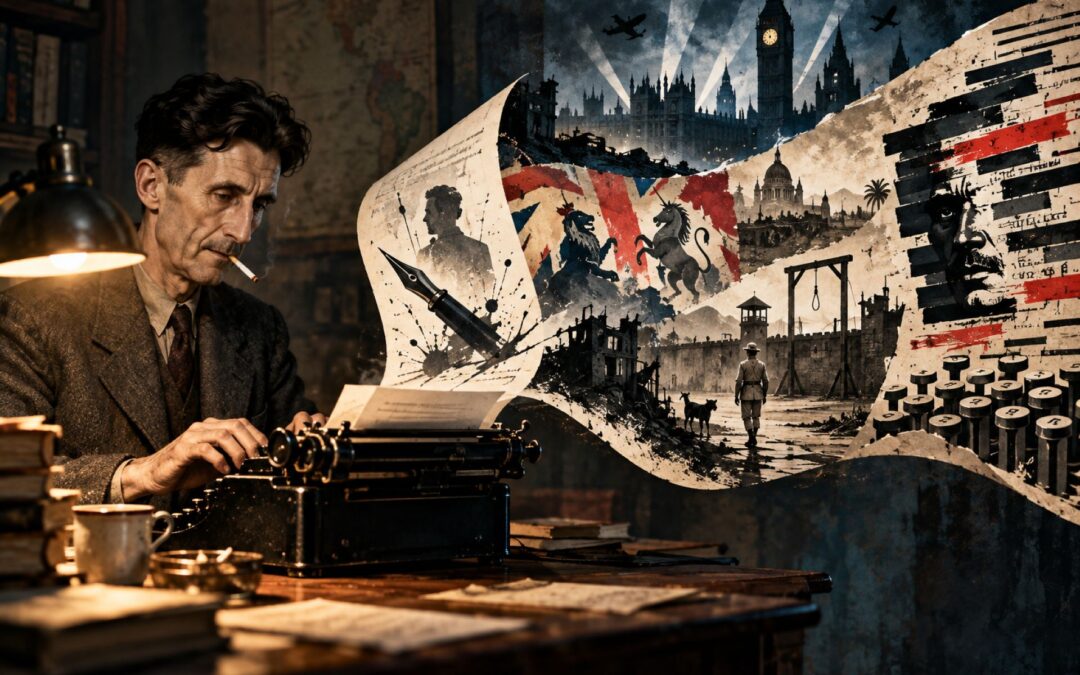
George Orwell’s Why I Write is easy to misunderstand before opening it. The title suggests a short book about the craft and motivation of writing, and the essay called “Why I Write” is indeed one of Orwell’s best-known statements about his literary life. But the Penguin Great Ideas edition is actually a collection of four independent works written at different moments in Orwell’s career: “Why I Write,” The Lion and the Unicorn: Socialism and the English Genius, “A Hanging,” and “Politics and the English Language.” Together they range from autobiography and literary reflection to wartime socialism, colonial execution and the corrupting relationship between politics and language.
Orwell never designed these four pieces as the chapters of a single book. Penguin assembled them decades after his death, so any unity they possess is partly editorial rather than authorial. Yet the selection exposes a remarkable continuity in Orwell’s thinking. Again and again, he tries to force abstractions back into contact with observable reality: political conviction must answer to lived experience, patriotism must answer to class inequality, the bureaucracy of execution must answer to the sight of a living man avoiding a puddle, and political language must answer to the concrete acts it conceals.
That recurring struggle explains both Orwell’s enduring appeal and his limitations. His prose is at its strongest when it cuts through euphemism, ideological habit and inherited phrases to make something visible. The same confidence in observation can become a weakness when he generalizes too freely about whole nations, classes, political movements or historical futures. Why I Write therefore remains valuable not because Orwell is always right, but because these four essays let readers watch a first-rate political writer testing language against reality—and occasionally discovering the limits of his own certainty.
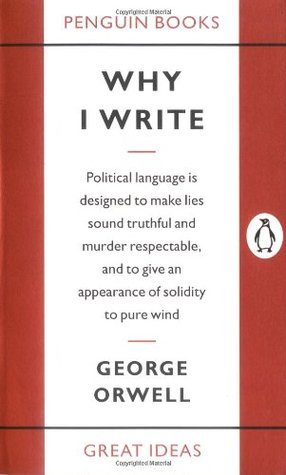
What Penguin’s Why I Write Actually Contains
The Penguin volume belongs to the Great Ideas series and was first issued in this form in 2004, with the ebook edition following later. Its four contents were originally written and published separately, across roughly fifteen years of Orwell’s career. “A Hanging” appeared first, in 1931; The Lion and the Unicorn belongs to the crisis of Britain during the Second World War and was published in 1941; “Politics and the English Language” appeared in April 1946; and the original “Why I Write” essay followed in the summer of that year.
That chronology matters because the Penguin arrangement is not chronological. It begins with Orwell looking back on his development as a writer, then places his longest and most ambitious wartime political pamphlet immediately after it. From there the collection moves backward to an early imperial narrative before ending with a late essay about language and politics. The result feels coherent because certain concerns recur, but it is not the progression of a book Orwell himself constructed.
The imbalance among the four pieces is also important. The title essay is compact and famous, but The Lion and the Unicorn dominates the collection in scale. It is a substantial political pamphlet with three formal parts and a complete programme for wartime socialist transformation. Readers who approach Why I Write expecting a book primarily about authorship will therefore encounter much more political theory, British social analysis and wartime argument than the title implies.
The collection works best when read as a cross-section of Orwell’s nonfiction rather than as a systematic treatise. Each essay uses a different mode—autobiographical explanation, political polemic, narrative reportage and linguistic criticism—but all four are concerned with the moral consequences of seeing badly. Orwell’s recurring question is not merely whether people possess correct opinions. It is whether they can look directly at the world without allowing self-interest, ideology, convention or ready-made language to decide in advance what they will see.
Why I Write: From Literary Ambition to Political Purpose
“Why I Write” begins not with politics but with childhood. Orwell says he knew from an early age that he would become a writer, although he also describes periods when he tried to abandon the ambition. He presents himself as a lonely child who developed an elaborate internal life, invented stories, carried on imaginary conversations and gradually acquired the habit of observing his own experiences as though he were already narrating them.
Writing first appears as compulsion rather than mission. Orwell remembers producing poems, school pieces and imaginative stories, but what matters most is his discovery of pleasure in words themselves. He becomes attentive to the sound of sentences, the physical arrangement of language and the possibility of using prose to create exact images. This aesthetic impulse remains important even after politics becomes central to his career.
From this autobiographical beginning, Orwell identifies four broad motives that he believes operate in prose writers. The first is sheer egoism: the desire to appear clever, be remembered, attract attention and exert influence. The second is aesthetic enthusiasm, meaning delight in beauty, rhythm, words, arrangements and the perception of one object in relation to another. The third is historical impulse, the urge to discover what is true and preserve facts for later readers. The fourth is political purpose, by which Orwell means the desire to push society in a particular direction or alter other people’s ideas about what kind of world is desirable.
The importance of the list lies less in the labels than in Orwell’s insistence that these motives coexist. A political writer is not purified of vanity or aesthetic ambition merely because the subject is serious. Nor does literary beauty eliminate political intention. Orwell presents writing as a mixture of motives whose proportions shift according to personality and historical circumstance.
His own proportions change dramatically. Experiences in the imperial police in Burma leave him hostile to imperialism, while later contact with poverty strengthens his political awareness. The decisive turning point, however, is the 1930s and especially the Spanish Civil War. By that stage Orwell believes it has become impossible for a serious writer to ignore totalitarianism, economic injustice and ideological conflict.
From 1936 onward, he says, the serious work he writes is directed against totalitarianism and in favour of democratic socialism. That declaration can sound as though politics simply replaces aesthetics, but Orwell’s deeper argument is the opposite. His problem is how to make political writing into art rather than mere propaganda.
He uses his own books to explain the difficulty. Homage to Catalonia contains material he regarded as politically necessary even when it damaged the artistic shape of the book. He wanted to record facts about Spain that were being distorted or suppressed, so historical impulse and political responsibility sometimes overrode formal elegance. Animal Farm, by contrast, represents his attempt to make political intention and artistic construction work together from the beginning.
This tension explains why “Why I Write” is more complex than a list of four motivations. Orwell is really describing the formation of a political artist. He does not believe writers can escape politics by pretending neutrality, but he also resists the idea that political commitment excuses bad art. The writer must care about truth, public consequences and form at the same time.
The ending prevents the essay from becoming self-congratulatory. Orwell returns to vanity, selfishness and the mysterious drives behind authorship, admitting that writers are not necessarily noble people merely because they write about noble causes. He also advances one of his characteristic ideals of prose: the personality of the writer should not become so ostentatious that it blocks the reader’s view of the subject.
The four motives therefore should not be treated as an exhaustive scientific psychology of writing. They are Orwell’s retrospective model for understanding his own vocation and, by extension, the tensions within literary ambition. Their continuing usefulness comes from the fact that they refuse the flattering fiction that serious writing springs from a single pure motive.
The Lion and the Unicorn: Orwell’s Wartime Case for an English Socialism
The Lion and the Unicorn: Socialism and the English Genius was published in 1941, during Britain’s war with Nazi Germany, and the wartime emergency shapes every stage of its argument. The Orwell Foundation’s publication history places the pamphlet squarely in the atmosphere of bombing, military crisis and uncertainty about whether Britain’s political and economic system was capable of defeating fascism. Orwell’s argument is not simply that socialism would be morally preferable to capitalism. He claims that Britain must transform itself politically in order to survive.
The work is divided into three parts. The first tries to define England and the peculiarities of English patriotism. The second argues that capitalism and the existing ruling class are obstructing an effective war effort. The third proposes a socialist programme that Orwell believes can unite revolutionary change with national continuity.
Part I: England Your England
Orwell begins under the immediate threat of German bombing. The fact that one country’s citizens can attempt to kill another country’s citizens without personal hatred forces him to confront the power of national loyalty. Internationalists may dislike patriotism or regard it as irrational, but Orwell thinks they make a serious political mistake when they pretend it is weak or unreal.
For him, nations possess recognizable continuities. England is not simply a legal territory or interchangeable administrative unit. Its identity is expressed through habits, landscapes, foods, institutions, manners and forms of everyday life. Orwell’s descriptions are deliberately concrete because he wants national belonging to feel rooted in lived experience rather than abstract theory.
He then attempts to define an English character. His catalogue includes privacy, domesticity, hobbies, suspicion of grand intellectual systems, relative gentleness and a popular culture existing partly outside official prestige. He also emphasizes a dislike of overt militarism and a tendency to prefer informal custom to ideological enthusiasm.
Yet this allegedly gentle civilization contains brutal contradictions. England rules an empire, tolerates enormous class inequality and retains violent institutions. The point is not that English people are naturally humane and therefore innocent. Orwell instead sees a culture whose self-image and practices often conflict.
One of the qualities he nevertheless values is respect for law. British democracy is deeply compromised by property and class power, but Orwell argues that the idea of rules existing above arbitrary rulers has genuine social force. The government cannot simply behave as a totalitarian state does, because habits of public opinion, legality and constitutional expectation place real limits on power.
Class inequality complicates his attempt to speak of a unified England. The rich and poor live different lives, inherit different opportunities and experience the country through different institutions. Orwell nonetheless insists that national solidarity is not therefore imaginary. Moments of crisis can reveal forms of attachment that cut across economic division.
Dunkirk becomes an example of this shared national instinct. Orwell interprets the evacuation and public response as evidence that ordinary people possess a sense of collective survival not reducible to ruling-class propaganda. His argument does not eliminate class conflict; rather, he thinks class conflict occurs inside a national culture that is still capable of common action.
This leads to one of the pamphlet’s most memorable analogies: England resembles a family. The family is unequal, embarrassing and governed by elderly figures who have outlived their competence, but its members remain tied together. The metaphor allows Orwell to condemn the social order without concluding that national identity is meaningless.
He next turns to the British ruling class. In his account, the aristocratic and upper-middle-class elite has preserved enormous prestige while losing the competence that once supposedly justified its leadership. Industrial modernity has changed the world, but the culture of the governing class remains backward-looking, complacent and poorly equipped for a mechanized war.
Appeasement and military unpreparedness become evidence of this decline. Orwell thinks the elite failed to understand fascism partly because confronting it seriously would require economic and political changes threatening its own position. The problem is therefore structural as much as personal.
At the same time, he refuses to portray the upper class as a collection of simple villains. Individual members may be courageous, patriotic and willing to die in war. Their failure, in Orwell’s argument, arises from habits of thought, obsolete institutions and class interest rather than from conscious treason.
The next target is the cultural division between old-fashioned imperial patriotism and the left-wing intelligentsia. Orwell caricatures the reactionary military type as the “Blimp”: patriotic, complacent and intellectually stagnant. Against him stands the intellectual who is cleverer but so alienated from ordinary national feeling that criticism of Britain has become almost automatic.
Orwell thinks both tendencies are politically sterile. Patriotism without intelligence preserves incompetence, while intelligence without patriotism isolates the left from the public it wants to persuade. The task is therefore to combine national loyalty with radical social transformation.
The final movement of Part I argues that Britain is already changing beneath its formal hierarchy. Industrialization has expanded managerial, technical, clerical and professional strata, while consumption and mass culture have blurred some older distinctions among sections of the working and middle classes. Traditional class markers remain powerful, but they are not static.
War, Orwell believes, will accelerate the process. The country cannot mobilize effectively while preserving every inherited privilege. He therefore expects social transformation to arise not by destroying everything English but by forcing an existing national culture into a more egalitarian form.
Part II: Shopkeepers at War
Part II shifts from cultural diagnosis to economic necessity. Orwell argues that private capitalism has failed to organize British production efficiently enough for total war. Nazi Germany is morally abhorrent, but its centralized direction of resources gives it an advantage over an economic system in which private interests can obstruct national priorities.
This argument requires Orwell to define socialism more carefully. State control alone is insufficient, because fascist states can direct production without creating equality or political freedom. His socialism therefore combines economic planning with democracy, reduced inequality and the abolition of entrenched hereditary privilege.
That distinction is crucial to the pamphlet. Orwell does not believe every planned economy is socialist, just as he does not believe every opponent of capitalism is democratic. Fascism demonstrates that centralized economic power can coexist with extreme hierarchy, coercion and racial domination.
Britain’s problem, he argues, is that its old ruling class cannot make the changes necessary for victory without undermining its own interests. Effective mobilization would require directing industry toward public rather than private priorities, reducing luxury, limiting inequalities and opening leadership to people previously excluded by class.
For Orwell, revolution therefore does not necessarily mean an insurrection following a foreign model. It means a genuine transfer of power. If the same people retain command of institutions while merely adopting radical language, nothing fundamental has changed.
Equality of sacrifice becomes both an economic and psychological requirement. Workers can accept rationing, danger and hardship more readily if they believe privileged groups are sacrificing as well. A war presented as a common national struggle loses legitimacy when one class bears the burden while another protects its comfort.
Orwell then discusses the possibility of a British “Fifth Column.” He does not restrict the danger to obvious fascist sympathizers or conspirators. Different forms of defeatism may emerge from different political motives, and entrenched wealth itself may become politically unreliable if national victory appears to require social revolution.
His point is not that every wealthy person secretly favours Hitler. It is that class interest can weaken resistance indirectly. People may prefer compromise, hesitation or an inadequate war effort if the alternative is a transformation of the social order from which they benefit.
Part III: The English Revolution
The final part asks why socialism has not already become the dominant British movement if capitalism is as inadequate as Orwell claims. His answer is partly institutional and partly cultural. Labour politics has been too cautious, while explicitly revolutionary groups have often spoken in a language alien to the people they hope to organize.
Orwell criticizes the Labour Party for remaining tied to limited trade-union demands and for failing to attack the wider architecture of privilege. He is even harsher toward sections of the Marxist left, which he sees as dependent on imported ideological formulas and contemptuous of ordinary middle-class habits.
The underlying problem is political communication. Socialism has too often presented itself as something that requires people to despise their existing country, culture or way of life before they can support economic equality. Orwell believes this makes mass conversion unnecessarily difficult.
War changes the political possibilities. The existing order can no longer pretend that it functions adequately, because military survival exposes failures of production, leadership and social organization. For Orwell, socialism moves from theoretical aspiration to practical necessity.
He then sets out a six-point programme. He calls for nationalization of major economic assets, including land, mines, railways, banks and large industries. He proposes severe limits on income inequality so that wartime sacrifice becomes visibly shared rather than rhetorically proclaimed.
Educational privilege must also be attacked. A formally democratic society remains profoundly unequal if wealthy families can purchase access to institutions that reproduce ruling-class power. Orwell therefore treats education as part of the political structure rather than a separate social issue.
His programme extends beyond Britain itself. He proposes Dominion status for India, including a later right to secede, and imagines a reformed imperial structure in which colonized peoples would participate through a representative council. He also advocates formal solidarity with peoples fighting fascist domination.
The India proposals reveal one of the pamphlet’s deepest contradictions. Orwell recognizes imperial rule as morally and politically unsustainable and accepts that India must possess a genuine right to independence. Yet he simultaneously assumes that British technical and administrative guidance will remain desirable, reflecting paternalistic ideas he has not fully escaped.
He nevertheless imagines the coming socialism as distinctly English rather than doctrinally imported. It would preserve elections and civil liberty, maintain aspects of national tradition, and perhaps even retain symbolic institutions that posed no serious obstacle to equality. The revolution would be radical in economic power without trying to erase every inherited cultural form.
This is where Orwell separates patriotism from conservatism. Loving a country does not require defending its existing ruling class. On the contrary, a national tradition may survive precisely because political structures change.
He also refuses the argument that Britain’s injustices make it morally equivalent to Nazi Germany. British democracy is limited and hypocritical, but Orwell considers its remaining liberties, political pluralism and legal habits worth defending. The fact that a society falls short of its democratic ideals does not mean those ideals are meaningless.
The pamphlet closes with extraordinary confidence. Britain, Orwell argues, faces a stark alternative: transform the anti-fascist war into a revolutionary war or risk defeat. The war must become a struggle in which ordinary people know they are defending a society that will be more equal than the one that entered the conflict.
History did not vindicate that either-or prediction in the form Orwell expected. Britain defeated Nazi Germany without undergoing the immediate socialist revolution he described. Yet the argument remains important because it reveals the political system underlying Orwell’s later reputation as a critic of totalitarianism: he was not defending the existing British order against revolution, but arguing for a democratic socialist revolution as the best defence against fascism.
A Hanging: The Ordinary Moment That Makes Execution Intolerable
“A Hanging” is the shortest narrative in the collection but among the most powerful. First published in The Adelphi in 1931, as recorded by the Orwell Foundation’s publication record, it draws on the colonial world Orwell knew from serving in the Indian Imperial Police in Burma. Its moral argument emerges through a sequence of physical observations rather than through an explicit philosophical case against capital punishment.
The narrator enters a prison where an unnamed Hindu man is about to be executed. The machinery of death has already become routine. Guards, officials and prisoners occupy assigned roles, and the condemned man is treated less as a continuing human consciousness than as an administrative problem moving toward completion.
A stray dog disrupts that routine. The animal runs among the group with uncontrolled friendliness, apparently unaware of the distinction between jailer, observer and prisoner. Its behaviour briefly breaks the official categories governing the scene because it treats everyone present according to the same simple logic of living bodies.
The central moment follows as the group walks toward the gallows. The condemned man steps aside to avoid a puddle. Nothing could be more ordinary, yet the gesture suddenly forces the narrator to perceive what execution actually means. The prisoner is not an abstraction called “the condemned.” He remains a functioning organism, noticing his environment and making small decisions about where to place his feet.
That recognition changes the scene. The horror of execution lies not only in pain or punishment but in intentionally cutting short an active consciousness that, moments before death, continues to participate in the world. Orwell’s moral insight arrives through the body before it arrives through argument.
At the gallows, the prisoner repeatedly calls upon his god while the officials wait for the process to end. The repetition stretches time and makes the institutional procedure more uncomfortable because the condemned man continues to assert a voice even as the machinery is prepared to silence him.
The execution then occurs. The body is examined, and the tension that has held the group together abruptly dissipates. What follows is perhaps as important as the hanging itself.
Officials joke, exchange anecdotes about other executions, smoke and drink whisky. Ordinary sociability returns with alarming speed. The ability to resume casual conversation while the body remains nearby shows how institutions normalize violence: people do not need to become consciously sadistic if routine permits them to stop seeing what they have done.
The colonial setting intensifies the moral structure. The execution occurs within an imperial system where racial hierarchy and administrative authority determine who commands and who is subjected to command. Yet the essay’s power comes partly from Orwell’s refusal to convert the prisoner into a symbolic speech about empire. The man remains unnamed, but a handful of bodily details are enough to destroy the bureaucratic abstraction surrounding him.
The piece should not automatically be treated as literal documentary autobiography. Orwell’s Burmese police experience clearly supplies its world, but the exact factual status of the episode remains uncertain; modern publication commentary on “A Hanging” notes that the story’s precise veracity cannot be established. Its literary and moral force does not depend on proving that every incident occurred exactly as narrated.
Politics and the English Language: How Bad Prose Protects Bad Politics
“Politics and the English Language,” first published in Horizon in 1946 and preserved through the Orwell Foundation’s text and publication record, is frequently reduced to six rules for good writing. Those rules matter, but they come at the end of a much broader argument about thought, habit, ideology and political dishonesty.
Orwell begins from a widespread complaint that English is deteriorating. He rejects the fatalistic version of that complaint. Language is not a natural organism declining independently of human action; people make linguistic choices, and bad habits can therefore be challenged.
At the same time, he thinks language and thought form a feedback loop. Political and social decline encourage evasive prose, but habitual bad prose also makes imprecise thought easier. Once writers rely on inherited formulas, they can produce sentences without fully confronting what those sentences mean.
To demonstrate the problem, Orwell presents examples of contemporary prose and then identifies recurring defects. His first category is the dying metaphor. A metaphor originally creates an image, but repeated use gradually turns it into a phrase that writers deploy without visualizing anything.
The problem is not metaphor itself. Orwell is an intensely figurative writer. The problem is language whose image has become so automatic that it no longer forces either writer or reader to see.
His second category is what he calls operators or verbal false limbs. These are inflated constructions that replace a simple verb with a cluster of nouns, auxiliaries and prefabricated phrases. Such expressions often make sentences longer while allowing responsibility to disappear.
Pretentious diction forms a third category. Writers use elaborate, foreign-derived or technical vocabulary to grant ordinary claims an aura of scientific, legal or intellectual authority. Orwell’s complaint is not that long or Latinate words are intrinsically wrong, but that prestige vocabulary can be used to disguise weak thought.
The fourth category is meaningless words. Political and critical terms may be repeated so promiscuously that speakers use them more as signals of approval or condemnation than as precise descriptions. Words associated with democracy, fascism, freedom or art can become especially vulnerable because different speakers quietly assign them incompatible meanings.
Orwell illustrates the larger loss by taking a vivid biblical passage and rewriting it in the style of abstract modern prose. The original depends on concrete people, actions and images. The transformed version converts those particulars into generalized categories and qualifications until the reader no longer experiences the underlying scene.
This is more than an aesthetic complaint. Orwell argues that ready-made language saves writers the trouble of thinking. A person can assemble familiar phrases into something that sounds politically serious while remaining only partially conscious of the reality being described.
The problem becomes most dangerous in political language. States and political movements frequently defend acts that would sound intolerable if described in ordinary concrete terms. Deportation, killing, dispossession, imprisonment and coercion are translated into abstractions that remove agents, bodies and consequences from view.
Euphemism therefore has a moral function. If a policy requires language designed to prevent listeners from picturing what the policy does, bad prose has become part of political action rather than a cosmetic defect.
Orwell also warns against misunderstanding his prescription. He is not calling for a return to archaic English, a prohibition on foreign vocabulary or a rule that every sentence must sound colloquial. Nor does he believe every passive construction is wrong.
His real principle is that meaning should determine language rather than language determining meaning. Writers should know what they are trying to say before reaching automatically for inherited expressions.
The six rules at the end of the essay give practical form to that principle. Orwell advises writers to avoid familiar metaphors, prefer shorter words when they work, delete unnecessary words, prefer the active voice when appropriate, avoid jargon or foreign expressions when an ordinary English equivalent exists, and finally break any of the preceding rules rather than write something barbarous.
The sixth rule prevents the list from becoming mechanical. Orwell is prescribing alertness rather than obedience. A sentence is not improved simply because it satisfies a checklist if the result is stiff, misleading or ugly.
His final argument returns to politics. Clear prose will not by itself abolish tyranny or transform society, but deliberate language makes dishonesty more difficult. A writer who continually asks what an expression actually means is less likely to reproduce ideological formulas without noticing what they hide.
Modern linguistics does not require accepting Orwell’s premise that English as a language was literally declining. His strongest claim survives at a different level. Institutions and individuals often use abstraction strategically, and careless language can make it easier not to notice when words have become substitutes for thought.
What Holds the Four Essays Together: Truth Against Abstraction
Because Penguin assembled these essays after Orwell’s death, it would be misleading to claim that they form a deliberate four-stage argument. Yet they do illuminate one another. Their strongest common feature is Orwell’s suspicion of abstractions that have become detached from observable reality.
“Why I Write” establishes the principle explicitly. Orwell’s historical impulse demands that the writer discover and preserve facts, while political purpose gives those facts public consequence. The difficulty is that political commitment can easily encourage writers to select, distort or beautify reality for ideological reasons.
The Lion and the Unicorn transfers the struggle to the scale of a nation. Orwell resists both patriotic mythology and left-wing dismissal of patriotism by insisting that England must be examined as it actually exists: unequal, imperial, culturally distinctive, politically contradictory and still capable of common feeling. His analysis frequently overgeneralizes, but the method begins by refusing a simple label.
“A Hanging” performs the same operation with extraordinary economy. “Execution” is an abstract institutional category until Orwell watches a living person avoid a puddle. Once the condemned man becomes physically particular, the administrative language surrounding the execution becomes morally inadequate.
“Politics and the English Language” finally names the mechanism directly. Abstractions can protect people from the reality of what they are saying. Euphemism allows violence to be discussed without bodies; ideological formulas allow opinions to be repeated without examination; familiar phrases permit a person to sound as though thought has occurred when it has not.
This helps explain Orwell’s reliance on things that can be seen, touched or imagined. Houses, food, weather, uniforms, tea, machinery, prison yards, animals and bodily gestures are rarely decorative in his nonfiction. They anchor political argument in material life.
The method also explains why Orwell can be so persuasive even when his larger generalizations are questionable. A vivid local observation may be exactly right while the sweeping national or historical claim built from it is much less secure. Readers should therefore distinguish between the extraordinary precision of his perception and the confidence of his extrapolation.
That distinction is central to evaluating the Penguin collection. Orwell’s strongest legacy is not a set of doctrines readers must accept intact. It is a demand that political language repeatedly be brought back into contact with what happens to actual people.
Socialism, Patriotism, Class and the Problem of England
Orwell is often remembered primarily as an enemy of totalitarianism, partly because Animal Farm and Nineteen Eighty-Four dominate his reputation. Why I Write makes it much harder to interpret that anti-totalitarianism as a defence of conventional capitalism. Orwell repeatedly identifies himself with democratic socialism, and The Lion and the Unicorn is one of the clearest statements of what he wanted that socialism to become.
His socialism is democratic because liberty is not merely an optional feature to be added after economic transformation. Fascism demonstrates why. A regime can direct production and suppress private economic power while preserving extreme hierarchy and destroying political freedom.
Orwell therefore rejects the equation of nationalization with socialism. Ownership and planning matter, but equality, democracy and the distribution of power matter as well. A state-controlled economy that leaves ordinary people politically powerless has not achieved the society he wants.
Patriotism complicates this politics. Marxist traditions often emphasize class solidarity across national borders, while conservative traditions tend to associate patriotism with defence of established institutions. Orwell tries to break both associations.
He regards national loyalty as psychologically real and potentially progressive. A socialist movement that requires people to feel contempt for their own country will, he thinks, surrender mass patriotism to reactionary politics. The left should instead argue that national survival requires greater equality.
This makes The Lion and the Unicorn unusual. Orwell wants revolution without cultural self-erasure. The monarchy might survive in some symbolic form, local habits could continue, and English life need not become an imitation of Soviet or continental revolutionary models.
The argument has genuine political insight. Successful mass movements usually need to address the loyalties people actually possess rather than the loyalties theory says they ought to possess. Orwell recognizes that identities of class and nation can coexist rather than simply cancel one another.
His treatment of class is similarly double-edged. He sees British democracy as materially distorted by wealth and inherited privilege, yet he refuses to conclude that every democratic institution is therefore fraudulent. The public may possess limited power, but limited power remains politically different from no power.
That distinction becomes essential when he compares Britain with fascist states. Orwell can condemn British inequality while insisting that civil liberty, elections and legal restraint matter. Imperfect democracy is not morally interchangeable with totalitarianism merely because both societies contain injustice.
His analysis is less convincing when observation becomes national psychology. Statements about what “the English” naturally dislike, understand, enjoy or fail to appreciate often rest on impression rather than systematic evidence. The family metaphor brilliantly communicates a feeling of national continuity, but a metaphor cannot establish that millions of people across regions, classes and ethnic backgrounds actually share one coherent temperament.
Modern scholarship has consequently treated Orwell’s wartime patriotism as both politically significant and internally tense. Gregory Claeys’s analysis of The Lion and the Unicorn and Orwell’s politics emphasizes the importance of the pamphlet for understanding Orwell’s democratic socialism while also confronting the failure of its central wartime prediction. More recent work on Orwell and English national identity continues to find value in his attempt to connect patriotism with an ethical critique of inequality rather than with simple celebration of national power.
Orwell’s caricature of political groups also needs caution. The “Blimp,” the alienated intellectual, the complacent capitalist and the doctrinaire Marxist are rhetorically effective types, but real societies are not populated by types alone. His polemical compression can turn complex political motives into memorable cartoons.
Yet the central problem he identifies has not disappeared. Democratic movements still face the question of whether national belonging must belong to the political right, and socialist or egalitarian politics still struggle with the relationship between cultural continuity and structural reform. Orwell’s answer is historically specific, but the dilemma remains recognizable.
Empire, Execution and Orwell’s Moral Blind Spots
Empire occupies a complicated place in Orwell’s thought because he knew colonial power from inside its machinery. His years in Burma gave him direct experience of imperial policing, and later essays repeatedly portray empire as morally degrading to rulers as well as destructive to subjects. Douglas Kerr’s scholarly work on Orwell and empire is useful precisely because it resists reducing this development to a simple conversion from imperial servant to perfectly decolonized thinker.
“A Hanging” shows Orwell at his strongest as an anti-imperial moral observer. The colonial system appears not through constitutional theory but through an institution capable of deciding that one man’s living consciousness should end at a scheduled hour. British and colonial functionaries cooperate in the process, and routine allows everyone to continue behaving normally.
The puddle scene matters because it destroys the administrative distance on which the execution depends. A person sentenced to death may be transformed by bureaucracy into a case, number or procedure, but his instinctive avoidance of dirty water reveals a body still oriented toward continued life. Orwell’s moral revolt begins when official categories stop controlling perception.
The episode also exposes something broader about imperial power. Hierarchy becomes sustainable when people are encountered mainly through roles: ruler and subject, guard and prisoner, civilized and subordinate. Orwell repeatedly tries to undo those roles by noticing individual behaviour.
Yet The Lion and the Unicorn shows how incomplete his escape from imperial assumptions could be. His wartime programme accepts that India should possess a genuine right to determine its political future, which separates him sharply from unqualified defenders of empire. At the same time, he assumes continued British technical involvement and imagines a reformed imperial partnership in language that can sound paternalistic.
The contradiction is revealing rather than accidental. Orwell understands that empire cannot continue unchanged, but he still sometimes imagines Britain as the experienced partner whose guidance other societies will need. Anti-imperial conviction has not automatically erased the habits of imperial thought.
History makes the limitation especially visible. The actual path to Indian independence was not a gradual realization of Orwell’s preferred wartime programme. The UK National Archives’ material on Indian independence and partition places British withdrawal within sustained Indian nationalist pressure, wartime transformation and postwar political change, culminating in independence for India and Pakistan in 1947 amid catastrophic partition violence.
Orwell’s discussion must therefore be read as a historically situated political proposal rather than a blueprint validated by subsequent events. His belief that continued British partnership would remain necessary reflects the limits of his imagination as much as his attempt to reform imperial relations.
The same caution applies when readers treat “A Hanging” as straightforward autobiography. Its setting, institutional atmosphere and moral intelligence arise from genuine experience, but the exact event cannot confidently be certified in every detail. The responsible conclusion is not that the essay becomes irrelevant if it contains literary shaping; it is that narrative truth and documentary proof are different claims.
Taken together, the Burma and India material reveal one of the most useful things about Orwell: his moral intelligence is real but not magically exempt from history. He can identify violence hidden by official language while still carrying assumptions produced by the society he criticizes. That tension makes him more interesting than either the heroic myth of Orwell as a uniquely incorruptible truth-teller or the opposite caricature of him as nothing more than a man of his class and empire.
Language, Style and the Window-Pane Ideal
Orwell’s theory of prose is often summarized as a preference for short sentences and simple words. That is too crude. His real ideal is transparency: language should allow a reader to encounter the intended meaning without being forced through unnecessary fog.
The vocabulary of English itself complicates any simplistic rule. English contains both a large everyday Germanic core and layers of more formal vocabulary inherited through French, Latin and other sources, a history explored in the development of English after the Norman Conquest. Orwell’s objection is not to one etymological category but to prestige vocabulary used automatically when a more exact expression is available.
This is why his sixth rule matters so much. If shorter words, active constructions and familiar vocabulary always produced good prose, writing could be automated. Orwell knows they do not.
His best prose frequently violates simplified versions of his own advice. He uses elaborate analogies, rhythmic repetition, comic exaggeration and carefully staged images. His apparent plainness is an artistic effect rather than the absence of style.
“A Hanging” offers the clearest demonstration. Orwell never needs to announce a philosophical doctrine about consciousness. The prisoner’s movement around the puddle carries the argument because the scene has been constructed with extreme control.
The same technique shapes The Lion and the Unicorn. England becomes comprehensible through domestic objects, landscapes, habits and comic types before Orwell turns those details into claims about patriotism and class. The concrete image gives emotional authority to the subsequent generalization.
“Politics and the English Language” makes the process explicit. Dying metaphors fail because they no longer create pictures. Pretentious diction fails when it replaces direct thought with social display. Political euphemism fails morally because it prevents readers from picturing what policies actually do.
The paradox is that Orwell’s prose can appear so transparent that readers forget how rhetorical it is. His analogies are selected, his examples arranged, his jokes timed and his sentences shaped for memorability. A useful Cambridge discussion of Orwell’s writing stresses the disciplined clarity of his journalistic prose rather than treating simplicity as something effortless.
That rhetorical power partly explains why Orwell’s generalizations can feel more proven than they are. A vivid sentence may create the impression that an argument has become self-evident. When he describes a social class through a brilliant comic type, readers can easily forget that a type is not a representative sample.
His prose ideal therefore contains both a method and a danger. Clear language can expose evasion, but elegant clarity does not guarantee factual accuracy. A beautifully expressed generalization remains a generalization.
The six rules are most useful when treated as tests against automatic writing. Has the phrase been inherited rather than chosen? Can a word be removed without loss? Is jargon concealing a simpler reality? Has the writer selected a construction because it clarifies responsibility or because it hides it?
Used this way, Orwell remains extremely practical. Used as rigid grammar law, he becomes much less convincing. The point of the essay is to make the writer conscious of language again, not to replace one set of dead formulas with another.
What History Confirmed—and Corrected—in Orwell’s Arguments
The Lion and the Unicorn is unusual among the collection’s essays because it makes urgent predictions about what Britain must do to survive. That makes historical reassessment unavoidable. Orwell is not merely describing values; he is claiming that a particular political transformation is necessary.
The most obvious correction is that Britain did not experience the revolutionary rupture he predicted during the war. Nazi Germany was defeated without the complete transfer of class power Orwell believed indispensable. His stark alternative—socialist revolution or national defeat—proved false.
That does not mean his sense of impending social change was wholly misguided. Wartime mobilization increased state direction of economic life, strengthened expectations of collective provision and helped create political conditions for the Labour victory of 1945. The UK Parliament’s account of Clement Attlee and the postwar Labour government records the major programme of welfare reform and nationalization that followed.
Some of Orwell’s programme therefore resembles later developments, but the resemblance should not be exaggerated. Attlee’s government was a parliamentary administration elected through existing democratic institutions, not the complete revolutionary transfer of power Orwell had imagined as a wartime necessity. Britain also retained the monarchy, large inequalities and a mixed economy.
The distinction matters because Orwell’s predictive mistake exposes a recurring feature of political polemic. Immediate crisis can make a writer mistake one plausible route for the only possible route. His argument that Britain required far greater equality and organization may contain insight even when his claim of inevitability does not.
His imperial expectations also aged unevenly. Orwell correctly understood that British rule over India could not remain politically stable indefinitely. But the actual end of empire moved faster and more violently than the reformed partnership he envisaged.
India and Pakistan became independent in 1947, and partition accompanied independence with displacement and mass violence. Britain’s relationship with South Asia was transformed by decolonization rather than by the gradual imperial reconstruction Orwell proposed.
His descriptions of Communists, pacifists and wartime political factions similarly belong to a specific historical moment. They should not be extracted from the 1940–41 crisis and treated as timeless descriptions of political types.
By contrast, Orwell’s broader analysis of how emergency exposes inequalities has aged better. Wars and national crises often make otherwise tolerated inequalities politically visible because governments suddenly demand sacrifice from entire populations. His insistence that legitimacy depends partly on whether burdens appear fairly shared remains intelligible beyond its original setting.
“Politics and the English Language” has also survived well, although not because every linguistic diagnosis was technically correct. Political institutions still use euphemism, passive construction, jargon and abstraction to manage responsibility. Orwell’s insight that language can make morally disturbing actions easier to discuss without picturing them remains powerful.
“A Hanging” has aged differently again. It makes fewer predictive claims and depends less on a particular political programme, which gives it unusual durability. Its fundamental observation—that institutional categories can hide the reality of an individual life—does not require readers to accept Orwell’s wartime sociology or economic forecasts.
The historical record therefore neither vindicates nor demolishes Orwell wholesale. Some of his most confident claims failed, while some of his deeper political intuitions proved more durable than the programmes attached to them. Reading him well requires preserving both facts at once.
Critical Review: How Well Does Why I Write Hold Up?
As a collection, Why I Write succeeds because its four essays display an unusually wide range of Orwell’s nonfiction abilities. The autobiographical essay explains his sense of vocation, the wartime pamphlet exposes his political commitments in full, “A Hanging” demonstrates his narrative moral imagination, and “Politics and the English Language” turns his stylistic instincts into explicit argument.
The title is nevertheless slightly misleading. Readers may reasonably expect a book primarily about writing, but much of the volume is occupied by The Lion and the Unicorn, a dense argument about English national identity, wartime economics and democratic socialism. Penguin’s selection is intellectually coherent, but its coherence becomes visible only after readers understand what has actually been assembled.
“Why I Write” remains one of the strongest pieces because it avoids sanctifying literary vocation. Orwell admits ego, vanity and aesthetic appetite alongside political conviction. His account feels credible partly because he refuses the flattering fiction that serious writers act from purely public-minded motives.
Its main limitation is that readers can mistake Orwell’s four categories for universal psychology. They are best understood as analytical distinctions generated by one writer reflecting on his own practice. Their value lies in provoking self-examination rather than classifying every writer exhaustively.
The Lion and the Unicorn is the collection’s most ambitious and most uneven work. Its greatest strength is its refusal to choose between patriotism and radical politics. Orwell sees that national belonging is politically powerful and asks whether the left can redirect that power toward democratic equality rather than abandon it to reaction.
The pamphlet also displays Orwell’s talent for converting social complexity into memorable images. The family metaphor, the contrast between Blimp and intellectual, and the descriptions of class habit give argumentative sections the momentum of narrative writing.
Yet this rhetorical compression repeatedly produces overstatement. Whole classes become character types, English national character becomes more uniform than evidence warrants, and political futures are described with a confidence history did not justify. His wartime argument has intellectual urgency, but urgency often substitutes for patient demonstration.
The treatment of empire is particularly mixed. Orwell recognizes that imperial domination is morally corrosive and accepts that India must ultimately be free to determine its future. At the same time, he retains paternalistic assumptions about British competence and post-imperial guidance that weaken the universality of his egalitarian claims.
“A Hanging” is arguably the collection’s most nearly complete literary achievement. It is concise without being thin, political without relying on slogans, and morally forceful without needing an extended theoretical conclusion. The puddle scene is memorable precisely because Orwell trusts concrete observation to carry the argument.
Its uncertainty as literal autobiography is a limitation only if the piece is treated as courtroom testimony. As literary reportage or autobiographically informed narrative, it succeeds through the precision with which it exposes the contradiction between routine administration and the destruction of life.
“Politics and the English Language” is equally durable but more frequently oversimplified. Its six rules remain useful because they challenge habitual prose, yet they are the least interesting part of the essay when separated from Orwell’s account of political evasion.
The stronger argument is that writers can become detached from meaning through formula. A person who repeatedly says “collateral damage,” “rectification,” “pacification” or another administrative abstraction may stop mentally representing the bodies, choices and coercion underneath the term. Orwell’s concern is therefore moral before it is grammatical.
His linguistic conservatism occasionally makes the essay sound as though language possesses an ideal state from which modern usage has fallen. That claim is much harder to defend than the practical observation that some prose obscures responsibility. Readers should preserve the latter without treating every change in language as decay.
Stylistically, Orwell remains formidable. His prose is readable without being shallow, argumentative without becoming academic, and concrete without sacrificing conceptual ambition. Few political essayists move as easily from an anecdote or household image into large questions about power, truth and morality.
That accessibility also produces a danger. Because Orwell writes with unusual clarity, readers may confuse clarity with neutrality. He is almost always selecting, framing and persuading, and his apparently transparent sentences frequently contain strong judgments about groups and institutions.
The collection is strongest when readers resist turning “Orwellian” into a certificate of infallibility. Orwell himself is most useful as an example of the discipline he recommends: look at reality, distrust formula, name what institutions prefer to euphemize, and remain willing to inspect one’s own political language.
Some parts have aged markedly better than others. The exact wartime programme of The Lion and the Unicorn belongs to 1941, and many of its generalizations require historical resistance. “A Hanging” and the strongest parts of “Politics and the English Language” retain an almost immediate moral force because their central insights depend less on particular predictions.
The title essay occupies a middle position. Its autobiographical account is historically specific, but the tensions it identifies—ego and public purpose, beauty and politics, truth and persuasion—remain central to serious writing. It is particularly valuable because Orwell does not pretend those tensions can be eliminated.
For readers who know him primarily from Animal Farm and Nineteen Eighty-Four, the collection is especially useful. It shows that Orwell’s opposition to totalitarianism emerged from a democratic socialist politics rather than from simple conservatism, and that his obsession with distorted language developed alongside his concerns about empire, class and political power.
Its greatest achievement is therefore cumulative. No single essay contains “the Orwell worldview,” but together the four pieces reveal how his moral and literary habits interact. He wants writing to see clearly, politics to acknowledge human realities and language to remain accountable for the things it describes.
Its most important limitation follows from the same confidence. Orwell is exceptionally good at recognizing when other people’s abstractions hide reality, but less reliable when his own intuitive observations harden into broad explanations of whole societies. His eye is often sharper than his sociology.
That imbalance does not make the collection obsolete. It makes the proper way to read Orwell clearer. He deserves neither unquestioning reverence nor dismissal for failing to transcend every assumption of his period.
Why I Write remains worth reading because it demonstrates a demanding form of political attention. Orwell repeatedly asks what happens when slogans, institutions and theories are forced to confront ordinary physical life: a writer’s vanity, a class system under bombing, a prisoner avoiding a puddle, a government hiding violence behind abstract nouns.
The best lesson of the collection is therefore larger than any one of Orwell’s rules or political proposals. Clear writing matters because reality can be concealed, but clarity itself is not enough; the writer must also be willing to question the judgments that seem clearest to him. Read that way, Orwell remains valuable not as an infallible oracle but as an exceptionally gifted essayist whose greatest insights and most revealing errors arise from the same determination to make political language answer to the world it describes.
Last Updated on October 5, 2026 by Aseem Gupta