
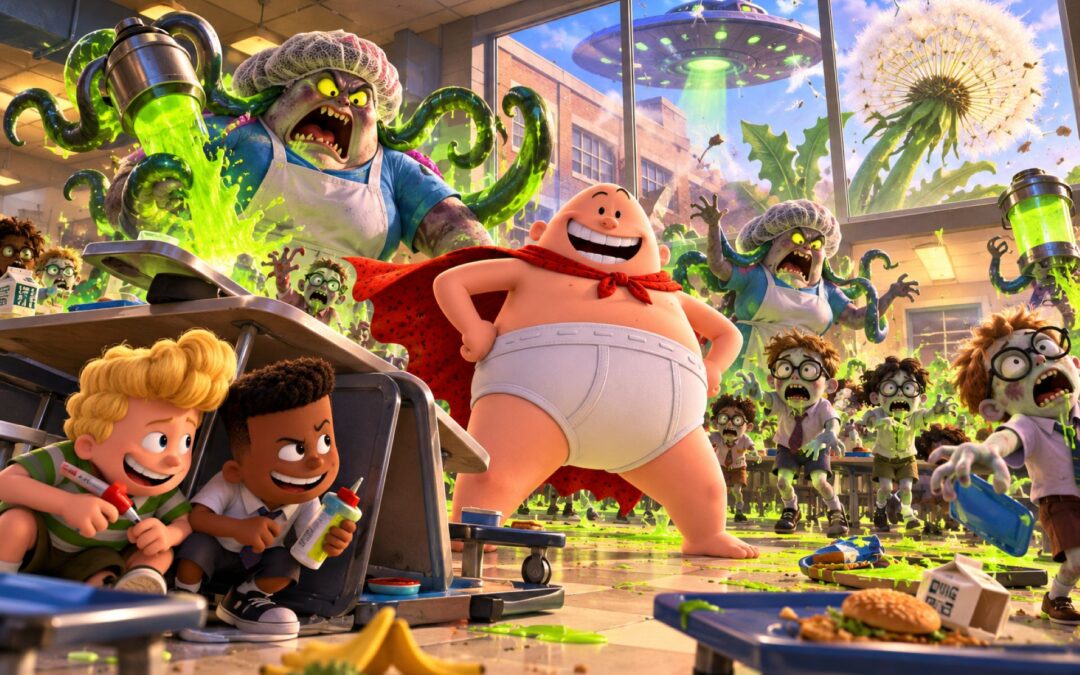
Dav Pilkey’s Captain Underpants and the Invasion of the Incredibly Naughty Cafeteria Ladies from Outer Space (and the Subsequent Assault of the Equally Evil Lunchroom Zombie Nerds) is the third Captain Underpants adventure. It begins with a school prank involving baking soda and vinegar, escalates through an alien invasion and an army of zombie nerds, and ends by changing Captain Underpants himself in a way that affects the rest of the series.
The ridiculousness is the point, but the book is more carefully constructed than its title suggests. George and Harold cause one disaster, try to fix it, accidentally create another, and repeatedly survive because the same creativity that gets them into trouble also makes them unusually good at solving problems. Pilkey builds the story out of callbacks, exaggerated consequences, homemade comics, visual jokes, abrupt chapter-length punchlines, and the interactive Flip-O-Rama sequences that had already become one of the series’ signatures.
This article discusses the complete story, including its ending. Full spoilers follow.

The Complete Story: From School Prank to Alien Invasion
Before the alien plot begins, Pilkey briefly re-establishes the strange rules governing George Beard, Harold Hutchins, their principal Mr. Krupp, and Captain Underpants. George and Harold once hypnotized the unpleasant Mr. Krupp into believing that he was the superhero they had invented in their comics. A snap of the fingers causes Krupp to transform psychologically into Captain Underpants, while water changes him back.
That premise means the boys effectively live with two very different people inside the same adult body. Mr. Krupp regards them as destructive troublemakers; Captain Underpants treats the world like a cheerful superhero adventure. Book 3 begins with that unstable arrangement already in place and then adds another complication: by the end of the story, Captain Underpants will no longer merely believe that he has superpowers.
The Prank That Starts Everything
George and Harold are fourth-graders at Jerome Horwitz Elementary School and inseparable partners in mischief. They are intelligent, imaginative, loyal, and fundamentally good-hearted, but they are also constantly looking for opportunities to turn ordinary school life into comedy. Mr. Krupp sees only the troublemaking side of them, while the narrator makes clear that their pranks rarely come from cruelty.
At almost the same time, a spaceship lands on the school roof. Its occupants are three aliens named Zorx, Klax, and Jennifer, who plan to use the school as the starting point for an invasion of Earth. Their scheme depends on turning the students and staff into giant, super-powered zombie nerds who can serve as an obedient army.
The aliens initially remain in the background while George and Harold create the situation that will allow them to infiltrate the school. During science class, Mr. Fyde demonstrates the familiar reaction between baking soda and vinegar by using the ingredients to make a model volcano erupt. George and Harold are less interested in the scientific explanation than in the enormous amount of foam the experiment produces.
They immediately recognize the possibilities for a prank. At George’s house, they write a fake recipe for “Mr. Krupp’s Krispy Krupcakes,” supposedly requested by the principal for his birthday. The recipe calls for large amounts of baking soda and vinegar, ingredients that obviously do not belong together in the quantities suggested.
The boys leave the recipe where the cafeteria workers will find it. Their plan is already reckless, but the lunch staff unknowingly makes it far more dangerous by multiplying the recipe so that there will be enough cupcakes for the entire school.
The result is not a batch of cupcakes but an enormous chemical eruption. Pilkey gives the explosion its own chapter-length comic beat, then follows it with the consequences: green foam surges out of the cafeteria and floods the school. Hallways, classrooms, lockers, students, and teachers are engulfed in goop.
George and Harold realize that their joke has grown far beyond what they expected. It establishes a pattern the rest of the novel will keep repeating: the boys make a clever decision based on incomplete foresight, the consequences become absurdly larger than intended, and they then have to improvise their way through the new problem.
The Lunch Ladies Leave and the Aliens Move In
The cafeteria workers are furious. Miss Creant and the other lunch ladies confront Mr. Krupp and blame George and Harold, but the explosion is only the latest event in a much longer history of humiliation. They recount previous food-related pranks and, most painfully, George and Harold’s habit of turning them into villains in homemade comics.
Pilkey then reproduces one of those comics, Captain Underpants and the Night of the Living Lunch Ladies. In George and Harold’s deliberately crude story, cafeteria workers become zombies and fight Captain Underpants through a series of increasingly juvenile food jokes. The comic is visually and verbally distinct from the surrounding novel, with intentionally childish artwork, exaggerated spelling, and the kind of logic two energetic fourth-graders might actually invent.
Within the larger novel, however, the comic does more than provide an interlude. George and Harold have imagined zombie lunch ladies before anything resembling them appears in reality. Their fiction therefore becomes a comic preview of the real adventure, although the eventual threat takes a different form.
The genuine cafeteria workers have finally had enough. Unable to get the punishment they want and sick of being mocked, they quit.
That resignation gives Zorx, Klax, and Jennifer exactly the opening they need. They disguise themselves as human women named Zorxette, Klaxette, and Jenniferette and present themselves as replacement cafeteria staff. Mr. Krupp hires them despite their lack of credible experience or references, another example of adult authority being far less competent than it assumes.
Meanwhile, Krupp still wants to punish George and Harold for the cupcake disaster. Because he cannot actually prove they caused it, he does not impose the punishment he would prefer. Instead, he revokes their cafeteria privileges and requires them to bring lunches from home and eat them under his supervision.
The punishment accidentally saves their lives.
The new cafeteria staff have begun serving Evil Zombie Nerd Milkshakes. Everyone who consumes the alien concoction is transformed into a zombie nerd: grayish, vacant, aggressive, bespectacled, and equipped with the stereotypical pocket protectors and school-supply imagery that Pilkey uses as shorthand for “nerdiness.” Because George and Harold are forbidden to eat cafeteria food, they avoid the milkshakes completely.
Their homemade lunches are so unpleasant that Krupp eventually leaves them alone, which gives them a chance to investigate. They notice that ordinary students and adults are going into the cafeteria but something is very wrong with the people coming out. The transformed population looks sickly and behaves strangely.
George and Harold sneak toward the kitchen and discover the truth. Zorx, Klax, and Jennifer are not merely trying to create zombies. The milkshakes are only the first stage of the operation. Once the entire school has been transformed, the aliens intend to administer Super Evil Rapid-Growth Juice, enlarging the zombie nerds into a gigantic army capable of conquering Earth.
George manages to steal the Rapid-Growth Juice. Believing that the safest solution is simply to get rid of it, he pours it outside.
At first, that seems sensible. In reality, it creates another delayed problem.
George and Harold rush to warn Mr. Krupp, but he assumes they are inventing yet another story to escape punishment. Even when his secretary, Miss Anthrope, behaves suspiciously, Krupp is reluctant to accept an explanation involving alien zombie milkshakes.
The confrontation becomes undeniable when the boys return to the cafeteria. Zorx seizes Harold, and the disguise fails enough for the aliens’ true anatomy to be exposed. During the struggle, Zorx snaps his fingers.
That sound activates the boys’ old hypnotic command.
Mr. Krupp immediately becomes Captain Underpants.
George and Harold Fight Back
Captain Underpants’s arrival should theoretically solve the problem, but the joke of the series is that he is rarely as useful as a conventional superhero. He has enormous confidence and no actual powers. George and Harold therefore tend to spend almost as much energy protecting him as they do defeating the villains.
The boys initially face the aliens themselves. Trapped in the kitchen, George and Harold arm themselves with a rolling pin and a frying pan. Pilkey then shifts into the first major Flip-O-Rama sequence.
Flip-O-Rama imitates animation using two alternating illustrations. The reader is instructed to hold a page and flip it rapidly backward and forward, causing the pictures to appear to move. The technique is deliberately primitive, and the narrator makes a joke of its cheapness, but that cheapness is part of the pleasure. Instead of merely reading about a fight, the reader physically creates the motion.
George and Harold temporarily get the better of Zorx, Klax, and Jennifer. Captain Underpants, however, has managed to miss the battle because he obediently followed an earlier absurd instruction involving a shoe store. His lateness makes the conventional superhero entrance useless, another way Pilkey keeps the children rather than the costumed adult at the center of the action.
The aliens then call on the much larger threat they have already created. The zombified students and staff begin pursuing George, Harold, and Captain Underpants through the school.
The trio escapes upward and reaches the roof. There they find the aliens’ spaceship, but they also discover something George did not anticipate when he disposed of the Rapid-Growth Juice.
He poured it onto a dandelion.
The weed is now enormous and still growing.
The spaceship therefore looks like the safer option. George, Harold, and Captain Underpants climb aboard and find several bottles of alien liquid. Among them are Anti-Evil Zombie Nerd Juice, Ultra Nasty Self-Destruct Juice, and Extra-Strength Super Power Juice. Each substance is almost comically convenient, and the story knows it; Pilkey treats the labels themselves as part of the joke rather than asking the reader to believe in serious science-fiction technology.
The aliens recapture them before they can escape. Zorx, Klax, and Jennifer imprison the trio and explain their plan to continue conquering Earth. George and Harold, however, now understand the spaceship well enough to create a counterplan.
Their solution once again depends on deception rather than strength.
George switches labels so that the Ultra Nasty Self-Destruct Juice will be mistaken for the Rapid-Growth Juice. Harold performs another label switch involving the ship’s systems and the equipment the aliens intend to use. The exact mechanics matter less than the principle: George and Harold defeat technologically superior invaders because they notice what the adults and aliens do not, then weaponize the villains’ own confidence against them.
The aliens unknowingly place the destructive liquid where it can destroy their ship. By the time they recognize the mistake, the self-destruct sequence is underway.
Captain Underpants has contributed enthusiasm, but the strategic victory belongs overwhelmingly to George and Harold.
The Spaceship, the Dandelion, and the Super Power Juice
The heroes still need to escape an exploding spacecraft. Captain Underpants attempts to lower George and Harold using toilet paper as though it were a rope, which is exactly the sort of heroic solution that makes sense to him and to almost nobody else.
Predictably, toilet paper cannot support them.
For a moment, the story appears to kill its heroes, but Captain Underpants’s cape catches the air and functions like a parachute. The trio survives as the alien ship explodes behind them.
Their relief lasts only seconds. They are descending toward the gigantic dandelion created by George’s discarded growth juice.
This second threat is important because it is not independent of the first. The alien invasion created the growth juice, but George’s own attempt to neutralize it produced the plant. Pilkey therefore turns what seemed like a solved problem into the final physical danger.
The enormous dandelion seizes Captain Underpants. George and Harold cannot fight something that large, and Captain Underpants still lacks the powers that his costume suggests he possesses.
George then remembers the Extra-Strength Super Power Juice taken from the spaceship.
He pours it into Captain Underpants.
The change is immediate. For the first time, Captain Underpants is not merely Mr. Krupp behaving like a superhero. He actually becomes capable of performing superhero feats.
Pilkey marks the transformation with the second Flip-O-Rama sequence. Newly empowered Captain Underpants battles the giant dandelion through exaggerated attacks, ridiculous movement, and another series of jokes in which the supposedly impressive spectacle is filtered through playground humor. The “Wedgie Weed Whacker” is typical of the book’s approach: conventional superhero action is constantly translated into the vocabulary of children who think underwear is inherently funny.
Captain Underpants eventually defeats the dandelion. The aliens are gone, the spaceship has been destroyed, and the monster created by the growth juice is no longer a threat.
One problem remains.
Almost everyone at school is still a zombie nerd.
The Cure and the New Normal
Harold remembers that the spaceship also contained Anti-Evil Zombie Nerd Juice. The boys mix the antidote into root beer and distribute it to the transformed students and adults. The cure works, returning the school population to normal.
George and Harold then need to restore Mr. Krupp. Captain Underpants dresses in the principal’s clothes, and the boys pour water on him. As established by the series’ hypnotic rules, he changes back into the unpleasant but ordinary principal.
For a brief moment, it appears that the entire adventure has reset itself. The aliens have been defeated, the zombie transformation has been reversed, the dandelion has been destroyed, and Mr. Krupp is once again himself.
Pilkey even compresses part of the resolution into a deliberately tiny chapter, turning narrative efficiency into another joke. After the long chain of increasingly ridiculous dangers, the restoration of everyone else can happen almost instantly.
The crucial change is revealed only afterward.
When Mr. Krupp becomes Captain Underpants again, the Super Power Juice is still effective. His Captain Underpants identity now possesses genuine extraordinary abilities.
George and Harold have therefore solved the immediate crisis while creating a permanent new complication. Before this adventure, Captain Underpants was dangerous because he believed he was a superhero despite being an ordinary man. After it, the boys still have to deal with his impulsive superhero personality, but now that personality can actually perform the impossible feats it imagines.
The book closes on that altered status quo and briefly points ahead to another problem, Professor Pippy P. Poopypants. The alien invasion is finished, but the consequences of Book 3 are not.
Jerome Horwitz Elementary and the Book’s Comic World
Most of Captain Underpants Book 3 takes place within the small universe of Jerome Horwitz Elementary School. Pilkey does not build an elaborate science-fiction world around the aliens, nor does he explain much about their civilization, technology, or history. Instead, he drops an interplanetary invasion directly into hallways, classrooms, a principal’s office, a cafeteria, and a school roof.
That contrast is central to the humor. A plot about enslaving humanity begins because a school needs replacement lunch ladies. A potentially world-ending invasion depends on cafeteria drinks, while the decisive heroes are two fourth-graders serving lunchtime detention. The grand scale of superhero and science-fiction storytelling is constantly reduced to the physical and social geography of elementary school.
Jerome Horwitz Elementary also operates as a caricature of institutional life from a child’s perspective. Teachers become obstacles, lunch food becomes almost monstrous, and the principal is convinced that two children are responsible for nearly every problem. Adults possess official power, but official power rarely corresponds to insight or competence.
Mr. Krupp can punish George and Harold, yet he cannot recognize aliens when they apply for jobs. The cafeteria workers control what everyone eats, yet the entire institution has no mechanism for noticing that the replacement staff are poisoning the school. George and Harold repeatedly violate rules, but they are also the people who observe the crisis clearly enough to solve it.
The book does not argue that children are always right and adults are always foolish. George and Harold genuinely cause the cafeteria explosion, and their decisions repeatedly produce unintended consequences. Its comic world is instead organized around distrust of self-important authority: the people most certain that they are in control are often the people least aware of what is happening.
George, Harold, Mr. Krupp, and Captain Underpants
The central character structure is stranger than a standard children’s superhero story because George, Harold, and Mr. Krupp effectively form a four-person relationship among three bodies. George and Harold are both protagonists and partial causes of the disaster; Mr. Krupp is their antagonist in ordinary school life; and Captain Underpants, despite occupying Krupp’s body, is their enthusiastic ally.
That arrangement lets Pilkey shift constantly between school comedy and superhero parody. The boys never simply summon a powerful protector when danger appears. Activating Captain Underpants removes Mr. Krupp but replaces him with a different kind of problem.
George and Harold
George Beard and Harold Hutchins work best as a pair because Pilkey rarely tries to make one the traditionally serious hero and the other comic relief. Both are pranksters, both make comics, both understand the absurdity around them, and both are willing to act when the adults fail.
Their friendship is built on shared imagination. They do not merely tell jokes together; they create stories, invent plans, improvise props, manipulate labels, and interpret reality through the comic logic they already use in their homemade adventures. When the actual school begins resembling one of their ridiculous comics, they adapt faster than everyone else because absurdity is already their natural language.
They are not infallible. Their fake cupcake recipe drives the original cafeteria staff away, indirectly creating the opening the aliens exploit. George’s decision to dump the growth juice initially prevents the zombie army from becoming gigantic, but it also produces the enormous dandelion that nearly kills Captain Underpants.
Those mistakes matter because they prevent the boys from becoming simple wish-fulfilment heroes. Their ingenuity creates both problems and solutions. Pilkey repeatedly asks them to live with consequences rather than merely rewarding cleverness.
When the real crisis arrives, however, George and Harold are remarkably effective. They discover the zombie transformation, investigate the kitchen, identify the growth-juice stage of the alien plan, survive the first confrontation, analyze the spaceship’s supplies, and create the label-switching sabotage that defeats the invaders.
Captain Underpants performs the most spectacular action after receiving his powers, but George and Harold do most of the thinking.
Mr. Krupp and Captain Underpants
Mr. Krupp begins the story as an exaggerated version of the hostile school principal familiar from children’s comedy. He assumes the worst about George and Harold, wants to punish them, and is more interested in controlling their behavior than understanding it.
He is not entirely wrong about them. George and Harold really did create the krupcake recipe, and their record of pranks gives him sensible reasons to suspect them whenever chaos breaks out. The comedy comes from his inability to distinguish between situations in which the boys deserve blame and situations in which they are the only people capable of saving him.
Captain Underpants is almost Krupp’s exact opposite. He is friendly, brave, eager, optimistic, and utterly convinced that he is a legitimate superhero. Yet before the ending, his heroism has a severe practical weakness: he has no superpowers.
The boys therefore have two incompatible problems attached to the same adult. As Krupp, he has authority but refuses to listen. As Captain Underpants, he listens and wants to help but possesses almost none of the abilities his fantasy requires.
That imbalance explains why George and Harold remain the protagonists even when a superhero is present. Captain Underpants can provide courage, distraction, and comic momentum, but the children repeatedly supply judgment.
The Super Power Juice changes that relationship. After the dandelion battle, Captain Underpants finally becomes physically capable of doing what he has always believed he could do. His psychological identity does not become more sensible, however, so the solution intensifies the underlying problem rather than eliminating it.
Krupp can still turn into an impulsive underwear-clad superhero whenever someone snaps their fingers. The difference is that the superhero can now actually fly and fight.
Zorx, Klax, Jennifer, and the Adults Around Them
Zorx, Klax, and Jennifer are intentionally simple villains. Their ambitions are enormous—transform a school population, enlarge it, conquer Earth—but their personalities are mostly differentiated through comic behavior rather than psychological depth.
That shallowness suits the speed of the plot. The aliens function less as fully developed antagonists than as catalysts who introduce a collection of ridiculous technologies that George and Harold eventually turn against them. They are dangerous because they have superior equipment, not because they understand their opponents particularly well.
Jennifer’s name itself is a joke beside the more stereotypically alien-sounding Zorx and Klax. The villains also participate in the book’s self-awareness, sometimes behaving as though they know that they are inside a story whose timing can be manipulated for comic effect.
The original cafeteria workers are similarly exaggerated. Their frustration is understandable—George and Harold have repeatedly mocked them—but the story treats their anger through caricature rather than emotional realism. Mr. Fyde mainly exists to introduce the scientific reaction that inspires the prank, while Miss Anthrope becomes a comic clue that something is wrong with the staff.
None of these adults has the complexity of George, Harold, or the Krupp/Captain Underpants split. That is a limitation if the novel is approached as character-driven fiction, but it is also consistent with Pilkey’s chosen form: the supporting adults and aliens operate like figures in a child’s cartoon, instantly readable and designed to keep the story moving.
Mischief, Authority, Creativity, and Consequences
The easiest moral to extract from the story would be that George and Harold should stop playing pranks, but the novel does not sustain such a simple lesson. Their mischief plainly has consequences, yet the imagination behind that mischief is also what allows them to solve the emergency when more obedient characters cannot.
The krupcake prank demonstrates the danger of thinking only about the immediate joke. George and Harold understand what baking soda and vinegar will do, but they do not anticipate the cafeteria staff multiplying the recipe for an entire school. A small plan becomes an enormous mess because real consequences extend beyond the pranksters’ intended scale.
The same pattern repeats with the growth juice. George’s decision to dump it is rational within the immediate problem: if the aliens cannot enlarge the zombie nerds, they cannot build their army. He does not notice the dandelion that will absorb it and become a later threat.
Pilkey therefore treats cleverness as valuable but incomplete. Intelligence without foresight creates chaos.
At the same time, the official authority figures show a different kind of failure. Mr. Krupp is so certain that George and Harold are habitual liars that he cannot recognize the moment when their story is true. The aliens can walk into his school under absurd disguises because institutional respectability matters more to him than careful observation.
His punishment of George and Harold becomes especially ironic. He bans them from cafeteria food in order to control them, yet that exact punishment prevents them from consuming the zombie milkshakes. Authority accidentally creates the only two uninfected students in a school full of victims.
The book therefore prefers adaptive intelligence over rigid obedience. George and Harold survive because they look at what is actually happening rather than what ought to be happening. They can accept that the cafeteria staff may be aliens, that labeled bottles of ridiculous liquid may be useful, and that changing a few labels may accomplish more than a direct fight.
Their homemade comics are part of the same theme. Adults treat the comics as evidence of immaturity and disrespect, but making stories has trained George and Harold to think in scenarios, reversals, visual sequences, and improbable solutions. Imagination is not merely a hobby surrounding the plot; it is a practical mode of problem-solving.
Friendship makes that creativity more effective. George and Harold rarely function as rival geniuses. Their plans emerge from collaboration, and neither is interested in taking individual credit when the immediate task is survival.
Their loyalty also extends beyond themselves. They could theoretically focus on escaping once they avoid the zombie milkshakes, but they repeatedly return to the larger problem of saving the school. The troublemakers are the characters most willing to take responsibility once trouble becomes genuinely dangerous.
Food, Goop, Underwear, and Transformation
Food is almost never ordinary in Book 3. The original cafeteria workers resent the way George and Harold mock their cooking, the fake krupcake recipe becomes a chemical bomb, alien milkshakes turn people into zombie nerds, and the antidote is eventually delivered through root beer.
The cafeteria therefore becomes the ideal meeting point between everyday school disgust and science-fiction horror. Children joking that school food is terrible becomes, in Pilkey’s comic exaggeration, a plot in which cafeteria drinks literally transform the people who consume them.
Liquids drive almost every major transformation. Baking soda and vinegar create foam; Evil Zombie Nerd Milkshakes transform the school; Rapid-Growth Juice enlarges living things; Self-Destruct Juice destroys the alien ship; Anti-Evil Zombie Nerd Juice reverses zombification; and Super Power Juice permanently changes Captain Underpants.
These are not subtle symbols so much as comic mechanisms. Pilkey likes immediate physical consequences: drink something, spill something, pour something, and reality changes. That directness suits a story built around visual escalation rather than scientific plausibility.
Water already has a special role before the aliens arrive because it changes Captain Underpants back into Mr. Krupp. Finger-snapping sends the transformation in the opposite direction. Book 3 places those established magical-hypnotic rules beside the aliens’ transformation liquids, making almost every identity in the story chemically or mechanically unstable.
Underwear plays a different role. Captain Underpants’s costume is ridiculous precisely because it consists of something adults normally expect to remain hidden. He turns embarrassment into a superhero uniform.
Toilet paper serves a similar purpose during the escape from the spaceship. In a conventional superhero story, the hero might use a grappling device or sophisticated equipment. Captain Underpants reaches for bathroom material and expects it to function heroically.
The recurring gross-out objects therefore do more than generate easy jokes. They continually drag the grandeur of superhero fiction back into the material world of children, bathrooms, lunchrooms, clothing, slime, and embarrassing bodies. Pilkey’s parody works by making epic genres answer to playground logic.
How Dav Pilkey Makes the Book Work
The Captain Underpants books are difficult to describe accurately if they are treated as ordinary illustrated novels. The pictures do not simply decorate prose that would function the same way without them. The narration, typography, comics, drawings, chapter lengths, and page-turning mechanics all participate in the storytelling.
That approach has roots in Pilkey’s own childhood. Scholastic’s biography of Dav Pilkey describes how, as a child with ADHD and dyslexia, he was frequently sent into the school hallway and used that time to draw and make stories, including early versions of Captain Underpants. That background helps explain the authenticity of George and Harold’s child-made comics and the series’ recurring sympathy with creative children who are treated primarily as disciplinary problems, although it should not be mistaken for proof that every incident is autobiographical.
Pilkey’s narrator behaves less like an invisible literary voice than like a conspirator talking directly to the reader. The narrator warns about supposedly graphic violence, comments on plot convenience, encourages page manipulation during Flip-O-Rama, and treats obvious absurdities as though everyone involved understands the joke.
That direct relationship with the reader prevents the novel’s nonsense from becoming confusing. The book never seriously asks readers to believe that this is a realistic world. Instead, it establishes that author, narrator, characters, and reader are participating in a comic performance whose rules can be broken whenever breaking them is funnier.
George and Harold’s homemade comics intensify the effect by placing one style of storytelling inside another. Their Night of the Living Lunch Ladies story is intentionally rougher than Pilkey’s surrounding illustrations, and its misspellings, crude drawings, and exaggerated violence imitate the creative work children might actually produce.
The embedded comic also blurs the boundary between imagination and reality. The boys invent zombie cafeteria workers before their real cafeteria is taken over and the school population becomes zombified. The fictional story does not predict events exactly, but the resemblance reinforces the sense that George and Harold’s imagination is constantly leaking into the world around them.
Pilkey also uses chapter structure as a source of jokes. Some chapters develop several narrative events, while others exist almost entirely to deliver a single explosion or confirm that something worked. Instead of maintaining conventional proportionality, the book lets the importance of a joke determine how much space it receives.
That creates extraordinary speed. A young reader rarely remains in one narrative mode for long: prose becomes an illustration, an illustration becomes an embedded comic, a comic gives way to action, and action may become Flip-O-Rama.
Flip-O-Rama is the clearest example of Pilkey making the reader part of the mechanism. Two images become a primitive animation only when the reader physically flips between them. The technology is deliberately unsophisticated, yet the limitation becomes the feature.
The reader is not merely told that George and Harold are fighting aliens or that Captain Underpants is battling a giant plant. The reader repeatedly performs the movement that creates the battle.
That interaction also reflects the book’s larger preference for child-made creativity over polished authority. Flip-O-Rama resembles something children could invent with a notebook more than conventional animation. The homemade comics look reproducible. Even the narrative voice often feels closer to playground storytelling than to formal literary narration.
Pilkey’s pacing depends heavily on escalation. A school science lesson becomes a cafeteria disaster; a cafeteria disaster creates a staffing vacancy; the vacancy enables an alien invasion; the alien invasion creates zombie nerds; an attempt to stop the zombie army creates a giant plant; and defeating the plant permanently changes Captain Underpants.
The sequence is absurd but structurally disciplined. Each new level of ridiculousness grows out of a previous event.
The book also uses constant reversals of superhero convention. Captain Underpants is technically the superhero but repeatedly needs George and Harold to tell him what is happening. He arrives too late, misunderstands obvious danger, uses toilet paper as rescue equipment, and initially possesses none of the powers his identity assumes.
Yet Pilkey never turns him into a coward. Captain Underpants is genuinely brave and eager to help. The comedy comes from the gap between heroic confidence and practical competence.
By the final battle, that gap closes physically but not psychologically. He gets the powers without becoming more sensible, which is why the ending simultaneously feels like a victory and a new problem.
The Ending Explained: How Captain Underpants Gets Real Superpowers
The most important event in the ending is not the destruction of the alien spaceship or even the cure of the zombie nerds. It is George’s decision to give Captain Underpants the Extra-Strength Super Power Juice.
Until that moment, “Captain Underpants” is essentially a hypnotic identity. Mr. Krupp physically remains an ordinary adult even though he believes he can perform superhero feats. George and Harold often have to stop him from getting himself hurt because his confidence is unsupported by actual abilities.
The giant dandelion changes the calculation. George has dumped the Rapid-Growth Juice outside to prevent the aliens from using it on their zombie army, but the liquid enlarges a weed instead. When the resulting monster captures Captain Underpants, the boys have no realistic way to save him with their usual tricks.
The Super Power Juice becomes an emergency measure.
After drinking it, Captain Underpants finally receives the abilities his identity has always assumed. The second Flip-O-Rama sequence demonstrates the change immediately: he can fight the enormous plant as an actual superhero rather than an ordinary man behaving recklessly.
The important question is what happens when he later turns back into Mr. Krupp.
Water still restores the principal’s ordinary personality. The hypnotic system therefore has not been erased. Krupp can continue switching between identities under the same basic conditions as before.
But the Super Power Juice has permanently altered the Captain Underpants side of that transformation.
When someone snaps their fingers and Krupp becomes Captain Underpants again, the powers return with him. George and Harold have not merely given an ordinary man a temporary boost during the dandelion battle; they have changed the continuing rules of the series.
That ending fits the novel’s larger pattern perfectly. George and Harold repeatedly solve one immediate problem while creating another complication they could not fully predict. The krupcake prank produces the cafeteria vacancy. Disposing of the growth juice produces the dandelion. Giving Captain Underpants Super Power Juice saves his life but leaves the boys with a much more powerful version of their already uncontrollable superhero.
The conclusion therefore restores normal life only superficially. The students are cured, the aliens are gone, and Mr. Krupp can return to his office, but the central premise has evolved.
Captain Underpants is now real in a way he was not before.
Critical Review: Does Captain Underpants Book 3 Hold Up?
Book 3 succeeds most clearly as a piece of comic construction. Its plot looks chaotic, but relatively little is wasted. The initial science demonstration creates the prank; the prank removes the cafeteria workers; their departure allows the aliens to enter; Krupp’s punishment keeps George and Harold away from the contaminated food; the discarded growth juice creates the dandelion; the alien liquids provide both the method of destroying the spaceship and the source of Captain Underpants’s powers.
That chain gives the book an unusual level of cause-and-effect coherence for a story that also contains zombie nerds, underwear battles, talking narration, and deliberately impossible technology. The reader rarely needs to stop and admire the structure because Pilkey hides it beneath speed, but the structure is one reason the escalation feels satisfying rather than merely random.
The book’s greatest strength, however, is probably its control of form. A contemporary Publishers Weekly review highlighted the series’ combination of prose, cartoon illustrations, George and Harold’s comics, and Flip-O-Rama, all of which are especially important here. The story continually changes the way the reader encounters it without losing clarity.
That formal variety is particularly effective for reluctant or inexperienced readers. Dense pages are broken by illustrations, long narrative passages are interrupted by comics, and major action sequences become participatory. The book is not simply easier to read because it contains pictures; it rewards reading through play.
George and Harold are another strength. Their friendship remains uncomplicated, but they have genuine agency. They cause problems, recognize danger, improvise under pressure, and repeatedly outperform both the villains and the adults around them.
The story also refuses to separate intelligence from silliness. George and Harold can be responsible for an enormous school disaster and still be the smartest people in the crisis. That contradiction is more interesting than a conventional distinction between “good children” and “bad children.”
Captain Underpants himself works because Pilkey does not treat his incompetence as proof that his heroism is fake. He is ridiculous, but he is also brave. The humor depends on taking his sincerity seriously even while everything around him exposes the absurdity of his methods.
The villains are much weaker as characters. Zorx, Klax, and Jennifer have little psychological identity beyond being aliens with a ridiculous plan. They are memorable primarily because of their names, disguises, technology, and role in the action.
That limitation does not seriously damage the story because the central conflict is less about defeating complex antagonists than about navigating an escalating comic machine. Still, readers looking for memorable villains comparable to the strongest antagonists in longer children’s fantasy will not find them here.
Many adult characters are similarly flat. The original cafeteria workers, Mr. Fyde, and Miss Anthrope are functional caricatures. Mr. Krupp receives more depth only because Captain Underpants turns his body into the center of the series’ central contradiction.
Some jokes have also aged more noticeably than the book’s structural inventiveness. The zombie “nerd” transformation relies on a familiar late-20th-century stereotype of taped glasses, pocket protectors, social awkwardness, and exaggerated academic uncoolness. The cafeteria-worker comedy occasionally depends on similarly broad caricatures.
Those jokes are unlikely to destroy the experience for most readers, but they can feel more dated than the book’s larger humor about school authority, embarrassing underwear, incompetent superheroes, and children outsmarting adults.
The convenience of the alien liquids is another potential weakness. A spaceship containing bottles conveniently labeled with exactly the substances the plot requires would be absurd in a story attempting serious science fiction.
Here, however, absurd convenience is explicitly part of the joke. Pilkey repeatedly acknowledges artificial storytelling logic rather than disguising it. The question is therefore not whether the plot is realistic but whether its ridiculous rules remain internally legible enough for the reader to enjoy the payoff.
They generally do.
The same applies to the violence. George and Harold fight aliens with kitchen equipment, Captain Underpants battles a giant plant, and a spaceship explodes, but the visual register remains closer to slapstick cartoons than danger. A contemporary Kirkus review recognized this mixture of school-food jokes, cartoon action, Flip-O-Rama, and deliberately gross humor as central to the book’s appeal.
The novel also deserves credit for understanding its audience without constantly explaining itself to adults. Pilkey does not apologize for bathroom humor or attempt to convert every joke into a wholesome lesson. George and Harold remain troublemakers at the end.
At the same time, the story does contain a meaningful ethical structure. Actions have consequences. Cleverness sometimes creates danger. Friendship requires cooperation. Authority does not guarantee wisdom. Imagination can be disruptive and useful at the same time.
Those ideas emerge through events rather than speeches.
The strongest limitation is therefore not childishness but narrowness. The book offers little emotional complexity, minimal world-building beyond the school, thin secondary characterization, and villains who exist almost entirely to move the plot. Readers who need psychological depth or coherent speculative logic will find the story deliberately uninterested in those goals.
Judged as a fast comic novel for children, however, those omissions matter less than pacing, accessibility, visual invention, and comic timing. On those terms, Book 3 remains effective.
It is also more important to the series than an entirely episodic adventure would be. Captain Underpants begins as a powerless man hypnotized into believing he is a superhero and ends as an actually superpowered version of the same ridiculous persona. That permanent development gives the novel lasting narrative weight beneath the disposable jokes.
Is Captain Underpants Book 3 Worth Reading?
Captain Underpants and the Invasion of the Incredibly Naughty Cafeteria Ladies from Outer Space remains worth reading for the audience most likely to enjoy what Pilkey is deliberately offering: fast-moving comedy, comics, gross-out jokes, cartoon science fiction, interactive pages, absurd villains, and children who repeatedly turn imagination into practical problem-solving.
Readers who dislike toilet humor, intentionally childish drawings, impossible plotting, or caricatured adults are unlikely to be persuaded by Book 3 because those features are not peripheral flaws that disappear later. They are part of the series’ identity.
Within that identity, however, this is a strong installment. Its escalating plot is tightly connected, George and Harold remain active rather than passive protagonists, the embedded comic and Flip-O-Rama sequences make the physical book part of the experience, and the final Super Power Juice twist permanently changes the relationship among George, Harold, Mr. Krupp, and Captain Underpants.
The story begins with two children seeing prank potential in a science experiment and ends with their imaginary superhero becoming physically real in a new sense. Everything between those points is ridiculous, but remarkably little of it is accidental.
Last Updated on October 14, 2026 by Aseem Gupta