
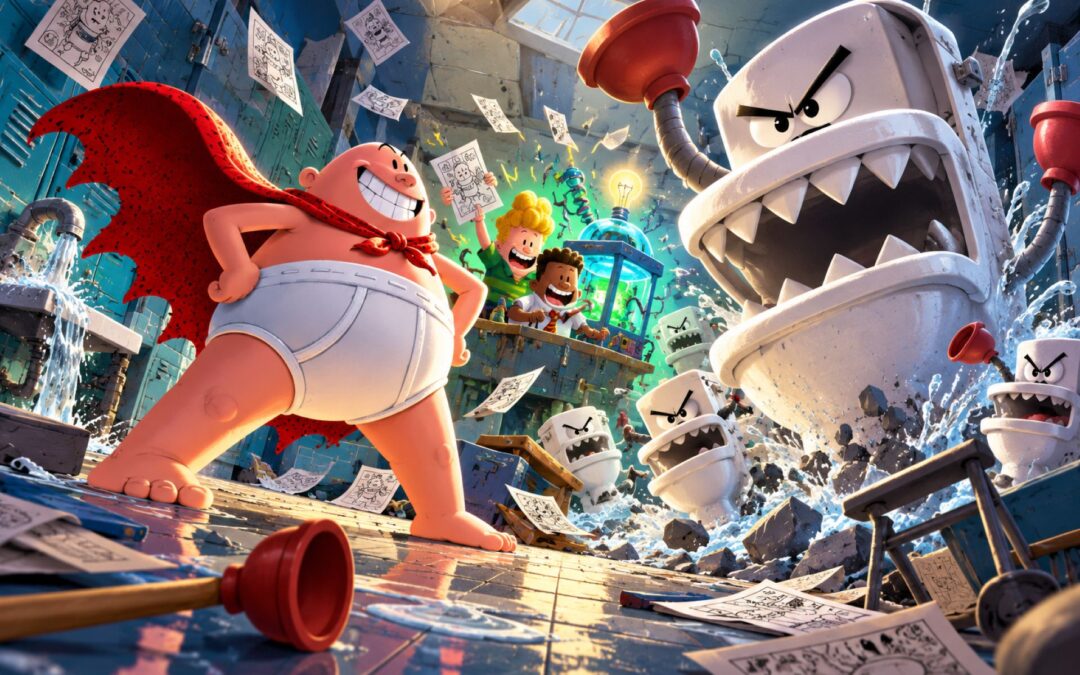
Captain Underpants and the Attack of the Talking Toilets is the second book in Dav Pilkey’s Captain Underpants series, first published in 1999. Like the first book, it combines prose, cartoons, comics drawn by its own protagonists, superhero parody, toilet humor, and Pilkey’s interactive Flip-E-Rama sequences. Beneath the deliberate silliness, however, the story is unusually well constructed: almost every disaster grows directly out of something George Beard and Harold Hutchins create, alter, misunderstand, or try to fix.
The central joke is that imagination becomes physically dangerous. George and Harold create a comic about an army of living toilets, accidentally use Melvin Sneedly’s invention to bring characters from the comic into the real world, and then have to create something else capable of defeating them. Their creativity causes the crisis and ultimately solves it, which gives the novel a stronger thematic pattern than its title might suggest.
Spoiler warning: This article explains the complete story, including the ending.

Complete Plot Summary
The novel contains a foreword and twenty-four very short chapters, but its plot works most clearly as three larger movements. The first establishes George and Harold’s conflict with school authority and introduces the machine that will create the disaster. The second turns their comic book into reality, while the final movement forces the boys to invent their way out of the crisis they caused.
The Invention Convention, Sabotage and Detention
Before the new story begins, George and Harold recap the events of the first Captain Underpants book. They explain that they once hypnotized their unpleasant principal, Mr. Krupp, and accidentally convinced him that he was Captain Underpants, the ridiculous superhero from their homemade comics. The hypnotism has left behind a strange permanent condition: whenever someone snaps their fingers near Krupp, he transforms into Captain Underpants, and whenever Captain Underpants gets wet, he changes back into Krupp.
Those rules matter enormously later, but the immediate problem is more ordinary. George and Harold learn that Jerome Horwitz Elementary School is holding its Second Annual Invention Convention. The winner will become Principal for the Day, which sounds irresistible to two boys who spend much of their school lives being punished by the actual principal.
Mr. Krupp has anticipated that reaction. The contest rules explicitly prohibit George and Harold from participating because of what they did at the previous year’s convention.
The book then flashes back to that earlier disaster. George and Harold had produced a homemade glue and secretly coated the seats in the school gymnasium with it. Once body heat activated the adhesive, the audience found themselves stuck to their chairs. The prank was presented as the boys’ “invention,” something designed to keep everyone literally glued to their seats.
Krupp therefore has good reason not to trust them. This year he does more than ban them from entering: he prevents them from even attending the event and places them in study hall instead.
George and Harold respond exactly as Krupp fears. If they cannot participate in the convention, they decide to sabotage it.
They sneak into the school before the event and begin tampering with the students’ inventions. An Automatic Dog-Washer is altered so that it will spray India ink instead of soap. An Electric Ping-Pong Ball Server is loaded with eggs. Other devices are similarly modified so that an ordinary school exhibition is primed to collapse into chaos.
During this sabotage, George and Harold meet Melvin Sneedly, one of the school’s most academically gifted students. Melvin is proud of his own invention, the PATSY 2000, a heavily modified photocopier that he claims can transform a two-dimensional image into a living three-dimensional object.
He demonstrates it with a photograph of a mouse. After he feeds the picture into the machine, the PATSY produces an actual living mouse.
George and Harold assume the demonstration is a trick. They are willing to leave Melvin’s machine untouched if he promises not to tell anyone that he saw them sneaking around the convention. Melvin agrees.
The next day, the Invention Convention begins. The adults are already nervous because of the previous year’s sticky-chair incident, and their concern proves justified almost immediately. The sabotaged Dog-Washer sprays the crowd with inky water. The Ping-Pong Ball Server fires eggs. Another machine launches pudding. Other inventions malfunction in similarly humiliating ways, and the carefully organized convention disintegrates.
Krupp knows George and Harold are the most likely culprits, but he faces an obvious problem: he deliberately prevented them from attending. He has no proof.
Melvin supplies it.
When George reminds him that he promised not to reveal what he had seen, Melvin simply explains that he changed his mind. That moment establishes him as something more than the stereotypical smart student. He becomes a direct foil to George and Harold: technically brilliant, proud of following conventional achievement, and willing to use adult authority against them.
Krupp sentences George and Harold to detention for the rest of the school year. Every afternoon, they must spend two hours copying a punishment sentence onto the chalkboards.
The punishment is designed to waste time through repetition, but George and Harold immediately turn it into another engineering problem. They build wooden devices capable of holding several pieces of chalk simultaneously. With one movement, they can write many copies of the required sentence at once.
What should take two hours now takes only a few minutes.
The boys are still required to remain in detention, but the rest of the period becomes free time. They use it to do what they enjoy most: make comics. George writes the stories, Harold draws the pictures, and together they create a new adventure called Captain Underpants and the Attack of the Talking Toilets.
That comic becomes the blueprint for everything that follows.
When George and Harold’s Comic Becomes Real
The book reproduces George and Harold’s new comic rather than simply describing it. Its drawings are intentionally crude, its spelling and grammar are deliberately childlike, and its plot is a parody of exaggerated superhero stories.
In their comic, an alien spaceship fires an evil ray at Jerome Horwitz Elementary School and transforms the school’s toilets into living monsters. The toilets begin swallowing people until Captain Underpants arrives to stop them.
He discovers that plungers make surprisingly useful weapons because he can jam them into the toilets’ mouths. He defeats the ordinary talking toilets and then confronts the much larger Turbo Toilet 2000. Captain Underpants gives the monster a wedgie, uses a stop sign like part of a giant slingshot, and launches the Turbo Toilet into the alien spaceship. The spacecraft explodes, the toilets return to normal, and the ridiculous crisis ends.
Having finished the comic, George and Harold want to make copies so they can sell it to other students. They cannot safely use the office photocopier while they are supposed to be in detention, but they remember Melvin’s PATSY 2000.
Because they never believed Melvin’s claim that the machine could make pictures real, they assume it will function as an ordinary copier.
They place the cover of their new comic onto the machine.
The PATSY begins shaking violently. Instead of producing a paper copy, it creates a living version of one of the talking toilets shown on the cover. More follow.
George and Harold finally understand that Melvin had been telling the truth.
They flee the gymnasium and immediately encounter Mr. Krupp. Rather than having time to explain properly, they are caught leaving detention, and Krupp gleefully suspends them.
The boys warn him that an army of living toilets is inside the gym, but Krupp does not believe them. The situation is absurd even by their standards: they have been permanently assigned to detention, immediately escalated to suspension, and accidentally created monsters that may destroy the school.
The teachers are equally dismissive. When George and Harold warn them not to open the gymnasium doors, the adults laugh at the boys. Mr. Meaner opens the doors anyway and is promptly swallowed by a talking toilet.
The monsters pour into the school.
The teachers panic. Ms. Ribble points at the toilets and angrily orders them to leave, snapping her fingers as she does so. Her command has no effect on the toilets, but the snap triggers something else entirely.
Mr. Krupp begins transforming into Captain Underpants.
George and Harold know that water would restore Krupp, so they hurry toward his office. They arrive too late. Krupp’s clothes and toupee are there, but Captain Underpants has already rushed away, taking a red curtain to use as his cape.
They find him racing through the neighborhood and collecting underwear from clotheslines. He intends to use the underwear as ammunition against the monsters.
Back at the school, the disaster has grown worse. Nearly every teacher has been swallowed. Ms. Ribble survives long enough to tell Captain Underpants what has happened, but she too is eaten.
Captain Underpants begins firing underwear into the mouths of the attacking toilets. The plan fails completely. Instead of choking or retreating, the toilets eat the underwear and become even hungrier.
George and Harold need a different weapon. They decide that if the toilets can eat almost anything, the best strategy is to feed them something disgusting enough to make them sick.
They turn to the school cafeteria.
The boys find a large supply of green creamed chipped beef intended for school lunch. Using underwear like a slingshot, they launch portions of it into the attacking toilets. The monsters devour the food.
Soon the strategy works. The toilets become violently ill and vomit up everything they have swallowed, including the teachers. The adults are unconscious but alive.
The ordinary talking toilets are defeated.
George immediately realizes that something is wrong. Their victory came too easily, because the cover of their comic contained another creature. If the PATSY turned the ordinary talking toilets into living beings, it should have done the same thing to the gigantic Turbo Toilet 2000.
The huge monster smashes its way out of the school.
Captain Underpants prepares to fight it.
The Turbo Toilet 2000, Robo-Plunger and Principals for the Day
Captain Underpants treats the Turbo Toilet 2000 as though it were simply a larger version of the creatures he has already confronted. George warns him that the monster is too powerful, but Captain Underpants charges into battle anyway.
Pilkey presents the fight using Flip-E-Rama, one of the series’ most distinctive visual devices. Two images are arranged so that readers can rapidly flip the page backward and forward, producing a crude form of animation.
In George and Harold’s comic, Captain Underpants defeated the Turbo Toilet himself. Reality now diverges from their story.
Captain Underpants attacks with his usual confidence, but the Turbo Toilet is much stronger than expected. It overpowers him and traps him in its mouth.
George and Harold run back into the school. Captain Underpants cannot solve this problem for them, so they need another idea.
George realizes that the same machine that created the monsters can potentially create something capable of defeating them. PATSY does not distinguish between dangerous pictures and helpful ones. If Harold can draw a sufficiently powerful machine, PATSY may be able to make it real.
Harold initially suggests a giant robotic urinal called the Urinator, but George jokes that they would never get away with putting something like that into a children’s book. They settle on another concept: the Incredible Robo-Plunger.
Harold draws a massive robot equipped with a giant plunger, laser eyes and rocket boosters. They also specify that it must obey their commands.
The damaged PATSY 2000 is lying on its side after producing the monsters. George and Harold struggle to restore it, place Harold’s drawing inside, and activate it.
The machine shakes, smokes and strains, but it works.
The Incredible Robo-Plunger becomes real.
George and Harold order it to fight the Turbo Toilet. A second Flip-E-Rama sequence turns the battle into another reader-operated animation. The Robo-Plunger rescues Captain Underpants, attacks the Turbo Toilet and finally defeats the monster with its enormous plunger.
The physical crisis is over, but the boys now have a different problem: their principal is still Captain Underpants, the school has been wrecked, the teachers are unconscious, and enormous amounts of evidence remain.
When George and Harold recover Captain Underpants from the defeated monster, they discover that the water inside the Turbo Toilet has already triggered his transformation back into Mr. Krupp.
Krupp remembers almost nothing.
He wakes in his underwear surrounded by destruction and assumes that he will be blamed for everything. From his point of view, the situation is impossible to explain: the school is damaged, the teachers are unconscious, and he appears to have lost his clothes in the middle of it all.
George and Harold offer to solve his problem.
They have conditions.
Krupp must cancel their suspension and detention, and he must honor the original Invention Convention prize by allowing them to become Principals for the Day.
Krupp agrees.
The boys then order the Robo-Plunger to repair the school, remove the evidence of the battle and leave Earth. The next chapter reduces this enormous task to an intentionally ridiculous narrative shortcut: the robot simply obeys.
When the teachers regain consciousness, they cannot make sense of their memories. They remember talking toilets and other impossible events, but the restored school gives them no physical evidence that anything happened. They conclude that they must have shared some kind of bizarre dream.
Krupp believes the entire crisis has finally been contained.
George and Harold remind him that he still owes them their reward.
They become Principals for the Day.
Their administration reverses almost every normal rule of Jerome Horwitz Elementary. Classes, homework and tests are cancelled. Everyone receives an A+. The students spend the day enjoying an enormous recess with pizza, fries, cotton candy, ice cream and music.
Meanwhile, the adults lose the power they normally exercise over George and Harold. Krupp, the teachers and Melvin are sent to detention and forced to write punishment sentences.
Krupp then discovers that George and Harold paid for the celebration by selling his antique desk and chair along with the furniture from the teachers’ lounge. Even after saving the school, they have not transformed into obedient model students.
At the end of the day, Miss Anthrope angrily snaps her fingers.
That familiar sound triggers Krupp’s hypnosis again.
He begins removing his clothes, rushes into his office and emerges once more as Captain Underpants.
The immediate story is complete, but the underlying problem has restarted. Captain Underpants is back.
Jerome Horwitz Elementary and the Book’s Comic World
Jerome Horwitz Elementary School is not realistic world-building in the sense of a fantasy kingdom or a detailed fictional city. It is instead a compressed comic version of a school as children might experience it: a place of rules, boring assignments, punishments, cafeterias, assemblies, competitive students and adults with enormous power over the daily lives of children. Pilkey exaggerates each element until an ordinary elementary school becomes capable of supporting a superhero adventure.
Nearly every major location has both a practical and comic function. The gymnasium hosts the Invention Convention and later becomes the place where PATSY creates the talking toilets. The detention room represents repetitive punishment but also becomes the birthplace of George and Harold’s new comic. The cafeteria supplies the weapon that defeats the ordinary toilets, while Krupp’s office repeatedly functions as the place where his respectable identity is abandoned and Captain Underpants emerges.
The school’s hierarchy matters even more than its geography. Krupp controls George and Harold through exclusion, detention and suspension; teachers repeatedly dismiss what the boys say because they already regard them as troublemakers. That disbelief becomes dangerous once the supernatural crisis begins. Mr. Meaner opens the gymnasium doors precisely because George and Harold have so little institutional credibility.
At the same time, Pilkey does not portray George and Harold as helpless victims of unreasonable adults. Krupp’s suspicion of them is frequently justified. They really did sabotage the Invention Convention, and the entire talking-toilet catastrophe begins because they misuse a machine they do not understand.
The comedy therefore depends on a deliberately unstable moral order. The adults are often petty, authoritarian or foolish, but the children are genuinely disruptive. Jerome Horwitz Elementary works because neither side completely deserves the power it wants.
Characters and Relationships
The characters in Attack of the Talking Toilets are intentionally broad rather than psychologically intricate. Pilkey gives them strong roles, recognizable motives and immediately readable relationships, then lets the speed of the plot and the visual humor do much of the remaining work. Within that simplified style, however, the major characters are more distinct than they initially appear.
George Beard and Harold Hutchins
George and Harold function as a team, but they are not interchangeable. George is usually the planner, storyteller and verbal improviser, while Harold is the artist. Their comic-making reflects this division directly: George writes, Harold draws, and their combined work becomes something neither would produce alone.
Their friendship is therefore built around shared creativity rather than simple companionship. They sabotage inventions together, invent shortcuts together, create Captain Underpants comics together and eventually solve the Turbo Toilet crisis together. Even when one boy supplies the idea, the other usually supplies the complementary skill necessary to make it work.
This creative partnership also explains why traditional school punishment has such limited effect on them. When Krupp tells them to spend hours copying sentences, they do not simply refuse. They accept the technical terms of the punishment and then invent a machine that completes the work more efficiently. What the school treats as enforced obedience becomes another engineering challenge.
That pattern has an interesting connection to Dav Pilkey’s own childhood experiences. Scholastic’s biography of Pilkey explains that, after being diagnosed with dyslexia and ADHD, he was frequently sent into the hallway at school, where he spent time drawing and making comics. That background does not mean George and Harold are straightforward autobiographical versions of Pilkey, but it helps explain why the books repeatedly imagine supposedly unproductive school time becoming the setting for creative work.
George and Harold’s greatest strength is also their greatest problem. They are inventive enough to escape boring constraints, but their confidence often exceeds their judgment. Their sabotage of the convention is intentional, and using PATSY is careless even though they do not understand what it really does. The talking-toilet disaster is not something that happens randomly to them; it is a consequence of their own actions.
The important development is not that they become obedient. They do not. Instead, they use the same qualities that created the crisis—improvisation, audacity, drawing, storytelling and mechanical problem-solving—to take responsibility for stopping it. Their growth is practical rather than moralistic.
Mr. Krupp and Captain Underpants
Mr. Krupp and Captain Underpants are opposites occupying the same body. Krupp is suspicious, punitive and obsessed with controlling George and Harold. Captain Underpants is cheerful, impulsive and completely convinced that he is a heroic defender of justice.
The contrast is inherently comic because the boys’ harshest authority figure literally contains their childish superhero fantasy. Whenever someone snaps their fingers, Krupp’s institutional identity disappears and the character invented by George and Harold takes over. Water reverses the transformation and restores the principal.
In the first book, that split establishes the series’ central gimmick. The second book develops it by making Captain Underpants less capable than the fantasy version George and Harold imagine. In their comic, he defeats the Turbo Toilet himself. In the real crisis, he tries the same kind of heroic attack and loses.
That failure matters because it prevents Captain Underpants from becoming an effortless solution whenever George and Harold make a mistake. They must rescue their own superhero.
Captain Underpants is therefore both an escape from Krupp’s authority and another responsibility the boys have accidentally created. They cannot simply enjoy the fact that their principal becomes a superhero; they also have to manage the transformations, protect Krupp from the consequences, and improvise whenever Captain Underpants’ confidence becomes dangerous.
Krupp remains deliberately simple as a character. The novel does not try to explain the emotional roots of his hostility toward the boys or turn him into a sympathetic adult. His effectiveness comes from the contrast: one body allows Pilkey to alternate between the joyless principal and the absurdly enthusiastic superhero whenever the plot needs a reversal.
Melvin Sneedly and the School Adults
Melvin Sneedly is a different kind of foil. George and Harold are creative, undisciplined and socially united; Melvin is academically successful, technologically gifted and proud of his intelligence. His PATSY 2000 is by far the most extraordinary invention in the book, yet the invention becomes catastrophic only because George and Harold refuse to believe that it actually works.
Melvin therefore complicates any simple argument that the book celebrates one kind of intelligence and mocks another. He is genuinely brilliant. George and Harold would never be able to make a drawing come alive without his machine.
What makes Melvin antagonistic is not intelligence but his relationship to the boys. He breaks his promise, reports them to Krupp and appears to enjoy having institutional authority on his side. At the end, George and Harold place him in detention alongside the adults, symbolically putting him on the opposite side of the student-versus-authority divide.
The teachers are even broader caricatures. Mr. Meaner ignores a life-saving warning because he assumes George and Harold are lying. Ms. Ribble unintentionally activates Captain Underpants while trying to impose authority on the toilets. Miss Anthrope accidentally restarts the entire superhero cycle with another angry finger snap.
Their simplicity serves the book’s perspective. Adults are not developed primarily as independent lives; they are presented as children experience them within the comic logic of school—as teachers, punishers, doubters and obstacles. That makes the comedy immediate, though it also limits the book’s emotional range.
Creativity, Authority and Responsibility: The Book’s Major Themes
The most important pattern in Attack of the Talking Toilets is the repeated transformation of creativity from harmless play into material power. George and Harold begin by using ingenuity for mischief. They make glue, sabotage inventions and build a device that lets them complete detention faster. Their imagination has consequences long before the supernatural plot begins.
The comic created during detention intensifies that pattern. George and Harold are ordered to perform meaningless repetition, but their homemade multi-chalk device reduces the punishment to a mechanical task. The time that remains becomes creative time, and the result is a new Captain Underpants adventure.
That sequence establishes a distinction between two kinds of production. Copying punishment sentences is repetitive and imposed. Making a comic is collaborative and self-directed. Pilkey clearly has more affection for the second kind of work.
The novel does not stop with the comfortable idea that creativity is always good. George and Harold take their comic to PATSY because they want copies, and the machine transforms their drawings into physical creatures. Their imaginative world becomes dangerous precisely because they treat creation casually.
The talking toilets are therefore not simply random monsters. They are consequences.
The solution repeats the same mechanism in a more responsible form. When Captain Underpants loses, George and Harold do not discover some external weapon or wait for an adult scientist. They deliberately create another image, this time with a specific purpose. Harold draws the Robo-Plunger, George helps formulate what it must do, and PATSY turns the drawing into reality.
The difference is intention. The first use of PATSY is careless; the second is purposeful.
That structure gives the book a surprisingly coherent idea about responsibility. George and Harold never become conventionally repentant children who promise to stop causing trouble. Their personalities remain almost completely intact. Responsibility instead means staying inside the consequences of their actions long enough to repair them.
Authority is treated with similar ambiguity. Krupp frequently behaves vindictively, and the teachers dismiss George and Harold even when the boys are trying to save them. The book plainly enjoys humiliating adults who rely on authority without judgment.
Yet the boys are not automatically right because they oppose those adults. Krupp bans them from the Invention Convention because they previously glued everyone to their seats, and they respond by sabotaging the new convention. The conflict works because neither side deserves complete moral victory.
The final Principal-for-the-Day sequence makes that tension explicit. George and Harold gain the power they wanted, then use it to eliminate homework and tests, award perfect grades, throw an enormous party and put the adults in detention. It is a fantasy of children reversing the normal structure of school.
But it is not presented as a serious educational program. They also sell school furniture to finance the celebration.
The book’s attitude is therefore irreverent rather than ideological. It delights in the idea of children escaping petty authority, but it also makes those children reckless enough that the reader can see why some authority exists in the first place.
Friendship connects all of these themes. George and Harold’s effectiveness comes from cooperation. Their pranks, comics and solutions are collective acts, and their different abilities make them stronger together than either would be alone. Even when the book is mocking school discipline or staging battles with giant toilets, its most stable relationship is the partnership between two children who genuinely enjoy making things together.
Comics Coming to Life: Metafiction, Motifs and Symbols
The PATSY 2000 turns the book’s central metafictional joke into a literal plot mechanism. George and Harold create fictional characters, and those fictional characters escape the page. The boundary between representation and reality collapses inside a novel that is already constantly moving between prose, cartoons and comics.
Chapter 9 is especially important because the reader sees the boys’ comic before the main story begins imitating it. Their version establishes the talking toilets, Turbo Toilet 2000 and Captain Underpants’ expected victory. Once PATSY brings the drawings to life, the reader naturally assumes reality will continue following the comic.
Then it does not.
Captain Underpants fails to defeat the Turbo Toilet.
The fictional story therefore acts first as foreshadowing and then as a false prediction. George and Harold have created the framework for what happens, but they have not predetermined the result. Reality becomes a revised version of their comic, requiring a new ending.
The Robo-Plunger completes that revision. Harold creates another drawing, but this time George and Harold know exactly what PATSY does. They are no longer accidental authors of the crisis. They become conscious authors of its solution.
Copying and reproduction appear repeatedly around this larger idea. Krupp orders the boys to copy sentences. They design a device to multiply their writing. They want to photocopy their comic. Melvin’s invention appears to be a copier but actually produces living objects.
These repetitions create a useful contrast between mechanical duplication and imaginative creation. PATSY looks like a copying machine, but its extraordinary power is not to reproduce an image faithfully. It changes the image into something new: an object capable of acting independently.
That is also what happens whenever a reader encounters George and Harold’s comic inside Pilkey’s novel. Their childish drawings are not merely background decoration. They become part of the story’s reality.
Other recurring elements work more as motifs and running jokes than as deep symbols. Underwear connects Captain Underpants’ superhero identity to the childish absurdity of the series. Toilets turn an everyday object into a monster and allow Pilkey to build an entire action plot around bathroom humor.
Finger snaps and water function almost like magical rules. One activates Captain Underpants; the other restores Krupp. Because these triggers are ordinary actions rather than mystical rituals, the superhero transformation can happen accidentally at any moment.
The final finger snap is effective precisely because the reader has learned that rule so thoroughly. Miss Anthrope does not intend to restart the Captain Underpants problem. She simply performs an ordinary angry gesture, and the entire serial mechanism begins again.
Humor, Illustration and Flip-E-Rama: How the Book Is Built
The form of Attack of the Talking Toilets is inseparable from its appeal. Pilkey does not write a prose story and then decorate it with pictures. The text, cartoons, comics and visual gags divide the storytelling between them.
That approach was already visible to contemporary reviewers. A 1999 Publishers Weekly review singled out the sequel’s self-referential humor, black-and-white cartooning and Flip-E-Rama device, recognizing that the book’s visual play was central rather than incidental.
The narrator frequently addresses readers directly and treats storytelling itself as something available for jokes. Chapter titles exaggerate the supposed danger of what is about to happen. The book knows that it is a book, George and Harold know that they make comics, and jokes repeatedly depend on the difference between what can happen in fiction and what adults supposedly permit in children’s publishing.
The Urinator joke is a good example. George and Harold briefly consider designing a giant robotic urinal, then reject the idea partly because it seems like something they could not get away with putting into a children’s book. The story is simultaneously creating its plot and commenting on the rules surrounding that plot.
The embedded Captain Underpants comic adds another layer. It is intentionally drawn and written in a style that looks as though two children made it. Misspellings, simplistic art, excessive action and absurd logic are features rather than mistakes.
This allows George and Harold to become creators inside the story rather than merely characters within it. Readers are not just told that the boys love comics; they are allowed to read one of those comics themselves.
Flip-E-Rama goes one step further by giving the reader a physical role. Rather than simply looking at a static drawing of a fight, the reader rapidly flips between images to create the illusion of motion. The animation is primitive, but that primitiveness is part of the joke.
It also fits the book’s larger interest in making things. George writes. Harold draws. Melvin invents a machine. George and Harold build devices. Even the reader is briefly asked to operate the pages like a homemade animation machine.
That interactive quality is especially important for the book’s intended audience. The official Scholastic description of the second book positions it squarely within the fast, comic-driven Captain Underpants series for young readers. Pilkey’s short chapters, abundant pictures and repeated visual interruptions make the book easy to move through without making it feel like a simplified version of a more “serious” book.
Chapter 22 provides one of the clearest examples of Pilkey’s pacing. After the long climactic battle and the complicated instructions George and Harold give the Robo-Plunger, the next chapter reduces the robot’s enormous repair job to essentially one joke: it obeys. Instead of describing the cleanup at length, Pilkey compresses it because the narrative work is already done.
The result is a book with remarkable momentum. New problems appear quickly, scenes rarely outlast their jokes, and visual sequences interrupt the prose before it becomes static. The drawback is that readers who want emotional depth or sustained character development will not find much of it. The form is designed around speed, participation and comic escalation.
Ending Explained: Why the Story Ends with “Here We Go Again”
The ending resolves the monster plot completely. The Robo-Plunger defeats the Turbo Toilet 2000, Captain Underpants survives, and exposure to toilet water turns him back into Mr. Krupp. George and Harold then use Krupp’s panic to negotiate an agreement: their detention and suspension will disappear, and they will receive the Principal-for-the-Day reward they were originally denied.
The Robo-Plunger repairs the school and removes the physical evidence. Because the teachers were unconscious and wake in an apparently normal building, their memories of talking toilets seem impossible even to themselves. They settle on the idea that the entire experience must have been some strange shared dream.
That leaves George, Harold and Krupp as the only people who understand enough of the event to know what really happened. It also means the institutional order can resume without anyone having to explain monsters, a giant robot or a principal who spends part of his life running around in underwear.
The Principal-for-the-Day sequence provides the story’s emotional payoff. George and Harold finally receive the authority that motivated them at the beginning. They abolish ordinary school obligations, reward every student and reverse the detention system so that the adults and Melvin experience the punishment normally imposed on them.
The ending is not a moral reform. George and Harold remain themselves. They even sell school furniture to finance the celebration, ensuring that their victory is still mischievous rather than conventionally responsible.
Miss Anthrope’s final snap then prevents the book from ending with permanent stability. Krupp transforms into Captain Underpants again, restoring the series’ central problem at exactly the moment when the immediate adventure seems finished.
That circular ending works because the reader now understands the transformation rule instantly. No lengthy explanation is necessary. A finger snap is enough to signal that George and Harold’s strange responsibility for Captain Underpants continues beyond this particular disaster.
The book therefore provides two kinds of closure at once. The talking toilets are gone, the school is restored and the boys receive their reward. But the larger Captain Underpants situation remains unresolved, allowing the series to continue without undoing the victory of this story.
Critical Review: How Well Does Captain Underpants #2 Work?
Captain Underpants and the Attack of the Talking Toilets succeeds most completely as a piece of comic engineering. Its events are ridiculous, but the causal structure is unusually tight. The boys are excluded from the Invention Convention because of an earlier prank; that exclusion motivates the sabotage; the sabotage introduces Melvin and PATSY; Melvin exposes them; detention gives them time to create the comic; the comic is placed on PATSY; PATSY creates the monsters; and the same machine eventually creates the weapon that defeats them.
That construction gives the book much more coherence than a random sequence of toilet jokes would have. Even the Principal-for-the-Day ending completes a desire introduced near the beginning. Almost every major element returns in altered form.
The book’s greatest strength is the integration of visual storytelling with plot. George and Harold’s comic is not an optional diversion because its imagery becomes reality. Flip-E-Rama is not merely an illustration gimmick because both major battles are staged through it. The childish drawings and misspellings are not simply jokes because they establish George and Harold as creators inside the book.
Pilkey also understands his target audience extremely well. The chapters are short, the stakes escalate quickly, and the prose rarely asks a reader to wait long before another drawing, joke or reversal appears. The humor is direct without requiring much cultural knowledge, while the metafiction gives older or more attentive readers an additional level of comedy.
George and Harold remain highly effective protagonists because their intelligence is expressed through action. They build, draw, cheat, improvise and negotiate. The story does not repeatedly announce that they are creative; it allows creativity to drive the plot.
Their friendship is equally efficient. Pilkey does not spend pages explaining why they care about one another, but their constant collaboration makes the bond obvious.
Captain Underpants himself is slightly more interesting in this sequel because he fails. If he could defeat every monster by charging toward it in his underwear, George and Harold would become spectators in their own story. Allowing the Turbo Toilet to overpower him forces the boys to become the real problem-solvers.
The book’s limitations are largely the reverse side of those strengths. Characterization is broad. Krupp is an unpleasant principal, the teachers are mostly obstacles, and Melvin is a smug rival. None receives enough interiority to become emotionally complicated.
That simplicity is appropriate to the speed and perspective of the story, but it limits how much weight the conflicts can carry. The humiliation of the adults is funny because they are caricatures; it would become considerably harsher if Pilkey asked readers to understand them as fully developed people.
The book’s moral structure is similarly loose. George and Harold deliberately sabotage a school event, misuse someone else’s invention and cause a disaster with potentially enormous consequences. They ultimately save everyone, but they do not undergo a conventional repentance arc or receive a proportionate consequence.
For some adult readers, that can make the book appear to reward irresponsibility. Within the story’s comic system, however, a neat lesson about obedience would feel false. George and Harold’s meaningful act of responsibility is not becoming different children; it is taking action to solve the problem they created.
The anti-authority humor has also contributed to the broader series’ controversial reputation. The American Library Association’s records of frequently challenged books place the Captain Underpants series among the prominent targets of challenges during the 2010s. That history applies to the series as a whole rather than proving that this specific volume generated every objection, but it illustrates how strongly some adults have reacted to Pilkey’s combination of irreverence, disruptive children and mockery of school authority.
Those criticisms are understandable without being decisive. The novel clearly invites children to laugh at principals, teachers, punishments and rules. It does not, however, present George and Harold as models of perfect judgment. The entire plot exists because their behavior goes catastrophically wrong.
The toilet humor will be a sharper dividing line. Readers who dislike gross-out comedy are unlikely to be converted by a book in which monsters are toilets, school cafeteria food is a weapon, underwear becomes ammunition and several adults are swallowed whole. Pilkey does not occasionally use this kind of humor; he builds the novel around it.
For the audience that enjoys that register, the commitment is a strength. The book never seems embarrassed by what children find funny or tries to elevate itself above its own premise. It takes childish humor seriously enough to construct an inventive story around it.
The book also has lasting value as an example of accessible reading that does not treat accessibility as a deficiency. Pictures carry information, short chapters maintain momentum, comics interrupt prose, and the reader physically participates in Flip-E-Rama. These devices can make reading less intimidating while still requiring readers to follow cause and effect across a complete narrative.
What has aged best is the confidence of the form. The book feels comfortable mixing novel, comic strip, illustrated gag book and homemade animation without worrying about which category deserves the most prestige. That hybridity is central to what makes it memorable.
What has aged less well is mainly the thinness of some secondary characters and the limited emotional range produced by constant comic escalation. A reader looking for subtle characterization, realistic school dynamics or a morally complex antagonist will find very little of that here.
Those omissions do not seriously damage the book’s central project because that project is different. Pilkey wants to make young readers laugh, keep the pages moving, let children defeat exaggerated authority figures and turn acts of drawing, writing and inventing into the engines of an adventure.
On those terms, Captain Underpants and the Attack of the Talking Toilets works remarkably well. Its absurd premise is supported by careful setup and payoff, its visual techniques genuinely affect the narrative, and its final solution grows naturally from the mistake that created the problem.
The book is easiest to recommend to young readers who enjoy cartoons, comics, slapstick, gross-out humor and stories in which children understand the crisis before adults do. Readers who need realistic characterization or who have little tolerance for bathroom jokes may find its comic range narrow.
For everyone else, the second Captain Underpants book remains a particularly clear demonstration of why the series became so effective: Pilkey does not merely tell children a story about imagination. He constructs a book in which drawing, writing, inventing, copying and even flipping the pages physically change what happens. George and Harold may create disaster with that power, but when the disaster becomes too large for Captain Underpants himself, creation is also what allows them to save the day.
Last Updated on October 14, 2026 by Aseem Gupta