
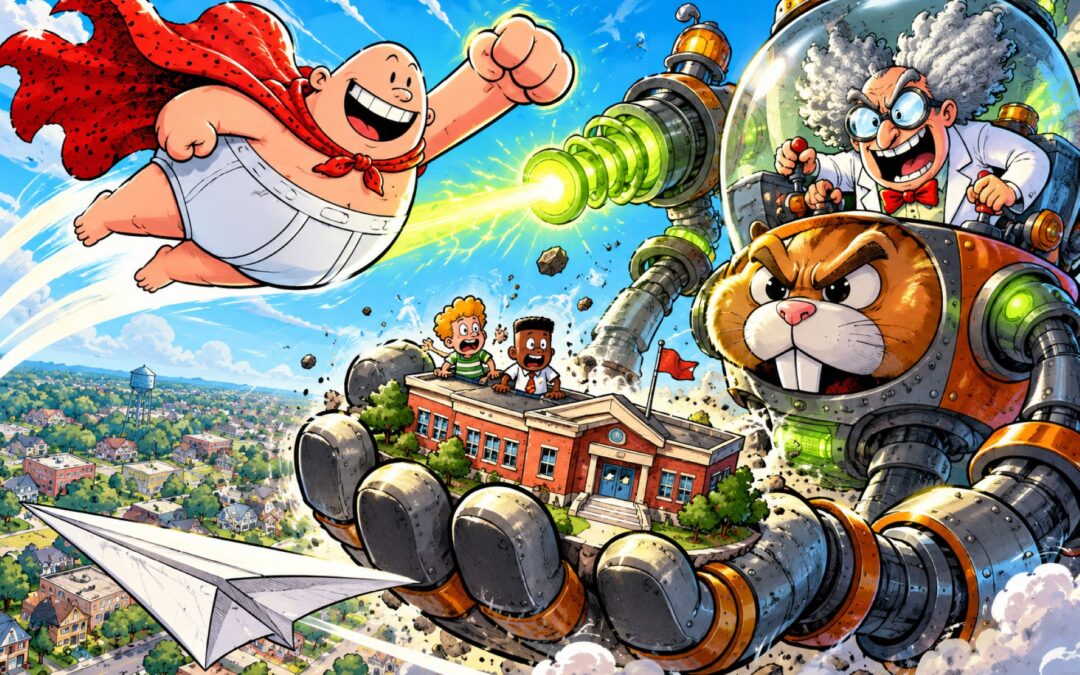
Dav Pilkey’s Captain Underpants and the Perilous Plot of Professor Poopypants is the fourth novel in the Captain Underpants series, following George Beard and Harold Hutchins through another disaster that begins with schoolboy mischief and escalates into an attempted conquest of the world. Scholastic identifies it as the fourth Captain Underpants book. The basic series premise remains important: George and Harold once hypnotized their unpleasant principal, Mr. Krupp, into believing he was their homemade superhero Captain Underpants. By this point in the series, that imaginary hero has acquired real superpowers, and snapping fingers transforms Krupp into Captain Underpants while water turns him back again.
The fourth book nevertheless spends much of its running time without Captain Underpants. Its real engine is Professor Pippy P. Poopypants, a brilliant scientist whose extraordinary inventions are continually ignored because people cannot stop laughing at his name. The story gradually brings his frustration into contact with George and Harold’s school, where jokes, humiliation, retaliation, and child-versus-adult conflict are already part of everyday life. What begins as a ridiculous comedy about names ultimately becomes a story about what happens when someone who has spent years being mocked gains enough power to make everybody else experience the same humiliation.
Spoiler warning: this article covers the complete plot, including Professor Poopypants’s defeat, his new name, and the final transformation of Mr. Krupp.

What Happens in Captain Underpants and the Perilous Plot of Professor Poopypants?
The novel’s plot works as a chain reaction. George and Harold’s misbehavior creates a vacancy at their school, that vacancy attracts Professor Poopypants, the professor’s attempts to win acceptance collapse into another round of ridicule, and George and Harold’s own comic book finally pushes him into becoming almost exactly the villain they imagined. From there the story grows literally larger and smaller, using shrinking machines, giant robots, microscopic heroes, enormous paper airplanes, and a ten-story Captain Underpants to resolve a crisis that the boys helped create.
Because the chapters are short and heavily illustrated, the action can feel breathless, but the major developments connect surprisingly carefully. The book repeatedly turns a joke into a consequence and then turns that consequence into a larger joke, until the entire school—and eventually the entire planet—is threatened by Professor Poopypants’s need to stop being laughed at.
George and Harold Set the Disaster in Motion
The book begins by re-establishing George Beard and Harold Hutchins as clever fourth graders who are considered troublesome by almost every adult at Jerome Horwitz Elementary School. A guidance counselor believes they have attention problems, a psychologist offers another diagnosis, and Principal Krupp simply regards them as bad children. The narrator proposes a more sympathetic explanation: George and Harold suffer from the effects of an incredibly boring school and cope by creating their own entertainment.
That entertainment includes elaborate pranks, homemade comics, and a refusal to treat authority with the seriousness authority believes it deserves. The boys are not presented as malicious in any straightforward sense, but neither are their actions harmless. Their creativity regularly creates chaos, and the story immediately hints that one of their attempts to make school more interesting will eventually contribute to a mad scientist nearly conquering the world.
Before that school plot develops, the story introduces Professor Pippy P. Poopypants in the fictional country of New Swissland. His name sounds absurd to American readers and later to American characters, but in New Swissland names of that kind are completely ordinary. The professor is not initially a villain. He is an exceptional scientist with two potentially world-changing inventions: the Shrinky-Pig 2000, which can reduce enormous objects to tiny sizes, and the Goosy-Grow 4000, which can enlarge small objects tremendously.
He demonstrates the Shrinky-Pig by reducing a huge pile of garbage until it becomes almost insignificant, suggesting a possible solution to the world’s waste problem. He then uses the Goosy-Grow machine on food, imagining that a small amount could be enlarged enough to feed many people. The experiment becomes chaotic when an enlarged hot dog bursts through the laboratory, but the underlying ambition is serious: Poopypants believes his inventions could make him one of the greatest scientists in history while helping humanity.
The chapter also gives an early indication that he is not simply a kind-hearted genius. When his assistant, Porkbelly Funkyskunk, celebrates their breakthrough as a shared achievement, the professor reacts angrily and insists that the genius belongs to him. Recognition matters enormously to Poopypants even before ridicule becomes the central conflict. He wants to improve the world, but he also desperately wants the world to admire the person responsible.
Back at Jerome Horwitz Elementary, George and Harold are waiting for the annual class trip to Piqua Pizza Palace. They rearrange letters on the school sign to create an insulting joke, and Principal Krupp catches them. His punishment is to ban them from the field trip and force them to clean the teachers’ lounge while everyone else eats pizza.
The exchange establishes an important pattern. George and Harold defend the sign joke because they think its rudeness makes it funny. Krupp responds by saying, in effect, that preventing them from enjoying the field trip is funny because it is cruel. The children and the adults are supposedly on opposite sides of discipline, but their humor often runs on the same principle: someone else’s discomfort becomes entertainment.
Left alone at school, George and Harold decide to improve their punishment by converting the teachers’ lounge into a trap. They tamper with the sink sprayer, place powdered paste where the ceiling fan can scatter it, arrange the room so that the fan activates when the lights are switched on, and fill the refrigerator with worm-like Styrofoam packing pieces. The prank is carefully engineered rather than spontaneous, showing the same practical imagination the boys will later use to escape Professor Poopypants.
When the teachers return from the pizza trip, they take obvious pleasure in tormenting George and Harold about everything the boys missed. Mr. Meaner and Principal Krupp join in the mockery before the staff enters the lounge. The trap then activates: water sprays the teachers, paste coats them, and the fan covers their sticky bodies with bits of Styrofoam until they emerge looking like strange white monsters.
The boys flee while the furious teachers chase them through school. For everyone except science teacher Mr. Fyde, the incident is simply another George-and-Harold disaster. Mr. Fyde, however, has already endured enough unexplained events associated with the boys’ previous adventures to believe his sanity is failing.
He remembers bizarre toilets, mysterious noises, strange green substances, and other apparently impossible sights. When he sees what look like abominable snowmen running through the school—and remembers previously seeing a bald man flying around in his underwear—he concludes that reality has become unreliable. Mr. Fyde resigns and enters a facility for people who have lost touch with reality.
His departure turns a prank into the event that drives the rest of the book. Principal Krupp suddenly needs a new science teacher. Without George and Harold’s teachers’-lounge joke, Professor Poopypants would never have entered Jerome Horwitz Elementary in the first place.
Professor Poopypants Arrives and Finally Snaps
Professor Poopypants has meanwhile traveled to America expecting his inventions to earn the respect he craves. Instead, he discovers that people cannot get past his name. Again and again, institutions and potential audiences dismiss him or laugh at him before giving his ideas serious attention.
His financial resources dwindle along with his optimism. Then he sees an advertisement announcing that Jerome Horwitz Elementary needs a science teacher. Children, he reasons, should be kinder and more open-minded than the adults who have mocked him.
The reader already knows that this hope is disastrously misplaced.
Poopypants introduces himself to his new class, and the students almost immediately dissolve into laughter. He tries to make them stop, explains that his name is not inherently funny, and attempts to behave like a conventional teacher. None of it works. The children remain fixated on “Poopypants.”
After enduring the problem for days, he decides that his science can accomplish what discipline cannot. He invents the Gerbil Jogger 2000, a tiny robotic suit that allows a pet gerbil to exercise alongside its owner. The machine is ridiculous enough to belong in the book’s world but ingenious enough to fascinate the students.
For a brief moment, Professor Poopypants succeeds. The children stop thinking about his name and become genuinely interested in science. He has found a way to connect with them, and he begins to believe he can finally earn the kind of admiration he has always wanted.
Then George asks what the professor’s middle name is.
Poopypants proudly reveals it: Pee-Pee.
The class erupts again. His successful lesson collapses into another round of humiliation, and the professor warns that he is reaching the limit of what he can tolerate.
Soon afterward, George and Harold encounter the story of the Pied Piper of Hamelin during reading class. As usual, they turn what they have heard into material for one of their homemade comics. The result is Captain Underpants and the Pied Pooper of Piqua, a crude parody starring a villainous version of Professor Poopypants.
In George and Harold’s comic, Professor Poopypants uses Gerbil Jogger machines and an army of gerbils as part of a scheme that brings him into conflict with Captain Underpants. The superhero and the fictional professor battle through increasingly ridiculous transformations and contraptions until Captain Underpants saves the day. The artwork and spelling are deliberately childlike, making the comic feel like something George and Harold genuinely created rather than a polished insert pretending to be their work.
The comic matters because it does more than make another joke about the professor’s name. It converts him into a villain before he has actually become one. George and Harold take a real adult who is already deeply sensitive about ridicule, exaggerate his inventions, and distribute a story in which he is the ridiculous enemy of their underwear-clad superhero.
They secretly photocopy the comic and sell copies around school. One copy is eventually left where Professor Poopypants can find it.
For the professor, the comic becomes the final insult in a long accumulation of insults. He has been laughed out of professional opportunities, mocked by his students, briefly believed he had earned their respect, and then immediately been humiliated again. Now he discovers that children have transformed his name, inventions, and appearance into a widely circulated joke.
He snaps.
The transition is intentionally exaggerated rather than psychologically subtle. Professor Poopypants decides that if the world insists on making him miserable because of his name, he will make the world miserable in return. George and Harold imagined him as a supervillain for comic effect, and humiliation now helps push the real man toward behaving like one.
The School Shrinks and the Name Plot Begins
Professor Poopypants retrieves his inventions and begins converting them from scientific curiosities into weapons. He uses the Goosy-Grow 4000 to enlarge the Gerbil Jogger 2000 until it becomes an enormous robotic machine roughly ten stories tall. The professor then climbs inside its control area and sets his revenge in motion.
A child watching the giant machine correctly tells his mother what he sees. She dismisses the claim as childish nonsense and sarcastically suggests that perhaps a giant man wearing underwear will soon fight the giant robot. The joke functions as direct foreshadowing because that is almost exactly what will happen.
Professor Poopypants directs the Shrinky-Pig 2000 toward Jerome Horwitz Elementary. From inside the school, George and Harold initially think the robot outside is growing larger. They gradually realize the opposite is happening: the school itself is becoming smaller.
The professor picks up the miniature building in the robot’s enormous hand, trapping the students and staff. News crews gather around him, expecting a conventional mad-scientist demand. When reporters ask what he wants, however, Poopypants asks for something absurdly ordinary: a pencil.
He uses the Goosy-Grow 4000 to enlarge the pencil and then brings it to several large blank billboards. There he creates the Name Change-O-Chart 2000, a system that generates ridiculous new names from people’s existing initials. The joke becomes an authoritarian policy.
Principal Krupp is used as a demonstration and becomes Lumpy Pottybiscuits. George becomes Fluffy Toiletnose, while Harold becomes Cheeseball Wafflefanny. Poopypants orders everyone in the school to adopt their assigned names, threatening to shrink them further if they refuse.
The revenge perfectly reproduces the experience that made him miserable. Professor Poopypants hated being reduced to a funny name, yet instead of abolishing that kind of humiliation, he forces it upon everyone else. He wants people to understand how he feels, but his chosen method ensures that they experience the lesson as coercion rather than empathy.
His plan soon expands beyond the school. Television gives him access to the wider population, and he threatens to use his shrinking technology unless people everywhere accept ridiculous new names. The scientist who once dreamed of solving food shortages and waste problems is now using the same technological genius to force the entire world into an elaborate version of the joke he resents.
Fluffy and Cheeseball Bring Back Captain Underpants
George and Harold realize that their best chance of stopping Professor Poopypants is Captain Underpants. The problem is that the superhero currently exists only as Mr. Krupp, who is hiding under his desk and has already been assigned the name Lumpy Pottybiscuits.
The boys snap their fingers, triggering the hypnotic transformation. Mr. Krupp becomes Captain Underpants and immediately returns to the exaggerated confidence of George and Harold’s superhero creation.
They tell him that Professor Poopypants has decreed that his new name is Buttercup Chickenfanny. Captain Underpants refuses to obey the professor’s command, a small joke that also captures his basic character. Unlike Krupp, whose authority depends on rules and punishment, Captain Underpants recognizes almost no authority outside his own simplistic sense of heroism.
George and Harold need the Goosy-Grow 4000 to restore the school, so Captain Underpants flies toward the machine. Professor Poopypants spots him and fires the Shrinky-Pig 2000. The beam reduces Captain Underpants so dramatically that George and Harold can barely locate him, and the Goosy-Grow device he is carrying becomes microscopic as well.
The apparent rescue has therefore created another problem. The school remains tiny, Captain Underpants is even tinier, and their best tool is almost impossible to use.
George and Harold climb onto the school roof and attempt to operate the miniature growth machine themselves. Professor Poopypants notices them and moves the giant robot’s hand, knocking them into a fall. Harold happens to have a piece of paper, and George tells him to fold it into an airplane.
They fire the Goosy-Grow beam at the paper just in time. The tiny paper airplane expands into a glider large enough to carry their miniature bodies away from the school.
The flight becomes another extended comic set piece. George and Harold remain extremely small relative to the ordinary world, so everyday hazards become enormous threats. Their glider nearly flies into destructive machinery, is pursued by a dog, and eventually lands in sticky asphalt directly in the path of a steamroller.
At several moments something seems to intervene on their behalf. The boys eventually realize that microscopic Captain Underpants has remained with them and has been helping despite being too tiny for them to see clearly. The superhero may be ridiculous, but his heroism is consistent: once activated, he keeps trying to protect George and Harold regardless of scale.
The boys now need to enlarge him enough to fight the enormous Gerbil Jogger. Since he is almost invisible, Harold lets Captain Underpants land on his finger so George can aim the Goosy-Grow beam. The attempt accidentally enlarges Harold’s hand as well, turning the rescue plan into another physical joke.
Repeated blasts eventually grow Captain Underpants until he reaches roughly the same enormous scale as Professor Poopypants’s robot. The child from earlier sees the giant man in underwear confronting the huge mechanical machine and, having already been dismissed once, decides not to bother telling his mother.
The confrontation leads into the book’s signature Flip-E-Rama sequence. Pilkey jokingly frames the chapter as one containing “incredibly graphic violence,” then turns the fight into crude reader-operated animation. By flipping, clicking, or swiping between paired illustrations, readers make Captain Underpants and Professor Poopypants appear to exchange attacks.
Poopypants initially lands powerful blows with the giant robot, while Captain Underpants retaliates through equally absurd physical attacks. The fight is not designed as tactically complex superhero action. Its pleasure comes from scale, movement, reader participation, and the ludicrous contrast between a giant mechanical war machine and an enormous bald superhero wearing only a cape and underwear.
Captain Underpants eventually wins, defeating Professor Poopypants and ending the immediate threat.
Everyone Returns to Normal—and Tippy Tinkletrousers Is Born
Victory does not automatically solve the problem of scale. Professor Poopypants has been defeated, but Jerome Horwitz Elementary and everyone inside it are still tiny, Captain Underpants is gigantic, and Harold has acquired an absurdly oversized hand.
George and Harold use the surviving technology to begin undoing the damage. The book continues exploiting the comic potential of size, including a joke about giving Captain Underpants “a big hand” when Harold’s hand is literally enormous.
The boys return the miniature school to its proper location and coordinate the machines so the building and its occupants can be restored while Captain Underpants is reduced to normal proportions. At one point the narration openly jokes about the reader’s willingness to accept the increasingly impossible chain of events, acknowledging that the story is operating on cartoon logic rather than pretending otherwise.
Chapter 23 then reduces an enormously complicated restoration procedure to a tiny punch line. After pages of elaborate explanations about shrinking, growing, targeting beams, and relative scale, the story essentially tells the reader that everything worked. The abruptness is deliberate; Pilkey makes the convenience of the resolution part of the joke.
With the school restored, George and Harold put clothing back on Captain Underpants and splash him with water. The superhero immediately turns back into Mr. Krupp, who has little understanding of what occurred while his alter ego was active.
Police arrive to arrest Professor Poopypants. Once the world is no longer in danger, George asks a question so obvious that it exposes the absurdity of the professor’s entire campaign: if he hates being mocked because of his name, why does he not simply change his own name instead of forcing everyone else to change theirs?
Poopypants admits that he never thought of it.
Weeks later, George and Harold receive a letter from prison. Professor Poopypants apologizes for attempting to conquer the world and announces that he has taken their advice. He has legally adopted a family name from his mother’s side and confidently expects his troubles with ridicule to be over.
His new name is Tippy Tinkletrousers.
The solution is therefore sincere and ridiculous at the same time. Poopypants has finally accepted that he can change his own circumstances instead of forcing the entire world to change, yet the name he chooses remains exactly the sort of name likely to provoke laughter.
George tells Harold that perhaps the whole experience has taught him an important lesson: making fun of people is wrong. Harold is amazed that one of their adventures appears to have produced an actual moral, and both boys hope this will not become a habit.
The narrator then reminds them that there is another lesson they have repeatedly failed to learn: hypnotizing your principal can have consequences. Someone snaps their fingers.
Mr. Krupp transforms into Captain Underpants again.
Whatever moral closure the story seemed to reach disappears as the series returns to its normal condition: George and Harold are once again responsible for a nearly naked superhero principal who is ready to race into another adventure.
Jerome Horwitz Elementary, New Swissland, and the Book’s Cartoon Logic
The physical world of Professor Poopypants is not elaborately constructed, but it follows a recognizable comic logic. Jerome Horwitz Elementary is less a realistic school than an exaggerated ecosystem in which boredom, petty adult authority, juvenile resistance, punishment, and practical jokes constantly collide. Principal Krupp embodies the school’s hostility most clearly, but other teachers also participate in taunting and humiliating the boys. The institution gives George and Harold rules to rebel against while rarely supplying adults wise enough to deserve unquestioned respect.
New Swissland operates differently. Its most important feature is cultural rather than geographical: names that Americans consider ridiculous are ordinary there. Professor Poopypants therefore grows up without treating his own name as a defect. His problem emerges only when he leaves that environment and encounters people who assign an entirely different meaning to the same sounds.
That contrast gives the name jokes slightly more structure than pure nonsense. “Poopypants” is not inherently humiliating inside the fictional world; it becomes humiliating because a community decides it is funny. The Name Change-O-Chart later reverses the process by giving Professor Poopypants the power to define everyone else through names they did not choose.
The inventions follow their own simplified rules. The Shrinky-Pig makes things smaller, the Goosy-Grow makes them larger, and those effects remain sufficiently consistent for George and Harold to use the machines creatively during the climax. The story never worries about mass, energy, biological consequences, or physical impossibilities because scientific plausibility is not its goal. What matters is that readers understand the rule of each machine clearly enough to anticipate how it can create trouble or solve it.
Captain Underpants operates under similarly firm comic rules. A finger snap turns Mr. Krupp into Captain Underpants, while water changes Captain Underpants back. The transformation is absurd, but because Pilkey preserves the rule from scene to scene, it becomes a reliable storytelling mechanism. Much of the comedy comes from combining internally consistent rules with increasingly impossible situations.
This is why the book can survive enormous shifts in scale without becoming incomprehensible. A school can fit into a robot’s hand, George and Harold can ride an enlarged paper airplane while only inches tall, and Captain Underpants can grow until he towers over a city because the reader always understands which device or transformation produced the change. The world is deliberately implausible, but its important jokes generally have understandable causes.
George, Harold, Professor Poopypants, and Captain Underpants
The characters in Professor Poopypants are deliberately broad rather than psychologically realistic. Pilkey builds them from strong comic traits—mischievous intelligence, wounded vanity, petty authority, fearless heroism—and then places those traits under escalating pressure. Within that cartoon simplicity, however, the central characters occupy meaningfully different positions in the book’s cycle of ridicule and retaliation.
George and Harold create much of the trouble while also possessing the imagination required to repair it. Professor Poopypants is both victim and villain, while Mr. Krupp and Captain Underpants allow one physical character to represent two radically different forms of adult power.
George Beard and Harold Hutchins
George and Harold are inseparable collaborators whose friendship supplies the series with its real stability. They make comics together, invent pranks together, escape danger together, and respond to problems through rapid improvisation. The book does not spend much time distinguishing their inner lives because their partnership functions almost like a shared creative intelligence.
Their misbehavior is genuine. They deliberately alter the school sign, sabotage the teachers’ lounge, produce a mocking comic about Professor Poopypants, copy it without permission, and distribute it to other children. The story likes George and Harold but does not need to pretend they are innocent.
At the same time, the adults around them often provoke rather than moderate conflict. Krupp humiliates them for missing the pizza trip, teachers join the taunting, and school is portrayed as so boring that George and Harold manufacture stimulation because institutional life gives them little of it. Their rebellion therefore feels partly self-created and partly environmentally encouraged.
The quality that makes them troublesome is also what makes them effective in a crisis. When they fall from the miniature school, they do not wait for rescue; Harold folds a paper airplane and George immediately sees how the Goosy-Grow can turn it into transportation. When Captain Underpants becomes microscopic, they redesign their plan instead of giving up. Their creativity has no moral alignment by itself: it can produce a malicious joke, an elaborate prank, or a lifesaving escape.
That ambiguity is central to their appeal. George and Harold do not become obedient children because one prank has serious consequences. They momentarily recognize that mocking somebody can cause harm, but the final pages immediately restore the chaotic series premise. Their development is real enough to support a moral insight, yet limited enough to preserve who they are.
Professor Pippy P. Poopypants / Tippy Tinkletrousers
Professor Poopypants receives the book’s most complete character arc. He begins as an extraordinary inventor with ambitions that are both humanitarian and egotistical. His machines could reduce waste and increase food supplies, but he also dreams of receiving recognition as the genius responsible.
That need for recognition is important because it exists before the American ridicule begins. Even in New Swissland he reacts badly when his assistant treats their work as collaborative. Professor Poopypants does not merely want his ideas to succeed; he wants himself to be acknowledged.
America repeatedly denies him that recognition for the most childish reason possible. Instead of evaluating his inventions, people laugh at his name. The book makes the situation funny for readers while simultaneously allowing the professor’s frustration to become understandable.
His decision to teach at Jerome Horwitz Elementary contains genuine hope. He believes children may be less prejudiced than adults and briefly proves himself capable of reaching them when the Gerbil Jogger turns science into something exciting. His most painful classroom humiliation comes precisely after that success, when revealing “Pee-Pee” as his middle name erases the respect he had just earned.
George and Harold’s comic becomes intolerable because it transforms his deepest grievance into entertainment. His students do not merely laugh at his name; they make his identity and inventions the basis of a fictional supervillain. The real professor responds by becoming the caricature.
His revenge also reveals why sympathy for him has clear limits. Instead of recognizing that humiliation is harmful and refusing to reproduce it, he acquires power and imposes humiliation on everyone else. The Name Change-O-Chart is revenge disguised as fairness: if he must endure a ridiculous name, then everybody will.
The escalation from hurt teacher to would-be world dictator is intentionally sudden. Pilkey is writing comic villainy rather than clinical psychology, so resentment becomes megalomania almost instantly. Even so, the preceding chapters give that transformation enough groundwork that Poopypants feels more motivated than a random mad scientist.
His final change into Tippy Tinkletrousers is therefore both resolution and punch line. He finally accepts the obvious principle that he can alter his own life rather than control everybody else’s. Yet he chooses another name that preserves the series’ obsession with ridiculous language, preventing the ending from becoming too neat or sentimental.
Mr. Krupp / Captain Underpants
Mr. Krupp and Captain Underpants share a body but represent opposite experiences of adult power. Krupp is suspicious, punitive, easily irritated, and invested in institutional control. Captain Underpants is fearless, enthusiastic, uncomplicated, and almost completely indifferent to respectable behavior.
The transformation is funny partly because the superhero qualities are so incompatible with Krupp’s ordinary personality. A man who normally wants George and Harold disciplined becomes, after one snap, the embodiment of their childish fantasy about what an adult hero should be.
Captain Underpants does not possess psychological complexity in this installment. Once activated, he wants to fight evil and protect people, and he continues doing so even after Professor Poopypants shrinks him nearly beyond visibility. His reliability contrasts with the instability of nearly every other adult authority figure in the book.
His refusal to accept the name Buttercup Chickenfanny also distinguishes him from the terrified school population. Poopypants gains power by making everyone fear what will happen if they disobey. Captain Underpants barely understands the social machinery of embarrassment in the first place, which makes him unusually resistant to it.
The joke is that George and Harold can command this symbol of liberation almost as easily as they created him. Captain Underpants rejects Professor Poopypants’s authority while obediently following the boys’ instructions, allowing child imagination to outrank both principal and dictator.
Children, Teachers, and the Cycle of Humiliation
One of the book’s strongest structural patterns is that humiliation rarely ends with the person who experiences it. George and Harold humiliate the school through their sign joke, Krupp humiliates them by excluding them from the pizza trip, teachers taunt them afterward, and the boys answer by humiliating the entire staff in the teachers’ lounge. Each side treats retaliation as deserved because somebody else started the problem.
Professor Poopypants enters a school already organized around that pattern. He arrives hoping children will offer the acceptance adults denied him, only to discover that the students can be even more merciless. His eventual response is the largest retaliation of all: he turns the emotional experience of being assigned a ridiculous identity into an authoritarian system imposed on everyone.
The children are therefore not simply virtuous rebels confronting bad adults. George and Harold are funny partly because they violate rules, but some of their jokes hurt people. The adults are not simply responsible guardians either; Krupp and the teachers frequently enjoy using their institutional power to make children uncomfortable.
Poopypants becomes dangerous when he gains enough technological power to escape the ordinary back-and-forth of school humiliation. George and Harold can embarrass a teacher, and a teacher can assign punishment, but Professor Poopypants can shrink a building or threaten the planet. His grievance does not become less understandable because he becomes powerful; it becomes more dangerous because power allows him to externalize that grievance without restraint.
The Name Change-O-Chart is the clearest example. Poopypants believes he is forcing others to understand what he has experienced, but coerced humiliation does not produce empathy. It produces fear, resentment, and more conflict.
Captain Underpants breaks the pattern partly because humiliation has almost no leverage over him. A man already running through public spaces in his underwear is difficult to control through embarrassment. His absurd lack of self-consciousness becomes an unexpected defense against Professor Poopypants’s central weapon.
The Major Themes: Ridicule, Power, Creativity, and Recognition
Ridicule is the book’s most obvious theme because nearly every important development depends on someone laughing at somebody else. Professor Poopypants is initially harmed by ridicule, George and Harold use ridicule as entertainment, adults use it as punishment, and Poopypants ultimately turns it into a political system. The story’s final stated moral—that making fun of people is wrong—therefore emerges directly from the plot rather than appearing without preparation.
At the same time, the book deliberately complicates that moral by continuing to make ridiculous names funny. Readers are expected to laugh at Pippy Pee-Pee Poopypants, Lumpy Pottybiscuits, Cheeseball Wafflefanny, and Tippy Tinkletrousers even while recognizing that being reduced to a joke can hurt. The story never fully resolves this contradiction because resolving it would require abandoning one of its main comic engines.
The distinction it implicitly makes is between laughter and cruelty. A silly word can be funny without requiring systematic humiliation of the person attached to it, but George, Harold, their classmates, and Professor Poopypants all repeatedly cross that boundary. The moral is therefore less “nothing should ever be laughed at” than “making another person’s humiliation your entertainment can have consequences.”
Power forms the second major theme. Nearly every character behaves differently when able to control somebody else. Principal Krupp uses school authority to punish George and Harold. The teachers use the boys’ exclusion from the field trip as an opportunity for mockery. George and Harold use cleverness to turn their punishment back on the adults.
Professor Poopypants magnifies the same dynamic. Once he controls machines that can shrink buildings and enlarge robots, resentment becomes policy. He does not merely defend himself from ridicule; he demands that the world reorganize itself around his emotional injury.
This is where the book’s emphasis on kid empowerment becomes important. Pilkey has described the broader series in terms that emphasize children’s imagination and their ability to challenge overbearing authority. In an International Literacy Association interview, Pilkey discusses the series’ emphasis on childhood creativity and empowerment. George and Harold survive not because an institution rescues them but because they keep inventing solutions themselves.
Creativity is therefore morally flexible but practically powerful. The same imagination that produces insulting comics produces the paper airplane that saves their lives. The same instinct that leads them to transform ordinary objects into pranks allows them to understand immediately how shrinking and growing devices can be recombined.
Their creativity also changes reality more directly than adult expertise does. Professor Poopypants possesses extraordinary scientific knowledge, yet anger makes him increasingly unimaginative: his solution to ridicule is simply to force everybody else to suffer it. George and Harold lack his formal expertise but remain adaptable under pressure.
Recognition completes the thematic pattern. Professor Poopypants’s problem is not merely that people laugh; it is that laughter prevents him from being seen as the brilliant scientist he believes himself to be. He begins with inventions that could theoretically benefit millions of people but becomes obsessed with the fact that those people are not giving him proper respect.
His tragedy, in comic miniature, is that the desire for recognition eventually replaces the achievement for which he wanted recognition. By the time he takes over the school, the garbage problem and food supply have disappeared from his priorities. The machines once intended to establish his greatness by helping humanity establish his power by threatening it instead.
Names, Size, Comics, and Other Recurring Motifs
Names are more than a collection of toilet jokes in this installment because they repeatedly determine social identity. Professor Poopypants is judged before people consider his achievements. His students hear his name before they understand his abilities, and the same dynamic follows him from professional institutions into the classroom.
New Swissland shows that the judgment is culturally produced. A name that is unremarkable there becomes humiliating in another social environment. The Name Change-O-Chart intensifies this idea by converting arbitrary sounds into officially imposed identities.
Professor Poopypants tries to demonstrate that nobody enjoys being trapped inside a ridiculous label. The problem is that he proves his point by becoming the person assigning labels to everyone else. His experience teaches him the reality of humiliation but not the ethics of refusing to reproduce it.
Changing size is the book’s other major recurring device. Poopypants shrinks the school when he gains control, Captain Underpants becomes microscopic when the rescue attempt fails, and the boys enlarge an ordinary paper airplane into their escape vehicle. Physical scale constantly determines who can act upon whom.
It is reasonable to see this as reinforcing the book’s power dynamics, although the interpretation should not be overstated. Pilkey primarily uses shrinking and growing because scale produces strong visual jokes and action possibilities. Still, the pattern repeatedly turns physical size into temporary power: the person who can manipulate scale can dominate the situation until someone else gains access to the same technology.
Comics themselves form another recurring motif. George and Harold do not simply consume stories; they rewrite the world around them as stories. Professor Poopypants enters their comic as a villain before he becomes one in reality, making their imagination both predictive and provocative.
The embedded comic also creates a second narrative voice inside the novel. Pilkey’s main story may be loose and cartoonish, but George and Harold’s version is even more deliberately crude, full of childish drawing, misspellings, exaggerated violence, and impossible transitions. That difference allows the novel to imitate the creative work of actual children rather than presenting childhood imagination only from an adult distance.
Underwear performs a related reversal. Conventional superheroes usually gain authority through elaborate costumes, secret identities, and impressive symbols. Captain Underpants turns ordinary underwear into his defining uniform, making childish embarrassment the foundation of heroic confidence.
That is particularly appropriate in a story about Professor Poopypants. The villain desperately wants protection from ridicule, while Captain Underpants is almost impossible to ridicule effectively because he possesses no visible shame about looking ridiculous.
How the Book Is Built: Comics, Flip-E-Rama, and Reluctant-Reader Design
Pilkey’s narrative method is inseparable from the book’s success. The prose is simple, chapters are short, drawings appear constantly, and visual jokes often carry information that a conventional novel would deliver through paragraphs of description. The result is a book that can move through twenty-five chapters without feeling remotely like a long reading assignment.
That architecture was deliberate. Pilkey has explained that short chapters, funny pictures, comics, and Flip-E-Rama were designed partly to help children who struggle with conventional reading experience the satisfaction of finishing a novel. The apparent simplicity therefore should not automatically be treated as a literary defect. The form is engineered around momentum, accessibility, and the association of reading with play.
The narrator contributes heavily to that momentum. Instead of maintaining invisible distance, the narration speaks to readers, anticipates objections, interrupts the story for jokes, and occasionally comments on storytelling itself. The voice treats children as collaborators in the joke rather than passive recipients of instruction.
Chapter titles participate in the same game. The novel can call something “The Twenty-Second Chapter” or turn a disproportionately tiny resolution into “To Make a Long Story Short.” The structure constantly reminds readers that a book is an object whose conventions can be played with.
George and Harold’s embedded comic pushes this further by placing amateur-looking storytelling inside professional storytelling. Its rough drawings and spelling errors are essential to the illusion. If the inserted story looked polished, it would cease to feel like something the two boys created during school.
The Pied Pooper comic also changes the pace at an important point. Instead of simply telling readers that George and Harold insulted Professor Poopypants, Pilkey lets them experience the insult directly by reading the kind of comic that enrages him. The form therefore supplies character motivation, not just decoration.
Flip-E-Rama takes participation even further. During the climactic battle, the reader is asked to move between illustrations rapidly enough to simulate animation. In print editions this involves physically flipping pages back and forth; the digital version adapts the mechanic for screen navigation.
The technique is deliberately primitive. Pilkey does not attempt smooth cinematic animation because the joke depends on how little technology is necessary to create movement. Two drawings and a reader’s hand are enough.
That physical participation changes the climactic relationship between reader and text. Instead of reading a long description of Captain Underpants fighting the giant Gerbil Jogger, the reader helps operate the fight. The action becomes closer to a toy, flipbook, comic, and novel simultaneously.
The book also uses metafiction without demanding that young readers know the term. When Harold invokes the reader’s willingness to suspend disbelief, the story openly admits how impossible its own machinery has become. Chapter 23 goes further by solving an elaborate logistical problem through extreme compression, making narrative convenience itself the punch line.
These devices explain why the novel’s simplicity should be judged carefully. The prose is not complex, characterization is broad, and the plotting relies on absurd coincidence, but those features support a reading experience designed around speed and comic confidence. Pilkey wants readers to feel that books are flexible objects they can manipulate, laugh at, imitate, and eventually make for themselves.
The Ending Explained: Why Professor Poopypants Becomes Tippy Tinkletrousers
The literal ending resolves the practical crisis first. Professor Poopypants loses his giant robot battle, the school returns to ordinary size, Captain Underpants is reduced from giant scale, Harold’s hand is corrected, and water changes the superhero back into Mr. Krupp. Police then remove the defeated professor.
The more important resolution comes from George’s question. Professor Poopypants spent the entire book attempting to change how everyone else lives because he could not tolerate their reaction to his name. George points out that changing his own name would have been infinitely easier.
That answer is intentionally simplistic, but it exposes the irrational scale of the professor’s revenge. He possessed enough intelligence to invent technology capable of transforming matter, yet anger prevented him from considering the most ordinary solution available.
His later prison letter shows that the suggestion affects him. He apologizes for the attempted takeover and announces that he has changed his name to Tippy Tinkletrousers, believing the source of his humiliation has finally disappeared.
The new name is the perfect Captain Underpants resolution because it solves the problem without ending the joke. Poopypants has changed his behavior in one meaningful respect: he modifies his own circumstances instead of coercing the world. At the same time, readers immediately recognize that “Tippy Tinkletrousers” is unlikely to protect him from laughter.
The story then allows George to formulate its explicit moral. After seeing where ridicule can lead, he concludes that making fun of people is wrong. Harold is surprised that one of their adventures has produced such a respectable lesson.
Yet Pilkey refuses to let the book settle into conventional moral instruction. George and Harold themselves have spent the entire series violating rules, making jokes, and creating Captain Underpants through an irresponsible act of hypnosis. Their declaration that they have learned one lesson immediately invites the narrator to remind them about another.
The final finger snap transforms Mr. Krupp back into Captain Underpants and restores the fundamental engine of the series. The ending therefore accomplishes two things at once: it gives Professor Poopypants’s individual story enough closure to feel complete while reopening the larger chaos that makes future adventures possible.
This final reversal also captures the book’s attitude toward moralizing. It can acknowledge that cruelty has consequences without demanding that George and Harold become solemn, obedient children. The lesson matters, but it does not cancel play.
Critical Review: How Well Does the Fourth Captain Underpants Book Work?
Captain Underpants and the Perilous Plot of Professor Poopypants succeeds best when judged as an illustrated comic novel designed to make reading feel fast, mischievous, and participatory. Its central plot is absurd, but it has clearer causal structure than the title might suggest. George and Harold’s prank contributes to Mr. Fyde’s departure, that vacancy brings Poopypants to the school, the children’s ridicule worsens his frustration, their comic triggers his breakdown, and the inventions introduced early return as weapons and rescue tools.
Professor Poopypants is also a stronger villain than a simple synopsis might imply. His ridiculous name invites immediate laughter, but Pilkey gives him a recognizable grievance before exaggerating him into a dictator. Readers can understand why he is hurt without accepting what he does in response.
That distinction gives the comedy a small but effective ethical tension. The book participates enthusiastically in the same name humor that wounds its villain, yet it also shows what can happen when people refuse to see anything beyond the joke. Its final moral does not completely solve that contradiction, but the contradiction itself gives the story more substance than a sequence of random toilet jokes would possess.
George and Harold remain effective protagonists because Pilkey never requires them to become conventionally admirable. They are responsible for several stages of the disaster, but they are also brave, loyal, resourceful, and exceptionally creative. Their flaws generate plot rather than merely existing beside it.
The action benefits from that creativity. Shrinking the school, enlarging a paper airplane, growing Captain Underpants to giant size, and turning the climactic battle into Flip-E-Rama all arise from the same basic storytelling principle: introduce a ridiculous object clearly enough that it can later be recombined into an even more ridiculous solution.
The illustrations are therefore not optional supplements. They carry timing, scale, facial reactions, physical comedy, and entire portions of the action. Removing them would not simply make the book less attractive; it would damage the narrative mechanism.
The most significant limitation is that the plot takes time to converge. The early school-prank story and Professor Poopypants’s scientific backstory initially operate as separate threads, while Captain Underpants himself does not become central until well into the novel. Readers who expect constant superhero action may find the setup diffuse.
Contemporary professional reception reflected some of those differences in emphasis. Library records preserving reviews from outlets including School Library Journal, Booklist, Horn Book, and Kirkus show both enthusiasm for the book’s comic accessibility and reservations about its loose plot and strained humor. That disagreement is useful because the same features can reasonably look like strengths or weaknesses depending on what a reader expects.
The supporting adults also remain extremely thin characters. Teachers generally exist to punish, complain, become victims of jokes, or supply the institutional resistance George and Harold need. That flatness suits the boys’ comic perspective, but it means the novel’s school conflicts are intentionally one-dimensional.
Professor Poopypants’s psychological transition is similarly compressed. The story provides enough humiliation to make his anger understandable, yet the leap from frustrated teacher to someone willing to threaten the entire world is enormous. In realistic fiction it would be unconvincing; within a superhero parody it works because emotional escalation follows cartoon proportions.
The humor presents the clearest question of audience. Readers who delight in names such as Lumpy Pottybiscuits and Cheeseball Wafflefanny are likely to find the repetition increasingly funny because Pilkey keeps inventing variations. Readers who do not enjoy bathroom jokes may find that the novel offers far too little distance from them.
Its moral tension may bother some readers for a different reason. A book that tells children not to mock people spends enormous energy making one character’s name funny. Pilkey does not resolve that contradiction philosophically, and the final “Tippy Tinkletrousers” joke demonstrates that he has no intention of abandoning it.
Yet complete consistency would arguably make the book worse. If the story stopped being mischievous long enough to lecture readers about respectful language, it would violate the tone that gives its moral any chance of being heard. Instead, Pilkey lets readers experience the pleasure of the jokes while also showing the emotional cost when a person becomes nothing except the joke.
The book’s strongest artistic achievement is its reading experience. Short chapters, direct narration, cartoons, homemade comics, absurd chapter titles, Flip-E-Rama, and rapid action continually reward forward motion. For children intimidated or bored by traditional chapter books, that architecture can make the object labeled “novel” feel unusually manageable.
That does not mean every limitation can be dismissed as a feature. The plot is sometimes convenient even by cartoon standards, secondary characterization is minimal, and repeated gag structures can become predictable. The story does not require deep rereading to untangle its psychology or ideas.
Its goal, however, is different. It wants a child to keep turning pages, anticipate jokes, imitate drawings, make comics, and discover that reading a book can feel closer to play than schoolwork. On those terms, the simplicity becomes highly functional.
Among the book’s most durable qualities is its refusal to treat children’s humor as something that must be cleaned up before it can belong in a novel. George and Harold create stories the way actual children might create them: too loud, badly spelled, visually chaotic, rude, derivative, imaginative, and intensely pleased with themselves.
That creative permission may be more important to the series’ appeal than any single lesson about bullying or authority. The books tell young readers that their own jokes, doodles, stories, and strange inventions belong inside the world of books rather than outside it.
Captain Underpants and the Perilous Plot of Professor Poopypants is therefore most rewarding for readers who enjoy anarchic school comedy, superheroes, cartoons, gross-out humor, visual storytelling, and plots that treat absurdity as a virtue. It is particularly well suited to children who find conventional chapter books slow or intimidating because almost every element of its design works to maintain momentum.
Readers who dislike toilet humor, deliberately crude artwork, cartoon violence, or highly simplified characterization may find the novel exhausting rather than liberating. Its jokes are not subtle, and the book has no interest in pretending otherwise.
What makes the fourth Captain Underpants novel work is the fact that its ridiculousness has structure. Professor Poopypants begins as someone who wants to improve the world and ends up threatening it because he cannot bear the way the world sees him; George and Harold help create the crisis through the same creativity that later saves everyone; and a book built almost entirely from childish jokes manages to acknowledge that jokes can hurt without losing its desire to make children laugh.
The final snap is therefore an appropriate ending. George and Harold may have learned something about ridicule, but they have not stopped being George and Harold, and Mr. Krupp has certainly not escaped Captain Underpants. The disaster is over, the lesson has been briefly recognized, and the ridiculous world that produced both is ready to begin again.
Last Updated on October 15, 2026 by Aseem Gupta