
Reading Time: 61 Minutes
What if Lord Shiva had once been an ordinary man? What if the god remembered as the Mahadev had begun life as a tribal warrior, with human weaknesses, painful memories, uncertain beliefs, and no special knowledge of his destiny? This is the premise of The Immortals of Meluha, Amish Tripathi’s 2010 debut novel and the first book in the Shiva Trilogy.
Set in an imagined ancient India beginning in 1900 BCE, the novel follows Shiva as he leaves his Himalayan homeland and enters Meluha, a prosperous empire built upon the principles of Lord Ram. There, an unexpected physical transformation convinces the population that Shiva is the Neelkanth, a prophesied saviour destined to destroy evil. His new identity draws him into an unfamiliar civilization, a forbidden romance, political rivalries, terrorist attacks, and eventually a devastating war.
Yet the central difficulty is one that neither extraordinary strength nor military skill can resolve. The Meluhans believe they know who their enemies are, and they expect Shiva to defeat them. As he becomes increasingly involved in their struggles, he must decide whether a society’s conviction of its own righteousness is sufficient justification for violence.
Amish combines mythological reinterpretation, action-adventure, romance, speculative science, and philosophical debate to tell the story of a man learning what it means to become worthy of extraordinary power. The novel’s most important development comes when Shiva begins to understand that accepting the responsibility to destroy evil is considerably easier than identifying evil correctly.
Spoiler Warning: This article covers the entire novel, including its major revelations, military conflicts, and cliffhanger ending.

From Mount Kailash to the Neelkanth Prophecy
The story begins near Lake Mansarovar at the foot of Mount Kailash, where twenty-one-year-old Shiva leads the Guna tribe. His people live in a beautiful but dangerous Himalayan region, constantly threatened by neighbouring tribes competing for territory and access to resources. The most persistent enemies are the Pakratis, whose attacks have turned ordinary survival into a continuous military struggle.
Shiva is already an accomplished warrior and respected leader. He possesses exceptional physical strength, considerable skill with weapons, and an instinctive understanding of military tactics. Nevertheless, he finds the endless fighting increasingly pointless. His people win battles but achieve little lasting security, while every victory is followed by another conflict.
His responsibilities are complicated by the expectations surrounding tribal leadership. Shiva prefers friendship and straightforward dealings to ceremonial displays of authority, but his people regard the chief’s decisions as binding. His closest friend, Bhadra, remains loyal to him while increasingly treating his position with the respect demanded by tradition.
An opportunity for change arrives through Nandi, a representative of Meluha. Nandi offers the Gunas settlement in a wealthy empire beyond the mountains, promising fertile land, security, and a comfortable standard of living. Shiva initially hesitates because accepting the invitation means abandoning his homeland and entering a society whose customs he does not understand.
The decision becomes urgent when the Pakratis attack the Guna settlement. Although Shiva and his warriors repel them with assistance from Nandi’s soldiers, the assault kills members of the tribe, including women and children. Shiva recognizes that remaining near Mansarovar will condemn his people to further violence.
He announces his intention to migrate but refuses to impose the decision without consulting the tribe. The Gunas support him, and the caravan begins its journey toward Meluha.
The migration provides an early test of Shiva’s character. When the Pakratis attack again, Shiva’s forces defeat them and capture their chief, Yakhya. Bhadra prepares to execute the prisoners, but Nandi objects, explaining that killing surrendered enemies violates the Meluhan rules of war.
Shiva initially believes that allowing the Pakratis to survive will only invite further attacks. Nandi argues that the Gunas are leaving the region and can choose to end their conflict differently. Shiva accepts the argument, disarms the defeated warriors, confiscates their provisions, and releases them.
This is an important early distinction between Shiva’s ability to defeat enemies and his capacity to exercise restraint. He possesses the violence necessary to defend his people, but he is also willing to reconsider what justice requires after victory.
After weeks of travel, the Gunas reach Srinagar in Kashmir, a frontier settlement of Meluha. The contrast with their former lives is extraordinary. They encounter paved roads, planned streets, underground drainage, comfortable housing, cotton clothing, public administration, and medical facilities.
The immigrant settlement is so well equipped that Shiva finds its temporary accommodation more luxurious than anything he has previously experienced. The Meluhans appear educated, organized, polite, and remarkably healthy. They have systems for almost everything, including registration, sanitation, food distribution, and the management of travellers.
The immigrants are placed under the care of Ayurvati, an accomplished physician. She explains the importance of hygiene and oversees their quarantine. Her strict instructions initially irritate Shiva, who is unfamiliar with Meluhan medical procedures and dislikes being treated as an ignorant outsider.
On their first night, the Gunas receive a medicinal drink. Soon afterward, most of them develop severe fevers. Shiva also experiences an extraordinary physical reaction, but his body responds differently.
Old injuries begin to heal. His damaged shoulder is restored, scars disappear, and even a frostbitten toe that had troubled him for years becomes healthy. His muscles and joints feel rejuvenated, and his entire body becomes stronger.
At the same time, his throat grows intensely cold.
While Ayurvati and her assistants treat the other immigrants, Shiva struggles to understand what is happening to him. Eventually, Ayurvati notices the unusual colour of his throat. She reacts with astonishment and reverence, recognizing the physical characteristic described in an ancient prophecy.
Shiva’s throat has turned blue.
Nandi, Ayurvati, and the other officials believe that the long-awaited Neelkanth has arrived. They fall at Shiva’s feet and begin addressing him as a divine saviour, leaving him bewildered by their sudden devotion.
The transformation is eventually connected to Somras, an extraordinary medicine developed in Meluha that can rejuvenate the human body and greatly extend life. The Gunas have been given the medicine without fully understanding what they are receiving. In Shiva, however, it produces the distinctive blue throat associated with the prophecy.
The news reaches Devagiri, the imperial capital. Emperor Daksha orders the discovery to be kept secret until Shiva can be brought before him and the prophecy properly explained.
Shiva agrees to travel, although he remains suspicious of the extraordinary importance being attached to him. Before leaving, he ensures that his people will be cared for and entrusts their welfare to Bhadra.
He has brought the Gunas to safety, apparently fulfilling the responsibility that first motivated his departure. Instead of returning to an ordinary life, however, he now finds himself carrying the expectations of an entire civilization.
Sati, the Nagas, and Shiva’s Arrival in Devagiri
As Shiva travels toward Devagiri with Nandi, he gains a clearer understanding of Meluha’s history and political identity. The empire follows the Suryavanshi tradition, which honours the sun and regards Lord Ram as the supreme model of just government.
The Suryavanshis value truth, discipline, duty, and obedience to established laws. Their customs are presented as the foundation of a prosperous society in which individual responsibilities are clearly defined and the government operates through carefully organized institutions.
Shiva admires much of what he sees, although some aspects of Meluhan life puzzle him. Citizens display their caste and professional identities through standardized amulets, social conduct follows rigid conventions, and even ordinary interactions are governed by expectations of rank and propriety.
Nandi also explains Meluha’s hostility toward the Chandravanshis, the followers of the moon. Unlike the disciplined Suryavanshis, the Chandravanshis are described as corrupt, dishonourable, unpredictable, and unwilling to respect moral or military rules.
Shiva hears these descriptions from people he increasingly trusts, but he has not yet encountered the Chandravanshis for himself.
During the journey, Nandi falls into a river while crossing by boat. Shiva immediately jumps into the dangerous water, pulls his companion toward safety, and helps rescue him. Nandi is horrified that the supposed saviour of Meluha has risked his own life for an ordinary soldier.
Shiva does not understand the objection. Nandi is his friend, and saving him is simply the appropriate thing to do. The episode demonstrates how differently the two men understand Shiva’s position: Nandi regards him as an almost sacred figure whose safety outweighs everyone else’s, while Shiva continues to think in terms of personal loyalty.
While Nandi recovers, Shiva visits a nearby temple dedicated to Lord Brahma. There he meets a mysterious elderly pandit who seems unusually perceptive.
The pandit notices that Shiva admires the temple’s architecture more than its religious idol. Shiva explains that he believes divinity is present throughout nature rather than confined to symbolic representations. Instead of criticizing him, the pandit suggests that different forms of worship may lead toward the same underlying truth.
Their conversation introduces an important spiritual relationship that will continue throughout the novel. The pandit appears to understand Shiva’s character and circumstances more deeply than an ordinary stranger should.
Outside the temple, Shiva sees a beautiful young woman arriving in a chariot with her companion, Krittika. He is immediately captivated by her appearance, dignity, and confidence.
Before he can learn much about her, several men disguised as ordinary visitors launch an attack. Shiva draws his sword to defend the woman, only to discover that she is an accomplished fighter who is perfectly capable of protecting herself.
They fight together against the attackers. A formidable masked warrior wearing a strange symbol on his wrist enters the battle, helping the assailants retreat. Shiva notices that the attackers appear unusually interested in controlling or capturing their target rather than killing indiscriminately.
After the confrontation, the woman reveals that her name is Sati and that she lives in Devagiri. Shiva introduces himself, but his attempts at conversation are clumsy. His admiration makes him unusually nervous, and his comments about her fighting ability irritate her rather than impress her.
Nevertheless, their shared defence creates an immediate connection. Shiva becomes determined to meet her again.
When Shiva describes the attack to Nandi, the symbol worn by the masked warrior becomes significant. It resembles an old representation of Aum, associated with an attempted union between the Suryavanshis and Chandravanshis. Its serpentine elements lead Nandi to identify the attacker as a Naga.
The Nagas are described as people born with unusual physical deformities who are regarded as cursed because of supposed sins committed in previous lives. They are feared throughout the Sapt Sindhu and excluded from ordinary society.
Nandi assumes that the Naga must be connected with the Chandravanshis. Shiva, however, remembers that the masked figure appeared to command the attackers rather than merely serve them.
This uncertainty establishes a mystery that will continue through the novel: who are the Nagas, what do they actually want, and why is Sati repeatedly placed in danger?
Shiva eventually reaches Devagiri, the magnificent capital of Meluha. Built upon vast elevated platforms, the city combines defensive architecture with standardized residential districts, drainage systems, public facilities, and carefully planned roads.
The royal quarter is surprisingly modest in appearance. Although Daksha rules an exceptionally wealthy empire, the city’s government buildings and aristocratic residences generally follow the same disciplined architectural principles as the rest of Meluha.
Shiva meets Daksha, Queen Veerini, and the chief officials of the empire. Daksha treats him with remarkable respect and begins explaining the significance of the Neelkanth prophecy.
The emperor reveals that the Meluhans have long benefited from Somras, which extends life and preserves physical vitality. Daksha himself is more than a century old, despite appearing much younger.
Shiva also learns that Lord Ram’s social and political reforms transformed Meluha into a society organized around individual aptitude and responsibility. The empire believes that its achievements are threatened by hostile forces, particularly the Chandravanshis and the terrorists associated with them.
Daksha hopes that the Neelkanth will restore security and protect Meluha’s way of life.
Although Shiva is impressed by the civilization’s achievements, he is reluctant to accept responsibility for a conflict he barely understands. He wants to know why a society possessing such extraordinary resources and institutions needs a foreign tribal leader to save it.
His attention is also increasingly occupied by Sati.
He finds her practising classical dance and discovers that she possesses considerable artistic talent. Shiva himself is an extraordinary dancer, and when her teacher witnesses his abilities, he recognizes a level of mastery that astonishes everyone present.
Shiva offers to help Sati improve, but she responds with unexpected reserve. Her refusal seems connected to something deeper than personal dislike, although Shiva cannot yet understand what troubles her.
Meanwhile, General Parvateshwar openly questions the willingness of the imperial court to worship Shiva because of his blue throat. Parvateshwar regards Lord Ram’s principle of merit as fundamental: a person’s achievements and actions determine their worth.
In his view, Shiva has not yet done anything to justify such extraordinary status.
Parvateshwar’s opposition irritates the other officials, but it also raises a question that will remain central to Shiva’s development. If Meluha believes in the supremacy of actions over birth and outward distinctions, why should a physical transformation automatically establish someone’s moral authority?
Meluha’s Laws, the Somras, and Shiva’s Growing Doubts
Shiva’s growing affection for Sati leads him into his first serious disagreement with Meluhan society.
During their interactions, he discovers that Sati is classified as vikarma. The term applies to people believed to be suffering the consequences of wrongdoing committed in earlier lives. Their present misfortunes are interpreted as punishments that must be accepted with dignity.
Vikarma people face restrictions on social participation, religious activities, and physical contact with others. The specific rules vary according to circumstances, but the general assumption is that misfortune reveals a moral debt carried from a previous existence.
Shiva finds the idea disturbing. His experience has taught him that suffering can be caused by violence, accidents, poor decisions, or circumstances beyond anyone’s control. He cannot understand why a society that prides itself on justice would interpret such suffering as evidence of guilt.
The issue becomes personal when he realizes that Sati is required to obey these restrictions.
He has already touched her in ways that ordinary Meluhans regard as prohibited. When the significance of his actions becomes clear, he refuses to accept the assumption that her touch could make him impure.
Sati reacts differently. Although she is courageous and independent in other matters, she believes the restrictions governing her status are legitimate. She therefore attempts to distance herself from Shiva, partly to protect him from the consequences of violating the law.
Shiva’s confusion deepens as he learns more about the social order that supposedly makes Meluha fair.
The empire recognizes four principal castes: Brahmins, Kshatriyas, Vaishyas, and Shudras. These correspond broadly to intellectual and religious professions, warfare and government, commerce and craftsmanship, and agricultural or manual work.
Rather than allowing caste to be inherited directly, the Meluhans claim to determine an individual’s social role through merit.
Their solution is the Maika system, established under Lord Ram.
Children are taken into a centralized system of upbringing, where they receive education and training before their aptitudes are assessed. Their later caste and occupational assignments are intended to reflect their abilities rather than the social status of their biological parents.
The system is presented as an answer to inherited inequality. A child born to a worker should theoretically have the same opportunity to become a scholar or ruler as a child born to an aristocrat.
Shiva recognizes the logic of this reform. He also realizes how much power the state possesses over families, education, professional identity, and the determination of individual futures.
His admiration is further complicated by exceptions granted to powerful families. The nobility has been allowed to retain biological children, weakening the very principle of equal treatment that the system supposedly protects.
Parvateshwar’s family, however, continues to honour the original restriction. His adherence to ancestral principles reflects the seriousness with which he treats institutional duty.
The emperor’s explanations also introduce the significance of Somras to Meluha’s prosperity.
According to the fictional history, Lord Brahma developed the medicine thousands of years earlier. Because its benefits were extraordinary, access was initially restricted, and a system of intellectual and social guardianship emerged around its use.
Lord Ram later expanded its availability, helping transform Meluha into a civilization whose citizens could remain healthy and productive for exceptionally long periods.
Daksha believes that Somras is essential to the empire’s achievements. He credits the medicine with sustaining its population, intellectual development, public institutions, and exceptional standard of living.
However, the production of Somras depends upon the waters of the Saraswati River.
The Saraswati is declining, and the Meluhans believe that Chandravanshi activities are responsible for damaging its flow. Daksha regards this as an attack on the foundations of their civilization.
His arguments increasingly move beyond defending Meluha’s borders. He believes the Chandravanshis must be defeated so that their society can be reformed according to Suryavanshi principles.
Shiva resists the idea of initiating a major war without fully investigating the allegations. He has witnessed enough meaningless violence in his Himalayan homeland to understand the human cost of fighting.
He asks whether diplomatic solutions have been exhausted and whether the evidence against the Chandravanshis has been properly examined.
The imperial court is uncomfortable with his hesitation. Many Meluhans believe that their honesty and honour make their interpretation of events beyond reasonable doubt.
Shiva nevertheless persuades Daksha to give him more time to understand the country and its problems.
One of his most important discoveries comes during a visit to Mount Mandar, the centre of Somras production.
There he meets Brahaspati, the scientist responsible for supervising the facility. Unlike many Meluhans, Brahaspati does not approach Shiva with unquestioning reverence. He is curious, thoughtful, and willing to challenge accepted beliefs.
The two quickly develop a close friendship.
Brahaspati explains how Somras works within the novel’s fictional scientific framework. The human body requires oxygen to release energy from food, but this process also produces oxidants, which are described as contributing to ageing and physical deterioration.
Somras supposedly counteracts these harmful effects, allowing people to remain healthy and youthful for exceptionally long periods.
Its manufacture requires large quantities of specially treated water from the Saraswati. Mount Mandar contains an elaborate industrial complex, including canals, machinery, and enormous churning equipment used in the production process.
Shiva is fascinated by the combination of technical knowledge and religious tradition. The name Somras suggests a divine drink, yet its manufacture is presented as a scientific achievement.
The explanation also raises questions about Shiva’s own transformation.
Brahaspati considers whether Shiva’s Himalayan origins might explain why his body reacted differently to Somras. Life at high altitude may have influenced his physical condition, although this hypothesis does not explain why the other Gunas failed to develop blue throats.
The scientist admits that the phenomenon is not fully understood.
Shiva appreciates this intellectual honesty. He is particularly drawn to Brahaspati’s willingness to question whether the Neelkanth prophecy has been interpreted correctly.
The prophecy identifies a saviour who will destroy evil, but this does not necessarily mean that the saviour must support the Suryavanshis against the Chandravanshis.
Daksha has made that connection because he already believes the Chandravanshis are responsible for Meluha’s suffering.
Brahaspati encourages Shiva to distinguish the prophecy itself from the political expectations attached to it. He also warns that Shiva’s personal decisions will have consequences far beyond those of an ordinary man.
The problem becomes especially important when Shiva tries to pursue Sati.
Daksha recognizes that Shiva’s love for his daughter could encourage him to remain loyal to Meluha and accept its military objectives. He therefore sees the relationship as potentially useful to the empire.
Shiva, however, is motivated by his affection for Sati rather than by the emperor’s political ambitions. He wants to understand why she rejects his advances and how he might persuade her to accept him.
Their relationship continues to develop, but her vikarma status remains a painful barrier.
At this stage, Shiva is beginning to recognize two different kinds of danger. The first comes from external enemies who may threaten Meluha through violence. The second arises from the laws, beliefs, and political ambitions of the very society that expects him to protect it.
The Attacks on Sati and the Cost of Being Vikarma
The mystery surrounding the Nagas becomes more urgent when the royal party travels away from Mount Mandar.
A group of attackers launches an ambush against the caravan. The assault involves deception and carefully planned movements intended to separate the defenders and create an opportunity to reach the royal passengers.
Shiva, Sati, Nandi, and the soldiers respond quickly. The encounter develops into a dangerous battle, and the hooded Naga again demonstrates exceptional martial skill.
The attackers eventually withdraw, but their behaviour leaves Shiva uncertain about their motives.
They do not simply appear interested in killing Meluhans at random. Their actions suggest a more specific objective involving Sati and the royal family.
Shiva later discusses the incident with Brahaspati, who recognizes that the circumstances do not fit comfortably into the simple explanation that Chandravanshi terrorists are trying to destroy Meluha.
Nevertheless, the attack strengthens the public belief that the Neelkanth has arrived at a moment of national crisis.
Daksha soon announces Shiva’s identity to the empire.
The people respond with extraordinary enthusiasm. Shiva’s blue throat becomes visible proof, in their eyes, that their long period of insecurity is coming to an end.
Shiva is uncomfortable with the worship directed toward him. He understands that he cannot guarantee victory or solve every problem simply because people believe he has been chosen.
Yet he also feels an obligation to help a society that has welcomed and protected his tribe.
His old friend Bhadra rejoins him, now known as Veerbhadra after performing an act of exceptional courage during the journey to Meluha. Their reunion restores an important connection with Shiva’s earlier identity.
Veerbhadra knows Shiva as a childhood friend rather than a divine figure. His presence provides the chief with someone who can question his decisions without being overwhelmed by religious devotion.
Shiva begins a tour of Meluha accompanied by Sati, Brahaspati, Parvateshwar, Ayurvati, Nandi, Veerbhadra, Krittika, and a military escort.
The journey allows him to see how ordinary people live under the Suryavanshi system. It also gives him opportunities to spend time with Sati, although their relationship remains complicated.
Along the way, discussions about Manu and the ancient laws of the Sapt Sindhu further explain the relationship between religious tradition and political authority.
The narrative also follows the mysterious hooded Naga outside Shiva’s immediate experience.
During one episode, the Naga encounters women endangered by a crocodile. Despite the danger, he enters the water and fights the animal, risking his own life to save a stranger.
His actions reveal courage and compassion.
This scene is especially significant because the reader sees conduct that contradicts the Meluhan characterization of Nagas as naturally evil. Shiva does not yet know what the reader has witnessed, creating a gap between the hero’s understanding and the evidence available within the narrative.
The contrast becomes sharper when Shiva visits Kotdwaar.
During a public gathering, a blind man approaches him seeking a blessing. The man is classified as vikarma, and the rules surrounding his condition make physical contact with him socially and religiously problematic.
Shiva refuses to treat him as impure. He responds with compassion and rejects the suggestion that touching him requires purification.
The blind man is deeply grateful, but he also insists upon his devotion to Meluha and his belief that the country’s laws are just.
Shiva is disturbed by this reaction. He recognizes that the man has accepted a judgment that turns his suffering into evidence of wrongdoing.
Sati witnesses the episode and sympathizes with the blind man. Nevertheless, she believes the law must be obeyed. Shiva’s refusal to undergo the prescribed purification creates further tension between them.
Brahaspati eventually explains the circumstances that led to Sati’s classification.
Sati was previously married to Chandandhwaj, a nobleman chosen through a political arrangement. Their marriage ended tragically when she gave birth to a stillborn child and her husband drowned on the same day.
Under Meluhan law, the stillbirth caused her to be classified as vikarma.
The tragedy therefore became a lifelong social punishment. Sati lost her husband and child, but she also became subject to religious and social restrictions because the society interpreted her misfortune as the consequence of earlier sins.
Shiva is appalled. He cannot understand how the death of a child could become evidence against its mother.
Brahaspati explains that Sati’s position is especially difficult because she has internalized the judgment. She believes her suffering must be accepted rather than challenged.
The history of noble exemptions makes the injustice more striking.
The nobility has already succeeded in modifying the Maika rules to preserve its own privileges, yet the vikarma system remains in place because those affected generally lack the political influence required to change it.
Brahaspati also asks Shiva to examine his motives. Does he oppose the law because it is unjust, or because it prevents him from marrying the woman he loves?
Shiva insists that his objections began before he understood Sati’s circumstances. Brahaspati’s challenge nevertheless forces him to consider the responsibility that accompanies his new authority.
Changing a law for personal convenience would be different from correcting an injustice that affects everyone.
Meanwhile, Veerbhadra and Krittika develop feelings for each other, offering a gentler parallel to Shiva and Sati’s troubled relationship.
Their connection demonstrates how relationships can develop within the very social conventions that Shiva finds restrictive. The contrast also emphasizes how unusual Sati’s position has become.
As the royal entourage travels toward the major commercial centres of Meluha, Shiva becomes increasingly determined to challenge the vikarma system. His love for Sati remains personal, but the injustice he has witnessed is no longer confined to her circumstances.
The Fire Trial, the Battle of Koonj, and Shiva’s Marriage
During the journey, Shiva visits a temple in Mohan Jo Daro and encounters another mysterious pandit who closely resembles the religious figure he met earlier.
The pandit discusses the relationship between individual ambition and social stability. He suggests that prosperous societies must find ways to prevent dissatisfaction from developing into destructive conflict.
Within this reasoning, the vikarma system serves a political function. People who experience misfortune are encouraged to understand it as the result of their own previous actions rather than blame society or its institutions.
Shiva recognizes the danger in this arrangement. It may discourage resentment, but it also makes people accept punishments they have done nothing to deserve.
The pandit does not simply dismiss Shiva’s objection. He acknowledges that the system may have become unjust and that preserving social stability cannot automatically justify every restriction.
Their discussion leaves Shiva with no easy solution, although his determination to help Sati remains unchanged.
The royal party eventually reaches Karachapa, an important commercial city whose atmosphere is more cosmopolitan than that of the imperial capital.
Its governor, Jhooleshwar, is accustomed to dealing with merchants and visitors from different cultural backgrounds. Consequently, some of the city’s customs are more flexible than those observed in Devagiri.
Nevertheless, conservative elements of Meluhan society remain influential.
At a public religious ceremony, a man named Tarak objects to Sati’s presence because of her vikarma classification. Although she is not participating in the ceremony in the prohibited manner, Tarak uses the occasion to challenge her dignity.
The confrontation escalates when Sati refuses to accept humiliation.
She invokes the right to an agnipariksha, a formal duel fought within a ring of fire. The contest allows no retreat and continues until one participant surrenders or dies.
Tarak is physically imposing and experienced in combat. The prospect of Sati fighting him terrifies many spectators, including those who recognize her skill.
Parvateshwar offers to fight on her behalf, but Sati refuses.
She insists upon defending her own honour.
Shiva supports her decision even though he understands the danger. His trust in Sati’s strength becomes part of his affection for her.
The duel is difficult and violent. Tarak possesses considerable physical advantages, while Sati must rely upon agility, precision, endurance, and intelligent tactics.
She gradually exploits her opponent’s weaknesses and eventually gains the advantage.
When Tarak is defeated, Sati has the opportunity to kill him. After years of accumulated suffering under the vikarma designation, she has every reason to feel anger toward someone who has publicly humiliated her.
Instead, she spares his life.
Her decision demonstrates that she can defend her dignity without allowing resentment to determine her final action. It also reveals that mercy, which Shiva practised when he released the Pakratis, is a quality she possesses independently of him.
The duel strengthens their relationship, but the barriers between them do not immediately disappear.
Shiva continues to demonstrate his affection while trying to respect Sati’s convictions. During their conversations and travels, they become increasingly aware that their feelings are mutual.
Their relationship is also presented through the imagery of the sun and the earth, suggesting the importance of complementary forces and the possibility of two distinct individuals finding balance.
The growing romance is interrupted by news of a terrorist attack on the village of Koonj.
The attackers include Chandravanshi soldiers and Nagas. They have targeted a temple and its Brahmin inhabitants, killing religious personnel and destroying sacred property.
Shiva is furious when he learns what has happened.
He leads the Meluhan soldiers toward the village, determined to confront the attackers rather than allow them to escape. Parvateshwar, Sati, Nandi, Veerbhadra, and the other warriors join him.
The battle is fierce. Shiva’s military skill and physical strength allow him to confront the attackers directly, while the Meluhan soldiers demonstrate their disciplined training.
During the fighting, Shiva is targeted by a Naga armed with an agnibaan, a poisoned fire arrow capable of causing an agonizing death.
Sati sees the danger before Shiva does.
She leaps into the path of the arrow, taking the blow intended for his neck.
The weapon strikes her chest, inflicting a catastrophic injury. The poison begins spreading through her body, and her survival appears almost impossible.
Shiva responds with uncontrollable rage. He attacks the Naga responsible and kills him, continuing to mutilate the body until Sati’s weak voice brings him back to his senses.
The episode reveals the frightening intensity of Shiva’s emotions. His violence is motivated by love and fear, but the loss of control contrasts with the moral restraint he demonstrated earlier.
He rushes to Sati and demands medical assistance.
Ayurvati recognizes the seriousness of the wound. The poison is resistant to known treatment, and ordinary medicines can only delay its effects.
Sati understands that she may be dying. Her resistance to expressing her love finally gives way, and she openly acknowledges her feelings for Shiva.
For Shiva, however, accepting her death is impossible.
He searches desperately for another treatment and remembers the extraordinary physical healing he experienced after receiving Somras.
Ayurvati initially objects because Somras is not normally used to repair traumatic injuries or neutralize poison. Its recognized function is to delay ageing by counteracting the harmful effects of oxidation.
Shiva argues that its effects on his own body suggest possibilities that the physicians have not fully explored.
With no better option available, the medicine is administered.
Sati’s condition improves, and she eventually recovers. The experience strengthens their bond and confirms their desire to marry.
When Daksha learns that Shiva wishes to marry his daughter, he is delighted. He sees an opportunity to restore Sati’s happiness while bringing Shiva permanently into the royal family.
Yet the vikarma law remains an obstacle.
Daksha proposes changing the rules so that noblewomen who give birth to stillborn children will no longer be classified as vikarma.
Shiva rejects the proposal.
He does not want an exception for Sati or for aristocratic families. He demands the abolition of the entire vikarma system, arguing that misfortune can affect anyone and cannot reasonably be treated as proof of wrongdoing in a previous life.
Daksha reluctantly agrees.
The law is abolished, freeing Sati and others from the restrictions that have governed their lives.
The decision is one of Shiva’s most important accomplishments in the novel. His personal desire to marry Sati leads him toward a reform that benefits people who possess none of her privileges.
Shiva and Sati return to Devagiri, where their wedding becomes a major public celebration.
The imperial capital is transformed with decorations and elaborate ceremonies. Their union is celebrated as a moment of happiness for the royal family and a hopeful event for Meluha.
Veerbhadra and Krittika’s relationship also moves toward marriage, reinforcing the atmosphere of affection and renewal.
Shiva is happy with Sati but remains uneasy about some aspects of Daksha’s behaviour. The emperor’s satisfaction with his own achievements sometimes appears inseparable from his desire to surpass the legacy of his father.
Meanwhile, Brahaspati prepares to return to Mount Mandar to continue his work on improving Somras production.
He hopes to reduce the enormous quantities of Saraswati water required for manufacturing the medicine, potentially addressing one of Meluha’s most serious long-term vulnerabilities.
Before leaving, Brahaspati shares an affectionate farewell with Shiva. Their friendship has developed beyond intellectual companionship into a bond resembling brotherhood.
Neither man expects their separation to become the source of Shiva’s next great crisis.
Mandar’s Destruction and the March Against Swadweep
Shiva’s happiness is interrupted by a strange dream involving one of the mysterious pandits.
During their conversation, the pandit challenges Shiva’s assumptions about reality and perception. Using the example of a leaf’s colour, he explains that what appears obvious from one perspective may be understood differently from another.
The discussion also concerns Shiva’s identity as the Mahadev.
The pandit suggests that greatness depends upon believing in one’s responsibility and acting accordingly. Shiva cannot wait until his achievements have been completed before accepting the duty that may make those achievements possible.
Their conversation ends when loud explosions interrupt the dream.
Shiva awakens to discover that Devagiri is in a state of alarm.
The initial fear is that the capital is under attack. Shiva, Sati, Nandi, Veerbhadra, and Parvateshwar immediately organize protection for the royal family and attempt to determine the source of the danger.
The explosions are eventually connected to Mount Mandar.
A military expedition travels toward the production centre, where the full scale of the catastrophe becomes clear.
Mandar has been devastated.
The sophisticated industrial complex that produces Somras lies in ruins. Its machinery, buildings, and scientific facilities have been destroyed in an attack involving exceptionally powerful weapons.
Shiva searches desperately for Brahaspati.
His friend cannot be found among the survivors, and the available evidence suggests that he has been killed.
The destruction is especially devastating because Shiva had only recently promised to visit Brahaspati again.
He discovers evidence associated with the Nagas and becomes convinced that the masked enemies responsible for earlier attacks have murdered his friend.
Shiva’s grief rapidly turns into a desire for revenge.
He blames himself for failing to protect someone he loved. The death appears to confirm an old fear that he repeatedly fails those who depend upon him.
His emotional suffering is intensified by memories of the woman he abandoned in childhood, whose desperate pleas for help continue to haunt him.
Sati and Veerbhadra attempt to comfort him, but he initially withdraws from those around him.
The crisis eventually leads to a debate about war.
Daksha and much of the Meluhan leadership believe the destruction of Mandar justifies a decisive campaign against the Chandravanshis.
The attack has threatened the principal technology sustaining their civilization. If the Somras production system cannot be restored, Meluha may lose the benefits that have supported its health, prosperity, and political stability.
Kanakhala argues for a more cautious response. She recognizes that a major war would carry enormous costs and that retaliation should not proceed without careful consideration of the evidence and available alternatives.
Shiva, however, is no longer approaching the conflict as a detached outsider.
His grief over Brahaspati has made the enemy personal.
He agrees to help lead the military campaign against Swadweep, the Chandravanshi empire.
The task is formidable. Although the Meluhans possess well-trained soldiers, standardized equipment, and exceptional discipline, the Chandravanshis can field a much larger army.
Shiva and Parvateshwar therefore develop tactics intended to neutralize the enemy’s numerical advantage.
Their preparations include specialized archery formations capable of delivering sustained volleys over substantial distances. The archers use modified equipment that allows them to generate unusual power from their bows.
They also prepare defensive formations designed to withstand direct charges and create opportunities for concentrated counterattacks.
Shiva contributes ideas drawn from practical battlefield experience, while Parvateshwar and the Meluhan officers translate them into organized military systems.
The relationship between the two men changes considerably during this period.
Parvateshwar, who once dismissed Shiva as an undeserving foreigner, now recognizes his military intelligence and willingness to accept responsibility. His respect develops through experience rather than merely through the prophecy.
The army’s preparations also create an opportunity for former vikarma soldiers to demonstrate their abilities.
Among them is Drapaku, a capable warrior whose earlier social classification had prevented him from serving as an ordinary Meluhan soldier.
Following Shiva’s abolition of the vikarma law, Drapaku and others like him can participate openly in the military.
Their presence becomes important when the army faces a dangerous strategic problem during the march toward Swadweep.
The Chandravanshis attempt to exploit their numerical superiority by threatening the Meluhan forces from more than one direction.
Shiva and Parvateshwar discover a narrow mountain pass that can be defended against a much larger army. Nevertheless, the position requires troops who are willing to withstand considerable danger.
Drapaku volunteers to hold the pass with a relatively small contingent.
His understanding of the terrain and his determination to prove the worth of the former vikarma soldiers make him a crucial part of the strategy.
The stand succeeds in protecting the main army from encirclement, although it requires extraordinary courage and sacrifice.
For Parvateshwar, this becomes further evidence of Shiva’s leadership. The man he once dismissed as a barbarian has not only transformed Meluhan law but has also helped reveal the abilities of citizens previously excluded from full participation in society.
Meanwhile, Shiva learns that Sati is pregnant.
The news gives him another reason to hope for a peaceful future, even as he prepares to lead an army into one of the largest battles in the region’s history.
His personal life and public responsibilities have become inseparable. He wants to protect his family, avenge Brahaspati, defend Meluha, and fulfil the expectations of the Neelkanth.
The difficulty is that he increasingly assumes these different goals all require the same action: defeating the Chandravanshis.
Victory, the Two Prophecies, and the Cliffhanger
The decisive confrontation between the Suryavanshis and Chandravanshis takes place after extensive military preparation.
The Chandravanshi army relies heavily on its enormous numerical advantage. Its commanders expect to overwhelm the smaller Meluhan force through direct pressure and repeated assaults.
Shiva and Parvateshwar intend to disrupt this strategy before the enemy can bring its full strength to bear.
The Meluhan army is arranged in a flexible formation resembling a bow. Specialized tortoise units occupy the centre, while infantry and cavalry protect the flanks.
Powerful archery units are concealed toward the rear.
Before the battle begins, Shiva addresses his soldiers.
He explains that the title Mahadev cannot simply be inherited or bestowed because of a prophecy. A person becomes worthy of it through action, courage, and commitment to fighting evil.
His speech transforms a religious expectation into a demand for personal responsibility.
The soldiers respond with the cry of Har Har Mahadev, expressing the belief that the potential for greatness exists within every individual who acts in defence of righteousness.
The battle begins with the Chandravanshis advancing toward the Meluhan lines.
The Suryavanshi archers unleash devastating volleys, disrupting the tightly packed enemy formations and causing confusion among soldiers who had expected a conventional engagement.
As the first Chandravanshi units retreat, they interfere with the troops advancing behind them.
The Meluhans adjust the range of their arrows and continue the assault, exploiting the enemy’s increasingly disorganized formation.
The Chandravanshis attempt to respond through cavalry movements and concentrated attacks against vulnerable sections of the Meluhan army.
Shiva and Parvateshwar coordinate their forces to counter these manoeuvres.
The tortoise formations play a central role. Their protective shields help absorb attacks, while specially developed weapons allow the soldiers to strike back against opponents attempting to break through.
When the Chandravanshis identify a weakness in the defensive arrangement, Shiva leads a direct attack against the advancing enemy troops.
His intervention prevents the Meluhan centre from collapsing.
The Chandravanshi army eventually loses its cohesion.
Despite its numerical superiority, it cannot overcome the coordinated archery, defensive formations, and counterattacks of the Suryavanshis.
The victory is comprehensive.
For the Meluhan soldiers, the battle appears to confirm everything they believe about Shiva. He has led them to a triumph greater than any achieved by their recent rulers.
Parvateshwar now openly acknowledges Shiva as his Lord, demonstrating how completely his opinion has changed.
Yet Shiva’s response to victory is unexpectedly troubled.
During the battle, he has noticed something that does not fit the explanation of the conflict offered by the Meluhan authorities.
The Nagas are absent.
If the Chandravanshis have been working closely with the Nagas to attack Meluha, Shiva cannot understand why they would leave such valuable allies out of the most important battle of the war.
The question becomes more disturbing when Emperor Dilipa, the defeated Chandravanshi ruler, is brought before Daksha.
Dilipa does not resemble the monstrous enemy Shiva has imagined.
He is extravagant, sarcastic, and unwilling to display the submissiveness that Daksha expects from a defeated ruler. Nevertheless, he also appears genuinely confused by the accusations surrounding the destruction of Mandar.
He denies responsibility for the attack.
Daksha dismisses his explanation and prepares to impose Suryavanshi authority over Swadweep.
He regards the victory as an opportunity to reform the Chandravanshis and bring their society under what he considers a superior political system.
Shiva begins to suspect that the war may have been based upon an incomplete understanding of events.
His doubts become a crisis when he encounters Princess Anandmayi, Dilipa’s daughter.
Anandmayi is outspoken, irreverent, and fiercely proud of her civilization. She openly despises the Suryavanshis and rejects the suggestion that their orderly society possesses an automatic claim to moral superiority.
During an argument, she mentions the Chandravanshi belief that a great saviour will arrive and destroy their evil enemies.
Shiva asks how they expect to recognize this saviour.
Anandmayi explains that he will be a foreigner from outside the Sapt Sindhu, belonging to neither the Suryavanshis nor the Chandravanshis.
When he receives Somras, his throat will turn blue.
Shiva is horrified.
The Chandravanshis possess essentially the same prophecy as the Meluhans.
Each civilization has assumed that the Neelkanth will support its own people against the other.
The revelation destroys Shiva’s confidence in the moral foundation of the war.
His blue throat may identify him as a figure of extraordinary importance, but it does not establish that the Suryavanshis have correctly identified evil.
He has allowed one society’s beliefs to determine his understanding of an entire population.
The scale of his possible mistake overwhelms him.
Shiva continues toward Ayodhya, the capital of Swadweep, accompanied by a smaller Meluhan force. His journey becomes an opportunity to encounter Chandravanshi society directly.
Ayodhya disappoints the Meluhan soldiers who expect the birthplace of Lord Ram to resemble an ideal Suryavanshi city.
Its streets are less carefully maintained than those of Devagiri. The infrastructure is inconsistent, the buildings are brightly decorated, and visible inequality contrasts with Meluha’s regulated prosperity.
Wealthy citizens enjoy extraordinary luxury, while poor people struggle for basic necessities.
The Chandravanshis also display a degree of personal freedom that shocks their visitors.
Their public behaviour, clothing, entertainment, and social interactions are far less restrained than those of the Suryavanshis.
Anandmayi defends this culture, arguing that freedom necessarily allows people to make choices that others may dislike.
Parvateshwar rejects her reasoning. He regards a society unable to provide basic welfare and public order as deeply flawed.
Shiva recognizes that both positions contain something worth considering.
Meluha provides security and stability but demands extensive obedience. Swadweep allows greater individual freedom but tolerates severe inequalities and social disorder.
Neither society can be understood completely through the prejudices of its enemies.
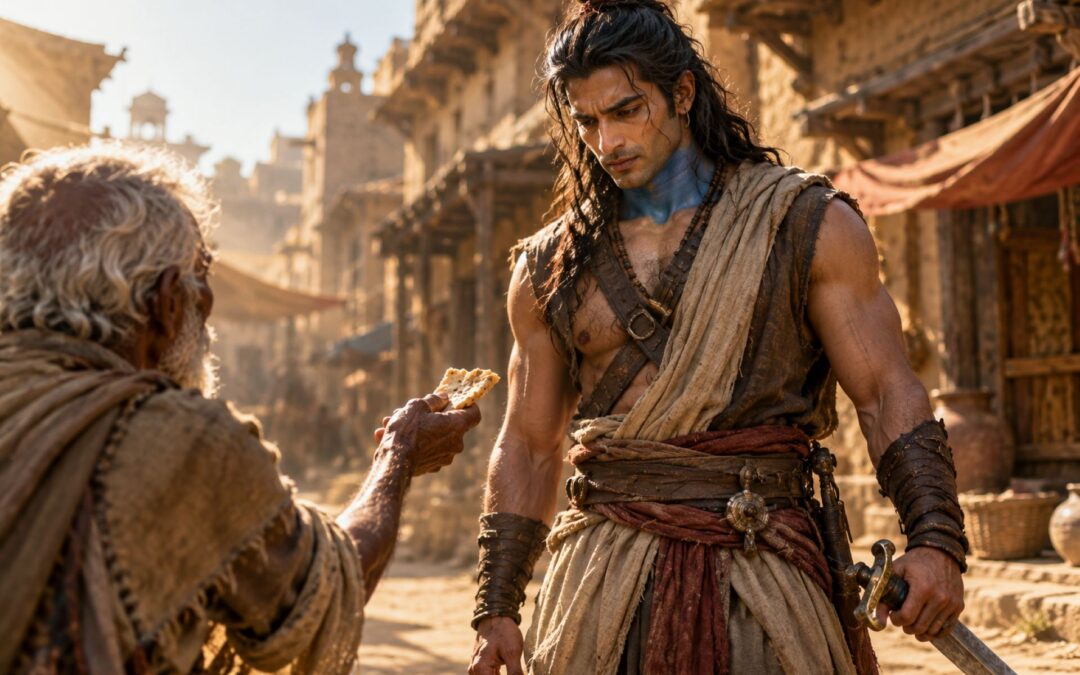
The decisive moment in Shiva’s transformation arrives through an encounter with a destitute old man.
The man possesses almost nothing and is struggling to survive. When Shiva accepts food from him, the old stranger generously offers more than he can afford to give.
Despite his poverty, the man treats Shiva with kindness and dignity.
Shiva is deeply moved by this generosity.
He recognizes that the old man’s goodness cannot be measured by his material circumstances, social position, or the quality of the government under which he lives.
The stranger possesses moral worth that Shiva’s earlier assumptions failed to recognize.
Shiva bows to him in gratitude and respect.
The encounter finally convinces him that he has committed a terrible error. He has helped wage a devastating war against people who are not inherently evil.
He proceeds to a temple dedicated to Lord Ram, where he meets another of the mysterious pandits.
Overwhelmed by guilt, Shiva reflects upon the enormous number of lives lost because he accepted the Suryavanshi interpretation of the prophecy.
The pandit explains that good and evil cannot be determined simply by dividing the world into opposing groups.
He discusses the relationship between Devas and Asuras, suggesting that apparent enemies may represent different forces within a larger balance rather than one side being wholly righteous and the other wholly wicked.
The history of Lord Rudra provides an important precedent.
Rudra, an earlier Mahadev, nearly destroyed the Asuras before recognizing that they were not inherently evil merely because they differed from the Devas.
The pandit explains that the Neelkanth must be an outsider precisely because his task requires freedom from established political loyalties.
Shiva has failed to maintain that independence.
Nevertheless, his mistake does not mean that his responsibilities have ended. The pandit tells him that he must acknowledge the consequences of his actions and continue searching for genuine evil.
Shiva also finally learns the identity of the mysterious religious figures who have guided him.
They are members of the Vasudev tribe, an order established to assist future Mahadevs and preserve the tradition through which another Vishnu may arise.
The pandit explains that Lord Rudra also left behind an order known as the Vayuputras.
These revelations suggest that Shiva’s apparent destiny belongs to a much larger historical and spiritual system than the Meluhan prophecy alone.
The novel does not fully explain these institutions or the nature of the evil Shiva must eventually confront.
After leaving the temple, Shiva rejoins Sati, who understands that he needs time to confront his guilt.
Their reunion is interrupted when Shiva notices the familiar hooded Naga nearby.
Sati immediately reacts to the threat, throwing a knife at the masked figure.
The Naga avoids the attack, retrieves the knife, and attaches it to his wrist in an unexpected gesture.
Shiva draws his weapon and rushes toward his wife as the Naga begins to move.
The novel ends at that moment.
Shiva has defeated the Chandravanshis, married Sati, and become the acknowledged Neelkanth, but he has not identified the true source of evil. The mystery surrounding the Nagas remains unresolved, and Sati is once again in immediate danger.
The first book therefore closes with a reversal of the certainty that guided its central conflict. Shiva has learned that victory can be morally disastrous when the cause itself has been misunderstood.
His larger journey as the Mahadev has only begun.
Meluha and Swadweep: Order, Freedom, and Moral Blindness
The political contrast between Meluha and Swadweep is one of the novel’s most developed ideas.
Meluha initially appears to represent nearly everything that a successful civilization should provide. Its people are prosperous, healthy, educated, and protected by sophisticated systems of government.
The empire’s achievements are visible in ordinary daily life.
Its cities have standardized construction, planned streets, drainage networks, regulated traffic, public facilities, and efficient administrative institutions. The Meluhans also maintain elaborate medical services and organize transportation across their territory.
The civilization’s physical order reflects its political philosophy.
Citizens are expected to understand their duties and perform them diligently. The government provides security and material stability, while individuals accept defined responsibilities within the larger social structure.
Lord Ram’s laws are treated as an unusually successful foundation for public life.
Shiva’s admiration is understandable because he arrives from a homeland where insecurity has prevented social development. The Gunas were forced to devote enormous effort to defending themselves against rival tribes.
In Meluha, they can imagine a future that does not depend upon continuous warfare.
Amish reinforces the attractiveness of the system through concrete details rather than relying exclusively on philosophical explanation.
The comfort of the immigrants’ accommodation, the professionalism of Ayurvati’s medical team, and the discipline of ordinary soldiers all demonstrate the advantages of organized institutions.
The capital’s restrained royal lifestyle also suggests that public duty matters more than extravagant personal privilege.
These achievements help explain why the Suryavanshis feel justified in defending their civilization.
Yet the same institutions that produce stability also limit personal freedom.
The Meluhans have detailed expectations about professions, caste identities, religious conduct, social relationships, and appropriate public behaviour.
Their citizens rarely question whether an established rule remains justified because obedience itself is considered virtuous.
The vikarma system exposes the darker possibilities within this arrangement.
People who suffer misfortune are taught to regard their circumstances as deserved punishment. Rather than challenging the institutions that regulate their lives, they are encouraged to accept social exclusion as an obligation.
The result is a society capable of protecting material welfare while failing to recognize certain forms of injustice.
Meluha’s belief in its own superiority also affects its foreign policy.
Its rulers assume that societies organized differently must be morally inferior. Chandravanshi freedom appears to them as evidence of corruption, while the Suryavanshi preference for discipline is treated as proof of righteousness.
The distinction between effective government and moral goodness becomes dangerously blurred.
Swadweep challenges this assumption through a contrasting social order.
The Chandravanshis tolerate considerable individual freedom and variation in lifestyle. Their public culture is colourful, expressive, and less concerned with conformity.
Their society also suffers from severe problems.
The wealthy enjoy extravagant privileges, while the poor may lack basic security. Public infrastructure is less reliable than in Meluha, and individual freedom does not automatically produce collective responsibility.
Anandmayi’s defence of Swadweep is therefore incomplete. She correctly recognizes the importance of freedom, but her willingness to tolerate inequality leaves important questions about social justice unanswered.
Parvateshwar’s criticism of Swadweep is equally understandable. He sees poverty and disorder that Meluha’s institutions have largely prevented.
The novel’s most productive insight arises from the fact that both civilizations possess genuine advantages and serious limitations.
Meluha protects people from material insecurity but risks suppressing dissent. Swadweep provides more freedom of individual expression but does not reliably protect its most vulnerable citizens.
The encounter with the poor old man introduces a further distinction.
Even when institutions fail, individuals may possess extraordinary moral character. The generosity of a starving stranger demonstrates that human goodness cannot be calculated from a society’s wealth, order, or public reputation.
The setting draws imaginative inspiration from the archaeological achievements of the Indus civilization. The archaeological remains of Mohenjo Daro documented by UNESCO provide evidence of sophisticated urban planning, brick construction, sanitation, and drainage in ancient South Asia.
These historical features help explain the physical plausibility of Amish’s imagined cities.
However, the political structures, social institutions, characters, and technologies described in the novel are fictional constructions. The historical existence of planned cities does not establish that the Meluhan empire, its version of the Maika system, or the Neelkanth prophecy existed as portrayed.
The distinction matters because the novel uses historical familiarity to make its imaginary world convincing.
Its political argument is strongest when understood through the fictional contrast between two civilizations rather than as a demonstrated account of how ancient Indian societies actually functioned.
Shiva’s Transformation: Guilt, Karma, and the Meaning of Mahadev
Shiva’s development is shaped by a tension between his extraordinary abilities and his persistent uncertainty about his own worth.
When the novel begins, he is already capable of leading warriors, planning battles, and making difficult decisions. His courage is established well before the Meluhans begin treating him as a divine figure.
Nevertheless, he does not possess complete confidence in his moral judgment.
His childhood memory explains much of this insecurity.
As a boy, Shiva witnessed a woman being sexually assaulted in a forest. When she noticed him and begged for help, he fled in fear rather than intervene.
The incident continues to haunt him.
His later willingness to confront danger appears partly motivated by a desire never to repeat that failure.
When the Gunas are threatened, he fights to protect them. When Nandi falls into the river, he risks his life without hesitation. When Sati is attacked, he immediately joins the battle.
These acts demonstrate genuine courage, but they also belong to a psychological pattern in which Shiva measures himself against an earlier moment of cowardice.
His sense of responsibility can therefore become excessive.
He is inclined to blame himself for suffering that he could not realistically have prevented, especially when someone close to him is harmed.
The destruction of Mandar and Brahaspati’s presumed death intensify this tendency.
Shiva interprets the catastrophe as another failure to protect someone who depended upon him. His grief becomes difficult to separate from a desire for revenge.
This combination of compassion, guilt, and aggression is one of the character’s most interesting contradictions.
Shiva dislikes unnecessary violence, yet he is capable of terrifying brutality when anger overwhelms him.
His response to the Naga who wounds Sati reveals this danger. He kills the attacker and continues mutilating the body until Sati’s voice brings him back to himself.
The scene makes it difficult to treat Shiva’s violence as automatically righteous simply because his motives are sympathetic.
His growing religious authority introduces another problem.
The Meluhans regard the blue throat as sufficient evidence that Shiva is destined for greatness. Shiva himself repeatedly questions the assumption.
He recognizes that he remains the same imperfect person he was before receiving Somras.
The transformation has given him extraordinary physical vitality and public importance, but it has not supplied the knowledge required to govern wisely or judge others fairly.
Parvateshwar’s initial skepticism therefore identifies an important weakness in the prophecy’s political use.
If merit depends upon actions, then Shiva must demonstrate his worth through conduct rather than rely upon the expectations created by his appearance.
He gradually does so.
His willingness to show mercy, protect vulnerable people, challenge the vikarma system, and accept personal danger establishes qualities that justify admiration independently of his blue throat.
The novel’s understanding of karma is central to this development.
Karma is presented through the importance of action and the moral consequences of individual choices. The opening premise of the trilogy explicitly imagines Shiva becoming godlike through what he does rather than through an inherently divine birth.
The problem is that good intentions are insufficient.
Shiva sincerely wants to protect Meluha and destroy evil, yet he becomes responsible for a devastating war because he accepts a mistaken definition of the enemy.
His most important development therefore occurs after the military victory.
He recognizes that the courage to fight is not the same as the wisdom to understand whether fighting is justified.
The meeting with the impoverished man in Ayodhya exposes the limitations of his earlier judgment more effectively than another heroic battle could have done.
Shiva encounters goodness in someone he had implicitly classified as belonging to an inferior civilization.
The experience forces him to acknowledge the individuality of people he had considered collectively guilty.
His later conversation with the Vasudev pandit deepens this recognition.
The responsibilities of a Mahadev involve enduring moral uncertainty, accepting mistakes, and continuing to act despite the burden of guilt.
However, Shiva’s development is incomplete when the novel ends.
He has recognized one dangerous error, but he has not yet demonstrated that he can consistently distinguish genuine evil from political disagreement or personal hostility.
This incompleteness is appropriate to the first volume of a trilogy, although the reader’s assessment of his eventual greatness must remain provisional.
Sati, Parvateshwar, Daksha, and the People Around Shiva
Although Shiva is the protagonist, the novel’s major supporting characters provide competing examples of duty, courage, loyalty, ambition, and moral independence.
Their relationships with Shiva determine much of his development.
Sati is the most important of these figures.
When Shiva first encounters her, she is confident, physically capable, and unwilling to accept patronizing assumptions about her abilities.
She fights effectively against armed attackers and later defeats Tarak in a dangerous duel.
Her identity as a warrior prevents her from functioning merely as a woman who must be rescued by the protagonist.
She is also a skilled dancer, a devoted daughter, and someone who takes religious obligations seriously.
The combination of artistic refinement, martial ability, and social discipline gives her a distinctive position within the fictional world.
Her principal internal conflict arises from the vikarma designation.
Sati has survived the loss of her first husband and stillborn child, but she has accepted the Meluhan interpretation of her tragedy as evidence of moral wrongdoing.
This produces a contradiction between her outward independence and her willingness to obey restrictions that unjustly diminish her status.
She can confront an armed opponent without fear, yet struggles to accept the possibility that she deserves happiness.
Her relationship with Shiva develops because he refuses to regard her as impure.
He recognizes her courage, intelligence, and dignity, even when he does not understand the social rules governing her life.
Nevertheless, Shiva’s affection sometimes risks becoming a desire to save Sati according to his own understanding of what she needs.
The mysterious pandit’s advice challenges this tendency by encouraging Shiva to consider Sati’s perspective rather than assume that removing an obstacle will automatically resolve her emotional conflict.
The agnipariksha is particularly important to her characterization.
Sati insists upon defending herself despite the objections of men who care about her. Her victory belongs to her own courage and intelligence.
Her decision to spare Tarak also demonstrates that she is capable of moral restraint independently of Shiva.
The later scene in which she takes the poisoned arrow intended for him reinforces her courage, although it also places her within a more conventional romantic pattern of self-sacrifice.
Her recovery and marriage provide emotional satisfaction, but the novel’s final cliffhanger again places her in danger.
Parvateshwar offers a very different model of strength.
He is disciplined, principled, experienced, and deeply committed to the laws of Lord Ram.
Unlike those who immediately worship Shiva, Parvateshwar insists that authority must be earned.
His refusal to accept the Neelkanth’s divinity without evidence initially creates hostility between them.
Yet his position is intellectually respectable.
He recognizes that allowing an extraordinary physical sign to determine moral status would undermine Meluha’s professed commitment to merit.
As Shiva demonstrates leadership, courage, and commitment to justice, Parvateshwar’s opinion gradually changes.
Their military cooperation becomes one of the strongest relationships in the novel.
Parvateshwar’s loyalty is eventually expressed through open reverence, but the transformation also creates a tension.
His earlier independence was valuable precisely because it allowed him to challenge the assumptions of the imperial court. His increasing devotion risks reducing that independence, even as it demonstrates sincere respect for Shiva’s achievements.
Daksha is less admirable and more politically complicated.
He is courteous, affectionate toward Sati, and proud of Meluha’s accomplishments.
His desire to protect his daughter is genuine, as demonstrated by his concern for her safety and his eagerness to restore her happiness.
Nevertheless, he is deeply ambitious.
Daksha wants to surpass the achievements of his father and establish himself as the ruler who restores Suryavanshi greatness.
The arrival of the Neelkanth offers an extraordinary opportunity.
He repeatedly encourages Shiva to identify Meluha’s political enemies with the evil described in the prophecy.
His willingness to use Shiva’s affection for Sati as an instrument of political influence reveals the manipulative side of his character.
The proposed exemption from the vikarma law further exposes his limitations.
Daksha initially seeks relief for his daughter and others of similar status rather than challenge the system as a whole.
His eventual agreement to abolish the law reflects Shiva’s pressure more than a fully developed change in his own convictions.
The emperor therefore represents the danger of treating personal ambition and national pride as interchangeable with moral righteousness.
Brahaspati provides an important counterweight.
As the leading scientist at Mount Mandar, he possesses knowledge and status without relying upon religious devotion to guide his judgment.
He approaches Shiva with curiosity rather than automatic worship.
Their friendship develops through frank conversations about medicine, prophecy, social institutions, and personal responsibility.
Brahaspati is particularly important because he repeatedly distinguishes what people believe from what available evidence actually establishes.
He recognizes the possibility that the Neelkanth prophecy has been interpreted according to Meluha’s political interests.
He also warns Shiva that his decisions will affect millions of people, requiring greater care than ordinary personal choices.
His presumed death is therefore more than a convenient motivation for revenge. Shiva loses one of the few people capable of challenging him intellectually without either hostility or excessive reverence.
Nandi represents affectionate loyalty.
He is physically imposing, cheerful, and deeply committed to Shiva’s safety.
His initial reverence frequently becomes a source of humour because Shiva insists upon being treated as a friend rather than a divine superior.
Nandi’s willingness to follow the rules of war also influences Shiva’s early decision to spare defeated enemies.
Veerbhadra serves a related but distinct function.
Because he knew Shiva before the Neelkanth prophecy, he understands the private memories and weaknesses concealed beneath the public image.
He is one of the few people who can recognize when Shiva’s decisions may be driven by unresolved guilt.
His romance with Krittika provides a less tragic parallel to Shiva’s relationship with Sati.
Krittika herself is loyal and perceptive, often recognizing emotional developments that the more powerful characters fail to understand.
Ayurvati embodies professional competence.
Her commitment to medicine repeatedly protects the characters from danger, and her treatment of Sati becomes essential to the romantic plot.
She also represents a professional understanding of duty that is not always identical with political obedience.
Kanakhala is a capable administrator whose willingness to consider alternatives becomes important before the war.
Her arguments for restraint show that opposition to military escalation exists within Meluha itself.
Queen Veerini provides a quieter perspective on Daksha’s decisions, particularly when the safety of their daughter is involved.
Drapaku’s role is smaller but thematically consequential.
His military abilities become visible after Shiva abolishes the vikarma restrictions, and his defence of the mountain pass demonstrates the human potential previously excluded by Meluhan law.
Emperor Dilipa and Princess Anandmayi challenge the Suryavanshi view of the Chandravanshis.
Dilipa is extravagant and irreverent, but he does not behave like the monstrous enemy Shiva expects.
Anandmayi is particularly effective because she refuses to accept Meluhan superiority and insists upon the value of individual freedom.
Finally, the mysterious pandits and the hooded Naga provide the novel’s larger sense of unfinished history.
The pandits possess knowledge that extends beyond the political concerns of Meluha and Swadweep, while the Naga’s contradictory behaviour prevents a straightforward moral classification.
Together, these characters ensure that Shiva’s story cannot be reduced to a conflict between a divinely chosen hero and an obviously evil enemy.
Maika, Vikarma, and the Contradictions of Meluhan Justice
Meluha’s social organization rests upon a claim that individual merit should determine a person’s position.
The Maika system is the principal institutional expression of this ideal.
By separating children from inherited family advantages and assigning social roles according to assessed ability, the system attempts to prevent birth from determining destiny.
Its stated purpose is understandable.
If children from wealthy or influential families receive better opportunities than equally talented children born into poverty, society cannot claim that its hierarchy reflects merit.
The Meluhan solution attempts to create a common foundation through standardized upbringing, education, and assessment.
Yet the mechanism requires extraordinary authority over personal life.
The state determines how children are raised, what opportunities they receive, and which roles they should eventually perform.
The system therefore assumes that centralized institutions can identify ability fairly and that individuals will accept the occupations assigned to them.
It also treats society as a structure in which each person should occupy an appropriate place.
This can promote coordination, but it risks restricting freedom and discouraging people whose aspirations change after their initial classification.
The categories themselves remain hierarchical.
Although caste is supposedly separated from hereditary status, the distinction between intellectual, military, commercial, and manual occupations continues to shape social respect and opportunity.
A system can remove one form of inequality while preserving another.
The exemptions granted to noble families expose a more immediate contradiction.
When powerful citizens are permitted to raise their biological children outside the ordinary Maika arrangement, inherited privilege can re-enter the system.
The law is modified in a way that benefits the powerful while its general justification remains unchanged.
Parvateshwar’s family refuses to accept this exception, demonstrating that some Meluhans recognize its inconsistency.
The vikarma system presents an even more serious problem.
Under this classification, suffering becomes evidence of wrongdoing committed in an earlier life.
A person who experiences severe misfortune may therefore be punished socially for circumstances beyond their control.
The injustice lies partly in the absence of a meaningful connection between evidence and blame.
Sati’s stillborn child does not establish that she committed a wrong. The blind man’s disability does not establish moral guilt.
Yet both are required to live under restrictions justified by these assumptions.
The treatment of vikarma people also raises questions about the relationship between religious belief and political authority.
Citizens are encouraged to accept that the law reflects a moral order extending beyond the present lifetime.
As a result, they may regard resistance to social punishment as resistance to justice itself.
The blind man in Kotdwaar demonstrates how deeply this reasoning can become internalized.
He continues to love Meluha and believes in its righteousness even while suffering discrimination under its laws.
Sati’s circumstances reveal a similar pattern.
She accepts her designation despite possessing considerable intelligence, courage, and social standing.
Her obedience is not simply the result of coercion. It reflects the beliefs through which she has learned to understand her own suffering.
The mysterious pandit introduces a political justification for this arrangement.
He suggests that societies may become unstable when people direct their dissatisfaction toward institutions or other groups.
The vikarma system can discourage resentment by encouraging individuals to interpret misfortune as the consequence of personal karma.
The argument has an identifiable mechanism, but its ethical implications are troubling.
A belief that preserves social stability by persuading people to accept unjust treatment cannot be evaluated solely by its effectiveness in maintaining order.
It must also be judged by whether the treatment itself is justified.
Shiva recognizes this distinction.
His demand to abolish the vikarma law is important because it extends beyond securing an exception for Sati.
Daksha’s initial proposal would have preserved the system while protecting particular aristocratic women from its consequences.
Shiva instead insists that a law based upon unjust blame must be removed for everyone.
The reform also reveals the practical consequences of changing institutions.
Once the classification is abolished, former vikarma soldiers can contribute openly to Meluha’s military defence.
Drapaku’s courage and tactical understanding expose the abilities that the earlier law had concealed or restricted.
The novel’s portrayal of Maika and vikarma reflects Amish’s broader interest in merit, caste, and social organization. In a later discussion of his approach to caste, he described his understanding of ancient social classification as connected to personal qualities and actions rather than fixed hereditary identity.
That stated interpretation should be distinguished from historical evidence. The particular institutions and rules in The Immortals of Meluha belong to the novel’s imaginative reconstruction.
The book is most persuasive when it uses its fictional institutions to examine a general moral problem: whether a society can remain just when obedience to law becomes more important than questioning the law’s consequences.
Somras, the Blue Throat, and the Reimagining of Hindu Mythology
The novel’s central imaginative device is the transformation of familiar religious figures and symbols into elements of a human historical narrative.
Rather than beginning with Shiva as an omnipotent deity, Amish presents him as a warrior whose extraordinary reputation develops through a combination of physical transformation, prophecy, public expectation, and personal action.
This approach gives the novel an unusual relationship with Hindu mythology.
Readers may recognize the names Shiva, Sati, Nandi, Brahma, Ram, Rudra, and the Nagas, but the characters inhabit a fictional society with its own political history and technological explanations.
The novel uses these familiar names to create recognition while changing the circumstances through which their significance develops.
Somras provides the most important example.
In the fictional world, the drink of the gods is a manufactured medicine that delays ageing and promotes exceptional physical vitality.
Brahaspati describes its effects through an explanation involving oxygen, free radicals, and the processes associated with bodily deterioration.
The scientific language gives the medicine an appearance of technical plausibility.
However, its extraordinary effects belong to speculative fiction.
Modern science does not establish that the kind of medicine described in the novel can preserve human youth for centuries, heal severe injuries in the manner shown, or produce Shiva’s transformation.
The explanation is valuable as world-building because it gives Meluha a material source of power.
The civilization’s health, prosperity, and longevity depend upon a specific manufactured substance.
This dependence also creates political vulnerability.
Somras production requires enormous quantities of Saraswati water, making the declining river a threat to the entire imperial system.
The destruction of Mount Mandar therefore attacks the technological foundation of Meluha rather than merely destroying a military installation.
The medicine also raises questions about access, control, and the concentration of scientific knowledge.
Although Somras improves the lives of Meluhan citizens, its production remains dependent upon specialized facilities and experts.
Brahaspati’s work makes him indispensable to the empire, and his presumed death exposes the fragility of a civilization built around a single critical technology.
Shiva’s blue throat transforms the medicine into a religious symbol.
Physically, it is an unusual reaction to Somras. Socially, it becomes evidence of a divine destiny.
The contrast between these meanings is central to the story.
Shiva knows that his throat changed after receiving an unfamiliar medicine, but the Meluhans interpret the result through a prophecy handed down across generations.
Their belief gives him extraordinary authority long before he has established the knowledge or wisdom necessary to exercise it.
The blue throat therefore represents both possibility and danger.
It makes Shiva visible as a potential saviour, while also encouraging others to project their expectations onto him.
The novel similarly reinterprets the title Mahadev.
Rather than treating godhood simply as an inherited identity, it associates the title with actions capable of transforming the world.
Shiva’s declaration before the final battle makes this principle explicit.
His soldiers are encouraged to believe that courage and righteousness are qualities they can develop through their own actions.
The familiar idea of a divine hero becomes an argument about human potential.
Amish’s treatment of Lord Ram follows a related approach.
Ram is remembered as an extraordinary ruler whose laws, institutions, and ethical principles shaped Meluhan civilization.
The Suryavanshis revere him as an almost divine protector, but the narrative emphasizes his achievements as a lawgiver and political reformer.
The portrayal also introduces an important difficulty.
Because Ram’s institutions are treated as sacred, later generations may defend rules that no longer serve their original purposes.
Religious reverence can preserve valuable traditions while making reform more difficult.
The Nagas provide a different kind of reinterpretation.
Their association with serpentine imagery, unusual bodies, and supposed curses creates an atmosphere of fear.
Yet the hooded Naga’s willingness to rescue strangers suggests that outward appearance and inherited reputation cannot establish moral character.
The serpent-like version of Aum worn by the Naga also complicates Meluha’s assumptions.
Aum is described as a symbol associated with a historical attempt to unite the Suryavanshis and Chandravanshis.
Its connection with the Nagas introduces the possibility of a shared history that the present political conflict has obscured.
The sun and moon represent the opposing civilizations, while the image of their union suggests that the two traditions may belong within a larger balance.
Fire appears repeatedly in moments of danger, purification, and transformation.
Sati’s agnipariksha places her courage and dignity within a literal ring of flames. The poisoned fire arrow later threatens her life and becomes the occasion for Shiva’s desperate attempt to save her.
The fire imagery connects physical danger with moments that transform relationships and moral understanding.
Dance provides another important symbol.
Shiva’s exceptional ability as a dancer reveals a side of his character that cannot be expressed through warfare alone.
His relationship with Sati develops partly through their shared appreciation of movement, discipline, and artistic skill.
The trident and related military imagery also connect his identity as a warrior with the iconography traditionally associated with Shiva.
These symbols are effective because they allow mythology to shape the narrative without requiring every event to be explained through supernatural intervention.
In a later interview about mythology, faith, and philosophical storytelling, Amish discussed the importance of philosophical ideas in fiction and how writing the Shiva Trilogy influenced his own religious outlook.
The novel’s reinterpretation is consistent with that interest, although its characters and events must still be evaluated as fictional creations rather than as statements of historical or theological fact.
Its distinctive achievement is to make familiar divine imagery part of a story about human choices.
Shiva’s transformation gives him a special place in the world, but the book repeatedly asks whether the significance of that place depends upon what he eventually does with it.
Good and Evil, Duality, and the Limits of Righteous War
The question of evil develops gradually across the novel.
At the beginning, Shiva’s enemies are relatively easy to identify.
The Pakratis repeatedly attack his people, endanger vulnerable members of the tribe, and make peaceful survival increasingly difficult.
Their conduct provides an understandable reason for Shiva to defend the Gunas.
Nevertheless, even this early conflict introduces the distinction between defeating an enemy and deciding what should happen afterward.
When the Pakratis surrender, Shiva must choose whether to execute them or end the cycle of retaliation.
His decision to spare them establishes that moral responsibility continues after military victory.
In Meluha, the problem becomes more complicated because wrongdoing is embedded within institutions.
The vikarma system punishes people who have suffered misfortune, yet its supporters believe they are preserving justice.
Sati and the blind man are treated unfairly by people who do not necessarily understand themselves as cruel.
The harm arises from accepted beliefs and legal procedures rather than from the obvious malice of a single enemy.
This complicates the assumption that evil can always be recognized through the intentions of an individual villain.
The conflict with the Chandravanshis introduces another difficulty.
Shiva learns about Swadweep almost entirely through the people of Meluha.
They describe the Chandravanshis as dishonest, corrupt, and incapable of honour.
Their explanations become part of the environment in which Shiva forms his own judgments.
Repeated terrorist attacks reinforce the narrative.
The destruction of temples and the killing of Brahmins are genuine acts of violence that demand investigation and response.
However, the responsibility for particular attacks is not always established as securely as the Meluhan leaders suggest.
The destruction of Mandar becomes the decisive point.
Shiva finds evidence associated with the Nagas and concludes that the attack belongs to a broader Chandravanshi campaign against Meluha.
His grief over Brahaspati gives this interpretation tremendous emotional force.
The desire to avenge his friend makes him less willing to question whether the Chandravanshi government actually ordered the destruction.
The resulting war demonstrates how a sincere commitment to fighting evil can become dangerous when the identity of the enemy is assumed rather than established.
Shiva’s motives are not simply selfish.
He wants to protect Meluha, honour his friend, and prevent further attacks on innocent people.
His military campaign also produces genuine acts of courage and sacrifice.
Yet these admirable qualities do not prove that the war itself is justified.
The Chandravanshi prophecy exposes the central error.
Both societies expect the Neelkanth to appear and destroy their enemies.
Because each believes itself righteous, each interprets the same physical sign as confirmation of its own moral superiority.
The prophecy therefore becomes less a source of independent moral guidance than a framework into which political loyalties are inserted.
Shiva’s status as an outsider was supposed to protect him from exactly this problem.
Instead, he becomes emotionally and politically attached to the first civilization that welcomes him.
The ending asks him to distinguish loyalty from judgment.
His admiration for Meluha is not entirely misplaced. Its citizens possess many admirable qualities, and its institutions have achieved remarkable results.
The mistake lies in assuming that these achievements make the civilization morally correct in every conflict.
The encounter with the poor old man in Ayodhya provides the emotional proof that Shiva needs.
The stranger’s generosity demonstrates that moral worth exists among people whom Shiva has treated as members of an evil society.
The incident also challenges the idea that social arrangements can fully determine individual character.
Swadweep’s government may fail to protect its poor, but its citizens are not therefore incapable of goodness.
The mysterious pandit’s discussion of duality develops this recognition into a broader philosophy.
The Devas and Asuras, like the Suryavanshis and Chandravanshis, are presented as apparently opposing forces whose differences do not necessarily establish absolute moral categories.
Lord Rudra’s earlier mistake demonstrates that even a Mahadev can confuse difference with evil.
The larger challenge is therefore to understand what genuinely threatens life and moral order without treating every rival identity as an enemy.
This does not require Shiva to abandon moral judgment.
The novel does not establish that all actions are equally justified or that violence against civilians becomes acceptable when committed by an opposing civilization.
The attacks on temples, the discrimination against vikarma people, and the suffering caused by war remain matters requiring ethical assessment.
Instead, the ending challenges the assumption that entire groups can be classified as good or evil according to their inherited beliefs, political identities, or social institutions.
There is also an unresolved difficulty in the pandit’s teaching.
The idea that apparently opposed forces belong to a larger balance can encourage humility, but it does not by itself explain how Shiva should identify genuine evil in practice.
Recognizing that both societies possess virtues and flaws is an important improvement upon his earlier certainty.
It does not provide a complete method for deciding when force is justified.
The novel acknowledges this incompleteness by leaving Shiva’s larger mission unresolved.
He has learned to question the beliefs of those who claim to be righteous, but he must still discover the true object of his responsibility.
The significance of the ending lies in the difference between these two stages.
Shiva’s first task was to acquire the courage to act. His next task is to develop the judgment required to know when action is right.
Prophecy, Romance, and the Novel’s Storytelling Style
Amish organizes The Immortals of Meluha as a chronological adventure built around a sequence of expanding responsibilities.
The opening focuses upon Shiva’s immediate duty to protect the Gunas. His arrival in Meluha introduces a larger social and political world, while the Neelkanth prophecy transforms his private responsibilities into public expectations.
The narrative subsequently develops through several intertwined plots.
Shiva’s relationship with Sati provides emotional motivation. The Naga attacks create suspense. His friendship with Brahaspati opens philosophical and scientific questions, while the conflict with Swadweep gradually expands the story into military and political territory.
These strands eventually converge.
The attack on Mandar affects Shiva personally because of Brahaspati. It threatens Meluha technologically because of Somras. It accelerates war because the Meluhan leadership attributes responsibility to its established enemies.
The convergence allows the story’s personal and political conflicts to reinforce one another.
The novel uses third-person narration with access to the thoughts of several characters.
Shiva remains the principal focus, but readers also encounter events involving the Nagas, the royal family, and other figures whose actions are not immediately known to him.
This shifting perspective produces dramatic irony.
The reader witnesses the hooded Naga behaving compassionately, even while Shiva continues to understand Nagas primarily through Meluhan descriptions.
The mystery is therefore maintained through incomplete knowledge rather than an absence of relevant information.
Amish also relies heavily on dialogue to explain the fictional world.
Daksha discusses government and history. Brahaspati explains science and the interpretation of prophecy. The mysterious pandits introduce philosophical ideas, while Anandmayi articulates the Chandravanshi defence of individual freedom.
These conversations make complex institutions accessible.
Readers do not need extensive prior knowledge of Hindu mythology, ancient geography, or political philosophy to understand the principal ideas.
However, the explanatory approach can become conspicuous.
Characters sometimes deliver extended arguments that resemble formal lectures more than spontaneous conversation.
The distinction between ordinary dialogue and exposition is particularly noticeable when the narrative pauses to explain the history of an institution or the meaning of a philosophical concept.
The prose is generally direct and contemporary.
Shiva speaks casually, jokes with his friends, becomes irritated, uses blunt language, and occasionally struggles to express his feelings.
This gives him an accessible personality that contrasts with the reverence directed toward him.
The contrast can be entertaining, particularly in his interactions with Nandi and during his awkward attempts to impress Sati.
At other times, the modern conversational style clashes with the solemnity of the ancient setting.
The romance follows a recognizable pattern of attraction, misunderstanding, social prohibition, danger, emotional confession, and eventual marriage.
Its appeal depends partly upon Sati’s independence and Shiva’s willingness to challenge the rules that restrict her.
Yet the repeated cycle of Shiva pursuing Sati and Sati withdrawing because of her status can slow the narrative.
The action sequences provide a different kind of momentum.
Amish frequently describes weapon movements, defensive positions, tactical advantages, and the physical consequences of combat.
The Battle of Koonj and the later war against Swadweep are particularly detailed.
These scenes establish Shiva’s competence as a warrior and make his leadership visible through practical decisions.
They also prepare the philosophical reversal by showing that military victory has real human consequences.
Foreshadowing is another important feature.
The identical prophecies, the contradictory behaviour of the Nagas, Brahaspati’s doubts, Daksha’s ambition, and the mysterious pandits all prepare the reader to question the apparent simplicity of the central conflict.
The final revelation therefore changes the meaning of earlier events without appearing entirely disconnected from them.
As the first volume of a trilogy, the novel also relies upon unresolved mysteries.
The true identity and motives of the hooded Naga, the larger purpose of the Vasudevs and Vayuputras, and the precise nature of the evil Shiva must confront are left for the continuing narrative.
The cliffhanger involving Sati creates immediate suspense, but the more important unfinished question concerns Shiva’s future moral judgment.
The novel has completed the first phase of his transformation without resolving the larger journey.
How the Mythological Premise and Moral Reversal Work
The strongest achievement of The Immortals of Meluha is its transformation of a familiar divine figure into the protagonist of an accessible adventure.
Shiva’s extraordinary reputation does not prevent him from behaving like a recognizable human being.
He makes jokes, becomes angry, falls in love, questions authority, experiences guilt, and makes serious mistakes.
This humanization gives the novel opportunities that a more conventional account of an already perfected deity would not possess.
Shiva can change because he begins with limitations.
His relationship with Meluha is particularly effective.
The empire first appears genuinely admirable, and the novel supplies enough detail to explain why Shiva would become attached to it.
The orderly cities, medical achievements, public services, and discipline of its soldiers create a convincing contrast with his former homeland.
This makes his later disillusionment more consequential.
If Meluha had been presented as obviously corrupt from the beginning, the revelation of its moral limitations would have carried much less force.
The vikarma storyline is also among the novel’s strongest elements.
Sati’s personal history gives emotional weight to an institutional problem, while Shiva’s decision to abolish the law transforms private concern into public action.
The reform is especially satisfying because the novel distinguishes between granting an exception to a powerful family and changing an unjust rule for everyone.
The battle sequences work best when they demonstrate character through action.
Shiva’s battlefield improvisation, Parvateshwar’s discipline, and Drapaku’s courage all contribute to developments that matter beyond the immediate fighting.
The final moral reversal gives these earlier achievements a more complicated significance.
Shiva’s victory does not simply complete the heroic journey. It forces him to confront the possibility that he has used admirable qualities in service of a mistaken cause.
This is the book’s most intellectually productive choice.
The ending changes the reader’s understanding of Shiva’s development without denying his courage or the genuine achievements of Meluha.
It also makes the trilogy’s larger premise more demanding.
Becoming worthy of the title Mahadev requires more than defeating powerful enemies. It requires the ability to question the beliefs through which those enemies have been identified.
Where the Dialogue, Pacing, and Characterization Struggle
The novel’s accessibility comes with artistic limitations.
Its prose is usually clear, but it often relies upon direct explanation where more economical characterization or dramatic development might have produced a stronger effect.
Characters frequently state their beliefs in extended speeches, particularly when the subject concerns government, religion, science, or morality.
These conversations help readers understand the fictional world, but they can interrupt narrative momentum.
The problem is particularly visible in the philosophical discussions with the pandits.
Their ideas are important to the book, yet the exchanges sometimes resemble structured lessons in which Shiva asks questions so that an authoritative figure can provide the next explanation.
The result is intellectually accessible but occasionally predictable.
Some characters are also defined heavily by their principal functions.
Nandi’s devotion, Parvateshwar’s discipline, Daksha’s ambition, and Brahaspati’s rationality are all recognizable qualities, but the narrative sometimes returns to them without developing their psychological complexity at the same rate as the plot.
Parvateshwar is among the more successful exceptions because his opinion of Shiva changes through identifiable experiences.
Daksha is potentially more complicated than his characterization always allows.
His sincere affection for Sati exists alongside his political manipulation and ambition, but the novel sometimes presents these qualities rather directly rather than exploring their contradictions through subtler choices.
Sati’s characterization is similarly uneven.
Her courage, intelligence, dignity, and commitment to duty are convincingly established through several important scenes.
Nevertheless, much of her romantic development depends upon repeated hesitation arising from her vikarma status.
Her emotional conflict is understandable, but the narrative could have explored more of her independent desires and judgments beyond the obstacles preventing her relationship with Shiva.
The treatment of social institutions also raises questions about internal plausibility.
Meluha possesses extraordinarily sophisticated systems of planning, medical care, social allocation, and public administration.
These arrangements are useful for exploring the contrast between order and freedom, but the novel sometimes assumes that their benefits would follow more easily than their institutional complexity suggests.
The Maika system, for example, is presented as a solution to hereditary privilege without equally sustained attention to the consequences of centralized control over childhood, family relationships, and personal choice.
The scientific explanations of Somras serve the story effectively, but their speculative nature can also create inconsistencies in how the medicine’s abilities are understood.
Shiva’s unusual recovery, Sati’s healing, and the broader claims about longevity are not all equally explained within the established mechanism.
This is not inherently disqualifying in fantasy fiction, but the novel’s use of scientific language invites questions that a more openly magical system might avoid.
The pacing becomes uneven when the narrative moves between romance, philosophical conversation, and military action.
Some travel sequences and repeated misunderstandings could be condensed without losing essential character development.
Conversely, certain political and moral transitions would benefit from more time.
Shiva’s movement from doubting the justification for war to committing himself to a major campaign is psychologically understandable through his grief over Brahaspati, but the narrative’s emphasis on revenge can make the political decision feel more immediate than fully examined.
The ending offers both strength and limitation.
The Chandravanshi prophecy and Shiva’s encounter with the poor man create a convincing moral reversal.
However, the concluding philosophical explanation arrives through a familiar pattern of instruction from a mysterious wise figure.
The novel could have allowed Shiva to develop more of its reasoning independently.
The cliffhanger also prevents complete resolution.
The immediate danger involving Sati and the unanswered mysteries surrounding the Nagas leave readers dependent upon the next installment.
This is effective serial storytelling, but it means that the novel’s larger questions cannot be fully assessed as a self-contained work.
These limitations are consistent with the division in critical reception.
A Publishers Weekly review of the international edition praised the imaginative premise while criticizing the dialogue, characterization, and exposition. An earlier Business Standard assessment likewise regarded the central idea as promising but questioned the sophistication of its execution.
Those criticisms identify genuine weaknesses, although they do not erase the appeal of the novel’s world or the effectiveness of its central reversal.
The book succeeds more consistently as an imaginative, accessible mythological adventure than as an example of highly refined literary prose.
Its philosophical ambitions are substantial, even where their presentation is more explicit than subtle.
Who Should Read The Immortals of Meluha?
The Immortals of Meluha is particularly rewarding for readers who enjoy mythology-inspired fantasy, accessible adventure, large fictional civilizations, political conflicts, and stories in which a protagonist’s personal development is connected to questions of morality and responsibility.
Its use of familiar Hindu names and imagery creates a distinctive imaginative setting, while the combination of romance, military action, and philosophical discussion gives readers several ways to engage with the story.
Those primarily seeking rigorous historical reconstruction, subtle literary characterization, or consistently polished prose may find it less satisfying. The novel’s invented institutions and speculative science should also be understood as elements of fantasy rather than reliable descriptions of ancient India.
As the first volume of a trilogy, it offers a complete initial transformation but deliberately leaves its larger narrative unresolved. Readers who strongly prefer standalone stories may find the cliffhanger frustrating.
The novel’s lasting interest lies in the difficulty Shiva discovers after achieving the victory that others demanded of him.
He begins by believing that courage and moral intention will be enough to fulfil his destiny. His experiences teach him that the responsibility to confront evil also requires humility, independent judgment, and the willingness to recognize error.
The book does not fully resolve that challenge, but it establishes why the challenge matters. For readers willing to accept its direct prose and occasional narrative excesses, The Immortals of Meluha remains an engaging and thought-provoking beginning to Shiva’s journey from a gifted human warrior toward the figure remembered as Mahadev.
Last Updated on October 16, 2026 by Aseem Gupta