
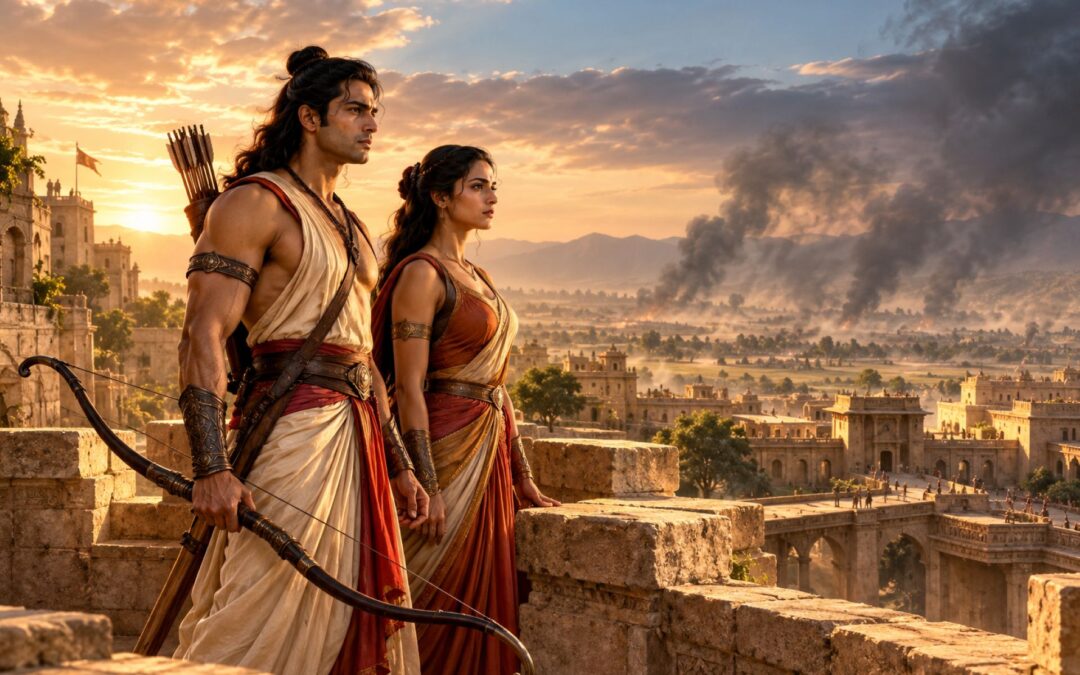
Reading Time: 77 Minutes
In Scion of Ikshvaku, Amish Tripathi imagines a version of Ram whose greatest strength is also the source of his most difficult decisions. Born into a royal family that regards him as unlucky, Ram grows into a disciplined warrior and reformer who believes that a society can become just only when its laws apply equally to everyone. Yet the world he inhabits continually places him in situations where following the law appears to conflict with protecting innocent people, honouring personal relationships, or achieving a greater good.
Published in 2015 as the first novel in the Ram Chandra Series, Scion of Ikshvaku retells the early life of Ram through an elaborate fictional world of competing kingdoms, political conspiracies, religious institutions, advanced weapons, and social philosophies. Amish retains recognisable elements of the Ramayana, including the four brothers, Sita’s marriage to Ram, the fourteen-year exile, and Raavan’s abduction of Sita. He substantially changes the circumstances surrounding these events, creating a story in which personal morality and the organisation of society are inseparable.
The novel follows Ram from a childhood marked by rejection to his emergence as a leader whom powerful institutions believe may become the next Vishnu. Along the way, his relationships with Bharat, Lakshman, Dashrath, Sita, and his two influential teachers expose different understandings of duty, freedom, equality, and justice. The result is an ambitious mythological adventure whose political ideas are often as important as its battles.
Spoiler Warning: This article covers the complete novel, including major character deaths, political revelations, the circumstances of Ram’s exile, and the ending involving Sita’s abduction.

The Forest Abduction and the Collapse of Dashrath’s Empire
The novel begins in 3400 BCE, somewhere near the Godavari River. Ram and his younger brother Lakshman are hunting in the forest while Sita remains at their temporary camp. Their appearance and circumstances immediately suggest that they have been living outside the comforts of royal life for a considerable time. Ram has become a hardened warrior, while Lakshman remains fiercely protective of his elder brother and suspicious of anyone who might threaten him.
Their conversation reveals that the brothers have recently encountered people connected to Raavan’s family. Lakshman is particularly uneasy about the intentions of these visitors, but Ram resists treating every uncertain situation as evidence of conspiracy. Their contrasting attitudes will become important throughout the story: Lakshman trusts his instincts and personal loyalties, while Ram insists upon judging people according to established principles.
The hunt is interrupted by distant cries. As the brothers rush towards their camp, they realise that something terrible has happened. They discover destruction, dead soldiers, and the critically wounded Naga warrior Jatayu. Above the forest, an extraordinary flying vehicle called the Pushpak Vimaan is carrying Raavan away with Sita.
Ram fires an arrow towards the departing aircraft, but it is already beyond his reach. Jatayu struggles to communicate what happened, confirming that Raavan has abducted Sita. The scene establishes the novel’s immediate crisis without explaining the chain of events that brought Ram, Sita, and Lakshman to this isolated place.
The narrative then moves thirty-three years into the past, to the western port of Karachapa.
At that time, Dashrath is the powerful king of Kosala and emperor of the Sapt Sindhu, a confederation of kingdoms whose capital is Ayodhya. Having expanded his dominion through successful military campaigns, he is accustomed to commanding obedience. His authority rests partly upon the formidable reputation of the Suryavanshi royal lineage and partly upon the belief that his armies are practically unbeatable.
The confrontation at Karachapa begins with commerce rather than religion or dynastic succession. For years, Ayodhya has profited from the trade passing through its territories, extracting substantial commissions and benefiting from its position as the dominant imperial power. Kubaer, a wealthy trader connected to Lanka, has challenged these arrangements with Raavan’s support.
Dashrath interprets the challenge as an intolerable insult. To him, merchants exist within a political order maintained by kings and soldiers. Their attempt to dictate terms therefore threatens the hierarchy through which he understands the world.
Raavan approaches the situation differently. His power comes from commerce, military preparation, and strategic calculation. He recognises that control over trade can weaken an empire without requiring an immediate campaign to conquer its capital.
Dashrath nevertheless expects a conventional victory. He believes his superior reputation, experienced cavalry, and personal courage will overwhelm the enemy. His general Mrigasya accompanies him, while his favourite wife Kaikeyi remains close to the military camp.
Kaikeyi understands her husband’s confidence but worries about his tendency to let pride overcome judgment. Their exchanges establish both their affection and the unusual freedom she possesses in comparison with Dashrath’s other queens. She is prepared to challenge him, yet she also recognises the danger of doing so when he has already decided upon battle.
Meanwhile, in Ayodhya, Dashrath’s senior wife Kaushalya is approaching childbirth.
Her position within the royal household has been miserable for years. Although she is the senior queen, her failure to produce an heir has left her politically weak and emotionally neglected. Dashrath’s attachment to Kaikeyi makes the imbalance more painful.
For Kaushalya, the birth of a son represents an opportunity to recover some dignity and secure her place within the dynasty. The coming child is personally precious, but he is also surrounded by expectations that he cannot possibly understand.
The battle at Karachapa destroys Dashrath’s confidence.
Raavan anticipates the emperor’s preferred tactics and prepares his army accordingly. When Dashrath launches a cavalry charge, the Lankan soldiers employ unusually long, heavy spears that stop the advancing horses and inflict terrible casualties. What Dashrath expects to be a demonstration of royal superiority becomes a carefully engineered defeat.
The emperor’s anger makes matters worse. Determined to reach Raavan, he places himself in increasing danger. His army loses cohesion, and the battle exposes the limitations of a military culture that has become too confident in its previous successes.
Kaikeyi eventually intervenes to save Dashrath’s life. She drives a chariot through dangerous terrain while enemy soldiers pursue them, forcing exhausted horses onward because stopping would mean capture or death. Her courage preserves the emperor, but it cannot preserve his reputation.
For the first time, Dashrath has suffered a devastating military defeat. The consequences extend far beyond the battlefield. Ayodhya’s aura of invincibility disappears, its influence weakens, and Raavan emerges as the most formidable challenger to the established political order.
At almost the same time, Kaushalya gives birth to Ram.
The coincidence becomes disastrous for the child. Dashrath associates his son’s arrival with the collapse of his military fortunes, interpreting the timing as evidence of inauspicious karma. Rather than confronting his own errors or recognising Raavan’s superior planning, he directs his humiliation towards someone incapable of defending himself.
There is also a separate anxiety surrounding Ram’s horoscope. The actual time of birth produces an unfavourable astrological interpretation, so Kaushalya’s attendant Nilanjana arranges for the recorded time to be altered. This concealment reflects the fear permeating the royal household, where predictions and political reputation can determine a child’s future.
Ram consequently enters life under the shadow of an event for which he bears no responsibility. His father regards him as a symbol of defeat, while the people of Ayodhya associate his birth with the beginning of their empire’s decline.
The opening establishes two conflicts that will shape the entire novel. Dashrath’s pride has helped destroy his empire’s security, and Ram must grow up attempting to restore a society that has already decided he is responsible for its misfortune.
The Unwanted Prince and Vashishta’s Education
Six years after the defeat at Karachapa, Ayodhya is no longer the flourishing imperial capital Dashrath once ruled.
The deterioration is visible in the city’s infrastructure. Its Grand Canal, a major achievement of an earlier period, suffers from neglect and poor maintenance. Administrative weakness has gradually followed military humiliation, while the political class remains more concerned with status and internal advantage than with restoring effective government.
Maharishi Vashishta, the royal guru, understands the seriousness of the decline. His assessment extends beyond individual rulers. He believes the problems of the Sapt Sindhu arise from defective institutions, social habits, and governing ideas that have ceased to serve their original purposes.
Vashishta also belongs to a larger religious and political world in which the titles Vishnu and Mahadev carry meanings different from those familiar in many traditional tellings. In this fictional history, extraordinary individuals may receive such designations because of their roles in preserving, reforming, or transforming civilisation.
The legacy of Lord Parshu Ram is particularly important to Vashishta. He reveres the earlier Vishnu and sees India’s present condition as evidence that another transformative leader may be required.
Near the Grand Canal, Vashishta secretly takes a blood oath to carry out a rebellion intended to change the country’s future. His determination is significant because it reveals that the education of Dashrath’s sons will serve purposes beyond preparing princes for ordinary royal responsibilities.
Kaushalya eventually agrees to send Ram away to Vashishta’s gurukul.
The decision is painful. She loves her son and knows that his father has treated him unjustly, but she also recognises that remaining in Ayodhya will expose him to continued humiliation. Distance may give him the opportunity to develop without constantly being reminded of the circumstances of his birth.
Ram’s three younger brothers accompany him. Bharat is Kaikeyi’s son, while Lakshman and Shatrughan are Sumitra’s sons. The four have different personalities, but their childhood establishes bonds that later political manipulation cannot easily destroy.
Lakshman is especially devoted to Ram. His attachment becomes one of the most dependable relationships in the novel, although his protectiveness sometimes makes him impatient, suspicious, and confrontational.
Bharat is charismatic, sociable, and emotionally expressive. He enjoys personal freedom and eventually develops views about government that sharply contrast with Ram’s preference for disciplined order. Shatrughan is quieter and intellectually observant, often understanding situations that his more outspoken brothers approach through emotion or instinct.
At the gurukul, Vashishta refuses to treat the princes as privileged aristocrats. They must perform ordinary tasks, follow routines, maintain the establishment, prepare food, study, and undertake demanding physical training.
This education gives them experiences rarely available within the protective environment of a royal palace. They encounter people who do not automatically defer to them and discover that discipline requires more than issuing commands.
The forest community surrounding the gurukul also introduces Ram to the unusual consequences of rigidly maintained traditions. Its inhabitants follow ancient laws whose original purposes have become obscure. Even when those rules produce difficulties, the community continues obeying them because their authority has been accepted for generations.
Ram finds aspects of this behaviour admirable. A system in which people obey rules consistently appears preferable to Ayodhya, where powerful nobles can disregard restrictions that ordinary citizens must follow.
Yet the example also contains a warning. A rule can retain its authority long after circumstances have changed, and obedience alone does not establish that the rule remains wise.
Vashishta’s martial training encourages the brothers to develop their individual strengths. Ram emerges as particularly disciplined, painstaking, and capable of sustained concentration. Bharat possesses natural flair and considerable ability, although he is less inclined to surrender his personal preferences to rigid routines.
Their contrasting attitudes become visible in competitions and everyday interactions. Ram approaches achievement through preparation and controlled effort, whereas Bharat more readily combines ability with improvisation.
Vashishta also teaches history, politics, philosophy, and the traditions of earlier civilisations.
The princes learn about Sangamtamil and Dwarka, ancient societies whose decline helped produce migrations and political transformations. Their teacher discusses leaders who achieved remarkable success but whose systems eventually became unsuitable for changing conditions.
The purpose of these lessons is to connect political order with the needs of human beings. A ruler cannot preserve a civilisation merely by inheriting its institutions. He must understand why those institutions were created, what functions they perform, and when their continued existence becomes destructive.
Ram is particularly interested in the qualities of an ideal king.
He believes rulers should place duty above personal advantage and create systems in which fairness does not depend on the mood of whoever holds power. Bharat questions whether government should possess so much authority over individual lives.
Their disagreements become more personal when they discuss Dashrath. Bharat can recognise their father’s weaknesses without feeling that acknowledging them is an act of disloyalty. Ram finds such criticism painful because he considers respect for parents and the royal institution fundamental obligations.
Shatrughan notices the limitations of both positions. He sees Ram’s idealism and Bharat’s practicality, understanding that their differences extend beyond temperament into competing assumptions about human nature.
The brothers’ personal lives develop alongside these debates.
Bharat becomes involved with Radhika, a young woman from the community near the gurukul. Their relationship reveals his romantic openness and the emotional vulnerability beneath his flamboyant behaviour. The surrounding culture allows women greater freedom in relationships than many of the societies the princes have been taught to regard as more advanced.
Ram is less comfortable with romance. He takes commitment seriously and has little interest in Bharat’s succession of attractions. His attitude is neither simple indifference nor contempt for women; he wants a relationship based upon profound admiration and enduring loyalty.
Lakshman, meanwhile, begins noticing suspicious activities involving Vashishta.
He encounters evidence of secret communications and meetings, including contact with an unusual Naga figure. Because Ayodhya’s politics have taught him to distrust appearances, he suspects that their guru is involved in plans extending beyond the education of four princes.
Ram refuses to accept these suspicions without convincing evidence. His confidence in Vashishta is reinforced by affection and respect, but it also reflects his unwillingness to assume that an apparently honourable person must be hiding dishonest motives.
The most important intellectual component of their education concerns Vashishta’s distinction between masculine and feminine civilisations.
These terms describe contrasting systems of social organisation rather than the biological sex of their inhabitants. In the novel’s terminology, a masculine society places greater emphasis on rules, institutional authority, predictability, and collective order. A feminine society gives greater importance to individual freedom, flexibility, and personal expression.
Vashishta argues that neither system is inherently perfect. Each contains strengths that can become destructive when carried beyond its useful limits.
A rule-bound society may achieve stability and fairness, but excessive rigidity can suffocate human initiative. A highly individualistic society may encourage creativity and freedom, but insufficient common discipline can weaken collective institutions.
His accounts of the Devas, Asuras, Shukracharya, and earlier political struggles illustrate how systems become vulnerable when they mistake inherited methods for permanent truths.
Ram nevertheless develops a strong preference for the masculine model. Ayodhya’s arbitrary treatment of law has convinced him that predictable rules are necessary to protect the weak from the powerful.
His education therefore produces a distinctive combination of qualities. He becomes courageous, intellectually serious, compassionate, and committed to public service, but he also develops an unusually demanding understanding of duty.
Vashishta hopes these qualities will make him capable of rebuilding India. Whether Ram can distinguish the spirit of a law from its literal requirements remains an unresolved question.
Ayodhya’s Lawgiver and the Death of Roshni
When the four princes return to Ayodhya, the royal household remains dominated by old grievances and political calculations.
Their formal recognition before Dashrath reveals how little affection the emperor has shown his eldest son. Ram receives neither the warmth nor the unquestioned approval that might reasonably be expected after years of successful education.
Bharat reacts differently to their father’s treatment. He is prepared to challenge Dashrath’s behaviour and does not measure his own worth through the emperor’s approval. His ease contrasts sharply with Ram’s constant effort to fulfil the expectations of a father who has repeatedly rejected him.
Powerful figures outside the royal family also begin evaluating the princes.
Manthara is the wealthiest merchant in the Sapt Sindhu and possesses considerable political influence. She understands that the identity of the next ruler will affect commercial privileges, court appointments, and the balance of power between nobles and merchants.
Initially, she is uncertain whether Ram or Bharat offers the better prospect. Bharat enjoys Kaikeyi’s influence and appears more flexible, while Ram has a reputation for integrity and an independent mind.
Manthara therefore encourages her daughter Roshni to spend time with the princes.
Roshni differs substantially from her mother. Despite growing up within immense wealth, she possesses genuine compassion and is uncomfortable with privileges disconnected from service. She works as a medical caregiver and is deeply concerned with the suffering of ordinary people.
She establishes a sibling-like relationship with the four princes by tying rakhi threads around their wrists. The ceremony symbolises their promise to protect her and creates an emotional bond that later acquires devastating significance.
Roshni becomes particularly important in helping the brothers understand lives outside the palace.
When Lakshman is injured while protecting Ram, she treats him and sees the depth of affection between the brothers. Her dealings with Ram also reveal his painful history and the extent to which he measures himself against standards that others would find impossibly demanding.
Manthara’s calculations continue in the background. She attempts to influence the responsibilities assigned to the princes, believing that their offices will affect their popularity and political futures.
Ram is appointed chief of police.
The position initially disappoints him because he had hoped for a more commanding military responsibility. Yet Roshni recognises its potential. Ayodhya’s criminal justice system has become another casualty of political decline, and its inhabitants urgently need protection.
Ram approaches the office as an opportunity to reform government at its most immediate level.
His first priority is to make the law intelligible and accessible. Ordinary people cannot reasonably be expected to comply with regulations that are obscure, arbitrarily interpreted, or known primarily to officials and the privileged.
He also strengthens the police force’s capacity to act without fear of powerful offenders. Officers receive authority to enforce rules against nobles, soldiers, and politically influential families rather than limiting themselves to criminals who cannot offer resistance.
Most importantly, Ram subjects himself to the same standards.
In one illustrative incident, he returns to Ayodhya after the fort gates have closed. The gatekeeper opens them because he recognises the prince, but Ram objects to the exception. A law that can be suspended for royalty without proper justification is not truly universal.
His approach produces visible results. Crime falls, the streets become safer, and ordinary citizens begin treating him as a protector rather than as the unlucky prince associated with Dashrath’s defeat.
The improvements are particularly important for people who previously lacked political influence. Women can move around the city with greater confidence, and the possibility of punishment becomes less dependent upon an offender’s wealth or connections.
Ram consequently earns a reputation as a lawgiver.
The same reforms antagonise powerful interests.
General Mrigasya and other influential figures resent having their associates punished. Kaushalya worries that Ram is creating enemies whose support he may later need to become king.
She urges him to behave more pragmatically, but he refuses to use his position primarily as a stepping stone towards the throne. He would rather serve the country well in a lesser office than obtain greater authority by compromising what he believes is right.
His relationship with Dashrath nevertheless remains an open wound.
An important change occurs during a royal hunting expedition. When danger threatens the emperor, Ram acts decisively to protect him, demonstrating courage and loyalty despite their painful history.
Dashrath is forced to confront the contrast between his treatment of Ram and the son’s willingness to risk his life for him.
Their subsequent conversation carries particular emotional weight. Ram explains that even the king must remain subordinate to dharma and reminds Dashrath that this principle belongs to the royal family’s own traditions.
The emperor recognises something of his former ideals in the son he has despised.
Soon afterwards, Dashrath publicly acknowledges Ram’s standing as a protector of the Raghu lineage. The ceremony represents more than a political promotion. It gives Ram a measure of the paternal acceptance for which he has long struggled.
The reconciliation arrives just as another relationship in the princes’ lives approaches catastrophe.
Roshni continues her medical and charitable work outside the palace, often travelling to places where vulnerable people lack adequate care. Her compassion is practical rather than ceremonial: she gives time and personal attention to patients whom many privileged citizens would prefer not to encounter.
During one such journey, she and her assistants encounter Dhenuka and his companions.
The men assault and murder her. One of her assistants is also killed, while another is seriously injured.
The discovery devastates the royal family.
Bharat, Lakshman, and Shatrughan are overwhelmed by grief and anger. Manthara loses the daughter who has been the most important emotional centre of her life. Ram is horrified, but his position as chief of police also places upon him the responsibility of ensuring that the perpetrators are handled through the legal system.
The investigation identifies the offenders, and the law permits severe punishment for those responsible.
Seven perpetrators are sentenced to death, with the executions becoming an exceptionally brutal public spectacle. The punishment is deliberately drawn out, turning the administration of justice into an exhibition of suffering.
Ram finds the spectacle repellent. He accepts that the offenders must face the legal sentence but objects to the additional cruelty, particularly because Roshni herself had dedicated her life to reducing suffering.
The most difficult dispute concerns Dhenuka.
Although he is the principal offender, he is legally underage. The relevant law prohibits executing minors, leaving him protected from the sentence imposed upon his adult accomplices.
Bharat cannot accept the distinction. The enormity of the crime, he believes, should determine the punishment, regardless of Dhenuka’s age.
He reminds Ram of the rakhi promise and demands to know how loyalty to their sister can be reconciled with allowing her principal murderer to escape execution.
Ram refuses to abandon the legal standard.
He does not defend Dhenuka or minimise Roshni’s suffering. His argument is that justice cannot depend upon changing the law whenever an individual crime generates public anger. If he exempts himself from the rules now, he undermines the principle that has protected countless ordinary citizens against arbitrary authority.
For Bharat, this reasoning appears to elevate an abstract rule above a person they loved.
The brothers’ disagreement becomes the novel’s first major demonstration of the conflict between procedural justice and the human demand for moral retribution.
Manthara experiences the same conflict more intensely. She watches the public executions without discovering the satisfaction she had anticipated. The death of Roshni has created a grief that no spectacle of punishment can reverse.
Nevertheless, she concludes that Dhenuka must also suffer.
The consequences of that decision will force Bharat, Shatrughan, and Ram to confront the limits of the promises they have made to one another.
Bharat’s Revenge and Vishwamitra’s Intervention
Ram discusses the brutality of the executions with Vashishta, expecting his guru to understand his objections.
Vashishta responds less predictably. He challenges the distinction Ram draws between killing and killing humanely, asking whether terrifying punishments might deter future criminals.
The exchange exposes a difference between the teacher’s willingness to reason from social consequences and the student’s determination to uphold general moral constraints. Ram cannot easily dismiss the possibility of deterrence, but he remains disturbed by the pleasure taken in prolonged suffering.
Meanwhile, Manthara converts her grief into a political and personal campaign.
She recognises that Bharat is vulnerable because of his emotional bond with Roshni and his opposition to Ram’s interpretation of justice. Through Kaikeyi and her own considerable influence, she encourages him to act where the legal system will not.
Bharat initially faces a difficult choice. He loves Ram and understands why his elder brother believes that rules must apply consistently. Yet he also regards the punishment of Dhenuka as a moral necessity.
Eventually, his conviction that justice requires an exception becomes stronger than his respect for the legal process.
With Shatrughan’s participation and help from others, Bharat arranges for Dhenuka to be taken illegally from custody.
The brothers conceal their involvement, taking precautions to avoid exposing the conspiracy. Their secrecy is important because it demonstrates that they understand the difference between their actions and the requirements of the law.
Bharat personally tortures and kills Dhenuka.
His conduct goes beyond imposing the death penalty that the law forbids. He deliberately inflicts suffering, driven by the belief that Roshni’s murder deserves an extraordinarily painful response.
The episode does not establish a comfortable moral victory.
Dhenuka’s death satisfies the demand that the principal offender should not survive, but Bharat and Shatrughan must now live with what they have done. Their actions have broken the legal order Ram has been trying to establish and introduced secrecy into relationships previously characterised by considerable trust.
Manthara receives confirmation that her revenge has been completed.
For Ram, the illegal killing represents a serious danger to government. If princes can ignore laws whenever their private judgments appear morally superior, ordinary people have little protection against the same reasoning when employed by less honourable rulers.
The conflict remains unresolved when another powerful figure arrives in Ayodhya.
Maharishi Vishwamitra demands that Ram and Lakshman accompany him on a mission involving the Asuras.
His arrival immediately creates tension with Vashishta. The two sages share a complicated history, including an earlier friendship and grievances that have clearly never been settled.
Their confrontation suggests that both men possess knowledge about the other’s past and both have ambitions extending beyond the immediate affairs of Ayodhya.
Ram respects Vashishta and is reluctant to disregard his guidance. Nevertheless, Vishwamitra commands sufficient religious authority to make his request difficult to refuse.
The brothers consequently leave Ayodhya under the protection and direction of a teacher whose purposes they do not fully understand.
Ram has already experienced what happens when personal feelings collide with public law. His journey with Vishwamitra will expose him to another challenge: what should a morally responsible leader do when an established religious or political institution demands violence against people it defines as enemies?
The Asuras, the Malayaputras, and the Search for a Vishnu
Vishwamitra leads the Malayaputras, a powerful organisation possessing extensive military resources and influence beyond any ordinary religious community.
Ram and Lakshman soon discover that their new guru commands large ships, trained soldiers, and a network of establishments. This display of strength makes his request for help against the Asuras seem increasingly strange.
Lakshman is immediately suspicious.
He questions why a leader with hundreds of experienced warriors would need two relatively young princes to confront an apparently isolated group. His instinct is that the mission conceals purposes that Vishwamitra has deliberately withheld.
Ram is also puzzled, although he is less inclined to accuse their host of dishonesty.
During the journey, the brothers learn about the longstanding hostility between the Devas and Asuras.
The history presented by the Malayaputras describes rival civilisations whose conflicts have acquired religious significance. The Asuras regard themselves as custodians of an older tradition associated with Shukracharya and the Ekam, while their enemies portray them as dangerous survivors of a discredited order.
Centuries of defeat have not persuaded the Asuras to reconsider their assumptions. Their continued resistance has become intertwined with religious identity and historical grievance.
When the party encounters an Asura warrior, hostility escalates quickly.
The encounter leaves little doubt that the opposing communities have learned to regard one another through inherited stereotypes. Their members are prepared to use lethal force without first investigating whether their present opponents have personally committed any relevant wrongdoing.
An injured Asura ultimately dies, reinforcing the suspicion that the mission is designed to end in bloodshed.
The confrontation with the larger Asura settlement reveals that the supposed threat has been exaggerated.
Tadaka and her son Subahu lead a group protected by improvised fortifications. Their military preparations appear formidable to themselves but are badly inadequate against a disciplined army.
Ram recognises that the defensive barriers could be overcome without much difficulty.
Lakshman sees little reason to prolong the encounter. He believes the Asuras are dangerous remnants of a hostile civilisation and regards the opportunity to neutralise them as straightforward.
Ram refuses to approach the situation in those terms.
He establishes the military advantage but chooses to speak with the community rather than immediately destroy it.
The ensuing conversation becomes one of the most important demonstrations of his leadership.
Tadaka believes the Asuras’ repeated defeats are tests of religious devotion. Their proper response, in her understanding, is to preserve the old ways more faithfully.
Ram asks why a divine power would require a civilisation to repeat a method that has produced centuries of failure. He suggests that their defeats may instead indicate the need to reconsider the assumptions through which they interpret their history.
His argument does not require them to renounce every part of their identity. Rather, it challenges the conviction that loyalty to a tradition means preserving all its practices unchanged.
He also rejects the idea that inherited hostility justifies indefinite conflict.
The Asuras have been taught to despise the Devas, but Ram insists that their responsibilities must be judged according to the needs of the present. They cannot rebuild themselves by endlessly reproducing an ancient war.
Tadaka resists because India is her homeland and because abandoning the Asura way appears to mean abandoning her ancestors.
Subahu proves more willing to consider the practical consequences of Ram’s argument. He recognises that survival may require a break with practices that have led his people into isolation.
Ram proposes that the group travel to Pariha, where other Asuras live under the protection of the Vayuputras.
Their departure would allow them to begin again, rather than remain trapped in a confrontation they cannot win. He promises that their return to India need not be permanently impossible, but it must occur through a different way of life.
The community eventually agrees.
Ram’s achievement is unusual because he has combined military authority with persuasion. He could have defeated the Asuras through force, but he chooses a settlement that offers them a future.
Vishwamitra’s reaction is complicated.
He appears impressed by Ram’s intelligence and authority, yet the peaceful outcome has not necessarily served the purpose for which he arranged the mission. His conversations with Arishtanemi indicate that he remains deeply concerned about Vashishta’s influence.
The rivalry becomes increasingly intelligible as a struggle over who will guide the person believed capable of becoming the next Vishnu.
Vashishta has trained Ram through years of education, trying to cultivate a leader capable of understanding and reforming society. Vishwamitra possesses substantial organisational power and appears more willing to direct events through strategic manipulation.
Both men see extraordinary potential in Ram. Neither necessarily accepts that he should determine his own future without interference.
For Ram, the encounter with Tadaka provides an experience that his formal education could not fully supply. He discovers that a leader can uphold responsibility without treating violence as the automatic consequence of an enemy’s disobedience.
The lesson will become important when he reaches Mithila, where another powerful adversary leaves him facing a choice between preserving a prohibition and protecting an entire population.
Mithila, Sita, and the Marriage Challenge
The journey towards Mithila introduces Ram to a society markedly different from Ayodhya.
During their travels, the princes and Arishtanemi discuss the caste system, the relationship between freedom and social order, and the position of women. Ram argues against inherited privilege when it prevents people from developing their abilities and recognises that social institutions must serve individuals rather than merely preserve ancestral arrangements.
Marriage becomes another subject of conversation.
Bharat’s romantic experiences have shown Ram the attractions and complications of relationships based primarily on personal pleasure. Ram, however, wants a permanent partnership with a woman whose qualities inspire his respect.
He is committed to monogamy and dislikes the idea of seeking admiration from women merely because he belongs to a royal family.
Lakshman explains that his brother wants someone before whom he can willingly bow his head in admiration. The description is important because Ram’s understanding of marriage requires equality of moral worth even if the surrounding society assumes that husbands should dominate their wives.
Arishtanemi appears to recognise that Sita may be such a person.
Mithila is ruled by Janak, a philosopher-king whose priorities differ sharply from those of Dashrath. Intellectual inquiry, public debate, and scholarship occupy an unusually important position in the kingdom’s political life.
Sita is Janak’s adopted daughter and serves as Mithila’s prime minister.
Her responsibilities are considerable. She is accustomed to making decisions, organising security, managing officials, and defending the interests of her people. She is not awaiting marriage as the only meaningful purpose of her life.
Mithila’s architecture reflects its unusual circumstances.
Surrounded by fertile land and dense vegetation, the city has developed a striking defensive arrangement. Buildings stand close together, with their rooftops forming an extensive elevated surface on which people can travel.
Stairways and entrances connect this upper network to the inhabited levels below. Visitors expecting an ordinary city are astonished to find what resembles a second ground level above the streets.
The construction is ingenious because it provides both practical movement and defensive possibilities. Its design will later become central to the battle against Raavan.
The brothers are brought into the city under carefully controlled circumstances.
Vishwamitra then reveals that he has entered Ram’s name in Sita’s swayamvar, a marriage contest, without first obtaining his consent.
Ram is furious.
He considers marriage too serious to be arranged through deception, particularly when the prospective bride has not even been introduced to him. Vishwamitra, however, knows his pupil’s attachment to formal rules.
He invokes the legal provisions governing the swayamvar and argues that Ram cannot withdraw after being registered without violating the applicable requirements.
The manipulation places Ram in a position where the very principles he values are used to defeat his personal freedom.
Unable to obtain satisfaction from his guru, he withdraws into the city.
There, he encounters Sita for the first time.
A crowd has gathered around a young person accused of theft. The situation is deteriorating towards mob violence, with the participants apparently convinced that their collective anger gives them the right to impose punishment.
Sita intervenes.
She insists that the accused must face the law rather than the crowd’s immediate vengeance. When an aggressor attacks her, she demonstrates exceptional skill with a staff, disabling him through controlled and decisive movements.
Ram is impressed by the combination of courage, physical competence, authority, and legal conviction.
She has acted in defence of someone who may have broken the law, not because she believes the alleged offence should be ignored, but because punishment must be imposed through legitimate procedures.
The incident closely resembles the principle governing Ram’s own reforms in Ayodhya.
He recognises in Sita someone who understands why institutions must protect people against arbitrary violence.
Their relationship develops through further meetings and conversations.
Sita is intelligent, forceful, and prepared to disagree. Ram finds himself attracted to qualities that would intimidate men seeking an obedient wife.
She also begins to appreciate his unusual sense of honour. Although his adherence to rules sometimes appears excessive, she recognises that his conduct is not merely an attempt to appear virtuous.
For Ram, a moral obligation remains binding even when fulfilling it is inconvenient and nobody is likely to discover a violation.
Their discussions cover marriage, the meaning of duty, political responsibility, and the relationship between personal commitment and public life.
The arrival of Raavan outside Mithila introduces a threat to this emerging relationship.
The king of Lanka possesses immense military and commercial power. His presence is intimidating, and the companions accompanying him reinforce the impression that he expects special treatment.
Lakshman is particularly alarmed.
He regards Raavan as a dangerous enemy whose previous actions have already devastated Ayodhya. Ram shares the concern but remains unwilling to abandon his principles merely because a powerful adversary has appeared.
Sita eventually shows Ram the Pinaka, the legendary bow associated with Lord Rudra.
The weapon is central to the swayamvar. Contestants must demonstrate extraordinary physical strength and archery skill, ultimately striking a difficult moving target by interpreting its reflection.
Because the contest will determine Sita’s marriage, the opportunity to handle the Pinaka in advance could provide a meaningful advantage.
Sita offers Ram the chance to practise.
He refuses.
His decision initially surprises her. Ram desperately wants to win, and the possibility of marrying Sita has transformed an unwanted obligation into something of immense personal importance.
Nevertheless, he will not secure an advantage unavailable to the other contestants.
The refusal confirms that his principles continue to operate even when the person encouraging an exception is the woman he loves.
The swayamvar takes place in Mithila’s Hall of Dharma, a building associated with philosophical inquiry and intellectual debate.
Its setting is appropriate because the contest will determine a marriage while also bringing competing forms of authority into direct confrontation.
Raavan disrupts the proceedings.
Angered by the order in which contestants are allowed to compete and by what he regards as disrespectful treatment, he confronts Vishwamitra and threatens him with the Pinaka.
The confrontation is serious. Raavan possesses the ability to use the weapon, and his willingness to turn a ceremonial event into a display of intimidation exposes the danger of placing personal pride above accepted rules.
Kumbhakarna helps restrain the situation, and Raavan eventually withdraws without completing the contest.
Ram then approaches the bow.
His preparation brings together everything he has learned through years of physical discipline, concentration, and reverence for the traditions associated with Lord Rudra.
The task requires him to string the Pinaka and strike the eye of a moving artificial fish by observing its reflection in water.
Rather than relying on raw strength alone, Ram combines controlled movement with exceptionally precise concentration.
His arrow finds the target.
The achievement wins him Sita’s hand, but its emotional meaning is deeper than victory in a competition.
Ram has spent much of his life trying to prove that he deserves respect despite the circumstances of his birth. Sita offers something different: admiration based upon the person he has become.
He no longer feels that his struggles must be endured entirely alone.
The contest therefore brings the novel’s romantic and philosophical strands together. Ram’s commitment to fairness has helped him win the respect of someone who shares many of his ideals, even though their future disagreements will prove as important as their similarities.
Raavan’s Siege and the Forbidden Weapon
Ram and Sita marry in Mithila shortly after the swayamvar.
Their wedding is relatively simple, especially compared with the elaborate ceremonies that might be expected for members of powerful royal families. The emphasis rests upon their commitment rather than the display of imperial wealth.
A second marriage takes place alongside theirs.
Lakshman weds Urmila, Sita’s younger sister. The arrangement reveals a more vulnerable dimension of Lakshman, who is usually consumed by his responsibilities towards Ram.
Urmila’s affection gives him the prospect of a personal life independent of protecting his brother. Their happiness will make the later decision to accompany Ram into exile particularly painful.
The newly married couples are expected eventually to travel to Ayodhya, where more elaborate royal celebrations can take place.
Before this peaceful future can begin, Raavan threatens Mithila.
The Lankan king commands experienced soldiers whose training and equipment greatly exceed those available to the small kingdom. Mithila possesses an ingenious defensive layout, but its population is not organised as a major military power.
Ram and Sita must prepare the city against an enemy whose strength has already been demonstrated in the defeat of Dashrath.
They examine the fortifications and make use of Mithila’s unusual arrangement of walls and elevated spaces.
Their plan involves allowing the Lankans to penetrate an outer defensive barrier before subjecting them to attacks from stronger internal positions. The arrangement offers the possibility of turning the space between the walls into a dangerous trap for the invading force.
Yet a defensive plan is only as effective as the people executing it.
Mithila’s defenders lack the experience of Raavan’s professional soldiers. Ram and Lakshman attempt to compensate through training, careful deployment, and the intelligent use of the terrain.
Sita remains closely involved in the preparations.
She knows her city and its people, and she refuses to surrender responsibility merely because Ram has greater experience as a warrior. Their cooperation reflects a genuine division of expertise.
Vishwamitra proposes another solution.
He possesses access to the Asuraastra, an extraordinarily destructive weapon whose use is prohibited by the laws associated with Lord Rudra.
The prohibition exists because certain weapons cause devastation far beyond the limited destruction normally associated with military combat. Their existence raises the possibility that technological superiority could annihilate entire armies or populations without the restraints imposed by conventional warfare.
Ram is horrified by the suggestion that the weapon should be used.
Sita also resists the idea.
Their objections are not based upon ignorance of the danger facing Mithila. They understand that the Lankans may defeat the city, but they believe that possessing a powerful weapon does not automatically confer the right to employ it.
Vishwamitra argues that exceptional circumstances justify exceptional measures.
For him, the imminent destruction of a city and the possibility of saving its population carry greater moral weight than obedience to a prohibition imposed under different circumstances.
The disagreement becomes urgent when the Lankans begin their attack.
Raavan’s soldiers approach the walls with siege equipment, ladders, and disciplined formations. Their assaults expose the weakness of Mithila’s limited defensive force.
The attackers also demonstrate an ability to adapt to the city’s unusual architecture.
Ram and Sita attempt to manage the defence, but casualties mount. The Lankans possess sufficient strength to continue pressing the attack despite significant losses.
The situation eventually becomes desperate.
Sita attempts to rally the ordinary inhabitants, believing that the city’s numerical advantage can compensate for its shortage of professional soldiers. She is prepared to fight with whatever weapons the citizens can obtain.
Ram understands her courage but doubts that determination alone can defeat a trained military force.
Vishwamitra returns with the Asuraastra and insists that the moment for ordinary tactics has passed.
Ram faces a decision more severe than anything he has encountered before.
If he refuses to use the weapon, Mithila may fall and its inhabitants may be killed. If he uses it, he will knowingly violate a prohibition he considers fundamental to the moral order.
The lives of Sita and her people make the consequences intensely personal.
Ram eventually agrees to fire the weapon.
Preparations are made, and the Lankans are warned. When they refuse to withdraw, the Asuraastra is launched towards the invading force.
Its initial appearance is deceptive. After travelling through the air, the weapon releases destructive power on a scale far beyond ordinary military equipment.
The Lankan army is devastated.
Raavan and Kumbhakarna survive through the intervention and protection of the Pushpak Vimaan, escaping while their forces suffer catastrophic destruction.
Mithila is saved.
For Vishwamitra, the result proves that the weapon was necessary. The invading army has been defeated, and the civilians who might otherwise have died have been protected.
Ram experiences the outcome very differently.
He knows that his decision has saved lives, but he also believes he has broken a sacred prohibition. The victory therefore carries the burden of a moral failure he cannot simply dismiss because the immediate result was beneficial.
Sita understands the conflict. She embraces him after the battle, recognising that he is suffering despite having saved her city.
Their relationship now confronts a problem that admiration and romantic affection cannot remove.
Ram has acted pragmatically under extreme pressure, but he refuses to conclude that the success of an action automatically makes it right.
The consequences of this decision will determine the next fourteen years of his life.
The Return to Ayodhya and the Fourteen-Year Exile
The newly married couples leave Mithila and begin their journey towards Ayodhya.
Although the Lankan invasion has ended, the circumstances of its defeat remain unresolved. Ram has already begun considering the punishment prescribed for violating the prohibition on the Asuraastra.
During the journey, he and Sita continue discussing the principles of good government.
Their conversations reveal that they agree about many moral goals while differing considerably about how those goals should be achieved.
Ram believes that equal treatment before the law is the foundation of a just society. Once rulers abandon this principle, power becomes arbitrary, and the weak are left dependent upon the goodwill of stronger people.
Sita considers legal equality essential but insufficient.
She observes that people are not born with equal wealth, opportunities, physical abilities, or social advantages. A legal system can treat two individuals identically while allowing enormous inherited inequalities to determine their lives.
The caste system offers her a particularly troubling example.
Although occupational categories may originally have reflected individual ability or training, social practice has increasingly converted them into hereditary identities. Children inherit expectations associated with their parents’ caste, whether or not those expectations suit their talents.
A child born into a family of scholars may possess extraordinary commercial abilities. Someone born into a disadvantaged family may have the intellectual or administrative gifts required for an entirely different occupation.
Yet a rigid hereditary order prevents such possibilities from developing.
Sita proposes a radical solution.
She believes the state should assume responsibility for raising all children rather than allowing birth families to determine their social identities and opportunities.
Under her proposed system, infants would be surrendered to state institutions and educated without knowing their biological parents. Around the age of fifteen, they would undergo assessments of their abilities and aptitudes.
Their subsequent training and social placement would reflect those assessments rather than inherited caste. They would eventually be adopted into families associated with the occupations for which they had demonstrated suitability.
The scheme is intended to break the connection between ancestry and opportunity.
Ram recognises the argument’s appeal but is deeply troubled by its implications.
He cannot easily accept a system that permanently separates parents and children. The emotional bonds of family are not incidental inconveniences to be removed whenever they interfere with social design.
Sita argues that civilisation already requires individuals to subordinate many natural impulses to collective arrangements. For her, the scale of inherited injustice justifies an unusually demanding reform.
Their disagreement is revealing.
Ram begins with the protection of individuals through equal rules. Sita is prepared to redesign institutions so that inequalities do not become entrenched before individuals have any meaningful opportunity to act.
Neither approach offers an uncomplicated solution, and the novel leaves the practical difficulties of Sita’s proposal largely unresolved.
The more immediate issue remains Ram’s use of the forbidden weapon.
The penalty associated with violating Lord Rudra’s law is fourteen years outside the boundaries of the Sapt Sindhu.
Ram decides that he must accept this punishment even if no outside authority formally compels him to do so.
He believes that failing to punish himself would establish a dangerous principle: powerful individuals could excuse their own violations by claiming that their motives were good or that their actions produced favourable results.
Sita insists that his decision concerns both of them.
They are married, and she understands the relationship as a sharing of responsibilities rather than a convenient arrangement that can be suspended whenever one partner faces adversity.
She therefore resolves to accompany him.
When the party reaches Ayodhya, Dashrath reacts with horror to the prospect of losing Ram.
His reconciliation with his eldest son has come late in life. Having finally recognised Ram’s character, he now faces the possibility that the son he once rejected will voluntarily disappear for fourteen years.
The emperor argues against the punishment and attempts to persuade Ram that the circumstances justify an exception.
Ram refuses.
The disagreement reverses their earlier relationship. Dashrath once treated Ram with contempt, while Ram desperately sought his approval. Now Dashrath pleads with his son, but Ram’s conception of duty prevents him from accepting the reprieve.
Bharat also objects.
He believes Ram’s understanding of the law has become excessively rigid and questions the value of an order that punishes a man for saving innocent people from destruction.
Their disagreement returns to the conflict exposed by Roshni’s murder.
Bharat accepts the importance of rules but refuses to regard them as morally supreme in every circumstance. Ram fears that making exceptions according to personal judgment will eventually destroy the equal protection that laws are supposed to provide.
Meanwhile, Manthara recognises an opportunity.
Her influence over Kaikeyi and her knowledge of royal obligations allow her to shape the political consequences of Ram’s decision.
Kaikeyi possesses two boons that Dashrath had promised her in gratitude for saving his life during the Battle of Karachapa.
Under Manthara’s pressure, she decides to claim them.
Her first demand is that Ram be banished from the Sapt Sindhu for fourteen years, with the punishment publicly connected to his violation of Lord Rudra’s law.
Her second demand is that Bharat be declared crown prince.
The combination is politically devastating.
Ram’s own sense of duty has made exile possible, but Kaikeyi’s intervention transforms the situation into a struggle over succession.
Dashrath recognises the danger and is furious. He cannot easily refuse promises connected to his honour, yet complying means removing the son he has finally learned to love and handing the future of the dynasty to another branch of the family.
Kaikeyi insists upon her demands.
The result is a public announcement that Ram must leave the Sapt Sindhu while Bharat assumes the position of crown prince.
Ram accepts the decision, although the intentions of those who arranged it are not identical to his own reasons for seeking exile.
Bharat does not celebrate.
He has never regarded the throne as a prize worth obtaining through his brother’s suffering. Although his political ideas differ from Ram’s, he recognises Ram’s moral authority and refuses to treat the situation as a personal triumph.
His subsequent use of Ram’s footwear as a symbol of legitimate rule expresses that loyalty.
The sandals placed upon the throne represent his refusal to claim the moral ownership of a position that he believes properly belongs to Ram.
Lakshman decides to accompany his elder brother into exile.
For him, remaining safely in Ayodhya while Ram faces danger is almost inconceivable. Their relationship has been organised around his determination to protect Ram since childhood.
The decision becomes emotionally painful because of his marriage to Urmila.
She loves him and is prepared to share the hardships of exile, even making practical preparations for forest life. Lakshman nevertheless believes that the dangers would be too great for her.
He persuades her to remain behind.
Their separation highlights the personal cost of loyalty when it leaves little room for competing obligations.
Sita’s decision is equally firm, although her situation is different.
She regards herself as Ram’s partner and refuses to allow the exile to become a punishment he bears alone.
Before leaving, she also makes arrangements connected to their future safety, including contact with Jatayu and access to Somras, a substance associated with resisting illness and ageing.
Vashishta remains in Ayodhya and promises to prepare the political ground during Ram’s absence.
He believes Ram’s destiny extends beyond kingship and that the fourteen years may eventually lead to a much larger transformation.
Ram leaves with Sita and Lakshman.
Dashrath has recovered his love for his son only to lose him again. Bharat must govern under the shadow of a succession he did not seek, while Lakshman and Urmila endure a separation caused by their responsibilities towards others.
The exile closes one stage of Ram’s life while opening another in which his principles will be tested far from the institutions he has spent years trying to reform.
Panchavati and the Abduction of Sita
The first months of exile bring further personal loss.
Dashrath dies, leaving Ram unable to return to Ayodhya and perform the funeral responsibilities traditionally expected of an eldest son.
The news devastates him.
He has spent much of his life seeking his father’s acceptance, and their reconciliation had only recently begun. Now even the possibility of rebuilding their relationship has disappeared.
Ram performs the religious rites available to him in the forest, but he cannot remove the knowledge that their years of estrangement have permanently reduced the time they might have shared.
Bharat remains faithful to his promise.
He governs without treating his position as an ordinary inheritance, keeping Ram’s footwear on the throne as a sign of continuing allegiance.
Ram, Sita, and Lakshman travel south towards the Narmada.
The river presents an unusual legal and philosophical problem.
According to a longstanding understanding of the rules governing the Sapt Sindhu, people crossing the Narmada should not return.
Ram initially regards the prohibition as binding because it was established by Manu, one of the foundational figures associated with the civilisation’s present order.
Sita examines the rule more closely.
She explains that the boundary arose from an agreement between groups following the great migrations associated with Sangamtamil and Dwarka. Its original purpose was to maintain peace between peoples occupying different regions.
An agreement, she argues, depends upon the continued existence of the parties and circumstances that gave it meaning.
If those conditions have fundamentally disappeared, its original obligations may no longer operate in the same way.
Ram considers the argument.
Unlike an arbitrary attempt to excuse disobedience, Sita’s reasoning asks whether the supposed prohibition remains a valid rule at all.
He eventually accepts the distinction, allowing the group to cross the river.
The incident is an important development in his moral education. He has not abandoned respect for law, but he demonstrates a capacity to examine the foundations of a rule rather than treating every inherited interpretation as permanently authoritative.
The exiles continue deeper into the forests of southern India.
Their journey brings them into contact with Malayaputra allies and other people connected to the larger institutions interested in Ram’s future.
Jatayu becomes an important protector and companion. As a Naga, he belongs to a group whose physical differences distinguish its members from ordinary human populations in Amish’s fictional world.
His loyalty is practical and personal. He helps protect the exiles and contributes to the security of their forest settlement.
Sita also ensures access to Somras.
The substance is believed to slow ageing and extend health when consumed appropriately over time. She insists that Ram’s future responsibility to India requires him to remain physically capable of carrying out his mission.
Ram, however, is unwilling to pursue prolonged life without considering whether Sita will share it.
Their exchange expresses the affection that has developed within their marriage. The larger responsibilities assigned to Ram matter, but he does not view personal companionship as expendable.
Life in the forest also requires ordinary survival skills.
During an encounter with a dangerous wild boar, the exiles and their companions face a threat that cannot be resolved through philosophical argument or political authority.
Sita demonstrates her combat abilities, while Ram responds rapidly when Makrant, a Malayaputra companion, is badly injured.
The incident reinforces the danger of their surroundings and the dependence of the group upon cooperation. Even highly trained warriors remain vulnerable to chance encounters, injuries, and the limitations of treatment in isolated conditions.
Over time, the exiles establish a life around Panchavati.
Their years together are not presented as unbroken suffering. They develop routines, companionship, and a measure of domestic happiness despite living far from Ayodhya.
Ram continues considering the future of India and the responsibility Vashishta believes he must eventually accept.
Sita remains confident that he can fulfil that responsibility, although he himself doubts whether he deserves the extraordinary expectations placed upon him.
The final chapter begins after approximately thirteen years of exile.
Only one year remains before Ram may return.
The three have become accustomed to forest life, but the approaching end of their banishment gives new urgency to discussions of their political future.
At this point, two unexpected visitors arrive: Vibhishan and his sister Shurpanakha.
They are members of Raavan’s family, making their presence immediately suspicious.
Vibhishan seeks temporary shelter, appealing to religious and social obligations requiring hosts to protect vulnerable guests.
Lakshman and Jatayu distrust the visitors.
Their suspicion is understandable because Raavan has repeatedly demonstrated hostility towards Ram and his allies. Granting protection to the family members of a dangerous adversary may expose the camp to infiltration or betrayal.
Ram nevertheless accepts Vibhishan’s appeal.
His reasoning follows the same principles that shaped his conduct towards the Asuras. He does not believe that a person’s family identity automatically cancels obligations of hospitality and protection.
Precautions are taken.
The visitors’ weapons are secured, guards remain alert, and their movements receive attention.
For several days, the arrangement appears manageable, although Shurpanakha’s conduct becomes increasingly troublesome.
She develops an interest in Ram and shows hostility towards Sita.
The resulting conflict eventually erupts during an excursion near the river.
Shurpanakha attempts to harm or humiliate Sita, and Sita returns to camp furious, bringing the Lankan princess with her.
An argument follows.
Vibhishan attempts to calm the situation, while Shurpanakha denies wrongdoing and responds with increasing aggression.
She suddenly draws a knife and attacks.
Lakshman intervenes to protect Sita and Ram.
During the struggle, Shurpanakha’s own knife strikes her face, severely injuring her nose.
The circumstances differ from familiar versions of the Ramayana in which Lakshman deliberately mutilates Shurpanakha. Here, the injury occurs through the sudden violence of the encounter and the movement of her weapon.
Nevertheless, Shurpanakha experiences the result as a terrible humiliation.
Her anger and the fear of Raavan’s retaliation force the exiles to reconsider their security.
They abandon their established settlement and move through the forest.
Meanwhile, another group is travelling towards them.
An unidentified Naga leader associated with the Vayuputras is attempting to reach Ram and Sita. His mission appears urgent, but the novel does not fully explain its purpose.
This parallel movement creates a sense that events around the exiles are being influenced by forces larger than the immediate quarrel with Shurpanakha.
The narrative then returns to the opening situation.
Ram and Lakshman have gone hunting while Sita remains at their temporary camp. During their absence, the camp is attacked.
The brothers hear sounds suggesting danger and race back.
They discover that their companions have been overwhelmed.
The destruction is extensive, and the bodies of defenders lie around the ruined camp.
Sita is missing.
Above them, the Pushpak Vimaan is carrying Raavan away.
Ram attempts to strike the aircraft with an arrow, but the distance makes resistance futile.
He finds Jatayu grievously wounded.
Jatayu confirms that Raavan has kidnapped Sita.
The dying warrior then struggles to communicate something more.
His final words insist upon Sita’s importance and connect her with the idea of Vishnu.
Ram cannot fully understand the significance of the revelation in the immediate circumstances.
He is consumed by grief and rage, while the woman he loves is being taken beyond his reach.
The novel ends without rescuing Sita.
Its immediate story has brought Ram from a rejected prince to a leader prepared to sacrifice comfort, power, and personal happiness for principles he believes necessary to society.
Yet his devotion to those principles has not protected him from catastrophe.
The final scene also suggests that Sita’s significance may extend far beyond her marriage to Ram. The unresolved roles of the Malayaputras, Vayuputras, and other powerful figures indicate that her abduction belongs to a wider struggle whose full dimensions remain unknown.
The first volume closes at the moment when Ram’s personal grief and his possible national destiny become inseparable.
The Political World of Sapt Sindhu and Lanka
Amish’s fictional India is organised around a political order that has inherited extraordinary achievements without preserving the competence needed to maintain them.
The Sapt Sindhu is not simply a collection of kingdoms waiting for a heroic ruler. It is an established imperial system suffering from military humiliation, administrative deterioration, unequal treatment under the law, and institutions that have become less effective over time.
Ayodhya’s Grand Canal provides one of the clearest expressions of this decline.
The canal represents the ambition and organisational capacity of earlier generations. Its construction required engineering knowledge, resources, political coordination, and long-term planning.
Yet its deteriorating condition demonstrates that descendants can inherit infrastructure without inheriting the discipline required to preserve it.
Vashishta’s attention to the canal is therefore politically significant. He understands that the empire’s problem is not limited to Dashrath’s failure in battle.
A society that neglects its foundations will eventually lose the advantages they once provided.
Ayodhya’s legal system suffers from a similar problem.
The laws exist, but their enforcement has become dependent upon social status and political influence. Privileged offenders expect protection, while ordinary citizens struggle to secure fair treatment.
Ram’s reforms attempt to restore a predictable relationship between public authority and the people it governs.
The economic conflict with Lanka reveals another weakness.
Dashrath views political authority largely through military power and hereditary prestige. His understanding of merchants reflects a world in which economic activity remains subordinate to the ruler.
Raavan has recognised that commercial networks create their own forms of power.
By challenging the commissions collected through Ayodhya’s trading arrangements, he attacks the financial assumptions supporting the imperial order.
His confrontation with Dashrath demonstrates that a state may remain militarily proud while becoming strategically dependent on economic relationships it no longer controls.
Manthara’s position provides a related example.
Her immense wealth allows her to influence the royal household, assess candidates for succession, and participate in decisions ordinarily associated with rulers and nobles.
Commercial power in the novel is therefore capable of both challenging monarchy from outside, as Raavan does, and manipulating it from within, as Manthara does.
Mithila offers an alternative model of political life.
Under Janak, intellectual inquiry occupies a more prominent place than military conquest. Sita’s position as prime minister also demonstrates a degree of flexibility absent from the assumptions governing much of Ayodhya’s court.
The city’s architecture is especially distinctive.
Its connected rooftops and carefully organised internal spaces turn a practical urban arrangement into a defensive system. When the Lankans attack, this arrangement allows Mithila to resist a vastly more experienced army.
The battle also exposes the limits of clever design.
Architecture can give defenders an advantage, but it cannot entirely compensate for shortages of professional soldiers, equipment, and resources.
Beyond these kingdoms lies a network of institutions whose authority does not depend upon conventional royal territory.
The Malayaputras and Vayuputras possess military resources, historical knowledge, and influence over the identification or preparation of extraordinary leaders.
Their existence means that kings are not the only people capable of directing political change.
The world also contains technology that complicates its apparently ancient setting.
The Pushpak Vimaan permits flight, the Asuraastra causes destruction on an exceptional scale, and Somras is believed to influence ageing and health.
These inventions give powerful individuals capabilities beyond those available to ordinary armies or populations.
Amish consequently builds a world in which older social structures coexist with forms of scientific and technological knowledge that can transform warfare, medicine, and political authority.
The resulting setting is deliberately hybrid. Its institutions resemble features associated with ancient Indian civilisation, while its economic conflicts and social arguments often resemble modern debates.
That mixture allows Amish to create an accessible political laboratory for his characters.
Its limitation is that the world sometimes appears organised to produce particular philosophical conflicts rather than arising organically from a fully independent history.
Nevertheless, the political geography is sufficiently developed to explain why Ram’s future matters to people beyond his immediate family.
If the Sapt Sindhu’s institutions cannot reform themselves, a new leader may be needed to rebuild their relationship with the society they claim to protect.
Ram: Law, Duty, and the Limits of Righteousness
Ram’s character develops around a persistent effort to separate moral worth from the accidents of birth.
He begins life under circumstances that make him an object of suspicion before he can exercise any agency. Dashrath’s defeat becomes associated with his arrival, and the emperor’s rejection teaches him that affection and recognition may be withheld for reasons he cannot control.
This experience helps explain his attachment to impartial rules.
If a person’s security depends upon the favour of powerful individuals, then even a prince may suffer arbitrary treatment. Ram’s legal philosophy offers an alternative in which duties and protections exist independently of private affection.
His years under Vashishta transform that inclination into a systematic worldview.
He learns to value discipline, consistency, responsibility, and the belief that rulers must obey the standards they enforce.
The police reforms demonstrate these qualities at their most effective.
Ram does not ask ordinary citizens to admire him because of his lineage. He attempts to create institutions that produce visible benefits.
Making laws public, disciplining privileged offenders, and requiring even himself to obey regulations establish his credibility through action.
The improvements in Ayodhya also show that his philosophy is not merely an eccentric personal preference.
A society in which influential people can break rules without consequences leaves its weakest members unprotected.
Ram recognises that equal enforcement gives ordinary citizens a defence against arbitrary power.
The difficulty emerges when rules themselves produce morally troubling consequences.
Roshni’s murder is the most emotionally severe example.
Ram believes Dhenuka is guilty and deserves serious punishment, but the law prevents executing him because he is underage.
The situation requires Ram to distinguish between the moral horror of an offence and the legal obligations governing its punishment.
His refusal to make an exception demonstrates integrity. He is prepared to endure hatred from people he loves rather than use authority according to his personal anger.
Yet the decision also exposes a limitation.
Ram does not fully resolve whether the law protects minors because of principles that genuinely apply to Dhenuka or whether the circumstances reveal a defect requiring legislative reform.
His immediate priority is preserving legal consistency.
The novel therefore invites a distinction between principled government and legal rigidity.
A responsible ruler may recognise that laws should not be suspended arbitrarily while also accepting that unjust provisions must eventually be reconsidered through legitimate processes.
Ram’s conduct towards the Asuras complicates any simple judgment that he is incapable of flexibility.
Rather than treating inherited hostility as sufficient justification for destruction, he investigates the circumstances and recognises that peaceful reform is possible.
His approach requires practical judgment.
He uses military superiority to establish security, then persuades Tadaka and Subahu to reconsider the assumptions guiding their community.
This combination of firmness and compassion suggests that his deepest ideal is not obedience for its own sake but the preservation of a just social order.
The swayamvar presents another test.
Ram refuses to practise with the Pinaka because doing so would give him an unfair advantage.
Here his rigidity appears admirable because he is resisting an exception that would benefit him personally.
The principle helps protect the legitimacy of his achievement and supports Sita’s admiration.
The battle at Mithila produces the opposite problem.
Ram’s refusal to use the Asuraastra may preserve the prohibition, but it also places innocent civilians at risk. When he finally chooses to fire the weapon, he acts upon the responsibility of protecting others.
His subsequent insistence upon exile demonstrates that he does not regard necessity as automatic moral absolution.
He has learned that extraordinary circumstances can force a violation without necessarily making that violation harmless.
The Narmada dispute provides a further development.
When Sita explains the origin of the boundary agreement, Ram accepts that the continuing authority of a rule depends partly upon its legal and historical foundations.
He is capable of changing his judgment when new information establishes that the supposed obligation has been misunderstood.
These incidents reveal a more complicated character than the description of an inflexible lawgiver would suggest.
Ram repeatedly distinguishes himself through his willingness to bear the consequences of decisions that other leaders might excuse.
His vulnerability lies in the possibility that his devotion to principle can become so demanding that he undervalues competing responsibilities.
The relationships with his father, brothers, and wife make this vulnerability emotionally significant.
Dashrath’s late reconciliation gives him something he has wanted throughout his life, but he nevertheless leaves because he believes the law requires it.
Bharat’s grief challenges his account of justice, yet Ram refuses to abandon the legal standard.
Sita’s arguments force him to consider that identical treatment may perpetuate unequal circumstances, while her companionship gives him reasons to value human relationships beyond abstract obligation.
By the ending, Ram has become a morally serious and unusually capable leader.
He has not, however, discovered a system capable of preventing every tragedy.
His story remains compelling because his virtues create genuine difficulties rather than guaranteeing successful outcomes.
Sita: Warrior, Prime Minister, and Rival Vision of Justice
Sita is introduced as a political leader whose authority comes from demonstrated ability.
As Janak’s adopted daughter and Mithila’s prime minister, she occupies a position requiring administrative judgment, courage, and responsibility for the welfare of an entire kingdom.
Her first meeting with Ram establishes the nature of that authority.
Confronted by a crowd threatening someone accused of theft, she refuses to surrender the administration of punishment to collective anger.
Her willingness to fight an armed aggressor demonstrates that her belief in lawful process is supported by personal courage.
The scene also prevents her relationship with Ram from beginning through conventional romantic admiration alone.
He is drawn to a woman who embodies qualities he considers essential to good government.
Their shared commitment to justice provides an intellectual foundation for marriage.
Yet Sita’s political philosophy is not identical to his.
She believes that fairness cannot be achieved merely by ensuring that everyone is subject to the same law.
The inherited structure of society determines what opportunities people possess long before they encounter the institutions intended to treat them equally.
Her criticism of hereditary caste illustrates this concern.
A person’s abilities are not guaranteed to match the occupation or social identity associated with the family into which that person is born.
A system that fixes professional and social roles through ancestry therefore wastes talent and perpetuates disadvantage.
Sita’s state-adoption proposal seeks to destroy this inherited arrangement completely.
By placing all children under public care and assigning training according to demonstrated aptitude, she hopes to prevent biological parentage from determining social destiny.
The proposal is politically radical and ethically troubling.
It assumes that the state can identify individual capacities fairly and that eliminating inherited disadvantage justifies separating children from their families.
Ram’s objections expose the possibility that a policy designed to improve collective justice could inflict severe suffering upon individuals.
The disagreement is important because neither character can be reduced to a simple representation of compassion or cold reason.
Ram is committed to protecting people against arbitrary state power, while Sita is concerned that existing inequalities make formal freedom inadequate.
Both arguments arise from genuine moral problems.
Sita’s conduct during the siege of Mithila provides another dimension to her character.
She understands military danger but refuses to surrender the city without exhausting its possibilities for defence.
When the professional defenders become overwhelmed, she attempts to mobilise ordinary citizens.
Her determination is courageous, although it also raises questions about the consequences of relying upon public enthusiasm against trained soldiers.
The episode places her in direct conflict with Vishwamitra’s willingness to employ a prohibited weapon.
Her opposition initially reflects an ethical commitment similar to Ram’s. Yet she must confront the possibility that protecting her people may require choices that violate established norms.
Within marriage, Sita offers Ram affection without withdrawing her intellectual independence.
She admires him for his integrity, but she does not consider every opinion he holds correct.
Their conversations about government, family, and public responsibility show a partnership in which disagreement is compatible with loyalty.
Her decision to accompany him into exile makes this commitment especially clear.
She refuses to treat marriage as a bond that operates only while circumstances remain comfortable.
At the same time, she continues influencing the practical conditions of their survival, including arrangements involving Somras and their protective network.
The forest episodes also establish that she remains an exceptionally capable fighter.
Her encounter with the wild boar and the confrontation involving Shurpanakha prevent the novel from portraying her as physically helpless.
Nevertheless, Scion of Ikshvaku remains more closely aligned with Ram’s development than with Sita’s.
Readers encounter many aspects of her past and political work through conversations rather than through extended direct experience.
Her proposal for social reform is intellectually distinctive, but the novel does not fully test how it might operate or what political resistance it would provoke.
The ending intensifies this limitation.
Sita’s abduction makes her the immediate objective of Raavan’s violence and the focus of Ram’s future struggle.
Jatayu’s final words suggest that she possesses a significance extending beyond her marriage, but the first volume does not explain its full nature.
Her character therefore occupies an interesting position.
She has independent authority, moral convictions, and practical abilities, yet much of her larger narrative potential remains deliberately unresolved.
The strongest interpretation of Sita in this novel recognises both qualities: she is a meaningful political and emotional partner, while the story leaves important parts of her identity for the series to develop later.
Bharat, Lakshman, and the Burdens of Brotherhood
Ram’s three younger brothers provide contrasting responses to the duties imposed by family, government, and personal conviction.
They do not merely exist to support the eldest prince. Each challenges aspects of his understanding of responsibility.
Bharat offers the most substantial philosophical alternative.
Where Ram values order, consistency, and a common legal framework, Bharat places greater emphasis upon freedom, individual judgment, and the possibility that moral obligations may override formal rules.
His personality reflects these preferences.
He enjoys romance, friendship, and public life. His relationship with Radhika during the gurukul years reveals both his charm and his vulnerability to emotional attachment.
He is also more willing than Ram to criticise Dashrath.
Bharat does not believe respect for a parent requires pretending that the parent’s decisions are always admirable.
His independence allows him to recognise the injustice done to Ram without feeling that defending his brother constitutes disloyalty to the dynasty.
Roshni’s murder creates the clearest division between the brothers.
Bharat regards the rakhi promise as a binding personal duty and cannot accept that Dhenuka’s age should protect him from execution.
His decision to arrange the illegal killing reflects the danger within an ethical system that gives personal conviction authority over institutional rules.
Bharat’s anger is understandable, but his retaliation becomes exceptionally brutal.
The moral complication is that he can recognise injustice while also becoming capable of inflicting terrible suffering.
His later conduct over succession prevents his character from being reduced to this violent act.
When Kaikeyi secures his appointment as crown prince, he refuses to benefit selfishly from Ram’s removal.
Placing Ram’s sandals on the throne expresses his belief that political legitimacy involves more than occupying a formal position.
He may disagree with Ram’s philosophy, but he continues respecting his brother’s character.
Lakshman’s principal quality is loyalty, although that loyalty contains both strength and danger.
From childhood, he has regarded Ram’s protection as a personal responsibility.
His physical courage and willingness to confront threats make him an invaluable companion.
He is also perceptive about conspiracies.
His suspicions concerning Vashishta and Vishwamitra sometimes anticipate dangers that Ram prefers to dismiss.
Yet suspicion can become excessive.
Lakshman occasionally treats uncertain circumstances as evidence of hostile intent and struggles to extend trust beyond the small group he considers worthy of it.
This creates tension with Ram’s insistence that people should not be condemned through association or reputation.
Lakshman’s treatment of the Asuras illustrates the difference.
He initially sees no reason to negotiate with enemies whom he considers barbaric, while Ram believes their actual circumstances must determine how they are treated.
His marriage to Urmila adds emotional complexity.
For much of the novel, Lakshman appears almost entirely oriented towards Ram. Urmila introduces a competing relationship that deserves its own claim upon his time and affection.
His decision to leave her behind during exile is therefore both an expression of loyalty and a painful sacrifice.
Urmila is willing to share his difficulties, but Lakshman believes that protecting her requires separation.
The scene exposes a recurring difficulty in his life: his desire to keep loved ones safe can prevent him from allowing them equal participation in decisions that affect them.
Shatrughan is less prominent but intellectually important.
He often observes the disagreements between Ram and Bharat with greater detachment than either brother can manage.
His intelligence allows him to recognise the practical considerations obscured by their competing ideals.
Yet his participation in Bharat’s revenge demonstrates that observation and insight do not guarantee moral restraint.
He is willing to support an illegal act because his emotional loyalties and sense of justice overpower the considerations that might otherwise make him cautious.
The relationship among the four brothers is one of the novel’s strongest emotional structures.
Their disagreements are consequential, but they do not naturally evolve into simple personal hatred.
Bharat can violate a principle central to Ram’s life and still love him. Lakshman can challenge Ram’s judgment while remaining fiercely devoted to him. Shatrughan can recognise weaknesses in his elders without abandoning the family.
Their relationships suggest that political disagreement need not destroy personal affection, although the choices those disagreements produce may carry lasting consequences.
The Queens, the Kings, and the Power Behind the Throne
Dashrath’s tragedy begins with a failure of self-knowledge.
He inherits and expands a powerful empire, but repeated military success encourages him to confuse victory with wisdom.
At Karachapa, he assumes that royal courage and the prestige of his lineage will overcome an opponent whose strength rests upon superior planning.
His defeat destroys that certainty.
Rather than accepting full responsibility, Dashrath associates the catastrophe with Ram’s birth.
The resulting rejection damages both father and son.
Ram grows up without the affection he deserves, while Dashrath deprives himself of a relationship with the child who eventually reflects many of his own professed ideals.
The hunting incident that brings about their reconciliation is emotionally effective because it confronts Dashrath with evidence he cannot dismiss.
Ram protects him despite years of mistreatment.
When Ram later recalls the principle that dharma stands above kings, Dashrath recognises the moral standard he once claimed to uphold.
His subsequent affection is genuine, but it cannot restore the lost years.
The exile makes this limitation permanent.
Kaikeyi’s role is more complicated than that of an ordinary antagonist.
She is courageous enough to save Dashrath’s life during the Battle of Karachapa, and their relationship originally contains genuine intimacy and mutual confidence.
Her concern for Bharat, however, becomes entangled with ambition, fear, and manipulation.
She has spent years occupying a privileged position within the royal household and understands the political advantages that such proximity to power provides.
When Manthara encourages her to claim the old boons, Kaikeyi accepts a course of action that protects Bharat’s succession while inflicting immense damage upon Dashrath and Ram.
Her conduct cannot be explained solely through maternal love.
The demands are shaped by the competitive structure of the household and by her willingness to use promises obtained through earlier sacrifice for present political ends.
Kaushalya occupies the opposite position in the domestic hierarchy.
Despite being the senior queen, she experiences neglect because of her inability to secure Dashrath’s affection and because Ram’s birth becomes associated with imperial disaster.
Her concern for Ram is sincere, but it sometimes takes the form of political caution.
She recognises that his integrity attracts public admiration while alienating powerful figures.
Her advice to cultivate influence reflects the perspective of someone who has suffered from lacking it.
Sumitra is less central to the succession conflict, but her influence appears in the upbringing and loyalties of Lakshman and Shatrughan.
The queens collectively demonstrate that domestic relationships within monarchy are inseparable from institutional power.
Marriage determines succession, maternal influence shapes political alliances, and personal grievances can become matters affecting an entire kingdom.
Manthara makes that connection particularly explicit.
As an extraordinarily wealthy merchant, she exercises influence through resources, networks, and calculated intervention.
Initially, her interest in the princes is strategic.
She wants to identify which future ruler will best protect her interests.
Roshni’s relationship with the royal family offers an apparently convenient means of acquiring information.
Yet Roshni herself is not merely an extension of her mother’s ambitions.
She devotes her abilities to medical work and develops genuine affection for the princes.
Her concern for people outside the privileged classes contrasts with Manthara’s willingness to treat influence as a commercial asset.
The murder destroys this relationship.
Manthara’s wealth cannot protect her daughter or bring her back.
Her subsequent actions reveal the terrifying power of grief when combined with political resources.
She can arrange outcomes that would be impossible for an ordinary bereaved parent, including influencing Bharat’s revenge and exploiting Kaikeyi’s position.
The novel therefore presents her as both a manipulator and a woman whose suffering has overcome her moral restraints.
Roshni’s role also deserves attention beyond the violence of her death.
She demonstrates the possibility of using privilege in service of others rather than simply defending one’s own class position.
Her medical work and personal generosity help establish the moral expectations that make her murder so devastating.
The limitation is that the novel increasingly uses her suffering to generate conflicts among other characters.
Her death exposes Ram’s philosophy, Bharat’s emotional intensity, Manthara’s ruthlessness, and the limits of the justice system.
Those consequences are important, but they sometimes threaten to overshadow the person whose life has been lost.
Vashishta and Vishwamitra: Competing Paths to the Vishnu
Vashishta and Vishwamitra share the conviction that India’s future requires exceptional leadership.
Their disagreement concerns who should guide that leader, what methods should be used, and how deeply personal ambition may be mixed with apparently sacred responsibilities.
Vashishta approaches Ram primarily through education.
He gives the princes a demanding intellectual and physical training intended to produce rulers capable of understanding society rather than merely commanding armies.
His lessons emphasise history, institutional decline, political alternatives, and the dangers of ideological rigidity.
The method suggests that a transformative leader should develop judgment through knowledge and experience.
Yet Vashishta is not a detached teacher.
His secret blood oath reveals that he has political intentions extending far beyond ordinary instruction.
He believes India’s condition requires a rebellion against existing arrangements and views Ram as a possible instrument of transformation.
His connections with the Vayuputras further suggest that his plans belong to a network with objectives extending beyond Ayodhya.
Ram’s education is therefore part of a larger strategy.
Vishwamitra possesses a different kind of power.
As leader of the Malayaputras, he commands resources, soldiers, ships, and influence that would make many kings cautious.
His authority is religious and political, but he also demonstrates substantial practical knowledge.
The mission against the Asuras exposes both his strengths and limitations.
He recognises Ram’s potential, yet he arranges a confrontation under circumstances that appear designed to produce a particular result.
Ram’s decision to negotiate complicates the plan.
Vishwamitra is impressed, but the episode reveals his difficulty in accepting that the person he wishes to guide may act independently of his expectations.
The swayamvar offers another example.
He enters Ram into the contest without his consent and uses Ram’s reverence for law to prevent him from withdrawing.
The manipulation is effective precisely because Vishwamitra understands his pupil’s character.
His method shows considerable strategic intelligence, but it also raises ethical questions about the freedom of the person he claims to serve.
The Asuraastra dispute makes those questions more consequential.
Vishwamitra believes the weapon’s use is justified by the threat to Mithila.
His argument rests upon the immediate welfare of the city, yet his readiness to employ a forbidden instrument also reflects a willingness to subordinate inherited constraints to desired outcomes.
Ram’s eventual decision to fire the weapon does not erase the difference between them.
Vishwamitra celebrates the result, while Ram feels responsible for violating a law that was intended to prevent catastrophic violence.
Their reactions demonstrate contrasting understandings of moral success.
Vashishta, however, cannot simply be identified with ethical purity while Vishwamitra represents manipulation.
Vashishta also keeps secrets, forms alliances, and directs Ram towards a destiny the young prince has not independently chosen.
The two teachers differ in method, but both occupy positions of extraordinary influence over someone they regard as essential to their political projects.
Their earlier relationship adds another layer of ambiguity.
Their confrontations reveal grievances, accusations, and knowledge of past events that the novel does not completely explain.
The partial disclosures create tension without allowing the reader to assign every motive confidently.
The concept of Vishnu intensifies the problem.
If a Vishnu is a transformative individual who preserves or reforms civilisation, the designation requires more than exceptional fighting ability.
It implies moral authority, intellectual understanding, and responsibility for the lives of others.
Yet powerful institutions appear determined to influence who receives that role and how it will be exercised.
The contradiction is central to the novel’s political world.
A leader expected to challenge inherited institutions may first have to free himself from the institutions claiming authority to prepare him.
Ram’s struggle is therefore not only to become worthy of extraordinary responsibility. He must also determine how to exercise judgment independently of the people who believe they understand his destiny better than he does.
Raavan and the Reimagined Mythic Adversaries
Raavan enters the novel as a formidable political and military opponent before he becomes the immediate antagonist of Ram’s personal story.
His power is rooted in commerce and strategic intelligence.
By challenging Ayodhya’s trading arrangements, he demonstrates that an empire can be attacked through its financial dependencies as well as through conventional military invasion.
The Battle of Karachapa establishes his ability to anticipate and exploit an opponent’s weaknesses.
Dashrath’s confidence in cavalry charges becomes a liability because Raavan prepares a response specifically designed to defeat them.
The victory transforms the balance of power.
Raavan is no longer merely a merchant-backed challenger. He becomes the ruler associated with Ayodhya’s humiliation and long-term decline.
His appearance at Mithila reinforces his arrogance.
He expects deference and responds aggressively when the swayamvar does not accommodate his preferences.
His confrontation with Vishwamitra demonstrates both his physical capability and his willingness to threaten violence in a setting intended for lawful competition.
Kumbhakarna’s intervention prevents the confrontation from escalating further.
The relationship between the brothers suggests that Raavan’s immediate circle contains individuals capable of moderating his impulses, even if they cannot fully control him.
The siege of Mithila reveals his dangerous combination of political ambition and military resources.
His forces nearly overwhelm a small kingdom that has little capacity to withstand a prolonged attack.
Yet his army is also vulnerable to an extraordinary weapon whose existence changes the strategic assumptions of conventional warfare.
The Asuraastra destroys much of his force, while Raavan and Kumbhakarna escape through the Pushpak Vimaan.
Raavan survives as an enemy capable of continuing the conflict.
Vibhishan and Shurpanakha complicate the representation of his family.
Vibhishan approaches Ram seeking sanctuary and attempts to secure protection through principles of hospitality.
His behaviour differs from Raavan’s open intimidation, suggesting that membership of the Lankan royal household does not determine a single uniform character.
Shurpanakha is more volatile.
Her hostility towards Sita and her attack with a knife contribute to the chain of events leading to the final disaster.
The injury to her nose is an especially revealing example of Amish’s method of reinterpretation.
A familiar mythological incident is retained but its mechanics are changed. Rather than reproducing the best-known account of Lakshman’s deliberate mutilation, the novel makes the wound result from Shurpanakha’s own weapon during a violent confrontation.
The alteration reshapes the moral responsibility of the characters without removing the incident’s consequences.
Tadaka and Subahu receive a different kind of reinterpretation.
They are presented as leaders within a community shaped by historical grievance, religious conviction, and political isolation.
Ram’s interaction with them provides an opportunity to question the assumption that inherited enemies must remain permanent enemies.
Jatayu is similarly transformed.
Rather than functioning simply as the familiar bird associated with the Ramayana, he is a Naga warrior whose physical characteristics and institutional connections belong to Amish’s speculative mythology.
His loyalty and sacrifice remain recognisable, but the fictional explanation of his identity differs considerably from traditional accounts.
These alterations contribute to what Urmi Chanda-Vaz described in her contemporary review as an unusually radical Ramayana reinterpretation.
The relevant question is not whether every detail matches a single canonical telling. The Ramayana has long existed through numerous versions, regional traditions, and retellings.
The more useful question is whether Amish’s changes produce compelling characters and coherent consequences.
Raavan succeeds most clearly as a political threat whose influence is established through concrete victories. The other reimagined adversaries vary in depth, although several help the novel challenge easy divisions between inherited virtue and inherited evil.
Masculine and Feminine Civilisations, Dharma, and Social Order
The novel’s most sustained philosophical inquiry concerns the relationship between social organisation and human freedom.
In an interview with India Today, Amish identified the search for an ideal society as the central philosophical concern of the novel. This concern explains why its characters spend considerable time debating government, individual rights, institutional authority, and social reform.
Vashishta introduces the broad distinction between masculine and feminine civilisations during Ram’s education.
These categories are the novel’s invented frameworks for understanding political systems. They should not be confused with scientifically established accounts of ancient societies or with fixed differences between men and women.
The masculine model emphasises rules, discipline, structure, order, and collective stability.
Its strength lies in creating predictable expectations.
When laws apply equally, individuals can plan their lives without constantly negotiating with powerful people. Institutions can function because obligations do not depend entirely upon private relationships.
Ram’s work as police chief illustrates these advantages.
He reduces crime by making enforcement less arbitrary and ensuring that privileged offenders cannot automatically escape punishment.
The feminine model places greater value upon individual freedom, adaptability, and the ability to depart from established arrangements.
Its strength lies in preserving room for innovation and personal judgment.
Bharat’s temperament reflects aspects of this orientation.
He distrusts systems that demand obedience without considering the particular circumstances of an individual case.
His response to Roshni’s murder demonstrates the emotional force of such a position.
For him, a law that prevents Dhenuka’s execution has failed to achieve justice.
Yet his retaliatory killing also demonstrates the danger of permitting individuals to substitute personal conviction for established procedure.
Freedom from institutional restraint can become another form of arbitrary power.
The novel does not present either social model as universally desirable.
Vashishta’s broader argument is that successful civilisations tend to create systems appropriate to their historical circumstances.
Over time, however, those systems may become rigid or excessively permissive.
A governing arrangement that once produced stability can begin preventing necessary reform.
The history of the Asuras provides an example.
Tadaka’s community interprets repeated defeat as evidence that it must preserve inherited practices more faithfully.
Ram challenges that interpretation because the community’s survival requires responding to changed conditions.
Its failure does not prove that every ancestral belief is worthless.
It demonstrates the danger of assuming that loyalty to tradition forbids examining whether particular methods still work.
The novel’s treatment of caste develops this argument through a more specific social institution.
Occupational divisions may once have been justified through ability or social function, but heredity transforms them into restrictions unrelated to individual aptitude.
Ram objects because inherited privilege violates the spirit of equal treatment.
Sita goes further, arguing that legal equality cannot undo disadvantages built into childhood and family structure.
Her proposed state-adoption system aims to create equality of opportunity through extraordinary institutional intervention.
The scheme exposes a tension between two forms of justice.
One approach attempts to ensure that the same laws govern everyone.
The other attempts to alter the circumstances in which individuals acquire advantages and disadvantages.
Neither aim is inherently unreasonable, but their implementation can produce conflicting obligations.
Ram fears that excessive state control may violate the bonds and freedoms that government should protect.
Sita fears that preserving existing family and caste structures will perpetuate inequality regardless of the apparent fairness of public laws.
Their disagreement is valuable because it prevents the novel’s philosophy from settling into a simple claim that equal rules automatically produce a just society.
Dharma functions as the broader moral vocabulary through which these problems are discussed.
It involves duties, responsibilities, and the principles necessary to sustain moral and social order.
For Ram, law is an important expression of dharma because it places constraints upon personal power.
Yet the Asuraastra dispute demonstrates that legal obedience can conflict with other responsibilities.
Protecting innocent people also belongs to the moral responsibilities of a ruler.
The decision at Mithila therefore cannot be resolved merely by identifying the applicable prohibition.
Ram must decide whether violating it is necessary, then determine how to understand his own responsibility for that violation.
His exile represents an attempt to preserve both moral commitments.
He saves Mithila but refuses to treat the successful outcome as permission to escape the consequences.
The difficulty is that the novel sometimes moves too quickly from a philosophical proposition to the assumption that it can govern entire societies.
The masculine and feminine categories are broad, and the historical examples offered within the fictional world do not always establish why particular forms of government produce particular outcomes.
The terms can also obscure the diversity of institutions existing within any actual society.
A government may combine strong laws with extensive personal freedoms. A society may require collective coordination in one field and individual discretion in another.
The most convincing parts of the philosophy therefore emerge through particular conflicts rather than through its overarching classification.
Roshni’s murder reveals the tension between impartial rules and moral outrage. The Asura negotiations demonstrate the value of re-examining inherited hostility. Mithila’s defence raises questions about exceptional violence, while Sita’s proposals expose the difference between equal legal status and inherited opportunity.
Through these situations, Amish shows that moral responsibility often involves several legitimate considerations that cannot be perfectly reconciled.
The novel is less successful when its characters appear to possess comprehensive theories capable of explaining historical development through a relatively simple binary.
Its philosophical achievement lies in making competing obligations dramatic and accessible, not in establishing a complete or unassailable theory of political organisation.
The Symbols and Inventions That Recast the Ramayana
The novel draws much of its imaginative force from giving familiar mythological objects and situations new functions within a politically organised fictional world.
The Pinaka is one of its most important symbols.
Associated with Lord Rudra, the bow represents extraordinary power connected to sacred authority and inherited responsibility.
Its presence at the swayamvar makes marriage dependent upon a demonstration of strength and skill, but Ram’s refusal to practise with it adds a different meaning.
He values the legitimacy of the contest more than securing an advantage.
The bow consequently becomes a test of his relationship with power: whether he will use exceptional opportunities for private benefit or accept restrictions that preserve fairness.
The Grand Canal performs a contrasting function.
Rather than representing personal achievement, it embodies collective civilisation.
Its deterioration reveals the gap between inherited greatness and present competence.
Ayodhya’s rulers celebrate their ancestry while failing to preserve the material foundations of their society.
The canal therefore gives physical form to the political decline that Ram is expected to reverse.
Roshni’s rakhi threads connect family affection with moral obligation.
When she ties them around the princes’ wrists, the gesture expresses trust and protection.
After her murder, the same threads become reminders of a promise the brothers could not fulfil.
Bharat interprets that failure as a reason to seek revenge, while Ram believes the promise must remain subordinate to the principles governing just punishment.
The object acquires conflicting meanings because the brothers understand responsibility differently.
Vashishta’s blood oath represents a more secretive form of commitment.
Its religious solemnity gives his political project an aura of sacred duty, but the secrecy surrounding it also suggests that moral language may coexist with strategic ambition.
Bharat’s placement of Ram’s sandals upon the throne provides a striking contrast.
The footwear symbolises authority without physical possession.
Bharat exercises the duties of government while acknowledging that the legitimacy of his position derives from someone absent.
The gesture expresses his loyalty more convincingly than an extended declaration of brotherly affection would have done.
Somras introduces another understanding of responsibility.
Its ability to influence health and ageing gives certain individuals the possibility of sustaining their lives beyond ordinary expectations.
For Sita, preserving Ram’s physical abilities is justified by the larger future she believes awaits him.
For Ram, the value of extended life remains connected to companionship. His concern about sharing that future with Sita humanises a technological advantage that might otherwise appear purely instrumental.
The Asuraastra represents the darker side of extraordinary knowledge.
Its destructive power changes the scale of war and creates the possibility that a single decision can annihilate an army.
The prohibition associated with Lord Rudra exists precisely because possessing such a weapon creates dangers beyond those addressed by ordinary martial codes.
The Pushpak Vimaan similarly transforms power through technology.
It enables Raavan to escape the destruction of his forces and later abduct Sita despite Ram’s fighting abilities.
In both cases, advanced inventions create advantages that personal courage cannot reliably overcome.
The forest exile is the novel’s broadest recurring symbol of obligation.
It removes Ram from hereditary privilege, immediate political authority, and domestic security, forcing him to confront the consequences of his beliefs outside the institutional setting in which they developed.
These symbols work best when they remain connected to character decisions.
The Pinaka matters because Ram refuses an unfair advantage. The sandals matter because Bharat declines to claim the throne as a selfish prize. The Asuraastra matters because Ram uses it and then accepts the cost.
Through such incidents, familiar mythological elements become instruments for exploring authority, restraint, loyalty, and the consequences of exceptional power.
The Flashback Structure, Modern Dialogue, and Narrative Style
The structure of Scion of Ikshvaku is built around a known catastrophe.
By opening with Sita’s abduction, Amish removes uncertainty about whether the event will occur. The reader instead follows the long process through which Ram becomes the person who experiences it.
The shift thirty-three years into the past allows the novel to trace the political and personal circumstances leading to the opening crisis.
Dashrath’s defeat explains Ram’s childhood rejection. That rejection helps produce his commitment to impartial laws. His education places him within the competing plans of Vashishta and Vishwamitra, while his marriage and the siege of Mithila create the conditions for exile.
By the time the narrative reaches Panchavati, the reader understands why Ram and Sita are in the forest and why their presence matters to forces beyond the immediate royal family.
The circular arrangement gives coherence to a novel containing several different kinds of story.
It includes royal family drama, political philosophy, military action, romance, religious reinterpretation, and conspiracy.
The opening provides a fixed destination towards which these strands converge.
Amish primarily uses third-person narration, moving attention among characters when necessary to reveal developments outside Ram’s immediate knowledge.
This allows the reader to understand political calculations involving Manthara, Vishwamitra, and other powerful figures while Ram remains unaware of their full implications.
The technique produces dramatic irony.
Readers can recognise dangers or hidden agendas that Ram’s trust prevents him from acknowledging.
Lakshman’s suspicions consequently acquire additional weight, even when his manner is excessive.
The novel’s prose is direct and accessible.
Physical actions are described with an emphasis on movement, weapons, positioning, and immediate consequences. This approach works particularly well during the Battle of Karachapa, the swayamvar, and the siege of Mithila.
These scenes become intelligible because the reader can usually understand what a character is attempting and why a particular tactical development matters.
The philosophical passages are handled differently.
Characters frequently explain their beliefs through extended conversations, using examples from history, politics, social organisation, and personal experience.
The dialogues make complicated questions approachable, particularly for readers unfamiliar with the intellectual traditions or concepts invoked.
They also interrupt narrative momentum.
At times, a conversation appears organised primarily to communicate a theory rather than to arise naturally from a character’s immediate emotional situation.
This is particularly noticeable when discussions of government and social reform become unusually systematic.
The modern quality of the dialogue contributes to the effect.
Characters speak with an informality and directness that make them accessible to contemporary readers, but the language can occasionally undermine the atmosphere of an imagined ancient world.
The contrast is especially noticeable when a solemn religious or political setting gives way to an exchange that resembles modern conversational fiction.
The novel’s tone also changes frequently.
Scenes of family tenderness stand alongside brutal punishment, elaborate political argument, romantic awkwardness, and intense military violence.
The variety gives the book considerable energy, but the transitions are not always proportionate to the emotional weight of preceding events.
Roshni’s death is a particularly demanding example. Its consequences are central to the story, yet the narrative must move from grief and extreme violence towards further adventures and philosophical disputes.
The handling of that transition affects whether the event feels like an emotionally sustained tragedy or primarily a device for revealing competing ethical positions.
The first volume also relies upon unresolved information.
Vashishta’s secret plans, Vishwamitra’s motivations, institutional rivalries, and Sita’s larger significance are deliberately left partially unexplained.
This creates curiosity about the series, but it also limits the completeness of the novel as an independent story.
Its central character has undergone substantial development by the final chapter, yet the most urgent external conflict remains unresolved.
The resulting style is characteristic of a novel designed to combine explanatory ambition with fast-moving popular fiction.
It succeeds most consistently when philosophical questions emerge through immediate choices. Its narrative becomes less convincing when characters seem to interrupt their lives in order to deliver unusually complete theoretical positions.
What Sita’s Abduction Reveals—and Leaves Unresolved
The final abduction changes the reader’s understanding of the opening scene because its surrounding circumstances have become clear.
Ram and Sita are living in the forest as the consequence of his decision to use a forbidden weapon. Their years of exile have created a close partnership supported by Lakshman and a network of companions.
The approach of the fourteenth year has also made their eventual return to political life increasingly important.
Their temporary sheltering of Vibhishan and Shurpanakha introduces the immediate danger that leads towards the disaster.
Ram’s willingness to grant hospitality is consistent with his earlier conduct towards the Asuras. He refuses to punish people simply because they belong to an enemy community.
Yet the visitors’ presence creates an opportunity for violence.
Shurpanakha’s attack and injury intensify hostility with Raavan, while the subsequent movement through the forest places Ram’s party under new pressure.
The attack on their camp demonstrates the limits of their protective arrangements.
The exiles possess exceptional fighting abilities and loyal allies, but these advantages cannot guarantee safety when a powerful enemy chooses the circumstances of confrontation.
Ram and Lakshman are absent when Sita is taken.
Their return comes too late to prevent the attack, and even Ram’s archery cannot overcome the distance created by the Pushpak Vimaan.
The moment is devastating because the novel has carefully established Ram’s competence.
He has survived extraordinary battles, defeated dangerous opponents, protected his father, and saved Mithila.
Yet none of those achievements allows him to protect the person most important to him.
Jatayu’s death gives the event additional significance.
His sacrifice demonstrates the loyalty of those who have chosen to support Ram, but his final words suggest that the abduction concerns more than a husband and wife.
His reference to Sita’s importance and to Vishnu introduces the possibility that her identity and future responsibilities differ from the assumptions guiding much of Ram’s development.
The novel has already established that powerful organisations are interested in preparing a transformative leader.
The parallel mission of the unidentified Naga figure strengthens the impression that more than one group is acting upon information the protagonists do not fully possess.
What remains uncertain is the precise relationship among these interests.
The first book does not disclose every motive, identity, or institutional plan necessary to explain the larger conflict.
Its ending should therefore be understood through both revelation and limitation.
The immediate sequence is clear: Sita is abducted by Raavan, her protectors are overwhelmed, and Ram is left facing the consequences.
The larger meaning is only partially visible.
Ram’s personal destiny, which has been shaped through law, duty, and public responsibility, now becomes inseparable from his love for Sita.
The cliffhanger is designed to carry that conflict into the following instalments rather than provide a complete resolution within this novel.
Where the Retelling Succeeds
The strongest achievement of Scion of Ikshvaku is its willingness to make Ram’s virtue a source of genuine conflict.
A less demanding retelling could have presented him as an ideal figure whose decisions are invariably vindicated.
Amish instead places him in situations where competing moral obligations cannot all be satisfied.
The Roshni tragedy is particularly effective in this respect.
The law protects a juvenile offender even when the crime creates overwhelming public anger.
Ram’s refusal to abandon the rule makes sense within his broader commitment to preventing arbitrary punishment.
Bharat’s response also possesses emotional force because the victim is someone he loved.
The conflict does not depend upon one character being wholly virtuous and the other wholly corrupt.
Both recognise important obligations, but their different priorities lead them towards incompatible actions.
The encounter with the Asuras presents a more constructive example.
Ram uses military strength to create conditions for negotiation and then challenges the assumptions through which Tadaka and Subahu understand their circumstances.
The scene develops his leadership through action, showing why intellectual flexibility can be as important as battlefield courage.
The siege of Mithila gives the novel another compelling moral problem.
A forbidden weapon offers the possibility of saving an entire city.
Ram’s choice demonstrates that real leadership may require accepting responsibility for decisions that cannot be made entirely innocent.
His subsequent exile extends that responsibility beyond the immediate victory.
The strongest emotional relationships also support the novel’s larger ideas.
Ram and Dashrath’s reconciliation works because it is grounded in years of rejection and a specific demonstration of loyalty.
The brothers’ disagreements matter because their affection survives genuine differences of judgment.
Sita’s relationship with Ram succeeds because their admiration emerges from character and intellectual compatibility rather than relying entirely upon physical attraction or inherited destiny.
Amish’s world-building is another substantial strength.
The Grand Canal, Mithila’s unusual architecture, the economic power of Lanka, and the rival institutions of the Malayaputras and Vayuputras create a political environment in which the familiar characters encounter unfamiliar problems.
The action sequences often make effective use of these details.
Raavan’s tactics at Karachapa explain the military defeat that shapes Ram’s childhood. Mithila’s architecture influences the defence of the city, while the Asuraastra changes the assumptions governing the battle.
The world therefore contributes directly to important plot developments.
The reinterpretation also gives familiar mythological figures distinctive new functions.
Raavan becomes a figure associated with trade and military strategy. Jatayu belongs to an unusual human community. Sita occupies high political office and possesses a developed philosophy of social reform.
These changes create an alternative fictional system rather than relying entirely upon the reader’s prior familiarity with the Ramayana.
The prose’s accessibility contributes to the book’s popular appeal.
Readers are not required to possess extensive knowledge of ancient philosophy or mythology to understand the principal conflicts.
The novel explains concepts through dialogue and demonstrates many of them through decisions with immediate consequences.
Its most successful passages make ethical debate inseparable from suspense, family conflict, and political danger.
Where the Novel’s Ambitions Falter
The novel’s largest weakness is the uneven integration of philosophical explanation with dramatic storytelling.
Amish gives his characters substantial ideas about law, freedom, caste, political history, and civilisation.
These ideas distinguish the book from a straightforward adventure, but their presentation can become overly explicit.
Conversations sometimes proceed as carefully organised arguments in which participants explain complete theories at considerable length.
The difficulty is not that political philosophy has no place in fiction.
The problem arises when the intellectual content temporarily overwhelms the characters’ immediate situations.
The contrast becomes clear when comparing the Roshni case with some of the broader lessons on civilisational systems.
Roshni’s murder creates a concrete conflict in which the characters must decide how to act.
The reader can understand the emotional and practical consequences before considering the wider moral principles.
By comparison, explanations of masculine and feminine civilisations occasionally depend on large generalisations whose meaning is asserted more confidently than it is demonstrated.
The framework is useful for organising the novel’s political debates, but it simplifies the complexity of institutions that often combine collective rules with substantial individual freedom.
The characterisation also varies in depth.
Ram receives a coherent developmental arc, and his relationships with Dashrath, Bharat, and Sita produce recognisable emotional conflicts.
Other characters are more closely defined by their usefulness to the story’s intellectual or political design.
Roshni is the most troubling example.
Her compassion and medical work give her a distinctive moral identity, but her violent death becomes a mechanism through which Ram, Bharat, and Manthara reveal their competing beliefs.
The novel’s description of suffering is severe, and its subsequent treatment of punishment and revenge is even more brutal.
The ethical questions are legitimate, but the intensity of the violence can feel disproportionate to the independent development granted to the victim.
The problem is not that fiction should avoid depicting cruelty.
Rather, the narrative must earn the emotional and moral weight of such material.
Here, the extraordinary violence sometimes threatens to overwhelm the subtler character work surrounding it.
Bharat’s revenge creates a related difficulty.
The action demonstrates the danger of abandoning institutional restraint, but its extremity reduces the ambiguity of his moral position.
A character who begins by demanding justice eventually commits a form of cruelty that is difficult to reconcile with the values motivating his anger.
That contradiction is potentially powerful, although the novel does not explore its psychological consequences as deeply as the event might warrant.
Sita’s proposed reform of caste illustrates another limitation.
Her criticism of inherited social restrictions is intelligible and important.
Yet the replacement system she proposes requires extraordinary state power and permanent interference with family relationships.
The ethical problems are significant, but the novel’s treatment remains largely concentrated on the disagreement between Sita and Ram.
It does not investigate sufficiently how such a system would function, how abuses would be prevented, or whether a supposedly impartial assessment of aptitude could create new hierarchies.
The proposal consequently works better as a provocative statement about inherited inequality than as a fully developed model of social reform.
The prose is similarly uneven.
Its clarity and conversational ease help readers move through an elaborate fictional world, but the language sometimes sounds too contemporary for the setting.
This can reduce the distinction between modern political discussion and the imagined historical culture surrounding the characters.
The effect is not inherently disqualifying. Historical and mythological fiction need not imitate ancient language.
However, the frequent movement between colloquial exchanges and solemn philosophical declarations occasionally produces tonal inconsistency.
The narrative structure also depends upon carefully arranged circumstances.
Vishwamitra’s manipulation of the swayamvar, the precise conflict created by Dhenuka’s legal status, and the availability of the Asuraastra all position Ram within unusually clear moral dilemmas.
Such construction is common in fiction, but repeated use can make the plot feel designed to demonstrate principles rather than emerging naturally from complex human situations.
The political world suffers from a comparable limitation.
Its institutions are imaginative, yet some of their rules and histories receive attention primarily when they create a problem for Ram to solve.
The result can be a society whose philosophical usefulness is more fully developed than its everyday texture.
Finally, the ending is deliberately incomplete.
The abduction provides an effective return to the opening, but the novel concludes just as its most urgent personal conflict begins.
Readers interested in Ram’s development receive a meaningful account of his transformation.
Readers expecting a self-contained resolution of the struggle with Raavan may find the cliffhanger less satisfying.
Contemporary criticism has identified several of these weaknesses. Arundhuti Dasgupta’s review in Business Standard questioned the relationship between the book’s philosophical ambitions and their fictional execution, while Sheila Kumar’s assessment drew attention to problems involving characterisation, diction, and narrative presentation.
These objections do not erase the book’s achievements.
They identify the places where its desire to explain important ideas competes with the demands of convincing fictional life.
The novel is most persuasive when its characters make difficult choices and experience consequences. It is less persuasive when it attempts to provide comprehensive explanations for those choices through simplified political frameworks.
Who Will Appreciate Amish’s Reimagined Ram?
Scion of Ikshvaku is particularly well suited to readers who enjoy mythological fiction built around recognisable characters but are willing to encounter substantially altered events, relationships, and institutions.
Readers interested in the political dimensions of heroic storytelling will find considerable material in Ram’s attempts to reform Ayodhya, his disagreement with Bharat over punishment, Sita’s proposals for social equality, and the conflict over the Asuraastra.
The novel also offers a distinctive introduction to several important moral questions: whether law should always prevail over personal judgment, whether equal treatment is sufficient to create justice, and whether a leader may legitimately violate a prohibition to prevent a greater disaster.
Its strongest scenes do not settle these questions. They demonstrate why the competing answers matter to people who must live with their consequences.
The book will also appeal to readers who value accessible prose, military action, family conflict, political intrigue, and large fictional worlds.
Amish’s willingness to reinterpret familiar mythological material makes the story approachable without requiring strict adherence to any single traditional Ramayana narrative.
Readers seeking a more restrained literary style may be dissatisfied by the frequent explanatory dialogues and contemporary tone.
Those expecting deep psychological treatment of every important supporting character may also find that the philosophical architecture sometimes receives more attention than individual emotional experience.
The use of extreme violence, particularly in the Roshni storyline, may be disturbing, while the unresolved ending makes the book more satisfying as the beginning of a series than as a fully independent adventure.
Nevertheless, Scion of Ikshvaku succeeds in establishing a Ram whose greatness is inseparable from the difficulty of living according to his convictions.
He is courageous, capable, compassionate, and willing to hold himself accountable, but those virtues do not guarantee that every decision will protect the people he loves.
By ending with Sita’s abduction, Amish leaves Ram confronting a problem that cannot be solved simply through personal discipline or legal consistency. The leader who has tried to organise his life around duty must now reckon with grief, love, and the consequences of forces he does not fully understand.
That tension gives the novel its enduring interest. Its philosophical framework may be more ambitious than its execution, and its narrative sometimes sacrifices subtlety for explanation, but its central character remains compelling because the principles that make him admirable also expose him to loss.
For readers willing to accept an inventive, politically charged interpretation of the Ramayana, Scion of Ikshvaku offers a substantial and engaging beginning to Amish Tripathi’s larger retelling.
Last Updated on October 16, 2026 by Aseem Gupta