
John Grisham’s The Boys from Biloxi, published by Doubleday in October 2022, follows two families whose fortunes become inseparable from the history of organized crime on Mississippi’s Gulf Coast. Jesse Rudy and Lance Malco grow up within the same Croatian-American community, but their ambitions eventually take them in opposite directions. Jesse becomes a lawyer determined to dismantle the criminal establishment, while Lance builds a profitable empire around gambling, prostitution, and political corruption. Their sons, Keith Rudy and Hugh Malco, inherit a childhood friendship that cannot survive the conflict between their fathers.
The novel begins in a Biloxi where respectable businesses coexist with an extensive underworld. As the years pass, its attention shifts from childhood baseball and family ambition to political campaigns, hurricane litigation, organized violence, criminal trials, and the death penalty. Grisham follows the consequences of these developments across several decades, allowing a local struggle over money and power to become a deeply personal confrontation between two men who once imagined spending their lives together.
The result is an unusually expansive legal thriller. Grisham’s detailed reconstruction of Biloxi’s economy, criminal networks, and judicial institutions gives the story a persuasive historical atmosphere, although the same breadth sometimes comes at the expense of intimate characterization. Its most difficult questions emerge toward the end, when the surviving members of the two families must confront the difference between establishing guilt, administering punishment, and making peace with the past.
Spoiler Warning: This article covers the complete novel, including its major crimes, character deaths, trials, death sentence, and final confrontation.

Biloxi’s Two Economies and the Boys’ Shared Childhood
The story begins with the development of Biloxi, Mississippi, long before the principal characters become involved in its conflicts. During the early twentieth century, the city is a thriving center of commercial fishing and seafood processing. Immigrants from Croatia and other parts of Eastern Europe settle along the Gulf Coast, bringing skills developed in the fishing communities of the Adriatic. Men work aboard shrimp boats and fishing vessels, while women and children earn modest wages in canneries that process the enormous catches.
Many immigrant families establish themselves around Point Cadet, the peninsula at Biloxi’s eastern end. Their children learn English, attend local schools, and gradually become part of American society. Family names change, businesses develop, and subsequent generations move beyond the demanding manual labor that originally brought their ancestors to the region. Catholic churches, neighborhood relationships, and the seafood industry provide a sense of communal identity.
Biloxi also attracts visitors seeking beaches, entertainment, and opportunities to spend money. The city’s hospitality industry expands alongside shipbuilding and military installations, especially during and after the Second World War. Bars and nightclubs benefit from the presence of servicemen, tourists, construction workers, and residents with disposable income.
Some establishments offer considerably more than legal entertainment. Illegal gambling, prostitution, and other criminal businesses flourish along Highway 90, where the concentration of clubs becomes known as the Strip. Local officials tolerate much of this activity, sometimes because they consider it economically useful and sometimes because criminals pay them to look away.
The result is a community with two overlapping economic systems. Legitimate businesses create employment and prosperity, while illegal enterprises exploit the same infrastructure and customer base. A restaurant, nightclub, convenience store, or property development can function as an ordinary commercial operation while concealing activities that depend on bribery, intimidation, and violence.
Within this environment, Keith Rudy and Hugh Malco grow up only a short distance apart. Both are born in 1948, belong to established Croatian-American families, and attend the same Catholic schools and churches. Their parents and grandparents know one another, and the boys share the experiences familiar to children growing up near the water: swimming, fishing, neighborhood adventures, and organized sports.
Baseball dominates their early lives. Both are gifted players, and their talent earns them unusual respect among their classmates and teammates. They become leaders on the field and share dreams of advancing through increasingly competitive levels of baseball, perhaps eventually reaching the major leagues.
Their friendship is close enough that differences in family circumstances initially seem unimportant. They play on the same teams, spend time with the same friends, and imagine futures shaped by their abilities rather than their parents’ occupations. Yet the adults around them are already moving into opposing worlds.
The Malco family’s history begins with immigration and modest commercial ambition. Hugh’s grandfather, Aaron Malco, arrives from Croatia as a teenager and gradually establishes himself in Biloxi. The family progresses from ordinary employment into grocery and bar businesses, creating the foundation that his son Lance will greatly expand.
Lance proves more ambitious and calculating than earlier generations. He understands the profits available from gambling and prostitution, and he recognizes that criminal enterprises can become remarkably secure when their owners cultivate the right political relationships. Rather than remaining a small businessman, he begins acquiring interests in clubs and other properties connected to Biloxi’s underworld.
His marriage to Carmen provides a conventional family life alongside his increasingly unconventional business career. Carmen enjoys some of the material advantages of Lance’s success but is less comfortable with the activities that produce them. Their son Hugh grows up surrounded by money, confidence, and the assumption that the Malcos are people whose wishes matter.
The Rudy family also descends from Croatian immigrants, but its history develops differently. Jesse Rudy, Keith’s father, is born in 1924 and grows up around the fishing industry. After serving in the Navy during the Second World War, he pursues legal education and returns to the Gulf Coast to practice law.
Jesse is energetic, competitive, and increasingly dissatisfied with routine legal work. He enjoys contested litigation and wants to establish a reputation as a capable trial lawyer. His marriage to Agnes and their growing family give him a stable domestic life, while his professional ambitions suggest that he will eventually seek a larger public role.
Unlike Lance, Jesse sees the legal system as the principal means through which he can advance. He is not indifferent to wealth or status, but he intends to obtain them through professional achievement and public respect. His relationship with Keith reflects this outlook. The boy grows up in a household where education, discipline, and achievement are expected.
One early property dispute brings Jesse into contact with Lance’s business interests. The case concerns the Truck Stop, an establishment whose ownership structure conceals important investors. As Jesse investigates the dispute, he discovers that Lance is involved behind the scenes.
The matter establishes a pattern that will become central to the novel. Lance protects his enterprises through intermediaries, concealed ownership, and legal arrangements that make responsibility difficult to establish. Jesse approaches such arrangements as problems that can be exposed through patient legal work.
For the moment, their conflict remains limited. The boys continue playing baseball, and the families maintain enough social contact to inhabit the same community. Yet Lance’s expanding criminal activities have begun to damage his reputation among respectable neighbors. The discomfort felt by other parents at baseball games reveals that the division between the families is becoming visible long before Keith and Hugh fully understand it.
Lance Malco Builds His Empire and the Boys Grow Apart
Lance’s growing influence becomes unmistakable during a dispute involving Foxy’s, one of the establishments on the Strip. A small-time operator named Cleveland acquires the club and attempts to attract customers by cutting the price of prostitution. His strategy threatens an informal understanding among established owners about what customers should expect to pay.
The resulting competition is dangerous because the businesses cannot rely on ordinary legal remedies. Their principal activities are illegal, and their owners have little interest in inviting honest investigations. They resolve commercial disagreements through pressure, threats, bribery, and violence.
Lance recognizes an opportunity to expand his position. He already understands how to use money and influential allies to manipulate rivals, but his rise increasingly requires men willing to commit violence. One of the most important is Nevin Noll, a criminal whose reputation for intimidation makes him valuable to those controlling the Strip.
Noll becomes one of Lance’s principal associates and eventually serves as an enforcer capable of dealing with problems that cannot be solved through negotiations. His presence changes the nature of Lance’s enterprise. The organization no longer relies primarily on shrewd commercial decisions; it can also threaten people who interfere with its profits.
Lance consolidates ownership and control over additional businesses, including Foxy’s. The profits allow him to move his family from Point Cadet into a more luxurious home, protected by gates and guards. His increasing wealth separates him from the immigrant neighborhood where his family first established itself.
The same success creates tensions inside his marriage. Carmen becomes troubled by her husband’s criminal connections and the effect they have on their children. Lance, however, treats the businesses as an established family enterprise and expects Hugh to take an interest in them.
The criminal system also depends on public officials. Sheriff Albert “Fats” Bowman occupies a particularly important position because he possesses the legal authority to investigate offenses while benefiting from the enterprises he is supposed to police.
Fats maintains the outward appearance of a successful, sociable elected official. He enjoys political gatherings, cultivated friendships, and considerable personal wealth. Behind that public identity, he uses his influence to protect favored establishments, discourage investigations, and ensure that the criminal organization retains access to useful information.
His deputy Rudd Kilgore helps manage this arrangement. Information flows between police officers, political figures, and club owners, allowing Lance and his associates to anticipate threats. Corruption becomes a system of cooperation rather than an isolated payment to a dishonest official.
The consequences are visible when violence erupts between rival criminals. Investigations fail, witnesses prove unreliable, and prosecutors struggle to assemble cases that can survive in court. The public knows that serious offenses are occurring, but knowledge alone rarely produces convictions.
Meanwhile, Hugh begins moving away from the disciplined activities that once defined his friendship with Keith. Baseball had given both boys a common ambition and an environment where success depended on practice and performance. As Hugh grows older, his interest in athletics shifts toward activities that emphasize toughness and personal confrontation.
He tries football but fails to establish himself as he once did on the baseball field. Boxing offers another opportunity to prove his courage, and he begins training under a local instructor known as Buster.
Hugh enjoys the physical contest and the reputation that comes with being a fighter. His early results are mixed, however, and his commitment is undermined by smoking, drinking, and an increasingly irregular lifestyle. During a Golden Gloves competition, he suffers a punishing defeat that leaves Carmen distressed.
Lance responds differently. He admires Hugh’s willingness to fight and interprets his battered appearance as evidence of determination. Their disagreement reveals how the parents understand success: Carmen sees the risks her son is taking, while Lance celebrates the toughness that he considers necessary in the family business.
As his athletic ambitions fade, Hugh spends more time around the clubs. He becomes comfortable with gambling, alcohol, women, and the men who manage Lance’s enterprises. He learns the language and habits of the underworld and begins treating its privileges as part of his inheritance.
Keith continues toward education and professional respectability. He remains attached to his childhood friends, but the group’s interests are diverging. Hugh increasingly inhabits places and circumstances that Keith does not wish to make part of his own life.
The criminal violence surrounding Lance provides an ominous example of Hugh’s future. Marcus Dean Poppy, the unreliable owner of the Carousel Lounge, becomes financially vulnerable through debt and poor management. Lance recognizes the value of the property and uses intimidation to advance his interests.
The episode also brings the murder of Earl Fortier into the story. Nevin Noll becomes implicated in the violence, and his prosecution offers an opportunity for the authorities to challenge someone closely associated with the criminal establishment.
The district attorney handling the case, Pat Graebel, is relatively inexperienced in murder prosecutions. Noll’s defense is organized by Joshua Burch, a lawyer whose skill and willingness to exploit weaknesses in the prosecution make him exceptionally valuable to criminal clients.
Burch attacks the case through witness credibility, evidentiary problems, and aggressive courtroom tactics. He understands that a prosecution can fail even when the defendant has a violent reputation and the public strongly suspects guilt. When the trial deteriorates, Noll is acquitted.
The result reinforces the organization’s confidence. Noll has survived a serious murder charge, and the criminal establishment has demonstrated that competent lawyers can neutralize investigations conducted by weaker public officials.
Burch’s role complicates the relationship between legal representation and justice. Defendants have a right to capable counsel, including defendants who appear reprehensible. Yet Grisham shows how the criminal organization’s wealth allows it to retain sophisticated legal assistance while its victims and witnesses remain exposed to intimidation.
The criminal dispute involving Poppy eventually ends in his murder. His body is discovered in New Orleans, beaten and shot, with few useful witnesses willing to provide information. His death demonstrates that the system protects its powerful members through fear while offering little protection to those who become expendable.
Hugh is increasingly familiar with this world and no longer seriously considers the conventional future that Keith is pursuing. Lance welcomes the prospect of his son’s participation, seeing him as someone who will eventually inherit the family enterprise.
Jesse, meanwhile, becomes increasingly disturbed by the apparent immunity of violent criminals. His work exposes him to people who have suffered through dishonest gambling and other abuses, yet effective public prosecution remains elusive.
Friends and supporters begin encouraging him to challenge the incumbent district attorney, Rex Dubisson. Jesse initially hesitates because a campaign against organized crime could expose Agnes and their children to danger. Nevertheless, the possibility remains attractive to a man who enjoys public contests and believes that his professional abilities could make him an effective prosecutor.
By the end of this phase, Keith and Hugh are no longer following parallel paths. Their affection for one another has not disappeared entirely, but the circumstances supporting their friendship are fading. Hugh sees his father’s power as something to emulate, while Keith is preparing to enter the profession through which Jesse hopes to challenge that power.
Jesse Rudy’s First Campaign, Hurricane Camille, and the Insurance Battles
Jesse finally commits himself to seeking the district-attorney position and challenges Rex Dubisson in the 1967 election. Dubisson possesses the advantages of incumbency, established political relationships, and the support of influential people who have little desire to see a reform-minded prosecutor take office.
Jesse campaigns on the promise of confronting organized crime. He argues that the authorities have tolerated gambling, prostitution, and serious violence for too long, and that the district attorney should do more than secure convictions in straightforward cases involving ordinary offenders.
His message attracts supporters who are dissatisfied with the corruption surrounding the Strip. It also alarms Lance and Fats Bowman, who understand that a genuinely determined prosecutor could threaten the arrangements that make their enterprises profitable.
The campaign becomes bitter. Fats and his allies coordinate support for Dubisson, while hostile advertisements and misleading political claims damage Jesse’s candidacy. Jesse discovers that exposing opponents’ dishonesty is not necessarily enough to defeat it.
Keith participates enthusiastically in his father’s campaign. When money becomes a serious problem, the family considers borrowing against its home to finance more direct communication with voters. Keith helps organize a large mailing operation, learning how difficult and expensive electoral politics can become.
The effort demonstrates both the Rudy family’s solidarity and Jesse’s willingness to accept financial risks for a public ambition. It also introduces Keith to the practical side of political combat: fundraising, publicity, personal loyalty, and the importance of reaching voters beyond the courtroom.
Jesse ultimately loses. Suspicious political activity and questionable absentee ballots deepen his frustration, but he cannot establish a basis for overturning the result. Rather than abandon his ambition, he resolves to prepare more effectively for the next election.
His defeat allows the existing criminal system to continue operating. Lance and Fats retain their influence, while criminal competition becomes increasingly violent.
One ambitious newcomer, Dusty Cromwell, attempts to challenge established operators on the Strip. His efforts create disputes involving clubs, arson, stolen property, and retaliatory killings. Men associated with Lance’s organization become targets, and the threat of further violence grows.
Hugh responds to these developments with anger and eagerness to retaliate. His reactions confirm that he is adopting the organization’s code of reputation and revenge, even as the older criminals attempt to manage the consequences.
The escalation is interrupted by an event entirely beyond the control of either faction.
In August 1969, Hurricane Camille approaches the Gulf Coast. Residents are familiar with tropical storms and initially treat the warnings as another occasion for routine precautions. Many underestimate the danger, particularly the unprecedented storm surge.
When Camille makes landfall, the destruction is catastrophic. Houses, businesses, roads, and waterfront structures are devastated. The loss of life and the number of displaced residents overwhelm local resources, while emergency workers struggle to reach damaged communities.
Grisham gives substantial attention to the storm itself because it changes the region’s physical and economic circumstances. The clubs that supported Lance’s criminal organization are damaged or destroyed alongside respectable homes and businesses. For a time, the Strip’s ability to generate revenue is seriously weakened.
Lance begins assessing reconstruction opportunities almost immediately. Although he has suffered financial losses, he recognizes that the storm will create cheap property, desperate sellers, construction activity, and demand for entertainment. His criminal enterprises can recover if he moves quickly enough.
Jesse encounters a different opportunity through the widespread disputes between homeowners and their insurers. Many policies cover certain forms of storm damage but exclude losses caused by flooding or rising water. Insurance companies begin rejecting claims by arguing that the damage resulted from excluded causes.
For homeowners whose property has been devastated, the distinction is financially enormous. A family may have paid premiums for years, only to discover that the insurer disputes responsibility precisely when coverage matters most.
Jesse begins representing property owners and develops a substantial practice around these claims. He recognizes that the insurers possess considerable financial resources and can delay payment through litigation. His clients, by contrast, often need money urgently to rebuild their homes and businesses.
He must therefore find a strategy that changes the balance of power. Rather than treating each case as a lengthy, isolated dispute, he works with a sympathetic judge, Oliphant, to bring groups of similar cases to trial efficiently.
The underlying legal questions remain concrete. Was a property destroyed by wind before the storm surge arrived? What evidence can establish the sequence of damage? How much will repairs cost? Can the insurer justify the position it has taken?
Jesse uses contractors’ estimates, physical evidence, witnesses, and the circumstances of the storm to challenge the insurance companies’ explanations. His willingness to try cases before local juries puts the insurers in an uncomfortable position.
Those jurors understand the devastation because they have experienced it themselves or witnessed its effects on friends and neighbors. They also know that many claimants have struggled for months without adequate compensation. This produces a favorable environment for Jesse, although it raises questions about the degree to which jurors can remain detached from the community’s anger.
Judge Oliphant helps maintain an aggressive trial schedule. The litigation becomes an exhausting process in which attorneys for the insurers must repeatedly defend substantially similar claims before juries inclined to distrust the companies.
Action Risk Underwriters becomes a particularly important opponent. Jesse tries eleven cases against the company in rapid succession and wins them all. The initial victories do not immediately generate payment, however, because the insurer appeals.
This delay highlights the difficulty of litigating against financially powerful defendants. A favorable verdict is not the same as money received, and Jesse’s practice faces its own financial pressures while he waits for judgments or settlements.
His response is to continue trying cases. Punitive damages become increasingly important because they expose insurers to liabilities far greater than the original repair claims. A company that can afford to contest an individual claim may be less willing to face repeated verdicts that multiply the value of its exposure.
Simmons Webb, a lawyer representing the insurers, gradually recognizes the seriousness of the problem. The legal contest eventually produces negotiations that allow large numbers of claims to be settled.
Jesse gains financially, but the more consequential result is his growing reputation. He becomes known as a lawyer willing to confront powerful institutions on behalf of ordinary residents. His courtroom victories create political capital that his earlier campaign lacked.
The storm also influences Keith’s outlook. He sees his father achieving extraordinary success through legal preparation, persistence, and public advocacy. As Keith moves toward law school, Jesse’s career provides a model for the kind of professional life he wants to pursue.
Yet the revival of Biloxi’s legitimate economy does not eliminate the underworld. The same reconstruction boom that helps residents rebuild also creates opportunities for nightclub operators. Temporary workers, military personnel, and visitors supply customers, while damaged property can be purchased and redeveloped.
Lance restores his enterprises, demonstrating the resilience of the criminal economy. The storm has interrupted its operations but has not changed the corrupt relationships that protect it.
Hugh also begins experimenting with a more independent criminal career. He takes responsibility for the Truck Stop’s restoration and operations, but ordinary management does not satisfy him. Despite the opportunities provided by Lance’s wealth, he seeks the excitement and recognition associated with committing crimes himself.
He joins associates in a series of jewelry-store robberies. Their early success encourages further offenses, but the violence surrounding a later robbery makes the risks impossible to ignore. The authorities obtain information that could eventually identify those responsible.
Hugh withdraws from the activity and spends time away from Biloxi, including a voyage aboard a freighter. His disappearance reduces immediate attention but does not erase the criminal evidence or the vulnerability it creates.
This episode becomes important much later. Hugh believes that participation in his father’s organization offers protection from ordinary consequences, but a crime committed beyond the Coast can still provide leverage against him.
Meanwhile, Jesse prepares for another election. He now possesses the money, experience, name recognition, and network of supporters that he lacked during his first campaign. The conflict with Lance is approaching a new stage because Jesse is no longer simply an ambitious lawyer promising reform. He is a successful public figure with a realistic chance of obtaining prosecutorial authority.
Jesse’s Prosecutions and the Collapse of Lance Malco’s Empire
Jesse runs again for district attorney in 1971. His campaign combines criticism of Rex Dubisson’s failure to confront organized crime with the considerable goodwill he has earned through the hurricane litigation.
His supporters are better organized, and he has learned to anticipate attacks from the political establishment. The campaign still requires tactical decisions, fundraising, and careful attention to the distribution of votes, but Jesse no longer approaches electoral politics as an inexperienced idealist.
He wins the election, achieving the public position he had pursued for years. Keith leaves for law school shortly afterward, while Jesse prepares to fulfill his promise of attacking the criminal establishments that have dominated the Strip.
The transition from campaigning to prosecution proves difficult. Jesse now has official authority, but he cannot simply close businesses because he considers them dishonest. He must obtain evidence that satisfies legal requirements, persuade witnesses to cooperate, and conduct proceedings before judges and juries.
His first major efforts target establishments such as the Carousel Lounge. Because the clubs combine lawful activities with prostitution and other offenses, he uses public-nuisance proceedings alongside criminal investigations.
A nuisance action offers a way to challenge a property being used for persistent illegal activity. It differs from prosecuting an individual for a particular crime, and it can provide remedies that interfere with the operation of the establishment itself.
Jesse’s investigators obtain evidence through undercover operations, but the criminal owners are skilled at concealing illegal transactions. Women working in the clubs use assumed names, move between establishments, and disappear when investigations threaten them. The owners maintain enough legitimate activity to complicate efforts to establish that the entire business is unlawful.
Lance responds by modifying procedures at his clubs. Regular customers may be required to obtain memberships, and employees become more cautious about dealing with strangers. These measures do not remove the illegal activities; they make those activities more difficult to document.
Fats Bowman remains a major obstacle. His department is unwilling to provide the aggressive assistance Jesse needs, and information can easily travel from law enforcement to the people under investigation.
Jesse therefore works with officers from outside the local corrupt network. He also begins placing greater emphasis on obtaining evidence from people who have direct knowledge of the establishments’ operations.
Egan Clement, an assistant district attorney, becomes important to this work. She is assigned to review several unsolved murders connected to criminal rivalries, including cases that Fats’s department has handled ineffectively or neglected.
The investigations reveal how much violence has accumulated without meaningful resolution. Victims associated with gambling, prostitution, and rival criminal factions have been killed, but witnesses remain afraid, evidence has deteriorated, and earlier investigators have shown little enthusiasm for identifying powerful suspects.
Jesse’s office also cultivates Haley Stofer, who obtains access to the criminal enterprises and becomes a source of inside information. His work is dangerous because discovery could expose him to retaliation from men who have already demonstrated their willingness to kill.
While these investigations develop, Keith completes law school at the University of Mississippi and returns to join the family practice. He now possesses the qualifications needed to follow Jesse professionally, although his father’s public responsibilities leave the private firm operating under different circumstances.
The first major legal campaign experiences a frustrating setback. In a contested proceeding involving Carousel, the evidence of prostitution appears substantial, but the jury cannot reach a unanimous decision.
The jurors divide nine to three, producing a mistrial. Jesse suspects that their disagreement reflects something more sinister than differing interpretations of the evidence.
His investigation focuses on possible jury tampering. One juror, Joe Nunzio, comes under scrutiny because Jesse believes that money or improper influence may explain his position.
The episode illustrates a crucial weakness in the system. Even determined investigators and competent prosecutors can lose when the decision-making process itself has been corrupted. A criminal organization does not necessarily need to disprove the allegations against it if it can interfere with the people responsible for deciding them.
Jesse continues pursuing the nuisance case through the courts. In January 1974, the Mississippi Supreme Court affirms the closure of Carousel, giving his campaign a significant victory.
The ruling establishes that an important nightclub can be closed despite the resources and lawyers available to its owners. Lance’s organization can no longer assume that every proceeding will end in delay, confusion, or acquittal.
Jesse increases pressure on Foxy’s and other establishments. Police activity discourages customers, damages profits, and exposes employees to arrest. Lance attempts to revive business through promotions and entertainment, but conspicuous law-enforcement attention makes customers reluctant to enter.
His business difficulties begin affecting his personal life. Years of managing criminal interests have already strained his marriage, and continued legal pressure intensifies his frustration. Hugh remains connected to the organization but offers little evidence that he can replace his father’s combination of patience, calculation, and discipline.
Joshua Burch attempts to organize a coordinated defense for Lance, the club managers, and the women arrested in connection with their activities. His strategy depends on their maintaining a common position rather than bargaining separately with prosecutors.
Jesse attacks that unity.
The women and managers face different levels of personal risk, and many have no reason to sacrifice themselves to protect Lance. A conviction could mean imprisonment, financial ruin, or exposure to people they fear. Cooperation with the prosecution offers a possible escape.
A performer known as Blaze becomes one of the first to break ranks. Others follow, consulting independent lawyers and seeking terms that will protect them from the worst consequences of prosecution.
The increasing number of cooperating witnesses gives Jesse access to detailed accounts of how the businesses actually operate. Instead of relying exclusively on undercover transactions, he can establish organizational responsibilities, financial arrangements, and deliberate violations of the law.
Fritz Haberstroh becomes especially valuable. His decision to plead guilty and cooperate weakens the remaining defendants because he possesses information that can implicate others.
Coot Reed, a longtime manager of Foxy’s, also abandons his loyalty to Lance. His decision reflects the collapse of the protection that once made association with the criminal organization attractive.
Lance has built his empire on the expectation that employees and associates will remain obedient. When the state threatens them with serious punishment and offers negotiated alternatives, that expectation proves unreliable.
The defense’s position grows worse as the prosecution gathers witnesses. Lance cannot confidently proceed to trial because too many people know enough to testify against him.
Jesse also possesses leverage unrelated to the club prosecutions. Hugh’s earlier jewelry-store robberies have exposed him to serious criminal jeopardy. Evidence of those offenses gives Jesse another means of pressuring Lance and Burch during negotiations.
The confrontation eventually moves toward a plea agreement. Jesse believes he possesses enough witnesses to convict Lance, while Burch recognizes the danger of allowing the case to proceed before a jury.
Lance agrees to plead guilty to a prostitution-related charge. He receives a sentence of ten years in prison and a fine of $5,000, an outcome that would once have seemed inconceivable for someone so influential on the Coast.
His transfer to Mississippi State Penitentiary at Parchman marks the collapse of his former security. The man who once controlled clubs, property, political relationships, and violent associates now occupies a place within an institution he cannot command.
Hugh accompanies his father to prison. As they travel into the Mississippi Delta, far from the Gulf Coast that has defined their lives, Hugh becomes increasingly angry with Jesse.
From Hugh’s perspective, Jesse has humiliated and imprisoned his father, damaged the family empire, and disrupted the future Hugh expected to inherit. He pays little attention to the crimes that produced the prosecution or to the decisions that brought Lance into conflict with the law.
His resentment transforms the old family rivalry into something more dangerous. Jesse has defeated Lance through the courts, but the criminal organization still possesses money, loyal associates, and the capacity for violence.
The Cromwell Investigation and the Bombing of Jesse Rudy
Lance’s imprisonment does not immediately end his organization’s operations. Hugh and Nevin Noll assume greater responsibility for the remaining enterprises, while the legal and political campaign against organized crime continues.
Life also moves forward for the Rudy family. Keith marries Ainsley Hart, whom he met while studying at the University of Mississippi, and begins establishing an independent household. The family enjoys a measure of personal stability despite the continuing danger associated with Jesse’s public work.
Jesse, however, remains dissatisfied. Although the prosecution of prostitution and gambling offenses has weakened the Strip’s criminal organizations, several murders remain unsolved. He believes that important figures have escaped accountability for violence committed during the gangland conflicts of earlier years.
The murder of Dusty Cromwell becomes particularly important. Cromwell had challenged established operators on the Strip, and his activities had contributed to the violent disputes preceding Hurricane Camille. His killing remains part of a wider pattern of retaliation and contract violence.
A significant breakthrough arrives in 1976 through Bayard Wolf, a former criminal associate and bootlegger. Wolf learns that he has terminal pancreatic cancer and decides to provide information about events from his earlier life.
His account connects the Cromwell killing to people associated with Lance’s organization. It identifies financial arrangements, intermediaries, and the movement of money connected to the murder.
The evidence threatens more than a single criminal defendant. If investigators can corroborate Wolf’s information, they may be able to establish that members of the Malco organization participated in a murder-for-hire conspiracy.
Nevin Noll learns that the authorities have obtained information about the killing. The possibility of further prosecution creates anxiety among men who have already witnessed Lance’s imprisonment.
The organization faces a choice between allowing Jesse’s investigation to continue and taking steps to stop him. Its history makes violence an available response, and the determination to intimidate Jesse produces the novel’s defining catastrophe.
Henry Taylor, a man with experience constructing explosives, becomes involved in the plan. His background includes participation in Ku Klux Klan violence, where bombs have been used against Black churches, Jewish institutions, and other targets.
Taylor possesses the technical knowledge needed to construct a powerful explosive device. He also operates within the same broader environment of intimidation and clandestine violence that has supplied criminals with methods for avoiding direct responsibility.
He enters the courthouse disguised as a delivery worker and places an explosive device intended to strike Jesse’s office.
The bomb detonates with devastating consequences. Jesse Rudy is killed, and other people in the building are injured, including Egan Clement. The courthouse, previously the place where Jesse had fought criminal organizations through lawful proceedings, becomes the site of the attack against him.
The murder shocks Biloxi. Jesse is no longer simply a controversial prosecutor engaged in a long struggle with the nightclub owners. He has become a public figure killed while carrying out the duties of his office.
Keith must confront the news of his father’s death and the terrible practical responsibilities that follow. He identifies Jesse’s remains, helps care for Agnes and the family, and begins absorbing the reality that the person who guided his education and career has been murdered.
The emotional effect extends through the entire Rudy household. Agnes has lost her husband, and Keith’s siblings must come to terms with a death that is both intimate and public. Their grief unfolds amid journalists, investigators, politicians, and community members who regard Jesse as a symbol of Biloxi’s struggle against organized crime.
The FBI takes a leading role in the investigation. Special Agent Jackson Lewis assumes responsibility for securing the scene and organizing the recovery of evidence.
Investigators examine the damaged building, collect debris, photograph nearby vehicles, question witnesses, and consult explosives specialists. Their work involves reconstructing the bomber’s movements and identifying materials that may connect the device to its maker.
The evidence includes a detonator and items associated with the delivery disguise. These clues become important because the bomber’s identity cannot be established merely from the criminal organizations’ obvious hostility toward Jesse.
Taylor himself is injured in the explosion, creating additional circumstances that investigators can exploit. The connection between a man with experience constructing bombs and the circumstances of the courthouse attack gradually becomes more apparent.
Grisham takes care to show that the investigation requires cooperation between different agencies. Federal officers, state police, and local personnel perform different functions, while forensic evidence must be combined with witness testimony and information about criminal associations.
The Rudy family’s grief continues as preparations are made for Jesse’s funeral. Churches across Biloxi receive mourners, and the scale of public sympathy demonstrates the reputation Jesse has acquired.
For Keith, however, the public recognition does not relieve the private loss. He must return repeatedly to the practical and emotional consequences of the murder while other people discuss the political vacancy it has created.
Judge Oliphant becomes an important figure in Keith’s next decision. The district-attorney office requires new leadership, and Keith possesses both professional qualifications and a powerful personal reason to continue the work.
The prospect troubles Agnes and Ainsley. They understand that accepting the position will expose Keith to some of the dangers that surrounded Jesse. His desire to succeed his father may also make it difficult for him to separate professional responsibility from personal revenge.
Keith nevertheless decides to pursue the appointment. He believes that abandoning Jesse’s work would allow the criminal organization to achieve part of its purpose.
The decision transforms the novel’s central conflict. Jesse’s long campaign had developed from professional ambition into a struggle against organized crime. Keith enters the same struggle after a personal tragedy, making the distinction between public duty and vengeance much harder to maintain.
Keith Rudy Takes Over and Brings His Father’s Killers to Trial
Following Jesse’s death, Governor Cliff Finch appoints Keith to complete the district-attorney term. A formal ceremony establishes him as the new prosecutor, but the office’s ordinary responsibilities do not disappear merely because its former occupant has been murdered.
Keith must oversee criminal cases, work with investigators, manage staff, and make decisions about prosecutions unrelated to his father. His early courtroom experiences include setbacks as well as convictions, gradually giving him the authority needed to lead the office independently.
He also assumes the burden of representing a family whose grief remains inseparable from the investigation. Agnes and Ainsley worry about his safety, while his determination to pursue the killers becomes one of the central forces shaping his professional life.
The FBI continues investigating Henry Taylor. Although the evidence points toward him, agents need a case strong enough to sustain criminal proceedings and establish his connection to the people responsible for arranging the bombing.
Investigators develop an undercover operation that exploits Taylor’s willingness to undertake another bombing assignment. By presenting him with what appears to be a criminal opportunity, they hope to obtain evidence of his methods, contacts, and readiness to supply explosives.
Taylor’s greed and confidence work against him. His participation in the operation creates opportunities for surveillance and strengthens the authorities’ understanding of his criminal activities.
He is eventually arrested and confronted with evidence connecting him to the courthouse explosion. Investigators use the physical traces recovered from the scene alongside information about his movements and criminal background.
The investigation now moves from identifying the bomber to establishing who hired him. This distinction matters because Taylor’s participation does not by itself prove the guilt of Hugh Malco or Nevin Noll.
Keith announces the breakthrough, and criminal proceedings begin against the suspects. The arrests produce intense public attention, especially because the alleged conspirators belong to the organization Jesse had spent years trying to dismantle.
Hugh and Keith encounter one another in the legal setting that has replaced their childhood friendship. The two men who once played baseball together now occupy opposing positions in a prosecution carrying the possibility of death.
Joshua Burch returns as an important defense attorney. He challenges the prosecution’s evidence, procedures, and legal assumptions while seeking to protect clients whose alleged crimes have made them deeply unpopular.
The proceedings raise a practical difficulty for Keith. As Jesse’s son and the person most publicly associated with demands for justice, he is not a disinterested prosecutor.
The authorities must preserve the legitimacy of the case despite his personal involvement. Judges and experienced attorneys therefore assume important roles in organizing and conducting the prosecutions.
Judge Abraham Roach becomes involved, while prosecutor Chuck McClure helps handle the trial. These arrangements allow the state to pursue the charges while reducing the danger that Keith’s participation will compromise the proceedings.
The prosecution also relies on cooperation agreements. Taylor faces the possibility of capital punishment, giving him a powerful incentive to provide information about the conspiracy and the people who arranged the bombing.
His testimony could establish the connection between the explosion and the criminal organization, but prosecutors must recognize its vulnerability. A witness who receives favorable treatment in exchange for cooperation has an obvious reason to shape his account in ways that satisfy the state.
Nevin Noll faces a similar problem. Once a feared enforcer who relied on intimidation and powerful associates, he now confronts evidence that could expose him to execution.
His lawyer, Millard Cantrell, negotiates with prosecutors. Noll ultimately agrees to cooperate against Hugh in return for a lesser sentence.
The decision exposes the organization’s underlying instability. Noll’s reputation had rested on violent loyalty, but the prospect of death makes that loyalty negotiable. The same man who once helped protect the Malco empire now provides evidence against Lance’s son.
For the prosecution, the cooperation of both Taylor and Noll creates a much stronger case. Each can describe a different aspect of the conspiracy, and their accounts can be evaluated alongside forensic evidence and other circumstances.
For the defense, the agreements offer an important line of attack. Both men have powerful reasons to blame Hugh, and neither can be treated as an impartial observer.
The capital trial begins in Hattiesburg in April 1978. The location places the proceedings away from the immediate community where Jesse’s murder has generated intense emotion, although public interest remains enormous.
The prosecution reconstructs the circumstances surrounding the bombing. It explains the growing pressure on the criminal organization, the importance of the Cromwell investigation, the use of Henry Taylor, and the evidence connecting Hugh and Noll to the attack.
Taylor’s testimony provides an account of his role in preparing and carrying out the bombing. Noll’s testimony helps establish the decisions and relationships that led to Taylor’s involvement.
Burch attacks their credibility. He emphasizes their own criminal responsibility, the severity of the penalties they faced, and the advantages they have obtained through cooperation.
His argument presents the witnesses as men willing to sacrifice Hugh to save themselves. The jury must decide whether their testimony can be trusted despite these incentives.
The prosecution counters through corroboration and the broader pattern of events. The bombing occurred against a prosecutor who had imprisoned Lance and was investigating an older murder that could implicate additional members of the organization.
The case therefore concerns both the direct evidence of the conspiracy and the circumstances that make the prosecution’s account plausible.
The jury finds Hugh guilty of capital murder.
A separate sentencing proceeding follows because the guilty verdict does not automatically complete the determination of punishment. The jury must consider whether Hugh should receive a death sentence.
Agnes Rudy testifies about the consequences of Jesse’s murder. Her presence gives the proceedings a dimension that evidence about explosives and criminal arrangements cannot provide. The killing has deprived a family of its husband and father and permanently altered the lives of people who had no role in the criminal feud.
Hugh is sentenced to death.
For Keith, the verdict represents the legal achievement toward which he has directed much of his energy since the bombing. The conspirators have been exposed, and the most consequential defendant faces the severest punishment available.
Yet the outcome does not bring the story to a natural emotional conclusion. Keith still has to live with Jesse’s absence, while Hugh and Lance must confront years of imprisonment and an uncertain sequence of appeals.
The convictions also demonstrate the price of the criminal organization’s internal betrayals. Taylor and Noll have helped the state secure Hugh’s death sentence, and their cooperation places them at risk from the people they once served.
Grisham allows the consequences to continue beyond the courtroom. The result of a criminal trial may establish legal responsibility, but it does not automatically end hatred, loyalty, fear, or the desire for revenge.
Death Row, Political Power, and the Final Meeting
Hugh begins serving his sentence on death row at Parchman. The setting bears little resemblance to the protected world in which he grew up, with its comfortable family home, profitable businesses, and expectation that the Malco name could overcome most obstacles.
He is now subject to the routines and restrictions of a prison system that controls his movements, possessions, and future. His lawyers continue challenging the conviction and sentence, but the appellate process moves slowly and offers no certainty of success.
Lance remains imprisoned under his own sentence. Visits between father and son emphasize their altered circumstances. Both once believed that criminal wealth and influential friends could insulate them from punishment; now they must confront a system over which they possess far less control.
Their conversations also reveal the personal consequences of the decisions that brought them to prison. Lance sees his son facing death while the family enterprise deteriorates. Hugh has sacrificed his youth and freedom to a world in which prestige proved temporary.
The Rudy family experiences a different progression. Keith and Ainsley have children, and Agnes becomes a devoted grandmother. Family life continues, although Jesse’s murder remains a permanent part of their history.
Keith’s public career also advances. He becomes an established prosecutor, and his success helps consolidate the decline of the criminal establishment.
The fall of Fats Bowman is especially significant. For years, the sheriff had maintained a public image of respectable authority while protecting illegal enterprises. His position appeared secure because he knew how to manage elections, cultivate political relationships, and benefit from illicit business without exposing himself unnecessarily.
As gambling and prostitution face increasing scrutiny, the sources of his protection income diminish. His continued participation in criminal activity eventually leads to a federal drug investigation.
Fats is arrested and pleads guilty to drug trafficking. He receives a twenty-year prison sentence, but rather than begin serving it, he takes his own life at a hunting property.
His death marks the disappearance of another major figure from the old criminal system. Lance’s empire has been damaged, Hugh is on death row, Noll is imprisoned, and the sheriff who once helped shield the organization has been destroyed by a prosecution of his own.
Keith, meanwhile, begins looking beyond the district-attorney position. His experience and political reputation make statewide office seem possible, and the prospect of becoming Mississippi’s attorney general appeals to his ambition.
He cultivates relationships with influential politicians and enters the 1983 race for attorney general. He campaigns successfully and defeats his principal opponent in the Democratic runoff by a large margin.
His election makes him one of the most prominent legal officials in the state. It also gives him a professional position that places him closer to the administration of capital punishment, including the appeals arising from Hugh’s conviction.
Grisham introduces a real episode from Mississippi’s death-penalty history during this period. The state prepares to execute Jimmy Lee Gray, whose death in the gas chamber on September 2, 1983, becomes notorious because of the suffering associated with the procedure.
The history of capital punishment in Mississippi provides the factual background for this episode. The novel uses that history to make the approaching possibility of Hugh’s execution more concrete.
The wider legal context is also important. The Supreme Court’s 1972 decision in Furman v. Georgia disrupted existing death-penalty systems, while decisions in 1976, including Gregg v. Georgia, allowed capital punishment to resume under revised procedures. The Supreme Court decisions governing capital punishment during this period form part of the legal environment through which Hugh’s case proceeds.
These developments are not simply background information. They establish that capital punishment is an active public issue, one involving constitutional rules, changing procedures, political responsibility, and the possibility of severe suffering during execution.
Keith takes office as attorney general in January 1984. His responsibilities now extend beyond the Gulf Coast, and his political status continues to grow.
The fate of Henry Taylor provides another demonstration that the criminal organization has not disappeared entirely. Although Taylor has cooperated with the authorities and is living under a protected identity, he is located and murdered.
The killing is connected to the surviving reach of Lance’s organization. A photograph of Taylor’s body reaches Lance and eventually Noll, demonstrating that the old code of retaliation remains operative even after convictions and imprisonment.
Lance has lost much of his former power, but he has not abandoned the methods through which he once maintained it. Criminal debts and perceived betrayals remain matters to be settled.
Noll also refuses to accept the limits of imprisonment. At Parchman, he becomes involved in corrupt arrangements and develops a plan to escape with fellow prisoner Sammy Shaw.
The two men study the prison’s routines, particularly the movement of waste and supplies through areas where security is less rigorous. They eventually conceal themselves inside a dumpster that is removed from the prison grounds.
Their escape succeeds through planning, timing, and the weaknesses of a large institution with extensive daily operations. Once outside, they separate to reduce the likelihood of capture.
Shaw is eventually caught, but Noll remains free. The authorities cannot complete the process of punishment because one of the men implicated in the criminal organization’s violence has escaped custody.
His disappearance leaves a significant loose end. Keith has achieved major victories against the organization, but the state cannot guarantee that every criminal will remain imprisoned or that every consequence of the old violence has been contained.
Lance also faces a changed world when he leaves prison. His marriage has disintegrated, many former associates are dead or incarcerated, and the Strip no longer offers the same opportunities or social position.
He moves into a quieter life away from the center of Biloxi’s nightlife. He has money and property, but the power that once gave those possessions meaning has largely vanished.
His principal remaining concern is Hugh. He is prepared to spend substantial resources on legal representation and further appeals, although he has little realistic reason to believe the courts will overturn the conviction.
Hugh’s lawyers continue pursuing every available remedy. His challenges move through state and federal courts, but successive rulings reject the arguments advanced on his behalf.
Eventually, the United States Supreme Court declines further intervention, and the state sets an execution date for March 28, 1986.
For Keith, the approaching execution brings the question of punishment into a more personal form. The jury has already found Hugh guilty, and the courts have repeatedly upheld the conviction and sentence. Yet the final decision about whether the punishment will proceed still requires a human judgment.
Governor William Allain becomes involved in the clemency question. He privately indicates that he will follow the wishes of Keith and the Rudy family when deciding whether Hugh should receive relief.
The arrangement is not presented as a formal transfer of legal authority. The governor retains his office and its powers, but he effectively places the decisive moral influence in the hands of the murder victim’s son.
The situation is deeply uncomfortable because Keith occupies several roles simultaneously. He is the attorney general responsible for defending lawful convictions, the son of the murdered prosecutor, and the former childhood friend of the condemned man.
The last appeal fails on the night scheduled for the execution. Keith travels from Jackson toward Parchman, using the governor’s aircraft for part of the journey.
During the trip, the narrative returns to the boys’ childhood.
Grisham describes Keith and Hugh at twelve years old, attending a summer camp on Ship Island. They are confident, close companions whose days are filled with sailing, swimming, fishing, and shared adventures.
While sailing a small catamaran, the boys discuss a story about young men who crossed the Atlantic in an old sailboat. Inspired by the idea, they begin planning a similar journey of their own.
They know that their parents might object and that baseball could interfere, but the difficulties seem remote. They imagine having years to prepare, finding a boat, and eventually setting sail for Portugal.
The scene restores a version of the characters that has nearly disappeared from the intervening narrative. Neither boy has yet been defined by the criminal organization, the law, or the murder that will destroy their friendship.
The story then returns to the present. Crowds have gathered outside Parchman, including journalists, law-enforcement officers, protesters, and others drawn by the execution.
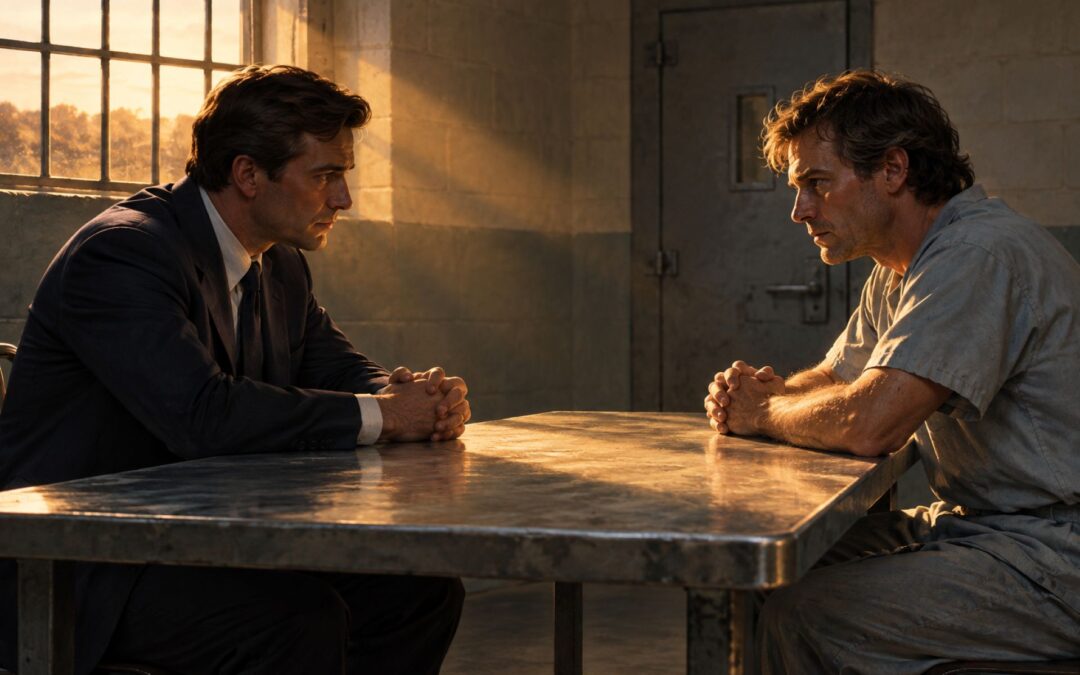
Keith enters the prison and arranges a private meeting with Hugh. The two men sit facing one another, separated by decades of resentment and the knowledge that Hugh may soon be put to death.
Their initial conversation is tense. Hugh mocks the extraordinary influence Keith now possesses over his fate, while Keith refuses to indulge in a prolonged exchange of insults.
The discussion eventually reaches Jesse’s murder.
Hugh insists that the bombing was intended as an act of intimidation. According to him, he and Noll arranged for Taylor to plant the device, but they expected the explosion to frighten Jesse rather than kill him.
Keith initially rejects the explanation. He remembers the evidence and testimony presented at trial and believes that the conspirators intended to murder his father.
Hugh continues to insist that he never wanted Jesse killed. He also maintains that Lance, who was imprisoned at the time, did not participate in the decision.
The conversation turns toward Agnes and the consequences for the Rudy family. Hugh remembers her from childhood and asks whether she wants him executed.
Keith acknowledges that Agnes does not share the same desire for punishment expressed by other family members. The answer does not resolve the question of clemency, but it makes clear that the family is not perfectly united in its emotional response.
Hugh also expresses bitterness about Keith’s position. He understands that the man he once considered his friend can now influence whether he lives or dies.
Gradually, however, the defensive posture gives way to a more direct confession of responsibility. Hugh continues denying an intention to murder Jesse, but he does not deny arranging the bombing.
He recognizes that his choices set the events in motion. The distinction matters profoundly to him because he wants Keith to believe that he did not deliberately seek the death of someone he had known since childhood.
Keith eventually accepts the sincerity of Hugh’s account. He agrees to tell Agnes and the rest of the family what Hugh has said.
Hugh apologizes. His acknowledgment does not undo the crime, restore Jesse’s life, or erase the suffering experienced by the Rudy family, but it allows the former friends to confront one another without relying entirely on hatred.
Keith nevertheless refuses to change his position on the death sentence. He believes that the jury’s judgment was justified and continues to support it.
He has long imagined watching Hugh’s execution, but now finds that he cannot do so. Instead, he decides to return to Biloxi and be with Agnes.
The novel ends with the two men parting. Hugh remains condemned, while Keith leaves without witnessing the execution.
Grisham does not narrate the execution itself. The ending brings the characters to the threshold of that event and leaves the final emphasis on their conversation, Hugh’s apology, and Keith’s decision to turn away from the spectacle of punishment.
Biloxi and the Dixie Mafia: Geography, Institutions, and Power
Biloxi provides much more than an attractive Southern setting for the Rudy–Malco conflict. The city’s geography, industries, ethnic communities, and political arrangements help explain how the characters acquire power and why confronting organized crime proves so difficult.
Grisham begins with the seafood economy because it establishes the social foundation shared by the two families. The Croatian immigrants who settle on Point Cadet work demanding jobs and develop businesses within a community that values family continuity and material advancement.
Their descendants inherit opportunities that earlier generations lacked. Jesse receives the education necessary to become a lawyer, while Lance can develop commercial interests beyond the small enterprises established by his family.
The two men therefore emerge from broadly similar circumstances, but the institutions they choose to exploit differ substantially. Jesse enters the legal profession, whose authority depends on formal rules and public recognition. Lance develops businesses that operate through a mixture of legitimate commerce and criminal arrangements.
The Strip is especially important because it makes these worlds overlap. Nightclubs, bars, and restaurants provide employment and entertainment, but some also function as gambling houses, brothels, and meeting places for criminal operators.
These establishments depend on ordinary infrastructure. They need property, electricity, suppliers, staff, customers, transportation, and banking arrangements. Their illegal activities are therefore embedded in a recognizable commercial environment rather than isolated from the rest of the city.
The presence of military installations and tourism helps sustain demand. Visitors seeking temporary entertainment may be less concerned about the businesses’ reputations, while the movement of workers and servicemen supplies a regular flow of potential customers.
This economic integration helps explain why the criminal establishments are difficult to remove. Closing them can affect property owners, employees, contractors, and politicians who benefit from their continued operation.
The organizations also exploit the separation between different levels of authority. The sheriff controls important aspects of local law enforcement, while prosecutors, state officers, federal agents, and judges possess different responsibilities.
Fats Bowman uses that division to protect favored criminals. He can discourage local investigations and provide warnings, but he cannot completely control state police, federal investigators, or every court.
Jesse’s campaign becomes effective partly because he learns to operate around those limitations. He obtains assistance from other agencies, develops witnesses inside the criminal enterprises, and uses legal remedies that do not always require proving a major criminal conspiracy.
The legal system thus appears as a collection of institutions with different capacities and vulnerabilities. Its effectiveness depends on the people occupying public office and their willingness to use the authority available to them.
Hurricane Camille briefly disrupts the established economic order, but the criminal organizations adapt. The storm destroys buildings without eliminating demand for illegal entertainment or the relationships that protect its suppliers.
The insurance litigation also shows how a major external event can alter political power. Jesse gains influence through civil cases rather than through the criminal prosecutions for which he will later become famous.
Parchman serves a different function in the final portion of the novel. Located far from the Coast, it represents the state’s power to confine, punish, and eventually execute. The distance between Biloxi’s nightlife and the prison’s restrictive environment becomes a measure of how completely Lance and Hugh have lost their former autonomy.
The historical dimension requires an important qualification. Grisham uses actual places, social developments, and aspects of Mississippi’s criminal history, but the central family conflict is invented.
In Grisham’s discussion of Biloxi’s history and the fictional nature of his novel, he distinguishes his researched setting from the story he has created. His Author’s Note makes the same distinction, acknowledging the historical seafood industry, immigration, and criminal activity while identifying the surrounding narrative as fiction.
The term “Dixie Mafia” also deserves care. It suggests a coherent criminal organization, but the historical label was applied to loosely connected criminals operating in different parts of the South. Grisham uses the popular reputation of these networks while constructing a particular fictional organization around Lance.
This mixture of researched background and invented events is one of the novel’s principal methods. It gives the story the texture of a regional history without imposing the obligations of a factual account of specific prosecutions or murders.
The distinction matters because the fictional legal victories and criminal activities should be evaluated as elements of Grisham’s narrative. They may draw credibility from the historical environment, but that environment does not independently verify the events attributed to Jesse, Lance, Keith, or Hugh.
Jesse Rudy and Lance Malco: Two Competing Models of Success
Jesse and Lance are the principal architects of the conflict that their sons eventually inherit. Both descend from families that arrived on the Gulf Coast seeking better economic opportunities, and both achieve a level of prominence unavailable to their ancestors.
Their shared background makes their differences more revealing. Neither man is simply a product of deprivation or inherited privilege. Each possesses intelligence, ambition, an understanding of social relationships, and the willingness to take substantial risks.
Lance develops his career through commercial calculation. He recognizes that gambling and prostitution can generate profits far beyond ordinary retail activity, particularly when political protection limits the likelihood of prosecution.
His rise depends on a sophisticated understanding of informal power. He uses concealed ownership, trusted managers, cooperative lawyers, and corrupt officials to reduce his exposure. When competitors threaten his interests, he can employ intimidation or violence through associates such as Noll.
The organization becomes an extension of his personality. Lance is confident, commanding, protective of his authority, and accustomed to seeing practical difficulties as problems that money or force can solve.
His greatest weakness is his belief that the system will continue operating because it has always served him. He understands commercial risk but underestimates the consequences of sustained institutional opposition.
When Jesse begins obtaining witnesses and negotiating plea agreements, Lance discovers that criminal loyalty is less reliable than he assumed. Employees who benefited from his enterprise refuse to accept imprisonment simply to protect their employer.
His paternal influence is equally consequential. Lance admires qualities in Hugh that can be useful within a criminal organization: physical courage, loyalty, aggression, and willingness to confront enemies.
He does not adequately distinguish those traits from recklessness. Hugh grows up receiving approval for behavior that increases his long-term vulnerability.
Lance’s willingness to overlook the risks of Hugh’s boxing and criminal apprenticeship is partly an expression of affection, but it also reflects his expectation that the boy will continue the family enterprise. He treats an illegal inheritance as though it were an ordinary business succession.
His relationship with Carmen demonstrates the limitations of this outlook. She repeatedly experiences anxiety and distress over the dangers associated with her husband’s career. Lance’s financial success cannot protect the family from the emotional consequences of violence.
His imprisonment forces him to confront the failure of the life he built. Yet the later murder of Henry Taylor indicates that punishment has not eliminated his dependence on retaliation.
His final isolation is particularly important. After leaving prison, he possesses money and property but has lost much of the network that once made those assets symbols of success. His marriage has disintegrated, his associates have disappeared, and the criminal economy no longer offers the same position.
Jesse’s career develops through a different understanding of authority. He believes that legal skill can produce professional advancement and, eventually, political influence.
His early ambitions are not entirely selfless. He enjoys courtroom victories, wants public recognition, and possesses the confidence necessary to challenge established figures. His prosecution of organized crime grows out of conviction, but it also provides a compelling purpose for an ambitious public career.
The hurricane litigation demonstrates his strategic intelligence. Jesse identifies a widespread grievance, assembles numerous cases, cooperates with a favorable judge, and uses repeated jury verdicts to change the insurers’ financial incentives.
His willingness to pursue punitive damages and maintain an exhausting trial schedule shows the same competitive instinct that makes him an effective prosecutor. He understands that opponents can be defeated by forcing them into positions where continued resistance becomes too expensive.
Later, he applies comparable pressure to Lance’s organization. Instead of expecting a dramatic confession, he closes businesses, exposes vulnerable associates, negotiates cooperation, and gradually isolates the principal defendants.
His determination makes him admirable, but Grisham also provides reasons to examine his methods critically. His close relationship with Judge Oliphant, aggressive use of legal leverage, and willingness to exploit favorable circumstances demonstrate how much prosecutorial success can depend on relationships and discretion.
These features do not make him morally equivalent to Lance. Jesse seeks legal remedies against criminal activities, while Lance organizes enterprises that use violence to maintain power.
The comparison is nevertheless illuminating because both men understand that influence depends on institutions and people. Lance cultivates corrupt police officers and criminal associates; Jesse builds networks among lawyers, judges, investigators, and voters.
The crucial difference lies in what those networks are used to accomplish and the extent to which their actions remain accountable to public law.
Jesse’s greatest vulnerability is the assumption that lawful authority can shield him from opponents who do not accept its limits. He understands that prosecution can be dangerous, but his commitment to investigating older murders keeps him in direct conflict with men accustomed to eliminating threats.
His murder exposes the physical risk concealed beneath the procedural struggle. Legal victories have weakened the criminal organization, but they have not removed its capacity to retaliate.
Both fathers leave powerful inheritances. Jesse’s reputation helps Keith enter public office, while Lance’s criminal wealth and expectations shape Hugh’s adulthood. Yet the consequences differ because the two careers have been built on fundamentally different foundations.
Keith Rudy and Hugh Malco: Inheritance, Rivalry, and Choice
Keith and Hugh begin the novel with a remarkable amount in common. Their families share an immigrant background, they attend the same schools and churches, and both excel at baseball.
Their early friendship is important because neither boy initially understands his future as an inevitable extension of his father’s choices. They enjoy the same games, friendships, and ambitions, and their talents give them similar opportunities for local recognition.
The divergence begins as they respond differently to adolescence. Keith remains disciplined and academically successful, while Hugh becomes attracted to physical confrontation and the privileges associated with Lance’s criminal world.
Hugh’s interest in boxing is revealing. It offers him an arena where courage and toughness matter, but his unwillingness to maintain disciplined habits prevents him from achieving the level of success he imagines.
The experience exposes an important contradiction in his personality. Hugh wants the reputation of a formidable man but is reluctant to accept the sustained work that might make him one.
Lance’s wealth makes the contradiction easier to sustain. Hugh does not need to develop an independent profession or earn his position through education. He can occupy a profitable place within an organization already created for him.
His jewelry-store robberies demonstrate that he is not simply obeying his father’s wishes. Hugh seeks excitement beyond the familiar enterprises and voluntarily engages in crimes that expose him to serious danger.
His decisions are increasingly shaped by the desire to prove himself. He wants recognition as someone capable of acting decisively, but his behavior often lacks the caution and strategic patience that enabled Lance’s rise.
Keith’s progress follows a more conventional route. He attends law school, becomes a lawyer, marries Ainsley, and works toward professional advancement.
His admiration for Jesse is genuine. He sees his father’s career as evidence that legal ability and public courage can improve the community. Their relationship gives Keith both a model of success and access to an established professional network.
Yet Keith also possesses personal ambition. His later campaign for attorney general shows that he is attracted to the influence and status available through public office, even after he has achieved the position his father’s murder placed before him.
The decisive change in his character occurs after the bombing. He is no longer pursuing public service primarily through admiration for Jesse’s achievements. He is also seeking punishment for the men responsible for destroying his family.
This creates an ethical problem because Keith’s personal interests align with his official duties. Prosecuting the killers is a legitimate public responsibility, but he has unusually strong emotional reasons to desire the harshest possible outcome.
The novel does not suggest that the charges against Hugh are fabricated or that the conviction depends solely on Keith’s anger. The trial includes evidence, witnesses, legal representation, and formal procedures.
Nevertheless, Keith’s desire for punishment cannot be separated from his grief. The governor’s later reliance on his judgment in the clemency question makes this conflict explicit.
Hugh’s position is different because his actions are the source of the criminal liability. He has inherited a dangerous environment, but he repeatedly chooses to participate in it.
He could have pursued other opportunities, particularly given the family’s resources. Instead, he adopts the organization’s code of retaliation and helps arrange the bombing of Jesse’s office.
His final account introduces a distinction between intention and consequence. He insists that he did not want Jesse killed, but he acknowledges that he participated in planning a violent attack intended to intimidate a public official.
The distinction does not eliminate his responsibility. The use of an explosive device against an occupied public building creates an obvious danger of death, regardless of the conspirators’ claimed expectations.
Hugh’s remorse becomes significant because it requires him to acknowledge something he had previously resisted: the limits of his own control over events. He believed that violence could deliver a calculated message, but the outcome destroyed another family and ultimately cost him his freedom and life.
His apology is not presented as a complete moral transformation. He remains defensive in parts of the final conversation, and the approaching execution gives him a compelling reason to seek Keith’s belief.
Even so, the scene allows the reader to see a person beneath the criminal identity. His memories of Agnes, the old schoolroom, and his friendship with Keith suggest that his earlier life has retained emotional meaning.
Keith also becomes less rigid during the encounter. He initially rejects Hugh’s explanation but eventually believes that the killing was not intended in the precise way established at trial.
His acknowledgment does not change his position on punishment, which is essential to the scene’s complexity. Keith can believe Hugh’s statement, experience a measure of sympathy, and continue supporting the execution.
The two men therefore reach a limited understanding without returning to their childhood friendship. Their shared past makes the encounter painful, but it does not provide a way to reverse the consequences of their adult choices.
Grisham’s characterization is strongest when he allows these contradictions to remain visible. Keith can be both a capable public official and a grieving son whose judgment is personally compromised. Hugh can be genuinely remorseful and still responsible for arranging the criminal act that resulted in Jesse’s death.
The novel also illustrates the limits of inherited identity. Both men follow paths strongly influenced by their fathers, but neither is deprived of agency. Their decisions gradually transform a shared childhood into an irreversible confrontation.
The Women, Allies, Lawyers, and Enforcers Who Shape the Feud
Although the central conflict is organized around four men, its development depends on numerous secondary characters. These figures reveal how family life, political influence, criminal loyalty, and legal procedure interact with the main story.
Agnes Rudy provides emotional stability within Jesse’s family. She supports his professional ambitions while understanding the risks created by his campaigns against organized crime.
Her reservations about Keith’s later decision to become district attorney reflect the same concern. Having lost Jesse to criminal violence, she is reluctant to see her son assume the position that exposed his father to danger.
Agnes’s testimony during Hugh’s sentencing also gives the prosecution’s case a personal dimension. The jury has already heard evidence about the conspiracy, but her account places the consequences of the killing within the lives of those who depended on Jesse.
Her response to Hugh’s impending execution becomes equally important. Keith acknowledges that Agnes does not share the desire for revenge expressed by other family members, although that does not mean she denies his responsibility.
Carmen Malco occupies a contrasting position. She benefits materially from Lance’s wealth but repeatedly suffers anxiety over his criminal activities and Hugh’s growing participation.
Her distress after Hugh’s boxing injuries illustrates the difference between parental care and Lance’s ideal of masculine toughness. Later, the family’s escalating criminal exposure makes her life increasingly unstable.
Carmen’s eventual separation from Lance reveals the limits of money as a substitute for trust and security. The comfortable home he provides cannot preserve a marriage repeatedly exposed to fear and dishonesty.
Ainsley Rudy becomes important during Keith’s transition into adulthood. She supports his professional life while recognizing that his public responsibilities and personal grievances expose their household to strain.
Their children and family routines provide a continuing sense of ordinary life as the legal conflict persists. Keith’s success has personal consequences beyond elections and courtroom victories, and Ainsley helps establish that dimension.
Egan Clement is one of the more consequential professional allies. Her work investigating unsolved murders extends Jesse’s campaign beyond the visible offenses associated with prostitution and gambling.
The courthouse bombing also makes her a victim of the criminal violence she has been investigating. Her injuries reveal that the consequences of the attack are not confined to Jesse or his family.
Haley Stofer represents the importance and danger of inside information. His infiltration allows investigators to understand how the criminal establishments operate, but his cooperation places him at risk from men whose loyalty is enforced through fear.
Nevin Noll is the most significant figure on the criminal side after Lance and Hugh. He embodies the organization’s willingness to employ violence, but his later cooperation with prosecutors exposes the self-preserving calculations concealed beneath his reputation.
Noll’s escape from Parchman prevents the story from ending with an entirely completed process of justice. His survival as a fugitive suggests that the criminal system can produce consequences beyond the point at which its original leaders have been punished.
Fats Bowman shows how organized crime becomes politically sustainable. He possesses legitimate public authority and uses it to shield criminal operations, demonstrating that illegal enterprises may depend less on secrecy than on the complicity of officials who already know what is occurring.
Joshua Burch performs a different function. He is a skilled criminal lawyer who repeatedly challenges prosecutions against members of the organization.
His effectiveness depends on legal rules that protect defendants against weak evidence and unfair procedures. Those safeguards are necessary even when the accused are morally unsympathetic, but Burch’s association with the organization also shows how wealth can secure formidable representation for violent criminals.
Jackson Lewis and the other investigators provide a counterweight to compromised local policing. Their forensic work and coordinated investigation demonstrate the difference that professional resources and institutional independence can make.
Judge Oliphant, Judge Roach, and Chuck McClure also help establish the procedural framework within which the conflict is resolved. Their involvement indicates that successful prosecutions depend on more than a determined district attorney.
These secondary characters are unevenly developed. Several possess clear narrative functions but limited independent psychological lives. Grisham generally introduces them when their professional skills, loyalties, or decisions become necessary to advance the plot.
The technique contributes to the novel’s breadth but sometimes reduces its emotional intimacy. Figures such as Carmen and Ainsley, whose experiences could provide a sustained view of the families’ private lives, are frequently subordinated to the legal and criminal developments involving the men.
Their presence remains indispensable, however. Without them, the story would risk treating violence as a contest between powerful individuals rather than an activity whose consequences spread through households, workplaces, and communities.
Justice, Corruption, Family Loyalty, and the Machinery of Violence
One of the novel’s most developed themes is the relationship between criminal power and public institutions. Lance’s organization survives for years because it operates within a political environment that makes prosecution difficult.
Its protection depends on relationships rather than complete secrecy. Fats Bowman and other influential figures understand the nature of the businesses they are protecting, and the criminals know which officials can be trusted.
The arrangement allows serious offenses to become routine. Illegal gambling and prostitution generate revenue, and violence is used when competitors or witnesses threaten that revenue.
Jesse’s career demonstrates how difficult it is to reverse such arrangements. His initial political defeat shows that public dissatisfaction does not automatically produce reform, especially when powerful interests control money and established political networks.
His later success depends on accumulating practical advantages. He gains financial independence through the insurance litigation, develops public credibility, builds institutional alliances, and acquires evidence through undercover investigations and cooperating witnesses.
Reform is therefore presented as a prolonged process of changing incentives. Criminal enterprises become less secure when owners lose property, customers, witnesses, and the ability to influence public officials.
This process also reveals the importance of legal procedure. Jesse cannot simply punish Lance because he believes Lance is responsible for criminal activity. He must establish specific offenses through admissible evidence and obtain appropriate judicial decisions.
At the same time, the novel acknowledges that legal institutions can be compromised. Jury tampering, dishonest police officers, political intimidation, and powerful defense networks allow defendants to frustrate proceedings.
The problem is therefore broader than the character of individual criminals. A community may possess laws against organized crime while lacking the institutional independence necessary to enforce them consistently.
Family loyalty provides another organizing principle. Lance expects Hugh to continue his enterprises, while Jesse encourages Keith to pursue legal education and public achievement.
Each father transmits more than an occupation. Lance teaches Hugh that toughness and retaliation establish authority, while Jesse demonstrates the rewards of preparation, litigation, and political determination.
The inheritance is complicated by individual choice. Hugh’s robberies and participation in arranging the bombing cannot be explained solely by his upbringing, just as Keith’s later political ambitions are not automatic consequences of his father’s career.
Loyalty also operates differently inside the criminal organization. Members are expected to remain faithful because betrayal can provoke punishment, but the expectation weakens when prosecution threatens their personal freedom.
Fritz Haberstroh, Coot Reed, Henry Taylor, and Nevin Noll all demonstrate how legal pressure can undermine criminal solidarity. Their cooperation exposes the practical limits of an organization held together by profit and fear.
The resulting betrayals do not necessarily involve remorse. A witness may provide truthful evidence because the alternative is a severe prison sentence, not because he has acquired a new moral outlook.
Grisham’s attention to plea bargaining is particularly important here. The state uses the defendants’ conflicting interests to secure information that would otherwise remain concealed.
Such agreements are effective but ethically complicated. Prosecutors must evaluate testimony from people with strong incentives to protect themselves, while defendants may accuse cooperating witnesses of inventing evidence.
The legal system nevertheless depends on these arrangements because criminal conspiracies rarely leave complete documentary records. The people best positioned to explain them may themselves be guilty of serious crimes.
Violence forms a further connection between the different phases of the narrative. Early criminal disputes lead to intimidation and contract killings; those crimes generate investigations; the investigations create pressure for additional violence.
The bombing intended to stop Jesse’s work instead produces the destruction of the remaining Malco organization. It brings federal investigative resources, public outrage, and determined prosecution against the people involved.
The attempt to preserve criminal power therefore accelerates its collapse. Lance’s organization cannot successfully manage the consequences of employing violence against a public official.
Yet the novel does not present legal punishment as a complete answer to the harm inflicted. Keith obtains convictions, but Jesse remains dead and the family’s grief continues.
This distinction becomes increasingly important during the death-penalty proceedings. Hugh’s guilt and the justice of imposing a particular punishment are related questions, but they are not identical.
The courts determine that the conviction and sentence can stand. Keith, however, must confront whether he personally wants the state to execute someone he once considered his closest friend.
His position combines lawful responsibility with emotional revenge. He believes that Hugh deserves death, but his long-standing desire to witness the execution suggests that personal satisfaction has become part of his expectation.
The final conversation complicates that expectation. Hugh accepts responsibility while denying a particular intention, and Keith comes to believe him.
This acknowledgment does not compel a conclusion that the death sentence is unjust. It does, however, expose the difficulty of translating a complex moral history into a punishment that ends a life.
Grisham leaves the reader with the distinction between public justice and private reconciliation. The state can administer a sentence, but it cannot restore Jesse, recreate the boys’ friendship, or eliminate every consequence of their decisions.
Baseball, Storms, Courtrooms, and the Novel’s Recurring Images
Baseball provides the clearest recurring connection to Keith and Hugh’s childhood. When the boys are young, their abilities place them in a world governed by recognizable rules, teamwork, and the possibility of advancement through performance.
Their friendship develops through shared practice, competition, and ambition. They are admired because they possess talent and because their accomplishments are visible to the community.
The sport also offers an early image of a future that neither boy will achieve. Their dreams of professional baseball gradually disappear as education, criminal activity, and family expectations pull them apart.
Grisham uses that lost ambition to give the later feud an emotional history. Keith and Hugh were not always opposing figures in a criminal prosecution. They once imagined succeeding together in a world where their fathers’ choices seemed relatively distant.
The final return to their childhood sailing trip broadens this idea. On Ship Island, the boys discuss crossing the Atlantic, inspired by a story of youthful adventure.
They recognize that the plan would require preparation and that baseball might interfere, but they have no reason to imagine the far greater obstacles that will arise from their adult lives.
The scene is effective because it restores the openness of their childhood. Their lives have not yet been reduced to the identities of prosecutor and criminal defendant.
The Gulf Coast setting contributes to this contrast. Water initially represents work, recreation, family history, and youthful possibility. Fishing and sailing are part of the community’s ordinary life, but they also suggest a wider world beyond Biloxi.
Hurricane Camille changes the function of the landscape. The coastline becomes a place of destruction, exposing the vulnerability of homes, businesses, and established livelihoods.
The storm is first a literal historical catastrophe with immediate human consequences. Its narrative significance follows from those consequences: it disrupts the criminal economy, creates the insurance litigation that establishes Jesse’s reputation, and helps alter the political balance of the region.
The connection is stronger because Grisham does not make the hurricane a simple symbol of purification. The same destruction that gives Jesse an opportunity to advance also creates circumstances in which criminal businesses can recover and expand.
Courtrooms recur as the principal public spaces where authority is challenged. They are not automatically places where truth prevails, as Noll’s early acquittal and the Carousel mistrial demonstrate.
The outcome of a proceeding depends on evidence, witnesses, lawyers, judges, juries, and sometimes improper influence. The courtroom therefore becomes a setting where the difference between legal legitimacy and actual justice must be negotiated.
For Jesse, courtroom success is a means of acquiring influence. For Lance, legal proceedings are initially obstacles to be managed through money and experienced counsel.
The same institutions eventually determine Hugh’s fate. The courtroom that once allowed criminal defendants to escape punishment becomes the setting for his capital conviction.
Parchman provides a final contrast to the open spaces of childhood. Where the boys once moved freely through the streets, beaches, and waters around Biloxi, Hugh’s life becomes confined within prison walls.
The institution reduces the importance of the wealth and connections that shaped his earlier existence. His father can still hire lawyers and attempt to influence events, but neither money nor reputation can restore Hugh’s ordinary freedom.
The final conversation takes place in a small room where the men confront one another without the familiar surroundings of their childhood. Its physical simplicity emphasizes how much has changed.
The recurring imagery is most persuasive when understood through these concrete relationships. Baseball and sailing are associated with childhood possibility, the hurricane with historical disruption, courtrooms with contested authority, and prison with the consequences of irrevocable choices.
Grisham’s symbolism is generally restrained. The objects and places derive their significance from the events occurring around them rather than from an elaborate system of hidden meanings.
How Grisham Structures the Saga and Builds Legal Suspense
The Boys from Biloxi differs from a conventional legal thriller in the amount of history it establishes before reaching its principal murder prosecution. Grisham begins with the development of a city and two families, then allows the legal conflict to emerge gradually from their circumstances.
The four-part structure reflects this progression. The opening establishes the environment and the boys’ childhood; the second part follows Jesse’s campaign against the criminal establishment; the third concentrates on imprisonment, murder, and prosecution; and the fourth explores the aftermath through appeals and the approaching execution.
This organization gives the novel a sense of generational continuity. Events in the final chapters carry significance because the reader has seen the families acquire wealth, influence, and convictions over many years.
Grisham’s narration moves freely among characters and situations. He describes private conversations, public events, criminal schemes, courtroom strategies, and historical developments without restricting the story to a single person’s perspective.
The method allows him to explain an extensive network of relationships. The reader can follow Lance’s operations, Jesse’s legal decisions, Hugh’s criminal activities, and Keith’s career even when the characters possess different information.
It also alters the nature of suspense. In many legal thrillers, the central mystery concerns whether a particular defendant committed a crime or whether a lawyer can uncover hidden evidence.
Here, the reader frequently understands the criminal activities before the authorities can prove them. Much of the tension concerns whether institutions can establish legal responsibility against defendants protected by money, corruption, and intimidation.
This is especially apparent in the early murder prosecutions. The narrative makes the criminal organization appear dangerous, but the question is whether the prosecution can overcome weak evidence and sophisticated legal defense.
The insurance litigation supplies a different form of suspense. Jesse’s cases are built around technical distinctions involving storm damage, coverage, and punitive awards.
Rather than relying on physical danger, Grisham creates momentum through repeated courtroom contests and the growing pressure on insurers. The narrative shows how a series of seemingly similar cases can become increasingly consequential when their cumulative financial effect changes the defendants’ position.
The later prosecution of Lance depends on another mechanism. The principal question becomes whether the organization can maintain its internal solidarity.
Witness cooperation develops gradually, and each plea agreement makes the remaining defendants more vulnerable. This provides a clear sequence of cause and effect even when the proceedings involve numerous characters and legal distinctions.
The murder investigation introduces a more familiar thriller structure. Investigators recover physical evidence, identify a suspect, construct an undercover operation, and assemble a case against the men allegedly responsible for arranging the crime.
Grisham’s familiarity with legal procedure gives these scenes clarity. He understands how evidentiary weaknesses, witness incentives, defense tactics, and judicial decisions can shape a prosecution.
His dialogue is especially effective when lawyers or investigators explain a practical problem through argument. The reader learns why a particular piece of evidence matters because characters must decide how to use it.
The novel’s broad chronology, however, creates difficulties. Grisham frequently summarizes months or years of activity in passages that describe careers, business arrangements, elections, or changing relationships.
This approach is efficient for explaining large-scale developments. It allows the reader to understand how Biloxi changes over decades without requiring every transition to be dramatized.
Yet the same technique can make character development feel reported rather than experienced. Keith and Hugh’s friendship is established convincingly in childhood, but much of their adult separation is conveyed through descriptions of their diverging lives rather than sustained interactions.
The reader can understand why the two men become enemies while still wishing to see more of the gradual emotional deterioration of their relationship.
The supporting cast also contributes to the novel’s documentary quality. Lawyers, investigators, officials, criminals, and witnesses appear as the narrative requires them, sometimes receiving extensive background before moving out of focus.
Their presence creates a believable sense of social scale, but the accumulation of professional histories and procedural explanations can interrupt dramatic momentum.
The final section demonstrates a different approach. The narrative narrows from the broad history of the two families to an individual encounter between Keith and Hugh.
The return to their sailing adventure is particularly effective because it briefly restores the childhood perspective that the intervening years have displaced. The reader no longer sees only a prosecutor and a condemned man, but two former friends who once imagined crossing the Atlantic together.
Grisham then refuses to provide a conventional climactic execution scene. The narrative ends with the emotional and moral encounter that precedes the punishment.
This choice gives the conclusion a quieter force than the surrounding material might suggest. The final uncertainty is less about whether the legal process will continue than about what Keith and Hugh have actually achieved through their conversation.
The novel’s strengths and limitations therefore arise from the same structural ambition. Its extensive history gives the legal conflict accumulated weight, but the breadth of that history sometimes prevents the central relationships from receiving sustained dramatic attention.
The Ending Explained: Guilt, Intention, Mercy, and Revenge
The ending of The Boys from Biloxi depends on a distinction that becomes clear only when Keith and Hugh finally speak face to face.
Hugh has been convicted of capital murder for his participation in the conspiracy that produced the courthouse bombing. The prosecution established his involvement through evidence that included testimony from Henry Taylor and Nevin Noll.
His final statement does not deny arranging the attack. Instead, he insists that the plan was to intimidate Jesse rather than kill him.
For Hugh, this distinction is profoundly important. He wants Keith to understand that he did not deliberately set out to murder the father of someone he had known since childhood.
The claim introduces a possible difference between the conspirators’ intended result and the actual consequences of their actions. It does not eliminate the danger they knowingly created by arranging an explosion in a public building.
Keith initially rejects Hugh’s explanation because he remembers the evidence presented at trial. The witnesses had implicated Hugh in the conspiracy, and Keith had spent years believing that the bombing was designed to kill Jesse.
Nevertheless, Hugh’s behavior during the conversation gradually persuades him that the explanation is sincere. The narrative presents Keith’s eventual belief as an emotional and personal judgment rather than a new judicial finding.
This distinction should not be overlooked. Keith’s belief does not reverse the conviction, establish a legal defense, or prove that Hugh bears no responsibility for the death.
Hugh himself accepts that the bombing occurred because of his decisions. He acknowledges that he set the events in motion and expresses regret for the consequences.
His remorse is therefore meaningful but limited. He can recognize his responsibility without persuading Keith that execution is unjustified.
The conversation also raises the question of Lance’s involvement. Hugh insists that his father did not participate in the decision to bomb the courthouse because he was imprisoned and unaware of the plan.
Keith’s inquiry reflects the wider history of the feud. Lance’s criminal organization created the relationships and methods through which the bombing became possible, but organizational responsibility does not automatically prove knowledge of every particular decision.
Hugh’s account leaves the distinction between Lance’s general influence and direct participation in the murder important. The novel does not need to establish Lance as the immediate organizer to show how his criminal career shaped the circumstances leading to Jesse’s death.
The governor’s clemency arrangement creates the ending’s central ethical difficulty. Formally, the legal process has reached the point where Hugh faces an execution authorized by the state.
The governor nevertheless makes clear that he will be guided by Keith and the Rudy family’s wishes. As a result, Keith must confront an unusual degree of personal responsibility for the punishment.
His position is complicated because he is both a public official and the son of the victim. The law has determined that Hugh may be executed, but Keith must decide whether he personally wants to support that outcome.
The two questions are not identical. A person may believe that a sentence is legally valid without believing that carrying it out is wise, necessary, or morally desirable.
Keith has another reason to hesitate. Hugh is not a stranger whose criminal history can be considered apart from personal memory. He was once Keith’s closest friend.
Their childhood recollections therefore have a direct function in the final scene. They restore the relationship that existed before the families became enemies and make the approaching execution emotionally different from an abstract application of state authority.
The sailing memory is especially revealing. Keith and Hugh once imagined a future in which they would undertake a shared adventure beyond Biloxi.
That future never arrived. Their lives instead became entangled in the rival institutions created by their fathers, and the choices they made within those worlds eventually destroyed their friendship.
Hugh’s request for Keith’s belief is also different from a straightforward plea for clemency. He understands that he may die, and he wants the surviving Rudy family to know that he did not intend Jesse’s death in the way Keith has assumed.
The request is partly an appeal to his former friend’s memory of him. He wants Keith to recognize that some remnant of the boy he knew still exists beneath the criminal reputation.
Keith grants that recognition when he accepts Hugh’s statement and agrees to repeat it to Agnes.
Yet he refuses to withdraw his support for the execution. He continues believing that Hugh deserves the punishment imposed by the jury.
This creates an ending that resists an easy division between forgiveness and vengeance. Keith experiences a measure of sympathy and accepts a limited explanation, but he does not offer mercy.
His decision not to witness the execution is therefore significant. For years, he has imagined observing Hugh’s death as the final consequence of the murder. After the conversation, he can no longer bring himself to participate in that manner.
He chooses to return to Agnes rather than watch the state carry out the sentence.
The decision does not establish that Keith has rejected capital punishment or secretly changed his mind about Hugh’s guilt. It shows that personal confrontation has altered his relationship to the punishment he supports.
Watching the execution would satisfy the desire that had accompanied him through years of grief and prosecution. His refusal suggests that this desire has lost some of its certainty, even though he does not oppose the sentence itself.
Hugh’s response is also notable. He accepts Keith’s departure without another sustained attempt to manipulate the situation, allowing the conversation to end with an acknowledgment of their former friendship.
The novel does not establish that the men have fully reconciled. Jesse remains dead, Hugh remains responsible for the bombing, and Keith continues endorsing his execution.
Nor does it show Hugh’s execution. The narrative ends before that event, leaving the reader at the point where the legal machinery appears ready to complete its work.
This omission matters because the most important development has already occurred between the two men. Hugh has acknowledged responsibility while asking to be believed about his intention, and Keith has accepted that limited account without changing his position on punishment.
The ending also leaves other consequences unresolved. Nevin Noll remains at large, and the family and criminal histories that produced the conflict cannot be erased by the approaching execution.
Grisham thus avoids presenting legal punishment as a perfect restoration of moral order. The principal conspirators have been identified and convicted, but the damage caused by their decisions continues beyond the outcome of the case.
The final emotional movement belongs to Keith. He cannot recover his father or return to the innocence of his childhood friendship with Hugh. What he can do is choose how he will spend the night that has occupied his imagination for years.
By returning to Agnes, he turns away from witnessing the death of an enemy and toward the living person who has shared his loss.
That choice offers a limited form of personal resolution without resolving the larger question of capital punishment. The law may proceed, but the novel’s final emphasis falls on the human relationship that the legal process cannot repair.
What Works: Gulf Coast History, Legal Strategy, and Accumulating Consequences
The strongest achievement of The Boys from Biloxi is the credibility with which Grisham constructs a social and institutional environment around the central feud. The Strip, the seafood industry, local politics, corrupt policing, and the courts are interconnected parts of a community whose economy makes organized crime profitable and difficult to challenge.
The historical exposition gives the conflict consequences beyond the principal families. Jesse’s struggle against Lance affects business owners, employees, witnesses, elected officials, investigators, and residents whose lives have been shaped by the tolerated criminal economy.
Grisham is especially effective when explaining the mechanics of legal power. Jesse’s insurance litigation demonstrates how preparation, repeated trials, and punitive damages can place financial pressure on powerful defendants.
The later prosecutions apply comparable strategic thinking to criminal organizations. Nuisance proceedings threaten businesses, undercover investigations develop evidence, and plea agreements turn former associates into witnesses against their leaders.
These developments create satisfying narrative progression because victories must be earned through successive decisions. The prosecution does not defeat Lance simply by exposing him as a criminal; it must overcome the protection he has accumulated over many years.
The depiction of corrupt public authority is also persuasive. Fats Bowman is effective as a character because he does not need to behave like a conventional gangster. He maintains the social habits and political image of a respected official while quietly protecting criminal interests.
The same attention to institutional detail makes the courthouse bombing an effective turning point. Jesse’s murder transforms an established professional conflict into a personal tragedy and provides the foundation for Keith’s subsequent career.
The investigation and capital trial make strong use of Grisham’s legal knowledge. The reader can understand why witness cooperation matters, how defense lawyers attack accomplice testimony, and why the legitimacy of the prosecution requires attention to Keith’s personal involvement.
The novel’s generational structure also produces accumulating consequences. The fathers’ choices shape the sons’ opportunities, but those opportunities do not prevent the younger men from making destructive decisions of their own.
The final conversation benefits from this long history. Its emotional effect depends on remembering the boys as talented friends before they became adversaries.
Grisham’s decision to end before the execution itself is another strength. The conversation supplies a more complicated resolution than a depiction of punishment could easily provide, preserving the difference between legal responsibility and personal understanding.
The novel is therefore most successful when it combines procedural clarity with consequences that extend beyond any individual case. Its broad construction allows readers to see how a criminal organization rises, how institutions gradually weaken it, and how the resulting conflict destroys relationships that predate the struggle.
Where the Novel Falls Short: Pacing, Character Depth, and Ethical Blind Spots
The novel’s scale also produces its most important weaknesses. Grisham devotes considerable attention to historical background, business arrangements, legal strategy, and political developments, sometimes at the expense of scenes that might deepen the reader’s understanding of the central characters.
The childhood friendship between Keith and Hugh is convincing, particularly through baseball and the final sailing memory. Their adult estrangement, however, is often described through the diverging courses of their lives rather than through sustained encounters.
This creates a gap between the novel’s premise and its dramatic execution. A story built around two childhood friends becoming enemies invites close attention to the emotional deterioration of their relationship. Grisham provides the circumstances that make the break plausible, but the relationship itself sometimes becomes secondary to the history of the two organizations.
Hugh is particularly affected by this approach. His boxing, robberies, criminal apprenticeship, and resentment toward Jesse establish a recognizable trajectory, but his internal life remains relatively limited compared with the amount of attention given to his activities.
His final remorse is believable within the circumstances of the execution, yet a more sustained examination of his changing beliefs during imprisonment might have made the encounter still more powerful.
Keith receives greater professional development, but his emotional life is also largely organized around admiration for Jesse, the shock of the murder, and the pursuit of punishment. His marriage, children, and other relationships provide context without consistently receiving the same dramatic depth as his public career.
Several secondary characters function primarily as legal or criminal instruments. They appear to provide information, negotiate agreements, represent defendants, or advance investigations, then recede when their immediate purpose has been fulfilled.
The women in particular receive comparatively little independent narrative attention. Agnes and Carmen are important to the consequences of the feud, but their experiences are often presented in relation to the ambitions and decisions of husbands and sons.
The novel’s social portrait has a similar limitation. It provides extensive detail about Croatian immigration, the seafood economy, and organized crime, but its treatment of racial relationships and Black life in Mississippi is narrower than the historical period might warrant.
Henry Taylor’s history of racist violence introduces an important dimension of the era, but the broader effects of segregation and racial inequality remain less central to the novel’s social analysis than the criminal and political networks surrounding the Strip.
This imbalance does not invalidate the chosen story, but it limits the completeness of Biloxi’s social world as Grisham constructs it.
The pacing presents another difficulty. Some early chapters contain lengthy accounts of businesses, criminal rivalries, or professional histories before their relevance to the central conflict becomes fully apparent.
The insurance litigation is detailed and important, yet its extended procedural treatment can temporarily displace the developing relationship between the two families.
Similar difficulties occur when the narrative moves rapidly through years of political or legal history. Events are efficiently explained, but the accumulation of summary can make the novel feel closer to an account of historical developments than a continuously dramatized story.
The legal proceedings also depend at times on unusually favorable arrangements. Jesse benefits from judicial cooperation during the insurance litigation, and Keith’s later career involves influential political support and complicated personal involvement in prosecution and clemency.
These developments are not inherently implausible within the novel’s world, but their convenience deserves scrutiny. Grisham often emphasizes the effectiveness of determined public officials while giving comparatively less attention to the institutional safeguards that should limit their personal influence.
The capital-punishment ending raises the most substantial ethical question. Keith is presented as a successful prosecutor whose desire for justice is complicated by grief, and the final conversation challenges the certainty of his hostility toward Hugh.
Yet the novel stops short of a sustained examination of whether the execution remains morally justified once Keith accepts Hugh’s account of the original intention. It establishes an ambiguity without fully developing all of its implications.
That restraint can be read as appropriate to a thriller concerned with characters rather than philosophical argument. It can also leave readers wishing that the final ethical conflict had received as much analytical attention as the earlier courtroom mechanics.
The book’s limitations therefore arise less from individual errors than from the priorities of its construction. Grisham favors the development of a broad criminal and legal history, and this produces a rich setting and coherent procedural plot. The cost is reduced psychological intimacy, particularly in the adult relationship that gives the novel its title.
Is The Boys from Biloxi Worth Reading?
The Boys from Biloxi is an accomplished historical crime saga and an absorbing legal thriller, especially for readers interested in the way criminal organizations become entangled with ordinary businesses, politics, and law enforcement. Grisham’s strongest material explains how power is accumulated, protected, challenged, and eventually lost through a long sequence of choices and institutional confrontations.
Its extensive treatment of hurricane litigation, public-nuisance proceedings, witness cooperation, murder investigations, and capital appeals makes the story unusually detailed. Readers who enjoy legal strategy and the workings of criminal justice will find much to appreciate, even when the narrative spends more time explaining those mechanisms than developing the personal relationships behind them.
Those expecting a fast-moving thriller centered primarily on two former friends may find the historical sections slow and the emotional development uneven. Keith and Hugh remain compelling because of their shared past and their radically different futures, but the novel does not always provide the sustained psychological depth that its central premise could support.
The ending offers the strongest answer to that limitation. By bringing the men together at Parchman and returning briefly to their childhood, Grisham restores the personal relationship beneath decades of criminal and legal conflict. Their conversation allows for remorse, limited understanding, and unresolved disagreement without pretending that an apology can undo murder or that a conviction can heal grief.
The novel is worth reading for its convincing Gulf Coast atmosphere, its detailed portrayal of legal and political conflict, and its patient accumulation of consequences across two generations. Its most lasting achievement is the recognition that even when the law successfully identifies and punishes the guilty, the people who survive must still decide how to live with what has happened. Keith’s final choice to leave the prison and return to his mother gives that recognition a quiet, distinctly human conclusion.
Last Updated on October 17, 2026 by Aseem Gupta