
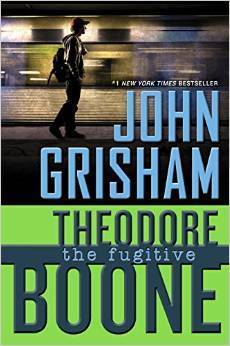
John Grisham’s Theodore Boone: The Fugitive begins with the kind of discovery its thirteen-year-old hero dreams about: Theo spots a wanted murder suspect hiding in plain sight and realizes that he may be the only person who recognizes him. Yet catching Pete Duffy turns out to be the easier part of the story. Once Duffy is returned to Strattenburg, Theo has to confront a harder question—what does justice require when proving the truth puts an innocent witness in danger?
Published in the 2015 Dutton Books for Young Readers edition, The Fugitive is the fifth Theodore Boone novel. It continues the unresolved murder case surrounding Pete Duffy and Bobby Escobar, but it gives enough context for readers to understand the essential conflict even without remembering every detail of the earlier books. Grisham combines a fugitive hunt, courtroom drama, legal education, and a coming-of-age story in which Theo’s confidence in the law is repeatedly tested by the people who have the most to lose from participating in it.
Spoiler warning: This article discusses the complete novel, including Pete Duffy’s capture, Bobby Escobar’s testimony, the plea agreement, and the final threat against Theo.
Complete Plot Summary of Theodore Boone: The Fugitive
The novel is divided into two named parts, and the division is essential to its design. “The Capture” follows Theo from his Washington school trip through the hunt for Pete Duffy and his arrest, while “The Retrial” shows that bringing a fugitive back is not the same thing as proving a murder case against him.
The two halves are tightly connected by Bobby Escobar. Theo’s determination to see Duffy face justice brings the earlier murder prosecution back to life, but doing so also forces Bobby back into a legal process he desperately wanted to escape.
Part One: The Capture
The story opens with Theodore Boone joining the annual eighth-grade trip from Strattenburg to Washington, D.C. Four buses carry the students toward several days of monuments, museums, and the small freedoms that come with being away from home. Theo is pleased that neither of his lawyer parents has volunteered as a chaperone, though their warnings about following rules are especially appropriate for a boy whose curiosity regularly pulls him into situations adults would prefer he avoid.
Theo travels with familiar classmates including Chase, Woody Lambert, Aaron Nyquist, and April Finnemore. The trip initially feels ordinary. He and some classmates visit Ford’s Theatre and the Petersen House, learning about Abraham Lincoln’s assassination before returning toward their hotel on the Washington Metro.
On the train, Theo notices a man reading a newspaper. Something about the face seems familiar even though the man now has darker hair, glasses, and a gray-flecked mustache. Recognition arrives suddenly: Theo believes he is looking at Pete Duffy, the Strattenburg businessman accused of murdering his wife, Myra.
Duffy’s earlier trial had already become one of the defining experiences of Theo’s young legal life. Prosecutors believed Duffy had left a golf course, returned home, strangled Myra, staged the scene to resemble a burglary, and then resumed his golf game. The original case had been weak enough that Duffy seemed capable of winning until a previously unknown eyewitness emerged. That witness was Bobby Escobar, an undocumented worker at Waverly Creek golf course, whom Theo had helped bring to the attention of the authorities.
Before Bobby could become the central witness in a new trial, however, Duffy fled. He became one of the most wanted men associated with Strattenburg, and many assumed he had escaped the country.
Now Theo thinks he has found him on an ordinary Metro train.
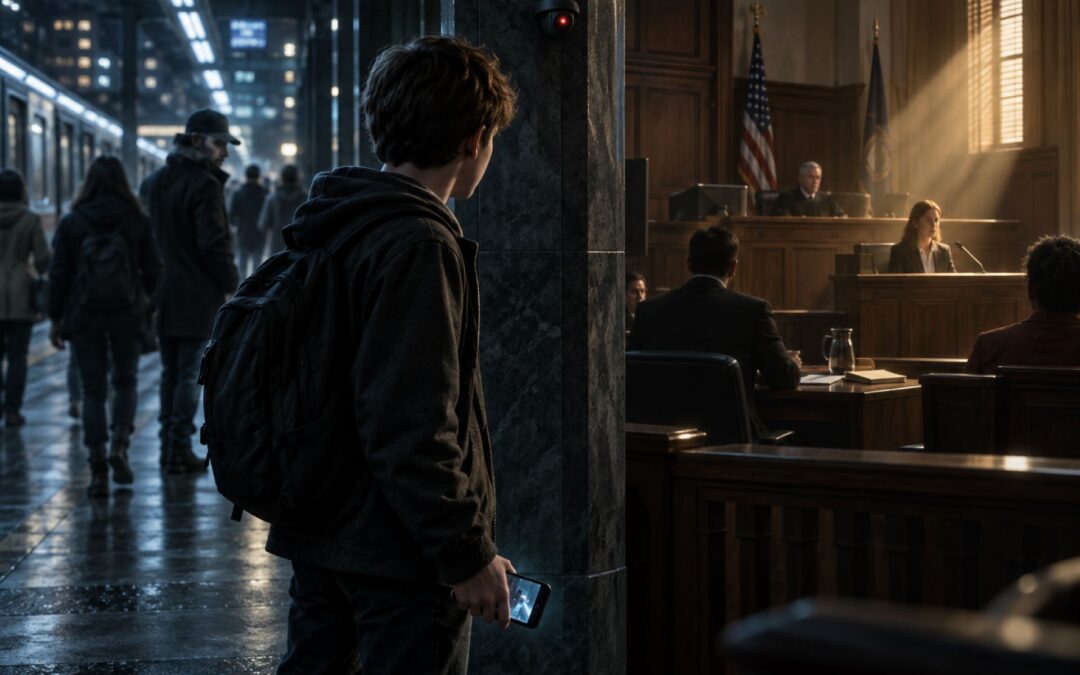
When the other students leave the train, Theo deliberately stays aboard. It is a serious violation of the field-trip rules, but he decides that losing Duffy would be worse. He uses his phone as inconspicuously as he can to record video of the man, then follows him after he exits at Tenleytown.
Theo notices more than Duffy’s altered appearance. He remembers the way Duffy walks, a detail that later becomes important because hair, glasses, and clothing can be changed more easily than habitual movement. Theo follows him through unfamiliar streets but eventually loses him and decides not to venture farther from the Metro station.
He then has to explain why he became separated from his group without revealing the real reason. Theo dislikes lying and tells himself that he is concealing the truth for a legitimate purpose, but the incident establishes a pattern that continues throughout the novel: his certainty that a larger good justifies bending an immediate rule.
Back at the hotel, Theo contacts Uncle Ike. Ike Boone, Woods Boone’s estranged brother, is a former lawyer who has spent time in prison and now works as a tax accountant. He is eccentric, suspicious of institutions, and much less cautious than Theo’s parents, which makes him one of Theo’s favorite adults.
Theo sends Ike the video. After examining it, Ike agrees that the man looks like Pete Duffy. Theo also remembers that there is a $100,000 reward for information leading to Duffy’s arrest and conviction, but the possibility of money is secondary to the excitement and danger of having found a fugitive.
Ike decides to travel to Washington and attempt an independent identification before they involve law enforcement. Theo gives him the Metro line, approximate time, station, and details of Duffy’s movements. While Theo continues with the school trip, Ike enters Duffy’s apparent world.
Ike eventually spots the man and follows him to an apartment building. His confirmation transforms Theo’s sighting from an extraordinary possibility into credible information. Once Theo returns home, the Boones discuss what to do next and decide the FBI must be contacted.
Agents Marcus Slade and Ackerman come to Boone & Boone. They repeatedly question Theo about the sighting, study his video, and send the material to specialists. Their preliminary assessment is strong enough to justify surveillance in Washington.
Theo is thrilled that professional investigators take his observation seriously, but he is also frightened. What if he was wrong? What if the government has deployed agents because a thirteen-year-old misidentified an innocent man?
The FBI watches the Metro and Duffy’s suspected apartment, but nothing happens. Duffy does not appear where Theo and Ike expect him. The agents begin to suspect that something has frightened him into changing his routine.
Theo’s imagination initially turns the FBI search into an action movie. He pictures agents blending into commuter crowds, silently coordinating an arrest, and surrounding Duffy at exactly the right moment. Reality is slower. Agents ride trains, watch strangers, wait, and repeatedly fail to find their target.
The disappointment causes Theo to question whether involving himself was wise. He worries that he has wasted federal resources and imagines legal consequences for wrongly accusing someone. Then the FBI calls again—not to reprimand him, but to ask him and Ike to return to Washington.
The agents realize that Theo and Ike possess something useful: direct familiarity. Theo has also emphasized that Duffy’s gait may be harder to disguise than his face. The FBI therefore incorporates them into a larger surveillance operation.
Theo enjoys the privilege of being treated as an asset by federal agents, but the actual work quickly becomes boring. He and Ike spend hours traveling back and forth on Metro trains, scanning crowds. They wear ordinary clothes and make small changes in appearance, but there is little glamour in the operation.
Duffy remains invisible.
The FBI eventually suspends the intensive search. Theo and Ike prepare to fly home, disappointed that their lucky discovery appears to have led nowhere. At Reagan National Airport, Theo wanders away from the gate while waiting for his flight.
There he accidentally bumps into a hurried traveler who drops his bag and glasses.
The man has blond hair and looks different from the person Theo saw on the Metro. Still, something is familiar. The eyes register first, and then the walk confirms Theo’s suspicion.
It is Duffy again.
Theo contacts Agent Slade using the operation’s coded language and follows Duffy through the terminal. Duffy is preparing to board a flight to Miami. Agents delay the plane and allow him to take his seat before intervening, reducing the chance that he can flee through the airport.
Duffy is traveling under the name Tom Carson. His identification documents are false. Investigators discover that he has a one-way itinerary leading from Miami to São Paulo, Brazil, and thousands of dollars in cash.
Under questioning, his false identity collapses. He admits who he is and is arrested.
As officers lead him away, Duffy sees Theo. Whatever secrecy the FBI can preserve publicly, Theo knows that the man himself may have recognized the boy involved in his capture.
The next morning, Strattenburg’s newspaper reports that Pete Duffy has been arrested at the Washington airport after an anonymous tip. Theo and Ike are not named, which relieves the Boone family. The relief is incomplete, however, because Duffy has dangerous associates and Theo understands that official anonymity does not guarantee personal safety.
The arrest also revives the murder prosecution. Duffy faces the unresolved charge involving Myra’s death as well as consequences for fleeing.
Theo quickly begins thinking about Bobby Escobar.
Bobby is not simply another witness. He is a young man from El Salvador who entered the United States illegally and found low-paid work maintaining the grounds at Waverly Creek. On the morning Myra Duffy died, Bobby happened to be eating lunch alone near the golf course when he saw Pete Duffy arrive at his house at a crucial time.
Theo had previously helped persuade Bobby to disclose what he had seen. Bobby never wanted the role. His immigration status makes any contact with official institutions frightening, and he worries about his family, especially his seriously ill mother in El Salvador.
Theo visits the neighborhood where Julio Peña, Bobby’s cousin, lives. Julio explains that Bobby remains nervous, sometimes stays with the family and sometimes elsewhere, and is thinking about going home. His mother’s illness gives him another powerful reason to leave the United States.
The problem for the prosecution is obvious. Catching Duffy matters only if the state can convict him, and Bobby may now be the most important person in the case.
The novel uses Theo’s school life to introduce the legal consequences gradually. In conversations with his favorite teacher, Mr. Mount, and with family members, Theo thinks about extradition, trial preparation, punishment, and the death penalty. Ike raises the possibility that Duffy could eventually avoid execution by accepting a plea bargain, planting the idea that the case may end through negotiation rather than a jury verdict.
Duffy is soon returned to Strattenburg. Theo and Ike attend his first court appearance before Judge Henry Gantry.
The contrast with Duffy’s earlier public image is striking. Once a prosperous businessman in expensive clothing, he arrives in an orange jail uniform with badly dyed hair and the look of a man whose attempt to vanish has failed. Judge Gantry confirms that Duffy still faces the capital murder charge and a separate escape charge.
Duffy pleads not guilty to both.
Judge Gantry makes clear that bail is not realistic and that he intends to move the case forward quickly. Duffy remains represented by Clifford Nance, the formidable defense lawyer who handled the first trial.
In the courtroom Theo also notices Omar Cheepe, one of Duffy’s associates. Omar and his companion Paco are the characters who convert Theo’s legal adventure into a personal danger. They are not merely interested observers; they are connected to the world around Duffy and willing to operate outside legitimate courtroom procedure.
Theo and Ike discuss discovery rules and the problem of Bobby’s identity. The defense will eventually need enough information to prepare for the prosecution’s witnesses, yet revealing Bobby also exposes him. Theo hopes that Judge Gantry and prosecutor Jack Hogan can protect him for as long as possible.
Elsewhere, Clifford Nance is asking the same questions from the opposite side. The defense still does not know exactly who caused Judge Gantry to stop the earlier trial. Omar tells Nance that Theo was in the courtroom and that Duffy remembers seeing Theo and Ike at the Washington airport.
Omar also remembers Theo’s involvement around the time the first trial collapsed. He suspects that the boy knows the mystery witness and may have helped the FBI find Duffy.
Nance orders Omar not to approach or openly follow Theo, but he tells him to keep an eye on the boy.
Before the murder retrial begins, Grisham inserts a seemingly unrelated case in Animal Court. Theo’s friend Woody Lambert and Woody’s brother Evan have trespassed on farmer Marvin Tweel’s property because they want to frighten his famous “fainting goats” and record the spectacle.
The goats have a muscular condition that causes them to stiffen and fall when startled. Woody and Evan shout, chase them, and finally throw a firecracker near the herd. All eleven collapse as expected, but later one goat, Becky, is found dead.
Tweel believes the boys killed her.
Theo represents them in the informal Animal Court presided over by Judge Sergio Yeck. He does not deny that Woody and Evan trespassed or behaved irresponsibly. Instead, he challenges the causal leap from misconduct to the claim that they killed Becky, noting that proving the goat’s cause of death would require more evidence.
At the same time, Theo recognizes that simply winning an argument would not make the situation right. He proposes a compromise. Instead of jail, a fine the boys cannot pay, or a disproportionate criminal consequence, they can work on Tweel’s farm.
Judge Yeck adopts the solution. Woody and Evan are found responsible for trespassing, avoid a formal record, and receive twenty hours of labor each.
The subplot is comic, but it quietly anticipates the larger resolution of the Duffy case. Wrongdoing can be real even when causation is disputed; punishment should be proportionate; and a negotiated outcome can sometimes satisfy justice better than the harshest available sanction.
Part Two: The Retrial
When Pete Duffy’s second murder trial begins, Theo is desperate to attend. School officials have already refused a request for Mr. Mount’s entire class to watch the proceedings, and Theo’s parents initially decide that he has missed too much school.
Theo responds with the tactics of a child who thinks like a lawyer. He considers fake illnesses and various schemes before settling on a brief hunger strike and an argument that watching the trial has educational value. His parents eventually relent for the opening day.
The sequence captures Theo’s unusual position in the series. He can discuss evidentiary rules and criminal procedure with practicing attorneys, yet he is still thirteen years old and negotiates family rules by refusing Cheerios.
Theo races to the courthouse and joins Ike in a packed courtroom. Pete Duffy sits with Clifford Nance in a dark suit, looking less like a fugitive and more like another professional at counsel table. The atmosphere differs sharply from the first trial because Duffy’s flight has changed public assumptions about him.
Theo believes strongly in the presumption of innocence, but even he struggles to maintain it emotionally. Duffy’s escape looks like consciousness of guilt, though flight by itself does not prove the murder.
The jury enters, and Jack Hogan begins the prosecution’s opening statement. He reconstructs the state’s theory of Myra Duffy’s death.
Myra was forty-six and was found strangled on the floor of her home beside Waverly Creek golf course. Pete, meanwhile, had been playing golf alone. Hogan argues that Pete’s real-estate finances were deteriorating and that a million-dollar life-insurance policy on Myra supplied a financial motive.
According to the prosecution, Duffy left the course, drove his golf cart home, entered without alarming his wife, strangled her while wearing gloves, staged parts of the house to suggest a burglary, and then returned to the course.
The state’s circumstantial case matters because Bobby’s testimony will not exist in isolation. The prosecution is constructing a timeline that Bobby can complete.
The defense has known Bobby’s identity for about a month. Judge Gantry allowed Hogan to keep the name concealed until procedural rules required disclosure, and once Bobby was revealed, the judge expressly warned everyone against unauthorized contact or intimidation.
Police move Bobby to a secret motel and provide protection. The precautions cannot eliminate his fear.
When Clifford Nance gives the defense opening statement, he largely ignores the physical evidence and attacks the witness who has not yet entered the courtroom. He labels Bobby a lawbreaker because of his unauthorized entry into the country and claims that Bobby has an overwhelming incentive to lie.
Nance suggests a bargain: Bobby supplies testimony damaging to Duffy, while police and prosecutors protect him from immigration consequences. Whether or not such a bargain actually exists in the form Nance describes, the strategy is powerful because it supplies jurors with an alternative explanation for Bobby’s conduct.
Instead of asking only, “Did Bobby see Duffy?”, the defense wants them asking, “What does Bobby gain by saying that he did?”
Theo is disturbed because he understands how frightened Bobby already is. Ike explains why the strategy could work: immigration is politically divisive, and jurors may bring strong opinions about undocumented workers into the courtroom even when those opinions do not establish whether a particular witness is truthful.
Theo increasingly regrets his role in bringing Bobby into the case.
The prosecution then begins presenting evidence. Myra’s sister, Emily Green, describes finding her after she failed to appear for lunch. She entered the house, found Myra on the floor, initially wondered whether she had fainted or suffered a medical emergency, and then discovered that she was dead.
Detective Thomas Krone describes the crime scene. Myra showed signs consistent with strangulation. Drawers and cabinets had been disturbed, valuables were missing, and the scene appeared arranged to suggest robbery.
Investigators found no useful outsider fingerprints. The house’s privacy and location near the golf course created an opportunity for someone familiar with the property to enter and leave unseen.
Krone also explains Duffy’s golf timeline. He had teed off alone on a quiet day, and investigators determined that he could have driven from his position on the course to the house within minutes.
Clifford Nance’s cross-examination demonstrates why circumstantial evidence remains vulnerable. He emphasizes that Myra was physically fit, that Duffy was not an especially imposing man, and that investigators cannot reconstruct every detail of how the strangulation occurred.
When Krone speculates about particular mechanics, Nance attacks the gap between possibility and proof. Theo watches the defense turn uncertainty into reasonable doubt one question at a time.
The trial therefore appears much like the earlier prosecution until Bobby can supply the missing direct observation.
After court, Julio arrives at Theo’s office. He explains that one of Bobby’s acquaintances attended the trial and reported Nance’s attack. Bobby has heard that he is being called a criminal and a liar before he has even testified.
Julio is angry with Theo. From his perspective, Bobby had been minding his own business when he happened to see something near the Duffy home. He did not choose to become part of a murder prosecution, and he lacks the security that makes abstract appeals to civic duty easy.
Theo insists that Bobby is doing the right thing. A woman was killed; Bobby saw something important; the justice system cannot function if crucial witnesses disappear because testifying is unpleasant or frightening.
Yet Theo also realizes that Julio’s objection is not merely cowardice. Bobby’s exposure is real.
Julio reveals that police have given Bobby a cell phone. He asks Theo to communicate with him.
Theo knows contacting a protected witness could create problems, especially because witness tampering is itself a crime. He nevertheless rationalizes that reassurance is different from manipulating testimony.
Using Julio’s Spanish, Theo sends a short message telling Bobby that he will be all right.
What neither boy knows is that Omar and Paco have broken into Boone & Boone and planted tiny listening devices in several rooms, including Theo’s office. Omar sits nearby listening to the conversation.
The surveillance changes the meaning of Theo’s helpful act. By sending the message, Theo places Bobby’s new phone number into a conversation the criminals can overhear.
Omar immediately contacts Paco. They now have a direct line to the protected witness.
That night Bobby sits in the secret motel between two police officers’ rooms. The officers have treated him well, but he remains isolated, unable to follow English-language television easily and worried about his family.
Then his phone begins receiving anonymous messages in Spanish.
The first tells him the lawyers will destroy him in court. Another claims police intend to arrest him as soon as the trial ends. A later message invokes his gravely ill mother and warns that if he testifies, he may not see her for years because he will be imprisoned before being deported.
The messages are carefully designed to exploit fears Bobby already possesses. They do not need to invent an entirely new anxiety; they merely convert uncertainty into apparent confirmation.
Bobby considers showing the messages to his police protectors but cannot overcome his distrust. He waits until the officers settle for the night, leaves the motel, and disappears.
Shortly after midnight, Julio calls Theo.
Bobby has fled.
At first Theo decides he has reached the limit of his involvement. Bobby made his decision, and adults should handle the consequences. Theo has been warned repeatedly to stay out of the case, and every attempt to help seems to pull him farther inside.
But the consequences of Bobby’s disappearance become clear the next morning.
Ike explains that Hogan promised the jury they would hear from Bobby. If the prosecution cannot produce him, the defense will argue that the promise itself has prejudiced the jury. Under the fictional rules operating in the novel, everyone fears a second mistrial could end the murder prosecution.
Duffy might then serve time for fleeing while escaping conviction for Myra’s death.
Theo tries to spend the second day at school while the trial proceeds as though nothing has happened. The prosecution continues presenting evidence, including testimony about Duffy’s finances designed to establish motive.
Only a few people know that the case may be collapsing.
At lunch Ike tells Theo that the defense seems unusually confident, though Theo cannot tell whether Omar and the defense team actually know Bobby has disappeared. The suspense now operates on two levels: the jury believes it is watching an ordinary murder trial, while readers know the state may no longer be able to complete the case described in its own opening statement.
Julio eventually learns that Bobby is hiding around apple orchards near Weeksburg among undocumented agricultural workers. He plans to travel back toward Texas, cross the border, and return to El Salvador.
Theo sends Bobby another message in Spanish. This time he writes it himself with the help of a dictionary, urging Bobby to return because the trial needs him and assuring him that he will be protected.
The next morning two officers arrive at Theo’s school and take him to the courthouse. The sight of Theo being escorted into a police car causes exactly the kind of gossip he expects. Theo himself briefly fears that he is being arrested for contacting Bobby.
Instead, Judge Gantry wants information.
Theo admits that he knew Bobby had disappeared and tells the judge about Weeksburg and the orchards. He also voluntarily shows Gantry the messages he sent.
Rather than accusing Theo of witness tampering, Gantry is primarily interested in finding Bobby and deciding what to do about the trial. He asks Theo to remain in chambers while the lawyers discuss the defense motion for a mistrial.
Clifford Nance argues that the prosecution explicitly promised Bobby’s testimony and has now failed to provide him. The jury has been primed to expect a damaging eyewitness whom the defense cannot confront.
Hogan proposes telling the jurors to disregard the relevant part of his opening statement and proceeding with the evidence already presented. Gantry is skeptical. He worries that the damage cannot simply be erased by instruction.
He delays his decision and gives authorities more time to search.
Theo watches the adults wrestle with competing forms of fairness. Letting Duffy benefit because a frightened witness vanished seems morally wrong, yet convicting him after the prosecution promised testimony that never appears may be procedurally unfair.
The police search the orchards around Weeksburg, but undocumented workers disappear before they can be questioned and Bobby remains missing. By early afternoon, the search has effectively failed.
Theo raises another possibility with Gantry. After the first mistrial, Bobby gave prosecutors a formal recorded statement through an interpreter. Why not read that statement to the current jury?
Gantry explains that Duffy’s lawyers were not present when Bobby gave it and therefore had no opportunity to question him. An accused person has a right to confront important witnesses rather than simply receiving damaging testimonial statements that cannot be tested.
That basic concern reflects a genuine constitutional principle. The Supreme Court’s decision in Crawford v. Washington emphasizes the importance of confrontation when testimonial statements are offered against a criminal defendant, particularly where there has been no prior opportunity for cross-examination.
For Theo, however, the legal doctrine becomes a moral discovery. Fairness is difficult precisely when it protects someone he believes is guilty.
At two o’clock, Gantry prepares to grant the mistrial.
Then Theo’s phone vibrates.
Bobby is calling.
The proceeding stops immediately. Bobby does not want to walk into a police station or courthouse without assurances, so he arranges to meet Judge Gantry, Theo, and a certified Spanish interpreter named Maria Oliva at Truman Park.
Bobby emerges looking exhausted, muddy, and frightened. He apologizes and admits he does not know whom to trust.
Gantry reassures him that the protections offered earlier remain in place. He will not be arrested for appearing, and the court will protect him.
Bobby agrees to return.
News of his reappearance spreads rapidly. By three o’clock, the courtroom is even more crowded. Duffy and Nance have lost the confidence they displayed while Bobby was missing.
Judge Gantry explains to the jury that Bobby will testify through Maria because he does not speak enough English to give reliable courtroom evidence without an interpreter. Both Maria and Bobby are sworn.
Hogan begins slowly.
Bobby says he is nineteen and from El Salvador. His family is poor, and he came to the United States looking for work so that he could support them. He entered illegally, left school at fourteen, speaks limited English, and earns seven dollars an hour doing maintenance work at Waverly Creek.
On the day Myra was killed, Bobby took his lunch break near the sixth fairway of the Creek Course. He preferred eating alone under trees where he could think about his family and pray.
During the break, he saw a golf cart moving quickly toward the Duffy home. The driver wore a black sweater, tan pants, and a maroon golf cap.
The man stopped near the patio, reached into his golf bag, removed a second glove, and put it on his right hand. Because right-handed golfers ordinarily wear a glove on the left, Bobby noticed the unusual action.
The man removed his shoes and went inside.
Several minutes later, he emerged, put his shoes back on, removed both gloves, placed them in his golf bag, and drove away.
Later Bobby saw the same man elsewhere on the course. He watched him remove something white from his golf bag and place it in a trash can. After the man left, Bobby searched the bin and found two golf gloves, one for each hand.
Bobby kept them. When he later realized that the golfer he had seen was connected to the murder investigation, the gloves eventually reached police.
Hogan presents the gloves in court, and Bobby identifies them.
Bobby also explains that when news of the death spread around the golf course, he moved close enough to see police at the Duffy residence. The same man he had seen entering the house was now sitting in a golf cart surrounded by officers.
A photograph confirms the clothing.
Finally, Bobby identifies Pete Duffy in the courtroom as the man he saw.
His testimony supplies what the circumstantial case lacked. Duffy was not merely close enough to return home; Bobby saw him do it. He was not merely a golfer who owned gloves; Bobby saw him put on an unusual second glove before entering the house and later discard both.
The day ends before Clifford Nance can launch the cross-examination everyone expects. A juror becomes ill, and Gantry adjourns until the following morning.
At dinner, Theo, Ike, and his parents discuss the testimony. Ike believes Bobby was highly credible. Although the gloves apparently do not contain some miraculous piece of forensic evidence establishing exactly how the murder occurred, Bobby’s account gives them a narrative meaning they did not previously possess.
The next morning Theo expects to miss the courtroom because his parents insist he has skipped enough school.
Then Judge Gantry calls the Boone home.
He requests Theo’s presence as an unofficial “law clerk.”
When Theo arrives in chambers, Gantry explains that events have changed dramatically overnight. Myra’s sons, Will and Clark, and her sister Emily have told prosecutor Jack Hogan that they do not want Duffy executed.
The family wants severe punishment but not the death penalty. Will and Clark had known Duffy as a stepfather who treated them well and helped provide for them before their mother’s death. Their feelings toward him therefore contain an uncomfortable mixture of grief, betrayal, anger, and remembered attachment.
Hogan has offered a deal. If Duffy admits murdering Myra, prosecutors will withdraw the pursuit of execution and accept life imprisonment without the possibility of parole.
The bargain also avoids years of capital appeals and gives the family certainty.
Gantry asks Theo what he thinks.
Theo supports the agreement. He has reservations about capital punishment and believes life without parole is sufficient. Duffy will never be free, the family accepts the outcome, and the murder case will finally end.
The lawyers enter chambers. Clifford Nance reports that Duffy will accept.
The plea agreement requires Duffy to plead guilty to murder and accept life without parole. He will also plead guilty to escape, with that sentence running concurrently.
When Duffy enters the room, he sees Theo and directly accuses him of being the person who found him at the Washington airport.
Theo refuses to answer, but Duffy’s suspicion is now certainty.
Judge Gantry conducts the formal plea inquiry. He confirms that Duffy understands the agreement, has consulted his lawyer, is competent, is acting voluntarily, knows he is surrendering his appellate rights, and understands that he will spend the rest of his life in prison.
Duffy pleads guilty.
There will be no jury verdict.
Gantry returns to the courtroom with Theo behind him. Theo sits near the bench while the judge informs the surprised jurors that Duffy has admitted the murder and will receive life imprisonment without parole.
The jury’s work is over.
For Theo, the moment has a second significance. Standing near Gantry and observing the courtroom from the judicial side, he imagines that being a judge may be just as interesting as being a trial lawyer. The case has taught him that the law is not only about proving arguments; it is also about making difficult decisions when several legitimate considerations collide.
A week later Sheriff Mackintosh visits Boone & Boone to resolve the $100,000 reward.
The sheriff believes Theo earned it. He spotted Duffy twice, recorded the initial video, involved Ike, and ultimately led federal agents to the fugitive.
Theo’s parents disagree with giving him the entire sum. They believe Ike deserves part because he immediately went to Washington and helped verify the sighting. More importantly, they believe Bobby deserves the largest share because there would have been no murder conviction or plea without him.
Their proposed division gives Theo $25,000 in a trust for college, Ike $25,000, and Bobby $50,000 under supervised arrangements.
Theo is not delighted that he cannot immediately use his money, and Ike would prefer a larger share as well, but neither wants to appear greedy at Bobby’s expense. The distribution extends the novel’s interest in fairness beyond strict entitlement. Theo may have fulfilled the technical terms of the reward, but the Boones judge contribution and need more broadly.
They do not know that Omar and Paco are listening.
The criminals still have functioning surveillance devices inside the law office. By overhearing the reward discussion, Omar finally confirms what he has suspected: Theo was responsible for Duffy’s capture.
Paco suggests that it is now too late to matter.
Omar disagrees.
The murder case is finished, but the danger to Theo is not.
Setting and Legal World: Strattenburg, Washington, and the Courts
The Fugitive uses a realistic setting, but it still performs a kind of world-building by constructing a social environment in which law surrounds nearly every part of Theo’s life. Strattenburg is a small enough city for courthouse gossip to travel rapidly, lawyers to know one another personally, and a thirteen-year-old with the right family connections to move through legal institutions with extraordinary familiarity.
Theo belongs securely inside this world. Both parents are lawyers, Uncle Ike is a former lawyer, Judge Gantry knows him personally, police officers recognize him, courthouse employees let him navigate back corridors, and teachers are accustomed to his fascination with trials. Even when adults tell him to stay out of a case, he knows how to reach the people making the decisions.
Washington briefly reverses that advantage. On the Metro, Theo becomes an anonymous child in an enormous city. Duffy benefits from the same anonymity, surrounding himself with millions of strangers and changing his appearance until recognition becomes difficult. The pursuit therefore depends not on formal authority at first but on Theo’s memory of a face, a gait, and a man he has watched before.
The airport provides the opposite version of the same setting. Duffy has false papers, cash, a new appearance, and an international escape route, yet modern travel infrastructure also creates points of control. Once Theo recognizes him and agents identify his flight, the airport becomes a trap rather than an exit.
Back in Strattenburg, the courthouse dominates the second half. The institution is public, formal, and ritualized. Jurors enter under supervision, lawyers speak according to rules, witnesses take oaths, and Judge Gantry controls what evidence reaches the jury.
Yet the most consequential actions repeatedly occur outside that visible space. Bobby is hidden in a motel. Omar listens from a van. Theo sends messages from his office and bedroom. Bobby vanishes into agricultural labor networks. Lawyers negotiate the plea in chambers rather than before the jury.
The contrast between Theo and Bobby is especially important. Theo experiences institutions as places he can enter almost at will; Bobby experiences them as institutions that may protect him today and punish him tomorrow. Theo worries about missing school to attend court, while Bobby worries that appearing in court could end with detention or separation from his family.
Boone & Boone initially seems like Theo’s safest environment. It is family territory, a place where he has his own makeshift office and can seek advice from lawyers. Once Omar and Paco bug the firm, that security becomes an illusion.
The surveillance makes physical setting part of the plot. A legal office associated with confidentiality and protection becomes the very place through which information about a vulnerable witness leaks.
Even the homeless shelter contributes to the book’s legal world. The Boone family volunteers there, Marcella provides legal assistance, Woods helps residents navigate paperwork, and Theo tutors children. Those scenes show that the Boones understand law not only as courtroom competition but as a form of civic service.
That ethic helps explain why Theo feels compelled to intervene when he believes he can help. It also explains the danger of his idealism: because he has repeatedly seen law used constructively, he initially underestimates how differently it can feel to someone like Bobby.
Character Analysis
The characters in The Fugitive are defined partly by their relationship to legal power. Theo can approach institutions with unusual confidence, Bobby has strong reasons to fear them, Duffy tries to manipulate and escape them, and the adult lawyers occupy different positions within an adversarial system that requires them to pursue conflicting goals.
The most interesting character development comes from what happens when Theo’s confidence meets Bobby’s vulnerability. The book does not turn Theo into a cynical critic of justice, but it forces him to recognize that believing in a system is easier when that system has generally treated you as someone worth hearing and protecting.
Theodore Boone
Theo begins the novel almost perfectly suited to a child legal thriller. He is observant, unusually knowledgeable about law, confident around adults, morally earnest, and unable to ignore a mystery once it crosses his path.
His decision to stay on the Metro after his classmates leave displays both his strength and his central flaw. He sees a chance to help catch a fugitive and acts quickly when hesitation would allow Duffy to disappear. At the same time, he assumes that because his objective is morally important, he can manage whatever consequences follow.
That assumption continues throughout the book. Theo contacts Ike rather than immediately turning to a teacher. He participates in FBI surveillance. He seeks information about Bobby through Julio. He sends messages to a protected witness even after recognizing that the situation may be legally sensitive.
None of these choices is malicious. Most are motivated by the desire to help.
That is precisely why his development matters. Theo discovers that good intentions do not control outcomes.
The most painful example is Bobby’s phone number. Theo wants to reassure someone who is frightened. He has no idea the office is bugged, yet his conversation gives Omar and Paco the information they need to intimidate Bobby.
Theo therefore becomes indirectly involved in creating the crisis he later helps solve.
His guilt is more mature than simple self-blame because Julio forces him to consider a perspective he has largely ignored. Theo thinks in terms of justice for Myra Duffy and society’s need for truthful witnesses. Julio thinks about what participation costs Bobby personally.
Theo is not wrong that murder witnesses sometimes have a civic responsibility to speak. Julio is not wrong that Bobby never volunteered to become a legal instrument for people who face far fewer risks than he does.
That tension complicates Theo’s moral universe without destroying it.
His relationship with Judge Gantry produces another stage of development. Theo usually imagines legal success in adversarial terms: spotting clues, making arguments, proving a point, or helping one side win. Gantry instead has to decide between competing forms of fairness.
Should the trial continue without Bobby? Should Duffy’s rights be protected even if everyone suspects guilt? Should a plea for life imprisonment replace a possible death sentence? A judge cannot solve those problems by simply choosing the person he likes better.
Theo begins to appreciate the loneliness of judicial authority when he sits in Gantry’s chambers during the mistrial dispute. For perhaps the first time, becoming a judge seems less glamorous because deciding fairly can mean accepting outcomes that feel emotionally unsatisfying.
By the plea hearing, however, he sees its appeal more clearly. Sitting near Gantry, looking over a courtroom in which punishment, mercy, procedure, family wishes, and public interest have converged, Theo recognizes another form of legal achievement.
The novel therefore moves him subtly from law as pursuit toward law as judgment.
Grisham keeps Theo believable as a child through humor and ordinary weaknesses. He schemes to escape school, launches a short-lived hunger strike, worries about his braces, feeds Judge under the table, fantasizes about reward money, and enjoys being treated as more important than his classmates.
Those qualities prevent his legal intelligence from turning him into a miniature adult. The balance is not always perfectly plausible, but psychologically it gives Theo more life than a purely precocious detective would have.
Bobby Escobar
Bobby Escobar is the most important character in the novel after Theo because his situation exposes the limits of Theo’s idealized understanding of justice. He possesses information the state desperately needs, yet participation in the system threatens the fragile life he has built.
Bobby is nineteen, from El Salvador, poorly educated, still learning English, and working for low wages at Waverly Creek. He entered the United States illegally because his family was poor and he hoped to earn money. His sick mother and younger brothers remain emotionally central to him even when they are physically absent.
His role in the murder case begins entirely by accident. Bobby does not investigate Duffy. He simply eats lunch alone near the golf course, observes a man behaving strangely, and later finds discarded gloves.
That accidental quality matters. Bobby is not motivated by ambition, revenge, or even an abstract desire to become a heroic witness.
His first instinct is avoidance.
The prosecution and Theo interpret his testimony primarily through its evidentiary value. Bobby sees something else: exposure. His name becomes known, his immigration status becomes courtroom material, police place him under protection, and defense counsel attacks his character before the jury hears a word from him.
Nance’s strategy works because Bobby genuinely has reasons to fear the authorities. He does not need to believe every anonymous message literally to know that his life depends on decisions made by people he does not fully understand.
His limited English deepens the problem. Even when officers are trying to protect him, he cannot fully participate in their world. The courtroom will require a translator, and legal distinctions that Theo absorbs almost casually may be inaccessible to Bobby.
The intimidation therefore targets an existing vulnerability rather than inventing one.
Bobby’s flight should not be read simply as cowardice. He has crossed countries, survived precarious employment, worked to support his family, and agreed at several points to cooperate despite considerable fear. Leaving the motel is a desperate judgment that the people claiming to protect him may eventually sacrifice him.
His return is consequently more significant than if he had never fled. Bobby comes back after confronting the possibility of disappearing permanently.
He also returns voluntarily. Theo helps create the opportunity, and Gantry supplies reassurance, but Bobby must still decide to walk into court.
Once on the stand, he becomes far more than the frightened person everyone has been discussing. His testimony is powerful because it is concrete. He remembers the cart, clothing, second glove, removal of shoes, return to the course, discarded gloves, and later recognition of Duffy.
The evidence is persuasive not because Bobby suddenly becomes eloquent but because his observations fit together.
His eventual receipt of half the reward provides a final recognition that testimony has cost him something. The money does not erase his fear or legal vulnerability, but it prevents the ending from treating his contribution as disposable once Duffy is convicted.
Bobby nevertheless remains somewhat underdeveloped because the novel spends more time showing what others think about him than exploring his interior life directly. Chapter 19 partially corrects this by entering his experience at the motel, but much of his characterization still serves the trial.
That limitation matters, especially because the book asks him to carry its largest social question. Even so, his presence transforms The Fugitive from a straightforward chase into a more ethically complicated novel.
Pete Duffy
Pete Duffy functions primarily as an antagonist and source of legal pressure rather than as a psychologically rich character. Readers see him through evidence, prior history, courtroom appearances, flight, disguises, and the reactions of others.
His fugitive behavior demonstrates intelligence and adaptability. He changes his appearance, routine, identity, and travel plans. He notices danger quickly enough to stop using the Metro pattern the FBI expects, and he comes close to escaping to Brazil.
Duffy’s ability to transform himself is limited by the habits Theo recognizes. He can dye his hair and carry fake documents, but his eyes and movement remain sufficiently familiar to betray him.
Once returned to court, Duffy’s legal position becomes more interesting than his personality. He pleads not guilty and allows Nance to challenge every weakness in the state’s case, as he is entitled to do. The novel does not ask readers to admire him, but it does insist that even a defendant who appears guilty receives procedural protection.
His plea finally resolves the gap between accusation and legal guilt. Until then, the responsible description is accused murderer or defendant, however convinced Theo and the town may be.
Duffy becomes most human near the end through the information about his relationship with Myra’s sons. Will and Clark remember him as a stepfather who treated them well and supported them, even though they believe he killed their mother.
That contradiction does not redeem him. It does, however, help explain why the family rejects execution and reminds readers that a person capable of a terrible crime may have occupied other roles in which he was not experienced simply as a monster.
Ike Boone and Judge Henry Gantry
Ike and Gantry function as contrasting mentors. Both treat Theo as unusually capable, but they represent very different relationships to law.
Ike stands partly outside the respectable legal establishment. He is a former lawyer with a criminal past, lives modestly, distrusts government institutions, and enjoys questioning conventional assumptions. His willingness to fly to Washington without bureaucracy or permission makes the Duffy investigation possible.
He also brings a rougher understanding of punishment. Having been imprisoned himself, Ike can explain distinctions Theo knows only in theory. Life in the general prison population, death row, plea agreements, and the human consequences of legal outcomes are not abstractions to him.
Ike’s cynicism sometimes slides into speculation, and Theo knows not to treat every theory as fact. Still, Ike is valuable because he complicates the clean institutional worldview Theo inherits from his parents.
Judge Gantry represents the opposite pole. His power is formal. He controls proceedings, protects witnesses, rules on evidence, weighs mistrial requests, oversees plea negotiations, and must consider appellate consequences.
Yet Gantry is not coldly bureaucratic. He takes Bobby’s fear seriously, understands the victim family’s wishes, and recognizes Theo’s unusual insight. His willingness to involve Theo is one of the novel’s largest plausibility stretches, but within the series it makes him the adult who most directly exposes Theo to judicial reasoning.
The difference between the two mentors becomes especially important near the end. Ike teaches Theo that law is messy because institutions and people are imperfect. Gantry teaches him that law is difficult even when everyone acts in good faith because legitimate principles can conflict.
Together they push Theo beyond simplistic legal heroism.
The Supporting Cast
Woods and Marcella Boone provide Theo with stability, boundaries, and a model of law as ordinary professional service. Their parenting is affectionate but demanding, and their arguments with Theo often remind readers that despite his unusual legal life, he remains a child accountable for school, homework, and family rules.
Their decision about the reward reveals their values clearly. Technical entitlement matters less to them than contribution, fairness, and need. By allocating the largest share to Bobby, they extend the novel’s final plea-bargain logic into family ethics: justice does not always mean maximizing what one person is formally entitled to receive.
Julio Peña gives Bobby’s perspective emotional force before Bobby receives much direct narrative space. His anger at Theo is important because it punctures the comfortable assumption that encouraging someone to “do the right thing” is morally costless.
April Finnemore plays a smaller role but remains one of the few friends Theo can speak to with relative openness. She keeps his extraordinary experiences connected to a recognizable adolescent social life.
Jack Hogan and Clifford Nance embody the adversarial system. Hogan believes Duffy is guilty and methodically constructs the state’s case. Nance’s job is to challenge it, and he proves highly effective when attacking Detective Krone and Bobby’s credibility.
Nance’s inflammatory treatment of Bobby is ethically uncomfortable, but the novel uses it to show that a defense lawyer’s role is not to help the prosecution reach what the community assumes is the truth. His responsibility is to attack weaknesses in the case against his client.
Omar Cheepe and Paco represent a very different form of opposition. Unlike Nance, who fights inside the rules, they manipulate events secretly. Their surveillance and intimidation turn legitimate defense interests into criminal interference.
Mr. Mount, the FBI agents, Judge Sergio Yeck, Woody, Evan, and Marvin Tweel occupy smaller roles, but each helps locate Theo between childhood and adulthood. He can be a schoolboy complaining about class in one scene, a pretend lawyer resolving a goat dispute in another, and a valued observer of a murder prosecution shortly afterward.
That constant movement is central to the Theodore Boone series’ appeal.
Relationships, Responsibility, and Theo’s Moral Education
Theo’s development cannot be understood through his individual choices alone because nearly every important decision emerges from a relationship. Adults repeatedly trust him with more responsibility than an ordinary thirteen-year-old would receive, while the people closest to him also have to remind him that intelligence does not eliminate limits.
His relationship with Ike is built on mutual admiration. Theo sees Ike as independent, fearless, and less constrained than his parents; Ike sees Theo as a young person whose judgment is often worth taking seriously. Their Washington adventure works because each supplies something the other lacks: Theo has the original recognition, while Ike has adult freedom and experience.
Yet Ike also tells Theo to stop interfering with Bobby. That warning matters because it shows that even the series’ most unconventional adult recognizes a boundary Theo repeatedly crosses.
With Woods and Marcella, the pattern is different. Theo negotiates, argues, schemes, and occasionally conceals information, but his parents remain the secure structure around him. They let him explore law precisely because they believe he can handle considerable independence, though they sometimes underestimate how dangerous his adventures have become.
Their anxiety after Duffy’s capture shows the limit of their pride. Theo has done something admirable, but the result is not emotionally simple when a dangerous man may know who caught him.
Theo’s relationship with Bobby and Julio is the most morally important. At first Theo thinks primarily about what he owes justice. Bobby knows something essential; therefore Bobby should testify.
Julio forces Theo to ask a second question: what does justice owe Bobby?
That question has no complete answer. The police can provide guards. Gantry can promise protection. Prosecutors can try to shield Bobby’s identity.
None of those measures removes the fact that Bobby lives under a form of insecurity Theo has never experienced.
Theo’s relationship with Gantry eventually teaches the same lesson at an institutional level. A judge cannot guarantee that every morally desirable result will be painless. He can only decide what the law allows, which rights deserve protection, and which compromises are acceptable.
Even Theo’s relationship with Pete Duffy changes. At first Duffy is almost an object of pursuit, the villain Theo has miraculously spotted. By the end, Duffy is still someone Theo believes deserves severe punishment, but Theo supports an outcome that spares his life.
That is a small but meaningful development in Theo’s understanding of responsibility. Justice no longer means simply defeating the bad person as completely as possible.
The Animal Court subplot makes the lesson visible in miniature. Woody and Evan undeniably trespass and behave irresponsibly, but whether they caused Becky’s death is uncertain. Theo does not demand total exoneration simply because the most serious accusation cannot be proved.
Instead, he helps produce a remedy proportionate to what can reasonably be established.
The murder case is far more serious, but it ends through a structurally similar judgment. Duffy admits guilt, accepts permanent imprisonment, the family rejects execution, and the state abandons the maximal penalty in exchange for certainty.
Theo’s moral education therefore consists less in changing his belief that justice matters than in learning how many judgments are hidden inside the word “justice.”
Major Themes and Social Ideas
The Fugitive places several large social questions inside an accessible thriller without turning them into abstract lectures. The murder plot gives each issue an immediate practical consequence: rules about confrontation affect whether the trial can continue, immigration vulnerability affects whether the most important witness will appear, and views about punishment determine whether the case ends in execution or a plea.
The novel’s strongest ideas overlap. Due process protects Duffy, even when Theo believes he is guilty; Bobby’s vulnerability makes participation in justice costly; and the final plea forces Theo to distinguish punishment from vengeance.
Justice, Due Process, and the Presumption of Innocence
Theo strongly believes in the presumption of innocence. He has absorbed the principle through his parents, courtroom observation, school discussions, and personal fascination with law.
Duffy tests the principle precisely because he is so easy to believe guilty.
He was already accused of murdering his wife. A surprise eyewitness appeared. He fled before the case could be resolved, lived under a false identity, carried fake documents, and tried to leave the country.
Emotionally, the evidence of flight feels overwhelming.
Legally, however, the murder charge still has to be proved or admitted.
Grisham repeatedly separates those two levels of judgment. Theo can think Duffy almost certainly killed Myra while still watching Nance expose genuine weaknesses in the state’s evidence. Detective Krone’s testimony contains assumptions that become less secure under aggressive questioning.
The defense’s work may frustrate Theo, but a murder trial cannot operate on the principle that investigators deserve to be believed because the defendant seems suspicious.
Bobby’s disappearance makes the issue even harder. Theo sees an obvious injustice in allowing Duffy to escape conviction because a witness is frightened. Gantry has to consider another injustice: allowing the prosecution to promise powerful testimony, fail to produce the witness, and then ask jurors to convict anyway.
The dispute over Bobby’s earlier recorded statement makes the conflict especially clear. Theo proposes what appears to be an efficient solution—read the statement to the jury. Gantry explains that Duffy’s lawyers never had an opportunity to challenge Bobby when the statement was made.
That is not a technicality invented merely to help criminals. Cross-examination is one of the mechanisms by which the legal system tests testimony. The confrontation principle reflected in Crawford v. Washington illustrates why testimonial accusations cannot ordinarily be treated like uncontested documents when the accused never had a prior chance to question the witness.
Theo’s response—recognizing that fairness sometimes requires courage—is one of his most important moments. It is easy to value rights when they protect sympathetic people. The harder test is accepting them when they appear to benefit someone you believe has done something terrible.
The book therefore presents due process not as an obstacle to justice but as part of what justice means. The system’s legitimacy depends on how it treats Duffy before guilt is legally established, not merely on whether it eventually punishes the person readers expect.
Immigration, Witnesses, and Unequal Risk
Bobby’s immigration status does not cause the murder, but it controls the second half of the novel. He sees what other people do not see, yet his ability to participate as a witness is constrained by a life lived outside secure legal status.
Nance understands immediately that this vulnerability can be reframed as dishonesty. Rather than denying Bobby’s expected observations before he testifies, he attacks motive.
If Bobby benefits from cooperation, Nance argues, then perhaps he is inventing the evidence.
That is an ordinary trial strategy applied to an extraordinary personal imbalance. Prosecutors need Bobby because his testimony transforms their case, while Bobby needs assurances from those same institutions because he fears detention and deportation.
The state therefore asks trust from someone who has strong reasons not to offer it easily.
The novel is careful enough to show that “protection” means different things to different people. To police, placing Bobby in a guarded motel demonstrates seriousness. To Bobby, it also isolates him from family and places his life under the control of officers whose long-term intentions he cannot verify.
His inability to communicate fluently in English increases the distance.
Omar and Paco exploit that gap brilliantly and cruelly. They do not threaten Bobby with an implausible fantasy. They tell him versions of what he already fears: the lawyers will humiliate him, officials are using him, and once his usefulness ends, he may be discarded.
The messages work because they resemble possibilities Bobby cannot independently evaluate.
Julio’s confrontation with Theo therefore becomes essential. Theo says Bobby has a duty to testify because a murdered woman deserves justice. Julio points out that Theo speaks from a protected position.
Theo can trust police without fearing that an ordinary encounter may expose his right to remain in the country. He can attend school, consult lawyers, and imagine future careers. Bobby’s life contains no comparable security.
The book does not settle the larger political debate over immigration, nor should its courtroom conflict be mistaken for a comprehensive account of immigration law. Its more durable observation is narrower: people do not encounter institutions from equal positions.
A legal system may need the truth from a vulnerable person without possessing an easy way to erase the vulnerability that makes cooperation dangerous.
Bobby’s eventual return is therefore courageous precisely because the fears do not disappear. Gantry reassures him, but no magical change makes his life secure.
He chooses to testify despite uncertainty.
Death Penalty, Plea Bargaining, and Mercy
Capital punishment initially appears in the novel as the maximum consequence waiting at the end of the trial. Duffy faces a murder prosecution serious enough that execution is possible, and several characters discuss what kinds of offenders deserve that penalty.
Theo is uneasy with it.
His doubts sharpen once the victim’s family asks Hogan not to seek death. Myra’s sons have perhaps the strongest emotional claim to demand harsh punishment, yet they refuse the most severe option.
Their decision introduces complexity into a story that could easily have ended with triumphant retribution.
Will and Clark do not forgive Duffy or doubt the seriousness of the murder. They remember that he had also been their stepfather, treated them well, supported them, and paid for their education.
That history cannot coexist comfortably with what they believe he did to their mother, but human relationships often contain precisely such contradictions.
Hogan then faces a prosecutor’s version of the problem Gantry has faced throughout the trial. He represents the state and has pursued the harshest charge, but he also considers the family’s wishes and the practical consequences of a capital prosecution.
Life without parole provides certainty. Duffy will never be released, while the family avoids years of litigation over execution.
Theo’s acceptance of the bargain shows his growing distinction between punishment and maximal punishment. Earlier in the novel, bringing Duffy to justice might have sounded like a simple demand for the strongest possible response.
By the end, Theo believes permanent imprisonment can be just even when the law could potentially authorize death.
The plea agreement also prevents the courtroom story from delivering the conventional dramatic climax of a jury announcing “guilty.” Instead, Bobby’s testimony changes the bargaining power of the parties.
Once the defense understands how damaging the witness appears, the rational choice changes.
Plea bargaining is therefore not presented merely as avoiding trial. It becomes the mechanism through which evidence, risk, punishment, family wishes, and institutional cost are converted into a final outcome.
The result is less emotionally spectacular than an execution verdict but more consistent with the book’s developing idea of proportional justice.
Doing the Right Thing—and Living With Consequences
Theo repeatedly believes he knows what the right action is. He sees Duffy, so he follows him. He has evidence, so he calls Ike. Bobby is afraid, so Theo tries to encourage him.
The novel does not ultimately tell Theo that these choices were wrong.
It tells him that right choices can produce consequences he did not anticipate.
Finding Duffy reopens the prosecution and therefore brings Bobby back into danger. Encouraging Bobby leads to a phone message that Omar overhears. Theo’s insistence that witnesses must act courageously initially fails to account for the personal risks Bobby bears.
Moral action is therefore separated from moral control.
This is a significant development for a protagonist who is accustomed to solving problems. Theo can often identify what others overlook, but the Duffy case teaches him that no amount of intelligence allows him to manage every variable.
The goat case provides a comic version of the same principle. Woody and Evan intend entertainment, not death. Their intentions do not erase the recklessness of trespassing, frightening animals, and throwing a firecracker.
At the same time, an unfortunate result does not automatically prove they caused it.
Judge Yeck’s compromise holds them responsible for what is established without pretending uncertainty does not exist.
The same pattern appears in Theo’s own conduct. He is not responsible for Omar and Paco’s decision to commit crimes, but he does have to confront the fact that his intervention had effects beyond what he intended.
Growing up, in The Fugitive, means becoming capable of holding those two ideas together.
Symbols, Motifs, and Recurring Patterns
The Fugitive does not rely on a dense symbolic system, but it uses several recurring motifs to connect the chase and trial halves of the story. The strongest concerns seeing: who recognizes whom, who is being observed, and who knows that observation is occurring.
Theo’s first advantage over Duffy is sight. He remembers a face on the Metro and later recognizes the same man despite another disguise at the airport. Duffy changes hair, glasses, clothing, name, and documentation, but Theo pays attention to eyes and movement.
Recognition becomes a moral act because seeing creates responsibility. Once Theo realizes who the man is, pretending he saw nothing would be a choice.
The motif then reverses.
Theo begins as the observer and becomes the observed.
Omar notices him in court. Duffy remembers seeing him in Washington. Omar and Paco bug Boone & Boone and listen to conversations Theo assumes are private.
The same boy whose attention exposes Duffy is exposed by someone else’s attention.
Disguise works similarly. Duffy repeatedly changes surfaces but cannot completely conceal habitual identity. His blond hair and false papers almost carry him to another continent, yet they cannot change the movement Theo recognizes.
The idea fits a legal thriller in which appearances constantly compete with underlying facts. Duffy can look like an ordinary traveler or respectable businessman; Bobby can be described as either a crucial eyewitness or an illegal immigrant seeking advantage; Theo can look like an ordinary schoolboy while possessing information adults desperately need.
Phones and recording technology also carry dual meanings. Theo’s video makes the hunt possible. His phone allows Bobby to contact him moments before the mistrial.
Yet the phone number also creates vulnerability. Communication is simultaneously connection and exposure.
Public and private spaces form another recurring contrast. Courtrooms are visible and rule-bound, but intimidation happens in motel rooms, parked vehicles, private offices, orchards, and anonymous messages.
The book repeatedly suggests that formal justice depends on events occurring beyond formal legal control.
Finally, Theo’s physical location in the courtroom changes meaningfully. He begins as a spectator trying to find a seat and ends sitting beside Judge Gantry near the bench.
The movement is literal, but it also reflects his developing understanding of law. He has moved from watching justice to influencing it and, briefly, to seeing proceedings from the position of someone responsible for judgment.
Style, Structure, and Narrative Technique
The novel’s two-part structure is its most important formal decision. A simpler thriller could have treated Duffy’s airport arrest as the climax and used a short courtroom epilogue to confirm punishment.
Grisham instead makes the arrest an apparent victory that creates the real conflict.
This midpoint transformation prevents The Fugitive from becoming a repetitive manhunt. Part One asks whether Duffy can be found; Part Two asks whether finding him actually allows justice to succeed.
The second question is richer because it cannot be solved by observation alone.
The predominantly third-person narration remains close to Theo, allowing readers to experience legal institutions through a child who understands far more than most children but still misunderstands consequences. His internal reactions supply humor, impatience, worry, and occasional self-importance.
Grisham strategically leaves Theo’s perspective when the suspense requires information he cannot know. The clearest example is Omar and Paco’s surveillance.
Readers learn that Theo’s office is bugged before Theo does. As a result, an innocent conversation about Bobby’s phone number becomes frightening in a way Theo cannot perceive.
That dramatic irony powers much of the middle of the novel.
The chapters are relatively short and usually organized around a concrete development: a sighting, meeting, courtroom exchange, search, or decision. This keeps legal explanation moving because doctrine appears when a character needs it.
Theo asks why Bobby’s statement cannot be read. Gantry explains confrontation because the trial depends on the answer. Theo asks about discovery because he fears for Bobby.
The novel rarely pauses for a detached lecture when it can turn the legal issue into a problem someone is trying to solve.
There are exceptions. Some dialogue exists primarily to teach younger readers about courts, immigration, punishment, or procedure, and adult readers may feel the educational purpose behind the conversation.
For the intended audience, however, the transparency is often an advantage. Grisham simplifies without making the legal system entirely magical.
He shows openings, testimony, cross-examination, evidentiary weakness, judicial discretion, mistrial arguments, witness preparation, translation, plea negotiation, and the formal acceptance of a guilty plea.
Humor keeps that instructional material from overwhelming the story. Theo’s hunger strike, school schemes, obsession with courtroom access, relationship with Judge the dog, and arguments with Ike repeatedly return the narrative to adolescence.
The humor also prevents Theo from becoming implausibly solemn. He may advise adults about a murder case, but he still cares deeply about restaurant meals and missing class.
Animal Court initially appears to interrupt the Duffy narrative, and readers primarily interested in the murder case may find the detour frustrating. Structurally, however, it serves a purpose.
The goat case introduces the same questions in miniature: what can actually be proved, how intention relates to outcome, whether the harshest punishment is appropriate, and whether negotiated restitution can produce a better result than simple victory.
Its comic scale allows Theo to practice judgments he will later confront in a far more serious context.
The novel’s strongest structural irony is that the trial almost collapses because Theo succeeds too well. If he had never found Duffy, there would be no retrial; if he had never helped identify Bobby earlier, there would be no star witness; if he had not tried to comfort Bobby, Omar might not have obtained the phone number.
The protagonist is not merely solving the story’s problems. His own successful interventions help create them.
That is a more interesting structure than a conventional child-detective plot in which every clever action simply moves the hero closer to victory.
The Ending Explained
The ending resolves Pete Duffy’s legal case without resolving every danger created by it. Bobby’s testimony is the decisive turning point because it supplies the prosecution with a witness who can place Duffy at the house around the time Myra died and connect him to the discarded gloves.
Importantly, the jury never determines guilt. Bobby testifies on direct examination, court adjourns, and the strength of what he has said changes the negotiations before Nance can conduct the expected cross-examination.
Myra’s family then asks Hogan not to pursue execution. Their position gives the prosecutor a reason to offer life without parole in exchange for a guilty plea.
Duffy accepts.
The distinction matters because the novel has spent two books’ worth of conflict around whether prosecutors can prove the murder. The final certainty does not come from a jury evaluating every piece of contested evidence.
It comes from Duffy himself admitting guilt through a formal plea after the case against him becomes substantially more dangerous.
The plea therefore serves several purposes at once. Duffy receives severe and permanent punishment. The victim’s family avoids an execution it does not want.
The state secures a murder conviction without risking the remaining uncertainties of trial, while Duffy avoids the death penalty.
Theo approves because he has begun to understand justice as something other than maximum punishment.
His position beside Judge Gantry reinforces that development. At the beginning of the novel, Theo’s great success is identifying a fugitive. At the end, his most significant legal experience is observing how a judge weighs a negotiated resolution.
Sitting close to the bench changes his imagination about his future. Being a judge suddenly seems less like passive observation and more like the difficult work of deciding among imperfect options.
The reward produces a smaller version of the same question. Sheriff Mackintosh believes Theo technically earned the entire $100,000 because his information led to Duffy’s capture and eventual murder conviction.
Woods and Marcella look beyond technical entitlement.
Ike contributed directly to confirming the sighting and assisting the search. Bobby made conviction possible and has far greater financial need. The final split—$25,000 for Theo, $25,000 for Ike, and $50,000 for Bobby—therefore treats fairness as broader than simply asking whose name best satisfies the reward language.
Theo does not receive immediate access even to his own share; it goes into a college trust. That detail keeps the reward from transforming the ending into wish fulfillment.
The final scene deliberately destabilizes the closure.
Omar and Paco are still listening to Boone & Boone. The reward conversation confirms beyond doubt that Theo was responsible for exposing Duffy.
For most of the novel, Theo fears that his involvement may become known. Now it has.
Omar’s response makes clear that conviction has not eliminated the danger produced by Theo’s intervention. Formal justice can put Duffy in prison, but it cannot automatically erase the informal loyalties and resentments surrounding him.
The revenge threat also reverses the opening once more. Theo’s great advantage was that he saw Duffy without Duffy realizing what was happening until too late.
At the end, Omar possesses hidden knowledge while Theo remains unaware.
The hunter has become a potential target.
That unresolved threat functions as a series hook, but it also fits the novel’s larger argument about consequences. The legal case can reach finality without every consequence of the case reaching finality.
Justice closes one story while opening another.
Critical Review: What the Book Does Well and Where It Falls Short
Theodore Boone: The Fugitive is best judged as a middle-grade legal thriller rather than as a simplified version of Grisham’s adult courtroom fiction. Its goals are to create suspense, introduce young readers to legal institutions, give Theo a credible moral problem within the heightened logic of the series, and remain accessible without making its subject matter trivial.
On those terms, it is one of the more conceptually interesting Theodore Boone stories because the obvious victory occurs only halfway through. Capturing Duffy is exciting, but the retrial forces Theo to confront questions that cannot be solved by clever observation.
What the Novel Does Best
The strongest feature is the two-stage plot. Theo’s Metro sighting immediately creates momentum, and the airport recognition provides a satisfying payoff to the manhunt.
Had the book ended soon afterward, however, it would have been a competent but fairly straightforward juvenile thriller.
The decision to turn Duffy’s capture into the beginning of a harder problem gives the novel greater depth. The title points toward the fugitive, but the second half increasingly belongs to Bobby.
That shift makes Theo’s success morally expensive.
The witness-intimidation plot is especially effective because it grows directly from Theo’s attempt to help. Omar does not obtain Bobby’s number through a random coincidence unrelated to the protagonist.
He obtains it because Theo and Julio discuss Bobby inside an office they believe is safe.
The causation strengthens both suspense and character development.
Grisham also handles courtroom procedure well for young readers. He explains why opening statements matter, how cross-examination can weaken apparently strong evidence, why witness credibility becomes central, what a mistrial means within the fictional case, why an absent witness creates confrontation problems, and how plea bargaining can resolve a prosecution.
The legal material rarely requires specialized prior knowledge.
A family or educational review such as Common Sense Media’s assessment reasonably emphasizes this combination of suspense with exposure to legal and civic questions. The book addresses murder, immigration, intimidation, and capital punishment without relying on graphic violence.
That balance suits readers who are ready for serious issues but not necessarily for the darker presentation of adult crime fiction.
Theo is also more interesting here than when he is simply the smartest child in a room. Julio’s accusation hurts because it is partly justified.
Theo genuinely did help pull Bobby into the system, and his comfortable language about civic duty initially ignores the difference between their lives.
The book does not humiliate Theo or prove his values meaningless. Instead, it makes his values harder to apply.
That is good coming-of-age writing.
Bobby’s courtroom testimony is another strength. Grisham makes it persuasive through ordinary observational detail rather than a melodramatic confession or surprise forensic miracle.
The second glove, shoes on the patio, golf cart, clothing, later disposal of the gloves, and identification of Duffy create a coherent sequence.
Readers understand why this witness changes the case.
The novel also deserves credit for not treating due process as a villain. Nance may be aggressive and sometimes inflammatory, but the defense’s basic function remains legitimate.
Krone should be challenged when he speculates. Duffy should have an opportunity to confront the witness against him.
Gantry should care whether the jury has been unfairly influenced.
For a children’s legal thriller, that is a more serious conception of justice than simply dividing the courtroom into good people and bad people.
The decision to end the murder case with a plea rather than a jury verdict is similarly mature. The result acknowledges that most legal resolutions are not cinematic climaxes.
Negotiation can be justice.
The victim family’s opposition to execution also avoids an easy revenge narrative. They want Duffy punished severely, but they do not demand death.
Theo’s support for life without parole therefore grows from the story rather than appearing as an abstract lesson inserted at the end.
Even the apparently comic Animal Court chapter earns its place when viewed structurally. The dead goat, uncertain causation, admitted trespass, possible excessive punishment, apology, and farm-work compromise anticipate the logic of the murder case.
The tonal jump is large, but the thematic connection is real.
Where It Strains Credibility
The novel’s largest weakness is also fundamental to the series premise: adults give Theodore Boone an extraordinary level of access to serious criminal proceedings.
The FBI recruits a thirteen-year-old into an active fugitive search. Judge Gantry repeatedly brings him into chambers during a capital murder trial.
Police officers remove him from school because the judge wants information. He is effectively invited to observe confidential plea discussions as an unofficial law clerk.
Within a children’s adventure series, these events create wish fulfillment and keep the protagonist where the action is. Taken as realistic institutional behavior, they are difficult to accept.
The problem becomes more noticeable because the legal details elsewhere often aspire to procedural realism. A story that carefully explains cross-examination and plea colloquies invites readers to scrutinize why federal agents and judges are treating a middle-school student like a junior colleague.
Grisham partially solves this through Theo’s established relationships and exceptional knowledge, but the explanation can only go so far.
The villains also lack the complexity of the legal conflicts. Duffy has some human texture through his relationship with his stepsons, yet he remains primarily the accused murderer trying to escape consequences.
Omar and Paco are even more functional. They exist to supply illegal surveillance, intimidation, and future danger.
Because the courtroom issues are relatively nuanced, the criminal side can feel comparatively blunt.
Bobby deserves somewhat more interior depth as well. His motel chapter is effective, and his fears are understandable, but much of the story presents him through Theo, Julio, lawyers, police, and courtroom argument.
A novel so dependent on his vulnerability could have benefited from more time inside his perspective.
The treatment of immigration is therefore strongest when it remains personal and weakest when characters make sweeping claims about undocumented workers, employment, or public opinion. Some of those claims belong deliberately to advocates with agendas, particularly Nance, and should not be mistaken for neutral narration.
The book works better as an illustration of Bobby’s precarious situation than as a guide to immigration policy.
There are also legal simplifications that readers should not generalize beyond the fictional jurisdiction. The most notable is the repeated assertion that a second mistrial would necessarily end the murder prosecution.
American double-jeopardy law is more complicated. In Richardson v. United States, for example, the U.S. Supreme Court held that a mistrial caused by a hung jury does not terminate jeopardy in a way that automatically prevents retrial.
That does not mean the fictional court cannot operate under a specific rule or circumstance that makes another trial impossible. It means the novel’s simplified statement should not be treated as a universal description of American criminal law.
By contrast, Gantry’s concern about simply reading Bobby’s prior testimonial statement to the jury rests on a genuine confrontation principle. The legal world of The Fugitive is therefore neither wholly realistic nor wholly invented; it selectively simplifies doctrine for narrative clarity.
The pacing occasionally suffers from the tension between thriller momentum and educational purpose. Long courtroom testimony is essential to the story, but younger readers primarily interested in the chase may feel a slowdown once Duffy is captured.
The Animal Court diversion can produce the same effect on a first reading.
Still, these are not arbitrary interruptions. The courtroom detail is the novel’s real subject, and the goat case develops ideas that matter later.
The better criticism is therefore not that such material is irrelevant, but that Grisham sometimes makes its instructional purpose more visible than its dramatic purpose.
The final revenge hook may also divide readers. The murder case receives satisfying legal closure, and ending with Omar’s threat deliberately removes the sense of complete safety.
For a continuing series, that is effective.
For a standalone emotional resolution, it slightly undercuts the peaceful significance of Duffy’s conviction because Theo immediately inherits another threat.
Whether that feels exciting or manipulative will depend largely on how invested the reader is in continuing the series.
Who Should Read It
Theodore Boone: The Fugitive is best suited to middle-grade and early-teen readers who enjoy mysteries but are also curious about courts, lawyers, criminal investigations, or how legal rules affect real decisions. The official publisher positions the book for younger readers, but its discussion of murder, the death penalty, undocumented immigration, witness intimidation, and possible deportation gives it more thematic weight than a light detective adventure.
Existing Theodore Boone readers will gain the most because the Pete Duffy case carries history from earlier books and Theo’s relationships with Bobby, Julio, Ike, Gantry, April, and his parents already have foundations. New readers can still understand the immediate plot because Grisham supplies the essential background when it becomes relevant.
Adult Grisham readers may find the prose and procedure simplified compared with his adult legal thrillers, and they will probably notice the implausibility of Theo’s access more sharply. Even so, the book offers an interesting example of how the legal-thriller form can be adapted for children without stripping away every difficult question.
Readers looking purely for action may prefer the first half, while those interested in the book’s deeper value should pay closer attention after Duffy is caught. The retrial is where The Fugitive becomes more than a chase.
Its fairest overall evaluation is that it sacrifices some realism to keep a thirteen-year-old protagonist at the center of a major murder case, but uses that improbable position to introduce young readers to genuinely important questions about evidence, rights, punishment, witnesses, and responsibility.
The most important thing Theo Boone does in The Fugitive seems at first to be spotting Pete Duffy on a Metro train. Without that moment, the fugitive might have reached another country and the Myra Duffy case might never have been completed. Yet the novel ultimately makes the consequences of Theo’s success more important than the success itself.
Finding Duffy forces Bobby Escobar back into a role he never wanted, exposes the difference between legal ideals and unequal personal risk, and makes Theo confront rules that protect a defendant he already believes is guilty. By the time Duffy pleads guilty, Theo has learned that justice is not simply the moment when the right side wins. It depends on how evidence is tested, how vulnerable people are treated, what punishment is proportionate, and whether the process remains fair when fairness is inconvenient.
That complexity is the book’s strongest achievement. Its institutional plausibility is often stretched to keep Theo inside rooms where a real thirteen-year-old would almost certainly not be invited, and some supporting characters remain more functional than fully developed. Those compromises are significant, but they do not undermine the central project.
For young readers interested in law and mystery, Theodore Boone: The Fugitive remains an engaging and unusually thoughtful legal adventure. It catches its fugitive halfway through and then asks the more difficult question: once you have the person you believe is guilty, what must happen before punishment can truly be called justice?
Last Updated on September 15, 2026 by Aseem Gupta