
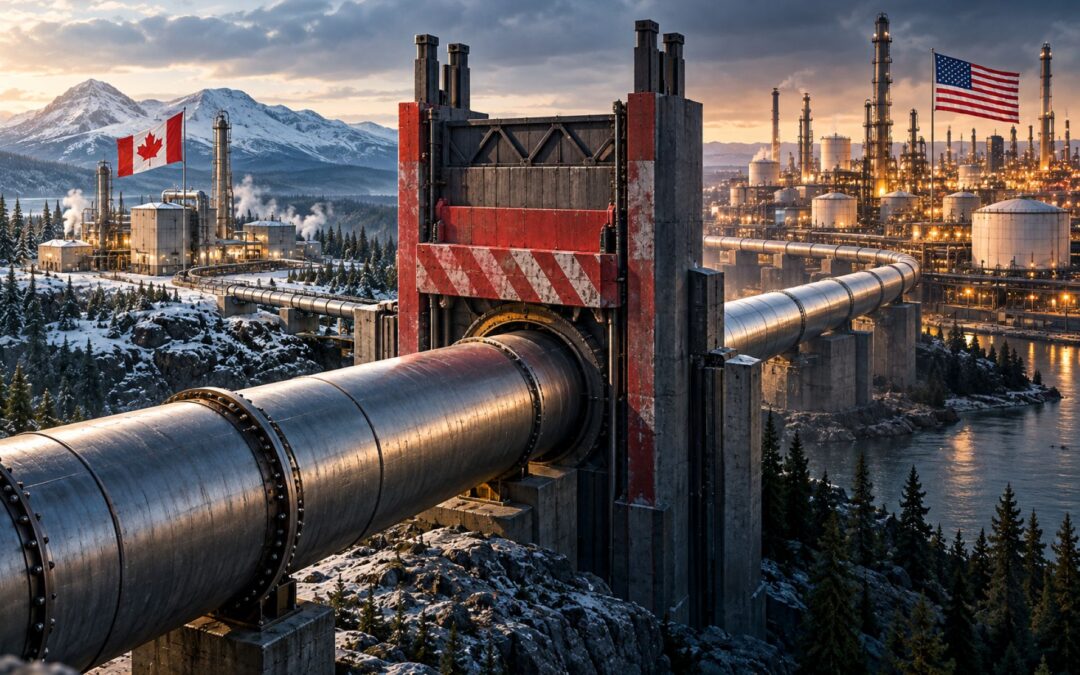
Canada supplies the United States with millions of barrels of oil every day, provides much of the fertilizer used by American farmers, and delivers electricity to homes and businesses across the northern states. These are not luxury products that Americans can simply stop buying. They are essential inputs for industries, agriculture, transportation, and everyday life. At first glance, that should give Canada considerable power in a trade war.
Yet when Donald Trump escalated tariffs against Canada, Prime Minister Mark Carney did not respond by cutting off American access to Canadian energy or agricultural resources. The reason becomes clearer when we examine how closely the two economies are connected. Canada may be indispensable to particular American industries, but the United States is also Canada’s largest customer, and much of Canada’s infrastructure was built around that relationship.
The resulting confrontation raises a difficult question: can a smaller country successfully resist economic pressure from a much larger neighbour when retaliation could inflict enormous damage on its own economy? The answer depends on understanding how North American trade developed, where Canada possesses genuine leverage, and why possessing an economic weapon is not the same as being able to use it.
The Free-Trade System That Bound Canada to America
The economic relationship between Canada and the United States was already extensive before the North American Free Trade Agreement (NAFTA) came into force on January 1, 1994. Canada and the United States had established their own free-trade agreement in 1989, while automotive production had been integrated across the border for decades. NAFTA expanded this arrangement to include Mexico, creating a continental trading system designed to reduce barriers and encourage investment across all three countries.
The underlying economic logic was straightforward. Businesses could purchase materials, manufacture components, assemble products, and sell finished goods across borders with fewer tariffs and administrative obstacles. Instead of organizing production entirely within one country, companies could locate different operations wherever they were most efficient. Consumers could benefit from lower prices and greater product variety, while businesses gained access to larger markets.
Automobile manufacturing became one of the clearest examples of this integration. A vehicle assembled in Canada might contain engines, electronics, steel, and other components produced in the United States or Mexico. Some parts could cross national borders several times before becoming part of a finished vehicle. The result was not three isolated national automotive industries but a highly interconnected North American production network.
However, the benefits of free trade were not distributed equally. While many companies and consumers benefited, certain industries and communities faced intensified competition, factory closures, and employment losses. Manufacturing employment in the United States declined substantially over the following decades, contributing to political resentment in regions that had once depended on industrial jobs.
Donald Trump made these losses central to his criticism of NAFTA, presenting the agreement as evidence that American politicians had sacrificed domestic workers for cheaper foreign production. But attributing the entire decline of American manufacturing employment to NAFTA would be misleading. Automation, rising productivity, changing consumer demand, competition from China and other countries, and broader economic restructuring all contributed. Trade liberalization was one part of a much larger transformation.
Trump also objected to America’s bilateral trade deficit with Canada, meaning the United States purchased more Canadian goods than Canada purchased American goods. However, a trade deficit does not automatically mean one country is losing. Much of the merchandise imbalance has historically reflected American purchases of Canadian energy, including crude oil that US refineries process into valuable fuels and other products.
Alongside these broader concerns, Washington raised specific complaints about Canadian trade practices. Canada’s supply-management system restricts dairy imports through quotas and high tariffs on products entering outside those quotas. The long-running softwood lumber dispute concerns differences in how timber is harvested and priced, while disagreements over steel, aluminum, and automobiles involve competing claims about subsidies, market access, production costs, and national industrial interests.
These disputes helped drive the renegotiation of NAFTA during Trump’s first presidency. Canada, the United States, and Mexico reached a replacement agreement in 2018, subsequently amended it in 2019, and brought the United States–Mexico–Canada Agreement (USMCA) into force on July 1, 2020.
The USMCA updated several aspects of continental trade, including automotive rules of origin, labour provisions, intellectual property protections, and agricultural market access. Yet it preserved the fundamental principle that the three economies would remain deeply integrated. For Canadian businesses that depended on predictable access to American customers, that continuity was enormously important.
The problem was that a trade agreement could regulate commercial relationships without eliminating the political disagreements beneath them. When Trump returned to office, those disagreements became the foundation for another confrontation.
Why Trump’s Tariffs Changed the Bargaining Balance
The trade conflict intensified during Trump’s second presidency as Washington imposed or threatened additional restrictions on Canadian goods. The American administration argued that Canada maintained unfair barriers against US producers and had failed to address persistent trade grievances. Ottawa disputed important parts of that assessment, maintaining that Canadian retaliation was a response to American measures rather than an attempt to initiate a trade war.
The confrontation became especially serious in 2026. Washington announced additional tariffs under Section 338 of the Tariff Act of 1930, with the US Trade Representative’s explanation of the measures focusing on alleged discriminatory treatment of American commerce.
It is important to distinguish these measures from the other tariffs affecting Canadian exports. Different American tariff authorities applied to different products, with separate rates, conditions, and exemptions. Likewise, Canada’s September 2026 countermeasures were not a universal 50% tax on everything imported from the United States. The relevant surtaxes included rates of 15%, 25%, and 50% on specified goods, making the Canadian government’s guidance on US tariffs necessary for understanding what was actually affected.
The disagreement was also about the future of the continental trading system. The USMCA required a joint review in 2026, during which the three governments could assess whether to extend the agreement. In July, Washington declined to renew it on the existing terms, as reflected in the US Trade Representative’s statement on the joint review.
That decision did not immediately terminate the USMCA. The agreement remained in force, although the failed renewal created additional uncertainty about future negotiations and the long-term stability of North American trade. Businesses therefore faced a difficult situation: existing trade arrangements continued to operate, but their future was becoming harder to predict.
The conflict deepened when Canada suspended bilateral negotiations in August 2026 after rejecting proposed American terms. In his explanation of Canada’s negotiating position, Carney presented the disagreement as a question of both economic interests and national sovereignty. Canada’s position was that maintaining access to the American market could not justify accepting every condition Washington demanded.
The difficulty was the enormous difference in the countries’ exposure to trade disruption. According to Statistics Canada’s 2025 merchandise trade figures, 71.7% of Canadian merchandise exports went to the United States, compared with 75.9% in 2024. That reduction suggests some movement away from the American market, but it also demonstrates how heavily Canadian exporters continue to depend on their southern neighbour.
These percentages describe the destination of Canadian merchandise exports, not the proportion of Canada’s entire economy that depends directly on American purchases. Nevertheless, they reveal an important vulnerability. When the United States restricts access to its market, Canadian businesses face disruption in the destination for most of their internationally traded goods.
The relationship is unequal in the opposite direction. Canada is an important customer and supplier for the United States, but it represents a much smaller share of America’s overall economic activity. A broad tariff confrontation can therefore impose serious costs on Canadian producers and communities without producing an equivalent nationwide shock in the United States.
That does not mean American consumers and industries escape unharmed. Tariffs can increase costs, disrupt supply chains, reduce competition, and provoke retaliation against American exports. However, the United States generally has more domestic economic capacity and a larger potential customer base over which to absorb those costs.
For Canada, the challenge is consequently more complicated than matching American tariffs dollar for dollar. Ottawa needs measures that can influence Washington’s decisions without imposing unsustainable damage on Canadian businesses and households. That is where Canada’s enormous natural-resource industries become strategically important.
Oil and Gas: A Weapon Canada Can Barely Afford to Use
Canada is one of the world’s major producers of oil and natural gas, with much of its production concentrated in western provinces, especially Alberta. Energy exports contribute substantially to Canadian investment, employment, government revenue, and international trade. The United States is by far the most important destination for these products.
This relationship might seem unusual because America is itself one of the world’s largest oil and gas producers. But producing enormous quantities of energy does not mean a country is self-sufficient in every commercially useful form of it. Different refineries are designed to process different types of crude oil, and moving petroleum across a continent depends on pipelines, storage facilities, shipping arrangements, and established commercial networks.
Canadian heavy crude is particularly valuable to American refineries equipped to process it. Much of this infrastructure developed around access to western Canadian production, making Canadian supply an important part of the economics of several major refining centres.
According to the US Energy Information Administration’s analysis of US–Canada energy trade, American imports of Canadian crude oil averaged approximately 3.9 million barrels per day in 2025. That represents a substantial flow of energy into a country that is already a global petroleum producer.
An interruption to those supplies would create real problems for American refiners. Facilities configured to process Canadian crude might need to obtain alternative grades from more distant suppliers, pay higher transportation costs, or modify their operating arrangements. Some could reduce production if suitable replacement crude became difficult or expensive to acquire.
The consequences could spread beyond the refining industry. Refineries produce gasoline, diesel, aviation fuel, and other petroleum products used throughout the economy. Higher refining costs or supply disruptions could affect transportation companies, manufacturers, agricultural businesses, and consumers.
This creates an apparent bargaining advantage for Canada. If American industries depend on Canadian energy, why not restrict exports until Washington agrees to lower tariffs?
The answer is that the same dependence works in the opposite direction. Canadian producers have organized much of their business around selling to American customers through established transportation networks. Restricting those exports could mean losing revenue, reducing production, filling available storage, and damaging the companies and workers who depend on the industry.
An oil producer cannot necessarily redirect millions of barrels to another country simply because a government announces a new trade policy. Different buyers require suitable crude, available refining capacity, shipping infrastructure, and commercially viable transportation routes. Even when alternative markets exist, reaching them can involve higher costs or reduced prices.
Natural gas presents similar difficulties. Pipelines connect Canadian production to particular American markets, and replacing established customers can require new infrastructure or different commercial arrangements. Restrictions imposed in an attempt to damage American energy users could therefore impose immediate costs on Canadian producers.
These consequences would also be distributed unevenly within Canada. Alberta and other energy-producing provinces could bear much of the direct economic burden, while the political benefits of a stronger national negotiating position would be uncertain. A policy that appears advantageous from Ottawa might be financially damaging to the communities whose industries are being used as bargaining tools.
Canada has made some progress toward diversifying its energy exports. The expanded Trans Mountain pipeline system, for example, provides additional access to Pacific markets and reduces exclusive dependence on transportation routes serving the United States. But infrastructure diversification takes years of planning, investment, construction, and regulatory approval.
The central problem is therefore not whether American refineries need Canadian crude. Many do. It is whether Canada can exploit that dependence without causing disproportionate damage to its own energy sector.
And the problem becomes even more complicated when we examine how Canadian oil reaches consumers within Canada itself.
The Pipeline Problem: Why Eastern Canada Still Depends on US Territory
Canada’s geography creates an unusual energy vulnerability. Much of the country’s oil production occurs in Alberta and Saskatchewan, while some of its largest population centres, industrial facilities, and transportation networks are thousands of kilometres away in Ontario and Quebec.
Moving western Canadian crude to eastern markets is therefore a major infrastructure challenge. Although Canada possesses enormous petroleum resources, that does not mean every province can access those resources through transportation networks entirely within Canadian territory.
The Enbridge Mainline system illustrates the problem. It transports oil from western Canada toward refineries and distribution networks across the American Midwest and eastern Canada. Parts of this network cross the international border, move through American territory, and connect with facilities that ultimately supply Canadian consumers.
One important component of this infrastructure is Line 5, which carries crude oil and natural gas liquids through Wisconsin and Michigan toward Sarnia, Ontario. Sarnia is a significant refining and petrochemical centre, and the wider connected pipeline system helps move western Canadian energy toward Ontario and Quebec.
Another important connection is Line 9, which transports crude from the Sarnia area toward Montreal. Together, these routes help explain why eastern Canada’s access to western Canadian oil depends partly on infrastructure passing through the United States.
This creates a strategic vulnerability that is easy to overlook. Canada may produce more than enough oil to meet its own national consumption in aggregate, but production capacity and practical access to that production are different things. Refineries require crude of suitable quality, delivered through workable transportation routes, at commercially viable prices.
If a major cross-border pipeline were unexpectedly interrupted, refineries and other facilities could face supply difficulties. Depending on the duration, location, available inventories, and replacement capacity, those difficulties could extend to gasoline, diesel, aviation fuel, petrochemicals, and other products.
Transportation companies, airports, manufacturers, agricultural businesses, and households could experience the consequences through higher costs or reduced availability. However, the severity and timing would depend on the precise pipeline affected and the alternatives available. Claims that a particular airport would run out of fuel within days, or that entire provincial economies would collapse overnight, require far more specific evidence than the existence of a cross-border pipeline.
Some replacement crude might be transported by rail or delivered by ship. Existing refineries could also draw on inventories or purchase alternative supplies where technically and commercially feasible. Nevertheless, these alternatives have constraints involving capacity, cost, refinery compatibility, seasonal conditions, and the time required to reorganize distribution.
The crucial point is that the infrastructure makes Canada vulnerable, not that the American president can simply turn off eastern Canada’s energy whenever a trade negotiation becomes difficult.
The 1977 Canada–US Transit Pipelines Treaty provides a legal framework intended to protect the uninterrupted transportation of hydrocarbons through the two countries. It reflects their shared recognition that cross-border pipelines are essential to both economies and that arbitrary interference could have serious consequences.
Pipeline operations are also governed by domestic laws, court decisions, environmental requirements, property rights, and other legal obligations. These constraints matter because a political dispute over tariffs does not automatically give Washington unrestricted authority to close pipelines carrying Canadian energy.
Line 5 has already demonstrated how complex these issues can become. The pipeline has faced legal challenges concerning its operation, environmental risks, and its passage through Indigenous territory. In particular, litigation involving the Bad River Band has raised questions about property rights, pipeline operations, environmental protection, and the consequences of potential disruptions.
These disputes cannot be reduced to a simple contest between Canadian energy security and American political interests. Indigenous rights and environmental concerns are substantive legal issues, while the economic consequences of interrupting an established energy supply network are also significant.
This distinction is important in evaluating Canada’s bargaining position. The existence of cross-border infrastructure does create strategic exposure, but the legal and commercial barriers to interrupting it also constrain American action. A hypothetical pipeline shutdown should not be treated as Washington’s automatic response to Canadian retaliation.
Nevertheless, the broader dependency raises an unavoidable question: why has Canada not built a more direct route connecting western oil production to eastern Canadian markets?
One proposed answer was the Energy East pipeline.
Announced in 2013, Energy East was intended to create a major west-to-east oil transportation route using a combination of converted natural-gas pipeline infrastructure and newly constructed sections. The proposed system would have transported western Canadian crude toward eastern refineries and Atlantic export facilities, potentially improving access to Canadian and overseas markets.
Supporters argued that Energy East could improve national energy security, strengthen connections between provinces, and reduce dependence on transportation routes passing through American territory. It could also provide additional market options for western producers, who have historically faced limitations in their ability to transport oil beyond North America.
Those arguments had genuine economic and strategic significance. However, the project’s cancellation cannot accurately be explained solely as a decision by Quebec or Justin Trudeau to prevent Canadian energy independence.
TransCanada, now known as TC Energy, withdrew the Energy East application in October 2017. The federal government’s account of the project’s withdrawal confirms that the project was cancelled before the federal government issued a final approval decision.
Several factors complicated the proposal. These included changing oil-market conditions, commercial uncertainty, the costs of constructing and converting infrastructure, regulatory requirements, environmental risks, and opposition from communities and Indigenous groups along the proposed route.
Quebec’s concerns were particularly significant because substantial infrastructure would have crossed the province. Critics questioned the environmental risks of transporting large volumes of oil and the broader consequences of building infrastructure that could support increased fossil-fuel production.
A project might offer economic and security benefits while also creating substantial environmental, financial, and social costs. Determining whether Energy East should have proceeded requires examining all these considerations rather than assuming that any additional pipeline would automatically be desirable.
Nor can we know that a completed Energy East pipeline would have eliminated Canada’s current vulnerabilities. Its actual contribution would have depended on capacity, refinery connections, operating arrangements, commercial use, and whether it provided practical alternatives to the supplies currently transported through the United States.
Still, its cancellation illustrates a larger strategic issue. Infrastructure decisions made for commercial, environmental, and political reasons can shape a country’s economic options many years later. Canada cannot quickly create new transportation routes whenever relations with Washington deteriorate.
This makes pipeline geography one of the most important constraints on Canada’s negotiating power. Canadian oil is valuable to America, but Canada’s access to its own domestic markets and alternative foreign customers is partly shaped by infrastructure developed around the United States.
Potash: The Pressure Point Beneath American Farms
If oil and gas are difficult weapons for Canada to use, potash offers a different kind of leverage. Canada is one of the world’s largest producers of potash, and the American agricultural sector depends heavily on Canadian supplies.
Potash is primarily used to produce potassium fertilizers, which are important for plant growth, crop yields, and soil fertility. Alongside nitrogen and phosphorus, potassium is one of the three major nutrients commonly supplied through agricultural fertilizers. Farmers growing crops such as corn, soybeans, and wheat depend on reliable access to suitable fertilizer products.
Canada’s position in this market is unusually strong because much of the country’s potash production is concentrated in Saskatchewan. The province possesses enormous deposits, extensive mining operations, and infrastructure supporting both domestic industry and international exports.
The United States has limited domestic potash production relative to its agricultural requirements. A September 2026 StoneX assessment of North American potash dependence estimated that roughly nine-tenths of American potash imports come from Canada.
That level of import concentration creates a genuine vulnerability. If Canada restricted exports, imposed additional costs, or otherwise disrupted potash shipments, American fertilizer buyers could struggle to replace the lost supply quickly.
Unlike some manufactured goods, potash cannot be produced in large new quantities simply by opening another factory. Mining operations require suitable geological deposits, extensive capital investment, regulatory approvals, and years of development. Even existing producers elsewhere in the world would need available capacity, transportation networks, and commercial arrangements to increase deliveries to the American market.
Russia, Belarus, China, and other producers form part of the international potash market, but sourcing from them introduces additional logistical, commercial, and geopolitical considerations. Alternative supplies may exist without being immediately available in the quantities, locations, or price ranges American buyers require.
A major disruption to Canadian potash exports could therefore increase fertilizer prices and complicate purchasing decisions for American farmers. Higher fertilizer costs could affect production expenses and farm profitability, especially where margins are already under pressure.
However, describing such a disruption as the immediate destruction of American agriculture would be exaggerated. Farmers and fertilizer distributors maintain inventories, markets adjust through prices, and buyers can seek other suppliers or change purchasing patterns. The degree of damage would depend on timing, duration, inventories, crop requirements, and the availability of substitutes.
Canada would also face consequences. Saskatchewan’s potash industry supports employment, mining investment, contractors, transportation activity, and government revenue. Restricting exports to the United States could reduce sales, weaken producer finances, and hurt communities dependent on mining.
Some Canadian potash also reaches international customers through transportation networks that involve the United States. This means that interfering with cross-border trade could create complications beyond shipments intended for American farms.
There is also a political difficulty. A federal retaliation policy could impose concentrated economic losses on Saskatchewan while delivering uncertain benefits to Canadian industries elsewhere. For a country already managing significant provincial economic differences, that is not a trivial consideration.
Yet potash remains potentially more useful as a targeted negotiating instrument than a broad energy embargo. American agricultural interests are politically influential, and substantial increases in fertilizer costs could motivate farmers, distributors, and agricultural organizations to press Washington for a resolution.
Canada would not necessarily need to cripple American agriculture to make potash restrictions politically consequential. The possibility of higher input costs, supply uncertainty, and pressure from affected industries could itself provide leverage.
The problem is determining whether those costs would change American trade policy before Canadian producers suffered unacceptable damage. That calculation is far more complicated than simply measuring Canada’s share of American potash imports.
Electricity: Local Vulnerability, Limited National Leverage
Electricity provides a third potential source of Canadian leverage, but its strategic importance differs considerably from oil and potash. Canada exports electricity to the United States through interconnected regional power networks, with hydroelectric and other generating facilities helping supply demand across the border.
Canadian electricity represents a relatively small proportion of total American electricity generation. However, national averages can conceal local dependencies. Particular states and utilities may rely on Canadian imports to supplement their own generation, balance demand, or access comparatively inexpensive power.
The US Energy Information Administration has documented changing electricity-import patterns in the American Northeast, including a decline in reliance on Canadian imports in recent years. This illustrates why the significance of electricity trade must be evaluated by region rather than assuming that the national import share describes every local market.
Ontario demonstrated the potential for electricity retaliation in March 2025, when the provincial government announced a 25% surcharge on electricity exports to the United States.
The measure targeted electricity supplied to Michigan, Minnesota, and New York. Ontario presented the surcharge as a response to American tariffs, arguing that consumers and businesses in the affected states would experience additional costs.
The confrontation quickly escalated. Trump threatened further tariff increases against Canadian steel and aluminum, raising the prospect that an electricity surcharge could trigger much broader economic retaliation. Ontario subsequently suspended the electricity surcharge as negotiations and discussions with American officials proceeded.
This episode demonstrates both the potential and the limitations of using electricity as an economic weapon. A relatively small cross-border energy flow can create political pressure when costs are concentrated in particular states, but a larger trading partner can respond by threatening measures against industries with much greater economic exposure.
Electricity also presents technical constraints. Power systems must continuously balance supply and demand, and replacement electricity must be generated and transmitted through available infrastructure. A region cannot necessarily compensate for lost imports simply because sufficient generating capacity exists somewhere else in the country.
The American government possesses emergency authority under Section 202(c) of the Federal Power Act, which can authorize temporary actions to address electricity-system emergencies. The Department of Energy’s January 2026 emergency order under Section 202(c) illustrates how such authority can be used under specific circumstances.
However, emergency powers do not automatically create new generators, fuel supplies, or transmission capacity. Nor do they guarantee that every interrupted Canadian electricity import could be replaced without additional costs or operational difficulties.
Electricity restrictions could therefore impose meaningful local costs, but they are unlikely to provide Canada with decisive nationwide leverage. Their effectiveness would depend heavily on the affected region, the timing of the disruption, available substitutes, and Washington’s willingness to respond.
Why Retaliation Can Work Without Winning an Economic War
Canada’s difficulty in confronting the United States becomes clearer when oil, potash, and electricity are considered together. Each gives Canada some ability to impose costs on American businesses and consumers, but every major measure also carries economic risks for Canada itself.
This creates an important distinction between winning an economic war and achieving a negotiating objective. Canada does not necessarily need to cause more total damage to the American economy than it suffers domestically. It needs to influence the political and economic calculations of the American government sufficiently to obtain a more acceptable outcome.
A broad restriction on Canadian oil exports, for example, could create substantial damage on both sides of the border. But a carefully targeted measure affecting a particular industry might produce political pressure without requiring Canada to interrupt an enormous portion of its own economy.
The effectiveness of retaliation depends partly on where costs fall. A policy that imposes a modest burden across the entire United States may attract less political attention than one that significantly affects an economically important industry concentrated in a few states.
Agriculture illustrates this possibility. Fertilizer prices are not simply an abstract economic statistic for American farmers. They directly affect production costs and financial decisions, making trade restrictions potentially important to agricultural organizations and political representatives.
Similar considerations apply to manufacturers dependent on Canadian raw materials, energy-intensive industries, and businesses whose supply chains cross the border repeatedly. Companies experiencing higher costs or operational uncertainty may push for negotiations even when the broader American economy remains relatively resilient.
This is why an assessment based only on national GDP can understate Canada’s bargaining power. Economic pressure does not have to produce a national recession to become politically relevant. It can matter through its effects on influential businesses, organized industries, regional employment, and public opinion.
However, there are limits to this approach. American policymakers may be willing to tolerate costs if they believe the concessions they seek are sufficiently important. Retaliation can also reinforce political support for tariffs, particularly when restrictions are framed as foreign interference with American consumers or industries.
Furthermore, targeted retaliation is not costless merely because it is narrower than an embargo. Canadian importers may face higher prices when Ottawa taxes American goods, while Canadian exporters can lose revenue if restrictions interfere with established commercial relationships. Companies may also face uncertainty that discourages investment on both sides of the border.
Legal constraints complicate matters further. Trade agreements and international obligations establish rules concerning tariffs, market access, and the treatment of imported products. Governments may dispute how those rules apply, but retaliation should not be confused with unlimited freedom to impose any economically damaging measure.
Canada therefore needs to evaluate the credibility of each threat. An export restriction that would devastate a Canadian province may not convince Washington that Ottawa is prepared to implement it. Conversely, a narrower measure that Canada can sustain may generate greater bargaining power because the threat is believable.
The distinction is between possessing leverage and possessing leverage that can actually be exercised. A resource is not a useful negotiating weapon simply because another country depends on it. It becomes useful when restricting access can plausibly change the other country’s behaviour at an acceptable domestic cost.
Diplomacy creates another possible source of strength. Canada is not the only economy affected by American trade measures, and cooperation with other trading partners could increase the political and economic consequences of unilateral tariffs.
The European Union is an obvious potential partner because of its economic size and extensive trading relationships. Coordinated diplomatic pressure or compatible trade responses could make American restrictions more difficult to sustain than a dispute involving Canada alone.
Yet international coordination is not automatic. European governments have their own commercial interests, domestic political pressures, and negotiating priorities. Measures that are advantageous for Canada may not be equally attractive to every European country.
The same applies to other American trading partners. Shared opposition to tariffs does not guarantee agreement on the risks worth accepting or the concessions worth demanding.
Carney’s challenge is therefore to combine economic pressure with diplomacy while avoiding measures that impose excessive costs on Canada. The goal is not to demonstrate that Ottawa can inflict the greatest possible harm on the United States. It is to make an acceptable negotiated settlement more attractive than the continuation of the dispute.
Success would have to be measured against that objective. A smaller economy can achieve meaningful concessions without defeating a larger economy in an aggregate contest of economic strength, but the result is never guaranteed merely because retaliation creates costs.
What Canada Would Need to Become Less Dependent
The most durable solution to Canada’s trade vulnerability is unlikely to come from any single retaliatory measure. It requires changing the economic conditions that make American pressure so consequential in the first place.
Canada’s dependence on the United States reflects geography, history, infrastructure, and commercial efficiency. The countries share an extensive land border, operate integrated industries, and possess transportation systems developed around decades of trade. For many Canadian companies, American customers are the closest, largest, and most commercially attractive foreign market.
Those advantages cannot be eliminated through political declarations. Exporting a product across the Atlantic or Pacific generally presents different transportation costs, logistical requirements, and business risks from selling it to customers just across the American border.
Consequently, diversification should not be understood as abandoning trade with the United States. A realistic strategy would preserve the advantages of North American integration while developing sufficient alternatives to reduce Canada’s exposure when relations deteriorate.
Energy infrastructure offers one example. Additional access to ports and overseas markets could allow Canadian producers to reach customers beyond the United States. But pipelines, terminals, and related transportation facilities require substantial investment, long development periods, and careful consideration of commercial viability.
Infrastructure development also creates legitimate questions concerning environmental impacts, Indigenous rights, land use, and long-term energy demand. Greater economic sovereignty does not remove the need to evaluate those considerations. The objective should be to make informed infrastructure decisions that account for both their immediate costs and their future strategic value.
Stronger connections within Canada could also improve resilience. When businesses in different provinces face transportation obstacles, regulatory differences, or limited access to domestic suppliers, national economic capacity may be less useful than it initially appears.
Improving interprovincial trade and transportation could help Canadian companies develop larger domestic markets, reduce unnecessary barriers, and establish more reliable links between producing and consuming regions. Such measures would not replace American demand, but they could make Canadian businesses less dependent on particular cross-border arrangements.
Export diversification presents a related challenge. Canada has opportunities to expand trade with European and Asian markets, but entering those markets requires more than signing agreements. Businesses need customers, distribution networks, competitive products, financing, regulatory familiarity, and efficient access to ports.
Existing trade relationships can make diversification easier, but they cannot guarantee that overseas buyers will purchase Canadian goods at prices comparable to those available in the United States. A successful long-term strategy must account for these commercial realities.
The same principle applies to industrial policy. Encouraging greater domestic processing or manufacturing can sometimes create higher-value economic activity within Canada, particularly where the country possesses significant natural resources. But public investment and industrial incentives must be evaluated against costs, demand, productivity, and the possibility that governments may support activities that remain commercially uncompetitive.
Reducing vulnerability therefore requires patience. Companies must establish new relationships, infrastructure must be built, regulations must be adapted, and investments must demonstrate that they can operate successfully. These changes often occur over years rather than months.
In the meantime, Canada must continue negotiating with the United States from a position of substantial economic exposure. This is where Carney’s approach to sovereignty becomes politically significant.
A government’s ability to reject unacceptable negotiating terms can matter even when doing so carries immediate economic costs. Trade agreements involve more than prices and market access; they can also determine how much freedom governments retain to make decisions concerning domestic industries, regulations, and relationships with other countries.
However, refusing an agreement is not automatically evidence of a successful strategy. The long-term result depends on whether the refusal produces more acceptable terms, whether Canadian businesses can withstand the uncertainty, and whether the country develops stronger alternatives during the confrontation.
Political determination can prevent a government from accepting concessions it considers unacceptable, but it cannot by itself replace lost export revenue or build the infrastructure needed to reach different markets.
This is why the 2026 trade conflict raises questions that extend beyond the immediate dispute between Trump and Carney. It exposes the extent to which Canada’s prosperity and policy choices have become connected to decisions made in Washington.
That relationship has delivered enormous economic benefits over several generations. American demand has supported Canadian jobs and investment, while Canadian energy, materials, manufacturing, and agricultural products have strengthened the American economy.
The challenge is not to dismantle a mutually beneficial relationship simply because it also creates vulnerabilities. It is to prevent those vulnerabilities from becoming so severe that Canada has little practical freedom when its interests diverge from those of the United States.
Canada’s long-term bargaining position would improve if its producers had more potential customers, its provinces were better connected, and its domestic industries were less exposed to the interruption of a few critical trade routes. In such a situation, Ottawa could respond to American pressure without confronting the same degree of immediate economic danger.
This would not make Canada equal to the United States in economic size or influence. But it could make Canadian negotiating choices more credible by reducing the costs of disagreement.
Canada is unlikely to overpower the United States in a broad economic confrontation. The American economy is much larger, and Canadian producers remain heavily dependent on access to American customers. Attempting to weaponize oil, potash, or electricity without regard for the consequences could damage Canada as severely as, or more severely than, the United States.
Nevertheless, economic size does not determine every negotiating outcome. Canada possesses resources and commercial relationships that matter deeply to particular American industries and regions. Carefully targeted retaliation, credible negotiating positions, and cooperation with other trading partners can create pressure even when a decisive economic victory is unrealistic.
The more important question is whether Canada can turn a period of confrontation into an opportunity to strengthen its future position. Developing alternative markets, improving domestic connections, and investing responsibly in strategic infrastructure would not eliminate its dependence on the United States, but they could make that dependence less restrictive.
Ultimately, Canada’s ability to defend its economic sovereignty will not be measured by how much damage it can inflict on America. It will be measured by how much freedom Canada has to protect its interests, reject unacceptable demands, and make independent choices without placing its own prosperity in jeopardy.
Last Updated on October 18, 2026 by Aseem Gupta