
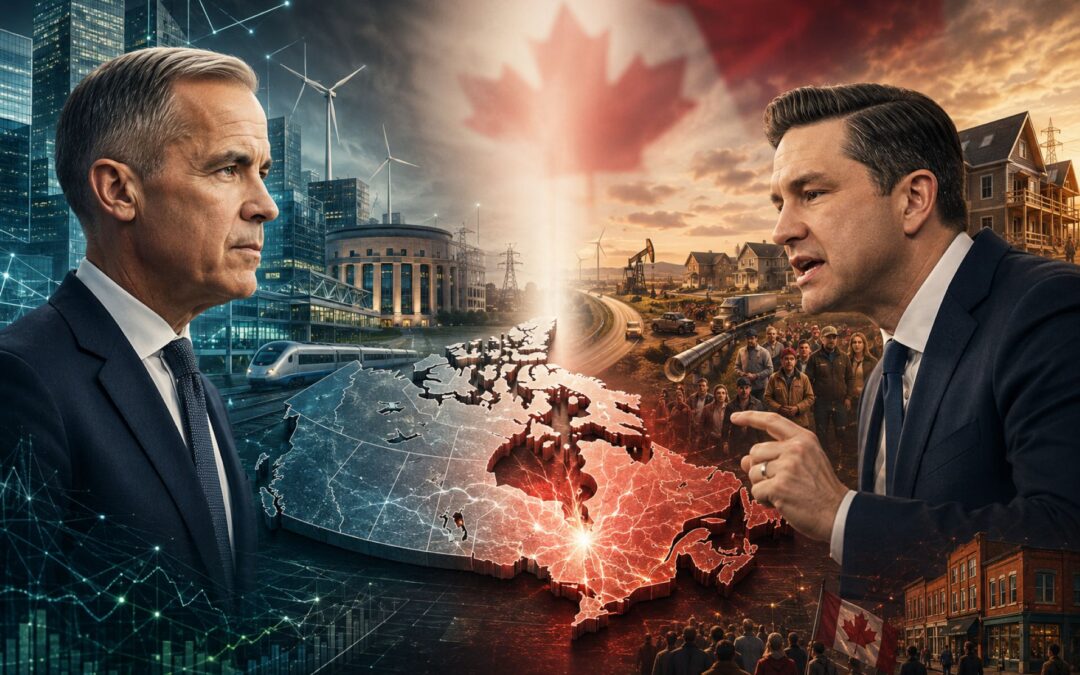
At the beginning of 2025, Pierre Poilievre appeared to be approaching an almost inevitable victory.
After nearly a decade under Justin Trudeau, Canadians were frustrated by unaffordable housing, strained public services, weak productivity and a prolonged decline in economic output per person. The Conservative leader had spent years turning that dissatisfaction into a simple political argument: life cost more because government had become bigger, more expensive and less competent.
Then Trudeau resigned, Mark Carney entered politics, and the election changed almost beyond recognition.
Carney was sworn in as Canada’s 24th prime minister in March 2025 despite never having held elected office. Donald Trump’s tariffs and threats against Canadian sovereignty transformed the campaign from a referendum on Trudeau into a test of who could manage a national economic emergency. Carney’s experience in central banking and global finance suddenly became more valuable than the political freshness Poilievre had once represented.
The Liberals won 169 seats in the April 2025 election, while the Conservatives won 144. Poilievre lost his own constituency of Carleton, although he returned to Parliament through an August 2025 by-election. Carney remains Canada’s prime minister, while Poilievre is once again the leader of the official opposition and the Conservative Party.
The campaign was often described as a contest between an insider and an outsider. That description was powerful—and misleading.
Carney was an electoral outsider but an institutional insider, shaped by Goldman Sachs, central banks, international organisations and one of the world’s largest asset managers. Poilievre was an anti-establishment campaigner who had spent virtually his entire adult life inside political parties and Parliament.
Their rivalry was not really between the system and someone standing outside it. It was between two different kinds of political authority.
Carney asked Canadians to trust expertise, institutions and coordinated economic action. Poilievre asked them to trust markets, individual choice and a politician promising to confront those same institutions.
Both men were highly disciplined, intelligent and ambitious. Both also carried a contradiction at the centre of their political identity.
How the 2025 Election Reversed the Race
Poilievre’s rise cannot be understood without first understanding the collapse of Trudeau’s political position.
The Liberal government had survived scandals, a pandemic, minority parliaments and successive Conservative leaders. What it could not overcome was the accumulating sense that ordinary life had become harder while the government continued to speak in abstractions.
Housing costs rose far faster than incomes in many cities. Population growth added demand to already constrained housing and public-service systems. Business investment and productivity remained weak. Inflation receded from its post-pandemic peak, but the price level did not return to where it had been.
Canada was not universally impoverished, nor did every individual become poorer. Nevertheless, the country’s economic performance per person was genuinely disappointing. The OECD’s 2025 review of Canada described an economy that remained broadly resilient while suffering from weak per-capita growth, sluggish productivity, high household debt and severe housing-affordability problems.
Poilievre built his opposition around those failures. His slogans reduced complicated problems to memorable causal chains: deficits produced inflation, bureaucracy blocked housing, taxes punished work and political elites benefited from a system that failed everyone else.
The message worked partly because Trudeau was the perfect opponent for it. By late 2024, Poilievre was not merely competing with the Liberals. He was campaigning against a prime minister many voters had already decided to remove.
Trudeau’s resignation therefore created a problem for the Conservatives. Their campaign had been built around defeating him, but the election would no longer contain him.
Carney gave the Liberals something they had lacked: distance from their own record without an open repudiation of it. He could promise change while defending Liberal priorities. He had advised Trudeau, supported carbon pricing and shared the party’s internationalist instincts, but he had never served in Trudeau’s cabinet or defended his government in Parliament.
Then Donald Trump changed the emotional centre of Canadian politics.
Trump’s return to the White House brought tariffs, economic coercion and repeated challenges to Canadian sovereignty. An election that had been dominated by anger at Ottawa became increasingly concerned with the threat coming from Washington. Carney’s background in crisis management, finance and international diplomacy became an electoral asset. Poilievre’s populist language, which had previously seemed disruptive and energetic, became easier for opponents to compare with Trump’s political style.
That comparison was imperfect. Poilievre was not simply a Canadian version of Trump. He was more ideologically consistent, more knowledgeable about parliamentary government and far more disciplined in his use of language. Yet campaigns are shaped by emotional associations as much as detailed policy comparisons. At a moment when Canadians wanted distance from American populism, Poilievre’s style created a vulnerability.
Carney also benefited from altered expectations. He did not need to embody the optimism Trudeau had promised in 2015. He needed to look competent, serious and capable of protecting the country during an external crisis.
The result was one of the most dramatic campaign reversals in modern Canadian politics. The official Elections Canada report recorded 169 Liberal seats and 144 Conservative seats. Carney formed a minority government. Poilievre not only failed to become prime minister but lost Carleton, the Ottawa-area constituency he had represented under different boundaries since 2004.
His defeat did not end his career. A Conservative MP resigned in the safely Conservative Alberta constituency of Battle River—Crowfoot, allowing Poilievre to contest the August 2025 by-election. He won more than 80 per cent of the vote and returned to the House of Commons as leader of the opposition.
The reversal exposed the strengths and weaknesses of both men.
Carney had proved that expertise could be politically compelling when the public felt threatened. Poilievre had proved that anger at an unpopular government was not the same as durable confidence in its replacement.
To understand why Canadians responded differently to them, however, requires looking beyond the campaign. Their approaches to politics were built over decades in two very different worlds.
Mark Carney: The Institutional Technocrat
Carney arrived in electoral politics unusually late, but he did not emerge from nowhere.
Long before becoming prime minister, he had accumulated influence in the institutions that manage financial crises, regulate markets and coordinate international policy. His political authority was built on the claim that he understood how those systems worked because he had operated inside them.
That experience gave him credibility. It also produced the central question surrounding his career: can someone so deeply formed by powerful institutions genuinely reform them?
From Goldman Sachs to the Bank of Canada
Carney was born in Fort Smith in the Northwest Territories in 1965 and raised in Edmonton, where his parents worked in education. He studied economics at Harvard before completing a master’s degree and doctorate at Oxford.
His early professional path did not lead toward Parliament or party activism. It led to Goldman Sachs.
According to his official Bank of England biography, Carney spent 13 years with the investment bank, working in London, Tokyo, New York and Toronto. His career exposed him to sovereign debt, emerging markets, investment banking and the relationships connecting governments, financial institutions and international organisations.
That background matters because Carney’s later public philosophy did not emerge from hostility toward markets. He did not see finance as an enemy that needed to be defeated. He saw it as a powerful system that could be disciplined, redirected and used to achieve public goals.
In 2003, he moved from Goldman Sachs to the Bank of Canada. He later served as a senior official in the federal Department of Finance before becoming governor of the central bank in February 2008.
The timing could hardly have been more consequential. Within months, the global financial system entered its deepest crisis since the Great Depression.
Carney’s appointment established the pattern that would define his public career. He was repeatedly placed at the centre of complex institutional problems and expected to manage them with technical competence, credibility and confidence.
His supporters interpreted that confidence as leadership. His critics sometimes saw it as the certainty of someone accustomed to being the most technically knowledgeable person in the room.
Both interpretations contain some truth.
The 2008 Crisis: Structure, Policy, and the Limits of the Hero Story
Carney’s handling of the financial crisis became the foundation of his international reputation.
The simplified version of the story says that Canada escaped the worst of the crash because Carney acted decisively. The opposing version says Canada’s financial system was already so strong that almost any competent central banker would have produced a similar result.
Neither explanation is sufficient.
Canada entered the crisis with important structural advantages. Its banking system was concentrated among a small number of large institutions. Regulation was more unified than in the United States. Mortgage lending was generally more conservative, while complex financial activity remained more contained within regulated banks.
Research published by the National Bureau of Economic Research on why Canada avoided a banking crisis emphasised that the country’s financial structure had absorbed major sources of systemic risk—including mortgage lending and investment banking—within tightly regulated institutions. The United States, by comparison, had a more fragmented regulatory system and a much larger shadow-banking sector operating beyond conventional bank oversight.
Canada also entered the crisis with greater fiscal room than many countries. Years of stronger public finances gave the federal government more capacity to support the economy without immediately creating doubts about its solvency. The later recovery in commodity demand also helped an economy with substantial energy and resource exports.
These advantages were not created by Carney. They were the product of institutional design, earlier policy choices and the structure of the Canadian economy.
But structural resilience did not make monetary policy irrelevant.
The Bank of Canada lowered interest rates, provided liquidity to financial markets and attempted to prevent fear from becoming a self-reinforcing collapse in credit and investment. Once the policy rate reached its effective lower limit, the bank made an unusual commitment to keep it there for a defined period, conditional on the outlook for inflation.
This form of forward guidance was intended to influence behaviour by reducing uncertainty about future borrowing costs. The Bank of Canada later concluded that its conditional commitment changed market expectations, added monetary stimulus and supported the recovery in output and inflation.
Carney therefore did not single-handedly save a fundamentally fragile financial system. He competently managed a system that was already better positioned than many of its peers.
That distinction matters.
Crisis leadership is rarely about one brilliant decision. It is about understanding the strength of existing institutions, identifying where panic could overwhelm them and using public authority to prevent manageable problems from becoming catastrophic ones.
The same policies that supported the economy also carried longer-term risks. Low interest rates made borrowing cheaper and contributed to rising demand for assets, including housing. Critics subsequently connected Carney-era monetary policy to Canada’s enormous increase in real-estate prices and household debt.
There is some truth in that criticism, but it becomes misleading when it treats monetary policy as the sole cause. Cheap credit increased purchasing power, yet prices could not have risen so persistently without supply restrictions, zoning constraints, tax incentives, population pressure and a housing market increasingly treated as an investment vehicle.
Interest rates helped inflate the demand side of the market. They did not explain the deeper structural causes of expensive housing.
The fairest assessment is therefore neither heroic nor dismissive. Canada’s institutions deserve much of the credit for avoiding a banking collapse. Carney deserves credit for using those institutions effectively during a crisis.
Readers looking for the global background can explore the wider mechanics of the 2008 financial crisis, where Canada’s relative stability appears not as an isolated miracle but as one outcome within a much larger international breakdown.
Brexit, Climate Finance, and Brookfield
Carney’s performance in Canada made him internationally prominent. In 2013, he became the first non-Briton appointed to lead the Bank of England.
The move reinforced both sides of his reputation. To admirers, it demonstrated that a Canadian had become one of the world’s most respected central bankers. To critics, it confirmed that Carney’s natural constituency was the international institutional elite rather than any particular national electorate.
His tenure placed him at the centre of the United Kingdom’s debate over Brexit. Carney warned that leaving the European Union could reduce investment, weaken growth, raise inflation and threaten financial stability. His interventions angered Brexit supporters, who argued that the central bank was entering a political contest rather than limiting itself to neutral economic analysis.
The criticism was not entirely unreasonable. Central bankers possess enormous authority precisely because they are expected to operate outside ordinary party politics. When their forecasts support one side of a referendum, the line between risk analysis and political intervention becomes difficult to maintain.
Yet silence would also have been a political choice. The Bank of England was responsible for financial stability, and Brexit created clear risks within that mandate. Carney’s approach reflected a broader conviction: institutions should not remain quiet when their expertise identifies a serious systemic threat.
That conviction eventually extended beyond monetary policy.
Carney increasingly argued that climate change was not only an environmental problem but a financial one. Physical damage could destroy assets and disrupt supply chains. Governments might suddenly change regulations. Fossil-fuel investments could lose value as the world moved toward lower emissions.
In 2019, the United Nations appointed Carney as its special envoy for climate action and finance. He later helped lead efforts to mobilise banks, insurers, pension funds and asset managers behind net-zero commitments.
The strategy was characteristically Carney. Rather than attempting to overthrow global finance, he wanted to alter the information, incentives and investment decisions operating within it. Capital markets, properly guided, would help finance the energy transition.
This was reform from inside the system.
It was also financially valuable work.
Carney joined Brookfield in 2020 as vice chair and head of environmental, social and governance investing and impact-fund investing. Brookfield described his role as combining measurable environmental outcomes with competitive returns for investors. He later became chair of Brookfield Asset Management and helped build its transition-investment business.
That career created a legitimate tension. Carney was not merely advocating climate finance as a public servant. He was also helping create investment products intended to profit from the transition he promoted.
Profit does not automatically invalidate environmental commitment. Large-scale decarbonisation will require private investment, and investors normally expect returns. The uncomfortable issue is not that Carney believed climate action could be profitable. It is that his public influence and private financial experience became deeply intertwined.
When Carney entered the Liberal leadership race in January 2025, Brookfield announced that it had accepted his resignation from the company. The announcement credited him with helping establish the firm as a major investor in the energy transition.
His previous financial interests nevertheless raised reasonable questions once he became prime minister. Brookfield invests across infrastructure, energy, property, private equity and other sectors that can be affected by federal policy. Carney had also held a position with Stripe, another company potentially affected by government decisions.
The responsible approach is to distinguish documented concerns from speculative allegations.
There is no need to invent estimates of secret wealth or assume that every government decision benefiting a former employer is corrupt. At the same time, a blind trust does not eliminate every appearance of conflict. A politician may no longer control individual investments while still understanding broadly where past interests and relationships lie.
Carney’s public conflict-of-interest declaration created a formal screen covering Brookfield Asset Management, Brookfield Corporation, Stripe and related companies known when the trust was established. The arrangement requires officials to prevent him from participating in specified decisions, while allowing involvement in policies that affect those companies only as part of a broad class.
That does not prove the concern is imaginary, nor does it prove wrongdoing. It reveals the central difficulty of Carney’s political identity.
The same experience that makes him unusually qualified to manage finance and investment also connects him to the companies most capable of benefiting from government economic policy.
Pierre Poilievre: The Political Insurgent
Poilievre’s route to power was almost the reverse.
Carney accumulated authority outside electoral politics and entered it near the top. Poilievre entered politics young, learned its institutions from the inside and spent decades building toward party leadership.
His outsider identity did not come from distance from politics. It came from his ability to speak as though he were fighting the political world he had mastered.
Freedom, Reform, and an Early Life in Politics
Poilievre was born in Calgary in 1979 and adopted by two schoolteachers. His upbringing was materially modest compared with the backgrounds often associated with national political leadership, and he later incorporated that story into his argument about opportunity, family and voluntary social cooperation.
He became involved in conservative politics while still a teenager. The Reform Party’s combination of western alienation, fiscal conservatism and hostility toward distant political elites offered him both an ideology and a political home.
Free-market thought gave those instincts a more systematic form. Poilievre was particularly influenced by arguments that prosperity emerged when individuals retained control over their labour, money and decisions rather than surrendering them to government.
At 20, he expressed those beliefs in his 1999 essay, Building Canada Through Freedom.
The essay called for lower taxes, fewer corporate subsidies, reduced government expenditure and political institutions that transferred power away from the prime minister and toward citizens. Poilievre argued that money left with workers, consumers and investors would be used more productively than money spent by politicians or bureaucrats. He also proposed term limits, writing that politics should not become a lifelong career.
The proposals were youthful, and some were more confident than practical. Yet the essay matters because its central themes remained remarkably consistent.
Poilievre believed economic freedom and democratic freedom were connected. A government that controlled too many resources would eventually control too many decisions. Political concentration and economic intervention were therefore not merely inefficient. They reduced individual autonomy.
He entered professional politics through the Canadian Alliance and the circles surrounding Stockwell Day, whose campaigns combined tax reduction, smaller government and institutional reform. That experience taught Poilievre how ideological arguments were translated into campaign messages—and how easily controversial social questions could distract from an economic programme.
His worldview was already largely established before he entered Parliament: government should be smaller, political authority should be more directly accountable, markets should allocate more resources and citizens should retain more control.
What changed over the following decades was not the underlying philosophy. It was his ability to communicate it.
The Harper Years and the Making of a Parliamentary Fighter
Poilievre was elected in Nepean—Carleton in June 2004 at the age of 25, defeating an incumbent Liberal MP.
His early victory gave him something Carney never had before becoming prime minister: sustained exposure to the ordinary machinery of electoral politics. He learned how constituencies were defended, how caucuses functioned, how committees examined government and how parliamentary procedure could be used as both a governing instrument and a political weapon.
His parliamentary record shows a steady rise through the Conservative government of Stephen Harper. He served as parliamentary secretary to the president of the Treasury Board, later worked closely with the prime minister and eventually became minister responsible for democratic reform and minister of employment and social development.
The roles suited his interests. Accountability, government expenditure, elections, labour policy and institutional power were the same subjects that had appeared in his early essay.
He participated in the Conservative government’s accountability programme, which tightened political-financing and lobbying rules. He later became closely associated with changes to federal election law, including the removal of voter-information cards as authorised identification and restrictions on the use of vouching.
Supporters presented those reforms as safeguards against fraud and administrative looseness. Critics argued they could make voting more difficult for legitimate electors who lacked conventional identification. The dispute foreshadowed Poilievre’s later political style: a procedural policy question would be reframed as a conflict between ordinary citizens and institutions whose neutrality he distrusted.
His record also contained more conventional Conservative positions. He supported legislation requiring greater financial disclosure from unions and promoted the government’s expansion of direct child benefits. He had previously attracted criticism for comments about compensation for residential-school survivors, for which he apologised.
These controversies matter, but they do not fully explain his rise. Poilievre advanced because he was diligent, combative and unusually capable of converting detailed institutional knowledge into partisan attack.
He knew government from the inside. He understood where money moved, how rules were written and which bureaucratic explanations could be made to sound evasive.
That expertise complicates his outsider identity. Poilievre has spent virtually his entire professional life in politics. The young essayist who argued that elected office should not become a permanent career became one of Canada’s longest-serving active federal politicians.
This does not necessarily make his limited-government convictions insincere. A person can spend decades attempting to apply a political philosophy through public office. But it creates an unavoidable credibility problem.
Poilievre presents himself as the adversary of a political class to which he unquestionably belongs.
From Finance Critic to Conservative Leader
The defeat of the Harper government in 2015 created the conditions in which Poilievre’s political identity became nationally recognisable.
In opposition, he no longer had to defend every compromise of governing. He could return to first principles: lower taxes, smaller government, sound money and hostility toward political privilege.
As a finance critic, Poilievre developed a highly effective performance style. He asked short questions, demanded numerical answers and framed evasive responses as proof that the government either did not understand its own policies or was attempting to conceal their consequences.
The Trudeau government supplied him with abundant material. Deficits became evidence of fiscal indiscipline. Rising housing prices became evidence that government was enriching asset owners while younger Canadians fell behind. Inflation became evidence that Ottawa had created money and spent beyond the economy’s capacity.
Some of these arguments captured genuine failures. The Trudeau government did preside over weak productivity, worsening housing affordability and rapidly increasing federal expenditure. Poilievre understood earlier than many Liberal politicians that macroeconomic statistics could not reassure people whose rent, groceries and mortgage payments had become unaffordable.
Other claims simplified complex causes.
Post-pandemic inflation was shaped by supply-chain disruption, energy prices, labour shortages, fiscal support, monetary policy and the rapid reopening of the economy. Describing the entire episode as government “money printing” made the political argument easier to remember but less complete.
The same was true of carbon pricing. Poilievre correctly identified that a visible consumer charge was politically vulnerable, especially during a cost-of-living crisis. His campaign treated the charge as both an economic burden and a symbol of distant elites imposing costs on people who lacked realistic alternatives.
That critique helped him build working- and middle-class support. It did not settle the larger question of how Canada should reduce emissions or whether alternative climate policies would impose less visible costs.
Poilievre also experimented with more explicitly populist economic themes. He promoted Bitcoin during the inflation crisis and attacked the Bank of Canada for failing to protect the value of money. These positions presented him as willing to challenge institutions that most mainstream politicians treated with deference.
The political method was consistent. Complex systems were organised into moral conflicts: workers against gatekeepers, taxpayers against bureaucrats, renters against protected property owners, citizens against elites.
His communication became increasingly disciplined. Repeated slogans, carefully produced videos and direct social-media distribution allowed the Conservatives to bypass traditional news organisations. Policy was framed through tangible objects and familiar experiences—housing permits, grocery bills, paycheques and fuel prices.
In 2022, that approach carried him to the Conservative leadership with an overwhelming first-ballot victory.
It also created risks.
Populist communication depends on distrust, but governing requires cooperation with at least some institutions. It is easier to accuse a central bank of failure than to explain how a government should preserve its independence while demanding greater accountability. It is easier to promise the removal of gatekeepers than to distinguish pointless obstruction from legitimate regulation.
The controversy over foreign-interference briefings illustrated the problem.
Poilievre declined to obtain the security clearance required to review certain classified intelligence. He argued that accepting a restricted briefing could prevent him from speaking publicly about what he learned, weakening his ability to hold the government accountable. Critics replied that refusing the information made it impossible for him to respond responsibly to potential threats involving his own party.
Reporting on the dispute over classified briefings captured both sides. Poilievre said his chief of staff had been briefed and that the government had not identified a Conservative knowingly participating in interference. Trudeau called Poilievre’s refusal unreasonable.
The refusal was not evidence that Poilievre was hiding wrongdoing. It was evidence of his political priorities. He preferred the freedom to attack the government publicly over the authority that might come from privately reviewing restricted evidence.
That instinct had served him well in opposition. During the 2025 campaign, however, its limits became visible.
Poilievre had built the ideal strategy for defeating Trudeau. Once Trudeau disappeared and external threats dominated the election, the appetite for disruption diminished. Carney could present institutional experience as national protection, while Poilievre had to persuade voters that a combative insurgent could also be a reassuring head of government.
He failed to do so sufficiently—not because his economic critique had disappeared, but because the election was no longer being fought entirely on the ground he had prepared.
The Contradictions That Define Both Men
Political contradictions are often described as hypocrisy. Sometimes they are. More often, they reveal the tension between a person’s ideals, interests and chosen method of exercising power.
Carney believes markets can be reformed to serve wider social purposes. Yet he has benefited enormously from the financial institutions and investment structures he wants to redirect.
His supporters see no contradiction. They argue that understanding capital markets is necessary to mobilise investment, build infrastructure and finance the transition to a lower-carbon economy. Experience inside Goldman Sachs, central banks and Brookfield is valuable precisely because governments must negotiate with those institutions rather than pretend they do not exist.
His critics see a closed loop. Financial elites identify social problems, design investment products to address them, influence policy and profit from the resulting flow of capital. Reform remains confined to solutions acceptable to the institutions whose power created many of the original distortions.
Carney’s formal ethics arrangements address immediate decision-making conflicts. They cannot answer the broader political question of whether his instinctive worldview gives too much authority to the financial system.
Poilievre embodies the opposite contradiction.
He condemns a permanent political class that has become detached from productive work, yet he has been a professional politician since his twenties. He praises entrepreneurs and private-sector risk without having built a career in either. His knowledge of economic life is largely intellectual, political and parliamentary rather than operational.
His supporters can answer that politics is where his convictions must be implemented. Long experience in Parliament may make him better equipped to reduce government power because he understands how that power operates.
His critics can reply that a lifelong politician promising liberation from politicians should be treated with caution.
The contradiction becomes especially striking when placed beside his youthful support for term limits. The young Poilievre warned that politicians who remained too long would devote themselves to preserving their power. The older Poilievre has demonstrated exceptional determination to survive defeats, retain party leadership and return to Parliament.
Yet neither contradiction automatically invalidates the man.
Carney’s wealth does not prove that his climate concern is insincere. Poilievre’s political career does not prove that his belief in limited government is false.
The more revealing question is how each man responds when his interests, institutions and principles collide.
Carney tends to trust formal safeguards, expert judgement and institutional procedure. Poilievre tends to trust public scrutiny, political contest and the pressure created by angry voters.
Each is suspicious of the source of power the other represents.
Technocracy and Populism: Where Their Worldviews Diverge
Technocracy and populism are often used as insults, but they describe two genuine approaches to political legitimacy.
Technocracy argues that modern societies are extraordinarily complex. Financial regulation, energy systems, trade, housing, infrastructure and climate policy cannot be governed effectively through slogans or intuition alone. Expertise matters, institutions preserve knowledge and long-term planning sometimes requires decisions that are unpopular in the short term.
Carney’s career reflects that worldview.
He trusts central banks, international coordination, regulated markets and expert-led institutions. He is comfortable with government setting strategic goals, creating incentives and using public authority to direct private capital toward national priorities.
This does not make him anti-market. His approach assumes that markets are indispensable. But markets must be shaped so that private incentives produce outcomes compatible with public goals.
Carney is therefore not easily described as a traditional socialist or even as a simple defender of big government. His preferred model is closer to managed capitalism: the state identifies strategic problems, changes the rules, absorbs part of the risk and encourages private investors to provide the scale.
The strength of this approach is capacity. A government facing trade disruption, financial instability or a costly energy transition may need officials who understand institutions, capital and international negotiation.
Its weakness is distance.
Technocratic politics can become so absorbed in models, systems and aggregate outcomes that it loses sight of how policy is experienced by individuals. A carbon-pricing mechanism may be theoretically efficient while remaining politically intolerable to a family that cannot easily change how it heats its home or travels to work.
Expertise can also become self-protective. Institutions tend to regard criticism as evidence that the public does not understand the problem, rather than evidence that the institution has failed to earn trust.
Poilievre begins from that failure of trust.
His populism argues that experts, regulators and political elites routinely use complexity to conceal choices that benefit themselves. Power should therefore be dispersed. Taxes should be lower, rules simpler, markets more open and elected leaders more directly accountable.
Where Carney sees coordination, Poilievre often sees control. Where Carney sees strategic investment, Poilievre sees governments selecting winners. Where Carney sees institutional continuity, Poilievre sees an establishment protecting itself from consequences.
The strength of this worldview is its sensitivity to incentives and concentrated power. Poilievre recognises that programmes can survive after they stop working, that regulations can protect incumbents and that sophisticated language can disguise elementary failures.
His weakness is simplification.
Not every gatekeeper is unnecessary. Building codes, banking rules and environmental standards exist partly because individual transactions can impose costs on people who are not participating in them. Markets distribute information efficiently, but they do not automatically provide affordable housing, financial stability or environmental protection.
The two men also define freedom differently.
For Poilievre, freedom begins with protection from political interference: keeping more income, making voluntary exchanges, building without unnecessary permission and controlling one’s own choices.
For Carney, freedom also depends on collective capacity. A person may be formally free but practically constrained by financial instability, climate disasters, monopolistic markets or the absence of infrastructure. Government can expand freedom by creating the conditions in which people are secure enough to act.
Neither conception is complete on its own.
Freedom from government can mean little when private power is concentrated. Freedom enabled by government can become control when institutions no longer respond to the people they claim to protect.
Their communication styles follow from these beliefs.
Carney explains politics as a system of interacting risks, incentives and institutions. Poilievre explains it as a struggle between people who work and gatekeepers who prevent them from advancing.
Carney’s language reassures people who fear disorder. Poilievre’s language energises people who believe order has become a defence of failure.
Canada’s argument between them is therefore not simply about whether government should be larger or smaller. It is about which failures deserve greater fear: institutional incompetence or unrestrained political disruption.
What the Election Settled—and What It Did Not
The 2025 election settled who would govern Canada immediately. It did not settle the argument represented by Carney and Poilievre.
Carney’s victory gave him the opportunity to convert professional credibility into political results. That is a different task from central banking.
A central banker operates within a defined mandate, supported by specialised staff and insulated from many forms of direct political pressure. A prime minister must negotiate with provinces, manage a caucus, maintain parliamentary confidence, answer to voters and make trade-offs across objectives that cannot all be reduced to a common model.
Carney’s intelligence and experience do not guarantee success. In some circumstances, confidence in expertise may even become a weakness. Governing requires recognising when public resistance reflects misunderstanding—and when it reflects a genuine flaw in the policy.
Poilievre’s defeat created a different test.
For years, he derived energy from opposing Trudeau and promising to dismantle the systems associated with him. Trudeau’s departure revealed how dependent the Conservative campaign had become on a single adversary.
Poilievre’s return to Parliament restored the formal confrontation. The House of Commons record of his current roles confirms that he again leads the official opposition, while Carney continues to govern as prime minister.
But Poilievre must now prove that his movement offers more than anger at a defeated government. He must demonstrate that market-oriented populism can address problems—particularly housing, productivity and affordability—that cannot be solved merely by removing a tax or defeating a gatekeeper.
The election also did not eliminate the conditions that produced his rise. Many Canadians remain economically insecure and distrustful of institutions. Housing remains unaffordable. Productivity remains weak. Public services remain strained. An electoral victory for Carney cannot itself resolve those grievances.
If his government fails to produce visible improvement, Poilievre’s argument will regain force: expertise without results is simply another form of elite failure.
The rivalry therefore continues in a more revealing form than the election campaign allowed.
Carney no longer needs only to appear competent. He must govern competently.
Poilievre no longer needs only to diagnose failure. He must persuade Canadians that his alternative can govern without turning every difficult question into a slogan.
The simplest portrayal of the two men presents Carney as the brilliant technocrat and Poilievre as the angry populist. That caricature obscures more than it explains.
Carney’s institutional knowledge gives him unusual capacity, but also a tendency to place faith in systems that have not always served ordinary people well. Poilievre’s distrust of those systems gives him democratic energy, but also encourages him to compress problems until the complexity disappears.
One believes institutions can be redirected by better leadership. The other believes they must be forced to surrender power.
Both claims contain insight. Both can become dangerous when treated as complete explanations of the world.
Canada’s choice between Mark Carney and Pierre Poilievre was therefore never only a choice between two personalities or sets of policies. It was a choice between two answers to a deeper question: where should political authority come from?
Carney’s answer is expertise disciplined by institutions.
Poilievre’s answer is power disciplined by citizens.
A functioning democracy needs both. It needs leaders capable of understanding complex systems and citizens willing to challenge those systems when they stop working.
The real test is whether either man can accept the part of that truth represented by the other.
Last Updated on July 21, 2026 by Aseem Gupta