
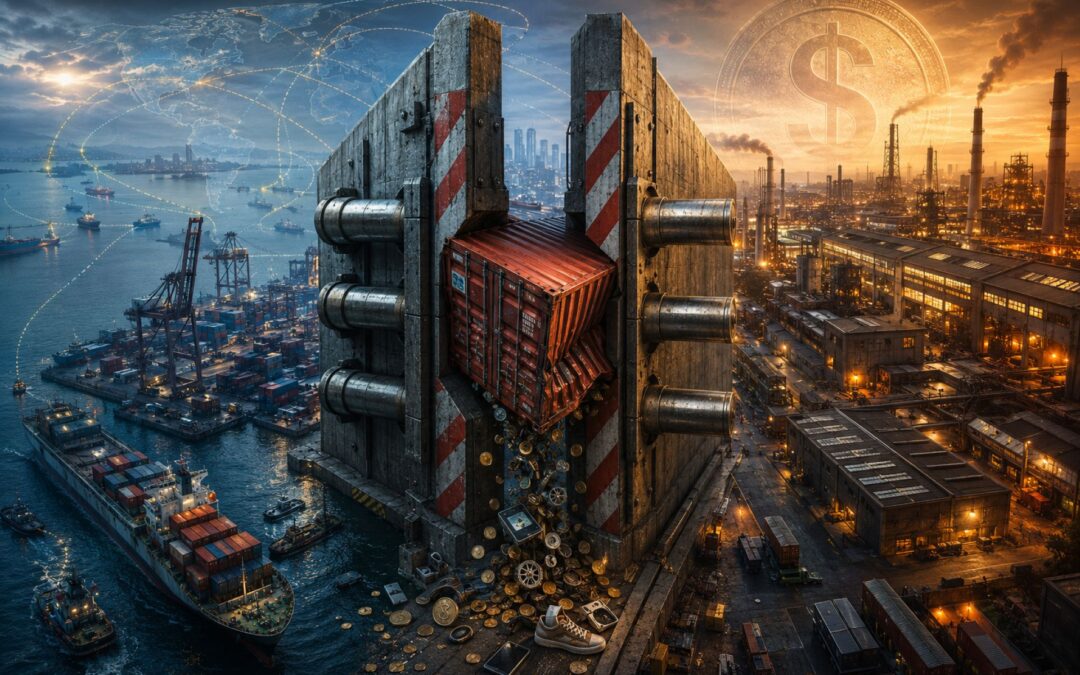
In April 2025, Donald Trump attempted one of the most dramatic transformations of American trade policy in generations. His administration declared the country’s persistent trade deficit a national emergency and announced a baseline tariff on nearly all imports, with higher rates for countries accused of maintaining unfair trade barriers.
The policy was designed to do several things at once. It was supposed to protect American industry, encourage companies to manufacture inside the United States, force trading partners to make concessions, reduce trade deficits, raise federal revenue and strengthen national security.
Then the legal foundation collapsed.
On February 20, 2026, the Supreme Court ruled that the International Emergency Economic Powers Act did not authorize the president to impose tariffs. The administration responded by turning to other laws, including Sections 122, 232 and 301 of the Trade Act, in an effort to reconstruct the tariff system through authorities that explicitly address trade.
As of July 21, 2026, the temporary global tariffs imposed under Section 122 were due to expire three days later unless Congress extended them. The administration was simultaneously accelerating investigations that could support a new wave of tariffs under Section 301.
The legal drama exposed something deeper than a dispute over presidential power. Tariffs had become the centrepiece of a much larger theory about what had gone wrong with the American economy.
Trump’s supporters saw them as a way to restore lost manufacturing, confront China, reduce strategic dependence and make foreign countries contribute more to the economic order protected by the United States. Critics saw them as taxes on American consumers that would provoke retaliation, disrupt investment and rearrange supply chains without addressing the deeper causes of industrial decline.
Both sides often talked about tariffs as though they produced a single, predictable result.
They do not.
A tariff can protect one industry while harming another. It can reduce imports from one country while increasing imports from somewhere else. It can raise federal revenue while reducing household purchasing power. It can expand manufacturing output while making the economy as a whole slightly smaller.
The right question is therefore not simply whether tariffs work.
It is what they are supposed to accomplish, how they are designed, who ultimately bears their cost and what other policies accompany them.
What Tariffs Actually Do
A tariff is a tax imposed on goods entering a country. In the United States, it is normally collected from the American company importing the product.
That does not necessarily mean the importer bears the entire economic burden.
An importer may absorb some of the cost through lower profit margins. It may negotiate a lower price from the foreign supplier. It may pass the cost to retailers, which may then raise consumer prices. It may shift production to another country, redesign the product, reduce wages, automate more work or stop selling the item entirely.
The final burden can therefore be divided among foreign exporters, American importers, businesses, workers and consumers.
Exchange rates complicate the picture further. Suppose the United States places a 10% tariff on goods from a particular country, but that country’s currency loses value against the dollar. The currency movement makes its exports cheaper in dollar terms and may offset part of the tariff.
How much is offset depends on several factors: the size of the exchange-rate movement, the currency used in contracts, the willingness of exporters to reduce their margins, the availability of alternative suppliers and the ability of American companies to pass costs forward.
That is why two statements commonly made during tariff debates are both misleading.
The first is that foreign countries simply pay the tariff. The American government collects the money from American importers, even when foreign producers indirectly bear part of the cost.
The second is that consumers always pay the full tariff immediately. They often pay a substantial share, but the burden can be dispersed throughout the supply chain and may emerge through prices, margins, investment, wages or product availability.
Tariffs also serve several different purposes.
A government may use them to raise revenue, protect a developing industry, punish unfair trade practices, retaliate against another country, safeguard military supplies, encourage domestic production or create leverage in negotiations.
Those objectives do not always reinforce one another.
A tariff that eliminates imports may protect domestic producers but eventually collect little revenue. A tariff designed primarily to raise revenue works best when imports continue, which limits the amount of domestic substitution it creates. A tariff that protects steelmakers may simultaneously raise costs for car manufacturers, construction firms and machinery producers.
A tariff can therefore succeed by one measure and fail by another.
Any serious evaluation must begin by asking what the policy was intended to achieve and what would probably have happened without it.
Why Hamilton Believed America Needed Protection
The American case for tariffs did not begin with Donald Trump.
When the United States emerged from the Revolution, it was politically independent but economically vulnerable. Britain possessed established factories, experienced workers, accumulated capital, merchant networks and access to markets developed over generations.
America remained largely agricultural. Its manufacturers were small, its financial system was immature and many essential goods still came from abroad.
British arguments for free trade therefore sounded very different in London and Philadelphia. Britain was already an industrial leader. Opening markets allowed its efficient manufacturers to sell into countries whose industries had not yet reached the same scale.
For a nation trying to catch up, immediate free competition could preserve the existing hierarchy rather than overturn it.
Alexander Hamilton developed the most influential American response in his 1791 Report on Manufactures.
Hamilton argued that manufacturing could increase national wealth, improve the division of labour, encourage technological development, create more varied employment and make the United States less dependent on foreign powers for military and essential supplies.
But new industries faced disadvantages that private initiative might not overcome quickly. Established foreign manufacturers had larger markets, lower costs, better financing and more experience. American entrepreneurs could be capable of competing eventually yet unable to survive the early years required to develop that capability.
Protection could give them time.
Import duties, restrictions and—in some cases—prohibitions could create room for domestic manufacturers to learn, invest and expand. Once they achieved sufficient scale and productivity, they might compete without permanent protection.
This became the classic infant-industry argument.
Its logic remains powerful. A country may possess the potential to produce semiconductors, batteries, aircraft or machinery but lack the supplier networks, technical knowledge and capital required to challenge established producers immediately. If the market is opened completely before those capabilities exist, the industry may never develop.
Yet Hamilton’s argument is frequently simplified into a defence of tariffs alone.
He also advocated government “bounties,” the contemporary term for subsidies, along with access to capital, immigration, infrastructure and other forms of state support. Protection was part of a developmental system.
That distinction matters.
A tariff can make an imported product more expensive, but it cannot by itself train engineers, build ports, finance new factories, develop technologies, construct power grids or create reliable supplier networks. It gives domestic producers an opportunity. It does not guarantee that they can use it.
Hamilton also recognised that protection imposed costs. Consumers might initially pay more, and established interests could seek to preserve assistance long after it had served its developmental purpose. The case for intervention therefore depended on particular industries and reasonable limits, not the assumption that every import was economically harmful.
Trump’s economic worldview draws heavily from this older tradition. He frequently portrays the period of high tariffs and rapid American industrialization as proof that protection created national prosperity.
But the modern American economy is not the economy of 1791.
A contemporary factory may import machinery from Germany, components from Japan, minerals from Chile and intermediate goods from China before selling the finished product in several countries. Raising the price of an import may therefore protect one American producer while increasing the costs of another.
Hamilton’s broader lesson is not that tariffs always create industry.
It is that countries sometimes need an industrial strategy—and that protection is only one part of it.
How Income Tax Changed the Tariff Debate
Tariffs were not merely industrial policy in early America. They were the financial foundation of the federal government.
The US International Trade Commission’s history of the American tariff system divides federal revenue into three broad eras.
From 1789 to 1862, nearly all federal revenue came from customs duties. Between 1863 and 1914, customs and internal revenue sources such as excise taxes contributed roughly comparable shares. From 1915 onward, internal taxation supplied the large majority of federal receipts, and customs duties became a relatively minor source.
The transition began during the Civil War, when the government needed far more money than customs alone could reliably provide. Congress introduced a temporary income tax, including a 3% levy on income above $800.
The modern system became constitutionally secure after ratification of the Sixteenth Amendment in 1913.
The change reflected the development of the American state. A government responsible for a larger military, national infrastructure, social programmes, education, debt service and an expanding administrative system required a broad and predictable tax base.
Customs revenue depended on imports. It could fall during recessions, wars, embargoes or periods when tariffs successfully discouraged foreign purchases.
That creates an unavoidable contradiction for anyone proposing tariffs as both a major source of revenue and a tool for eliminating imports.
If tariffs cause companies to replace foreign goods with domestic production, the tax base shrinks. If imports remain high enough to produce large and lasting revenue, the tariffs have not fully reshored production.
Modern tariffs can still raise substantial sums. They may even finance reductions in other taxes at the margin. But the federal government is vastly larger, relative to both its nineteenth-century predecessor and the volume of taxable imports, than it was before the income-tax era.
Tariffs also fall differently from income taxes. Lower-income households generally spend a larger share of what they earn, particularly on physical goods. A broad tariff can therefore consume a larger proportion of their income even when wealthier households pay more in absolute dollars.
Trump’s nostalgia for the pre-1913 system nevertheless has a clear political appeal. Tariffs appear to tax foreign commerce rather than domestic earnings. They connect revenue to national borders and make taxation look like a cost imposed on outsiders.
The burden, however, does not remain neatly outside the country.
History also shows how quickly protection can escalate. During the Great Depression and the Smoot-Hawley tariff, governments responded to economic insecurity by raising barriers against one another. Retaliation compressed trade further at precisely the moment the world economy was contracting.
Smoot-Hawley did not single-handedly cause the Depression, but it illustrates a persistent danger: a tariff designed to protect domestic producers changes the incentives of every trading partner it affects.
What Trump’s First Trade War Actually Achieved
Trump’s first administration offered a large modern test of tariff policy.
Beginning in 2018, the United States imposed tariffs on steel, aluminium, washing machines, solar products and a wide range of Chinese imports. The measures affected hundreds of billions of dollars in trade.
Each policy had a plausible objective. Steel tariffs were intended to protect an industry considered economically and strategically important. Washing-machine tariffs were supposed to stop foreign producers from repeatedly shifting production to avoid earlier trade remedies. Tariffs on China sought to challenge intellectual-property violations, forced technology transfer, subsidies and other practices that the United States considered unfair.
The tariffs did change behaviour.
Domestic producers received protection. Some foreign companies moved production. Direct imports from China fell in affected categories. The government collected revenue, and industries sheltered from foreign competition gained room to raise output or prices.
But those were not the only effects.
American manufacturers also buy imported materials and components. Foreign governments retaliated against American exports. Supply chains moved rather than disappeared. Higher costs reached consumers and downstream businesses. Political benefits were concentrated in places where protection was visible, while economic costs were spread across the country.
The result was neither the total failure described by tariff opponents nor the industrial revival promised by tariff advocates.
Steel and Washing Machines: Visible Gains, Hidden Costs
Steel is the clearest example of how tariffs create concentrated benefits and dispersed costs.
In March 2018, the Trump administration imposed a 25% tariff on imported steel under Section 232, which allows trade restrictions when imports threaten national security.
Domestic steelmakers gained an obvious advantage. Foreign steel became more expensive, allowing American producers to increase prices, output or capacity that might otherwise have remained uncompetitive.
For steelworkers and communities built around mills, those gains were real. Strategic arguments also mattered. A country that cannot produce enough steel for infrastructure, machinery or defence may be vulnerable during a crisis.
The complication is that steel is not only a finished product. It is an input.
American carmakers, construction companies, appliance manufacturers and machinery producers purchase steel to make other goods. For them, the tariff functioned as an increase in production costs.
A Federal Reserve study of the 2018–2019 tariffs found that manufacturing industries receiving more protection did not experience a net employment benefit once rising input costs and retaliatory tariffs were considered. Industries more exposed to the tariffs experienced relative employment reductions, while producer prices increased.
The pattern demonstrates why counting jobs in the protected industry is insufficient.
If a steel mill adds workers but steel-using firms delay investment, reduce employment or lose export competitiveness, the economy may gain visible jobs in one place while losing less visible opportunities elsewhere.
The USITC later estimated that Section 232 tariffs increased domestic sourcing of steel and aluminium but reduced production among downstream industries that relied heavily on those inputs. The size of the effect differed by industry, but the trade-off was unmistakable.
Washing machines tell a similar story.
After the United States imposed safeguard tariffs in 2018, domestic prices rose sharply. Research on the washing-machine tariffs found that prices increased not only for washing machines but also for dryers, even though dryers were not directly tariffed.
Retailers commonly sell the appliances together. Once washing-machine prices increased, companies had room to raise dryer prices as well.
At the same time, the policy encouraged production relocation. Foreign manufacturers expanded American operations to serve the protected market.
This is precisely why tariff outcomes resist simple slogans. The washing-machine policy helped induce domestic production, but American buyers paid substantially more for the products. Whether that counts as success depends on the value placed on additional capacity, the durability of the new investment and the cost per job or unit of output created.
The political effects were clearer.
A study of the tariffs’ employment and electoral consequences found little evidence of meaningful employment gains in newly protected sectors by the end of Trump’s first term. Retaliatory tariffs produced negative employment effects, particularly in agriculture.
Yet exposure to import protection increased political support for Trump and the Republican Party in affected areas.
Tariffs communicated action. A mill, factory announcement or trade confrontation was easier to see than higher input costs distributed across thousands of businesses.
Protection could therefore succeed politically even when its overall employment record was weak.
China: Less Direct Trade, More Trade Diversion
China presented a different challenge.
After joining the World Trade Organization in 2001, China became the centre of an enormous manufacturing network. Its low production costs, infrastructure, labour force, supplier density and state-supported investment drew factories and supply chains away from other countries.
American consumers benefited from cheaper goods, but many manufacturing communities absorbed severe disruption. The gains from trade were widely distributed through lower prices, while job losses were geographically concentrated and socially devastating.
Trump treated the bilateral trade deficit with China as evidence that the relationship was fundamentally unfair. His administration imposed tariffs under Section 301 on a vast range of Chinese imports.
Those tariffs reduced direct imports from China.
The USITC’s assessment of the Section 232 and Section 301 tariffs found that Section 301 measures reduced imports from China across affected sectors by 13%, increased the value of American production by 0.4% and increased American product prices by 0.2%.
Some industries experienced much larger changes. Tariffs substantially reduced imports in specific categories and encouraged domestic production.
That was a meaningful effect. It showed that tariffs can alter sourcing and provide space for American producers.
But reducing imports from China is not the same as reducing imports overall.
Companies still needed many of the goods, components and materials they had previously purchased from Chinese suppliers. Instead of abandoning foreign production, they shifted orders to Vietnam, Mexico and other economies.
Chinese companies also adapted. Some relocated final assembly outside China, invested in overseas plants or sold intermediate products to manufacturers in third countries.
This does not mean every product arriving from Vietnam or Mexico was simply a Chinese good with a different label. Those countries developed genuine manufacturing capacity of their own. But it does mean that trade barriers changed the geography of supply chains more easily than they eliminated the economic forces behind them.
The distinction between a bilateral deficit and the total American trade balance is crucial.
A country can reduce its deficit with China while increasing deficits elsewhere. If American consumption and investment continue to exceed national saving, foreign capital must finance the gap, and the overall external deficit tends to persist in some form.
Tariffs may determine which country supplies the imports. They do not automatically eliminate the underlying demand for them.
The first trade war therefore accomplished more diversification than reshoring.
It weakened China’s direct position in parts of the American market, raised domestic output in selected industries and gave the United States negotiating leverage. It also raised prices, hurt some downstream manufacturers, provoked retaliation and encouraged supply chains to route themselves through new countries.
Why Trump Escalated the Strategy in His Second Term
The mixed record of the first trade war did not persuade Trump to abandon tariffs. It convinced him to use them more aggressively.
The policy continued to serve several purposes.
First, tariffs offered direct protection to industries competing with imports. Second, they signalled loyalty to industrial communities that believed earlier trade policy had sacrificed them for cheaper consumer goods. Third, the threat of market exclusion created negotiating leverage. Fourth, restrictions on strategic imports could reduce dependence on geopolitical rivals. Fifth, tariff revenue could finance other fiscal priorities.
In April 2025, the administration attempted to combine those purposes into a single global system.
Its stated case for reciprocal tariffs described persistent trade deficits, non-reciprocal barriers, currency practices and foreign industrial policies as threats to American economic and national security.
The administration imposed a baseline tariff and assigned higher rates to countries with which the United States had large trade deficits. It also claimed authority to change those rates depending on retaliation or concessions by trading partners.
That flexibility was politically useful but economically destabilizing.
Businesses make investment decisions over years. A manufacturer considering a new American factory must estimate the future cost of imported components, the probability of retaliation, the availability of exemptions and whether the protection will remain in place long enough to justify the investment.
When tariff rates can change quickly through presidential orders, firms may respond by postponing decisions rather than committing billions of dollars to a new supply chain.
The legal problem was even more fundamental.
On February 20, 2026, the Supreme Court ruled that the International Emergency Economic Powers Act did not authorize the president to impose tariffs. The Court held that IEEPA’s power to regulate importation did not contain the clear congressional authorization required for tariffs of such extraordinary scope, amount and duration.
The ruling did not eliminate presidential tariff powers. Congress has delegated substantial authority through laws specifically addressing trade.
Section 232 permits restrictions based on national security. Section 301 allows the United States to respond to unjustifiable, unreasonable or discriminatory foreign trade practices. Section 122 permits temporary import surcharges to address serious balance-of-payments problems.
Those laws impose different procedures and limits.
Immediately after the Supreme Court decision, the administration used Section 122 to impose temporary tariffs. As of July 21, 2026, those measures were scheduled to expire on July 24 because the statute allows them to operate for only 150 days without congressional extension.
At the same time, the administration was trying to rebuild the tariff wall through Section 301 investigations covering alleged forced-labour failures and global manufacturing overcapacity.
Section 301 offers more durability than an emergency declaration, but it requires investigations, public comments and hearings. That makes it slower and more procedurally constrained.
The shift reveals an important institutional trade-off. A rule-bound tariff system is less flexible for the president, but its predictability may make it more useful for businesses deciding where to invest.
The economic trade-offs remain just as important.
The Budget Lab’s April 2026 estimates projected that the tariff system could raise substantial federal revenue and increase long-run manufacturing output by about 1.1%. Yet the model also found that gains in manufacturing would be more than offset by contractions elsewhere, leaving the total economy slightly smaller.
Assuming the temporary Section 122 tariffs expired, the model estimated a persistent long-run output loss of about 0.1%, alongside higher consumer prices and a disproportionate burden on lower-income households.
These are projections rather than completed historical outcomes. They depend on assumptions about substitution, retaliation, exchange rates and how long the tariffs remain in force.
But they illustrate the central point.
Tariffs can make manufacturing larger without making the entire economy larger.
That may still be an acceptable trade-off when the protected production is strategically essential. A country might rationally accept higher costs to maintain access to weapons, medicines, semiconductors or critical infrastructure.
The same defence is harder to apply to broad tariffs on allies, ordinary consumer goods and inputs for American producers.
The more objectives a tariff system is expected to accomplish at once, the more difficult it becomes to judge—and the more likely it is to produce contradictions.
Why Tariffs Cannot Fix China’s Economic Imbalance Alone
Trump’s tariff strategy rests partly on an accurate diagnosis: China produces far more manufactured goods than its households consume.
For decades, the Chinese growth model directed resources toward investment, infrastructure, property development and industrial capacity. Household consumption remained unusually weak relative to the size of the economy.
The resulting factories could not depend entirely on domestic buyers. Exports became an outlet for production that China’s internal market did not absorb.
The mistake is to treat that imbalance primarily as a cultural preference for saving.
Culture may influence behaviour, but Chinese households also face powerful economic reasons to accumulate money.
The IMF’s latest assessment of China’s economy identifies population aging, limited social spending and inadequate access to benefits for migrant workers as important drivers of high household saving.
Families save to prepare for retirement, medical expenses, education and income shocks. Migrant workers may live in cities without receiving the same public services as fully registered urban residents. Weak pension and welfare coverage increase the value of precautionary savings.
The property downturn has reinforced the pattern. Housing has long been a major store of household wealth. Falling prices, unfinished projects and financial stress among developers have weakened confidence and encouraged families to postpone purchases.
China’s industrial policy pushes from the opposite direction. Priority sectors receive support through grants, tax benefits, subsidized land, cheaper credit and government-linked investment funds.
The combination is powerful: weak household consumption alongside enormous productive capacity.
That structure helps produce trade surpluses and intense competition in global markets. When domestic demand cannot absorb output, firms have strong incentives to export.
American tariffs can change where those exports go. They can make direct access to the United States more expensive, protect selected American industries and encourage companies to diversify away from Chinese suppliers.
They cannot directly improve Chinese pensions, raise household income, repair the property market or change the balance between investment and consumption.
Nor can they force the rest of the world to stop buying competitively priced Chinese goods. Unless other countries coordinate their policies, exports blocked from the United States may be redirected to Europe, Latin America, Asia or the Middle East.
China therefore has to participate in any lasting rebalancing. Stronger social protection, better benefits for migrant workers, higher household income and less reliance on industrial investment could increase domestic consumption and reduce pressure to export excess production.
But the United States also has work to do at home.
It is not enough to make Chinese goods more expensive. American companies need skilled workers, infrastructure, affordable energy, access to finance, predictable regulation, research capacity and networks of suppliers.
China’s clean-energy dominance demonstrates what tariffs alone cannot create. China’s advantage in solar panels, batteries and related technologies emerged from scale, industrial coordination, infrastructure, technical expertise, financing and dense production ecosystems.
A border tax can give an American factory room to compete. It cannot manufacture the ecosystem surrounding that factory.
The strongest response to Chinese industrial power therefore combines selective protection with domestic construction.
Tariffs may hold the door open. Industrial policy must build what stands behind it.
The Dollar, Stephen Miran, and the Mar-a-Lago Strategy
Trump’s tariff agenda is often presented as a straightforward attempt to protect American factories.
The intellectual framework developed by Stephen Miran is much more ambitious.
In A User’s Guide to Restructuring the Global Trading System, Miran argues that the decline of American manufacturing cannot be understood through trade policy alone. It is also connected to the international role of the dollar.
The dollar is the central currency of global finance. Governments hold dollar reserves. Businesses use dollars to settle transactions. Investors purchase Treasury securities because the American market is deep, liquid and supported by strong institutions.
That worldwide demand creates major advantages for the United States.
It can lower borrowing costs, allow the government to finance deficits more easily, support financial sanctions and give American institutions enormous influence over international payments.
But Miran argues that reserve status also imposes a burden.
Persistent demand for dollar assets keeps the currency stronger than it would otherwise be. A strong dollar makes imported goods cheaper for Americans but makes American exports more expensive for foreign buyers.
The benefits are distributed heavily toward consumers, financial markets and the government’s borrowing capacity. The costs fall more directly on exporters and industries competing with imports.
In Miran’s interpretation, the reserve system therefore transfers part of the burden of maintaining the global financial order onto the American tradable sector.
Tariffs are one way to compensate.
He argues that the inflationary impact of a tariff can be reduced when the dollar appreciates or the exporting country’s currency depreciates. If a foreign currency falls enough, the dollar price of the imported good may rise by much less than the tariff rate.
Something like this occurred during the first US–China trade war. The renminbi weakened against the dollar, partially offsetting the increase in tariffs when import prices were measured in American currency.
The mechanism is real. Its size is disputed.
A currency move does not automatically reduce the invoice price paid by an American importer. Contracts may be written in dollars. Foreign firms may preserve their dollar prices and accept the exchange-rate gain as higher profit. Retailers may still raise prices. Other economic developments may also be moving the currency at the same time.
Research on the first-term tariffs generally found substantial pass-through to American importers, even when exchange-rate adjustment absorbed part of the burden.
There is also a tension in the strategy.
Tariffs can strengthen the dollar if they reduce demand for foreign currency, attract capital into the United States or weaken foreign growth. Yet one of Miran’s goals is a weaker dollar that makes American exports more competitive.
The proposed solution is international coordination.
The historical model is the 1985 Plaza Agreement. The United States, France, West Germany, Japan and the United Kingdom agreed that an orderly appreciation of non-dollar currencies was desirable. Their governments coordinated intervention that contributed to a weaker dollar.
A modern version has been described, with deliberate poetic licence, as a “Mar-a-Lago Accord.”
Under the idea, America’s trading partners would help strengthen their currencies against the dollar. They might sell dollars in foreign-exchange markets while continuing to support the Treasury market through purchases of longer-term American debt.
Tariffs would provide the pressure that brings them to the negotiating table. American security guarantees could become part of the bargain: countries benefiting from US military protection and access to the American market would be expected to share more of the economic burden.
In theory, the arrangement attempts to solve several problems simultaneously.
A weaker dollar would improve American export competitiveness. Continued foreign Treasury purchases would prevent the currency adjustment from producing a surge in government borrowing costs. Tariffs would create leverage and generate revenue during the transition.
The strategy is more coherent than the slogan “foreign countries will pay.”
It is also extremely difficult to execute.
The Plaza Agreement involved a small group of major economies that broadly accepted the need for coordinated adjustment. Today’s trade and financial system contains more countries, more private capital and far larger stocks of American debt.
Europe, China and Japan would not automatically benefit from stronger currencies. Their exporters could lose competitiveness, and their governments might resist policies that redirect demand toward the United States.
Coercion introduces additional risks.
A country threatened with tariffs or reduced security support may agree to purchase long-term Treasury securities. It may instead diversify its trade, develop alternative financial arrangements or question the reliability of the American alliance.
Forcing foreign holders to exchange short-term securities for very long-term bonds could also be interpreted as a reduction in liquidity or an attempt to shift financial risk onto allies. Rather than preserving low borrowing costs, it might cause investors to demand a higher return.
The dollar’s dominance is supported by more than military power. It rests on trust in American institutions, open capital markets, legal predictability and the ability to move money freely.
A policy intended to preserve reserve status could weaken it if trading partners begin to view American assets as instruments of coercion.
That does not mean the dollar is about to lose its central position. The euro lacks a single Treasury market of comparable depth, while China maintains capital controls and does not offer the same degree of convertibility or institutional trust.
But reserve dominance is not indestructible.
Miran’s framework identifies a genuine tension between the financial benefits of a powerful dollar and the pressure it can place on American manufacturing. It also recognizes that tariffs alone cannot resolve that tension.
The unresolved question is whether the United States can persuade other countries to share the burden through a negotiated system—or whether attempts to force them will encourage the very diversification Washington hopes to prevent.
So, Do Tariffs Work?
Tariffs work when the objective is narrow enough to be tested and the rest of the economic strategy is strong enough to support them.
They are more likely to succeed when a country targets an industry with a realistic path to competitiveness, when domestic production can expand, when protection is stable and time-limited, and when firms have access to capital, infrastructure, workers, technology and inputs.
They can also be justified when the economic cost buys something valuable that markets would otherwise underprovide: military readiness, supply-chain resilience or the preservation of a strategically essential capability.
Coordination matters. Tariffs imposed alongside allies can isolate a problematic supplier. Tariffs imposed simultaneously on allies and adversaries encourage every trading partner to find alternatives to the United States.
Measurement matters too. A successful tariff needs a defined standard: more domestic capacity, lower strategic exposure, changed foreign behaviour or a particular amount of revenue. Without such a benchmark, temporary protection can become permanent regardless of results.
Tariffs are far less likely to work when they are expected to achieve every goal at once.
A single policy cannot reliably raise maximum revenue, eliminate imports, reduce inflation, weaken the dollar, strengthen the dollar, create jobs, discipline allies, punish rivals and lower consumer prices simultaneously.
Those objectives contain conflicts.
Revenue requires continued imports. Reshoring requires reducing them. A stronger dollar can offset consumer-price increases but weaken exporters. A weaker dollar can help exporters but make imports more expensive. Protection can expand one industry while raising costs throughout the rest of the economy.
The evidence from Trump’s first term reflects those trade-offs.
Tariffs protected selected producers, changed trade routes, encouraged some production and created political benefits. They also raised prices, harmed downstream manufacturers, provoked retaliation and did not produce a broad manufacturing-employment revival.
The second-term strategy is larger and more ambitious. It may raise substantial revenue and increase manufacturing output while making other parts of the economy smaller. It may create bargaining leverage while introducing uncertainty that discourages investment. It may confront China while pushing allies to reduce their own dependence on the United States.
Tariffs are tools, not an economic system.
They can alter prices, sourcing, revenue, negotiating power and the fortunes of particular industries. What they cannot do by themselves is create the institutions, skills, technologies, infrastructure, supplier networks and demand that make an industrial economy competitive.
Protecting an industry and building one are not the same task.
A successful industrial strategy may sometimes require tariffs.
It can never consist of tariffs alone.
Last Updated on July 21, 2026 by Aseem Gupta