
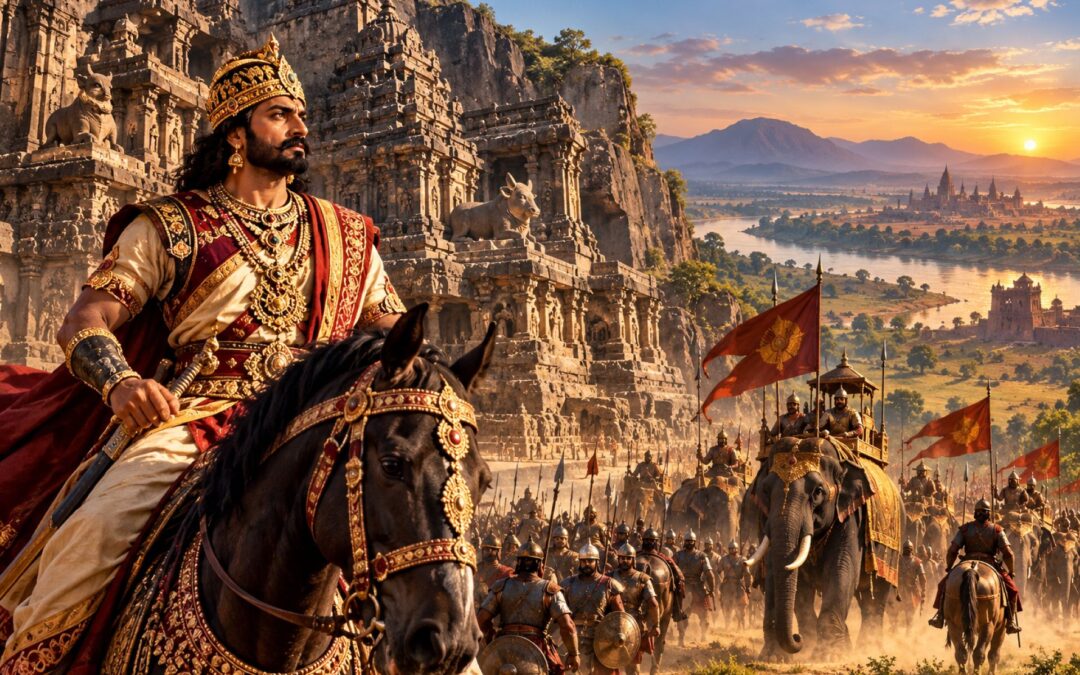
In the ninth century, Arab travellers described the ruler of the Rashtrakuta Empire as one of the most powerful monarchs in the world. Their accounts placed a dynasty based in India’s Deccan Plateau alongside the great imperial powers of their age. The comparison reflected the extraordinary reputation of a kingdom whose armies had crossed much of the Indian subcontinent and challenged the established rulers of northern India.
The Rashtrakutas had not begun as an independent imperial dynasty. They emerged from the political system of the Badami Chalukyas, gradually displaced their former masters, and built an empire that became one of the dominant powers of early medieval India. From their Deccan heartland, they competed with the Gurjara-Pratiharas and Palas for influence over Kannauj and the Gangetic plains, while simultaneously confronting ambitious kingdoms to their south and east.
Their history presents an important puzzle. How could rulers based so far from the traditional political centres of northern India repeatedly project power across the subcontinent? And why did a dynasty capable of defeating formidable opponents eventually collapse under pressure from its own former subordinates?
The answer lies in more than a succession of military victories. Rashtrakuta power depended on geography, regional alliances, commercial wealth, military organization, and the ability to command the loyalty of other rulers. These foundations produced an empire renowned for conquest, monumental architecture, religious patronage, and literary achievement, but they also exposed it to political fragmentation when the authority of its emperors weakened.
From Chalukya Vassals to Deccan Rulers
The Rashtrakuta Empire emerged during a period of intense political competition in the Deccan, the vast plateau occupying much of peninsular India. Its location made the region strategically important because it connected northern India with the southern kingdoms and provided access to commercial routes leading toward both coasts. A ruler who controlled substantial parts of the Deccan could influence several regional political systems without necessarily governing them all directly.
During the early eighth century, much of the western Deccan was dominated by the Badami Chalukyas. Their authority rested partly on subordinate chiefs who administered territories, supplied military assistance, and acknowledged Chalukya supremacy. The Rashtrakutas belonged to this political environment, although their precise earlier origins remain debated. Attempts to trace the dynasty directly to much older groups mentioned in ancient inscriptions have not produced a universally accepted genealogy.
The ruler who transformed the family’s position was Dantidurga. Initially associated with the Chalukya political order, he gained military experience and prestige during a period when western India faced incursions by Arab forces advancing from Sind. The Rashtrakutas participated in the regional military response, although accounts that personally credit Dantidurga with saving all southern India from multiple invasions exaggerate what the surviving evidence can establish.
Dantidurga subsequently pursued an increasingly independent political career. He campaigned against rulers in central India, extended his influence toward Malwa and neighbouring regions, and developed a valuable relationship with the Pallavas of Kanchipuram. These activities weakened the position of the Chalukyas while expanding the territory and political connections available to the rising Rashtrakuta house.
Around 753 CE, Dantidurga challenged the Chalukya king Kirtivarman II and established himself as an independent sovereign. The transformation did not occur through one isolated victory. It represented the culmination of years in which a subordinate commander had accumulated enough military resources, prestige, and alliances to overturn the hierarchy to which he had previously belonged.
Dantidurga died around 756 without leaving a direct male successor, and his uncle Krishna I inherited the new kingdom. Krishna completed the destruction of effective Badami Chalukya rule by approximately 757 and continued expanding Rashtrakuta authority. His campaigns brought pressure upon the Western Gangas, the Konkan region, and the Eastern Chalukyas of Vengi, although the resulting political relationships varied between conquest, submission, and temporary subordination.
The early rulers therefore had to accomplish two related tasks. They needed to replace the Chalukyas as the dominant power in their heartland while persuading neighbouring rulers that the new dynasty possessed the military strength and political legitimacy to command their obedience. Krishna I’s patronage of the extraordinary Kailasa temple at Ellora added a cultural expression of sovereignty to these military achievements.
By Krishna’s death in the 770s, the Rashtrakutas had established a formidable regional empire. The historical account of the Rashtrakuta dynasty traces this transition from subordinate rulers to a powerful imperial house whose successors would increasingly intervene in the politics of northern India.
The empire’s next challenge would arise from an opportunity far beyond its original Deccan territories.
The Contest for Kannauj—and the Limits of Conquest
The city of Kannauj, situated near the Ganges in present-day Uttar Pradesh, became one of the most contested political prizes of early medieval India. Its importance was partly economic: the surrounding northern plains supported productive agriculture, substantial populations, and commercial connections extending across the Gangetic basin. Control of the region could provide access to resources and trading networks unavailable to a kingdom confined to the Deccan.
Kannauj also possessed enormous symbolic value. It had been associated with the seventh-century ruler Harsha, whose kingdom represented one of the most important northern imperial formations after the decline of Gupta power. In the centuries following Harsha, possession of Kannauj became a way for ambitious rulers to demonstrate that their authority extended beyond their immediate regional homelands.
Three dynasties emerged as the principal competitors for this prestige. The Gurjara-Pratiharas controlled territories in western and northern India, with important connections to Rajasthan and Malwa. The Palas, whose power developed in Bengal and Bihar, competed for influence across the eastern Gangetic plains. The Rashtrakutas approached the same political arena from the Deccan.
Their rivalry became known as the Tripartite Struggle, although it was not one continuous war fought by three permanently united states. It consisted of campaigns, shifting alliances, political submissions, and repeated reversals extending across generations. Its development reflected the wider fragmentation of political authority described in the history of India, where regional powers repeatedly attempted to establish wider supremacy without permanently eliminating their competitors.
The Rashtrakuta ruler who decisively entered this contest was Dhruva Dharavarsha. He came to power around 780 after displacing his elder brother Govinda II, whose succession had followed Krishna I’s death. Before undertaking extensive northern campaigns, Dhruva strengthened his position within the Deccan by confronting opponents and subordinate rulers whose loyalties could not be taken for granted.
This internal consolidation was essential. An emperor marching north could not afford to leave behind powerful regional chiefs ready to rebel while the main imperial army operated hundreds of kilometres away. The Rashtrakutas therefore faced a recurring strategic problem: their military ambitions required extended campaigns, but those campaigns depended on maintaining political stability at home.
Dhruva’s northern expeditions brought him into conflict with the Gurjara-Pratiharas and Palas. He defeated the Pratihara ruler Vatsaraja and challenged the Pala ruler Dharmapala, demonstrating that a Deccan army could intervene effectively in the political struggles of the Gangetic region. These victories greatly increased Rashtrakuta prestige and reduced the immediate ability of the northern dynasties to challenge his supremacy.
However, defeating an army was not the same as governing the territory from which it had come. Dhruva’s operations established military superiority over important rivals, but they did not create a durable system of direct Rashtrakuta administration across the northern plains. The emperor eventually returned south, leaving the region’s political future open to renewed competition.
This distinction between victory and control became central to the history of the empire. A successful expedition could secure treasure, recognition, and temporary submission without producing a permanent territorial acquisition. Maintaining distant garrisons, collecting revenue, and managing local elites required administrative commitments that might exceed the benefits of an extended occupation.
After Dhruva’s death in 793, his son Govinda III inherited the throne amid another succession dispute. His elder brother Kambarasa challenged his authority and attracted support from powerful subordinate rulers, including members of the Western Ganga political establishment. Govinda defeated the rebellion and consolidated his position, demonstrating once again that imperial succession could threaten the stability of the entire political order.
Rather than relying solely on punishment, Govinda appears to have combined military force with political accommodation. Restoring relationships with defeated relatives and subordinate chiefs could be more practical than attempting to eliminate every rival family. Such settlements, however, also meant that local centres of power survived within the imperial system.
Once his position was secure, Govinda III renewed the northern offensive. His campaigns around the beginning of the ninth century defeated the Gurjara-Pratihara ruler Nagabhata II and compelled important northern rulers, including Dharmapala and the Kannauj claimant Chakrayudha, to acknowledge Rashtrakuta superiority. These achievements represented one of the dynasty’s most impressive demonstrations of military power.
Gujarat and Malwa were especially significant because they connected the Deccan heartland with the northern political arena. Their control or allegiance could help secure routes for armies, resources, and communication. Rashtrakuta branches and subordinate ruling families played important roles in these frontier territories, although claims that Govinda personally founded particular later dynasties as permanently obedient instruments of his government require caution.
Royal inscriptions celebrated Govinda’s accomplishments in extravagant language. Accounts of horses reaching the Himalayan region and elephants encountering the sacred waters of the Ganges presented the emperor as a conqueror whose power extended across the subcontinent. Such descriptions are valuable evidence of imperial ambition and political self-presentation, but they cannot automatically be converted into precise maps of territory under everyday Rashtrakuta administration.
Govinda’s wider campaigns also reached toward the southern kingdoms. He confronted powers associated with the Pallavas, the Eastern Chalukyas, and other peninsular states, reinforcing the dynasty’s claim to supremacy across an exceptionally broad political landscape. His reputation depended not simply on territorial expansion but on the ability to compel powerful rulers in different regions to recognize his superiority.
Yet Kannauj remained difficult to hold permanently. Northern rulers could recover their position once Rashtrakuta armies withdrew, and the Pratiharas eventually established a stronger presence in the city. Distance, rival military capabilities, and the continuing autonomy of regional elites prevented the Deccan emperors from transforming repeated victories into lasting northern political integration.
The campaigns of Dhruva and Govinda III therefore reveal both the strength and the limits of Rashtrakuta imperialism. Their armies could defeat the principal powers of northern India, but their government could not exercise the same degree of control everywhere its soldiers marched. The dynasty’s greatest military achievements repeatedly exposed the difference between projecting power and sustaining it.
Amoghavarsha I’s Long Reign: Crisis, Conciliation, and Manyakheta
Govinda III died in 814, leaving the throne to his young son Amoghavarsha I. The new ruler inherited an empire with extraordinary military prestige, but its stability depended on personal authority and the continuing cooperation of powerful subordinates. His youth created opportunities for relatives, regional chiefs, and rival dynasties to challenge the political arrangements established by his father.
The early years of Amoghavarsha’s reign were consequently marked by serious instability. His kinsman Karka played an important role in protecting the young monarch’s position, while conflicts involving the Western Gangas and Eastern Chalukyas threatened Rashtrakuta influence. The emperor’s effective exercise of power was interrupted during this turbulent period, and approximately 821 is sometimes treated as an important point in the restoration of his authority.
These difficulties demonstrated how quickly an empire built through conquest could become vulnerable during a disputed or weakened succession. Subordinate rulers who had accepted Govinda III’s authority did not necessarily feel equally obligated to obey his young heir. Military strength remained important, but repeated campaigns against every rebellious chief risked exhausting the resources needed to govern the empire.
Amoghavarsha therefore became particularly associated with negotiation, accommodation, and marriage alliances. Political marriages could transform opponents into relatives, reduce the immediate incentives for warfare, and provide relationships through which rival ruling houses could negotiate their disagreements. Such arrangements were not guarantees of permanent peace, but they offered alternatives to continuous military intervention.
Relations with the Gangas and Eastern Chalukyas remained complicated, and the long reign was not free from warfare. Nevertheless, Amoghavarsha’s reputation differs markedly from that of rulers whose political achievements were remembered primarily through campaigns of conquest. He came to be celebrated for scholarship, religious patronage, and a comparatively conciliatory approach to imperial government.
One of his most consequential political associations was with Manyakheta, identified with modern Malkhed in Karnataka. The city became the principal centre of Rashtrakuta imperial authority and gave the dynasty a durable administrative and cultural focus. Its location within the Deccan helped connect the royal establishment with important territories and subordinate political networks.
A capital was more than a royal residence. It housed the court, attracted scholars and religious teachers, supported craftsmen and merchants, and served as a centre from which the ruler could distribute honours and negotiate with important families. The prominence of Manyakheta reflected the empire’s ability to concentrate political and cultural resources without abandoning its wider relationships across the subcontinent.
Amoghavarsha’s court became particularly renowned for intellectual and religious activity. Jain teachers received substantial patronage, while Kannada and Sanskrit literature flourished within the cultural environment associated with his reign. His religious interests were sufficiently important that later traditions also connected the emperor’s final years with withdrawal from political affairs, although the details of his retirement and possible abdication are not uniformly established.
The apparent contrast between Amoghavarsha and his militarily aggressive predecessors should not be exaggerated. He still ruled a kingdom that depended upon armed force and political hierarchy, and his diplomacy was partly a response to the practical dangers of rebellion. His distinction lay in the prominence of alternative methods of preserving authority.
When Amoghavarsha died in 878, he had occupied the throne for more than six decades. His reign demonstrated that imperial durability could depend on institutions, negotiated relationships, and the prestige of the royal court as much as on new territorial conquests.
How Rashtrakuta Power Worked
The Rashtrakuta Empire was not governed as a uniformly centralized state in which every village answered directly to officials appointed from the capital. Imperial authority operated through a hierarchy of territories, provincial officials, military commanders, local elites, and subordinate kings. The emperor occupied the highest political position, but his ability to command distant regions depended on relationships with people who possessed substantial power of their own.
Administratively, the empire included territorial divisions whose officials managed revenue, local affairs, and military responsibilities. Inscriptions refer to units such as rashtras, vishayas, and smaller local jurisdictions, although their functions and boundaries could vary. Important subordinate rulers maintained their own courts and political traditions while acknowledging Rashtrakuta supremacy.
This arrangement gave the emperors considerable flexibility. Rather than administering every conquered region through a new bureaucracy, a Rashtrakuta ruler could require tribute, troops, or formal recognition from an existing dynasty. Such relationships extended imperial influence without necessarily imposing the costs of direct administration across the entire territory.
The military system reflected this political organization. Rashtrakuta armies employed infantry, cavalry, and war elephants, supported by resources from the royal domains and subordinate rulers. Cavalry was especially useful for campaigns across long distances, while elephants could provide shock power, intimidate opponents, and serve as prominent platforms for military leaders.
The effectiveness of these forces depended on much more than the weapons carried by individual soldiers. Horses required procurement and maintenance, elephants demanded specialized training, and large campaigns needed supplies, communications, and access to reliable routes. A ruler who could mobilize the resources of multiple regional kingdoms possessed advantages unavailable to a smaller independent chief.
Economic strength came partly from agriculture and the revenues associated with cultivated land. Control over prosperous settlements allowed the government and its allies to finance armies, religious establishments, courtly households, and building projects. Grants to temples and other institutions also linked political authority to influential local communities.
Commerce supplied another important dimension of imperial power. Rashtrakuta influence extended into regions connected with the western coast, where merchants participated in exchange networks reaching the Persian Gulf and the wider Arab world. Indian textiles, agricultural products, precious materials, and other goods circulated through commercial relationships that connected inland producers with distant markets.
Arab and Persian merchants were therefore valuable participants in the economy, not simply representatives of a foreign religious tradition. Muslim trading communities developed within parts of the western Indian commercial world, and medieval accounts suggest that rulers could accommodate merchants and religious institutions belonging to different faiths. The extent of these arrangements varied, and the evidence does not justify portraying every Rashtrakuta ruler as following one uninterrupted policy of religious tolerance.
The empire’s administrative flexibility was also a source of vulnerability. A subordinate ruler could strengthen the monarchy through tribute and military assistance while the emperor remained powerful. When imperial authority weakened, however, the same ruler might withdraw support, join a rival coalition, or attempt to establish an independent kingdom.
Rashtrakuta power consequently rested on a continuing negotiation between central supremacy and regional autonomy. The system made extensive conquest possible, but it demanded emperors capable of commanding loyalty across a politically diverse collection of territories.
Kailasa, Kannada Literature, and Religious Patronage
The Rashtrakutas left an enduring cultural legacy that extended beyond the boundaries of their empire. Their rulers and associated elites supported religious institutions, scholars, poets, and monumental architecture, helping transform the Deccan into one of medieval India’s important centres of artistic and intellectual activity. Political patronage strengthened royal prestige, but the resulting works often survived long after the rulers who sponsored them had disappeared.
The most spectacular monument associated with the dynasty is the Kailasa temple at Ellora, generally attributed principally to the patronage of Krishna I. Dedicated to Shiva, it stands within a wider complex of rock-cut monasteries and temples in present-day Maharashtra. Its construction required extraordinary planning, skilled labour, and the mobilization of substantial resources.
What makes Kailasa particularly remarkable is its method of construction. Rather than assembling the temple from quarried blocks, builders excavated the surrounding rock to produce an immense architectural complex from the existing basalt formation. The work transformed a solid mass of stone into a monument containing courtyards, pillars, sculptural panels, and spaces that resemble conventional freestanding temple architecture.
The engineering challenges were enormous. Excavation had to proceed according to a coherent design because mistakes in removing rock could not easily be reversed. Sculptors and builders also had to coordinate structural planning with the elaborate religious imagery decorating the monument.
The temple’s carved representations of Hindu mythology, including the dramatic depiction of Ravana attempting to lift Mount Kailasa, reveal how architectural scale and religious storytelling were combined. The monument celebrated devotion to Shiva while simultaneously expressing the capacity of royal patrons to command wealth, labour, and extraordinary artistic skill.
The UNESCO documentation of the Ellora Caves identifies 34 Buddhist, Hindu, and Jain monuments developed across several centuries. Kailasa is Cave 16, but the entire complex cannot be credited to Krishna I or to the Rashtrakutas alone. Its importance lies partly in the succession and coexistence of religious traditions represented by monuments created at different times.
Rashtrakuta patronage also reflected the religious diversity of the Deccan. Hindu worship, particularly traditions associated with Shiva and Vishnu, remained prominent, while Jain institutions received significant royal and elite support. Buddhism had a longer established presence in the region, and commercial relationships introduced additional religious communities into the empire’s social environment.
Amoghavarsha I was especially associated with Jain scholarship and religious teachers. Jain traditions influenced the intellectual climate of his court, although royal support for Jainism did not necessarily exclude patronage of Hindu institutions. Religious affiliation could shape personal devotion, political legitimacy, and relationships with influential communities without requiring exclusive allegiance to one tradition throughout an entire kingdom.
The period also witnessed important developments in Kannada literature. The Kavirajamarga, a ninth-century treatise concerned with Kannada poetics and literary expression, is closely associated with Amoghavarsha’s court. Traditionally linked with the emperor and the scholar Srivijaya, it occupies an important place in the history of Kannada literary culture, although attributing every part of the work directly to Amoghavarsha would be too confident.
Its significance extends beyond the question of personal authorship. The work demonstrates that Kannada possessed an established literary culture with sophisticated expectations of style and expression. Court patronage helped elevate the prestige of regional languages while Sanskrit continued to serve important religious, scholarly, and political functions.
The intellectual environment also supported mathematical scholarship. Mahaviracharya, associated with the ninth-century Rashtrakuta world, composed the Ganitasarasangraha, an influential Sanskrit mathematical treatise. His work illustrates how the achievements of the period extended beyond literary and religious composition into systematic mathematical learning.
Later in the dynasty’s history, Kannada literary culture produced major figures including Pampa and Ponna. Pampa’s career was associated with the wider political and courtly environment of Rashtrakuta-era Karnataka, particularly the Vemulavada Chalukya court, while Ponna was connected with Krishna III’s period. Their contributions belonged to a developing tradition rather than to a single emperor’s lifetime.
The institutional material on Kannada literary history helps place these authors and works within the broader evolution of early Kannada writing.
These achievements reveal an empire whose cultural influence cannot be measured solely through the outcomes of battles. The Rashtrakutas participated in the development of regional literary identities, supported complex religious institutions, and sponsored monuments that remained important after their political authority vanished.
Indra III, Krishna III, and the Return to War
Amoghavarsha’s death did not immediately end Rashtrakuta supremacy, but the following decades witnessed renewed political instability and competition with neighbouring kingdoms. His successors faced familiar problems involving the Eastern Chalukyas, Western Gangas, southern rivals, and powerful regional chiefs. The balance between maintaining the imperial heartland and pursuing distant campaigns remained difficult.
The northern contest over Kannauj eventually returned to the centre of Rashtrakuta ambition. By the early tenth century, the Gurjara-Pratiharas had established a substantial position in northern India, but internal disputes created opportunities for their opponents. Indra III, who ruled during the early decades of that century, took advantage of this situation.
Around 916, Rashtrakuta forces invaded northern India and captured Kannauj, striking a significant blow against Pratihara prestige. The expedition demonstrated that the Deccan monarchy retained its capacity to intervene decisively in the politics of the Gangetic region, even after the long reign of Amoghavarsha had shifted the emphasis of imperial policy.
However, Indra’s achievement again proved difficult to convert into lasting occupation. Northern political conditions changed, and the Pratiharas recovered their position. The campaign reinforced the reputation of the Rashtrakutas as powerful conquerors without resolving the underlying problem of governing distant territories.
The later reign of Krishna III marked another major resurgence. Ascending the throne in 939, he proved to be one of the dynasty’s most capable military rulers and undertook campaigns intended to restore Rashtrakuta influence across important regions. His successes demonstrated that the empire could still mobilize substantial resources despite generations of rebellion and rivalry.
Southern India had become an increasingly important arena of conflict. The Cholas, whose imperial revival began during the ninth century, had developed a powerful territorial base in the fertile Kaveri region. Their expanding ambitions threatened the influence of neighbouring kingdoms and created conditions for confrontation with the Rashtrakutas and their allies.
The rivalry was not simply a confrontation between two isolated monarchies. Both powers participated in networks of regional political relationships, and the outcome of a campaign often depended on subordinate chiefs whose interests were closely tied to the larger conflict. The Western Gangas were especially important allies of Krishna III.
The decisive encounter occurred at the Battle of Takkolam, generally dated to 949. Rashtrakuta forces and their allies fought the Cholas in a battle that became one of the major turning points of tenth-century southern Indian politics. The Chola prince Rajaditya was among the central figures in the engagement.
Rajaditya was killed during the fighting, and his death played a major role in the outcome. The Atakur inscription, associated with the Western Ganga side, credits the Ganga ruler Butuga II with killing the Chola prince. Accounts connect Rajaditya’s death with his prominent position on a war elephant, although the surviving evidence does not establish every detail of how he was struck.
The episode illustrates the risks of elephant-mounted battlefield command. An elephant provided height and visibility, allowing a commander to oversee parts of the fighting and serve as a conspicuous rallying point for his soldiers. Those advantages could become dangerous when enemy forces recognized the commander and concentrated their attacks upon him.
The death of an important royal commander could affect an army far beyond the immediate military loss. Leadership uncertainty, collapsing morale, and confusion about orders could transform the course of an engagement. Rajaditya’s death therefore carried both practical and symbolic consequences for the Chola side.
Krishna III’s victory greatly strengthened Rashtrakuta prestige. It weakened Chola ambitions for a time and enabled the northern coalition to extend its influence into important parts of Tamil country. The victory also demonstrated the value of the emperor’s relationships with powerful subordinate rulers, whose military contributions were central to the campaign.
Nevertheless, the results should not be mistaken for permanent and comprehensive Rashtrakuta administration throughout southern India. Territorial influence shifted repeatedly, and the Cholas eventually recovered and expanded their political strength. Krishna’s southern successes represented an impressive resurgence rather than the final destruction of his principal rivals.
During his reign, Rashtrakuta claims of imperial authority once again extended across a vast geographical area. Military victories and subordinate relationships connected the monarchy with regions far beyond its Deccan centre. Yet descriptions of influence reaching from Sri Lanka to the Himalayas should be understood as claims about political prestige and military reach, not as evidence that every intervening territory was governed directly from Manyakheta.
Krishna III died in 967, leaving behind a dynasty that had recently achieved remarkable military successes. The speed of the collapse that followed exposed the difference between the strength of an individual emperor and the deeper stability of the political system he commanded.
The Fall of Manyakheta and the Empire’s Afterlife
After Krishna III’s death, the Rashtrakuta Empire entered a period of rapid decline. The succession of Khottiga Amoghavarsha and subsequent rulers exposed the monarchy to renewed external attacks and weakening internal loyalties. The imperial system had always depended on subordinate kings and regional chiefs, but the authority needed to hold those relationships together was becoming increasingly uncertain.
The immediate crisis came from the north. The Paramara ruler Siyaka II, whose dynasty had emerged within the political environment shaped by earlier Rashtrakuta dominance, launched an attack into the Deccan. In 972, his forces sacked Manyakheta, striking directly at the symbolic and administrative centre of imperial power.
The sack was more than an ordinary military defeat. Manyakheta represented the concentration of royal authority, wealth, scholarship, and political prestige that had developed over generations. Its vulnerability demonstrated that the Rashtrakuta monarchy could no longer reliably protect the heart of its own empire.
Such a defeat also had consequences for the loyalty of subordinate rulers. Regional chiefs who had previously accepted Rashtrakuta supremacy could now reassess whether continued obedience served their interests. When the imperial centre appeared incapable of defending itself, independence or allegiance to a rising alternative power became more attractive.
One of the most important beneficiaries was Tailapa II, a powerful chief associated with the Chalukya lineage. He exploited the weakening Rashtrakuta position and established a new political order that came to be known as the Western Chalukya dynasty. By 973, Tailapa had displaced effective Rashtrakuta imperial rule and emerged as the dominant power in the former heartland.
The transformation was especially striking because the Rashtrakutas themselves had risen through the overthrow of an earlier Chalukya dynasty. More than two centuries later, another Chalukya ruling house brought their imperial supremacy to an end. The two events were not identical, but both demonstrate the importance of powerful subordinate families within medieval Indian political systems.
The decline should not be attributed to one supposed mistake by Krishna III, such as granting a particular territory to a commander who later rebelled. Land grants and the empowerment of military chiefs could certainly contribute to the strength of regional rulers, but they were normal features of the political environment. The empire’s fall involved interacting pressures rather than one isolated decision.
Repeated warfare required substantial resources, succession disputes weakened confidence in the monarchy, and ambitious subordinate families retained the ability to challenge their imperial overlords. The Paramara attack accelerated these difficulties by demonstrating that the capital itself was vulnerable. Tailapa’s success then converted the decline of central authority into a new political arrangement.
The end of the Rashtrakuta Empire in 973 did not mean that every member of the ruling family immediately disappeared. Dynastic claimants continued briefly, including Indra IV, whose death is generally dated to 982. Nevertheless, these survivals did not restore the imperial system that had once commanded obedience across much of the Deccan and exercised influence deep into northern India.
The political landscape that followed was shaped by the Western Chalukyas, the continuing importance of the Eastern Chalukyas, and the expanding ambitions of southern rulers. Among the most consequential was the Chola Empire, whose subsequent rulers developed an increasingly powerful state capable of major territorial conquests and extensive maritime activity.
The Rashtrakutas had therefore disappeared as a dominant imperial dynasty, but the political structures and regional relationships they had helped shape remained influential. Their successors inherited a Deccan landscape in which powerful royal houses, subordinate chiefs, agricultural resources, temple institutions, and commercial networks continued to determine the distribution of political authority.
The history of the Rashtrakutas reveals both the possibilities and the limitations of imperial power in early medieval India. Their rulers transformed a subordinate Deccan kingdom into an empire capable of defeating major northern and southern rivals, but their most impressive victories did not always produce durable territorial control. Sustaining supremacy required continued negotiation with regional powers whose independence could never be entirely eliminated.
Their achievements were nevertheless enduring. The Kailasa temple at Ellora, the development of Kannada literature, the patronage of religious and scholarly institutions, and the expansion of commercial connections all contributed to a cultural world that survived the collapse of the dynasty. The Rashtrakutas were important not merely because their armies reached distant cities, but because they helped make the Deccan a major centre of political and intellectual life.
Ultimately, the empire’s collapse reflected a weakness embedded within the arrangements that had enabled its rise. The ability to mobilize subordinate rulers allowed Rashtrakuta emperors to exercise influence across enormous distances, yet those same rulers could withdraw their allegiance when the centre weakened. The dynasty’s history is therefore not simply a record of expansion followed by defeat, but an illustration of how medieval empires could achieve extraordinary reach without acquiring permanent control over every region they claimed.
Last Updated on October 25, 2026 by Aseem Gupta