
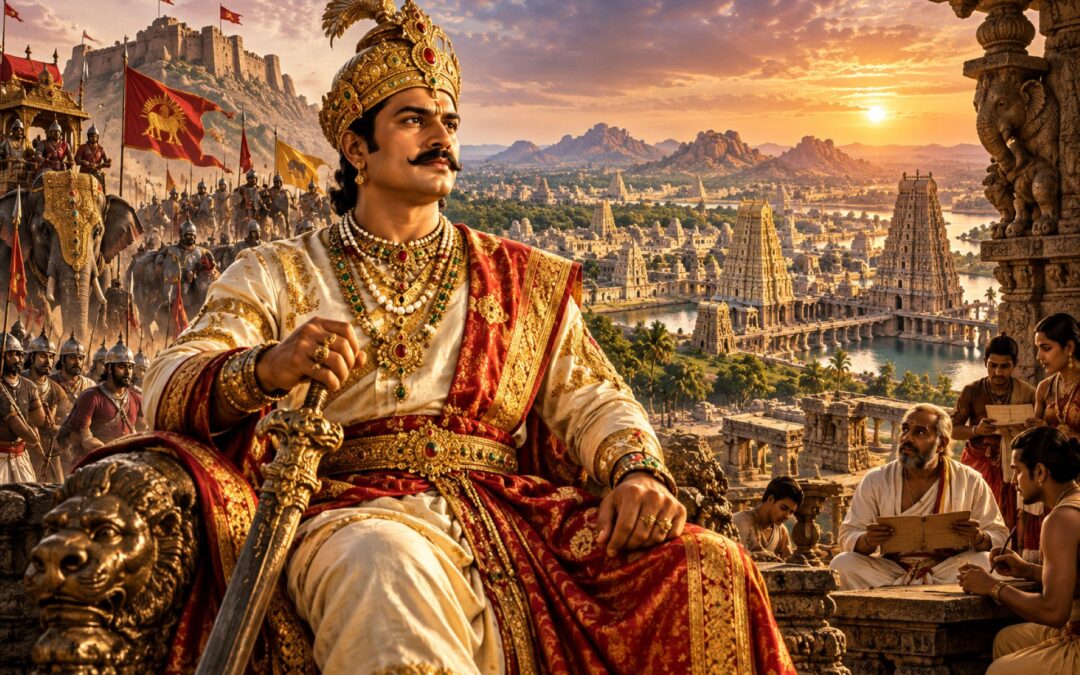
In 1520, Krishnadevaraya achieved one of the most celebrated victories in Indian history. His armies defeated the Bijapur Sultanate near Raichur, overcame a heavily defended fortress, and established the Vijayanagara emperor as one of the most formidable rulers of his age. The victory demonstrated the military strength of a kingdom whose capital impressed foreign visitors with its wealth, enormous markets, magnificent temples, and elaborate royal ceremonies. Yet the consequences of Krishnadevaraya’s triumph extended beyond the battlefield, creating diplomatic tensions that would complicate relations with his powerful northern neighbours.
Krishnadevaraya ruled the Vijayanagara Empire from 1509 to 1529, a period widely remembered as a high point in South Indian political and cultural history. He was an ambitious conqueror, an accomplished literary figure, a patron of religious institutions, and a ruler whose ability to command loyalty helped him overcome serious challenges. His reign also produced stories of forbidden romance, extraordinary military courage, political deception, and bitter betrayal, although not every dramatic episode preserved in later accounts can be accepted as historical fact.
Behind these stories stands a remarkable historical figure whose achievements were inseparable from the difficulties of governing a vast and diverse empire. Krishnadevaraya strengthened a kingdom that had endured dynastic instability and transformed it into a dominant regional power. But the personal authority that made his reign so successful could not guarantee a stable succession, and his final years exposed vulnerabilities that military victories alone could not resolve.
An Empire in Crisis and a Disputed Crown
When Krishnadevaraya ascended the throne in 1509, the Vijayanagara Empire was already approaching its second century. Its foundations had been established during the political upheavals of the fourteenth century, when the Delhi Sultanate’s expansion into southern India disrupted several established kingdoms. The resulting struggles created opportunities for new rulers to consolidate territory, build military alliances, and establish independent states.
Under Alauddin Khalji and his successors, Delhi’s armies had campaigned against the Yadavas, Kakatiyas, Hoysalas, and Pandyas. These invasions transformed the region without producing a permanently stable northern administration. As Delhi’s incursions into the Deccan weakened older political arrangements, two brothers, Harihara and Bukka, established the foundations of the Vijayanagara state during the 1330s.
The brothers are traditionally credited with founding the empire in 1336, although the precise circumstances surrounding their rise remain disputed. Later religious narratives describe their capture by the Delhi Sultanate, conversion to Islam, and eventual return to Hinduism under the guidance of the sage Vidyaranya. These stories became important elements of Vijayanagara’s royal identity, but historians cannot establish every detail of the traditional account.
What emerged around the Tungabhadra River was a formidable new kingdom. Its rulers developed relationships with regional chiefs, military commanders, merchants, and religious establishments, gradually expanding their authority over much of southern India. The capital at Vijayanagara, near present-day Hampi, became a major political and commercial centre.
The empire’s early rulers belonged to the Sangama dynasty, which presided over significant territorial expansion and the development of imperial institutions. Their successors inherited not only extensive resources but also powerful regional elites whose cooperation was essential to effective government. During the later fifteenth century, dynastic struggles weakened central authority, allowing neighbouring states and ambitious commanders to challenge the ruling family.
The Saluva dynasty emerged from one attempt to restore stability, but its hold on power remained insecure. The military commander Tuluva Narasa Nayaka subsequently became the dominant figure in imperial politics, establishing the foundations of the Tuluva dynasty that would eventually produce Krishnadevaraya. Narasa Nayaka’s authority rested heavily on his military success and ability to manage the powerful chiefs who controlled substantial resources throughout the kingdom.
After Narasa Nayaka’s death, his son Viranarasimha occupied the throne. His reign was marked by continuing political tensions, and when he became seriously ill, the question of succession threatened to create another crisis. Krishnadevaraya, Viranarasimha’s younger half-brother, had established a reputation for military ability and enjoyed the support of influential figures at court.
One of those figures was Saluva Timmarusu, an experienced minister whose relationship with Krishnadevaraya would become central to the emperor’s life. Timmarusu is remembered not simply as an administrator but as a political mentor who helped guide the younger prince towards power.
According to the Portuguese chronicler Fernão Nuniz, the dying Viranarasimha intended to leave the throne to his young son. Fearing that Krishnadevaraya might displace the boy, he allegedly instructed Timmarusu to blind his half-brother. Rather than obeying, the minister supposedly presented the eyes of a slaughtered goat to the dying ruler, deceiving him into believing that the order had been carried out.
The story survives in the Portuguese chronicles translated and published by Robert Sewell in A Forgotten Empire. It is memorable, but it should not be mistaken for an independently verified account of the succession. Nuniz recorded traditions about events that occurred before his own period of observation, and other historical evidence does not establish precisely how the transfer of power unfolded.
What is clear is that Krishnadevaraya became emperor in 1509. His accession secured the Tuluva dynasty’s position after decades of political instability, but it also placed him at the head of a kingdom whose unity depended upon military authority, personal alliances, and the loyalty of powerful regional commanders. The new ruler would have to demonstrate that his claim to the throne was supported by more than the circumstances of his succession.
The Emperor Behind the Legend
Krishnadevaraya’s early life has become surrounded by stories that reveal as much about the politics of royal legitimacy as they do about the emperor himself. Some traditions portray him as a ruler who overcame the disadvantages of humble maternal origins. Others emphasise his dynastic connections, military upbringing, and place within an established political family.
His father, Narasa Nayaka, had risen to prominence through military service rather than inheriting an uncontested royal position. That background distinguished the Tuluva rulers from dynasties whose legitimacy depended upon longer-established genealogies. Accounts describing Krishnadevaraya’s mother as a woman of relatively low social standing further complicated representations of his right to rule.
These stories should be approached cautiously. The exact circumstances of his birth and his family’s caste identity are not established with sufficient certainty to support the claim that he was simply an illegitimate outcast who defeated a rigid social order. Medieval South Indian political authority involved overlapping claims based on ancestry, military success, royal service, landholding, religious patronage, and the recognition of influential elites.
Krishnadevaraya’s career nevertheless illustrates how military and political achievement could help establish royal legitimacy. Whatever opposition he encountered, he eventually commanded one of the subcontinent’s most powerful states. His victories, public ceremonies, religious gifts, and literary accomplishments would all strengthen the image of a ruler entitled to exercise imperial authority.
The emperor’s personal relationships have attracted almost as much attention as his origins. One particularly famous story concerns Chinnadevi, a woman traditionally described as a dancer or courtesan with whom Krishnadevaraya fell in love before becoming king.
According to the account examined by historian Srinivas Reddy in his study of Krishnadevaraya and Chinnadevi’s romance, Nuniz described a young prince who promised to marry Chinnadevi if he ever acquired the throne. The relationship allegedly continued after his accession, when royal obligations made the fulfilment of that promise politically difficult.
The story depicts Krishnadevaraya disguising himself and leaving the palace at night, partly to observe ordinary life and partly to visit Chinnadevi. During one such excursion, Timmarusu supposedly discovered the emperor and accompanied him back to the palace. Krishnadevaraya reportedly insisted that he intended to honour his marriage promise despite the objections that might arise from Chinnadevi’s social position.
Timmarusu eventually arranged a compromise. Krishnadevaraya would first marry Tirumaladevi, a woman whose royal connections made her an appropriate principal queen, and could then marry Chinnadevi. The story thus presents an emperor negotiating between personal affection and the political expectations attached to kingship.
The romantic details cannot be verified with the same confidence as the emperor’s public career. They belong to a narrative tradition that emphasises devotion, defiance, and the minister’s influence over a passionate young ruler. Nevertheless, Tirumaladevi and Chinnadevi were real figures associated with Krishnadevaraya’s royal household, even if the circumstances of their relationships remain more difficult to reconstruct.
The importance of Tirumaladevi is supported by epigraphic evidence. A Gaya inscription commissioned during Krishnadevaraya’s reign identifies him as her husband, demonstrating the public recognition of her place within the royal family. Such records provide a firmer historical foundation than the elaborate conversations attributed to the emperor in romantic narratives.
Timmarusu’s presence in these accounts is equally revealing. Whether or not every incident occurred as described, the minister was remembered as a figure whose authority rested on long service and personal influence. The bond between the emperor and his adviser became an important feature of Krishnadevaraya’s political identity, making their eventual estrangement especially consequential.
Contemporary Portuguese descriptions offer another perspective on his personality. Domingo Paes portrayed a ruler capable of generosity and warmth but also subject to sudden anger. These qualities appeared compatible in a political world where kings were expected to demonstrate magnificence, reward loyalty, punish disobedience, and personally embody the authority of the state.
The resulting portrait is more complex than that of either a benevolent literary monarch or an aggressive conqueror. Krishnadevaraya could accommodate competing demands when circumstances required compromise, yet he was also capable of imposing his will forcefully. Both tendencies would become visible as he moved from securing his throne to expanding the empire.
Rebuilding Authority Across the South
Krishnadevaraya’s first responsibility was to establish effective control over the territories he had inherited. Vijayanagara possessed considerable resources, but those resources were distributed across provinces and military estates controlled by powerful local chiefs. The emperor depended upon their cooperation for revenue, soldiers, horses, elephants, and the supplies required to conduct sustained campaigns.
A regional commander who resisted royal authority could weaken the government’s finances while encouraging neighbouring chiefs to question the emperor’s position. Successful kings therefore had to negotiate, reward service, and occasionally use force to demonstrate that the centre remained capable of imposing its decisions.
One of Krishnadevaraya’s important early challenges involved the southern territories associated with the Ummattur chiefs. Their resistance threatened the stability of regions that connected Vijayanagara’s political centre with valuable territories farther south. The conflict became an early test of the new emperor’s capacity to conduct military operations and restore obedience.
The surviving accounts describe campaigns against fortified positions, including operations associated with Gangaraja of Ummattur. Siege warfare was particularly important because a strong fortress could allow a rebellious chief to resist even when the royal army possessed superior numbers. Rather than relying exclusively on open battle, imperial forces could surround defensive positions, restrict supplies, and gradually undermine the defenders’ ability to continue fighting.
The traditional narratives credit Krishnadevaraya with defeating the resistance and restoring royal control. Although individual incidents and their exact chronology require caution, the broader political result was significant. The emperor strengthened his authority in the south and demonstrated that regional chiefs could not assume that dynastic instability would prevent effective intervention from the capital.
Military consolidation also involved diplomacy. Marriage alliances, the confirmation of local privileges, administrative appointments, and the redistribution of responsibilities could help incorporate former opponents into the imperial order. Such arrangements were often more useful than permanently occupying every contested district with large numbers of troops.
Krishnadevaraya’s methods reflected the practical realities of governing a state in which regional leaders remained essential partners. He could punish disobedience, but he also needed to preserve the networks through which soldiers were recruited and revenue collected. Military victories were therefore followed by political settlements intended to make continued obedience worthwhile.
This process also helped prepare the empire for larger campaigns. A ruler who could command dependable provincial contributions had access to greater military resources and more reliable supply arrangements. By strengthening his authority within the southern territories, Krishnadevaraya improved his ability to confront the powerful kingdoms beyond Vijayanagara’s northern and eastern frontiers.
The emperor’s attention increasingly turned towards the Gajapati kingdom of Odisha, whose rulers controlled or contested territories that Vijayanagara regarded as strategically and economically important. Unlike the resistance of an individual regional chief, the Gajapati challenge involved a substantial neighbouring state with its own military resources, political alliances, and claims to imperial prestige.
The Gajapati Wars and the Eastern Frontier
The eastern campaigns became one of the defining achievements of Krishnadevaraya’s reign. His principal opponent was Prataparudra Deva, ruler of the Gajapati kingdom of Odisha, whose possessions extended into territories associated with present-day Andhra Pradesh. Control of these regions was important because the fertile river valleys supported substantial agricultural revenue while major fortresses protected routes between the coast, interior plateau, and northern territories.
The Krishna River delta was particularly valuable. Its agricultural productivity made it an important source of income, and control over surrounding districts could strengthen both military logistics and access to trade. For Vijayanagara, recovering contested territory meant more than satisfying an old dynastic claim; it could reinforce the material foundations of imperial power.
The struggle also involved questions of royal standing. Later accounts emphasise hostility between Prataparudra’s established royal lineage and Krishnadevaraya’s comparatively recent dynastic ascent. They portray the Gajapati ruler as regarding his southern rival as socially inferior, sometimes using insulting references to his maternal origins.
Such claims require attribution rather than acceptance as a complete explanation of the war. Dynastic status and caste-based ideas of legitimacy could certainly influence the language of royal rivalry, but the conflict was also driven by strategic territory, revenue, fortresses, and the ambitions of two expanding states. Reducing it entirely to personal contempt would obscure the political competition that made confrontation likely.
Krishnadevaraya began a sustained series of eastern campaigns during the early 1510s. Udayagiri was among the first important strongholds targeted, and its resistance demonstrated the difficulty of conquering a well-defended fortress. A siege could require the attackers to construct approaches, maintain supply arrangements, prevent reinforcements from reaching the defenders, and endure the considerable costs of an extended military presence.
The fall of Udayagiri strengthened Krishnadevaraya’s position, but it did not settle the eastern frontier. His armies continued towards Kondavidu, a major fortress associated with Gajapati authority. The campaign brought Vijayanagara into conflict with regional commanders and members of the Odisha royal establishment who were responsible for defending the contested districts.
Kondavidu was captured in 1515, marking an important stage in the advance. The conquest provided the emperor with both strategic advantages and valuable prisoners, including members of the Gajapati ruler’s family and prominent nobles. Such captives could become instruments of political negotiation, particularly when their relatives remained in control of substantial territories.
Further operations carried Vijayanagara’s forces towards Kondapalli and the northern coastal region. Krishnadevaraya’s presence at Simhachalam in 1516 is supported by inscriptional evidence, providing an important chronological reference for the eastern campaigns. His success demonstrated the ability of the imperial army to sustain operations far from its principal southern bases.
These advances did not necessarily involve the permanent annexation of every territory entered by the emperor’s forces. Medieval campaigns could produce tribute, negotiated submission, territorial concessions, political recognition, or agreements with local commanders. The distinction between defeating an opponent and governing all his possessions remained important, especially when an ambitious ruler faced the logistical difficulties of operating across a large region.
One of the most disputed episodes concerns Prince Virabhadra, a son of Prataparudra. Nuniz describes him as a skilled swordsman who was captured during the campaigns and later invited by Krishnadevaraya to demonstrate his abilities. According to the chronicler, the prince considered it intolerable to fight a man of lower social standing and killed himself rather than accept the encounter.
The story illustrates the importance assigned to rank and royal honour in later narratives, but its historicity has been debated. In K. A. Nilakanta Sastri’s historical discussion of Krishnadevaraya, inscriptional evidence identifies a Gajapati prince named Virabhadra exercising authority under Krishnadevaraya during the period following his capture.
Some historians have regarded these records as evidence against Nuniz’s account. Others have argued that the inscriptions precede the period in which the chronicler placed the alleged suicide and therefore do not necessarily contradict it. The evidence does not justify presenting the dramatic death as an uncontested fact, nor does it settle the prince’s entire subsequent life.
The Gajapati campaigns also generated accounts of elaborate political deception. One tradition describes Krishnadevaraya sending gifts or treasure to important Odisha nobles in a manner intended to make Prataparudra suspect them of disloyalty. The resulting distrust supposedly weakened the Gajapati ruler’s position and helped Vijayanagara advance towards his capital.
This may reflect a remembered stratagem or the tendency of royal narratives to celebrate the intelligence of successful conquerors. It should not displace the better-supported explanation of the campaigns: sustained military operations, the capture of important fortresses, negotiations with regional elites, and the political pressure created by successive territorial losses.
Eventually, the conflict gave way to a negotiated settlement. A marriage alliance involving a Gajapati princess formed part of the traditions associated with the peace, while territorial arrangements reduced the immediate danger of renewed conflict. Krishnadevaraya had demonstrated military superiority without permanently absorbing the entire Odisha kingdom into Vijayanagara.
The eastern victories transformed his political standing. They restored influence over strategically valuable territories, strengthened his prestige among imperial chiefs, and confirmed that Vijayanagara could defeat a powerful neighbouring kingdom in a sustained campaign. They also illustrated a distinctive feature of his kingship: military force was most effective when followed by arrangements that converted victory into political authority.
Yet success in the east did not end the emperor’s military ambitions. The northern frontier remained contested, and the fragmentation of the old Bahmani Sultanate had created an environment in which several ambitious successor states competed for control of the Deccan. The most celebrated confrontation of Krishnadevaraya’s career would emerge from this rivalry.
Raichur: Krishnadevaraya’s Defining Victory
The fortress of Raichur occupied one of the most disputed strategic regions in the Deccan. The surrounding Raichur Doab, situated between the Krishna and Tungabhadra rivers, offered valuable agricultural land and important military routes. For generations, Vijayanagara and the Bahmani Sultanate had fought over its towns and fortifications, and control of the region had changed repeatedly.
By Krishnadevaraya’s reign, the Bahmani Sultanate had fragmented into competing successor states. Among them, Bijapur had emerged as a major power under the Adil Shahi dynasty. Its ruler, Ismail Adil Shah, controlled Raichur and possessed military resources that made a Vijayanagara invasion an undertaking of considerable difficulty.
Both rulers had reasons to value the fortress beyond its economic importance. Raichur represented prestige, territorial security, and the ability to project authority across a politically sensitive frontier. For Krishnadevaraya, capturing it would demonstrate that his achievements against the Gajapatis could be repeated against one of the strongest northern rivals.
The diplomatic circumstances preceding the campaign remain partly uncertain. Portuguese narratives describe a Muslim official or merchant known as Cide Mercar, who received money associated with the purchase of horses and subsequently sought refuge within Bijapur’s territory. Krishnadevaraya demanded his return, while Ismail Adil Shah declined to comply.
The disagreement supplied a justification for military action, but it cannot be separated from the longstanding struggle over Raichur. Some interpretations of the sources suggest that Krishnadevaraya deliberately used the affair to create a diplomatic dispute. The stronger claim that Cide Mercar knowingly participated in an elaborate double-agent operation is not securely established.
Whatever the precise circumstances of the incident, Krishnadevaraya marched against Raichur in 1520. His army represented the resources of an extensive imperial state, drawing upon cavalry, infantry, war elephants, siege workers, transport animals, and the large number of people required to sustain a major campaign.
Contemporary chroniclers described armies of extraordinary size, but their numerical claims should not be accepted as exact counts. Such figures often reflected the desire to emphasise royal greatness and the overwhelming scale of an event. The important historical point is that Vijayanagara possessed the financial, administrative, and logistical capacity to maintain a very large military force far from the capital.
Raichur’s fortifications presented a formidable obstacle. Heavy masonry walls protected the settlement, while the defenders had access to artillery and firearms that could make an assault extremely costly. A fortress with dependable water supplies and adequate provisions could resist for an extended period, particularly when its defenders expected reinforcements from a nearby allied army.
Krishnadevaraya’s forces attempted to weaken the defences through siege labour. Workers approached the walls with tools intended to loosen stones and break down sections of the fortifications, exposing themselves to attack from soldiers stationed above them. Such methods remained important even as gunpowder weapons became more common, because possessing cannons did not automatically give an army the means to demolish every defensive structure.
The emperor’s siege was interrupted when Ismail Adil Shah advanced with a substantial force to relieve the fortress. Bijapur’s artillery was an important component of its army, and the northern Deccan states had invested in gunpowder weapons and military expertise connected with wider Persianate and Central Asian networks. The approaching army therefore possessed capabilities that could seriously threaten Vijayanagara’s numerical and logistical strength.
The opposing armies confronted one another near the Krishna River. The precise tactical sequence is difficult to reconstruct because the surviving accounts differ, but access to river crossings shaped the confrontation. Movement through restricted crossing points could concentrate troops in vulnerable positions, creating opportunities for firearms, artillery, and charges by cavalry or elephants.
Some narratives describe Bijapur’s artillery inflicting severe casualties and disrupting Vijayanagara’s advancing troops. Krishnadevaraya’s forces were reportedly thrown into confusion, and the emperor had to restore their willingness to fight. The Portuguese accounts place particular emphasis on his personal courage and ability to rally soldiers at a critical moment.
According to one celebrated version, he prepared himself for possible death and addressed his men before leading a renewed attack. The precise words attributed to him should be treated as part of the chronicler’s dramatic presentation rather than a reliable transcript of a battlefield speech. Nevertheless, the story reflects the importance contemporaries attached to the king’s visible leadership.
Vijayanagara ultimately defeated Bijapur’s relieving army. The surviving narratives describe the collapse of the opposing formation, retreat towards the river, and the escape of Ismail Adil Shah. The victory demonstrated that substantial artillery advantages could be overcome when the opposing army maintained cohesion, exploited battlefield disorder, and successfully coordinated its different forces.
The historical significance of this encounter has been examined by Richard M. Eaton in his study of firearms, diplomacy, and the Battle for Raichur in 1520. Raichur illustrates why technological superiority alone does not determine the outcome of warfare. Weapons must be supported by trained personnel, effective command, logistical systems, and tactical arrangements suited to the terrain.
The battle also belongs to the changing history of gunpowder warfare in India, when Indian states were incorporating cannons, muskets, foreign specialists, and new defensive techniques into armies that still depended heavily on cavalry, elephants, and traditional siege methods.
Following the defeat of Bijapur’s field army, the fortress remained a difficult obstacle. The defenders could still fire from their protected positions, while the attackers needed to continue weakening the fortifications. It was at this stage that a small Portuguese contingent became particularly important in the surviving accounts.
The Portuguese nobleman Christovão de Figueiredo arrived with a group of armed men associated with the horse trade. Portuguese expansion along the western coast had already created opportunities for military and commercial interaction with Indian rulers, and Krishnadevaraya was willing to employ useful foreign expertise.
According to the chronicle, Figueiredo recognised that his marksmen could target defenders who exposed themselves along the fortress walls. By firing accurately at soldiers attempting to resist the siege workers, they helped create conditions in which the attackers could approach the fortifications more effectively. The death of a defending commander is also attributed to their shooting in the narrative.
The Portuguese contribution mattered, but it should not be exaggerated into the claim that a handful of European soldiers conquered Raichur on behalf of Vijayanagara. The fortress surrendered after a prolonged campaign involving extensive imperial resources, difficult siege operations, the defeat of a major relieving army, and the continuing pressure of the besiegers. The marksmen formed one part of this larger military achievement.
Raichur’s surrender confirmed Krishnadevaraya’s position as the dominant ruler in the immediate regional balance of power. He had defeated a major northern Sultanate, recovered a coveted fortress, and demonstrated that Vijayanagara could combine enormous manpower with effective military organisation.
The victory also displayed the emperor’s capacity to govern the consequences of conquest. Accounts describe arrangements for the defeated inhabitants and the restoration of order rather than portraying the capture solely as indiscriminate slaughter. These descriptions remain subject to the limitations of royal and foreign narratives, but they reinforce the contrast between the violence of campaigning and the administrative responsibilities that followed.
For Krishnadevaraya, Raichur represented the summit of military prestige. His authority had been secured in the south, his campaigns had transformed the eastern frontier, and he had now defeated one of the most important rulers of the northern Deccan. Yet the diplomatic aftermath would reveal that extraordinary military success could create problems that another victory might not solve.
The Empire He Governed and the Culture He Shaped
Krishnadevaraya’s achievements cannot be explained through warfare alone. His campaigns depended upon a complex political and economic system capable of financing armies, collecting agricultural revenue, maintaining infrastructure, and securing the cooperation of regional elites. The same resources that supported military expansion also allowed him to patronise temples, scholars, artisans, and urban development.
Vijayanagara was not governed through an entirely uniform administrative structure. Its rulers relied upon regional commanders and powerful landholding authorities who maintained troops and exercised substantial influence within their territories. The relationships between the emperor and these figures involved grants, military obligations, appointments, tribute, negotiations, and the threat of punishment.
This arrangement gave the empire access to extensive local resources without requiring every decision to be administered directly from the capital. It also created a vulnerability: regional commanders who controlled their own military and economic networks could become dangerous when the central government appeared weak.
Krishnadevaraya worked to maintain royal authority within this system. Campaigns against rebellious chiefs demonstrated the costs of resistance, while successful warfare provided new opportunities to reward loyal supporters. Royal patronage helped secure relationships with institutions and communities whose resources were important to imperial government.
Agriculture remained fundamental to the empire’s wealth. Fertile regions supplied revenue and food, while irrigation works helped sustain cultivation in areas where agricultural productivity depended upon the management of water. Tanks, canals, reservoirs, and local infrastructure were therefore matters of political significance as well as practical necessity.
The prosperity of the capital reflected these extensive networks. Vijayanagara drew resources from agricultural hinterlands, internal trade routes, temple establishments, and commercial relationships extending beyond the peninsula. Markets served residents, court officials, soldiers, religious institutions, and merchants arriving from different regions.
Portuguese visitors were particularly impressed by the city’s scale and activity. Domingo Paes described marketplaces, ceremonial spaces, public gatherings, and royal displays that conveyed the magnificence of imperial power. His testimony helps reconstruct the capital’s appearance, although his observations reflected the interests and limitations of a foreign visitor.
The city was unquestionably one of the major urban centres of sixteenth-century South Asia, but exact population estimates remain uncertain. Claims placing it at a precise rank among all the world’s cities should therefore be treated cautiously. Its historical significance rests more securely on its extensive built environment, commercial activity, political institutions, and concentration of wealth.
The empire’s international connections were equally important. Portuguese expansion along India’s western coast intensified maritime commerce and diplomatic interaction, especially after the Portuguese established themselves at Goa in 1510. Their merchants supplied horses and other goods that were valuable to Indian rulers, while foreign military specialists could participate in campaigns without becoming permanent imperial allies.
Imported horses were particularly important because cavalry remained essential to warfare in the Deccan. Maintaining an effective mounted force required access to suitable animals, equipment, training, and replacement supplies. Control over trade relationships could therefore influence the balance of power far from the ports where horses entered the subcontinent.
Krishnadevaraya’s religious and cultural patronage formed another central feature of his rule. He supported temples and religious establishments, commissioned or encouraged construction, and associated his authority with important sacred centres. These activities expressed genuine devotional commitments while also reinforcing relationships with influential institutions and local communities.
Royal patronage was not merely decorative. Temples could hold land, employ artisans, support festivals, organise economic activity, and connect the crown with regional populations. Gifts to religious establishments therefore helped integrate imperial authority into institutions that shaped everyday social and economic life.
Krishnadevaraya is especially celebrated for his support of literature. His court became associated with an extraordinary flowering of Telugu literary culture, while Kannada, Tamil, and Sanskrit continued to occupy important positions in the empire’s multilingual intellectual environment. Poets, scholars, and religious teachers could receive royal patronage, allowing literary production to become an expression of political prestige.
The emperor himself was an accomplished literary author. His most famous work, Amuktamalyada, is a Telugu poem concerned with devotion, divine love, kingship, and the responsibilities of political authority. Its narrative is associated with Andal, the Tamil Vaishnava saint whose devotion to Vishnu forms an important part of the work’s religious world.
The poem is not simply a collection of practical instructions for government. Its religious imagination and treatment of community are central to understanding its significance. Nevertheless, reflections on political conduct within the work reveal an emperor deeply interested in the obligations and difficulties of rulership.
In Ilanit Loewy Shacham’s study of religion, conquest, and community in Amuktamalyada, the poem is examined in relation to the changing cultural and political environment of Krishnadevaraya’s empire. This approach helps explain why his literary activity should be understood as part of his larger project of kingship rather than an incidental pastime.
The emperor’s religious identity also should not be confused with a simple division between Hindu Vijayanagara and uniformly hostile Muslim states. Krishnadevaraya was a major patron of Hindu institutions, but the political environment of the Deccan crossed religious boundaries constantly. Muslim soldiers and officers served South Indian rulers, merchants and specialists moved between courts, and alliances reflected changing strategic interests as much as religious affiliation.
The emperor’s personal discipline attracted attention as well. Paes described a demanding routine that included physical exercise, wrestling, horsemanship, and martial training before the business of government. The account contributed to the image of a ruler who embodied the military qualities expected of kings while remaining personally involved in administration.
These different activities were interconnected. Military victories generated prestige and resources, cultural patronage strengthened legitimacy, administrative relationships supported the army, and religious institutions reinforced the empire’s political networks. Krishnadevaraya’s reign became a celebrated period because he was able to combine these forms of authority with unusual effectiveness.
That success, however, depended heavily upon the ruler’s personal capacity to maintain relationships across a diverse and competitive political world. His achievements did not eliminate rival ambitions, and the confidence produced by repeated victories could encourage demands that neighbouring rulers considered intolerable.
When Victory Became Diplomatic Overreach
The consequences of Raichur extended well beyond the recovery of a fortress. Ismail Adil Shah had suffered a humiliating military defeat, but the political relationship between Bijapur and Vijayanagara remained unresolved. Both rulers needed to preserve their status in a region where royal prestige influenced alliances, obedience, and the willingness of powerful nobles to continue supporting their sovereign.
According to the surviving Portuguese narratives, Bijapur sought a settlement involving the return of captured property and the restoration of relations. Krishnadevaraya responded with a demand that Ismail Adil Shah personally demonstrate submission by kissing his foot. The exchange became one of the most memorable diplomatic episodes associated with the emperor.
The words recorded in the chronicles should not be treated as an independently verified transcript of an ambassadorial negotiation. Their importance lies in the political message they convey. Krishnadevaraya was no longer simply asserting his right to possess Raichur; he was presenting the defeated Sultan as a ruler who should acknowledge his personal superiority.
Ceremonies of submission could carry enormous significance in medieval and early modern political culture. A ruler’s public dignity helped sustain his authority among nobles, soldiers, subjects, and foreign courts. Agreeing to a humiliating demand might secure temporary peace while simultaneously weakening the ruler’s domestic standing.
Krishnadevaraya’s position was strengthened by victory, but his demand made reconciliation difficult. Ismail Adil Shah could not easily accept a relationship that placed his sovereignty under such visible challenge. The resulting confrontation reflected the limitations of trying to translate battlefield success into permanent political supremacy.
The chronicles describe further movements against Bijapur after the anticipated submission failed to occur. Krishnadevaraya reportedly advanced into northern territory and interfered in political arrangements associated with the former Bahmani establishment. One account credits him with restoring a member of the old Bahmani ruling family to a nominal position of authority.
Such intervention could serve an immediate strategic purpose. Supporting a dependent ruler or manipulating rival claims might weaken a neighbouring state without requiring its complete annexation. Yet these arrangements also encouraged other Deccan rulers to reconsider the dangers posed by Vijayanagara’s growing influence.
The northern Sultanates were not permanently united, and their rivalries offered Vijayanagara considerable opportunities. Bijapur, Ahmadnagar, Golconda, Bidar, and Berar pursued shifting interests, sometimes fighting one another and sometimes forming temporary alliances. Krishnadevaraya could exploit their competition, but he could not guarantee that their calculations would always favour him.
His later reputation has sometimes encouraged historians and storytellers to connect his diplomatic behaviour directly with Vijayanagara’s eventual defeat at Talikota in 1565. That interpretation gives too much explanatory weight to events separated by several decades and overlooks the political decisions of subsequent rulers.
The empire remained powerful after Krishnadevaraya’s death, and Rama Raya would later pursue his own extensive strategy of intervening in disputes among the Deccan Sultanates. Those policies, together with changing military capabilities and regional alliances, helped create the circumstances in which a coalition eventually challenged Vijayanagara.
Krishnadevaraya’s diplomacy therefore illustrates a genuine weakness without proving that collapse was inevitable. His victories had established extraordinary prestige, but repeatedly imposing humiliation on defeated neighbours could make stable agreements harder to maintain. Military superiority created opportunities for influence, not an unlimited capacity to dictate the political future of the Deccan.
The Fatal Succession Crisis and the End of a Reign
For much of his reign, Krishnadevaraya’s personal leadership helped hold together the networks that sustained Vijayanagara’s power. By his final years, however, the question of succession had become increasingly urgent. A strong empire required not only an effective ruler but also a credible means of transferring authority without allowing influential nobles and royal relatives to turn the transition into a struggle for power.
The emperor’s earlier accession had already demonstrated how uncertain succession could become when several members of a ruling family possessed plausible claims. Krishnadevaraya therefore had good reason to establish the position of an heir while he could still control the political process.
Accounts describe his decision to designate his young son Tirumala Raya as successor and to arrange for the boy to assume royal authority while the emperor remained in a position to guide the government. Such an arrangement could help secure dynastic continuity, but it also depended upon the child’s survival and the willingness of powerful courtiers to accept the succession.
The situation was complicated by the ambitions of influential members of the royal household. Rama Raya, who was connected to Krishnadevaraya through marriage, possessed relationships and political opportunities that would become increasingly significant after the emperor’s death. His later dominance has encouraged retrospective narratives that present him as the central villain in every earlier court crisis.
The immediate tragedy was the death of the young prince. The succession accounts describe him becoming ill and dying after a short period in which his position had been publicly elevated. The possibility of poisoning became a central element of the stories preserved about the incident, although the surviving evidence does not establish the precise cause of death with certainty.
Suspicion eventually fell upon Timmarusu, the experienced minister who had helped Krishnadevaraya acquire and consolidate royal power. According to the chronicles, the emperor responded with extraordinary anger, ordering the minister and members of his family imprisoned and punished.
The accounts include the blinding of Timmarusu, an act that transformed the relationship between the ruler and the man traditionally credited with protecting him during the succession crisis of 1509. If the chronicles preserve the essential events accurately, the episode represented a devastating rupture in one of the most important political partnerships of Krishnadevaraya’s life.
Later narratives sometimes claim that Timmarusu was innocent and that Rama Raya had arranged the prince’s death while directing suspicion towards the minister. These accusations are not sufficiently established to identify Rama Raya as the murderer or architect of the alleged conspiracy. The available traditions demonstrate the bitterness of court politics, but they do not permit every accusation to be converted into historical fact.
The significance of the crisis does not depend entirely upon proving who was responsible. Krishnadevaraya had lost the heir around whom he hoped to organise the succession, while the punishment of influential courtiers disrupted relationships that had helped sustain his government. The emperor’s authority remained considerable, but the political arrangements intended to survive him had become more uncertain.
The episode also reveals the difficulties faced by rulers whose personal judgment carried enormous institutional weight. A king could reward trusted advisers, appoint heirs, and punish suspected betrayal, but these powers did not necessarily produce reliable procedures for investigating wrongdoing or managing a contested succession. When decisions depended upon the ruler’s immediate interpretation of events, personal grief and political suspicion could have consequences for the entire court.
Krishnadevaraya’s final years were therefore overshadowed by circumstances very different from the confidence surrounding his earlier conquests. He had defeated major opponents, strengthened imperial authority, and cultivated a reputation for effective kingship, yet he could not ensure the succession of the son upon whom he had placed his hopes.
His death is now associated with a more precise date than older general histories often supplied. A Kannada inscription from Honnehalli, recorded by the Archaeological Survey of India in its BharatSHRI repository of inscriptions, identifies 17 October 1529 as the date of Krishnadevaraya’s death. The inscription provides an important documentary anchor for the end of his reign.
Krishnadevaraya was succeeded by Achyuta Raya, his younger half-brother, rather than immediately by Rama Raya. The transition involved political tensions, but Vijayanagara remained a powerful imperial state. Its military resources, courtly institutions, regional networks, and cultural prestige did not disappear with the ruler who had brought them to such prominence.
During the following decades, Rama Raya gradually became the dominant figure in imperial politics. His authority rested upon military influence, dynastic connections, and his ability to manage relationships among regional chiefs and the Deccan Sultanates. The resulting political order developed under circumstances that differed substantially from those of Krishnadevaraya’s reign.
Vijayanagara’s decisive defeat at Talikota came in 1565, more than three decades after Krishnadevaraya’s death. The empire’s capital subsequently suffered extensive destruction, although royal institutions survived elsewhere under a successor dynasty. The later catastrophe cannot be explained simply as the inevitable result of two mistakes made by Krishnadevaraya.
His final crisis nevertheless exposes a central vulnerability of the imperial system. The ruler had succeeded in strengthening his own authority without creating a succession arrangement capable of guaranteeing an equally stable transfer of power. His personal abilities had helped sustain the empire, but those abilities could not be inherited automatically by the next occupant of the throne.
Krishnadevaraya’s historical reputation has endured because the achievements of his reign were extraordinary. His campaigns expanded and consolidated imperial authority, his patronage enriched South Indian literary and religious life, and his government mobilised resources on a scale that impressed contemporaries. At the same time, his life demonstrates how the strengths of personal monarchy could coexist with profound institutional uncertainty.
Krishnadevaraya brought Vijayanagara to a remarkable height of military, political, and cultural power. His victories strengthened the empire, his patronage enriched its cultural world, and his ability to command loyalty helped him overcome challenges that had destabilised earlier rulers. He became the model of a successful South Indian emperor not because he excelled in one field, but because he combined conquest, administration, religious patronage, and literary achievement within a single reign.
Yet the final years of his life revealed a problem that even his military genius could not resolve. A ruler could conquer fortresses, defeat neighbouring kings, and discipline rebellious chiefs without establishing a secure future for his own dynasty. The succession crisis surrounding his son and Timmarusu showed how personal authority, courtly loyalty, and political suspicion could become dangerously entangled.
His legacy should therefore be separated from the assumption that he either guaranteed Vijayanagara’s greatness forever or personally doomed it to destruction. The empire continued to develop after his death, and Vijayanagara’s later political history involved decisions and circumstances that belonged to subsequent generations.
What made Krishnadevaraya exceptional was his capacity to bring together the military, economic, political, and cultural possibilities of his time. What his reign ultimately demonstrated was that the greatness of an emperor and the long-term security of an empire were not necessarily the same thing.
Last Updated on October 26, 2026 by Aseem Gupta