
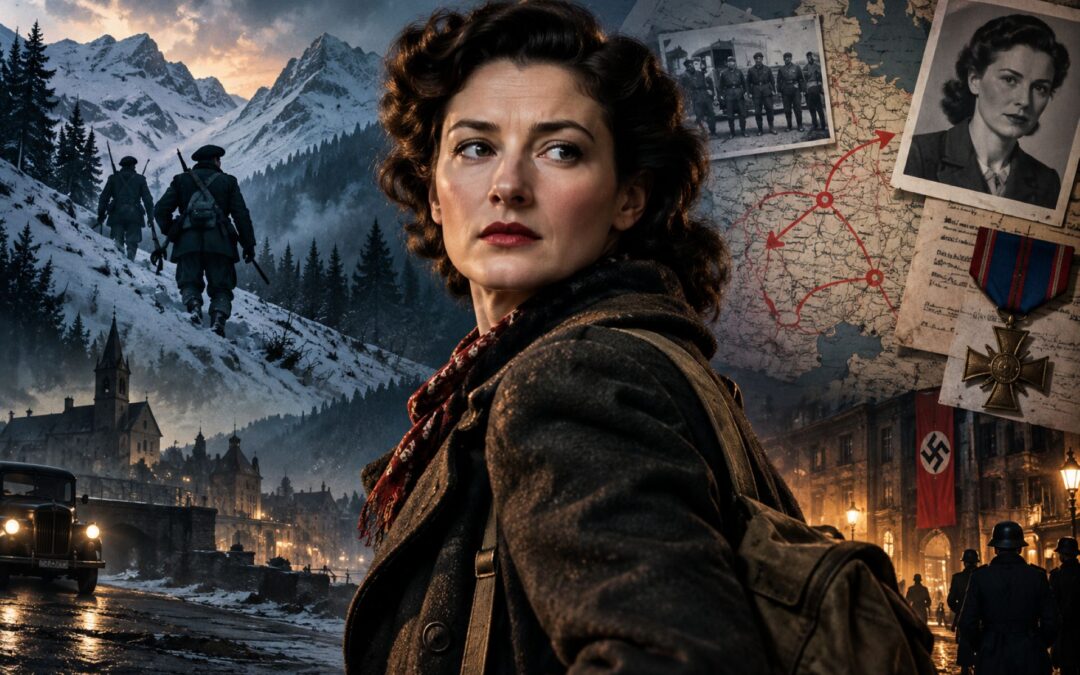
Krystyna Skarbek was one of Britain’s most remarkable secret agents during World War II. Born into Polish aristocracy, she became a pioneering female intelligence operative who crossed Nazi-occupied borders, smuggled military secrets, organized resistance connections, and negotiated the release of three Allied agents facing execution. Operating under the name Christine Granville, she served the British war effort for more than five years and earned some of its highest decorations for bravery.
Yet her life ended far removed from the world of clandestine operations. In June 1952, seven years after the war, Skarbek was murdered in a London hotel by a man who had become obsessed with her. The woman who had repeatedly escaped capture by German security forces had struggled to find stable employment, financial security, or a permanent home in the country she had served.
Her story reveals much more than the adventures of a resourceful spy. Skarbek’s career illuminates the importance of intelligence and resistance operations in occupied Europe, the unusual opportunities wartime offered certain women, and the difficulties those same women encountered when peace returned. To understand her significance, it is necessary to look beyond the glamorous reputation that followed her and examine the extraordinary work she actually performed.
A Polish Countess Between Privilege and Prejudice
Maria Krystyna Janina Skarbek was born in Warsaw on May 1, 1908. Her father, Count Jerzy Skarbek, belonged to an old Polish aristocratic family, while her mother, Stefania Goldfeder, came from a wealthy Jewish banking family. Their marriage brought together two social worlds that were not always comfortable with one another in early twentieth-century Poland.
The Skarbek family enjoyed the privileges associated with landed aristocracy, although maintaining that lifestyle placed considerable pressure on its finances. Krystyna spent much of her childhood on the family estate at Trzepnica, where she developed a strong attachment to horses, outdoor pursuits, and physical independence. Her father encouraged her riding and taught her skills that were more commonly associated with boys of her social class.
She was not especially suited to the conventional expectations placed upon aristocratic daughters. Rather than devoting herself entirely to formal education and the social accomplishments expected of a young countess, she preferred outdoor activity, adventure, and a considerable degree of personal freedom. Her education included private instruction and formal schooling, but she was never particularly willing to let established conventions determine how she should live.
Her maternal Jewish ancestry also placed her family within the complicated social and religious hierarchies of interwar Poland. Although Krystyna was raised in a Catholic environment and identified strongly with Poland, her family background combined Polish nobility with a Jewish heritage that would acquire terrible significance under Nazi occupation.
The family’s financial circumstances deteriorated during her youth. The estate was eventually sold, her father died in 1930, and the Goldfeder family’s banking fortunes suffered during the economic turmoil of the early 1930s. The loss of financial security meant that Krystyna could no longer depend upon the comfortable existence that had surrounded her childhood.
As the Warsaw Ghetto Museum’s biographical account of Krystyna Skarbek explains, she entered paid employment and worked for a Fiat automobile dealership in Warsaw. In 1930, she married businessman Gustaw Gettlich, but the marriage lasted only a few months. Their incompatible temperaments and expectations contributed to a separation that left her free to pursue a less conventional life.
Working near automobile testing facilities had an unexpected consequence. Exposure to exhaust fumes was associated with a respiratory illness that caused doctors to investigate the possibility of tuberculosis. She was advised to spend more time outdoors, and she increasingly turned to the mountains of southern Poland.
The Tatra Mountains became an important part of her life. She developed considerable ability as a skier, enjoyed demanding physical activities, and became familiar with terrain that would later provide routes between occupied Poland and neighboring countries. What began as recreation and a means of restoring her health eventually became useful preparation for wartime intelligence work.
Her second husband, Jerzy Giżycki, was a Polish diplomat, writer, and adventurer who had spent time travelling in Africa and working in the United States. According to biographical accounts, they met following a skiing accident in which Giżycki helped her escape a dangerous fall. They married in November 1938 and subsequently travelled to Africa, where his diplomatic responsibilities took them away from Poland.
By the time Europe approached war, Skarbek had experienced aristocratic privilege, financial insecurity, failed relationships, independent employment, and considerable international travel. She was comfortable moving between different social environments and had acquired linguistic and practical skills that would prove valuable in unfamiliar circumstances.
None of these experiences predetermined a career in espionage. They did, however, help produce a woman with an unusual combination of social confidence, physical resilience, and determination to make her own decisions.
From the Invasion of Poland to British Intelligence
On September 1, 1939, Nazi Germany invaded Poland. Two days later, Britain and France declared war on Germany, beginning the European phase of a conflict that would spread across continents and transform the international order.
Skarbek and Giżycki were in southern Africa when the invasion began. The news was devastating for a woman whose identity remained closely connected to Poland, regardless of how much time she had spent abroad. She wanted to return to Europe and contribute directly to the struggle against the occupation of her homeland.
The German invasion of Poland and the wider course of World War II created an urgent need for information about conditions inside occupied territory. Poland’s regular armed forces had been overwhelmed by German and Soviet invasions, but resistance networks were beginning to emerge. Britain needed reliable information about the occupation, potential contacts inside Poland, and routes through which personnel and intelligence could move.
Skarbek and her husband travelled back to Europe, and she reached London in October 1939. Their marriage was already deteriorating, and she increasingly pursued her wartime ambitions independently. Rather than waiting to be invited into an official role, she began seeking contacts who might help her enter British intelligence.
Her proposal was ambitious. She wanted to travel to neutral Hungary, cross the mountains into occupied Poland, contact resistance groups, and help establish routes for moving intelligence, money, and people between Poland and the outside world. Her knowledge of skiing and the region offered a practical basis for the plan, but accepting an inexperienced civilian woman for such dangerous work was hardly routine.
An introduction eventually brought her to George Taylor of the Secret Intelligence Service, usually known as MI6. Taylor recognized that her patriotic commitment, confidence, and mountain experience might make her unusually effective. In an assessment of her suitability, he described her as a Polish patriot and skilled adventurer whose potential deserved serious attention.
It is important to distinguish this recruitment from her later association with the Special Operations Executive. Skarbek entered British intelligence in 1939, whereas the SOE was established in July 1940 to conduct sabotage, support resistance movements, and carry out unconventional operations behind enemy lines. Her earliest missions therefore preceded the organization with which she would become most closely associated.
The distinction also reveals how exceptional her career was. Britain had not yet developed its later system for recruiting and training women as special agents, and official attitudes toward female operatives were frequently skeptical. Skarbek entered intelligence work at a time when women were generally expected to perform supporting or administrative duties rather than undertake independent missions inside enemy-controlled territory.
She was not recruited simply because she was an aristocrat with useful acquaintances. Her proposal addressed a genuine operational problem: Britain needed contact with occupied Poland, and conventional diplomatic or military channels could no longer provide it. Skarbek offered an unconventional solution based on personal skills that the intelligence service did not have in abundance.
By December 1939, she was travelling toward Hungary to begin the work she had proposed. The privileged daughter of a Polish count had become a clandestine operative whose movements would place her repeatedly at risk of imprisonment or execution.
Across the Carpathians: Couriers, Resistance and German Secrets
Hungary occupied an important position in the early wartime intelligence network surrounding Poland. Although politically sympathetic to Germany and increasingly constrained by its relationship with the Axis, Hungary initially offered opportunities for Polish refugees and military personnel to move through its territory. Routes across the Carpathian Mountains connected Hungarian territory with the occupied Polish lands to the north.
These routes were far from safe. German control of Poland, border patrols, severe winter weather, and the danger of betrayal made clandestine movement difficult. An agent caught carrying intelligence, forged documents, or supplies for resistance organizations faced consequences considerably worse than ordinary detention.
Skarbek used her skiing abilities to make repeated crossings into occupied Poland during the winter of 1939–1940 and subsequent operations. The journeys required physical stamina, trusted guides, and the ability to move through mountainous country in freezing conditions. Snow and difficult terrain could conceal movement, but they also increased the danger of exposure, injury, and exhaustion.
Her work involved more than carrying messages from one destination to another. She helped establish connections between Polish resistance contacts and British intelligence, transported resources into occupied territory, and assisted the movement of people seeking to escape. Money, equipment, documents, and information could all be valuable to groups attempting to operate under German surveillance.
These networks depended upon local cooperation. Guides, couriers, families offering temporary shelter, and resistance members who could arrange transport were essential to the success of operations. Skarbek’s daring attracted attention, but her missions were possible only because people inside occupied territory accepted enormous risks to help her.
In Budapest, she worked closely with Andrzej Kowerski, a Polish military officer who had also become involved in clandestine operations. Kowerski later used the name Andrew Kennedy, while Skarbek became known as Christine Granville. Their relationship combined operational partnership, personal affection, and a shared commitment to Poland.
Kowerski was important because Skarbek’s work required more than individual improvisation. Reliable intelligence networks needed coordination, security arrangements, contacts who understood local circumstances, and people capable of maintaining communication under pressure. Together, they operated across a region where political alliances and border restrictions were becoming increasingly dangerous.
One of Skarbek’s most important intelligence contributions concerned German preparations for the invasion of the Soviet Union. Although Germany and the Soviet Union had signed a non-aggression agreement in August 1939, Adolf Hitler intended eventually to attack his eastern partner. Information about German preparations was therefore of considerable importance to British intelligence.
Skarbek helped bring out intelligence concerning these preparations on microfilm concealed inside her clothing. In one widely documented account, the film was hidden inside her leather gloves. Its contents contributed to the information available to British authorities about the approaching German offensive, later launched as Operation Barbarossa on June 22, 1941.
The military significance of the episode deserves careful interpretation. Britain had access to several sources indicating that Germany was preparing an invasion of the Soviet Union, and intelligence assessments did not depend upon one courier or one set of documents. Skarbek’s contribution was valuable because it helped move sensitive information through dangerous territory, not because she single-handedly discovered Hitler’s plans or determined Allied strategy.
Historian Clare Mulley, writing about the work of women in the Special Operations Executive and Skarbek’s intelligence career, identifies the Barbarossa microfilm as one of her notable early achievements. The same account reflects the extraordinary length of her wartime service, which began before Britain had established the SOE’s later female-agent recruitment program.
Skarbek’s personal circumstances made her missions even more difficult. Her mother, Stefania Goldfeder, remained in Warsaw despite the growing dangers facing Jewish people under Nazi occupation. During one of her visits, Skarbek attempted to persuade her mother to leave Poland, but Stefania refused.
Her mother’s decision became tragic as German persecution intensified. The Warsaw Ghetto Museum records that Stefania was murdered in Pawiak prison in January 1942, although historical accounts differ over some details of her arrest and final months. Skarbek had been unable to secure the escape of one of the people closest to her.
The episode illustrates the limitations of even a highly capable operative. Skarbek could cross borders, establish clandestine contacts, and carry intelligence, but she could not compel her mother to abandon her home or reverse the increasingly destructive machinery of Nazi persecution.
Her Polish missions established the qualities that would define her professional reputation. She could operate independently, negotiate dangerous encounters, and use her knowledge of people and places to solve practical problems. Yet those same missions also made her vulnerable to suspicion, arrest, and the eventual collapse of the networks that sustained her.
The Arrest, Escape and Years in Cairo
By January 1941, Skarbek and Kowerski had spent more than a year working in a region where the risks of clandestine activity were steadily increasing. German influence over Hungary had grown, intelligence networks were under pressure, and the possibility of arrest could no longer be treated as remote.
That month, the two agents were detained in Budapest and subjected to interrogation by security authorities operating within the German and Hungarian intelligence environment. Their identities and activities exposed them to serious danger. If their captors established the full extent of their work for Britain and the Polish resistance, they could face prolonged imprisonment, torture, or death.
Skarbek responded with one of the most frequently recounted acts of improvisation in her career. During interrogation, she deliberately bit her tongue until it bled and then coughed up the blood. The symptoms suggested that she might be suffering from tuberculosis, a contagious disease that authorities feared.
The deception gained credibility because a medical examination reportedly revealed damage to her lungs. The scarring was associated with the respiratory illness she had experienced years earlier while working near the automobile dealership. A medical problem from her civilian life had unexpectedly become an advantage in a life-threatening situation.
The authorities were persuaded that the pair might be dangerously ill and released them. The escape was not simply a matter of convincing interrogators with a dramatic performance; it involved a combination of medical evidence, fear of infection, and the authorities’ willingness to dispose of apparently infectious prisoners rather than continue investigating them.
Freedom did not make Hungary safe. Their arrest had compromised their position, and they needed to leave the country before renewed suspicion resulted in another detention.
Skarbek and Kowerski escaped through southeastern Europe, travelling across territory increasingly threatened by the expanding war. Accounts describe their journey through Yugoslavia and Turkey, including an adventurous drive in a German vehicle, before they eventually reached the British intelligence establishment in Cairo.
They expected their survival and previous achievements to strengthen their standing. Instead, they encountered suspicion. British officials questioned how two known intelligence agents had managed to escape custody, and allegations circulated that they might have been compromised or recruited as double agents.
Such concerns were not entirely irrational within the intelligence environment. Enemy services sometimes released captured agents deliberately, hoping to use them to transmit false information, expose networks, or penetrate opposing organizations. Intelligence officers therefore treated unusually successful escapes with caution, even when the explanation appeared credible.
Nevertheless, suspicion was not proof. The accusations against Skarbek and Kowerski were not substantiated, and Skarbek eventually returned to operational service. The episode left her frustrated because she had risked her life in Poland only to discover that her own employers were reluctant to trust her.
Her period in Cairo involved uncertainty, limited assignments, and considerable dissatisfaction with the slow pace of her career. Skarbek was not suited to a permanently administrative existence, particularly while other agents were operating in occupied Europe. She continued seeking opportunities to return to the field.
Eventually, she received additional preparation for special operations, including training in wireless communication, weapons, explosives, and parachuting. She also received instruction in close-quarters combat and silent killing, although there is no reliable evidence that she personally killed anyone during her wartime service.
These skills prepared her for a very different operational environment. By 1944, Allied forces were preparing to liberate occupied Europe, and resistance networks in France had become increasingly important to military planning. Skarbek was about to return to enemy-controlled territory.
Back Behind Enemy Lines: The Jockey Network in France
On the night of July 6–7, 1944, Skarbek parachuted into occupied southern France. She was operating as Christine Granville and also used the field identity Pauline Armand. Her mission placed her within a growing network of Allied intelligence agents and French resistance fighters preparing to challenge German control.
The timing was important. Allied troops had landed in Normandy on June 6, opening a major front in western Europe. German forces were struggling to respond to the invasion, while underground resistance groups attempted to disrupt communications, delay troop movements, and assist the advancing Allies.
Skarbek joined the Jockey network led by Francis Cammaerts, whose SOE codename was Roger. Cammaerts had spent more than a year developing resistance connections across southeastern France, particularly in the Rhône Valley and surrounding mountainous regions. His organization relied upon dispersed groups, careful communication, and local leaders who could mobilize fighters without exposing the entire network.
The Jockey organization coordinated a wide range of activities, including intelligence collection, receiving Allied supplies, supporting sabotage operations, and maintaining contact between groups operating in different areas. Some resistance members engaged German forces directly, while others provided transport, shelter, communications, and information. The effectiveness of the network depended upon these different roles working together.
Skarbek served as a courier and increasingly important operational assistant to Cammaerts. She travelled across dangerous territory, carried messages between resistance contacts, and helped maintain links that could not safely depend upon ordinary communications systems. Her ability to speak French and operate confidently among unfamiliar people was particularly useful.
Courier work could appear less dramatic than armed sabotage, but it was essential to the functioning of resistance networks. Plans could fail if a message arrived late, a contact could not be reached, or separate groups acted without coordination. An experienced courier helped prevent these failures by carrying information and maintaining personal relationships between people who might otherwise be isolated.
The French Resistance was also not a single unified organization. The Maquis, a name commonly applied to rural guerrilla groups, included fighters with different political loyalties, military experience, and local objectives. Allied agents had to work with these groups while respecting their independence and navigating disagreements over tactics and priorities.
Skarbek’s mission took her into mountainous country where geography remained both an obstacle and an advantage. The same practical qualities that had helped her cross the Carpathians—endurance, confidence in difficult terrain, and comfort operating away from established infrastructure—were valuable in the Alps and the rugged countryside of southeastern France.
She took part in events surrounding the Battle of Vercors in July 1944, when German forces launched a major offensive against resistance fighters who had established a prominent position on the Vercors plateau. The offensive inflicted severe losses upon the Resistance and exposed the dangers of attempting to hold territory against superior regular forces without sufficient Allied support.
During the fighting, Skarbek and Cammaerts escaped through difficult terrain. English Heritage’s account describes a forced journey of approximately seventy miles in twenty-four hours, an extraordinary physical effort under dangerous conditions. The experience demonstrated that clandestine warfare still demanded endurance and sound judgment even as Germany’s wider military position deteriorated.
Skarbek also helped establish contacts between French resistance groups and Italian partisans across the Alps. These links were valuable because the mountain frontier connected separate theaters of resistance activity. Information, personnel, and cooperation could move across a boundary that was increasingly important as Allied operations advanced toward Germany’s remaining positions.
Another significant achievement involved persuading troops serving under German command to defect. Accounts describe her role in bringing about the surrender or defection of a garrison positioned near a strategically important mountain pass. Polish soldiers serving within German-controlled formations were particularly receptive to appeals based on national loyalty and the changing course of the war.
This work required a different form of courage from escaping an arrest or carrying hidden documents. Approaching armed men whose willingness to defect was uncertain could expose an agent to immediate detention or execution. Success depended upon understanding their motivations, presenting credible assurances, and persuading them that resistance to Germany offered a better future than continuing to serve it.
These operations also demonstrate why reducing Skarbek’s career to glamour and seduction is misleading. Her contribution included intelligence liaison, operational coordination, cross-border resistance cooperation, and persuading enemy-controlled troops to change sides. These were substantive military and intelligence achievements with consequences beyond the survival of an individual agent.
Nevertheless, it was another operation in August 1944 that would become the most celebrated event of her career.
Digne: A Bluff, Two Million Francs and Three Lives Saved
In August 1944, Allied forces were preparing to land in southern France while German control across the country was coming under increasing pressure. Resistance organizations expected the military situation to change rapidly, but German security forces remained capable of arresting, interrogating, and executing suspected agents.
During this tense period, Francis Cammaerts, Xan Fielding, and Christian Sorensen were captured and imprisoned in the Digne area of southeastern France. Accounts differ slightly over the precise date of their arrest, with some placing it on August 11 and others on August 13. By mid-August, however, the three men were in German custody, facing an increasingly dangerous situation as Allied forces approached.
Their capture threatened far more than three individual lives. Cammaerts occupied a senior position within the Jockey network, and his knowledge of resistance personnel, communication arrangements, and operational contacts made him a valuable prisoner. Fielding and Sorensen also possessed information that could prove dangerous if extracted through interrogation.
German security personnel had considerable experience in destroying clandestine networks. A single compromised agent might reveal safe houses, radio operators, supply arrangements, and local collaborators. Even information obtained from someone attempting to mislead interrogators could help security officers identify weaknesses in an underground organization.
Skarbek learned of the arrests and understood that the three men might be executed before Allied troops reached Digne. Their position was especially precarious because German authorities had little reason to release known enemy agents during a military withdrawal. On the contrary, advancing Allied forces could increase the incentive to eliminate prisoners who possessed sensitive information.
Rather than accepting that the men were beyond rescue, she decided to intervene personally.
Her approach relied upon bluff, political pressure, and an understanding of how the changing military situation might affect the calculations of German officials. She could not storm the prison or assemble a force capable of defeating its guards. What she could do was try to persuade the men controlling the prisoners that releasing them was safer than carrying out an execution.
The first problem was access. Skarbek needed to reach someone with influence over the prisoners without immediately being arrested herself. According to accounts preserved in historical material concerning Francis Cammaerts and the Digne rescue, she approached local contacts and was eventually directed toward Albert Schenck, an Alsatian who acted as a liaison between local French administrative authorities and German security personnel.
Schenck was not necessarily in a position to order the prisoners’ release. He could, however, provide access to people who might possess the authority or influence to arrange it. This made him an essential intermediary.
Skarbek used an audacious combination of identity claims and threats. She presented herself as a British agent with connections to the imprisoned men, and some accounts describe her claiming to be Cammaerts’s wife. She also allegedly invoked a family relationship with British General Bernard Montgomery, a claim intended to increase the apparent seriousness of her intervention.
The alleged connection to Montgomery was part of the bluff, not an actual family relationship. Its purpose was to make German officials believe that they were dealing with someone who could bring their actions to the attention of senior Allied commanders.
Her strongest argument concerned the military situation. Allied forces were advancing, and anyone responsible for executing captured British agents might soon find himself in Allied hands. By releasing the prisoners, the officials involved could potentially protect themselves from retaliation when the occupying authorities lost control.
The threat was particularly potent because Operation Dragoon, the Allied landings in southern France, began on August 15, 1944. German officers and collaborators could no longer assume that the occupation would continue indefinitely. A decision that appeared safe a few weeks earlier might now create serious personal danger.
Skarbek also made clear that local resistance fighters were aware of the arrests. Those fighters had their own reasons to seek retribution against officials associated with executions and repression. Even if Skarbek could not guarantee what the Resistance or the advancing Allies would do, the possibility of reprisals introduced uncertainty into the calculations of her opponents.
The negotiations eventually involved Max Waem, a Belgian with influence in the German security apparatus. Accounts identify Waem as a crucial participant in arranging the prisoners’ release, while Schenck acted as an intermediary. The rescue depended upon persuading men who had served the occupation authorities to cooperate with a British agent.
Threats alone were not sufficient. The negotiations also involved an extraordinary bribe of two million French francs, a considerable sum at the time. Skarbek’s success therefore rested on a combination of personal confidence, the changing military balance, and access to substantial financial resources through Allied and resistance connections.
The bribe complicated the situation. Offering money could make the deal more attractive, but it could also expose Skarbek’s desperation or encourage her opponents to demand more. She had to convince them that releasing the prisoners was a genuine opportunity to improve their own prospects, not merely a chance to extract money from someone who could later be arrested.
There was no guarantee that the arrangement would succeed. The men conducting the negotiations could have betrayed her, detained her, or taken the money without releasing anyone. Skarbek was effectively placing her own life at risk while dealing with people who already held three Allied agents and had little reason to respect the rules of ordinary negotiation.
Eventually, the arrangement worked. The prisoners were released from German custody and passed into the hands of people able to help them reach safety. Accounts differ over some details of the release and its timing, but the central outcome is firmly established: Skarbek secured the freedom of Cammaerts, Fielding, and Sorensen before their captors could execute them.
The three men survived because she recognized an opportunity that a conventional rescue operation could not easily exploit. German military defeat had made their captors vulnerable to persuasion, and she turned that vulnerability into leverage. Her achievement lay in recognizing that the enemy’s changing circumstances could become as useful as any weapon.
Xan Fielding later reflected upon the extraordinary personal and professional judgment involved in her decision. As an individual, she was willing to risk her life for the prisoners, but as an intelligence operative she also had to consider whether sacrificing a valuable agent was justified. Fielding believed that the presence of Cammaerts, whose knowledge and leadership were important to the wider resistance organization, made the decision especially consequential.
The rescue also depended upon circumstances and people beyond Skarbek’s individual control. Local intermediaries provided access, resistance connections helped support the operation, and the Allied advance made her warnings plausible. Acknowledging those contributions does not diminish her achievement; it explains how her initiative translated into a successful operation.
For her wartime service, Skarbek received the George Medal and was appointed an Officer of the Order of the British Empire. France also awarded her the Croix de Guerre. These distinctions recognized a career in which exceptional personal courage had repeatedly been combined with useful operational results.
The Digne rescue became the episode most closely associated with her name because it condensed several of her strengths into one mission. She had no army at her disposal, no secure means of compelling obedience, and no guarantee of surviving the meeting. Nevertheless, she understood the people involved, exploited the political moment, and used negotiation to save three lives.
Victory Without a Home: Britain After the War
When World War II ended in Europe in May 1945, Skarbek had been working for British intelligence since 1939. She had served across several operational theaters, survived arrest, delivered valuable intelligence, supported resistance organizations, and earned decorations for her courage. The end of the war, however, did not bring the stability or recognition she might reasonably have expected.
Her homeland presented the first and most painful difficulty. Poland had been liberated from Nazi occupation but was falling under Soviet political control. The government that emerged after the war did not represent the independent Poland for which Skarbek had volunteered to fight.
The country had suffered catastrophic destruction, immense civilian losses, and the murder of much of its Jewish population. Polish soldiers and resistance members who had fought alongside the Western Allies now faced an uncertain political future. Some returned home, while others feared imprisonment, political persecution, or exclusion from public life.
For Skarbek, returning to Poland was not simply a matter of taking a train back to Warsaw. Her British intelligence connections and wartime activities could attract suspicion under the emerging communist authorities. The Soviet domination of postwar Eastern Europe created a political environment in which many Polish émigrés found themselves effectively separated from their homeland.
During the final months of the war, Skarbek had hoped to undertake another mission to Poland. Plans associated with the British intelligence operation known as Freston contemplated further work involving Polish contacts, but her intended deployment did not go ahead. The prospect of continuing to serve Poland through clandestine operations gradually gave way to the reality that her wartime career was ending.
The British authorities demobilized her in 1945, providing limited financial assistance rather than an enduring professional role. Accounts describe a severance payment of approximately £100, a modest sum in relation to the years of dangerous service she had performed. Her medals acknowledged her bravery, but they did not provide an income or a clear place within peacetime society.
Her relationship with British citizenship was also complicated. She had entered the war as a Polish national serving British intelligence and had subsequently operated under British identity documents as Christine Granville. Those documents had supported her clandestine assignments, but permanent citizenship required a separate administrative process.
In December 1946, she became a naturalized British citizen and formally adopted the name Christine Granville. Her naturalisation application preserved by the UK National Archives provides important evidence of the circumstances surrounding her postwar identity and the uncertainty created by the changing political situation in Poland.
Citizenship gave her a recognized legal position in Britain, but it did not automatically resolve her practical difficulties. She had spent years moving between intelligence stations and occupied territories rather than building the conventional professional credentials that civilian employers expected. Her experience in clandestine operations was impressive but difficult to translate into ordinary employment.
Gender made the transition more difficult. Wartime organizations had accepted women in dangerous operational roles because their skills were urgently needed, yet peacetime employment structures offered few equivalent opportunities. Skarbek had demonstrated leadership, independence, and the ability to work under extreme pressure, but these accomplishments did not guarantee respect or economic security outside the intelligence world.
Her private life was also unsettled. She divorced Jerzy Giżycki in 1946, and her long relationship with Andrzej Kowerski did not provide a permanent domestic arrangement. She valued independence and maintained personal relationships on her own terms, but the absence of a secure family home contributed to the uncertainty of her postwar circumstances.
Skarbek attempted several occupations, including work in shops, hotels, and telephone services. She eventually obtained employment as a stewardess aboard passenger ships, a position that allowed her to travel but offered little of the responsibility or professional standing she had possessed during the war.
One frequently recounted episode illustrates the contrast between her past and present. On a passenger ship, crew members were required to display their wartime decorations. Skarbek’s impressive collection of medals reportedly attracted resentment and accusations that she had exaggerated her military service. Achievements that had once commanded the respect of intelligence officers now provoked suspicion among colleagues who knew little about her career.
Her circumstances should not be interpreted as evidence that every British official deliberately abandoned her. Wartime intelligence services were being reorganized, many personnel struggled with demobilization, and the government faced enormous postwar demands. Nevertheless, the disparity between Skarbek’s recognized service and her subsequent opportunities was striking.
The qualities that had made her effective in wartime were difficult to accommodate in ordinary civilian life. She was independent, restless, unwilling to accept unnecessary authority, and accustomed to acting decisively when circumstances demanded it. In occupied Europe, these traits had helped her save lives; in postwar Britain, they did not lead to a stable livelihood.
By the early 1950s, she was living in modest accommodation at the Shellbourne Hotel in Kensington, London. The building provided relatively inexpensive rooms for Polish émigrés, placing her among others whose lives had been permanently altered by the war. She had acquired British citizenship but still lacked the settled existence that peace was supposed to make possible.
Murder, Memory and the Myths Around Christine Granville
During her employment aboard passenger ships, Skarbek became acquainted with Dennis Muldowney, another member of the crew. Accounts indicate that he initially defended her when colleagues questioned her wartime decorations, but his interest in her developed into an obsessive attachment. Whether their relationship had been romantic remains uncertain.
Skarbek eventually rejected Muldowney’s advances and wanted to end their association. He refused to accept her decision and began pursuing her. What might initially have appeared to others as an unhappy personal relationship became a dangerous pattern of unwanted attention and possessiveness.
On June 15, 1952, Skarbek returned to the Shellbourne Hotel at Lexham Gardens in Kensington. Muldowney was waiting for her and confronted her after she rejected him. He stabbed her in the hallway, inflicting fatal injuries from which she died that day.
She was forty-four years old. The woman who had survived repeated journeys through occupied Europe, arrest in Hungary, and operations behind German lines had been killed in the building where she lived.
Muldowney was arrested, tried, convicted of murder, and sentenced to death. He was executed later that year. The circumstances of the killing attracted considerable attention because the victim’s extraordinary wartime record contrasted so sharply with the relatively obscure and insecure life she had been leading.
Some later accounts have speculated that her death involved a political conspiracy intended to silence a former intelligence operative. The available evidence does not establish such a conspiracy. The documented circumstances support the conclusion that she was murdered by a man whose obsessive attachment became violent after she rejected him.
Skarbek was buried in the Roman Catholic cemetery at Kensal Green in London on June 21, 1952. Andrzej Kowerski, who had remained an important figure in her life, continued to help protect her memory. Following his death in 1988, he was buried with her, bringing their long personal association to a final resting place.
Her reputation did not disappear, but it developed unevenly. The secrecy surrounding intelligence operations meant that many details of her service remained difficult to reconstruct, while the more sensational elements of her life attracted considerable interest. Beauty, romantic relationships, aristocratic ancestry, and an early death were easier to turn into a dramatic story than the complicated work of maintaining clandestine networks.
One enduring description identifies Skarbek as Winston Churchill’s favourite spy. The phrase appears in biographies and institutional accounts, particularly in connection with the intelligence she helped deliver about Operation Barbarossa. However, its precise documentary basis is less secure than the evidence for her actual wartime operations, and it should be understood as a widely repeated characterization rather than an independently established personal declaration by Churchill.
Another popular claim links Skarbek to Ian Fleming’s James Bond novels. She has sometimes been identified as a possible inspiration for Vesper Lynd, the complex female character introduced in Casino Royale. The association is attractive because Fleming had intelligence experience and Skarbek possessed many qualities that could appeal to a writer of espionage fiction.
Yet there is no established documentary evidence that Fleming deliberately based Vesper Lynd on Skarbek. Claims about a personal relationship between them are similarly uncertain. The comparison may help explain her place in the public imagination, but it cannot substitute for historical proof.
These legends have sometimes distracted from her more substantial achievements. She entered British intelligence before the creation of the SOE, carried sensitive information out of occupied Poland, survived capture through improvisation, supported resistance cooperation in southeastern France, helped secure the defection of enemy-controlled troops, and rescued three agents from German imprisonment. These accomplishments are significant without any need to connect her to a fictional spy or an undocumented remark by a prime minister.
Historians and biographers have played an important role in restoring attention to her career. Madeleine Masson’s work helped preserve important personal and operational accounts, while Clare Mulley’s The Spy Who Loved brought a detailed modern examination of Skarbek’s life to a wider readership. Their work has encouraged a more complete understanding of a woman whose independence and professional abilities were often overshadowed by descriptions of her appearance.
Public commemoration has also expanded. The National Portrait Gallery holds a wartime image of Skarbek, and a bronze bust at Ognisko Polskie, the Polish cultural centre in London, honors her memory. In 2020, English Heritage unveiled a blue plaque at Lexham Gardens, where she had lived during the final years of her life.
The English Heritage commemoration of Christine Granville recognizes her exceptional wartime service, including her place among Britain’s earliest female special agents and the remarkable duration of her operational career. The plaque preserves the name under which she became known in British intelligence while acknowledging the Polish identity with which her life began.
Skarbek’s position in intelligence history is distinctive. She entered clandestine work before Britain had established an organized program of recruiting women for special operations and continued serving across multiple theaters of war. She demonstrated that the skills required for espionage included far more than physical strength or conventional military training: language, judgment, persuasion, initiative, and the ability to understand other people’s motivations could be equally important.
Her life also exposes a historical contradiction. Britain recognized her wartime bravery with distinguished decorations, yet the society to which she returned offered few professional opportunities corresponding to her abilities. She had helped fight for the liberation of Europe but could not return safely to the independent Poland she had hoped to see restored.
Krystyna Skarbek’s lasting importance lies in these achievements and contradictions together. She was neither merely a glamorous adventurer nor a flawless fictional heroine. She was a determined Polish patriot and highly capable intelligence operative whose courage was matched by practical judgment, whose successes depended upon cooperation with others, and whose personal freedom remained central to the way she lived.
Her wartime career demonstrates how much clandestine operations could depend upon individuals capable of acting decisively without certainty or protection. Her postwar experience reminds us that recognition for extraordinary service does not necessarily translate into security, opportunity, or belonging. Remembering Christine Granville means understanding both the lives she helped save and the remarkable woman behind the legend.
Last Updated on October 27, 2026 by Aseem Gupta