
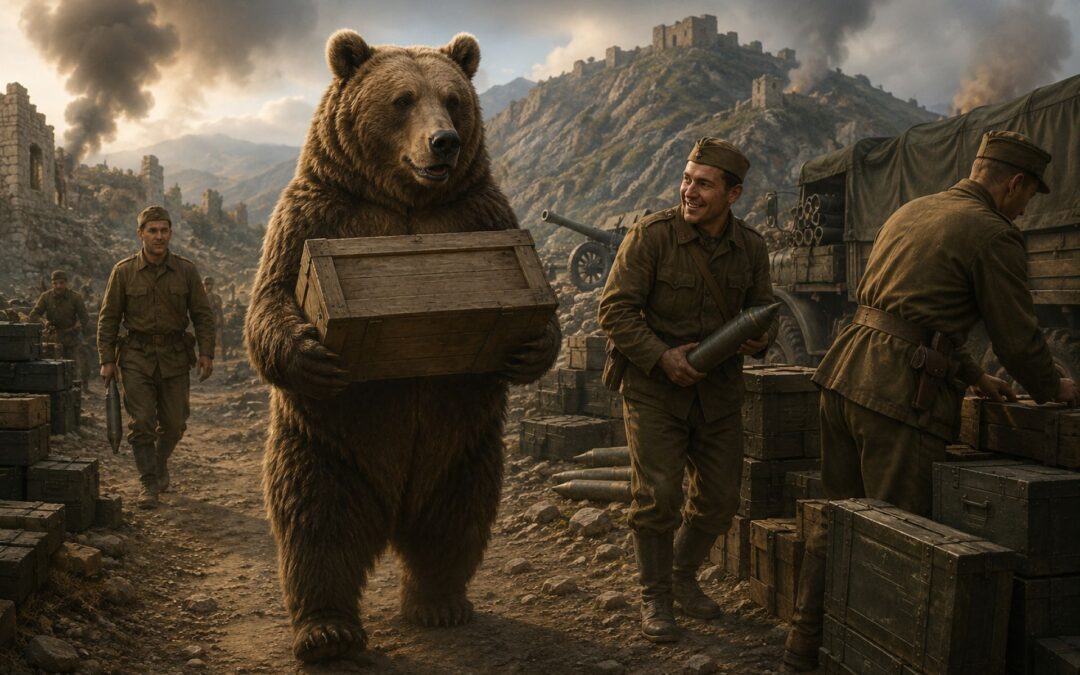
The popular version of Wojtek’s story belongs in a war film: artillery explodes across the Italian mountains while an enormous bear strides through the chaos carrying ammunition for Polish soldiers.
The truth is less cinematic, but no less extraordinary.
Wojtek did not charge German positions or fight like a human soldier. He lived with an artillery supply company, travelled with the Polish II Corps and helped move military material during the Battle of Monte Cassino. The precise nature of that work remains disputed, but his presence in the unit is not.
He ate with the soldiers, wrestled with them, copied their movements and became part of their daily lives. They gave him military papers, placed his image on their insignia and carried his memory long after the war separated them.
To understand why an orphaned bear became so important, however, it is not enough to recount his taste for beer or the famous image of him carrying an artillery shell. Wojtek’s story is also the story of the displaced Polish soldiers who adopted him—men who had lost their homes, survived imprisonment and crossed several countries before ending the war unable to return to the Poland for which they had fought.
How an Orphaned Bear Joined a Displaced Polish Army
Wojtek was a Syrian brown bear found as an orphaned cub in Iran during 1942. The exact details of his discovery are difficult to reconstruct because surviving accounts differ.
In the most commonly repeated version, an Iranian boy found the cub after hunters killed its mother. The boy later encountered a group of Polish civilians or soldiers and exchanged the bear for food, money or other supplies. Some accounts place Wojtek for a time in the care of a young Polish woman before he was transferred permanently to the soldiers.
The broad sequence is clearer than the individual details. Wojtek entered a Polish refugee community in Iran and eventually came into the care of men serving in the military formation that would become the Polish II Corps. The Institute of National Remembrance’s account of Wojtek identifies the soldiers who adopted him with the unit later known as the 22nd Artillery Supply Company.
The soldiers themselves had followed an almost equally improbable path to Iran.
After Germany and the Soviet Union invaded Poland in 1939, large numbers of Polish citizens were arrested, deported or transported into the Soviet interior. Families were separated. Some people were sent to prisons, labour camps or remote settlements under brutal conditions.
Germany’s invasion of the Soviet Union in 1941 changed the political situation. The Soviet government restored relations with the Polish government-in-exile and permitted the creation of a Polish military force under General Władysław Anders. Former prisoners and deportees travelled enormous distances to join it.
Food, equipment and medical care remained desperately scarce. Eventually, tens of thousands of soldiers and civilians were evacuated from the Soviet Union through Iran. They had escaped imprisonment, but many had no home to which they could safely return.
This movement formed one small part of the wider history of World War II, yet it is essential to Wojtek’s story. He was not adopted by soldiers living a stable military life. He entered a community shaped by loss, hunger, separation and exile.
The cub’s vulnerability made an immediate impression. Like many of the soldiers around him, he had lost his family and been carried into an unfamiliar world by forces he could not control.
They named him Wojtek, a Polish name commonly interpreted in English as “joyful warrior.” It was an affectionate and eventually prophetic choice, although the literal linguistic meaning is more complicated than the familiar translation suggests.
At first, Wojtek was too young to eat solid food properly. The soldiers fed him condensed milk from a bottle fashioned from an empty vodka bottle. He slept close to the men for warmth and depended entirely on them.
What began as the rescue of an animal gradually became something closer to adoption.
Growing Up as One of the Soldiers
Wojtek did not remain a manageable cub for long. As he grew into a large bear, keeping him within a military camp became more complicated. Yet the soldiers did not push him to the margins of the unit. They brought him further into its routines.
He travelled with them, slept near them and learned to recognise the sounds and habits of camp life. He reportedly marched alongside the men and sometimes appeared to imitate their salutes. When soldiers stood upright or gathered for an activity, Wojtek often followed.
His favourite form of play was wrestling.
The bear would rear up on his hind legs and grapple with soldiers who were willing to challenge him. Despite his increasing strength, recollections generally describe the contests as playful rather than vicious. Wojtek had been socialised around people from infancy, and he seemed to treat the men as members of his own group.
He also acquired several habits that later became central to his legend.
The soldiers gave him beer, which he reportedly enjoyed, although probably in far smaller quantities than popular retellings imply. He was also fascinated by cigarettes. Accounts often say that he accepted lit cigarettes, took a puff and then chewed or swallowed them. It is more accurate to describe this as mimicking the soldiers than to imagine him sitting comfortably and smoking like a human.
The anecdotes are amusing, but they mattered because they made Wojtek familiar. He was not simply an exotic animal kept nearby for entertainment. He participated in the rituals through which soldiers created a sense of normality in abnormal conditions.
Military units have adopted animals for centuries. As Imperial War Museums explains in its history of military mascots, such animals can become sources of morale, continuity and shared identity. Their presence offers soldiers affection and distraction while reinforcing the feeling that the unit is a community rather than merely an administrative formation.
Wojtek performed all these functions.
The men who cared for him had spent years being displaced by governments and armies. Their families were scattered across continents. News from Poland was uncertain, and the future of their country remained beyond their control.
Looking after Wojtek gave them a relationship that was immediate and uncomplicated. He depended on them, recognised them and shared their surroundings. His antics produced laughter in camps otherwise defined by military discipline and memories of suffering.
The British Library’s history of Wojtek describes him primarily as a beloved mascot, but the word can sound less significant than the role he actually played. Wojtek gave the company a personality. Soldiers who might otherwise have been remembered only as part of a vast wartime movement became the men who travelled with a bear.
By the time the unit prepared to join the fighting in Italy, leaving him behind had become almost unthinkable.
Why Wojtek Was Given Military Papers
The Polish soldiers’ route eventually took them through the Middle East towards the Mediterranean. When their unit was ordered to Italy, military transport regulations created a problem.
Animals could not simply be brought aboard troopships as unofficial passengers.
The solution became one of the most famous parts of Wojtek’s story. He was entered into military records and provided with documents that allowed him to travel with the company. Some accounts describe a service number, a paybook and an official enlistment as a private soldier.
The exact legal formality is uncertain. It is possible that later retellings made Wojtek’s paperwork sound more identical to an ordinary human enlistment than it really was. More cautious institutional accounts describe him as a unit mascot granted the necessary military authorisation to travel.
Either way, the practical outcome was the same.
Wojtek was no longer merely an animal following the soldiers informally. On paper as well as in daily life, he belonged to the unit.
He travelled to Italy with the men who had raised him. By then, he was a large and powerful bear capable of moving heavy objects. The habits he had learned by watching the soldiers would soon produce the episode that transformed him from a cherished mascot into a wartime legend.
What Wojtek Really Did at Monte Cassino
The Battle of Monte Cassino was not a single clash but a succession of Allied attempts to break through the German defensive system known as the Gustav Line.
The position blocked the route north towards Rome. Mountains, rivers, fortified slopes and destroyed infrastructure made the fighting exceptionally difficult. Troops often had to move ammunition, food and water through steep terrain where vehicles could not operate effectively.
The Commonwealth War Graves Commission’s account of the battles at Cassino describes the severe logistical demands placed on the forces fighting there. Supplies frequently had to be carried by hand while artillery units worked continuously to support troops attacking heavily defended positions.
The Polish II Corps entered the decisive phase of the battle in May 1944. The 22nd Artillery Supply Company was responsible for keeping guns supplied, and Wojtek was present with the unit.
According to the famous version of the story, the bear watched soldiers lifting heavy ammunition crates. He then approached them, stood upright and extended his paws as he had learned to do while playing. A soldier handed him a crate. Wojtek carried it to the required location, returned and repeated the task.
Some retellings say he carried individual artillery shells. Others say he transported boxes of ammunition without dropping or damaging them.
The central event is supported by numerous military and institutional accounts: Wojtek imitated the men and helped move artillery-related material. The details, however, are less certain.
A later account associated with one of the unit’s veterans offered a more restrained explanation. As reported in TIME’s examination of Wojtek’s history, he may have carried empty ammunition crates and helped move spent shell casings rather than transporting boxes filled with live explosives.
This does not mean the entire story was invented. It means that a practical episode was gradually compressed into a heroic image.
A large bear carrying an empty wooden crate through a supply area is already extraordinary. Over time, “empty crate” can easily become “ammunition crate,” then “live ammunition,” and finally “artillery shells carried through enemy fire.”
The location of the activity is equally important. Wojtek was attached to a supply company, not an assault unit. There is no reliable evidence that he charged towards German positions, crossed a battlefield under direct fire or deliberately participated in combat.
He was not trained to understand the battle or the political cause for which the soldiers were fighting. He saw familiar men moving familiar objects and copied them, as he had copied their marching, saluting and wrestling.
That imitation was useful.
It also had an enormous effect on morale. In the exhaustion and danger of a major battle, the sight of the company’s bear joining the work would have been difficult to forget. Whether the crates were full or empty, Wojtek had moved beyond being an animal who merely entertained the soldiers.
He had taken part in the life of the unit at its most demanding moment.
How the Bear Carrying a Shell Became the Unit’s Emblem
After Monte Cassino, the 22nd Artillery Supply Company adopted an image of a bear carrying an artillery shell as its emblem.
The design was simple and instantly recognisable. Wojtek stood upright, holding a large shell between his paws. The image appeared on vehicles and insignia, turning the company’s unusual companion into its public identity.
The emblem should not be treated as a literal photograph rendered in graphic form. Military symbols simplify experience. They compress stories, values and memories into images that can be recognised at a glance.
The bear and shell captured several truths at once.
Wojtek had lived with the company. He had copied the soldiers’ work. He had helped move material associated with their artillery operations. Most importantly, the men considered him part of their collective achievement.
The insignia also strengthened the most dramatic version of the story. Once the image of a bear carrying a shell existed, later audiences naturally imagined the scene as direct combat. Illustrations, films and popular histories could then place Wojtek amid explosions and enemy fire even when the historical evidence supported a less spectacular setting.
Yet the emblem’s symbolic meaning is more important than the precise contents of any crate.
The soldiers were honouring a companion who had travelled with them from the Middle East to Italy and who had become inseparable from the unit’s identity. Wojtek represented resilience, loyalty and the strange forms of normal life that people create during war.
He was their bear.
From Victory in Italy to Exile in Scotland
The end of the war did not bring the Polish soldiers a simple homecoming.
They had fought as part of the Allied war effort and helped defeat Nazi Germany, but Poland’s political future had been determined largely by the advance of the Soviet Union and agreements among the major Allied powers. A Soviet-backed government took control, while the borders and institutions of pre-war Poland were fundamentally changed.
For many members of the Polish armed forces in the West, returning was dangerous or unacceptable. Some feared arrest or persecution because of their military service, social background or opposition to Soviet power. Others no longer had homes within Poland’s new borders.
Their predicament belonged to the Soviet-dominated postwar order in Eastern Europe. Victory had ended one conflict while creating another form of exile.
The 22nd Artillery Supply Company was transferred to Britain and based at Winfield Camp in Scotland. Wojtek went with it.
In Scotland, he became locally famous. Civilians heard about the bear who had served with Polish troops, and his presence helped connect the displaced soldiers with the communities around them.
But military demobilisation was approaching. The men would leave the camp, settle in different countries or attempt to rebuild private lives. A large adult bear could not accompany any one of them into civilian housing.
Wojtek therefore faced a version of the same problem confronting his comrades. The community that had become his home was dissolving, while his place in the postwar world remained uncertain.
Describing him as simply “donated” to a zoo misses the emotional difficulty of the decision. The soldiers had raised him from infancy. He recognised their voices and routines. He had rarely lived apart from people he knew.
But keeping him within a disbanded military unit was impossible.
A permanent home had to be found.
Wojtek’s Final Years and Enduring Legacy
On 15 November 1947, Wojtek was transferred to Edinburgh Zoo.
For the public, he was an unusual attraction with an extraordinary biography. For the former soldiers of the Polish II Corps, he remained a comrade.
Veterans visited him at the zoo and spoke to him in Polish. Some accounts say he became visibly animated when he heard familiar voices. Former soldiers occasionally crossed barriers or approached him more closely than zoo rules permitted, attempting to recreate the physical contact they had shared in camp.
Cigarettes also appear in these stories. Visitors reportedly threw them to him, recalling one of the habits he had acquired among the troops. Whether every such anecdote is precise matters less than the persistence of the relationship. The men did not regard Wojtek as a former possession. They regarded him as someone who remembered them.
His life at the zoo was necessarily different from his military years. He no longer moved freely through a camp or wrestled with soldiers. The company that had formed his social world existed mainly in memory.
Wojtek died in 1963.
By then, his story had already spread beyond the men who had known him. Photographs, insignia, memoirs and later histories preserved the image of the upright bear carrying an artillery shell. Memorials would eventually appear in Poland, Britain and elsewhere, commemorating both Wojtek and the soldiers with whom he served.
The legend survived because it could be told as an entertaining wartime curiosity. A bear drank beer, ate cigarettes, enlisted in an army and carried ammunition at Monte Cassino.
But its deeper power comes from something more human.
Wojtek was adopted by men who had been separated from their families, displaced from their country and pushed across continents by decisions made far above them. They cared for an orphaned animal while trying to preserve their own sense of community. In return, he gave them affection, laughter and an identity that belonged entirely to their unit.
The famous picture of Wojtek carrying a shell may not record every detail exactly as it happened. It records how the soldiers chose to remember him.
He did not need to understand the war or fight like a man to become one of them. He shared their camps, their journeys, their most famous battle and, finally, their exile.
That was enough to make Wojtek a soldier in everything but the ordinary sense of the word.
Last Updated on July 27, 2026 by Aseem Gupta