
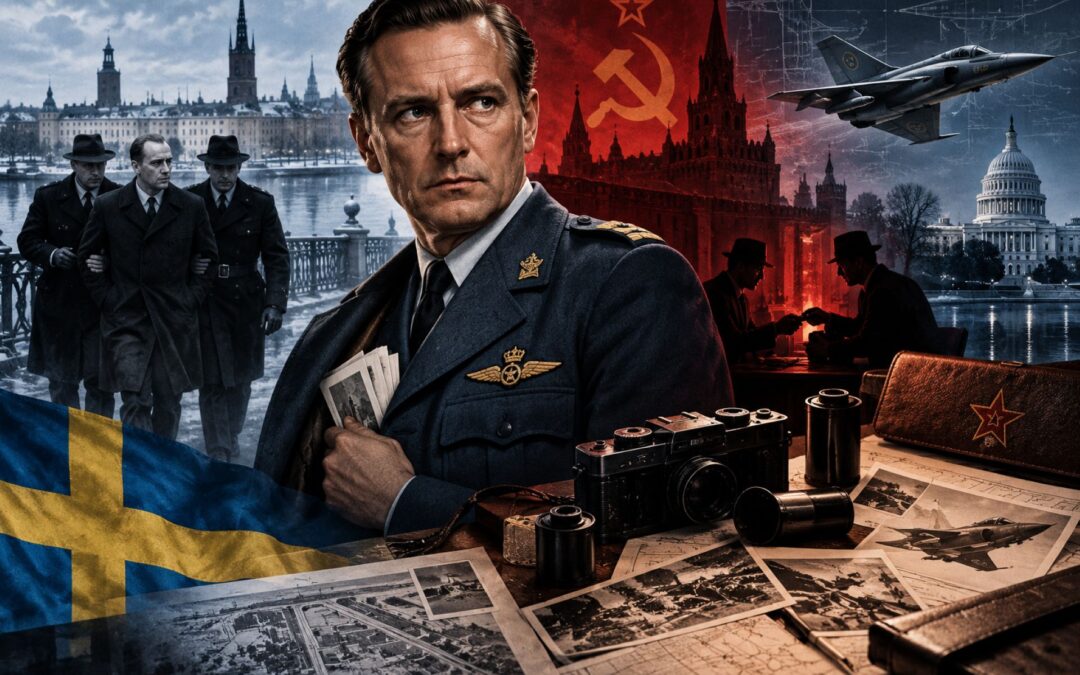
On the morning of June 20, 1963, Stig Wennerström was walking across Riksbron, a bridge in central Stockholm, on his way to work at Sweden’s Ministry for Foreign Affairs. The retired Air Force colonel had spent decades serving his country, represented Sweden in Moscow and Washington, and moved comfortably among senior military officers, diplomats, and government officials. As he crossed the bridge, plainclothes police officers approached him and placed him under arrest on suspicion of espionage.
The authorities had been watching Wennerström for years. What finally gave them the evidence they needed was not a confession or an intercepted diplomatic message, but something discovered inside his own home: rolls of photographic film concealed in the attic. The material exposed a clandestine relationship with Soviet military intelligence that had continued through some of the most dangerous years of the Cold War.
Wennerström had used his positions to acquire information about Swedish defence plans, Western military capabilities, and sensitive relations between Sweden and the United States. His betrayal became one of the most serious espionage scandals in Swedish history, raising uncomfortable questions about how a trusted officer could remain close to national secrets despite repeated warnings.
His story is also more complicated than the familiar image of a master spy deceiving everyone around him. Wennerström was an ambitious officer whose career had disappointed him, a cultivated diplomat with valuable international contacts, and a man who later insisted that his actions had helped preserve world peace. Understanding how he became a Soviet agent requires examining not only what he did, but also the institutions and relationships that made his espionage possible.
The Officer Who Moved Easily Between Military and Diplomatic Circles
Stig Erik Constans Wennerström was born in Stockholm on August 22, 1906. His father, Gustaf Wennerström, was a major in the Swedish military, and his mother was Ester Berggren. Growing up in a family connected to the armed forces, he entered a world in which military service offered both a respected profession and a route into Sweden’s social establishment.
His military career initially developed through the navy rather than the Air Force. Wennerström became a naval officer in 1929 and underwent flying training in 1931 and 1932, eventually transferring into the Swedish Air Force. Aviation was becoming central to military strategy, and a capable officer who understood aircraft, operations, and foreign military developments could expect important responsibilities.
Wennerström gained practical experience as a pilot, although his flying career was not without accidents. During formation training in November 1931, he was involved in a collision near Västerås, and in 1944 he survived another aircraft accident involving a Saab 17. These incidents did not prevent his advancement through the military establishment.
According to the Swedish Spy Museum’s account of his military career, Wennerström became an Air Force lieutenant in 1936, captain in 1939, major in 1944, lieutenant colonel in 1946, and colonel in 1951. He also attended advanced military education, taught at the Swedish Air War College, and held operational responsibilities during the Second World War.
His career offered another kind of opportunity: proximity to influential people. Between 1938 and 1947, Wennerström served as an aide-de-camp to Sweden’s hereditary prince, Gustaf Adolf. The assignment placed him within royal and military circles where personal connections could prove as valuable as formal rank.
He was also well suited to diplomatic assignments. His knowledge of foreign languages, familiarity with military aviation, and ability to navigate international social environments made him useful in representing Sweden abroad. These qualifications would later become central to his value as an intelligence source.
During the Second World War, Wennerström served for periods in Moscow as an assistant air attaché. A military attaché is an officer assigned to an embassy to represent the armed forces, maintain professional relationships, and gather information about military developments through legitimate diplomatic channels. Such work naturally involves conversations with foreign officers, attendance at official events, and access to material that ordinary civilians rarely encounter.
Sweden’s international position made these duties particularly sensitive. The country remained outside the military alliances that increasingly divided Europe, but neutrality did not mean isolation from the Cold War intelligence rivalry. Swedish leaders needed information about both NATO and the Soviet Union, while those powers had strong reasons to understand Sweden’s military capabilities and strategic intentions.
Wennerström’s professional relationships were therefore not inherently suspicious. A Swedish officer might meet Soviet diplomats, exchange information with American military representatives, or discuss aviation technology with foreign colleagues as part of his ordinary responsibilities. The difficulty for counterintelligence officials was determining when legitimate contact crossed the boundary into clandestine cooperation.
By the late 1940s, Wennerström appeared to possess the qualifications of a successful international military officer. Yet his ambitions had begun to encounter resistance within the Swedish Air Force, while his relationships with Soviet representatives were becoming increasingly consequential.
The 1948 Airfield Deal and His Recruitment by Soviet Intelligence
Wennerström’s involvement with foreign intelligence did not begin with a dramatic recruitment meeting during the height of the Cold War. Swedish authorities had already noticed his contacts with foreign diplomats during the Second World War, including relationships with German and Soviet representatives. Those connections later became significant when investigators reconstructed his activities.
The decisive development in his established Soviet espionage career came in 1948. While in Stockholm, Wennerström offered a Soviet military attaché named Rybachenkov information about the location of a secret Swedish airfield in exchange for 5,000 Swedish kronor. According to the account subsequently examined by American intelligence, the transaction was completed.
The episode matters because it was more than a casual expression of political sympathy. Wennerström had supplied sensitive information about his own country’s defences to a foreign representative in return for money. Whatever explanations he later offered for his conduct, this was a concrete act of betrayal.
At the beginning of 1949, Wennerström took up another diplomatic posting in Moscow. There, his acquaintance with a Soviet intelligence officer named Nikitushev became part of a more formal recruitment process. Nikitushev approached him about cooperation and eventually arranged a meeting with a senior officer in the Soviet intelligence organisation.
The service involved was the GRU, the Soviet Union’s military intelligence apparatus. It was distinct from the KGB, the state-security organisation that became particularly well known during the Cold War. Both conducted foreign intelligence activities, but Wennerström’s principal handlers were associated with Soviet military intelligence, whose interests included Western military planning, aircraft, and defence technology.
The Soviet recruitment approach appealed to something more complicated than outright communist conviction. According to Wennerström’s later testimony, his recruiters argued that the Soviet Union needed better knowledge of Western military capabilities to preserve the international balance of power. If Moscow understood NATO’s strength and intentions, they suggested, it could avoid dangerous miscalculations and contribute to peace.
This argument appeared to resonate with Wennerström. He later portrayed his cooperation as an attempt to prevent war by helping the superpowers achieve a more stable military balance. In his account, sharing information was not an act of hostility toward Sweden but a contribution to international security.
The contradiction was obvious. His Soviet recruiters initially assured him that they would not demand information directed against Sweden, yet the airfield transaction had already demonstrated his willingness to reveal Swedish secrets. The Soviets also knew that their earlier dealings with him could be used to exert pressure if necessary.
Whether Wennerström genuinely believed the balance-of-power argument, adopted it to rationalise his conduct, or was influenced by several motives remains uncertain. His career had suffered setbacks, including unfavourable assessments from senior Swedish officers. Personal ambition, resentment, the attraction of secret influence, financial benefits, and the relationships he developed with Soviet handlers may all have contributed.
Once he accepted the recruitment proposal, the GRU initially tested his reliability. Wennerström was asked to establish contacts within the American and other Western embassies in Moscow and report on the people he encountered. His assignments began with information about diplomatic personnel, responsibilities, and relationships rather than the immediate theft of highly classified military plans.
He proved adept at developing these connections. One American defence attaché was already familiar to him through earlier meetings in Stockholm, making introductions easier. His position as a neutral Swedish military representative also helped him interact with officials from countries that were increasingly suspicious of one another.
The Soviets eventually gained confidence in their recruit. Wennerström provided photographs of a sensitive Swedish defence analysis, and his relationship with the GRU developed into a sustained intelligence operation. He received a codename commonly translated as Eagle and was assigned a senior Soviet handler with whom he developed a remarkably close working relationship.
By then, Wennerström had become far more than a useful diplomatic contact. He was an established Soviet agent operating inside a military profession that continued to trust him.
Washington: How a Neutral Attaché Reached American Military Secrets
Wennerström’s most strategically valuable foreign appointment began on April 1, 1952, when he became Sweden’s air attaché in Washington, D.C. He remained in the United States until 1957 and also received accreditation to Canada during that period.
The timing was significant. NATO had been established in 1949, the Korean War was underway, and the United States was expanding its military commitments across Europe and Asia. Western governments were investing heavily in aircraft, radar networks, missiles, and the systems required to defend against a possible Soviet attack.
As Sweden’s representative, Wennerström could participate in professional military exchanges, develop relationships with American officers, and obtain information relevant to Swedish defence planning. Although Sweden was not a NATO member, its location in northern Europe made its security important to Western strategic calculations.
Swedish airspace, coastal geography, and military capabilities mattered to any potential conflict involving the Baltic region. Western officials therefore had reasons to maintain relations with Sweden, even while respecting its formal position outside NATO. Wennerström’s diplomatic status allowed him to operate within this environment without appearing to represent an adversary.
His Soviet handlers wanted information about the principles of NATO war planning, especially aerial warfare and the military consequences of a major confrontation in Europe. They also had obvious interests in Western aviation technology and air-defence capabilities.
Wennerström was particularly useful because he understood the material he encountered. He was not simply collecting documents whose significance he could not evaluate. His aviation training and senior military experience enabled him to recognise which technical and operational details might interest Soviet planners.
The information associated with his espionage included Western defence arrangements, military capabilities, and aspects of advanced weapons development. Accounts of the case have also connected his activities with intelligence on NATO exercises, missile systems, and air-defence technology.
However, these categories must not be confused with proof that he personally obtained every document later attributed to him. Particular claims that he photographed complete American missile blueprints or compromised specific NATO exercises require more precise evidence than the general record of his espionage provides. His access and his intelligence value were substantial without assuming that every dramatic account of a stolen document is accurate.
His methods also extended beyond photographing documents. He cultivated personal contacts, attended meetings, gathered information through conversation, and reconstructed details from his notes and recollections. Military intelligence does not consist exclusively of secret files; it can also involve understanding how an organisation makes decisions, which officers hold influence, and what capabilities it considers important.
The Soviet relationship continued while Wennerström lived in Washington. According to his subsequent account, successive Soviet air attachés acted as intermediaries who received material and maintained contact on behalf of his senior handler. This arrangement allowed the most important Soviet officer directing him to remain relatively distant from the routine exchanges.
His Swedish nationality and diplomatic position complicated the security picture. American officials could regard him as a representative of a friendly neutral country while remaining unaware that information shared with him might reach Moscow. Even material that was not formally classified could become valuable when combined with intelligence from other sources.
During these years, Wennerström also claimed to have performed limited intelligence assignments for American authorities against the Soviet Union. That claim later contributed to his reputation as a double agent, but the nature and importance of any American relationship remain contested. His extensive service to Soviet intelligence is much more firmly established than the suggestion that he operated as an equally committed agent for both sides.
When Wennerström returned to Sweden in 1957, his espionage career was not ending. Instead, he was moving into positions where he could compromise the defence establishment of his own country more directly.
When His Espionage Turned Against Sweden’s Own Defences
On returning from Washington in June 1957, Wennerström briefly resumed duties within the Swedish Air Force staff. In October, he became head of the aviation section at the Defence Command Expedition, an organisation involved in important military and administrative matters.
The appointment placed him close to information about Swedish defence policy and planning. His responsibilities and professional contacts created opportunities to understand developments across the armed forces, including matters not directly connected to his own immediate duties.
This marked a particularly damaging phase of his intelligence activity. The Soviet Union had every reason to study Sweden’s military arrangements, notwithstanding the country’s neutrality. In the event of a conflict in northern Europe, Swedish airfields, aircraft, coastal defences, and mobilisation systems would all influence the military balance around the Baltic Sea.
An intelligence service seeking to understand those arrangements would value more than a collection of weapons specifications. Knowing where military installations were located, how air-defence systems were organised, and which units were intended to respond to particular threats could reveal vulnerabilities that would be difficult to identify from outside Sweden.
Wennerström had the background to interpret such information. Years of military service gave him familiarity with Swedish operational thinking, while his international appointments allowed him to understand how Swedish capabilities related to developments in the Soviet Union and NATO countries.
The Saab 35 Draken fighter aircraft became one of the most prominent technologies associated with the affair. Developed to meet Sweden’s need for a modern interceptor, the Draken represented a major investment in domestic military aviation. Information concerning its development and associated defence arrangements would naturally interest Soviet intelligence.
Historical accounts indicate that significant material relating to the Draken programme and Sweden’s broader air-defence system became available to the Soviets through Wennerström. This does not necessarily mean that he personally handed over every technical document concerning the aircraft. The supported conclusion is that his activities exposed substantial information about an important Swedish military project.
The same caution applies to reports concerning underground air installations, coastal defences, and Swedish strategic planning. Such disclosures could be extremely serious, but their significance depends on precisely what was compromised, when the information was current, and how the Soviet military could use it.
One particularly troubling allegation concerns the Soviet destruction of a Swedish signals-intelligence aircraft over the Baltic Sea in June 1952. The aircraft, a Swedish Air Force DC-3, was engaged in reconnaissance connected with Soviet military communications when it was shot down, killing eight Swedish servicemen.
Some historical accounts suggest that information supplied by Wennerström helped the Soviets understand Swedish signals-intelligence activities and their connections with the United States. His possible role has consequently become part of the debate surrounding the incident, commonly associated with the Catalina Affair.
The available evidence does not establish that Wennerström personally caused the attack or that Soviet commanders acted solely on intelligence obtained from him. The allegation is nevertheless significant because it demonstrates the potential human consequences of exposing reconnaissance operations, rather than merely compromising abstract military plans.
His later assignment at the Ministry for Foreign Affairs created further opportunities for contact with sensitive government information. By then, the authorities had already developed substantial suspicions about him, yet he continued working within important official circles.
The progression from military attaché to defence official and foreign-ministry adviser illustrates how one compromised individual could repeatedly acquire new forms of access. Even when a particular appointment did not provide direct control over classified files, Wennerström’s experience and relationships helped him identify information worth seeking.
His value to the GRU came from that combination of formal position, technical knowledge, and personal access.
How Wennerström Smuggled Intelligence to His Soviet Handlers
Wennerström’s ability to obtain information was only part of the operation. He also needed to communicate it to Soviet intelligence without exposing himself, his contacts, or the materials he had collected.
His methods included photographing documents, preparing written reports, memorising information, and transferring photographic film through discreet personal encounters. Small cameras and film made it possible to reproduce substantial amounts of information without removing the original documents permanently.
A photograph could preserve technical details, diagrams, or passages that would be difficult to reproduce accurately from memory. At the same time, the original papers could be returned to their normal location, reducing the chance that someone would discover a missing document.
A revealing account of these methods appears in the CIA’s declassified study, Notes on the Wennerström Case, written by Alexander Mull. Drawing heavily on Wennerström’s testimony, it describes a combination of ordinary social interaction and carefully arranged clandestine contact.
During his early work in Moscow, Wennerström reportedly met Soviet contacts in vehicles and apartments. He also used his legitimate diplomatic relationships to collect information about Western embassy personnel, sometimes preparing notes after meetings rather than obtaining physical documents.
His Soviet handlers paid considerable attention to the organisation of the relationship. According to the account, a senior officer became Wennerström’s principal handler, while other Soviet representatives acted as intermediaries. Maintaining a close relationship with one senior officer helped create continuity and reinforced Wennerström’s sense that he was an important member of the intelligence organisation.
The personal element mattered. Wennerström’s later descriptions suggest that he admired his handler and considered their professional relationship a form of friendship. Soviet officers encouraged this attachment, treating him as a trusted collaborator rather than merely an expendable source.
Contrary to the elaborate training often associated with fictional espionage, Wennerström claimed that he received relatively little systematic instruction. Soviet intelligence valued the knowledge, confidence, and connections he already possessed. Much of his practical preparation developed through experience.
One method described in his testimony involved passing a roll of film during a handshake. It required coordination between two people who could appear to be exchanging ordinary greetings while transferring a small object. The account describes such exchanges in public settings, including occasions when other military officers were nearby.
Other reported transfers occurred during receptions, social gatherings, and meetings arranged through diplomatic contacts. The advantage of these environments was that Wennerström already had legitimate reasons to be present. An observer might see two acquaintances speaking briefly without recognising that sensitive material had changed hands.
The system also relied on designated contacts and planned meetings. Soviet officials could pass messages or receive material without Wennerström meeting his principal handler on every occasion. During periods away from Moscow, intermediaries helped maintain the connection.
His testimony also described a radio receiver used for practising the reception of coded Soviet messages in preparation for a possible wartime emergency. That arrangement should not be confused with evidence that every document he supplied was transmitted through elaborate encrypted broadcasts. The more consistently documented methods involved photographic material, personal exchanges, and reports.
These accounts are valuable, but their limitations matter. Much of the operational detail comes from Wennerström’s own explanations after his arrest, and not every recollection can be independently corroborated. Investigators could examine recovered equipment, documents, and testimony, but they could not necessarily reconstruct every clandestine meeting across fifteen years.
The central feature of his espionage was not technological sophistication alone. It was his ability to make intelligence collection fit inside a normal professional life. Meetings, conferences, diplomatic receptions, travel, and correspondence all provided opportunities to gather or transfer information without creating an obvious break from his public identity.
That ordinary appearance helped his espionage continue, even as Swedish security officials accumulated reasons to distrust him.
The Warnings Swedish Counterintelligence Could Not Ignore
The most troubling aspect of the Wennerström affair is that Swedish authorities did not first suspect him in 1963. Questions about his foreign contacts had emerged during the Second World War, long before the discovery of film in his attic.
In the early 1940s, Swedish security officials became concerned about Wennerström’s relationships with German and Soviet diplomatic personnel. In 1943, information obtained from German military communications suggested that he had provided intelligence to German representatives. His contacts with Soviet personnel also attracted attention.
Swedish authorities placed him under telephone and postal surveillance that year. On one occasion, police monitoring his movements learned that he intended to visit a Soviet representative. Officers considered whether to intervene, but no arrest followed.
These early suspicions were difficult to evaluate in isolation. Sweden was neutral during the war, and its military officials sometimes maintained contacts with representatives of opposing powers. Information-sharing and intelligence collection also formed part of the wider diplomatic environment, making it harder to determine whether a particular interaction was criminal.
The concerns did not disappear entirely. In 1947, Wennerström’s unusually active contacts with Soviet diplomatic personnel again came to official attention. He had also prepared memoranda concerning intelligence matters that later became relevant to investigations of his conduct.
Nevertheless, the available information failed to produce decisive action. Military superiors often continued to regard him as a capable and loyal officer, while counterintelligence officials lacked evidence sufficient to establish a prosecutable espionage offence.
The situation became more serious in the late 1950s. New intelligence concerns and a renewed examination of his conduct prompted closer cooperation between Swedish security authorities and military officials. By 1959, investigators were again focusing substantial attention on him.
The 1964 Swedish parliamentary inquiry into the Wennerström affair provides an unusually detailed reconstruction of these decisions. It shows that the problem was not a complete absence of warning signs, but the difficulty of evaluating them, sharing information, and determining when action was justified.
In November 1959, a court authorised telephone surveillance of Wennerström. The authorisation was subsequently extended, and the monitoring continued until his arrest. Investigators also examined his movements, foreign contacts, and professional activities.
Officials within the Swedish government gradually learned of the suspicions. Defence Minister Sven Andersson received a detailed briefing in January 1960, and other ministers were informed as the investigation developed. Yet the extent of knowledge within the government, including what Prime Minister Tage Erlander had been told, became a matter of considerable controversy.
The problem was complicated by Wennerström’s official appointments. Removing a senior officer from sensitive responsibilities without publicly explaining the reasons could create professional and political difficulties. Leaving him in place, however, meant accepting the possibility that someone under suspicion might continue obtaining classified information.
Authorities attempted to limit his access, particularly after he moved into his foreign-ministry role. Such restrictions could reduce the immediate danger but did not eliminate the opportunities available to someone with longstanding military contacts and a habit of seeking information from colleagues.
During 1962 and 1963, Wennerström continued asking questions and attempting to obtain military material. Some of these activities were reported to the police and strengthened their suspicions.
The authorities faced an increasingly urgent choice. They could arrest him on the basis of accumulated circumstantial evidence, potentially exposing a lengthy investigation without obtaining a conviction, or continue surveillance in the hope of discovering something more conclusive.
The final breakthrough came when investigators found a way to observe what was happening inside his home.
The Housekeeper, the Hidden Film, and the June 1963 Arrest
By 1963, Swedish counterintelligence officials were considering a more direct approach to Wennerström’s private activities. One possibility was to obtain information from someone who worked inside his household.
Their attention turned to Carin Rosén, the family’s housekeeper. Investigators had considered approaching her earlier but worried that doing so might compromise their surveillance. In May 1963, they finally established contact, and she began supplying information about Wennerström’s habits and behaviour.
Rosén occupied a position of unusual importance. Unlike surveillance officers watching from outside, she could observe the routines of the household and notice objects or activities that might otherwise remain hidden.
During June 1963, she discovered packages containing photographic film concealed among wood shavings in the attic of the Wennerström home. The film contained images of secret documents, providing the kind of tangible evidence investigators had struggled to obtain.
The discovery transformed the case. Officials now had material connecting Wennerström’s private possession of photographic evidence with classified information. This was considerably more powerful than suspicions arising from foreign contacts or unusual questions about military affairs.
According to the Swedish Security Service’s historical account of his exposure, Wennerström realised on the evening of June 19 that film intended for his Soviet contact was missing. Recognising the danger, he attempted to destroy compromising material by burning it in a frying pan.
The effort came too late. That evening, the authorities issued the decision to detain him, and the following morning police intercepted him as he crossed Riksbron on his way to the Foreign Ministry.
Wennerström was arrested on June 20, 1963. The case became public several days later, on June 25, a distinction that helps explain why some retrospective accounts give conflicting arrest dates.
The arrest exposed a remarkable contradiction. An officer who had been treated as a trusted representative of Sweden’s military establishment was now suspected of passing secrets to one of the country’s most formidable strategic adversaries.
Investigators subsequently examined his documents, equipment, contacts, and statements to establish the scale of the operation. Wennerström’s eventual admissions helped reconstruct years of intelligence activity that surveillance alone had not been able to prove.
Rosén’s involvement was decisive because it supplied what repeated investigations had lacked: physical evidence from inside the suspect’s home. The case had not been solved by identifying a mysterious codeword or tracing a single intercepted message, but by connecting long-standing suspicion with material that could be examined and used in legal proceedings.
The exposure also shifted attention toward the Swedish authorities themselves. If Wennerström had been under suspicion for so long, why had he continued to occupy positions that provided access to sensitive defence information?
That question became almost as important as the espionage charges.
Trial, Sentence, and the Arguments Over His Allegiance
The Wennerström affair developed into a major national scandal. His arrest prompted intense public interest, while the investigation revealed a prolonged relationship with Soviet military intelligence extending across several countries and official appointments.
In June 1964, a Swedish court convicted Wennerström of serious espionage offences and sentenced him to life imprisonment with hard labour. He also lost his military position. The conviction confirmed that the case concerned sustained criminal intelligence activity rather than merely inappropriate diplomatic contacts.
The proceedings established that Wennerström had obtained and supplied information concerning Swedish and foreign military matters. His service in Moscow, Washington, and Stockholm created separate periods of offending, each involving different opportunities for intelligence collection.
Yet the legal findings could not fully resolve the question of why he had done it. Wennerström continued to describe his actions through the language of international security, arguing that better Soviet knowledge of Western military capabilities could help preserve peace.
This explanation portrayed him as someone acting above conventional national loyalties in pursuit of a broader objective. It was also extraordinarily convenient for a man accused of betraying his country, since it allowed him to present espionage as a form of strategic responsibility.
The financial dimension further complicates the picture. Wennerström received compensation and operational funds from Soviet intelligence, and the amounts involved changed over time. Some of the money supported travel and intelligence expenses, while other payments or promised rewards benefited him personally.
Money alone does not adequately explain a relationship that continued for so long, but neither can his actions be detached from material incentives. His Soviet connections offered recognition, influence, and a sense of importance that his Swedish military career did not always provide.
A further complication was Wennerström’s claim that he had occasionally performed intelligence tasks for the United States. These assertions contributed to descriptions of him as an unusually complex double agent operating between American and Soviet intelligence services.
The historical evidence does not justify treating the two relationships as equivalent. Wennerström’s prolonged cooperation with the GRU is firmly established, while the extent of any American intelligence relationship is much less certain.
Historian J. J. Widén has challenged the conventional double-agent interpretation, arguing for a more critical assessment of the claims surrounding Wennerström’s relationship with Western intelligence. The larger distinction is important: an officer who occasionally supplied information to another service is not necessarily a double agent in the formal sense of maintaining substantial clandestine obligations to both sides.
His personal explanations also require caution. They were produced in circumstances where he had strong reasons to justify his decisions, explain his relationships, or influence how investigators interpreted his conduct.
Wennerström’s punishment was eventually reduced. His life sentence was commuted to a twenty-year term, and he received conditional release in September 1974 after approximately eleven years in custody.
His release did not mean that his espionage had been reconsidered as harmless. It reflected the subsequent legal treatment of his sentence and the rules governing imprisonment and release, rather than an official finding that his actions had caused no damage.
The years that followed were relatively quiet compared with the extraordinary publicity surrounding his arrest and trial. But the historical questions raised by his case continued well beyond his imprisonment.
The Damage to Sweden—and the Myth of the Perfect Spy
Wennerström is frequently described as one of Sweden’s most damaging spies. The description is understandable given his senior appointments, lengthy Soviet relationship, and ability to provide intelligence about military systems and planning during a period of intense international confrontation.
His disclosures affected several categories of information. Swedish defence arrangements were especially vulnerable because he understood the country’s military organisation from within. His foreign diplomatic service also gave him opportunities to gather information concerning Western military capabilities and relationships.
The potential consequences were substantial. An adversary who understood Swedish airfields, operational procedures, aircraft development, and military planning could use that knowledge to improve reconnaissance priorities, prepare military contingencies, or identify weaknesses in Swedish defences.
Information about Western air-defence systems and NATO planning could likewise help Soviet analysts evaluate the capabilities they might face during a European conflict. Even when a particular document did not reveal an entire weapons programme, its technical or organisational details could become useful when combined with information collected elsewhere.
Accounts of the affair have described enormous quantities of material passing through Wennerström’s hands, sometimes attributing tens of thousands of pages to his espionage. Such figures should be treated cautiously because the number of pages compromised is not automatically a reliable measure of intelligence value.
A single highly sensitive document might be more important than hundreds of routine reports. Conversely, a large collection of technical material could lose much of its usefulness as equipment, military doctrine, and deployment arrangements changed.
The historical record supports serious security damage, but it does not allow every later estimate of that damage to be treated as a precisely measured outcome. The extent to which individual disclosures directly changed Soviet operational decisions is often harder to establish than the fact that classified information was transferred.
Wennerström’s case was nevertheless deeply embarrassing for Sweden. His espionage had continued despite earlier suspicions, internal warnings, and surveillance. The resulting scandal raised questions about security clearances, professional trust, cooperation between intelligence organisations, and the government’s handling of sensitive information.
Official inquiries examined these institutional failures and the responsibilities of ministers and security authorities. The affair helped establish a broader understanding that counterintelligence could not rely simply on the reputation or social standing of senior officials.
It also exposed the limits of conventional assumptions about espionage. Wennerström did not fit neatly into the image of an ideologically committed communist operating secretly within an openly hostile organisation. He was a well-connected Swedish officer whose normal duties supplied much of the access his handlers wanted.
His effectiveness depended heavily on existing professional relationships. Diplomatic acquaintances, military colleagues, technical expertise, and social confidence allowed him to obtain and interpret information that might have remained inaccessible to a less established agent.
At the same time, the mythology surrounding his career should not obscure his mistakes. He attracted suspicion repeatedly, maintained relationships that worried investigators, and ultimately kept incriminating photographic material in his own home. Once Swedish authorities obtained access to that material, his carefully maintained public identity rapidly collapsed.
Even his apparent loyalty to his Soviet handlers requires a more complicated interpretation than simple devotion. He accepted payments, received encouragement and recognition, and developed a personal attachment to the officers directing him. His claims about serving international peace were part of that relationship, but they cannot erase the practical reality that he was supplying military intelligence to a foreign power.
After his release, Wennerström lived away from the public prominence that had characterised much of his earlier career. He died on March 22, 2006, at the age of 99, more than four decades after his arrest.
His death did not settle every question about the material he supplied, the strategic consequences of his disclosures, or the motivations that sustained his espionage. Some aspects remain dependent on testimony, retrospective accounts, and incomplete intelligence records.
What is clear is that Wennerström exploited a particular vulnerability in Sweden’s national security establishment. His positions gave him legitimate access to sensitive people and information, while the trust attached to those positions made his conduct difficult to challenge conclusively.
The Wennerström affair is therefore not simply the story of a gifted spy who successfully deceived an entire country. It is the history of an officer whose legitimate career and secret loyalties became intertwined, allowing him to compromise military information over many years while institutions struggled to act on their suspicions.
That distinction matters because it explains both his success and his eventual exposure. Wennerström did not need to defeat every security system placed before him. He benefited from the ordinary assumptions that colleagues, superiors, and governments make about people they already know and trust, until documentary evidence finally made those assumptions impossible to sustain.
Last Updated on October 27, 2026 by Aseem Gupta