
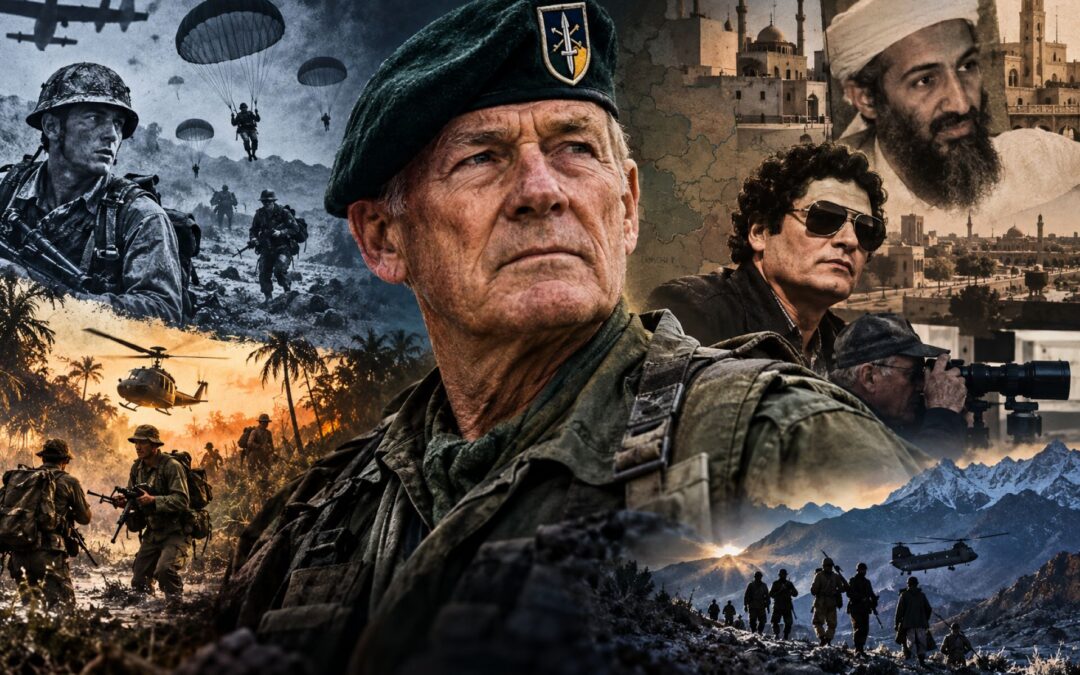
In November 2001, as American intelligence officers and Special Forces soldiers entered Afghanistan to fight the Taliban and hunt Osama bin Laden, one member of the CIA’s expedition was old enough to be the grandfather of many of the men around him. Billy Waugh was nearly 72 years old, yet he had returned to a war zone rather than settle into retirement.
His presence was remarkable, but it was hardly the beginning of his story. Waugh had fought in Korea, survived devastating injuries in Vietnam, participated in some of America’s earliest clandestine combat parachute operations, and helped track internationally wanted terrorists. His career connected the Cold War’s unconventional battlefields with the counterterrorism campaigns of the early twenty-first century.
William Dawson Waugh would become a celebrated figure in American Special Forces and intelligence circles. Behind that reputation was a documented history of combat, dangerous assignments, extraordinary endurance, and operations whose complete details remain classified.
The Boy from Bastrop Who Tried to Join a War
William Dawson Waugh was born on December 1, 1929, in Bastrop, a small Texas town southeast of Austin. He grew up during the Great Depression and the Second World War, when military service occupied a prominent place in American life. His mother, a college-educated schoolteacher whom he remembered as intelligent and strict, provided much of the family’s stability.
Waugh began working as a child, taking jobs that included pumping petrol, stacking groceries, working at a local theatre, and eventually serving as a lifeguard. These experiences contributed to an unusually independent childhood, although his strongest ambition had little to do with civilian employment. He wanted to become a soldier.
At fifteen, with World War II still underway, Waugh attempted to enlist in the Marine Corps. Having heard that he might be accepted in California, he left Texas and began hitchhiking toward Los Angeles. His journey ended in Las Cruces, New Mexico, where police detained the underage teenager and his mother arranged for him to return home.
The episode became a favourite part of Waugh’s personal history. It revealed both his determination to join the military and his tendency to pursue difficult objectives without giving much consideration to the obstacles ahead.
He eventually completed his education at Bastrop High School and enlisted in the United States Army in 1948, aged eighteen. Although he had missed the Second World War, military service would soon provide the experience he had been seeking.
After completing his initial training, Waugh qualified as a paratrooper. The Army would become his profession, but the Korean War would determine the kind of soldier he wanted to be.
Korea and the Making of a Green Beret
When North Korean forces invaded South Korea in June 1950, the United States intervened under the United Nations command. What began as an attempt to repel the invasion developed into a major international conflict involving American, South Korean, Chinese, and other forces.
Waugh served with the 187th Airborne Regimental Combat Team, a formation known as the Rakkasans. Its soldiers were trained to parachute into contested territory, seize important positions, and operate without the immediate support available to conventional infantry units.
One of the regiment’s most significant operations occurred on March 23, 1951. During Operation Tomahawk, American airborne troops were dropped near Munsan-ni, close to the Imjin River northwest of Seoul.
The operation was part of a larger effort to trap communist forces withdrawing northward. The 187th Airborne and supporting Ranger units were assigned to establish a blocking position while an American armoured task force advanced toward them along the main road from Seoul.
As explained in the U.S. Army’s history of Operation Tomahawk, the parachute assault succeeded in placing troops behind the anticipated enemy withdrawal route. However, much of the opposing force had already escaped, limiting the operation’s intended encirclement.
The mission became the last large American airborne combat operation of the Korean War. For the men of the 187th, it demonstrated both the possibilities and limitations of inserting soldiers behind enemy lines.
Waugh later described Korea as the conflict that made military service meaningful to him. Combat demanded endurance, initiative, teamwork, and a willingness to act under circumstances that training could never completely reproduce.
After the fighting ended with the 1953 armistice, Waugh encountered soldiers serving in the relatively new U.S. Army Special Forces. Their work appealed to him because it combined demanding field operations with unusual independence and specialized training.
In 1954, he entered Special Forces and joined the 10th Special Forces Group, stationed at Bad Tölz in West Germany.
The assignment placed him at another important frontier of American military strategy. Within the broader Cold War confrontation between the United States and the Soviet Union, Special Forces units in Europe prepared for the possibility of a Soviet invasion and the unconventional resistance operations that might follow.
Unlike conventional formations designed primarily for large-scale battles, Special Forces teams trained to operate with small groups, work with local populations, gather intelligence, and conduct missions in hostile territory. Their emphasis on adaptability and independence suited Waugh’s personality.
He had found the branch of the military in which he would spend the remainder of his Army career.
Bong Son: The Battle That Nearly Killed Waugh
By the early 1960s, American involvement in Vietnam was expanding. Special Forces personnel were among the Americans working with South Vietnamese troops and local defence organizations before the conflict developed into a large conventional American war.
Waugh served during multiple deployments to Vietnam and Laos, helping train indigenous forces and participating in operations against communist guerrillas and North Vietnamese troops. The work demanded language and cultural awareness alongside conventional combat skills because American teams frequently depended on local soldiers for intelligence, movement, and battlefield support.
In June 1965, Waugh took part in a mission near Bồng Sơn in Bình Định province that nearly ended his life.
The operation was commanded by Captain Paris Davis of the 5th Special Forces Group. Davis led three other American Special Forces soldiers and an inexperienced South Vietnamese Regional Force company against an enemy position. Intelligence gathered before the assault suggested that the Americans and their South Vietnamese allies faced a larger enemy formation than initially expected.
The attack began on the morning of June 18, following preparations the previous evening. Davis’s force encountered intense resistance, and the battle developed into a prolonged struggle against numerically superior communist troops.
Waugh was severely wounded during the fighting. Bullets struck his legs and other parts of his body, leaving him unable to withdraw with the rest of his unit. In later accounts, he described being injured repeatedly while enemy soldiers moved through the battlefield, at one point apparently believing that he was dead.
His situation was desperate. A wounded soldier isolated from his unit faced the prospect of bleeding to death, being captured, or being killed before help could arrive.
Captain Davis, however, refused to leave his men behind.
Despite sustaining serious wounds himself, Davis repeatedly exposed himself to enemy fire to retrieve injured American soldiers. He continued directing his troops, arranging artillery and air support, and organizing an eventual evacuation.
The U.S. Army’s official account of Paris Davis’s Medal of Honor action identifies Waugh, Robert Brown, and John Reinberg as the American soldiers whose lives Davis helped save. The battle lasted approximately nineteen hours, during which Davis repeatedly refused evacuation until his men were brought to safety.
Davis’s conduct earned him the Silver Star at the time. Nearly fifty-eight years later, on March 3, 2023, he finally received the Medal of Honor for his actions during the battle.
Waugh received the Silver Star and a Purple Heart for his own service and wounds. He would ultimately be credited with eight Purple Hearts over his military career, reflecting repeated injuries sustained during combat assignments.
His recovery was lengthy and painful. He spent months undergoing medical treatment and rehabilitation, including care at Walter Reed Army Medical Center, with the possibility that his military career might be over.
For many soldiers, surviving such injuries would have been reason enough to leave combat behind. Waugh instead worked toward returning to duty, eventually making his way back to Vietnam in 1966.
The experience left a permanent mark on his life. It also established one of the most important relationships in his military history: he owed his survival to another Special Forces officer who had risked his own life to bring him home.
MACV-SOG and the Experiments in Secret Airborne Warfare
Waugh’s return to Vietnam eventually took him into one of the most secretive American military organizations of the war: the Military Assistance Command, Vietnam Studies and Observations Group, commonly known as MACV-SOG.
Despite its bureaucratic name, MACV-SOG was a highly classified organization conducting unconventional warfare, reconnaissance, intelligence gathering, and other special operations. Its missions extended beyond South Vietnam into areas of Laos, Cambodia, and North Vietnam where communist forces maintained supply routes and military installations.
Small teams of American Special Forces soldiers worked alongside Vietnamese and other indigenous personnel. Their responsibilities included locating enemy movements, identifying supply networks, conducting reconnaissance, supporting air operations, and recovering personnel stranded in hostile territory.
These missions were particularly dangerous because small reconnaissance teams could find themselves isolated far from friendly forces. An unexpected encounter with a larger enemy unit could quickly turn a carefully planned operation into a fight for survival.
Waugh served in command and reconnaissance roles within MACV-SOG, helping train personnel and organize unconventional missions. His experience in Korea and earlier Vietnam operations made him valuable in an environment where officers and senior enlisted soldiers frequently had to make decisions without waiting for detailed instructions from higher headquarters.
The organization also operated rescue teams known as Bright Light teams. When aircraft were shot down in dangerous territory and conventional rescue units could not reach the survivors, these specialized groups could be sent to help recover them.
Waugh recalled participating in such efforts, including an operation to rescue a Navy pilot who had ejected over the jungle near Khe Sanh. The experience reflected a broader feature of MACV-SOG’s work: the same soldiers who conducted offensive reconnaissance could also be responsible for bringing stranded Americans back alive.
The most technically significant part of Waugh’s MACV-SOG career involved experimental combat parachute operations using the High Altitude, Low Opening technique, or HALO.
Unlike a conventional parachute jump, in which the canopy opens comparatively soon after a soldier exits the aircraft, HALO involves a prolonged freefall followed by a lower-altitude parachute deployment. The technique allows personnel to leave an aircraft at a substantial height while reducing the time during which their open parachutes can be detected.
For clandestine reconnaissance missions, this offered a valuable possibility: inserting a small team into enemy-controlled territory with less warning than a conventional airborne assault might provide.
The challenges were considerable. Jumpers had to navigate at night, often over heavily forested terrain, while dealing with equipment, poor visibility, uncertain landing positions, and the possibility of separation from the rest of their team.
Waugh helped oversee the development and execution of such missions within MACV-SOG. However, popular accounts sometimes compress several distinct operations into a single claim that he performed the first combat HALO jump.
In Waugh’s detailed interview with Modern Forces, he distinguished between the missions. He described an October 1970 practice insertion into a combat zone in South Vietnam, a November 1970 operational HALO mission against the Ho Chi Minh Trail led by Sergeant First Class Melvin Hill, and his own June 1971 combat insertion.
Waugh stated that the June 1971 operation was the third combat HALO insertion of its kind. His account therefore supports his pioneering participation in clandestine military freefall operations without establishing that he personally led every operation later described as a historical first.
That June mission was dangerous and costly. Waugh recalled descending into jungle terrain at night in rain and losing a team member, Sergeant Madison Strohlein, during the operation.
The experience illustrated the difficulties of an emerging technique that required both specialized airborne skills and the ability to function immediately after landing inside enemy territory.
By the time Waugh retired from active Army service in February 1972, he had spent more than two decades in uniform. He had progressed from a young paratrooper in Korea to an experienced Special Forces sergeant major who had participated in some of the American military’s most demanding unconventional operations.
Yet his retirement would prove temporary.
A Postal Worker’s Unexpected Path Back into Espionage
After leaving the Army, Waugh returned to civilian life and worked for the United States Postal Service. The transition offered stability after years of deployments, injuries, and dangerous assignments, but ordinary employment held little appeal for a man whose adult life had largely revolved around special operations.
In 1977, he was approached about an opportunity involving military training in Libya. The arrangement was associated with Edwin P. Wilson, a former CIA officer who had developed controversial private relationships involving foreign governments and military services.
Libya was then ruled by Muammar Gaddafi, whose government maintained close military and political relationships with the Soviet Union while pursuing policies frequently opposed by Washington.
Waugh became involved in training Libyan personnel. The assignment also exposed him to an environment in which observing military facilities, documenting equipment, and assessing local conditions could provide useful intelligence.
Wilson’s role requires distinction from the CIA’s official activities. Although he had previously worked for American intelligence, his Libya-related business arrangements were not simply ordinary CIA operations. His later criminal prosecutions became complicated by disputes over his government relationships and misconduct in one of the cases against him.
For Waugh, the Libya assignment formed part of his transition into a much longer career conducting CIA-associated paramilitary and intelligence work. The skills that had made him effective in the military remained useful, but his responsibilities increasingly demanded patience rather than battlefield aggression.
He became proficient at photographing locations, observing movements, understanding unfamiliar environments, and gathering information without attracting attention. Subsequent assignments took him through different regions, including areas where Soviet military activities and other security concerns interested American intelligence.
There was an important difference between this work and the conventional image of an armed secret agent. Surveillance often required waiting, maintaining an ordinary appearance, recognizing patterns, and collecting information over extended periods.
Many of those disciplines overlap with the surveillance, cover, and human-source skills involved in CIA operations. Waugh, however, entered the intelligence world through an experienced paramilitary background rather than following the career path of a typical civilian case officer.
The transformation would become especially important in Sudan, where Waugh participated in operations against two of the world’s most notorious terrorist figures.
Khartoum: Watching Bin Laden and Finding Carlos the Jackal
During the early 1990s, the Sudanese capital of Khartoum became an important location for international intelligence and counterterrorism operations. The government of Omar al-Bashir had created an environment in which several militant organizations and politically connected foreign figures could establish themselves, raising concerns among Western intelligence agencies.
For Waugh, the city presented two very different assignments. One involved gathering information about a militant leader who would later become America’s most wanted terrorist. The other involved locating an internationally wanted fugitive whose campaign of violence had already stretched across two decades.
Both operations relied heavily on surveillance, patience, and the ability to remain unnoticed in a city where an unfamiliar foreigner could quickly attract attention.
Surveilling Osama bin Laden
Osama bin Laden had emerged as an important figure among Arab militants who participated in the struggle against Soviet forces in Afghanistan during the 1980s. After the Soviet withdrawal, his activities increasingly focused on developing an international militant organization that would become known as al-Qaeda.
By the early 1990s, bin Laden was based in Sudan, where he maintained business interests, residences, and relationships with militants from several countries. American intelligence was beginning to examine his network and the threat it might eventually pose.
Waugh later said that he conducted surveillance on bin Laden in Khartoum during 1992 and 1993. His assignment involved monitoring movements, observing locations associated with bin Laden, and collecting information about his activities.
According to Waugh’s recollections, he established an observation position near one of bin Laden’s facilities and regularly watched vehicles and visitors. He also described using jogging as a means of moving through residential areas without making his activities appear overtly connected to intelligence work.
His appearance made blending into the local population difficult, but jogging provided an explanation for his repeated presence along certain routes. Waugh said he occasionally came close enough to bin Laden and his bodyguards to observe them directly.
In later interviews, he claimed that he could have killed bin Laden at close range with an improvised weapon. The statement became one of the most repeated anecdotes associated with his intelligence career, especially after the September 11 attacks.
However, physical proximity to a target is not equivalent to possessing authorization to capture or kill that person. Intelligence officers operate under legal, political, and operational restrictions, and the consequences of an unauthorized attack can extend far beyond the individual carrying it out.
Waugh’s recollections establish his belief that he had opportunities for direct action, but they do not demonstrate that he possessed the authority to act or that an attempted assassination would necessarily have succeeded.
At the time, the American government was still developing its understanding of al-Qaeda and bin Laden’s international network. The threat that would become unmistakable after the 1998 American embassy bombings in East Africa and the attacks of September 2001 had not yet produced the same intelligence and military response.
Waugh’s Sudan assignment therefore illustrates a difficult problem in counterterrorism: information about a dangerous individual can accumulate for years without immediately producing a decision to apprehend or attack that person.
Tracking Carlos the Jackal to His Apartment
Waugh’s other major assignment in Khartoum involved Ilich Ramírez Sánchez, better known as Carlos the Jackal.
Born in Venezuela in 1949, Carlos became involved in international revolutionary movements and Palestinian militant organizations during the 1970s. His name was associated with assassinations, bombings, kidnappings, and attacks across Europe and the Middle East.
One of his most notorious operations was the December 1975 seizure of a meeting of oil ministers at the headquarters of the Organization of the Petroleum Exporting Countries in Vienna. Carlos and his associates took several ministers hostage, transforming the incident into an international crisis.
He was also implicated in a series of bombings and violent attacks in France during the early 1980s. By the following decade, French authorities had been seeking him for years, while his changing identities and movements across several countries complicated efforts to locate and arrest him.
In the early 1990s, Carlos settled in Sudan. American and French intelligence services were interested in determining his precise whereabouts and developing an opportunity to bring him into custody.
Waugh became part of a small surveillance effort seeking to locate him.
According to his account, the team began by identifying individuals associated with Carlos, including a bodyguard whose movements could potentially reveal where the fugitive was living. Rather than attempting to confront Carlos directly, the operatives monitored the associate and followed the connections that eventually led them to a residential building in Khartoum.
Waugh recalled photographing Carlos on the street in February 1994. The team subsequently established an observation position in an abandoned building near his apartment, using cameras and prolonged visual surveillance to document his movements.
In his Modern Forces interview, Waugh described working from an abandoned hospital approximately 150 metres from the apartment building. He said the team collected thousands of photographs documenting Carlos, his associates, and the people visiting him.
The information was shared through intelligence channels with France’s domestic security service, the Direction de la Surveillance du Territoire, or DST.
The operation demonstrated the importance of patient intelligence collection. Identifying a fugitive did not automatically establish an opportunity to arrest him, particularly when he was living in a country whose cooperation was essential to any transfer into foreign custody.
Sudan’s government ultimately agreed to facilitate Carlos’s apprehension, although the complete political and intelligence negotiations behind that decision are more difficult to reconstruct than the arrest itself.
On August 14, 1994, Sudanese authorities detained Carlos. He was then transferred to French custody and flown to Paris, where he faced prosecution for crimes committed during his terrorist career.
As contemporary reporting by United Press International established, Sudanese police carried out the arrest and French authorities received the prisoner. American intelligence contributed to the effort to locate him, but the operation was not simply a case of Waugh personally capturing Carlos.
Carlos was subsequently convicted of multiple offences in France and received life sentences.
For Waugh, the operation represented one of the most significant publicly documented achievements of his intelligence career. His contribution lay in locating, observing, and documenting a target whose ability to evade international authorities had become part of his reputation.
It also showed how much his work had changed since Korea and Vietnam. Where he had once fought as a paratrooper and reconnaissance soldier, he was now helping international intelligence services achieve their objectives through observation, photography, and information sharing.
Afghanistan in 2001: One Last Hunt at Tora Bora
The terrorist attacks of September 11, 2001, transformed American intelligence and military priorities. Al-Qaeda had demonstrated its ability to conduct mass-casualty attacks inside the United States, and Afghanistan’s Taliban government was providing sanctuary to its leadership.
The United States launched Operation Enduring Freedom in October 2001, combining American airpower, CIA paramilitary personnel, Special Forces teams, and Afghan opposition groups to overthrow the Taliban and pursue al-Qaeda.
Waugh returned to operational service in Afghanistan in his early seventies. In interviews, he explained that he wanted to assist the same Special Forces community in which he had spent much of his life, and the conflict offered an opportunity to continue work related to his earlier pursuit of bin Laden.
He joined the American intelligence and special-operations effort as teams entered Afghanistan and established relationships with local anti-Taliban forces, including the Northern Alliance. Their responsibilities included coordinating with Afghan fighters, gathering intelligence, identifying important targets, and supporting the military campaign.
The initial campaign achieved rapid results. With American air support and assistance from special-operations personnel, anti-Taliban forces captured major cities, including Kabul, during November 2001.
However, overthrowing the Taliban government did not mean that its leaders or senior al-Qaeda figures had been captured.
By December, American intelligence indicated that bin Laden and members of his organization were operating in the mountainous Tora Bora region of eastern Afghanistan, close to the Pakistani border.
The subsequent battle involved American special-operations personnel, CIA officers, Afghan militia forces, and extensive airstrikes. Yet the operation failed to capture bin Laden, who escaped into Pakistan.
Gary Berntsen, a CIA officer who commanded important elements of the Afghanistan intelligence operation, later argued that additional American ground forces should have been committed to blocking escape routes.
In his PBS FRONTLINE interview about the Tora Bora operation, Berntsen described requesting additional troops and believing that the military response had been insufficient to prevent bin Laden’s escape.
His assessment remains important because it came from an officer directly involved in the hunt, although it should not be treated as definitive proof that additional troops would certainly have captured the al-Qaeda leader. The terrain, difficulties coordinating with Afghan forces, incomplete intelligence, and competing military judgments all influenced the operation.
Waugh’s exact responsibilities in every phase of the Afghanistan campaign have not been publicly established. It would therefore be misleading to portray him as the commander of the Tora Bora battle or suggest that he personally determined its outcome.
His presence in Afghanistan was nevertheless extraordinary. More than five decades after serving in Korea, he had returned to a conflict involving the same mixture of reconnaissance, unconventional warfare, local alliances, and clandestine intelligence work that had defined much of his career.
The United States succeeded in removing the Taliban from power in 2001, but bin Laden remained at large until American forces killed him in Pakistan in May 2011. The Taliban eventually returned to power in Afghanistan in August 2021.
Waugh’s final major wartime assignment therefore belonged to a conflict whose immediate military successes did not produce the lasting strategic outcome American leaders had initially sought.
The Legacy Behind the Legend
Billy Waugh died on April 4, 2023, at the age of 93. His death prompted tributes from American Special Forces veterans and intelligence professionals who regarded him as an exceptional figure in the history of unconventional warfare.
During more than two decades of active Army service, he had fought in Korea and Vietnam, earned numerous decorations, survived repeated wounds, and participated in the development of specialized reconnaissance and airborne techniques.
His post-military intelligence career extended that experience into a different world of clandestine surveillance and counterterrorism. He helped track Carlos the Jackal, monitored Osama bin Laden years before September 11, and returned to Afghanistan when American intelligence was again attempting to find the al-Qaeda leader.
As the Stars and Stripes account of Waugh’s life and death emphasized, his military and intelligence service inspired generations of American special-operations personnel. Much of his later work remains classified, making a complete reconstruction of every assignment impossible.
Waugh also contributed to his own legend through interviews and his memoir, Hunting the Jackal, written with Tim Keown. These accounts provide valuable firsthand testimony, but recollections recorded decades after events must still be distinguished from independently established facts.
Descriptions of Waugh as the most dangerous CIA officer in history cannot be verified as an objective ranking. Intelligence organizations do not publish complete operational records, and dangerous assignments cannot be meaningfully compared through reputation alone.
The documented career is remarkable without that title. Few individuals served across such different eras of American conflict, moving from airborne combat in Korea to Special Forces operations in Vietnam, covert intelligence work in Sudan, and counterterrorism operations in Afghanistan.
What makes Billy Waugh historically significant is not merely how long he survived dangerous assignments. It is the unusual continuity of his experience across a period in which American warfare and intelligence gathering changed profoundly. His life connected generations of soldiers and intelligence professionals who worked in secrecy, often far from conventional battlefields, and whose achievements, failures, and consequences remain difficult to assess in full.
Last Updated on October 27, 2026 by Aseem Gupta