
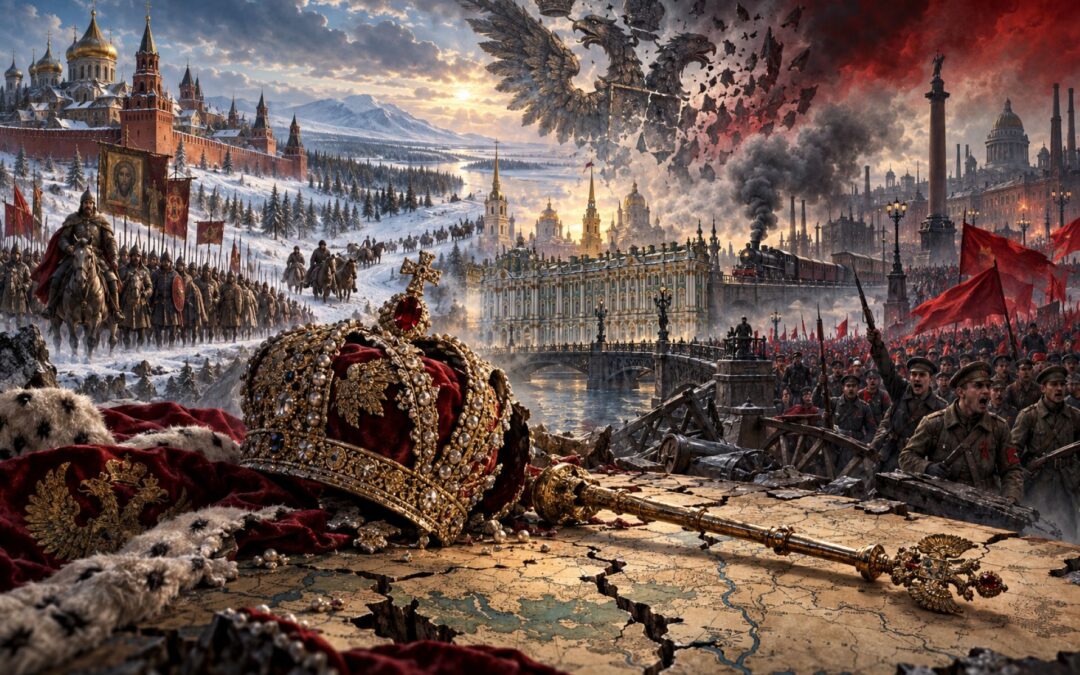
On March 15, 1917, Tsar Nicholas II abdicated the Russian throne, ending more than three centuries of Romanov rule. His decision came amid strikes, military mutinies, food shortages, and political unrest that had overwhelmed the imperial government. Within days, an institution that had appeared to embody the permanence of Russian power had lost the support of the soldiers, officials, and political leaders on whom its survival depended.
The collapse was extraordinary because the Russian Empire was one of the largest and most powerful states in history. At its greatest extent, it controlled approximately 22.8 million square kilometres, stretching from Eastern Europe across Siberia to the Pacific Ocean. Its armies had defeated Napoleon, its rulers had dominated much of Eastern European politics, and its expansion had brought dozens of peoples and territories under the authority of a single monarchy.
Yet the Russian Empire was never as politically secure as its enormous size suggested. Its rulers depended on a system of centralized authority, landowning privilege, peasant obligations, military power, and political repression. Successive tsars attempted to strengthen the country through conquest, administrative reforms, Western technology, and industrialization, but many resisted changes that might limit their personal authority.
The Russian Empire’s history is therefore more than the story of how a small principality became an immense state. It is also the story of how a monarchy developed extraordinary resources and military strength while struggling to adapt its institutions to the society it governed. Understanding that contradiction helps explain both the empire’s remarkable endurance and its eventual collapse.
From Mongol Rule to the Tsardom of Moscow (1237–1598)
The origins of Russian imperial power lie in the political world of medieval Eastern Europe, long before the creation of a unified Russian state. From the ninth century onward, networks of principalities and trading communities developed along the rivers connecting the Baltic and Black Seas. These territories, conventionally associated with Kyivan Rus’, maintained commercial and cultural relationships with Scandinavia, the Byzantine Empire, and the Islamic world.
Kyivan Rus’ was not simply an early version of modern Russia. Its historical legacy belongs to the shared medieval inheritance of present-day Ukraine, Belarus, and Russia, whose later states emerged through different political experiences. Nevertheless, its religious traditions, dynastic relationships, commercial routes, and political institutions influenced the development of the Russian principalities that followed.
One of the most consequential developments was the adoption of Byzantine Christianity under Prince Vladimir in 988. Eastern Orthodox Christianity became an important source of religious identity and political legitimacy, connecting the Rus’ lands to Constantinople. Over subsequent centuries, these connections helped shape the institutions and traditions through which Russian rulers understood their authority.
By the twelfth century, the political unity of Kyivan Rus’ had fragmented. Rival dynasties governed competing principalities, and no single ruler exercised effective authority across the region. This fragmentation left the territories vulnerable when Mongol armies advanced into Eastern Europe during the thirteenth century.
Between 1237 and 1240, Mongol forces under Batu Khan devastated numerous Rus’ principalities, capturing major settlements and destroying Kyiv in 1240. Much of the region subsequently came under the supremacy of the Golden Horde, a Mongol successor state that dominated extensive territories across the Eurasian steppe.
Mongol rule did not operate identically everywhere. Some areas suffered direct military destruction, while others retained local rulers who governed under the authority of the khans. These princes collected tribute, maintained political relationships with the Golden Horde, and competed for recognition and privileges.
The principality of Moscow gradually became particularly successful within this political system. Its rulers secured advantageous relationships with the Mongol authorities while strengthening their position against neighbouring principalities. They expanded their influence through marriages, negotiations, territorial purchases, warfare, and the acquisition of administrative and financial resources.
Moscow also benefited from its position within a network of rivers and commercial routes. Its growing wealth supported military organization and political consolidation, enabling its princes to challenge rival centres of power. Over time, a state that had once been subordinate to Mongol authority began developing the resources necessary to assert greater independence.
In 1380, Grand Prince Dmitry Donskoy led Russian forces to victory over an army commanded by Mamai at the Battle of Kulikovo. The battle became an important symbol of resistance to Mongol domination, although it did not immediately end the Golden Horde’s supremacy. Moscow’s growing political influence was the product of a longer process rather than a single decisive victory.
The most significant consolidation occurred under Ivan III, who ruled from 1462 to 1505. He annexed Novgorod in 1478 and Tver in 1485, absorbing territories, economic resources, and political rivals into the expanding Muscovite state. The absorption of Novgorod was especially important because of its commercial networks and extensive lands in northern Russia.
In 1480, the confrontation between Ivan III and the forces of the Golden Horde along the Ugra River became associated with the end of Moscow’s formal subordination to Mongol power. Although independence had developed gradually, Ivan’s reign established Moscow as the dominant political centre across much of northeastern Rus’.
Ivan also strengthened the ideological foundations of Muscovite authority. Following the Ottoman conquest of Constantinople in 1453, Moscow increasingly presented itself as an important independent centre of Orthodox Christianity. Ivan’s marriage to Sophia Palaiologina, a member of the former Byzantine imperial dynasty, reinforced these associations, while the adoption of the double-headed eagle provided a symbol of imperial legitimacy.
These claims did not make Moscow a direct institutional successor to the Byzantine Empire, but they strengthened the monarchy’s conception of its religious and political importance. Ivan III also undertook major construction at the Moscow Kremlin, transforming it into an imposing centre of government, religion, and military authority.
His successors continued consolidating neighbouring territories, but the next major transformation occurred under Ivan IV, better known as Ivan the Terrible.
In January 1547, Ivan IV was crowned Tsar of All Russia. The title, derived from Caesar, expressed claims to a higher form of sovereign authority than the earlier designation of Grand Prince of Moscow. Russia had not yet become the formally proclaimed empire of the eighteenth century, but its rulers were increasingly adopting imperial ambitions and methods.
Ivan’s most successful campaigns extended Muscovite power along the Volga River. The capture of Kazan in 1552 and Astrakhan in 1556 defeated two important khanates that had emerged from the fragmentation of the Golden Horde. These conquests gave Moscow greater access to the Caspian region and brought substantial Muslim and Turkic populations under the tsar’s authority.
The territorial expansion was accompanied by increasingly coercive domestic policies. In 1558, Ivan invaded Livonia, hoping to improve Russia’s access to Baltic trade routes. The resulting Livonian War became a prolonged and destructive conflict that eventually ended without achieving his principal ambitions.
As the war continued, Ivan became increasingly suspicious of powerful nobles, known as boyars, whom he feared might challenge his authority. In 1565, he established the Oprichnina, separating selected territories into a domain governed through his personal authority. His agents, the Oprichniki, conducted confiscations, executions, and campaigns of terror against people accused of disloyalty.
The devastation reached an extreme during the assault on Novgorod in 1570, when Ivan’s forces carried out widespread killings and destruction. Rather than producing an efficient and secure government, the Oprichnina disrupted agriculture, damaged commercial activity, undermined sections of the nobility, and spread fear throughout the population.
Peasants faced additional burdens from warfare, taxation, and insecurity. Many attempted to escape by moving away from established agricultural regions, contributing to growing efforts by landlords and the state to restrict their mobility. The development of Russian serfdom was gradual, but the pressures of this period helped strengthen the system of control that later rulers would formalize.
Meanwhile, expansion continued beyond the Ural Mountains. In the early 1580s, the Cossack commander Yermak Timofeyevich, supported by the wealthy Stroganov merchant family, led an expedition against the Khanate of Sibir. His victories helped establish the beginnings of sustained Russian expansion into western Siberia, although effective control required further campaigns and settlement.
The enormous commercial value of Siberian furs encouraged subsequent expeditions, while the Russian state gradually established fortified settlements and systems of tribute collection. This expansion was neither peaceful nor a journey into unoccupied wilderness. Indigenous communities traded, negotiated, resisted, and experienced profound disruption as Russian authority advanced.
Over the following century, these processes would form the basis of Russia’s expansion across Siberia and the creation of its enormous territorial footprint.
By Ivan IV’s death in 1584, Muscovy had become a substantially larger and more centralized state, but its internal stability was far from secure. His son Fyodor inherited the throne, while Boris Godunov became the dominant political figure at court. When Fyodor died without an heir in 1598, the Rurik dynasty’s long association with Russian rulership came to an end.
The resulting succession crisis exposed the fragility of a political system whose legitimacy depended so heavily on dynastic authority.
The Time of Troubles and the Romanov Settlement (1598–1682)
The death of Fyodor I plunged Russia into one of the most destructive political crises in its history. Without an undisputed hereditary successor, rival claimants competed for the throne, powerful families struggled for influence, and external powers intervened in Russian affairs.
Boris Godunov, who had exercised considerable influence during Fyodor’s reign, became tsar in 1598. His position was nevertheless vulnerable because his claim to the throne lacked the hereditary legitimacy traditionally associated with the Rurik dynasty. When severe harvest failures produced widespread famine between 1601 and 1603, popular suffering intensified dissatisfaction with his government.
The crisis deepened when rival claimants appeared, including men presenting themselves as Dmitry, a son of Ivan IV who had died as a child. These pretenders attracted support from groups dissatisfied with the ruling authorities, while Polish nobles and other foreign interests became involved in the struggle. After Boris died in 1605, the succession crisis became increasingly violent and unpredictable.
Russia experienced competing rulers, peasant revolts, military conflicts, and foreign intervention. Polish forces eventually occupied Moscow, while Sweden intervened in the northwest. The breakdown of central authority exposed the country to devastation at precisely the moment when its rulers had spent generations trying to construct a stronger and more unified state.
This period became known as the Time of Troubles. It demonstrated that territorial expansion and centralized political authority did not guarantee stability when the institutions of succession and government collapsed.
The crisis gradually subsided through a combination of military resistance, political negotiation, and exhaustion. In 1612, forces associated with Kuzma Minin and Prince Dmitry Pozharsky helped expel the Polish garrison from Moscow. The following year, an assembly known as the Zemsky Sobor selected the sixteen-year-old Michael Romanov as tsar.
Michael’s accession in 1613 established the dynasty that would rule Russia until 1917. His selection did not immediately resolve the country’s problems, but it provided a new source of dynastic legitimacy around which political institutions could be rebuilt.
The early Romanovs faced the difficult task of restoring administrative authority, collecting revenue, reconstructing military capacity, and rebuilding relationships with influential landowners. Their government remained dependent on cooperation with the nobility, whose military service and local influence were important to the monarchy.
Over time, this relationship encouraged the further consolidation of peasant obligations. Landowners sought reliable access to agricultural labour, while the state needed predictable taxation and military recruitment. Restricting the movement of peasants helped protect the economic arrangements supporting both the noble elite and the monarchy.
The decisive legal development occurred in 1649, during the reign of Michael’s son, Tsar Alexis. A comprehensive law code, commonly called the Sobornoye Ulozheniye, strengthened the hereditary character of serfdom and removed the time limits that had previously constrained efforts to recover runaway peasants.
Millions of peasants consequently became legally tied to estates and subjected to obligations controlled by landlords. The system did not make every Russian peasant a privately owned serf, since different categories of peasants existed, but it dramatically strengthened the position of landlords over a substantial portion of the agricultural population.
Serfdom was not merely an outdated social custom that survived because rulers were indifferent to reform. It formed part of the economic and administrative arrangements through which the monarchy sustained itself. The state relied on agricultural production, taxation, military recruits, and the service of nobles whose privileges depended partly on controlling peasant labour.
Historian David Moon’s examination of Russian peasants and agriculture helps explain how the empire’s agricultural population supplied resources essential to its development as a military power. The same arrangements imposed severe costs on rural society and complicated later attempts at modernization.
The Romanovs also renewed territorial ambitions. In 1648, a major Cossack uprising led by Bohdan Khmelnytsky began against the Polish-Lithuanian Commonwealth. The revolt emerged from complex religious, social, military, and political tensions within the Commonwealth’s Ukrainian territories.
In 1654, Khmelnytsky and representatives of the Cossack Hetmanate entered into an agreement with the Russian tsar at Pereiaslav. The nature and implications of this arrangement remain historically contested, and it should not be treated as a straightforward, universally accepted transfer of all Ukrainian lands to Russia.
The agreement nevertheless drew Muscovy into a prolonged war with the Polish-Lithuanian Commonwealth. Under the Truce of Andrusovo in 1667, Russia obtained important territories, including Smolensk and lands east of the Dnieper, while Kyiv was placed under Russian control through arrangements later confirmed in a permanent settlement.
The Hetmanate initially retained significant institutions and traditions of self-government, although Russian authorities gradually restricted its autonomy over subsequent decades. These developments substantially expanded Moscow’s political influence while creating new tensions over sovereignty, local privileges, and imperial control.
Religion presented another challenge to the government’s authority. During the 1650s, Patriarch Nikon introduced reforms intended to bring Russian Orthodox rituals and liturgical practices into closer conformity with contemporary Greek Orthodox usage. The changes produced fierce opposition among believers who regarded traditional Russian practices as sacred.
The resulting schism gave rise to the Old Believers, many of whom rejected the reforms and suffered persecution. The controversy showed how deeply religious practices were embedded in Russian society and how difficult it could be for rulers and church authorities to impose uniformity.
By the end of the seventeenth century, the Romanovs had restored the monarchy, strengthened administrative centralization, extended territorial influence, and reinforced the social hierarchy underpinning their power. Yet Russia remained constrained by its dependence on agricultural resources and by limited access to important European maritime trading routes.
These weaknesses would become the focus of the most ambitious reforming ruler in Russian imperial history.
Peter the Great Turns Tsardom into Empire (1682–1725)
When Peter I emerged as Russia’s dominant ruler at the end of the seventeenth century, he inherited a vast state with substantial military resources but important institutional limitations. Its armies could mobilize large numbers of men, yet military organization and equipment were uneven. Its economy maintained commercial relationships with neighbouring regions, but its integration with Western European maritime trade remained restricted.
Peter believed that Russia needed stronger military institutions, improved technology, more effective administration, and greater access to European commerce if it was to compete with the continent’s leading powers.
He became tsar in 1682 while still a child, initially sharing the throne with his half-brother Ivan V under political arrangements shaped by family rivalry and the regency of their sister Sophia. Peter gradually consolidated his authority and, following Ivan’s death in 1696, ruled without a co-tsar.
His early military experiences convinced him of the importance of naval power and technical expertise. Russia had limited access to ports capable of supporting the sustained development of an ocean-going navy. The northern port of Arkhangelsk connected the country with European commerce, but its remoteness and seasonal ice conditions imposed difficulties.
Peter first pursued maritime opportunities against the Ottoman Empire, capturing Azov in 1696 after an unsuccessful earlier attempt. He subsequently undertook an extensive journey through Western Europe, known as the Grand Embassy, during which he studied shipbuilding, military technology, and administrative practices.
During his travels, Peter worked in Dutch shipyards and visited England, where he encountered important centres of naval construction and manufacturing. He also recruited foreign specialists and developed relationships intended to support Russian modernization.
Peter’s Western interests extended far beyond ships. He wanted to reshape the institutions and behaviour of Russia’s ruling elite, believing that traditional customs and administrative practices obstructed the development of a modern military state.
His most visible cultural reforms included encouraging European clothing and regulating the wearing of traditional beards, particularly among nobles and officials. These measures became famous because they seemed to symbolize Russia’s transformation from a relatively isolated eastern monarchy into a participant in European cultural life.
Yet the more consequential changes concerned government, taxation, manufacturing, and military service.
Peter reorganized the army, developed a permanent navy, expanded military production, and strengthened the state’s ability to mobilize resources. His reforms increased the importance of trained officers, technical expertise, and administrative institutions capable of supporting prolonged warfare.
The Table of Ranks, introduced in 1722, established a formal hierarchy of service positions in military, civil, and court administration. Although noble privilege remained important, the measure attempted to organize elite status around service to the state rather than hereditary position alone.
Peter also reorganized central government through new administrative colleges and strengthened institutions intended to supervise provincial administration. These reforms aimed to improve the state’s capacity to collect revenue, enforce policy, and support military expansion.
Such modernization was expensive. New taxes, military recruitment, compulsory labour, and state-directed economic policies placed heavy burdens on the population. Peter’s reforms were not a liberal attempt to reduce monarchical power; they were largely designed to make that power more effective.
His greatest strategic objective was to secure dependable access to the Baltic Sea, where Sweden controlled important territories and commercial routes.
In 1700, Russia entered the Great Northern War as part of an alliance challenging Swedish dominance. The campaign began disastrously when Swedish forces under Charles XII defeated the Russian army at Narva. Peter used the setback to accelerate military reorganization and improve his army’s capacity to fight a modern European war.
Over the following years, Russian forces gradually achieved success. In 1703, Peter established St Petersburg on territory captured near the mouth of the Neva River. The city was intended to provide a strategic port and symbolize Russia’s new relationship with European commerce, diplomacy, and culture.
Building St Petersburg required enormous resources and labour. Thousands of workers were mobilized, and harsh conditions made construction costly in human terms. The city embodied both Peter’s ambitions and the coercive methods through which he pursued them.
The decisive military turning point came in 1709, when Russian forces defeated Charles XII’s army at the Battle of Poltava. The victory significantly weakened Sweden’s position and demonstrated Russia’s growing military capabilities.
The war continued until 1721, when the Treaty of Nystad confirmed major Russian territorial acquisitions along the eastern Baltic. Russia emerged as one of Europe’s leading military powers, with St Petersburg serving as its new capital since 1712.
Following the victory, Peter adopted the title of Emperor, and Russia was formally proclaimed an empire in 1721. The change recognized a political transformation that had developed over generations but had now acquired a new international and institutional form.
Peter also reorganized the relationship between church and state. After the death of Patriarch Adrian in 1700, he prevented the appointment of a new patriarch and eventually replaced the patriarchal system with the Holy Synod in 1721.
The change brought Orthodox Church administration more directly under imperial supervision. As examined in Chris Chulos’s study of Russian religious culture and the relationship between church and state, Peter’s reforms formed part of a wider transformation in the relationship between religious institutions and autocratic authority.
The emperor’s personal relationships also revealed the tensions within his vision of rulership. His son Alexei opposed aspects of his father’s policies and became the focus of an increasingly bitter political conflict. Accused of treason, Alexei died in custody in 1718 after interrogation and torture.
Peter’s determination to establish a stronger state therefore extended into the imperial household itself. Political loyalty, military service, and obedience to the monarch were treated as essential foundations of government.
When Peter died in 1725, he left behind a transformed country. Russia possessed a stronger army and navy, improved access to European trade, more elaborate institutions of government, and a recognized position among the continent’s great powers.
Yet his reforms had not resolved the problem of how imperial authority should be limited or transferred. Peter had altered the succession arrangements but failed to designate a clear heir, leaving the monarchy vulnerable to renewed palace intrigue.
His greatest achievement was to strengthen the Russian state without fundamentally changing the autocratic principle on which it rested. That distinction would shape the empire’s subsequent development.
Catherine the Great and the Costs of Expansion (1725–1796)
Peter the Great’s death initiated a period of political instability during which successive rulers struggled to secure and retain the throne. Court factions, influential noble families, and elite military units played central roles in determining who governed Russia.
Over the following decades, emperors and empresses rose and fell through complicated succession disputes and palace coups. The political instability revealed the continuing weakness of imperial succession arrangements, even as the institutions created under Peter remained important to the functioning of the state.
Russia nevertheless continued participating in European conflicts, including the Seven Years’ War of 1756–1763, during which its armies demonstrated their military capabilities against Prussia. Imperial power did not disappear simply because its rulers changed frequently.
The next decisive transformation occurred in 1762, when Catherine, the German-born wife of Emperor Peter III, participated in a coup that removed her husband from power. Peter III was subsequently killed, and Catherine became Empress Catherine II, later remembered as Catherine the Great.
Catherine cultivated an image of enlightened monarchy. She corresponded with prominent European intellectuals, supported cultural and educational initiatives, and demonstrated interest in legal reform. Her intellectual ambitions reflected the wider European Enlightenment, with its debates over reason, government, law, and social progress.
However, Catherine ruled an empire whose political institutions depended on hereditary monarchy and powerful landowning elites. Her intellectual interests did not lead her to establish constitutional limits on her own authority or dismantle the social arrangements sustaining the nobility.
She initially explored legal reform through the Legislative Commission of 1767 and the instructions she prepared for it, commonly called the Nakaz. The project demonstrated her interest in rationalizing government, but it failed to produce the comprehensive new legal code originally envisaged.
Military expansion became one of the defining achievements of her reign.
Russia had long sought greater influence around the Black Sea, where the Ottoman Empire and its dependent territories limited Russian strategic access. Catherine’s government pursued this objective through war, diplomacy, territorial annexation, and settlement.
The Russo-Turkish War of 1768–1774 ended with the Treaty of Küçük Kaynarca, which greatly increased Russian influence in the Black Sea region and weakened Ottoman control over the Crimean Khanate. Crimea’s formal independence from Ottoman authority proved temporary, and Catherine annexed the peninsula in 1783.
The annexation was a major geopolitical development because Crimea provided strategically important positions for naval operations and control of the northern Black Sea coastline. Russia also developed Sevastopol as a major naval base, reinforcing its ability to project maritime power.
A further Russo-Turkish conflict between 1787 and 1792 strengthened Russian territorial gains and confirmed important changes in the regional balance of power. These campaigns formed part of the longer struggle between the two monarchies, explored more extensively in the history of the Ottoman Empire and its rivalry with Russia.
Catherine also participated in one of the most consequential territorial reorganizations of eighteenth-century Europe.
The Polish-Lithuanian Commonwealth had once been one of the continent’s largest political states, but internal institutional problems and sustained interference by neighbouring powers weakened its independence. Russia, Prussia, and Austria exploited the Commonwealth’s difficulties through three successive partitions in 1772, 1793, and 1795.
The final partition eliminated the Commonwealth as an independent state. Russia acquired enormous territories and populations, significantly extending imperial control over lands that are now parts of several Eastern European countries.
For the inhabitants of these territories, the partitions represented more than an adjustment of borders. They meant the destruction of existing political institutions and the imposition of foreign sovereignty. The consequences for national identity, political resistance, and regional relationships became central themes in the history of Poland and its struggle to recover independence.
Russia’s expanding empire was increasingly multinational. Orthodox Russians lived alongside Catholic Poles, Jews, Muslims, and numerous other communities whose languages, customs, institutions, and political loyalties differed substantially. Imperial authorities managed this diversity through combinations of negotiation, local privilege, administrative control, religious policy, and coercion.
Jewish populations incorporated through the partitions became subject to imperial restrictions that would develop into the Pale of Settlement, limiting where most Jews could reside. Such policies demonstrated that incorporating territory did not imply equal membership within the empire.
Catherine’s domestic policies also exposed the limits of her enlightened reputation.
In 1773, a major uprising began under Yemelyan Pugachev, a Cossack leader who claimed to be the deposed Peter III. The rebellion attracted Cossacks, peasants, industrial workers, and various communities dissatisfied with imperial policies.
The rebels challenged landlords, government officials, and established social hierarchies across significant portions of the Volga and Ural regions. Their demands and motivations varied, but the uprising revealed profound tensions within the imperial social order.
Government forces eventually defeated the rebellion, and Pugachev was executed in 1775. Catherine responded by strengthening administrative control and reinforcing the monarchy’s relationships with the nobility.
The Charter to the Nobility of 1785 confirmed important privileges for the landowning elite. Rather than dismantling serfdom, Catherine’s government preserved and in some respects strengthened the social arrangements that supported noble authority.
The outbreak of the French Revolution in 1789 further influenced Catherine’s political outlook. The overthrow of established authority in France alarmed European monarchies, including Russia, and contributed to increasingly restrictive attitudes toward political dissent.
Meanwhile, Russian expansion continued beyond Eurasia. Expeditions across the North Pacific had developed during the eighteenth century, including Vitus Bering’s exploration of the Alaskan coastline in 1741. Russian merchants and adventurers pursued valuable fur-bearing animals, while the first permanent Russian settlement in Alaska was established at Three Saints Bay in 1784.
Russian America became an extension of the empire’s commercial ambitions, although settlement remained limited and Indigenous communities experienced coercive trade relationships, disease, violence, and disruption. The enormous distance from Russia’s principal population centres also created persistent logistical difficulties.
By Catherine’s death in 1796, Russia had become one of the most formidable powers in Europe. Its influence reached across the Baltic, Black Sea, and eastern European regions, while its settlements and claims extended deep into northern Asia and across the Pacific.
The empire’s expansion, however, had not created a politically uniform or socially equal state. Its rulers governed an increasingly diverse population through institutions that protected the monarchy and privileged elites. Military success had strengthened Russia’s international position without resolving the tensions developing within its own society.
Napoleon, the Decembrists, and the Limits of Autocratic Power (1796–1856)
Catherine was succeeded by her son Paul I, whose reign was characterized by strained relations with sections of the nobility and abrupt changes in imperial policy. Paul involved Russia in the European struggles against revolutionary France, but disagreements over foreign policy and dissatisfaction among influential elites contributed to a conspiracy against him.
In March 1801, Paul was overthrown and murdered in a palace coup. His son Alexander I inherited the throne under circumstances that highlighted the vulnerability of rulers whose authority depended on the loyalty of powerful court and military groups.
Alexander entered a European political environment increasingly dominated by Napoleon Bonaparte. France’s revolutionary and military expansion had transformed the continent, threatening established monarchies and forcing Russia to reconsider its position within the European balance of power.
Russia participated in coalitions opposing Napoleon, but military defeats at Austerlitz in 1805 and Friedland in 1807 forced Alexander to negotiate. The resulting Treaties of Tilsit established a temporary settlement between the two emperors and brought Russia into Napoleon’s Continental System, which attempted to exclude British trade from European markets.
The relationship brought limited strategic opportunities, including Russia’s acquisition of Finland following its war with Sweden in 1808–1809. However, the restrictions on British commerce damaged important Russian economic interests and contributed to growing tensions between the two empires.
Alexander gradually moved away from strict enforcement of the Continental System, while disputes over trade, political influence, and European territories intensified. In June 1812, Napoleon invaded Russia with the Grande Armée, a multinational force assembled from across his European empire.
The invasion presented one of the greatest military threats Russia had faced for centuries.
Russian forces initially withdrew rather than risk the destruction of their principal armies in a decisive battle. Their retreat forced Napoleon to advance across enormous distances, increasing the difficulties of maintaining supplies, replacing losses, and controlling territory.
The Russian strategy was not a perfectly coordinated plan from the beginning, and political leaders disagreed over how to resist the invasion. Nevertheless, the retreat deprived Napoleon of the rapid victory he needed and gradually exposed his army to severe logistical problems.
In September, Russian forces under Mikhail Kutuzov fought Napoleon at the Battle of Borodino. The engagement caused enormous casualties without producing the decisive political result Napoleon sought. Russian troops subsequently withdrew, allowing the French to occupy Moscow.
Napoleon expected Alexander to negotiate, but the Russian emperor refused. Large portions of Moscow had been destroyed by fire, and the French army lacked the resources and political leverage necessary to sustain its occupation indefinitely.
Napoleon began withdrawing in October. His retreat became catastrophic as Russian forces attacked isolated units, supplies deteriorated, disease and exhaustion spread, and winter conditions intensified the suffering of an already weakened army.
The failure of the invasion severely damaged Napoleon’s power and contributed to the formation of new coalitions against France. The Russian campaign was a major turning point in the Napoleonic Wars and the eventual defeat of Napoleon’s European empire.
Russian armies subsequently advanced westward with their allies, eventually participating in the campaigns that brought Napoleon’s first empire to an end. At the Congress of Vienna in 1814–1815, Russia emerged as one of the principal powers shaping the postwar European settlement.
Alexander gained substantial influence over Polish territories through the establishment of the Congress Kingdom of Poland, which was linked to the Russian monarchy. Russia’s international prestige reached extraordinary heights, and its ruler became a central participant in European diplomacy.
Yet the victory also exposed Russian officers and intellectuals to political ideas and institutions that differed from those governing their own country.
Officers who had travelled through Europe encountered societies where constitutional arrangements, legal institutions, and public debate offered alternatives to unrestricted monarchy. Not all became liberals or revolutionaries, but some began questioning why Russia continued to rely on serfdom and autocratic rule.
When Alexander died unexpectedly in 1825, uncertainty over the succession created an opportunity for reform-minded officers to act. In December, members of secret societies organized an uprising in St Petersburg, demanding political changes that included constitutional restrictions and, among some participants, the abolition of serfdom.
The Decembrist Revolt was poorly coordinated and lacked broad popular support. The new emperor, Nicholas I, suppressed it, executed several leaders, and sent others into exile.
Although the uprising failed, its significance extended beyond the immediate confrontation. It demonstrated that opposition to unlimited autocracy had emerged within sections of the educated and military elite, including people whose families had traditionally served the monarchy.
Nicholas I responded by strengthening political supervision and emphasizing the principles of Orthodoxy, Autocracy, and Nationality. The doctrine presented religious tradition, loyalty to the emperor, and a particular conception of Russian national identity as foundations of political stability.
The government expanded surveillance, restricted political expression, and sought to prevent revolutionary ideas from destabilizing the state. Nicholas believed that maintaining firm authority was essential to defending Russia against the upheavals that had transformed other European countries.
Meanwhile, the empire continued expanding and competing with neighbouring powers. Russian victories against Persia and the Ottoman Empire during the late 1820s strengthened its position in the Caucasus, although the conquest of the mountainous regions involved prolonged resistance from local communities.
In the northern Caucasus, movements led by figures such as Imam Shamil organized sustained opposition to Russian military campaigns. Imperial expansion frequently required decades of warfare, administrative intervention, and coercive settlement policies rather than simple victories over established governments.
Russia also sought greater influence around the Black Sea and the waterways connecting it to the Mediterranean. These ambitions alarmed other European powers, particularly Britain and France, which feared that Russian dominance might weaken the Ottoman Empire and disrupt the balance of power.
Tensions escalated in 1853, leading to the Crimean War. Britain and France joined the Ottoman Empire against Russia in 1854, turning a regional confrontation into a major European conflict.
The war exposed serious limitations in Russian military organization, transportation, equipment, and administration. Despite its enormous army and territorial resources, Russia struggled against opponents capable of supporting technologically demanding military operations through more developed supply networks.
The prolonged siege of Sevastopol culminated in the fall of the city’s principal southern defenses in 1855. Nicholas I had died earlier that year, leaving his son Alexander II to negotiate an end to the war.
The Treaty of Paris in 1856 imposed restrictions on Russia’s Black Sea military position and damaged its international prestige. More importantly, the defeat convinced influential officials that the empire could not maintain great-power status indefinitely without substantial reform.
Russia had defeated Napoleon and exercised enormous influence over European politics, yet it had proved unable to overcome weaknesses in institutions that had changed far less than those of some of its principal competitors.
The monarchy now faced a difficult question: could it modernize the state without undermining the social and political order on which autocratic power depended?
Alexander II Tries to Reform an Empire (1856–1881)
Alexander II inherited a powerful but troubled empire. Its military defeat had exposed administrative weaknesses, its agricultural economy depended heavily on coercive labour arrangements, and its political institutions struggled to respond to changing economic and social conditions.
The emperor concluded that reform was necessary to preserve Russia’s strength. His objective was not to replace monarchy with democracy, but to modernize institutions that had become increasingly difficult to defend.
The most consequential challenge was serfdom.
By the middle of the nineteenth century, millions of Russian peasants remained legally bound to estates controlled by landlords. Their status imposed obligations affecting labour, movement, property, and personal independence. The system supported sections of the nobility, but it also contributed to rural poverty, social tension, and difficulties in agricultural and economic development.
Serfdom created problems for the state itself. An economy organized around compulsory obligations and landlord privilege was poorly suited to the increasing demands of industrial production, military modernization, and more flexible labour markets.
Alexander believed that the continued existence of serfdom threatened the stability of the empire. He warned landowners that emancipation from above would be preferable to allowing the system to be destroyed through rebellion from below.
In 1861, he issued the Emancipation Manifesto, liberating approximately 23 million privately owned serfs from their previous legal status.
The measure was one of the largest social reforms in nineteenth-century Europe. It transformed the legal relationship between peasants and landlords, allowing former serfs to acquire personal freedoms that had previously been restricted.
However, emancipation did not automatically give every peasant economic independence.
The land settlement involved complicated arrangements concerning property rights, compensation to landlords, and financial obligations imposed on peasant communities. Many former serfs received land allotments that were insufficient for their needs or faced continuing redemption payments and communal obligations.
The government attempted to balance the interests of landowners, peasants, and the state. These compromises helped secure the reform politically, but they also preserved significant inequalities.
Peasants who had expected substantial economic improvement often remained burdened by poverty and limited opportunities. Landowners, meanwhile, faced changes to the labour arrangements and economic relationships that had supported their estates.
The abolition of serfdom was therefore transformative without being a complete solution to Russia’s rural problems.
Alexander pursued a wider reform agenda intended to strengthen the state. Judicial reforms introduced new courts, legal procedures, and a greater degree of professional independence within the justice system. Local government reforms established elected bodies known as zemstvos, which became involved in infrastructure, education, healthcare, and other administrative responsibilities.
Military reforms attempted to modernize organization, training, recruitment, and service obligations. Educational changes expanded opportunities within universities and other institutions, while administrative measures sought to make government more effective.
As Larisa Zakharova’s examination of Alexander II’s reign and the Great Reforms emphasizes, the period represented an important transformation in the relationship between Russian institutions and society.
These reforms changed the empire substantially, but they did not establish constitutional government. Ultimate political authority remained concentrated in the emperor, and the monarchy continued to resist demands for a representative national legislature with meaningful control over government.
The reforms also created new expectations. Educated professionals, local officials, intellectuals, and sections of the public became more involved in discussions about administration and public affairs. For some, the changes demonstrated that Russia could reform; for others, they highlighted how much remained unchanged.
Conservatives feared that reform would undermine political order and traditional authority. Liberals argued for constitutional limits and greater representation. Radical movements questioned whether gradual change could address the deeper inequalities of Russian society.
While these domestic debates intensified, territorial expansion continued.
During the nineteenth century, Russian forces extended imperial authority across Central Asia. The conquest involved existing states, political communities, and populations with their own institutions and systems of government, rather than territories simply awaiting incorporation.
Russian troops captured Tashkent in 1865, and the subsequent establishment of administrative institutions strengthened imperial control in the region. Campaigns against Bukhara, Khiva, and Kokand produced different political outcomes.
Bukhara and Khiva became Russian protectorates, retaining local rulers while losing substantial independence in foreign and strategic affairs. Kokand was ultimately annexed in 1876, becoming part of the empire’s directly administered territory.
These advances brought Russia into increasing competition with Britain, whose imperial government feared potential threats to British India. Their rivalry, commonly known as the Great Game, involved diplomatic negotiations, military pressure, intelligence gathering, and competing influence over states such as Afghanistan and Persia.
Russian expansion was not a simple contest between two European empires. The decisions and resistance of local rulers and communities shaped events throughout the region, while conquest and colonial administration imposed significant costs on subjected populations.
Alexander’s reign also witnessed an unusual departure from the empire’s general pattern of territorial acquisition.
In 1867, Russia sold Alaska to the United States for $7.2 million.
The Russian government had maintained commercial interests and settlements in North America, but Alaska’s distance from the imperial centre created substantial logistical and military difficulties. The fur trade faced commercial limitations, and Russian officials worried about defending the territory against potential British pressure.
The sale was therefore a strategic and economic decision rather than simply an irrational surrender of valuable land. The U.S. Office of the Historian’s account of the Alaska Purchase identifies Russia’s limited capacity to support its North American possessions and its rivalry with Britain as important considerations.
The discovery of valuable resources in Alaska during subsequent decades transformed perceptions of the transaction, but those later developments should not be projected backward as though Russian officials possessed certain knowledge of the territory’s future economic value.
At home, the political consequences of Alexander’s reforms became increasingly difficult to control.
Groups within the Russian intelligentsia developed competing visions for the country’s future. Some favored liberal reform, while others advocated socialism, agrarian revolution, or more radical transformations of the state.
Revolutionary organizations increasingly challenged the monarchy. The People’s Will, a radical group that believed political assassination could help destroy autocratic government, organized attempts to kill Alexander.
On March 13, 1881, members of the organization attacked the emperor in St Petersburg with bombs, fatally wounding him.
The assassination demonstrated the depth of hostility that had developed toward the monarchy, but it did not prove that reform itself had been futile. Alexander had pursued substantial changes while maintaining the central principle of autocratic authority, leaving competing political movements dissatisfied for different reasons.
His successor drew a very different conclusion. Rather than accelerating political reform, Alexander III came to believe that his father’s concessions had encouraged revolutionary violence and weakened the state.
The result was a renewed commitment to autocracy at precisely the moment when Russian society was becoming more politically and economically complex.
Industrial Growth, Repression, and the Revolution of 1905 (1881–1914)
Alexander III inherited the throne in 1881 convinced that Russia’s stability required firm monarchical authority. He regarded constitutional demands and revolutionary movements as threats to the state and believed that political concessions could encourage further opposition.
His government restricted selected reforms introduced under Alexander II, strengthened censorship, expanded surveillance, and increased political controls. Local government institutions and courts continued to operate, but their independence and opportunities for public participation were constrained.
The authorities used police institutions to monitor suspected opponents, suppress revolutionary organizations, and restrict political activity. The Okhrana, the imperial political security apparatus, became associated with surveillance, informants, and efforts to disrupt opposition movements.
Alexander also pursued policies intended to strengthen Russian political and cultural dominance within the empire. These efforts, commonly described as Russification, included measures affecting language, education, administration, and religious life.
The empire’s population was extraordinarily diverse, containing communities whose political traditions, languages, and religions differed significantly. Policies toward these populations were not uniform and varied according to regional conditions and the government’s changing priorities.
As Theodore Weeks explains in his study of how the tsarist government managed the empire’s different nationalities, imperial policies involved complicated relationships between central authority, local elites, religious institutions, and different communities.
Nevertheless, many non-Russian populations experienced growing pressure to conform to official political and cultural expectations. In Poland and parts of the western empire, Russian-language policies and administrative controls became important sources of resentment.
Jewish communities faced especially severe discrimination. Restrictions on residence, education, and economic activity limited opportunities, while antisemitic pogroms subjected communities to violence and destruction.
The authorities did not respond to every outbreak of violence in the same way, and the extent of official involvement varied. However, the discriminatory legal environment and the failure to provide consistent protection contributed to insecurity and encouraged significant Jewish emigration.
Alexander III’s reign was nevertheless not characterized solely by repression.
Russia maintained relative peace in its major European relationships and strengthened its international position through diplomacy. The emerging alliance with France in the early 1890s was particularly important because both powers were concerned about the growing strength of Germany.
The alliance reflected the changing European balance of power and eventually became part of the diplomatic alignments that shaped the First World War.
The Russian economy also underwent substantial industrial development.
The government encouraged investment in railways, mining, steel production, manufacturing, and other industries. Foreign capital became increasingly important, while economic policies attempted to strengthen Russia’s capacity to compete with more industrialized European states.
Railway construction was particularly significant in a country where enormous distances complicated economic integration, military transportation, and administration.
In 1891, construction began on the Trans-Siberian Railway, an ambitious project intended to connect European Russia with territories stretching toward the Pacific Ocean. The railway eventually became one of the most remarkable transportation networks in the world, facilitating trade, settlement, military movement, and the administration of distant regions.
Industrial development accelerated during the reign of Alexander III and continued under Nicholas II, particularly through the economic policies associated with Sergei Witte. State-backed railway construction, industrial investment, and financial reforms helped expand Russia’s productive capacity.
Yet industrialization was uneven.
Much of Russia’s population remained dependent on agriculture, and rural poverty continued despite the abolition of serfdom. Industrial growth was concentrated in particular cities and regions, while vast areas of the empire experienced much slower economic change.
Factories also created new forms of social conflict. Workers frequently faced long hours, low wages, dangerous conditions, and overcrowded housing. The concentration of industrial labour in major urban centres made strikes, political organization, and collective protest increasingly possible.
These changes transformed the social environment in which the monarchy operated.
Peasants remained dissatisfied with landholding arrangements, workers demanded better economic conditions, liberal professionals sought political representation, and national movements challenged aspects of imperial authority. The government faced several kinds of opposition that did not necessarily share the same objectives.
Socialist ideas gained influence among sections of the working class and educated radicals. The writings of Karl Marx provided one framework for understanding industrial inequality and revolutionary change, although Russian socialists disagreed about how Marxist ideas applied to a country where agriculture remained so important.
The Russian Social Democratic Labour Party emerged as one organization attempting to build a socialist movement. Internal disagreements eventually contributed to the division between Bolsheviks and Mensheviks, associated with differing approaches to party organization, leadership, and revolutionary strategy.
Vladimir Lenin became a prominent figure within this emerging revolutionary movement, arguing that disciplined political organization was essential to achieving socialist transformation. Yet socialist revolutionaries were only one part of Russia’s opposition, and they did not control the wider protests that would soon challenge the monarchy.
When Alexander III died in 1894, his son Nicholas II inherited an empire undergoing profound economic and social changes.
Nicholas was personally committed to the principle of autocracy. He believed that preserving the monarchy’s authority was a responsibility inherited from his predecessors, but he lacked the political flexibility required to manage the increasingly complicated relationship between government and society.
His government faced pressures from industrial workers, peasants, reform-minded liberals, revolutionary parties, and minority populations. These groups disagreed about Russia’s future, but their demands exposed the limitations of a system that allowed little meaningful participation in national government.
The monarchy’s difficulties intensified through foreign policy.
At the beginning of the twentieth century, Russia expanded its strategic interests in East Asia, particularly in Manchuria and Korea. Its ambitions brought it into conflict with Japan, which was also seeking regional influence.
Russian authorities had acquired a lease over Port Arthur on the Liaodong Peninsula and developed military and railway facilities supporting their position in Manchuria. Russia subsequently occupied much of Manchuria during the international intervention surrounding the Boxer Rebellion in 1900.
Japan regarded Russian expansion as a threat to its own interests. Diplomatic negotiations failed to resolve the dispute, and in February 1904 Japanese forces attacked the Russian fleet at Port Arthur, beginning the Russo-Japanese War.
The conflict exposed serious Russian weaknesses in military leadership, transportation, coordination, and strategic planning. Although Russia possessed enormous resources, supplying and reinforcing forces across the vast distance to East Asia proved extremely difficult.
Japanese victories at Port Arthur, Mukden, and the naval Battle of Tsushima demonstrated the effectiveness of Japan’s military modernization. Russia’s defeat damaged the monarchy’s international prestige and intensified dissatisfaction within the empire.
By then, political unrest had already erupted at home.
On January 22, 1905, tens of thousands of workers and their families participated in a procession through St Petersburg. Led by the priest Georgy Gapon, the demonstrators intended to present a petition to Nicholas II calling for better working conditions, political reforms, and relief from economic hardship.
Many participants still regarded the tsar as a potential protector who might respond to their grievances. Their protest reflected both frustration with the government and the persistence of traditional expectations surrounding the monarchy.
Nicholas was not present at the Winter Palace, and troops had been deployed to prevent the crowds from approaching. Soldiers opened fire on demonstrators at several locations, killing and wounding large numbers of people.
The event became known as Bloody Sunday.
Its political impact was enormous because it undermined the image of the tsar as a benevolent ruler capable of protecting ordinary Russians from injustice. A demonstration seeking assistance from the monarchy had ended in bloodshed.
Strikes, peasant disturbances, military mutinies, and political protests subsequently spread across the empire. Different groups demanded different changes, but together they created a crisis that threatened the government’s ability to maintain control.
Workers established councils known as soviets to coordinate strikes and political activity. The St Petersburg Soviet became an influential institution during the upheaval, demonstrating the capacity of organized workers to create political structures outside the traditional machinery of government.
The monarchy attempted to divide its opponents through concessions.
In October 1905, Nicholas issued the October Manifesto, promising civil liberties and the creation of an elected legislative assembly, the State Duma. The announcement persuaded some constitutional reformers that meaningful political change might be possible, although more radical groups continued their opposition.
The concessions represented an important departure from the previous system of unrestricted monarchical government. However, Nicholas remained determined to preserve extensive imperial powers.
The Fundamental Laws of 1906 reaffirmed the emperor’s authority over important areas of government, while the Duma operated within constitutional arrangements that restricted its independence. The monarchy retained considerable influence over ministers, legislation, foreign policy, and military affairs.
In the years that followed, political repression weakened revolutionary organizations, while economic recovery reduced some immediate pressures.
Prime Minister Pyotr Stolypin pursued agricultural reforms intended to strengthen private landownership and encourage a more prosperous and politically conservative rural population. He hoped that economic opportunity would reduce the social instability that had helped produce the Revolution of 1905.
These reforms achieved some changes, but they did not resolve the country’s fundamental agricultural problems. Stolypin’s government also used harsh measures against revolutionary violence and political opposition, associating reform with repression.
Stolypin was assassinated in 1911, removing one of the monarchy’s most influential reforming officials.
By 1914, Russia was not a country standing still. Its industries were expanding, railways were transforming transportation, education and political organization were developing, and parts of society had undergone substantial economic improvement.
Yet the monarchy remained unwilling to accept the full political implications of these changes.
The events of 1905 had demonstrated that workers could organize mass protests, soldiers could mutiny, peasants could challenge landowners, and political opposition could force concessions from the emperor. The government had survived, but it had not created a stable constitutional settlement accepted by the different groups within Russian society.
The empire entered the First World War with a growing economy, considerable military resources, and profound unresolved political tensions. The war would place extraordinary pressure on every weakness that the monarchy had failed to address.
World War I and the End of Tsarist Rule (1914–1917)
When the First World War began in 1914, Russia initially experienced a surge of patriotic enthusiasm. The government presented its involvement as a defense of national interests, its position as a great power, and its relationship with Serbia.
The immediate crisis followed the assassination of Archduke Franz Ferdinand of Austria-Hungary in Sarajevo on June 28, 1914. Austria-Hungary’s confrontation with Serbia triggered a series of diplomatic and military decisions involving the European great powers.
Russia supported Serbia and began mobilizing its armed forces as the crisis escalated. Germany declared war on Russia on August 1, drawing the empire into a conflict that would transform its political and economic future.
The initial wave of patriotism temporarily reduced some political divisions. Many citizens supported the war effort, and the government hoped that military success would strengthen national unity and imperial prestige.
However, the war quickly exposed the enormous difficulties of mobilizing and sustaining Russian military power.
Russia possessed a large population and extensive natural resources, but its transportation networks, industrial capacity, military administration, and supply systems struggled to meet the demands of modern warfare. Enormous armies required rifles, ammunition, artillery, clothing, food, medical supplies, and reliable transportation across vast distances.
Early military failures revealed weaknesses in planning and coordination. Russian forces suffered devastating defeats against Germany at Tannenberg and the Masurian Lakes in 1914, although operations against Austria-Hungary produced important successes elsewhere.
The war was therefore not an uninterrupted series of Russian defeats. Nevertheless, the scale of the conflict imposed pressures that steadily weakened the country’s ability to sustain prolonged military operations.
In 1915, German and Austro-Hungarian offensives forced Russian armies to retreat from substantial territories. The retreat involved heavy casualties, large numbers of prisoners, displacement of civilians, and serious logistical disruption.
Russia’s military leadership struggled to manage these problems while maintaining confidence among soldiers and the civilian population.
The economic consequences spread throughout the empire.
Military mobilization removed millions of men from civilian employment and agriculture. Industrial production was increasingly directed toward military requirements, while transportation networks struggled to carry food, fuel, raw materials, and essential goods to the places where they were needed.
Food shortages in major cities were not simply the result of Russia producing too little food. Problems of distribution, railway congestion, inflation, administrative failure, and the competing demands of the army made it increasingly difficult to supply urban populations.
Prices rose sharply, reducing the purchasing power of wages. Workers struggled to obtain essential goods, while soldiers’ families faced insecurity and uncertainty.
The war also intensified tensions within Russia’s multinational population. Military defeats, refugee movements, deportations, and suspicion toward particular ethnic communities contributed to social instability.
The monarchy’s authority weakened as these pressures accumulated.
In 1915, Nicholas II decided to assume personal command of the Russian army. The decision reflected his determination to demonstrate leadership and strengthen military performance, but it exposed him to direct responsibility for the conduct of the war.
The emperor’s departure from the capital also changed the political balance at the centre of government.
Empress Alexandra became increasingly prominent in court politics, while the imperial family’s relationship with Grigori Rasputin attracted intense public criticism.
Rasputin was a Siberian religious figure who had gained access to the royal family partly because of his apparent ability to comfort or assist the young heir, Alexei, who suffered from haemophilia. Alexandra’s confidence in Rasputin gave him extraordinary proximity to the monarchy.
The extent of his actual influence over government appointments and policy has often been exaggerated in popular accounts. Nevertheless, perceptions of his influence became politically damaging, particularly when combined with rumors about his personal behavior and Alexandra’s German background.
Sections of the aristocracy, political establishment, and wider public increasingly regarded the imperial court as incompetent and disconnected from the country’s suffering.
In December 1916, a group of aristocrats murdered Rasputin in an attempt to eliminate what they considered a dangerous influence over the monarchy. The assassination did not resolve the political crisis, because Rasputin was more a symbol of the government’s declining credibility than the principal cause of its failures.
By the beginning of 1917, the monarchy faced an increasingly dangerous combination of military exhaustion, urban shortages, political opposition, and declining confidence among influential elites.
The Duma had become more critical of the government’s conduct, while officials and political leaders feared that continued mismanagement might produce a revolutionary upheaval. Many who had previously supported the monarchy began questioning whether Nicholas could preserve the state.
The crisis reached its decisive stage in Petrograd, the name adopted by St Petersburg in 1914 because the older name sounded too German during the war.
On March 8, 1917, women textile workers began demonstrations and strikes amid bread shortages and worsening economic conditions. The date corresponded to February 23 under the Julian calendar then used in Russia, which is why the events became known as the February Revolution.
The demonstrations were associated with International Women’s Day, and the participation of working women became an important moment in the history of International Women’s Day and its connection with revolutionary Russia.
What began as protests over food shortages and working conditions rapidly expanded into a broader political movement.
Industrial workers joined the demonstrations, strikes spread, and crowds increasingly demanded an end to the war and the removal of the monarchy. Government attempts to restore order proved ineffective as protests grew larger and more determined.
The decisive transformation occurred when soldiers began refusing orders to suppress the demonstrators.
Military units in Petrograd mutinied, and sections of the garrison joined the uprising. The monarchy could no longer rely on the armed forces in the capital to enforce its authority.
This development fundamentally altered the political situation.
Autocratic government depended not simply on the emperor’s legal authority, but on institutions capable of carrying out his commands. Once soldiers refused to suppress the crowds, the government’s ability to govern the capital deteriorated rapidly.
Political institutions also began creating alternative sources of authority.
Members of the Duma formed a committee that helped establish a Provisional Government, while workers and soldiers organized the Petrograd Soviet. These institutions represented different political interests and would soon compete over the direction of the revolution.
Nicholas, who had been away from the capital at military headquarters, attempted to respond to the crisis but found his authority increasingly isolated. Political leaders and senior military commanders concluded that his continuation as emperor threatened the stability of the state.
The role of the generals was particularly important.
The monarchy’s collapse was not simply the result of protesters overpowering the government. It also involved a loss of confidence among political and military elites who had previously been essential to sustaining imperial authority.
As historian Christopher Read explains in his study of the relationship between World War I and the Russian revolutions, the collapse emerged from interacting long-term political tensions, immediate wartime pressures, social unrest, and decisions made by influential members of the governing establishment.
Nicholas eventually accepted that he could no longer remain on the throne.
On March 15, 1917, he abdicated, initially considering succession arrangements involving his son Alexei before relinquishing the throne in favor of his brother Michael. The following day, Michael declined to assume the crown without a decision by a representative constituent assembly.
With no immediate successor taking the throne, the Romanov monarchy came to an end.
The abdication destroyed a dynastic system that had governed Russia since 1613, but it did not settle the country’s political future.
The Provisional Government faced demands for peace, land reform, economic relief, and political representation while attempting to govern a country whose military and administrative institutions were under extraordinary strain. The Petrograd Soviet exercised influence through workers and soldiers, creating a complicated division of authority.
The monarchy’s fall also encouraged political movements throughout the empire, including national organizations seeking greater autonomy or independence. The government had to confront the demands of a multinational population at the same moment that the institutions of central authority were being transformed.
These pressures would shape the Russian Revolution and the subsequent Bolshevik seizure of power.
In October 1917, the Bolsheviks led by Vladimir Lenin overthrew the Provisional Government. Their victory initiated another phase of political conflict, eventually producing a civil war and the establishment of a new Soviet political order.
However, the October Revolution should not be treated as an inevitable consequence of Nicholas II’s abdication. Different political outcomes remained possible after the monarchy fell, and the Bolsheviks succeeded through a combination of political organization, changing popular support, military developments, and the failures of competing authorities.
The destruction of the Russian Empire as a hereditary monarchy was complete by March 1917. What would replace it remained fiercely contested.
The extraordinary collapse of tsarist government cannot be explained by a single military defeat, one unpopular ruler, or an isolated revolutionary movement.
The monarchy had survived earlier wars, rebellions, dynastic crises, and periods of economic hardship. It had repeatedly demonstrated an ability to mobilize resources, suppress opposition, and restore political control.
Yet its historical strengths also created lasting difficulties.
The concentration of authority in the emperor limited the development of institutions capable of adapting government to social and economic change. The reliance on noble privilege and peasant obligations supported imperial power but contributed to deep inequalities. Territorial expansion increased Russia’s resources while multiplying the challenges of governing a diverse population.
Peter the Great and his successors strengthened military and administrative institutions without establishing constitutional limits on the monarchy. Alexander II’s reforms transformed important parts of Russian society without resolving the conflict between demands for representation and the preservation of autocracy.
Industrialization then created new economic capabilities and new social movements, while the crisis of 1905 demonstrated that the monarchy could be challenged through mass political action. The government survived that confrontation but failed to establish a durable settlement.
The First World War finally brought these unresolved tensions together. Military difficulties, economic disruption, shortages, and political failures weakened public confidence, while the loss of support among soldiers, officials, and senior commanders destroyed the institutions on which Nicholas II depended.
The Russian Empire had accumulated enormous territory and influence over centuries, but the territorial endurance of a state was not the same as the political durability of its ruling dynasty.
Much of the empire’s geographical inheritance survived under the Soviet Union and, later, the Russian Federation. The Romanov system of government did not.
The empire’s history illustrates how a powerful state can repeatedly strengthen its capacity to wage war, administer territory, and command resources without resolving the political contradictions within its society. Russia’s monarchy endured for centuries because those institutions were capable of sustaining imperial authority. It collapsed when war and domestic crisis made that authority impossible to maintain.
Last Updated on October 30, 2026 by Aseem Gupta