
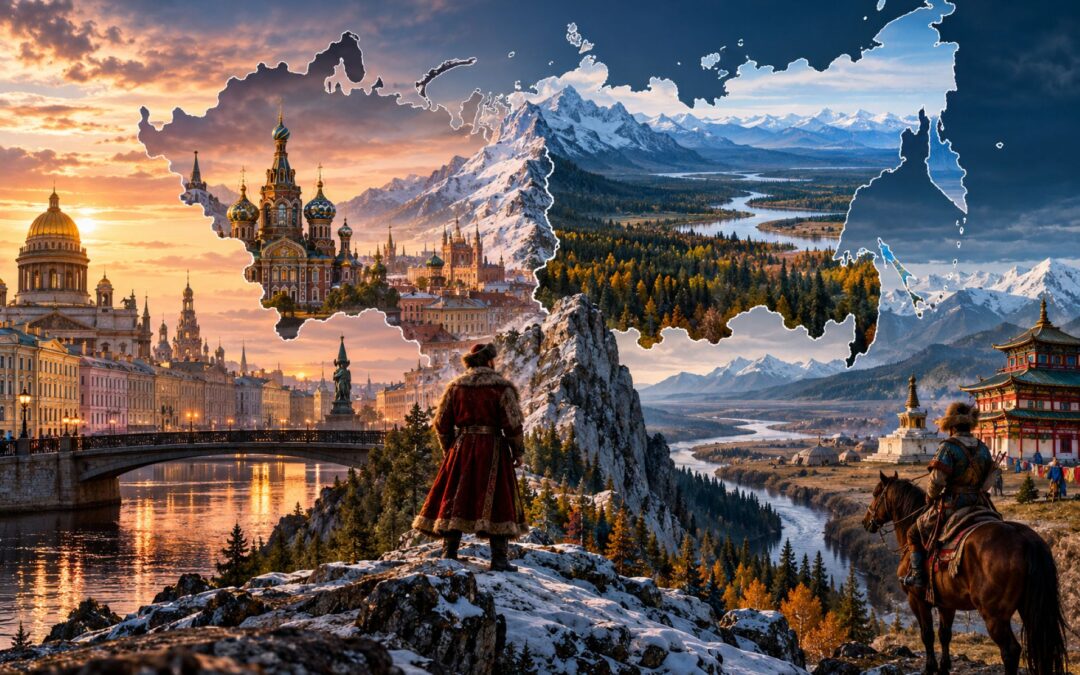
Russia stretches from the Baltic Sea in the west to the Pacific Ocean in the east, crossing eleven time zones and occupying an enormous portion of northern Eurasia. Its western borders touch European countries such as Finland, while its eastern territories extend beyond Japan’s longitude. Yet this vast country is usually represented by a capital, a language, and a cultural heritage that most people associate with Europe.
So, is Russia European or Asian?
The simplest answer is both. Russia is a transcontinental country, with territory in Europe and Asia. Most of its land lies in Asia, while most of its population lives in Europe. But geography alone cannot explain the country’s identity, because Russia’s history developed through centuries of interaction with both regions.
Its earliest political foundations emerged among the Eastern Slavs and their neighbours. Byzantine Christianity helped shape its religious traditions, Mongol domination influenced its political development, and expansion across Siberia transformed it into a vast Eurasian empire. Later rulers deliberately adopted Western European customs while governing peoples whose languages, religions, and cultures extended far beyond Europe.
The result is a country whose geographical location, historical inheritance, cultural identity, and political orientation do not fit comfortably into a single continental category.
Russia Is Both European and Asian on the Map
Russia is the world’s largest country, covering approximately 17 million square kilometres. It stretches across northern Eurasia, encompassing landscapes ranging from the forests and plains of European Russia to the mountains, steppes, and vast Siberian territories of Asia.
The conventional boundary between European and Asian Russia follows the Ural Mountains and the Ural River, with additional boundary conventions farther south. The Urals run roughly north to south through western Russia, providing a recognizable geographical landmark between the two regions.
Under this commonly used division, approximately 77% of Russia’s territory lies in Asia, while only about 23% lies in Europe. However, the population distribution is almost the reverse. According to the German federal government’s geographical profile of Russia, roughly 85% of the country’s population lives in its European portion.
That difference explains much of Russia’s apparent geographical contradiction. The Asian territory is enormous but comparatively sparsely populated, while European Russia contains the country’s principal population centres, important historical cities, and many of its most influential political and economic institutions.
Moscow, the capital, lies west of the Urals, firmly within conventional European boundaries. Saint Petersburg, another historically important Russian city, stands near the Baltic Sea and has maintained close connections with European political and cultural life.
Yet the distinction becomes less straightforward when we examine the boundary itself. As National Geographic’s explanation of Asia’s physical geography illustrates, Europe and Asia form a continuous landmass, and their conventional separation relies partly on historically established geographical definitions.
Unlike the Atlantic Ocean separating Europe from North America, no ocean divides Europe from Asia. The Ural Mountains mark a recognizable geographical transition, but they do not create an absolute separation between two independent landmasses.
Geographically, therefore, Russia belongs to both Europe and Asia under the conventional continental model. Understanding why its cultural and political identity is more complicated requires examining how the Russian state emerged and expanded.
The Rus’, Byzantium, and the Mongol Turning Point
The foundations of Russian history developed in the eastern European lands inhabited by Eastern Slavic communities and their neighbours. Between the sixth and ninth centuries, these populations established settlements, agricultural communities, and trading networks connecting the Baltic region with the Black Sea and the Byzantine world.
Scandinavian traders and warriors, commonly described as Varangians, also participated in these networks. Traditional accounts associate the beginnings of Rus’ political rule with the Varangian leader Rurik in the ninth century, although historians continue to debate the precise origins of the early Rus’ state and the extent of Scandinavian influence.
By the late ninth century, a political network centred on Kyiv had emerged, eventually developing into what historians commonly call Kyivan Rus’. Its rulers controlled important trading routes and maintained relationships with Scandinavian, Byzantine, Slavic, and steppe societies.
Kyivan Rus’ was not equivalent to modern Russia. Its history forms part of the shared medieval inheritance of present-day Ukraine, Belarus, and Russia, whose later political and national identities developed through different historical experiences.
One of the most consequential developments occurred in 988, when Prince Vladimir adopted Byzantine Christianity. This decision strengthened ties with Constantinople and helped establish Eastern Orthodox Christianity as a defining influence on the region’s religious and cultural development.
Byzantine traditions shaped church architecture, religious art, literature, and concepts of political authority. Orthodox Christianity also introduced religious institutions and intellectual connections that would remain influential long after the political fragmentation of Kyivan Rus’.
These developments complicate any attempt to classify Russia’s early identity as simply European or Asian. Its emerging political culture belonged to an eastern European world deeply connected to Byzantium, which itself occupied territories and inherited traditions spanning the geographical boundary between Europe and Asia.
During the twelfth century, the Rus’ principalities became increasingly fragmented. Regional rulers competed for power, and political authority shifted among different centres.
Then came the Mongol invasions.
In the thirteenth century, Mongol armies conquered much of the Rus’ lands, destroying major cities and bringing numerous principalities under the supremacy of the Mongol rulers of the Golden Horde. The invasion of Kyiv in 1240 became one of the most significant events in this transformation.
However, the Mongol conquest did not mean that every Rus’ principality was administered directly by Mongol officials. Local princes frequently continued ruling their territories while recognizing the authority of the khans, paying tribute, and obtaining confirmation of their political positions.
This arrangement created relationships involving coercion, negotiation, military pressure, and political competition. The experience of Mongol rule influenced the development of regional power, although historians disagree about how extensively it shaped later Russian institutions.
One principality benefited particularly from the changing political environment: Moscow.
Moscow’s rulers gradually expanded their authority through territorial acquisitions, alliances, military campaigns, and their relationships with the Golden Horde. Over time, the city became a powerful political and religious centre, increasingly capable of challenging neighbouring principalities and the authority of the khans.
By the fifteenth century, Moscow had become the centre of a growing state. Under Ivan III, who ruled from 1462 to 1505, it absorbed important neighbouring territories and substantially reduced its dependence on the Golden Horde.
The confrontation at the Ugra River in 1480 is traditionally associated with the end of Mongol overlordship over Moscow. Although the process was more gradual than a single decisive military victory, it represented a major turning point in the emergence of an increasingly independent Russian state.
Russia’s early development had therefore involved Eastern European communities, Scandinavian connections, Byzantine religion, and centuries of interaction with Mongol and other steppe powers. Its political identity emerged from these overlapping influences rather than from an exclusively European historical experience.
How Moscow Expanded into a Eurasian Empire
The growing Muscovite state did not stop expanding after establishing its independence from the Golden Horde. Instead, its rulers increasingly pursued territories to the east and south, extending their authority into regions previously controlled by various successor states of the Mongol Empire.
Ivan IV, commonly known as Ivan the Terrible, became the first ruler formally crowned Tsar of All Russia in 1547. His reign marked an important development in Moscow’s imperial ambitions and the political claims of its monarchy.
In 1552, Russian forces conquered the Khanate of Kazan, a major political power along the Volga River. Four years later, Moscow conquered the Khanate of Astrakhan, strengthening its influence over the lower Volga and improving access toward the Caspian region.
These conquests incorporated populations with different ethnic, linguistic, and religious traditions into the expanding Russian state. Muslim Turkic communities, among others, became subjects of a monarchy whose ruling institutions were associated primarily with Orthodox Christianity.
The expansion also brought Russian authorities into closer contact with the peoples of the steppe and the territories extending toward Siberia.
During the late sixteenth century, expeditions associated with the Cossack leader Yermak helped initiate the Russian conquest of western Siberia. Although these campaigns began during Ivan IV’s reign, Russian expansion across Siberia continued long after his death.
Over the seventeenth century, traders, Cossacks, military detachments, and settlers moved farther east. They established forts, collected tribute, developed trade routes, and extended Russian authority across enormous territories until expeditions reached the Pacific coast.
The fur trade was particularly important to this process. Valuable animal pelts attracted merchants and provided an incentive for the state to establish control over distant regions.
Russian authorities frequently demanded tribute, known as yasak, from indigenous communities, often in the form of furs. This system could involve coercion, hostage-taking, violence, and resistance, alongside negotiated arrangements and commercial exchanges.
Siberia was not empty territory awaiting incorporation into a European state. It was home to numerous peoples with established political relationships, languages, spiritual traditions, and ways of life adapted to very different environments.
Russian expansion transformed these societies, sometimes through trade and cooperation, but also through conquest, displacement, disease, and unequal imperial relationships.
By the time Russia had established a substantial presence across northern Asia, its territory had become unmistakably transcontinental. The state governed populations whose histories connected them to European, Central Asian, Siberian, and Pacific worlds.
One important distinction separates Russian imperial expansion from the development of many Western European overseas empires. Whereas Britain, France, Spain, and Portugal acquired numerous territories separated from their metropolitan centres by oceans, Russia developed a largely contiguous land empire.
This geographical continuity made overland administration and movement possible across connected territories, although Siberia’s enormous distances, climate, and limited infrastructure also created severe logistical difficulties.
The difference mattered strategically. Russia increasingly found itself participating in European diplomacy while competing for influence across Asia. During the nineteenth century, its expansion into Central Asia brought it into rivalry with Britain, whose imperial government feared threats to its position in India.
That competition, commonly known as the Great Game, formed part of Britain’s wider imperial history and its rivalry with Russia in Asia. The two empires followed different geographical routes to expansion, but their ambitions eventually intersected across the Asian continent.
By this stage, Russia was not merely a European state possessing a distant Asian colony. Its Asian territories had become a central part of its imperial geography, economy, security, and population.
Peter the Great and the Remapping of Europe
While Russia expanded across Asia, its rulers also looked increasingly toward Western Europe for military technology, administrative practices, and cultural models.
Few rulers pursued that transformation as forcefully as Peter the Great, who became the dominant figure in Russian politics at the end of the seventeenth century and ruled as emperor from 1721 until his death in 1725.
Peter believed that Russia needed stronger military institutions, improved technology, and a more effective administrative system to compete with established European powers. His reforms affected the army, navy, government, education, manufacturing, and the public appearance of the elite.
He travelled through Western Europe, studied shipbuilding and technical practices, recruited foreign specialists, and introduced changes intended to strengthen the Russian state.
His cultural reforms were especially visible among the nobility. Peter promoted Western European clothing, discouraged traditional long beards through regulations and taxation, and encouraged court customs associated with European aristocratic society.
These measures were not simply matters of fashion. They reflected an effort to reshape the behaviour and institutional culture of Russia’s ruling class while reinforcing the authority of the monarchy.
Peter’s military ambitions also drew Russia more deeply into European affairs. During the Great Northern War against Sweden, Russian victories secured important territory around the Baltic Sea.
In 1703, Peter founded Saint Petersburg, which became the imperial capital in 1712. Designed with significant European architectural influence, the city symbolized Russia’s ambition to participate more directly in European commerce, diplomacy, and cultural life.
Saint Petersburg became famous as Russia’s window to Europe, representing the westward orientation of a monarchy whose territorial expansion continued across Asia.
Peter also changed Russia’s civil calendar conventions. Beginning in 1700, the official numbering of years followed the Christian era, and the civil New Year began on January 1 rather than September 1.
However, he did not introduce the Julian calendar, as some popular accounts suggest. Russia already used that calendar and retained it during his reign. The distinction is examined in Andreas Schönle’s study of calendar reform under Peter the Great.
Peter’s reign helped strengthen Russia’s position as a major European power. Yet it also raised a deeper question: how should a state extending across two conventional continents be classified?
The answer was connected to changes in geographical thinking during the eighteenth century.
Modern readers often regard the Ural Mountains as an obvious dividing line between Europe and Asia. Historically, however, the location of that boundary was not always defined in the same way.
Ancient and later geographical traditions used different landmarks to distinguish the regions, including rivers and other features farther west. The definition of Europe’s eastern extent changed as geographical knowledge, political interests, and ideas about continental identity evolved.
The Swedish scholar and former prisoner of war Philip Johan von Strahlenberg published an influential geographical work in 1730 that helped popularize a division associated with the Ural region. The Russian scholar and administrator Vasily Tatishchev also played an important role in developing and promoting geographical interpretations of Russia’s continental position.
Their respective contributions remain the subject of historical discussion. As historian Mark Bassin explains in his examination of the ideological construction of geographical space between Europe and Asia, the boundary reflected intellectual and political assumptions as well as physical geography.
The growing acceptance of the Urals as a continental boundary reinforced a way of describing Russia as a country with a substantial European core and an enormous Asian territory.
Nevertheless, this was not simply a cartographic trick that transformed an Asian country into a European one. Russia had already maintained extensive connections with European states, while geographical conventions themselves were evolving.
Peter’s reforms and eighteenth-century geographical thinking together illustrate a broader point: continental identity involves not only where a country is located, but also how governments, scholars, and societies choose to understand its place in the world.
The Many Cultures and Peoples Within Russia
Russia’s geographical size and imperial history produced a society containing numerous ethnic communities, languages, and religious traditions. Although ethnic Russians constitute the largest population group, the country has never been culturally uniform.
The Russian language belongs to the East Slavic branch of the Indo-European language family. Its historical development connects it to other Slavic languages, while its literary and administrative importance grew alongside the expansion of the Russian state.
Russian cultural achievements also occupy an important place in broader European intellectual and artistic history.
Writers such as Leo Tolstoy and Fyodor Dostoevsky helped shape the development of the modern novel, exploring morality, religion, political authority, and the psychological complexities of human behaviour. Composers such as Pyotr Tchaikovsky became central figures in classical music, producing works that entered international concert and theatrical traditions.
Russian artists, scientists, philosophers, and performers participated in European intellectual networks, even when political relationships between Russia and other European states were strained.
The aristocracy maintained especially strong connections with European court culture. French became an important language among sections of the Russian elite, while dynastic marriages linked the Romanovs with other European royal families.
These connections help explain why Russia was commonly treated as one of Europe’s major powers despite its extensive Asian territories.
However, focusing exclusively on ethnic Russian and aristocratic culture would overlook much of the country’s population.
The Volga region contains communities whose histories include Turkic languages and Islamic traditions. The North Caucasus is home to numerous peoples with distinct languages, historical experiences, and religious identities. Buddhism has longstanding roots in regions such as Buryatia, Kalmykia, and Tuva, while indigenous Siberian communities preserve a variety of spiritual practices, including shamanic traditions.
Russia also contains smaller religious communities associated with other faiths, including Hinduism. Yet the country’s religious diversity cannot be understood through a simple contrast between European Christianity and Asian religions, because these traditions cross continental boundaries and possess complex histories of their own.
The same applies to ethnicity. A Russian citizen’s geographical identity cannot be determined by physical appearance, language, or ancestry. Millions of people belong to communities whose histories do not correspond neatly to conventional European or Asian categories.
The Russian Empire and its successors incorporated different populations through conquest, migration, settlement, administration, and cultural exchange. These processes produced shared institutions while also generating inequalities, resistance, and conflicting understandings of belonging.
Historian Michael Khodarkovsky describes Russia as a political formation shaped by interacting European, Byzantine, and Turko-Mongol traditions. His analysis of Russia’s hybrid imperial identity provides one interpretation of why the country’s institutions and historical development cannot be explained through an exclusively European model.
The important distinction is between describing the influences that shaped Russia and claiming that all Russians share a single mixed identity. The country contains different historical memories and cultural affiliations, and those differences remain significant.
Russia’s diversity is therefore not simply evidence that one part of the country is European and another is Asian. It reflects the development of a multinational state whose communities have interacted across the wider Eurasian landmass for centuries.
Russia’s Search for a European or Eurasian Identity
Russia’s position between Europe and Asia has long shaped debates about its political development and place in the world.
During the nineteenth century, Russian intellectuals disagreed about whether their country should follow Western European models or preserve a distinctive historical path.
Thinkers commonly described as Westernizers emphasized the importance of European institutions, intellectual traditions, and social reforms. Slavophiles, by contrast, attached greater importance to Russia’s Orthodox heritage and what they regarded as the distinctive characteristics of Russian historical and communal life.
These were not two uniform political camps, nor did every participant agree about the meaning of Europe or Russia. Nevertheless, their disagreements demonstrated that Russia’s relationship with Europe had become a central question within Russian intellectual life.
The twentieth century introduced further transformations. The Russian Revolution and the collapse of the Romanov monarchy overturned the imperial political order, eventually leading to the creation of the Soviet Union.
Soviet political identity was organized around communist ideology and a multinational federal state rather than a straightforward claim to European civilization. The Soviet Union governed territories across Eastern Europe, the Caucasus, Central Asia, and northern Asia, making it another political formation spanning the conventional continental boundary.
During the early twentieth century, some Russian émigré intellectuals developed Eurasianist ideas that presented Russia as a distinctive civilization shaped by the interaction of European and Asian traditions. These ideas varied considerably, and later political uses of Eurasianism should not be treated as identical to the original intellectual movement.
Following the dissolution of the Soviet Union in 1991, Russia again confronted questions about its international orientation. Its relationships with European institutions, neighbouring states, and Asian powers became important parts of its foreign-policy debates.
In contemporary Russian political discourse, Eurasian identity sometimes serves as a way to emphasize the country’s distinctive geopolitical position and its relationships beyond Western Europe.
Russia’s participation in the Shanghai Cooperation Organisation provides one example of those relationships. The organization began with six members but subsequently expanded; the SCO’s official membership information now lists ten members, including Russia, China, India, Pakistan, Iran, and Belarus.
However, membership in an international organization does not determine which continent a country belongs to. Russia’s absence from the European Union and NATO similarly reflects institutional and geopolitical relationships rather than a geographical verdict.
Cultural institutions provide another example of why these categories should not be confused. Russia participated in the Eurovision Song Contest for many years, demonstrating its involvement in a prominent European broadcasting tradition. However, the European Broadcasting Union excluded Russia from the 2022 contest, and Russia has not returned to the competition.
Neither participation nor exclusion can settle Russia’s geographical identity. Such developments show how political and cultural relationships change over time, even when a country’s physical location remains the same.
Russia’s contemporary orientation toward particular international partners is therefore one aspect of its changing political identity. It does not erase its European historical inheritance, its Asian territories, or the diversity of the people who live within its borders.
Why the Europe–Asia Divide Cannot Define Russia Completely
The difficulty of classifying Russia ultimately reveals a larger problem with the way continents are defined.
Europe and Asia are conventionally recognized as separate continents, and this division remains useful in geography, education, history, and political discussion. Yet they form a continuous landmass commonly called Eurasia.
The boundary between them does not possess the same obvious physical character as an ocean separating major landmasses. Instead, geographers have historically relied on combinations of mountains, rivers, seas, and established conventions to identify where one region ends and the other begins.
Different educational traditions also recognize different numbers of continents. Some models distinguish seven, while others combine Europe and Asia into Eurasia or use different conventions for the Americas.
This does not mean that every classification is equally useful for every purpose. It means that continental geography depends partly on the criteria being applied.
Geology does not establish one universally correct cultural or geographical definition of Europe and Asia. Their separation has developed through historical geographical traditions, and a different convention could produce a different continental map without changing the underlying landmass.
Russia exposes the limits of treating these categories as exclusive identities.
Its political heartland developed within European geographical boundaries, yet much of its territory lies in Asia. Its rulers participated in European diplomacy while expanding across Siberia and Central Asia. Its culture drew on Byzantine Christianity, European intellectual traditions, steppe relationships, and the histories of numerous peoples incorporated into successive Russian states.
The word Eurasian captures this geographical and historical complexity more effectively than insisting that Russia must belong exclusively to one side.
Still, Eurasian should not be treated as a single cultural identity shared by everyone within Russia. Geography, citizenship, ethnicity, language, political allegiance, and personal identity describe different aspects of belonging, and they do not always align.
A person from Moscow, Kazan, Buryatia, or another Russian region may understand their identity differently depending on family history, language, religion, culture, and personal experience. None of those identities can be determined simply by drawing a continental boundary.
Russia is therefore both European and Asian geographically, while remaining a historically distinctive and internally diverse country.
The short answer to whether Russia is European or Asian is that it belongs to both continents under the conventional geographical model. The longer answer is that centuries of political development, cultural interaction, conquest, and intellectual debate have made those labels insufficient on their own.
Eurasia describes the landmass across which Russia developed, but it does not erase the differences among the societies that inhabit it. Understanding Russia requires recognizing both the European and Asian dimensions of its history without assuming that either one completely defines the country.
Last Updated on October 29, 2026 by Aseem Gupta