
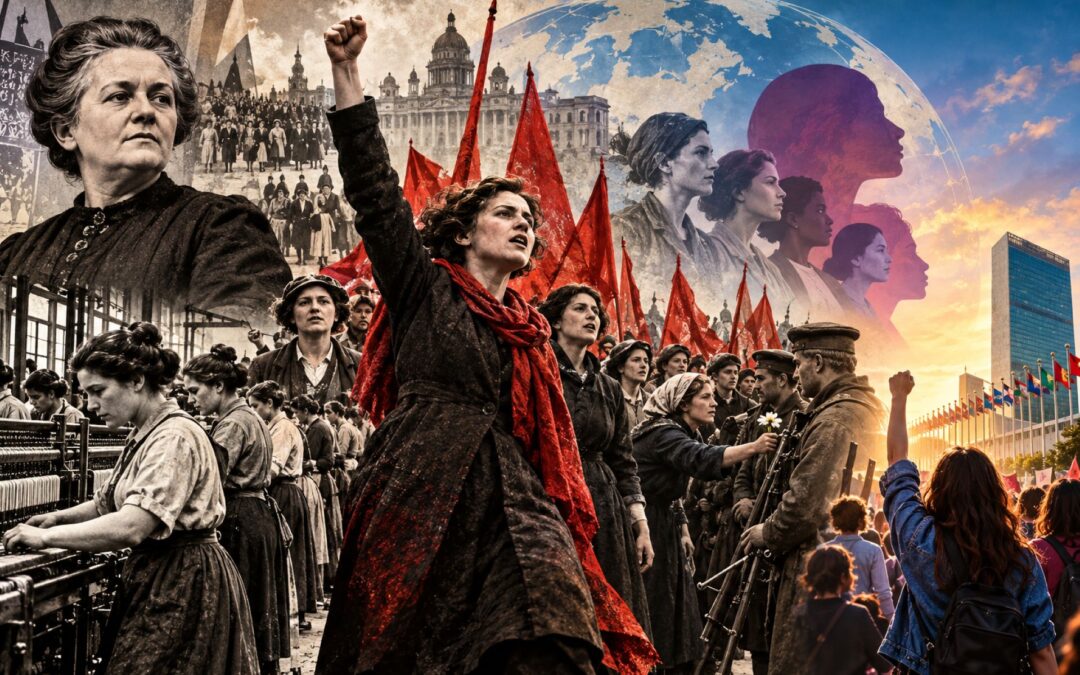
Every year on March 8, millions of people around the world celebrate International Women’s Day. Governments recognize women’s achievements, organizations campaign for equality, and individuals mark the occasion with speeches, demonstrations, flowers, and messages of appreciation. Yet the history of International Women’s Day is far more politically charged than many modern celebrations suggest.
The occasion began as part of an international struggle by working women for political representation, economic security, and better working conditions. It emerged from socialist movements in Europe and the United States, acquired revolutionary significance in Russia, and eventually became a worldwide observance recognized by the United Nations.
Its connection to the Russian Revolution is particularly remarkable. In 1917, demonstrations initiated by women on International Women’s Day helped unleash a political crisis that brought down the Romanov monarchy, ending more than three centuries of dynastic rule. Understanding how a campaign for women’s rights became associated with such a dramatic historical event reveals why March 8 carries a significance extending well beyond annual celebrations.
A Socialist Women’s Day Before There Was an International Women’s Day
At the beginning of the twentieth century, women across much of Europe and North America faced severe restrictions on their political and economic independence. Most could not vote in national elections, their opportunities for education and professional advancement were limited, and those who entered industrial employment frequently encountered long working hours, low wages, and dangerous conditions.
Industrialization had brought increasing numbers of women into factories, particularly in textiles, clothing, and other labour-intensive industries. Their employment helped sustain industrial economies, but it rarely translated into economic security or political influence. Women workers faced discrimination in wages and advancement while often remaining responsible for domestic labour and childcare.
These conditions encouraged women to organize through trade unions, socialist parties, and suffrage organizations. Although these movements sometimes cooperated, they did not always agree on the best path toward equality. Many middle-class feminists emphasized legal rights and political representation, while socialist women argued that genuine emancipation also required confronting economic exploitation and class inequality.
One of the most influential organizers was Clara Zetkin, a German Marxist and leading figure in the Social Democratic Party of Germany. Zetkin believed working women needed organizations through which they could participate in political life, defend their economic interests, and campaign for universal suffrage. She opposed approaches that treated women’s equality as separate from the wider struggle over labour and economic power.
In 1907, socialist women from several countries gathered in Stuttgart, Germany, for the first International Socialist Women’s Conference. The delegates demanded voting rights for women without property, tax, educational, or other qualifications that disproportionately excluded members of the working class. This was significant because some contemporary suffrage proposals still accepted restrictions based on wealth or social position.
Across the Atlantic, American socialist women were developing similar initiatives. In May 1908, the Socialist Party organized a Woman’s Day meeting in Chicago, bringing together women campaigning for economic and political equality. The following year, the movement held a more widely recognized national observance on February 28, 1909, with activities in New York and other American cities.
American organizers, including Theresa Malkiel, helped establish the idea that women could use a dedicated annual occasion to mobilize around their political and economic demands. These early events were not yet celebrated on March 8, nor were they part of an internationally coordinated calendar. Nevertheless, they provided an important practical example for European socialist organizers.
As historian Birgitte Søland explains in Ohio State University’s history of International Women’s Day, the movement developed through connections between American socialist initiatives and European campaigns for women’s rights. Its eventual international character emerged from several organizations working across national boundaries rather than from a single founding demonstration.
Clara Zetkin and the 1910 Copenhagen Decision
The decisive step toward establishing International Women’s Day came in August 1910, when socialist women gathered in Copenhagen, Denmark, ahead of the broader congress of the Socialist International. More than one hundred delegates representing seventeen countries participated in discussions about women’s political rights, employment, and the responsibilities of socialist organizations toward working women.
Clara Zetkin and fellow German socialist Luise Zietz proposed an annual International Woman’s Day. The intention was to create a recurring occasion on which women across different countries could organize demonstrations, public meetings, and campaigns for political and economic equality.
The delegates unanimously supported the proposal. International Woman’s Day had been established in principle, although the conference did not select March 8 or any other fixed date for its annual observance.
The decision reflected a substantial development within the international socialist movement. Some socialist leaders had previously regarded women’s political demands as secondary to the broader struggle between workers and employers. Zetkin and her allies argued that women needed independent opportunities to organize while remaining participants in the wider working-class movement.
Women’s suffrage was a central demand, but the Copenhagen discussions were not limited to voting rights. Delegates addressed the material circumstances that made participation in public life difficult for working women, including excessive working hours, inadequate wages, and the absence of effective protection during pregnancy and childbirth.
An eight-hour working day was among the wider socialist labour demands. Delegates also advocated maternity protections, including time away from employment before and after childbirth, financial assistance, and arrangements intended to prevent pregnancy from forcing working women into destitution. Proposed protections extended beyond conventional factory employment to groups such as domestic, agricultural, and home-based workers, whose conditions often placed them outside existing legislation.
The underlying argument was that women should not have to choose between economic survival and motherhood. Campaigners also recognized that childbirth and childcare involved essential work for society, even when that work received no direct wages.
These proposals did not immediately become law, and modern parental leave systems cannot be attributed to a single conference. Their importance lies in the broader reform movement they represented. As the Workers Museum of Denmark’s history of maternity leave demonstrates, maternity protection developed through prolonged interaction among labour organizations, national legislation, and international agreements.
The Copenhagen resolution therefore established more than an annual celebration. It provided an international organizing mechanism through which demands for political participation, workplace protection, and economic security could be advanced together.
The First European Demonstrations and the Bread and Roses Movement
The first major International Woman’s Day observances across Europe took place in March 1911. The principal commemorations are commonly dated to March 19, although some historical accounts describe demonstrations on March 18. Austria, Denmark, Germany, Switzerland, and other parts of Europe witnessed meetings, marches, and public campaigns demanding women’s political and economic rights.
The choice of dates reflected the political traditions of the organizers rather than any universally established calendar. In the German-speaking socialist movement, March 19 carried associations with the revolutionary struggles of 1848, while demonstrations also invoked the memory of the Paris Commune of 1871.
In Austria-Hungary, women organized hundreds of demonstrations, including marches through Vienna. Participants carried banners and socialist symbols while demanding voting rights, greater political representation, and improvements in working conditions. Germany also experienced extensive mobilization, supported by socialist newspapers, pamphlets, and labour organizations.
Estimates of participation across the first international observances exceeded one million people. Although exact figures are difficult to establish, the scale demonstrated that the campaign had moved beyond a relatively small network of socialist leaders. It had become a recognizable vehicle for mass political participation.
The movement’s emphasis on economic dignity was also reflected in contemporary labour struggles outside the formal International Woman’s Day celebrations.
In January 1912, textile workers in Lawrence, Massachusetts, began a major strike after reductions in their weekly earnings. A new state law had shortened the maximum working week for women and children, but some employers reduced wages accordingly. Workers who were already struggling to support their families found themselves earning even less.
The strike spread rapidly through the city’s textile mills. Its participants included large numbers of immigrant workers speaking different languages, many of them women. Their ability to organize across ethnic and linguistic divisions challenged prevailing assumptions that such a workforce could not act collectively.
The dispute became remembered as the Bread and Roses Strike. The phrase expressed a demand for more than the bare necessities of survival: workers also wanted dignity, security, and the opportunity to enjoy a meaningful life.
The slogan’s origins are more complicated than popular retellings suggest. James Oppenheim published his poem Bread and Roses in 1911, before the Lawrence strike, drawing on language already circulating among women’s labour activists. Socialist organizer Rose Schneiderman also helped popularize the connection between economic survival and the dignity of working life.
The Digital Public Library of America’s historical exhibition on the Bread and Roses Strike traces both the industrial conflict and the complicated history of the slogan. Although the phrase became inseparable from the strike’s memory, its association with the events developed through a wider tradition of labour activism.
The Lawrence strike did not create International Women’s Day, nor was it simply another celebration of the occasion. It belonged to the same historical landscape: women workers insisting that political equality meant little without meaningful improvements in their material conditions.
War, Repression, and the Antiwar Women’s Movement
The outbreak of World War I in 1914 placed enormous pressure on European societies. Governments redirected economic resources toward military production, millions of men entered the armed forces, and civilian populations faced increasing shortages, inflation, and political restrictions.
The conflict also divided the international socialist movement. Although socialist organizations had previously emphasized solidarity among workers across national boundaries, many supported their respective governments once the war began. Others regarded the conflict as a struggle between imperial powers in which ordinary workers were being asked to sacrifice their lives for the interests of political and economic elites.
These divisions weakened the international cooperation that had supported Women’s Day during its early years. Public demonstrations could face restrictions, political publications were censored, and activists who challenged the war risked surveillance, harassment, or imprisonment.
Clara Zetkin remained committed to international opposition to the conflict. She helped organize a conference of socialist women in Bern, Switzerland, from March 26 to 28, 1915, bringing together delegates from countries whose governments were often fighting on opposing sides.
Twenty-two women participated in the meeting, representing different socialist traditions and national backgrounds. Zetkin played a central role in preparing its antiwar manifesto, which argued that the conflict served capitalist and imperial interests at the expense of workers and their families.
Russian socialist activists, including Nadezhda Krupskaya and Inessa Armand, belonged to the international antiwar networks surrounding these efforts. Alexandra Kollontai, another prominent Russian socialist, shared their opposition to the conflict but did not attend the Bern meeting in person. Vladimir Lenin was politically connected to the antiwar socialist movement, but describing him as an attending delegate at this women’s conference would be inaccurate.
The meeting also revealed differences between socialist women and other feminist peace activists. Some women’s peace movements emphasized international law, negotiation, and the possibility that women’s political participation would strengthen peaceful relations. The Bern socialists instead placed their opposition to war within a broader critique of capitalism and class power.
Historian Glenda Sluga’s research on women international thinkers and the history of war and peace explains how the Bern conference formed part of a wider network of women’s international activism during the war.
Meanwhile, International Woman’s Day had already reached Russia. Russian socialist women began organizing observances in 1913, followed by further activities in 1914 despite increasing political repression.
These early commemorations did not yet possess the revolutionary importance they would acquire a few years later. They did, however, establish a connection between the international socialist women’s movement and political organizing inside the Russian Empire.
By 1917, that connection would become historically decisive.
March 8, 1917: The Strike That Helped Bring Down the Tsar
By the beginning of 1917, Russia was approaching a political and economic breakdown. Nearly three years of participation in World War I had produced enormous military casualties, disrupted industry and agriculture, strained transportation networks, and undermined public confidence in Tsar Nicholas II.
The consequences were especially visible in Petrograd, the Russian capital. Food supplies were unreliable, prices were rising, and bread shortages forced residents to spend hours waiting in queues. Workers faced difficult industrial conditions while their wages struggled to keep pace with inflation.
Women carried a particularly heavy burden. Millions of men had been mobilized for military service, increasing women’s responsibilities in factories, households, and the wider economy. Many women worked long shifts in demanding industries while remaining responsible for obtaining food and caring for their families.
In Petrograd’s textile factories, women confronted a combination of exhausting work, economic insecurity, and the daily struggle to keep their households fed. Their dissatisfaction was connected to grievances shared across Russian society, but their position made the worsening crisis especially immediate.
On February 23, 1917, according to the Julian calendar then used in Russia, women textile workers and other women took to the streets of Petrograd to protest against food shortages, the war, and deteriorating living conditions.
That date was March 8, 1917, in the Gregorian calendar used across much of Western Europe and employed internationally today. Russia’s Julian calendar was thirteen days behind the Gregorian calendar, which is why the uprising became known as the February Revolution despite occurring in March according to the modern international calendar.
The timing was significant. March 8 was International Woman’s Day, and socialist activists had already established a tradition of using the occasion for public political mobilization. What began as a day of protest soon became part of a much larger revolutionary movement.
Women left their workplaces and gathered in the streets, calling for bread and an end to the war. They encouraged other workers to abandon their factories and join the demonstrations. The protests spread through industrial districts, including the politically active Vyborg area, where factories and working-class communities had already experienced growing unrest.
Not all revolutionary leaders had expected an uprising at that moment. Some activists worried that a premature confrontation with the authorities could lead to violent repression before the workers were sufficiently organized. Yet the demonstrations gathered momentum faster than political organizations could control.
This spontaneous expansion was one of the most consequential features of the uprising. Women workers helped initiate the movement, but its success depended on the participation of an increasingly broad coalition of industrial workers, students, soldiers, and ordinary residents.
By the following day, more than 200,000 workers were on strike. Demonstrations spread across the city, and the demands became increasingly political. Calls for food and relief from wartime hardship were accompanied by demands to end autocratic government.
Historian S. A. Smith’s account in The Cambridge History of Russia describes how the protests initiated by women textile workers and housewives rapidly developed into mass strikes. Revolutionary activists helped organize the growing movement, but the speed of its expansion surprised established political leaders.
The authorities attempted to suppress the unrest through police action and military force. Nicholas II ordered that order be restored, but this required the cooperation of soldiers whose willingness to defend the monarchy was increasingly uncertain.
Some troops initially obeyed orders to confront demonstrators. On February 26 in the Russian calendar, soldiers fired on crowds, killing and wounding civilians. The violence demonstrated that the government remained prepared to use force, but it also exposed the weakness of its authority over the capital’s garrison.
Women played an important part in confronting soldiers and appealing to them to join the demonstrations. They approached military cordons, argued with the troops, and encouraged them not to fire on the people. These appeals were particularly powerful in a city where many soldiers were themselves exhausted by wartime conditions and shared the grievances of the protesters.
Leon Trotsky later emphasized women’s courage in approaching soldiers and urging them to turn against the authorities. His account reflects the importance revolutionary observers attached to their actions, although the military mutinies cannot be explained by women’s appeals alone.
The decisive turning point came when elements of the Petrograd garrison began refusing orders and joining the uprising. On February 27 in the Russian calendar, the Volynsky Regiment mutinied, and other military units followed. As soldiers turned against their officers or sided with demonstrators, the government lost the means to restore control.
The crisis was no longer simply a strike or a demonstration. It had become a breakdown of the political and military institutions supporting the monarchy.
Members of the Duma, Russia’s legislative assembly, began organizing alternative political authority, while workers and soldiers reestablished the Petrograd Soviet. Nicholas II was increasingly isolated, and senior military commanders concluded that his continued rule threatened the stability of the state and its ability to continue the war.
On March 15, 1917, according to the Gregorian calendar, Nicholas II abdicated. His brother, Grand Duke Michael, subsequently declined to assume the throne without broader political approval, bringing Romanov rule to an end after more than three hundred years.
The women’s demonstrations of March 8 had helped trigger the February Revolution that toppled the Romanov monarchy. It would be misleading to suggest that a single strike independently destroyed the regime, because military defeat, food shortages, political alienation, industrial unrest, and the collapse of military discipline all contributed to its downfall.
Nevertheless, the initiating role of women workers was central. Their protests transformed a familiar socialist observance into the opening event of a revolution that changed Russian and world history.
The revolution also created new opportunities for women’s political participation. The Provisional Government introduced important civil and political reforms, but women’s suffrage was not simply granted automatically when Nicholas abdicated.
Russian feminist organizations continued campaigning, organizing large demonstrations and demanding equal electoral rights. Their pressure contributed to the extension of women’s voting rights during 1917, including the electoral provisions adopted in July.
Women who had mobilized against food shortages and autocratic rule were therefore also participating in the struggle to determine what political rights would exist after the monarchy.
The February Revolution would eventually be followed by the Bolshevik seizure of power in October 1917. Yet the significance of International Woman’s Day did not depend on the outcome of that later struggle. The events of March 8 had already established a lasting connection between the international women’s movement and one of the great political turning points of the twentieth century.
Why March 8 Became the Date—and How Communists Carried It Forward
The revolutionary events of 1917 gave March 8 a significance that earlier International Woman’s Day observances had lacked. The date became associated not merely with demonstrations for women’s rights but with an uprising that had helped bring down one of Europe’s oldest ruling dynasties.
For communist organizers, the connection between women’s mobilization and revolutionary political change was particularly powerful. It provided a historical example of working women participating directly in a broader struggle against an established political and economic order.
In 1921, the Second International Conference of Communist Women met in Moscow and endorsed the observance of Women’s Day on March 8. The decision helped establish a common date for communist women’s organizations internationally, replacing the varying dates that had characterized the movement’s earlier years.
Clara Zetkin subsequently described the decision in her 1922 article, The International Communist Women’s Day. Her account explicitly connected the international adoption of March 8 with the women-led demonstrations in Petrograd and presented the observance as an instrument for mobilizing women within the communist movement.
The date was therefore not selected in Copenhagen in 1910, nor was it simply invented by Lenin after the Russian Revolution. Its establishment emerged through the accumulated history of women’s demonstrations, the political significance attached to Petrograd in 1917, and subsequent decisions by international communist organizations.
The Soviet Union increasingly incorporated March 8 into its political calendar. Communist movements elsewhere, including those developing in China during the early 1920s, also began observing the occasion. The day became associated with women’s participation in socialist politics, industrial labour, and revolutionary transformation.
However, official recognition did not guarantee that women achieved substantive equality. Soviet women gained important legal rights in areas such as political participation and family law during the early revolutionary period, but policy changed over subsequent decades. Stalin-era restrictions on abortion and renewed emphasis on traditional family responsibilities demonstrated how far state policy could depart from earlier emancipatory ambitions.
The holiday itself also changed. In socialist countries, it increasingly became an established public occasion, sometimes combining political recognition with celebrations of motherhood, family relationships, and women’s contributions to society. The Soviet Union eventually made March 8 a non-working public holiday in 1965.
Outside socialist countries, the association with communism complicated its reception. The political divisions of the twentieth century, particularly during the Cold War, contributed to the observance receiving less prominence in some Western societies.
Yet International Women’s Day did not disappear completely from the West, nor did every socialist country celebrate it in precisely the same way. Its visibility and meaning varied across political movements and national traditions.
By the middle of the twentieth century, March 8 had become firmly established as an international date, even as the purposes attached to its celebration continued to evolve.
The UN and the Return of a Global Women’s Movement
During the 1960s and 1970s, a renewed international movement for women’s rights brought greater attention to issues such as workplace discrimination, reproductive autonomy, political representation, legal equality, and violence against women.
International Women’s Day increasingly attracted participants beyond the socialist and communist organizations that had originally sustained it. Feminist groups and other campaigners adopted March 8 as an occasion to organize demonstrations, public discussions, and collective demands for reform.
The changing movement did not abandon the holiday’s earlier concerns. Economic independence, workplace rights, and political equality remained central, but they were now discussed alongside a wider range of issues affecting women’s personal freedom, social position, and participation in public life.
A major milestone came in 1975, when the United Nations designated International Women’s Year and began observing International Women’s Day on March 8. The year also included the first World Conference on Women, held in Mexico City, where governments discussed international commitments to equality, development, and peace.
In 1977, the United Nations General Assembly adopted a resolution inviting member states to proclaim a United Nations Day for Women’s Rights and International Peace, according to their historical and national traditions. This strengthened international recognition of the observance, although it did not require every country to establish March 8 as a compulsory public holiday.
The United Nations’ official history of International Women’s Day identifies the labour movements of North America and Europe as the holiday’s origins while explaining how its significance expanded through the international women’s movement.
International Women’s Day subsequently became established in countries with very different political systems, cultures, and traditions. Some governments designated it a public holiday, while others recognized it through official events, educational campaigns, and civil society activities.
This expansion transformed the observance from a predominantly socialist political initiative into a broad international occasion. Its participants no longer needed to share the ideological commitments of its original organizers, even though many of the issues they addressed remained closely connected to the demands made more than a century earlier.
The Origin Myth and the Meaning of International Women’s Day Today
Despite the extensive historical record surrounding International Women’s Day, one of the most frequently repeated stories about its origins is not supported by the evidence.
According to this account, the holiday commemorates a demonstration by women garment workers in New York on March 8, 1857. The women supposedly marched against poor working conditions, establishing the tradition that later became International Women’s Day.
The problem is that historians have found no reliable contemporary evidence that this particular demonstration occurred.
French historian Françoise Picq investigated the story and traced its emergence to accounts circulating in the 1950s. As explained in the French National Centre for Scientific Research’s examination of the historical origins of March 8, the supposed 1857 demonstration was first popularized in 1955, long after the actual socialist women’s movement had established the observance.
The story may have gained popularity partly because it provided an American labour-related explanation for the holiday while distancing it from its Soviet and communist associations. That interpretation remains a historical hypothesis, but the absence of contemporary evidence for the alleged 1857 demonstration is an important reason not to repeat it as fact.
The actual history is both more complicated and more revealing. International Women’s Day emerged from organized campaigns involving American socialists, European labour movements, suffrage activists, and women seeking greater economic independence.
It became associated with March 8 because of the events in Petrograd in 1917 and the subsequent decisions of international communist organizers. Its later global recognition came through feminist mobilization, international institutions, and changing attitudes toward women’s political and social rights.
Remembering these origins matters because modern celebrations can sometimes obscure the conflicts through which many rights were achieved. Women’s access to voting, education, employment, workplace protections, and independent political participation developed through different national histories, often involving prolonged campaigns against established institutions and practices.
Progress has been substantial, but the original concerns have not disappeared. Women remain underrepresented in important political and economic decision-making positions, experience unequal access to opportunities, and face disproportionate responsibilities for unpaid domestic and care work.
The United Nations’ Gender Snapshot 2026 highlights how far the world remains from equal representation in leadership. Its findings estimate that, at current rates of progress, parity in national parliaments remains more than six decades away. Such projections depend on existing trends, but they illustrate the continuing distance between formal commitments to equality and actual representation.
The significance of International Women’s Day therefore extends beyond one historical movement or political ideology. Its development reflects the changing ways societies have understood women’s rights, from suffrage and industrial labour protections to questions of personal autonomy, economic opportunity, political power, and freedom from violence.
Different countries and communities continue to observe March 8 differently. For some, it remains a day of political demonstration and protest; for others, it is an occasion for recognizing women’s achievements or expressing appreciation toward women in their lives. These approaches coexist, sometimes comfortably and sometimes in tension with one another.
Understanding the history of International Women’s Day does not require treating every modern celebration as inadequate or endorsing every political belief held by its founders. It does require recognizing that the date emerged from collective organizing rather than ceremonial recognition alone.
The history of International Women’s Day is ultimately a history of how organized political demands can acquire significance far beyond the circumstances in which they began. What started as a campaign by socialist women for voting rights, economic security, and better working conditions became connected to the collapse of the Russian monarchy, was carried forward through international political movements, and eventually achieved recognition across much of the world.
Its meaning has expanded considerably since the early twentieth century, but its underlying historical lesson remains relevant. The rights and opportunities now associated with women’s equality were not simply granted through the passage of time; many were won through sustained organization, political pressure, and demands for institutional change.
March 8 endures because it connects the achievements of those earlier struggles with the questions of equality that societies continue to confront.
Last Updated on October 29, 2026 by Aseem Gupta