
Reading Time: 30 Minutes
In May 1754, a young British colonial officer named George Washington led a small force into the forests of the Ohio Valley in North America. His mission was to challenge French claims to territory that both colonial powers wanted to control. The encounter that followed was brief, but it helped ignite a struggle that would eventually draw much of Europe into war and transform the balance of power across several continents.
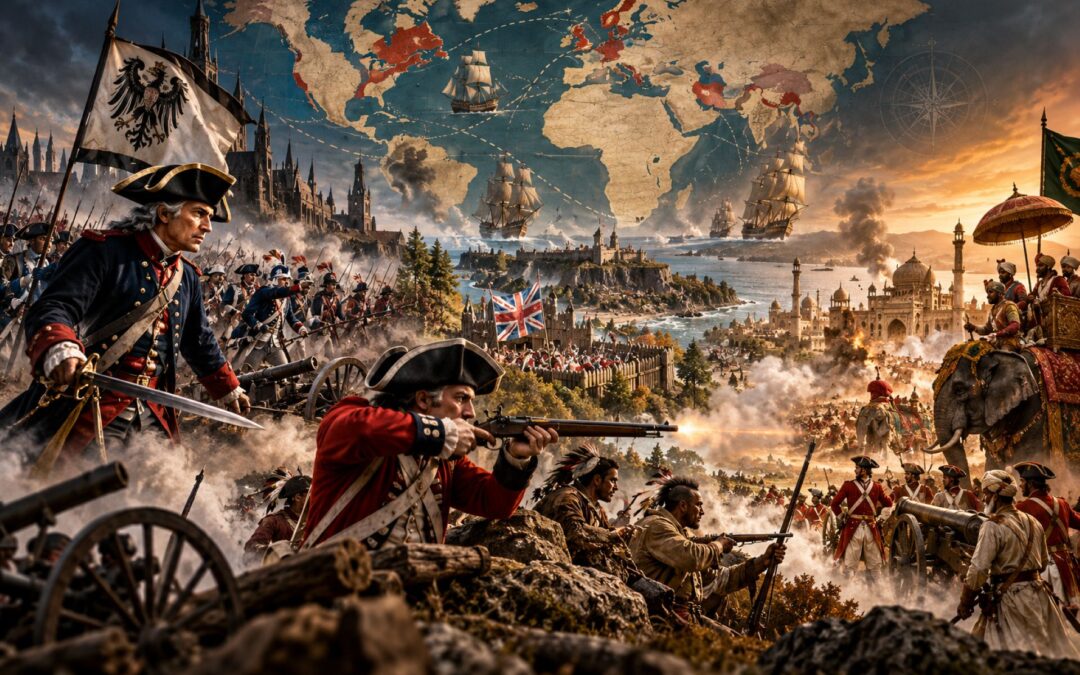
The resulting conflict became known as the Seven Years’ War, fought formally between 1756 and 1763, although hostilities in North America began two years earlier. Britain and France battled for colonial supremacy, Austria attempted to recover territory lost to Prussia, and Russia, Spain, Sweden, Portugal and numerous German states became involved. Fighting extended from the forests of North America to the battlefields of Central Europe, from India’s political courts and coastal settlements to the Caribbean, West Africa and the world’s oceans.
The Seven Years’ War has consequently been described as the first world war. Although earlier conflicts also crossed continents, the global scope of the Seven Years’ War makes that description understandable. It connected European diplomatic rivalries with overseas struggles whose participants had their own interests, ambitions and grievances.
By the time peace returned in 1763, Britain had emerged as the leading European colonial power, Prussia had secured its position among Europe’s great states, and France had suffered devastating overseas setbacks. Yet the settlement created new tensions that would help produce the American Revolution and another generation of international conflict. Understanding how the war unfolded reveals why victory on the battlefield did not necessarily bring lasting political stability.
The Unfinished Wars That Made Another Conflict Inevitable
The Seven Years’ War emerged from rivalries that had developed over generations. In eighteenth-century Europe, political authority was concentrated in hereditary monarchies, and the balance of power depended on dynastic marriages, territorial possessions, military strength and diplomatic alliances. The great powers constantly sought advantages over their neighbours, but they also feared allowing any single rival to become too powerful.
Two dynasties had dominated much of European politics: the Habsburgs, whose Austrian territories formed the core of an extensive Central European monarchy, and the Bourbons, who ruled France and Spain. Austria and France had traditionally regarded each other as enemies, while Britain frequently supported Austria to prevent French predominance on the continent. Prussia, an increasingly formidable military state in northern Germany, was emerging as a challenger to Habsburg authority.
These relationships were tested during the War of the Austrian Succession, which lasted from 1740 to 1748. The conflict began after Emperor Charles VI died and his daughter, Maria Theresa, inherited the Habsburg dominions. Although her succession had been anticipated through diplomatic arrangements, several European rulers challenged her position or sought territorial advantages from the uncertainty.
Frederick II of Prussia, later known as Frederick the Great, exploited the situation by invading Silesia, a wealthy province belonging to the Habsburg monarchy. Its agriculture, manufacturing and population made it a valuable acquisition, while its geographical position strengthened Prussia’s strategic position. Austria ultimately retained Maria Theresa’s succession but lost most of Silesia to Frederick.
The Treaty of Aix-la-Chapelle ended the wider conflict in 1748 without resolving these underlying disputes. Maria Theresa remained determined to recover Silesia, and Frederick knew that Austria would seek an opportunity to reverse its defeat. Both states therefore treated the peace as an uneasy interruption rather than a final settlement.
The war also failed to eliminate the growing maritime and colonial rivalry between Britain and France. Both possessed overseas trading networks, colonial settlements, commercial companies and naval forces capable of projecting influence far beyond Europe. Competition for trade, territory, military access and political alliances repeatedly brought their interests into conflict.
North America and India were particularly important. British and French expansion in those regions generated disputes that could not easily be settled by European treaties, especially because local populations and political authorities pursued objectives of their own. European officials might consider a boundary settled through diplomacy, while settlers, merchants, Indigenous nations or Indian rulers understood the situation differently.
The conditions for another major war were therefore already present. Austria wanted Silesia back, Prussia wanted to keep it, Britain and France were struggling for overseas supremacy, and Russia increasingly regarded Prussian expansion as a threat. What remained uncertain was how these rivalries would interact and which powers would stand together when fighting resumed.
From the Ohio Valley to the Diplomatic Revolution, 1754–1756
The first major escalation occurred in North America, where Britain and France possessed extensive but very different colonial systems. Britain’s thirteen mainland colonies were concentrated along the Atlantic coast and contained a growing population of settlers, agricultural communities and commercial towns. New France, by contrast, depended heavily on settlements around the St Lawrence River and a network of trading posts, waterways and alliances extending through the Great Lakes and Mississippi Valley.
The Ohio Valley became a particularly contentious region because it connected the Great Lakes with the interior of North America. British colonial settlers, land companies and officials wanted to expand westward, while France sought to preserve communications between Canada and Louisiana. Neither European claim eliminated the existing political authority of Indigenous nations, whose territories and trading networks predated both imperial systems.
French authorities began constructing forts to strengthen their position, including Fort Duquesne at the confluence of the Allegheny and Monongahela rivers, near present-day Pittsburgh. Virginia’s colonial government considered French expansion an intrusion into territory it claimed. Governor Robert Dinwiddie initially sent George Washington to deliver a demand for French withdrawal, but the French refused to abandon their positions.
In 1754, Washington returned with troops. He was supported by Indigenous allies, including Tanaghrisson, an influential Mingo leader whose interests and relationships with other Native nations shaped his participation. On 28 May, Washington’s men encountered a French party commanded by Joseph Coulon de Jumonville in a wooded ravine.
The resulting engagement at Jumonville Glen lasted only a short time, but its circumstances remain contested. French accounts portrayed Jumonville as carrying a diplomatic message, while British colonial accounts described a hostile French party operating in disputed territory. Accounts also differed over who fired first and precisely how Jumonville was killed, with Tanaghrisson playing a central role in some reconstructions.
The National Park Service’s account of Jumonville Glen illustrates why the incident cannot be understood simply as Washington attacking an enemy patrol. European imperial rivalry intersected with Indigenous diplomacy, territorial security and rival interpretations of what had happened. The ambiguity surrounding this encounter would become part of the larger dispute over responsibility for the escalating conflict.
French forces retaliated in July 1754 by attacking Washington’s position at Fort Necessity. Outnumbered and unable to sustain his defence, Washington surrendered on 3 July. The engagement ended his immediate expedition but intensified hostilities across the frontier, beginning the conflict known in North America as the French and Indian War.
Neither Britain nor France immediately declared formal war, yet both sent reinforcements and prepared for a wider confrontation. In June 1755, British forces seized Fort Beauséjour in Acadia, while colonial authorities initiated the deportation of thousands of Acadians, French-speaking inhabitants whose loyalty they distrusted. Families were separated, communities destroyed and people dispersed across British colonies and beyond.
The British also suffered a disastrous setback in July 1755 when Major-General Edward Braddock advanced towards Fort Duquesne. French troops and Indigenous allies attacked his expedition near the Monongahela River, inflicting heavy casualties and mortally wounding Braddock. The defeat exposed the limitations of conventional European formations when operating in unfamiliar terrain against opponents using different tactical methods.
At sea, British vessels began intercepting French ships even before the countries were formally at war. These attacks threatened French communications and commerce, while reinforcing fears in Paris that Britain intended to destroy French overseas power. France responded by preparing operations against British interests closer to Europe.
Meanwhile, the European alliance system underwent a transformation that historians call the Diplomatic Revolution. Britain needed to protect Hanover, the German electorate ruled by its monarch, George II, while Austria was chiefly concerned with recovering Silesia. These priorities increasingly conflicted, weakening the long-standing Anglo-Austrian relationship.
Britain concluded the Convention of Westminster with Prussia in January 1756, seeking to secure Germany against destabilizing military intervention and protect Hanover. Austria, under the direction of Maria Theresa and her minister Wenzel Anton von Kaunitz, developed closer relations with its traditional enemy France. The two powers formalized their new relationship through the First Treaty of Versailles in May 1756, while Russia remained deeply hostile to Frederick.
The reversal was extraordinary because it replaced decades of familiar diplomatic alignments with a new strategic division. France and Austria now cooperated against Prussia, while Britain supported Frederick despite their different long-term interests. Russia’s involvement strengthened the coalition threatening Prussia, while the Dutch Republic avoided direct participation.
The war entered its formal international phase in 1756. France attacked British-held Menorca in the Mediterranean, and Britain declared war on France on 17 May. Admiral John Byng failed to relieve the British garrison, after which the island surrendered; his subsequent court-martial and execution in 1757 demonstrated the political fury surrounding Britain’s early reverses.
In August 1756, Frederick invaded Saxony, a state associated with Austria’s coalition. His objective was to strike before his enemies could fully coordinate their forces and use Saxony as a route towards Austria’s territories in Bohemia. Instead of preventing a wider war, the invasion accelerated one.
The conflict had thus developed through two connected but distinct pathways. Britain and France were already fighting over colonial territory and maritime power, while the Austrian-Prussian rivalry threatened to engulf Central Europe. The Diplomatic Revolution connected these struggles into a confrontation that neither side could easily contain.
Frederick the Great and Prussia’s Fight for Survival
Prussia entered the European war in a dangerous position. Frederick the Great commanded a highly disciplined army whose organization, training and battlefield manoeuvres were admired throughout Europe. Yet Prussia possessed fewer resources and a smaller population than the major powers arrayed against it, leaving little room for prolonged defeat.
Frederick’s strategy depended on speed, concentration and the ability to defeat enemies separately before they combined their forces. His invasion of Saxony secured an important strategic position and placed pressure on Austria. However, his subsequent campaigns demonstrated that tactical skill could not easily overcome the geographical and numerical problems facing his kingdom.
In October 1756, Frederick fought an Austrian army at Lobositz in Bohemia. The Prussians ultimately gained the field, but the engagement showed that Austria’s forces were capable of resisting his attacks. Frederick spent the following months preparing a more ambitious campaign intended to defeat Austria before Russia could become fully engaged.
In May 1757, he invaded Bohemia and fought a major battle outside Prague. The Prussians defeated the Austrian field army at considerable cost, forcing much of it to withdraw into the city. Frederick began a siege, hoping to secure a decisive result that would break Austrian resistance.
The campaign unravelled in June at the Battle of Kolín. Austrian forces under Leopold Joseph von Daun defeated Frederick’s army, ending the siege of Prague and forcing the Prussians to retreat. Austria had prevented a rapid Prussian victory and demonstrated that Frederick’s military system could be beaten.
Threats simultaneously developed elsewhere. French armies advanced into Hanover, defeating an allied force under the Duke of Cumberland at Hastenbeck in July 1757. The Convention of Kloster Zeven subsequently provided for the withdrawal and neutralization of much of the Hanoverian military effort, although the British government later rejected the arrangement.
Russia also entered the fighting against Prussia, defeating a Prussian force at Gross-Jägersdorf in August 1757. Russian troops threatened East Prussia and its surrounding territories, while Sweden joined the anti-Prussian coalition and opened operations in Pomerania. Frederick now faced danger from several directions, with little prospect of replacing soldiers and resources as easily as his larger opponents.
His fortunes improved dramatically towards the end of 1757. At Rossbach on 5 November, Frederick used rapid manoeuvre, cavalry attacks and artillery to defeat a larger French and German force. The victory was particularly important because it weakened one of the immediate threats to Prussia and undermined France’s military reputation.
Frederick then redirected his forces against Austria. At Leuthen on 5 December, he employed an oblique attack that concentrated Prussian strength against a vulnerable section of the Austrian army. The resulting victory restored much of the ground lost in Silesia and established Leuthen as one of the most celebrated engagements of eighteenth-century warfare.
Rossbach and Leuthen transformed Frederick’s international reputation, but neither ended the struggle. Austria remained determined to regain Silesia, Russia continued to mobilize enormous military resources, and the French retained substantial forces in western Germany. Prussia’s battlefield successes could relieve immediate pressure without eliminating the strategic coalition confronting it.
Britain’s support became increasingly important. William Pitt, who emerged as the leading figure directing British wartime policy, recognized that Prussia’s continued resistance helped prevent France from concentrating its strength against British colonial possessions. British financial subsidies therefore supported Frederick’s military operations, while British and allied troops sought to protect Hanover.
The Hanoverian war changed direction under Ferdinand of Brunswick, who reorganized the allied forces after the failed 1757 campaign. His troops drove French forces out of Hanover in 1758 and won important engagements, including Krefeld. Although France retained substantial armies in Germany, it could not simply overrun Hanover or redirect all its continental resources overseas.
Frederick, meanwhile, confronted Russia in a series of increasingly destructive campaigns. In August 1758, Prussian and Russian armies fought at Zorndorf, an exceptionally bloody battle whose outcome remained strategically inconclusive. Both sides suffered heavy losses, and the Russian threat remained intact despite Frederick’s determination to destroy it.
The decisive crisis came in 1759. In July, a Prussian army suffered defeat at Kay, weakening Frederick’s position against the Russians. On 12 August, Frederick attacked a combined Russian-Austrian army near Kunersdorf, where an initially promising Prussian assault ended in catastrophe.
The battle destroyed much of Frederick’s effective fighting strength, and he narrowly escaped with the remnants of his army. For a time, the Prussian monarchy appeared close to military collapse. Austria and Russia possessed an opportunity to exploit their victory, but difficulties coordinating their armies, concerns over supplies and competing strategic priorities prevented a decisive follow-up.
Prussia suffered another serious setback in November when an isolated corps surrendered to Austrian forces at Maxen. The combination of Kunersdorf and Maxen made 1759 one of the most dangerous years of Frederick’s reign. His survival owed as much to the limitations and disagreements of his opponents as to his own ability to recover from defeat.
Fighting continued in 1760. Austrian forces defeated Prussian troops at Landeshut, while Frederick won an important victory at Liegnitz in August despite facing a formidable enemy concentration. Later that year, he fought another costly battle at Torgau, compelling the Austrians to retreat but paying heavily for the result.
These engagements revealed the fundamental problem facing Prussia. Frederick could win battles without destroying the coalition, and victories often consumed soldiers whom he could not readily replace. Austria and Russia could suffer defeats yet continue campaigning because their larger territories and populations offered greater military endurance.
By 1761, the situation had become increasingly desperate. The Russians and Austrians exerted continuous pressure, Prussia’s finances were strained, and the Russians captured the Baltic port of Kolberg in December. Control of the port improved their ability to supply forces operating against Prussia and raised the prospect of a more decisive offensive.
Britain’s support was also becoming politically uncertain, particularly as the British government reassessed the growing costs of continental warfare. Frederick could no longer assume that subsidies would continue indefinitely, and his kingdom was approaching the limits of its military capacity.
What rescued Prussia was ultimately a diplomatic transformation outside Frederick’s control. Empress Elizabeth of Russia died on 5 January 1762, and her successor, Peter III, was an admirer of Frederick. Peter rapidly abandoned Russia’s anti-Prussian policy, made peace and formed an alliance with Prussia, temporarily providing the relief Frederick desperately needed.
Peter’s reign ended after a palace coup brought Catherine II to power. Catherine did not preserve his military alliance with Prussia, but neither did she immediately resume Russia’s campaign against Frederick. Russia’s departure from the hostile coalition fundamentally altered Prussia’s prospects and allowed Frederick to recover positions in Silesia.
This reversal is often called the Miracle of the House of Brandenburg. It illustrates why the outcome of the war cannot be explained solely through military genius. Frederick survived through battlefield successes, British financial assistance, opposing coalition weaknesses and an unexpected change of government in Russia.
The resulting peace would confirm Prussia’s retention of Silesia, consolidating its position as one of Europe’s great powers. The longer rivalry between Austria and Prussia would subsequently become an important part of the political history of the German states, eventually shaping the struggle over German leadership in the nineteenth century.
The French and Indian War: Britain’s Conquest of Canada
While Frederick fought for survival in Europe, Britain and France pursued a different struggle in North America. The immediate prize was control of the continent’s valuable waterways, trade routes, fortified settlements and expanding frontier regions. Yet the outcome also depended on Indigenous nations whose own political interests were threatened by European territorial ambitions.
France initially enjoyed important advantages. Its trading and diplomatic relationships with Indigenous communities provided valuable intelligence, military assistance and access to the continental interior. British settlers greatly outnumbered French settlers, but Britain struggled to coordinate its colonies and deploy forces effectively across difficult terrain.
The French exploited these weaknesses during the early stages of the war. After the defeat of Braddock’s expedition in 1755, they captured Fort Oswego on Lake Ontario in 1756, undermining British access to important northern routes. In 1757, Louis-Joseph de Montcalm’s forces took Fort William Henry near Lake George after a siege.
The surrender at Fort William Henry became notorious because some Indigenous warriors attacked portions of the withdrawing British column, taking captives and killing people despite the terms agreed by European commanders. The violence reflected tensions between European rules of surrender and the expectations, grievances and independent decisions of Indigenous participants. It cannot be accurately explained by treating all Native allies as soldiers under French military command.
Britain also inflicted suffering on civilian populations during the conflict. The deportation of the Acadians, begun in 1755, uprooted thousands of French-speaking inhabitants from Nova Scotia and neighbouring regions. British authorities feared that Acadian neutrality concealed support for France, but the expulsions punished entire communities and created a diaspora whose consequences survived long after the fighting ended.
The balance gradually shifted as Britain mobilized greater military and financial resources. The thirteen mainland colonies contained a far larger population of European settlers than New France, providing Britain with potential manpower and supplies. The Royal Navy also made it increasingly difficult for France to reinforce Canadian positions while maintaining commitments in Europe.
William Pitt supported a more coordinated strategy focused on defeating French power overseas while subsidizing Prussia’s European resistance. The objective was not to defeat the French army everywhere on land, but to exploit Britain’s comparative advantages in naval power, finance and colonial mobilization. British commanders increasingly combined regular soldiers, provincial troops, Indigenous allies and amphibious operations.
The campaign of 1758 brought a major reversal of French fortunes. British forces captured Louisbourg, the heavily fortified French position on Cape Breton Island, opening the approaches to the St Lawrence River. They also captured Fort Frontenac and Fort Duquesne, damaging French supply lines and weakening French control of the western frontier.
Not every British operation succeeded. At Carillon, near Lake Champlain, Montcalm’s forces defeated a much larger British army in July 1758, demonstrating that French commanders could still exploit strong defensive positions. Nevertheless, Britain’s growing numerical and logistical advantages made sustained French resistance increasingly difficult.
The decisive campaign came in 1759. British forces under Major-General James Wolfe sailed up the St Lawrence River to attack Quebec, the principal fortified city of New France. Wolfe faced a difficult challenge because Montcalm defended strong positions overlooking approaches to the settlement, while the British expedition needed to secure victory before winter made river operations impossible.
After weeks of manoeuvring and unsuccessful attacks, Wolfe landed troops upstream from Quebec during the night of 12–13 September. British soldiers climbed to the heights above the river and assembled on the Plains of Abraham. Montcalm chose to attack before the British could strengthen their position.
The engagement on 13 September ended in a decisive British victory. French troops were driven back, and both Wolfe and Montcalm received mortal wounds. Quebec surrendered shortly afterwards, giving Britain control of a crucial strategic position, although the struggle for Canada was not immediately over.
French forces won a battle near Quebec at Sainte-Foy in April 1760 and attempted to recover the city. Their efforts failed when British naval reinforcement strengthened the garrison. In September 1760, British armies converged on Montreal, compelling the surrender of the remaining major French forces in Canada.
The conquest effectively ended French colonial rule over mainland Canada. It did not, however, mean that France’s former Indigenous allies had accepted British authority or that Britain controlled every territory claimed on European maps. Native nations continued pursuing their own diplomatic and military objectives, and many feared that British settlement would threaten their lands more severely than the earlier French trading system.
For Britain, victory created an enormous imperial opportunity alongside major administrative problems. The government now ruled a substantial French-speaking Catholic population and faced the challenge of managing relations with numerous Indigenous nations. These responsibilities would complicate the wider transformation of France’s colonial empire and Britain’s expansion in North America.
India: How a Commercial Rivalry Changed the Balance of Power
The struggle between Britain and France in India developed from circumstances very different from those in North America. India was not an empty territorial prize awaiting European conquest, nor was it governed by one unified political authority. It contained powerful regional states, established commercial networks, major urban centres and political institutions whose histories extended far beyond European involvement.
The Mughal Empire had exercised extensive authority over much of the subcontinent, but its central power weakened during the eighteenth century. Provincial rulers and regional powers increasingly asserted their independence or autonomy. The Maratha Confederacy expanded across large territories, while the rulers of Bengal, Awadh, Hyderabad, Mysore and other states pursued competing ambitions.
British and French commercial companies operated within this political landscape. The English East India Company maintained important settlements at Bombay, Madras and Calcutta, while the French East India Company possessed establishments including Pondicherry and Chandernagore. Their wealth depended on Indian textiles, commercial credit, maritime trade and favourable relationships with local rulers.
The companies were not simply private merchants exchanging goods. They possessed armed forces, fortified settlements and political privileges acquired through negotiations with Indian authorities. European soldiers and locally recruited Indian troops served in company armies, allowing commercial disputes to become military confrontations.
The Carnatic Wars had already demonstrated how European rivalries could become entangled with Indian succession disputes and regional conflicts. Fighting in southern India continued beyond the European War of the Austrian Succession, with British and French representatives supporting competing claimants and seeking political influence. Robert Clive gained military prominence during these struggles, notably through his operations around Arcot.
When the Seven Years’ War began in Europe, its consequences reached India through these existing networks of conflict. Yet Indian rulers were not merely extensions of European alliances. They sought military assistance, commercial advantages, legitimacy and territorial influence for reasons rooted in local political circumstances.
Bengal became the most important location for the East India Company’s expansion. Its agricultural production, textile industry and commercial wealth made the province one of India’s richest regions. The Nawab of Bengal, Siraj ud-Daulah, regarded the company’s growing fortifications, disputed privileges and political interference as threats to his authority.
In 1756, Siraj’s forces captured Calcutta. British forces subsequently retook the settlement in January 1757, and Clive began preparing for a confrontation with the nawab. Meanwhile, company officials cultivated relationships with influential figures inside Bengal’s political establishment who were dissatisfied with Siraj’s rule.
These figures included Mir Jafar, a senior military commander who expected to benefit from replacing Siraj. Wealthy commercial interests and political intermediaries also participated in arrangements intended to transfer power. The resulting conspiracy was crucial to what happened at Plassey.
On 23 June 1757, Clive confronted Siraj’s much larger army near the village of Plassey, or Palashi. The company’s forces included European soldiers and several thousand Indian sepoys, while the nawab possessed a considerably larger army supported by artillery and a small French contingent. Yet the apparent numerical imbalance concealed serious political divisions within Siraj’s command.
The fighting involved artillery exchanges, a heavy rainstorm and manoeuvres that affected the effectiveness of the opposing forces. More importantly, Mir Jafar and other commanders failed to provide the support Siraj needed. The nawab’s military position collapsed, allowing Clive to secure a victory far greater than the size of the engagement initially suggested.
The National Army Museum’s reconstruction of the Battle of Plassey demonstrates the importance of both battlefield circumstances and Mir Jafar’s refusal to participate decisively. Plassey was not simply a demonstration that a small European force could defeat an enormous Indian army through superior military technology. It was also a political struggle over Bengal’s government, in which Indian elites played indispensable roles.
Siraj was captured and killed after his defeat, and Mir Jafar became nawab under arrangements that greatly increased the company’s influence. British officials received financial payments and commercial privileges, while the corporation acquired the ability to intervene more extensively in Bengal’s political affairs. The victory marked an important stage in the company’s transformation from merchant enterprise to territorial power.
Nevertheless, Plassey did not instantly give Britain sovereignty over India or even uncontested direct rule over Bengal. The company’s political position continued to evolve through subsequent confrontations and negotiations. Its victory at Buxar in 1764 and the acquisition of Diwani revenue-collection rights in 1765 were crucial further stages in establishing a durable company state.
Meanwhile, the British and French continued fighting in southern India. French commanders initially threatened British positions, but difficulties obtaining reinforcement and sustaining campaigns weakened their prospects. The French siege of Madras failed, and British forces under Eyre Coote defeated a French army at Wandiwash in January 1760.
The victory at Wandiwash severely damaged French military power in the Carnatic. British forces subsequently besieged Pondicherry, which surrendered in January 1761. These defeats ended France’s realistic prospect of challenging British military predominance through its existing Indian company forces.
France nevertheless retained a presence in India after the peace settlement. Its trading establishments survived under restrictions, and French commercial and cultural influence did not disappear. What changed was the balance of military and political power between the two European companies.
The Seven Years’ War therefore accelerated a transformation whose consequences would extend far beyond 1763. Through alliances, military victories, revenue arrangements and intervention in Indian politics, the East India Company began developing from a trading corporation into a ruling power. The resulting conquest unfolded over generations and depended on India’s own political divisions as well as British military and financial resources.
The Royal Navy and Britain’s War Across the Oceans
The Seven Years’ War could not have become a global conflict without maritime power. Oceans connected European governments with colonies, commercial establishments and military forces separated by enormous distances. Ships carried soldiers, weapons, food, money and information, while control of important sea routes determined whether distant settlements could be defended or attacked.
Britain possessed a particularly important advantage through the Royal Navy. Its fleet was supported by a substantial merchant marine, financial institutions and an increasingly sophisticated system for funding military operations. Britain could sustain campaigns across several theatres while using naval pressure to interrupt French commerce and restrict enemy reinforcement.
France remained a formidable military power, especially on land, but it faced difficult strategic choices. Maintaining armies in Europe consumed enormous resources, while protecting its overseas possessions required ships that could compete with the Royal Navy. French commanders frequently had to decide whether to concentrate on continental operations or risk important forces in distant colonial campaigns.
William Pitt’s strategy sought to exploit these pressures. British subsidies helped keep Prussia engaged against France and Austria, while British and allied forces defended Hanover. Meanwhile, the Royal Navy supported attacks on French commerce, coastal facilities and overseas territories.
Britain initially experimented with raids against the French coastline. Operations against Rochefort in 1757 and Cherbourg in 1758 were intended to disrupt enemy facilities, demonstrate naval reach and force France to retain troops for coastal defence. Their results were mixed, with some successes offset by failed operations and substantial costs.
The British increasingly concentrated on overseas possessions whose capture could damage French finances or strengthen Britain’s negotiating position. In West Africa, expeditions attacked French commercial settlements around Senegal, including the important trading centre at Saint-Louis in 1758. These operations targeted trading networks connected with commodities such as gum arabic and enslaved people.
The Caribbean was especially valuable. French colonies such as Guadeloupe and Martinique produced sugar through plantation systems dependent on enslaved African labour. Their exports generated considerable wealth, making them economically significant territories despite their relatively small geographical size.
In 1759, a British expedition captured Guadeloupe after difficult operations during which tropical diseases caused heavy losses. The island’s economic importance made its seizure a significant blow to France. Britain subsequently captured Martinique in 1762, extending its temporary control over valuable French Caribbean possessions.
These campaigns demonstrated both the strength and the limitations of naval power. British ships could transport troops, blockade ports and support amphibious assaults, but military success still depended on land forces capable of taking and holding defended territory. Disease, supply shortages and unfamiliar conditions frequently proved as dangerous as enemy resistance.
The decisive naval year was 1759. France had developed plans to invade Britain, hoping that an attack near the British homeland might reverse its deteriorating international position. The operation required French naval forces to protect troop transports and overcome Britain’s command of surrounding waters.
In August, Admiral Edward Boscawen engaged a French Mediterranean squadron under Jean-François de La Clue-Sabran near Lagos, off the Portuguese coast. The British victory damaged French naval strength and reduced the possibility of coordinating French fleets for a major invasion. Nevertheless, the French Brest fleet remained an important threat.
The final confrontation came on 20 November at Quiberon Bay, off the French Atlantic coast. Admiral Edward Hawke pursued the French fleet commanded by Hubert de Brienne, Comte de Conflans, as it attempted to seek shelter in dangerous coastal waters. Hawke followed despite the risks posed by reefs, poor weather and difficult navigation.
The battle ended in a decisive British victory. French ships were sunk, captured, driven ashore or trapped in positions from which they could not readily operate. As the Royal Museums Greenwich account of Quiberon Bay explains, the result effectively destroyed France’s immediate ability to execute its planned invasion.
The naval success reinforced British victories elsewhere in 1759, particularly in North America and the Caribbean. The year became celebrated in Britain as an annus mirabilis, or miraculous year, because successes across multiple theatres dramatically improved its prospects. Yet Prussia’s near-collapse at Kunersdorf showed that Britain’s global coalition was not winning uniformly.
By preventing France from using its fleet effectively and limiting reinforcement of overseas positions, the Royal Navy helped convert Britain’s financial and commercial resources into military advantage. Its contribution cannot be measured solely by the number of enemy ships destroyed. Naval supremacy made sustained operations possible across an imperial system whose major territories lay thousands of miles apart.
The strategy also inflicted extensive economic disruption. French merchants struggled with interrupted trade, vulnerable shipping and the effects of blockades, while the loss of valuable colonial production reduced commercial revenues. Such pressure did not independently force France to surrender, but it strengthened Britain’s negotiating position as the war approached its end.
The Turning Point of 1762: Russia, Spain and the Final Campaigns
By 1761, the principal belligerents had been fighting for years without achieving all their objectives. Austria still sought Silesia, Frederick struggled to preserve Prussia, and France faced continuing defeats overseas. Britain had gained enormously from its military campaigns but incurred substantial debt and could not assume that every additional year of fighting would produce comparable benefits.
The war’s final phase was shaped as much by dynastic succession and diplomatic calculation as by battlefield victories. The most consequential change occurred in Russia, where Empress Elizabeth had been a determined opponent of Frederick the Great. Russian armies had imposed severe losses on Prussia and contributed significantly to its increasingly desperate position.
Elizabeth’s death on 5 January 1762 brought Peter III to the throne. Peter admired Frederick and rejected the anti-Prussian direction of Russian policy. He rapidly negotiated peace, restored Russian conquests to Prussia and temporarily entered a military alliance with Frederick.
The reversal deprived Austria of a crucial partner. Frederick could now redirect forces against his remaining enemies and recover positions that had appeared permanently lost. The change was especially remarkable because Russia had been approaching a position from which its continued military pressure might have helped destroy Prussian resistance.
Peter’s policies did not survive unchanged after Catherine II seized power in July 1762. She withdrew Russia from the alliance with Prussia rather than maintaining Peter’s commitment to Frederick’s cause. Nevertheless, she did not restore active Russian participation in the anti-Prussian coalition, preserving the strategic relief that had saved Frederick.
Sweden also reached peace with Prussia in 1762, ending another source of military pressure. Frederick could now concentrate more effectively on Austria and Saxony. His improved position did not guarantee complete victory, but it made a negotiated settlement increasingly attractive to enemies who had failed to defeat him despite years of campaigning.
Meanwhile, Spain had entered the conflict against Britain. Although Spain and France were both ruled by Bourbon monarchies, Spain had initially avoided direct participation. Charles III, who became king in 1759, increasingly feared that unchecked British overseas expansion would threaten Spain’s own imperial possessions.
The Third Family Compact of 1761 strengthened cooperation between the French and Spanish Bourbon monarchies. Britain interpreted the arrangement as evidence that Spain intended to support France, and Anglo-Spanish tensions escalated into war in early 1762. Portugal, Britain’s long-standing ally, was also drawn into the conflict.
Spain’s intervention expanded the geographical struggle just as France’s military position was deteriorating. British forces quickly targeted vulnerable Spanish possessions, aiming to convert maritime superiority into territorial gains. The resulting operations demonstrated the reach of British expeditionary warfare.
In June 1762, a large British expedition attacked Havana, the principal Spanish naval and commercial centre in Cuba. After a prolonged siege involving difficult fighting and heavy losses from disease, the city surrendered in August. Havana’s capture threatened Spain’s Caribbean defensive system and handed Britain an immensely valuable bargaining position.
Another British expedition attacked Manila in the Philippines. Forces under Admiral Samuel Cornish and Brigadier-General William Draper captured the city in October 1762. The British did not conquer the entire Philippine archipelago, and Spanish authority continued across much of the surrounding territory, but Manila’s loss represented a serious strategic humiliation.
Spain and France attempted to retaliate in Europe by invading Portugal. The campaign initially appeared promising because of the numerical advantages available to the invading armies. However, Portuguese resistance, British reinforcements, supply problems and the difficult operating environment prevented the attackers from obtaining a decisive victory.
By the end of 1762, Spain’s intervention had achieved little of what Charles III intended. Britain held Havana and Manila, the invasion of Portugal had failed, and France lacked the ability to reverse its overseas defeats. Spain’s experience demonstrated that entering the war late did not guarantee favourable results, particularly against an opponent capable of projecting military power across oceans.
The other belligerents also faced strong incentives for peace. Austria had failed to recover Silesia despite enormous effort, Prussia had survived at terrible cost, and France could no longer reasonably expect its colonial position to return to what it had been before the war. Britain remained militarily successful but had reasons to secure its gains rather than continue spending indefinitely.
The conditions for negotiation had therefore emerged from exhaustion, strategic disappointment and changes in political circumstances. Britain and Prussia were approaching peace from positions of relative advantage, but their successes differed fundamentally. Britain had acquired territories and commercial opportunities, while Prussia had chiefly ensured that the coalition against it could no longer destroy the state.
The Peace of 1763: Two Treaties and a New Global Order
The Seven Years’ War ended through two major peace settlements signed within days of one another in February 1763. They addressed different parts of the conflict and produced very different outcomes. The distinction matters because the European territorial balance remained relatively stable even as overseas imperial power changed dramatically.
The Treaty of Paris was signed on 10 February 1763 between Britain, France and Spain, with Portugal included in the settlement. It dealt principally with the colonial and maritime struggle, confirming Britain’s gains while restoring certain territories that had been captured during the fighting. The negotiations revealed that military occupation did not automatically determine which possessions would be retained permanently.
France surrendered Canada and most of its remaining mainland North American claims east of the Mississippi River to Britain. It also confirmed British control over territories such as Acadia, although much of that region had already been transferred under earlier treaties. France retained limited fishing rights and received Saint Pierre and Miquelon for fishing-related purposes.
The transfer fundamentally changed the European political geography of North America. Britain had eliminated France as its principal territorial competitor across much of the continent, dramatically enlarging its imperial responsibilities. However, the territorial settlement was an agreement among European monarchies, not a transfer of Indigenous sovereignty that Native nations necessarily accepted.
The settlement also involved major exchanges with Spain. Spain ceded Florida to Britain in return for the restoration of Havana, which Britain had captured the previous year. France had separately agreed to transfer Louisiana west of the Mississippi, together with New Orleans, to Spain through arrangements made in 1762.
These exchanges changed the political balance in North America without eliminating underlying disputes over territory. Britain gained a much larger geographical empire, Spain retained an extensive continental presence, and France withdrew from its former position as a major territorial power in mainland North America.
The Caribbean settlement followed a different logic. Britain restored Guadeloupe and Martinique to France despite the enormous resources expended in capturing them. Their prosperous sugar plantations made these islands extraordinarily valuable, and France considered retaining its Caribbean economy more important than recovering most of continental Canada.
Britain nevertheless secured additional Caribbean possessions, including Grenada, Tobago, Dominica and Saint Vincent, while France retained Saint Lucia. The settlement demonstrated that imperial negotiators evaluated territories according to commercial profitability, strategic usefulness and the political costs of holding them. Land area alone was a poor measure of a colony’s importance.
The West African settlement also strengthened Britain’s position in certain commercial territories associated with Senegal. French interests in the region were reduced, although French trading activity in West Africa did not disappear. These arrangements affected trading networks closely connected with Atlantic commerce and slavery.
In India, the agreement restored limited French commercial establishments but prevented France from recovering the position it had held as a major military competitor to Britain. The French could continue trading, yet the East India Company possessed a decisive advantage in Bengal and southern India. Britain’s expanding influence would be consolidated through later Indian political and military developments, rather than through an immediate transfer of the entire subcontinent in 1763.
Britain also recovered Menorca, which France had captured near the beginning of the war. This restoration mattered because the Mediterranean island provided a strategically valuable naval position. The combination of overseas acquisitions and recovered European possessions strengthened Britain’s maritime system substantially.
The original Treaty of Paris of 1763 shows the detailed nature of these arrangements, including provisions governing territorial transfers, religious rights, commercial privileges and the circumstances under which inhabitants could leave ceded possessions. The settlement was more complex than a simple declaration that Britain had defeated France and taken its empire.
Five days later, on 15 February, the Treaty of Hubertusburg brought peace between Prussia, Austria and Saxony. Unlike the Treaty of Paris, it produced no comparable rearrangement of overseas possessions. Its principal effect was to restore the territorial situation in Central Europe largely to the position that had existed before the war.
For Frederick the Great, this was a remarkable political achievement. Prussia retained Silesia despite years of warfare against a coalition of larger powers, preserving the territorial acquisition that had triggered much of Austria’s hostility. Frederick emerged with an enhanced military reputation and Prussia’s status as a major European power more securely established.
Austria, however, had not achieved its central objective. Maria Theresa failed to recover Silesia, despite committing extensive military and diplomatic resources to the campaign. The Habsburg monarchy remained powerful, but its rivalry with Prussia continued to shape politics within the German-speaking world.
France emerged from the war badly weakened in its overseas position. Its army remained a significant European force, and it retained valuable colonies, particularly in the Caribbean. Nevertheless, the loss of Canada, the failure of its invasion plans and the reduction of its military influence in India damaged its strategic position and prestige.
Russia’s experience was more ambiguous. Its armies had demonstrated an ability to operate effectively against Prussia, but the change of government in 1762 prevented Russia from converting those successes into lasting territorial acquisitions. The war nevertheless confirmed Russia’s importance in European great-power politics, where its military and diplomatic choices could determine the fate of other states.
Britain was the clearest beneficiary of the overseas settlement. It acquired extensive territories, strengthened its navy’s international standing and consolidated its commercial position. The victory helped establish Britain as the leading European imperial power of the period, marking an important stage in the expansion of the British Empire.
Yet the settlement left important questions unresolved. Britain’s new American territories contained populations with different languages, religious traditions and political expectations. French-speaking Catholics in Canada would have to be governed within a Protestant British empire, while Indigenous nations confronted growing pressure from settlers and colonial authorities.
Many Native communities rejected the assumption that France’s defeat gave Britain uncontested authority over their lands. In 1763, a broad Indigenous resistance movement associated with Pontiac challenged British forts, settlements and policies around the Great Lakes and Ohio Country. The fighting demonstrated how European peace agreements could produce new conflicts among people who had not participated in negotiating them.
India presented a similarly complicated picture. British commercial and military influence had expanded, but the subcontinent remained home to powerful states whose governments retained substantial authority. The company’s future expansion depended on further wars, political alliances, revenue settlements and intervention in regional disputes.
The war also left European governments struggling with its financial consequences. Military campaigns had required borrowing, taxation and increasingly elaborate systems of state finance. Britain possessed unusually strong credit and financial institutions, yet its victory created debts and new imperial commitments that policymakers believed the colonies should help support.
Those expectations would help destabilize Britain’s relationship with its North American settlers. Colonial assemblies had long exercised considerable authority over local taxation and government, and many colonists viewed new parliamentary demands as violations of established constitutional rights. British ministers, by contrast, regarded the costs of imperial defence and administration as responsibilities that should be shared across the empire.
The Royal Proclamation of 1763 attempted to regulate settlement beyond the Appalachian Mountains, partly to reduce conflict with Indigenous nations. Settlers and land speculators resented restrictions that obstructed westward expansion, while Native communities remained concerned that British authorities could not effectively control colonial encroachment.
Subsequent measures, including the Sugar Act of 1764 and Stamp Act of 1765, intensified arguments about taxation, representation and the authority of Parliament. These disputes arose from more than the war’s financial cost, but Britain’s new imperial position made them increasingly difficult to resolve. The government had gained a larger empire while inheriting political responsibilities that its existing institutions struggled to accommodate.
The Seven Years’ War thus transformed global power without producing lasting political stability. Britain had defeated its principal overseas rival, Prussia had preserved Silesia, and France had lost much of its mainland North American empire. Yet the settlement left unresolved questions about sovereignty, colonial government, financial obligations and the distribution of power.
Within little more than a decade, Britain’s American colonies would begin their rebellion, setting in motion the American Revolution. France would later support the Americans in a new opportunity to weaken Britain, while its own financial pressures and political problems continued to deepen.
The Seven Years’ War was transformative precisely because its consequences extended far beyond the territories captured or restored in 1763. It altered the relationships between European states, reshaped colonial power in North America and India, and created new pressures within the victorious British Empire. The peace ended one interconnected global struggle, but it helped establish the conditions from which another would emerge.
Last Updated on October 31, 2026 by Aseem Gupta