
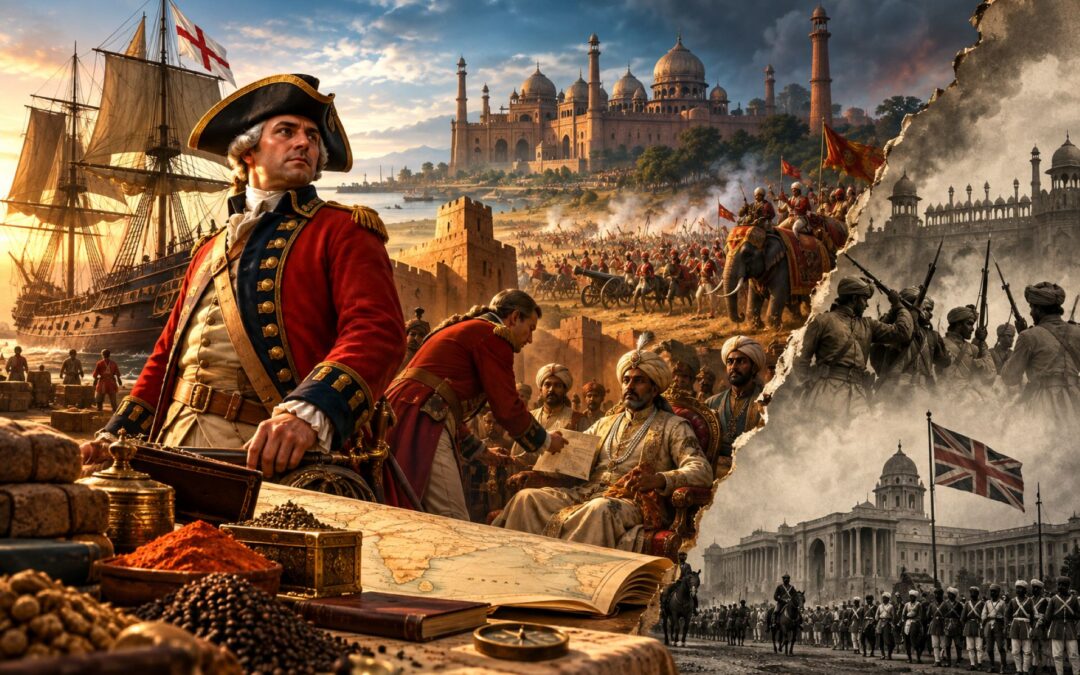
In 1600, a group of English merchants received permission from Queen Elizabeth I to establish a company for trading with Asia. Their ambitions were commercial: purchase valuable goods, transport them across the oceans, sell them in European markets, and reward the investors who financed the voyages. They could hardly have imagined that their enterprise would eventually command enormous armies, collect taxes from millions of people, and govern vast territories across the Indian subcontinent.
Yet that is precisely what the East India Company became. By the nineteenth century, a corporation headquartered in London’s Leadenhall Street had transformed itself into one of the most extraordinary political institutions in history. Its officials negotiated treaties, conducted wars, appointed administrators, displaced Indian rulers, and controlled revenues that could finance further territorial expansion. Although its directors and shareholders remained in Britain, much of the power sustaining the organization came from Indian soldiers, merchants, financiers, and taxpayers.
The Company’s rise was neither inevitable nor an uninterrupted sequence of European victories. For much of its early existence, it depended on the permission of powerful Asian governments and struggled against established commercial rivals. Its transformation into a territorial power required political alliances, military victories, access to Indian revenues, and increasingly extensive support from the British state.
Its eventual downfall was equally remarkable. Parliamentary intervention gradually stripped the Company of its commercial independence, and a widespread rebellion in 1857 convinced the British government to take direct control of its Indian territories. The corporation survived the loss of its governing authority for another sixteen years before disappearing in 1874.
The history of the East India Company is therefore more than the story of a successful trading enterprise or the beginning of British rule in India. It explains how a commercial organization acquired the powers of a government, how those powers reshaped the societies under its control, and why the institution that built such an empire ultimately could not retain it.
Why England Created the East India Company in 1600
At the end of the sixteenth century, European merchants were eager to participate more directly in the profitable trading networks connecting India, China, and Southeast Asia. Asian markets supplied commodities that European consumers valued highly, including pepper, cinnamon, cloves, nutmeg, silk, cotton textiles, and porcelain. These products could be transported over great distances and sold at prices that made successful trading expeditions extremely attractive to investors.
Portugal had established a maritime route to India after Vasco da Gama reached Calicut in 1498. Portuguese merchants subsequently developed an extensive network of trading settlements, fortified ports, and commercial relationships across the Indian Ocean. Spanish expansion had likewise demonstrated the possibilities of overseas commerce and imperial acquisition, while merchants in the Dutch Republic were becoming formidable competitors in Asian trade.
England entered this competition relatively late. Its merchants understood that accessing Asian markets could produce substantial profits, but organizing expeditions required considerable capital. Ships had to be purchased or equipped, sailors recruited, provisions assembled, and valuable cargoes acquired. A successful voyage might take several years, while storms, disease, piracy, warfare, and commercial failure could destroy an investment entirely.
The joint-stock company offered a way to distribute these risks among investors. Rather than financing an expedition individually, merchants and other investors could contribute capital to a common enterprise. The company would organize commercial operations, and those who supplied the funds would receive returns when its ventures generated profits.
England already possessed experience with chartered trading organizations. The Muscovy Company, established in 1555, had helped English merchants develop commercial connections with Russia. Similar arrangements demonstrated how private capital and government privileges could be combined to support expensive overseas enterprises.
On December 31, 1600, Elizabeth I granted a royal charter to the Governor and Company of Merchants of London Trading into the East Indies. The organization became commonly known as the English East India Company. Its charter provided privileged access to English trade in designated eastern markets, protecting the enterprise against competing English merchants operating outside the authorized arrangements.
The Company was governed by a governor and a body of directors, traditionally numbering twenty-four, who represented its commercial leadership. Investors expected financial returns, while the English Crown viewed overseas trade as a means of increasing national wealth and strengthening England’s commercial position.
The Company’s original purpose was not to conquer India or establish an Asian territorial empire. As the British Library’s historical account of the East India Company’s formation and operations explains, its early existence revolved around voyages, trading privileges, commercial settlements, and negotiations with Asian authorities.
The first English expeditions encountered a commercial world that was already sophisticated and intensely competitive. Indian merchants supplied established international markets, Southeast Asian ports connected regional trading networks, and powerful rulers controlled access to valuable commercial centres. European merchants could not simply arrive and dictate the conditions under which trade would occur.
The Company also faced competition from the Dutch East India Company, established in 1602. The Dutch developed extensive commercial and military operations in Southeast Asia, becoming particularly influential in the spice trade. Their resources and regional positions frequently exceeded those available to English merchants, forcing the East India Company to seek opportunities where it could establish more secure trading relationships.
For the first several decades, the Company’s central challenge was therefore straightforward: obtain valuable Asian goods at prices that made long-distance commerce profitable. Its political privileges in England offered little protection when negotiating with powerful governments thousands of miles away.
How Trade Became a Network of Forts and Settlements
The Company’s earliest voyages concentrated heavily on Southeast Asia, where merchants hoped to secure access to spices and other valuable commodities. English traders established commercial relationships in parts of the Indonesian archipelago, but they struggled against Dutch competition and the established Portuguese presence. These difficulties gradually encouraged greater attention to the Indian subcontinent, where commercially attractive textiles and other goods offered alternative opportunities.
India was already deeply integrated into international commerce. Merchants exported cotton fabrics, silk, indigo, spices, and numerous manufactured products through ports connected to the Indian Ocean. The Mughal Empire controlled extensive territories and possessed military and financial resources far exceeding those of the English Company.
English representatives consequently needed permission from Indian rulers and officials to trade. They negotiated commercial privileges, paid duties, established relationships with local merchants, and maintained agents in important ports. These arrangements could benefit both sides: Indian authorities gained customs revenue and commercial opportunities, while the Company obtained access to goods desired in Europe.
The English developed an important trading presence at Surat on India’s western coast during the early seventeenth century. Surat connected the Company to the commercial networks of Mughal India and the wider Indian Ocean. Its merchants supplied textiles and other products, while local intermediaries helped organize purchasing, financing, transportation, and negotiations.
Over time, the Company sought more permanent settlements. In 1639, its representatives obtained rights to land on the Coromandel Coast, where Madras developed into an important commercial centre. Fort St George became a fortified headquarters for the Company’s operations in the region, combining warehouses and administrative facilities with military protection.
Bombay entered English possession through a different arrangement. In 1661, Portugal agreed to transfer the islands to the English Crown as part of the marriage settlement between Charles II and Catherine of Braganza. The Crown subsequently transferred Bombay to the East India Company in 1668, allowing it to develop the settlement into another important commercial and maritime base.
Calcutta emerged later, toward the end of the seventeenth century, as Company agents expanded their activities in Bengal. Together, Surat, Madras, Bombay, and Calcutta helped establish the commercial infrastructure from which the Company would eventually exercise much greater influence.
These settlements were not initially equivalent to an independent empire. Their legal authority, military capacity, and relationships with surrounding populations differed considerably. The Company could administer certain commercial affairs and defend its possessions, but its operations remained subject to the power of Indian rulers and the political circumstances of each region.
Conflicts repeatedly exposed these limitations. During the late 1680s, Company attempts to use military pressure against the Mughal Empire resulted in a confrontation commonly known as Child’s War. Mughal forces demonstrated their ability to threaten English settlements and commercial privileges, compelling the Company to seek reconciliation.
The episode illustrates why the broader history of European colonization in Asia cannot be explained as a continuous expansion of superior European military power. European companies often entered Asian markets as comparatively weak outsiders. Their eventual success depended on changing political conditions, commercial relationships, naval capabilities, and opportunities to establish more durable forms of influence.
The Company’s growing settlements also relied on forms of labour that extended beyond ordinary wage employment. Its operations became entangled with slavery and forced labour across the Indian Ocean, including the movement of enslaved people from parts of East Africa, Madagascar, India, and other regions.
The nature and scale of these activities varied across periods and locations. Enslaved people could be used in households, workshops, maritime operations, and other forms of labour associated with colonial settlements. The Company’s involvement should not be confused with the Royal African Company’s much larger role in the Atlantic slave trade, but it nevertheless participated in systems that treated human beings as transferable property.
Historical research into slavery and forced labour in the Indian Ocean world helps place these practices within the wider networks of coercion that connected European commercial enterprises to existing regional systems of enslavement.
By the beginning of the eighteenth century, the Company had developed a substantial commercial presence in India. It possessed fortified settlements, armed vessels, diplomatic relationships, and experience in maintaining its own security. Yet the decisive transformation still lay ahead: the acquisition of political power over territories far beyond its original trading establishments.
Plassey, Buxar, and the Conquest of Bengal
During the eighteenth century, political developments within India created opportunities for the East India Company to expand beyond commerce. The Mughal Empire had reached enormous territorial influence under earlier rulers, but its central authority weakened after the death of Emperor Aurangzeb in 1707. Regional governors, military commanders, and powerful families increasingly exercised independent authority, while Maratha expansion and other political struggles altered the balance of power across the subcontinent.
This fragmentation did not mean India had become militarily helpless. Bengal, Awadh, Hyderabad, Mysore, the Maratha Confederacy, and other states possessed substantial resources, organized armies, and established political institutions. Their conflicts nevertheless created opportunities for foreign companies to intervene in succession disputes and negotiate advantages with competing political factions.
European rivalry intensified these developments. British and French commercial interests supported different Indian rulers and claimants, particularly during the Carnatic Wars in southern India. Military assistance could produce trading privileges, territorial concessions, or influence over governments, while Indian political leaders sometimes sought European support against regional opponents.
Robert Clive emerged within this environment. Originally employed by the East India Company as a young official, he entered military service and became prominent through operations in southern India. His experience demonstrated the growing importance of military organization, local alliances, and political intervention to the Company’s commercial ambitions.
Bengal became especially attractive because of its wealth. Its fertile agricultural lands produced substantial revenues, while textile manufacturing and river commerce supported prosperous trading centres. Control over Bengal’s government offered possibilities extending far beyond the profits available from purchasing and exporting merchandise.
The decisive confrontation developed under Siraj ud-Daulah, who became Nawab of Bengal in 1756. Relations with the Company deteriorated over commercial privileges, unauthorized fortifications, and interference in the province’s political affairs. Siraj regarded the Company’s increasingly independent behaviour as a challenge to his authority.
In 1756, the nawab’s forces captured Calcutta, temporarily disrupting the Company’s operations. British forces subsequently recovered the settlement, and Clive became involved in negotiations and military preparations against Siraj.
The Company was not acting alone. Clive and his associates cultivated relationships with influential figures opposed to the nawab, including Mir Jafar, a senior military commander who expected to benefit from a change in Bengal’s leadership. Wealthy intermediaries and political factions also played roles in the negotiations that preceded the confrontation.
On June 23, 1757, Company forces confronted Siraj ud-Daulah’s army at the Battle of Plassey. The nawab possessed a considerably larger army, but numerical strength did not translate into effective battlefield coordination. Mir Jafar and other commanders associated with the conspiracy withheld decisive support, contributing to the collapse of Siraj’s position.
The Company’s forces benefited from discipline, artillery, command decisions, and the political arrangements made before the fighting. However, the outcome cannot adequately be explained as a small European army defeating an overwhelmingly larger Indian force solely through superior weapons.
The National Army Museum’s account of the Battle of Plassey demonstrates the importance of the conspiracy involving Mir Jafar and the political circumstances surrounding Clive’s victory. The battle was as much a struggle over Bengal’s government as it was a military engagement.
Siraj ud-Daulah was defeated and subsequently killed, while Mir Jafar became nawab under arrangements that gave the Company substantial political influence. Company officials received financial payments and privileges, and the corporation acquired a much stronger position within Bengal’s administration.
Yet Plassey did not instantly make the East India Company the undisputed sovereign of Bengal. Its early dominance operated through the nawab’s government, political influence, commercial concessions, and the ability to intervene in regional affairs. The transformation from influential commercial power into territorial government took several further years.
Relations with Bengal’s rulers remained unstable. Mir Jafar’s position depended heavily on Company support, and subsequent disputes brought Mir Qasim, another nawab, into conflict with British interests. Mir Qasim attempted to strengthen his authority and resist arrangements that favoured Company merchants, producing a wider confrontation.
In 1764, Company forces fought a coalition including Mir Qasim, Shuja ud-Daulah of Awadh, and Mughal emperor Shah Alam II at the Battle of Buxar. The Company’s victory demonstrated that its military position could withstand opposition from several major Indian political authorities acting together.
The settlement that followed was more consequential than a conventional battlefield victory. In 1765, Shah Alam II granted the Company Diwani rights over Bengal, Bihar, and Orissa. These rights authorized the collection of revenues in some of the subcontinent’s richest territories.
The distinction was fundamental. A trading company ordinarily earned money by buying and selling goods. The East India Company could now collect revenue from people living under its authority and use those resources to finance commercial purchases, maintain soldiers, and support administration.
This fiscal transformation changed the relationship between the Company and India. Rather than depending primarily on investment capital transferred from Britain, it increasingly possessed access to revenues generated within the territories it influenced or controlled.
The Company did not immediately replace every existing institution of government. Indian officials, revenue intermediaries, landholders, and established administrative systems continued functioning under changing arrangements. Nevertheless, control over substantial revenue resources gave Company authorities powers and incentives that extended far beyond commerce.
Bengal also supplied the financial foundations for expansion elsewhere. The Company’s growing territorial ambitions became possible partly because acquired political authority could support military operations without requiring each campaign to be financed entirely by new investment from London.
Plassey and Buxar thus represent successive stages in the Company’s transformation. The first established overwhelming influence within Bengal’s political establishment; the second helped secure the military position that made the 1765 revenue settlement possible. Together, they explain how the Company began converting commercial privileges into the machinery of a territorial state.
This transformation belonged to a wider period of political change in the history of India, when declining Mughal central authority, powerful regional governments, Indian commercial networks, and foreign trading companies interacted in struggles over political and economic control.
How the Company Built an Army and Conquered an Empire
The East India Company’s territorial expansion depended on an extraordinary military establishment. Unlike an ordinary commercial enterprise, it maintained armed forces capable of defending settlements, campaigning against regional states, and occupying territories. As its revenues and political influence increased, these forces developed into armies that rivalled those of substantial European powers.
The Company’s military strength was not primarily the product of British soldiers transported across the oceans. Its forces relied heavily on Indian troops known as sepoys, recruited from different regions and communities. British officers occupied many senior command positions, but Indian personnel supplied the manpower essential to the organization’s military operations.
Three major military establishments developed around the Company’s presidencies of Bengal, Madras, and Bombay. Their organization, recruitment practices, and local military traditions differed, but each became important to the expansion and defence of Company authority.
Indian military employment was part of a wider market for armed service. Soldiers could seek positions under regional rulers, military commanders, or the Company’s establishments, evaluating opportunities according to pay, professional status, local obligations, and prospects for advancement. The Company’s recruitment success therefore did not mean that Indian societies lacked experienced soldiers or sophisticated military traditions.
As the National Army Museum’s history of the East India Company’s armies explains, the organization’s forces expanded alongside its territorial responsibilities. By the beginning of the nineteenth century, the Company commanded an army numbering in the hundreds of thousands, including substantial bodies of Indian infantry, cavalry, and artillery personnel.
Maintaining such a force required far more than recruiting soldiers. Armies needed weapons, ammunition, clothing, food, transport animals, pay systems, officers, fortifications, hospitals, and reliable supply arrangements. Military campaigns also required knowledge of local geography, political conditions, and the capabilities of opposing states.
Indian merchants, bankers, financiers, and suppliers played important roles in sustaining these operations. Credit enabled military expenditure, commercial networks moved supplies, and local political allies provided intelligence, access, and reinforcements. Company power developed through these relationships rather than through the independent capabilities of a small foreign population.
The acquisition of revenue rights created a powerful reinforcing system. Taxes collected from territories under Company authority could finance soldiers and administrative operations. Military victories could then secure additional territory, producing new revenues that helped sustain further campaigns.
This relationship between taxation and warfare was central to the Company’s transformation into a territorial government. Its military operations increasingly resembled those of states competing for sovereignty rather than those of merchants protecting warehouses.
Nevertheless, expansion was fiercely contested. Mysore, the Maratha Confederacy, and other Indian powers possessed substantial military capabilities and repeatedly challenged Company ambitions.
Mysore became one of the Company’s most formidable opponents during the late eighteenth century. Under Haidar Ali and later his son Tipu Sultan, the kingdom developed military forces capable of confronting British and allied armies. Its rulers employed artillery, trained infantry, cavalry, and diplomatic relationships while attempting to preserve independence against expanding Company influence.
Four Anglo-Mysore Wars were fought between 1767 and 1799. These were not a series of effortless British victories. Mysore inflicted significant defeats, maintained regional alliances, and forced Company authorities to commit substantial military and financial resources.
Tipu Sultan pursued military reforms and sought assistance from foreign powers, including France, as part of his efforts to resist British expansion. His government demonstrated that Indian rulers could adapt military practices and employ sophisticated weapons while challenging European political ambitions.
The conflict ended decisively in 1799, when British and allied forces captured Seringapatam during the Fourth Anglo-Mysore War. Tipu Sultan was killed defending his capital, and Mysore’s political independence was substantially reduced under the settlement that followed.
The Maratha Confederacy posed an even larger strategic challenge. Its military and political leaders controlled extensive territories across central and western India, with influence reaching into northern India. However, the confederacy consisted of powerful chiefs whose interests did not always coincide.
Company officials used warfare, diplomacy, territorial concessions, and alliances to exploit these divisions. Different Maratha rulers negotiated or fought according to their immediate circumstances, while British authorities gradually extended their influence through military victories and subsidiary agreements.
Under a subsidiary alliance, an Indian ruler accepted the presence and protection of British-controlled forces, typically while surrendering significant freedom in foreign affairs and assuming financial obligations associated with the troops. Such arrangements allowed the Company to dominate some territories without immediately annexing them.
These agreements could provide protection against rivals, but they also created dependence. Rulers who accepted British forces often lost the ability to pursue independent diplomacy or maintain military arrangements contrary to Company interests. Protection gradually became a mechanism of political control.
The Anglo-Maratha conflicts unfolded over several decades. In 1803, Company forces captured Delhi from Maratha control, strengthening British influence over the remaining Mughal imperial establishment. Nevertheless, the Company’s possession of Delhi did not mean that it controlled the entire subcontinent.
Major Maratha resistance continued until the Third Anglo-Maratha War of 1817–1818, after which the defeat of the peshwa and other settlements fundamentally altered the balance of power. British authority extended across much of India, though direct administration remained distinct from the indirect control exercised over allied princely states.
Expansion continued beyond these victories. Sind was annexed in 1843, while the Anglo-Sikh Wars of 1845–1846 and 1848–1849 ended the independence of the Sikh kingdom in Punjab. Other territories were brought under British authority through annexation, diplomacy, and the manipulation of succession arrangements.
The Company’s growing influence therefore emerged through different mechanisms in different regions. Some territories were conquered and governed directly, others remained under Indian rulers subject to British supremacy, and still others were controlled through treaties, military arrangements, or diplomatic pressure.
The British state was increasingly involved in these developments, providing political supervision and strategic support. The Company’s armies remained distinctive corporate institutions, but the boundary between private commercial expansion and British imperial policy became progressively less meaningful.
It would also be misleading to treat Indian participation in Company government or military service as uniform support for foreign domination. Some soldiers and political elites found employment, protection, or advantage within the new arrangements. Others cooperated because resistance appeared dangerous, while many communities and rulers actively fought against the loss of their independence.
By the middle of the nineteenth century, the Company controlled or dominated most of the Indian subcontinent through a combination of direct rule and indirect political supremacy. Its military establishment was one of the most extraordinary features of its history, but its effectiveness depended on the Indian resources and relationships that sustained it.
A corporation initially founded to purchase Asian commodities had acquired the ability to determine the political futures of powerful kingdoms. That achievement required remarkable organizational capacity, but it also created responsibilities and conflicts that a profit-oriented commercial institution was poorly equipped to resolve.
What Company Rule Meant for the People It Governed
The East India Company’s transformation into a government created a fundamental tension between its commercial interests and its obligations to the people living under its authority. Its directors and shareholders expected financial returns, while its territorial administration possessed powers over taxation, law, land, and public affairs. The interests of investors, Company officials, local elites, and ordinary inhabitants did not necessarily coincide.
This tension became especially visible in Bengal following the acquisition of revenue rights. The Company gained access to substantial agricultural taxation, but its administrative arrangements remained entangled with existing institutions and local intermediaries. Responsibility for collecting revenue did not automatically produce an effective system for protecting the population or responding to crises.
Company servants could also pursue private commercial interests while exercising public authority. Opportunities for personal enrichment arose through political payments, preferential trading arrangements, contracts, and influence over local governments. Some officials accumulated fortunes that made them prominent figures upon returning to Britain.
These wealthy former Company employees were sometimes described as nabobs, a term derived from the Indian title nawab. Their fortunes attracted admiration, resentment, and suspicion in British society, particularly when critics questioned whether their wealth had been acquired through legitimate commerce or the abuse of political power.
Private enrichment was not the only problem. Company administration had to reconcile revenue demands with the needs of cultivators, landholders, merchants, and local institutions. Decisions that increased immediate receipts could create longer-term instability, while military expenditure placed continuing pressure on public finances.
The Bengal famine of 1769–1770 exposed the devastating consequences of these weaknesses. Severe agricultural distress and food shortages struck a region whose political and fiscal arrangements had recently undergone substantial disruption. Crop failures and environmental conditions contributed to the crisis, but the ability of affected populations to survive also depended on taxation, market conditions, purchasing power, and access to relief.
Company authorities faced criticism for their response. Revenue demands, administrative failures, commercial practices, and inadequate relief aggravated the suffering of communities already confronting extreme scarcity. The catastrophe revealed how a government organized around fiscal extraction could struggle to respond effectively when its subjects faced a widespread humanitarian emergency.
The famine killed enormous numbers of people, although its precise mortality remains uncertain. Historical accounts have frequently repeated an estimate of approximately ten million deaths, but this figure cannot be treated as a securely established demographic total. Scholars have questioned the underlying evidence and offered differing assessments of the scale of population loss.
The uncertainty surrounding the exact death toll does not diminish the severity of the catastrophe. Large areas experienced widespread mortality, displacement, declining agricultural activity, and profound social disruption. Those who survived frequently faced continued economic hardship as communities attempted to recover from the loss of labour, productive resources, and commercial relationships.
The famine also demonstrated the limitations of assuming that profitable commerce would naturally produce competent government. A company could extract revenue and expand military operations without possessing the administrative capacity, political incentives, or institutional accountability necessary to protect vulnerable populations.
British criticism of Company rule intensified during the following decades. Allegations of corruption, financial mismanagement, and political abuse raised questions about whether a private corporation should exercise authority over millions of people while remaining accountable primarily to directors, shareholders, and distant political institutions.
These problems did not mean that every Company official behaved identically or that Indian society lacked administrative experience before British rule. The Company’s government depended heavily on Indian officials, revenue collectors, legal intermediaries, merchants, and landholders who possessed substantial knowledge of local institutions. Some arrangements continued existing practices, while others transformed relationships between authority, property, and taxation.
The consequences were therefore uneven. Certain merchants and political groups benefited from Company contracts, protection, and new commercial opportunities. Others experienced lost privileges, increased revenue pressure, weakened bargaining power, or the disruption of established livelihoods.
Company authority also strengthened international commercial connections while changing who controlled their benefits. Indian commodities remained important to European and Asian markets, but decisions concerning revenue collection, purchasing, military expenditure, and political priorities increasingly rested with institutions connected to Britain.
The broader economic impact of British colonial rule in India involved changing industrial competition, agricultural systems, fiscal arrangements, infrastructure, and international commerce. Those long-term developments cannot be attributed exclusively to the Company’s early policies, but its acquisition of territorial revenue created a crucial foundation for the colonial economic system that followed.
The central contradiction was institutional. The Company exercised governmental powers over people who did not choose its directors, control its shareholders, or possess meaningful representation in the political bodies that supervised its activities. Its capacity to collect taxes and command armies was therefore not matched by an equivalent system of accountability to the populations it governed.
The China Trade, Opium, and the Company’s Global Reach
India was the centre of the East India Company’s territorial empire, but its commercial interests extended across Asia. China became especially important because British consumers developed an enormous demand for tea, alongside silk, porcelain, and other Chinese goods.
For much of the Company’s history, tea imported into Britain came predominantly from China rather than India. Although India would eventually become a major tea-producing region, that transformation occurred considerably later than the establishment of the Company’s original trading networks.
The China trade presented a commercial difficulty. British consumers wanted large quantities of Chinese products, but Chinese merchants had comparatively limited interest in many goods that British traders could offer in return. Silver consequently played a major role in settling commercial transactions.
British commercial interests sought commodities that could be sold profitably into Chinese markets and help reduce the need for silver payments. Opium cultivated in British-controlled India became an increasingly important part of this system.
The Company exercised considerable influence over opium production and auctions in Bengal and other areas under its control. Private merchants purchased opium and transported it through commercial networks into China, where the Qing government prohibited its importation.
This distinction matters because the Company did not simply operate a publicly authorized drug-export business under Chinese law. Its Indian production and revenue arrangements supplied a commodity that private traders smuggled into a market whose government attempted to restrict it. The financial benefits were distributed among producers, intermediaries, merchants, and colonial authorities, while Chinese society bore serious consequences.
The opium trade contributed to addiction, corruption, and disputes over the movement of silver. Qing officials regarded the expansion of illegal imports as a threat to public welfare and political authority, and efforts to suppress the traffic repeatedly brought Chinese administrators into conflict with British commercial interests.
In 1839, the Qing official Lin Zexu ordered decisive action against the trade at Canton, compelling the surrender and destruction of substantial quantities of opium. British merchants demanded compensation, and the confrontation escalated into military conflict.
The First Opium War was fought between Britain and Qing China from 1839 to 1842. It was not a war independently declared by the East India Company. British state authorities directed the intervention, while British and British-Indian military resources participated in the campaign.
British naval forces possessed significant advantages in artillery, mobility, and maritime operations. Their ability to attack along China’s coast and waterways exposed weaknesses in Qing defences, ultimately forcing the Chinese government to negotiate.
The resulting Treaty of Nanjing in 1842 required China to cede Hong Kong Island, open additional ports to British trade, and pay indemnities. It transformed the conditions under which British merchants operated, although the treaty itself did not formally legalize the opium trade.
The National Army Museum’s account of the First China War places the conflict within the commercial and military confrontation between Britain and Qing China. The war demonstrated how demands for trade access could become connected to military coercion, unequal diplomatic arrangements, and territorial concessions.
The Company’s relationship with this conflict was complicated by changes already taking place within its own organization. The Charter Act of 1833 ended its remaining commercial privileges and initiated the termination of its trading activities. By the time Britain fought the Opium War, the Company was increasingly a government administering Indian territories rather than an ordinary merchant corporation directing independent overseas trade.
The wider history of China shows how the Opium Wars formed part of a prolonged nineteenth-century crisis involving foreign intervention, internal rebellion, unequal treaties, and challenges to Qing political authority.
For the East India Company, the China trade illustrates the geographic reach and changing nature of its operations. Its interests linked Indian agriculture, British consumer demand, Chinese markets, shipping networks, and imperial military power. Yet those connections increasingly belonged to a British imperial commercial system whose direction was passing beyond the Company’s independent control.
Why Parliament Took Control of the Company
The East India Company’s territorial expansion created serious political problems for the British government. A corporation originally chartered for commerce had become responsible for governing enormous populations, administering revenues, maintaining armies, and conducting diplomacy with Indian states. Its decisions affected British foreign policy and national finances, even though many of its officers remained associated with a private shareholder organization.
The Company’s early territorial successes produced considerable wealth for some officials and investors, but expansion also generated administrative and financial difficulties. Military campaigns were expensive, revenue collection was unstable, and corruption scandals damaged the organization’s reputation. Large territorial possessions did not automatically guarantee financial security.
By the early 1770s, the Company faced a serious financial crisis. Its difficulties alarmed British politicians because the organization had become too important to imperial commerce and government to be treated as an ordinary failing business.
Parliament intervened through the Regulating Act of 1773. The legislation established a more formal structure for supervising Company government in India, including the position of governor-general of Bengal and a council intended to exercise greater control over administrative decisions.
Warren Hastings, already governor of Bengal, became the first governor-general under the new arrangements in 1774. The reforms were accompanied by the creation of a Supreme Court at Calcutta, although overlapping jurisdictions and disagreements over authority complicated the early operation of the new system.
The 1773 legislation did not eliminate the Company’s governing role. Instead, it represented an attempt to impose greater supervision on an organization whose political responsibilities had expanded far beyond those contemplated by its original commercial charter.
As the UK Parliament’s history of its regulation of the East India Company documents, the Company’s territorial powers increasingly became matters of national political concern. Its finances, administration, and conduct in India could no longer be separated from the responsibilities of the British government.
Further intervention followed through Pitt’s India Act of 1784. This legislation established a Board of Control that gave the British government greater authority over important political and military decisions concerning India.
The arrangement produced a form of shared authority. The Company’s directors continued to exercise significant administrative and commercial functions, while the British government gained stronger influence over its territorial policies. The organization remained legally distinct, but its political independence was progressively restricted.
Criticism of Company government also involved the conduct of individual officials. Parliamentary investigations and public controversies raised questions about political corruption, the accumulation of private fortunes, and the treatment of Indian rulers and populations.
Warren Hastings himself became the subject of a lengthy impeachment proceeding in Britain. Although he was ultimately acquitted in 1795, the controversy demonstrated how Company government had become entangled with debates over British political morality, imperial responsibility, and the accountability of officials exercising power overseas.
These disputes exposed a fundamental difficulty. Company servants could wield authority comparable to that of government ministers or military commanders while operating within an institution designed around commercial investment. Parliamentary supervision became an increasingly important response to that mismatch.
The Company’s commercial privileges were also reduced. The Charter Act of 1813 ended much of its exclusive trading position in India, although important privileges involving China and tea remained temporarily in place.
The Charter Act of 1833 went further. It ended the Company’s remaining commercial monopoly and brought its trading activities to a close, leaving the organization principally responsible for governing British-controlled territories in India under increasingly extensive state supervision.
This was an extraordinary reversal of its original purpose. The Company had been established to conduct trade, but by the 1830s it was no longer primarily a trading enterprise. Its continuing existence rested on administrative and legal arrangements rather than the independent buying and selling of Asian commodities.
The transformation also affected the relationship between shareholders and the state. The 1833 settlement provided for a 10.5 percent annual dividend on Company stock under specified conditions, creating financial obligations that would matter even after the organization lost its governing authority.
The parliamentary history of the East India Company and the Raj between 1785 and 1858 demonstrates the gradual replacement of corporate commercial independence with state-directed imperial administration.
By the middle of the nineteenth century, the Company remained the formal governing institution across large parts of India, but its autonomy had been fundamentally transformed. Parliament and the British government exercised growing authority over its policies, while its civil and military establishments operated as central instruments of imperial rule.
The Company’s eventual removal from government was therefore not a sudden abandonment of an entirely independent private empire. It was the culmination of a long process through which the British state progressively absorbed the functions of a corporation that had become inseparable from its imperial ambitions.
The Rebellion of 1857 and the End of Company Rule
By the 1850s, Company rule had generated widespread grievances among different sections of Indian society. Its territorial expansion displaced rulers and political elites, revenue policies affected landholders and cultivators, and military changes created dissatisfaction among soldiers. Religious anxieties and racial discrimination further intensified distrust of British authority.
The grievances did not produce a single unified opposition movement. Different communities experienced Company government in different ways, and their political objectives were not always compatible. Nevertheless, the accumulation of military, political, economic, and social tensions made the colonial system vulnerable to a widespread uprising.
Annexation policies were a particularly important source of resentment. Under Governor-General Lord Dalhousie, the Doctrine of Lapse provided a justification for annexing certain princely states when a ruler died without a successor recognized under British rules.
These policies disrupted established political relationships and challenged the authority of ruling families. The annexation of Jhansi, for example, contributed to the grievances associated with Rani Lakshmibai, who later became one of the rebellion’s most prominent figures.
Awadh was annexed in 1856 under a different justification: alleged misgovernment. Its incorporation into British-controlled territory affected the ruling dynasty, landholders, soldiers, administrators, and numerous others whose livelihoods depended on established institutions.
Dissatisfaction was also growing within the Company’s Indian armies. Sepoys had concerns involving pay, service conditions, promotion, overseas deployment, and the treatment of religious customs. These grievances mattered because the Company’s military system depended heavily on Indian soldiers.
The immediate crisis developed around cartridges issued for the new Enfield rifle. Soldiers believed that the cartridges had been greased with substances derived from cows and pigs, creating serious religious objections for Hindu and Muslim sepoys who were expected to bite them open.
The controversy became a powerful symbol of wider distrust. Many soldiers interpreted the cartridges as evidence that British authorities were indifferent or hostile to their religious beliefs. The resulting confrontation cannot be understood adequately without the political and military grievances that preceded it.
On May 10, 1857, sepoys rebelled at Meerut and subsequently marched to Delhi. There, rebels proclaimed the elderly Mughal emperor Bahadur Shah Zafar as a symbolic sovereign, invoking the remaining prestige of the Mughal dynasty to legitimize resistance against Company rule.
The uprising spread across substantial parts of northern and central India, including Delhi, Kanpur, Lucknow, and Jhansi. Soldiers, dispossessed rulers, landholders, and civilians participated for different reasons, ranging from the protection of local interests to the rejection of foreign authority.
Rani Lakshmibai became one of the best-known leaders of resistance, while other political and military figures pursued their own objectives. The rebellion brought together diverse groups, but it did not possess a single command structure or a unified political programme comparable to that of a modern national independence movement.
The conflict was also geographically uneven. Large areas remained outside the principal centres of rebellion, and many Indian rulers and soldiers supported British forces or remained neutral. Sikh states, Gurkha soldiers, and other groups helped the British suppress the uprising.
These divisions were consequential. The same reliance on Indian political relationships and military personnel that had enabled Company expansion also influenced the outcome of the rebellion.
Fighting continued through 1857 and into 1858. Rebel forces killed British officers and civilians, while British campaigns involved executions, collective punishment, destruction, and severe violence against Indian combatants and noncombatants.
The human cost was enormous, but exact mortality remains difficult to establish. Casualty estimates vary substantially depending on whether they count battlefield deaths, reprisals, civilian killings, or deaths associated with disease and social disruption. Claims of a single precise total for Indian deaths should therefore be treated cautiously.
British forces eventually regained control of the principal centres of rebellion. The suppression of the uprising demonstrated the continued military resources available to the imperial government, but it also revealed the political dangers of allowing the Company to remain the formal authority over India.
The British government concluded that the existing arrangement could no longer continue. Under the Government of India Act of 1858, the Company’s governmental powers and Indian territories were transferred to the British Crown.
The transfer established a new administrative system. A secretary of state for India became responsible for imperial policy, supported by a council in Britain, while a viceroy represented the Crown in India.
Queen Victoria’s proclamation of 1858 promised greater respect for Indian religious practices and princely rights, partly reflecting British concerns that annexation and perceived interference had contributed to the rebellion. The colonial military establishment was also reorganized to reduce the likelihood of another uprising on a comparable scale.
The transition did not grant India independence. Foreign political authority continued, and many of the institutions developed under Company rule remained central to the new administration. Indian soldiers, civil servants, landholders, and princely rulers continued to support the operation of a government whose ultimate authority lay in Britain.
The transition formed part of the wider history of the British Empire, marking a significant change in imperial organization rather than the end of British colonial power.
The Company’s governing career was over. For more than a century, its expansion had transformed the political geography of India, and its armies and revenue systems had helped create the foundations of British imperial rule. The rebellion exposed the vulnerabilities of that system and gave the British state the immediate reason to remove the corporation from its remaining governmental role.
Yet the institution itself had not disappeared. The Company had lost its territories and administrative authority, but the legal and financial arrangements surrounding its stock remained unresolved.
Why the East India Company Was Not Dissolved Until 1874
The transfer of governmental authority in 1858 effectively ended the East India Company’s political role, but it did not immediately terminate the corporation’s legal existence. Its commercial activities had already ceased following the reforms of 1833, and its civil, military, and territorial functions were now controlled by the British state.
The remaining obstacle was substantially financial. The settlement established under the Charter Act of 1833 had provided for an annual dividend of 10.5 percent on the Company’s stock for a period of forty years, subject to the relevant statutory arrangements. Shareholders therefore possessed financial rights that could not simply be ignored when the Company ceased exercising governmental authority.
This created an unusual situation. An organization that no longer conducted ordinary commercial business and no longer governed India continued to exist because of obligations connected to its corporate stock.
Parliament eventually addressed those obligations through the East India Stock Dividend Redemption Act of 1873. The legislation provided arrangements for redeeming the Company’s stock dividend and compensating shareholders, allowing its remaining legal structure to be wound up.
The parliamentary proceedings concerning redemption of the East India Company’s stock dividend in 1873 reveal the financial and legislative character of the final settlement. The Company’s dissolution was no longer principally a question of trade, conquest, or colonial administration, but of resolving the obligations attached to an institution whose substantive functions had already passed elsewhere.
The legislation was enacted in 1873, while the Company’s formal dissolution occurred in 1874. The distinction matters because the transfer of India to the Crown in 1858, the parliamentary arrangements of 1873, and the corporation’s legal extinction in 1874 were separate stages of its disappearance.
Its final years were therefore very different from the dramatic expansion that had characterized the eighteenth and early nineteenth centuries. The Company no longer commanded a territorial empire, directed large-scale commercial expeditions, or exercised independent political authority. It survived primarily as the remnant of a financial and legal structure associated with an earlier age of imperial expansion.
The East India Company’s history had begun with merchants seeking permission to trade in distant markets. It ended with Parliament arranging the dissolution of an organization that had surrendered its commercial privileges, lost its governing powers, and ceased to serve an independent institutional purpose.
The East India Company’s transformation from a trading corporation into a territorial government was made possible by a combination of commercial privileges, political alliances, military organization, access to Indian revenues, and British state support. Its early success depended on entering established Asian markets; its later expansion depended on controlling the political and financial resources of the territories in which it operated.
The Company did not conquer India through European soldiers and technology alone. Indian sepoys supplied much of its military strength, Indian financiers and merchants supported its operations, and Indian rulers participated in the alliances and conflicts that shaped its expansion. These relationships enabled Company power while also demonstrating that colonial conquest emerged from complex political circumstances rather than an inevitable contest between a strong Europe and a weak Asia.
The same developments that made the Company powerful eventually undermined its independence. Governing millions of people created responsibilities, conflicts of interest, financial pressures, and political crises far beyond those of an ordinary commercial enterprise. Parliament responded by imposing supervision, restricting privileges, and progressively transferring power to the British state.
The rebellion of 1857 completed the destruction of Company government, but the imperial system it had helped construct survived. Britain continued ruling India directly until independence and partition in 1947, decades after the corporation itself had ceased to exist.
What makes the East India Company historically extraordinary is not simply the scale of the wealth it handled or the armies it commanded. It is the way a commercial institution acquired powers normally associated with sovereign states, used those powers to expand its influence, and became so closely integrated with an imperial government that its original identity eventually disappeared.
Its history reveals both the possibilities and dangers of concentrating commercial, military, and political authority within a single institution. The Company built an empire by combining those powers, but its governing authority ultimately survived only by passing into the hands of the state that had chartered it.
Last Updated on October 27, 2026 by Aseem Gupta