
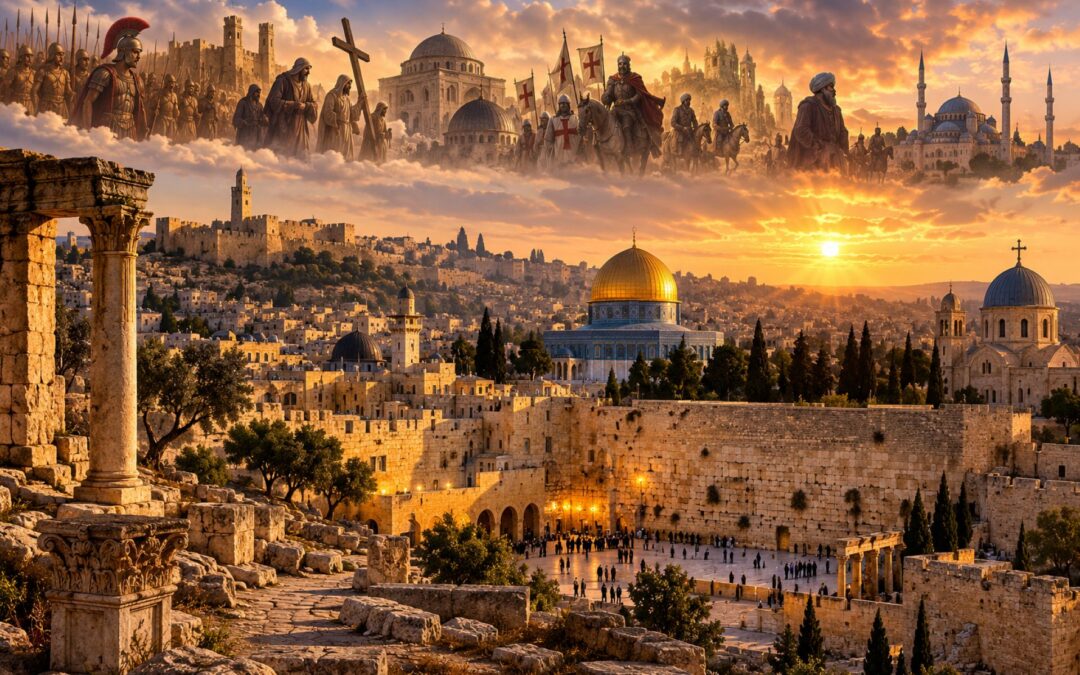
Jerusalem occupies a relatively small area in the hills of the eastern Mediterranean, yet few places have carried so much religious, historical, and political significance. For Jews, it is the city of the ancient Temples and the spiritual centre of Jewish history. For Christians, it is where Jesus was crucified and, according to Christian belief, resurrected. For Muslims, it is home to the sacred compound associated with the Prophet Muhammad’s Night Journey and Ascension.
These attachments developed over thousands of years. Long before Jerusalem became a destination for pilgrims, crusaders, emperors, and armies, it was a fortified settlement whose inhabitants depended on a spring for survival. Successive rulers transformed its buildings, institutions, and religious character, while communities maintained connections to places that acquired new meanings with every generation.
Jerusalem’s history is therefore not simply the story of a city repeatedly conquered by competing powers. It is the story of how sacred traditions accumulated within the same physical landscape, creating overlapping claims that could survive even when political control changed.
Understanding how Jerusalem became sacred to three religions requires following that process from its earliest settlement through the emergence of Judaism, Christianity, and Islam, the medieval struggles for the Holy Land, and the modern conflict over the city’s sovereignty.
A Spring, a Fortified Town, and an Israelite Capital
Jerusalem’s history began with geography rather than religion. The ancient settlement developed on a ridge in the Judean hills, south of the elevated area that would later become associated with the Temple Mount. Its location offered natural defensive advantages, while access to the Gihon Spring provided something essential for permanent habitation: a reliable source of water.
Archaeological discoveries indicate that people lived in the area during the fourth millennium BCE, although the size and character of the earliest settlement remain uncertain. Over subsequent centuries, Jerusalem developed into a fortified town. Its inhabitants constructed substantial defensive works around important parts of the settlement and its water supply, demonstrating that the spring had become an asset worth protecting.
The city belonged to the broader Canaanite cultural world of the ancient Levant. Its inhabitants participated in regional networks of agriculture, commerce, diplomacy, and religion that connected settlements across the eastern Mediterranean. Jerusalem was not yet the centre of a distinctive Jewish, Christian, or Islamic tradition; it was one among several fortified communities operating within a landscape dominated by more powerful kingdoms.
The earliest written references to Jerusalem appear in ancient Egyptian sources. Middle Kingdom Egyptian texts contain forms generally identified with the city’s name, while the Amarna letters of the fourteenth century BCE provide more detailed evidence of its political position. These diplomatic records include correspondence from Abdi-Heba, a ruler of Jerusalem who appealed to the Egyptian pharaoh for assistance against regional rivals.
Jerusalem was then part of Egypt’s political sphere rather than an independent territorial kingdom comparable to later states. Egyptian rulers exercised influence over much of Canaan through local governors and client rulers, although the degree of control varied across the region. The letters reveal a world of competing towns, shifting alliances, and rulers trying to preserve their authority by maintaining Egyptian support.
That political order weakened during the upheavals conventionally associated with the Late Bronze Age collapse, around the twelfth century BCE. Major powers across the eastern Mediterranean experienced crises, while the political structures connecting Egypt and Canaan became less stable. New kingdoms and communities gradually emerged in the highlands and surrounding territories.
Among them were the early Israelites, whose origins are closely connected to the wider Canaanite population. Archaeological evidence suggests substantial cultural continuity between many early Israelite communities and their neighbours, even as distinctive traditions, identities, and religious practices developed. The emergence of Israel was therefore a historical process rather than the sudden appearance of an entirely separate civilisation.
According to biblical tradition, King David captured Jerusalem around 1000 BCE and established it as the capital of a united kingdom of Israel. The choice was politically meaningful within the biblical narrative because Jerusalem offered a royal centre not previously identified as the principal capital of either the northern or southern Israelite tribal groupings. David also became central to later Jewish expectations concerning legitimate kingship and the relationship between the people of Israel and God.
How much of this traditional account can be independently reconstructed remains debated. Archaeologists disagree about the size, wealth, and political reach of Jerusalem during the tenth century BCE, and the biblical narratives were shaped and transmitted through later religious and literary traditions. Nevertheless, the association of Jerusalem with the Davidic dynasty became one of the foundations of its enduring significance.
David’s successor Solomon is traditionally credited with constructing the First Temple, a sanctuary dedicated to the God of Israel. The biblical description presents it as a magnificent religious building containing the innermost sanctuary known as the Holy of Holies, associated with the divine presence and the Ark of the Covenant. Direct archaeological evidence for Solomon’s Temple is limited, and its precise architectural form cannot be independently confirmed in all the detail supplied by scripture.
The Temple’s importance extended beyond architecture. It associated Jerusalem with centralised royal worship and eventually became the defining institution of Judah’s religious life. Over time, traditions surrounding the Temple, priesthood, sacrifice, pilgrimage, and divine covenant strengthened Jerusalem’s status as a place whose importance could not be measured solely by its political power.
The biblical account describes the united monarchy dividing after Solomon’s reign, leaving a northern Kingdom of Israel and a southern Kingdom of Judah. Jerusalem remained the capital of Judah, while the northern kingdom developed its own political and religious centres. The exact early chronology remains contested, but by the later Iron Age both kingdoms were identifiable political entities.
The balance of power changed dramatically in the eighth century BCE. Assyria conquered the northern Kingdom of Israel in the late 720s BCE, while Judah survived as a smaller kingdom operating under intense imperial pressure. Jerusalem became increasingly important as a political and religious centre for Judah, particularly as its rulers sought to strengthen their institutions and consolidate religious practice.
In 701 BCE, the Assyrian king Sennacherib campaigned against Judah and captured numerous fortified towns. Jerusalem survived, although the biblical and Assyrian descriptions of the campaign emphasise different outcomes. Hezekiah, Judah’s king, is associated with defensive preparations, including water infrastructure traditionally connected with the tunnel that carried water from the Gihon Spring toward a protected reservoir.
This development illustrates how Jerusalem’s physical survival and religious importance became intertwined. The same spring that had sustained its earliest inhabitants now helped support a fortified royal capital facing one of the ancient world’s most powerful empires.
By the end of the seventh century BCE, Jerusalem had become the centre of Judah’s monarchy and an increasingly important focus of worship. Religious reforms associated with kings such as Hezekiah and Josiah reflected efforts to concentrate legitimate worship in Jerusalem, although scholars continue to debate their precise scope and historical development.
The city had not yet acquired the sacred significance it would eventually hold for three world religions. It had, however, established the first great foundation of that history: the association between a particular urban place, a royal dynasty, a Temple, and a religious community whose identity would survive the destruction of its kingdom.
Destruction, Exile, and the Second Temple
Jerusalem’s transformation into an enduring religious centre was shaped as much by destruction as by royal patronage. During the late seventh and early sixth centuries BCE, the balance of power in the Near East shifted as the Assyrian Empire collapsed and Babylon emerged as the dominant imperial force. Judah became caught between Babylonian expansion and Egyptian attempts to preserve influence in the region.
The Babylonian king Nebuchadnezzar II first captured Jerusalem in 597 BCE after Judah’s ruling house became entangled in resistance to Babylonian authority. King Jehoiachin and members of the royal court, military elite, and skilled population were deported to Babylonia. The Babylonians installed Zedekiah as king, leaving Judah under their control but not yet destroying its capital.
Zedekiah later rebelled, provoking another Babylonian campaign. Following a prolonged siege, Jerusalem fell in 587 or 586 BCE. Babylonian forces destroyed much of the city, dismantled its political institutions, and burned the Temple traditionally associated with Solomon.
The destruction was a religious catastrophe as well as a military defeat. The Temple was the principal sanctuary of Judah’s God, and Jerusalem had been associated with divine protection and the legitimacy of the Davidic monarchy. Its fall raised profound questions about the relationship between God, the people, their covenant, and the possibility of religious continuity without an independent kingdom.
Further deportations followed, although the entire population of Judah was not removed. Some inhabitants remained in the devastated territory, while exiled communities established themselves in Babylonia. These different experiences would become part of the historical background against which Jewish religious traditions developed.
The Babylonian exile contributed to the preservation and reinterpretation of Israelite religious literature, identity, and communal practice. Traditions associated with Jerusalem, the Temple, the law, and the covenant acquired new significance among people who could no longer participate in the religious life of their former capital.
Jerusalem could therefore remain central to a community even when many of its members lived elsewhere. That relationship between a sacred homeland and a dispersed population became a defining feature of Jewish history, although Jewish communities also continued living in the land.
A decisive change came in 539 BCE when Cyrus the Great of Persia conquered Babylon. The new Achaemenid Empire governed its territories through a different imperial system, and Jewish exiles were permitted to return and participate in restoring their religious institutions.
The return did not occur through one universal migration. Communities returned over time, while many Jewish families remained in Mesopotamia, where important Jewish religious and intellectual traditions would continue developing. The rebuilding of Jerusalem was also a gradual process shaped by imperial administration, local disputes, limited resources, and competing interests.
The Second Temple was completed around 516/515 BCE, restoring a central sanctuary for Jewish worship. Later biblical traditions associated with figures such as Ezra and Nehemiah describe efforts to strengthen religious observance, rebuild communal institutions, and repair Jerusalem’s fortifications. The chronology and historical relationship among these activities remain subjects of scholarly debate.
Persian rule did not restore an independent Jewish kingdom. Nevertheless, the Temple once again provided a shared religious centre, while the relationship between Jerusalem and Jewish communities living elsewhere became increasingly significant. The city was both an inhabited provincial centre and the symbolic focus of a much wider religious world.
The city’s history during Persian rule forms part of the wider relationship between Jerusalem and successive Iranian empires, examined in Encyclopaedia Iranica’s account of Jerusalem under Persian rule.
Another major transformation followed Alexander the Great’s conquest of the Persian Empire. By 332 BCE, Jerusalem had passed into the Hellenistic political world created by Alexander’s campaigns. After his death in 323 BCE, rival successor dynasties competed for control of the eastern Mediterranean and Near East.
Jerusalem initially came under the Ptolemaic dynasty based in Egypt before passing to the Seleucid Empire around 200–198 BCE. Greek language, political institutions, education, and cultural practices became increasingly influential throughout the region, including among sections of the Jewish population.
Hellenisation did not mean that all Jews abandoned their traditions. Some adopted Greek cultural practices while continuing to observe Jewish religious law, and different groups disagreed about how far accommodation with the surrounding political culture should extend. These internal disputes became particularly consequential when Seleucid rulers intervened directly in Jerusalem’s religious institutions.
Under Antiochus IV Epiphanes, political conflict and royal intervention culminated in measures that profoundly disrupted Jewish worship. In 167 BCE, the Jerusalem Temple was desecrated and traditional religious practices were suppressed. The precise political circumstances remain debated, but the crisis provoked a rebellion associated with the priestly family of Mattathias and his son Judah Maccabee.
The Maccabean revolt combined religious resistance with a struggle over political authority. In 164 BCE, rebel forces recovered Jerusalem’s sanctuary and rededicated the Temple to Jewish worship. The event became the historical foundation of Hanukkah, the Jewish festival commemorating the restoration of the Temple.
The revolt eventually helped establish the Hasmonean dynasty, which achieved a substantial degree of autonomy and later independence. Jerusalem once again became the capital of a Jewish-ruled state, while Hasmonean leaders combined religious and political authority and expanded their influence beyond the city.
This independence did not eliminate conflict. Dynastic rivalries, disagreements over religious legitimacy, and competition among Jewish political and religious groups complicated Hasmonean government. Such divisions became increasingly important as Rome expanded its influence into the eastern Mediterranean.
In 63 BCE, the Roman general Pompey intervened in a Hasmonean succession struggle and captured Jerusalem. The city became subordinate to Roman power, although its internal political arrangements continued changing through client rulers and local institutions.
Herod the Great captured Jerusalem in 37 BCE and established himself as a Roman-backed king. His reign combined ambitious construction with harsh political repression, and his dependence on Rome remained a defining feature of his authority.
Herod’s most consequential project in Jerusalem was the enormous expansion and reconstruction of the Second Temple complex, beginning around 20/19 BCE. He enlarged the Temple platform with massive supporting walls, transformed the sanctuary precinct, and commissioned monumental buildings that expressed both royal ambition and religious prestige.
The expanded Temple became one of the most extraordinary architectural and religious complexes in the region. Its courts attracted worshippers and pilgrims, while sacrifices, priestly service, religious festivals, teaching, and political debates made it central to Jewish public life.
The Western Wall, which remains sacred to Jewish worshippers today, formed part of the retaining-wall system supporting Herod’s enlarged Temple platform. It was not itself an interior wall of the Temple sanctuary. Its later significance developed because of its physical connection to the ancient sacred precinct and its role as an accessible place of prayer and remembrance.
Herod’s construction transformed Jerusalem into a monumental religious city, but the political order supporting it remained fragile. Roman authority, local elites, religious movements, and popular expectations frequently came into conflict.
The city was entering another period in which its religious importance would increase even as its political institutions faced destruction.
How Jerusalem Became a Christian Holy City
Jerusalem’s importance to Christianity developed from events associated with the life and death of Jesus of Nazareth during the early first century CE. Jesus was a Jewish teacher whose activities took place within the religious and political world of Roman-ruled Judea and Galilee. His message, followers, and disputes with religious authorities belonged to that setting, rather than to a separate Christian society already established during his lifetime.
According to the New Testament, Jesus travelled to Jerusalem, taught in and around the Temple, celebrated religious occasions, and became involved in confrontations that contributed to his arrest. He was executed by crucifixion under the Roman prefect Pontius Pilate, whose administration governed Judea between approximately 26 and 36 CE.
The crucifixion is widely accepted as a historical event. Christianity’s central claim that Jesus rose from the dead belongs to religious belief, although the conviction that he had been resurrected was fundamental to the emergence of the Christian movement.
For Jesus’s earliest followers, Jerusalem consequently became the setting of events they understood as decisive for humanity’s relationship with God. The city was associated with the crucifixion, burial, resurrection, and the subsequent activities of the apostles. These associations gave Jerusalem a significance that extended beyond its existing importance within Judaism.
The earliest Christian community emerged within the Jewish religious world. Jesus’s followers initially continued participating in Jewish practices, while debates gradually developed about the movement’s relationship to Jewish law, the admission of non-Jewish believers, and the meaning of Jesus’s identity. The spread of Christianity across the Roman Empire eventually produced increasingly distinct religious communities.
Jerusalem retained symbolic importance, but Christianity’s expansion did not depend on the city remaining its sole organisational centre. Communities developed in Antioch, Alexandria, Rome, and elsewhere, allowing the religion to spread even when political upheaval disrupted life in Judea.
That disruption became catastrophic during the First Jewish-Roman War. In 66 CE, a revolt against Roman authority spread through Judea, driven by political grievances, social tensions, religious expectations, and opposition to imperial government.
Roman forces gradually suppressed the rebellion and besieged Jerusalem in 70 CE. The campaign culminated in the capture of the city and destruction of the Second Temple under forces commanded by Titus, the future Roman emperor.
The destruction transformed Jewish religious life. Temple sacrifices and the central priestly system could no longer operate as before, while religious leadership and communal institutions developed in new directions. The traditions that became Rabbinic Judaism increasingly emphasised religious law, study, prayer, and communal practice without requiring a functioning Temple sanctuary.
Jerusalem remained central to Jewish religious memory, even as the city itself underwent major political changes. Prayers, mourning traditions, pilgrimage aspirations, and hopes for restoration preserved its significance across Jewish communities throughout the Mediterranean and beyond.
For early Christians, the destruction of Jerusalem also acquired theological meaning, although Christian interpretations varied and developed over time. The city associated with Jesus’s ministry had now experienced the destruction of the sanctuary that had defined its earlier religious identity.
Another revolt, led by Simon bar Kokhba between 132 and 135 CE, brought renewed conflict with Rome. Emperor Hadrian suppressed the rebellion and developed Jerusalem as the Roman colony of Aelia Capitolina.
The new city reflected Roman urban and religious practices, including monumental public architecture and pagan cult institutions. Jewish access and residence were severely restricted, although the precise application of these restrictions changed over time and cannot be reduced to one uninterrupted rule covering every subsequent century.
Jerusalem did not immediately become a predominantly Christian city following the Temple’s destruction. Christianity remained a minority religion within the wider Roman Empire for generations, and the city’s religious development continued under Roman political institutions.
A fundamental shift occurred during the reign of Constantine the Great in the early fourth century. Constantine supported Christianity and promoted the construction of major churches across the empire, helping transform the religion’s relationship with imperial government.
Jerusalem became an especially important focus of Christian imperial patronage. According to Christian tradition, Constantine’s mother Helena visited the city and identified places associated with Jesus’s crucifixion and burial.
The site selected for the Church of the Holy Sepulchre had been occupied by structures from the Roman period. These were removed, and an ambitious church complex was constructed under Constantine’s patronage. The church was dedicated in 335 CE and became one of Christianity’s principal pilgrimage destinations.
The Church of the Holy Sepulchre brought together sacred locations traditionally associated with the crucifixion and burial of Jesus. Its significance rested not simply on imperial architecture but on the belief that the events at the heart of Christianity had occurred there.
Pilgrims travelled to Jerusalem from distant parts of the Christian world, visiting sites associated with the Passion, the Mount of Olives, and other biblical events. Churches, monasteries, hostels, and religious institutions developed around this pilgrimage economy, reshaping the city’s physical and social landscape.
After the Roman Empire’s western political institutions declined, Jerusalem remained under the eastern Roman Empire, commonly called the Byzantine Empire. Its rulers continued supporting Christian religious buildings and institutions, while the city’s patriarchate became an important centre of ecclesiastical authority.
This period was not characterised by uniform religious harmony. Jews, Christians, Samaritans, and other communities experienced changing legal restrictions, theological conflicts, and political pressures. Christian authorities themselves disagreed over doctrine and ecclesiastical jurisdiction, demonstrating that a shared religious identity did not eliminate rivalry.
The city’s importance to several traditions is reflected in the religious and architectural heritage recognised by UNESCO in its description of the Old City of Jerusalem and its Walls. The monuments preserved there represent successive religious communities rather than a single uninterrupted political or cultural tradition.
Byzantine rule suffered a major interruption in 614 when Sasanian Persian forces captured Jerusalem. The conquest involved substantial violence and damage, while the Persians removed the relic traditionally identified as the True Cross. Jewish participation in the conflict and subsequent political arrangements remain subjects of historical debate.
The Byzantine emperor Heraclius eventually recovered control of Jerusalem around 629–630, restoring imperial authority after years of warfare. The recovery proved temporary, however, because a new political and religious movement was expanding from the Arabian Peninsula.
Within a decade, Jerusalem would enter the Islamic world, adding another sacred tradition to a city already central to Jewish and Christian religious history.
Why Jerusalem Became Sacred to Islam
Islam emerged in western Arabia during the early seventh century through the preaching of the Prophet Muhammad. Its religious message recognised the importance of earlier biblical prophets and placed itself within a tradition of monotheistic revelation. Jerusalem consequently belonged to a sacred geography that already included figures and events recognised within Jewish and Christian scripture.
Jerusalem’s particular significance in Islamic tradition is closely associated with the Night Journey and Ascension. The Quran describes Muhammad’s night journey from the Sacred Mosque to the Farthest Mosque, while later Islamic tradition identifies the latter with Jerusalem. Accounts of the Ascension describe Muhammad’s journey through the heavens and his encounters with earlier prophets.
These events belong to Islamic religious belief, and their significance cannot be explained simply as the result of later political conquest. The association between Jerusalem and the prophetic tradition gave the city a sacred identity within Islam, while early Muslim connections to Jerusalem also included traditions concerning the direction of prayer before it was changed toward Mecca.
Following Muhammad’s death in 632, the early Muslim community expanded under the leadership of the Rashidun caliphs. Muslim armies defeated Byzantine forces in several major campaigns, bringing much of Syria and Palestine under their authority.
Jerusalem surrendered to Muslim rule around 637–638 during the caliphate of Umar ibn al-Khattab. Later Islamic historical traditions describe Umar’s personal involvement in the city’s surrender and agreements intended to protect Christian inhabitants and religious institutions.
The details of these agreements are difficult to reconstruct because surviving accounts were written and transmitted through different historical and religious traditions. Nevertheless, Jerusalem’s conquest did not involve the wholesale destruction of its principal Christian institutions, and Christian communities continued occupying a prominent position in the city.
Muslim rule altered the legal and political hierarchy without immediately replacing the population’s religious composition. Christians remained numerous, while Jewish communities were able to re-establish or strengthen their presence under changing conditions. The extent of Jewish settlement and access varied by ruler and period.
The Islamic legal order generally recognised Jews and Christians as protected religious communities, but protection did not mean full equality under modern understandings of citizenship. Non-Muslims could face special taxes, legal restrictions, and limitations on public religious expression, even while maintaining communal institutions and places of worship.
These arrangements also differed across time. Individual rulers could impose restrictions, grant privileges, encourage restoration projects, or pursue policies driven by political and fiscal considerations. Jerusalem’s religious life under Muslim government therefore cannot be accurately described as either uninterrupted tolerance or continuous persecution.
The most visible transformation occurred under the Umayyad dynasty, whose rulers governed a rapidly expanding Islamic empire from Damascus. During the reign of Abd al-Malik, the Dome of the Rock was constructed on the elevated sacred platform that Jews identify as the Temple Mount and Muslims call al-Haram al-Sharif, or the Noble Sanctuary.
Completed around 691–692, the Dome of the Rock became one of the earliest and most remarkable monuments of Islamic architecture. Its elaborate decoration, inscriptions, and prominent position expressed the religious and political significance of the new Islamic imperial order.
The structure is not simply a conventional congregational mosque. It is a monumental shrine built around a rock that holds significance within Islamic tradition and lies within a precinct deeply associated with the ancient Jewish Temples.
The broader sanctuary also contains Al-Aqsa Mosque, whose early development is generally associated with Umayyad patronage during the late seventh and early eighth centuries. The complex underwent successive rebuilding campaigns following earthquakes, political changes, and architectural alterations.
Together, the Dome of the Rock and Al-Aqsa Mosque established the precinct as one of Islam’s most important sacred locations. Jerusalem acquired an enduring position in Muslim religious life alongside Mecca and Medina, while its buildings made that significance visible in the city’s architectural landscape.
The development also created an extraordinary concentration of sacred meaning. The same elevated area had been central to Jewish Temple traditions for centuries, while Christian sacred sites stood nearby within the city. Jerusalem’s growing importance to Islam did not erase its earlier religious associations; it added another set of traditions to a landscape already rich in religious memory.
Political control passed through successive Islamic dynasties. The Abbasids replaced the Umayyads in 750, while regional governors and later dynasties exercised changing degrees of authority as the caliphate’s political unity weakened.
Jerusalem remained a place of pilgrimage and worship, although its economic and political importance varied. It was not always a major administrative capital, and its fortunes depended partly on larger imperial developments involving Damascus, Baghdad, Egypt, and other regional centres.
In 969, the Fatimid dynasty established control over Egypt and extended its influence into Palestine. Fatimid rule introduced further changes in Jerusalem’s political and religious environment, including periods of conflict among competing powers and changing relationships with Christian and Jewish communities.
One of the most consequential incidents occurred in 1009, when the Fatimid caliph al-Hakim bi-Amr Allah ordered the destruction of the Church of the Holy Sepulchre. The action caused considerable damage to one of Christianity’s most sacred monuments and generated outrage across the Christian world.
The church was subsequently reconstructed during the eleventh century through arrangements involving local authorities and the Byzantine Empire. Its destruction became part of a wider history of religious grievance, although it would be misleading to treat the event as the sole or inevitable cause of the Crusades.
During the eleventh century, the Seljuk Turks expanded across the Middle East, weakening Byzantine positions and changing the regional political balance. Jerusalem came under Turkish-controlled authorities during the 1070s, while competing Muslim rulers continued struggling over territory.
Reports concerning the difficulties faced by Christian pilgrims circulated in Europe, but conditions varied and contemporary narratives could exaggerate or reinterpret events for political and religious purposes. The more immediate strategic problem for Byzantium was the loss of territory and the growing military power of Turkish states in Anatolia and the eastern Mediterranean.
Byzantine emperor Alexios I Komnenos sought military assistance from Western Christian rulers. Pope Urban II responded in 1095 by calling for an armed expedition that combined support for eastern Christians with the recovery of Jerusalem and its holy places.
The result was the First Crusade. Jerusalem, already a sacred city for three religions, was about to become the principal objective of an extraordinary campaign of religious warfare.
Crusaders, Saladin, and a City Under Repeated Siege
The First Crusade began as a movement combining pilgrimage, military service, religious devotion, and papal authority. Thousands of participants travelled from Western Europe toward the eastern Mediterranean, although they did not form a single permanently unified army.
After several years of campaigning, the surviving crusading forces approached Jerusalem in June 1099. By then, the city had returned to Fatimid control after Egyptian forces recovered it from Turkish rulers in 1098. The crusaders therefore faced a Muslim political authority different from the one that had originally helped provoke Byzantine appeals for assistance.
Jerusalem’s defences presented a formidable challenge. The attackers struggled with supplies, limited access to water, and the difficulty of constructing and deploying siege equipment. Their campaign had already been weakened by disease, casualties, desertion, and rivalries among its leaders.
On 15 July 1099, crusading forces breached the city’s defences and captured Jerusalem. The victory was followed by extensive killing of Muslim and Jewish inhabitants, an episode described by contemporary chroniclers from different religious backgrounds. Although the exact number of victims cannot be established confidently, the scale of violence was substantial.
For the crusaders, the conquest appeared to fulfil the spiritual objective around which their expedition had been organised. Jerusalem had returned to Latin Christian political control after more than four centuries under successive Muslim rulers.
The conquest established the Kingdom of Jerusalem, one of several Latin Christian states created during the Crusades. Godfrey of Bouillon became the city’s principal ruler, while his successor Baldwin I adopted the royal title in 1100 and worked to consolidate the kingdom’s institutions.
The new rulers altered the use and administration of several religious buildings. Latin Christian institutions acquired prominent positions in Jerusalem, while parts of the Islamic sanctuary were adapted for Christian purposes.
The Dome of the Rock became associated with the Christian institution called the Templum Domini, or Temple of the Lord. The Al-Aqsa Mosque complex was also used by the Latin rulers and later became associated with the Knights Templar, whose headquarters were established there.
The Templars developed during the early twelfth century as a religious military order whose purposes included protecting pilgrims travelling through the Holy Land. Their name reflected their association with the sanctuary precinct, which medieval Christians linked to Solomon’s Temple.
The Knights Hospitaller had a different institutional background. Their charitable and medical activities originated in Jerusalem before the Crusader conquest, although the order subsequently acquired military responsibilities. Both organisations became important institutions within the wider Crusader political world.
Christian pilgrimage expanded under Latin rule, bringing travellers, donations, and commercial activity into the region. Churches, monasteries, hospitals, and supporting institutions contributed to Jerusalem’s economy, while the city developed within a kingdom whose military survival depended heavily on control of territory beyond its walls.
The conquest also changed the position of Muslim and Jewish communities. The massacre and subsequent political arrangements profoundly disrupted their presence in the city, although the composition of the population evolved over time.
The Crusader Kingdom faced persistent difficulties. Its rulers depended on a relatively small Latin Christian population, military support from Europe, alliances with neighbouring powers, and the ability to defend strategically important towns and fortresses.
The wider history of these campaigns, military orders, and changing political alliances is explored in the history of the Crusades. For Jerusalem itself, the decisive turning point came when Muslim political power in Egypt and Syria became more effectively coordinated.
Saladin, who established the Ayyubid dynasty in Egypt and expanded his authority across much of Syria, sought to recover territories held by the Crusader states. During the 1180s, tensions intensified through border warfare, political instability within the Latin kingdom, and attacks on Muslim caravans.
In July 1187, Saladin defeated the main Crusader field army at the Battle of Hattin. The victory destroyed much of the military force available to defend the Kingdom of Jerusalem and opened the way for a campaign to recover its principal cities.
Jerusalem surrendered to Saladin on 2 October 1187 after negotiations involving Balian of Ibelin, who played a central role in organising the city’s defence. Unlike the conquest of 1099, the surrender avoided a general massacre of its inhabitants.
The outcome was not entirely peaceful by modern standards. Many residents had to obtain their freedom through ransom arrangements, while some who could not secure release faced enslavement. Nevertheless, the negotiated transfer represented a striking contrast with the violence accompanying the earlier Crusader conquest.
Saladin restored Muslim control over the Islamic sanctuary, while the Church of the Holy Sepulchre remained an important Christian religious site. Jerusalem’s religious institutions again changed under a new political authority, demonstrating how its sacred spaces could survive while their administration and public symbolism were transformed.
The loss of Jerusalem produced a profound reaction in Latin Christendom. The Third Crusade brought European monarchs and armies to the eastern Mediterranean, including forces associated with Richard I of England and Philip II of France.
The crusaders recovered important coastal positions, most notably Acre in 1191, but they failed to recapture Jerusalem. Richard considered military advances toward the city, yet the challenge extended beyond occupying its walls. Maintaining control would have required secure supply routes, sufficient soldiers, and the ability to withstand renewed Muslim campaigns.
The Treaty of Jaffa in 1192 left Jerusalem under Muslim rule while allowing Christian pilgrims access to its holy places under agreed conditions. The Crusader states retained territory along the coast, but the city that had inspired the movement remained outside their political control.
Jerusalem continued changing hands during the thirteenth century. Its fortifications were dismantled in 1219 by the Ayyubid ruler al-Mu’azzam, partly to prevent the city from becoming a strategically valuable fortress if captured by hostile forces.
In 1229, Emperor Frederick II negotiated an agreement with the Ayyubid ruler al-Kamil that restored Jerusalem to Latin Christian control under specified conditions. The arrangement preserved Muslim rights over the important Islamic sanctuary and demonstrated that the city’s political future could sometimes be negotiated without a major battle.
This period of restored Christian control ended in 1244, when Khwarazmian forces allied with Ayyubid interests attacked Jerusalem. The city was devastated, and the Crusaders permanently lost the opportunity to establish it as the centre of a durable Latin Christian kingdom.
Subsequent Crusades increasingly concentrated on Egypt, coastal strongholds, and other strategic targets. In 1291, the Mamluk conquest of Acre ended the remaining major Latin Christian territorial presence on the mainland of the Holy Land.
Under Mamluk government, Jerusalem remained an important religious centre, even though it was no longer the capital of a large regional kingdom. Rulers, governors, scholars, and wealthy patrons supported the construction and maintenance of mosques, madrasas, charitable foundations, religious complexes, and other institutions.
Christian and Jewish communities continued maintaining connections to the city, while pilgrimage remained an important part of its religious and economic life. The Mamluk period contributed substantially to the architectural landscape of Jerusalem, particularly around the Islamic sanctuary and its approaches.
By the beginning of the sixteenth century, Jerusalem had experienced repeated military conquests, negotiated transfers, periods of destruction, and extensive religious rebuilding. Its sacred importance had survived changes in political authority, but no single government had permanently resolved the competing meanings attached to the city.
Ottoman Jerusalem: Walls, Communities, and the City Beyond Them
Jerusalem entered another long period of imperial government when the Ottoman Empire conquered the region in 1516–1517. The city became part of a vast political system connecting Anatolia, southeastern Europe, the Arab Middle East, and North Africa.
The Ottoman conquest did not establish Jerusalem as an imperial capital. Its importance lay primarily in its religious status, local administration, commercial connections, and role in pilgrimage networks. It operated within broader provincial arrangements whose political and administrative structures changed over time.
The most visible Ottoman contribution came during the reign of Suleiman I, widely known as Suleiman the Magnificent. During the sixteenth century, his government commissioned the reconstruction of Jerusalem’s city walls, with the principal rebuilding undertaken during the 1530s and early 1540s.
These walls remain among the defining features of the Old City. Their gates, towers, and defensive structures shaped movement through Jerusalem, while the enclosed area preserved much of the historic urban landscape around the city’s religious monuments.
Ottoman patronage also supported repairs and improvements to important Islamic religious structures, including elements of the Haram al-Sharif. These projects reflected the rulers’ position as protectors and patrons of major Islamic holy places, while Jerusalem’s Christian and Jewish communities continued sustaining their own religious institutions.
The city’s inhabitants included Muslims, Christians, Jews, and Armenians, whose communities maintained distinctive religious, linguistic, and cultural traditions. Jerusalem’s famous Muslim, Christian, Jewish, and Armenian quarters gradually became established as recognisable parts of the Old City’s geography.
These quarters were never completely exclusive residential compartments. Neighbours, merchants, pilgrims, and religious communities interacted across local boundaries, and their distribution changed over time. The familiar modern map of four quarters is therefore a useful description of the Old City’s organisation, but it should not be projected unchanged across every earlier century.
Ottoman government operated through a combination of imperial institutions, local officials, religious authorities, courts, and influential families. Religious foundations, including Islamic waqf institutions, supported buildings, education, charitable services, and the maintenance of sacred places.
Daily life was shaped by agriculture, markets, crafts, pilgrimage, trade, taxation, and relationships with the surrounding towns and villages. Jerusalem remained connected to wider regional networks rather than existing as an isolated religious settlement.
The city’s political influence varied, and economic conditions were not uniformly prosperous. Nevertheless, describing the entire Ottoman period as centuries of uninterrupted decline overlooks the continuing development of religious institutions, local society, architecture, and commerce.
During the nineteenth century, Jerusalem began undergoing changes that would transform its physical size and political importance. European governments, churches, missionary organisations, and commercial interests expanded their presence as Ottoman authorities introduced administrative reforms and faced growing international pressure.
The temporary Egyptian occupation of the region between 1831 and 1840 also disrupted existing political arrangements and contributed to changing relations among local communities and foreign powers. Ottoman restoration was followed by further reforms, while European involvement became increasingly visible.
Foreign consulates, churches, schools, hospitals, and pilgrim institutions appeared in greater numbers. European Christian powers regarded Jerusalem not only as a religious destination but also as a place where cultural and diplomatic influence could be established.
One major development was the Russian Compound, built outside the Old City during the nineteenth century to accommodate Russian religious and diplomatic institutions and the growing number of Orthodox pilgrims. Its construction demonstrated that Jerusalem was beginning to expand beyond the walls that had defined its urban geography for centuries.
Jewish neighbourhoods also developed outside the Old City. Mishkenot Sha’ananim, associated with Moses Montefiore and funding connected to Judah Touro’s legacy, became one of the earliest prominent Jewish residential developments beyond the walls in 1860.
These changes reflected overcrowding, new infrastructure, philanthropic investment, security concerns, and the growing attraction of Jerusalem to people seeking opportunities or religious fulfilment. They were not all driven by one political movement.
Jewish connections to Jerusalem had persisted for centuries, and migration to the city long predated modern political Zionism. During the nineteenth century, however, growing immigration from Europe and elsewhere gradually intersected with new forms of Jewish nationalism, especially as persecution and antisemitism encouraged some Jews to seek security and collective political self-determination.
At the same time, Jerusalem’s Arabic-speaking Muslim and Christian inhabitants maintained longstanding social, economic, cultural, and religious connections to the city. Their participation in local institutions and wider regional developments would become increasingly important as questions concerning the territory’s political future intensified.
The arrival of new residents and institutions changed the urban landscape. Roads improved, buildings spread beyond the old walls, and the opening of the Jaffa–Jerusalem railway in 1892 strengthened connections between Jerusalem and the Mediterranean coast.
The city’s expansion was part of a much larger transformation taking place across the Ottoman Empire, whose institutions were struggling to adapt to modern military, administrative, economic, and political pressures. These developments belong to the wider history of the Ottoman Empire, but their effects in Jerusalem were especially visible because of the city’s growing international religious importance.
By the early twentieth century, Jerusalem had become more than an Ottoman provincial city surrounded by ancient walls. Its population was expanding, foreign governments were increasingly involved in its affairs, and competing national movements were beginning to transform the political meaning of its religious geography.
The First World War would bring Ottoman rule to an end and place Jerusalem at the centre of a fundamentally different political struggle.
From British Conquest to a Divided Jerusalem
The First World War transformed the political future of Jerusalem and the wider territory of Palestine. The Ottoman Empire entered the war alongside Germany and Austria-Hungary, bringing its Middle Eastern provinces into conflict with Britain and its allies.
Britain regarded Palestine as strategically important because of its proximity to Egypt and the Suez Canal. Control of the region offered military advantages and helped protect imperial communications and transport routes connecting Britain with Asia.
British wartime diplomacy also encouraged competing expectations about the political future of former Ottoman territories. Through the Hussein–McMahon correspondence of 1915–1916, British officials encouraged Arab hopes for independence in exchange for support against Ottoman rule. Whether those commitments included Palestine subsequently became a major point of dispute.
Meanwhile, the secret Sykes–Picot Agreement of 1916 outlined proposed British and French spheres of influence across parts of the Ottoman Arab territories. Although the agreement was not implemented exactly as originally drawn, it demonstrated that European powers were planning the region’s political future before Ottoman authority had collapsed.
Another consequential commitment came on 2 November 1917, when Britain issued the Balfour Declaration. The declaration expressed British support for establishing a national home for the Jewish people in Palestine while stating that the civil and religious rights of existing non-Jewish communities should not be prejudiced.
The wording did not explicitly promise the immediate creation of an independent Jewish state. Nevertheless, it provided the Zionist movement with formal diplomatic recognition from a major power.
The declaration also contained a fundamental political imbalance. It recognised Jewish national aspirations while referring to Palestine’s predominantly Arab population through the category of non-Jewish communities whose civil and religious rights required protection, without expressly recognising equivalent national political rights.
Just over a month later, British forces captured Jerusalem during their campaign against the Ottoman Empire. Ottoman authority collapsed in the city in December 1917, and General Edmund Allenby entered Jerusalem on 11 December.
Britain initially administered the territory through military government. Its position was subsequently formalised within the League of Nations Mandate system, with the Mandate for Palestine approved in 1922 and entering into force in 1923.
Jerusalem became the administrative centre of British Mandatory Palestine. New government institutions developed alongside the city’s existing religious and communal structures, while debates concerning immigration, landownership, political representation, and eventual independence intensified.
Modern political Zionism had developed in nineteenth-century Europe as a movement advocating Jewish national self-determination. Supporters understood the historical Jewish connection to Palestine as a basis for establishing a national home, although Zionists disagreed about religion, political strategy, economics, and the eventual form of statehood.
Jewish immigration increased during the Mandate period, driven by Zionist organisation, economic opportunity, and escalating antisemitic persecution in Europe. Jewish institutions developed schools, political bodies, economic networks, neighbourhoods, and defence organisations that would later contribute to the foundations of Israel.
Palestinian Arabs, meanwhile, opposed the prospect of losing political control over a territory where they constituted the majority population. Their national movement developed through local organisations, newspapers, political associations, protests, and wider Arab political networks.
Jerusalem became a focal point of these competing aspirations because it was both the administrative capital and a city containing sacred places central to different communities. Political disagreements over sovereignty could therefore become entangled with disputes concerning religious access, symbolic ownership, and public demonstrations.
Violence broke out during the 1920s, while tensions surrounding the Western Wall and the adjacent Muslim religious precinct contributed to the serious disturbances of 1929. The violence affected communities in Jerusalem and elsewhere in Palestine, exposing the difficulty of maintaining public order amid growing national antagonism.
The Palestinian Arab Revolt of 1936–1939 further challenged British rule and Zionist immigration. Britain suppressed the uprising through extensive military operations and emergency measures, while the conflict weakened Palestinian political institutions and increased communal hostility.
Britain’s policies subsequently shifted as it tried to reconcile competing political demands. The 1939 White Paper restricted Jewish immigration and proposed a different future political arrangement for Palestine, provoking opposition from Zionist leaders.
The Second World War intensified the crisis. Nazi Germany’s systematic murder of European Jews made the question of Jewish security and refuge especially urgent, while restrictions on immigration prevented many refugees and survivors from entering Palestine legally.
Jewish political organisations increasingly challenged British rule, while Palestinian Arabs continued opposing the creation of a Jewish state. Britain faced an escalating conflict in which its own administrative authority was becoming increasingly difficult to sustain.
In 1947, Britain referred the Palestine question to the United Nations. A UN commission examined competing proposals and recommended partitioning the territory into separate Jewish and Arab states, with special arrangements for Jerusalem.
On 29 November 1947, the UN General Assembly adopted Resolution 181, recommending partition. The plan proposed that Jerusalem and surrounding areas, including Bethlehem, should be established as a corpus separatum, or separate entity, governed under an international regime.
The proposed arrangement reflected the city’s exceptional religious importance and the difficulty of assigning it exclusively to either national movement. The United Nations partition resolution and its proposed international regime for Jerusalem set out plans for international administration, protection of sacred places, and safeguards for the city’s inhabitants.
Mainstream Jewish political leaders accepted the partition plan in principle, although they disputed aspects of its boundaries and debated the implications for Jerusalem. Arab leaders rejected the proposal, arguing that it violated the political rights of Palestine’s Arab majority and allocated an unjustifiably large share of the territory to the proposed Jewish state.
Resolution 181 was a recommendation rather than an already implemented political settlement. Its proposed boundaries and international institutions never became the governing reality envisaged in the document.
Civil war erupted between Jewish and Palestinian Arab forces following the partition vote. Jerusalem became an important battleground, with fighting around roads, neighbourhoods, access routes, and strategic positions.
Jewish areas of Jerusalem experienced severe supply difficulties as fighting threatened the routes connecting the city with the coastal plain. Convoys carrying food and other necessities faced repeated attacks, while civilian communities throughout the region became increasingly vulnerable to violence.
The war also involved massacres, expulsions, and population flight. The April 1948 massacre at Deir Yassin, a village near Jerusalem, became an especially notorious episode and contributed to fear among Palestinian Arab communities.
On 14 May 1948, David Ben-Gurion declared the establishment of the State of Israel as British rule ended. Armies from neighbouring Arab states entered the conflict shortly afterward, transforming the fighting into a wider Arab-Israeli war.
The military outcome differed substantially from the UN partition proposal. Israeli forces established control over West Jerusalem, while Jordan’s Arab Legion secured East Jerusalem, including the Old City and its principal sacred precincts.
The division involved major population displacement. Palestinian Arab inhabitants fled or were expelled from neighbourhoods that came under Israeli control, while Jewish residents of the Old City’s Jewish Quarter were forced to leave after its surrender to Jordanian forces.
Jewish synagogues and community buildings in the Old City suffered destruction or damage, and Jewish worshippers lost access to the Western Wall under the arrangements that followed. Palestinian refugees likewise lost homes, property, and access to neighbourhoods that had formed part of their lives before the war.
For Israelis, 1948 marked the establishment of a sovereign state after decades of political mobilisation and the catastrophe of the Holocaust. For Palestinians, the war became the Nakba, or catastrophe, associated with mass displacement, the loss of communities, and the failure to establish the Arab state envisaged in the partition plan.
The wider territorial consequences of this period are explored in the history of Palestine and its changing boundaries. Jerusalem’s distinctive outcome was that the internationally proposed city never materialised, and two governments instead controlled different parts of the urban area.
The 1949 armistice agreements established military demarcation lines, including the division separating Israeli-controlled West Jerusalem from Jordanian-controlled East Jerusalem. These were ceasefire arrangements rather than mutually agreed final sovereign borders.
Israel established its principal government institutions in West Jerusalem and declared the city its capital. Jordan administered East Jerusalem and later annexed the West Bank, including East Jerusalem, in 1950, an action that received limited international recognition.
The city remained divided by barriers, military positions, and restrictions on movement. People who had previously travelled between neighbourhoods or visited familiar religious sites now found themselves separated by a heavily guarded line.
Jerusalem had entered a modern political situation unlike those that existed under its earlier empires. Two national movements claimed an enduring connection to the city, while the military outcome had divided its territory without settling its internationally disputed political status.
1967 and the Unresolved Question of Jerusalem
Jerusalem’s division changed fundamentally during the Six-Day War in June 1967. Amid escalating confrontation between Israel and neighbouring Arab states, Israel fought Egypt, Jordan, and Syria, achieving a rapid military victory that transformed the territorial situation across the region.
Israeli forces captured East Jerusalem from Jordan, including the Old City and the Temple Mount/Haram al-Sharif. Israel also captured the West Bank, Gaza Strip, Sinai Peninsula, and Golan Heights during the wider war.
For Jewish Israelis, the recovery of access to the Western Wall carried enormous historical and religious significance. Jewish worshippers could once again visit a place that had been inaccessible to them during Jordanian control.
The physical landscape surrounding the Western Wall also changed. Shortly after the war, the Moroccan Quarter adjacent to the Wall was demolished, displacing its Palestinian residents and creating the large open prayer plaza familiar today.
This episode illustrates the complicated relationship between religious access and political authority. A development understood by many Jewish Israelis as the restoration of a sacred connection also involved the destruction of an existing neighbourhood and the displacement of people who had lived there.
After the war, Israel extended its law, administration, and municipal jurisdiction to East Jerusalem and a substantial area of surrounding territory. The resulting municipal boundaries incorporated areas that had not formed part of Jordanian-administered East Jerusalem before 1967.
Israeli authorities subsequently developed infrastructure, residential neighbourhoods, public institutions, and administrative arrangements across the enlarged municipality. These developments reinforced Israeli control over the city while contributing to disputes about territory, demography, planning, and the future of Palestinian sovereignty.
In 1980, Israel enacted the Basic Law: Jerusalem, Capital of Israel, declaring Jerusalem complete and united as Israel’s capital. Israeli governments have maintained that the city should remain under Israeli sovereignty, emphasising historical Jewish connections, national identity, and security concerns.
The international legal position has differed substantially from Israel’s claim over East Jerusalem. The United Nations Security Council has repeatedly rejected unilateral measures intended to alter the city’s status following the 1967 war.
In Security Council Resolution 478 of 20 August 1980, the Council determined that legislative and administrative measures purporting to alter Jerusalem’s character and status, particularly the new Basic Law, were null and void under international law. It also called upon states maintaining diplomatic missions in Jerusalem to withdraw them.
The resolution did not erase the reality of Israeli administration. It established a clear distinction between a government’s exercise of control and international recognition of its legal claim to sovereignty.
That distinction remains central to Jerusalem’s modern political status. Israel regards Jerusalem as its capital, while Palestinians seek East Jerusalem as the capital of a future independent Palestinian state. The city’s final status remains one of the most consequential unresolved questions in the Israeli-Palestinian conflict.
The everyday experience of its inhabitants reflects these different political and legal arrangements. Most Palestinians living in East Jerusalem hold Israeli permanent-resident status rather than Israeli citizenship, although individual circumstances vary. Their rights and access to services, residency protections, and political participation differ in important ways from those of Israeli citizens.
Disputes over residency, construction permits, housing, neighbourhood development, property claims, and settlement expansion have consequently become important parts of Jerusalem’s political struggle. These issues affect whether communities can remain in their homes, expand their neighbourhoods, maintain family life, and participate equally in the city’s development.
The religious significance of Jerusalem makes these disputes especially sensitive. The Temple Mount/Haram al-Sharif lies at the heart of the Old City and holds extraordinary importance within both Judaism and Islam.
For Jews, the site is associated with the First and Second Temples and remains the holiest place in Jewish religious tradition. The Western Wall, located along the western side of the elevated platform, is one of the principal places of Jewish prayer.
For Muslims, the compound includes Al-Aqsa Mosque and the Dome of the Rock and is one of Islam’s most sacred locations. It is connected to the religious traditions surrounding Muhammad’s Night Journey and Ascension and forms a central part of Palestinian Muslim religious identity.
The historical and religious terminology used for the precinct itself can carry political significance. References to the Temple Mount and Haram al-Sharif reflect different religious traditions associated with the same location, and responsible historical explanation must recognise both rather than treating one tradition as evidence that the other has no legitimate connection.
Following the 1967 war, arrangements developed in which Islamic religious authorities associated with the Jordanian waqf continued administering the Muslim sanctuary, while Israeli authorities exercised overarching security control and regulated access. These arrangements are often described as the religious status quo, although their precise interpretation and application have been repeatedly disputed.
Questions concerning who may pray at the compound, who may visit it, how security should be maintained, and whether existing arrangements are being altered can generate tensions extending far beyond Jerusalem. The site’s religious importance gives local decisions regional and international consequences.
Christian holy places introduce another dimension. The Church of the Holy Sepulchre remains a central destination for Christian pilgrimage, while longstanding arrangements distribute rights and responsibilities among different Christian denominations.
The administration of Christian holy sites illustrates that disputes over sacred spaces are not limited to relations among three religions. Different Christian churches have historically competed over property, worship schedules, maintenance responsibilities, and ceremonial privileges within buildings they all regard as sacred.
Jerusalem’s religious institutions therefore operate through a complex combination of historical traditions, community agreements, property arrangements, political authority, and legal protections. The city’s sacred character cannot be separated from the practical question of who makes decisions affecting those institutions.
Diplomatic efforts have repeatedly attempted to address Jerusalem’s status. The Oslo agreements of the 1990s created a framework for negotiations between Israel and the Palestine Liberation Organization but deferred Jerusalem, along with borders, settlements, refugees, and security arrangements, to later final-status talks.
That postponement reflected the difficulty of reaching agreement. Jerusalem was not simply a territorial issue that could be resolved by dividing administrative responsibilities; it was also central to national identity, political legitimacy, religious history, and the meaning of sovereignty for both peoples.
The failure to achieve a comprehensive final settlement left the city’s political status unresolved. Subsequent negotiations, proposals, and diplomatic initiatives have explored various arrangements, including different forms of territorial division, security guarantees, shared administration, and special protections for sacred sites.
The question of international recognition has also remained contentious. In 2017, the United States recognised Jerusalem as Israel’s capital and subsequently moved its embassy there in 2018. The decision was welcomed by Israeli leaders but opposed by Palestinian representatives and many other governments concerned about the implications for Jerusalem’s disputed status.
Such diplomatic changes have not produced a mutually accepted agreement about the city’s boundaries or sovereignty. Recognition by particular states also does not settle the wider legal questions surrounding territory occupied in 1967.
The legal assessment became particularly significant in July 2024, when the International Court of Justice issued an advisory opinion examining Israel’s policies and practices in the occupied Palestinian territory, including East Jerusalem.
In its 19 July 2024 advisory opinion on the occupied Palestinian territory, the Court concluded that Israel’s continued presence in the occupied Palestinian territory was unlawful and addressed the obligations arising for Israel and other states. An advisory opinion is not a judgment resolving a bilateral case through binding orders against the parties, but it carries substantial authority as a statement of international legal interpretation.
Israel has rejected important aspects of international legal assessments concerning its control of these territories, arguing from its own interpretations of security, history, sovereignty, and the political circumstances of the conflict. Those arguments remain distinct from the prevailing international legal position that East Jerusalem is occupied territory.
The dispute also cannot be reduced entirely to diplomatic language. The lives of Jerusalem’s inhabitants are shaped by municipal services, neighbourhood boundaries, schools, employment, transport, religious access, public security, and the ability to maintain stable homes and communities.
Jewish, Muslim, Christian, Armenian, and other residents continue participating in the city’s economic, cultural, and religious life under these conditions. Their experiences differ, and their relationships cannot be accurately represented as one uninterrupted conflict between completely separate populations.
At the same time, political violence, unequal legal and administrative arrangements, competing national movements, and the unresolved status of East Jerusalem remain consequential. Wider regional conflicts reinforce these difficulties, as explored in the history of conflict across the Middle East, but Jerusalem’s circumstances cannot be understood solely through events elsewhere.
The central difficulty is that several different questions are being asked of the same city. Who should exercise sovereignty? How should residents’ rights be protected? Who should administer religious sites? What arrangements would guarantee meaningful access for worshippers? How can national self-determination and security be reconciled?
Each question has historical and practical implications, and an answer to one does not automatically settle the others.
Jerusalem’s long history explains why the city carries such powerful meanings for different communities. It does not, by itself, determine which contemporary political arrangements would be lawful, just, secure, or acceptable to its inhabitants.
That is the distinction necessary for understanding why the city remains contested. Religious attachments can be ancient and sincere while modern sovereignty, citizenship, territory, and political rights remain questions requiring negotiation and legal resolution.
Jerusalem became sacred through centuries of religious development, pilgrimage, worship, destruction, restoration, and collective memory. Its contemporary conflict developed through political decisions, national movements, warfare, and contested claims that emerged under historically specific conditions.
For nearly five millennia, successive communities and governments have transformed Jerusalem without erasing the significance it held for those who came before them. A Canaanite settlement became a royal capital, a Temple city, a centre of Christian pilgrimage, a major Islamic sanctuary, a medieval prize of conquest, an Ottoman provincial centre, and finally a city divided and contested by modern national movements.
The accumulated religious history makes Jerusalem exceptionally important, but it also makes attempts to claim an exclusive and uncomplicated ownership of its past difficult to sustain. Its monuments and traditions testify to different communities that invested the same landscape with meaning, often while living under political arrangements they did not control.
The history of Jerusalem therefore offers two different lessons. It explains how a relatively small city acquired extraordinary sacred importance, and it demonstrates that sacred importance has never guaranteed political stability or equal treatment for everyone who considers the city home.
Resolving Jerusalem’s contemporary status requires more than choosing which historical period should define it. Any durable settlement must confront present questions of sovereignty, rights, security, religious freedom, and the protection of communities whose connections to the city cannot simply be removed from its history.
Jerusalem’s past belongs to several intertwined traditions. Its future will depend on whether those connections can coexist within political arrangements that protect the people and places at the centre of the world’s most enduring sacred city.
Last Updated on October 31, 2026 by Aseem Gupta