
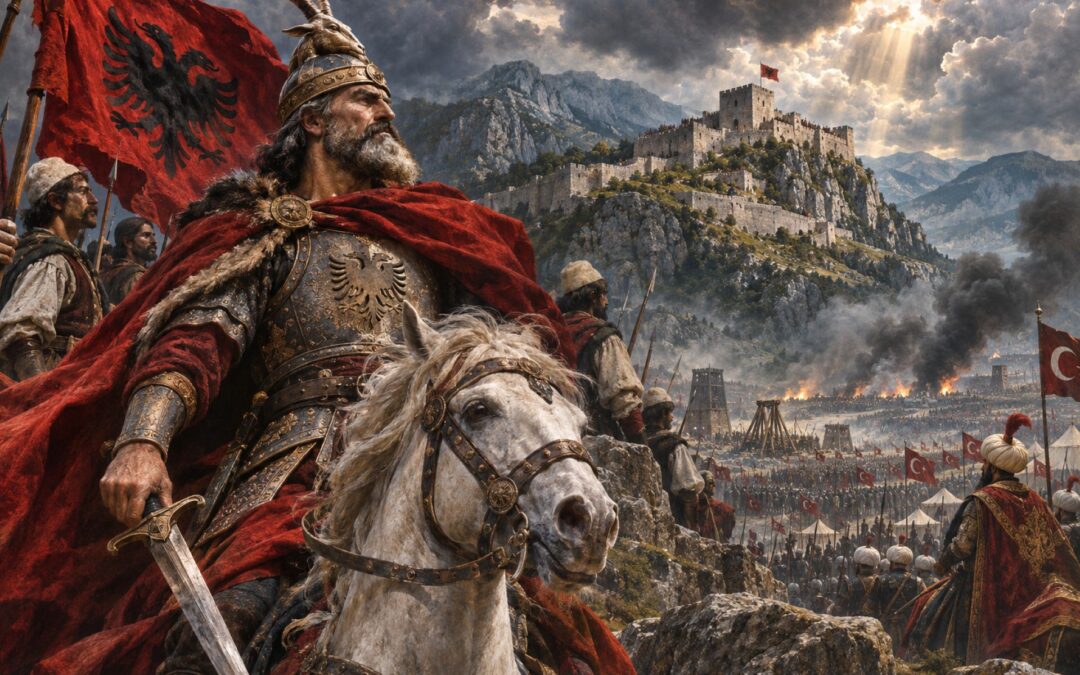
In 1450, an Ottoman army arrived beneath the fortress of Krujë in the Albanian mountains. Its commander was Sultan Murad II, whose victories had already defeated major European coalitions and reinforced Ottoman power across the Balkans. Krujë seemed an improbably small obstacle for an empire with far greater manpower and resources, yet the fortress held through months of siege. The man directing the resistance was not a foreign crusader or a hereditary king. He was a former Ottoman officer who understood the army advancing against him.
Gjergj Kastrioti, better known as Skanderbeg, had broken with the Ottomans in 1443 and rallied a group of Albanian nobles to oppose their expansion. For roughly a quarter of a century, his forces repeatedly frustrated campaigns intended to restore Ottoman control. They did so without building a powerful centralized state, and without enjoying dependable support from Europe’s larger rulers. His life is often remembered as an almost unbroken series of impossible victories, but the history is more compelling—and more revealing—than that legend.
How could such resistance endure, and why did it ultimately fail? The answer lies in the interaction of one commander’s abilities with the terrain, politics, alliances and resources of a region caught between competing powers.
How an Albanian Nobleman Became an Ottoman Officer
Skanderbeg was born around 1405 into the Kastrioti family, one of several noble households competing for influence in the Albanian lands. His father, Gjon Kastrioti, controlled territories that shifted in extent and security as neighboring rulers and the rising Ottoman state pressed their claims. The family’s position was not that of an independent monarchy governing a modern Albanian nation. Local nobles negotiated, resisted and sometimes accepted the overlordship of stronger powers while trying to preserve their estates and authority.
The region’s mountainous interior and its routes to the Adriatic made it strategically valuable. The Republic of Venice held important coastal possessions and pursued commercial security, while Serbian and other Balkan dynasties had their own interests inland. Ottoman expansion increasingly changed the terms of these relationships. The sultans used warfare, tribute demands, vassal agreements and local appointments to draw territories into a growing imperial system. This was the wider process of Ottoman expansion into the Balkans, which altered political life long before every district came under direct administration.
Gjergj entered Ottoman service while young. Traditional narratives describe sons of the Kastrioti family being sent as hostages to guarantee their father’s loyalty, though the chronology and arrangements are not as clear-cut as later biographies suggest. Accounts commonly place Gjergj’s entry into Ottoman service around the early 1420s. Hostage-taking and service at a ruler’s court were instruments of political control, but they could also provide education, patronage and advancement to members of provincial ruling families.
Within the Ottoman establishment, Gjergj became associated with the name İskender, a form of Alexander, and acquired the title bey. From these came the name by which he is now widely known: Skanderbeg. He served as a military officer and held positions connected to the management of territory in the western Balkans. The precise details of his palace education and early campaigns are difficult to reconstruct, particularly when later stories supply an unusually neat progression from captive child to the sultan’s favorite general.
His position was nevertheless significant. The man who later challenged Ottoman rule had learned how its commanders organized troops, how authority moved through its provincial hierarchy, and how campaigns depended on local cooperation and supplies. He also understood the Albanian landscape and the noble families whose support an insurgency would require. These experiences did not predetermine a rebellion; for years, his career belonged to the political order he eventually fought.
Gjon Kastrioti died in the later 1430s, as the family’s territorial position had already been repeatedly contested. His son’s eventual decision to return was therefore not simply a straightforward recovery of an uncontested inheritance. It was a political gamble in a region where allegiance, religion and landholding had become intertwined with Ottoman expansion.
The Break with Murad II, 1443
Skanderbeg’s opportunity emerged from a crisis far beyond Albania. In 1443, the Hungarian commander John Hunyadi led a major campaign into the Balkans against Sultan Murad II. The fighting disrupted Ottoman positions and raised hopes among regional opponents of Ottoman rule that the balance of power might be changing. One of the campaign’s encounters, near Niš in November, became central to the traditional story of Skanderbeg’s defection.
According to that account, Skanderbeg withdrew from Ottoman service during the turmoil, taking a company of Albanian followers with him. The famous embellishment is that he forced an Ottoman official to produce a forged command ordering the governor of Krujë to surrender the fortress. The document supposedly gave Skanderbeg access to a stronghold he could not easily storm. Although the episode is widely retold, its polished dramatic details owe much to later narrative traditions and should not be mistaken for a verbatim record of the event.
What matters historically is the reversal itself. Skanderbeg broke with Ottoman authority, returned to Krujë and established himself there in late November 1443. The date 28 November is traditionally associated with his recapture of the fortress and the raising of the Kastrioti family’s double-headed eagle banner. It later acquired a second significance when Albania declared independence on the same calendar date in 1912. The symbolism became inseparable from the story, although the precise design and continuity of medieval and modern flags need to be treated with care.
Skanderbeg’s public return to Christianity also belonged to this political transformation. He had been associated with Islam during his Ottoman career, and later Christian accounts emphasized his return as proof of religious liberation. Yet personal belief is difficult to extract from the political circumstances. Medieval alliances frequently crossed religious boundaries, and the Albanian population itself included Catholic, Orthodox and Muslim communities. His revolt cannot be reduced to a single private conversion experience, even though Christian identity became important to his diplomacy and reputation.
The takeover of Krujë offered him a defensible political center, not a functioning independent country. Ottoman power still surrounded the region, and many local rulers had good reasons to distrust one another. Their rivalries could give the sultan opportunities to recover territory through negotiation, selective favors or military force. A rebellion confined to one castle would have remained vulnerable regardless of the bravery of its defenders.
Skanderbeg therefore faced two tasks at once: survive the inevitable Ottoman response and persuade competing nobles that cooperation offered them more than separate arrangements with the sultan. His most consequential early decision was not a battlefield maneuver but the attempt to organize that cooperation.
The League of Lezhë and the First Victories, 1444–1448
On 2 March 1444, Albanian nobles gathered in the coastal town of Lezhë to form what became known as the League of Lezhë. Among the participating aristocratic networks were families such as the Dukagjini, Arianiti, Thopia and Muzaka, whose interests did not always coincide. Skanderbeg was chosen as the principal military leader of the coalition. That decision helped bring otherwise separate forces into campaigns that no individual lord could sustain so effectively alone.
The League mattered because it permitted cooperation over soldiers, money and defensive priorities. A commander operating across several territories could mobilize troops, draw on local strongholds and coordinate responses to approaching armies. The nobles, however, did not surrender all their political independence to Skanderbeg. Their obligations, rivalries and outside connections remained sources of recurring tension. Calling the League the birth of a fully unified Albanian state would impose a modern political meaning on an unstable medieval alliance.
Its military challenge was formidable. Ottoman armies could assemble specialized cavalry, infantry, engineers and siege resources across a much larger imperial territory. The Albanians could rarely win by meeting every invading force on open ground in a prolonged contest of numbers. Skanderbeg instead sought moments when enemy formations, supply arrangements and unfamiliar terrain made that superiority less decisive. Mountain routes offered hiding places and alternatives to the roads followed by larger columns, while local knowledge made ambushes and rapid movements possible.
The battle of Torvioll in June 1444 provided the new coalition with an early success against an Ottoman force commanded by Ali Pasha. Traditional accounts describe Skanderbeg concealing troops and striking when the attackers committed themselves against the Albanian center. The broad picture—a well-timed victory that established the League’s credibility—is important, although precise reconstructions of formations, casualties and army strengths vary. Claims about thousands killed or captured should not be treated as a reliable ledger merely because they appear in later histories.
Further campaigning followed in the middle 1440s, with the Albanian forces resisting Ottoman operations around mountain passes and contested districts. These encounters were not identical repetitions of a single flawless tactic. Skanderbeg needed to choose where to defend, when to fight and how to keep disparate supporters committed between campaigns. Success often meant denying an opponent the intended political result rather than destroying an entire army. A raid that made provisioning difficult could matter as much as a dramatic victory in the field.
Nor were the Albanians fighting only the Ottomans. Venice feared that an ambitious inland ruler might threaten the territories, trade routes and clients on which its Adriatic position depended. Relations deteriorated into the Venetian-Albanian War of 1447–1448. The conflict exposed a lasting contradiction: a Christian republic could regard Skanderbeg as a useful opponent of Ottoman expansion while simultaneously opposing him when its own regional interests were threatened. The eventual accommodation did not erase that conflict of priorities.
Hunyadi’s renewed campaign in 1448 offered the possibility of wider coordination against the Ottomans. Yet negotiations and movement through territories controlled by other rulers proved difficult, including obstruction associated with the Serbian despot Đurađ Branković. Skanderbeg’s army did not unite with Hunyadi before the latter’s defeat at the Second Battle of Kosovo. That failure was not proof that the two men could have guaranteed victory together, but it showed the practical costs of divided Balkan politics.
By the end of 1448, Skanderbeg had demonstrated that Ottoman authority in Albania could be challenged repeatedly. He had not solved the harder problem of building a coalition large and stable enough to change the wider balance of power. Murad II would soon put that limitation to a severe test.
Krujë, 1450: An Empire Meets a Mountain Fortress
Murad II personally led a major campaign against Krujë in 1450. The fortress occupied elevated, difficult ground, and its approaches restricted how attackers could deploy men and siege equipment. Such defenses did not make Krujë impossible to capture, but they reduced the advantages of an army whose numerical strength could not all be brought to bear against the walls at once. The Ottomans faced a problem familiar to armies operating in mountain country: the need to sustain a large siege force for long enough to exhaust defenders who required much less space and food.
Skanderbeg did not simply shut himself behind the fortifications. He entrusted the defense of Krujë to the experienced Vrana Konti and retained mobile troops outside the fortress. The garrison resisted Ottoman assaults while forces operating in the surrounding hills threatened messengers, foragers and supply movements. This combination forced the besiegers to protect their communications as well as attack the walls. Every additional task consumed attention and manpower that might otherwise have been concentrated on the siege.
Skanderbeg’s mobile forces were not expected to destroy the siege army in a conventional set-piece battle. Their more realistic objective was to make continued operations expensive and uncertain. Foraging parties needed escorts, roads needed protection, and commanders had to divide their attention between taking the castle and maintaining the army that surrounded it. Even where the exact details of individual raids remain uncertain, the combined defense worked by forcing the besiegers to solve several problems at once.
The balance was dangerous for the defenders, too. The Ottomans could maintain pressure, seek agreements with wavering local leaders and attempt repeated assaults. Albanian operations outside the walls carried risks and could not make up indefinitely for shortages of manpower or supplies. It would be misleading to imagine a vast, helpless Ottoman host simply trapped by a few invulnerable mountain fighters. The campaign was a prolonged contest of logistics, endurance and political will.
Accounts of the siege often give enormous figures for Murad’s army, sometimes reaching 100,000 or more, along with precise numbers for the defenders and casualties. Those estimates vary and come from traditions that frequently magnified the scale of a victory. The essential facts do not require accepting the largest figures: Murad brought substantial forces, Krujë survived the siege, and the Ottoman army withdrew later in the year without achieving its principal objective.
The outcome was a major success for Skanderbeg and the League. It strengthened his prestige, preserved an important defensive center and showed potential supporters that the rebellion was not about to disappear. Yet one failed siege did not end Ottoman designs on Albania. Murad died in 1451, and his successor Mehmed II inherited both the resources of the empire and the challenge of bringing resistant territories into its orbit. Krujë had held, but the struggle was far from finished.
From Berat to Albulena, 1455–1457
The strategic environment changed dramatically in 1453 when Mehmed II conquered Constantinople. The capture of the Byzantine capital transformed the sultan’s prestige and strengthened his position at the center of an expanding imperial system. For an understanding of that watershed and the transformation of the city afterward, the conquest of Constantinople in 1453 provides essential context. Albania remained one of several difficult frontiers, but it now confronted a ruler whose ambitions and resources reached across much of southeastern Europe.
Skanderbeg’s position was never one of uninterrupted military success. In 1455 he attempted to take the Ottoman-held fortress of Berat. The campaign ended in a serious Albanian defeat when Ottoman forces attacked the besiegers and inflicted heavy losses. Berat exposed the dangers of operations that required the rebels to commit considerable manpower against a fortified position. The same commander who was adept at disrupting an enemy siege could struggle when he had to conduct one himself.
The defeat also damaged confidence within the coalition. Followers faced the immediate cost of losses and the longer-term possibility that an Ottoman return was inevitable. Skanderbeg could not rely solely on personal prestige to maintain cooperation among nobles who owned lands, feared reprisals and had choices about their political allegiance. The League’s resilience depended on whether military recovery could follow a setback large enough to encourage defections.
Ottoman operations continued in 1456, including fighting around Oranik. The region’s contested routes and strongholds remained central to both sides. Then the confrontation acquired an especially personal dimension: Skanderbeg’s nephew Hamza Kastrioti joined the Ottoman side. Later narratives turn this into a simple family betrayal, but the defection also reflected political ambition and the persistent temptation for Albanian nobles to seek status and security through Ottoman patronage.
In 1457, an Ottoman army entered Albania with Hamza among its leaders. Skanderbeg avoided offering an immediate battle under unfavorable conditions, and accounts describe him concealing his forces while the invaders came to believe that resistance had weakened. The resulting attack at Albulena, traditionally dated 2 September 1457, brought a decisive Albanian victory. Hamza was captured, and Skanderbeg’s reputation recovered after the disaster at Berat.
Like Torvioll, Albulena accumulated impressive casualty figures in later retellings. What made the battle important was not a precisely countable annihilation but the political reversal it produced. The rebellion remained viable, while Ottoman plans to break it through a combination of military pressure and internal division had failed on this occasion. An army that could retreat, reorganize and choose its moment had shown that a severe defeat did not necessarily end the resistance.
The victory also strengthened Skanderbeg’s standing among Christian powers looking for ways to check Ottoman expansion. Pope Calixtus III supported his cause, and the honorific Athleta Christi, or “Athlete of Christ,” became associated with him. Such language expressed how papal diplomacy interpreted his campaign, not a complete explanation of its motives. The troops fighting in Albania were defending homes, lands and political interests as well as participating in a struggle that outsiders framed in religious terms.
The period from Berat to Albulena captures both the achievement and the limits of Skanderbeg’s leadership. He could recover from devastating setbacks and turn a divided political landscape into a source of tactical advantage. But he had not made that landscape permanently loyal, nor had he forced the Ottoman government to abandon its ambitions. To keep fighting, he needed more than victories at home.
Allies Across the Adriatic: Naples, Venice, and the Papacy
Skanderbeg’s resistance depended partly on the fact that Albania was not isolated from the politics of the Adriatic and Italy. Across the sea, the Kingdom of Naples, the papacy and Venice all had reasons to monitor Ottoman expansion. Their concerns were genuine, but they differed sharply, and none was prepared to subordinate its own priorities permanently to the needs of Albania. Skanderbeg’s diplomacy therefore required constant negotiation rather than reliance on a single united Christian alliance.
A particularly important connection was with Alfonso V of Aragon, who also ruled Naples. Under the Treaty of Gaeta in 1451, Skanderbeg accepted arrangements that linked him to Alfonso’s protection and political interests in exchange for support. These terms are sometimes celebrated as straightforward international recognition of Albanian independence, but their obligations were more complicated. The relationship involved questions of overlordship, assistance and the future distribution of authority, illustrating how a ruler resisting one empire might depend on another monarch’s patronage.
After Alfonso’s death, his successor Ferdinand I faced challenges to his throne. Skanderbeg intervened in southern Italy, particularly during the campaigns of 1461–1462, in support of the Neapolitan cause. These expeditions have sometimes been treated as an interruption of his real struggle, yet they reveal how the alliance worked. By fighting for Ferdinand, Skanderbeg upheld a relationship that might provide soldiers, money, political protection and strategic leverage against the Ottomans.
The papacy supplied another kind of legitimacy. Popes praised Skanderbeg’s resistance and looked toward larger coalitions against Ottoman power, but crusading plans repeatedly ran into problems of finance, timing and competing rulers’ interests. Papal approval could enhance his standing without guaranteeing that a sufficiently large allied army would reach Albania. Religious rhetoric was important to diplomatic mobilization, but it did not eliminate the calculations of states and dynasties.
Venice was an even more complex partner. The republic’s overseas possessions, trade and naval security made Ottoman expansion threatening, but a strong Albanian commander could also challenge Venetian influence near the coast. Understanding Venice’s maritime empire and Adriatic interests helps explain why it had fought Skanderbeg in the 1440s before later cooperating with him. When Venice entered a major war against the Ottomans in 1463, its relationship with Skanderbeg acquired renewed strategic importance, though distrust and diverging objectives persisted.
As historian Oliver Jens Schmitt emphasizes in his study of Skanderbeg’s uprising and political alliances, the rebellion must be understood within the competing interests of Balkan elites and neighboring powers, not as a self-contained confrontation between a nation and an empire. That does not diminish Skanderbeg’s personal achievements. It explains how he continued fighting and why each diplomatic gain carried conditions that could eventually become liabilities.
Aided by external funds and changing diplomatic opportunities, Skanderbeg could maintain resistance longer than Albania’s resources alone might have permitted. But the same system left him exposed when allies pursued peace, rival campaigns or their own survival. By the mid-1460s, the limits of foreign assistance were becoming painfully visible.
Mehmed II’s Sieges and Skanderbeg’s Final Years, 1464–1468
The later years of Skanderbeg’s resistance were shaped by sustained Ottoman pressure. Campaigns in 1464 and 1465 involved repeated clashes with commanders sent to impose control, including Balaban Pasha, an Ottoman officer of Albanian background. His role is a reminder that the conflict did not divide people neatly according to their language or place of birth. Some Albanians served the sultan, others fought with Skanderbeg, and personal, dynastic and local interests could shift allegiances.
Skanderbeg continued to defeat opposing forces in particular engagements, but victories did not reverse the deterioration of his broader position. Fighting consumed manpower and resources that the League could not easily replace. Ottoman authorities had a much wider pool of soldiers, revenue and fortified bases from which to operate. The struggle was increasingly about preventing effective occupation of Albania rather than achieving a decisive offensive triumph that would end Ottoman intervention.
In 1466, Mehmed II led a major campaign into Albania and again confronted Krujë. Its defenses resisted the Ottoman siege, while Skanderbeg operated beyond the walls, disrupting movements where his smaller forces could act effectively. The pattern resembled Murad’s campaign in 1450, but the surrounding strategic environment was different. Mehmed had learned that an army need not take one formidable fortress immediately to weaken the resistance supporting it.
Before leaving, Ottoman forces established the fortress of Elbasan on a strategically important route. This development mattered enormously. A permanent stronghold allowed the Ottomans to maintain pressure, protect movement through contested territory and threaten Albanian communications after the main army had withdrawn. The inability to capture Krujë therefore coexisted with a significant expansion of Ottoman military infrastructure. Judged only by whether its walls had fallen, the campaign would seem a straightforward Albanian victory; judged by territorial control, it was far more ambiguous.
Skanderbeg appealed for assistance in Italy and continued attempts to mobilize western support. The papacy, Naples and Venice still recognized the strategic value of resistance in Albania, but their own difficulties restricted what they could provide. A coalition often described as Europe’s defense against the Ottomans remained fractured by rivalries and by the extraordinary expense of sustaining prolonged war. No single ruler could force all the others to act on the same timetable.
Mehmed returned with another major campaign in 1467. Krujë again survived, but repeated invasions intensified the strain on surrounding districts and weakened the political and economic foundations of resistance. The conventional language of “three failed sieges” captures the fortress’s endurance without conveying the devastation that could occur outside its walls. A sultan who failed to conquer a particular stronghold might still be making it increasingly difficult for the local coalition to survive.
By then Skanderbeg had fought for more than two decades since his return in 1443. He was an aging commander responsible for alliances that depended strongly on his authority, diplomacy and reputation. His power was never absolute, yet he remained the figure best able to coordinate local aristocrats, military followers and foreign patrons whose priorities otherwise diverged. That combination was unusually difficult to reproduce or pass intact to a successor.
In January 1468, Skanderbeg traveled to Lezhë, the town associated with the League’s founding, while plans for continued resistance remained urgent. He became seriously ill and died on 17 January 1468. His illness is frequently identified as malaria, although the surviving evidence does not allow a modern clinical diagnosis with certainty. Later accounts preserve moving final words and farewell scenes, but these should be read as part of the memory surrounding him rather than as reliably recorded bedside dialogue.
The coincidence of place was powerful: he died near the town where the coalition had been formed almost 24 years earlier. Yet his death was not the instantaneous disappearance of all Albanian resistance. Fortresses and communities continued to fight, and the political outcome remained contested for years. What had disappeared was a commander whose personal relationships and tactical judgment had helped keep a fragmented movement together under repeated pressure.
After Skanderbeg: The Fall of Krujë and the Uses of His Legend
Skanderbeg’s death altered the balance in Albania, but it did not produce an immediate Ottoman conquest of everything he had defended. Some noble families continued resistance, Venetian positions remained significant, and local fortresses still imposed costs on attackers. The League’s earlier unity had always been imperfect, and its dissolution was a process rather than a switch that could be flipped by one man’s death. Continued campaigning, rival ambitions and depleted resources gradually reduced the remaining centers of opposition.
Krujë endured further pressure before falling to the Ottomans in 1478, roughly a decade after Skanderbeg’s death. The fortress that had survived major campaigns in his lifetime could no longer be defended under the same conditions. Its fall is a useful marker of the military transformation of the region, but it should not erase the defenders who resisted after 1468 or imply that Ottoman rule everywhere began on the same day. The conquest proceeded through specific places, negotiations and garrisons rather than a single decisive surrender by an already unified Albania.
In 1479, Venice reached a peace settlement with the Ottoman Empire and relinquished Shkodër and other positions under the treaty’s terms. The agreement reflected Venice’s broader strategic predicament after prolonged warfare, not simply a sudden personal betrayal of an ally who had died years earlier. For Albanian communities, however, the consequences were profound. The loss of fortified centers and the extension of Ottoman authority reshaped political life, while conflict and displacement contributed to migrations, including movements toward southern Italy.
The failure to secure permanent independence did not make Skanderbeg’s career inconsequential. His campaigns demonstrated how a smaller coalition could obstruct a powerful empire when geography, mobile operations, local loyalty and foreign diplomacy worked together. They also showed how vulnerable such resistance could be when its institutions remained fragmented and outside support fluctuated. The outcome was neither a straightforward victory for an invincible national army nor proof that resistance had been meaningless simply because the Ottomans eventually prevailed.
Skanderbeg’s subsequent reputation developed through writing as much as through surviving military records. The humanist Marin Barleti composed an influential account of his life in the early sixteenth century, presenting a model Christian commander whose speeches, decisions and victories could inspire later audiences. That biography helped make him known far beyond Albania, but it also blended historical material with rhetorical invention and heroic exaggeration. As the Library of Congress explains in its account of the growth of Skanderbeg’s legend, the historical figure became a subject of European literature and political imagination as well as Albanian remembrance.
That European reception took different forms across centuries. His story could be read as resistance to Ottoman expansion, an example of military leadership, or an expression of Christian heroism. Antonio Vivaldi even composed an opera titled Scanderbeg, one illustration of how the commander moved from historical chronicles into European cultural life. These artistic representations mattered, but they reveal the interests of later creators and audiences as much as the details of his fifteenth-century campaigns.
In Albania, his image took on greater national significance during the emergence of modern nationalism. Nineteenth-century writers and political activists could look back to Skanderbeg as a figure associated with autonomy, collective identity and resistance to foreign rule. The League of Lezhë offered a historical symbol of cooperation among Albanian nobles, even though the league itself had not been a modern national government. This distinction matters because the political aspirations of the nineteenth and twentieth centuries were not identical to those of the 1440s.
When Albania declared independence on 28 November 1912, the date recalled Skanderbeg’s traditional recovery of Krujë in 1443. The red flag with a black double-headed eagle drew on the Kastrioti-associated emblem and became one of the strongest symbols of the new state. Yet medieval banners, later artistic renderings and the modern national flag cannot all be assumed to have exactly identical designs. The continuity is historical and symbolic, not proof that one unchanged piece of cloth or one precisely fixed graphic survived for centuries.
Objects linked to Skanderbeg have also become part of this historical memory. The distinctive helmet attributed to him, often shown with a goat’s-head crest, is preserved in Vienna rather than Tirana. The Kunsthistorisches Museum’s catalog entry for Skanderbeg’s helmet provides a concrete connection between the figure remembered in portraits and the surviving material culture associated with him. Its significance does not depend on the mistaken claim that it is displayed in the Albanian capital.
Remembering Skanderbeg responsibly means allowing both his achievement and its limitations to remain visible. His resistance involved formidable military judgment, but also unpopular compromises, local rivalries and relationships with patrons whose goals were not his own. His coalition survived extraordinary pressure yet ultimately failed to prevent Ottoman conquest. Neither the heroic tradition nor its modern critics should flatten those realities into a simple verdict about one man’s greatness.
For about 25 years after 1443, Skanderbeg helped keep an organized Albanian resistance alive against successive Ottoman campaigns. The mountains shaped what his forces could do; his knowledge of Ottoman warfare helped him exploit their advantages; the League and foreign alliances supplied the political and material foundations. When those foundations weakened, neither a celebrated commander nor a well-defended fortress could permanently overturn the empire’s larger resources. His lasting importance lies in the extraordinary duration and influence of that struggle, and in the meanings later generations found in a history that ended in conquest rather than independence.
Last Updated on November 3, 2026 by Aseem Gupta