
Reading Time: 32 Minutes
In July 1402, two of the most formidable conquerors of their age faced each other on the Çubuk Plain north of Ankara. Bayezid I, the Ottoman sultan known as Yıldırım, or “the Thunderbolt,” had defeated crusaders, subdued rival princes and brought Constantinople under relentless pressure. Timur, whose armies had crossed Central Asia, Iran, India and Syria, had destroyed kingdoms that seemed beyond the reach of any single ruler. Neither had come to Anatolia intending to acknowledge another man’s supremacy.
The battle ended with the Ottoman army broken and Bayezid in captivity. Timur’s soldiers advanced through Anatolia, plundered the early Ottoman capital of Bursa and restored rulers whom Bayezid had expelled. The sultan died a prisoner, and his sons fought one another for eleven years. A dynasty that had seemed unstoppable suddenly appeared close to extinction.
Yet the Ottomans survived. To understand both their defeat and their recovery, the story must begin long before the armies assembled outside Ankara. It involves the destruction of older empires, the anger of dispossessed princes, refugees caught between rival courts, threatening letters, strategic miscalculations and the difference between conquering a territory and securing its loyalty.
Timur’s Rise: From Transoxiana to the Gates of Anatolia
Timur was born in 1336 near Kesh, later called Shahrisabz, south of Samarkand, into the Barlas, a Turkic-speaking group with Mongol origins. His father, Taraghay, belonged to the tribal aristocracy of Transoxiana, the region between the Amu Darya and Syr Darya rivers. Timur did not inherit a great empire, but neither did he begin as an unknown peasant. Family connections, familiarity with warfare and the opportunities created by political collapse helped him enter the struggles that eventually made him supreme.
The Chagatai Khanate, descended from a son of Genghis Khan, had lost much of its effective unity. Regional commanders and tribal leaders increasingly exercised authority in their own names. One powerful figure was Qazaghan, who dominated Transoxiana while preserving the outward forms of Chagatai rule. Traditions about Timur’s early service place him in this world of shifting allegiance, where an ambitious young warrior could learn that political survival depended as much on alliances as battlefield courage.
Qazaghan’s assassination in 1358 deepened the disorder. When Tughlugh Timur, khan of the eastern Chagatai territories, intervened in Transoxiana, Timur at first found advantage in acknowledging his authority. That accommodation did not last. Timur’s position changed repeatedly as he manoeuvred among rival Mongol and Turkic commanders, at times fleeing, fighting with small forces and rebuilding support through marriage and patronage.
He eventually joined forces with Amir Husayn, another contender for power. Their partnership survived years of campaigning but deteriorated into rivalry. In 1370 Timur defeated Husayn and emerged as the effective master of Transoxiana, making Samarkand the centre of his rule. The familiar image of an assembled nobility acclaiming a new sovereign captures the political achievement, but the constitutional reality was more complicated than a simple replacement of the Chagatai state by a kingdom bearing Timur’s name.
Timur was not a direct male-line descendant of Genghis Khan, a distinction that mattered in the political culture he inhabited. He therefore usually ruled as amir, exercising power alongside nominal Chinggisid khans, and strengthened his prestige through marriage into the imperial lineage. The title Gürgän, or royal son-in-law, advertised that relationship. His regime blended older Mongol concepts of dynastic legitimacy with Islamic political language, personal military authority and a formidable network of dependent princes and commanders.
His name meant “iron” in Turkic. A leg injury contributed to the epithet Timur-i Lang, or “Timur the Lame,” from which the European name Tamerlane developed. The injury never prevented him from leading long, demanding campaigns. Indeed, a striking feature of Timur’s rise and conquests is the combination of relentless movement with patient political calculation: he could fight, negotiate, reward defectors and destroy a resisting city as parts of the same campaign.
His armies drew on the mounted warfare traditions of Central Asia, especially mobile cavalry, coordinated wings and reserves. They also employed siege specialists and administrators from conquered territories. Timur rewarded commanders and relatives with authority but kept the wider enterprise tied to his own direction. Intelligence from scouts, agents, merchants and envoys helped him choose when to strike and when to avoid an unfavourable confrontation.
Iran became one of his principal theatres of expansion. The Ilkhanate, established by Mongol rulers in the thirteenth century, had fragmented, leaving competing dynasties and regional powers. Among them were the Muzaffarids in southern and central Iran. Timur used submission demands, alliances and successive campaigns to establish control over this divided landscape. The process involved repeated fighting, not a single swift conquest of a unified Iranian state.
One of the most terrifying episodes came at Isfahan in 1387. After the city had submitted, a revolt against Timurid forces was followed by a mass killing. Some chroniclers give figures of roughly 70,000 dead and describe the construction of towers of severed heads. Those precise totals cannot be independently verified, but the massacre itself is part of the established history of Timur’s rule. It illustrates the devastation inflicted on medieval Isfahan and the role exemplary punishment played in frightening other communities into surrender.
Timur was not solely interested in Iran. He intervened repeatedly against Tokhtamysh, the ruler of the Golden Horde, whom he had earlier helped to power. Their alliance broke down as both sought influence over contested territories and trade routes. Timur defeated Tokhtamysh in major campaigns in 1391 and 1395, and his forces devastated important centres of the Golden Horde, including Sarai and trading towns connected with the lower Volga. The damage weakened an already complex political order and contributed to changes that later benefited the emerging Muscovite state.
That longer connection should not be turned into a simple national origin story. Timur did not establish Russia, personally end every form of Golden Horde power or march into Moscow in a universally celebrated moment. The Horde survived in altered forms, while the growth of Moscow depended on many later political and military developments. Timur’s campaigns nevertheless affected a vast region far beyond the territories he occupied permanently.
In 1398 Timur invaded northern India, defeated the forces defending Delhi and subjected the city to a catastrophic sack. His army carried away captives and enormous wealth, while the Delhi Sultanate was left grievously weakened. This was a devastating expedition rather than the lasting incorporation of all northern India into a stable Timurid administration. The reported massacres, including enormous round figures found in later narratives, should be understood within the limitations of medieval evidence.
He also fought in the Caucasus, Georgia, Iraq and the lands bordering Anatolia. Cities that submitted might negotiate terms; those that resisted could face destruction. The atrocities were not incidental to his reputation. Fear travelled ahead of his army, influencing whether governors opened their gates, fled or sought alliances. But terror had a strategic limit: ravaged territories and intimidated subjects did not necessarily become dependable foundations of government after the conqueror moved on.
The enduring history of Persia places these conquests in a longer pattern of political fragmentation and imperial reconstruction. By the end of the fourteenth century, Timur had built a dominion of extraordinary reach from Samarkand. His next western rival was a ruler whose own rapid expansion had created both strength and vulnerabilities.
Bayezid’s Expansion and the Powers Caught Between Two Empires
Bayezid became Ottoman sultan in 1389 after his father, Murad I, died during the Battle of Kosovo. He inherited a growing dynasty with power in both Anatolia and southeastern Europe. His reputation for speed and determination earned him the title “the Thunderbolt,” although the name should not suggest that every success was a sudden battlefield triumph. Marriage alliances, negotiated submission, tribute, sieges and the management of regional notables were as important to his expansion as open battle.
In the Balkans, the Ottoman presence had become durable enough to draw on local rulers, military households and revenue-producing lands. Yet it remained contested by Hungary, surviving Byzantine institutions and other Christian powers. The crusading coalition that confronted Bayezid at Nicopolis in 1396 represented a major effort to halt Ottoman advances. Bayezid’s decisive victory shattered that attempt and greatly strengthened his standing as a defender and extender of his realm.
Constantinople was another central objective. The Byzantine capital occupied the straits between the Black Sea and the Mediterranean, but its emperor controlled little territory beyond the city and a few remaining possessions. Bayezid sought to pressure it through blockade and repeated military threats. Its great land walls and access by sea made outright conquest difficult, yet prolonged Ottoman pressure limited Byzantine freedom and drove Emperor Manuel II to seek assistance in western Europe.
Bayezid’s campaigns belong to the larger history of the Ottoman Empire’s rise, but Anatolia presented a problem different from the Balkan frontier. There, long-established Turkish principalities had their own dynasties, armed retainers, laws of succession and local loyalties. Bayezid absorbed or subordinated territories associated with Germiyan, Aydın, Saruhan, Menteşe and Karaman. Each acquisition supplied land, revenue and potentially troops; each also dispossessed people who might someday prefer a different sovereign.
The exiled beys did not disappear. Some sought Timur’s protection, arguing that Bayezid had stripped them of hereditary domains and asking the conqueror to restore their rights. Their appeals gave Timur an opportunity to present intervention in Anatolia as the correction of an injustice rather than a wholly new invasion. It also offered him practical military advantages: princes who knew their former territories could identify roads, political factions and soldiers likely to reconsider their allegiance.
Meanwhile, Timur’s western campaigns drove other rulers toward Bayezid. Sultan Ahmad of the Jalayirid dynasty had lost ground in Iraq, including Baghdad, while Kara Yusuf of the Qara Qoyunlu confederation resisted Timurid power in Azerbaijan and neighbouring regions. These were not minor fugitives in a private dispute. They controlled or claimed important territories, possessed followers and could reopen trouble behind Timur’s advancing armies if sheltered by a strong neighbour.
The Mamluk Sultanate stood between these rival worlds. Based in Egypt and Syria, it governed prosperous cities and commanded military resources that neither Timur nor Bayezid could ignore. Sultan Barquq had opposed Timur’s expansion; after his death in 1399, instability at the Mamluk court complicated the diplomatic landscape. Bayezid’s own moves into areas linked to Mamluk interests, including Malatya and the Dulkadirid frontier, had also damaged the trust needed for a united response to Timur.
Thus the Muslim states facing Timur were not members of a single political bloc. A ruler could regard Timur as dangerous and still fear Ottoman expansion. Bayezid could propose common action against an invader while Mamluk leaders worried that an Ottoman victory would leave Syria exposed to a different conqueror. Their refusal to cooperate effectively was not simply an inexplicable mistake: it reflected conflicts that existed before Timur reached their borders.
The small but strategically placed principality of Erzincan supplied another flashpoint. Its ruler, commonly called Mutahharten or Taharten, maintained ties with Timur, while Bayezid regarded the region as part of his own expanding sphere of influence. Control of Erzincan affected routes between eastern Anatolia, Azerbaijan and the central plateau. An advance against it could threaten a protected Timurid ally without requiring an Ottoman march all the way to Samarkand.
The Aq Qoyunlu confederation, whose notable leaders included Qara Yuluk Uthman Beg, also mattered to the balance of power. The western frontier contained overlapping claims and tribal alliances rather than a clean line on a map. Timur could recruit support among rulers threatened by Bayezid; Bayezid could offer refuge to men who had challenged Timur. Both sides used the language of honour, protection and legitimate sovereignty, but each sought a political arrangement in which the other’s independent choices were constrained.
That made the dispute combustible. Bayezid’s most recent victories had increased the scale of his empire but reduced the security of some of its allegiances. Timur had the resources to convert those local grievances into a campaign. By the turn of the fifteenth century, a quarrel over refugees and frontier princes was becoming a contest over who had the right to decide the political order of Anatolia.
Sivas, Syria and Baghdad: The Campaigns That Made War More Likely
In 1399 Timur began another great western expedition. The prospect of his arrival forced established rulers to choose between preparing resistance, approaching him with gifts or abandoning vulnerable capitals. Sultan Ahmad and Kara Yusuf, both threatened by his operations, looked toward Mamluk territory and ultimately the protection of Bayezid. At the same time, Timur established positions from which he could advance against Georgia, the Syrian cities or eastern Anatolia. His campaigns did not unfold as an uninterrupted march toward Ankara; they changed direction according to enemies, intelligence, supplies and political opportunities.
The destruction of Sivas in 1400 became the warning no Ottoman ruler could ignore. Sivas was more than a fortress on a road west: it was a significant town under Ottoman authority, a symbol that Bayezid’s frontiers could be penetrated. Timur approached with forces experienced in siege warfare and enclosed the town while his engineers worked against its walls. Accounts describe bombardment with large stones, tunnelling and the growing pressure on a garrison whose prospects of relief were uncertain.
Ottoman narratives place Bayezid’s son Mehmed and other commanders in attempts to respond to the threat, and describe an Ottoman force defeated before it could intervene effectively. Details of those manoeuvres vary among the chronicles. What is clear is that Bayezid was unable to prevent the fall of the town. The defenders surrendered, apparently hoping to avoid the destruction threatened by continued resistance.
The aftermath became notorious. Chronicles report that Timur gave assurances against bloodshed but then ordered thousands of captives buried alive, with the number often stated as 4,000. Some accounts identify the victims as Armenian soldiers, while other versions do not establish that identity. The famous contrast between a promise not to spill blood and the method of killing is part of the narrative tradition and should be attributed rather than treated as a verbatim legal exchange. The historical discussion of the Sivas campaign provides a basis for assessing the atrocity without assuming the later stories are exact transcripts of events.
The violence had a purpose beyond the captured town. Sivas demonstrated that Timur could inflict punishment in territory Bayezid claimed to protect. Accounts describe the fortress being severely damaged and the news carried back to the Ottoman court. It is difficult to measure how far those reports spread or what precise decision they caused, but their power as a warning was obvious: resisting Timur could bring consequences more frightening than surrendering to him.
Timur did not immediately push toward the Ottoman heartland. He faced other adversaries and perhaps judged that an advance against Bayezid required more preparation. His forces turned toward the territories of the Dulkadir Turkmens and Malatya. The transcript describes a raid in which Dulkadir fighters seized horses from Timurid camps, followed by retaliatory plunder around Elbistan. Such stories evoke the exposed supply lines and dangerous mobile warfare of the frontier, although the precise episodes require caution where only a partisan chronicle supplies the details.
Malatya was taken amid the wider struggle for control of the Mamluk-Ottoman borderlands. Medieval accounts describe different treatment of Muslim and Christian inhabitants and the taking of captives and ransom. The distinction mattered in the rhetoric of an army that claimed Islamic legitimacy even while attacking Muslim-ruled cities, but it does not establish that all residents experienced the conquest in a single uniform way. These campaigns also deepened Bayezid’s concern that Timur would not stop at the eastern edge of Anatolia.
The Syrian offensive brought Timur against the Mamluks. Their forces contested his approach near Aleppo in 1400, but the city fell and suffered extensive looting and killing. Timur advanced through the northern Syrian towns toward Damascus, where Mamluk resistance failed and destruction followed. The scholarly and commercial importance of these cities made their loss more than an isolated military setback. Their capture disrupted a political network that linked Egypt, Syria, Anatolia and Iraq, and advertised how little protection an established sultanate could guarantee against a determined Timurid offensive.
Bayezid had reasons to hope the Mamluks would unite with him. Yet their leaders remembered Ottoman encroachment and questioned his reliability. To fear Timur did not mean they wanted Bayezid to grow stronger. The possibility of coordinated resistance was undermined by the very regional rivalries that Timur exploited. In this respect, the diplomatic failure before Ankara mirrored the internal weaknesses that would later damage Bayezid on the battlefield.
Rather than attempt an overland invasion of Egypt across the Sinai, Timur turned again toward Mesopotamia. Baghdad had changed hands amid the struggles involving Ahmad Jalayir, and Timur’s forces subjected it to another devastating sack in 1401. The city belonged to a region with a long imperial and intellectual history; its destruction carried a message to rulers who considered offering refuge to Timur’s enemies. From there he could move back toward Azerbaijan and maintain pressure on the disputed Anatolian frontier.
Bayezid was not inactive during these operations. He challenged Timur’s ally at Erzincan, supported fugitives whom Timur demanded and tried to turn movements across eastern Anatolia into leverage against the invader. Kara Yusuf remained capable of making trouble in regions Timur had subdued, while Sultan Ahmad continued to seek opportunities to recover Baghdad. Their activities demonstrated why sheltering a deposed ruler could have genuine strategic consequences: a refugee with loyal followers might still command an army and reopen an entire theatre of war.
The campaigns also influenced the timing of the eventual confrontation. Timur was strengthening his western position and testing which rulers would yield; Bayezid was assembling men from both Anatolia and Rumelia while trying to protect a realm whose different regions responded unevenly to danger. Every raid, siege and occupation changed the credibility of the two rulers’ threats. The rivalry was no longer a distant argument between courts. It had cost cities their security and made the populations of central Anatolia fear that another catastrophe was approaching.
The Letters Between Timur and Bayezid: Why Peace Failed
Before their armies met, Timur and Bayezid fought a sustained diplomatic battle. Envoys crossed the frontier with elaborate salutations, religious language, accusations and demands. Chroniclers preserved several letters attributed to the rulers, though the precise texts are filtered through manuscript transmission, courtly convention and later historical interests. The study of correspondence between Timur and Bayezid makes the exchanges useful evidence of the issues that divided them, even when a stirring phrase should not be presented as a recording of what was said.
The first and most persistent question concerned the men Bayezid protected. Timur wanted Sultan Ahmad Jalayir and Kara Yusuf returned, expelled or otherwise placed beyond the possibility of threatening his western provinces. Bayezid saw their presence differently. A sovereign who surrendered guests to an enemy at another ruler’s command would appear unable to offer protection within his own territory. For a monarch whose authority depended on reputation as well as force, the demand was an invitation to public humiliation.
According to the correspondence traditions, Bayezid argued that a man seeking refuge should not be handed over to those pursuing him. The moral principle was politically convenient, since the refugees were useful counterweights to Timur. Still, it was not merely a cynical excuse. Protection and hospitality were recognised signs of rulership, and the ability to refuse a rival’s demand was itself a declaration of independence. Timur’s insistence consequently turned two displaced rulers into an argument about who was the greater sovereign.
The land claims were equally difficult to reconcile. Timur regarded Erzincan and its ruler as falling within his sphere, while Bayezid had advanced against them. Other towns, including Sivas, Malatya, Elbistan and Kemah, appeared in lists of territories Timur demanded be acknowledged as his. The extent and exact wording of these demands vary by account, but they point in the same direction: Timur was asking Bayezid to relinquish political authority in areas the Ottomans considered strategically essential.
Some narratives add that Timur expected a son of Bayezid to be delivered as a hostage and sought a ceremonial acknowledgment of superiority. Even when individual conditions cannot be authenticated in their popular form, they illustrate the kind of relationship the sources associate with Timur’s diplomacy. Peace on those terms would not have been an agreement between equals. It would have advertised that the Ottoman sultan occupied a lower place in a hierarchy Timur claimed the power to enforce.
The rulers presented themselves as defenders of Islam even while threatening another Muslim ruler. Timur reminded Bayezid of his long record of campaigns, invoking conquest, religious purpose and the prestige of a state whose coins and public prayers expressed sovereignty. He could depict his operations against Georgia as holy war while dismissing Ottoman troops drawn from previously Christian populations. The message was intended to weaken Bayezid’s claim that victories on the European frontier made him uniquely deserving of respect.
Bayezid’s reported answer pushed back on those accusations. The Ottoman dynasty, he argued, had fought to defend and expand Muslim territory, and the conversion of soldiers recruited from Christian backgrounds was not something to disparage. The reference reflected a real feature of the Ottoman military system: men of differing origins served a ruler who claimed Islamic legitimacy. His response also contrasted the dynasty’s service in frontier warfare with Timur’s devastation of Muslim cities, especially Sivas.
Behind the religious argument lay incompatible political projects. Timur claimed an almost universal pre-eminence among rulers in the lands he could reach. Bayezid had developed a powerful sovereign identity of his own, grounded in Ottoman inheritance, victory and the independence of his court. Each could praise the goal of peace while defining peace in terms the other was unwilling to accept. The more they made public threats, the more a retreat risked damaging their authority among allies and soldiers.
The transcript presents speeches by advisers on both sides. Bayezid’s religious counsellor Emir Sultan reportedly urged an accommodating tone and warned against war between Muslim rulers. A scholar associated with Timur, named Shamseddin in some accounts, is likewise depicted warning that victory over an Ottoman sultan engaged in campaigns against Christian powers could bring benefit to their common enemies. Such admonitions fit real debates about political legitimacy, but their extended wording should be treated as literary or chronicler testimony, not certified minutes from a council meeting.
These warnings also reveal a genuine dilemma. Bayezid could delay, negotiate or concede a peripheral point, but how many concessions could he make before his own princes and commanders doubted him? Timur could claim that he preferred Muslim reconciliation, but he had already occupied towns and demanded the surrender of protected rulers. Each ruler’s envoys carried offers of settlement that sounded more like tests of submission than workable compromises.
Stories about astrology underline the way later writers narrated this decision. One account describes a comet and an astrologer predicting that an army from the east would overcome a western ruler. This is illuminating as a story about medieval beliefs and the chronicler’s effort to foreshadow the result; it is not evidence that a celestial sign determined Timur’s military plan. By the same measure, the memorable threats to transform a rival’s sword into something harmless belong to a rhetoric of intimidation rather than a fact that can be independently reconstructed.
Was Bayezid to blame for refusing to soften his replies? The answer depends on whether the demands were genuine negotiating positions or instruments designed to obtain his subordination. Ottoman-oriented narratives often portray Timur as the aggressor and Bayezid as a ruler defending his sovereignty. Timurid accounts can place greater emphasis on Bayezid’s insults, frontier encroachments and protection of troublesome fugitives. Neither perspective is neutral, and Bayezid’s own expansion had given neighbouring rulers substantial cause to resent him.
Timur certainly advanced with an army into the disputed territories, and the attack on Sivas had already shown his willingness to impose terms by force. Bayezid’s pride and confidence made compromise harder, but it does not follow that a polite letter would have caused Timur to abandon his strategic objectives. Conversely, describing Timur as solely interested in conquest should not erase the specific disputes over refugees, frontiers and alliances that made the conflict intelligible to both courts.
By the time the last envoys returned, the diplomatic dispute had become a trap. Bayezid feared the consequences of appearing weak; Timur could not easily allow a rival to shelter enemies and reject his authority. The correspondence had not merely failed to end the conflict. It had defined the stakes of the coming battle as a judgement on the independence and prestige of both rulers.
The March to Ankara: Strategy, Surprise and Lost Opportunities
By the spring of 1402, military preparation replaced diplomatic pressure. Timur had assembled a formidable force, including veteran cavalry, commanders drawn from his own family, and contingents supplied by dependent rulers. Bayezid, for his part, called on troops from his European and Asian territories. His army contained men well acquainted with battle, but it had to be gathered from distant regions and moved across a large and difficult landscape while its opponent was already campaigning in the east.
Both rulers understood the value of choosing the ground. Timur’s army excelled at movement across open country, where mounted archers and heavy cavalry could manoeuvre, disengage and return. Bayezid’s Ottoman force included substantial infantry, alongside cavalry from Anatolia, Rumelia and Serbian allies. A battle in rugged approaches near Tokat or another defensible eastern position might have limited the advantages of Timur’s horsemen and protected Ottoman supply arrangements.
Bayezid moved toward the Sivas region expecting to intercept Timur’s advance. The transcript describes his positions near Akdağmadeni and other locations and presents a plan to draw the invaders into terrain where Ottoman troops could attack from the hills. We cannot reconstruct every march and conversation with certainty, but the underlying strategic choice makes sense. A commander threatened by superior mobile cavalry would prefer ground that restricted the enemy’s movement and kept his own troops from being outflanked.
Timur refused to fight on Bayezid’s expected terms. Instead of proceeding straight toward an Ottoman army waiting farther east, he manoeuvred through central Anatolia, passing the Kayseri region and moving toward Kırşehir and Ankara. His cavalry could screen the movement and provision itself from the countryside, while the threat to settlements forced the Ottomans to respond. It was a campaign fought in miles and days before it became a battle fought in hours.
When Bayezid realised that Timur had moved past his intended intercepting positions, the threat was no longer distant. Ankara was a vital Ottoman centre, and a Timurid army in its vicinity threatened to devastate the interior and embarrass the sultan before his own subjects. Bayezid could remain in favourable terrain and allow Timur to operate at will, or march hard toward the city to bring him to battle. The latter choice meant accepting the strain Timur had helped create.
Accounts of Bayezid’s council offer a vivid picture of disagreement. Grand Vizier Ali Pasha is said to have preferred using the mountains to raid, harass and wear down Timur’s forces, then seeking an advantageous moment to fight. Another adviser, often named Hoca Firuz, is depicted urging immediate action to protect Anatolian communities from plunder. Whether the alternatives were presented in those exact words is uncertain, but both expressed real military and political pressures: preserve the army’s strength, or defend the population before more territory was ruined.
Bayezid chose to hurry toward Ankara. The march was exhausting, particularly for infantry moving in summer heat with baggage, animals and equipment. Water, fodder and food became decisive considerations. Timur’s troops had greater freedom to rest and arrange themselves as the Ottoman column approached. The familiar contrast between refreshed Timurid cavalry and weary Ottoman infantry is plausible, even if the exact number of marching days and the soldiers’ physical condition cannot be established.
One strand of the chronicles describes an unexpected Ottoman appearance from a direction Timur had not anticipated. Bayezid’s troops reportedly found a chance to strike before the Timurid force had completely formed for battle, and some advisers urged the sultan to seize it. In the most dramatic version, Bayezid declined to attack an unprepared enemy because he wanted an openly fought contest. That scene may preserve a memory of tactical hesitation, but its dialogue and the idea that one decision alone determined the result are much harder to prove.
Timur was not immune to alarm. The historian Nizam al-Din Shami, writing from the Timurid side, records the fear and religious devotion surrounding the night before the engagement, although his work also serves the conqueror’s political reputation. Such descriptions make the approaching battle less mechanical than a contest in which the winning side had supposedly calculated everything perfectly. There were surprises, uncertainties and moments when either army might have been vulnerable.
Water supplies became another reported battleground. Some sources describe Timurid measures to divert or control water near the Çubuk Plain, worsening the Ottoman army’s difficulties. The specific methods and consequences are disputed, and the lurid assertion that Timur poisoned all available water should not be repeated as established fact. What matters is that access to water could turn a hard march into an even more dangerous prelude to fighting.
The military setting and course of the Battle of Ankara make Timur’s success in manoeuvre central to understanding the defeat. He had drawn Bayezid away from the eastern position the sultan preferred and brought the encounter to a plain suited to mounted operations. Yet the battle still had to be fought. The Ottoman army was tired and politically uneven, not incapable of resistance; its most dependable formations would make Timur pay heavily for the victory.
The Battle of Ankara: Resistance, Betrayal and Bayezid’s Capture
The opposing armies met north of Ankara on the Çubuk Plain in July 1402. The date is commonly given as 28 July, though other historical traditions place the battle on 20 July; the disagreement should not obscure the uncontested outcome. Medieval accounts also offer radically different estimates of troop strength, sometimes repeating totals that would have been extraordinarily difficult to sustain in the conditions of the campaign.
What can be said with more confidence is that Timur possessed an experienced, highly mobile force and probably a numerical advantage. Bayezid retained a hard core of loyal infantry and effective cavalry, but several contingents had been drawn from principalities he had recently absorbed. Their readiness to stand by him under the pressure of a losing battle was less certain than their presence on an assembly ground might suggest.
The Two Armies and the Opening Attacks
Timur organised his forces in a centre, substantial wings and supporting lines that could be brought forward as circumstances required. The transcript names Miran Shah on one wing, Shahrukh on another and several princes or commanders assigned to second-line formations. Precise rosters and placements differ across narrative accounts, and some individual identifications cannot safely be treated as an authoritative order of battle. The broader arrangement, however, reflects the Timurid practice of keeping mounted units and reserves available to exploit openings.
The army included contingents from Central Asia, Iran and other regions within Timur’s dominion, as well as rulers who had chosen to join his campaign. Former Anatolian princes appeared under his protection, bringing followers and knowledge of the country. Their presence had a significance beyond the fighting power of their own men: they were familiar faces to soldiers now serving the Ottoman sultan, and visible reminders that those soldiers had once owed allegiance elsewhere.
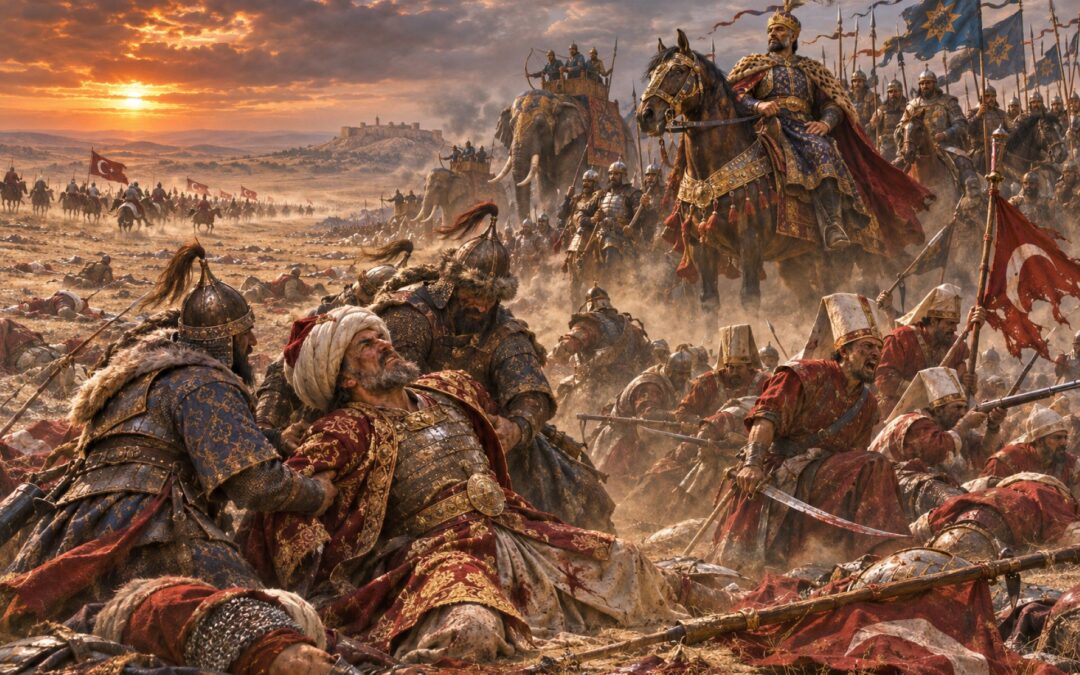
The chroniclers also describe elephants brought from India. One recurring tradition specifies thirty-two, sometimes describing them as armoured or linked together before the Timurid centre. Their appearance must have been alarming to men unused to seeing such animals in battle. But elephants were neither a magic weapon nor necessarily decisive: their effectiveness depended on their handlers, surrounding infantry and horses, and the ability of opponents to resist or disrupt them.
Bayezid stood in the centre with the Janissaries, the household infantry whose loyalty to the sultan gave him one of the strongest formations on the field. Other infantry, often identified as azaps, occupied forward positions. Anatolian forces held one wing and Rumelian troops another, while Serbian cavalry under Stefan Lazarević formed an important supporting contingent. Ottoman princes commanded sections of the army or reserves, linking the day’s contest to the dynasty’s political survival.
The presence of Stefan’s Serbian troops illustrates the limits of treating the battle as a struggle between religions. Stefan was a Christian ruler tied to Bayezid through a vassal relationship and dynastic connections. His heavily armoured cavalry fought effectively for the Ottoman sultan, despite Timur’s claims to be acting in defence of the Islamic world. Conversely, Muslim soldiers from Anatolian principalities would soon prove less dependable than Bayezid expected.
Narratives of the opening engagement describe fierce attacks and resistance rather than an immediate Ottoman collapse. One account has Miran Shah’s cavalry charging against the Ottoman left, raising so much dust that visibility became poor. The Rumelian troops held their ground, and the arrival of Serbian horsemen reportedly strengthened them at a critical moment. Other units pressed their opponents elsewhere. There were periods when Timur’s flanks had to absorb serious pressure.
Bayezid could draw encouragement from such fighting. Men who had defeated the crusading army at Nicopolis were not easily intimidated by an unfamiliar opponent. The Janissaries and other dependable formations could maintain their order while cavalry struck at threatening forces. Yet success at one point on a wide battlefield offered no guarantee that distant contingents would remain in position, especially when the enemy could reinforce endangered sectors.
Defections and the Collapse of the Ottoman Flanks
The first major shock was political. Tatar groups serving in or associated with Bayezid’s army reportedly changed sides, responding to Timur’s invitations or to ties that predated their Ottoman service. The transcript places such a defection amid the fighting on the Ottoman left, where horse archers threatened Rumelian and Serbian forces from an unexpected direction. Accounts vary on the exact timing and numbers, but a commander forced to fight men he had counted among his own suffers more than a loss of manpower: he loses the ability to trust his dispositions.
A second fracture affected the Anatolian forces. The former rulers of Germiyan, Aydın, Saruhan, Menteşe and other principalities had been brought to Timur’s side or restored to prominence through his patronage. Chroniclers describe them displaying their banners and calling to soldiers who had once served their houses. Some men reportedly deserted or turned their weapons against other Ottomans. The old relationships that Bayezid had never fully extinguished returned at the worst possible moment.
These stories should not be converted into a perfectly synchronised scene in which all Anatolian troops changed allegiance at a signal. Chroniclers had their own reasons to frame an Ottoman defeat as treachery rather than a failure of command, and the scale of desertion remains debated. Still, the repeated emphasis on broken loyalty is revealing. Bayezid had conquered states faster than he could absorb the social and political attachments that made their armies function.
Timur had prepared precisely to exploit such weaknesses. By sheltering dispossessed princes, cultivating frontier chiefs and presenting himself as an alternative patron, he had worked on the Ottoman coalition before the armies met. Soldiers watching their former rulers on the opposing line now faced a choice between obedience to Bayezid and loyalties rooted in local dynasties, family interest or hope of reward. The battlefield exposed tensions that had been created years earlier by territorial expansion.
As the situation deteriorated, the Timurid commander could move reserves toward endangered parts of his line. Descriptions name princes and senior commanders dispatched to reinforce Miran Shah or support the opposite wing. An attack that might have succeeded against an isolated formation now met fresh cavalry, while the Ottoman commanders had to spend their strength plugging gaps caused by withdrawals and defections. The advantage of reserves became greater as the cohesion of Bayezid’s army weakened.
The Ottoman side did not cease resisting. Accounts single out the Serbian contingent for its persistence, and the Janissaries continued to hold around the sultan. On the flanks, men loyal to Bayezid could fight courageously even while others slipped away. This mixture of stubborn local resistance and broader collapse explains why a battle could be fiercely contested and nevertheless end in a decisive defeat.
The elephants add one of the more striking images to these accounts. Timurid narratives describe their use against the Ottoman centre, where infantry confronted massive animals supported by armed men. Janissary archers are said to have shot at them, and other stories claim that some were killed or driven back. The details are difficult to verify, but they illustrate how the chroniclers remembered the variety of weapons and unfamiliar battlefield sights. They do not justify explaining the victory as an elephant charge overwhelming helpless Ottomans.
By the later stages of the battle, Timur’s cavalry and reserves could exert pressure across a front no longer supported evenly by Bayezid’s soldiers. Commands that should have moved as parts of a coordinated army were increasingly making their own decisions. Princes and senior officials had to consider whether staying with the sultan would preserve the state or leave it without any surviving claimant. The question could no longer be answered purely in terms of battlefield courage.
Bayezid’s Last Stand and Capture
As defeat became apparent, several Ottoman princes and commanders withdrew with forces that still obeyed them. Süleyman escaped toward the west, and Mehmed made for the northeastern Anatolian territories where he had followers. The transcript describes other princes, including İsa, Musa and Mustafa, facing very different fates. Their precise movements cannot all be reconstructed from contradictory chronicles, but the essential division is clear: Bayezid’s sons were no longer acting as a single political household.
Stefan Lazarević and his Serbian troops are credited with fighting through the danger and helping surviving Ottoman princes escape. Their performance matters not merely as a story of personal bravery. By preserving men and military resources outside the shattered centre, the retreat helped ensure that at least part of the dynasty’s fighting capacity survived the catastrophe. The same battle that destroyed Bayezid’s command did not destroy every armed group willing to support an Ottoman successor.
Bayezid himself remained with a hard core of loyal soldiers, including Janissaries. Accounts place his final resistance on or near a hill and describe a shrinking circle of defenders as Timurid forces closed around them. Some later narratives supply exact numbers—ten thousand Janissaries facing seventy thousand attackers—or stirring speeches pledging to protect the sultan to the last man. These are dramatic but not verifiable figures or transcribed declarations. The underlying picture of prolonged resistance is more credible than the precision of its storytelling.
When escape became impossible, Bayezid tried to withdraw and was captured. Stories differ over whether his horse fell after being struck, whether men from the Germiyanid forces recognised him, and how he was delivered to Timur. Those details have the texture of a battlefield tale repeated through generations, with different witnesses and political purposes shaping the telling. The central event does not depend on choosing a single version: the ruler who had never expected to submit to another conqueror was now in his enemy’s hands.
The defeat cost the Ottomans more than casualties, equipment and territory. The sultan himself could no longer issue orders, negotiate with neighbouring rulers or keep his sons together under one undisputed authority. An army can sometimes regroup after a lost battle; a dynasty deprived of its sovereign and divided among rival heirs faces a crisis of legitimacy as well as military strength.
Timur had won through the interaction of several advantages. His manoeuvre forced Bayezid into an exhausting march, his coalition politics weakened the Ottoman flanks, his mobile troops could exploit openings, and his reserves helped sustain pressure as the battle shifted. Bayezid’s courage and the loyalty of the formations that stood by him were real, but personal determination could not repair a coalition whose political foundations were failing under combat conditions.
A Captive Sultan and the Destruction of Ottoman Anatolia
Bayezid’s capture immediately became the subject of stories designed to reveal the character of both rulers. One famous account places Timur at a chessboard when the prisoner was brought into his tent. Timur supposedly smiled at the sight of the defeated sultan, who had an eye condition, and Bayezid reproached him for mocking misfortune. Timur then answered that he was not laughing at Bayezid but at a world entrusted to a lame man and a man with impaired sight. The exchange is memorable, but its words are a literary tradition, not a conversation that historians can verify.
Other accounts describe a more formal reception, with Timur showing a measure of respect and perhaps considering whether Bayezid might eventually exercise authority under his supervision. Whatever their first meeting, respect did not mean freedom. Bayezid remained in Timurid custody while the victorious army moved across Anatolia, unable to negotiate on behalf of his state or command the soldiers still loyal to his dynasty.
The most enduring legend depicts the Ottoman sultan confined in an iron cage and displayed as a trophy. European writers and later dramatists found the image irresistible: a ruler whose name meant the Thunderbolt reduced to an object of spectacle. Yet the evidence is contested. In a re-examination of the traditions about Bayezid’s cage, historians Marcus Milwright and Evanthia Baboula address the difficulties of reading later accounts and images. A barred travelling litter and an actual punitive cage are not necessarily the same thing, and the theatrical version should not be treated as settled history.
Johann Schiltberger offers another perspective on the turmoil. A young Bavarian who had joined the crusading army defeated at Nicopolis in 1396, he was captured and spent years in Bayezid’s service before falling into Timurid hands after Ankara. His subsequent travels and long captivity produced an extraordinary account of interconnected Eurasian courts and wars. The story is valuable because he experienced the upheaval from outside the rival dynasties, although his narrative, like every medieval travel account, needs critical reading.
Timur’s occupation of Ottoman territory had consequences that were much less uncertain than the stories of Bayezid’s confinement. His forces entered Bursa, an early Ottoman capital that contained wealth, political symbols and members of the ruling household. The city was plundered, and reports describe burning, seized treasure and captives, including members of Bayezid’s family. Ottoman princes who could escape sought safer bases in other regions, leaving civilians to face the consequences of an army advancing through a defeated state.
Timur moved on to Smyrna, taking the coastal fortress held by the Knights Hospitaller in late 1402. The conquest was a striking demonstration of his reach: having defeated one of the most powerful Muslim rulers of the region, he could also overcome a Christian stronghold that Bayezid had not captured. In Anatolia he restored or supported rulers associated with Karaman, Germiyan, Aydın, Saruhan and Menteşe, dismantling much of Bayezid’s recent territorial settlement without establishing an equally unified Timurid administration in its place.
Bayezid died in captivity at Akşehir in March 1403. Some later accounts identify a particular illness, but the evidence does not justify a confident modern diagnosis. Timur is said to have lamented the loss of a formidable opponent, and reports describe arrangements for Bayezid’s body to be sent for burial at Bursa. Whatever feelings Timur expressed, the political result was irreversible: the Ottoman dynasty no longer had a universally accepted sultan, and the conqueror did not restore the authority Bayezid had exercised.
Timur eventually withdrew from Anatolia with wealth and captives, leaving competing rulers and Ottoman claimants behind. Preparing for a campaign against China, he died at Otrar in 1405. His sprawling empire did not remain unified on the scale he had commanded it, although Timurid dynasties and cultural achievements endured in parts of Central and South Asia. In Anatolia, the more immediate question was whether Bayezid’s heirs could rebuild any coherent state from the fragments.
The Ottoman Interregnum: Why the Dynasty Survived
The Fetret Devri, or Ottoman Interregnum, lasted from 1402 to 1413. It was not a brief pause between two stable reigns. Bayezid’s sons competed for armies, cities, taxation and recognition, sometimes collaborating with regional powers against their own brothers. The history of the Ottoman Interregnum shows how many political settlements remained possible after the catastrophe at Ankara.
Süleyman escaped to Rumelia, the Ottoman territories in southeastern Europe, where much of the dynasty’s military and administrative structure survived. İsa sought authority in parts of Anatolia, while Mehmed retained or established a base around Amasya, Tokat and nearby northeastern districts. Musa later emerged as a serious claimant, supported at different moments by shifting alliances. Mustafa’s fate was particularly complicated: later opponents called him Düzmece Mustafa, or “False Mustafa,” yet that hostile label cannot by itself disprove his identity as Bayezid’s son. Research suggests that he may have been captured in the aftermath of Ankara and reappeared as a dynastic challenger.
Rumelia was central to Ottoman survival because Timur never crossed the straits to dismantle the dynasty’s European foundations. Towns, provincial revenue arrangements, cavalry households and soldiers still connected local interests to Ottoman rule. The Janissaries and provincial military systems had suffered disruption, but they had not disappeared. Their survival did not guarantee reunion; it meant that a prince could still assemble troops, negotiate support and collect resources rather than begin with nothing.
Local elites had choices. A commander might back one claimant to protect estates or privileges, then switch if his fortunes declined. Regional rulers could bargain for autonomy or accept an Ottoman prince who offered stability. Rival powers had reasons to influence the outcome but could not effortlessly replace Ottoman structures across the Balkans and Anatolia. The monarchy was divided, yet the political relationships through which it had operated remained valuable enough to compete over.
Constantinople gained an important respite. Bayezid’s blockade and pressure ended, and Süleyman negotiated with the Byzantines, restoring Thessalonica and granting other concessions in return for diplomatic support. Emperor Manuel II returned from the western journey on which he had sought assistance against the Ottomans. Timur had relieved the pressure on Byzantium far more dramatically than its western allies had managed, but this did not restore the empire’s former territorial power. Constantinople remained a vulnerable city whose survival depended partly on the competing ambitions around it, as the broader history of Istanbul makes clear.
The dynastic struggle was prolonged and brutal. Mehmed defeated İsa; Süleyman and Musa fought for supremacy in Rumelia; Mehmed eventually overcame Musa in 1413. These were military contests supported by bargaining, local patronage and diplomatic manoeuvre, not an orderly succession dictated by a single recognised rule. Historian Dimitris Kastritsis’s study of the interregnum’s political narratives also cautions that later accounts were shaped by the claims of winners and losers, which complicates simple judgements about the legitimacy of individual princes.
Mehmed I emerged with reunited dynastic leadership, but he had not magically restored every territory and advantage Bayezid had possessed. His achievement lay in rebuilding enough political cooperation to govern. Under Murad II, the Ottoman state continued consolidating and eventually defeated major European challenges at Varna in 1444 and the Second Battle of Kosovo in 1448. Its strength returned through decades of warfare, diplomacy and administrative recovery, not immediately after Timur’s departure.
The contrast with Timur’s own empire is revealing, but it should not become an easy lesson that one state had perfect foundations and the other none. Timur created powerful ruling houses and a lasting cultural legacy; the Ottomans endured a civil war that could have ended differently. The distinction was that Timur destroyed Bayezid’s army and territorial arrangement without erasing every Ottoman base of manpower, revenue and dynastic allegiance. Those surviving foundations offered possibilities that Mehmed and his successors still had to win by force and negotiation.
In 1453, fifty-one years after Ankara, Mehmed II conquered Constantinople. That conquest was not the inevitable outcome of a state destined to rise again. It was the culmination of a long recovery from a disaster that had once threatened the Ottoman dynasty’s existence. Timur had defeated the Thunderbolt and shattered the empire Bayezid assembled, but the political world he left behind still contained people, institutions and territories capable of sustaining an Ottoman future.
Last Updated on November 5, 2026 by Aseem Gupta