
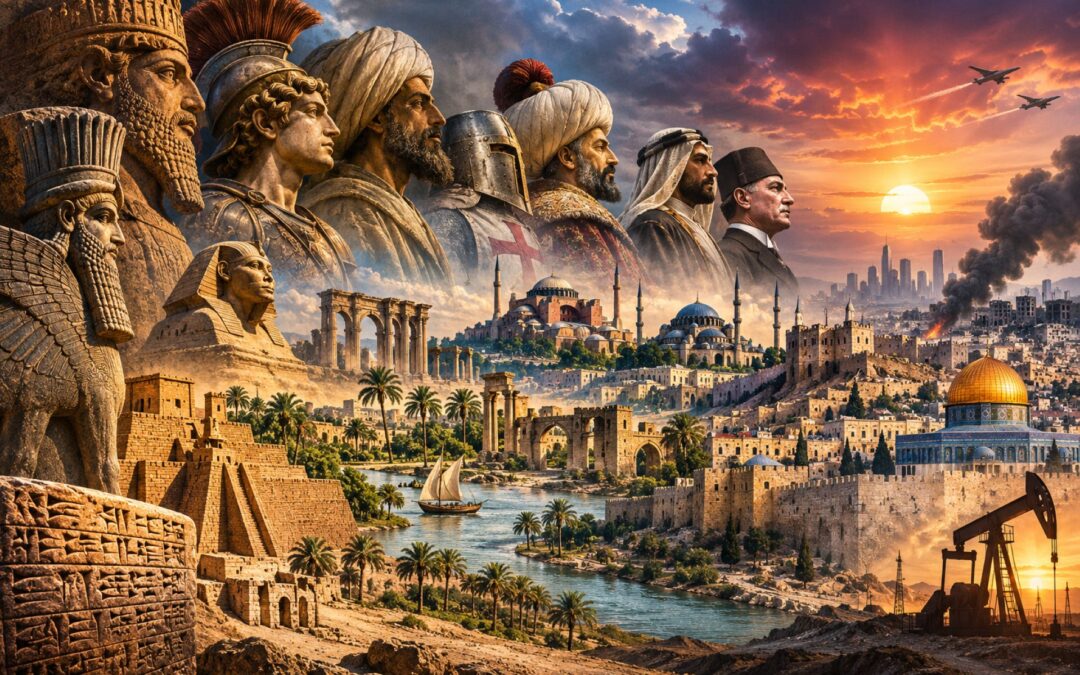
The Middle East has been home to some of humanity’s earliest cities, most influential empires, and enduring religious traditions. Long before the modern countries of the region existed, its people were developing agriculture, inventing systems of writing, organizing governments, and establishing trade networks that connected distant civilizations. Kingdoms rose along the Nile and the Euphrates, Persian rulers governed territories stretching across continents, and cities such as Babylon, Jerusalem, Alexandria, Baghdad, and Constantinople became centers of political power and cultural exchange.
The region also witnessed the emergence of Judaism, Christianity, and Islam, three religions that would influence societies far beyond their places of origin. Roman emperors, Persian kings, Arab caliphs, Mongol conquerors, Ottoman sultans, and European colonial administrators all shaped its political landscape. Yet no empire, dynasty, or religious tradition ever completely defined the Middle East. Its history has always involved different peoples negotiating, competing, trading, and living alongside one another.
Today, discussions of the region often begin with oil, religious divisions, territorial disputes, or war. These subjects are important, but they represent only part of a much longer history. Understanding the Middle East requires looking beyond its modern conflicts to examine how its civilizations developed, how political and religious authority changed, and how successive historical transformations created the societies and states that exist today.
A Region Before the Name: Geography and Early Settlements
The Middle East did not begin as a single country, civilization, or political unit. Even the expression Middle East is relatively modern, emerging from European geographical and strategic thinking around the turn of the twentieth century. Its boundaries remain flexible, generally encompassing Southwest Asia and Egypt, sometimes extending into North Africa or neighboring regions according to the context. Ancient inhabitants would not have understood themselves as belonging to one geographical community called the Middle East.
The region’s geography nevertheless helps explain why so many influential societies developed there. Between the Mediterranean Sea and the Persian Gulf lay river valleys, agricultural plains, mountains, deserts, and corridors connecting Africa, Asia, and Europe. The Tigris and Euphrates supported settlements in Mesopotamia, while the Nile provided the foundation for Egyptian civilization. The Mediterranean coastline, Anatolian highlands, Iranian plateau, and Arabian Peninsula offered different resources, environments, and opportunities for movement.
A particularly important area was the Fertile Crescent, a broad zone extending through parts of the Levant and Mesopotamia. Following the last Ice Age, communities across Southwest Asia gradually developed more permanent settlements and increasingly relied on cultivated plants and domesticated animals. The process unfolded over thousands of years rather than through one sudden agricultural revolution. Some communities continued hunting and gathering while experimenting with cultivation, and others developed settled ways of life before becoming fully dependent on farming.
By approximately 10,000 BCE, parts of the region were experiencing changes that would eventually support much larger populations. Wheat, barley, sheep, goats, and other domesticated species became important foundations of food production. Communities invested more labor in particular locations, built permanent structures, stored harvests, and developed increasingly complex relationships over land and resources. Agriculture did not originate everywhere from a single Middle Eastern settlement, however, and independent farming traditions later appeared in other parts of the world.
These changes transformed the possibilities of human organization. Food surpluses could support craftworkers, religious specialists, administrators, and people whose occupations were not primarily concerned with producing food. Storage facilities, irrigation systems, and increasingly concentrated populations created new demands for coordination. They also created opportunities for inequality, as control over agricultural land, surplus production, and labor became sources of wealth and authority.
Geography was important, but it did not determine a single path of development. Reliable agriculture could encourage settlement without producing a kingdom, and large populations did not automatically require centralized monarchy. Different societies responded to their circumstances through different institutions, technologies, and social relationships. The broader history of human civilization shows how these developments occurred in several regions independently, even as Southwest Asia became one of the earliest centers of urban life.
The Middle East’s location would continue influencing its history for millennia. Its rivers supported intensive agriculture, while its mountains and deserts offered protection, barriers, and routes for migration. Its coastlines and inland trade networks connected communities across continents, ensuring that ideas, technologies, religions, and armies frequently crossed political boundaries. The conditions that encouraged early settlement would eventually support some of the ancient world’s most powerful states.
Sumer, Egypt, and the First Bronze Age Empires
By the fourth millennium BCE, southern Mesopotamia contained settlements that had become substantially larger and more complex than ordinary agricultural villages. The most important early example was Uruk, a major urban center whose population, monumental buildings, workshops, and administrative institutions demonstrated an extraordinary degree of social organization. Mesopotamia, meaning the land between rivers, was becoming one of the world’s earliest documented centers of urban civilization.
The Sumerians established cities including Uruk, Ur, Lagash, Kish, and Eridu. These cities possessed their own political identities, religious institutions, agricultural hinterlands, and competing ruling elites. They were not initially united into one Sumerian nation or empire. Their rulers negotiated alliances, fought over territory and water resources, and sought to strengthen their authority through military achievements and religious legitimacy.
Managing agricultural production required increasingly sophisticated administration. Officials needed to record deliveries, organize workers, account for stored goods, and maintain relationships between temples, political authorities, and surrounding farms. During the late fourth millennium BCE, systems of written notation developed into the earliest forms of Mesopotamian cuneiform. What began largely as an administrative technology eventually became a medium for recording laws, royal inscriptions, literature, mathematics, and religious traditions.
The Sumerian world produced important innovations, but describing its inhabitants as the inventors of every foundational institution would exaggerate the evidence. Writing, urbanism, and complex governance developed through prolonged experimentation, sometimes through interaction with neighboring societies. Other civilizations created their own administrative and technological traditions. Sumer’s particular importance lies in the richness of its surviving evidence and its enormous influence on later Mesopotamian societies.
Meanwhile, another major civilization was emerging along the Nile. Ancient Egypt developed through interactions among communities in Upper and Lower Egypt, eventually producing a unified kingdom around 3100 BCE. The process is often associated with Narmer, although the archaeological evidence suggests a longer transformation involving political competition, conquest, and increasing administrative integration. Egyptian rulers developed institutions capable of coordinating agricultural production, collecting resources, and directing extraordinary construction projects.
The Nile shaped Egyptian life in ways different from the less predictable river systems of Mesopotamia. Its seasonal flooding supplied water and fertile sediment that supported intensive agriculture along a narrow corridor surrounded by desert. Egyptian kings exercised authority through religious ideology, administrative officials, provincial elites, and control over agricultural resources. Monumental architecture, especially the pyramids of the Old Kingdom, demonstrated the state’s capacity to mobilize labor and organize production.
Egypt also experienced repeated periods of political fragmentation and reunification. Powerful provincial rulers sometimes challenged royal authority, foreign groups entered the Nile Valley, and successive dynasties rebuilt central institutions under changing circumstances. During the New Kingdom, beginning around 1550 BCE, Egyptian rulers expanded their influence into Nubia and the Levant, transforming the kingdom into a major imperial power. The complete history of ancient Egypt reveals a much more complicated civilization than the familiar image of pyramids and pharaohs alone.
Mesopotamia followed its own sequence of imperial transformations. Around the twenty-fourth century BCE, Sargon of Akkad established a kingdom that brought several previously independent Mesopotamian cities under one political authority. The Akkadian Empire is frequently regarded as one of the earliest major territorial empires, although earlier states had also exercised power beyond individual cities. Its achievements demonstrated how military conquest, administration, and the management of distant territories could produce political systems operating on a much larger scale.
After the Akkadian kingdom fragmented, new powers emerged across Mesopotamia. The Third Dynasty of Ur briefly restored substantial centralized authority before the political landscape changed again. Babylon became especially influential under Hammurabi in the eighteenth century BCE, whose reign is associated with a famous collection of legal judgments and principles. His laws did not create justice from nothing, but they provide valuable evidence of social hierarchy, property relations, family obligations, and royal authority.
Assyria subsequently developed into one of the ancient Near East’s most formidable imperial powers. Beginning in northern Mesopotamia, Assyrian rulers expanded their authority through military campaigning, provincial administration, tribute systems, and the movement of conquered populations. By the eighth and seventh centuries BCE, the Neo-Assyrian Empire controlled or dominated enormous territories across Mesopotamia and the Levant, with military operations reaching Egypt. Its kings combined administrative sophistication with coercion, including deportations and harsh punishment of resistance.
Other peoples made equally important contributions to the region’s development. The Hittites established a powerful state in Anatolia and competed with Egypt over influence in Syria, most famously at the Battle of Kadesh in the thirteenth century BCE. Coastal cities associated with the Phoenicians developed extensive maritime trading networks across the Mediterranean. Their alphabetic writing traditions helped shape the scripts later adopted and adapted by Greek and Roman societies.
The Levant also became the setting for the development of Israelite and Judahite political and religious traditions, which would eventually have an influence far beyond the region. Ancient communities interacted through trade, intermarriage, diplomacy, migration, and conflict, so their histories cannot be reconstructed as entirely separate stories. The movement of ideas across boundaries was as important as the movement of armies.
By the seventh century BCE, the Assyrian Empire faced growing internal and external pressures. Babylonian and Median forces captured Nineveh in 612 BCE, helping bring Assyrian imperial rule to an end. A Neo-Babylonian kingdom subsequently rose to prominence, becoming particularly consequential for Jewish history through the conquest of Jerusalem and the deportation of parts of the Judahite population in the early sixth century BCE.
The ancient Middle East had already experienced thousands of years of political experimentation by this point. Cities had become kingdoms, kingdoms had become empires, and new ruling powers had repeatedly inherited the administrative and cultural achievements of their predecessors. The next major transformation would bring much of this interconnected world under an Iranian imperial dynasty.
Persia and the Greek Kingdoms of the East
In the sixth century BCE, Cyrus II, remembered as Cyrus the Great, transformed the political balance of western Asia. Originally the ruler of a Persian kingdom in the Iranian plateau, he defeated the Medes and expanded his authority over territories that included Lydia in Anatolia and Babylon in Mesopotamia. His conquests established the foundations of the Achaemenid Empire, one of the largest political systems the ancient world had yet seen.
The Persian Empire differed from earlier kingdoms in both its territorial extent and its methods of government. Its rulers governed numerous peoples with different languages, religions, customs, and political traditions. Rather than attempting to eliminate every existing institution, Persian authorities often incorporated local elites and administrative systems into imperial rule. Military power remained essential, but durable government also required taxation, communication, infrastructure, and negotiation with established communities.
Cyrus did not personally conquer every territory later associated with the empire. Egypt was brought under Persian rule in 525 BCE by his son and successor, Cambyses II. Under Darius I, the empire developed a more elaborate administrative structure, supported by provincial governors, taxation arrangements, roads, and systems of official communication. Royal centers such as Persepolis expressed the grandeur of imperial kingship, while commercial and administrative networks connected distant regions.
Persian rule did not produce cultural uniformity. Egyptians maintained important religious and social traditions, Mesopotamian cities preserved elements of their older institutions, and diverse communities continued using local languages. Imperial authorities could be accommodating in one setting and coercive in another, particularly when faced with rebellion. The empire’s strength rested partly on its ability to govern difference without always demanding complete assimilation.
The Achaemenids became deeply involved in the politics of the Greek world. Their interventions in the eastern Mediterranean contributed to the Greco-Persian Wars, including famous battles at Marathon, Thermopylae, and Salamis. Yet the empire was much larger than its conflicts with the Greek city-states, and those wars should not define its entire history. Persia’s economic, administrative, and cultural relationships extended across Southwest and Central Asia.
In 334 BCE, Alexander III of Macedon launched his invasion of Persian territory. Through a series of decisive campaigns, his armies defeated the forces of Darius III and dismantled Achaemenid imperial rule. Alexander subsequently advanced farther east, extending his conquests beyond the traditional boundaries of the ancient Middle East. His death in Babylon in 323 BCE left no stable succession arrangement capable of preserving the empire intact.
Alexander’s generals divided much of his territory into competing successor kingdoms. The Seleucid dynasty controlled substantial portions of Syria, Mesopotamia, and Iran, while the Ptolemaic dynasty governed Egypt. Greek language and culture became influential within royal courts, urban institutions, commerce, and administration. New and expanded cities served as centers of political authority, scholarship, and exchange.
The Hellenistic world was not simply a Greek civilization imposed unchanged upon passive local populations. Greek-speaking elites adopted practices from older Near Eastern societies, while local communities adapted Hellenistic institutions according to their own needs. Religious traditions interacted, artistic styles changed, and cities became places where different identities could coexist. Alexandria in Egypt was a particularly important center of learning and scholarship, connecting intellectual traditions from different parts of the Mediterranean and Near East.
Greek influence also faced resistance and developed differently across territories. Indigenous ruling families and religious institutions remained powerful in many places, and the Seleucid Empire gradually lost control over eastern regions. The Parthians eventually established an Iranian imperial state that challenged Hellenistic authority and later competed with Rome.
These centuries created a lasting pattern: conquerors could dismantle a ruling dynasty without erasing the civilization that dynasty had governed. Iranian political and cultural traditions survived Alexander’s victories, just as Greek language and institutions persisted after the decline of Hellenistic kingdoms. This capacity for continuity through political change is central to the longer history of Persia, which would remain one of the Middle East’s major civilizational centers.
Rome, Christianity, and the Sasanian Frontier
As the Hellenistic kingdoms weakened, Roman power expanded across the eastern Mediterranean. During the first century BCE, Rome brought much of Anatolia and the Levant into its growing imperial system. Pompey’s campaigns established Roman dominance in Syria, while Egypt became a Roman province after the defeat of Cleopatra VII and Mark Antony in 30 BCE. The eastern Mediterranean increasingly formed part of a political order centered on Rome.
Roman rule connected the region to an enormous network of cities, roads, ports, military garrisons, and commercial markets. Agricultural products, manufactured goods, luxury items, and ideas moved throughout the empire. Cities such as Antioch, Alexandria, Ephesus, and Caesarea played important roles in administration and trade. These connections could bring prosperity, but Roman taxation, military occupation, and unequal political relationships also generated resentment and rebellion.
Judea became especially important to the development of world religious history. During the first century CE, Jesus of Nazareth preached within the Jewish religious and social world of Roman Palestine. His followers eventually developed communities that understood his life, teachings, crucifixion, and resurrection as foundational to a new religious movement. Christianity emerged from Judaism rather than arriving as an entirely separate tradition.
Christian communities expanded across the eastern Mediterranean and into other parts of the Roman Empire. Their growth involved missionary activity, urban social networks, debates over religious doctrine, and the development of institutions that linked otherwise distant congregations. Roman authorities sometimes persecuted Christians, but imperial policies varied across time and place. Christianity’s relationship with political power changed decisively during the fourth century.
In 313 CE, Constantine and Licinius issued arrangements commonly associated with the Edict of Milan, establishing religious toleration and restoring rights to Christian communities. Constantine increasingly supported Christianity and founded Constantinople as a new imperial capital in 330. The city occupied a strategic position between Europe and Asia, controlling routes between the Mediterranean and Black Sea. By the late fourth century, imperial policies under Theodosius I had given Nicene Christianity a privileged position within the Roman state.
Christianization was gradual and complicated. Traditional religious practices did not disappear overnight, and theological disagreements produced intense arguments over doctrine and religious authority. Jewish communities continued living throughout the region, while Christian institutions developed distinct traditions across Greek-, Syriac-, Armenian-, Coptic-, and other language communities. Religious change therefore created new identities without eliminating the Middle East’s existing diversity.
Meanwhile, Rome faced a powerful rival to the east. The Parthian Empire controlled substantial territories across Iran and Mesopotamia and repeatedly fought Roman forces over Armenia, frontier territories, and strategic influence. In the third century CE, the Sasanian dynasty replaced the Parthian ruling order and developed a monarchy that drew heavily upon Iranian imperial traditions. Zoroastrianism acquired stronger institutional connections with royal authority, although the Sasanian realm contained numerous religious communities.
The Roman Empire’s eastern territories increasingly came to be administered from Constantinople, forming the state historians commonly call the Byzantine Empire. Its inhabitants generally understood themselves as Romans, and the state maintained Roman legal and imperial traditions while gradually developing a predominantly Greek-speaking political culture. The Byzantines and Sasanians became the principal rival powers across much of the region. Their relationship alternated between warfare, diplomacy, trade, marriage negotiations, and temporary accommodation.
Competition over Mesopotamia, Armenia, and frontier fortresses repeatedly brought the two empires into conflict. The last major war, beginning in 602 and ending in 628, devastated large parts of their territories. Sasanian forces temporarily conquered important Byzantine provinces, including Syria, Palestine, and Egypt, before Emperor Heraclius reversed much of their success. The struggle weakened both imperial systems through military losses, economic disruption, and political instability.
These wars also affected communities that had already endured generations of competition between rival states. People living in the Levant or Mesopotamia could experience successive changes in political administration without necessarily sharing the identities or priorities of their rulers. Religious differences complicated loyalties, while taxation and military demands created additional pressures. The region had become interconnected through imperial institutions, but it remained far from politically or culturally uniform.
The political and religious transformations of late antiquity were particularly visible in the history of Jerusalem. The city had been sacred to Jewish communities for centuries, acquired central significance in Christianity, and would soon become important to Islam. Its experience illustrates how successive empires could transform the political control of a place while adding new layers to its religious significance.
The exhaustion of the Byzantine and Sasanian empires did not make their defeat inevitable. Both remained substantial powers with established administrative and military resources. Nevertheless, the crises of the early seventh century created circumstances in which a new movement from Arabia could expand with extraordinary speed. That movement would permanently transform the religious and political history of the Middle East.
Muhammad, the Caliphates, and the Early Islamic Conquests
During the early seventh century, the Arabian Peninsula was home to diverse communities organized around tribal relationships, trading towns, agricultural settlements, and religious traditions. Mecca was an important western Arabian center associated with pilgrimage and commerce, while communities elsewhere practiced different forms of polytheism, Judaism, Christianity, and other religious beliefs. Arabia was connected to the wider Middle East through commercial routes, diplomacy, migration, and the influence of neighboring empires.
Muhammad was born in Mecca around 570 CE. According to Islamic tradition, he began receiving revelations around 610, proclaiming the worship of one God and emphasizing moral accountability, charity, justice, and the responsibilities of individuals toward their communities. His message challenged aspects of the existing religious and social order, provoking opposition among influential Meccan groups. The movement developed in an environment where monotheistic traditions were already known, but its beliefs, scripture, and institutions acquired a distinct identity.
In 622, Muhammad and his followers migrated from Mecca to Yathrib, subsequently known as Medina. The Hijra became the starting point of the Islamic calendar and marked an important transformation from a persecuted religious movement into a community exercising political and social authority. Muhammad mediated relationships among different groups, established alliances, and led the emerging Muslim community through periods of conflict. Over the following decade, its influence expanded across much of western Arabia.
When Muhammad died in 632, the community faced a fundamental question concerning leadership. The rulers who succeeded him became known as caliphs, although disagreements over legitimate succession would eventually contribute to major divisions within Islam. The first caliphs expanded Muslim rule beyond Arabia and confronted the Byzantine and Sasanian empires.
The conquests were remarkably rapid. Muslim armies defeated major Byzantine forces in Syria and Palestine during the 630s and secured control over Egypt by the early 640s. They also defeated Sasanian armies and gradually dismantled the Iranian imperial state, whose final ruler, Yazdegerd III, died in 651. The result was an enormous political transformation that brought territories previously governed by competing empires under new rulers associated with the Islamic community.
Military success depended on several factors rather than one simple explanation. Byzantine and Sasanian armies had suffered through prolonged warfare, while political disputes and local grievances weakened imperial authority in some territories. Arab Muslim commanders developed effective military and logistical arrangements, and the expanding caliphate could negotiate with local elites as well as conquer territory. The reactions of subject populations varied, and it would be misleading to assume that everyone immediately welcomed or resisted the new rulers.
Conquest did not produce instant religious conversion. Large Christian, Jewish, Zoroastrian, and other communities continued living under Muslim governments for generations. Arabic gradually became important in administration and public life, but established local languages persisted, and the process of Arabization differed substantially between regions. The transformation of predominantly Christian territories into predominantly Muslim societies often took centuries, while Iran retained its distinctive linguistic and cultural traditions.
Non-Muslim religious communities could receive legally recognized protection under Islamic rule, but that status involved obligations and inequalities. Arrangements concerning taxation, worship, legal autonomy, and political participation changed according to dynasty, location, and historical circumstances. The experience of religious minorities therefore cannot be reduced to either uninterrupted tolerance or constant persecution. It was shaped by institutions, rulers, local relationships, and changing political priorities.
The early caliphate also experienced serious internal conflicts. Disagreements over leadership intensified during the period following the murder of the third caliph, Uthman. Ali, Muhammad’s cousin and son-in-law, became the fourth caliph amid civil war, and the struggle over his legitimacy produced political and religious divisions. The killing of Ali’s son Husayn at Karbala in 680 became especially important to Shia Muslim memory and religious identity.
The distinction between Sunni and Shia Islam developed through these succession conflicts and the later evolution of theology, legal traditions, and religious authority. It was not a fully formed division from the first days after Muhammad’s death, nor has it always operated as a permanent geopolitical opposition. The broader distinction between religious and ethnic identity is equally important: as the explanation of Arab and Muslim identities makes clear, many Muslims are not Arabs, and not all Arabs are Muslims.
In 661, the Umayyad dynasty established its caliphal capital at Damascus. Umayyad rulers expanded Muslim territory across North Africa, into the Iberian Peninsula, and toward Central and South Asia. They developed administrative institutions, promoted Arabic within government, and supported major architectural projects. The Dome of the Rock in Jerusalem, completed under Abd al-Malik in the late seventh century, became one of the earliest monumental expressions of Islamic imperial culture.
Umayyad rule also generated considerable opposition. Some non-Arab Muslims resented inequalities associated with imperial society, while groups supporting alternative claims to religious and political leadership challenged the dynasty. Regional and tribal rivalries further complicated government across an enormous territory. These tensions eventually contributed to a revolutionary movement that displaced the Umayyads.
By 750, the Abbasids had overthrown the ruling Umayyad dynasty in most of the caliphate. The transfer of political authority would shift the center of imperial life eastward, bringing Iraq and the older civilizations of Mesopotamia into a new period of prominence. The Islamic world had developed from a western Arabian religious movement into a complex, multicultural imperial system whose institutions and intellectual traditions would influence societies across Eurasia and Africa.
Baghdad’s Golden Age and the Fracturing of Caliphal Rule
The Abbasid Revolution of 750 transformed the leadership and political orientation of the Islamic world. The new dynasty drew important support from eastern territories, particularly Khurasan, where Arab and non-Arab communities had become involved in struggles against Umayyad rule. Although the Abbasids claimed legitimacy through their relationship to Muhammad’s family, their success also reflected economic grievances, political alliances, and the ambitions of competing elites.
In 762, Caliph al-Mansur founded Baghdad near the Tigris River. The new capital occupied a strategic location with access to Mesopotamian agricultural resources and commercial networks connecting the Mediterranean, Iran, Central Asia, and the Indian Ocean. Its development represented more than a geographical move from Damascus. It placed the political center of the caliphate in a region with long-established traditions of imperial administration and intellectual exchange.
Baghdad became one of the great cities of the medieval world. Merchants traded textiles, spices, metals, ceramics, paper, and luxury goods, while officials managed taxation, provincial correspondence, and the affairs of the royal court. Scholars, physicians, mathematicians, poets, religious thinkers, and translators operated within an expanding urban culture. Wealth generated through agriculture and commerce supported institutions and social networks that made intellectual activity possible.
The period commonly described as the Islamic Golden Age was not the work of one ethnic group or a single centralized institution. Arabic became a major language of scholarship, but the people contributing to intellectual life included individuals from Persian, Arab, Syriac Christian, Jewish, Central Asian, and other backgrounds. Many worked within networks of patronage that connected courts, private scholars, libraries, hospitals, and educational circles.
A major achievement involved the translation and critical examination of earlier intellectual traditions. Greek philosophical, mathematical, and medical works became available in Arabic through the efforts of multilingual scholars, particularly those familiar with Greek and Syriac. Indian mathematical and astronomical knowledge also contributed to new developments, while Persian administrative and literary traditions influenced court culture. Scholars did more than preserve old texts: they criticized, adapted, corrected, and extended them.
Mathematics offers a particularly influential example. Al-Khwarizmi, associated with scholarly activity in Abbasid Baghdad, helped develop the systematic treatment of equations that gave algebra its name. His mathematical writings also played an important role in transmitting calculation methods associated with the Hindu numeral tradition. The word algorithm ultimately derives from the Latinized form of his name, reflecting the long influence of this intellectual exchange.
Medicine underwent its own transformations. Physicians examined classical medical theories, developed clinical observations, produced extensive medical literature, and worked in institutions that provided treatment and opportunities for professional learning. Scholars such as al-Razi contributed influential discussions of illness and medical practice, while later figures such as Ibn Sina developed comprehensive medical and philosophical works. These achievements emerged across several centuries and political territories, not exclusively within Baghdad.
Astronomy, geography, optics, philosophy, and literature also flourished through interaction among different traditions. Scholars studied planetary motion, improved observational practices, investigated the behavior of light, and debated questions inherited from Greek philosophy and Islamic theology. Literature developed through poetry, historical writing, storytelling, and works of ethical and philosophical reflection. Texts associated with the One Thousand and One Nights reflect a long process of composition and transmission involving multiple cultural influences.
Intellectual achievements were accompanied by developments in art and architecture. The Metropolitan Museum of Art’s account of the Abbasid period describes how artistic techniques associated with Baghdad and Samarra spread across the Islamic world. New approaches to ceramics, ornament, architectural decoration, manuscripts, and luxury objects reflected connections among distant cities and craftsmen. The distinctive artistic culture of the period cannot be separated from the movement of people and technologies through imperial trade networks.
Yet the political unity of the Abbasid caliphate began to weaken. Governing a vast territory required cooperation with military commanders, provincial authorities, tax administrators, and local elites whose interests did not always align with Baghdad. Financial pressures and competition within the military increasingly limited the caliphs’ ability to command every part of their nominal empire. Independent and semi-independent dynasties appeared in territories that continued to participate in wider Islamic cultural and commercial networks.
Iranian and Persianate political traditions became particularly important in this changing order. The Buyids established control over Baghdad in 945, reducing the Abbasid caliph to a figure whose religious status remained significant even though much practical authority belonged to others. Turkish military groups also gained prominence, especially the Seljuks, who entered Baghdad in 1055 and presented themselves as protectors of the Sunni caliphate.
A competing caliphal institution emerged under the Fatimids, an Ismaili Shia dynasty founded in North Africa in 909. The Fatimids conquered Egypt in 969 and established Cairo as a new capital, challenging Abbasid claims to universal leadership. Their government became an important center of political authority, trade, scholarship, and religious life. This rivalry reflected differences in religious legitimacy, but it also involved control over territories, wealth, trade routes, and political alliances.
The Abbasid period therefore illustrates the difference between political unity and cultural influence. Even as centralized caliphal authority fragmented, scholars and merchants continued exchanging knowledge and goods across an enormous area. Baghdad remained important, but other cities increasingly developed their own institutions and intellectual traditions. Islamic civilization did not cease to function simply because one caliph could no longer govern every region.
By the eleventh century, the Middle East contained several competing states connected through trade, religious traditions, and inherited institutions. The political fragmentation created opportunities for ambitious military dynasties, while neighboring European and Central Asian powers also became involved in regional affairs. The next centuries would bring conflicts that transformed the balance of power without ending the cultural networks established under earlier Islamic governments.
Crusaders, Mongols, and the Mamluk Response
During the late eleventh century, the political map of the eastern Mediterranean was changing rapidly. The Seljuks had established power across Iran, Iraq, and substantial portions of Anatolia, while the Byzantine Empire struggled to defend territories lost to Turkish forces. The Fatimids controlled Egypt and periodically influenced Palestine and Syria. Rival dynasties, governors, and military commanders competed over cities and trade routes, creating a fragmented political environment.
In 1095, Pope Urban II called for an armed expedition that would become the First Crusade. The movement was framed through Christian religious obligations, concern for holy places, and support for eastern Christians, but participants also brought political ambitions, family interests, and expectations of reward. Crusading armies traveled from Western Europe toward the eastern Mediterranean and eventually established several Latin Christian states in the Levant.
The capture of Jerusalem in 1099 was particularly consequential. Crusader forces took the city after a siege and killed substantial numbers of its inhabitants, including Muslims and Jews. Jerusalem became the center of a Latin Christian kingdom, while other crusader states emerged around Edessa, Antioch, and Tripoli. These political entities depended upon military resources, fortified settlements, maritime connections, and relationships with neighboring powers.
Muslim responses were initially divided. Different rulers competed among themselves, and the presence of crusader states did not immediately produce a unified campaign against them. Over time, however, leaders such as Zengi and Nur al-Din sought to combine political consolidation with the language of religious struggle. The development of stronger regional leadership eventually created the conditions for a major reversal.
Saladin, a Kurdish military leader who established the Ayyubid dynasty in Egypt, expanded his influence across parts of Syria and neighboring territories. By bringing substantial resources under coordinated political authority, he became capable of challenging the crusader states more effectively. After defeating a crusader army at Hattin in 1187, his forces recaptured Jerusalem. The city once again came under Muslim political control, although subsequent diplomacy and warfare continued to shape access to its sacred sites.
The Crusades did not end with Saladin’s victory. European rulers organized further expeditions, and warfare continued across the Levant and Egypt for generations. Diplomacy, commercial exchange, and temporary alliances existed alongside military confrontation. The wider history of the Crusades demonstrates that these campaigns were not simply an uninterrupted struggle between two unified religious civilizations.
An even more disruptive force emerged from Central Asia during the thirteenth century. The Mongol Empire, established under Genghis Khan, developed an extraordinary capacity for military expansion and political conquest. Mongol armies advanced across Iran and neighboring territories, defeating established rulers and integrating large parts of Eurasia into their expanding imperial system. Their methods combined rapid cavalry warfare, intelligence gathering, military organization, and the strategic use of terror.
In 1258, Mongol forces under Hulagu captured Baghdad. The city’s destruction devastated its population, institutions, and political leadership, bringing the Abbasid caliphate’s effective rule in Iraq to an end. The event became one of the most memorable disasters in medieval Middle Eastern history. Nevertheless, the popular idea that the sack destroyed Islamic learning everywhere or permanently ended an intellectual Golden Age oversimplifies the wider historical record.
Mongol forces subsequently advanced toward Syria, but their expansion faced opposition from the Mamluk Sultanate of Egypt. In 1260, a Mamluk army defeated a Mongol force at Ain Jalut in Palestine. The victory helped prevent immediate Mongol domination of Egypt and contributed to a new balance of power between the Mamluks and the Mongol successor state established in Iran and Iraq. It was significant, although it did not permanently end conflict between these powers.
The Mamluks developed a powerful military and political system based on ruling elites whose careers originated in military slavery and specialized training. Their government controlled Egypt and Syria and increasingly dominated the struggle against the remaining crusader states. In 1291, Mamluk forces captured Acre, bringing the last major mainland crusader stronghold in the Levant to an end. Their rule continued to shape commerce, scholarship, architecture, and religious institutions across the region.
Meanwhile, the Mongol Ilkhanate established authority across Iran and neighboring territories. Its rulers gradually became more deeply involved in the cultural and religious worlds of the societies they governed, with conversion to Islam becoming important under Ghazan in the late thirteenth century. Mongol conquest had been destructive, but the resulting political structures also participated in wider Eurasian exchange. The region continued adapting to new rulers through processes of conflict, accommodation, and institutional inheritance.
By the fourteenth century, the Middle East remained divided among several major political systems. Mamluk authority dominated Egypt and Syria, Iranian territories experienced further dynastic transformations, and Anatolia contained competing Turkish principalities. One relatively modest frontier dynasty in northwestern Anatolia would eventually expand beyond all its local rivals and establish the most durable empire of the region’s early modern history.
The Ottomans and Safavids Reconfigure West Asia
The Ottoman dynasty emerged in northwestern Anatolia around the turn of the fourteenth century. Its founder, Osman I, ruled a frontier principality near territories controlled by the declining Byzantine Empire. The conventional founding date of 1299 is useful as a historical marker, although the surviving evidence does not establish one precise moment when a fully formed Ottoman state appeared. The dynasty developed gradually through military expeditions, alliances, settlement, and the incorporation of neighboring communities.
Early Ottoman rulers benefited from Anatolia’s fragmented political environment and the opportunities created by Byzantine weakness. They attracted warriors seeking land, status, and wealth while gradually establishing institutions capable of governing acquired territories. Their expansion was not confined to Muslim-majority regions. Ottoman armies crossed into southeastern Europe during the fourteenth century, beginning the long process through which the dynasty became a major European as well as Asian power.
The Ottoman state experienced serious setbacks, including its defeat by Timur at Ankara in 1402. Sultan Bayezid I was captured, and rival members of the dynasty fought over the succession. The resulting interregnum demonstrated the fragility of Ottoman political authority, but the dynasty ultimately reunited and resumed its expansion. Its survival depended as much on political negotiation and institutional rebuilding as on conquest.
The capture of Constantinople in 1453 transformed Ottoman power and prestige. Sultan Mehmed II assembled the military resources necessary to overcome the city’s formidable defenses, employing artillery, siege engineering, and naval operations. After a prolonged siege, Ottoman forces captured the Byzantine capital on 29 May. The conquest ended the Byzantine Empire as a sovereign state and gave the Ottomans control over one of the most strategically important cities in the eastern Mediterranean.
Constantinople became the imperial capital of an expanding Ottoman state. The city, increasingly known as Istanbul, was rebuilt and repopulated through government initiatives, migration, commercial development, and religious patronage. Its mosques, markets, palaces, and administrative institutions came to express the ambitions of a dynasty that claimed a broader imperial inheritance. Ottoman rulers drew legitimacy from Islamic traditions while also presenting themselves as successors to older forms of Roman and Mediterranean authority.
During the sixteenth century, the empire expanded across much of the Arab Middle East. Sultan Selim I defeated the Mamluks in campaigns of 1516–17, bringing Syria and Egypt under Ottoman control and extending the dynasty’s authority over the holy cities of Mecca and Medina through political relationships with the Hejaz. Under Suleiman I, commonly called Suleiman the Magnificent, Ottoman armies campaigned across southeastern Europe and the eastern Mediterranean while strengthening the empire’s position in Iraq and neighboring territories.
Imperial government required far more than military success. Ottoman institutions organized taxation, provincial administration, landholding, legal authority, religious endowments, and the management of trade. The sultan’s household, military establishment, bureaucratic officials, and provincial elites formed a complicated structure that changed over time. Ottoman law combined imperial regulations with Islamic legal traditions, while courts and administrative bodies mediated relationships among diverse subjects.
Religious communities experienced varying forms of recognized autonomy, particularly through institutions that later came to be described collectively as the millet system. These arrangements could allow communities to maintain religious practices and internal institutions while remaining subject to imperial authority and legal inequalities. The system was not a timeless arrangement implemented identically across the empire from its founding. Its organization evolved through changing political and administrative circumstances.
The empire’s population included Turks, Arabs, Greeks, Armenians, Kurds, Jews, Slavs, and many other communities. Its cities connected European, Mediterranean, African, and Asian commercial networks. Istanbul, Cairo, Damascus, Aleppo, and Baghdad became important centers of exchange and political activity, while provincial societies maintained distinctive cultures and relationships with imperial government. The history of the Ottoman Empire reflects a system of remarkable diversity, institutional adaptation, and recurring internal tensions.
To the east, a different imperial tradition was emerging under the Safavid dynasty. In 1501, Shah Ismail I established his authority in Iran and proclaimed Twelver Shiism as the state religion. The decision marked a fundamental transformation in Iranian religious and political identity, since much of the population had previously followed Sunni Muslim traditions. The development of a predominantly Shia Iranian state occurred over time through religious institutions, official patronage, migration of scholars, and sometimes coercive policies.
Ottoman and Safavid rulers competed over territory, trade routes, political legitimacy, and influence in Iraq, eastern Anatolia, and the Caucasus. Their rivalry acquired a powerful religious dimension because Ottoman rulers identified with Sunni institutions while the Safavids promoted Shia authority. Nevertheless, geopolitical competition and dynastic ambition were equally important. It would be misleading to describe their wars as the inevitable consequence of religious disagreement alone.
Neither empire was permanently stable or uniformly expansionist. Ottoman governments faced military setbacks, provincial revolts, fiscal pressures, and changing relationships with European powers, while Safavid Iran experienced its own succession crises and political difficulties. Both systems transformed the societies they ruled and strengthened institutions that survived particular dynasties. Their rivalry helped establish enduring distinctions between political centers in Anatolia and Iran, but the modern boundaries and conflicts of the region cannot be explained solely through their sixteenth-century competition.
Reform, European Power, and the Discovery of Oil
By the late seventeenth century, the political and economic balance between the Ottoman Empire and major European powers was changing. Ottoman armies experienced significant defeats, particularly against Habsburg and Russian forces, while expanding European commercial networks and increasingly sophisticated military institutions altered strategic relationships. These developments created serious pressures for Ottoman rulers, but they did not produce a simple, uninterrupted decline from a former golden age.
The familiar description of the Ottoman Empire as the sick man of Europe reflects a particular nineteenth-century European perspective. It can obscure the empire’s continuing military capabilities, commercial importance, political reforms, and institutional transformations. Historian Donald Quataert’s critique of conventional Ottoman decline narratives highlights the limitations of treating Ottoman history after its early expansion as little more than a prolonged collapse. The empire was changing in response to new pressures, sometimes successfully and sometimes at considerable social and political cost.
Reform became increasingly important during the eighteenth and nineteenth centuries. Ottoman rulers sought to improve military organization, taxation, education, transportation, and central administration. Some reforms encountered opposition from established institutions and elites, while others strengthened the government’s ability to intervene in provincial affairs. These efforts involved internal debates over legitimate authority and political survival, not simply the uncritical imitation of Europe.
The Tanzimat reforms, usually dated from 1839 to 1876, represented a major attempt to reshape imperial government. They included changes in administration, legal institutions, taxation, military recruitment, and the formal status of subjects. Reformers hoped to strengthen the empire and reduce the vulnerabilities that European intervention exploited. However, the new arrangements could also increase central control, generate conflicts over local autonomy, and expose disagreements concerning political equality.
European powers frequently intervened in Ottoman affairs while claiming to defend strategic interests or religious communities. Russia sought influence around the Black Sea, the Straits, and territories connected to Orthodox Christian populations, while Britain and France pursued commercial and imperial objectives. European involvement in regional conflicts was not always coordinated, and rival governments often disagreed over whether the Ottoman Empire should be preserved, weakened, or divided.
Egypt experienced its own transformation under Muhammad Ali, whose government expanded military capacity, reorganized agriculture, and encouraged state-directed economic development during the nineteenth century. Although Egypt remained formally associated with the Ottoman Empire, its rulers exercised substantial autonomy. Egyptian armies intervened in neighboring regions, while the country’s economic relationships with European creditors and investors became increasingly consequential.
The opening of the Suez Canal in 1869 dramatically increased the strategic importance of Egypt. Connecting the Mediterranean and Red Seas, the canal reduced the maritime distance between Europe and Asia and became particularly valuable to British imperial communications. Financial difficulties and political conflict eventually contributed to Britain’s occupation of Egypt in 1882. The country retained distinctive institutions, but British influence constrained its sovereignty for decades.
Persia, governed during much of the nineteenth century by the Qajar dynasty, remained formally independent but faced pressure from both Russia and Britain. Military defeats, commercial concessions, and foreign interference limited the monarchy’s freedom of action. The Constitutional Revolution of 1905–11 demonstrated growing demands within Iranian society for political accountability and restrictions upon royal authority. These movements emerged from domestic political and social struggles as well as opposition to foreign influence.
Petroleum would eventually transform the region’s importance to the global economy. Commercially significant oil was discovered in southwestern Iran in 1908, encouraging further British interest and investment. The increasing use of petroleum in industry, transportation, and naval warfare made secure supplies strategically important. However, the vast oil resources subsequently discovered in several Arabian territories were not yet fully understood, and earlier imperial interventions cannot be reduced to a search for petroleum.
By the beginning of the twentieth century, the Middle East was experiencing interacting pressures from reform, nationalism, imperial competition, new technologies, and changing economic relationships. The Ottoman Empire still governed extensive territories, while Iran and Egypt followed different political trajectories. These arrangements would be transformed by a European war that expanded into a global struggle and destroyed the imperial order governing much of the region.
World War I, Mandates, and the Making of Modern States
The Young Turk Revolution of 1908 was part of the Ottoman Empire’s struggle over its political future. Reformist officers and activists sought to restore constitutional government and strengthen a state threatened by territorial losses, foreign influence, and internal divisions. Their movement did not immediately establish a unified political program, and subsequent developments increased the influence of leaders who believed that stronger central control was essential to imperial survival.
The Balkan Wars of 1912–13 further weakened Ottoman authority and deprived the empire of much of its remaining European territory. When World War I began in 1914, Ottoman leaders feared Russia and other rival powers while considering whether a major alliance could protect the state. An agreement with Germany helped bring the empire into the Central Powers’ camp. Following Ottoman naval attacks on Russian ports in October 1914, the empire entered the war against Russia and its allies.
Fighting spread across several fronts, including the Caucasus, Mesopotamia, Palestine, Syria, and the Arabian Peninsula. Ottoman forces faced Russian, British, French, and other Allied armies, while local populations suffered requisitions, displacement, famine, and military violence. The war also included the Armenian genocide, during which Ottoman authorities organized mass deportations and killings that devastated Armenian communities. The wartime destruction of civilian populations became part of the political and human catastrophe accompanying imperial disintegration.
Arab leaders were divided in their responses to the war. Some served within Ottoman military and administrative institutions, while others sought greater autonomy or independence. Sharif Hussein bin Ali of Mecca negotiated with British representatives, hoping to secure support for a large Arab political entity after the defeat of the Ottomans. The Hussein–McMahon correspondence of 1915–16 encouraged expectations of independence, although the geographical scope of Britain’s commitments became intensely disputed.
In June 1916, Hussein launched the Arab Revolt against Ottoman rule. Arab forces, supported by British supplies, money, intelligence, and military advisers, attacked positions and communications in the Hejaz and elsewhere. The revolt contributed to Allied operations but was only one component of a larger war involving numerous armies and political interests. Its symbolic importance would eventually exceed the scale of some of its military operations.
While Britain negotiated with Arab leaders, it was also discussing the future of Ottoman territories with France. The secret Sykes–Picot Agreement of 16 May 1916 outlined proposed spheres of direct control and influence across substantial parts of the Ottoman Arab provinces. The arrangement reflected European imperial expectations rather than the freely expressed preferences of the region’s inhabitants.
Sykes–Picot has become shorthand for the artificial division of the modern Middle East, but that description requires qualification. The agreement was not implemented precisely as originally drafted, and the borders of later states emerged through several additional processes. Military occupations, postwar negotiations, treaties, local uprisings, diplomatic compromises, and the decisions of emerging governments all influenced the political settlement. Nevertheless, the agreement remains important evidence of how Britain and France planned to divide influence before the Ottoman Empire had been defeated.
Another controversial commitment appeared in November 1917, when Britain issued the Balfour Declaration. The declaration supported the establishment of a Jewish national home in Palestine while stating that the civil and religious rights of existing non-Jewish communities should not be prejudiced. It did not establish a Jewish state at the time, but it substantially strengthened Zionist diplomatic ambitions and deepened concern among Palestinian Arabs over their political future.
The commitments made during the war could not easily be reconciled. Arab leaders expected independence, Britain and France sought imperial influence, and Zionist organizations pursued a national home in a territory inhabited predominantly by Palestinian Arabs. These competing expectations created disputes that would continue long after the military defeat of the Ottoman Empire.
The war ended Ottoman rule across most of its Arab territories, but the empire’s final dissolution involved further political struggles. The Treaty of Sèvres in 1920 proposed extensive territorial losses and restrictions on Ottoman sovereignty. Turkish nationalists, led by Mustafa Kemal, rejected the settlement and fought a successful war of independence. The Ottoman sultanate was abolished in 1922, and the Republic of Turkey was proclaimed on 29 October 1923, with Ankara as its capital.
The new Turkish republic pursued a political program distinct from the Ottoman imperial system. Mustafa Kemal Atatürk’s government promoted secular legal and educational reforms, developed a new understanding of national sovereignty, and attempted to reshape relations between state institutions and religious authority. These changes were accompanied by powerful debates over citizenship, minority rights, cultural identity, and the meaning of modernization.
Across the former Ottoman Arab provinces, the League of Nations mandate system provided an international framework for British and French administration. France governed Syria and Lebanon, while Britain administered Iraq and Palestine, with Transjordan developing through a distinct arrangement. Mandates were formally justified through the language of preparing territories for self-government, but they frequently protected imperial strategic interests and constrained political independence.
Local populations did not simply accept these arrangements. Resistance movements emerged in Syria, Iraq, Palestine, and other territories, while political leaders negotiated, collaborated, or challenged colonial administrations according to their circumstances. Existing regional identities, trading networks, religious communities, and local institutions influenced the creation of new states. The resulting borders did not erase historical connections, but they introduced political frameworks that shaped later national movements.
The Arabian Peninsula followed a different political path. Abdulaziz Ibn Saud expanded his family’s authority through military campaigns, alliances, and the incorporation of rival territories. In 1932, the Kingdom of Saudi Arabia was established, bringing much of the peninsula under one monarchy. British influence remained significant in parts of the Gulf and southern Arabia, but local dynastic struggles and religious alliances were central to the region’s political development.
Iran remained formally independent throughout this period, although foreign influence and the rise of the Pahlavi monarchy changed its institutions. Egypt also experienced a complicated transition, achieving nominal independence from Britain in 1922 while continuing to face substantial restrictions on its sovereignty. The Middle East was therefore not uniformly colonized or uniformly independent. Its emerging states had different experiences of imperial power, national resistance, and institutional development.
World War I did not create every modern Middle Eastern division, but it accelerated the collapse of one imperial system and helped establish another political order. New governments inherited older communities, religious institutions, economic relationships, and territorial disputes. As European power weakened during the following decades, these states would increasingly confront the challenge of translating formal independence into effective sovereignty.
Independence, Israel–Palestine, and Arab Nationalism
The Second World War further weakened the ability of Britain and France to maintain imperial control across the Middle East. European governments faced economic exhaustion, changing international expectations, and increasingly organized nationalist movements. The United States and Soviet Union emerged as dominant global powers, while the language of self-determination acquired greater significance in international politics. Regional governments began negotiating and demanding forms of independence that colonial administrations had previously resisted.
Syria and Lebanon secured independence during the 1940s, while Britain gradually reduced its formal administrative presence across several territories. Iraq had already become formally independent in 1932, although British military and political influence persisted. Egypt’s independence remained constrained by British interests, especially around the Suez Canal. These experiences demonstrated that the end of colonial administration did not necessarily eliminate external influence over military, economic, or diplomatic affairs.
Palestine became the center of one of the region’s most enduring conflicts. The territory contained longstanding Arab communities, Jewish religious and historical connections, and an expanding Zionist movement seeking national self-determination. Jewish immigration had increased during the late nineteenth and early twentieth centuries, particularly as European antisemitism intensified. Palestinian Arabs increasingly feared that demographic, political, and landownership changes would prevent them from achieving independence in their own homeland.
The Holocaust transformed the international circumstances surrounding Jewish statehood. Nazi Germany and its collaborators murdered approximately six million European Jews, creating a catastrophe that intensified demands for a secure Jewish national home. For many Jewish survivors and supporters of Zionism, sovereignty in Palestine represented a response to centuries of persecution. Palestinian Arabs, however, objected to losing political control over a territory where their families and communities had long lived.
In November 1947, the United Nations General Assembly adopted Resolution 181, recommending the partition of British Mandatory Palestine into separate Jewish and Arab states, with a special international arrangement for Jerusalem. Jewish leaders accepted the plan, although some disputed its details, while Arab leaders rejected it as a violation of the political rights of the Arab majority. The proposal did not create functioning governments or settle the conflicting territorial and national claims.
Civil war began in Palestine following the partition recommendation. Fighting intensified as British withdrawal approached, involving attacks, displacement, and the collapse of security in several communities. On 14 May 1948, David Ben-Gurion declared the establishment of Israel. Armed forces from neighboring Arab states entered the conflict shortly afterward, transforming the fighting into a wider interstate war.
Israel survived the war and secured territory beyond the boundaries proposed in the UN partition plan. Jordan controlled the West Bank, including East Jerusalem, while Egypt administered the Gaza Strip. The proposed Palestinian Arab state was not established. More than 700,000 Palestinians fled or were expelled from their homes during the fighting and its aftermath, producing the refugee crisis remembered by Palestinians as the Nakba, or catastrophe.
For Israelis, the conflict became associated with independence and national survival after generations of persecution. For Palestinians, it represented mass displacement, territorial dispossession, and the failure to secure sovereignty. These different experiences remained central to political identity and national memory. The broader history of Palestine explains the territorial and institutional changes that followed, including the unresolved questions of refugees, borders, occupation, and statehood.
The consequences of 1948 extended throughout the Arab world. Military defeat damaged the legitimacy of several established governments and encouraged political movements that associated monarchy, colonial influence, and social inequality with national weakness. Military officers and nationalist activists increasingly called for radical political change. One of the most influential figures emerging from this environment was Gamal Abdel Nasser.
In 1952, Egyptian military officers overthrew King Farouk. Nasser gradually consolidated power and became president in 1956, promoting a vision of Arab nationalism based on independence, modernization, anti-imperialism, and political cooperation among Arab-speaking peoples. His ideas appealed to populations frustrated with colonial influence and existing political hierarchies. Yet the movement contained tensions between the aspiration for Arab unity and the interests of individual governments.
The Suez Crisis of 1956 became a defining moment. Nasser nationalized the Suez Canal Company, challenging an arrangement strongly associated with British and French commercial and strategic interests. Britain, France, and Israel subsequently coordinated military action against Egypt. Although Egyptian forces faced serious military difficulties, international pressure, particularly from the United States and Soviet Union, compelled the invaders to withdraw.
Nasser emerged with substantial political prestige. The crisis demonstrated that Britain and France could no longer impose their preferred regional settlements without considering the global superpowers. It also strengthened movements advocating independence from European imperial influence. However, political success during the Suez Crisis did not guarantee the wider realization of Nasser’s ambitions.
Egypt and Syria established the United Arab Republic in 1958, creating a political union intended to advance Arab nationalism. The arrangement collapsed in 1961 amid disagreements over centralization and the distribution of authority. Other Arab governments, including conservative monarchies, opposed aspects of Nasser’s revolutionary program. Regional rivalries persisted despite shared languages and overlapping cultural traditions.
Cold War competition further complicated these relationships. The Soviet Union supplied military and economic assistance to Egypt, Syria, Iraq, and other governments at different times, while the United States developed close partnerships with Israel, Saudi Arabia, Iran under the Shah, and several Gulf monarchies. These alignments were not fixed or absolute. Regional rulers frequently sought foreign assistance while pursuing interests that differed from those of their powerful patrons.
In June 1967, Israel defeated Egypt, Syria, and Jordan in the Six-Day War. Israel occupied the Sinai Peninsula, Gaza Strip, West Bank, East Jerusalem, and Golan Heights, transforming the territorial basis of the Arab–Israeli conflict. The defeat damaged the prestige of Nasser and other Arab nationalist leaders while increasing the importance of Palestinian organizations seeking national liberation. Yasser Arafat and the Palestine Liberation Organization became especially significant in the following years.
Egypt and Syria launched another war against Israel in October 1973, hoping to reverse territorial losses from 1967. Initial Arab military successes were followed by Israeli counterattacks, and the conflict eventually produced ceasefire arrangements rather than a comprehensive territorial settlement. Nevertheless, the war changed diplomatic calculations and contributed to a major economic confrontation.
Arab oil-producing states imposed an embargo on countries supporting Israel, while broader production and pricing developments intensified a global energy crisis. The episode demonstrated the economic influence acquired by petroleum-exporting governments and the vulnerability of industrial economies to disruptions in energy supplies. Oil wealth increasingly transformed state finances, infrastructure development, international investment, and the political importance of the Gulf.
By the 1970s, the Middle East was no longer primarily shaped by the direct administration of European colonial powers. Independent governments pursued competing national and ideological projects, while external influence increasingly operated through military partnerships, economic relationships, and Cold War diplomacy. The Israeli–Palestinian conflict remained unresolved, Arab political unity had proved elusive, and oil had become a major instrument of international power. Another political revolution would soon challenge the region’s emerging order.
Iranian Revolution, Oil Shocks, and American Ascendancy
The late 1970s brought two developments that substantially changed the Middle East’s political direction. The first was Egypt’s decision to pursue peace with Israel, demonstrating that individual Arab governments might separate their national diplomatic priorities from the broader Arab–Israeli confrontation. The second was the Iranian Revolution, which overthrew one of Washington’s most important regional allies and introduced a powerful new ideological challenge.
Egyptian President Anwar Sadat had gradually redirected his country’s foreign policy after succeeding Nasser in 1970. He reduced Egypt’s dependence on the Soviet Union and pursued closer diplomatic relations with the United States. His visit to Jerusalem in 1977 opened the possibility of direct negotiations with Israel, although unresolved Palestinian claims and territorial disputes remained major obstacles. The United States, under President Jimmy Carter, played a central mediating role.
The Camp David Accords of September 1978 established a framework for negotiations between Egypt and Israel. They were followed by a formal peace treaty in March 1979, making Egypt the first Arab country to conclude such a treaty with Israel. Egypt eventually recovered the Sinai Peninsula through Israeli withdrawal, while the broader Palestinian questions addressed in the negotiations remained unresolved. The agreement transformed regional diplomacy and strained Egypt’s relationships with several Arab governments.
In Iran, opposition to Shah Mohammad Reza Pahlavi had developed across a broad range of political and social groups. His government pursued industrialization, military expansion, and social modernization, but it also relied on authoritarian institutions and political repression. Critics condemned inequality, corruption, foreign influence, and the concentration of authority around the monarchy. Religious leaders, students, liberals, nationalists, and left-wing activists participated in the growing revolutionary movement.
Ayatollah Ruhollah Khomeini became the most influential leader of the opposition. Following mass demonstrations, strikes, and the collapse of support for the monarchy, the Shah left Iran in January 1979. Khomeini returned from exile in February, and the existing government fell. The revolution subsequently produced an Islamic Republic in which religious institutions acquired extraordinary political authority, even as many groups that had participated in the revolution were marginalized or suppressed.
Iran’s new government challenged American influence and the legitimacy of regional monarchies associated with Western power. The seizure of the US embassy in Tehran in November 1979 produced a hostage crisis that deepened hostility between Iran and Washington. Revolutionary ideology, religious identity, and national security concerns became intertwined with a much older history of Iranian resistance to foreign interference.
In September 1980, Iraqi President Saddam Hussein invaded Iran. His government hoped to exploit Iran’s revolutionary instability, improve Iraq’s strategic position, and settle territorial disputes in its favor. The resulting Iran–Iraq War lasted until 1988 and caused enormous destruction. Both governments mobilized substantial resources, while the conflict involved attacks on cities, oil infrastructure, and commercial shipping, as well as Iraq’s extensive use of chemical weapons.
Gulf monarchies feared the spread of Iran’s revolutionary influence, and several supported Iraq financially or politically. The United States also developed policies that favored Iraq during parts of the war, although its regional dealings remained complicated. The conflict demonstrated that religious affiliation alone could not explain alliances: governments frequently made decisions according to territorial, economic, and security interests. By the war’s end, neither Iran nor Iraq had achieved a decisive victory.
Iraq emerged heavily indebted and economically strained. In August 1990, Saddam invaded Kuwait, claiming grievances involving debt, oil production, and territorial disputes. The occupation threatened regional stability and raised fears that Iraqi power could extend toward other Gulf states. An international coalition led by the United States expelled Iraqi forces in 1991 under United Nations Security Council authorization.
The Gulf War greatly strengthened the American military position in the region. US forces, bases, arms relationships, and security partnerships became increasingly important to governments seeking protection from regional threats. For some rulers, this presence offered a necessary security guarantee; for critics, it represented a new form of foreign dependence. These contrasting perceptions would influence the political arguments of several Islamist movements during the following decade.
The rise of the Gulf’s petroleum economies also altered the region’s development. Saudi Arabia, Kuwait, Qatar, the United Arab Emirates, and other producers invested hydrocarbon revenues in infrastructure, education, public services, transportation, and international financial assets. Their development trajectories differed, but oil and gas wealth allowed several governments to exercise influence far beyond what population size alone might suggest. Economic prosperity, however, coexisted with questions about political accountability, labor systems, inequality, and dependence on energy exports.
By the end of the twentieth century, the Middle East had developed into a region shaped by several competing centers of power. Iran promoted its revolutionary political system, Iraq had been weakened by prolonged warfare, Gulf monarchies relied partly on Western security relationships, and Israel maintained substantial military advantages while facing unresolved territorial disputes. The United States had become a dominant external military actor, but its expanding influence would also generate new resistance and instability.
The War on Terror, Arab Spring, and the Middle East of 2026
The attacks of 11 September 2001 marked another turning point in the political history of the Middle East and its relationship with the wider world. Al-Qaeda, a transnational jihadist organization led by Osama bin Laden, carried out attacks against the United States that killed nearly 3,000 people. The organization had developed through militant networks connected to earlier conflicts, including the war against Soviet forces in Afghanistan. Its ideology drew upon an extremist interpretation of political and religious struggle, but it did not represent Muslim societies or Islamist movements as a whole.
The United States responded by launching the War on Terror, initially invading Afghanistan in 2001 to remove the Taliban government that had sheltered Al-Qaeda. The campaign expanded into a wider system of military interventions, counterterrorism operations, intelligence cooperation, and security policies. Afghanistan was not generally classified as part of the Arab Middle East, but its wars had important consequences for militant networks and international relationships across the broader region.
In March 2003, the United States and its partners invaded Iraq and overthrew Saddam Hussein. The Bush administration emphasized alleged weapons of mass destruction and other security concerns, but the claimed active stockpiles were not found. The invasion also provoked major international disputes over its legal justification and strategic consequences. Removing Saddam’s government created an opportunity for political change while simultaneously destroying institutions upon which the existing Iraqi state had depended.
Iraq subsequently experienced insurgency, sectarian violence, militia competition, and deep political instability. Sunni and Shia communities did not act as homogeneous political groups, but sectarian identities became increasingly influential in conflicts over representation, state power, and security. Iran expanded its relationships with Iraqi political organizations and armed groups after the fall of Saddam, increasing its regional influence. The intervention intended to reshape the Middle East consequently produced outcomes that Washington had not fully anticipated.
By the end of the first decade of the twenty-first century, many Middle Eastern governments faced public frustration over unemployment, corruption, political repression, social inequality, and restricted opportunities for participation. These pressures developed differently in each country, but they created conditions in which apparently stable political systems could become vulnerable to mass protest. In late 2010, demonstrations began in Tunisia following the self-immolation of Mohamed Bouazizi, helping trigger a broader wave of uprisings.
The Arab Spring of 2011 spread across North Africa and the Middle East. In Tunisia, protests forced President Zine El Abidine Ben Ali from power, while demonstrations in Egypt contributed to the fall of Hosni Mubarak. Other movements challenged governments in Libya, Yemen, Syria, Bahrain, and elsewhere. Protesters did not share one uniform ideology or political program; their demands ranged from dignity and economic opportunity to constitutional reform and the removal of authoritarian rulers.
The results varied dramatically. Egypt experienced elections and a brief period of civilian political government before the military removed President Mohamed Morsi in 2013. Libya descended into prolonged conflict following the overthrow of Muammar Gaddafi, while Yemen’s political transition collapsed into civil war and foreign intervention. Tunisia initially established a more competitive political system, but that achievement proved fragile. The country’s democratic reversals documented by Freedom House show how the concentration of executive power after 2021 undermined several of the gains associated with the uprising.
Syria became one of the Arab Spring’s most devastating battlegrounds. Demonstrations against President Bashar al-Assad were met with repression, and the conflict developed into a civil war involving government forces, fragmented opposition movements, Kurdish-led organizations, extremist groups, and foreign powers. Russia and Iran supported Assad, while Turkey, the United States, Gulf governments, and other actors pursued different objectives. Millions of Syrians were displaced, and cities, infrastructure, and public institutions suffered enormous destruction.
The instability of Syria and Iraq contributed to the rise of the Islamic State, commonly known as ISIS. Building upon extremist organizations that had developed in Iraq after 2003, ISIS seized large territories and declared a caliphate in 2014. Its rule involved mass killings, persecution of religious minorities, sexual slavery, forced displacement, and systematic destruction of cultural heritage. Military campaigns involving Iraqi, Kurdish, Syrian, and international forces gradually destroyed its territorial control in Iraq by 2017 and in Syria by 2019, although insurgent networks survived.
These conflicts intensified regional competition. Iran developed close relationships with armed and political organizations in Iraq, Lebanon, Syria, and Yemen, while Saudi Arabia and other Gulf governments viewed aspects of Iranian influence as a threat. Turkey pursued military operations and diplomatic initiatives connected to Kurdish movements, border security, and regional influence. Russia sought to maintain military relationships and strategic access, while the United States remained involved through security partnerships and counterterrorism operations.
Describing the region as divided into permanent Sunni and Shia blocs would nevertheless be misleading. Iran has supported Sunni Palestinian armed organizations, while Arab governments have maintained different relationships with Tehran. Saudi Arabia and Iran restored diplomatic relations in 2023 through an agreement facilitated by China, demonstrating that longstanding rivals could seek accommodation when their interests changed. Regional diplomacy was becoming increasingly flexible, even as military competition persisted.
The Gulf states also pursued development strategies that extended beyond petroleum exports. The United Arab Emirates expanded its roles in aviation, logistics, finance, tourism, and international investment, while Saudi Arabia launched ambitious programs intended to diversify economic activity and reshape its domestic institutions. Qatar developed substantial international influence through natural gas, investment, diplomacy, and media. These transformations created new opportunities but also raised questions concerning labor rights, economic sustainability, governance, and the distribution of development benefits.
Diplomatic realignment became particularly visible in 2020 with the Abraham Accords. The United Arab Emirates and Bahrain established formal normalization agreements with Israel, while Morocco advanced normalization and Sudan entered a more complicated process that did not produce the same degree of implementation. The agreements reflected commercial interests, diplomatic calculations, American mediation, and shared concerns about aspects of Iranian regional power. They also demonstrated that some Arab governments were willing to pursue relations with Israel without first obtaining a comprehensive Israeli–Palestinian peace settlement.
The unresolved Palestinian question nevertheless remained central to regional politics. On 7 October 2023, Hamas-led armed groups attacked southern Israel, killing civilians and military personnel and taking hostages into Gaza. Israel launched a major military campaign in response, producing catastrophic destruction, mass displacement, and extensive civilian suffering in Gaza. The war also intensified international debates concerning humanitarian law, civilian protection, military necessity, occupation, and Palestinian national rights.
Fighting and political instability extended beyond Gaza. Israel and Hezbollah exchanged attacks along the Lebanese border, while the Houthi movement in Yemen launched operations that threatened shipping through the Red Sea and nearby maritime routes. These developments demonstrated how conflicts involving local political movements could intersect with wider regional rivalries and global trade. Disruption near the Suez Canal, Bab el-Mandeb, and Strait of Hormuz carried economic consequences far beyond the immediate areas of fighting.
A major political transformation occurred in Syria in December 2024. Rebel forces advanced rapidly, and Bashar al-Assad’s government collapsed, bringing more than five decades of Assad family rule to an end. The United Nations’ response to the fall of the Syrian government emphasized the importance of a peaceful political transition and protection of the population. The collapse substantially weakened an important ally of Iran and changed relationships established during Syria’s civil war.
The new Syrian authorities faced difficult questions about the future of the state. Armed factions needed to be integrated or demobilized, damaged institutions required reconstruction, and different communities sought security and political representation. Ahmed al-Sharaa emerged as the transitional president in 2025, but the removal of Assad did not automatically resolve Syria’s political divisions. Kurdish autonomy, minority protections, accountability for wartime abuses, and relations with neighboring countries remained important sources of uncertainty.
The Gaza war continued shaping regional politics through 2025 and 2026. Even where ceasefire arrangements reduced major military operations, they did not settle the issues of governance, reconstruction, territorial control, refugees, or Palestinian sovereignty. The United Nations’ humanitarian reporting from September 2026 documented the continuing difficulties facing civilians, including problems involving shelter, essential services, and humanitarian assistance. The consequences of years of warfare could not be reversed simply through a temporary reduction in hostilities.
Relations involving Iran, Israel, and the United States also escalated into direct confrontation. Previous decades had frequently involved diplomatic hostility, covert operations, sanctions, and the activities of allied armed organizations, but direct military exchanges increasingly altered the regional security environment. In February 2026, Israel and the United States began a major campaign of strikes against Iran, citing its nuclear and ballistic missile programs and other security objectives. Iran retaliated against targets in Israel and across the region, creating serious threats to Gulf infrastructure and maritime commerce.
The UK House of Commons Library’s assessment of the 2026 Israel–US–Iran conflict documents the strikes beginning on 28 February, Iranian counterattacks, the declaration of a conditional ceasefire in April, and subsequent diplomatic efforts. The confrontation raised fundamental questions about military deterrence, nuclear proliferation, national sovereignty, international law, and the security arrangements connecting regional governments with external powers. It also demonstrated the vulnerability of commercial shipping and energy markets to conflict around the Strait of Hormuz.
These developments exposed the limits of treating the Middle East as a single geopolitical camp or a permanent battlefield. Gulf monarchies faced incentives to protect their security relationships while avoiding prolonged regional warfare, and governments frequently balanced competition with diplomacy. Turkey, Iran, Israel, Saudi Arabia, Egypt, and other powers pursued distinct national interests shaped by different histories and political institutions. The region’s alliances remained fluid rather than permanently determined by religion or ethnicity.
The differences among Middle Eastern societies were equally important. Some countries had developed internationally connected service economies, major infrastructure systems, and ambitious programs of economic diversification. Others struggled with displacement, authoritarian institutions, armed conflict, poverty, and the legacies of repeated intervention. The history of the Middle East had produced both extraordinary concentrations of wealth and deeply unequal experiences of security and opportunity.
Understanding these contemporary developments requires distinguishing the long history of the region from the particular causes of its modern wars. Religious divisions, colonial arrangements, territorial disputes, energy resources, and foreign intervention all matter, but none can explain every event independently. The more focused question of why the Middle East has experienced so much conflict requires examining how these factors interacted through the decisions of particular governments and political movements.
By November 2026, the region remained in a period of considerable transformation. The fall of Assad, the consequences of the Gaza war, direct confrontation involving Iran, and shifting diplomatic relationships had altered political calculations that appeared established only a few years earlier. Yet the Middle East was also being reshaped through economic investment, demographic change, technological development, migration, and the continuing evolution of its societies. Its contemporary history cannot be understood through war alone.
The history of the Middle East is not one uninterrupted sequence of conquest and conflict. It is the history of societies that developed some of humanity’s earliest urban institutions, preserved and transformed intellectual traditions, created influential religious communities, and connected distant parts of the world through trade and cultural exchange. The political systems governing these societies changed repeatedly, but earlier ideas, institutions, languages, and identities often survived in new forms.
Ancient Mesopotamian administrative traditions influenced later imperial states. Greek scholarship interacted with Persian, Indian, Arab, and other intellectual worlds. Judaism, Christianity, and Islam developed across overlapping historical landscapes, while successive governments negotiated the relationship between religious authority and political power. Ottoman, Safavid, colonial, and postcolonial institutions contributed different layers to the region’s modern states.
No single empire, religion, foreign power, or historical agreement created the Middle East as it exists today. Its development resulted from thousands of years of exchange, adaptation, competition, and decisions made by people confronting changing circumstances. Understanding that history explains not only why particular conflicts emerged, but also why the region contains such extraordinary cultural depth, institutional diversity, and continuing potential for change.
Last Updated on November 1, 2026 by Aseem Gupta