
Reading Time: 22 Minutes
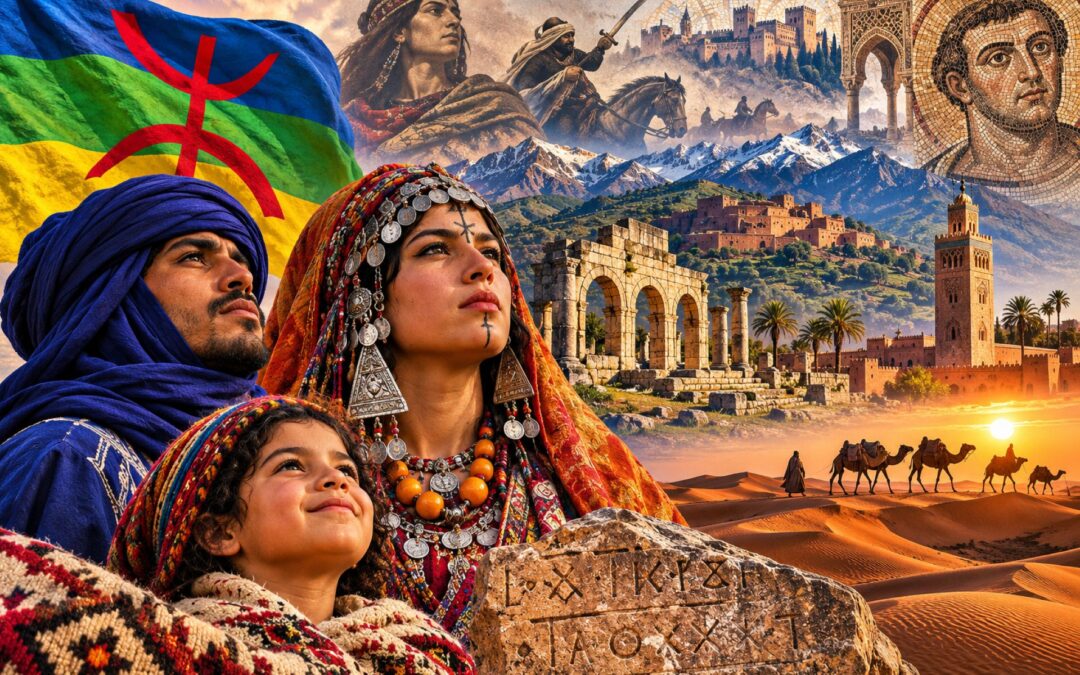
In June 2019, Algerians demonstrating against their country’s political leadership encountered an unexpected restriction. The army chief insisted that only the national flag should be displayed at public marches, and police began arresting protesters who carried another banner: three horizontal bands of blue, green and yellow, crossed by a red symbol resembling a human figure. It was the Amazigh flag, a sign of Indigenous North African identity, and in the eyes of the authorities it could threaten national unity. Some people were arrested simply for possessing it.
The controversy raised a question much older than independent Algeria. How could a people whose ancestors had inhabited North Africa long before the arrival of Arabic or Islam still struggle to secure public recognition of their language and identity? The answer stretches from Egyptian pharaohs and Roman cities through Saharan caravans, Muslim dynasties, European colonialism and modern cultural revival.
The Amazigh were never merely spectators to those histories. They founded kingdoms, led armies, shaped the religions they adopted and carried goods and ideas between the Mediterranean and Africa’s interior. Their story is not one of a single people remaining unchanged for thousands of years, but of related communities adapting to new worlds while keeping ways to recognise themselves.
Amazigh, Berber, and Tamazgha: Names and Homelands
Many North Africans who were long called Berbers identify today as Amazigh, with Imazighen as the plural. Amazigh is commonly interpreted as a free or noble person, though the history of the word and its use across different communities is more complicated than a neat dictionary definition suggests. Regional identities such as Kabyle, Riffian, Chleuh and Tuareg can matter just as much as the shared name. An Amazigh-speaking villager in the Moroccan Atlas and a Tuareg pastoralist in Niger may belong to related linguistic traditions without sharing the same customs or political outlook.
The word Berber is usually traced through Latin and Arabic usages to the Greek language’s designation for outsiders whose speech Greeks did not understand. In different times it functioned as an external label rather than a community’s chosen name, and for some it carries an unwelcome association with barbarism. Others continue to use Berber without discomfort, especially in historical or academic contexts. The preference for Amazigh respects the increasingly visible terminology of many communities without assuming that everyone uses one name.
The region called Tamazgha in modern Amazigh cultural thought extends across North Africa, approximately from the Atlantic and the Canary Islands to the Siwa Oasis in western Egypt, with connections deep into the Sahara and Sahel. It is a cultural geography, not the territory of a historically unified Amazigh state or a claim that every inhabitant shares one ethnicity. Morocco and Algeria have large Amazigh-speaking populations; important communities also live in Tunisia, Libya, Egypt, Mali, Niger and elsewhere. The Indigenous Guanche populations of the Canary Islands had historical connections with North African peoples, although their histories cannot simply be treated as identical to those of present-day mainland communities.
Even the names found in ancient sources need caution. Egyptian texts refer to groups such as the Meshwesh, while Greek and Roman writers described Libyans, Numidians, Mauri and many other peoples. These labels do not map perfectly onto current identities. What historians can trace are long continuities of settlement, language families, cultural contact and sometimes political institutions—not an unchanging ethnic boundary extending unchanged across millennia.
As the Princeton Amazigh Oral Narratives Digital Archive explains, shared identity now connects geographically dispersed communities whose histories also contain considerable local variety. That tension between collective belonging and diversity is essential to understanding everything that follows.
Ancient North Africa: Kingdoms, Rome, and Christianity
People lived in North Africa long before any group was called Amazigh. Archaeological remains show lengthy histories of settlement, herding, agriculture and movement across landscapes that shifted with the climate. The ancestors of today’s populations came from complicated processes of migration and interaction within Africa and across the Mediterranean. Genetic research can illuminate those connections, but it cannot assign a modern cultural identity to a person who lived thousands of years before that identity was recorded.
Ancient Egyptian rulers confronted, traded with and sometimes recruited populations from the lands to their west. The Meshwesh appear among the groups Egyptian sources described, and people of Libyan descent eventually entered Egypt’s ruling elite. Shoshenq I, generally dated to the mid-tenth century BCE, established the Twenty-second Dynasty. Later rulers of the dynasty and other contemporaneous Egyptian houses had varied relationships with these Libyan-origin networks; the episode was more complex than a single conquest by a unified Berber nation.
Farther west, Mediterranean trade and competition produced different political formations. Phoenician settlement helped create Carthage, whose influence spread through coastal North Africa, while the Numidian kingdoms became significant powers in their own right. Their rulers negotiated alliances and rivalries with Carthage and Rome. Masinissa, for example, helped Rome defeat Carthage in the Second Punic War and strengthened a Numidian kingdom; his successors confronted the pressure of an increasingly dominant Roman republic.
Rome’s conquest brought major changes, but it did not reduce North Africa to a string of foreign garrisons on the coast. Parts of the region became productive Roman provinces with cities, farms, roads and complex local elites. Other districts maintained distinctive political arrangements or resisted outside authority, particularly where mountains and deserts made military control difficult. An Amazigh-speaking community might trade with Roman towns, serve in an imperial army, live under a local chief or inhabit an urban environment influenced by several languages.
The ruins of Walili, better known internationally as Volubilis, show how layered those worlds could be. The site developed in a Mauretanian setting and became an important Roman outpost amid fertile farmland. Its surviving public buildings and houses, described in UNESCO’s account of Volubilis, speak not simply of conquest but of the economic and cultural life that flourished where local and imperial systems met. Centuries later the site also had associations with the early Idrisid dynasty, a reminder that buildings can outlast the states that sponsored them.
After western Roman authority weakened, Vandal rulers established a kingdom in parts of the region, and Byzantine forces subsequently tried to restore imperial control. Their power varied enormously by place and period. Local communities were not always permanent rebels waiting in inaccessible mountains: they could cooperate, negotiate, revolt, or create political structures as conditions changed. This combination of participation and independence helps explain the resilience of Amazigh societies far better than a simple story of invaders arriving and eventually disappearing.
Christianity likewise became part of North African life well before the Arab conquests. The region produced churches, theological disputes, influential bishops and communities that disagreed sharply over religious authority. Augustine of Hippo, born in Roman North Africa in 354 CE, became one of Christianity’s most consequential thinkers through works such as Confessions and The City of God. His precise ancestry cannot be confidently categorised in modern ethnic terms, but his career demonstrates how deeply North African intellectual life contributed to the wider Mediterranean world.
Arab Conquests: Resistance, Conversion, and the Road to Iberia
The Arab Muslim conquests of the seventh century did not enter an empty region. Byzantine authorities governed important territories, towns followed different Christian traditions, and Amazigh-speaking groups had their own networks and leaders. Muslim armies advanced across North Africa over several decades, encountering both resistance and alliances. The balance shifted repeatedly as commanders sought routes, supplies, taxation and political legitimacy.
Some Amazigh communities fought the advancing armies. Among the best-known figures is Dihya, often called al-Kahina, a leader associated with the Aurès Mountains who resisted Umayyad expansion near the end of the seventh century. Later narratives describe her defeating an invading force before ultimately being killed as the conquest proceeded. Her fame rests partly on those accounts and partly on her later place in collective memory, where she became an enduring emblem of resistance.
Not everything told about Dihya can be treated as established biography. Her religion is disputed, accounts of her motives differ, and the dramatic story that she ordered land to be devastated to deny resources to the invaders comes from traditions written after her lifetime. Those details matter as evidence of how she was remembered, but not as firm proof of precisely what she ordered. Her legend reveals the political power of historical memory without diminishing the underlying reality of resistance.
Other Amazigh groups aligned themselves with the new Muslim rulers and participated in further campaigns. Conversion to Islam unfolded over time rather than taking place in one moment following military defeat. Some adopted Arabic in daily life, while many retained Amazigh languages; the spread of a religion and the spread of a language followed related but different trajectories. This distinction helps explain why Arab identity and Muslim identity are not interchangeable, in North Africa or elsewhere.
In 711, the commander Tariq ibn Ziyad crossed the strait separating Africa from Iberia with a force commonly described as predominantly Amazigh. His troops defeated the Visigothic king Roderic at the Battle of Guadalete, breaking a monarchy already weakened by internal divisions. Muslim forces advanced into important cities, including Toledo, through a mixture of military campaigns and political agreements. Traditional accounts give specific numbers for Tariq’s army, but those estimates should not be presented as precise modern military records.
The invasion initiated a transformation that would produce al-Andalus and centuries of Muslim political power in parts of Iberia. It did not create seven centuries of uninterrupted rule by one government, nor did it make every inhabitant Muslim overnight. The fuller sequence belongs to the history of the Reconquista and medieval Iberia, but the North African contribution is fundamental to its beginning.
A geographic name preserves the commander’s memory. Jabal Tariq, or Tariq’s mountain, eventually became Gibraltar. It is an unusually visible reminder that Amazigh warriors were not simply defending an ancestral homeland: they helped transform the politics of regions beyond it.
Caravans, Religious Revolts, and Amazigh Empires
North Africa’s mountains were places of cultivation and political refuge, but the desert was not merely a barrier to civilisation. Saharan peoples learned routes between wells and oases, organised caravans and connected markets separated by enormous distances. Near the northern edge of the Sahara, Sijilmasa grew into an important commercial centre linking the Maghreb with trading networks to the south. Merchants transported goods in both directions, while desert communities supplied the knowledge, animals and protection needed to make long journeys possible.
Gold from West African networks became a particularly valuable northbound commodity. Salt, textiles, manufactured goods and other products moved along intersecting routes, while the trade in enslaved people formed a brutal part of the system. These exchanges helped connect Mediterranean and Middle Eastern markets to Sahelian states; they also generated profits and political power for merchants and rulers along the way. Calling the Sahara an empty expanse misses the organised societies whose labour sustained these connections.
Ideas travelled with people and merchandise. Muslim merchants and scholars helped introduce and deepen Islamic connections in parts of West Africa, although adoption depended on local rulers, teachers and communities. Religion moved through persuasion, scholarship, political alliance and commercial contact as well as warfare. The resulting societies were never merely copies of the Maghreb or the Middle East: they developed their own intellectual and religious traditions.
Meanwhile, Amazigh political movements in North Africa challenged Arab-led imperial authority. The great Berber Revolt beginning in the 740s reflected grievances over taxation, hierarchy and unequal treatment even among converts to Islam. Its aftermath contributed to the emergence of independent political formations, some of which adopted religious doctrines that the dominant Sunni and other Muslim authorities rejected. Resistance could therefore take the form of creating a new state or redefining religious authority, not simply refusing conversion.
One striking example was the Barghawata, a confederation that established power in the Atlantic plains of what is now Morocco. The political beginnings of the movement are associated with Tarif, but later accounts attribute prophetic claims to his son or successor Salih ibn Tarif, active in the eighth century. Medieval writers describe a distinctive religious system and a sacred text in an Amazigh language. The accounts are fragmentary and often hostile, however, so neither its full doctrines nor every detail of Salih’s career can be reconstructed securely. Scholarship on Salih ibn Tarif’s prophetic claims makes clear why separating different figures matters.
The Barghawata story overturns the idea that North Africa simply exchanged one externally imposed religion for another without debate. Its communities were operating in an environment where Islamic teachings, local customs and competing claims to authority could be combined in controversial ways. Their kingdom survived for generations before being overwhelmed by changing regional powers. The extraordinary episode belongs within the broader history of religious and political experimentation, not as a colourful exception detached from it.
The eleventh century saw the rise of the Almoravids, a movement with origins among Saharan Amazigh groups and a strong emphasis on Islamic religious reform. From bases in the western Sahara, its leaders consolidated political power, expanded into the Maghreb and helped develop Marrakech as a major centre. Yusuf ibn Tashfin became one of the dynasty’s most famous rulers. In 1086 he crossed into Iberia and defeated the Castilian king Alfonso VI at the Battle of Sagrajas, responding to the precarious position of Muslim rulers there.
Military success turned the Almoravids into governors of an empire spanning the strait, but governing cities and territories brought problems unlike those faced by a mobile reform movement. Rulers had to collect revenue, negotiate with scholars and local elites, maintain armies and manage competing expectations of religious discipline. Their civilisation was not a simple desert revolt against urban sophistication: the same movement that originated in Saharan networks became a builder of cities, institutions and commercial connections.
In the twelfth century the Almohads challenged the Almoravids from the Atlas Mountains. The religious reformer Ibn Tumart supplied the movement’s early ideological force, and Abd al-Mu’min transformed it into a formidable imperial power. Almohad forces captured Marrakech in 1147 and went on to control extensive North African and Iberian territories. Their ambitions were political, military and doctrinal; their attempts to enforce religious uniformity could also bring persecution and coercion to communities that differed from official expectations.
The architectural legacy is particularly visible. The Koutoubia Mosque in Marrakech, the Giralda’s original Almohad minaret in Seville, and the unfinished Hassan Tower in Rabat all speak to the resources and artistic networks mobilised by these rulers. They are achievements of intersecting Amazigh, Andalusi and wider Islamic traditions, rather than evidence of a single isolated culture. The interplay of Almoravid and Almohad power shaped politics and art on both sides of the Mediterranean.
Almohad authority weakened after military defeats, internal disputes and the growing strength of rival dynasties. The Battle of Las Navas de Tolosa in 1212 was an important setback in Iberia, but no single battle explains the entire process of fragmentation. Marinids and other regional rulers inherited territories and institutions in the Maghreb, while the Nasrid kingdom of Granada survived in Iberia until 1492. There was no final disappearance of Amazigh political influence when the great empires ended; the scale and organisation of that power changed.
Ottoman North Africa and French Colonial Rule
By the early modern period, North Africa was divided among kingdoms, regencies and local centres of influence. The Ottoman conquest of Egypt in 1517 began a major expansion into the region, and Ottoman-linked administrations developed in Algeria, Tunisia and Tripoli. Yet the empire’s authority varied considerably, and Morocco retained independent ruling dynasties. Even in territories associated with Istanbul, local rulers and communities frequently exercised substantial power. It is misleading to imagine four centuries of uninterrupted, uniform Turkish control across every Amazigh homeland.
Political influence depended on more than a community’s linguistic identity. Amazigh-speaking groups continued to inhabit mountains, towns, rural districts and oases, sometimes cooperating with central authorities and sometimes confronting them. Arabic-speaking elites could dominate particular institutions, but this did not mean Amazigh culture vanished from everyday life. Languages, customary practices and local allegiances persisted even when they received little recognition in state administration.
In 1827 a diplomatic confrontation in Algiers gave France an opening for military action. Hussein Dey reportedly struck the French consul Pierre Deval with a fly whisk during a dispute connected to longstanding debts and relations between the governments. The incident became famous because it seems absurdly small beside the consequences, but it was neither the complete cause of the invasion nor an encounter with a French merchant. The wider circumstances of France’s invasion of Algiers involved diplomatic calculations, domestic politics and Mediterranean power.
French forces landed west of Algiers in June 1830 and captured the city on 5 July. That ended the existing ruling regime in the capital; it did not end Islam or establish immediate French control over all Algeria. Resistance continued for decades, most famously under Emir Abd al-Qadir in the west, while the mountainous Kabylia region remained difficult to conquer. French military campaigns into Kabylia, particularly in the 1850s, confronted communities with their own institutions and defensive advantages, and resistance was renewed in later uprisings.
Colonial administrators tried to classify their subjects into supposedly distinct racial and cultural groups. Some depicted Kabyle Amazigh communities as more naturally European, more secular or more receptive to French rule than Arabs. The assumptions behind this so-called Kabyle myth were selective and self-serving; they ignored the diversity of both populations and exaggerated differences to support colonial arguments. A historical critique of the Arab–Berber divide helps show how deeply these categories were shaped by political interests.
French policies could open particular schools or administrative opportunities while maintaining an unequal system of colonial rule. Greater exposure to French education did not make Kabyle populations willing colonial partners. Amazigh activists and intellectuals played important roles in Algerian nationalism and the struggle for independence, even when they disagreed over the future meaning of an Algerian national identity. Their participation is part of the wider history of France’s colonial empire and decolonisation, rather than a footnote to a neatly divided ethnic conflict.
Arabization, Protest, and the Revival of Amazigh Identity
Independence brought new questions about what the countries of North Africa would become. Algeria gained independence from France in 1962, while Morocco had recovered independence in 1956. Political leaders sought national cohesion after foreign domination, and Arabic was promoted as a central language of public life. For many, Arabization represented an effort to reverse the prestige of French and recover a neglected cultural inheritance. For Amazigh-language advocates, however, defining national belonging principally through Arab language and identity could marginalise a different inheritance native to the same lands.
The tension affected schools, universities, official forms, cultural events and the ability to use one’s mother tongue in public institutions. It did not mean Arabic and Amazigh communities existed as wholly separate populations: many families spoke both languages, shared religious practices or identified with several traditions at once. The dispute concerned whose languages and histories counted as part of the nation. Recognition in a constitutional statement mattered, but so did the practical question of whether children could learn to read and write a language their grandparents spoke.
In April 1980, Algerian authorities prevented the writer and scholar Mouloud Mammeri from delivering a lecture on old Kabyle poetry in Tizi Ouzou. What might appear to have been one cancelled academic event exposed a much larger frustration. Students and activists organised demonstrations and strikes, and the authorities used force to suppress protests. The events became known as the Berber Spring, or Amazigh Spring, and supplied a lasting point of reference for language and cultural rights movements.
The activism that followed encompassed more than one organisation or demand. Writers, teachers, associations and community leaders called for cultural expression, research, broadcasting and formal instruction. Some emphasised an Algerian national identity broad enough to include its Amazigh dimensions; others advocated stronger regional autonomy, and a minority would later call for independence for Kabylia. Treating these positions as one movement with one political goal would obscure the disagreements among its participants.
In April 2001, another tragedy ignited protests across Kabylia. Massinissa Guermah, a young man detained by the gendarmerie, died after being shot in custody. Anger spread through demonstrations, strikes and confrontations, and security forces responded with lethal violence. The Black Spring left more than a hundred dead; a widely reported figure is 126, alongside many injured. Human Rights Watch’s account of the crackdown described abuses and the need for accountability, making the uprising a reminder that cultural rights were also a question of physical security and political power.
Pressure contributed to concessions by the Algerian state. Tamazight gained recognition as a national language in 2002 and as an official language in 2016. The distinction was consequential: national status recognised its place in the country’s identity, while official status strengthened its standing in public institutions. Whether laws could be translated into trained teachers, textbooks, services and consistent implementation remained another matter.
A powerful image of the modern movement is the Amazigh flag. Its blue, green and yellow bands evoke the sea, mountains and desert; the red Tifinagh character ⵣ, called yaz, signifies freedom and shared Amazigh identity. The symbol and its modern flag history emerged through twentieth-century cultural activism and gained recognition among diaspora organisations and international Amazigh networks. It is a political expression of community, not an ancient standard carried unchanged by all past Amazigh kingdoms.
In 2019 Algeria’s Hirak protest movement demanded fundamental political change. When the army leadership restricted the display of flags other than the Algerian national flag, people carrying the Amazigh banner faced arrest and prosecution. Human Rights Watch documented restrictions on protesters, while rights organisations challenged the punishment of peaceful flag-bearers. The episode was striking because the country’s constitution already recognised Amazigh identity and its language. A symbol intended to communicate belonging to Algeria’s history could nonetheless be treated as a threat to national unity.
Tamazight, Tifinagh, and a Reclaimed Public Language
The Amazigh languages belong to the Afroasiatic family, which also contains Arabic, Hebrew, ancient Egyptian and several other branches. They are related at a deep linguistic level, but Amazigh is not a dialect of Arabic. Communities speak varieties commonly known as Kabyle, Tarifit, Tashelhit, Central Atlas Tamazight, Chaoui, Tuareg varieties and Siwi, among others. Some are closely related; others differ enough that speakers cannot automatically understand one another.
Tamazight may refer to a particular variety, to the language complex more generally or to standardised forms used in education and government. This flexibility helps political movements build a common linguistic identity, but it also creates practical questions. Which vocabulary should schools use? How can materials serve children whose home speech differs from the variety chosen for a textbook? Recognition requires decisions about teaching, translation and literacy as well as cultural celebration.
Written Amazigh has a long and distinctive history. Ancient Libyco-Berber inscriptions preserve characters related to later scripts, and Tuareg communities maintained Tifinagh traditions. Modern Neo-Tifinagh, used particularly in Morocco, develops those connections into a standardised alphabet suitable for classrooms, books and signs. It is therefore both a revival and an adaptation, not simply the effortless restoration of a single alphabet continuously used in identical form for thousands of years.
Morocco made Amazigh an official language alongside Arabic in its 2011 constitution, a milestone described in the constitutional materials assembled by the Royal Institute of Amazigh Culture. Teaching programmes and bilingual or trilingual public signs have made Tifinagh increasingly visible in cities such as Marrakech and Agadir. Algeria followed a different constitutional path, recognising Tamazight nationally in 2002 and officially in 2016. That history is documented alongside continuing challenges in IWGIA’s discussion of Amazigh rights in Algeria.
Legal status does not guarantee universal teaching or equal access to services. Schools need teachers who know the language and the chosen writing system, while publishers need readers and sustainable markets. Families who speak Arabic or French as their everyday languages may still value an Amazigh heritage they cannot fluently express. Public recognition can create new opportunities, but a language survives through the ordinary decisions of people to speak, learn, write and pass it on.
Life Beyond the Nomad Stereotype: Land, Kinship, Women, and Art
Popular images of Amazigh life often feature a camel caravan crossing endless dunes. Such scenes capture a genuine part of Saharan history but erase the much larger variety of settlement and work. For centuries Amazigh-speaking communities have farmed valleys, tended orchards and herds, cultivated oases, worked in markets and lived in towns. Mountain agriculture required techniques adapted to steep slopes and changing rainfall, while oasis cultivation depended on careful water management and cooperation over shared resources.
The Tuareg are among the best-known Saharan Amazigh peoples, living across territories now divided among Mali, Niger, Algeria, Libya and neighbouring states. Historically, groups maintained routes and relationships spanning deserts that modern borders later subdivided. Their livelihoods have included pastoralism, caravan commerce, trade, agriculture and urban work, with important differences between places and generations. Even communities with strong nomadic traditions have never all lived the same way, and drought, conflict, schooling and changing markets have reshaped many lives.
The well-known image of the Tuareg man with a face veil reflects a distinctive custom. Men traditionally wear a wrapped cloth often called the tagelmust, which can cover the mouth and much of the face and may be dyed with indigo. Women generally do not follow the same male veiling convention, although dress practices vary. The contrast has often encouraged outsiders to imagine a society in which every gender rule of the surrounding region is reversed. Real social arrangements are more intricate than that appealing reversal.
In many Tuareg communities women have held important rights in property, family life and the management of camps, and some kinship traditions trace descent or inheritance through female lines. Marriage decisions, divorce and household arrangements have sometimes given women considerable authority compared with expectations held by outside observers. But those practices are not universal across all Amazigh peoples or even all Tuareg communities. Household wealth, social position, local custom and historical period can sharply shape the experience of an individual woman.
Historical Tuareg politics also reveal hierarchy, not just independence and freedom. Some confederations had a paramount leader known as an amenokal, while noble lineages, religious specialists, dependent groups and enslaved people occupied unequal positions. Rivalries over grazing, tribute and caravan routes could produce raids or warfare as well as alliances. The cultural significance of the Tuareg societies documented in Yale’s eHRAF collection becomes clearer when their internal diversity and unequal power relationships are recognised, rather than suppressed beneath romantic stories of desert democracy.
Elsewhere, village communities often governed shared concerns through councils of elders or assemblies, sometimes described with terms such as jemaa. Such councils could settle disputes, regulate resources and uphold customary law. A clan or village might identify itself with an ancestor through names incorporating Aït, meaning people or descendants of a named figure. These institutions were meaningful, but they did not make every family equal or ensure every resident had the same voice. Gender, age, property and status could influence participation.
Cultural identity also lives in objects made and used far from any ruler’s court. Across the Atlas and other Amazigh regions, women have woven carpets and blankets in colours and geometric patterns associated with particular places and techniques. A textile might embody knowledge transmitted within a household, economic skill, family memory and aesthetic judgement. Diamonds, lines and repeated forms can carry associations of protection, fertility, landscape or belonging, but there is no universal dictionary that gives every carpet motif one fixed meaning. Local context and a maker’s own explanation matter.
Jewellery, silver ornaments, distinctive fibulae used to fasten clothing, elaborate headpieces, henna and older facial tattoo traditions have likewise expressed beauty, status, life stages and regional identity. Tattoo practices have declined in many places, partly through religious and changing social attitudes, while other visual traditions have adapted to modern markets and clothing. Harvard’s Peabody Museum exhibition on Imazighen artistry demonstrates how craftsmanship offers another entry into the history of these communities, one concerned with creativity and daily labour rather than battles alone.
These traditions cannot be assigned exclusively to women or treated as identical across all communities. Yet women have been central to transmitting skills, songs, clothing practices and household knowledge in many places. Their work helps explain how cultural memory survives periods when the language of government, education or public prestige is different from that spoken at home.
Amazigh Identity Today: Continuity and Change
How many Amazigh people live in the world today? There is no single dependable total. Census systems differ, some record mother tongue rather than identity, and multilingual people may choose different ways to describe their background. Estimates therefore range widely, especially because identifying as Amazigh does not always mean speaking an Amazigh language every day. Numbers cannot be understood without asking what each survey actually counts.
Migration has added further dimensions to identity. Communities of North African origin live throughout Europe, particularly in France, Belgium, the Netherlands and Spain, while families elsewhere maintain connections through language, music, gatherings and cultural organisations. Children raised far from the Atlas Mountains or Kabylia may learn an Amazigh variety from relatives, encounter it online, or rediscover a heritage their parents had rarely discussed publicly. Some choose a strong Amazigh identification; others understand their lives through overlapping national, Arab, North African, Muslim or secular identities.
Religion likewise has a layered history. Most Amazigh communities today are Muslim, but North Africa was previously home to important Christian communities, and Jewish communities have long histories in parts of the region. Morocco included Jewish populations in Amazigh-speaking towns and rural districts, where neighbours shared some languages and cultural practices while maintaining religious distinctions. Studies of Jewish-Muslim life in the Atlas Mountains explore relationships more intricate than a straightforward story of permanently separate groups.
During the twentieth century, particularly in the decades around Morocco’s independence and the creation of Israel, most Moroccan Jews left for Israel, France and other destinations. This included many from Amazigh-speaking regions, and their departure altered communities that had developed over generations. The memory of those relationships survives through family stories, music, scholarship and diasporic cultural practices. It would be misleading to reduce that history either to seamless coexistence or to inevitable hostility; local experiences varied over time.
The calendar offers another way to understand the relationship between antiquity and modern identity. Yennayer, celebrated around 12–14 January depending on local tradition and calendar convention, marks the beginning of an agricultural year associated with seasonal renewal, meals and family gatherings. Modern Amazigh-year numbering adds approximately 950 years to the Gregorian year, symbolically linking its epoch to Shoshenq I. That convention is a modern choice associated with cultural revival, not proof that communities have counted years by precisely that numbering system continuously since ancient Egypt.
Morocco’s recognition of Amazigh New Year as a national holiday in 2023 gave official visibility to something families had celebrated much longer. The significance lies not in discovering a single untouched ancient ritual, but in demonstrating how customs can be inherited, reinterpreted and affirmed in new political circumstances. Religious festivals, local languages, popular music, digital publishing and public performances similarly show a culture responding to the present instead of living only in museums.
Challenges remain. Teaching programmes are uneven, official recognition can advance faster than administrative practice, and debates continue over representation, regional autonomy, political repression and resources for language preservation. Yet the diversity that complicates any simple account of Amazigh identity is also part of its endurance. These communities have survived not by rejecting every outside influence, but by finding different ways to participate in wider worlds without surrendering the right to describe themselves.
When an Amazigh flag appeared at an Algerian protest in 2019, its colours carried more than a demand about one language or one constitutional clause. They recalled long histories of kings and caravans, religious debate and imperial power, mountain villages and city streets, households and classrooms. The controversy was about whether those histories could be acknowledged as belonging within the nation, rather than standing against it.
Amazigh societies shaped ancient North Africa, medieval Islam, Saharan commerce and the modern Maghreb. Their histories contain resistance, certainly, but also alliance, exchange, creativity, disagreement and transformation. What has endured is not one unchanged way of life. It is the continuing ability of diverse people to recognise a shared inheritance and decide what it should mean in the world they inhabit now.
Last Updated on November 7, 2026 by Aseem Gupta