
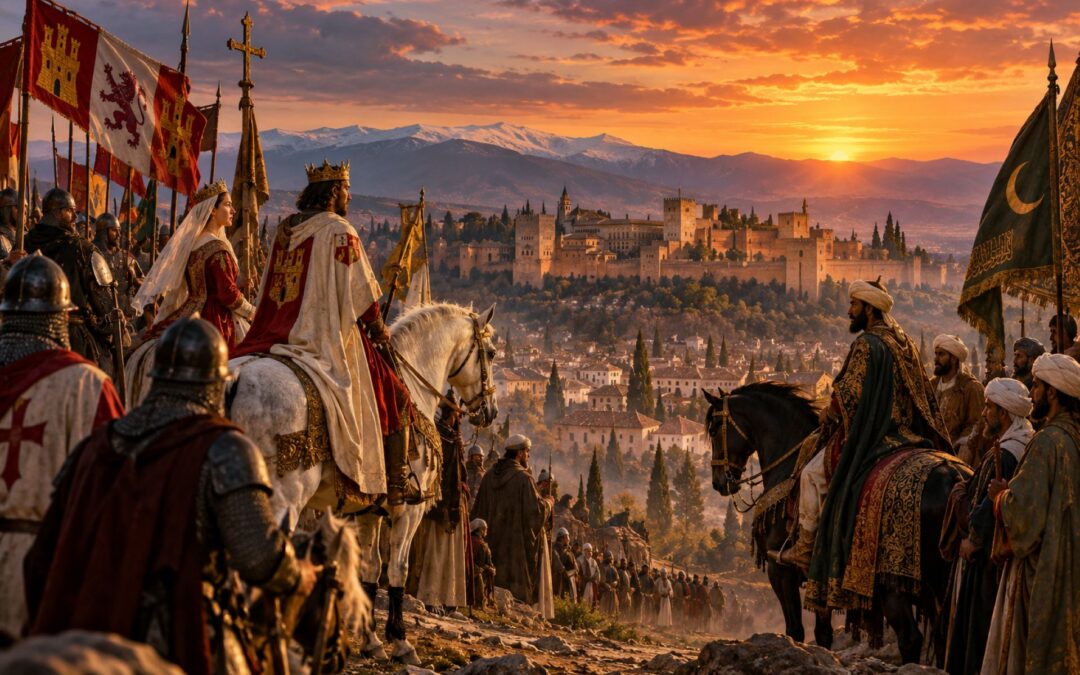
On January 2, 1492, Muhammad XII, the last Muslim ruler of Granada, surrendered his kingdom to Ferdinand of Aragon and Isabella of Castile. The surrender ended almost eight centuries of Muslim political rule in parts of the Iberian Peninsula, completing a transformation that had begun when Muslim armies crossed from North Africa into the Visigothic kingdom in 711. What had once been a peninsula dominated by Islamic states was now divided among Christian monarchies, with Castile and Aragon emerging as its principal powers.
This long transformation became known as the Reconquista, or reconquest. It is often presented as a centuries-long religious struggle in which Christian kingdoms steadily recovered territory from Muslim conquerors. That description captures an important dimension of the conflict, but it conceals much of what actually happened.
Christian rulers frequently fought other Christians, while Muslim dynasties struggled against their own political rivals. Kings employed soldiers from different religious communities, negotiated alliances across religious boundaries, and sometimes found it more profitable to collect tribute from their neighbors than to conquer them. Warfare alternated with diplomacy, commerce, cultural exchange, and long periods in which political frontiers remained relatively stable.
Nor was the eventual Christian victory inevitable. For centuries, the Muslim states of al-Andalus possessed formidable armies, prosperous cities, sophisticated political institutions, and cultural achievements that made the region one of Europe’s most important intellectual and economic centers. The Christian kingdoms survived and expanded through a changing combination of military opportunities, political consolidation, dynastic ambition, and religious mobilization.
Understanding the Reconquista therefore requires following more than the movement of armies across a map. It means examining how medieval Iberia’s competing societies developed, why their relative power changed, and how the consequences of conquest continued long after Granada’s surrender.
711: The Muslim Conquest of Visigothic Iberia
At the beginning of the eighth century, the Iberian Peninsula was governed primarily by the Visigothic kingdom, a Christian monarchy whose ruling elites descended from Germanic peoples who had settled in former Roman territories. The kingdom controlled much of what is now Spain and Portugal, with Toledo serving as an important political center. Although Visigothic rulers had established institutions that survived for generations, their authority depended heavily on aristocratic cooperation and contested arrangements for royal succession.
The kingdom was particularly vulnerable in 711. King Roderic faced opposition from rival aristocratic factions, and disagreements over the succession weakened the monarchy’s ability to respond to external threats. Across the Strait of Gibraltar, meanwhile, Muslim armies had already conquered much of North Africa as part of the extraordinary expansion of Islamic political power following the death of the Prophet Muhammad in 632.
That expansion had begun under the Rashidun caliphs and continued under the Umayyad dynasty, which took power in 661. By the early eighth century, Umayyad authority extended across North Africa, bringing its frontier close to the Iberian Peninsula. Yet the forces that eventually entered Iberia were not simply an army of Arabs: North African Berbers played a central role in the conquest, reflecting the expanding political and religious connections between the Maghreb and the wider Islamic world.
In 711, a force commanded by Tariq ibn Ziyad crossed the strait and entered southern Iberia. His army confronted Roderic’s forces at the Battle of Guadalete, where the Visigothic king was defeated and probably killed. The battle severely weakened the central monarchy, allowing Muslim commanders to advance through a kingdom already divided by political rivalries.
The conquest proceeded with remarkable speed. Córdoba and Toledo passed under Muslim control, while Zaragoza and other important centers followed through further campaigns and agreements. Within a few years, much of the peninsula had been incorporated into a new political order connected to the Umayyad Caliphate.
This expansion did not involve the military destruction of every settlement. Some cities resisted, while others surrendered through negotiated agreements that preserved elements of local authority, property ownership, and religious practice in exchange for political submission and taxation. As the Metropolitan Museum of Art’s history of Umayyad Spain explains, the establishment of Muslim power involved both warfare and diplomacy, followed by the development of institutions that would shape Iberian society for centuries.
The conquered territories became known as al-Andalus, initially governed by Muslim officials connected to the Umayyad administration. Their authority reached across most of the peninsula, but control remained weaker in some mountainous northern regions where local Christian political communities survived.
Muslim forces also advanced beyond the Pyrenees into territories belonging to the Frankish world. They occupied Narbonne and conducted further campaigns into present-day France before a Frankish army led by Charles Martel defeated a Muslim force near Tours or Poitiers in 732. Although the battle later acquired enormous symbolic importance in European historical writing, Muslim power north of the Pyrenees did not disappear immediately, and the course of the frontier was shaped by subsequent campaigns.
By the middle of the eighth century, the political transformation of Iberia was unmistakable. The Visigothic monarchy had collapsed, much of the peninsula belonged to the Islamic world, and the surviving Christian powers were concentrated in comparatively small northern territories. The balance of power overwhelmingly favored the Muslim rulers, making the eventual reversal of their territorial dominance far from predictable.
Asturias and the First Christian Kingdoms
The survival of Christian political authority in northern Iberia was crucial to the developments that followed. The Cantabrian Mountains and other rugged landscapes complicated military operations, while local communities maintained political relationships that were not entirely dependent on the defeated Visigothic monarchy. These northern territories did not immediately constitute a united resistance movement, but they provided the foundations for new kingdoms.
The most celebrated early episode was the Battle of Covadonga, traditionally dated to 722. According to later Christian accounts, a leader named Pelagius, or Pelayo, gathered local warriors and defeated a Muslim force in the mountains of Asturias. The engagement eventually became one of the central founding stories of Christian Spain.
Its historical details are less certain than its later reputation suggests. Some chronologies place the encounter around 718, while others favor 722, and the surviving narratives were written long after the events they describe. Historians debate the scale of the fighting, the political circumstances, and the extent to which later accounts transformed a local confrontation into the beginning of a national religious mission.
Nevertheless, a Christian political center developed in Asturias and gradually expanded its authority. Its rulers established connections with neighboring communities, claimed elements of Visigothic political inheritance, and presented themselves as legitimate Christian monarchs. These claims became increasingly important as northern rulers sought to justify their authority and territorial ambitions.
During the eighth and ninth centuries, Asturian power spread into parts of northwestern Iberia. The movement of its political center toward León eventually contributed to the emergence of the Kingdom of León, which became one of the peninsula’s most important Christian states. Castile developed from frontier territories associated with León before acquiring a more independent political identity.
Other Christian centers emerged through different historical circumstances. The Kingdom of Pamplona grew from Basque-speaking and neighboring communities around the western Pyrenees, negotiating its position between Muslim powers to the south and Frankish influence to the north. Over time, its rulers expanded their territories, and the kingdom became increasingly associated with the name Navarre.
Farther east, Frankish rulers established a series of frontier counties south of the Pyrenees after pushing Muslim forces away from parts of northeastern Iberia. These territories formed the region commonly described as the Spanish March, which provided a military buffer between the Frankish world and al-Andalus.
Barcelona and the surrounding counties gradually developed greater political independence as Frankish royal authority weakened. Their rulers maintained connections with other Christian states but pursued their own territorial and dynastic interests, eventually contributing to the formation of the Crown of Aragon.
The result was a collection of Christian political entities rather than an emerging unified Spain. Asturias, León, Castile, Pamplona, Aragon, and the Catalan counties developed different institutions, alliances, and territorial ambitions. Their rulers could cooperate against Muslim forces, but they also competed for inheritance, influence, resources, and control of strategically valuable lands.
For several centuries, these Christian states remained weaker than the major Islamic political centers to their south. Their survival owed much to geography, local military organization, and the ability to exploit opportunities created by changing political circumstances. They were establishing the foundations of future expansion, but the most prosperous and powerful state in Iberia still lay in al-Andalus.
The Caliphate of Córdoba and the World of al-Andalus
The political history of al-Andalus took a dramatic turn in 750 when the Abbasid dynasty overthrew the Umayyad Caliphate. The new rulers established their own imperial authority, while members of the defeated Umayyad family faced persecution. One survivor, Abd al-Rahman, escaped the violence and eventually traveled westward through North Africa to Iberia.
In 756, Abd al-Rahman established himself as ruler of Córdoba and founded an independent Umayyad emirate. Although he did not initially claim the title of caliph, his success separated al-Andalus politically from the Abbasid rulers who governed much of the eastern Islamic world. Córdoba became the center of a dynasty that would dominate large parts of the peninsula for generations.
The emirate faced repeated challenges from provincial rulers, aristocratic factions, frontier commanders, and rival claimants. Its authority was never automatically accepted throughout the peninsula, and governing territories populated by different religious and ethnic communities required a combination of military force, taxation, patronage, and negotiation.
Nevertheless, the Umayyad rulers developed increasingly sophisticated political institutions. Córdoba became an administrative and commercial center whose influence extended through the western Mediterranean. Its position connected Iberian agriculture and manufacturing with the trading networks of North Africa and the broader Islamic world.
The political importance of Córdoba reached a new height under Abd al-Rahman III, who came to power in 912. After confronting internal rebellions and strengthening central authority, he proclaimed himself caliph in 929. This elevated his claim beyond that of a regional emir and placed his dynasty in ideological competition with other rulers who claimed leadership within the Islamic world.
The Caliphate of Córdoba became one of the wealthiest and most influential states in medieval western Europe. Its rulers supported monumental construction, diplomatic relationships, scholarship, courtly culture, and military organization on a scale that demonstrated their political ambitions.
One of its most famous monuments was the Great Mosque of Córdoba, begun under Abd al-Rahman I and expanded by later rulers. Its striking red-and-white arches and extensive prayer halls reflected generations of investment, while its architectural development demonstrated the growing prestige of the Umayyad court.
Abd al-Rahman III also commissioned Medina Azahara, an elaborate palatine city outside Córdoba. Built to express caliphal authority, it contained ceremonial spaces, administrative buildings, residential complexes, gardens, and sophisticated water infrastructure. The surviving archaeological remains, recognized by UNESCO as the Caliphate City of Medina Azahara, provide tangible evidence of the dynasty’s resources and political organization.
Córdoba’s reputation extended beyond architecture. Its intellectual life benefited from scholars, physicians, legal specialists, poets, and individuals engaged in astronomy, mathematics, philosophy, and other fields of learning. Books and manuscripts circulated through networks connecting Iberia with North Africa and the eastern Mediterranean, helping transmit and develop knowledge across different languages and scholarly traditions.
This intellectual activity should not be understood as a single uninterrupted golden age in which every scientific achievement occurred under one ruler. Scholarship developed through different institutions, periods, and communities, while some of the most influential transfers of Arabic learning into Latin occurred later, particularly after Christian rulers gained control of important urban centers.
Agriculture was another source of prosperity. Farmers and engineers developed or expanded irrigation systems using canals, water channels, wells, and water-lifting devices. Crops and agricultural techniques associated with wider Mediterranean and Islamic networks contributed to the cultivation of citrus fruits, rice, sugarcane, cotton, and other products in suitable regions.
These developments did not replace all earlier agricultural practices. They interacted with farming traditions inherited from Roman, Visigothic, and local Iberian societies, creating different combinations of irrigation, crop cultivation, and rural settlement. Their significance lay in the accumulation and adaptation of useful knowledge rather than the sudden introduction of agriculture to an otherwise unproductive peninsula.
Al-Andalus was also socially and religiously diverse. Its population included indigenous Iberians, descendants of earlier Christian communities, Arab elites, North African Berbers, Jewish communities, enslaved people, and individuals whose identities changed across generations through conversion, marriage, language, and political affiliation.
Many inhabitants gradually converted to Islam, although the pace and motivations differed across regions and social groups. Conversion could reflect sincere religious commitment, social relationships, economic opportunities, political incentives, or the increasing cultural influence of Muslim institutions. It would be misleading to describe the process solely as an attempt to preserve wealth or avoid taxation.
Christians and Jews living under Muslim rule generally possessed a recognized but subordinate legal status. Their communities could maintain religious institutions and practices under various conditions, while particular taxes, legal restrictions, and changing political circumstances distinguished their position from that of Muslims.
This system made forms of religious coexistence possible, but it did not establish equality. Tolerance varied among rulers and periods, and episodes of political conflict or religious persecution interrupted the more cooperative relationships that developed elsewhere.
The same complexity applied to cultural exchange. Muslim, Christian, and Jewish communities contributed to the region’s intellectual and commercial life, yet they did not always participate on equal terms or inhabit a society free from prejudice and conflict.
By the tenth century, al-Andalus demonstrated that political power, cultural prosperity, and religious diversity could coexist within a sophisticated medieval state. Its achievements, however, rested partly on the ability of the central government to control powerful regional interests. When that authority weakened, the political balance that had sustained Córdoba began to unravel.
Taifa Rivalries, El Cid, and the Rise of Crusading
The decline of the Caliphate of Córdoba began before its formal disappearance. During the late tenth century, much of its effective political power passed into the hands of Muhammad ibn Abi Amir, better known as Almanzor, a powerful court official and military commander who exercised authority while the caliph remained largely removed from active government.
Almanzor conducted repeated campaigns against Christian territories and strengthened the military position of Córdoba. His authority, however, depended on a political arrangement that concentrated enormous influence outside the caliphal office itself. When he died in 1002, the system became increasingly vulnerable to succession disputes and competition among powerful factions.
The resulting crisis escalated into civil war. Rival claimants, military commanders, aristocratic groups, and regional governors struggled for control, while Córdoba suffered political violence and destruction. The conflict also brought an end to the world represented by Medina Azahara, which was devastated during the upheavals of 1009–1010.
In 1031, the caliphate was formally abolished. Its territories had fragmented into numerous independent or semi-independent Muslim principalities known as taifas, governed by different dynasties and political elites.
The taifa kingdoms included major centers such as Seville, Zaragoza, Toledo, and Granada. Some developed impressive courts, supported scholars and artists, and maintained prosperous economies. Their political weakness did not necessarily imply immediate cultural decline, but fragmentation made coordinated military resistance much more difficult.
Christian rulers increasingly exploited competition among the taifas. Rather than relying exclusively on conquest, they demanded payments known as parias, effectively receiving tribute in exchange for protection, military assistance, or the promise of withholding attacks.
These arrangements could enrich Christian courts and provide resources for soldiers, fortifications, and further expansion. For a taifa ruler, however, paying tribute might offer a practical way to survive against rival Muslim states or a threatening Christian neighbor.
The result was a political landscape in which religious identity did not determine every alliance. Muslim rulers sometimes employed Christian mercenaries to fight fellow Muslims, while Christian kings cooperated with Muslim powers against rival Christian states. Such relationships did not eliminate religious hostility, but they demonstrate why the period cannot be reduced to two united religious camps.
No figure illustrates these contradictions more vividly than Rodrigo Díaz de Vivar, remembered as El Cid.
Born into the Castilian nobility, Rodrigo served in the political world of the Christian kingdoms before his relationships with powerful rulers deteriorated. Following his exile from the court of Alfonso VI, he entered the service of the Muslim rulers of Zaragoza, where his military skills could be employed against opponents from different religious backgrounds.
His career was shaped by the realities of frontier warfare. Military commanders sought patronage, rulers needed experienced soldiers, and territorial opportunities sometimes mattered more immediately than religious solidarity. Rodrigo’s shifting loyalties therefore reflected established political practices rather than an entirely exceptional rejection of his Christian identity.
In 1094, El Cid captured Valencia and established his own authority over the city. He ruled until his death in 1099, creating a political position that depended on military control, alliances, and relationships with both Christian and Muslim communities.
Later epic traditions transformed him into one of the great heroic figures of Christian Spain. These accounts preserved the memory of a formidable warrior but often simplified the political compromises, changing allegiances, and personal ambitions that shaped his actual career.
Meanwhile, the Christian kingdoms were developing more powerful military and territorial institutions. One of the most consequential events occurred in 1085 when Alfonso VI of León and Castile captured Toledo, the former Visigothic capital.
Toledo possessed enormous symbolic value because of its association with the earlier Christian monarchy. Its conquest also shifted the strategic balance in central Iberia, giving Alfonso control of an important city and increasing pressure on neighboring Muslim territories.
The fall of Toledo alarmed the taifa rulers. Their divisions had already made them vulnerable to tribute demands and military intervention, and Alfonso’s success suggested that their political independence could not be secured through existing arrangements.
Several Muslim rulers therefore appealed to the Almoravids, a North African Berber dynasty whose military power and religious reform movement had produced a substantial state across the western Maghreb.
In 1086, the Almoravid ruler Yusuf ibn Tashfin crossed into Iberia and defeated Alfonso VI at the Battle of Sagrajas, also known as Zallaqa. The victory checked Christian expansion and demonstrated that the Muslim states of Iberia could draw upon powerful military resources from North Africa.
The intervention, however, transformed the position of the taifa rulers themselves. Rather than remaining external protectors, the Almoravids began absorbing the smaller states into their own political system. By the early 1090s, much of Muslim Iberia had come under Almoravid control, ending the independence of many rulers who had requested assistance.
This development introduced a new phase of military and religious politics. The Almoravids brought a reform-oriented interpretation of Islamic rule, and their attempts to consolidate authority were influenced by both religious commitments and practical imperial interests.
Among Christian rulers, meanwhile, warfare against Muslim states was increasingly connected to wider developments in Latin Christianity. Popes had begun recognizing and encouraging campaigns in Iberia, while Christian rulers presented territorial conquest in religious terms that could attract support beyond their immediate kingdoms.
The capture of Barbastro in 1064, involving Iberian and foreign Christian forces, became an important precedent for later religiously sanctioned military campaigns. Its interpretation remains debated, but it demonstrates that papal involvement in Iberian warfare developed before the famous call for the First Crusade.
In 1095, Pope Urban II summoned Christian warriors to assist eastern Christians and recover Jerusalem. Although the movement that followed focused principally on the eastern Mediterranean, Iberian campaigns increasingly became associated with similar spiritual privileges and religious obligations.
The relationship between the Reconquista and the Crusades was therefore gradual rather than instantaneous. Medieval rulers had long fought for territory, prestige, resources, and security, but crusading language and institutions increasingly provided additional legitimacy, recruits, and incentives for warfare.
This transformation did not make political calculation disappear. Christian kingdoms continued fighting one another, rulers negotiated with Muslim neighbors, and military operations were shaped by practical limitations. Nevertheless, the increasingly powerful language of religious warfare changed how conquest could be justified and organized.
By the beginning of the twelfth century, Iberia had entered a more complicated political environment. The Christian kingdoms possessed growing resources, the Muslim south had been reorganized under North African authority, and warfare was becoming connected to institutions that extended beyond the peninsula.
The long-term balance of power was shifting, but neither side had achieved a decisive victory.
Portugal, Aragon, and the Christian Advances of the Twelfth Century
The twelfth century witnessed changes in the political organization of Christian Iberia that would have lasting consequences. Territories once governed through loosely connected counties and kingdoms developed stronger dynastic identities, while frontier campaigns created opportunities for rulers seeking political independence and territorial expansion.
Portugal emerged from this environment. During the early twelfth century, the County of Portugal was associated with the Kingdom of León, although its leading families maintained ambitions and political relationships of their own.
Afonso Henriques became the central figure in the county’s transformation into an independent monarchy. In 1128, he defeated forces supporting his mother, Teresa of León, at the Battle of São Mamede, gaining effective control over the county and strengthening his political position.
His subsequent campaigns involved both struggles against neighboring Christian authorities and expansion into territories controlled by Muslim rulers. The traditional association of his kingship with the Battle of Ourique in 1139 became important to Portuguese historical memory, although the battle’s details and the precise political significance of that date remain debated.
The settlement of Zamora in 1143 helped establish Afonso’s position in relation to León. His authority received clearer papal recognition in 1179 through the bull Manifestis Probatum, reinforcing Portugal’s standing as a kingdom distinct from its powerful Christian neighbor.
Military expansion was essential to Portugal’s political consolidation. In 1147, Portuguese forces besieged Lisbon with assistance from crusaders arriving from northern Europe, including participants from England, Flanders, and German-speaking territories.
Lisbon’s capture was significant for more than its religious symbolism. The city occupied a valuable position near the mouth of the Tagus River, connecting inland commerce and agriculture with maritime trade. Control of its harbor increased the kingdom’s economic and strategic opportunities while strengthening its territorial position.
Farther east, the political relationship between Aragon and the County of Barcelona underwent its own transformation. In 1137, dynastic arrangements connected the Aragonese royal house with Barcelona’s ruling family, laying the foundations for the composite political structure that became the Crown of Aragon.
This union did not immediately erase the separate political traditions of the territories involved. Aragon and the Catalan counties retained distinct institutions and interests, but their connection created a powerful new political grouping capable of pursuing expansion along the Mediterranean frontier.
Castile and León also experienced periods of union and separation as dynastic successions brought territories under common rulers or divided them among heirs. Their political relationships changed repeatedly, reflecting the continuing importance of inheritance, aristocratic loyalties, and personal monarchy in medieval government.
These developments coincided with another major transformation in Muslim Iberia. During the middle of the twelfth century, the Almohads, a new religious and political movement originating in North Africa, challenged and eventually displaced Almoravid authority across much of the Maghreb and al-Andalus.
The Almohads established a formidable state with its own reformist religious commitments and imperial ambitions. Their arrival prevented the Christian kingdoms from simply overrunning a politically fragmented south, while renewing competition over strategically important frontier territories.
Christian military institutions were also becoming more organized. Orders such as Calatrava, Santiago, and Alcántara combined religious commitments with the practical responsibilities of defending castles, maintaining garrisons, and conducting frontier warfare.
These orders helped provide a more continuous military presence in contested regions. Their members could defend strategic positions while royal armies were occupied elsewhere, making them important instruments of territorial consolidation.
Religious authorization increasingly encouraged participation from beyond Iberia, as illustrated by the conquest of Lisbon. Yet the motives driving expansion still differed among rulers, nobles, clerics, soldiers, and settlers. Some sought religious rewards, while others pursued land, political advancement, commercial opportunities, or security.
The significance of the twelfth century lay in the development of more durable Christian political and military structures. These kingdoms were not united under one sovereign, but they were becoming capable of sustaining expansion on a scale that earlier northern rulers would have struggled to achieve.
1212–1249: Las Navas de Tolosa and the Great Conquests
The decisive military turning point came in 1212, when a coalition of Christian forces confronted the Almohads at the Battle of Las Navas de Tolosa. The campaign was led principally by Alfonso VIII of Castile, with important participation from the kings and forces of Aragon and Navarre, alongside other Christian fighters.
The campaign benefited from papal support and the increasingly established tradition of religiously sanctioned warfare in Iberia. It also reflected the strategic interests of the participating rulers, who sought to weaken Almohad military power and expand their territories.
The Christian victory was substantial. It damaged the Almohads’ position and helped create conditions for renewed expansion into Muslim-controlled territories.
Its consequences, however, should not be exaggerated into an immediate collapse of Islamic political authority. Almohad forces and institutions continued to exist after 1212, while Christian rulers faced their own military, political, and financial constraints. The significance of the battle becomes clearer when viewed as part of a broader process of weakening North African control and strengthening Christian territorial organization.
During the following decades, the political balance shifted dramatically. As Almohad authority declined and local Muslim rulers pursued competing interests, Christian monarchs mounted increasingly successful campaigns across different parts of the peninsula.
In the east, James I of Aragon developed an ambitious program of territorial expansion. In 1229, his forces conquered Mallorca, beginning the incorporation of important Balearic territories into the growing maritime sphere of the Crown of Aragon.
The Balearic campaign was particularly important because it connected territorial conquest with Mediterranean commerce and naval strategy. The islands offered valuable positions along maritime routes, while their acquisition strengthened the monarchy’s ability to project power beyond its mainland territories.
James subsequently turned toward Valencia, a prosperous region with important agricultural settlements, towns, and commercial connections. Valencia surrendered to his forces in 1238, becoming a major acquisition for the Crown of Aragon.
These conquests required more than battlefield victories. Royal authorities negotiated surrender arrangements, distributed land, encouraged Christian settlement, and developed institutions for administering communities with different legal and religious backgrounds.
In central and southern Iberia, Ferdinand III of Castile and León pursued equally consequential campaigns. The union of the two kingdoms under his rule in 1230 strengthened his political resources, allowing him to coordinate expansion across a broader territory.
Córdoba fell to Castilian forces in 1236. The conquest possessed enormous symbolic significance because the city had once served as the capital of the independent Umayyad emirate and caliphate.
The transfer of Córdoba represented more than the seizure of an important city. It demonstrated how completely the political balance had changed since the tenth century, when Córdoba had governed one of the wealthiest and most influential states in western Europe.
Ferdinand’s campaigns continued through the Guadalquivir region. Murcia entered Castilian overlordship through an agreement in 1243, Jaén passed under Castilian control in 1246, and Seville fell in 1248 after a major siege.
Seville was especially valuable because of its position on the Guadalquivir River and its connections to inland trade and Atlantic navigation. Its conquest extended Castilian authority across another major urban and commercial center, strengthening the monarchy’s economic resources and strategic position.
The western frontier experienced similar transformations. Portuguese rulers continued expanding southward until the conquest of the Algarve in 1249 brought the southernmost region of mainland Portugal under Christian control.
The broad territorial outline of Portugal was now established, although agreements with Castile would subsequently clarify important sections of the border. The Treaty of Alcañices in 1297 helped formalize much of the frontier that has endured into modern times.
Across Iberia, conquest transformed the lives of existing populations. Some Muslims fled toward territories still governed by Muslim rulers, particularly Granada, while others moved across the Strait of Gibraltar to North Africa.
Many remained in territories that had passed under Christian control. Their continued presence presented rulers with practical questions concerning taxation, agricultural production, property ownership, religious practice, and political loyalty.
Christian authorities often allowed Muslim communities to retain certain institutions and customs under negotiated conditions. Such arrangements varied considerably and could change as political priorities, social pressures, and religious policies developed.
Christian settlement also altered the demographic and economic organization of conquered regions. Land grants rewarded soldiers and supporters, towns received new privileges, and institutions connected to the Church or monarchy acquired property and authority.
These processes could involve population displacement, the redistribution of resources, and the weakening of institutions associated with earlier rulers. They also depended on the continued labor and expertise of communities whose agricultural and commercial knowledge could not simply be replaced.
By the middle of the thirteenth century, the territorial transformation was extraordinary. Portugal had completed its major mainland expansion, Castile controlled much of central and southern Iberia, and the Crown of Aragon had established its dominance across extensive eastern territories.
Only one major independent Muslim state remained: the Nasrid Emirate of Granada. Its survival would become one of the most remarkable features of the Reconquista’s final centuries.
Why Granada Survived—and Why It Finally Fell in 1492
The Nasrid dynasty emerged during the political upheavals of the thirteenth century. As Almohad authority weakened and Christian armies advanced, Muhammad I ibn al-Ahmar established a new Muslim political power in southern Iberia, eventually making Granada the center of his rule.
By the middle of the thirteenth century, the Nasrids governed a comparatively small territory surrounded by increasingly powerful Christian states. Their position appeared precarious, especially after the major conquests of Córdoba, Valencia, and Seville.
Yet Granada survived for approximately two and a half centuries. Its longevity cannot be explained simply by military strength, because the emirate lacked the resources to confront Castile in a prolonged struggle on equal terms.
Instead, Nasrid rulers developed a flexible political strategy that combined tribute payments, diplomacy, commercial relationships, military preparedness, and exploitation of rivalries among neighboring powers.
Granada frequently accepted a subordinate relationship with Castile, paying substantial tribute in exchange for recognition and periods of relative security. These arrangements were not permanent guarantees of peace, and warfare continued at intervals, but they could make accommodation advantageous to both sides.
For Castilian rulers, tribute provided revenue without the enormous costs and uncertainties of conquering a heavily defended territory. Granada also possessed valuable commercial connections, including silk production and relationships with merchants operating across the Mediterranean and North Africa.
Its rulers could maintain contacts with Muslim powers beyond the peninsula, while Castilian political difficulties sometimes created opportunities to negotiate more favorable conditions. Granada’s position therefore depended on diplomacy as much as fortifications.
The emirate also possessed a rich cultural and artistic life. Its most famous surviving monument, the Alhambra, developed into an extraordinary complex of palaces, gardens, courtyards, defensive structures, and administrative spaces overlooking the city.
The buildings expressed Nasrid ideas about political authority, courtly life, religious identity, and aesthetics. Intricate geometric decoration, Arabic inscriptions, carefully designed spaces, and sophisticated arrangements of water and gardens demonstrated the continued vitality of Islamic cultural traditions in late medieval Iberia.
The Metropolitan Museum of Art’s account of the Nasrid period illustrates how the emirate maintained important artistic achievements despite its restricted territory and increasingly vulnerable political position.
Granada’s survival was also facilitated by problems within Castile. During the fourteenth century, dynastic struggles and civil conflict repeatedly diverted attention from campaigns against the Nasrids.
The Black Death reached Iberia in 1348, causing severe demographic and economic disruption. Disease, social instability, and pressure on royal finances complicated the military ambitions of rulers who were already occupied with internal disputes and external conflicts.
Castile’s involvement in wider European politics further constrained its ability to pursue uninterrupted conquest. These circumstances did not create permanent peace, but they helped prevent Granada from facing sustained military pressure over long periods.
The political situation changed dramatically during the second half of the fifteenth century.
In 1469, Isabella of Castile married Ferdinand of Aragon, creating a dynastic partnership between two of Iberia’s most powerful Christian ruling houses. Isabella became queen of Castile in 1474, while Ferdinand inherited the Aragonese crown in 1479.
Their marriage did not immediately produce a single centralized Spanish state. Castile and Aragon retained separate laws, political institutions, fiscal arrangements, and traditions, even as their monarchs increasingly coordinated policy.
Nevertheless, the partnership allowed Ferdinand and Isabella, later celebrated as the Catholic Monarchs, to combine important political and military resources. Their authority strengthened at a time when Granada faced internal dynastic conflicts that complicated its ability to maintain a unified defense.
In 1482, the Catholic Monarchs began a prolonged campaign against the Nasrid emirate. Unlike earlier raids or limited frontier operations, the Granada War developed into a systematic effort to capture the remaining Muslim strongholds and eliminate the emirate’s political independence.
Over the following decade, Christian forces advanced through sieges, negotiated surrenders, and military operations against important fortified towns. The campaign placed increasing pressure on the Nasrid rulers while internal rivalries weakened their ability to coordinate resistance.
The final stage centered on Granada itself. Muhammad XII, known in Christian sources as Boabdil, confronted a deteriorating military position and eventually negotiated the city’s surrender.
On January 2, 1492, Granada passed into the hands of Ferdinand and Isabella. Muhammad XII relinquished the last independent Muslim-ruled kingdom in Iberia, bringing the political history conventionally associated with the Reconquista to its conclusion.
The surrender ended a process spanning roughly 781 years from the first Muslim invasion. Yet the length of that period should not create the impression that Christian expansion had proceeded continuously from the eighth century onward.
The major territorial advances occurred unevenly, separated by centuries of political stability, reversals, alliances, and internal conflicts. Granada’s survival demonstrates how a weaker state could endure when its rulers successfully navigated the competing interests of more powerful neighbors.
The conquest of 1492 ended independent Muslim sovereignty, but it did not immediately remove the peninsula’s Muslim inhabitants or erase the institutions, languages, architecture, and cultural traditions that had developed over centuries.
The consequences for those communities formed another chapter of Iberian history.
The Fate of Jews and Muslims After Christian Conquest
The Reconquista changed political authority across Iberia, but the relationship between conquest and religious identity was never straightforward. Muslim and Jewish communities had lived throughout the peninsula for centuries, and the expansion of Christian rule did not initially produce one uniform policy toward them.
Muslims who remained under Christian sovereignty became known as Mudéjars. In many territories, they were permitted to continue practicing Islam while maintaining certain communal institutions, property rights, and customary arrangements.
These protections were not universal or permanent. Their terms depended on local surrender agreements, royal policy, economic circumstances, and the changing interests of Christian authorities.
For rulers consolidating newly conquered regions, allowing Muslim communities to remain could be politically and economically advantageous. Agricultural production, irrigation networks, commercial relationships, and specialized skills depended partly on populations already established in those territories.
Jewish communities also occupied important positions in medieval Christian kingdoms. Jewish individuals served as physicians, financiers, translators, merchants, and administrators, while communal institutions sustained religious and intellectual traditions.
Yet these roles did not guarantee security. Anti-Jewish prejudice, legal discrimination, religious hostility, and episodes of violence existed alongside periods in which rulers protected Jewish communities or relied upon their economic and administrative contributions.
The social history of medieval Iberia therefore cannot be divided neatly into an earlier Islamic age of tolerance and a later Christian age of persecution. Conditions differed across territories and periods, while cooperation and discrimination could exist within the same political society.
Nevertheless, religious policy became increasingly coercive in important parts of Christian Iberia during the late medieval period. Political authorities and Church institutions placed growing pressure on communities whose beliefs or practices were considered incompatible with Christian religious ideals.
The treatment of Jews illustrates this transformation particularly clearly. Anti-Jewish violence and pressure to convert had already affected communities before Ferdinand and Isabella completed the conquest of Granada.
The establishment of the Spanish Inquisition in 1478 added a powerful institution to the enforcement of Catholic orthodoxy. Authorized under Ferdinand and Isabella, the Inquisition was designed principally to investigate baptized Christians suspected of heresy, including converts from Judaism who were accused of secretly maintaining Jewish religious practices.
This distinction is important. The Inquisition did not possess the same ordinary jurisdiction over every unbaptized Jew or Muslim simply because they followed a different religion. Its authority focused on baptized Christians, although wider royal and ecclesiastical policies could impose severe restrictions on communities that had not converted.
In 1492, the Catholic Monarchs issued the Alhambra Decree, ordering Jews who refused conversion to leave their kingdoms. The decision forced Jewish families to confront the loss of homes, businesses, communal institutions, and relationships established over generations.
Some accepted baptism, while others chose exile despite the enormous personal and material costs. The number who left remains uncertain, and historical estimates vary considerably.
Many refugees traveled to Portugal, North Africa, Italy, and territories of the Ottoman Empire. Their descendants formed important parts of the Sephardic Jewish diaspora, preserving and transforming religious traditions, languages, customs, and collective memories associated with their Iberian heritage.
The National Library of Israel’s account of the expulsion of Spain’s Jews provides historical context for this upheaval and the communities it helped establish beyond Iberia.
For the Muslims of Granada, the surrender initially appeared to offer a different outcome. The agreements associated with the conquest promised protections for religious practice, property, and communal institutions under Christian sovereignty.
These terms, however, were progressively undermined. Pressure for conversion intensified, and Christian authorities increasingly restricted Islamic religious life.
Following coercive policies and resistance in Granada, Muslims in Castile faced compulsory conversion in the early sixteenth century. The Crown of Aragon later imposed similar requirements in its territories.
Converted Muslims and their descendants became known as Moriscos. Their public legal status changed through baptism, but conversion did not necessarily eliminate suspicion or discrimination.
Some Moriscos practiced Christianity, others maintained aspects of Islamic religious life privately, and still others combined inherited customs with changing religious practices. Their experiences cannot be reduced to a single uniform response.
Religious authorities and royal officials frequently viewed Arabic language, clothing, bathing customs, ceremonies, and other inherited practices as possible signs of inadequate conversion or concealed religious loyalty.
As scholarship on religion, ancestry, and discrimination in early modern Iberia demonstrates, the relationship between religious identity and inherited social status became increasingly complicated. Formal conversion did not always remove the stigma associated with belonging to a formerly Jewish or Muslim family.
Portugal followed its own trajectory. After initially receiving Jewish refugees from Spain, the Portuguese monarchy adopted coercive measures in 1496–1497 under Manuel I.
Although an expulsion order was issued, the authorities subsequently obstructed Jewish emigration and imposed widespread forced conversion. The result was not simply the removal of the Jewish population but the creation of a large community of New Christians whose descendants remained vulnerable to discrimination and religious suspicion.
The history of these measures is examined in scholarship on the Portuguese experience of Jewish conversion, which helps explain why Portugal’s policies should not be described as a straightforward repetition of Spain’s 1492 expulsion.
The repercussions continued long after the Reconquista had conventionally ended. During the sixteenth century, restrictions on Morisco communities contributed to further tension and rebellion, including the major revolt in the former Kingdom of Granada between 1568 and 1571.
In 1609, the Spanish monarchy began another enormous upheaval by ordering the expulsion of the Moriscos. The expulsions continued into 1614 and affected approximately 300,000 people according to a commonly cited historical estimate, although demographic calculations remain subject to scholarly debate.
These later events were separated from Granada’s surrender by more than a century. They nevertheless reveal how the conquest’s political settlement failed to establish durable religious security for the communities incorporated into Christian kingdoms.
The end of independent Muslim rule in Iberia was therefore not the same thing as the end of Muslim life, and the forced conversion of religious minorities did not create a society free from religious differences.
Instead, the movement toward religious uniformity produced new forms of coercion, suspicion, displacement, and cultural transformation whose consequences extended across Europe, North Africa, and the Mediterranean.
How the Reconquista Shaped Iberian Empires and Historical Memory
The fall of Granada coincided with another event that would transform world history. In 1492, Christopher Columbus secured sponsorship from the Castilian monarchy for an Atlantic expedition intended to reach Asian markets by sailing west.
Columbus had pursued royal support before Granada’s surrender, and the completion of the war was not the sole reason Ferdinand and Isabella approved his proposal. Portuguese maritime expansion, commercial ambitions, diplomatic considerations, and Columbus’s persistent negotiations all contributed to the decision.
Nevertheless, the timing was significant. The Catholic Monarchs had just completed a major military campaign that strengthened their prestige and altered their political priorities. Castile was now in a position to participate more aggressively in Atlantic exploration.
Columbus departed from Palos on August 3, 1492, and reached the Caribbean in October. His expedition did not arrive in an unknown or uninhabited world, but it initiated a sustained process of European expansion that connected the Americas with the political and commercial systems of the Atlantic.
The subsequent development of Spain’s overseas empire involved conquest, settlement, Christian missionary activity, extraction of resources, and the establishment of colonial institutions. Some of these practices had meaningful precedents in the centuries of Iberian frontier warfare and territorial expansion.
Medieval rulers had already developed methods for rewarding military service with land, encouraging settlement in conquered territories, establishing new political jurisdictions, and justifying expansion through religious claims. The experiences of frontier warfare helped shape certain assumptions and institutions that later accompanied conquest overseas.
Spanish colonial expansion, however, was not simply the Reconquista transferred to another continent. The conquest of the Americas depended on Indigenous alliances, political rivalries within American societies, maritime developments, European economic ambitions, and the catastrophic consequences of epidemic diseases introduced through sustained transatlantic contact.
Religious conviction played an important part in this expansion, but it interacted with demands for wealth, power, political legitimacy, and commercial advantage. The relationship between these motives is central to scholarship on Spanish Catholicism during the age of exploration and early colonization.
Portugal followed a related but distinct path. Its Christian rulers had completed their mainland territorial expansion in 1249, long before Granada fell to Castile. Portuguese maritime activity developed through Atlantic navigation, African commercial relationships, and the search for access to markets beyond the Mediterranean.
The growth of Portugal’s maritime empire reflected this different historical trajectory. Its overseas system developed through fortified ports, trading relationships, settlements, naval power, and colonial conquest, rather than through the same geographical pattern followed by Castile.
The later histories of Spain and Portugal were therefore connected to the medieval transformation of Iberia without being predetermined by it. Neither empire emerged from one continuous national plan stretching back to the eighth century.
This distinction also matters when considering the historical meaning of the Reconquista itself.
Medieval Christian rulers sometimes invoked the recovery of lands associated with earlier Christian authority, and religious arguments played an increasingly important part in justifying warfare. Nevertheless, the familiar idea of the Reconquista as a single, unified national undertaking was developed and consolidated much later.
The modern interpretation became especially influential during the nineteenth century, when historical writing increasingly connected the medieval conquests to narratives of Spanish national origins. As the historian Damian J. Smith explains in his scholarly treatment of the Reconquista, the period is better understood through the changing relationships among Christian and Muslim states than as an uninterrupted religious war with one predetermined conclusion.
This does not mean that the term has no historical value. It remains a useful name for the long transformation through which Christian rulers expanded across territories formerly governed by Muslim powers. Its limitations become apparent only when it is treated as an explanation rather than a description of that process.
The Reconquista was shaped by a combination of changing political authority, military opportunities, religious institutions, economic resources, and the ability of particular rulers to exploit divisions among their opponents.
The Muslim conquest of 711 destroyed the Visigothic monarchy but did not eliminate Christian political life. The establishment of Córdoba created a powerful Islamic state, but its eventual fragmentation transformed the strategic balance. Christian kingdoms expanded when military organization, dynastic consolidation, and favorable political circumstances made conquest possible, while North African interventions repeatedly challenged their advances.
The decisive territorial transformation occurred over several centuries rather than through one continuous campaign. Granada’s exceptional survival demonstrated the continuing value of diplomacy and economic relationships, while its eventual defeat reflected changing political circumstances as much as the accumulation of earlier Christian victories.
By 1492, the peninsula had been transformed, but its societies remained deeply connected to the histories of all the peoples who had inhabited it. Islamic architecture, agricultural knowledge, language, scholarship, and artistic traditions continued to influence Iberian culture, while Jewish and Muslim communities carried their inheritances into new societies through migration and exile.
The Reconquista ultimately changed who governed Iberia, not everything that Iberia had become. Its history is therefore neither simply the triumph of one religion over another nor the inevitable creation of modern Spain and Portugal. It is the story of how competing medieval states and communities shaped a shared historical landscape whose political boundaries changed dramatically, but whose cultural legacies could never be confined to the victors.
Last Updated on October 31, 2026 by Aseem Gupta