
Reading Time: 14 Minutes
The possibility that human activity could change Earth’s climate is often treated as a discovery of the modern environmental movement. Images of melting glaciers, burning forests and extreme weather have made global warming a defining concern of our time. Yet the scientific ideas behind it emerged when steam engines were transforming industry, scientists were debating ancient ice ages, and nobody had imagined the scale of fossil-fuel consumption to come.
Long before satellites measured the atmosphere or computers simulated the climate, a French mathematician wondered why Earth was warm enough to sustain life. An American experimenter investigated what happened when different gases were exposed to sunlight. An Irish physicist built an elaborate apparatus to measure their absorption of heat, and a Swedish chemist spent months calculating what changes in atmospheric carbon dioxide could do to planetary temperature.
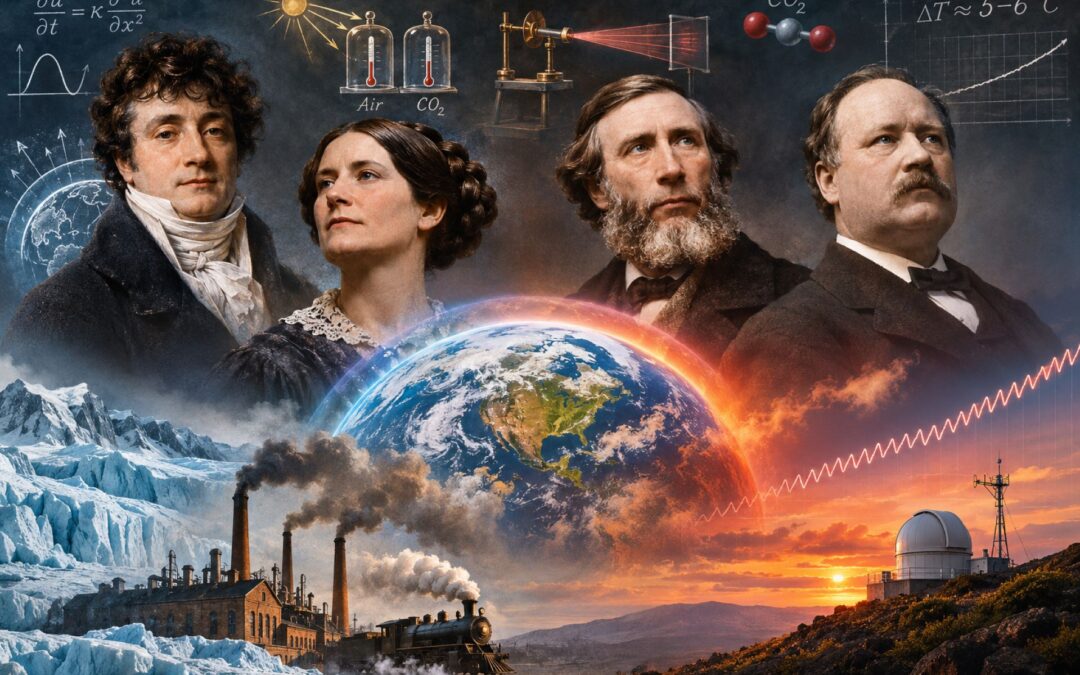
None possessed a complete theory of modern climate change. Together, however, Joseph Fourier, Eunice Newton Foote, John Tyndall and Svante Arrhenius established a sequence of insights that remains fundamental: the atmosphere warms Earth, certain gases are responsible for much of that effect, and changing their concentrations can change the climate. The remarkable part is not simply that they anticipated warming. It is how they arrived at that conclusion while investigating questions that initially seemed to have little to do with human industry.
Fourier’s Puzzle: Why Wasn’t the Earth Frozen?
In the early nineteenth century, Joseph Fourier was already famous for his work on mathematics and heat. He had participated in Napoleon’s expedition to Egypt and developed mathematical methods for analysing how heat moves through materials. But one of the most consequential questions he addressed was much larger than any laboratory experiment: what determines the temperature of an entire planet?
Earth receives energy from the Sun, absorbs some of it and sends energy back toward space. If the planet continuously absorbed sunlight without releasing energy, it would grow hotter. If it lost more than it received, it would cool. Its long-term temperature must therefore depend on a balance between incoming and outgoing energy, yet Fourier recognised that sunlight alone did not adequately explain the warmth of the world around him.
In 1824, he proposed that Earth’s atmosphere played an important role in maintaining its temperature. His reasoning brought together the behaviour of sunlight, heat emitted by the planet and the insulating effects of the air surrounding it. He was approaching what later scientists would call the greenhouse effect, although he did not coin that term or identify the gases responsible.
To understand the question, it helps to distinguish two kinds of radiation. The Sun, with its extremely hot surface, sends much of its energy toward Earth as visible light and other relatively short-wavelength radiation. Land and oceans absorb part of that energy and become warm, but Earth’s cooler surface releases energy mainly as longer-wavelength infrared radiation. Certain atmospheric gases interact much more strongly with this outgoing infrared energy than with most incoming visible light.
When greenhouse gases absorb infrared radiation, they also emit radiation in different directions, including downward. This changes how readily the planet loses energy to space and keeps its surface warmer than it would otherwise be. The natural greenhouse effect is not an abnormal condition: without it, the global average surface temperature would be far below freezing. The crucial question is what happens when its strength changes.
The greenhouse comparison is useful but imperfect. A real glass greenhouse stays warm mainly because its enclosure restricts the movement of heated air, whereas the atmosphere affects Earth’s temperature through radiative processes and the movement of energy through air and clouds. Fourier did not have the later physics required to describe this mechanism accurately. Nevertheless, as NOAA’s account of early climate research explains, his insight opened a new way of considering the atmosphere: not merely as the air people breathe, but as part of the system controlling planetary temperature.
Fourier had established an important possibility, not a complete explanation. If the atmosphere was keeping Earth warm, which of its components mattered? Could those components vary enough to make the planet warmer or colder? Those questions would lead to one of the most overlooked experiments in the history of science.
Eunice Newton Foote and the Experiment Nobody Remembered
In 1856, Eunice Newton Foote faced a scientific world that largely excluded women from universities, learned societies and professional careers. She nevertheless had scientific training from Troy Female Seminary in New York and pursued questions that interested her as an adult.
Foote and her husband, Elisha, also participated in the women’s rights movement and signed the Declaration of Sentiments at the 1848 Seneca Falls Convention. Her scientific career would reveal the contradiction between women’s intellectual abilities and the institutions that restricted their recognition.
Foote wanted to understand how gases respond to the Sun’s rays. Scientists were debating questions such as why the air was colder on mountains than at lower elevations, and how pressure, moisture and atmospheric composition affected temperature. Rather than approaching the problem only through theory, she designed a series of experiments using equipment simple enough to operate without an institutional laboratory.
Her apparatus consisted of two glass cylinders, each containing a thermometer. She placed them side by side so they experienced comparable conditions, then altered what was inside. With an air pump she could reduce the amount of air in one cylinder or increase the density in another. After allowing their temperatures to become comparable, she placed the cylinders in sunlight, recording how they warmed, and repeated parts of the investigation in shade.
The differences were measurable. Denser air became warmer under her test conditions than more rarefied air. To examine moisture, she compared damp air with air dried using calcium chloride and found that the moist air grew hotter. She then tested different gases, including ordinary air, oxygen, hydrogen and what nineteenth-century scientists called carbonic acid gas—carbon dioxide.
The carbon dioxide cylinder produced her most striking observation. Under sunlight it reached a higher temperature than the comparison cylinder and, after being removed from the Sun, took much longer to cool. Here was evidence that the identity of a gas affected how a confined sample heated and retained warmth. Carbon dioxide was not simply interchangeable with the oxygen and nitrogen that make up most of the atmosphere.
Foote went beyond thermometer readings. With geologists uncovering evidence of very different ancient climates, she suggested that an atmosphere richer in carbon dioxide would have made the planet warmer. The experiment had prompted a hypothesis about Earth itself.
That leap matters because it connected atmospheric composition to climate change. A gas present in relatively small quantities could still have an outsized climatic role, and the proportions of gases in the atmosphere need not remain fixed forever. Foote did not calculate how many degrees the Earth would warm if carbon dioxide doubled, but she recognised the direction of the relationship decades before such calculations were attempted.
On 23 August 1856, her paper was brought before a meeting of the American Association for the Advancement of Science in Albany, New York. Foote did not present it herself. Joseph Henry, the prominent scientist who served as secretary of the Smithsonian Institution, presented her research on her behalf. Her account was published later that year in the American Journal of Science and Arts, while other contemporary publications also drew attention to the work.
It would be inaccurate to say that nobody noticed her work. Contemporary reports acknowledged it, and Scientific American praised her scientific abilities. Yet this attention did not become lasting credit: her name largely disappeared from the familiar history of the greenhouse effect.
An important distinction also prevents the pendulum from swinging too far in the other direction. Foote’s experiments did not directly demonstrate the physical mechanism now understood to drive the atmospheric greenhouse effect. Glass itself interacts with radiation, and her cylinders could not isolate the absorption of Earth’s outgoing infrared energy from other influences, including pressure differences and heating of the glass. What warmed a cylinder in direct sunlight was not necessarily identical to what warms the open atmosphere.
That limitation does not erase her achievement. She performed a thoughtful series of comparisons, found that carbon dioxide and moisture affected heating, and drew an unusually perceptive conclusion about climate. As a detailed Physics Today history of Foote’s experiments explains, renewed examination of her work followed its rediscovery by researchers in the early twenty-first century. The more accurate story gives her credit for what she actually did rather than assigning her an experiment she never performed.
The remaining experimental question was how specific atmospheric gases behave when exposed not to sunlight inside glass, but to radiant heat like the energy leaving Earth’s surface. John Tyndall would attack precisely that problem.
John Tyndall Proves How Atmospheric Gases Absorb Heat
John Tyndall was an Irish-born physicist at London’s Royal Institution, with access to laboratory equipment and scientific colleagues. He was fascinated by geological evidence that immense ice sheets had once covered regions of Europe and North America. Earth’s climate, it seemed, could change radically.
The evidence of ancient glaciation raised a difficult question. How could an entire region become cold enough for ice sheets to advance and then warm sufficiently for them to retreat? Scientists considered changes in the Sun, geological conditions and other possible explanations. Like Fourier and Foote, Tyndall saw atmospheric composition as a potential part of the answer.
Tyndall wanted to measure which gases absorb radiation from a heated object. Beginning in 1859, he passed radiant heat through a long tube containing a selected gas and compared the energy reaching a detector with a reference measurement. He could remove air, introduce a gas or vapour, and measure how transmission changed.
The arrangement may have looked intimidating, but its underlying logic was straightforward. If the detector registered less energy after the tube was filled with a particular gas, that gas had absorbed some of the radiation passing through it. Repeat the procedure with a different gas, and the effects could be compared. By working with a controlled heat source rather than simply placing cylinders in sunlight, Tyndall could address the physical question that Foote’s apparatus had left unresolved.
The differences in radiant energy were small, so he needed sensitive detectors and controls to separate gas absorption from unwanted heating elsewhere. His radiant-heat apparatus, preserved by the Royal Institution, demonstrates the ingenuity behind these measurements.
His findings were decisive. The main constituents of dry air, nitrogen and oxygen, absorbed comparatively little of the infrared radiation he was studying. Water vapour, by contrast, was an effective absorber. Carbon dioxide also absorbed heat radiation, as did certain other gases and vapours. A small quantity of an active gas could therefore affect the passage of radiation even when surrounded by much larger quantities of less absorbing gases.
This explained why a trace constituent such as carbon dioxide could matter climatically. The atmosphere’s insulating capacity did not depend only on how much gas it contained, but on the physical properties of the molecules within it. Tyndall also appreciated that water vapour plays a major role in the natural greenhouse effect and that changes in gases capable of absorbing heat might affect climate over time.
Water vapour responds rapidly to temperature and weather, while carbon dioxide can accumulate and change the climate’s energy balance over longer periods. Warming can then increase atmospheric water vapour, amplifying the initial change. Understanding this interaction matters more than ranking the two gases against each other.
Tyndall’s work is often described as the discovery of the greenhouse effect. That is reasonable if the phrase refers specifically to demonstrating infrared absorption by atmospheric gases, but it is incomplete if it implies that nobody had connected carbon dioxide and climate before him. Foote had articulated that connection three years earlier, while Fourier had argued for an atmospheric warming effect decades before either experiment.
Did Tyndall know about Foote’s paper? The historical record does not settle the question. Her work appeared in a scientific journal that he might have encountered, but an opportunity to read something is not evidence that he actually read it. Nor is there a basis for dismissing his measurements as a mere repetition of hers: his experimental approach isolated a different physical process and provided stronger evidence about the mechanism.
The fairest interpretation is therefore neither to erase Foote nor to strip Tyndall of his achievement. Foote showed that different gases produced different heating outcomes under her experimental conditions and recognised a possible climatic consequence. Tyndall established that certain gases absorb infrared radiation. Their contributions fit together as stages in the emergence of climate science, even if the scientists themselves did not necessarily know they were part of the same story.
Svante Arrhenius Calculates a Warmer World
By the late nineteenth century, scientists knew that carbon dioxide absorbed infrared radiation. But could changing its concentration alter Earth’s temperature by several degrees—enough to help explain an ice age? Swedish scientist Svante Arrhenius decided to calculate the answer.
A physical chemist, Arrhenius was primarily interested in the ice ages, not the future of industrial civilisation. Perhaps lower atmospheric carbon dioxide had helped glaciers advance. If so, higher concentrations might warm the planet.
Before he could calculate the temperature change, Arrhenius needed a reason to believe the amount of carbon dioxide might vary substantially. Another Swedish researcher, Arvid Högbom, had been studying the carbon cycle: how carbon moves among the atmosphere, oceans, rocks and other parts of Earth. Volcanoes release carbon dioxide; geological and oceanic processes remove or exchange it; and over sufficiently long intervals these processes can affect atmospheric composition.
Högbom also considered fossil-fuel combustion. Factories and engines burned coal stored underground over immense geological spans, releasing carbon dioxide into the air. He suggested that industrial emissions were not necessarily negligible beside the natural exchanges geologists studied. For Arrhenius, carbon-cycle changes might explain past cold periods while continued industrial emissions raised the possibility of future warming.
Without computers, Arrhenius worked through laborious tables and handwritten calculations using measurements from researchers including Samuel Langley. He estimated how carbon dioxide concentrations could influence temperatures across different latitudes and seasons.
He had to estimate how water vapour and carbon dioxide across the atmosphere affected outgoing heat, not merely measure a laboratory sample. He also considered snow and ice: when they spread, their reflectivity can reinforce cooling by sending more sunlight back into space.
The results made the climate consequences of changing carbon dioxide appear surprisingly large. Arrhenius estimated that halving the amount in the atmosphere could lower temperatures in parts of Europe by roughly four to five degrees Celsius, a change potentially significant enough to help explain glaciation. When he considered a doubling instead, his calculations suggested an average global warming on the order of five to six degrees Celsius.
His treatment of clouds and atmospheric absorption was incomplete, and he later revised his estimates. Nevertheless, he had given the climatic effects of carbon dioxide a numerical scale rather than merely proposing that they existed.
His research was presented to the Royal Swedish Academy of Sciences in December 1895 and published in April 1896 as On the Influence of Carbonic Acid in the Air upon the Temperature of the Ground. The paper investigated the role of carbon dioxide in climatic variation and discussed industrial emissions, but it did not explicitly make the modern claim that continued fossil-fuel combustion would cause dangerous global warming. Arrhenius explored human-driven warming more directly in later writing, including his popular book Worlds in the Making in 1908.
Even when he recognised the possibility, he imagined a much slower process. At the rate of industrial activity he knew in the 1890s, he thought it might take around three thousand years for atmospheric carbon dioxide to double. Högbom was doubtful that industrial emissions could ever produce such an enormous shift. Both also expected natural reservoirs, especially the oceans, to absorb much of the additional gas.
Coal was already transforming industry, but neither scientist foresaw the scale of subsequent fossil-fuel use or how quickly emissions could outpace natural absorption. Their assumptions about the industrial economy would prove badly mistaken.
Perhaps even more striking was Arrhenius’s attitude toward the warming he contemplated. Living in Sweden, where harsh winters constrained agriculture and everyday life, he sometimes described a warmer climate as potentially more pleasant and productive. He did not foresee the full range of consequences that global warming would pose for ecosystems, sea levels, agriculture and societies adapted to existing climatic conditions.
He was not alone in imagining deliberate warming as desirable. The distinguished German scientist Walther Nernst even entertained the possibility of burning otherwise unused coal seams to release carbon dioxide and warm the planet. The proposal seems extraordinary from a modern perspective, but it reveals how different the perceived problem was. Scientists were asking how to escape the cold of geological history, not how to avoid destabilising a rapidly warming future.
Arrhenius’s calculations were not universally accepted. Other researchers questioned whether his treatment of radiation was accurate and whether additional carbon dioxide would make much difference once certain wavelengths were already strongly absorbed. These objections would occupy climate science for decades. Yet the underlying challenge he posed could not simply disappear: if atmospheric gases determine how efficiently Earth releases energy, then changing those gases must be part of any serious account of climate.
From a Scientific Prediction to a Global Concern
The nineteenth-century scientists established a physical possibility, not a widely understood environmental threat. Fourier proposed an atmospheric warming effect, Foote linked carbon dioxide to past climates, Tyndall established infrared absorption, and Arrhenius estimated how changes in the gas might alter global temperature.
Early twentieth-century researchers disputed the effect’s size. Some expected the oceans to absorb almost all additional carbon dioxide; others argued its infrared absorption was already effectively saturated. Better spectroscopy and atmospheric physics eventually showed why those objections were inadequate.
In 1938, British engineer Guy Stewart Callendar compared temperature records and carbon dioxide estimates, arguing that human emissions were already warming Earth. Subsequent studies of infrared physics, ocean–atmosphere exchanges and computer modelling extended the earlier work.
In 1958, Charles David Keeling began systematic carbon dioxide measurements at Mauna Loa in Hawaii. They revealed seasonal fluctuations linked partly to vegetation but, more importantly, a persistent rise that scientists could observe year after year.
The later record also shows how severely nineteenth-century expectations underestimated the pace of change. Before large-scale industrialisation, atmospheric carbon dioxide was approximately 280 parts per million. According to NOAA’s global greenhouse-gas measurements, its global average reached about 425.6 parts per million in 2025—roughly 52 percent above that earlier level. That increase has occurred over centuries, not the millennia Arrhenius imagined might be needed for an even larger shift.
Today’s evidence includes warming land and oceans, shrinking land ice and rising seas, supported by independent observations, physical theory and climate models. It establishes human influence with an evidentiary strength the nineteenth-century pioneers could not have imagined.
There is an important distinction between the natural greenhouse effect and human-caused global warming. Without greenhouse gases, Earth would be a much colder place; their presence makes the world habitable. The problem arises when human activities increase their concentrations and alter the energy balance on which existing climates, ecosystems and societies depend. Coal and oil do not need to produce heat directly in the atmosphere to change the climate. By releasing carbon dioxide, they affect the flow of heat out to space.
Nor did science possess a complete answer in 1856 or 1896. Foote lacked a decisive mechanism, Tyndall did not quantify industrial warming, and Arrhenius had incomplete data and mistaken expectations about its pace. Their work became more useful as later scientists tested and corrected it.
Glass cylinders, a radiation tube and handwritten calculations began to reveal how invisible atmospheric properties could change an entire planet. The story of climate science is therefore neither the tale of a single forgotten genius nor the account of one astonishing prediction. It is a cumulative discovery in which different people answered different parts of the same question, sometimes without realising how their work connected. Fourier asked why the planet was warm, Foote recognised the significance of its gases, Tyndall established how they absorb heat, and Arrhenius explored how changing their amounts might change the world. We know much more about the consequences today, but the foundations were laid long before global warming entered the headlines.
Last Updated on November 8, 2026 by Aseem Gupta