
Reading Time: 18 Minutes
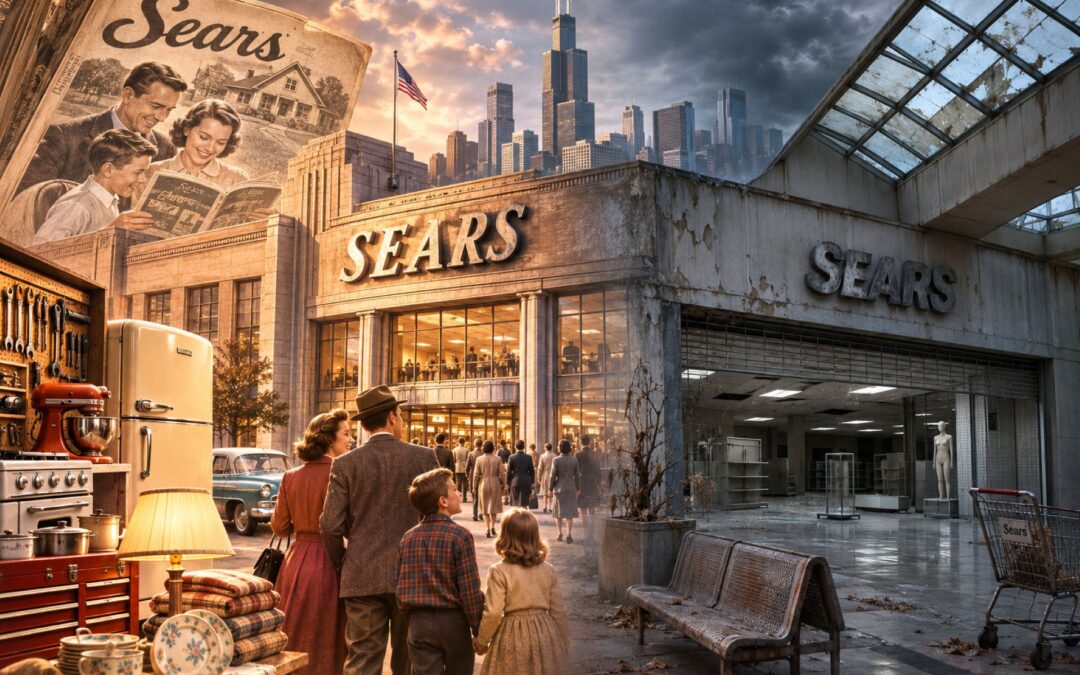
On 15 October 2018, Sears Holdings filed for bankruptcy protection in New York. The company that had once furnished American homes, supplied their workshops, insured their cars and occupied some of the most coveted spaces in the country’s shopping malls could no longer meet its obligations. Sears Holdings was only thirteen years old, but the Sears name carried more than a century of history.
For generations, a trip to Sears had been an ordinary part of life. A family might buy a child’s first bicycle there, replace a washing machine, collect tools for a home renovation or leaf through the Christmas catalog to plan gifts. The company had been so confident of its place in American commerce that it put its name on the world’s tallest building. By the time bankruptcy arrived, many of its stores looked exhausted, and familiar brands were being sold to raise cash.
The tempting explanation is that Amazon destroyed an old-fashioned retailer that failed to understand the internet. It is also an incomplete one. Sears had already transformed shopping twice, first through mail order and then through physical stores, and it experimented with electronic commerce remarkably early. Its collapse came from a much longer struggle over competition, investment, priorities and what kind of business Sears was supposed to be.
The Watches That Built a Mail-Order Empire
In 1886, Richard Warren Sears was working as a railway station agent in North Redwood, Minnesota, when an unwanted shipment of watches presented an opportunity. A local jeweler declined the consignment; Sears acquired the watches and found buyers among people connected by the railroad. The profit demonstrated that a seller could reach distant customers with a desirable product, an affordable price and reliable delivery.
That insight mattered in nineteenth-century rural America. Farm families might live miles from a town large enough to offer more than a modest general store. Local merchants carried limited inventories and often charged prices that customers had little ability to compare. Ordering by post could be inconvenient, but so was traveling all day to an understocked shop.
Sears began a mail-order watch business and soon worked with Alvah Curtis Roebuck, a watchmaker whose technical knowledge complemented his salesmanship. Their ventures changed form over several years before the name Sears, Roebuck and Co. was established in 1893. The business expanded beyond timepieces into jewelry, clothing, household goods, agricultural equipment and almost anything that could be packed and shipped. Its general merchandise catalog, introduced in the 1890s, turned a railway entrepreneur’s experiment into a system for supplying the country.
For a family on an isolated farm, the thick volume was a window into a larger consumer world. A plow and a wedding ring could appear within the same covers. So could a piano, a winter coat, a stove or a child’s toy. Customers could study illustrations, compare prices, discuss purchases at home and order without negotiating with the only merchant in town. The catalog was not simply advertising: it gave people access to choice on a scale their immediate surroundings could not provide.
A growing mail-order enterprise also demanded more than persuasive descriptions. Its success depended on accurate inventory, consistent quality, efficient warehouses, dependable fulfillment and the trust of customers sending money to a distant firm. Sears had to turn a sprawling assortment into a business that could keep its promises to distant buyers.
Julius Rosenwald, a Chicago clothing manufacturer who became an investor in 1895, was central to that transformation. He brought managerial discipline to the business and helped develop the policies, purchasing arrangements and systems needed for expansion. The company cultivated a reputation for dependable value and customer satisfaction rather than relying on one successful transaction. As the Library of Congress account of Sears’s early history describes, the firm went public in November 1906, giving it access to capital for further growth.
By then, the retailer had learned a lesson that would define its best years: shoppers were not merely buying products. They were paying a company to solve the problems of distance, limited selection, uncertain quality and inconvenient access. Sears would become enormous because it repeatedly found new ways to solve those problems.
How Sears Followed Americans from Farms to Suburbs
The mail-order operation succeeded because so many Americans lived far from large stores. But the country was changing. More people were moving into cities, automobiles were extending the distance families could travel for shopping, and the emerging suburbs created new patterns of consumption. A catalog that brought goods to remote households was still useful, but it could no longer be the retailer’s only way of reaching a growing market.
Robert E. Wood, a former Army general who joined Sears in 1924, recognized the opportunity. Rather than wait for urban customers to order from Chicago, the company could open outlets where those customers already lived and traveled. On 2 February 1925, Sears opened its first retail store at its Chicago mail-order complex. The experiment succeeded, and more stores followed, often in locations accessible to motorists rather than expensive traditional downtown districts.
This was a consequential choice. Sears was not abandoning its catalog because a new fashion had appeared; it was developing another channel for the same basic promise. Stores let customers examine and immediately collect merchandise, while the catalog continued serving those shopping from a distance. In 1931, store sales overtook mail-order sales for the first time, an unmistakable sign that the company’s center of gravity was shifting.
Retail expansion reinforced the appeal of Sears’s own brands. Craftsman, launched under that name in 1927, became closely associated with home workshops, with lifetime replacement guarantees on many hand tools. Kenmore, whose history had begun earlier with sewing machines, became familiar on washing machines, refrigerators and other appliances. DieHard batteries later appeared under countless car hoods. When these products were reliable, the Sears name gained value with each use; when something needed replacing, customers already knew where to shop.
The company also moved into services that surrounded those purchases. Allstate, established in 1931, brought car insurance into the Sears orbit. A household that bought tools and appliances from the retailer might also encounter it while protecting a vehicle. The arrangement made commercial sense because Sears already possessed something competitors had to build from scratch: regular access to customers who trusted the brand.
Perhaps the most extraordinary expression of the catalog’s reach was its housing business. Between 1908 and 1940, Sears sold an estimated 70,000 to 75,000 homes through its Modern Homes program. Families could browse house plans, select a design and order construction materials to be delivered by railroad. The packages could include precut and numbered lumber, doors, windows, hardware and detailed assembly instructions. Buyers still needed land and builders, but Sears made the process far more organized.
The Sears Modern Homes historical archive records hundreds of designs, ranging from modest cottages to substantial multistory houses. A family could choose a simpler plan or pay for additional rooms and finishes. Sears did not invent prefabricated housing or every architectural style it offered; its achievement lay in making standardized designs, materials and purchasing support accessible to a broad audience. Thousands of surviving houses remain a remarkable physical reminder of what a mail-order business could do before online shopping existed.
By finding a place in both the mailbox and the neighborhood, Sears became more than a distant supplier. Its goods, stores and even houses entered the ordinary fabric of American life.
The Golden Age of the Everything Store
After the Second World War, America entered an era that seemed almost designed for Sears. Suburbs expanded, highways connected residential communities to shopping centers, and rising household consumption drove demand for appliances, furniture, clothes and cars. A new family might need an entire collection of practical possessions at once. Sears could supply much of it under one roof.
The stores fit the rhythm of that life. A parent could examine refrigerators while children looked at bicycles or toys. A homeowner could buy a wrench, a lawn mower and a replacement part in one visit. Unlike a small specialist shop, Sears offered breadth; unlike an anonymous supplier, it offered a name people had known for decades. Its catalogs and stores reinforced each other, creating the sense that almost any domestic need had a Sears answer.
Its private brands were especially important. Craftsman suggested tools worth keeping. Kenmore represented the appliances around which families organized cooking, washing and everyday chores. DieHard promised dependable performance when a car needed to start. The value of these names was not merely that Sears could make a margin on merchandise; each successful purchase brought customers back into a network that sold many other things.
The catalog retained an emotional role even as stores grew. The Christmas Wish Book, first published in the 1930s, turned merchandise into anticipation. Children circled toys, compared bicycles and imagined what might appear under the tree, while adults looked for gifts, clothing and useful household purchases. A book that began as an answer to geographic isolation became part of shared family rituals.
By the 1970s, Sears dominated American retail. Its ambition found an architectural monument in Chicago, where the 110-story Sears Tower opened in 1973 as the world’s tallest building. The tower was more than office space: it advertised the scale and confidence of a company whose customers and suppliers reached across the country. It was an astonishing ascent from selling watches by post.
The company was also expanding its idea of what it could sell. It had long offered credit to customers, and in 1985 it introduced the Discover credit card nationally. Financial products extended customer relationships beyond shopping. But those ambitions would increasingly compete with the stores for attention.
When Sears Lost Its Focus
Sears did not suddenly deteriorate when internet shopping arrived. Its difficulties were visible much earlier, while the company was still wealthy, well known and accustomed to leading its industry. During the 1980s, executives pursued the idea that Sears could become a destination not only for household goods but also for major financial decisions. In 1981, it acquired the Dean Witter brokerage business and the Coldwell Banker real estate company, adding them to a corporate portfolio already containing Allstate and extensive credit operations.
The vision was sometimes described as a financial supermarket: customers might buy clothing, arrange insurance, seek investment advice and consider a home purchase through businesses associated with Sears. The logic had some merit: trust and convenient access had built the retail empire. But brokerage and real estate required different expertise and management priorities from department stores.
Meanwhile, the stores faced increasingly focused competitors. Walmart and Kmart expanded discount retailing with strong attention to price, inventory and operating costs. Specialist chains could offer deeper selections in categories such as home improvement, electronics or toys. Sears, which had once distinguished itself through exceptional access and value, was being challenged by businesses that did specific parts of its enormous assortment more effectively.
The contrast became impossible to ignore when Walmart rose to the top of American retail sales, with Kmart also moving ahead of Sears in the early 1990s. It was not simply a contest of slogans or corporate size. Efficient replenishment, attractive prices and clearer identities gave families reasons to shop elsewhere.
In 1992, the company reported a staggering loss of approximately $3.93 billion. That number has become shorthand for the collapse of its original business model, but it requires explanation. The reported loss included major restructuring provisions, retiree-benefit accounting changes and real estate write-downs; it did not represent $3.93 billion disappearing solely through ordinary shopping transactions. Sears faced genuine competitive weakness, yet the headline figure alone cannot measure how poorly every store was performing.
On 25 January 1993, Sears announced a far-reaching restructuring. It would close 113 stores, eliminate around 50,000 positions and discontinue its traditional general merchandise catalog. The decision ended the celebrated Big Book after decades as an institution. According to contemporary reporting on the restructuring, the catalog operation had generated billions in sales but had also recorded significant losses. The final general catalog appeared in 1993, although other specialized catalog and direct-selling activities did not vanish.
For longtime customers, the loss of the catalog was wrenching. For management, closing an unprofitable operation was a defensible attempt to redirect resources. The harder question was whether the money and attention saved would be invested in a retail strategy capable of winning customers back.
Sears began dismantling its financial conglomerate as well. It separated Dean Witter and its associated Discover business, divested Coldwell Banker and completed Allstate’s separation in the mid-1990s. These moves made Sears more recognizably a retailer again, but they did not erase years of competitive pressure or guarantee that the stores would improve. In 1999, its removal from the Dow Jones Industrial Average offered another public sign that an institution once treated as indispensable had lost its former standing.
The catalog decision is often portrayed as the moment Sears discarded the future just before Amazon arrived. It was a painful turning point, but what Sears actually understood about electronic shopping makes that irony more complicated.
The Internet Future Sears Saw but Could Not Seize
Long before most households had internet access, Sears was involved in an ambitious attempt to deliver information and shopping through home computers. Prodigy, developed through a partnership involving Sears and IBM, with CBS among its early partners, offered users news, messaging, weather and commercial services. It emerged in the late 1980s, when connecting a computer to an online network was still a novelty and the World Wide Web had not become a mass consumer medium.
That experiment makes it inaccurate to describe Sears as a retailer that never imagined electronic commerce. It recognized that people might browse information and make purchases remotely, and it was willing to participate in building the infrastructure. As WIRED’s history of online shopping explains, Prodigy included shopping features but confronted the limitations of early computer graphics, customer habits and the technology available at the time. A shopper accustomed to inspecting clothing or furniture in person could hardly treat a primitive electronic listing as an equivalent experience.
Sears continued to experiment with digital retail as the web developed. It operated online storefronts and promoted shopping that connected its website, catalog services and physical locations. It also retained specialist catalogs after the general Big Book disappeared. Digital experiments existed, but they never became an online operation strong enough to reshape Sears’s competitive position.
Amazon began in the 1990s with books, then expanded its range while investing in digital systems, distribution, customer information and the convenience of remote ordering. Sears had long possessed warehouses, delivery experience, supplier relationships and an enormous body of customer goodwill. On the surface, the similarities were striking: both promised people a broad selection of goods without requiring a visit to a physical shop. But possessing established logistics did not automatically mean possessing the software, incentives, capabilities or economics required for a new kind of retailer.
Mail order and online commerce were related inventions, not interchangeable businesses. A printed general catalog required enormous production and distribution costs, carried information that aged between editions and depended on ordering systems built for a different era. An effective website needed constantly updated inventory, secure payment, searchable product information, dependable shipping and an organization prepared to prioritize customers who might never enter a Sears store. A company could sensibly close a losing printed catalog and still fail to invest enough in its digital successor.
Sears’s experience invites comparison with Blockbuster’s struggle to adapt to a changing distribution model. Blockbuster eventually recognized the threat posed by new ways of getting movies to customers and attempted serious responses, yet its existing financial commitments and operating model constrained the transition. Sears faced its own version of that problem: a vast network of stores, established systems and internal priorities that could make new methods harder to build even when managers understood their potential.
The tragedy was not that Sears had never looked ahead. It had repeatedly anticipated what consumers would want, from delivery by railroad to suburban stores and early computer shopping. What it no longer managed to do was turn an early view of the future into a coherent, adequately funded business that customers preferred.
Eddie Lampert and the Kmart Gamble
By the early 2000s, Sears was a weakened but still formidable retailer, rich in valuable brands, customer relationships and real estate. Kmart had suffered its own financial crisis and emerged from bankruptcy in 2003. Edward Lampert, a hedge fund manager whose ESL Investments held significant interests in the businesses, saw an opportunity to combine them. The plan promised purchasing advantages, operational improvements and greater value from two well-known retail names.
The transaction was completed on 24 March 2005. According to the merger announcement issued by the companies, Sears Holdings began with nearly 3,500 stores across the United States and approximately $55 billion in combined annual revenue. To an outside observer, the new company looked like a retail giant with enough scale to compete aggressively. It owned or controlled familiar product brands, occupied valuable locations and served millions of households.
But combining troubled chains could not make their problems disappear. Sears and Kmart had different customers and formats, while Walmart and other competitors kept improving prices, supply chains and stores. Integration might save costs, but it also diverted management attention.
Lampert approached the business through a financial and managerial philosophy emphasizing accountability, measurable returns and the value of individual assets. One of the most unusual decisions came in 2008, when Sears Holdings reorganized operations into dozens of business units, each responsible for its own financial results. The idea was that independently evaluated units would reveal strengths and weaknesses more clearly than an integrated structure could.
Critics argued that the arrangement rewarded divisions for defending their own budgets rather than working together. Departments that ought to coordinate products, promotions and customer service could find themselves negotiating as if they were separate companies. A tool department and an appliance department might have different incentives even though shoppers experienced them as parts of the same store. Accountability could come at the cost of a coherent customer experience.
Store investment became another source of controversy. Customers and employees reported dated interiors, poorly maintained fixtures, unappealing displays and gaps on shelves. A retailer needs to spend money not only to open stores but also to keep them worth visiting. When competitors make shopping faster, easier or more pleasant, neglected premises can discourage visits, which then weakens sales and leaves even less money available for improvements.
Sears Holdings also spent substantial sums on share repurchases during periods when its stores faced mounting challenges. Supporters of Lampert’s strategy argued that buybacks, cost discipline and the sale of underused assets could create value and free the business from inefficient practices. Critics saw a company using financial tools to protect shareholders while failing to make the investments needed for durable retail recovery. Results increasingly favored the critics’ concern that financial restructuring alone could not restore customer demand.
Lampert repeatedly presented his initiatives as efforts to transform Sears into a more flexible retailer, including through membership-based shopping and online services. It would be too simple to claim he never wanted a successful retail business or that every transaction served the same hidden purpose. The stronger, demonstrable criticism is that his chosen strategy did not produce a competitive revival, while the store network continued to shrink and the company’s strongest assets became sources of emergency liquidity.
Selling the Pieces: The Road to Bankruptcy
As sales weakened, Sears Holdings increasingly looked beyond ordinary retail earnings for cash. It could sell land, separate businesses or license brands that generations of customers had come to trust. Such deals could buy time but could not replace customers. Each sale also reduced the assets remaining for a turnaround.
In 2014, Sears spun off Lands’ End, the clothing business it had acquired decades earlier. The move simplified Sears’s portfolio but reduced the assets still available to support its struggling stores.
Real estate offered another source of money. Sears occupied many sites acquired when its business was expanding and shopping malls were central to American consumer life. A property could be valuable to a landlord or developer even if the Sears store operating there had stopped earning an adequate return. Sears could therefore raise cash by selling properties and renting them back.
In July 2015, Sears completed a transaction with Seritage Growth Properties, a newly formed publicly traded real estate investment trust. The company’s SEC-filed announcement reported approximately $2.7 billion in gross proceeds from the sale of 235 stores and stakes in property joint ventures holding additional sites. Sears leased back many of the locations, allowing shopping operations to continue while transferring ownership of the property to another company.
The transaction mattered for more than its size. Sears received immediate cash, but leasing back stores meant that occupancy obligations could continue even after it had given up ownership. Seritage was not simply Lampert’s private trust: it was publicly traded, although Lampert-associated interests were financially involved, and related-party relationships raised legitimate questions about who benefited from the terms. Management argued the deal provided flexibility for transformation. Critics questioned whether converting store property into liquidity ultimately weakened the retailer’s ability to recover.
The fate of Craftsman was even more symbolic. For generations, Craftsman had represented durability and trust. In March 2017, Sears completed the sale of the Craftsman brand to Stanley Black & Decker. The transaction disclosure filed with the SEC described a value exceeding $900 million on a net-present-value basis, involving an initial payment, a later payment and royalties on certain future sales. Sears retained rights to sell Craftsman products under a license, so the brand did not instantly disappear from its stores.
Even with those qualifications, the deal exposed how far the company had retreated. A name Sears had nurtured for roughly ninety years was now controlled by another business, and its sale was celebrated primarily for providing liquidity. Kenmore, another of Sears’s most recognizable brands, was subsequently considered for sale. Assets that once brought customers into the stores were being evaluated as potential means of keeping the company afloat.
Sears and Kmart closed locations in successive rounds, leaving empty mall storefronts and diminishing the brands’ reach. Suppliers dealing with a financially troubled retailer had reason to worry about payment, while customers had reason to question whether the store would remain nearby to honor a promise or service a purchase. Falling sales and declining confidence could reinforce one another.
Workers faced uncertainty when departments and stores appeared on closure lists. Communities lost jobs and the familiar businesses that had anchored their shopping routines.
By October 2018, the company had reached a financial breaking point. A debt payment of approximately $134 million was coming due, and Sears Holdings lacked a sustainable way to meet its obligations and fund operations. On 15 October, it sought Chapter 11 bankruptcy protection. In its bankruptcy and restructuring announcement, the company said Sears and Kmart stores and online platforms would continue operating while it pursued a smaller, reorganized business. It also announced plans to close 142 additional unprofitable stores.
Chapter 11 allowed stores to remain open while Sears sought financing, renegotiated obligations and pursued a sale. Employees and suppliers still faced immediate uncertainty. The famous retail name had survived wars, depressions and generations of changing shopping habits, yet it was now dependent on a court-supervised process to decide which parts could continue.
Lampert’s investment interests returned as the buyer of the surviving operations. In January 2019, Transform Holdco, associated with ESL Investments, reached a purchase agreement disclosed to the SEC for substantially all the remaining operating retail business and other assets. The approximately $5.2 billion transaction value included assumed liabilities and other components; it was not simply a cash payment of that amount. The purchase preserved stores and jobs that might otherwise have disappeared more rapidly.
The hope was that a smaller chain, freed from some of the old company’s burdens, could finally become viable. But store closures continued after the sale. Neither the Sears name nor Kmart’s once-familiar national reach was restored. Financial transactions had extended the company’s life, yet the underlying challenge remained: people needed a reason to shop at Sears that competing retailers could not offer more effectively.
There is a revealing comparison with the financial pressures that helped overwhelm Toys “R” Us. The companies had different ownership structures and histories, but both demonstrated how expensive legacy store networks and financial obligations could narrow the room for adaptation. Neither story is fully explained by saying that online shopping arrived and customers simply walked away.
What Remains of Sears
The decline of Sears in the United States is so extreme that it can be difficult to reconcile the remaining footprint with the company’s former dominance. In September 2026, reporting on Sears’s unexpected survival in Mexico counted just five stores in the United States, compared with more than ninety in Mexico. These were September 2026 figures, not counts from the 2018 bankruptcy.
The Mexican business also needs to be understood separately. Sears stores there operate under the ownership of Grupo Sanborns, associated with the business empire of Carlos Slim, rather than as a straightforward continuation of the bankrupt American chain. The familiar name has remained commercially meaningful in that market even as its US counterpart has diminished to a fraction of its former size. The brand’s different fortunes show that corporate collapse and the disappearance of a name are not necessarily the same event.
Other pieces of the old Sears world continue outside its remaining stores. Craftsman tools are sold through different retail channels under new ownership. Kenmore appliances and DieHard batteries still evoke products that once introduced customers to Sears. The Sears Tower carries the Willis Tower name, but many Chicagoans and visitors still associate its skyline silhouette with the retailer that commissioned it. Products and associations outlived the old company.
Then there are the houses. Across American neighborhoods, thousands of former Sears kit homes still shelter families, though no precise official count establishes how many survive. Some owners trace their homes through old plans and shipping records; others may never know their walls began as a catalog order.
Old catalogs occupy a different sort of afterlife. Their pages preserve an inventory of what Americans wanted, needed and hoped to afford: farm equipment, dresses, radios, furniture, toys and eventually entire houses. A Christmas Wish Book marked with a child’s penciled circles captures an intimacy that a balance sheet cannot. The books also documented changing ideas of comfort and family life.
The company’s rise and fall matter because Sears was once exceptionally good at seeing the problems American shoppers needed solved. It used the railroad and post to overcome distance, stores to serve a mobile and increasingly suburban population, and trusted brands to make recurring purchases feel less uncertain. Its later troubles emerged not from a complete inability to imagine change, but from the difficulty of sustaining that customer-centered discipline while competitors, corporate ambitions and financial pressures pulled the business in different directions.
Sears did not fall because of a single catalog decision, one executive or one new website. Its decline accumulated through years in which stores lost their competitive edge, strategic experiments failed to become lasting strengths and the sale of valuable assets substituted for a durable retail recovery. What remains is larger than the surviving chain: houses, brands, buildings, catalogs and memories of a company that once helped define how Americans shopped. Its history illustrates how even a retailer that repeatedly reinvented commerce can lose its place when it can no longer make that reinvention work for its customers.
Last Updated on November 10, 2026 by Aseem Gupta