
Reading Time: 57 Minutes
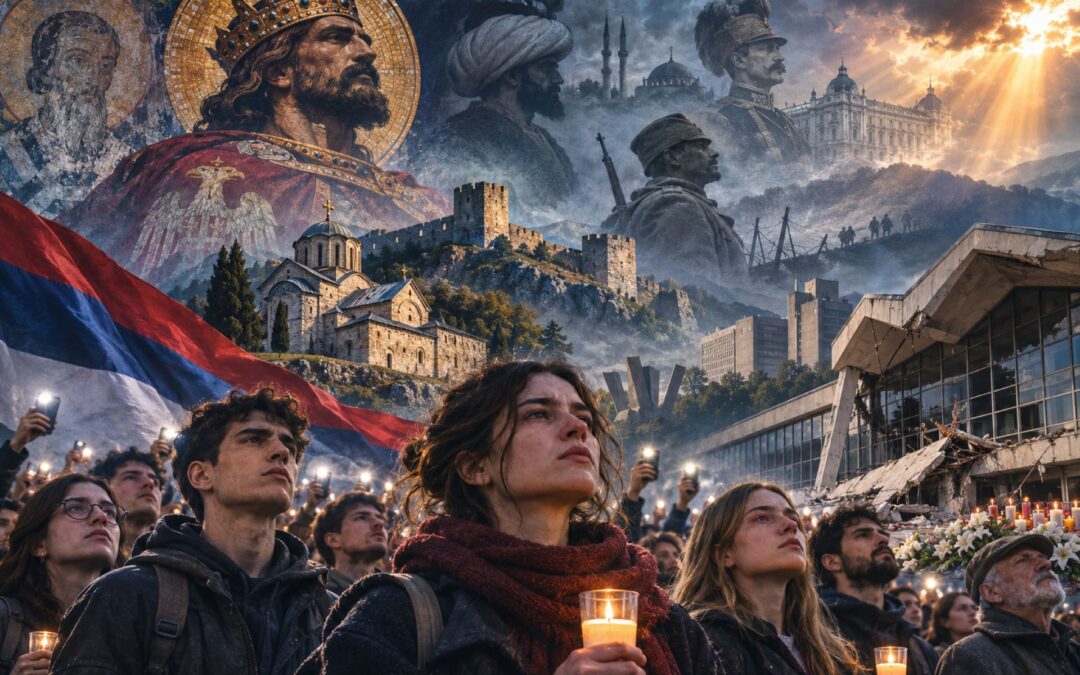
On the morning of 1 November 2024, passengers were moving through the recently renovated railway station in Novi Sad, Serbia’s second-largest city. The station was part of an ambitious infrastructure programme connecting Belgrade with Budapest. At 11:52 a.m., the enormous concrete canopy above its entrance collapsed onto the pavement below, crushing people who were waiting or passing underneath.
Fourteen people died immediately or shortly afterwards. Two more eventually succumbed to their injuries, bringing the death toll to sixteen. The tragedy raised disturbing questions about construction standards, government contracts, official oversight, and whether the renovations had compromised the structure. What initially appeared to be a catastrophic engineering failure became the catalyst for a nationwide political movement.
Students began organising demonstrations and occupying university buildings. Lawyers, teachers, farmers, actors, and ordinary citizens joined them. Their demand was deceptively simple: government institutions should explain what happened, publish the relevant documents, and hold those responsible accountable.
The movement eventually achieved something few observers had anticipated. Following nearly two years of demonstrations, the student-backed opposition won Serbia’s parliamentary election in October 2026, ending fourteen years of government dominated by the Serbian Progressive Party.
Yet the Novi Sad disaster was not the beginning of Serbia’s troubled relationship with political authority. To understand why this particular tragedy generated such extraordinary resistance, we need to examine the much longer history of a country shaped by competing empires, religious institutions, devastating wars, national ambitions, and repeated struggles over who should govern.
That history begins with Serbia’s geography.
Why Serbia’s Geography Made It a Frontier
Serbia occupies one of southeastern Europe’s most strategically important crossroads. The country connects the Danube basin and Central Europe with the southern Balkans, the Aegean Sea, and the approaches to Constantinople, today’s Istanbul. For centuries, armies, merchants, migrants, and imperial administrators travelled through this landscape because the alternatives were often more difficult.
The Morava River valley provides a particularly important passage through otherwise challenging terrain. Routes running south from Belgrade converge near Niš before dividing towards Thessaloniki or continuing east towards Sofia and Constantinople. The Romans incorporated this corridor into their military road network, including the Via Militaris. Long after Rome disappeared, Ottoman, Habsburg, German, and other armies continued using the same geographical connections.
Belgrade stands at another natural strategic point, where the Sava River joins the Danube. Controlling this junction meant influencing river transport, regional trade, and military movement between Central Europe and the Balkans. Consequently, Belgrade became a repeatedly contested fortress city, passing between rival rulers and suffering numerous sieges and destructions.
However, the history of human settlement in the region began thousands of years before any recognisable Serbian state existed.
At Lepenski Vir, beside the Danube in the Iron Gates gorge, archaeologists discovered an extraordinary prehistoric settlement associated with communities living in the region during the Mesolithic and Neolithic periods. Its distinctive trapezoidal buildings and stone sculptures, some resembling human faces and fishlike features, demonstrate sophisticated social and symbolic activity. The surviving remains reveal people developing enduring relationships with a river environment that supplied food, shaped movement, and influenced their cultural practices.
Further south, the Vinča culture flourished across parts of the central Balkans during the sixth and fifth millennia BCE. Its communities produced elaborate pottery, anthropomorphic figurines, and evidence of early copper working. Some objects carry incised symbols that have generated speculation about prehistoric writing. Although these signs are significant archaeological evidence, interpreting them as a developed writing system remains controversial, and they should not be presented as proof of Europe’s earliest script.
During the first millennium BCE, different Balkan populations inhabited territories that would eventually become part of Serbia. These included communities conventionally associated with Illyrian, Thracian, and Dacian cultural spheres, although ancient ethnic labels rarely describe populations as neatly as modern national categories suggest. Celtic groups, notably the Scordisci, also established themselves in the region during the third century BCE.
Roman expansion gradually transformed the political landscape. Territories corresponding to modern Serbia entered Roman control through several campaigns and administrative reorganisations, becoming parts of provinces such as Moesia and Pannonia. The Romans constructed roads, settlements, military installations, bridges, and fortified river crossings. Their political authority created lasting connections between the Balkans and the wider Mediterranean world.
Several important Roman centres developed in the region. Singidunum became modern Belgrade, Naissus became Niš, and Sirmium became Sremska Mitrovica. Sirmium rose to exceptional importance during the later Roman Empire, serving as an imperial residence and major administrative centre. The territory of modern Serbia also produced numerous Roman emperors, reflecting its importance to the empire’s military and political establishment.
Constantine the Great was born at Naissus, probably around 272 CE. He became one of Rome’s most consequential emperors, founded Constantinople as a new imperial capital, and helped transform Christianity’s position within the empire. Constantine did not personally establish Christianity as Rome’s exclusive state religion; his policies legalised and favoured Christian worship, while the decisive establishment of Nicene Christianity as the empire’s official religious orthodoxy came under Theodosius I in 380.
The eventual division between the Latin-speaking western Roman world and the Greek-speaking eastern empire deeply influenced the Balkans. Political, religious, linguistic, and administrative differences developed over centuries, eventually contributing to the distinction between Catholic and Orthodox Christianity.
Modern Serbia would emerge primarily within the eastern Christian tradition, although western religious and cultural influences remained important, particularly in coastal and border regions.
The region’s geographical importance created opportunities for trade and communication, but it also exposed inhabitants to repeated invasions. Rome’s declining authority, movements of Germanic and other peoples, and later Slavic settlement transformed the population. The frontier between competing political worlds shifted repeatedly across the Balkans.
Serbia’s location did not doom it to permanent instability. Geography creates strategic possibilities and constraints rather than determining political outcomes. Nevertheless, the combination of accessible transport corridors, powerful neighbours, and competing imperial interests meant that political independence would rarely be easy to preserve.
How the Serbs Emerged from the Slavic Migrations
The emergence of the Serbs belongs to the wider transformation of southeastern Europe following the weakening of Roman imperial power.
During the sixth and seventh centuries, Slavic-speaking populations moved into the Balkans in substantial numbers. Byzantine accounts describe military raids, settlements, alliances, and shifting relationships between newcomers and imperial authorities. Some communities established themselves through conquest, while others settled in areas where imperial administration had weakened.
These populations did not enter an empty landscape. The Balkans already contained communities descended from Roman provincial inhabitants and earlier regional populations. Over generations, migration, intermarriage, language change, and political integration produced new societies. Slavic languages became dominant across much of the interior, while other linguistic and cultural traditions survived in different regions.
The exact origins of the early Serbs remain contested. Medieval sources were written from particular political and religious perspectives, often generations after the events they described. Consequently, attempts to identify an unbroken ethnic community extending unchanged from late antiquity into the present are historically problematic.
What can be established is that recognisable Serbian political groups emerged in the western Balkans during the early medieval period.
The Byzantine Empire referred to many Slavic-controlled territories as Sklaviniai. These regions maintained varying degrees of autonomy while remaining within the empire’s claimed sphere of authority. Local princes negotiated with Byzantine officials, fought neighbouring rulers, and sought to consolidate control over scattered settlements and mountain valleys.
The Vlastimirović dynasty became associated with one of the earliest Serbian principalities. A Frankish account from 822 mentions Serbs occupying a substantial part of Dalmatia, although the geographical meaning of that description should not be confused with modern borders. Later Byzantine histories provide additional information about Serbian rulers and their relationships with neighbouring powers.
One remarkable surviving object is the seal of Prince Strojimir, generally dated to the ninth century. Bearing a Greek inscription and a Christian cross, it offers physical evidence of elite authority and written administration. A seal does not prove the existence of a modern bureaucratic state, but it does indicate participation in the political and diplomatic practices of the surrounding Byzantine world.
Christianity spread gradually among the South Slavs. Missionaries, local rulers, Byzantine institutions, and influences from the Latin West all contributed to the process. By the ninth century, Christian institutions were becoming increasingly important within Serbian political society, although complete and uniform Christianisation did not occur overnight.
The religious orientation of medieval Serbian elites eventually developed predominantly around Constantinople and the eastern Christian tradition. This influenced church organisation, religious literature, artistic production, and relations with neighbouring Orthodox societies. Cyrillic writing later became especially important, alongside earlier and continuing uses of other scripts.
Yet conversion did not guarantee political security.
Serbian territories lay between stronger neighbours, including Bulgaria and Byzantium. During the early tenth century, the Bulgarian ruler Simeon I pursued an aggressive policy in the Balkans. Following conflict with Serbian leaders, Bulgarian forces took control of Serbia in 924, temporarily ending its independent political organisation.
After Simeon’s death in 927, Časlav, a Serbian prince associated with the earlier ruling dynasty, returned from Bulgarian captivity and re-established authority. His principality is traditionally portrayed as extending across several western Balkan regions, although its precise boundaries remain uncertain.
Časlav’s death around the middle of the tenth century was followed by another period of fragmentation. Different principalities and local dynasties became prominent, often under Byzantine or Bulgarian influence.
Duklja, broadly associated with parts of modern Montenegro, emerged as an important political centre. The Vojislavljević dynasty challenged Byzantine authority during the eleventh century, while the inland region of Raška gradually gained prominence under rulers associated with the Vukanović line.
Raška’s mountainous terrain offered protection from some forms of direct imperial control. Its rulers could exploit the difficulty of campaigning through the interior while negotiating with Byzantium, Hungary, and other regional powers.
This environment encouraged a political pattern that would recur throughout medieval Serbian history: local consolidation when neighbouring empires were distracted, followed by renewed external pressure when those empires recovered.
By the twelfth century, Raška had become the principal centre from which a more durable Serbian medieval state would emerge. Its transformation owed much to one ruling family whose political ambitions became closely connected with the development of an independent Serbian church.
The Nemanjić Kingdom and the Making of the Serbian Church
The Nemanjić dynasty transformed Serbia from a collection of regional principalities into a recognised medieval kingdom with an increasingly sophisticated religious and administrative structure.
Stefan Nemanja emerged as the dominant ruler of Raška during the second half of the twelfth century, traditionally dating the beginning of his rule to 1166. His political career unfolded within a complicated network of Byzantine influence, Hungarian ambitions, local rivalries, and shifting alliances.
Nemanja’s personal religious history reflected this environment. Medieval accounts describe his connections to both Latin and Orthodox Christian rites, an indication of the cultural overlap that existed in parts of the western Balkans. Rather than belonging to two completely separate worlds, Serbia’s rulers operated within a region where religious and political affiliations could intersect.
Nemanja enlarged his territories through warfare, diplomacy, and the defeat of competing relatives. He strengthened his authority over regional nobles and supported the construction and restoration of religious institutions. His achievements established a more stable territorial basis for the dynasty, although political power remained dependent on personal relationships and military strength.
Then, in 1196, he made an unusual decision for a ruler at the height of his influence.
Nemanja abdicated in favour of his son Stefan and entered monastic life, taking the name Simeon. He eventually joined his youngest son Rastko, who had already abandoned a conventional princely career to become a monk on Mount Athos in Greece.
Rastko had taken the monastic name Sava. Together, father and son secured and restored the monastery of Hilandar, establishing it as a major Serbian monastic centre. Hilandar became much more than a place of worship. It preserved manuscripts, supported religious scholarship, cultivated diplomatic relationships, and helped educate generations of Serbian clerics.
Its importance rested partly on the institutional connections it created. Medieval monasteries could hold land, maintain written records, receive patronage, and transmit ideas across political boundaries. In a society where literacy was concentrated among religious and administrative elites, these functions were central to state development.
Nemanja died in 1199 and was later canonised as Saint Simeon. Sava’s influence continued to grow.
The dynasty achieved two major political breakthroughs within a remarkably short period.
In 1217, Stefan Nemanjić received royal recognition and became known as Stefan the First-Crowned. His coronation was associated with papal recognition, demonstrating the ability of Serbian rulers to engage diplomatically with the Latin Christian world.
Two years later, in 1219, Sava secured the autocephaly of the Serbian church from the Orthodox authorities then based in Nicaea, where the Byzantine imperial and patriarchal leadership had taken refuge following the Fourth Crusade’s capture of Constantinople.
Autocephaly meant that the Serbian archbishopric possessed the right to govern its own ecclesiastical affairs rather than remaining subordinate to another regional church hierarchy. Sava became its first archbishop and organised a network of bishoprics serving the kingdom.
His achievements also extended into religious law and administration. Sava’s Nomocanon, or Zakonopravilo, adapted Byzantine ecclesiastical and legal traditions for Serbian use. It was not a modern constitution, but it provided an influential framework for church governance and aspects of legal life.
The significance of these developments becomes clearer when the events are considered together.
Stefan obtained royal standing through contacts with the western Christian world, while Sava obtained institutional independence through the eastern Orthodox world. The brothers were not simply choosing one civilisation over another. They were using the available diplomatic and religious structures to strengthen Serbian political autonomy.
The monarchy and church subsequently reinforced each other’s authority. Rulers endowed monasteries, supported religious institutions, and benefited from the legitimacy conferred by ecclesiastical recognition. Religious leaders preserved dynastic traditions and helped develop a shared cultural language across territories that were not always politically united.
Monasteries such as Studenica and Žiča became important centres of worship, art, and royal memory. Frescoes, manuscripts, liturgical texts, and architectural projects expressed the dynasty’s religious authority and its participation in wider Orthodox traditions.
These institutions outlived the medieval kingdom itself.
When Serbian territories later came under Ottoman rule, the Orthodox Church retained important functions in community organisation, religious education, historical remembrance, and the transmission of literary culture. Its precise powers and jurisdiction changed repeatedly, but its institutional continuity gave Serbian communities a source of identity that was not wholly dependent on possessing an independent state.
That endurance helps explain why Saint Sava remains one of Serbia’s most important historical and religious figures.
It also explains why the relationship between church and state remains politically meaningful. Medieval institutional achievements acquired new significance through subsequent centuries of imperial domination, national revival, and modern state-building.
Dušan’s Empire, Kosovo, and the Medieval Collapse
The medieval Serbian kingdom reached its greatest territorial extent under Stefan Dušan, who ruled from 1331 until 1355.
Dušan inherited a state that had already benefited from economic development, mining activity, aristocratic consolidation, and the weakening of Byzantine authority. During the fourteenth century, Byzantium experienced destructive internal conflicts that reduced its ability to defend many Balkan possessions.
Dušan exploited this opening. Serbian forces expanded into Macedonia, Albania, Epirus, and Thessaly, bringing substantial territories with Greek-speaking and Albanian-speaking populations under his authority. His ambitions extended beyond governing a Serbian kingdom. He sought a place within the imperial political order traditionally dominated by Constantinople.
In 1346, Dušan was crowned emperor at Skopje. His imperial title asserted authority over Serbs and Greeks and reflected his intention to claim a major share of Byzantine political legitimacy.
His rule also produced one of medieval Serbia’s most important legal documents: Dušan’s Code, promulgated in 1349 and expanded in 1354.
The code regulated relationships involving the church, nobility, judiciary, dependent peasants, and other groups. It addressed offences, obligations, property relationships, and legal procedure. One notable provision required judges to apply the law rather than follow an imperial instruction that contradicted it, demonstrating an aspiration to place recognised legal rules above individual commands.
That should not be mistaken for modern equality before the law.
The code reinforced a deeply hierarchical society. It prescribed severe corporal punishments, protected elite privileges, and contained discriminatory provisions concerning religious minorities and certain pastoral communities. It was simultaneously an ambitious instrument of state organisation and a reflection of medieval coercive authority.
Dušan died unexpectedly in 1355, before his imperial ambitions could be consolidated. His son Stefan Uroš V lacked the political strength to control the powerful regional nobles who had benefited from expansion.
The empire fragmented as aristocratic families established increasingly independent territories. This decentralisation occurred just as a formidable new power was expanding into southeastern Europe.
The Ottomans had established themselves in Anatolia and began acquiring durable footholds in Europe during the fourteenth century. Their success did not depend solely on spectacular battlefield victories. They combined warfare with negotiated submission, tribute arrangements, local alliances, and the incorporation of Christian soldiers and administrators into Ottoman political structures.
The Serbian defeat at the Battle of Maritsa in 1371 seriously weakened important regional rulers. Other lords continued governing parts of the former empire, including Prince Lazar Hrebeljanović, who became a leading figure in the central Serbian lands.
In 1389, Lazar led a coalition against an Ottoman army commanded by Sultan Murad I on the Kosovo field near present-day Pristina. The battle is commemorated on Vidovdan, 28 June in the modern calendar, although medieval dating and the later commemorative tradition need to be distinguished.
Both commanders died during the campaign. Lazar was captured and executed, while Murad was killed under circumstances that remain disputed.
Serbian tradition identifies Miloš Obilić as Murad’s assassin, often describing him entering the Ottoman camp by pretending to defect. Yet surviving accounts differ substantially, and the familiar narrative emerged through layers of later storytelling.
The immediate military outcome is also debated. Some early reports suggested Christian success, while the losses suffered by both armies were considerable. What mattered over the longer term was that the Ottoman state possessed greater resources and political flexibility than the fragmented Serbian territories.
Murad’s son Bayezid I succeeded him and continued Ottoman expansion. Lazar’s heirs were eventually compelled to accept Ottoman suzerainty.
Lazar’s son Stefan Lazarević illustrates the uncomfortable choices confronting Serbian rulers. He maintained a degree of local authority while serving as an Ottoman vassal, supplying troops to Bayezid’s campaigns. Serbian soldiers consequently fought on the Ottoman side against Timur at the Battle of Ankara in 1402.
The Ottoman defeat at Ankara temporarily disrupted imperial expansion and created opportunities for Balkan rulers. Stefan subsequently cultivated relations with Hungary, acquired new territories, and made Belgrade an important political centre.
The Serbian Despotate continued under the Lazarević and Branković families. Its survival depended on diplomacy, tribute, military cooperation, and the shifting balance between Hungary and the Ottomans.
Belgrade became particularly important as a defensive fortress. In 1456, an Ottoman army under Mehmed II besieged the city, but Christian defenders led by John Hunyadi and supported by the preaching of John of Capistrano successfully resisted the attack.
Pope Callixtus III had ordered bells to be rung at midday to encourage prayers during the campaign. The connection between the victory and the enduring Catholic noon-bell tradition developed through subsequent commemoration, rather than being a simple order issued after the battle.
Despite the success at Belgrade, the remaining Serbian Despotate could not survive indefinitely.
In 1459, the Ottomans captured Smederevo, effectively ending the independent medieval Serbian state. They subsequently expanded across other Balkan territories, taking Bosnia in 1463, consolidating control over Herzegovina, and extending authority into Zeta. Belgrade itself fell to Suleiman I in 1521.
Yet the political consequences of Kosovo extended far beyond these events.
Over subsequent centuries, the battle acquired a powerful position in Serbian religious memory and oral literature. Prince Lazar came to symbolise sacrifice, particularly through the story that he had chosen a heavenly kingdom over an earthly victory.
The narrative developed over time and was reshaped by later generations. During the nineteenth-century national revival, it became especially important in constructing a story of historical continuity, collective suffering, and eventual liberation.
Kosovo was consequently both a medieval battlefield and a political symbol repeatedly reinterpreted in different circumstances.
That distinction would become crucial in the twentieth century, when nationalist politicians revived medieval imagery to justify contemporary political ambitions.
Under Ottoman Rule: Faith, Migration, and Survival
Ottoman domination transformed the Serbian lands, but it did not produce one uniform experience that remained unchanged for centuries.
Governance differed across provinces and historical periods. Local conditions depended on military pressures, tax arrangements, economic activity, administrative practices, and relations between provincial officials and the communities they ruled.
Christian subjects occupied an unequal legal position within the Ottoman system. Many paid the cizye, a tax levied on non-Muslim subjects, and were subject to restrictions concerning religious institutions and public authority. At the same time, local Orthodox communities retained forms of religious organisation and communal life, although these privileges were neither unlimited nor consistently respected.
Land tenure was organised through arrangements in which revenue rights and service obligations connected local agricultural production with imperial administration. Peasants owed taxes and dues, while the balance between customary rights and official demands varied across time and place.
The Ottoman system could provide a degree of stability and economic opportunity, particularly in periods of relative peace. However, warfare, corruption, irregular taxation, and arbitrary violence could devastate local communities. Describing the entire period as either uninterrupted persecution or harmonious coexistence obscures this variation.
One particularly consequential institution was the devşirme, the levy through which Christian boys were recruited for Ottoman service.
Selected children were removed from their families, converted to Islam, and trained for military or administrative careers. Some entered the Janissary corps, while others advanced within the imperial bureaucracy. A small minority achieved remarkable political prominence, but this possibility of advancement cannot erase the coercive character of the recruitment system.
Mehmed Sokollu, or Sokollu Mehmed Pasha, provides a striking example.
Born into a Christian family in Bosnia, he entered Ottoman service through the recruitment system and eventually became grand vizier, one of the empire’s highest offices. His career demonstrates how imperial institutions could incorporate individuals from conquered populations into the centre of political power.
He was also associated with the restoration of the Serbian Patriarchate of Peć in 1557.
The restored patriarchate provided an Orthodox ecclesiastical structure whose jurisdiction extended across numerous territories inhabited by Serbs. It preserved religious organisation, supported monasteries and clergy, and helped maintain cultural links among populations divided by political boundaries.
The patriarchate also served Ottoman administrative interests. A recognised religious hierarchy could facilitate communication and the collection of obligations from Orthodox communities. The same institution could therefore strengthen imperial governance while simultaneously preserving a distinctive Serbian religious identity.
This dual role helps explain the patriarchate’s historical importance.
Its leaders sometimes engaged with foreign Christian powers during periods of war. Such involvement could bring severe consequences. Patriarch Jovan Kantul, associated with anti-Ottoman activity, was executed in 1614. Other clerics faced punishment or displacement when political and military circumstances changed.
Religious symbolism also became a focal point for resistance.
During the Banat uprising of 1594, Serbian rebels carried images of Saint Sava. Ottoman authorities subsequently destroyed his relics in Belgrade, traditionally dated to 1595. The burning was intended to strike at a major symbol of Serbian religious identity.
Centuries later, the monumental Church of Saint Sava rose on Vračar Hill in Belgrade, traditionally associated with the destruction of the relics. The building illustrates how historical trauma can acquire enduring architectural and commemorative expression.
The patriarchate itself did not survive unchanged. In 1766, Ottoman authorities abolished the Patriarchate of Peć and transferred its jurisdiction to the Ecumenical Patriarchate of Constantinople. Serbian church communities subsequently operated under different ecclesiastical arrangements, while the loss of an independent patriarchate became an important grievance in later national history.
Outside formal religious institutions, resistance and adaptation took other forms.
The hajduks were armed bands operating in rural and mountainous regions. Later nationalist literature often portrayed them as heroic freedom fighters, but their actual activities were more complicated. Some attacked Ottoman officials and tax convoys; others robbed merchants and travellers, engaged in personal feuds, or participated in local conflicts without a coherent national programme.
They nevertheless became important figures in oral storytelling.
Serbian epic poetry, commonly performed with the accompaniment of the single-stringed gusle, preserved stories of medieval rulers, legendary heroes, battles, loyalty, and betrayal. These songs were not reliable transcripts of medieval events, but they were powerful vehicles of historical imagination.
When the language reformer Vuk Karadžić collected and published Serbian folk poetry during the nineteenth century, European intellectuals encountered a rich oral literary tradition. Serbian national thinkers also used these works to support arguments about historical identity and political independence.
Meanwhile, large populations of Serbs migrated northward into territories controlled by Hungary and, later, the Habsburg monarchy.
This migration occurred over several centuries and was driven by war, economic opportunity, political instability, and imperial settlement policies. The Habsburg Military Frontier became especially significant. Families received land or privileges in exchange for military service, creating communities whose everyday lives were organised around the defence of the imperial border.
The frontier was administered differently from ordinary provincial territories. Military obligations, local arrangements, and religious privileges helped create distinctive social structures. Serb communities became established across parts of modern Croatia and northern Serbia, including regions such as Slavonia, Krajina, and Vojvodina.
These settlements would have consequences long after the Habsburg Empire disappeared.
The Great Turkish War of 1683–1699 produced another major population movement. When Habsburg forces advanced into Ottoman territories, some Serbian communities supported them. After the military situation reversed, many fled northward to escape possible reprisals.
The migration associated with Patriarch Arsenije III in 1690 became a foundational episode in Serbian historical memory. Contemporary accounts offer different estimates of the population involved, and frequently repeated figures for entire families should not be treated as precise demographic measurements.
The movement nevertheless altered the religious and ethnic geography of the northern Balkans.
Its interpretation remains politically sensitive because later national narratives connected the migration with changes in Kosovo’s population. Those narratives must be evaluated alongside longer demographic processes rather than presented as a complete explanation for the region’s modern ethnic composition.
The Habsburgs temporarily conquered Belgrade and parts of northern Serbia during the early eighteenth century. The Treaty of Passarowitz in 1718 brought these territories under Austrian control, but they returned to the Ottomans following the Treaty of Belgrade in 1739.
A further Austro-Ottoman war between 1788 and 1791 again encouraged local expectations that foreign military intervention might produce liberation. Once more, those expectations proved difficult to realise.
By the end of the eighteenth century, many Serbian communities were familiar with the pattern of imperial promises, military mobilisation, and political disappointment.
The Ottoman administration in the Belgrade region was also entering a period of serious internal instability. This time, however, the consequences would be different. Rather than waiting for a foreign army to transform their position, local Serbian leaders began building institutions capable of sustaining their own political authority.
The Serbian Revolution and the Return of Statehood
The modern Serbian state emerged from a crisis within Ottoman provincial government rather than from a straightforward war of national independence.
During the late eighteenth century, Sultan Selim III attempted to reform the Ottoman Empire and strengthen central authority. His efforts threatened the interests of powerful military groups, particularly Janissary factions that had acquired considerable local influence.
In the Belgrade Pashalik, Governor Hacı Mustafa Pasha sought cooperation with Serbian village leaders and attempted to contain Janissary abuses. His comparatively conciliatory policies earned him a favourable reputation among parts of the Serbian population.
The situation deteriorated dramatically when rebellious Janissary commanders murdered him in 1801 and seized effective control of the province.
These commanders, known as the dahije, imposed increasingly oppressive conditions and feared that Serbian community leaders might organise resistance. In early 1804, they ordered the killing of numerous Serbian knezes, or local headmen, and priests.
The killings became known as the Slaughter of the Knezes. Intended to eliminate potential opponents, they instead helped provoke a wider rebellion.
In February 1804, Serbian representatives gathered at Orašac and selected Đorđe Petrović, better known as Karađorđe or Black George, to lead the uprising.
Karađorđe had worked as a livestock trader and possessed military experience from earlier conflicts involving the Habsburgs and Ottomans. His reputation for determination and severity made him a formidable leader, although his authority was not universally accepted.
The First Serbian Uprising initially targeted the Janissary commanders rather than Sultan Selim himself. The rebels presented their struggle as an effort to restore legitimate Ottoman authority against unlawful provincial usurpers.
That position changed as the insurgents achieved military successes.
Serbian forces captured Belgrade in 1806 and expanded their control across much of the surrounding territory. The uprising developed political ambitions extending beyond the removal of individual commanders. Its leaders established a governing council, courts, educational initiatives, and other institutions intended to administer territory under Serbian control.
The insurgents also sought international support, particularly from Russia, which had its own strategic interests in the Balkans and the Ottoman Empire.
However, the relationship with Russia created vulnerabilities.
During the Napoleonic Wars, Russian foreign policy was shaped by competing military priorities. The Treaty of Bucharest in 1812 ended a Russo-Ottoman conflict but did not provide the Serbian insurgents with the protection they needed.
In 1813, Ottoman forces reconquered the rebel territories. Karađorđe fled, and the returning authorities imposed severe reprisals. The uprising had failed militarily, but it had demonstrated that Serbian leaders could organise armed resistance and establish rudimentary institutions of self-government.
A second opportunity emerged in 1815 under Miloš Obrenović.
Miloš had participated in the earlier uprising and understood the limitations of direct confrontation with Ottoman power. His approach combined military resistance with negotiation, seeking arrangements that the Ottoman government might accept.
The Second Serbian Uprising began at Takovo in April 1815. Serbian fighters achieved enough military success to make negotiations worthwhile, while Miloš pursued recognition of local self-government within the Ottoman Empire.
The resulting settlement developed gradually. By 1817, Miloš had established himself as the dominant Serbian ruler, and the principality enjoyed considerable practical autonomy. Nevertheless, full formal recognition of Serbia’s hereditary princely status and internal autonomy came through subsequent diplomatic agreements and Ottoman imperial edicts, especially those of 1830 and 1833.
These distinctions matter because Serbian independence was a process rather than a single revolutionary moment.
Miloš also demonstrated that restoring Serbian political authority did not necessarily produce a more tolerant domestic system.
In 1817, Karađorđe secretly returned to Serbia. Miloš, fearing that his rival might undermine the political settlement, arranged his assassination. Karađorđe’s head was sent to the Ottoman authorities.
The murder established a bitter rivalry between the Obrenović and Karađorđević families, whose competing claims would influence Serbian politics for generations.
Miloš strengthened his personal rule, accumulated wealth, and frequently resisted efforts to limit princely authority. Constitutional reform became an increasingly important question as Serbian political institutions developed.
The short-lived Sretenje Constitution of 1835 represented an ambitious attempt to introduce constitutional government. Its provisions reflected European liberal ideas, but the constitution was quickly abandoned under domestic and foreign pressure.
The principality continued evolving through political conflict, diplomatic negotiations, and institutional development.
In 1867, Prince Mihailo Obrenović secured the withdrawal of the remaining Ottoman garrisons from Serbian fortresses, including Belgrade. It was a major step towards effective sovereignty, achieved through diplomacy rather than a decisive battle.
Mihailo was assassinated in 1868, demonstrating the persistent instability of dynastic politics.
The Eastern Crisis of the 1870s and the Russo-Turkish War created another opportunity for Serbia to expand its independence. At the Congress of Berlin in 1878, Serbia received formal international recognition as a sovereign state and gained additional territories, including Niš and surrounding districts.
In 1882, Serbia became a kingdom.
The transformation was social as well as political. Much of the old Ottoman landholding system had disappeared, and small peasant proprietors formed the foundation of Serbian society. The country lacked a large hereditary aristocracy comparable to those found in parts of Central Europe.
This gave Serbian society distinctive possibilities for political participation, but it did not eliminate economic inequality or administrative weakness.
Governments sent promising young men to European universities, and returning intellectuals introduced new ideas concerning constitutionalism, education, socialism, journalism, and economic reform. Belgrade became a growing administrative and cultural centre.
Yet much of the population remained rural, agricultural, and relatively poor. Modern political ideas frequently developed faster than the state’s capacity to implement them.
Serbia had achieved independence, but its leaders still faced a familiar problem: how to preserve autonomy while surrounded by stronger powers.
From the May Coup to Sarajevo: Serbia Before 1914
The independence of Serbia did not free the country from the strategic influence of its neighbours.
Serbia remained landlocked, with many of its commercial routes passing through territory controlled by Austria-Hungary or the Ottoman Empire. The Habsburg monarchy was an important trading partner, but the relationship also gave Vienna considerable influence over Serbian economic life.
Foreign policy became increasingly controversial as Serbian leaders debated whether their country’s future lay in cooperation with Austria-Hungary, closer ties with Russia, or expansion into neighbouring South Slav territories.
Military and political setbacks intensified these debates.
In 1885, Serbia fought Bulgaria after Bulgaria’s unification with Eastern Rumelia altered the regional balance. Serbian forces suffered a serious defeat at Slivnitsa, damaging the monarchy’s prestige and exposing weaknesses in military planning.
The reign of King Alexander Obrenović became associated with constitutional conflict, political instability, and growing resentment within the army. His marriage to Draga Mašin, opposed by many powerful figures, contributed to hostility towards the royal household.
The crisis ended violently.
During the night of 28–29 May 1903 according to the Julian calendar then used in Serbia, corresponding to 10–11 June in the Gregorian calendar, conspiratorial army officers entered the royal palace in Belgrade.
They searched for Alexander and Draga, eventually finding the couple hiding in a concealed chamber. Both were murdered, and their bodies were thrown from the palace. The brutality of the coup shocked international opinion.
The assassination ended the Obrenović dynasty and brought Peter Karađorđević to the throne.
Peter had spent much of his life abroad and had been influenced by western European political ideas. He had translated John Stuart Mill’s On Liberty into Serbian and supported a more constitutional form of monarchy.
Under his reign, parliamentary politics and press freedoms expanded. Serbia experienced one of its most politically open periods to that point, although electoral politics remained shaped by patronage, strong personalities, and military influence.
The greatest problem was that the new king owed his position to the officers who had murdered his predecessor.
Those officers retained considerable influence within the army and political establishment. Some eventually participated in the secret nationalist organisation Unification or Death, better known as the Black Hand, which sought the unification of Serb-populated territories.
Its leading figures included Dragutin Dimitrijević, known as Apis, who occupied an influential position in military intelligence.
National ambitions increasingly collided with those of Austria-Hungary.
In 1908, Vienna formally annexed Bosnia and Herzegovina, which it had administered since the Congress of Berlin in 1878. The annexation angered Serbian nationalists, who regarded Bosnia’s substantial Serb population as part of a potential future national union.
Serbia protested, but Russia was unwilling to risk a wider war. Under diplomatic pressure, Belgrade eventually accepted the situation.
The crisis deepened Serbian hostility towards Vienna and encouraged nationalist groups to believe that conventional diplomacy could not achieve their objectives.
The Balkan Wars of 1912 and 1913 transformed the regional political map.
In 1912, Serbia joined Bulgaria, Greece, and Montenegro in the Balkan League against the Ottoman Empire. The allies achieved major victories, ending Ottoman rule across most of its remaining European territories outside the Constantinople region.
Serbia gained Kosovo, parts of Macedonia, and other territories. Its leaders also hoped to secure access to the Adriatic Sea through northern Albania.
Austria-Hungary strongly opposed that ambition and supported the creation of an independent Albanian state. Serbia was ultimately compelled to abandon its immediate plans for an Adriatic outlet.
The victorious Balkan allies then quarrelled over the division of conquered territory. In June 1913, Bulgaria attacked Serbia and Greece, beginning the Second Balkan War. Bulgaria suffered defeat, while Serbia emerged with substantially enlarged territory.
These victories strengthened Serbian national confidence, but they also generated serious political and humanitarian problems.
Military operations in Kosovo, Macedonia, and Albania involved violence against civilians, including Albanian and Muslim communities. Killings, expulsions, and coercive practices were documented by contemporary observers, including the Carnegie Endowment’s International Commission of Inquiry.
The new territories contained populations that did not all identify with the Serbian national project. Their incorporation raised questions about political rights, cultural autonomy, and the consequences of military conquest.
Meanwhile, Serbia’s army was experienced but exhausted, and the state faced substantial financial pressures.
By 1914, Austria-Hungary increasingly regarded Serbian nationalism as a threat to the stability of its multinational empire. Serbian political and military circles, meanwhile, viewed Habsburg control over South Slav populations as an obstacle to national ambitions.
The confrontation reached its decisive moment in Sarajevo.
On 28 June 1914, Archduke Franz Ferdinand, heir to the Austro-Hungarian throne, visited the Bosnian capital with his wife Sophie.
Members of the revolutionary Young Bosnia movement prepared an assassination attempt. One conspirator threw a bomb at the royal motorcade, but it failed to kill the archduke.
Later that morning, a change in the motorcade’s route created another opportunity.
The driver mistakenly turned into a side street and stopped while attempting to reverse. Gavrilo Princip, a nineteen-year-old Bosnian Serb nationalist, was nearby. He fired two shots, fatally wounding Franz Ferdinand and Sophie.
The assassination was not simply an isolated act by an angry student.
Princip and his associates had received assistance through clandestine networks connected with Serbian nationalist military figures. However, the Serbian government itself was not directing the operation, and Prime Minister Nikola Pašić had serious reasons to fear the influence of the Black Hand.
The distinction between conspiratorial involvement and formal government responsibility became central to the ensuing crisis.
Austria-Hungary issued an ultimatum on 23 July, demanding extensive Serbian cooperation, including provisions that challenged Serbia’s legal authority over its own territory.
Serbia accepted most demands while qualifying those that infringed upon its sovereignty.
Vienna nevertheless decided on war. On 28 July 1914, Austria-Hungary declared war on Serbia.
The alliance commitments, military mobilisation plans, imperial rivalries, and political decisions of Europe’s major powers transformed a Balkan crisis into a continental conflict.
Within days, Russia, Germany, France, and Britain were drawn into what became the First World War.
World War I: Defiance, Catastrophe, and Victory
Serbia entered the First World War with an experienced army but limited resources.
Its military had recently fought two Balkan Wars, leaving equipment depleted and soldiers exhausted. Yet Serbian commanders understood the terrain, possessed valuable combat experience, and benefited from considerable public willingness to defend the country against invasion.
The first major Austro-Hungarian attack came in August 1914.
At the Battle of Cer, Serbian forces defeated the invading army, delivering one of the earliest Allied victories of the war. The success raised morale, but it did not end the threat.
Austria-Hungary launched further operations later that year. Serbian troops suffered setbacks and shortages, while the invading forces temporarily occupied Belgrade.
The decisive Serbian counteroffensive came during the Battle of Kolubara in November and December.
Under commanders including Radomir Putnik and Živojin Mišić, the Serbian army reorganised, concentrated its forces, and attacked overstretched Austro-Hungarian positions. The invaders were driven back, and Serbian forces recaptured Belgrade in December 1914.
These victories became celebrated episodes in Serbian national memory. Nevertheless, military success concealed an increasingly desperate humanitarian situation.
The winter of 1914–1915 brought a devastating typhus epidemic. Disease spread through military camps, hospitals, and civilian communities already strained by displacement and wartime shortages.
Medical facilities were overwhelmed. Many doctors and nurses became infected, and large numbers died while treating patients. Foreign medical missions provided assistance, but Serbia’s limited healthcare infrastructure struggled to contain the outbreak.
The epidemic killed many tens of thousands of people, with estimates varying according to the populations and causes of death included.
Serbia had successfully resisted repeated invasions, but its army and society were becoming dangerously weakened.
In October 1915, the Central Powers launched a coordinated campaign involving Germany, Austria-Hungary, and Bulgaria.
German Field Marshal August von Mackensen commanded the principal northern forces, while Bulgarian armies attacked from the east. The strategy threatened to encircle Serbia and open secure communications between Germany and the Ottoman Empire.
Serbian forces were outnumbered and faced enemies advancing from several directions. Continuing conventional resistance risked the destruction or capture of the entire army.
The Serbian government and military leadership chose an extraordinary alternative: retreating across the mountains of Montenegro and Albania towards the Adriatic coast.
The retreat began during the onset of winter. It involved soldiers, government officials, the elderly King Peter I, prisoners of war, and civilians attempting to escape the advancing armies.
The conditions were catastrophic.
Mountain paths became almost impassable, food supplies collapsed, and exposure killed people already weakened by illness. Local hostility and attacks by armed groups added to the dangers, although relations with Albanian communities varied and some civilians provided assistance.
Retreating soldiers discarded equipment they could no longer carry. Thousands died along the routes, while families became separated and exhausted men collapsed in snow-covered passes.
The operation entered Serbian historical memory as the Albanian Golgotha, drawing on Christian imagery of suffering and sacrifice.
Eventually, surviving Serbian forces reached the Adriatic coast. Allied naval operations, particularly involving French and Italian ships with British assistance, evacuated large numbers to places including the Greek island of Corfu.
The precise number of survivors and deaths remains difficult to establish because different historical accounts count soldiers, civilians, prisoners, and evacuation stages differently.
Even after reaching safety, conditions remained severe. Soldiers arrived malnourished and ill, and additional deaths occurred during medical treatment and recovery.
On the small island of Vido, near Corfu, the dead could not always be buried on land. Some were committed to the sea, giving rise to the memorial image of the Blue Tomb.
The symbolism became an enduring part of Serbian national remembrance.
Yet the surviving army did not disappear from the war.
Allied forces reorganised and re-equipped Serbian units, which joined the Salonika front in 1916. For two more years, Serbian troops fought alongside French, British, Greek, and other Allied forces in the Balkans.
In September 1918, the Allied offensive broke through Central Powers positions in Macedonia. Serbian divisions played a major part in the advance, helping force Bulgaria out of the war.
The advancing troops moved northward, and Belgrade was liberated in November 1918.
Serbia had survived the destruction of its territory and the near-collapse of its army. The victory, however, came at an immense human cost.
The number of Serbian deaths during the First World War remains a subject of demographic and historical debate.
Frequently cited estimates suggest approximately 1.1–1.2 million deaths from a prewar population of around 4.5 million. These figures have become deeply embedded in public memory, but scholars have challenged aspects of their methodology, including how wartime losses, population changes, military deaths, and civilian mortality were calculated.
The exact proportion should therefore not be treated as established beyond dispute.
What is clear is that Serbia suffered extraordinary losses from combat, disease, occupation, displacement, and economic destruction. A substantial share of the adult male population was killed, leaving lasting demographic and social consequences.
This experience influenced how Serbian leaders approached the postwar settlement.
Their country had paid an enormous price for victory. When the Austro-Hungarian Empire collapsed in 1918, Serbian politicians possessed both a functioning state and an army that had fought on the victorious side.
They believed these achievements entitled Serbia to a leading role in the political reconstruction of the South Slav lands.
That expectation would soon collide with the ambitions of other peoples who wanted a shared state, but not necessarily one dominated by Belgrade.
Why Yugoslavia Began Divided
The collapse of Austria-Hungary at the end of the First World War created an extraordinary political opening in southeastern Europe.
Slovenes, Croats, Serbs, and other South Slav populations had spent centuries living under different imperial systems. The idea of uniting them within a common political framework had existed among intellectuals and national activists for decades.
However, agreement on the principle of South Slav cooperation did not mean agreement on the structure of a future state.
In November 1918, an assembly in Novi Sad voted for the unification of several former Habsburg territories, including Vojvodina, with Serbia. Another assembly in Podgorica voted to depose Montenegro’s ruling dynasty and unite the country with Serbia.
The Montenegrin decision was contested, particularly because Serbian forces were present and supporters of Montenegro’s separate monarchy opposed the manner of unification. The resulting tensions contributed to an armed uprising shortly afterwards.
On 1 December 1918, Prince Regent Alexander Karađorđević proclaimed the Kingdom of Serbs, Croats and Slovenes in Belgrade.
The new kingdom formally united populations from the former Kingdom of Serbia with territories previously governed by Austria-Hungary and other political authorities.
The founding of the new kingdom created enormous possibilities, but it also inherited difficult questions about representation, national identity, religion, economic development, and constitutional power.
Serbian political leaders generally preferred a centralised state. They argued that a strong administration was necessary to preserve unity, prevent foreign interference, and consolidate the military achievements of the recent war.
Many Croatian and Slovenian politicians wanted a more decentralised arrangement that would recognise the historical institutions and political identities of their regions.
The conflict was not simply between three unified national communities. Political parties and intellectuals within each society held different views, and competing loyalties complicated any straightforward division.
Nevertheless, centralisation became a persistent source of disagreement.
The 1921 Vidovdan Constitution established a unitary constitutional monarchy with considerable powers vested in the crown. Its adoption faced significant opposition, including from the Croatian Peasant Party.
Stjepan Radić, the party’s influential leader, became one of the most important critics of the existing political order.
Radić argued for Croatian political rights and challenged the assumption that unity required subordination to Belgrade. His movement attracted widespread rural support and became a major force in parliamentary politics.
Tensions escalated dramatically in June 1928.
During a parliamentary session, Puniša Račić, a deputy associated with Serbian political interests, opened fire on Croatian opposition members. Two deputies died immediately, while Radić suffered wounds from which he died several weeks later.
The shootings fatally damaged confidence in parliamentary government.
In January 1929, King Alexander suspended the constitution, dissolved parliament, and established a royal dictatorship.
He subsequently renamed the country Yugoslavia, meaning the land of the South Slavs, and reorganised its internal administration into regions intended to weaken established national territorial identities.
The goal was to replace competing national loyalties with a unified Yugoslav identity.
Instead, authoritarian measures intensified political alienation. Opposition movements were suppressed, while more radical organisations increasingly operated underground or abroad.
On 9 October 1934, King Alexander was assassinated during a state visit to Marseille.
The gunman was associated with the Internal Macedonian Revolutionary Organization, and the operation involved cooperation with the Croatian fascist Ustaša movement.
A regency governed in the name of Alexander’s young son, Peter II.
In August 1939, the Cvetković–Maček Agreement established an autonomous Croatian Banovina, representing an attempt to resolve longstanding constitutional tensions.
But this compromise arrived when Europe was already approaching another catastrophic war.
The political system had failed to create lasting agreement on how Yugoslavia should distribute authority among its peoples. Within two years, the state would collapse under foreign invasion, and its internal divisions would become inseparable from occupation, genocide, resistance, and civil war.
World War II: Occupation, Genocide, and Civil War
By early 1941, Yugoslavia was surrounded by Axis-controlled or Axis-aligned territories.
Germany had expanded its domination across continental Europe, Italy controlled Albania, and neighbouring countries had joined or cooperated with the Axis powers.
Prince Paul’s government sought to avoid invasion by negotiating with Germany.
On 25 March 1941, Yugoslavia joined the Tripartite Pact under German pressure, obtaining assurances concerning its sovereignty and the movement of foreign troops.
Two days later, military officers carried out a coup in Belgrade, removed the regency, and proclaimed the young King Peter II capable of exercising royal authority.
Crowds celebrated the overthrow of the government and expressed opposition to alignment with the Axis.
Hitler responded by ordering the destruction of Yugoslavia.
On 6 April 1941, German forces invaded, and the Luftwaffe launched devastating attacks on Belgrade.
The bombing killed substantial numbers of civilians and destroyed important buildings, including the National Library, whose manuscript and archival collections represented centuries of cultural heritage.
The precise death toll remains disputed. Some older Yugoslav figures were substantially higher than estimates supported by later research, and responsible historical writing must distinguish established deaths from unsupported maximum claims.
Yugoslav military resistance collapsed rapidly.
Belgrade fell on 13 April, and the Royal Yugoslav Army surrendered on 17 April. The king and government escaped into exile.
The Axis powers dismantled the country.
Germany and Italy established or supported occupation administrations, while Hungary and Bulgaria annexed territories. The Independent State of Croatia, commonly known by its Croatian initials NDH, was created under the fascist Ustaša movement led by Ante Pavelić.
Its territory included most of present-day Croatia and Bosnia and Herzegovina.
The German-occupied Serbian territory came under military administration, supported by collaborationist governments, including that led by General Milan Nedić.
Occupation brought catastrophic consequences for Jews, Roma, political opponents, and other targeted groups.
German forces in occupied Serbia implemented mass hostage executions as part of an exceptionally brutal reprisal policy. Following attacks on occupation personnel, the authorities ordered the killing of large numbers of civilians, frequently according to ratios of hostages executed for German casualties.
Jewish men were among those systematically murdered in shooting operations.
Women, children, and other surviving members of the Jewish community were later imprisoned in camps, including the Sajmište complex on the edge of Belgrade.
Sajmište occupied a former fairground and became a site of Nazi mass murder. During 1942, many Jewish prisoners were killed using a gas van. The destruction of Serbia’s Jewish community was nearly complete by the end of the occupation’s early years.
Roma also suffered persecution and mass killing, while camps such as Banjica imprisoned and killed political prisoners, resistance suspects, and members of targeted communities.
In October 1941, German forces carried out notorious mass shootings in Kragujevac and Kraljevo. Thousands of civilians were murdered in reprisals, including students and other people who had no involvement in armed attacks.
These events became enduring symbols of the occupation’s cruelty.
A separate but closely connected campaign of genocide unfolded in the Ustaša-controlled NDH.
The regime targeted Serbs, Jews, and Roma through killings, expulsions, forced conversions, imprisonment, and other measures. Serbian communities across Croatia and Bosnia and Herzegovina suffered extensive mass violence.
The Jasenovac concentration camp system became particularly notorious.
The United States Holocaust Memorial Museum’s account of Jasenovac distinguishes the estimated deaths within the camp complex from the broader number of Serbs murdered throughout the Ustaša state.
Historical estimates place approximately 320,000–340,000 ethnic Serbs among the victims of Ustaša persecution across Croatia and Bosnia and Herzegovina. Estimates for the Jasenovac complex itself are much lower, generally numbering in the tens of thousands rather than several hundred thousand.
The distinction matters because casualty figures have repeatedly been inflated or minimised for political purposes.
The crimes require neither exaggeration nor denial to establish their enormity.
Meanwhile, resistance developed along competing political and ideological lines.
The royalist Chetnik movement emerged under Draža Mihailović, a Yugoslav army officer who sought to preserve the monarchy and opposed communist revolution.
Josip Broz Tito led the communist Partisans, who developed an increasingly organised multinational resistance movement committed to replacing the monarchy with a socialist federation.
Both movements initially opposed Axis occupation, but they soon clashed over strategy, ideology, territorial control, and the future political organisation of Yugoslavia.
The German policy of collective reprisals sharpened their disagreements.
Mihailović increasingly favoured limiting direct attacks that could provoke mass civilian executions, while Tito’s Partisans continued extensive armed operations.
The situation became far more complicated as Chetnik formations entered local agreements or collaborated with Italian, German, and collaborationist forces against the Partisans.
The Chetnik movement was not completely uniform, and particular commanders behaved differently. Nevertheless, documented collaboration and attacks against non-Serb civilians form an essential part of its historical record.
Partisan forces also committed abuses, and the conflict became a civil war as well as a resistance struggle.
The Western Allies initially recognised Mihailović’s forces, but their assessment changed as intelligence indicated that Tito’s Partisans were carrying out more sustained resistance against Axis troops.
By 1943, Allied support increasingly shifted towards Tito.
The Red Army entered the Balkans in 1944, cooperating with Yugoslav Partisan forces during the liberation of Belgrade on 20 October.
The defeat of Axis occupation did not bring an uncomplicated peace.
Communist authorities established control through revolutionary institutions, disarmed rivals, confiscated property, and conducted extensive purges. Political opponents and suspected collaborators were imprisoned or executed, sometimes without proper judicial proceedings.
Mihailović was captured in 1946, tried, and executed.
The broader Yugoslav war had killed approximately one million people, though estimates vary according to methodology. Many victims died in fighting between communities and political movements that had previously inhabited the same state.
The consequences were profound.
Families remembered different forms of suffering, while postwar authorities promoted a unified narrative of antifascist resistance under communist leadership.
Certain memories of atrocities committed by the Ustaše, Chetniks, Partisans, and other forces were subordinated to the official ideology of national reconciliation.
The regime sought to prevent renewed conflict by discouraging competing national interpretations.
But suppression did not necessarily resolve the grievances beneath them.
Tito’s Yugoslavia and the Unresolved National Question
In November 1945, Yugoslavia formally became a socialist federal republic under communist leadership.
The new federation consisted of six republics: Serbia, Croatia, Slovenia, Bosnia and Herzegovina, Montenegro, and Macedonia.
Serbia also contained two autonomous provinces, Vojvodina and Kosovo.
This structure reflected the communists’ determination to prevent the concentration of political power that had contributed to the earlier kingdom’s instability.
Federalism was meant to recognise different national communities while maintaining an overarching Yugoslav political identity.
The guiding slogan was brotherhood and unity.
In practice, that unity depended heavily on the authority of the Communist Party, the security apparatus, and Tito himself.
Tito was an extraordinary political survivor. He had led the Partisan resistance, consolidated communist rule, and emerged from the war commanding a substantial independent military and political organisation.
Unlike most communist leaders in Eastern Europe, he did not depend entirely on Soviet military intervention for his position.
This distinction became decisive in 1948.
Stalin expected Yugoslavia to follow Soviet directives, but Tito resisted external control. The resulting confrontation led to Yugoslavia’s expulsion from the Cominform, the organisation coordinating communist parties under Soviet influence.
Many observers expected Tito to fall.
Instead, his government survived and developed a distinctive political and economic system.
Yugoslavia adopted workers’ self-management, allowing enterprises formally to operate through structures involving worker participation rather than the Soviet model of rigid central planning.
The system remained within a one-party socialist framework, and political freedoms were sharply restricted. Nevertheless, the Yugoslav economy possessed features that distinguished it from those of the Soviet bloc.
The country also maintained increasingly extensive economic relations with western Europe.
Yugoslav citizens could travel and work abroad more freely than most inhabitants of Soviet-aligned communist states. Large numbers found employment in West Germany and elsewhere, sending remittances home.
Foreign loans, tourism revenue, and trade helped finance industrialisation and rising living standards.
Within a generation, Serbia experienced profound social transformation. Urban populations expanded, factories employed workers who had previously depended on agriculture, and education and healthcare became more widely accessible.
Yugoslavia also developed an influential international role.
Tito joined leaders such as India’s Jawaharlal Nehru, Egypt’s Gamal Abdel Nasser, Indonesia’s Sukarno, and Ghana’s Kwame Nkrumah in advancing the principles of nonalignment.
The movement sought to protect the independence of countries unwilling to identify themselves entirely with either superpower bloc during the Cold War.
Belgrade hosted the first summit of the Non-Aligned Movement in 1961, symbolising Yugoslavia’s unusual diplomatic position.
Yet beneath its international successes, the federation faced difficult questions about political representation and national autonomy.
One important turning point came in 1966 with the removal of Aleksandar Ranković.
Ranković had been one of Tito’s closest associates and a central figure in the state security apparatus. His influence was particularly associated with political centralisation and harsh policing.
He was accused of involvement in surveillance abuses, including allegations concerning Tito himself, although the precise circumstances remain disputed.
His removal weakened an important advocate of centralised authority and accelerated decentralising reforms.
In Kosovo, the change was especially significant because the security system had exercised extensive pressure on the Albanian population.
Many Serbian nationalists, however, interpreted Ranković’s dismissal as part of a political effort to weaken Serbia.
The episode showed how institutional changes could acquire competing national meanings.
Another major crisis occurred during the Croatian Spring of the late 1960s and early 1970s.
Croatian reformers demanded greater control over republican economic resources, stronger language recognition, and a different relationship with federal institutions.
Tito suppressed the movement in 1971, removed party leaders, and punished activists.
He subsequently also purged liberal political figures in Serbia.
The government thus resisted both nationalist and liberal challenges to central authority while gradually implementing some decentralising changes through constitutional reform.
The 1974 constitution substantially expanded the powers of Yugoslavia’s republics and autonomous provinces.
Kosovo and Vojvodina obtained strong positions within the federal structure, including representation in federal institutions.
Serbian critics argued that the arrangement left their republic uniquely constrained because its two provinces possessed substantial autonomy while remaining formally within Serbia.
Supporters regarded the autonomy provisions as necessary protection for diverse populations, particularly Kosovo’s Albanian majority.
The economic problems of the federation were also becoming more severe.
Yugoslavia borrowed heavily from international financial institutions and commercial banks. Its economy struggled with inefficiency, regional disparities, and enterprises that could continue operating despite poor financial performance.
Unemployment remained especially high in less-developed southern regions, while the wealthier northern republics increasingly questioned how resources were distributed.
By 1980, Yugoslavia’s foreign debt had reached approximately $20 billion.
That year brought another major turning point.
Tito died on 4 May 1980.
The constitution provided for a collective presidency rotating leadership among representatives of the republics and provinces.
This arrangement was intended to prevent personal dictatorship and preserve federal balance. But it also made coordinated decision-making difficult, particularly during economic crises.
Inflation, unemployment, foreign debt, and political disputes worsened through the 1980s.
In Kosovo, Albanian students protested in 1981, initially over university conditions. The movement expanded into demands that Kosovo become a constituent republic within Yugoslavia.
The authorities suppressed the demonstrations, leading to deaths, arrests, and intensified political tension.
Kosovo became a central focus of competing national grievances.
Many Albanians demanded greater equality and political recognition. Serbian communities expressed fears concerning insecurity, discrimination, and migration.
Federal institutions struggled to address these grievances without appearing to favour one group over another.
Nationalist politicians increasingly found opportunities to mobilise public anger.
The federal system that Tito had held together through personal authority and party discipline was entering a period of political fragmentation.
Its eventual destruction was not unavoidable, but the institutions capable of managing conflict were becoming progressively weaker.
Milošević and the Wars That Destroyed Yugoslavia
Slobodan Milošević emerged as Serbia’s dominant political figure during the final years of communist Yugoslavia.
He had previously worked within the socialist economic and political establishment and initially appeared to be a conventional party official rather than a revolutionary nationalist.
His political ascent depended on recognising the growing power of Serbian national grievances.
In 1986, a Belgrade newspaper published extracts from a draft memorandum prepared by members of the Serbian Academy of Sciences and Arts.
The document criticised Yugoslavia’s constitutional arrangements, argued that Serbia had been weakened within the federation, and expressed grave concerns about the position of Serbs outside central Serbia, particularly in Kosovo.
The memorandum was never formally adopted by the academy, and its interpretation remains contested. Nevertheless, it offered a framework through which political difficulties could be understood as evidence of Serbian national injustice.
Milošević discovered the political potential of this message during a visit to Kosovo Polje in April 1987.
Serbian demonstrators complained of mistreatment by the police. When violence occurred outside a meeting, Milošević addressed the crowd and declared that nobody should be allowed to beat them.
The moment was widely broadcast and transformed his public reputation.
He increasingly presented himself as the protector of Serbian communities, combining nationalist rhetoric with the institutional machinery of the Communist Party.
In September 1987, he defeated his political mentor Ivan Stambolić and consolidated authority within the Serbian party leadership.
During 1988 and 1989, mass demonstrations and organised political pressure removed leaders in Vojvodina, Kosovo, and Montenegro, replacing them with figures aligned with Milošević.
The process became known as the anti-bureaucratic revolution.
In March 1989, constitutional changes drastically reduced the autonomy previously enjoyed by Kosovo and Vojvodina.
The Kosovo assembly acted amid intense political pressure and a strong security presence. Albanian opposition was suppressed, and demonstrations resulted in deaths.
Milošević’s growing control over institutions associated with Serbia and its provinces changed the balance within the Yugoslav federation.
On 28 June 1989, he addressed a massive gathering at Gazimestan during the six-hundredth anniversary commemoration of the Battle of Kosovo.
The speech connected medieval national memory with contemporary political struggle. Most of its language concerned historical experience and national unity, but its references to future battles acquired ominous significance as Yugoslavia moved towards disintegration.
The decisive institutional break came in January 1990.
At the Fourteenth Congress of the League of Communists of Yugoslavia, disagreements over reform and federal authority became irreconcilable.
The Slovenian delegation walked out, followed by Croatian delegates. The party that had governed the country since the Second World War effectively ceased functioning as a unified organisation.
Multiparty politics developed across the republics, but competing national programmes increasingly displaced the possibility of a negotiated federal settlement.
In June 1991, Slovenia and Croatia declared independence.
The Yugoslav People’s Army intervened in Slovenia, beginning a brief conflict that ended with the army’s withdrawal.
Croatia experienced a much longer and more destructive war.
Serb communities in parts of Croatia rejected the authority of the new Croatian state and established separatist institutions. These were supported by elements of the Yugoslav army and by the Serbian leadership.
The war included sieges, shelling, displacement, and atrocities against civilians.
Vukovar became one of its defining tragedies.
The city endured a prolonged siege in 1991 before falling to Serbian and Yugoslav forces. Its buildings were devastated, and many civilians suffered from bombardment and deprivation.
After the city’s capture, approximately 260 people taken from Vukovar hospital were murdered at Ovčara.
Bosnia and Herzegovina became the next centre of conflict.
Its population included Bosniaks, Serbs, and Croats with different political preferences concerning independence and continued participation in Yugoslavia.
Following a referendum boycotted by many Bosnian Serbs, Bosnia declared independence in 1992.
War quickly escalated into a complex struggle involving Bosnian Serb, Bosnian Croat, and Bosnian government forces, as well as support from neighbouring states.
The conflict became notorious for systematic attacks on civilians and campaigns of ethnic cleansing.
Ethnic cleansing involved more than the movement of populations during combat. Armed forces deliberately used intimidation, detention, killings, sexual violence, and destruction of homes and religious buildings to remove communities from contested territories.
Sarajevo endured a siege lasting nearly four years.
Residents faced shelling, sniper fire, shortages of food and water, and constant insecurity. The city’s suffering became one of the most visible demonstrations of the war’s brutality.
The most notorious atrocity occurred in July 1995 at Srebrenica.
Bosnian Serb forces commanded by Ratko Mladić captured the United Nations-declared safe area. Approximately 8,000 Bosniak men and boys were murdered in the subsequent operation.
International judicial institutions, including the International Criminal Tribunal for the former Yugoslavia and the International Court of Justice, determined that genocide occurred at Srebrenica.
The tribunal’s Krstić appeals judgment affirmed the genocidal character of the killings.
The legal findings also require precision about individual and state responsibility. Crimes committed by Bosnian Serb forces should not be attributed indiscriminately to every Serbian citizen, while the extensive political, military, and material support supplied by Milošević’s Serbia must not be ignored.
Serbia’s government frequently denied direct participation in wars beyond its borders while supporting allied Serb political and military structures.
Inside Serbia, the consequences were severe.
International sanctions imposed during the early 1990s contributed to economic collapse, while government mismanagement and monetary expansion fuelled extraordinary inflation.
Hyperinflation peaked in January 1994, destroying savings and disrupting ordinary economic exchange.
People struggled to obtain fuel, medicine, and basic necessities. Informal markets, smuggling networks, and politically connected businesses acquired enormous influence.
Government-controlled media promoted nationalist interpretations of the conflicts and attacked political opponents.
Many educated young Serbians emigrated, weakening the country’s professional and economic capacity.
By the middle of the decade, the Yugoslav wars had transformed the region’s political map.
The Dayton Peace Agreement of 1995 ended the war in Bosnia, but it did not resolve the tensions within Kosovo or bring lasting democratic transformation to Serbia.
Milošević remained in power, and the next crisis would unfold within Serbia’s own borders.
Kosovo, NATO, and the Fall of Milošević
Kosovo had long occupied a special position within Serbian national memory, but its modern political conflict emerged from the competing rights and aspirations of the people living there.
The province contained an Albanian majority and a Serbian minority, along with other communities. Its constitutional position within Yugoslavia had changed repeatedly, particularly through the expansion and subsequent reduction of autonomy.
Following the removal of Kosovo’s autonomy in 1989, Albanian political leaders created parallel institutions, including educational and political organisations.
Ibrahim Rugova became associated with a largely nonviolent movement seeking independence through sustained political resistance.
During the 1990s, however, many Albanians became frustrated by the limited results of this strategy.
The Kosovo Liberation Army, or KLA, emerged as an armed organisation challenging Serbian authority.
By 1998, attacks and counterattacks had escalated into a broader conflict. Serbian and Yugoslav security forces conducted operations against KLA positions and communities suspected of supporting the insurgency.
Civilians suffered from both insurgent violence and state military operations, but the scale and systematic character of abuses committed by government forces became an increasing concern internationally.
Villages were destroyed, people were displaced, and reports of killings intensified pressure for intervention.
Diplomatic negotiations at Rambouillet in early 1999 failed to produce a settlement acceptable to all parties.
On 24 March 1999, NATO began an air campaign against the Federal Republic of Yugoslavia, then consisting of Serbia and Montenegro.
The operation was conducted without an explicit United Nations Security Council authorisation, creating a lasting controversy over its legality and political justification.
NATO governments argued that intervention was necessary to prevent further humanitarian catastrophe in Kosovo.
Critics challenged the absence of Security Council approval and questioned whether the bombing campaign complied with principles of sovereignty, necessity, and proportionality.
Over seventy-eight days, NATO aircraft attacked military installations, bridges, communications infrastructure, industrial facilities, and other targets.
The campaign also caused civilian casualties.
Air strikes damaged infrastructure in Belgrade, Novi Sad, and other cities. Particularly controversial attacks included the bombing of Serbian state television headquarters and the Chinese embassy in Belgrade.
The consequences of these attacks remain part of Serbian public memory.
At the same time, Serbian and Yugoslav forces intensified operations inside Kosovo.
Large numbers of Kosovo Albanians were forcibly displaced, while killings and other abuses were committed against civilians.
Human Rights Watch documented these operations extensively in its investigation of war crimes in Kosovo, identifying patterns of state-directed violence and abuses by security forces.
Approximately 800,000 Kosovo Albanians fled or were expelled during the conflict, although estimates vary depending on the period and population counted.
The war ended in June 1999 with the withdrawal of Yugoslav forces and the establishment of an international security and administrative presence under United Nations arrangements.
The departure of Serbian forces was followed by attacks on Serbs, Roma, and other non-Albanian communities, contributing to another major displacement.
Many of those who fled did not return.
Kosovo remained formally contested, while Serbia’s international position was badly weakened.
Milošević nevertheless continued to exercise power until the following year.
In September 2000, he called federal presidential elections. Opposition candidate Vojislav Koštunica challenged him through a broad coalition.
When the authorities initially refused to recognise an outright opposition victory and announced a second round, demonstrations spread.
On 5 October, enormous crowds gathered in Belgrade.
Protesters converged on government buildings, and a convoy from Čačak brought industrial vehicles, including a bulldozer that became a defining symbol of the uprising.
Demonstrators stormed parliament and entered state television facilities. Important elements of the security forces declined to suppress the movement.
Milošević conceded defeat.
The so-called Bulldozer Revolution ended his immediate hold over the Yugoslav presidency, although dismantling the political and security structures that had sustained his rule proved much harder.
Milošević was arrested in 2001 and transferred to the international tribunal in The Hague. He died in custody in 2006 before the proceedings reached a final judgment.
Post-Milošević politics became dominated by disagreements over reform, nationalism, democratic institutions, and cooperation with international justice.
Koštunica favoured a cautious constitutional approach, while Zoran Đinđić advocated faster economic and institutional changes.
Đinđić became Serbian prime minister and pursued reforms that challenged entrenched interests within the state security apparatus and organised crime networks.
On 12 March 2003, he was assassinated outside a government building in Belgrade.
The murder involved individuals connected with a special police unit and organised crime groups. It exposed the persistence of violent networks that had developed during the preceding decade.
The government declared a state of emergency and arrested thousands of suspects, but the assassination damaged the reform process.
Yugoslavia itself continued to disintegrate.
In 2003, the Federal Republic of Yugoslavia was replaced by the State Union of Serbia and Montenegro.
Montenegro voted for independence in May 2006, and Serbia subsequently became an independent state in its present republican form.
Kosovo declared independence on 17 February 2008.
Many countries recognised the new state, while Serbia continued to reject its independence. Russia and China supported Serbia’s position, and several European Union members also withheld recognition.
The 2013 Brussels Agreement attempted to normalise relations between Belgrade and Pristina, but implementation remained difficult.
Kosovo continued to influence Serbian domestic politics, regional security, and the country’s prospects for European Union membership.
Serbia had formally moved beyond the Milošević era, yet its institutions remained vulnerable to political concentration, nationalist mobilisation, and unresolved questions about state authority.
Vučić’s Serbia: Power, Protest, and Foreign Balancing
Aleksandar Vučić emerged as the dominant figure in Serbian politics during the 2010s.
His political career had begun in the nationalist Serbian Radical Party, and he served as information minister under Milošević during the 1999 NATO bombing campaign.
The government’s media legislation during that period imposed heavy penalties on independent publications and contributed to restrictions on press freedom.
Vučić later reinvented himself as a pragmatic reformer, joining the Serbian Progressive Party and adopting a more explicitly pro-European political position.
The party came to power in 2012.
Vučić became prime minister in 2014 and president in 2017.
Although the Serbian presidency possesses more limited formal constitutional powers than the prime ministership, political decision-making increasingly became associated with Vučić personally.
His supporters credited him with maintaining stability, attracting foreign investment, developing infrastructure, and navigating Serbia’s difficult external relationships.
His opponents argued that these achievements came alongside growing political pressure on independent institutions.
International democracy-monitoring organisations documented concerns about media concentration, electoral conditions, political patronage, and the unequal treatment of opposition parties.
The distinction between regular elections and genuinely competitive democratic politics became central to assessments of Serbia.
Elections continued to take place, and opposition groups could formally participate. However, access to nationally influential television channels, the use of state resources, and the political advantages enjoyed by the ruling party raised serious questions about fairness.
The opposition boycotted the 2020 parliamentary election, allowing the governing party and its allies to dominate the assembly.
Vučić won another presidential term in 2022.
Meanwhile, his foreign policy rested on a difficult balancing strategy.
Serbia pursued European Union membership and depended heavily on economic connections with European countries. Yet it also maintained strong relationships with Russia and welcomed extensive Chinese investment.
Russian energy supplies remained important, while historical and religious connections contributed to generally favourable attitudes towards Russia among sections of the Serbian public.
China became a prominent infrastructure and industrial partner.
Large transport projects, factories, and other investments offered visible opportunities for modernisation, but some agreements raised concerns over transparency, environmental safeguards, and public procurement.
Following Russia’s full-scale invasion of Ukraine in 2022, Serbia condemned the invasion at the United Nations while declining to participate fully in European Union sanctions.
The government presented this position as evidence of an independent foreign policy.
Critics considered it an attempt to obtain economic and diplomatic benefits from competing international partnerships without accepting all their political consequences.
Domestic opposition developed around several different issues.
In 2021 and 2022, demonstrations challenged a proposed lithium-mining project in the Jadar Valley. Protesters raised environmental concerns and questioned the government’s handling of development agreements.
Road blockades and sustained mobilisation forced a temporary reversal of the project, although plans were subsequently revived and continued to generate controversy.
Two mass shootings in May 2023 brought another wave of public anger.
One attack occurred at a Belgrade primary school, where children and a school employee were killed. Another shooting took place in villages near Mladenovac.
Large demonstrations followed under the slogan Serbia Against Violence.
Protesters criticised government responsibility, public rhetoric, media culture, and the broader political environment.
The December 2023 elections generated further controversy.
International observers reported irregularities, concerns about the misuse of public resources, and problems involving voter registration and political conditions, particularly in Belgrade.
The governing party remained dominant, but its political legitimacy was increasingly challenged by organised citizens.
Vučić’s government had survived many protests because opposition groups were divided, public anger was often concentrated on separate issues, and political institutions remained closely associated with the governing establishment.
The collapse of the Novi Sad station canopy changed the nature of the confrontation.
It provided a concrete event around which many different grievances could be organised.
From the Novi Sad Disaster to the 2026 Election
The railway station disaster of 1 November 2024 became a national crisis because it connected an identifiable human tragedy with questions about public responsibility.
Novi Sad’s railway station dated from the 1960s. Its renovated facilities formed part of the larger project to improve rail connections between Serbia and Hungary.
The project had been promoted as evidence of Serbia’s economic development and its ability to attract international investment, particularly through cooperation with Chinese state-linked construction companies.
The station had been ceremonially reopened in 2022 and again in July 2024.
When its entrance canopy collapsed four months later, the contrast between official celebration and structural failure became politically devastating.
The initial death toll was fourteen, later rising to sixteen as injured survivors died.
Government officials initially stated that the canopy had not been reconstructed during the renovation. Subsequent documentation and investigations raised questions about that assertion and the relationship between the works and the collapse.
The tragedy quickly became associated with broader concerns about construction oversight, public procurement, and political accountability.
Prosecutors opened investigations, and several officials resigned or faced legal proceedings.
Yet public confidence remained low.
The protests did not begin with a demand for a new political party or an immediate change of government. They developed around demands for documents, criminal accountability, protection from violence, and proper institutional responses.
The first major student turning point occurred at the Faculty of Dramatic Arts in Belgrade.
On 22 November 2024, students and faculty members participated in a memorial gathering for the victims.
People observing the silence were attacked, prompting outrage within the university community.
On 25 November, students initiated a blockade of the faculty. The movement spread to other faculties and universities, eventually developing into a nationwide campaign.
Its organisational methods were unusual.
Instead of relying on a single charismatic leader, many participating students made decisions through plenary assemblies in which members debated and voted on proposals.
The approach made it difficult for government-controlled media to discredit the movement by attacking one individual.
It also created challenges.
Decentralised decision-making required extensive discussion, and the absence of a permanent leadership structure sometimes complicated negotiations and strategic coordination.
Nevertheless, the movement’s collective character became one of its defining features.
The students demanded publication of relevant station reconstruction documents, accountability for those responsible for attacks on protesters, the release or fair treatment of detained participants, and improved financial support for higher education.
Their immediate emphasis was on applying existing law rather than replacing the constitutional order.
A simple form of public commemoration became central to the movement.
At 11:52 a.m., the time of the collapse, participants stopped traffic and stood in silence.
Initially, the silence lasted fifteen minutes, commemorating the victims then known. As the death toll reached sixteen, the observance expanded to sixteen minutes.
Drivers stepped out of vehicles, pedestrians stopped in streets, and entire public spaces became temporarily quiet.
The ritual created a shared experience that required no elaborate speech or party organisation.
As the protests expanded, students travelled between Serbian cities on foot and by bicycle. Supporters provided meals, accommodation, water, and encouragement.
The journeys became a way of connecting university centres with smaller towns and rural communities.
Teachers, farmers, lawyers, actors, taxi drivers, and workers increasingly participated.
The movement developed into a broader challenge to the political establishment.
The government responded through a mixture of concessions, public criticism, legal measures, and political counter-mobilisation.
Pro-government media frequently portrayed the protesters as manipulated by foreign interests or participants in an attempted colour revolution.
Opposition supporters accused officials of tolerating or encouraging intimidation.
Several protesters were injured in incidents involving vehicles, while journalists and activists reported threats and attacks.
Prime Minister Miloš Vučević resigned in January 2025 following an attack on a student in Novi Sad.
His departure represented a significant concession, but it did not satisfy the demonstrators.
The National Assembly formally acknowledged his resignation in March. In April, Đuro Macut, an endocrinologist and medical academic, became prime minister.
The governing coalition remained in place, while Vučić retained the country’s dominant political position.
The most dramatic demonstration of the movement’s scale came on 15 March 2025.
Hundreds of thousands of people gathered in central Belgrade. Estimates varied, but the gathering was widely described as one of the largest demonstrations in modern Serbian history.
During a period of commemorative silence, a sudden disturbance passed through part of the crowd, producing fear and panic.
Protesters alleged that authorities had used an acoustic weapon, sometimes described as a sound cannon.
The government denied the allegation.
The incident became the subject of competing claims, witness statements, investigations, and international concern.
The Parliamentary Assembly of the Council of Europe subsequently described the allegations as credible enough to warrant an investigation, but this did not establish conclusively that a particular acoustic device had been deployed.
The distinction between serious allegations and proven findings is essential.
Through the remainder of 2025, the protests continued despite pressure, fatigue, and internal disagreements.
On 1 November 2025, large crowds gathered in Novi Sad for the first anniversary of the canopy collapse.
Students and supporters stood in silence outside the station, commemorating the sixteen people whose deaths had become a national symbol.
At that stage, accountability proceedings remained incomplete.
Investigations concerned construction negligence, possible corruption, financial arrangements, and the responsibilities of officials and contractors.
The absence of final judicial resolution sustained public anger.
The movement gradually shifted from demands for institutional accountability towards an explicit call for early elections.
This represented an important strategic development.
For many months, the students had insisted that their immediate demands could be satisfied under existing law. Their eventual decision to support an electoral challenge reflected growing doubts that meaningful accountability would emerge while the same political establishment controlled the government.
During 2026, preparations for parliamentary competition became increasingly prominent.
Student assemblies supported the formation of an electoral list composed largely of individuals from outside established party politics, including academics, professionals, and civic figures.
The movement retained its association with student activism while recognising that governing required participation in formal political institutions.
Meanwhile, the political position of Vučić and the Serbian Progressive Party weakened.
On 9 September 2026, parliament was dissolved, and an early election was scheduled for 25 October.
Vučić resigned the presidency on 27 September, allowing him to lead the electoral campaign associated with the Serbian Progressive Party and its allies.
Ana Brnabić, then speaker of parliament, assumed the duties of acting president.
The election became a direct confrontation between the longstanding governing establishment and the student-backed movement.
The result was a historic defeat for the ruling party.
The Student List won 140 seats in Serbia’s 250-member parliament, securing a parliamentary majority.
The electoral alliance associated with Vučić won 103 seats, while representatives of minority lists occupied the remaining seats.
The figures were confirmed by Serbia’s electoral authorities after the election and repeat voting at several polling stations.
The result ended fourteen years of national government dominated by the Serbian Progressive Party.
It also presented the student-backed movement with an entirely different challenge.
Organising demonstrations, maintaining public support, and resisting political pressure require certain skills. Forming a government, appointing ministers, managing budgets, enforcing laws, and reforming institutions require others.
The movement’s decentralised culture had helped protect it from some conventional methods of political attack.
Yet parliamentary government demands clear responsibility, coordinated administration, and decisions that cannot always be reached through extended consensus.
The transition began during a period of intense public expectation.
On 1 November 2026, Serbia marked the second anniversary of the Novi Sad disaster.
Thousands attended commemorations, once again honouring the sixteen victims. This time, however, the ceremonies occurred only a week after the movement born from the tragedy had defeated the political establishment at the ballot box.
The symbolism was extraordinary.
Two years earlier, students had gathered to demand accountability from institutions they believed were failing the public.
Now, representatives supported by that same movement were preparing to occupy the institutions themselves.
On 17 November 2026, the newly elected members of parliament took their seats.
Two days later, Aleksandar Čupić, a university lecturer associated with the Student List, was elected speaker of the National Assembly.
Under Serbia’s constitutional arrangements, he also assumed the role of acting president pending the next presidential election.
These developments marked an important institutional transfer of authority.
They did not, however, mean that Serbia’s political problems had been solved.
As of 20 November 2026, the formation of a new government remained unfinished, and the movement faced questions concerning its political programme, internal organisation, and capacity to govern.
The investigation and accountability processes connected with the Novi Sad disaster also remained essential tests of whether the new parliamentary majority could deliver the institutional changes its supporters expected.
More broadly, the incoming political leadership inherited challenges involving media independence, judicial institutions, political patronage, economic development, environmental disputes, and relations with Kosovo.
Serbia’s international relationships would remain complicated.
European integration, Russian energy, Chinese investment, and the unresolved status of Kosovo continued to impose competing political and economic pressures.
The electoral victory created an opportunity for change, but no guarantee of its success.
The distinction matters because Serbian history contains many examples of leaders who rose to power promising a departure from the failures of their predecessors.
The deeper challenge has always been whether political institutions can become strong enough to function independently of the individuals controlling them.
The student movement achieved a significant democratic breakthrough by transforming public mourning into political mobilisation and eventually electoral victory.
What remains uncertain is how that victory will reshape the Serbian state.
The answers will depend on decisions made after the demonstrations have ended and the responsibilities of government have begun.
Serbia’s history contains an extraordinary sequence of political transformations. Medieval rulers built kingdoms between competing empires. Religious institutions preserved cultural traditions through centuries of foreign domination. Revolutionary leaders restored autonomy, only to struggle over constitutional authority and personal power. The country survived devastating wars, participated in the creation of Yugoslavia, experienced communist industrialisation, and endured the violent destruction of that federation.
Throughout these events, the relationship between political authority and the communities living under it has remained a recurring source of conflict. Yet there is no single unbroken struggle connecting every Serbian ruler, rebellion, and modern protest. Each period involved different institutions, interests, identities, and historical possibilities.
The Novi Sad disaster gave this long history another important turning point. Sixteen people died beneath a concrete structure that should have been safe. The public response began with demands for evidence and accountability, expanded into a nationwide movement, and ultimately changed the country’s parliamentary majority.
The extraordinary achievement of Serbia’s students was not simply that they challenged a powerful government. They persuaded enough citizens that a different political outcome was possible.
Now their successors in parliament must demonstrate whether the institutions they criticised can be made more transparent, independent, and accountable.
The monument outside Novi Sad railway station commemorates lives that cannot be restored. The political movement that emerged from their deaths has altered Serbia’s future, but the lasting meaning of that transformation remains unwritten.
Serbia has entered another chapter of its history. Whether it becomes a story of enduring democratic reform or another episode of disappointed expectations will depend not on the symbolism of victory, but on what the country’s new leaders actually do with power.
Last Updated on November 20, 2026 by Aseem Gupta