
Reading Time: 17 Minutes
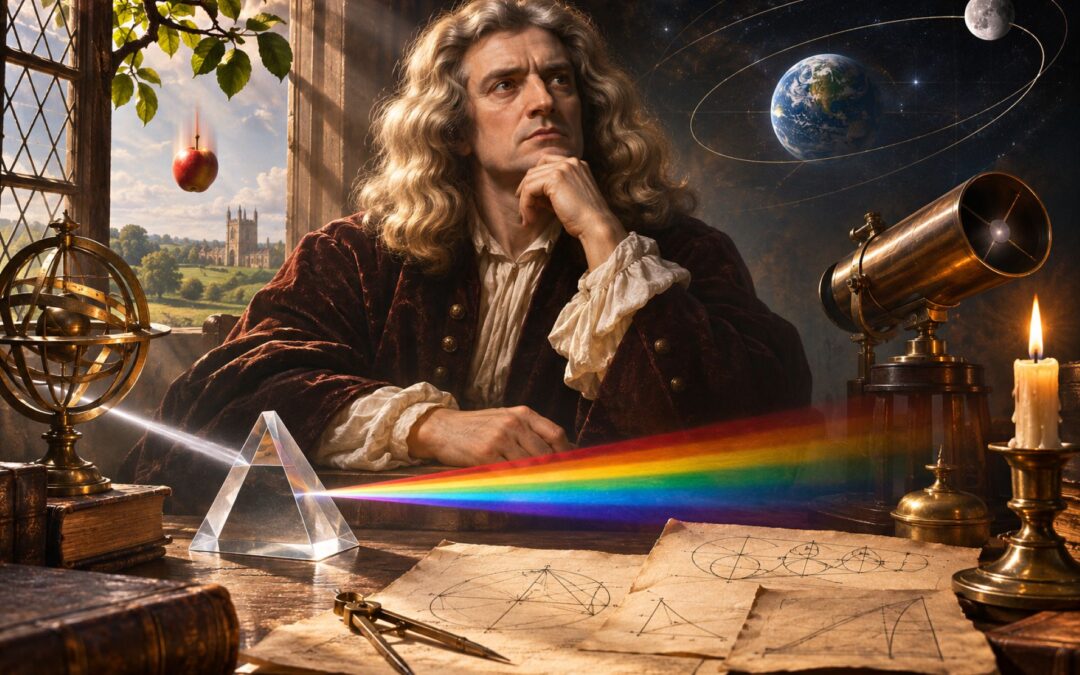
An apple falls from a tree while the Moon moves across the night sky. Isaac Newton’s extraordinary insight was that they could be understood through the same physical principles. The Moon, like the apple, is continually falling towards Earth. Its sideways motion carries it around the planet rather than straight into the ground.
The familiar apple story was not simply invented after Newton’s death. He told it in old age to William Stukeley, who preserved the account of the falling apple in a biographical manuscript. Yet there is no good evidence that the apple struck Newton’s head or that a fully developed theory appeared in one afternoon. The question it prompted demanded years of work.
Newton would transform our understanding of motion, light and the heavens. But he was also a private theological dissenter, a painstaking investigator of alchemy, a government official who pursued counterfeiters and a formidable participant in scientific disputes.
Early Life and Education
Isaac Newton was born at Woolsthorpe Manor in Lincolnshire on 25 December 1642, according to the Julian calendar then used in England. That date corresponds to 4 January 1643 in the Gregorian calendar. His father, also named Isaac, had died before his birth, and his mother, Hannah Ayscough, initially raised him at the family home.
When Newton was about three, Hannah married the clergyman Barnabas Smith and moved to a nearby village. Isaac remained at Woolsthorpe with his maternal grandmother. His mother returned after Smith’s death, bringing three younger children into the household. Years later, Newton compiled a private list of sins that included a threat he had made against his mother and stepfather, suggesting how bitterly he remembered some of these experiences. They offer a glimpse of anger, not an explanation of his adult personality.
At school in Grantham, Newton lodged with an apothecary’s family. Early biographers described him constructing mechanical models and marking out sundials. Those recollections were written many years later, so their details cannot all be independently confirmed. A sundial, after all, turns changing shadows into precise measurements of time.
His mother removed him from school in the hope that he would manage the farm. Newton showed little interest or aptitude, and adults who valued his academic abilities encouraged his return to formal education. In 1661, he entered Trinity College, Cambridge, leaving behind the occupation that his family had envisaged for him.
Newton’s university education combined traditional instruction with unusually ambitious private study. Cambridge teaching still leaned heavily on Aristotle, but Newton’s notebooks show him investigating alternatives. He read René Descartes on nature and motion, explored the mathematics of John Wallis and worked through questions that formal lectures did not settle.
He graduated in 1665, just as plague disrupted university life. Cambridge closed for periods, sending Newton back to Woolsthorpe for much of the following two years. The interruption gave him space to investigate independently. These years laid foundations he would develop over decades.
The Plague Years and the Invention of Calculus
Consider a stone dropped from your hand. If it travels a certain distance in one second, dividing that distance by one second gives its average speed during the interval. Yet the stone is accelerating, so its speed at the beginning is not the same as its speed at the end. How can we describe how fast it is travelling at a single instant?
One approach is to examine increasingly short intervals around that moment. Newton developed mathematical methods for handling such questions systematically, imagining quantities that flowed as they varied. He called these quantities fluents and their rates of change fluxions. The question remains familiar from a speedometer: how rapidly is something changing now?
Calculus also tackles the reverse problem. Suppose we know a car’s speed throughout a journey, including every acceleration, stop and restart. How far has it travelled? We can divide the trip into short periods, estimate the distance covered in each and add those small distances together. As the intervals become finer, the calculation approaches the total distance. Differentiation and integration describe these related problems.
Newton did not begin with an empty mathematical landscape. Earlier scholars had investigated tangents to curves, areas beneath them and infinite series. His achievement was to bring related techniques into a powerful, increasingly general framework and connect them to changing physical quantities.
These results did not immediately reach the public through a printed textbook. Newton kept much of his work in manuscript and discussed parts of it with a relatively small circle. In 1669, Isaac Barrow passed one of his mathematical writings to John Collins, an influential correspondent among mathematicians. Such exchanges were not equivalent to public publication.
That distinction eventually mattered enormously. Newton developed essential parts of his calculus before Gottfried Wilhelm Leibniz published his own methods, but Leibniz provided an accessible written presentation first. Questions about intellectual priority, independent discovery and mathematical notation would later fuel one of the most contentious disputes in European science.
Light, Colour and the Reflecting Telescope
Newton’s investigations at Woolsthorpe were not confined to mathematics. He directed a narrow beam of sunlight through a prism in a darkened room and watched a band of colours spread across the opposite surface. Others had seen prisms produce colours before. Newton wanted to establish what the observation actually meant: was the glass manufacturing colours, or separating properties already present in apparently white sunlight?
To test the alternatives, he isolated one portion of the coloured spectrum and directed it through a second prism. The selected light refracted again but did not turn into a new mixture of colours. Different portions of the original spectrum bent by different amounts. If the first prism had simply manufactured colours by altering ordinary light, a second prism might have produced further changes. Instead, the selected beam retained its colour while changing direction.
He also demonstrated that separated colours could be recombined to produce white light. Together, these experiments showed why a single prism created a spectrum without needing to create colour from colourless light.
This was a triumph of experimental design as much as observation. The first prism displayed an effect, but the second allowed Newton to test competing explanations. White sunlight, uniform to ordinary vision, contained components whose different behaviour could be measured. A good experiment distinguished competing explanations rather than merely displaying a phenomenon.
The results exposed a practical problem. In a telescope that focuses light through lenses, different colours bend by different amounts and may come to focus at different distances. Bright objects can acquire coloured fringes, an effect known as chromatic aberration. Newton built an instrument that used a curved mirror to gather and focus light, avoiding that particular problem. Although he did not invent the concept of a reflecting telescope, his working design in 1668 was an important achievement.
Newton returned to Cambridge and succeeded Isaac Barrow as Lucasian Professor of Mathematics in 1669, when he was twenty-six. A later version of his reflecting telescope attracted the Royal Society’s attention, and he became a fellow in 1672. That year, he sent the society’s secretary, Henry Oldenburg, an account of his theory of light and colour.
Robert Hooke, the society’s curator of experiments, questioned elements of Newton’s interpretation even while accepting important observations. Newton answered extensively, and an argument over prisms became a contest over what experiments could prove. Frustrated by criticism, he repeatedly expressed a desire to withdraw from such exchanges. Yet another question raised by Hooke would soon draw him into an even larger scientific controversy.
Robert Hooke, Edmond Halley and the Mystery of Planetary Motion
Astronomers had become remarkably effective at predicting where planets would appear in the sky. Johannes Kepler showed that planets travel along elliptical paths with the Sun at one focus rather than in perfect circles. But identifying the shape of an orbit was not the same as explaining the physical reason a moving planet followed that shape.
Imagine a body moving sideways through space. Without a force acting on it, it continues in a straight line. If something continually pulls it towards a centre, its direction changes. Its path bends because its existing motion carries it sideways while the inward attraction keeps deflecting it. The critical question was whether a particular law of attraction could produce the elliptical orbits Kepler had described.
In letters exchanged during 1679 and 1680, Hooke and Newton discussed combining sideways motion with attraction towards a central body. An especially promising possibility was the inverse-square rule: if the distance doubles, the attraction becomes one-quarter as strong; if the distance triples, it falls to one-ninth. This offered a candidate rule linking observations at different distances, but it still had to be shown that the resulting path matched the astronomers’ ellipses.
The rule was straightforward to express. Demonstrating what orbit followed from it required difficult mathematics.
Hooke had raised significant elements of the problem, and discussions also involved the architect and mathematician Christopher Wren and astronomer Edmond Halley. In 1684, Halley visited Newton at Cambridge and asked what path would result from an attraction decreasing with the square of the distance. According to accounts of the meeting, Newton answered that the orbit would be an ellipse. He subsequently worked up a mathematical demonstration and sent Halley a short treatise, De Motu Corporum in Gyrum.
Halley recognised that the argument could transform the study of the heavens. He pressed Newton to expand his work, helped manage publication and eventually paid the printing costs himself when the Royal Society could not meet them. His role was much more than that of an enthusiastic reader: without his encouragement and practical support, the eventual book might have appeared very differently or much later.
The project also revived disputes about credit. Hooke argued that Newton owed him recognition for the inverse-square idea and its application to orbital motion. Hooke’s contributions were genuine, but suggesting a physical principle and proving its mathematical consequences were distinct achievements. Newton’s work connected the proposed rule to detailed calculations and a unified account of phenomena across the solar system. Their disagreement exposed tensions between collaboration and credit.
Halley’s intervention helped turn a relatively short mathematical argument into three books. The resulting Philosophiæ Naturalis Principia Mathematica, generally known as the Principia, appeared in 1687.
The Principia, the Laws of Motion and Universal Gravitation
The Principia supplied a mathematical system for understanding movement on Earth and in the heavens. It began with three laws of motion and used them, alongside the law of universal gravitation, to explain how forces change the movements of physical bodies. Phenomena once treated as separate—the descent of objects, planetary orbits and the motion of comets—could now be investigated within one framework.
Newton’s first law concerns inertia. Slide a book across a table and it stops, apparently suggesting that moving objects naturally come to rest. But friction between the book and table slows it. A puck travelling across smoother ice slides farther because there is less resistance. Remove all net external force, and an object already moving continues at constant speed in a straight line; an object at rest remains at rest.
The second law concerns the relationship between force and changes in motion. In Newton’s formulation, the change in momentum depends on the applied force. For an object whose mass remains constant, the familiar modern expression is F = ma: net force equals mass multiplied by acceleration. Give two objects of different masses the same push and the lighter one accelerates more. Apply a larger force to the same object and its acceleration increases.
The third law concerns interaction. Stand in a small boat beside a dock and push against it. Your hands exert a force on the dock, while the dock exerts an equal and opposite force on you. You and the boat glide away; the dock, connected to the much more massive shore, scarcely moves. The equal forces act on different bodies and do not cancel.
Now replace the dock and boat with Earth and the Moon. Earth attracts the Moon, and the Moon attracts Earth with an equal force in the opposite direction. Their accelerations are different because their masses differ enormously. Both actually move around a common centre of mass, although that point lies inside Earth in the simplified Earth–Moon system.
Newton’s gravitational law states that the force between two masses increases with the product of those masses and decreases with the square of the distance between their centres. Written in modern symbols, it is:
F = Gm₁m₂/r²
Here, G is the gravitational constant. Doubling the distance quarters the attraction. The resulting theory of universal gravitation gave physical meaning to the inverse-square relationship Halley had brought to Cambridge.
Why does the Moon not fall directly to Earth? Newton illustrated the principle with an imaginary projectile fired horizontally from a very high mountain. At low speed, it falls to the surface nearby. Fired faster, it travels farther before hitting the ground. At an appropriate speed, ignoring air resistance and assuming a suitable orbit, Earth’s surface curves away beneath the projectile as it falls. It keeps going around the planet in continuous free fall. The Moon’s orbit follows the same fundamental logic, though real celestial motions are more complicated.
The Earth–Moon example involves two mutually attracting bodies. Add the Sun, other planets and their moons, and every body’s gravitational pull slightly changes the others’ trajectories. The Principia laid the foundations for calculating these perturbations. Newton also investigated comets whose elongated paths had once seemed particularly mysterious, as well as the effects of motion through resisting fluids.
His theory helped explain tides too. The Moon attracts the near side of Earth slightly more strongly than Earth’s centre and the far side slightly less strongly. These differences in gravitational acceleration help produce tidal bulges on approximately opposite sides of the planet. The Sun contributes another tidal influence. But determining the exact tide at a harbour is more difficult: coastlines, the shape and depth of the sea, and the movement of water all matter.
The achievement was not a final explanation of gravity’s physical cause. How could two objects affect each other across apparently empty space? Newton recognised the difficulty and resisted pretending that he knew the underlying mechanism. What his mathematical theory established was how gravitational attraction behaved and what followed from it. It was a powerful distinction: a law could reliably predict observable consequences even when deeper questions remained open.
Newton’s Hidden World of Alchemy and Theology
The mathematician who explained planetary movement also spent years working with furnaces, vessels and cryptic recipes. In seventeenth-century natural philosophy, studying the properties and transformation of substances was not wholly separate from investigating nature’s fundamental workings. Alchemists tried to understand how metals formed, how materials changed when heated or dissolved, and whether one substance could be transformed into another.
Newton copied passages from alchemical manuscripts, comparing accounts by different authors and creating indexes of their terminology. The vocabulary was often deliberately obscure. A reference to an animal, for example, might actually denote an ingredient or a product of a chemical process. Understanding a recipe required interpreting its coded language before attempting to test its claims.
He did not simply read these writings. Laboratory notes record the preparation, heating, dissolving and distillation of substances, and attempts to determine whether described processes worked. These investigations involved painstaking experimentation, although many of the theoretical aims and assumptions of alchemy do not survive modern scientific scrutiny. Working out precisely what the instructions meant was itself difficult; performing an experiment could expose ambiguities that remained hidden on the manuscript page.
It would be misleading either to portray Newton as an infallibly rational modern scientist or to dismiss his laboratory work as meaningless superstition.
His religious research was equally extensive. Newton examined different versions of biblical passages, studied accounts of early church councils and questioned how Christian doctrines had developed. He eventually rejected the orthodox doctrine of the Trinity, a position that could endanger his standing within the religious and institutional world of his time. Consequently, much of his theological writing remained private or circulated only among trusted acquaintances.
Newton approached biblical history with a determination to compare documents, dates and interpretations. He studied ancient chronology and the prophetic passages of the Book of Daniel, hoping to understand their historical meaning. Among his surviving calculations is one suggesting that a particular prophetic period might end no earlier than 2060. Contrary to popular accounts, this was not a scientific prediction of the world’s destruction or a definite announcement that history would end in that year.
His theological investigations reveal a man whose interests do not fit neatly into today’s professional categories. In mathematical physics, he sought testable relationships between forces and motion; in biblical history, he sought the meaning of texts through comparison and interpretation. Both demanded enormous attention, but they did not use identical standards of evidence. Newton’s private manuscripts complicate any portrait of him as interested in science to the exclusion of everything else.
Parliament, Counterfeiters and the Royal Mint
Newton’s religious and institutional world occasionally pulled him into public conflict. In 1687, the year of the Principia, King James II sought to make Cambridge grant a degree to a Benedictine monk without the customary oath. Newton participated in the university’s resistance. After the Glorious Revolution, he represented Cambridge in Parliament, although his reputation would ultimately rest more on his administrative work than on legislative speeches.
In 1696, he became Warden of the Royal Mint, based in the Tower of London. England’s silver currency was in serious trouble. Older coins had often been produced by methods that left their edges relatively easy to trim. People clipped off small quantities of silver and returned the lighter coins to circulation, keeping the removed metal for themselves. Counterfeit coins compounded the problem, and worn pieces could differ greatly from their expected weight.
The government undertook the Great Recoinage to replace the old silver currency with properly manufactured coins. This was a national logistical undertaking, not just an exercise in producing better designs: huge amounts of circulating money had to be withdrawn, processed and replaced while trade and ordinary payments continued. Additional mints operated around the country alongside the main facility in London.
Newton helped oversee production and administration, bringing formidable attention to procedures and records. Machine-struck coins had more uniform shapes, while decorated or marked edges made clipping easier to detect.
Counterfeiting investigations were part of Newton’s responsibilities, and he pursued them vigorously. He questioned informants, examined testimony and worked to identify people involved in illegal minting. The most notorious case concerned William Chaloner, a counterfeiter who had also petitioned Parliament and claimed to expose corruption and irregularities at the Mint.
Newton assembled evidence against Chaloner through witness statements and investigations. Chaloner was convicted, and a surviving letter written after the verdict appealed to Newton for assistance while insisting that witnesses had lied. He was executed in 1699. Unlike academic mathematics, this work involved judgments with life-or-death consequences.
That same year, Newton became Master of the Mint, a post he retained until his death. His responsibilities involved the quality of coins, the purity of metals, mint operations and the monetary relationship between silver and gold. In 1717, his advice helped bring the official valuation of the gold guinea down to twenty-one shillings. The decision contributed to longer-term developments that favoured gold in Britain’s monetary system, although it did not by itself establish the later formal gold standard.
The Royal Mint career was not a ceremonial retirement from science. Newton spent decades in demanding public service, applying his abilities to problems where measurements, regulations, money and human conduct were inseparable.
Scientific Authority, Rivalries and the Battle for Credit
Even as Newton administered the Mint, his scientific influence continued to grow. He became president of the Royal Society in 1703 and published Opticks in English the following year. The book revisited prisms and colours while exploring phenomena such as coloured rings appearing between glass surfaces and the behaviour of light near the edges of shadows. Some questions remained open because his experiments and conceptual tools could not settle every property of light.
Queen Anne knighted him in 1705. By then, he was not merely a distinguished investigator: he possessed institutional authority over one of Europe’s most important scientific societies. He could promote research, influence publication and shape the way disputes were evaluated. That power became particularly consequential in his long conflict with Gottfried Wilhelm Leibniz over calculus.
Newton’s manuscripts showed that he had developed central elements of his method in the 1660s. Leibniz, however, independently constructed a powerful approach and published his differential calculus in 1684. Their mathematical languages differed. Newton’s fluxions described quantities changing through time, whereas Leibniz introduced symbols for differentials that made manipulating general relationships especially convenient.
Much of the notation familiar to modern calculus students, including the elongated integral sign, derives from Leibniz rather than Newton. His publications allowed other mathematicians to learn and apply the methods more readily than Newton’s privately circulated papers had done.
The quarrel intensified when supporters of Newton accused Leibniz of taking ideas from him. Leibniz sought an inquiry from the Royal Society, which formed a committee in 1712. Yet Newton helped select the committee and shape its evidence while presiding over the society. The resulting Commercium Epistolicum, published in 1713, supported Newton’s claim to priority and encouraged the implication that Leibniz had borrowed the central method.
Newton subsequently produced an anonymous review of the society’s report, effectively reinforcing a verdict in which he had already participated. The surviving account of the Commercium Epistolicum illustrates how fiercely questions of scientific reputation were contested. Priority and independent discovery were distinct questions. Newton’s early work supports his priority in development; it does not justify accusing Leibniz of plagiarism.
A parallel dispute concerned John Flamsteed, the Astronomer Royal. Newton needed high-quality astronomical observations for his calculations and pressed Flamsteed to release a catalogue of stars. Flamsteed wanted to complete and publish the work himself, retaining control over observations collected across many years. An edition edited by Halley appeared without Flamsteed’s approval; Flamsteed eventually recovered and destroyed many copies, and his completed catalogue was published after his death.
As a younger scholar, Newton had depended on correspondence, intellectual exchanges and the help of astronomers. As an established authority, he could exert pressure over how another astronomer’s painstaking work reached the public. The controversies complicate the image of an invariably fair scientific genius.
Newton’s Death and the Scientific Legacy of His Discoveries
Newton continued revising the book that had transformed his reputation. The second edition of the Principia appeared in 1713 and the third in 1726, nearly four decades after its original publication. Meanwhile, visitors such as William Stukeley sought stories about the beginnings of his discoveries. The apple anecdote survived partly because the elderly scientist was willing to revisit a youthful question.
Newton died on 31 March 1727 in the Gregorian calendar, aged eighty-four, and was buried in Westminster Abbey. His monument represents not only mathematics and optics but also chronology and divinity. Those subjects reflect the breadth of his lifelong investigations, including pursuits that had remained largely invisible to the public that admired his scientific achievements.
His mathematical system continued developing after his death. Eighteenth-century researchers refined techniques for calculating the movement of several mutually attracting bodies, going beyond the simpler arrangements considered in introductory explanations of Newton’s laws.
One spectacular demonstration came in 1846. Astronomers had noticed that Uranus did not move exactly as calculations based on known planets predicted. Urbain Le Verrier calculated where an additional planet might be found if its gravitational pull explained the discrepancies. Johann Gottfried Galle and Heinrich Louis d’Arrest observed Neptune close to the predicted position. The discovery of Neptune showed how an unseen object could be inferred from the gravitational effects it exerted on something visible.
Another orbital puzzle eventually exposed a limitation. Newtonian calculations explained most of the gradual rotation of Mercury’s elliptical orbit, but a small unexplained difference remained. In 1915, Albert Einstein’s general theory of relativity accounted for this discrepancy by treating gravitation through the geometry of spacetime rather than solely as an attraction acting between masses.
For ordinary speeds and comparatively weak gravitational fields, Newtonian mechanics remains extraordinarily accurate and useful. Engineers calculate loads on bridges and the movements of machines using its principles; spacecraft navigation relies heavily on Newtonian methods while incorporating corrections when required. In the development of modern physics, Newton’s framework is not a discarded mistake but an indispensable approximation within a more comprehensive understanding.
Return, finally, to the orchard. Let an apple fall, and its changing motion becomes visible almost immediately. Look at the Moon, and a similar gravitational influence reveals itself only through a long, curved journey. Newton’s achievement was to establish a mathematical connection between the two: the same principles could describe what happened near our feet and far above our heads.
The man who uncovered that connection was argumentative, intensely private and intellectually restless, but his work gave humanity a new way to ask questions of the physical world—and to calculate the answers.
Last Updated on November 25, 2026 by Aseem Gupta