
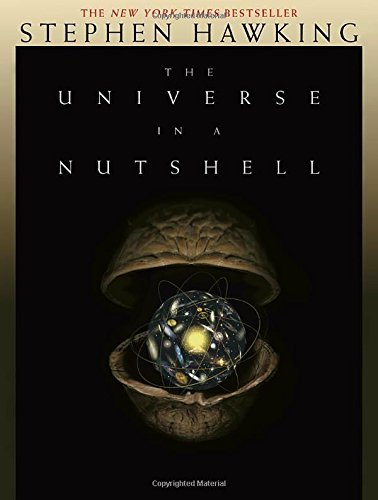
When Stephen Hawking published The Universe in a Nutshell in 2001, he was returning to a scientific landscape that had changed considerably since A Brief History of Time appeared thirteen years earlier. Cosmologists had accumulated stronger evidence for an expanding universe dominated by unfamiliar forms of matter and energy, string theory had developed into the broader framework called M-theory, black-hole information had become one of the deepest disputes in theoretical physics, and new models suggested that the visible universe might be only a four-dimensional surface embedded in a higher-dimensional reality.
Hawking does not present these subjects as the pieces of a completed Theory of Everything. In fact, the unfinished nature of the project is one of the book’s central themes. General relativity describes gravity and the large-scale structure of spacetime with extraordinary success, while quantum mechanics describes matter and the other fundamental interactions with equal success, yet the two frameworks resist straightforward combination under the extreme conditions found inside black holes and near the beginning of the universe.
That tension determines the book’s unusual architecture. Hawking describes Chapters 1 and 2 as the trunk of a tree: they establish relativity, quantum mechanics, singularities, and the problem of quantum gravity. Chapters 3 through 7 then branch outward into quantum cosmology, black-hole information, time travel, humanity’s technological future, extra dimensions, branes, and holography. The result is less a linear textbook than an illustrated map of the frontier of theoretical physics as Hawking understood it at the beginning of the twenty-first century.
Its visual design is equally important. Diagrams of warped spacetime, railway tracks representing time, curled dimensions, strings, p-branes, black holes, holograms, and nested universes are not decorative additions but part of Hawking’s attempt to translate mathematics into intuition. That approach makes the book unusually accessible, but it also creates one of its central limitations: the reader can sometimes acquire a vivid picture of an idea without seeing the mathematical machinery that determines exactly where the analogy works and where it fails.
The Book’s Starting Point: Why Relativity and Quantum Theory Must Meet
Hawking begins with the two revolutions that transformed twentieth-century physics. Relativity changed the meaning of space, time, motion, and gravity, while quantum theory changed the meaning of particles, measurement, probability, and predictability. The rest of the book depends on understanding why both theories can be extraordinarily successful and still become mutually incompatible at the most extreme limits of nature.
The first chapter therefore follows Einstein’s path from special relativity to general relativity and cosmology. The second then asks what happens when curved spacetime encounters quantum uncertainty, eventually leading Hawking toward strings, M-theory, imaginary time, black-hole entropy, and holography.
Chapter 1: A Brief History of Relativity
Hawking starts in the late nineteenth century, when physicists generally assumed that light propagated through an invisible medium called the ether. Sound waves required air, water waves required water, so it seemed natural to imagine that electromagnetic waves required some comparable substance filling space. If the Earth moved through this ether, however, an observer should measure different speeds of light depending on the Earth’s direction of motion.
Albert Michelson and Edward Morley’s famous 1887 experiment failed to detect that expected difference. Light behaved as though its speed were the same regardless of the Earth’s motion through the supposed ether. Hendrik Lorentz and George FitzGerald tried to preserve the ether by suggesting that moving objects contracted and moving clocks slowed by precisely the amounts required to hide motion through it.
Einstein’s 1905 approach was more radical. Instead of modifying objects so that observers would fail to detect the ether, he removed the ether from the theory. He assumed that the laws of physics should take the same form for all observers moving freely at constant velocity and that all such observers should measure the same speed of light.
This forces a profound revision of time. If everyone measures the same speed of light even while moving relative to one another, then observers cannot all share a universal clock. Events that are simultaneous for one observer need not be simultaneous for another, and the amount of time measured between events depends on motion.
Hawking illustrates the point with versions of the twin paradox and with experiments involving precision clocks carried around the Earth. A fast-moving traveler experiences slightly less elapsed time than someone who remains comparatively stationary. The effect is tiny at everyday speeds but becomes substantial as an object approaches the speed of light.
Special relativity also connects mass and energy through Einstein’s famous relation (E=mc^2). A small amount of mass corresponds to an enormous amount of energy because the conversion factor is the square of the speed of light. Hawking uses nuclear fission to show how this principle became materially consequential: when a uranium nucleus splits, the slight difference between the initial and final masses appears as released energy.
He also addresses Einstein’s historical relationship to nuclear weapons. Einstein lent his name to the 1939 letter urging President Franklin Roosevelt to take the possibility of an atomic bomb seriously, but Hawking rejects the idea that discovering mass-energy equivalence makes Einstein morally responsible for Hiroshima and Nagasaki. Einstein did not work on the Manhattan Project and later became an advocate for international control of nuclear weapons.
Special relativity created a new problem because Newtonian gravity no longer fit comfortably inside the theory. Newton’s law implied that a change in the distribution of matter would alter the gravitational field everywhere instantaneously. That would permit influences to propagate faster than light and would also seem to require a universal notion of simultaneity that relativity had abolished.
Einstein’s route to a solution began with the equivalence between gravity and acceleration. A person standing inside a sealed elevator cannot easily distinguish between being pulled downward by gravity and being accelerated upward by the elevator. Similarly, an observer in free fall experiences apparent weightlessness whether falling in Earth’s gravitational field or floating far from any massive object.
The simple equivalence becomes difficult on a spherical Earth because gravitational acceleration points in different directions at different locations. Einstein’s decisive insight was that gravity does not need to be treated as a conventional force acting through an unchanging stage of space and time. Matter and energy alter the geometry of spacetime itself.
Objects then follow the straightest possible paths through curved spacetime. A planet orbiting a star is not being pulled sideways through a fundamentally flat background in the Newtonian sense; it is moving through a geometry that has been warped by the star’s mass. Hawking uses the familiar image of a heavy ball deforming a flexible surface, while warning implicitly through the surrounding explanation that the analogy is only an aid: real general relativity involves four-dimensional spacetime, not a two-dimensional rubber sheet bending into some ordinary third dimension.
Einstein completed the general theory of relativity in 1915. One of its spectacular early confirmations came when observations during the 1919 solar eclipse showed that light from distant stars was deflected while passing near the Sun, as the theory predicted. Spacetime had ceased to be a passive container for events and had become an active participant in physical dynamics.
Once spacetime itself becomes dynamic, cosmology changes as well. Einstein initially wanted a static universe, but his equations naturally resisted one. He introduced a cosmological constant whose repulsive effect could counterbalance gravity and hold the universe steady.
Observations in the 1920s showed that distant galaxies are generally receding, with more distant galaxies receding faster. The universe was expanding, making the static solution unnecessary. Einstein later regarded his introduction of the cosmological constant as a mistake, although Hawking notes the irony that observations at the end of the twentieth century had once again made a cosmological constant—or something physically similar to it—cosmologically relevant.
Expansion also transforms the question of cosmic origins. If galaxies are farther apart today, they were closer together in the past. Follow the expansion backward far enough in classical general relativity and the universe reaches an extremely dense state associated with the big bang.
Einstein hoped that irregular motions might somehow prevent a true beginning, perhaps allowing an earlier contracting universe to rebound. Work by Roger Penrose and Hawking instead showed that under broad physical conditions, singularities cannot be avoided merely by abandoning perfectly symmetric models. General relativity itself predicts boundaries at which its classical description breaks down.
The same difficulty appears during gravitational collapse. A sufficiently massive star that exhausts its nuclear fuel can no longer support itself against gravity. If nothing halts its collapse, spacetime becomes so strongly curved that a black hole forms, surrounded by an event horizon from beyond which light cannot escape.
Inside the classical theory, collapse continues toward a singularity. In that sense, Hawking says time comes to an end for matter falling into the black hole, just as tracing cosmic expansion backward leads to an apparent beginning of time at the big bang. Yet the equations cease to provide an adequate description at precisely those points.
That failure points toward the second great revolution. Quantum theory began when Max Planck proposed that energy is emitted and absorbed in discrete packets, and Einstein himself used the quantum hypothesis to explain the photoelectric effect. Later work by Werner Heisenberg, Erwin Schrödinger, Paul Dirac, and others produced quantum mechanics, in which particles do not generally possess simultaneously definite positions and velocities in the classical sense.
Einstein resisted the fundamentally probabilistic character of the new framework, but experiments overwhelmingly vindicated quantum mechanics. Hawking therefore closes the chapter with the problem that drives most of the book: general relativity and quantum theory are both extraordinarily successful, yet the conditions created by the big bang and black-hole singularities require both at once. A deeper quantum theory of gravity must somehow contain them.
Chapter 2: The Shape of Time
The second chapter asks what time becomes once general relativity and quantum mechanics are both taken seriously. Hawking begins with a methodological declaration. Scientific theories, in his preferred approach, are mathematical models that organize observations and produce predictions; asking what time is “in itself” is less useful scientifically than asking which model of time accurately describes what can be measured.
Newtonian physics treated time as something like an infinite railway line. Events occur at different positions along it, but the track itself exists independently of the trains. Time extends indefinitely into the past and future and remains unaffected by the events taking place within the universe.
That model generated philosophical problems. Immanuel Kant argued that both an eternal universe and a universe created at a finite time seemed to produce difficulties. If time extended infinitely backward before creation, why was there an endless period during which nothing happened? If the universe had always existed, why had it not already reached some final equilibrium?
General relativity changes the question because time does not exist independently of the physical universe. Space and time form spacetime, whose geometry responds to matter and energy. If spacetime itself can have a finite extent, then asking what occurred “before” the beginning of time may be like asking what lies farther north than the North Pole: the question assumes a coordinate that the model no longer defines.
Hawking then revisits the singularity theorems. Earlier researchers had argued that singularities might arise only in unrealistically symmetric solutions of Einstein’s equations. Penrose and Hawking instead studied the global behavior of spacetime, especially the focusing of light rays by gravity.
When we observe distant galaxies, we see them as they were in the past because their light took time to reach us. Plotting all the light rays arriving at the present observer creates a past light cone. As the universe is traced backward toward denser conditions, matter causes those rays to focus together.
The cosmic microwave background provides observational evidence that the early universe was hot, dense, and sufficiently opaque for radiation to have interacted repeatedly with matter. Within classical general relativity, Hawking argues, this means that the past-directed light cone eventually contracts toward a boundary. The classical description does not extend smoothly to an infinite past.
Yet Hawking immediately limits what the singularity theorems prove. They do not tell us that nature literally contains an infinitely dense point described by classical equations. They tell us that classical general relativity becomes incomplete and that quantum gravitational effects can no longer be ignored.
Quantum mechanics introduces Heisenberg’s uncertainty principle. A particle cannot possess an arbitrarily precise position and momentum simultaneously. The more accurately one quantity is specified, the more uncertain the other becomes.
Hawking illustrates the principle with an oscillating pendulum. Classical reasoning says a pendulum in its lowest-energy state should simply hang motionless at the bottom. Quantum mechanics forbids such perfectly definite position and momentum, so even the ground state contains unavoidable fluctuations.
The same idea applies to fields. Empty space is not literally empty in quantum field theory but contains zero-point fluctuations. Different wavelengths contribute vacuum energy even when no ordinary particles are present.
These fluctuations create mathematical infinities. In quantum electrodynamics, physicists including Richard Feynman, Julian Schwinger, and Shin’ichiro Tomonaga developed renormalization procedures that separate measurable finite quantities from divergent intermediate calculations. Comparable methods successfully describe the weak and strong nuclear interactions.
Gravity creates a deeper problem because energy itself produces gravitational curvature. An infinite vacuum energy cannot simply be treated as an irrelevant mathematical background if gravity responds to energy density. Straightforwardly combining general relativity with ordinary quantum-field techniques therefore produces uncontrollable infinities.
The Casimir effect gives Hawking a particularly useful example of why vacuum fluctuations cannot simply be dismissed. Placing two conducting plates very close together alters which quantum-field modes can exist between them. The resulting difference in vacuum energy produces a measurable force, demonstrating that the quantum vacuum has observable physical consequences.
The search for quantum gravity led physicists through several candidate frameworks. Supersymmetry proposes relationships between two broad families of particles, while supergravity incorporates supersymmetry into a theory containing gravity. These approaches softened some divergences but did not provide the final unification researchers wanted.
String theory makes a more radical change by replacing fundamental point particles with tiny one-dimensional strings. Different vibrational modes of a string can appear as different particles, much as different modes of a musical string correspond to different notes. One of the allowed vibrational states has the properties required of a graviton, making gravity part of the framework rather than something attached afterward.
Strings also require additional dimensions of spacetime beyond the familiar three dimensions of space and one of time. The extra dimensions could be curled into extremely small geometries, making them invisible at everyday scales. Hawking’s illustrations turn these otherwise mathematical constructions into twisted surfaces and loops that readers can visualize.
Strings are not the only extended objects that appear. Higher-dimensional entities called p-branes generalize the idea: a zero-brane is pointlike, a one-brane resembles a string, a two-brane resembles a membrane, and higher-dimensional branes extend the pattern. These objects become central again in the final chapter.
During the 1990s, physicists discovered surprising relationships among what had seemed to be several different string theories. Under particular conditions, one description could transform into another. Eleven-dimensional supergravity also appeared connected to them.
The emerging framework became known as M-theory. Hawking treats it as a promising unifying structure rather than a completed final theory. Its various formulations may be different limits of some deeper underlying description whose full mathematical form was still unknown.
The chapter then returns to cosmology through the idea of imaginary time. In mathematics, multiplying the time coordinate by the square root of minus one can transform difficult spacetime geometries into forms that behave more like ordinary spatial geometry. Hawking argues that such a description may allow the universe to be finite yet lack a singular boundary.
This approach prepares the Hartle-Hawking no-boundary proposal developed more fully in Chapter 3. Instead of cosmic history beginning at an abrupt edge where the laws of physics cease to determine anything, an imaginary-time geometry may close smoothly. The distinction between time and space changes near what would classically be called the beginning.
Black holes provide another bridge between gravity and quantum theory. Classical general relativity gives an event horizon an area, while thermodynamics gives physical systems entropy. Work by Jacob Bekenstein and Hawking showed that black-hole horizon area behaves as entropy and that black holes have a temperature.
Hawking radiation makes the connection literal. Quantum effects cause black holes to emit thermal radiation and gradually lose mass. Gravity, quantum theory, thermodynamics, and information are therefore not separate topics but pieces of one problem.
The chapter ends by introducing holography. In ordinary intuition, information about a three-dimensional region should require a three-dimensional description. Black-hole entropy instead suggests that the maximum information associated with a region may scale with the area of its boundary rather than its volume.
The holographic principle generalizes this suggestion. A physical system described in one number of dimensions might possess an equivalent description on a boundary with fewer dimensions. The possibility becomes central to the information paradox in Chapter 4 and to brane-world physics in Chapter 7.
Chapter 3: A Universe with Many Histories
Having built the relativistic and quantum foundations, Hawking turns from the breakdown of classical cosmology to a possible quantum description of the universe’s origin. The chapter takes its title from the image of being “bounded in a nutshell” while still containing an enormous world of possibilities. Hawking’s cosmic nutshell is not a miniature physical universe hidden inside an object but a compact quantum description from which an immense real-time cosmos can emerge.
The starting point is the expansion of the universe. A static eternal universe faces the familiar problem that an infinite collection of eternal stars should make the night sky far brighter than it is. Observations instead show a universe that evolves, with galaxies moving apart and a hot early state implied by both expansion and the cosmic microwave background.
Classical general relativity drives that history backward toward a big-bang singularity. Yet Chapters 1 and 2 have already established that a singularity does not provide a satisfactory final explanation. It marks the place where classical spacetime itself ceases to be adequate.
Quantum mechanics suggests a different approach through Feynman’s sum over histories. A quantum particle need not be represented as having followed one uniquely determined classical trajectory. Instead, the calculation considers many possible histories, each associated with a quantum amplitude, and observable probabilities emerge from their combination.
Hawking extends that idea to the universe itself. There need not be one uniquely prescribed classical cosmic history at the deepest level. The universe can be described through a collection of possible histories that contribute differently to what observers can eventually measure.
A dynamical law still does not completely specify a universe because one also needs something analogous to an initial condition. The laws might explain how a state evolves without explaining why the universe began in that state rather than another. Hawking and James Hartle attempted to remove this arbitrary starting boundary through the no-boundary proposal.
In imaginary time, a possible history can close smoothly like the surface of the Earth. The Earth’s surface is finite but has no edge where geography suddenly stops. Similarly, a quantum universe may be finite in imaginary time without requiring an external boundary at which initial conditions are imposed from outside the physical theory.
When such histories are translated into ordinary real time, an expanding universe can emerge. The no-boundary proposal therefore does not say that the universe simply appeared from nothing in the everyday sense. It proposes a quantum description in which the distinction between a temporal beginning and a spatial boundary changes so radically that the ordinary question of “before” may no longer apply.
Hawking then confronts the fact that possible universes could possess different geometries and dimensional structures. Why do we experience three large spatial dimensions rather than two, four, or ten? Here he introduces anthropic reasoning.
Two large spatial dimensions would make complex organisms difficult to construct because internal structures could not cross one another without dividing bodies into disconnected regions. More than three large spatial dimensions also create severe problems under simple generalizations of familiar force laws: stable planetary systems and stable atomic structures become difficult to sustain.
The fact that observers exist therefore filters the set of histories that can be observed. Hawking does not argue that human beings causally create three-dimensional space. Rather, histories incompatible with complex observers cannot be the histories from which anyone is asking the question.
The same reasoning enters his treatment of inflation. A perfectly smooth and symmetric early universe would not easily produce the irregular structures that later became galaxies. Quantum fluctuations introduce small deviations from perfect uniformity.
During inflation, extremely rapid expansion stretches microscopic quantum fluctuations to astronomical scales. Regions that begin slightly denser attract more matter after inflation, eventually becoming stars, galaxies, and clusters. The subtle variations seen in the cosmic microwave background therefore connect quantum fluctuations in the early universe to the large-scale structure of the cosmos.
Hawking uses this mechanism to show why a universe can begin from a comparatively simple quantum state and still produce enormous later complexity. The “nutshell” does not need to contain every galaxy as an independently specified initial detail. Tiny deviations encoded in its quantum history can be magnified through cosmic evolution.
The chapter also examines the long-term fate of expansion. Matter produces gravitational attraction and therefore tends to slow expansion. A cosmological constant or vacuum energy can instead drive accelerated expansion.
By 2001, observations of distant supernovae had made cosmic acceleration a major problem. Quantum field theory suggests vacuum energy contributions vastly larger than the amount apparently required by cosmology. Hawking therefore confronts one of the sharpest mismatches between naive theoretical expectation and observation.
Anthropic reasoning again enters the argument. If vacuum energy were much larger and positive, cosmic acceleration could prevent matter from collecting into galaxies. Observers therefore find themselves only in histories where the value falls within a range compatible with structure formation.
The explanation is controversial precisely because it replaces a unique dynamical prediction with a selection effect among possible histories. Hawking nonetheless treats it as a potentially legitimate component of quantum cosmology, especially if a deeper theory permits many possible macroscopic realizations.
The chapter closes by returning to the central metaphor. The universe we observe can be almost unimaginably large in ordinary time while corresponding to a compact quantum geometry in imaginary time. In that sense, an enormous cosmos can indeed be contained in a theoretical nutshell.
Chapter 4: Black Holes and the Limits of Prediction
Prediction is one of the defining ambitions of science, but Hawking uses black holes to ask whether nature imposes fundamental limits on how completely the future can be derived from the present. The chapter moves from classical determinism through quantum mechanics and eventually to the information-loss paradox. What begins as a question about knowing the future becomes a question about whether the laws of physics themselves preserve information.
Hawking opens with astrology as an example of failed prediction before turning to the far stronger determinism associated with Pierre-Simon Laplace. In classical mechanics, if an intelligence knew the exact position and velocity of every particle and knew the laws governing them, it could in principle calculate both future and past.
Chaos weakens that vision without completely destroying it. In chaotic systems, tiny uncertainties in initial conditions can grow rapidly, making long-term prediction practically impossible. The underlying equations may remain deterministic even when available measurements are never precise enough to exploit that determinism.
Quantum mechanics imposes a deeper limit because exact classical initial conditions do not exist in the same way. Position and momentum cannot both be assigned arbitrarily precise values. Nevertheless, the quantum wave function evolves according to a well-defined equation, so quantum theory preserves a form of predictability: given a quantum state, one can calculate probabilities for later states.
Black holes threaten even that more limited structure. Classical gravitational collapse creates an event horizon, and once matter crosses it, signals from that matter cannot return to the outside universe. From the exterior, a stationary black hole loses almost all evidence of the detailed object that formed it.
This is captured by the “no-hair” idea. A settled black hole can be characterized by only a few macroscopic properties such as mass, angular momentum, and charge. A black hole formed from complicated matter therefore appears extraordinarily simple from the outside.
If the black hole remained forever, one might argue that the information still existed beyond the horizon even though external observers could not retrieve it. Hawking radiation makes the problem much harder because the black hole does not remain forever.
Quantum fields near the horizon cause a black hole to emit thermal radiation. As it radiates, it loses mass and eventually evaporates. The radiation, in Hawking’s original semiclassical calculation, depends primarily on macroscopic black-hole properties rather than on every detail of the material that entered.
If the black hole disappears completely and its radiation carries no detailed information about what formed it, then information has been destroyed. Two distinct initial quantum states could evolve into the same final thermal state. Standard quantum mechanics normally forbids that loss because quantum evolution is unitary: different complete initial states remain distinguishable in principle.
The paradox affects predictability in both directions. If information can disappear, one cannot reconstruct the past perfectly from the present. More importantly for fundamental physics, a complete present state may no longer determine a unique quantum evolution in the usual sense.
Entanglement sharpens the problem. Two quantum systems can share correlations such that neither subsystem possesses a complete independent description. If one member of an entangled pair falls into a black hole and is ultimately lost when the black hole evaporates, the outside state appears to lose the correlations needed to describe a pure quantum state.
Hawking’s position in The Universe in a Nutshell remains genuinely unresolved. He presents his own case for information loss but also explains an important challenge from string theory. Andrew Strominger and Cumrun Vafa had shown that certain black holes could be represented in terms of enormous numbers of microscopic string- and brane-based states whose statistical counting reproduces the expected black-hole entropy.
That result suggested that the information might remain encoded microscopically rather than disappear. If the underlying quantum theory is unitary, Hawking radiation would need to contain extraordinarily subtle correlations carrying the information back out even though it looks nearly thermal when examined coarsely.
Hawking does not pretend the matter is settled. Chapter 4 therefore ends with one of the book’s most productive tensions: semiclassical gravity appears to erase information, while emerging quantum-gravity models strongly suggest that a complete theory should preserve it. That dispute became even more important after the book appeared.
Chapter 5: Time Travel and Chronology Protection
General relativity makes time part of a flexible spacetime geometry, so Hawking next asks whether sufficiently extreme curvature could allow a path that returns to its own past. The subject sounds like science fiction, but the chapter is not primarily about imaginative machines. It examines a genuine feature of Einstein’s equations: some mathematically valid spacetimes contain closed timelike curves along which an observer could, in principle, return to an earlier event.
Kurt Gödel discovered one famous example. His rotating-universe solution to Einstein’s equations contains paths through spacetime that loop back in time. The solution does not resemble the universe we observe, but it demonstrates that general relativity alone does not automatically guarantee an ordinary global ordering of past and future.
Other proposals involve rapidly moving cosmic strings or wormholes. A wormhole can be imagined as a shortcut connecting two otherwise distant spacetime regions. If its entrances experience different relativistic histories, the time difference between them might transform the wormhole into a route not merely across space but into the past.
That immediately produces paradoxes. The familiar grandfather paradox asks what happens if a traveler goes backward and prevents an event necessary for the traveler’s own existence. More generally, closed causal loops threaten the usual assumption that causes precede their effects.
Hawking therefore distinguishes between a mathematical spacetime that contains closed timelike curves and a time machine that could actually be built from an initially ordinary universe. Constructing the latter may require unusual distributions of energy and matter, particularly negative-energy effects.
Quantum theory does permit limited negative-energy densities. The Casimir effect already shows that vacuum energy can differ between configurations in ways that create measurable forces. It is therefore not enough simply to declare negative energy impossible and consider the question finished.
The important issue is what quantum fields do when a chronology-violating region begins to form. Near a chronology horizon—the boundary at which closed timelike curves would first become possible—light or other radiation can circle repeatedly through the developing time-loop geometry.
Each circuit can produce further blueshifting. The energy seen by some observers can therefore become extremely large. Because energy gravitates, that accumulated quantum stress could strongly distort the geometry that was supposed to create the time machine.
The backreaction may destroy the chronology horizon before macroscopic travel into the past becomes possible. Hawking sees this as evidence for what he calls the chronology protection conjecture: the laws of physics may protect ordinary causality by preventing stable macroscopic time machines from forming.
A complete judgment ultimately requires quantum gravity because the geometry of spacetime itself should fluctuate at sufficiently small scales. Feynman’s sum-over-histories formulation can include microscopic geometries containing loops, but the existence of such quantum configurations does not imply that a spaceship can travel through its own history.
Hawking discusses work suggesting that quantum probabilities become strongly suppressed as a geometry approaches the formation of macroscopic closed timelike curves. He presents this as encouraging evidence rather than a rigorous universal theorem.
The tone becomes characteristically playful because the stakes are conceptually enormous but the evidence remains incomplete. Hawking jokes that chronology protection keeps the world safe for historians. The larger point is serious: general relativity permits far stranger causal structures than everyday intuition, yet quantum effects may restore the practical distinction between past and future.
Chapter 6: Humanity’s Biological and Electronic Future
After five chapters dominated by spacetime, cosmology, and quantum gravity, Hawking abruptly widens the subject to human evolution and technology. The shift is not as disconnected as it first appears. Information has already become central to black holes and holography, and Chapter 6 asks what happens when information is embodied in DNA, culture, brains, and computers rather than in quantum states.
Hawking uses Star Trek as a foil because its distant future remains biologically recognizable. Humans have faster spacecraft and extraordinary technology, yet the species itself remains fundamentally similar to present-day humanity. Hawking thinks such long-term biological and technological stability is implausible.
He begins with exponential growth. Human population, scientific information, and computational capability had all grown rapidly over parts of the modern era. Yet no exponential process can continue indefinitely because finite physical systems eventually encounter resource, energy, speed, or organizational limits.
The more important shift concerns the rate at which information can change. Biological evolution stores information in DNA and modifies it through mutation and natural selection. That process produced enormous complexity, but major genetic transformations unfold across many generations.
Language, writing, printing, and electronic communication created a second inheritance system. Humans can accumulate useful information outside their genes and transmit it directly across generations. Cultural evolution can therefore move much faster than biological evolution.
Genetic engineering might eventually narrow that difference by making biological information deliberately editable. Hawking predicts that efforts to modify human characteristics will be difficult to prevent indefinitely once the technology becomes powerful enough. He does not present this as an endorsement, and he explicitly recognizes the social danger of a world divided between modified and unmodified people.
The speculation extends to reproduction and development. If scientists became able to alter many genes safely and control more aspects of embryonic development, human evolution could partly move from natural selection toward intentional design. Hawking emphasizes the enormous ethical consequences without offering a detailed political solution.
Computers create a second path toward increasing complexity. In 2001, Hawking considered contemporary machines much less complex than the human brain and wrote that they showed no convincing sign of intelligence. He nevertheless saw no fundamental physical reason why sufficiently complex electronic systems could never display behavior comparable to biological intelligence.
His reasoning is materialist rather than mystical. If intelligence emerges from extremely complicated electrochemical activity in biological tissue, then carbon-based neurons cannot simply be assumed to possess a metaphysical monopoly on intelligence. Different physical substrates might implement comparable information processing.
Electronic evolution could also proceed faster than biological evolution because machines can be redesigned directly. An intelligent computer might assist in designing a more capable successor, potentially producing a feedback process in which design cycles accelerate.
Physics still imposes limits. Signals cannot propagate faster than light, and increasingly complex processors encounter communication delays as information moves between components. Parallel processing offers one way around the bottleneck because many operations can occur simultaneously instead of waiting for a single serial processor.
The human brain itself provides the obvious example. Neurons are individually slow compared with electronic components, but enormous numbers operate in parallel. Hawking therefore expects future computing systems to rely increasingly on parallel architectures rather than on unlimited increases in a single processor’s speed.
He then turns outward to space and extraterrestrial intelligence. Because the universe has existed for billions of years, a technologically advanced civilization could easily be millions of years older than humanity if intelligent life commonly arises. The absence of obvious evidence for such civilizations is therefore puzzling.
Hawking considers the possibility that intelligent life is simply rare or short-lived. Evolution does not work toward intelligence as a predetermined goal, and intelligence has existed on Earth for only a tiny fraction of the planet’s biological history. A trait that produces technology may not necessarily guarantee long-term survival.
The chapter’s future is therefore very different from Star Trek. Humanity may find itself relatively isolated while biological and electronic systems continue changing much faster than traditional science fiction assumes. Hawking’s point is not that one precise future is inevitable but that expecting technological growth without transformation of the beings using the technology is probably unrealistic.
Chapter 7: Brane Worlds, Extra Dimensions, and Holography
The final chapter returns from human futures to the search for fundamental physics. Hawking compares M-theory to a partially assembled jigsaw puzzle: physicists understand several edges and corners through different approximations, but the central picture remains missing. The analogy is deliberately anti-triumphalist, because the existence of connections among string theories does not mean the final theory has already been found.
The historical movement toward smaller scales resembles a set of Russian dolls. Ordinary objects are made of molecules, molecules of atoms, atoms of nuclei and electrons, and nuclei of quarks and gluons. Physics repeatedly discovers that apparently elementary objects contain deeper structure or are governed by a more fundamental description.
Quantum gravity introduces the Planck scale, an unimaginably small length at which ordinary concepts of continuous spacetime may cease to apply straightforwardly. Strings and branes were attractive partly because extended objects can soften some of the violent short-distance behavior associated with point particles.
M-theory requires more dimensions than the four familiar dimensions of spacetime. The standard picture had been that the extra dimensions are curled up so tightly that ordinary experiments cannot resolve them. Hawking then presents a much more radical possibility that became prominent around the turn of the millennium: some extra dimensions might be comparatively large.
Our observable universe could be a brane embedded in a higher-dimensional bulk. Ordinary matter and the electromagnetic, weak, and strong interactions could be confined to the brane, while gravity might propagate into the extra dimensions.
This offers a possible explanation for gravity’s apparent weakness. Compared with electromagnetism or the nuclear forces at particle scales, gravity is extraordinarily feeble. If gravitational field lines spread into additional dimensions while the other interactions remain trapped on our brane, observers confined to the brane would naturally measure gravity as weaker.
The idea becomes scientifically interesting only if it produces testable consequences. At ordinary distances, gravity follows an inverse-square law. If extra dimensions become accessible below some length scale, the behavior of gravity could change.
Hawking therefore discusses experiments designed to test gravity at short distances. He also imagines high-energy particle accelerators probing scales at which particles might reveal higher-dimensional behavior. This optimism about near-future tests is one of the aspects of the chapter that can now be judged against subsequent experiments.
A nearby “shadow” brane creates another possibility. Matter on that brane would not emit light visible to us if electromagnetism were confined to each brane separately. Its gravitational field, however, might influence our brane through the higher-dimensional bulk.
Hawking speculates that such invisible matter might imitate some effects attributed to dark matter. The idea is exploratory rather than a claim that dark matter has been explained. It illustrates how brane models can transform apparently separate cosmological puzzles into consequences of higher-dimensional geometry.
Lisa Randall and Raman Sundrum developed another influential model in which an extra dimension can be effectively infinite but strongly warped. Gravity remains concentrated near our brane despite the extra dimension’s size. The geometry therefore allows four-dimensional gravitational behavior to emerge over familiar scales without requiring the additional dimension to be microscopically curled up.
Gravitational waves become an especially interesting probe because gravity may access the bulk even when light and ordinary particles cannot. Energy carried by gravitational fields could in principle behave differently from energy carried by particles trapped on the brane.
Black holes would also be higher-dimensional objects. A black hole observed on our brane might extend into the bulk. Hawking’s visual language turns such objects into flattened “black pancakes,” although the actual geometry is governed by equations rather than by the literal shape suggested by the illustration.
As a brane black hole evaporates, some radiation or gravitational influence might escape into extra dimensions. To an observer confined to the brane, energy could appear to have vanished even though it had merely entered the bulk. Once again, information, horizons, and higher-dimensional geometry become connected.
The chapter then combines brane physics with cosmology. Quantum fluctuations might create branes somewhat as bubbles nucleate in a boiling liquid. Our universe could be associated with one such brane embedded in a higher-dimensional space.
This allows Hawking to reinterpret the “nutshell” of Chapter 3. Instead of imagining the no-boundary universe as a purely four-dimensional closed geometry, one can picture our observable universe as the boundary of a five-dimensional configuration. The cosmic nutshell becomes filled from the higher-dimensional perspective.
Small irregularities in the brane can again provide seeds for structure. Inflation magnifies quantum fluctuations, galaxies form, and anthropic selection enters because observers can arise only in cosmological histories compatible with sufficiently stable and complex structures.
Holography then unifies the final chapter with Chapter 2. A higher-dimensional bulk theory and a lower-dimensional theory on its boundary may encode the same physical information. What looks like a gravitational process in one description might correspond to a nongravitational quantum process in the other.
Hawking’s positivist philosophy becomes especially important here. If two mathematically different pictures generate the same observable predictions, he regards asking which one is uniquely “real” as potentially meaningless within physics. The useful question is which descriptions work and what each allows us to calculate.
The book ends without revealing the final center of the M-theory jigsaw. Instead, Hawking returns to experiment. If the fundamental gravitational scale is lower than conventionally assumed because of extra dimensions, accelerators or precision gravitational experiments might eventually detect unexpected phenomena.
The printed work then closes visually with the nutshell motif rather than with a conventional grand concluding statement. That choice perfectly matches Hawking’s argument in the foreword: science advances by widening the horizon of questions, not by reaching a final intellectual stopping point.
The Ideas That Hold the Book Together
The branch structure can make The Universe in a Nutshell seem like a collection of separate excursions, yet several ideas repeatedly connect those excursions. Hawking keeps returning to the status of mathematical models, the failure of classical descriptions at extreme boundaries, the physical meaning of information, and the possibility that what looks fundamental in one description may be emergent in another. Understanding those connections turns the book from an illustrated miscellany into a coherent portrait of a particular scientific worldview.
Another recurring feature is Hawking’s willingness to move between different levels of certainty. Special and general relativity are experimentally established foundations, while M-theory, no-boundary cosmology, chronology protection, and brane worlds occupy much more speculative territory. Part of reading the book well is learning to distinguish the strength of the underlying physics from the boldness of the proposal being built upon it.
Hawking’s Positivism: Models Before Metaphysics
Hawking repeatedly emphasizes a model-centered philosophy of science. Physics constructs mathematical descriptions of observations and tests the predictions generated by those descriptions. A successful theory does not need to provide direct access to some reality independent of all observation in order to be scientifically meaningful.
This attitude helps him handle several apparently metaphysical problems. Asking what happened before the beginning of time may be meaningless if the relevant model does not define earlier times. Asking whether the universe “really” has a higher-dimensional bulk or “really” exists only through a lower-dimensional holographic description may likewise exceed what physics needs to decide if both descriptions are empirically equivalent.
The advantage is intellectual discipline. Hawking avoids treating visual intuition as an ultimate court of appeal and allows radically unfamiliar models to be judged through their predictive consequences. Imaginary time, for example, need not resemble ordinary experienced time in order to function as part of a successful quantum-cosmological description.
The limitation is that the philosophy can move too quickly from empirical equivalence to indifference about ontology. Physicists and philosophers may reasonably ask whether competing models explain the same evidence while making different assumptions about what exists. Hawking’s position is powerful as a working methodology, but it does not settle every philosophical question merely by declaring the question experimentally inaccessible.
The Search for Quantum Gravity
The deepest scientific thread in the book is the failure of general relativity and quantum mechanics to coexist peacefully at extreme scales. General relativity treats spacetime as a smooth dynamical geometry. Quantum theory, by contrast, makes physical quantities fluctuate and refuses to permit perfectly definite classical configurations at arbitrarily small scales.
Black holes and the big bang force both frameworks into the same problem. General relativity predicts singularities, while quantum mechanics says that extreme microscopic conditions cannot be treated with classical certainty. The singularity is therefore not Hawking’s final answer but an alarm announcing the limits of the existing theory.
Chapter 2 surveys candidate responses—supersymmetry, supergravity, strings, branes, and M-theory. Chapter 3 tries to apply quantum principles to the universe as a whole. Chapter 4 shows how black-hole evaporation threatens quantum information, while Chapter 7 explores whether higher-dimensional theories can reproduce ordinary four-dimensional physics.
The important point is that Hawking never actually possesses the completed theory toward which these ideas point. M-theory is promising because apparently different string theories appear to be parts of a larger structure, but the central formulation remains incomplete in his account. The book therefore records the search for quantum gravity rather than its successful completion.
That unfinished status makes the work more historically valuable than a triumphalist presentation would have been. Hawking lets readers see what theoretical physicists thought the key clues might be in 2001. Some of those clues became even more important, while others failed to produce the near-term experimental breakthroughs that the book entertained.
Information, Entropy, and Holography
Information is the book’s most unexpected unifying concept. In Chapter 4 it appears technically through quantum states and the black-hole information paradox. In Chapter 2 it is connected to entropy and horizon area, while Chapter 7 uses holography to suggest that all information in a region may be represented on a lower-dimensional boundary.
Black-hole thermodynamics transforms information into something physical. Entropy measures how many microscopic configurations correspond to the same macroscopic state. When black-hole entropy turns out to scale with horizon area, the geometry of a boundary becomes linked to the amount of microscopic information hidden behind it.
Holography generalizes the implication. A volume of space may possess an equivalent description using degrees of freedom associated with a lower-dimensional boundary. The idea challenges ordinary intuition that three-dimensional physical information must fundamentally require three-dimensional storage.
Chapter 6 then uses “information” more broadly. DNA stores biological instructions, books and digital systems store cultural information, brains process information, and computers may eventually rival biological systems in complexity. These are not technically identical uses of the term, and the distinction matters, but Hawking clearly sees information as a bridge between fundamental physics and the growth of organized complexity.
The contrast is revealing. In the black-hole problem, physics asks whether information can ever be destroyed. In biological and technological evolution, civilization asks how rapidly information can be copied, changed, and accumulated. The same word therefore links the deepest conservation questions in quantum gravity with Hawking’s speculation about intelligence and the future.
The Anthropic Principle and Multiple Histories
The anthropic principle appears when Hawking confronts features of the universe that the available theory does not uniquely predict. If quantum cosmology permits many possible histories, observers necessarily find themselves only within histories where observers can exist. This sounds obvious, but Hawking uses it to place constraints on otherwise unexplained physical parameters.
The number of large spatial dimensions provides one example. Universes with two large dimensions appear inhospitable to organisms with complicated internal anatomy, while simple force laws in more than three large dimensions make stable atoms or planetary orbits problematic. The fact that beings capable of observation exist therefore favors histories with three large dimensions.
Vacuum energy provides a more controversial example. If positive vacuum energy were too large, cosmic acceleration would prevent matter from collapsing into galaxies. Observers therefore cannot arise in histories where the value lies far outside the structure-forming range.
Anthropic reasoning is strongest when used as a selection constraint among already motivated possibilities. It becomes less satisfying when treated as a substitute for a dynamical explanation of why the underlying possibilities exist or how their probabilities should be assigned. The book occasionally passes over that distinction too quickly because Hawking is more interested in what the framework allows than in every philosophical objection it creates.
Multiple histories make the anthropic principle more natural within Hawking’s cosmology because there is no longer necessarily one unique classical past specified independently of observation. Yet this is also where the book moves furthest from experimentally settled territory. The conceptual architecture is elegant, but elegance should not be confused with observational confirmation.
How Hawking Explains the Universe
The book’s form is part of its argument. Hawking knows that the mathematics underlying relativity, quantum field theory, black-hole thermodynamics, and M-theory is far beyond what can be reproduced in a general-audience volume without fundamentally changing the readership. His solution is to combine compressed prose with diagrams, analogies, captions, humor, historical anecdotes, and visual detours that create multiple routes through difficult material.
That strategy often succeeds brilliantly because it makes abstract relationships memorable. It also produces an unusual reading experience in which the reader can understand the broad shape of an idea without being able to derive it mathematically. The resulting accessibility is a real achievement, but it requires careful awareness of what has been gained and what has been sacrificed.
The Tree Structure and Nonlinear Reading
Hawking explicitly rejects the strict linearity of A Brief History of Time. Readers of that earlier book could become trapped in an early difficult section and never reach later material. The Universe in a Nutshell therefore provides a trunk of essential concepts followed by branches that can be explored with greater independence.
The structure works especially well for browsing. A reader fascinated by time travel can move toward Chapter 5, while someone interested in black holes or extra dimensions can focus on Chapters 4 or 7. The book feels less like climbing a staircase and more like exploring connected rooms.
The cost is that conceptual dependencies never disappear completely. Chapter 7 is much easier if the reader understands Chapter 2’s branes, holography, and quantum gravity, while Chapter 4 depends on black-hole thermodynamics introduced earlier. The branches are independent only relative to the tightly cumulative structure Hawking wanted to avoid.
This looseness also creates shifts in tone and subject. Moving from the information paradox to time machines, human genetic engineering, and brane cosmology can feel episodic. The recurring ideas of information, prediction, quantum gravity, and complexity hold the work together, but readers must sometimes reconstruct those connections themselves.
Visual Pedagogy, Analogies, and Humor
The illustrations are among the book’s greatest strengths. Newtonian time becomes a railway line. Curved spacetime becomes a warped grid. The past light cone becomes a narrowing, pear-shaped structure reaching toward the early universe, while p-branes and extra dimensions become spatial objects that can be mentally manipulated.
The M-theory jigsaw communicates incompleteness more effectively than an abstract discussion of perturbative limits would for most readers. Russian dolls capture the repeated discovery of deeper physical scales, while the nutshell and brane-bubble images turn cosmic boundary conditions into memorable visual motifs.
Hawking also uses humor to prevent conceptual intimidation. Jokes about airline food, electrically operated academic chairs, science fiction, and the protection of historians from time travelers repeatedly interrupt material that could otherwise become oppressively abstract. The humor is not merely decorative; it signals that confusion is permissible and that fundamental physics can be approached with curiosity rather than reverence.
Science-fiction references perform a similar function. Star Trek provides familiar images against which Hawking can compare relativity, genetic change, and future technology. Wormholes and time machines become scientifically discussable without requiring the reader to pretend they have never encountered the concepts in fiction.
Yet every visual analogy carries a danger. Spacetime does not literally sag into an ordinary surrounding space like rubber cloth, imaginary time is not simply another compass direction, and branes need not resemble floating sheets in a familiar room. The illustrations succeed when treated as scaffolding for thought, but they become misleading when mistaken for literal pictures of otherwise invisible structures.
Where Simplification Becomes a Limitation
The book frequently compresses mathematical developments that took generations of physicists to construct into a few pages of conceptual explanation. That is unavoidable in popular science, but it sometimes produces abrupt leaps. A reader may move from quantum uncertainty to renormalization, supergravity, strings, branes, and M-theory quickly enough to recognize the sequence without fully understanding why each proposal was mathematically necessary.
Hawking also shifts between different levels of scientific confidence without always slowing down to mark the boundary. General relativity, Hawking radiation, the no-boundary proposal, anthropic reasoning, brane worlds, and speculative future genetic enhancement do not possess the same empirical status. Their juxtaposition can create an impression of greater uniformity than the evidence warrants.
The lavish design can amplify that effect because everything receives similar visual confidence. A diagram of experimentally confirmed gravitational time dilation may look no more or less authoritative than an illustration of a hypothetical brane universe. Readers need to supply an epistemic distinction that the page design does not consistently make for them.
Still, the alternative would have been a much more technical and far less accessible book. Hawking’s real accomplishment is not removing complexity but giving non-specialists a conceptual map of where the complexity lies. The limitation is that a map cannot substitute for the terrain itself.
What Has Changed Since 2001?
A book deliberately centered on frontier science inevitably ages differently from one confined to settled knowledge. Some of Hawking’s foundations have been reinforced spectacularly, while some of his favored research programs remain unconfirmed and several debates have changed shape. Reading the book in 2026 therefore requires distinguishing the historical state of physics in 2001 from what later observations and theoretical developments have added.
The changes do not simply make the book “wrong.” In several cases, they reveal why its questions were so important. Black-hole information became even more central, precision cosmology advanced dramatically, gravitational waves were directly detected, genome editing became practical, and artificial intelligence developed far beyond the machines Hawking was describing at the beginning of the century.
Cosmology: Precision Parameters and the Dark-Energy Problem
Hawking wrote when modern precision cosmology was still taking shape. Subsequent observations, including Planck’s final cosmological-parameter analysis, tightened measurements of the universe’s age, composition, geometry, and primordial fluctuations. Within the standard ΛCDM model, the universe is about 13.8 billion years old, considerably more precise than the broad estimates available in earlier popular treatments.
Planck also strengthened the extraordinary success of a relatively simple cosmological model built from ordinary matter, dark matter, dark energy associated with a cosmological constant, and nearly scale-invariant primordial fluctuations. In that respect, several basic ideas Hawking discusses—an expanding universe, early quantum fluctuations, inflationary-style initial conditions, and a major vacuum-energy problem—remained central rather than becoming obsolete.
Dark energy itself remains mysterious. A cosmological constant fits a vast range of data, but its extremely small observed value compared with naive quantum-field expectations remains theoretically uncomfortable. Hawking’s discussion of the problem therefore still feels surprisingly current even though the measurements around it have improved.
The picture became more intriguing with DESI’s 2025 results, which strengthened indications that dark energy might evolve over cosmic time when DESI measurements are combined with other cosmological datasets. The evidence is not a definitive discovery of changing dark energy, so it would be premature to declare the cosmological constant dead. What it does show is that the problem Hawking treated as frontier cosmology remains genuinely open.
His anthropic treatment of vacuum energy has therefore neither been decisively vindicated nor rendered unnecessary. The observed value continues to demand explanation, while the scientific community still debates whether that explanation should come from fundamental dynamics, selection effects across a landscape of possibilities, some modification of cosmology, or a framework not yet known.
Black-Hole Information: Hawking’s Reversal and the Island Era
The most important post-publication change concerns Chapter 4. Hawking’s willingness in 2001 to accept genuine information loss did not remain his final position. In Hawking’s 2005 information-loss paper, he argued that a more complete treatment of quantum gravity should preserve information rather than destroy it.
That reversal aligned him more closely with the broader direction suggested by string theory and holography. The AdS/CFT correspondence, developed before The Universe in a Nutshell but not made the organizing center of the book, provided strong theoretical reasons to expect a gravitational system to possess an equivalent unitary quantum description. If the boundary theory preserves information, the equivalent gravitational process should not fundamentally erase it.
The problem then became explaining how Hawking’s apparently thermal radiation can return the information. An important diagnostic is the Page curve, which tracks the entropy of the radiation during evaporation. In a unitary process, the entropy should initially rise as the radiation becomes entangled with the remaining black hole, then eventually fall as information emerges.
Major progress came from replica-wormhole calculations and the related idea of quantum “islands.” In controlled gravitational models, these methods reproduce the Page-curve behavior expected from unitary evaporation. Regions that seem to lie inside the black hole become part of the quantum description relevant to the radiation’s entropy.
This is a major conceptual shift from the version of the paradox presented in Chapter 4. Theoretical evidence for information preservation is now considerably stronger, and Hawking’s own later position changed accordingly.
It would still be an overstatement to say that the information paradox has been experimentally solved. The calculations are performed in controlled theoretical settings, and no one has collected the complete Hawking radiation from a realistic astrophysical black hole and decoded the information carried by it. The modern lesson is not that Chapter 4 became irrelevant, but that the question it dramatized became one of the driving problems behind some of the deepest subsequent developments in quantum gravity.
Extra Dimensions and M-Theory: Still Unconfirmed
Chapter 7 reflects an era when some physicists genuinely hoped large or warped extra dimensions might produce dramatic experimental signatures within reach of new accelerators. That possibility was scientifically legitimate, but the expected evidence has not appeared. M-theory and string theory remain enormously influential theoretical frameworks without experimental confirmation of their characteristic extra-dimensional structures.
The Large Hadron Collider has searched for signatures that could arise in extra-dimensional models, including missing-energy events and related phenomena. A 2025 CMS search for extra dimensions found no significant excess of the relevant kind and instead tightened constraints on the tested scenarios.
Short-distance tests of gravity have likewise failed to reveal the dramatic departures that simple large-extra-dimension models could produce. Such null results do not eliminate every conceivable higher-dimensional theory because different models can place new physics at very different scales. They do, however, make the near-term optimism of parts of Chapter 7 look distinctly historical.
One major prediction associated with general relativity has, by contrast, received spectacular confirmation since the book appeared. In 2015, LIGO observed the first direct detection of gravitational waves from a merger of two black holes. The observation opened gravitational-wave astronomy and provided a new way to test extreme gravity.
The detection does not establish brane leakage or extra dimensions. It strengthens the general-relativistic foundation from which such deviations would have to be identified. Hawking’s suggestion that gravitational waves might become important probes was directionally correct, but the waves observed so far have not revealed the higher-dimensional structure Chapter 7 hoped might emerge.
M-theory therefore occupies an unusual place in the book’s legacy. Its conceptual influence on quantum gravity, black-hole physics, duality, and holography has been profound, yet the empirical Theory of Everything anticipated by popular discussions at the turn of the century has not materialized.
Genetic Engineering and AI: The Future Arrived Unevenly
Chapter 6 has aged more dramatically in everyday technological terms than any other part of the book. Human genome editing became a real biomedical technology after the development of tools such as CRISPR-Cas systems. The possibility of deliberately altering human DNA is therefore no longer merely futuristic.
The distinction Hawking did not have the benefit of observing in mature form is between therapeutic editing of non-heritable cells and heritable modification of embryos or reproductive cells. WHO’s human-genome-editing guidance treats the field as scientifically powerful but ethically and institutionally demanding, especially where changes could be transmitted to future generations.
The wholesale redesign of humans that Hawking speculates about remains far beyond established clinical practice. Complex traits arise from many genes interacting with development and environment, and safe control over such systems is much harder than altering a single disease-causing sequence. His forecast therefore anticipated the direction of capability without accurately describing what would become practical first.
Artificial intelligence has changed even more visibly. Hawking wrote in a world where mainstream computers could defeat humans at some narrow tasks but were nowhere near contemporary systems in language, vision, coding, scientific assistance, and multimodal reasoning.
By 2026, Stanford’s 2026 AI Index documents systems reaching or exceeding human-level performance on numerous demanding benchmarks while progress continues across multimodal generation, coding, scientific applications, and autonomous task completion. The technological baseline of Chapter 6 now feels much more distant than its cosmological foundations.
That does not mean modern AI straightforwardly proves Hawking’s entire forecast about electronic intelligence. Benchmark performance, economic usefulness, general reasoning, consciousness, self-directed goals, and human-equivalent cognition are different questions. The scientific meaning of “intelligence” remains contested, and impressive capability does not automatically settle philosophical questions about mind.
Still, Hawking’s directional expectation was striking. Electronic systems did become dramatically more capable, increasingly general, and increasingly important to scientific and economic activity. His larger argument—that the information-processing systems defining humanity’s future are unlikely to remain static over centuries—looks considerably more plausible now than the relatively stable future he mocked in Star Trek.
Critical Review: The Achievement and the Limits of The Universe in a Nutshell
The Universe in a Nutshell should be judged as neither a textbook nor a timeless reference manual. Hawking set out to communicate the conceptual excitement of theoretical physics as it stood around 2001, concentrating especially on subjects connected to his own research. On those terms, the book remains an impressive achievement, even though several of its most exciting possibilities now carry a historical layer that readers at publication could not have seen.
Its strongest quality is the relationship between intellectual ambition and accessibility. Few popular books attempt to move from special relativity to singularity theorems, quantum vacuum fluctuations, M-theory, black-hole information, closed timelike curves, genetic engineering, brane cosmology, and holography without assuming significant mathematical training. Hawking often succeeds because he knows which conceptual skeleton must remain visible even when the equations have been removed.
What It Does Exceptionally Well
The first great achievement is scale. Hawking does not treat relativity, quantum mechanics, black holes, cosmology, and string theory as unrelated curiosities. He shows why they collide at common boundaries, especially singularities and horizons. The reader therefore receives a sense of fundamental physics as an interconnected problem rather than a catalog of bizarre phenomena.
The historical material is similarly effective when it serves conceptual development. Einstein’s path from special relativity to general relativity explains why gravity became geometry. The rise of quantum mechanics explains why singularities cannot simply be treated as acceptable endpoints, while the development of strings and branes shows why physicists were willing to entertain extraordinary additional dimensions.
The book is also unusually candid about incompleteness. Hawking does not reveal a Theory of Everything at the end. His M-theory jigsaw still lacks its center, the information paradox remains disputed in his 2001 account, chronology protection is a conjecture, and the no-boundary proposal is a proposal rather than an experimentally verified origin story.
That openness gives the book a genuine sense of scientific inquiry. Readers encounter not merely results but questions that working physicists did not know how to answer. For a popular-science audience, that can be more intellectually valuable than a simplified narrative in which every mystery has already been solved.
The visual communication deserves equal credit. Many readers who would struggle to retain an abstract description of light cones, extra dimensions, or horizon entropy will remember the pear-shaped past, the railway tracks of time, the M-theory jigsaw, the Russian dolls, and the brane bubble. The images create cognitive handles for concepts that otherwise resist ordinary intuition.
Hawking’s humor also matters more than it may initially appear. Fundamental physics often acquires an aura of forbidding seriousness, and Hawking repeatedly punctures it with jokes about airline meals, academic chairs, science fiction, and physicists themselves. The effect makes difficult ideas feel approachable without turning them into trivial entertainment.
The book’s treatment of uncertainty is another strength. Hawking is willing to say that a proposed explanation is incomplete, that a rival view has serious arguments behind it, or that a deeper theory remains unknown. That intellectual openness has aged well, particularly because later developments did in fact alter his position on information loss.
Where It Has Aged or Overreaches
The same commitment to frontier physics that gives the book its excitement also dates it. Brane worlds and large extra dimensions receive an immediacy that made sense when experimental prospects appeared unusually promising. Twenty-five years later, the absence of confirming evidence makes that optimism feel more clearly tied to its historical moment.
The information paradox presents a different kind of aging. Hawking’s 2001 willingness to countenance information destruction is essential to understanding the debate of that period, but it is no longer his own final position. A modern reader who encounters the chapter without context could mistake a historically important stance for the current endpoint of Hawking’s thought.
Chapter 6 is even more uneven because prediction amplifies both insight and error. Hawking correctly recognized that electronic and biological information technologies could change far faster than ordinary human evolution, and the growth of AI makes his discussion of machine capability newly striking. His more radical scenarios of deliberate human redesign remain speculative and simplify immense biological, political, and ethical obstacles.
Anthropic reasoning is another area where Hawking sometimes moves faster than the controversy surrounding the method. Observer selection can legitimately explain why certain observed values must fall within life-compatible ranges if a theory already produces many possibilities. It is less obviously satisfying as an ultimate explanation of why those possibilities and probability distributions exist at all.
The no-boundary proposal has a similar issue. Hawking explains it with remarkable elegance, especially through imaginary time and the smooth-sphere analogy. Yet the conceptual beauty of the picture can easily feel more definitive than its empirical status warrants.
The book also occasionally blurs the distinction between understanding an analogy and understanding the physics. A reader can visualize gravity through a distorted grid without learning Einstein’s equations, or imagine strings and branes without understanding the consistency conditions that make them mathematically interesting. Popular science cannot eliminate that gap, but The Universe in a Nutshell sometimes hides how wide it is.
Its nonlinear structure produces another trade-off. The branching design makes the book friendlier to readers who might otherwise abandon a strictly cumulative text, but it weakens the feeling of one continuously developing argument. Chapter 6 in particular feels detached from the main quantum-gravity trajectory even though information and complexity provide a thematic bridge.
None of these flaws destroys the central project. In several cases, they are consequences of the qualities that make the book worth reading. A popular account that ventures into live science will inevitably date faster than one restricted to safe textbook material.
Who Will Get the Most from It
The ideal reader is someone who wants to understand the conceptual questions driving modern cosmology and quantum gravity without first mastering tensor calculus or quantum field theory. Readers who enjoyed A Brief History of Time but wanted more visual support may find The Universe in a Nutshell easier to navigate because the illustrations and branching chapters reduce the pressure to absorb every argument sequentially.
It is especially rewarding for visual learners. The diagrams provide memorable representations of ideas such as spacetime curvature, light cones, extra dimensions, holography, and branes. Readers interested in the history of theoretical physics will also gain something that was less obvious in 2001: the book now captures the mood of the field at a specific moment when string dualities, brane worlds, the information paradox, and accelerating cosmology seemed to be converging toward major breakthroughs.
The book is less suitable as a first choice for someone seeking mathematical understanding. Hawking deliberately removes most derivations, so a reader who wants to know precisely how general relativity, quantum field theory, or string theory produces its results will need a more technical text.
It is also no longer sufficient as a fully current guide to cosmology. Precision measurements, gravitational-wave astronomy, AI, genome editing, the information paradox, and experimental searches for extra dimensions have all moved substantially since publication. The best modern reading therefore combines Hawking’s book with awareness of what later research confirmed, constrained, or transformed.
Is The Universe in a Nutshell Still Worth Reading?
Yes, but its value in 2026 is slightly different from what it was in 2001. At publication, it offered readers a tour of some of the newest ideas in theoretical physics from one of the scientists most closely associated with black holes, singularities, and quantum cosmology. Today it does that while also functioning as an unusually vivid historical snapshot of what physicists hoped might soon become the next great synthesis.
Large parts of the foundation remain remarkably durable. Relativity still describes spacetime and gravity with extraordinary accuracy, quantum uncertainty remains fundamental, gravitational waves have been directly observed, black-hole thermodynamics remains central to quantum gravity, and the information paradox has become more rather than less important. Hawking’s insistence that the deepest problems emerge where apparently successful theories meet their limits has aged extremely well.
Other parts should now be read with greater distance. M-theory remains unconfirmed, large extra dimensions have not appeared in experiments, anthropic reasoning remains contested, and Hawking later changed his own position on black-hole information. Chapter 6 contains both striking foresight about electronic complexity and speculative claims that remain far from realization.
Those changes do not reduce the book to obsolete science. They clarify what kind of book it always was: an attempt to show general readers the frontier while the frontier was still moving. That willingness to expose uncertainty is precisely why later corrections and developments do not undermine the work’s intellectual honesty.
The fairest recommendation is therefore to read The Universe in a Nutshell not as a final map of reality but as Hawking’s map of the questions that seemed most capable of reshaping physics at the start of the twenty-first century. Its greatest achievement is not that every route on that map reached the destination Hawking imagined. It is that the reader comes away understanding why spacetime, quantum mechanics, information, black holes, and the structure of the universe all converge on the same unresolved question: what deeper framework makes the laws we already know parts of one coherent physical world?
Last Updated on August 20, 2026 by Aseem Gupta