
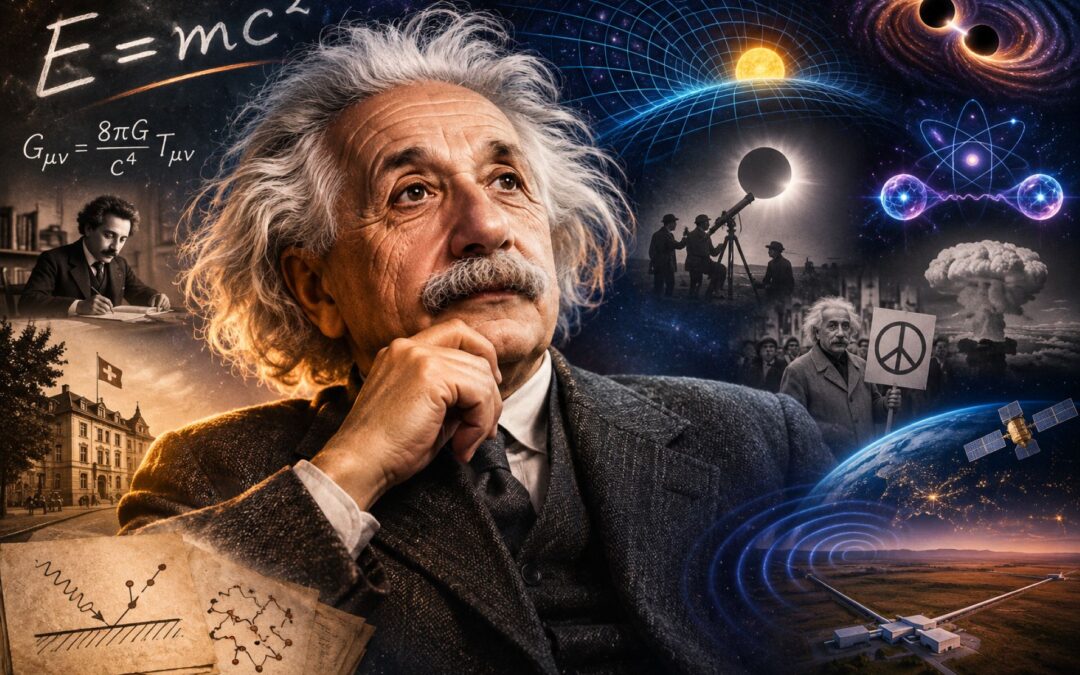
Reading Time: 28 Minutes
Mercury completes an orbit around the Sun in approximately eighty-eight days. Its orbit is elliptical, and the point at which the planet comes closest to the Sun, known as its perihelion, gradually shifts. The gravitational laws developed by Isaac Newton explained most of this movement, including the effects of the other planets. Yet careful astronomical observations revealed a discrepancy.
Mercury’s perihelion advanced approximately forty-three arcseconds per century beyond the amount predicted by Newtonian mechanics. An arcsecond is one three-thousand-six-hundredth of a degree, making this a remarkably small difference. Some astronomers proposed that an undiscovered planet, named Vulcan, might be responsible. Despite repeated searches, no convincing evidence of its existence emerged.
In November 1915, Albert Einstein found a different explanation. Instead of introducing another planet, he reconsidered the nature of gravity itself. His equations yielded the missing forty-three arcseconds and suggested that the geometry of space and time depended on the matter and energy present within the universe.
Einstein was thirty-six years old. A decade earlier, he had been examining inventions at a Swiss patent office while conducting scientific research in his spare time. His journey between those two moments would change physics, but his achievements extended well beyond relativity. He helped establish the physical reality of atoms, pioneered quantum theory, questioned its interpretation, and grappled publicly with the political and moral consequences of scientific discovery.
Childhood, Family and the Making of a Curious Mind
Albert Einstein was born on 14 March 1879 in Ulm, in the German Empire, to Hermann Einstein and Pauline Koch. The Jewish family moved to Munich the following year, where Hermann and his brother Jakob established an electrical engineering business. Einstein’s younger sister, Maja, was born in 1881.
The family business brought Einstein into contact with an important technological transformation. European cities were beginning to adopt electric lighting, and engineers were developing practical applications for the discoveries of nineteenth-century physics. Electrical currents and magnetic fields were becoming commercially useful even though their underlying behaviour remained invisible to the people using the technology.
One of Einstein’s earliest scientific memories involved a pocket compass. His father showed him the instrument when he was a boy, and Einstein was fascinated by the way its needle repeatedly returned to the same orientation. He could move the compass in his hand without preventing the needle from responding to something he could neither see nor touch.
As an adult, Einstein remembered the experience as an encounter with something mysterious beneath the surface of ordinary appearances. The compass did not reveal how magnetism worked, but it demonstrated that an unseen physical influence could produce a consistent, observable effect. Much of his subsequent career would involve identifying the principles behind such effects.
Mathematics offered another way of exploring the world. Einstein developed an enthusiasm for geometry and independently worked through mathematical material beyond his school curriculum. He was impressed by the possibility of establishing conclusions through logical demonstration rather than accepting them merely because an authority said they were true.
Music was equally important within the Einstein household. Pauline played the piano and encouraged her son to learn the violin. Although he initially resisted the discipline of formal lessons, Einstein eventually developed a lifelong appreciation of classical music, particularly Mozart. He continued playing the violin and participating in chamber music even after becoming internationally famous.
The popular story that Einstein failed mathematics at school is misleading. His academic record shows that he was already an accomplished mathematics student during his youth. His difficulties with formal education were more closely associated with its rigid discipline and his dissatisfaction with certain teaching methods than with an inability to understand the material.
When the family’s electrical business encountered financial difficulties, his parents moved to Italy. Einstein initially remained at school in Munich but subsequently left to join them. In 1895, aged sixteen, he attempted the entrance examination for the Swiss Federal Polytechnic in Zurich. He performed well in mathematics and physics but fell short of the overall admission requirements in other subjects.
Einstein completed additional schooling in Aarau, Switzerland, where he lived with the family of a teacher and encountered an educational environment more encouraging of independent thought. Around this time, he began contemplating a question that would occupy him for years. If he could travel alongside a beam of light at its own speed, would he see a stationary electromagnetic wave? The established equations governing light suggested that such a frozen wave could not exist. His attempt to understand why would ultimately transform the concepts of space and time.
Zurich, Mileva Marić and the Patent Office Years
In 1896, Einstein entered the Swiss Federal Polytechnic in Zurich to pursue a teaching diploma in mathematics and physics. Among his fellow students was Marcel Grossmann, an accomplished mathematician whose assistance would later prove crucial when Einstein began developing a new theory of gravity.
Another classmate was Mileva Marić, a Serbian student who had pursued an unusually ambitious scientific education at a time when opportunities for women in higher education were severely restricted. Einstein and Marić developed a personal and intellectual relationship, discussing their studies, books, scientific interests and hopes for the future in surviving letters.
Their relationship has subsequently attracted considerable historical attention, particularly concerning Marić’s possible involvement in Einstein’s early research. Their correspondence demonstrates a shared intellectual environment, but the available evidence does not establish that she co-authored his major discoveries. Recognising her ambitions and the difficulties she faced does not require attributing scientific achievements to her without sufficient documentary support.
Einstein obtained his teaching diploma in 1900 but initially struggled to secure an academic position. His independent approach to studying physics had not always endeared him to his professors, and the recommendations available to him did not immediately open the doors of university employment. He spent time applying for positions and undertaking temporary teaching work.
His circumstances improved in 1902 when assistance from Grossmann’s family helped him obtain a position at the Swiss patent office in Bern. As a technical expert, Einstein examined applications for inventions, considered how the proposed devices operated and assessed whether their descriptions justified granting patent protection.
The occupation required him to distinguish a device’s essential working principles from the complicated language used to describe it. It also exposed him to practical problems involving electrical machinery, signals and measurement. Historians have explored possible connections between these technologies and his scientific interests, although it would be an exaggeration to trace relativity directly to any particular patent application.
The position provided Einstein with a regular income and sufficient time to pursue theoretical investigations outside the office. Unlike many professional researchers, he was not attached to a major physics laboratory. His work depended largely on his understanding of existing scientific literature, mathematics, correspondence and sustained independent reasoning.
Einstein and Marić married in 1903. They had already had a daughter, known through their correspondence as Lieserl, in 1902. What happened to her remains uncertain. Surviving documents do not establish whether she died in childhood or was raised elsewhere, and accounts of her fate must therefore remain provisional. Their son Hans Albert was born in 1904, followed by Eduard in 1910.
Bern also provided Einstein with an intellectual community. Together with Maurice Solovine and Conrad Habicht, he established an informal discussion group they jokingly called the Olympia Academy. They read works on science and philosophy, walked together and debated questions about the foundations of knowledge. These discussions allowed Einstein to explore ideas outside the narrower requirements of his professional occupation.
There was no guarantee that his independent investigations would attract attention. He lacked the institutional authority of established professors, and some of the conclusions he was developing challenged accepted assumptions within physics. Nevertheless, the papers emerging from Einstein’s work in Bern would establish his reputation across several branches of the discipline.
The Miracle Year of 1905: Light and Atoms
Einstein published four particularly influential papers in 1905 while working at the patent office. He also completed a doctoral dissertation on molecular dimensions. The subjects ranged from the behaviour of light and microscopic particles to the foundations of motion and the relationship between mass and energy. Each addressed a distinct problem, but together they demonstrated the limitations of several established physical assumptions.
His first major paper of the year considered the relationship between light and matter. Physicists had substantial evidence that light behaved as a wave. When two light waves overlapped, they could reinforce each other in some places and cancel each other in others, producing alternating bright and dark patterns. James Clerk Maxwell’s electromagnetic theory had given such phenomena an extraordinarily successful mathematical explanation.
However, experiments involving light shining on certain materials presented a different problem. Under suitable conditions, the light caused electrons to escape from the material, a phenomenon known as the photoelectric effect. The dependence of electron emission on the frequency of the incoming light was difficult to understand using an exclusively classical wave description.
Consider a beam of light directed at a metal surface. In ordinary circumstances, increasing its intensity does not produce photoelectric emission if the frequency remains below a particular threshold. Above that threshold, more intense light can release more electrons, but the maximum kinetic energy of those electrons depends on the frequency of the light rather than its brightness.
Einstein’s explanation drew inspiration from the work of Max Planck, who had introduced discrete energy quantities in 1900 when studying thermal radiation. Einstein took a further step: he proposed that light itself could behave, in certain circumstances, as though it carried energy in discrete packets.
The energy associated with each packet was proportional to the frequency of the light. This relationship is expressed as E = hf, where h is Planck’s constant and f is the frequency. The greater the frequency, the more energy the individual light quantum carries. Increasing intensity at a fixed frequency, by contrast, increases the number of available quanta rather than the energy of each one.
An electron requires a certain amount of energy to escape from a material. If a light quantum delivers less than that amount, it cannot free an electron through the ordinary single-photon photoelectric process. If it delivers more, the surplus can appear as the electron’s kinetic energy. The threshold frequency therefore reflects an energy requirement associated with the material.
Einstein’s hypothesis offered a quantitative explanation that later experiments, notably those conducted by Robert Millikan, helped confirm. It contributed to the modern understanding of the photon, although physicists did not immediately accept all its implications. The interference patterns that demonstrated light’s wave behaviour had not disappeared. Instead, the challenge was to develop a theory capable of accounting for both kinds of observation.
His research on Brownian motion addressed another fundamental question: how could the existence of atoms and molecules be established when individual molecules were too small to observe with ordinary microscopes? Atomic theories had proved extremely useful in chemistry and physics, but their status as descriptions of physical reality remained contested.
Under a microscope, a small particle suspended in liquid appears to move in an irregular, restless fashion even without a visible current. Einstein explained this motion through the thermal agitation of the molecules surrounding it. Their collisions produce fluctuating forces that cause the larger particle to move unpredictably.
It would be impossible to predict the precise sequence of collisions from moment to moment, but the collective behaviour of many particles could be described statistically. Einstein derived relationships connecting their typical displacement over time with measurable quantities, including temperature, viscosity and particle size. A microscope could therefore reveal the consequences of molecular motion without resolving individual molecules.
The French physicist Jean Perrin subsequently conducted experiments that tested such predictions and helped establish the physical reality of atoms and molecules. Einstein’s doctoral work on molecular dimensions addressed a complementary problem by developing methods to estimate molecular sizes and numbers. The significance of these investigations lay in turning an unseen microscopic world into something that could be examined through measurable effects, much as the compass had revealed an invisible influence during his childhood.
Special Relativity: Rethinking Space, Time and Energy
Einstein’s youthful question about travelling alongside a beam of light exposed a conflict between two successful branches of nineteenth-century physics. Classical mechanics suggested that the velocity of an object depended on the motion of the observer. Electromagnetic theory, however, gave light a particular propagation speed in a vacuum. Reconciling these descriptions required more than adjusting an existing formula.
Under ordinary circumstances, relative velocities seem straightforward. A person walking towards the front of a moving train travels at one speed relative to the carriage and another relative to the ground. In everyday situations, adding the train’s velocity to the person’s walking velocity provides an excellent approximation of their speed relative to the ground.
Applying the same reasoning to light suggested that observers moving in different directions should measure different light speeds. Einstein instead took seriously two principles: the laws of physics have the same form in all inertial reference frames, and light in a vacuum travels at the same speed for observers in those frames, independently of the motion of its source.
The consequences become clearer through a thought experiment Einstein later used to explain relativity. Imagine a train moving along a straight track at constant speed when lightning strikes the locations corresponding to its front and rear. An observer standing on the platform, midway between the two strike locations, receives the flashes together. Since they travel equal distances at the same speed, the observer concludes that the lightning strikes occurred simultaneously.
A passenger at the midpoint of the moving train is travelling towards the light coming from the front and away from the light coming from the rear. The passenger consequently receives the front flash first. In the passenger’s own reference frame, the front and rear strike locations on the train are equally distant from its midpoint, and the speed of light is identical in either direction. The passenger therefore concludes that the front strike happened before the rear strike.
Both observers agree that the flashes occurred and can account for the events at which each flash reached each observer. Their disagreement concerns whether the two distant strikes took place at the same time. Simultaneity is not a universal relationship between spatially separated events; it depends on the observer’s state of motion.
This result undermined the classical assumption that clocks throughout the universe could, in principle, share one absolute time. Einstein’s theory showed that measurements of time and distance were interconnected. An observer could measure a moving clock as ticking more slowly, and a moving object as having a shorter length along its direction of motion, than corresponding measurements made in the object’s own reference frame.
These effects are negligible in ordinary human travel but become substantial at velocities approaching the speed of light. They are also experimentally measurable. Short-lived particles moving at high speeds can travel farther before decaying than their lifetimes when at rest might lead someone to expect. In their own frames, their physical processes proceed normally; in the laboratory frame, more time elapses between their creation and decay.
The relationship between motion and elapsed time has a further consequence. Suppose two people begin with synchronised clocks, separate, and later meet again. One remains in an approximately inertial frame while the other travels away and eventually returns. Their clocks need not display the same elapsed time at the reunion.
The traveller changes direction, so the two journeys are not physically symmetrical despite the fact that each person can describe the other as moving during portions of the trip. Relativity distinguishes the time recorded along each person’s particular path through spacetime from a universal time assumed to pass identically for everyone. This difference is measurable and does not depend on whether the clocks operate mechanically, electronically or through atomic processes.
Einstein followed his relativity paper with a shorter investigation connecting energy and inertia. He showed that a body releasing energy would lose a corresponding amount of mass, a relationship subsequently expressed through the famous equation E = mc². Here, E is the rest energy associated with mass m, and c is the speed of light in a vacuum.
The speed of light is approximately 300 million metres per second. Squaring such a large number explains why even a small mass difference corresponds to a considerable amount of energy. In nuclear reactions within stars, some of the initial mass is accounted for in the energy released, helping explain how the Sun sustains its radiation over immense periods.
The equation is not a method for obtaining energy from any material without restriction; the physical processes and conservation laws involved determine what transformations are possible. Its deeper importance lies in demonstrating that mass and energy are fundamentally related rather than independent quantities with no connection to one another.
From Falling Elevators to Curved Spacetime
The papers of 1905 gradually opened academic opportunities for Einstein. He left the patent office in 1909 to become a professor at the University of Zurich, subsequently taught in Prague, and returned to Zurich in 1912 before moving to Berlin in 1914. Throughout these changes, he pursued a question that special relativity had left unresolved: how should gravity fit into his new account of space and time?
Newtonian gravity described the motions of planets with extraordinary accuracy. In its traditional formulation, however, gravitational interactions depended on the positions of objects at the same instant. Special relativity had undermined the assumption that distant observers shared a single universal present. A consistent relativistic theory of gravity could not simply retain all the assumptions of Newton’s framework.
Einstein found a promising starting point in 1907 through a thought experiment involving a freely falling observer. Imagine someone inside a falling cabin who releases a coin. Ignoring air resistance and differences in gravitational acceleration across the cabin, both observer and coin fall together. From the observer’s perspective, the coin appears to float nearby.
The same principle explains why astronauts experience weightlessness while orbiting Earth. They are not beyond Earth’s gravitational influence. Their spacecraft and the objects inside it are continually falling together, with their sideways motion keeping them in orbit rather than carrying them directly towards Earth’s surface.
Now imagine a sealed cabin accelerating through empty space far from any planet. A person standing inside feels the floor pressing against their feet. If they release a coin, the accelerating floor approaches it, and the coin appears to fall towards the floor. Within a sufficiently small cabin, these observations resemble the experience of standing in a room on Earth.
Einstein recognised a profound relationship between gravitation and acceleration, now associated with the equivalence principle. The resemblance has limits, however. Earth’s gravitational influence varies across space, whereas the idealised accelerated cabin lacks the same distribution of gravitational effects. With sensitive enough instruments, an observer could identify tidal differences within a laboratory. Two freely falling objects placed side by side, for example, would tend to converge slightly as they approached Earth’s centre.
Those variations pointed towards a more fundamental geometric description. Einstein’s emerging theory would treat freely falling bodies as following natural paths through spacetime, with the geometry itself influenced by matter and energy. Describing gravity in this way required mathematics far more complicated than the geometry taught in ordinary schools.
When Einstein returned to Zurich, he sought help from his former classmate Marcel Grossmann. Grossmann introduced him to mathematical tools developed by earlier mathematicians for studying curved spaces. Their collaboration helped Einstein investigate how four-dimensional spacetime might possess geometry that differed from the familiar flat geometry of everyday experience.
A simple comparison is the surface of Earth. Two travellers can begin walking north along different lines of longitude that are parallel at the equator, yet their paths eventually meet at the North Pole. Neither needs to turn towards the other for this convergence to occur. The geometry of the surface makes their initially parallel directions converge. Spacetime curvature is more complex than this two-dimensional analogy, but it likewise changes the relationships between natural paths.
Einstein and Grossmann produced an intermediate gravitational theory in 1913, but it did not satisfy all the necessary mathematical and physical requirements. Among its difficulties was an inadequate explanation of Mercury’s perihelion. Einstein spent years reconsidering assumptions, attempting calculations, abandoning approaches and seeking equations consistent with both his physical insights and the successes of Newtonian theory.
In November 1915, he presented a series of papers to the Prussian Academy of Sciences in Berlin. On 18 November, he reported that his revised gravitational framework explained Mercury’s anomalous perihelion advance. A week later, on 25 November, he presented the final form of his gravitational field equations.
These equations relate the geometry of spacetime to the distribution and movement of matter and energy. A massive object such as the Sun influences the geometry around it, and freely moving planets follow paths determined by that geometry. What Newton had described as gravitational attraction could now be understood through the structure of spacetime itself.
General relativity did not render Newtonian mechanics useless. For many situations involving comparatively weak gravitational fields and low velocities, the predictions of both theories are nearly identical. Engineers and astronomers continue to use Newtonian calculations wherever their accuracy is sufficient. Einstein’s theory becomes essential when relativistic effects are large enough to matter or when greater precision is required.
Mercury provided a particularly revealing example because its proximity to the Sun makes relativistic corrections more significant than for planets farther away. General relativity produced the approximately forty-three arcseconds of additional perihelion advance per century that astronomers had already identified. No hypothetical planet was needed to supply the missing influence.
The successful calculation was compelling precisely because the discrepancy had been measured independently of Einstein’s theory. Yet explaining a known anomaly was not the same as observing an entirely new prediction. The next opportunity to examine his theory would require astronomers to look towards the Sun during a total solar eclipse.
The Eclipse That Made Einstein Famous
General relativity predicts that light travelling near a massive object follows a path influenced by spacetime curvature. A star observed close to the Sun’s apparent position should therefore appear slightly displaced from its usual location, even though the star itself has not moved. The displacement offers a way to investigate the gravitational influence of the Sun on passing light.
Ordinarily, sunlight makes stars close to the solar disc difficult to observe. During a total solar eclipse, however, the Moon temporarily blocks the bright surface of the Sun. Astronomers can photograph the surrounding stars and compare their apparent positions with photographs of the same region taken when the Sun is elsewhere.
A total eclipse on 29 May 1919 provided a suitable opportunity. British astronomers organised expeditions to two sites: the island of Príncipe, off the western coast of Africa, and Sobral in Brazil. Arthur Eddington and Edwin Cottingham travelled to Príncipe, while another group made observations in Sobral. Their work occurred shortly after the First World War, giving the collaboration between British astronomers and a German-based physicist additional symbolic significance.
The observations were technically demanding. Clouds interfered with photography on Príncipe, while one of the instruments used in Sobral produced poorly focused images. Detecting a tiny apparent shift in stellar positions required careful examination of photographic plates and consideration of instrumental distortions. The teams could not simply count every image as equally reliable.
When the results were announced at a joint meeting of the Royal Society and Royal Astronomical Society in London on 6 November 1919, the more reliable measurements favoured Einstein’s prediction. The announcement attracted worldwide attention, although the evidence from the eclipse was far less precise than later measurements.
Historians examining the 1919 eclipse measurements have also investigated whether the exclusion of problematic data reflected bias. There were substantial instrumental reasons to question those observations, and subsequent research has confirmed gravitational light deflection with considerably greater precision.
Newspapers presented the announcement as a revolution in science, often portraying Einstein as the man who had defeated Newton. The reality was more nuanced, but the story transformed Einstein from a distinguished physicist into an international celebrity. Public interest followed him on lecture tours, including his 1921 visit to the United States, during which large crowds gathered to see him.
The scientific recognition that followed contained an interesting distinction. Einstein received the 1921 Nobel Prize in Physics, which was announced in 1922. The award particularly recognised his discovery of the law of the photoelectric effect rather than his theory of relativity. His worldwide celebrity had largely resulted from one line of research, while a different discovery from his patent-office years secured his Nobel Prize. The distinction reflects the remarkable breadth of his scientific career.
Cosmology, Quantum Physics and Einstein’s Greatest Disagreements
Einstein’s new theory of gravity could be applied not only to planets and stars but also to the universe as a whole. In 1917, he investigated what general relativity might reveal about the large-scale structure of the cosmos. Like many scientists of his generation, he assumed that the universe should be static on its largest scales.
The gravitational equations did not naturally produce the kind of static cosmological model he envisaged. Einstein therefore introduced an additional term, known as the cosmological constant, which allowed a static solution under particular conditions. The modification was mathematically compatible with his general framework, even though the physical motivation for including it was connected to contemporary assumptions about the universe.
Other researchers approached the equations differently. Alexander Friedmann developed mathematical solutions describing a changing universe, while Georges Lemaître connected an expanding cosmological model with astronomical evidence. Observations of distant galaxies increasingly supported the idea that the universe was expanding rather than remaining static.
Einstein eventually abandoned his static cosmological model, but the cosmological constant did not disappear from physics. Late twentieth-century observations indicating that cosmic expansion was accelerating renewed interest in the term. It became part of the standard Lambda cold dark matter cosmological model, where it provides a simple mathematical description of the accelerated expansion commonly associated with dark energy. Whether dark energy is ultimately explained by a cosmological constant or some other physical mechanism remains a subject of investigation.
While these developments were unfolding, Einstein continued contributing to the emerging quantum theory. In 1924, the Indian physicist Satyendra Nath Bose sent Einstein a paper proposing a new statistical approach to light quanta. Recognising its importance, Einstein translated the work into German and helped arrange its publication. He subsequently extended Bose’s approach to particles of matter.
Bose’s method treated identical quantum particles differently from distinguishable classical objects. Einstein’s extension suggested that, at sufficiently low temperatures, a large proportion of particles of a suitable kind could occupy the same lowest-energy quantum state. Under these conditions, quantum behaviour could become apparent on a much larger scale than that of a single atom.
The resulting prediction became known as Bose–Einstein condensation. Achieving the necessary conditions required advances in experimental physics that took decades. In 1995, researchers created a Bose–Einstein condensate in a dilute atomic gas, allowing physicists to investigate a state of matter that had emerged from a theoretical collaboration seventy years earlier.
Einstein’s contributions to quantum physics make his later disagreements with the theory particularly interesting. He recognised its remarkable predictive success but questioned whether its statistical description represented a complete account of physical reality. His objection was not that probability could never be useful in physics; he had himself employed statistical reasoning in explaining Brownian motion. The issue was whether the probabilities expressed fundamental features of nature or reflected limitations in the description offered by the theory.
Einstein debated these questions with the Danish physicist Niels Bohr, including during the famous Solvay conference of 1927. Their exchanges involved imagined experiments designed to investigate what could be measured and what conclusions could legitimately be drawn from those measurements.
In 1935, Einstein, Boris Podolsky and Nathan Rosen presented a particularly influential argument, now known as the EPR paradox. They considered two systems that had interacted and subsequently become spatially separated. Quantum mechanics allowed their combined state to display correlations even after the separation. Under certain measurement choices, information obtained from one system could be used to predict the corresponding result for the distant system.
The three researchers argued that if measuring one system could leave the distant system physically undisturbed, the ability to predict its properties indicated that those properties should correspond to elements of reality. Yet the standard quantum description did not assign simultaneous definite values to all the relevant quantities. They concluded that the theory was incomplete under the assumptions they considered reasonable.
Bohr challenged their reasoning, emphasising the importance of the experimental arrangement in defining what could meaningfully be said about a quantum system. Their disagreement exposed fundamental differences concerning locality, physical reality and measurement.
In 1964, after Einstein’s death, physicist John Bell demonstrated that theories satisfying certain locality assumptions would impose mathematical limits on measurable correlations. Subsequent experiments violated Bell inequalities in agreement with quantum predictions. These findings rule out broad classes of local explanations meeting Bell’s assumptions, though they do not settle every philosophical interpretation of quantum mechanics. Nor do entangled particles provide a method for transmitting a controllable message faster than light.
An argument originally intended to demonstrate a shortcoming in quantum theory had thus helped establish one of the most important experimental approaches to its foundations. Einstein’s doubts became scientifically productive even where the answers differed from what he had hoped to establish.
Family, Exile and the Rise of Nazi Germany
Einstein’s growing scientific reputation was accompanied by difficulties in his personal life. His marriage to Mileva Marić deteriorated as his academic career developed. When he moved to Berlin in 1914, their relationship had become deeply strained, and Marić returned to Switzerland with Hans Albert and Eduard. Their divorce was finalised in 1919.
The settlement included an unusual financial arrangement involving the proceeds of a Nobel Prize that Einstein expected he might eventually receive. In the same year as the divorce, he married Elsa Einstein, his cousin, who subsequently helped manage aspects of his increasingly demanding public life. The international attention generated by the eclipse results brought travel, correspondence and public commitments on a scale very different from the routine of his earlier years in Bern.
Einstein remained connected with his sons through visits and correspondence, although the geographical distance between them and the demands of his career complicated their relationships. Eduard developed serious psychiatric difficulties, and his mother carried much of the responsibility for his care. Einstein’s scientific accomplishments did not protect his family from emotional conflict, illness or the burdens created by prolonged separation.
His move to Berlin had coincided with another upheaval. In 1914, the First World War divided Europe, and ninety-three German intellectuals signed a public declaration defending their country’s wartime conduct. Einstein was among a much smaller group supporting a counter-appeal that called for intellectual cooperation and solidarity across national borders.
His opposition to nationalism was significant in an environment where scientific institutions and prominent scholars had become deeply entangled with patriotic mobilisation. During the following years, Einstein increasingly encountered antisemitic hostility, including attacks on relativity that combined scientific objections with nationalist and racial prejudice. The celebrity that amplified his ideas also made him a conspicuous political target.
When Adolf Hitler became chancellor of Germany in January 1933, Einstein was visiting the United States. The Nazi government’s anti-Jewish policies rapidly undermined the position of Jewish academics and professionals. Einstein renounced his membership in the Prussian Academy of Sciences and did not return to establish his life in Germany. By the autumn of 1933, he had settled at the newly founded Institute for Advanced Study in Princeton, New Jersey.
There, Einstein continued working on theoretical physics while following the increasingly dangerous situation in Europe. He used his public standing to help people displaced by Nazi persecution, writing letters of recommendation, supporting requests for employment and assisting efforts to secure opportunities abroad. His intervention could attract the attention of officials and academic institutions, but it could not eliminate immigration quotas, financial barriers or the shortage of positions available to refugees.
Elsa died in 1936, leaving Einstein without the partner who had accompanied much of his international public life. In 1940, he became an American citizen while retaining the Swiss citizenship he had acquired in 1901. By then, a new development in physics had already forced him to reconsider how his opposition to war should apply in the face of Nazi aggression.
Nuclear Weapons, Pacifism and Civil Rights
The discovery of nuclear fission in the late 1930s transformed scientists’ understanding of the energy associated with atomic nuclei. Experiments showed that certain heavy nuclei could split into smaller nuclei, releasing energy. Researchers began investigating the consequences of this discovery and recognised that nuclear processes might have military applications.
The possibility that Nazi Germany could develop a powerful new weapon particularly concerned physicists who had escaped European persecution. Leo Szilard and his colleagues believed the United States government needed to recognise the significance of the research. Einstein’s scientific reputation and international standing made his support potentially valuable in bringing the matter to the attention of senior American officials.
In the summer of 1939, Szilard visited Einstein on Long Island, New York, where Einstein was spending time away from Princeton. Their discussions led to a letter addressed to President Franklin D. Roosevelt, dated 2 August 1939, which warned that developments in uranium research might eventually make an exceptionally destructive weapon possible. It urged closer cooperation between the government and researchers investigating nuclear physics.
Roosevelt received the letter in October, after Germany’s invasion of Poland had already begun the Second World War in Europe. His administration established a committee to consider uranium research. The American wartime nuclear programme subsequently developed through numerous scientific, military and political decisions, eventually becoming the Manhattan Project.
Einstein’s role in the early warning should be distinguished from the work of the scientists who developed the weapons. He did not participate in the Manhattan Project and was not responsible for designing the atomic bomb. His famous mass-energy relationship helped establish fundamental principles relevant to nuclear physics, but the connection between that theoretical discovery and the eventual weapon involved many other discoveries, institutions and people.
The atomic bombings of Hiroshima and Nagasaki in August 1945 exposed the consequences of nuclear weapons to the wider world. With the defeat of Nazi Germany and the emergence of a rivalry between the United States and the Soviet Union, the original fear that had prompted Einstein’s warning gave way to concerns about a continuing arms race.
In 1946, Einstein helped establish and lead the Emergency Committee of Atomic Scientists, which sought to educate the public about nuclear dangers and support international arrangements capable of preventing their destructive use. He believed scientific knowledge had created problems that could not be resolved by technical expertise alone. Political institutions and public understanding would have to address the consequences of what scientists had discovered.
Einstein’s public commitments in the United States extended beyond international security. He spoke against racism and supported efforts to challenge discrimination at a time when legal segregation remained widespread. In 1946, he visited Lincoln University in Pennsylvania, a historically Black university, where he accepted an honorary degree and addressed the injustice of racial segregation.
His willingness to speak publicly on these issues reflected a conception of citizenship that extended beyond his professional achievements. Having experienced antisemitism and witnessed the displacement of Jewish scholars, Einstein understood how prejudice could be reinforced through institutions and public policy. His own experiences did not make every form of discrimination identical, but they informed his opposition to the exclusion of people on racial or ethnic grounds.
Einstein’s political life was therefore more complicated than the simple description of him as either a pacifist or an advocate of military research. His response to the threat posed by Nazism differed from his opposition to the continuing nuclear arms race. In both circumstances, he confronted questions about the relationship between scientific knowledge, political authority and human survival.
The Search for a Unified Theory and Einstein’s Final Years
At the Institute for Advanced Study, Einstein continued pursuing one of his most ambitious scientific objectives: finding a unified mathematical description of gravitation and electromagnetism. Both phenomena had been successfully described through field theories, and he hoped they might emerge from a deeper underlying framework rather than requiring separate fundamental descriptions.
General relativity had already demonstrated that seemingly independent phenomena could be connected by reconsidering the mathematical foundations of physics. Einstein sought a comparable breakthrough that would bring gravity and electromagnetic interactions together. He explored different geometrical formulations and worked with younger mathematicians and physicists who assisted in developing and examining his approaches.
The scientific landscape around him was changing. Quantum mechanics and quantum field theory were becoming increasingly successful, while experiments revealed the importance of nuclear interactions beyond gravitation and electromagnetism. A unified classical description of the two forces that had originally motivated Einstein would not automatically account for the increasingly complex picture of fundamental physics.
Einstein never produced a unified field theory that successfully explained the established evidence while generating convincing new predictions. His inability to solve the problem occupied decades of a career that is frequently remembered primarily for its exceptionally productive early years. It illustrates the difference between recognising a profound scientific question and possessing the conceptual and mathematical resources necessary to resolve it.
During the closing years of his life, Einstein also remained concerned about international conflict and nuclear weapons. In April 1955, he agreed to sign a statement prepared by the philosopher Bertrand Russell with the support of other scientists. It called attention to the potentially catastrophic consequences of nuclear warfare and urged governments to seek peaceful means of resolving disputes.
Einstein died in Princeton on 18 April 1955, aged seventy-six. In July, Russell publicly presented the statement, which became known as the Russell–Einstein Manifesto. It helped inspire the international scientific dialogue that subsequently developed through the Pugwash Conferences. Einstein’s final public intervention thus addressed a problem that, like his unfinished scientific investigations, would remain important long after his death.
Einstein’s Scientific Legacy: From GPS to Gravitational Waves
The consequences of Einstein’s discoveries can be found in technologies used far beyond research laboratories. Satellite navigation provides one of the clearest examples. A GPS receiver determines its location using signals transmitted by satellites whose precise clocks allow the receiver to estimate the travel times of those signals.
Because electromagnetic signals travel at the speed of light, even tiny timing discrepancies can translate into substantial errors in calculated distances. The clocks carried by GPS satellites are subject to two relativistic effects. According to special relativity, their motion makes them run more slowly relative to corresponding clocks on Earth. According to general relativity, the weaker gravitational field experienced by the orbiting satellites makes their clocks run faster than equivalent clocks closer to Earth’s surface.
For GPS satellites, the gravitational effect exceeds the effect of their orbital speed, producing a net difference of approximately thirty-eight microseconds per day before correction. Navigation systems incorporate relativistic adjustments so the clocks remain consistent with the timing reference needed to calculate positions accurately. The thought experiments that once seemed remote from everyday experience have therefore become practically important to a technology used by millions of people.
Another consequence of Einstein’s theory took approximately a century to observe directly. General relativity permits disturbances in spacetime to propagate as gravitational waves. Accelerating distributions of mass under appropriate conditions, such as two black holes orbiting one another, can generate these disturbances and carry information about their source across the universe.
On 14 September 2015, two detectors belonging to the Laser Interferometer Gravitational-Wave Observatory, located in Louisiana and Washington State, registered the distinctive signal of gravitational waves generated by merging black holes. The instruments detected tiny changes in the relative lengths of their perpendicular arms as the disturbance passed. The measured changes were smaller than the width of a proton, and the two sites recorded the characteristic pattern a few milliseconds apart.
The first direct detection of gravitational waves, announced in February 2016, provided a striking confirmation of general relativity in an extreme gravitational setting. It also established an entirely different way of studying astronomical phenomena. Instead of relying exclusively on light and other electromagnetic radiation, researchers could investigate the gravitational disturbances produced by some of the universe’s most energetic events.
Einstein did not live to see these observations or the practical implementation of satellite navigation. Both depended on mathematical, technological and experimental achievements developed by many subsequent researchers. Their connection with his work demonstrates how theoretical discoveries can acquire unexpected significance when new methods of observation become available.
Consider once more the compass Einstein encountered as a child. Its needle moved in response to something he could not directly observe. Decades later, astronomers photographed stars near the eclipsed Sun to investigate the geometry of spacetime. A century after that, instruments measured minute changes in distance caused by an astronomical event that had occurred far beyond Earth. Each investigation depended on finding a measurable consequence of an otherwise inaccessible physical process.
Einstein’s legacy does not require treating all his opinions as correct. His static cosmological model was superseded, his objections to the completeness of quantum mechanics generated questions that subsequent experiments addressed in unexpected ways, and his unified field theory remained unfinished. Science advanced through these disagreements and failures as well as through his successes.
Mercury’s forty-three arcseconds per century remain an especially fitting illustration of his achievement. The discrepancy was small enough to overlook, yet sufficiently consistent to suggest that the existing explanation was incomplete. By taking that difference seriously, Einstein helped establish a new account of space, time and gravitation whose consequences continue to shape our understanding of the universe.
Last Updated on November 25, 2026 by Aseem Gupta