
Reading Time: 24 Minutes
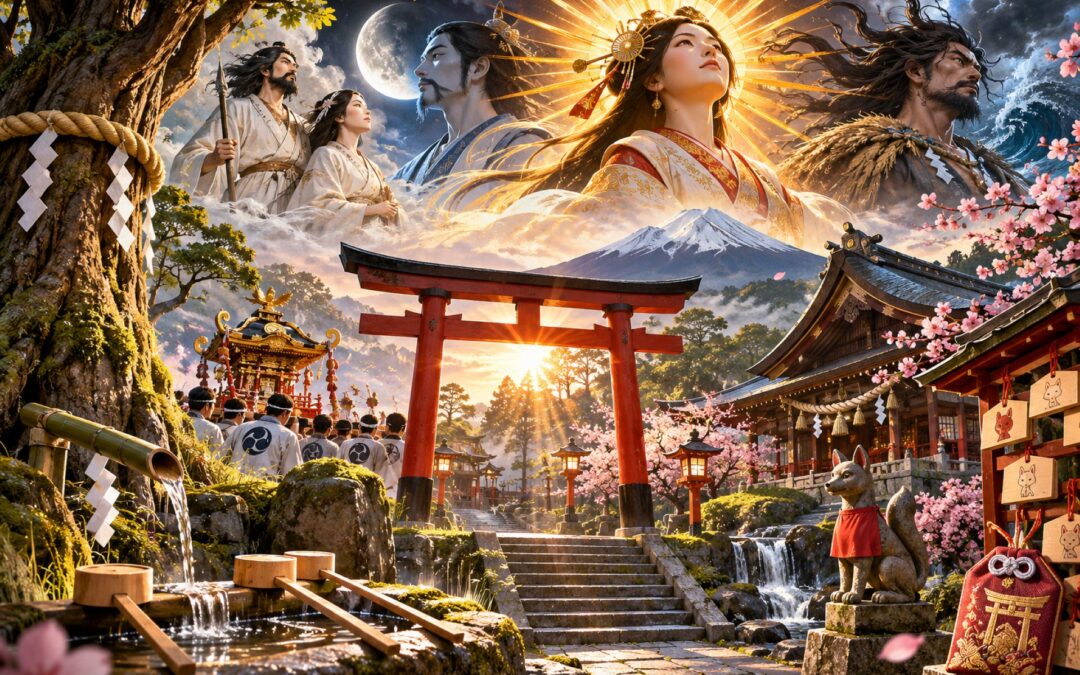
A red torii gate rises from the water at the edge of a Japanese island. Elsewhere, a row of smaller gates climbs a wooded hillside, their pillars forming a tunnel of vermilion. Even people who know little about Japanese religion recognize these images. They mark an entrance into a world where a mountain may be sacred, a tree may be treated with reverence, and a visit to a shrine can be part of an ordinary family celebration.
That world is shaped by Shinto, Japan’s indigenous religious tradition. Yet it resists an easy definition. Many Japanese people visit shrines without identifying themselves as religious. Some honour kami while also taking part in Buddhist rituals. Shinto has priests, sacred places, myths and elaborate ceremonies, but no single founder, universally binding creed or one scripture that settles every question.
Understanding Shinto means following a relationship rather than merely memorizing a pantheon. Its stories describe how the world took shape; its rituals seek to restore purity; its shrines connect communities to the places they inhabit. Across centuries, those practices have also changed under the influence of Buddhism, imperial politics and modern life.
What Is Shinto, and Where Did It Come From?
Shinto is often translated as “the way of the kami.” The Japanese word is written with characters associated with the sacred or divine (shin) and a path or way (tō). The latter character also appears in the Chinese term Dao. This linguistic connection does not make Shinto a branch of Daoism. Instead, it reflects how Japanese traditions were named and discussed using a writing system and intellectual vocabulary shaped by contact with China.
The concept at its centre is kami, commonly translated as gods or spirits, though neither English word fully captures it. Shinto takes many forms: shrine ceremonies conducted by priests, village festivals, household observances, pilgrimages and deeply local customs. Participants may express reverence, gratitude or hopes for protection without being required to subscribe to a fixed list of doctrines. Ritual practice and relationships with the sacred often matter more than formal statements of personal belief.
Its beginnings are difficult to pin down. Archaeologists have found evidence of prehistoric ritual activity, including distinctive objects, burial practices and sites later associated with sacred landscapes. During the Yayoi period, agricultural communities developed increasingly elaborate practices connected with seasonal cycles, fertility, ancestors and political authority. But artifacts cannot tell us precisely what prehistoric people believed, and calling every early ceremony “Shinto” projects a later category backward.
As political networks grew into the Yamato court, local cults, clan traditions and rites connected to rulers acquired broader significance. The institutional history of early kami rites shows how state formation and the legal-administrative reforms of the seventh and eighth centuries helped systematize certain ceremonies and shrines. Ritual life was never simply invented by the government, but neither was there an entirely unchanged national religion waiting to be discovered.
The term Shinto appears in early Japanese written sources, including the eighth-century Nihon Shoki, although its meaning varied across time. At different moments it distinguished practices relating to kami from Buddhism, described particular schools of teaching, or served as a name for an apparently indigenous tradition. Only much later did Shinto acquire several of the familiar institutional boundaries associated with a modern religion.
Two texts are especially important: the Kojiki, compiled in 712, and the Nihon Shoki, completed in 720. They preserve mythological accounts and imperial genealogies alongside political traditions and historical material. They are invaluable evidence for how early court elites represented their world, but they are not a pair of divinely revealed scriptures, nor can their stories be read as literal records of prehistoric events. Shinto’s history is therefore both very old and continually changing: ancient practices developed through centuries of reinterpretation.
The Creation Myths: Izanagi, Izanami, and the Birth of the Kami
In the creation narratives recorded in Japan’s early chronicles, the beginning of the world is not the work of a solitary all-powerful creator. The universe emerges from an undifferentiated condition as lighter matter separates from heavier matter, heaven takes shape, and the earth remains unsettled. Primordial heavenly kami appear, followed by generations of divine beings. The details and sequences differ between the Kojiki and Nihon Shoki, but both present a world gradually acquiring form through relationships among sacred powers.
Among these beings are Izanagi and Izanami, usually portrayed as a male-female pair entrusted with making land out of the drifting waters below. Standing on a heavenly bridge, they lower a jewelled spear into the sea and stir. Drops falling from its tip solidify into an island, often identified as Onogoro. The couple descend and establish themselves there, creating a place from which the rest of the world can be generated.
Their first attempt to produce offspring involves a striking marriage ceremony. They erect a pillar, circle it in opposite directions and meet again. In one influential telling, Izanami speaks first, after which their union produces Hiruko, an imperfectly formed child whom they place in a reed boat and send away. A second offspring is also unsuccessful. The couple consult the heavenly kami, repeat the ceremony with Izanagi speaking first, and their union then produces the islands of Japan. The story reflects the concerns and social expectations of its compilers; it should not be treated as a timeless prescription for marriage.
Hiruko’s fate also illustrates the way myths develop. Later religious traditions sometimes identify the abandoned child with Ebisu, the immensely popular kami associated with fishing, commerce and good fortune. That identification, however, is not simply a line in the earliest narrative about a child growing up and recovering. It is a later joining of traditions that gave an unsettling creation episode a different religious meaning.
Izanagi and Izanami go on to generate numerous kami associated with islands, winds, mountains, trees, water and other features of the living world. Creation is not a single moment followed by a completed universe. It is an ongoing proliferation of relationships, places and powers, with the physical landscape intimately bound to the divine genealogy.
The narrative then turns tragic. Izanami gives birth to Kagutsuchi, a fire kami whose birth fatally burns her. Izanagi mourns his partner and, overcome by grief and anger, kills the fire deity with a sword. Further kami arise from Kagutsuchi’s blood and body in versions of the story, connecting even an act of destruction with new forms of sacred life. Traditional genealogies involving the sea deity Watatsumi belong to other moments in the creation cycle, and Takemikazuchi’s emergence is associated with the violence surrounding Kagutsuchi rather than with a straightforward birth as a storm god.
Unable to accept his loss, Izanagi travels to Yomi, the realm of the dead, hoping to retrieve Izanami. She tells him she has already eaten the food of that realm, yet she will try to obtain permission to return. He must not look at her while she does so. Izanagi waits, becomes impatient and eventually lights a flame. The sight before him is terrible: Izanami’s body has decayed, and the reunion he imagined is impossible.
Humiliated and furious at being seen, Izanami pursues him, with terrifying beings sent after the fleeing husband. The stories furnish the escape with memorable obstacles and delaying tricks. Izanagi ultimately reaches the boundary between the worlds and blocks the entrance with an enormous boulder. Husband and wife speak across the barrier, now separated not merely by anger but by the division between life and death.
Izanami threatens to cause the deaths of a thousand people each day. Izanagi replies that he will ensure the birth of fifteen hundred. Their exchange is a mythic explanation of why death remains part of human existence while new generations continue to appear. It is also a bleak account of a relationship that cannot be restored once its boundary has been crossed.
Contact with Yomi leaves Izanagi contaminated, so he seeks purification in flowing water. As he removes his garments and washes different parts of his body, still more kami are born. Finally, his left eye gives rise to Amaterasu, the radiant sun kami; his right eye to Tsukuyomi, associated with the moon; and his nose to Susanoo, the turbulent deity commonly linked with storms and the sea. These three become central figures in subsequent myths.
Amaterasu is especially important because the imperial lineage claims descent from her through further divine generations. Other stories tell of Susanoo’s destructive behaviour and Amaterasu’s withdrawal into a heavenly cave, plunging the world into darkness until the other kami devise a ritual means of drawing her out. These accounts connect cosmic order, light, performance and political legitimacy. They also introduce a recurring Shinto theme: defilement and rupture are serious, but ritual action can restore a livable relationship with the sacred.
Who Are the Kami? Nature, Ancestors, and Sacred Presence
Calling a kami a “god” is a useful starting point, but it can create misleading expectations. Shinto has no requirement that every kami be an eternal, all-knowing person who rules a particular department of nature. Some are named figures in myths; others are connected to particular landscapes, exceptional ancestors, communal protections or remarkable phenomena. What unites them is not an identical form but the capacity to inspire reverence, gratitude, wonder or fear.
Japan’s mountains, rivers, waterfalls, seas and forests have often provided settings for such relationships. A mountain may be sacred in its entirety, not merely because someone placed a religious building on it. Powerful storms or dangerous diseases can likewise be understood in terms of kami without implying that every fox, tree or earthquake is automatically a separately worshipped god. A sacred presence is recognized within a specific history of stories, customs and practices.
Some kami are known across the country. Amaterasu is worshipped at Ise and has long been linked to imperial ancestry. Inari, associated especially with rice, agriculture and prosperity, is honoured at thousands of shrines and is frequently represented through fox imagery. The foxes are commonly understood as Inari’s messengers rather than as an uncomplicated statement that Inari is a fox. Other kami have narrower geographical reach, guarding a village, family, shrine precinct or particular waterfall such as Nachi Falls.
Humans can also enter the world of kami through remembrance and worship. Sugawara no Michizane, a scholar and statesman who died in 903, was posthumously honoured as Tenjin, associated with learning and scholarship. Students still visit Tenjin shrines in the hope of success in examinations. His transformation from a politically wronged historical figure into an object of worship shows how fear, reconciliation and admiration can merge in Japanese religious history.
Shinto traditions also speak of musubi, a concept associated with generative and binding power. It suggests the creative processes through which life grows, relationships form and the world continues to develop. That is a richer idea than simply picturing nature as a collection of individual gods. Humans, places and sacred powers exist in an interdependent world, and appropriate relationships require attention and reciprocity.
These relationships do not guarantee permanent harmony. Kami can be beneficent, formidable or dangerous; misfortune may be interpreted through harmful divine influences, with other kami invoked for restoration. Traditions surrounding magatsuhi and naobi, for example, evoke disorder and its correction. The innumerability of sacred powers is sometimes expressed as “eight million kami,” where the number conveys countlessness rather than an official census.
The wider folklore of Japan also contains yōkai: strange apparitions, animals and beings that can frighten, deceive or amuse. They range from terrifying figures to the oddly comic Tōfu-kozō, a childlike figure associated with carrying tofu. Yōkai and kami can overlap in some local traditions, but they are not interchangeable categories. Their proximity reveals the porous boundary between formal worship, folk narratives and everyday imagination.
Sometimes a religious relationship is visible in the most modern setting. At Kayashima Station near Osaka, an enormous camphor tree rises through the railway platform. When the tracks were elevated, the tree associated with Kayashima Shrine was preserved after local residents pressed for it to remain, and the station was designed around it. The sight is striking precisely because the tree was not dismissed as an obstacle to progress: infrastructure made space for a cherished sacred landmark.
Purity, Pollution, and the Meaning of Shinto Ritual
Izanagi’s first act after escaping Yomi is to wash. The episode makes purification more than a matter of personal cleanliness: he has crossed into the realm of death, and returning to life requires a symbolic restoration of order. Many Shinto rituals begin with the same underlying concern, although their forms differ widely among shrines and traditions.
The broad term harae refers to purification or the removal of ritual obstacles. Kegare often describes a condition of defilement associated with events such as death, blood or illness, while tsumi can refer to ritual transgressions or offences. Their meanings have shifted across history, so translating either word simply as “sin” produces confusion. In particular, ritual impurity need not imply that a person is morally bad, and an experience of death or illness is not evidence of personal guilt.
This distinction matters because Shinto is sometimes said to lack morality altogether. It is true that many shrine rituals focus less on universal creeds or salvation from sin than on maintaining appropriate relationships. But the tradition also contains ideals of sincerity, reverence, good conduct and responsibility to other people. Moral wrongdoing and ritual disruption are related subjects without being identical.
The most familiar practice is temizu, the rinsing of hands and sometimes the mouth before approaching a shrine. A purification basin, often accompanied by ladles, stands near the entrance. The sequence is modest, but its meaning is important: a visitor symbolically leaves behind some of the disorder of ordinary life before entering a place devoted to the kami. Modern facilities may use running water, and local instructions should guide the visitor.
More demanding forms of purification are associated with misogi, including washing in rivers, the sea or beneath waterfalls. These can be physically intense rites involving preparation and discipline, not activities that every worshipper is expected to perform. A priest may purify a person, vehicle, building site or ceremonial object by waving a haraigushi, a wand fitted with paper streamers or other materials. Salt is another familiar purifying substance, used in certain shrine ceremonies and in ritualized settings such as sumo.
Some shrines also perform collective purification at seasonal turning points. During ceremonies often called Ōharae, priests recite ritual prayers, or norito, seeking the removal of accumulated defilement and wrongdoing. At midyear, visitors to certain shrines walk through a large ring of woven grass known as a chinowa, following local instructions as a symbolic renewal. The practice is meaningful partly because impurity is not assumed to be permanent: the passing months bring disruptions, and the community can mark a fresh beginning. Its public setting also shows that purification concerns relationships beyond an isolated individual.
Purification is therefore not an attempt to keep nature at a distance or condemn the human body as permanently unclean. It recognizes disruptions to relationships and responds with action. Like the renewed birth of kami from Izanagi’s washing, the rite holds out the possibility of returning to ordinary life with a restored sense of order.
Shinto Shrines: Where Humans Meet the Kami
Shinto is inseparable from its sacred places. A shrine, or jinja, is somewhere people approach and honour kami, but it does not have to resemble a grand building. Some shrines occupy carefully maintained architectural compounds, others consist of a modest roadside structure, and still others centre on a tree, rock, waterfall or mountain. Their importance comes from the sacred relationship sustained there, not simply the scale of construction.
The best-known marker is the torii, the gateway that signals a transition from everyday surroundings to sacred precincts. Often painted vermilion, a torii can also be made from unpainted wood or stone. The approach may continue through a wooded path or a succession of gates, as at Fushimi Inari Taisha in Kyoto. Its famous passages of closely spaced torii are offerings associated with devotion to Inari, not a requirement that every Shinto shrine imitate the same design.
Within a larger shrine, the honden is the main sanctuary, commonly housing a goshintai: an object through which the presence of a kami is understood to be enshrined. Sacred mirrors, swords and jewels are traditional examples, as are natural formations. The object is not simply identical to the kami, and it is usually concealed from ordinary visitors. A haiden, or worship hall, stands before the sanctuary and provides a setting for prayers and ceremonies.
Not all shrines follow this arrangement. At Ōmiwa Shrine in Nara Prefecture, Mount Miwa itself is revered as a sacred embodiment associated with Ōmononushi, and the shrine traditionally has no conventional honden containing a separate sacred object. Such places preserve an understanding of sacred presence in which the natural feature, rather than an image housed inside a building, is fundamental.
A rope called shimenawa, often decorated with folded paper streamers, marks a ritually significant boundary. It may encircle an ancient tree, hang across an entrance or identify an object treated as sacred. These markers help visitors recognize that they are encountering a place governed by religious conventions. They do not imply that all nature is literally a shrine or that kami can be contained permanently by a rope.
Priests, often called kannushi, oversee ceremonies and help maintain shrines, sometimes alongside women serving as miko, who assist in ritual and other duties. Shrines may also belong to networks of supporters and local parishioners, for whom an annual festival and the upkeep of the precincts are shared responsibilities. The Association of Shinto Shrines represents roughly 80,000 affiliated shrines, although Japan also has shrines outside that network and numerous small sacred sites that complicate any national count.
Ise Grand Shrine, associated especially with Amaterasu, illustrates the connection between sacred architecture, imperial tradition and renewal. Some of its principal structures are ritually rebuilt at regular intervals, notably in a twenty-year cycle. Elsewhere, shrines are intimately tied to the needs of trades and neighbourhoods. Kyoto’s Mikami Shrine, associated with the historical hairdresser Fujiwara no Uneme no Suke Masayuki, is linked with hairdressing and appeals concerning hair, including hopes for healthy growth. Its unusual specialty is less evidence of a whimsical national “god of hair” than of the extraordinary variety of localized worship.
A person’s relationship with a shrine may be lifelong, occasional or entirely absent. But the green spaces around many urban shrines offer a vivid contrast to crowded streets. Passing from traffic into a wooded precinct can make the central idea physically tangible: the same landscape can be ordinary ground and, through accumulated stories and ritual attention, a place of sacred encounter.
How to Visit a Shinto Shrine
A visitor need not belong to Shinto to enter most public shrine precincts. The essential expectation is respectful behaviour toward the place and toward people who have come to worship. Because practices vary, instructions at the shrine itself take priority over any universal checklist.
Many people pause briefly and bow before passing beneath a torii. The path may lead to a temizuya, a purification station with water. The customary ladle sequence is to rinse the left hand, switch hands and rinse the right, then pour water into the left palm to rinse the mouth. Visitors should not drink directly from the ladle or return used water to the basin; the mouth-rinsing water is discarded at the base of the station. A final rinse of the left hand completes one commonly taught version. At some shrines, simpler handwashing or a different arrangement is used.
The guidance for entering a shrine published by the Association of Shinto Shrines also emphasizes that the sacred space includes the surrounding grounds, not just the buildings. Barriers and closed doors should be respected. The main sanctuary is normally not an attraction to enter; the visitor’s worship takes place in front of the appropriate hall or offering area.
At the offering box, worshippers may place a coin and ring a bell if one is present. A five-yen coin is popularly considered auspicious because its Japanese pronunciation recalls the word for a fortunate connection, though no specific amount is required. A widely used pattern follows: two deep bows, two claps, a quiet prayer and one final bow. Other shrines have different customs, so the sequence is a convention rather than a creed.
The offerings and gestures need not be understood as a commercial bargain in which money purchases protection. They express respect, gratitude, requests or intentions within an established ritual relationship. Some visitors pray for health, examination results or success in business. Others simply mark a family milestone, give thanks or participate because the visit is an inherited custom.
Shrines also offer omamori, amulets associated with protective blessings, and omikuji, paper fortunes covering matters such as relationships, health or work. People sometimes tie unfavourable fortunes to designated racks or branches, leaving the uncertainty symbolically at the shrine; favourable ones may be taken home. Wooden ema plaques provide space for written wishes or messages. These objects are treated with varying degrees of seriousness, but they are more than decorations. They allow a visitor to take part in Shinto’s world of reciprocal attention through something small and tangible.
Matsuri, Sumo, and Shinto in Everyday Life
A shrine is not only a place for solitary prayer. It can be the centre of a neighbourhood’s social calendar, particularly during a matsuri, or festival. Different communities celebrate different kami and histories, and their events range from restrained ceremonies to spectacular street processions. Food stalls, music and crowds are visible features, but ritual offerings and acts of communal devotion often provide the reason for gathering.
A central element at many festivals is the mikoshi, a portable shrine that represents the temporary presence or conveyance of a kami. Participants carry it through streets, sometimes with rhythmic calls and energetic movements, bringing the sacred presence into contact with the community beyond the fixed shrine grounds. Other festivals feature kagura, music and dance performed in religious contexts, as well as forms of traditional performance, archery or ceremonial contests. Food offerings to kami, known as shinsen, and rites of purification may accompany the festivities.
The new year provides one of the most familiar occasions. Hatsumōde, the year’s first visit to a shrine or Buddhist temple, is particularly popular in the opening days of January. Families and friends may queue for hours, make offerings, draw fortunes and return old amulets before obtaining new ones. For some it is a solemn act of worship; for others, a seasonal outing with religious customs woven into the celebration. Any estimate of participation depends on how visits and individual visitors are counted, so a sweeping claim that a fixed percentage of Japan observes the event is unreliable.
Other ceremonies are linked to life stages. Parents may bring a newborn child for a shrine visit known as miyamairi, asking for protection and celebrating the child’s arrival. Children participate in Shichi-Go-San observances traditionally associated with ages three, five and seven. Shrine weddings offer another occasion for blessings and family ritual, even among people who do not describe themselves as active religious believers.
Sumo makes the relationship between ritual and public spectacle especially visible. Before a bout, wrestlers scatter salt as a gesture of purification, and the ring is treated as a space subject to ceremonial conventions. The yokozuna, the highest-ranked wrestlers, take part in distinctive ring-entering ceremonies and wear elaborate ceremonial ropes that recall sacred marking. Sumo’s history combines religious symbolism, sporting institutions and theatrical presentation; it would be misleading to say every competitive act is itself a shrine ceremony.
The unusual nakizumō, or crying-sumo festival, turns competition into a blessing for infants. At some local events, sumo wrestlers hold babies while attendants encourage them to cry, drawing on the belief that a vigorous cry can signal health or repel harmful influences. Rules, dates and methods vary by location; it is not a single nationally standardized May festival. What might look strange from outside is another example of how hopes for health and prosperity become a shared ceremony.
These customs reveal why Shinto cannot be measured only through attendance at formal worship services. A neighbourhood procession, a child’s blessing or a family visit at New Year may be religious, social and cultural at the same time. The boundaries depend partly on how participants understand what they are doing.
How Shinto and Buddhism Became Intertwined
Shinto is often described as Japan’s indigenous religion and Buddhism as an imported one. Historically, that contrast is useful only up to a point. Buddhism came to Japan through connections with the Korean peninsula and mainland Asia during the sixth century, and the two traditions then influenced one another for more than a millennium. Much of Japanese religious life developed within their coexistence rather than in separate, self-contained compartments.
At first, Buddhist teachings and institutions gained support among competing elite families and members of the imperial court. Temples offered sophisticated rituals, sacred images, scholarly traditions and promises of protection for the realm. Existing kami rites did not simply disappear. Instead, political and religious leaders sought ways of understanding how the powers honoured at shrines related to buddhas and bodhisattvas. The resulting encounters between Japanese worship and Buddhist traditions shaped ritual life and architecture alike.
An important historical process is called shinbutsu shūgō, the combination or integration of kami and buddhas. Shrines and temples might occupy a shared precinct, Buddhist monks might perform rites for local kami, and religious images or titles could cross boundaries. The practice differed by period and locality; no single theology was applied everywhere. Some shrine traditions retained particular identities, and disputes over authority and resources were not uncommon.
A major framework was honji suijaku, often explained as the relationship between an original ground and its manifested trace. In many medieval interpretations, a buddha or bodhisattva was the deeper reality appearing to people in Japan in the form of a local kami. This did not mean that every Buddhist figure and every kami could be paired mechanically. Rather, it provided a language through which communities could hold together overlapping sacred histories and practices.
Hachiman illustrates the complexity. Associated with warriors and imperial protection, Hachiman was also revered through Buddhist identities, including the title Hachiman Daibosatsu, or Great Bodhisattva Hachiman. Shrine-temple complexes sometimes made the combination materially inseparable. Visitors could encounter architecture, images, clergy and ceremonies that did not fit a clean distinction between “Shinto shrine” and “Buddhist temple.”
The connections also influenced ideas about death and the afterlife. Buddhist traditions supplied elaborate funerary and memorial practices, while many shrine rituals focused strongly on blessings, purification and relationships within this world. Yet it would be wrong to imagine that Shinto never dealt with death or that Buddhism alone handled every spiritual concern. Local customs and family histories could complicate the usual division.
Early modern Japan saw renewed efforts to classify these traditions, including scholarship that sought sources of an indigenous Japanese cultural identity. Later government action would try to separate practices that had become deeply interwoven. The historical record of shinbutsu bunri, the state-directed separation of kami and Buddhist institutions beginning in 1868, makes clear how extensive the earlier mixture had been. A decree to separate two religions was necessary precisely because ordinary religious life rarely kept them neatly apart.
This long history helps explain contemporary Japan. A person can seek blessings at a shrine, appreciate Buddhist memorial services and feel no conflict between those activities. That does not erase important differences between Shinto and Buddhism; it reflects the ways religious traditions can coexist and become meaningful through shared institutions and personal practice.
The Meiji Restoration, State Shinto, and the Second World War
Shinto’s relationship with political power is older than modern Japan. Early court chronicles connected the imperial family to Amaterasu, and court rituals helped express the authority of the sovereign. Nevertheless, the nationally organized Shinto associated with modern imperial ideology did not exist unchanged from antiquity. It emerged through specific political decisions during a period of upheaval and state-building.
During the early modern era, scholars associated with kokugaku, or National Learning, studied Japanese classical literature, language and religious traditions. Some criticized the intellectual dominance of Chinese learning and Buddhism and argued for renewed attention to what they considered Japan’s authentic inheritance. These thinkers did not all share one programme, but their work helped provide concepts and narratives later used by political reformers.
The Meiji Restoration of 1868 overturned the Tokugawa shogunate’s political order and initiated a far-reaching effort to build a centralized modern state. Leaders sought a common national identity as they reformed administration, the military, education and Japan’s relationship with foreign powers. Imperial symbolism offered one language of unity, and selected shrine rites and myths were elevated in the new political environment.
The government introduced shinbutsu bunri, measures requiring a formal separation between shrines and Buddhist temples. Buddhist images and terminology were removed from many shrine settings, and priests who had served blended institutions faced changes in status. The campaign sometimes encouraged haibutsu kishaku, destructive anti-Buddhist movements that damaged temples, images and property. The severity varied greatly across regions, and the destruction should not be presented as the inevitable preference of every Shinto worshipper.
Later government administration placed shrines within a system distinct from many other religious organizations. In 1900, a Shrine Bureau was established to oversee shrine affairs. Certain shrine ceremonies were presented as public, national observances rather than ordinary denominational worship. That distinction helped officials promote participation in imperial rites while maintaining a claim that the state was not simply enforcing membership of one religion.
The term State Shinto is used in different ways by historians. In a narrow institutional sense, it refers to state-supervised shrine systems and their legal administration. More broadly, it describes religiously inflected national ideology that connected imperial legitimacy, civic duty and loyalty to the state. Those meanings overlap but are not identical, and the system developed through separate laws and policies rather than one timeless doctrine.
The imperial origin myths played an important role. Amaterasu’s place in the sacred genealogy supported representations of the emperor as uniquely connected with the divine. Rituals, school instruction and official ceremonies could present loyalty to the emperor as a moral duty tied to Japan’s national destiny. The traditional founding narrative surrounding Emperor Jimmu also acquired renewed political prominence, including commemorations of Japan’s supposed foundation. Mythological chronology was treated as national symbolism, not independently verifiable early history.
As Japan expanded its empire and descended into prolonged warfare in Asia and the Pacific, state-sponsored imperial ideology contributed to the environment in which militarism and sacrifice were glorified. This did not make every shrine priest an architect of war or every person attending a festival a supporter of imperial conquest. The role of state institutions, coercion, local practices and individual belief must be distinguished. Shinto’s entanglement with nationalism is historically serious precisely because it cannot be reduced to a single explanation.
Japan’s defeat in 1945 brought decisive changes. The Allied occupation authorities issued the Shinto Directive in December 1945, seeking to end governmental sponsorship of state-directed shrine ideology and to separate public authority from religious indoctrination. Emperor Hirohito’s New Year’s rescript in January 1946 rejected claims that the bond between emperor and people depended on a false idea of the emperor as a manifest deity. The rescript’s interpretation remains debated, so describing it as a simple renunciation of every religious connection between the emperor and Shinto goes too far.
Under Japan’s postwar constitutional order, religious freedom and the separation of religion and state became central principles. Many shrines reorganized outside direct government administration, and the Association of Shinto Shrines emerged as an important non-governmental organization rather than an institution ruling all forms of Shinto. Imperial rites, local devotion and debates over memorial shrines still coexist, showing that the political history of Shinto has not ceased to matter.
Shinto in Modern Japan: Religion, Culture, or Both?
A visitor to Japan might see shrine gates everywhere, encounter local festivals throughout the year and watch families making offerings at New Year. It would be tempting to conclude that nearly everyone identifies as Shinto. Yet surveys asking people to name their religion often produce much lower figures, while institutional statistics may count affiliations through household or shrine networks. The figures measure different relationships and should not be added together or treated as contradictions.
A 2024 Pew Research Center report offers a useful distinction. In its survey, 4% of Japanese adults identified Shinto as their religion, while 27% reported feeling personally connected to the Shinto way of life. A separate question found that 38% said they prayed or paid respects to kami. These results do not mean the other 62% never enter a shrine, nor that everyone who attends a festival is a Shinto believer. They show why identifying with a tradition, practising a particular rite and taking part in a cultural event require different questions.
A frequently repeated shorthand says that Japanese people have Shinto weddings and Buddhist funerals. It captures a recognizable pattern, but it is not a rule governing every family. Weddings can be secular, Christian-style, Buddhist or Shinto; funerary customs also vary. Some individuals visit shrines and temples without treating the activities as competing claims to exclusive religious membership. Others have strongly defined religious commitments or no interest in ritual life at all.
In daily practice, Shinto often takes shape through relationships with places and communities. The shrine at the centre of a district may host an annual festival, receive families for children’s ceremonies or organize blessings for buildings and businesses. A household may maintain a kamidana, a small shelf for enshrined sacred objects or talismans, while a person living elsewhere may know Shinto primarily through occasional visits and seasonal celebrations.
Images associated with kami and animated landscapes also appear in Japanese art and popular culture, including fantasy stories, animation and games. Films by Studio Ghibli and franchises such as Pokémon draw upon broader Japanese imaginative worlds in which place, spirit and nonhuman agency can matter. These are creative interpretations, not transparent accounts of Shinto doctrine, and the sources of any particular character or scene may be more diverse than a single religious tradition.
Shinto’s relationship with nature is similarly complex. Ritual attention to mountains, forests and waterfalls can encourage care for sacred landscapes, but it does not automatically make every shrine or adherent part of an environmental movement. Nor is modern Shinto free of institutional debate: questions about politics, historical memory, local customs and religious identity remain alive. The tradition contains both enduring practices and disagreements about what those practices should mean.
Perhaps the most important point is that Shinto’s presence cannot be understood through an all-or-nothing choice between “religion” and “culture.” The same act can be communal, inherited, aesthetic and devotional. Its meaning changes with the participant, the place and the occasion. That flexibility does not make Shinto unreal or empty; it is part of what has allowed it to remain recognizable through repeated historical transformations.
A torii gate does not reveal what every person who passes beneath it believes. It announces that a boundary matters: ordinary surroundings can become a place of encounter, gratitude and ritual attention. Beyond it may stand an imposing sanctuary, a quiet grove, a weathered stone or a tree that a community refused to cut down.
That is the thread running from the myths of Izanagi and Izanami to a family drawing a fortune at New Year. Shinto has never been one unchanging collection of beliefs. It is an evolving set of relationships among kami, people, landscapes, ancestors and institutions. Its stories explain how the world becomes alive with sacred presence, and its rituals give people ways to respond to that presence. In Japan, those relationships have survived not by remaining untouched by history, but by becoming part of it.
Last Updated on November 26, 2026 by Aseem Gupta