
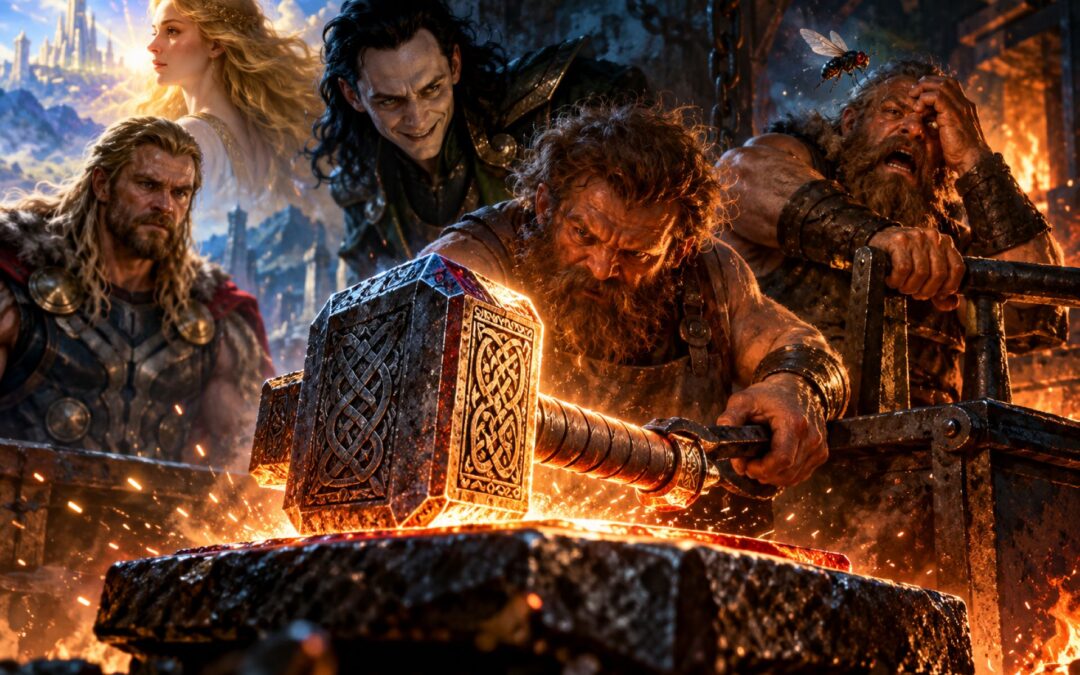
Thor is rarely imagined without Mjölnir, the mighty hammer that makes him one of the most formidable gods in Norse mythology. With it, he battles giants, protects the gods of Asgard, and wields a weapon that returns to his hand whenever he throws it. Yet the story of how Thor acquired his legendary hammer is surprisingly less about his own strength than about Loki’s mischief, the extraordinary skills of dwarven craftsmen, and a wager that nearly costs the trickster his head.
Even more surprisingly, Mjölnir was never supposed to have such a short handle. Its most recognizable physical feature was the result of an interruption during its creation, and the circumstances behind that mistake reveal how close the gods came to receiving a very different weapon.
The story, preserved in the medieval Icelandic Prose Edda, begins not with a battle or a quest, but with Loki deciding to play a particularly cruel trick on Thor’s wife.
Loki Cuts Sif’s Hair and Faces Thor’s Wrath
Sif, the wife of Thor, was renowned for her beautiful golden hair. Although the surviving myths reveal relatively little about her compared with figures such as Odin, Thor, and Loki, her extraordinary hair plays a central role in one of the most entertaining stories of Norse mythology.
One day, Loki decided to cut it all off. The surviving account does not explain his precise motivation, but the incident fits his reputation for causing trouble without considering the consequences. Whatever amusement he expected from the prank disappeared when Thor discovered what had happened.
Thor was furious. In the account preserved in Skáldskaparmál, the section of the Prose Edda describing the creation of the gods’ treasures, Thor seized Loki and threatened to break every bone in his body unless he found a way to restore Sif’s hair.
Loki understood that he could not defeat Thor through physical strength. His only hope was to talk his way out of the punishment, something at which he was considerably more accomplished. He promised that he would obtain a new head of hair for Sif, made entirely from gold yet capable of growing like ordinary human hair.
It was an ambitious promise, but Loki knew where he might find someone capable of fulfilling it. In Norse mythology, dwarves were master craftsmen whose abilities extended far beyond ordinary metalworking. They could create enchanted objects possessing extraordinary properties, including weapons and treasures that even the gods could not manufacture for themselves.
Loki therefore sought out the dwarves known as the Sons of Ivaldi. His immediate objective was to save himself from Thor’s anger, but his visit would set in motion a much larger sequence of events.
By the time he returned to Asgard, the gods would possess several remarkable new treasures, including the weapon that would become inseparable from Thor’s identity.
The Sons of Ivaldi and Loki’s Dangerous Wager
The Sons of Ivaldi accepted the challenge and demonstrated their craftsmanship by producing three extraordinary objects. Each possessed magical qualities that made it far more valuable than an ordinary treasure, and together they established the standard against which another group of dwarven craftsmen would soon be judged.
Their first creation was the golden hair intended for Sif. Rather than simply manufacturing a decorative wig, they fashioned strands of gold that would grow naturally once placed upon her head. The object fulfilled Loki’s promise and provided a means of restoring what he had destroyed.
The second treasure was Gungnir, a magnificent spear intended for Odin, the chief of the Norse gods. Its defining quality was its unfailing accuracy: when used against a target, it would not miss. For a god associated with warfare, kingship, and the pursuit of knowledge, such a weapon was an exceptionally valuable gift.
Their third creation was Skíðblaðnir, an enchanted ship intended for Freyr. The vessel was large enough to accommodate the gods and their equipment, yet it could be folded into a tiny bundle and carried away when not needed. Whenever its sail was raised, it would also receive a favorable wind, making it an extraordinary means of transportation.
Having obtained these treasures, Loki might reasonably have considered his problem solved. Instead, he became involved in another dangerous arrangement, this time with two brothers named Brokkr and Sindri. The latter is also called Eitri in some retellings of the myth.
Loki wagered his own head that Sindri could not produce three objects equal in excellence to those created by the Sons of Ivaldi. If the brothers succeeded, Brokkr would be entitled to claim the trickster’s head as payment.
The wager was extraordinarily reckless, even by Loki’s standards. He had already escaped one potentially devastating punishment through a promise, yet he was now risking his life on the outcome of a contest he could not directly control.
What followed was not merely a demonstration of craftsmanship but an increasingly desperate attempt to prevent the brothers from winning. Brokkr and Sindri possessed the necessary skills to challenge the Sons of Ivaldi, and Loki’s best chance of escaping his wager appeared to lie in interfering with their work.
The scene shifted to the dwarves’ forge, where three new treasures would be created under increasingly difficult circumstances.
The Fly, the Forge, and Mjölnir’s Short Handle
The brothers divided their responsibilities. Sindri would place the necessary materials into the forge and perform the work that transformed them into magical objects, while Brokkr operated the bellows to maintain the fire.
The bellows were essential to the process. By forcing air into the forge, Brokkr kept the fire burning with the intensity required for Sindri’s work. He was instructed not to stop operating them until his brother returned, no matter what happened.
For their first creation, Sindri placed a pigskin into the forge and left Brokkr to maintain the bellows. While Brokkr worked, a fly landed on his hand and bit him, causing considerable discomfort. Despite the distraction, he continued operating the bellows without interruption.
When Sindri returned and removed the finished object, the pigskin had been transformed into a remarkable golden boar named Gullinbursti. Its magical abilities would make it one of the most extraordinary creatures associated with the Norse gods.
The brothers then began their second creation. Sindri placed gold into the forge and once again instructed Brokkr to maintain the bellows without stopping. The fly returned, this time biting Brokkr on the neck and inflicting a more painful injury.
Once again, Brokkr endured the attack and continued working. The second object emerged successfully from the forge: Draupnir, an enchanted golden ring capable of multiplying itself.
Two treasures had now been completed despite the interruptions. Their creation demonstrated that the brothers were more than capable of challenging the Sons of Ivaldi, and the final object would determine whether they could produce something even greater.
For their third creation, Sindri placed iron into the forge. As before, Brokkr was instructed to operate the bellows continuously, but this time the fly launched its most determined attack.
Instead of biting his hand or neck, it landed on Brokkr’s eyelid and bit him so fiercely that blood flowed into his eye. Unable to see properly and struggling with the pain, Brokkr finally raised a hand from the bellows to drive the insect away.
The interruption lasted only a moment, but it was enough to damage the result.
When Sindri returned and removed the finished object, he discovered that the hammer they had created was magnificent but imperfect. Its handle had come out shorter than intended because the bellows had briefly stopped during the forging process.
That hammer was Mjölnir.
The fly’s repeated attacks are commonly interpreted as Loki attempting to sabotage the brothers’ work, sometimes through the suggestion that he had transformed himself into the insect. The interpretation fits Loki’s predicament and his established reputation for deception, but an important textual distinction remains: Snorri’s surviving account describes the fly and its attacks without explicitly identifying it as Loki.
What the narrative establishes beyond doubt is the relationship between the attacks and the hammer’s unusual appearance. Brokkr resisted the first two interruptions, allowing the golden boar and ring to emerge successfully. During the third attack, however, he briefly abandoned his task, and the resulting hammer was left with an unusually short handle.
The mistake could not be undone. Nevertheless, the hammer possessed abilities so extraordinary that its imperfect construction would ultimately prove less important than its usefulness.
With all three treasures completed, Brokkr was ready to present them before the gods and demand judgment on Loki’s wager.
The Six Treasures and the Gods’ Verdict
The contest was judged by three of the most important gods in Norse mythology: Odin, Thor, and Freyr. Each would receive two remarkable gifts, one from the Sons of Ivaldi and another from Brokkr and Sindri, allowing the gods to evaluate the achievements of the rival craftsmen.
The Sons of Ivaldi’s treasures were presented first. Odin received Gungnir, the unfailing spear, while Freyr received Skíðblaðnir, the extraordinary ship that could be folded away and summoned for voyages with favorable winds. Thor received the golden hair intended for Sif, fulfilling Loki’s promise to restore what he had cut away.
These were impressive creations, and each served a distinct purpose. Gungnir offered certainty in combat, Skíðblaðnir provided extraordinary mobility, and Sif’s golden hair repaired the damage that had begun the entire affair.
Brokkr then presented the three treasures created by his brother, beginning with Gullinbursti.
The golden boar was given to Freyr. Its bristles shone brightly enough to illuminate even the darkest surroundings, and it could travel through the air and across water with extraordinary speed. In the account, its abilities made it more than an impressive ornamental creature; it was also a supernatural means of transportation.
The next gift was Draupnir, presented to Odin. Every ninth night, the enchanted ring would produce eight additional rings of equal weight. Its ability to generate more gold made it a remarkable treasure, although the myth does not require the additional rings to be understood as possessing every magical quality of the original.
Finally, Brokkr presented Mjölnir to Thor.
Despite its short handle, the hammer possessed extraordinary powers. Thor could strike with it as forcefully as he wished, and whatever he struck would not withstand the blow. When he threw it at a target, the hammer would not miss, and regardless of how far it traveled, it would return to his hand.
Mjölnir could also be made sufficiently small to be concealed within Thor’s clothing, allowing him to carry it conveniently when it was not being used.
These abilities made it an exceptional weapon, particularly for a god whose strength and confrontations with giants were central features of his mythology. Thor already possessed enormous physical power, but Mjölnir gave him a magical weapon that could repeatedly deliver devastating blows without being lost after each throw.
The gods now had to decide which group of craftsmen had produced the superior treasures. Their judgment was not simply a matter of determining which objects were most beautiful, valuable, or technically impressive. The usefulness of the creations also mattered, especially in a world where the gods faced dangerous enemies.
Gungnir was an extraordinary weapon, Skíðblaðnir a remarkable ship, and Draupnir a treasure capable of continually producing additional wealth. Gullinbursti combined speed with magical illumination, while Sif’s hair fulfilled the immediate obligation that had brought Loki to the dwarves.
Yet Mjölnir offered something the gods considered more important than any of these individual advantages.
The hammer would provide their greatest defense against the giants.
In Norse mythology, the giants, commonly called jötnar, frequently appear as powerful opponents of the gods, although their relationships with the divine world are more complicated than a simple division between good and evil. Thor’s role as a formidable adversary of hostile giants made Mjölnir especially valuable to the security of Asgard.
The judges therefore declared that Brokkr and Sindri had produced the superior gifts, with Mjölnir receiving the greatest praise. Its short handle was an acknowledged flaw, but the weapon’s extraordinary powers outweighed the imperfection.
Loki had lost his wager.
The result was especially ironic because the hammer’s most distinctive flaw had emerged from the very interference commonly associated with Loki’s attempt to prevent the brothers from succeeding. Instead of securing his escape, the contest had given Thor the greatest weapon he would ever possess.
For Brokkr, however, the judgment meant something more immediate. He had fulfilled the conditions of the wager and was now entitled to collect his payment.
That payment was Loki’s head.
Loki’s Head, His Neck, and the Sewn Lips
Loki had no intention of surrendering his head, even after the gods declared Brokkr the winner. He initially attempted to escape the consequences of his wager by offering compensation, but Brokkr refused to accept an alternative payment.
The dwarf wanted exactly what had been promised.
Loki then fled, relying on his ability to escape pursuit, but Brokkr appealed to Thor for assistance. Thor caught Loki and brought him back, leaving the trickster to confront the debt he had incurred.
It appeared that Loki had finally run out of ways to avoid punishment. He had agreed to surrender his head if the brothers won, and the gods had confirmed that their creations were superior. Brokkr therefore prepared to claim his prize.
At that moment, Loki raised an objection that revealed just how skillfully he could exploit the wording of an agreement.
The wager had given Brokkr the right to take Loki’s head, but Loki argued that it had not given him any right to his neck. If the dwarf attempted to sever the head, he would necessarily have to cut into the neck, which was not included in the bargain.
The distinction was absurdly convenient, but it created a problem for Brokkr. He had won the wager, yet Loki’s interpretation prevented him from carrying out the punishment exactly as intended.
Unable to take the head without violating the condition, Brokkr decided to punish Loki in another way.
He would sew the trickster’s mouth shut.
The surviving account describes Brokkr attempting to pierce Loki’s lips with a knife, only to discover that the blade would not cut them. He then called for his brother’s awl, a sharp tool used for making holes, and used it to pierce Loki’s lips before sewing them together.
This punishment carried an obvious irony. Loki had escaped danger repeatedly through clever speech, persuasive promises, and the exploitation of technicalities. Now the very mouth that had allowed him to manipulate others became the object of his punishment.
Yet even this ending was not quite as permanent as Brokkr might have hoped.
After his lips had been sewn together, Loki tore out the fastening used to bind them. The punishment had been inflicted, but the trickster was not permanently silenced.
The myth therefore ends with two different outcomes for Loki. His clever argument saves him from losing his head, but it does not prevent him from suffering the consequences of his reckless wager. Meanwhile, Thor emerges from the affair with a weapon far more valuable than anything Loki originally set out to obtain.
Mjölnir would become one of the defining treasures of the Norse gods.
Thor used the hammer in his struggles against the giants, and its importance continued throughout the surviving mythology, extending to his final confrontation with Jörmungandr, the great world-serpent, at Ragnarök.
The hammer also held significance beyond the literary stories. Archaeological discoveries, including Viking Age hammer-shaped amulets and rings documented by the Swedish History Museum, demonstrate that symbols associated with Thor were used in historical Scandinavian societies. Although their precise meanings and uses varied and cannot always be established, they show that Mjölnir was more than an object confined to mythological storytelling.
The origin of Thor’s hammer brings together several characteristic elements of Norse mythology: the unpredictability of Loki, the ingenuity of dwarven craftsmen, the importance of binding promises, and the constant tension between the gods and their enemies.
Mjölnir was not created through Thor’s own effort, nor was its unusual appearance the result of deliberate design. It emerged from Loki’s attempt to escape one punishment, his willingness to risk another, and an interruption that nearly ruined an extraordinary piece of craftsmanship.
In trying to save himself, Loki inadvertently helped provide Thor with the very weapon that would make him one of the most formidable figures in Norse mythology.
Last Updated on October 29, 2026 by Aseem Gupta