
Reading Time: 20 Minutes
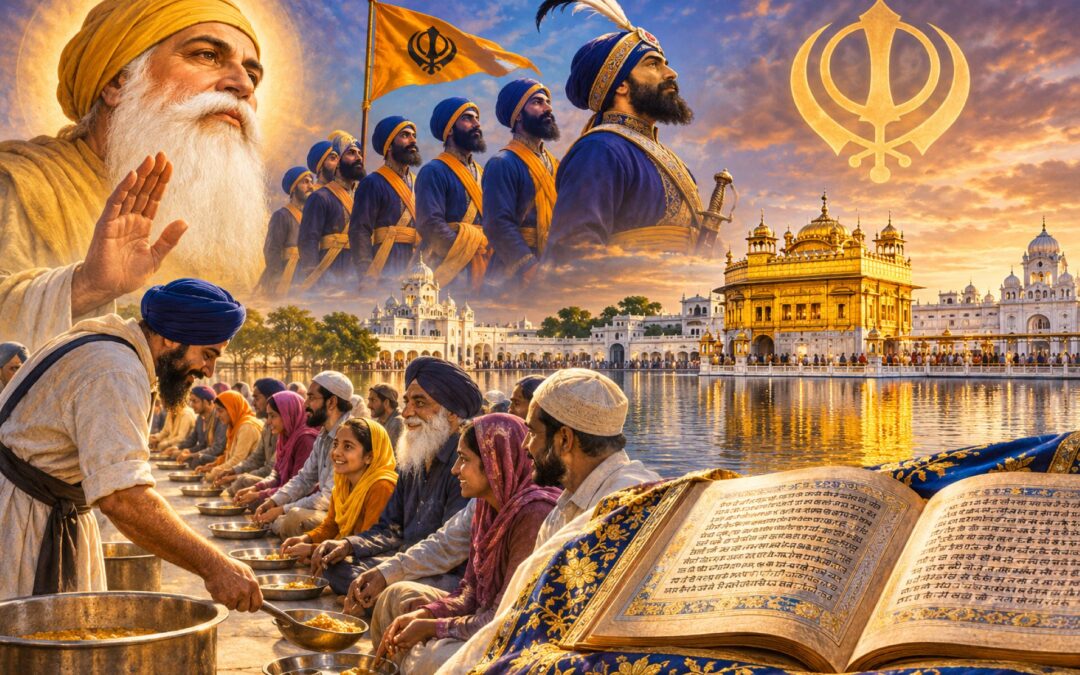
Every day, people gather inside the Golden Temple complex in Amritsar to prepare enormous quantities of food, wash utensils, serve meals and clean the floors. Visitors sit together to eat, without being separated by religion, caste or social standing. They do not need to pay, offer proof of faith or explain why they have come. The meal is called langar, and the people who make it possible are often volunteers.
Outside the kitchen, another familiar image of Sikhism seems to tell a different story: a person wearing a turban and carrying a kirpan, a blade that is among the articles of faith of initiated Sikhs. One image suggests hospitality and service; the other, discipline and an obligation to confront injustice. They are not competing visions. They emerge from a tradition that asks believers both to recognize a divine presence in everyone and to take responsibility for what happens to other people.
Sikhism, or Sikhi, arose in Punjab around five centuries ago. Its teachings developed through ten human Gurus and are now centred on the Guru Granth Sahib, a scripture honoured as the eternal Guru. To understand Sikhism is to explore how its beliefs about God, the ego, equality and liberation became a way of living, working, worshipping and belonging to a community.
Guru Nanak and the Punjab That Gave Birth to Sikhi
Punjab, the land of five rivers, has long been a meeting place of peoples, languages and religious traditions. Centuries before Sikhism emerged, the wider region had been home to settlements of the Indus Valley Civilization. Later, different kingdoms, trading networks and empires shaped its life. Hindu devotional traditions, Islamic learning and Sufi spirituality were all part of the religious world in which Sikhism took form. The broader history of India provides the political and cultural background to this setting.
Guru Nanak was born in 1469 in Rai Bhoi di Talwandi, a village now known as Nankana Sahib in Pakistan. Sikh traditions remember him as unusually reflective from childhood, questioning empty rituals and conventional measures of success. Rather than treating the spiritual teachings he encountered as reasons for competing identities, he was drawn to questions about God, human conduct and the barriers people placed between themselves.
As a young adult, Nanak lived in Sultanpur Lodhi, where he worked in the administration of a local official. He had a family and earned a livelihood. This matters because the path he later taught was not built around withdrawing permanently from ordinary life: earning an honest living, caring for others and remembering God could belong to the same spiritual discipline.
A decisive episode in Sikh tradition takes place near Sultanpur, beside the River Bein. Nanak enters the water and disappears for three days. When he returns, he is transformed by an encounter with the Divine and is remembered as declaring, “There is no Hindu, there is no Muslim.” The story is a sacred account of revelation, not an event whose supernatural details can be established by historical investigation. Nor is the declaration best read as a denial that Hindus or Muslims existed. It challenges the assumption that a religious label, by itself, determines one’s relationship with God or the worth of another human being.
Nanak subsequently travelled, taught and sang hymns with companions, including the musician Mardana, who is traditionally remembered as a Muslim. The journeys associated with Nanak, called udasis, take him in Sikh accounts across the subcontinent and beyond. Individual itineraries are difficult to reconstruct with certainty, but their larger message is plain: his teaching addressed people across familiar religious boundaries.
In later life, Nanak established a community at Kartarpur. His followers gathered for devotion, work and shared meals rather than forming a movement restricted to inherited caste or priestly status. He appointed Lehna, known thereafter as Guru Angad, to succeed him. The word Sikh means a learner or disciple; the Guru is the teacher who guides that learning.
What began with Nanak would develop through nine succeeding human Gurus into a distinctive religious community. This succession was not based on ordinary family inheritance from the first Guru. Nanak chose a successor whose devotion and conduct expressed the teachings, making the relationship between Guru and disciple central to the community’s identity. The Sikh Coalition’s historical overview traces that development from the first Guru to the formation of the Khalsa.
How the Ten Gurus Shaped a New Community
Sikhism did not emerge in its final institutional form during Guru Nanak’s lifetime. Each succeeding Guru inherited the central commitment to one Divine Reality while responding to the needs of a growing community. Religious teaching, shared institutions, scripture and political conditions increasingly became parts of the same story.
Guru Angad developed the use of the Gurmukhi script, which became a major vehicle for recording Sikh sacred compositions. Guru Amar Das strengthened congregational life and the practice of langar, in which people ate together regardless of rank. A well-loved tradition tells of the Mughal emperor Akbar visiting him and joining the communal meal before receiving an audience. In the story, an emperor sits alongside ordinary people, illustrating the principle that social prestige should not determine access to the Guru.
Its importance is ethical and symbolic, although the specific meeting comes to us through historical traditions rather than a contemporary transcript. A retelling appears in the account of Akbar and the Guru’s langar.
Guru Ram Das founded the settlement that grew into Amritsar and developed around the sacred pool. His successor, Guru Arjan, oversaw the construction of the Harmandir Sahib and compiled the Adi Granth in 1604, bringing together the compositions of the Sikh Gurus and other spiritual voices. By this stage, the Sikh community possessed not only a developing body of teachings but also a major centre of collective worship and an organized religious identity.
That visibility drew it into the politics of the Mughal Empire. In 1606, Guru Arjan was arrested and died while imprisoned under Emperor Jahangir’s authority. Sikh memory reveres him as the first Guru to attain martyrdom and preserves accounts of severe torture. Historians differ over aspects of the circumstances and the role of imperial politics, including the succession conflict surrounding Jahangir’s rule.
The emperor’s own account and later Sikh narratives are not identical, so the familiar description of Guru Arjan being roasted alive should not be repeated as a straightforward, uncontested eyewitness fact. The political context of Jahangir’s reign is important to understanding the period.
The next Guru, Hargobind, gave greater prominence to the community’s capacity to defend itself. He is associated with miri-piri, the linked responsibilities of temporal and spiritual life, symbolized by two swords. The establishment of the Akal Takht at Amritsar also expressed the idea that spiritual commitment was not confined to private devotion.
Subsequent Gurus Har Rai and Har Krishan led the community through further changes, preserving religious continuity amid challenging political circumstances. Although these figures do not dominate the best-known narratives of martyrdom and conflict, their place in the succession is essential: Sikh religious life continued through the transmission of teaching, care for the community and the recognition of a living Guru, not merely through confrontations with imperial power.
Guru Tegh Bahadur, the ninth Guru, was executed in Delhi in 1675 during Aurangzeb’s reign. Sikh tradition particularly remembers him as defending freedom of conscience for Kashmiri Hindus facing religious coercion. Historians debate the precise sequence of petitions, political tensions and imperial motives, but his death became a defining example of accepting personal danger rather than surrendering the right to religious belief. It holds significance beyond the protection of one’s own community: the moral principle is that another person’s freedom of faith is worth defending.
His son, Guru Gobind Rai—later Guru Gobind Singh—would lead Sikhs through an era of intense conflict and create the Khalsa in 1699. His life brought together spiritual discipline, collective identity and the willingness to resist oppression. The story of the ten Gurus is therefore neither a simple progression from peace to violence nor a history of perpetual war with the Mughals.
Relations with rulers varied, and the Sikh response changed with events. What endured was the conviction that devotion to God should produce courage and responsibility toward others.
Ik Onkar: One Divine Reality and Human Equality
The opening of the Sikh scripture begins with Ik Onkar, written with the numeral one: an affirmation of one ultimate Divine Reality. The opening Mool Mantar develops this vision through descriptions of the Divine as true, creative, without fear or enmity, beyond birth and not confined by time. The name Waheguru, often translated as “Wondrous Lord,” expresses devotion and awe toward this reality.
It would be misleading to picture Sikh theology as worship of a large humanlike being somewhere outside the universe. The Divine is understood as without a limiting physical form, present throughout creation and yet not exhausted by any single created thing. Sikh teachings can speak both of God’s transcendence and of God’s nearness within life. No idol, exclusive human image or one person’s social status can contain what is ultimately beyond description.
This idea also explains why Nanak’s teaching could address a world of Hindus and Muslims without simply borrowing half its beliefs from each. The existence of different names and paths does not necessarily mean that different groups possess separate ultimate realities. At the same time, Sikhism is not merely a claim that every religious doctrine is identical. It developed its own scripture, account of the Guru, form of devotion and understanding of spiritual liberation.
Readers familiar with Hinduism’s varied ideas of ultimate reality will recognize overlapping questions, but not an interchangeable theology.
If Divine light is not the property of one caste, sex or community, inherited hierarchies lose their spiritual justification. Sikh teaching explicitly challenges caste arrogance, restrictions on shared food and claims that women are inherently less worthy. Guru Nanak’s compositions question the disparagement of women and remind listeners of their indispensable place in human life. Sikh women have participated in devotion, community leadership and the defence of the community, while the tradition’s ideals also allowed women to be initiated into the Khalsa.
Principle, however, must not be confused with complete historical achievement. Caste distinctions and gender inequalities have persisted in Sikh societies, as they have in many communities that teach egalitarian ideals. The importance of Sikh equality lies not in a claim that discrimination instantly vanished, but in the religious standard against which such practices can be criticized.
The daily image of people sitting together in langar gives the principle a practical, publicly visible form. It also changes the meaning of religious tolerance. Welcoming a person of another faith is not just a matter of allowing that person’s presence in a sacred place; it means recognizing an equal claim to food, respect and participation. Equality becomes an obligation with material consequences, rather than an agreeable statement about human nature.
Ego, Karma and Liberation: The Inner Struggle
Sikh spiritual life begins with an unsettling possibility: the deepest obstacle is not another religion or an unfamiliar culture, but the ego that makes people see themselves as separate, superior and entitled. The term haumai, often understood as self-centred “I-ness,” describes this mistaken orientation. It is more than ordinary confidence. It is the habit of making oneself the measure of everything and forgetting one’s dependence on the Divine and on other people.
The idea of maya helps explain how that forgetfulness persists. The created world is not simply evil or unreal, and Sikh teaching does not demand that everyone escape family, work and material responsibilities. The problem arises when appearances, status, possession and desire become ultimate concerns. A person might accumulate wealth and power while losing the ability to perceive another person’s dignity. The things that should serve life instead begin to govern it.
Sikh tradition often describes five powerful inner tendencies as the Five Thieves: kam (lust or unrestrained craving), krodh (anger), lobh (greed), moh (attachment) and ahankar (pride). Their danger is not that every emotion or relationship is forbidden. Rather, these impulses can overwhelm judgment, distort relationships and keep attention fixed upon oneself. Attachment, for example, becomes destructive when it means treating people or possessions as extensions of one’s own ego.
The person led by these impulses is called manmukh: one oriented toward the self and its desires. By contrast, gurmukh names someone whose outlook is shaped by the Guru’s teaching and remembrance of God. The transformation is ethical as well as contemplative. Compassion (daya), truthfulness (sat), contentment (santokh), humility (nimrata) and love (pyar) are not merely attractive personal traits; they are ways of weakening the ego’s control over how a person lives.
Sikhism also teaches karma and rebirth, concepts found in other South Asian traditions. Human actions have consequences, and ordinary existence is bound up with repeated birth and death. Yet karma is not an excuse for treating suffering as deserved, nor is liberation a reward mechanically earned by accumulating good deeds. Divine grace, remembrance and the transformation of one’s way of living are central to the Sikh account.
Liberation is called mukti: freedom from the bondage of ego and the cycle of birth and death. Sikh hymns often use the language of union with the Divine, sometimes likening the individual to something that finds its true home in a greater reality. Such images should not be forced into one crude picture of a soul physically dissolving into another substance. The tradition also emphasizes that spiritual freedom can begin while someone is alive, amid ordinary relationships and duties.
These ideas share vocabulary with Buddhist accounts of karma and liberation and Jain teachings about rebirth and the soul, but their metaphysical explanations differ. Buddhism, for instance, famously questions the existence of a permanent individual self, while Jain philosophy describes an enduring soul bound by karmic matter. The scholarly study of Sikh ethics helps clarify how the Sikh path joins inner transformation to the responsibilities of life in the world.
The point of overcoming ego, then, is not to become indifferent to human concerns. It is to become less dominated by the need to be powerful, admired or right, and more capable of treating other people with truth and care. In that sense the spiritual journey is tested every day, not only during prayer.
Consider the difference between giving food because one wishes to be admired and giving it because another person is hungry. The outward action may look the same, but the struggle with haumai changes its spiritual meaning. Sikh ethics is concerned with what people do and with the attachment, pride or care that animates their actions.
A Faith Lived Through Work, Sharing and Service
Sikhism is often introduced through three principles: Naam Japna, Kirat Karni and Vand Chakna. These are a useful modern summary of interconnected teachings rather than a claim that Guru Nanak personally left behind one fixed list under that exact heading. Their strength lies in showing that spirituality, livelihood and generosity belong together.
Naam Japna means remembering or meditating on the Divine Name. Sikhs may practise remembrance through recitation, prayer, sung hymns and attention to God’s qualities. Naam simran is not meant to be a formula repeated while the rest of life remains untouched. It is a discipline of orienting the mind away from constant self-absorption. Morning and evening devotion are common, but remembrance is not confined to an appointed hour.
Kirat Karni means earning one’s living through honest labour. Instead of making withdrawal from society a requirement for holiness, the Sikh ideal recognizes the dignity of work. A merchant, farmer, teacher or craftsperson can practise faith through integrity in ordinary responsibilities. Hard work without honesty would miss the point; earning through exploitation and then displaying public piety does not fulfil the teaching.
Vand Chakna means sharing what one has with others. It goes beyond giving away whatever is left after one’s own wants have been satisfied. In a community, earnings, food, time and resources can become means of supporting those in need. The practice finds a particularly striking expression in langar, the shared meal offered in gurdwaras. The menu is generally vegetarian so that people from different backgrounds and dietary customs can eat together; this does not mean that Sikhism universally requires every follower to avoid meat.
Another central practice is seva, selfless service. Volunteers may cook, serve, wash dishes, clean the premises, arrange shoes, maintain facilities or help people facing difficulties outside a gurdwara. None of these tasks is too humble to matter. Indeed, a respected or wealthy visitor sweeping a floor alongside someone with little money makes an important statement: work done for others need not reflect social rank.
The Akbar story captures the same point dramatically. In the traditional account, the emperor wishes to meet Guru Amar Das and is first directed to sit and eat with everyone else. The meal does not deny that he holds political power; it denies that such power earns him a separate place in spiritual fellowship. Whether read as a remembered event or a teaching story, it shows why the shared meal was a serious challenge to caste-based and status-based separation.
These practices reinforce one another. Remembering the Divine without ethical action can become hollow; earning honestly without sharing can leave the ego’s attachment to possession untouched; charity without humility can become another display of superiority. Together, remembrance, labour, sharing and service turn religious belief into visible habits of communal life.
Vaisakhi 1699: The Making of the Khalsa
One of Sikh history’s most dramatic episodes takes place at Anandpur Sahib during Vaisakhi in 1699. Sikhs have gathered in great numbers before Guru Gobind Rai, the tenth Guru. According to the traditional account, he appears before the assembly carrying a sword and demands that someone willing to give their head for the faith step forward. The request shocks the crowd into silence.
At last, one man offers himself and follows the Guru into a tent. The Guru emerges alone, his sword apparently marked with blood, and asks for another volunteer. A second man enters, then a third, a fourth and a fifth. Each time the gathering fears the worst. Eventually the Guru emerges with all five men alive, dressed as members of a new brotherhood. The narrative is told in slightly different forms across Sikh traditions, and its staging should be understood as sacred communal memory rather than verified theatrical detail.
Those five became the Panj Pyare, the Five Beloved Ones. They are remembered as Daya Singh, Dharam Singh, Himmat Singh, Mohkam Singh and Sahib Singh. Their different social and regional backgrounds are essential to the meaning of the episode: the commitment joining them was not an inherited caste or a shared family lineage, but devotion and responsibility.
The Guru initiated the Five Beloved Ones with amrit, water prepared ceremonially and associated in the traditional account with sweetness and a double-edged sword. They shared in the same initiation, signifying a new community that rejected claims of ritual superiority based on birth. The Guru then asked the five to initiate him in turn. The teacher accepted initiation from those who had first placed their trust in him, demonstrating that the new collective identity was not built simply around obedience to one individual’s inherited rank.
This community became the Khalsa, often understood as a body of committed initiated Sikhs dedicated to disciplined conduct and justice. In the traditional telling, the shared amrit made the five volunteers members of one spiritual family, despite the boundaries that ordinarily separated their communities. Their names and previous social positions no longer determined who could stand first before the Guru. The story thus joins a demanding pledge of courage to a public rejection of inherited hierarchy.
Guru Gobind Rai became Guru Gobind Singh. The names Singh, conventionally meaning lion, and Kaur, commonly rendered princess or associated with princely dignity, became powerful expressions of identity. Both names challenge the expectation that a person’s public standing must announce their caste lineage. Women could also be initiated, though Sikh practice and social realities have changed across periods and regions.
The formation of the Khalsa did not mean that every Sikh immediately became an initiated Khalsa Sikh, or that every person identifying as Sikh today observes the same practices. The wider Sikh community includes different forms and degrees of observance. The initiation ceremony, often called Amrit Sanchar, nonetheless remains a defining religious commitment, and the Panj Pyare continue to have a ceremonial role within Sikh life.
Why create such a visible and disciplined community? Guru Gobind Singh inherited a history that included the executions of Sikh Gurus and the need to protect a vulnerable community amid political struggle. Distinctive outward practices could make belonging public rather than easily concealed, while collective initiation emphasized courage, restraint and an obligation to stand against tyranny. That goal is often expressed through the ideal of the sant-sipahi, the saint-soldier: a person whose readiness to defend others must be governed by spiritual discipline.
The story’s most important turn is not the shock of the sword or the fear that five people have died. It is the appearance of five living volunteers who, by submitting themselves to a shared initiation, are treated as the founders of a collective with duties greater than personal safety or inherited status. The Khalsa is therefore part of Sikhism’s response to the question of how equality and compassion can be defended in a world where people are sometimes persecuted for practising them.
The Five Ks, the Turban and the Kirpan
Initiated Khalsa Sikhs are associated with five articles of faith whose Punjabi names begin with the letter k. They are often called the Five Ks, or Panj Kakar. They are not simply accessories or a costume designed to make people recognizable. Together they express remembrance, discipline, responsibility and a commitment that a person carries into ordinary life.
Kesh is uncut hair, retained as an expression of respect for the body and the discipline of Sikh identity. Kangha is a small comb, generally wooden, used to care for the hair; it reminds the wearer that acceptance of the natural body does not mean neglecting cleanliness. Kara is a steel or iron bracelet, a constant physical reminder of connection to the Guru and of responsibility for one’s actions. Its unbroken circle is often understood as suggesting enduring commitment and divine unity.
Kachera is a particular kind of undergarment associated with modesty, self-control and readiness for action. Kirpan is a blade carried as an article of faith, representing the obligation to uphold justice and defend those at risk. Its meaning is not a general permission to threaten others. It is closely linked to restraint: force must not be driven by anger, vanity or a desire to dominate. The Sikh Coalition’s explanation of Sikh identity describes how outward practices reflect religious obligations rather than mere cultural fashion.
The turban, perhaps the most immediately recognizable Sikh symbol, is not itself one of the Five Ks. It is an important way of covering and caring for kesh and has acquired deep significance as a mark of dignity and identity. Turbans have also been worn by people of different faiths and communities, so it is inaccurate to assume that everyone wearing one is Sikh, or that everyone who is Sikh wears one. Sikh women as well as men may wear turbans, and observance varies.
Because Sikh appearance is distinctive, Sikhs have sometimes been misidentified or subjected to prejudice, including being mistaken for members of other religious communities. The appropriate response is not to stigmatize those other communities, but to understand what Sikh symbols actually mean. The turban and kirpan are most intelligible when seen as part of the same ethical life expressed through worship, honest work and service.
The Guru Granth Sahib as the Eternal Guru
The Sikh community has a scripture that occupies an unusual place in its religious life. The Guru Granth Sahib is not simply a collection of teachings left behind by important people. Sikhs revere it as their eternal living Guru: the continuing spiritual authority after the succession of human Gurus came to an end.
Guru Arjan compiled the Adi Granth in 1604, drawing together hymns of preceding Sikh Gurus and compositions associated with spiritual teachers from different religious and social backgrounds. Among those represented are figures such as Kabir and Sheikh Farid. Their inclusion does not imply that all religions are indistinguishable; it expresses a willingness to recognize spiritual insight beyond a single inherited community. The text’s emphasis is not biography or a chronological record of political events but poetry devoted to divine truth and right living.
The Adi Granth was installed at the Harmandir Sahib in Amritsar in 1604, an event remembered as the first prakash. The Sikh Research Institute’s account of that installation explains its place in the community’s devotional history. The scripture subsequently reached its authoritative form through the tradition associated with Guru Gobind Singh, including hymns of Guru Tegh Bahadur. In 1708, before his death, Guru Gobind Singh ended the succession of human Gurus and invested the scripture with continuing guruship.
The authority of the Guru Granth Sahib is inseparable from how it is approached. It is treated with reverence, placed on a raised platform in congregational settings, and attended to with gestures of respect. It is also sung. Many compositions are arranged according to musical ragas, so kirtan, the singing of sacred hymns, becomes a means of engaging with the words rather than an ornamental addition to worship.
The relationship between the sacred word and its musical expression matters: listeners encounter the teachings in a shared, audible form, while the language of poetry makes questions about devotion, ego, mortality and justice available for reflection. The book is therefore not a silent monument to a completed past; it shapes the rhythms of present-day communal life.
Sikh tradition also speaks of the Guru Khalsa Panth, the collective responsibility of the initiated community under the Guru’s teaching. This does not establish a new human Guru or give any individual unlimited authority. It reminds the community that the scripture’s ethical instruction has to be lived through collective judgment, institutions and action. In a faith originally built around the relationship between teacher and learner, the end of human guruship was therefore a transformation of guidance, not its disappearance.
Inside a Gurdwara: From the Golden Temple to the Langar
A gurdwara means, in a common translation, a doorway to the Guru. It is a place where the Guru Granth Sahib is installed and people gather for devotion, listening, kirtan and community life. Gurdwaras vary enormously in size and architecture, from neighbourhood buildings to major pilgrimage centres. What connects them is the centrality of the Guru’s word and the effort to make worship and fellowship accessible.
Visitors of any religion may ordinarily enter a gurdwara. Basic etiquette includes covering the head, removing shoes, maintaining cleanliness and dressing respectfully. Tobacco and intoxicants are prohibited on the premises. People may sit together to listen to hymns and readings, then join a communal meal if one is being served. A visitor does not need to be Sikh to receive hospitality, and participating in langar does not amount to religious conversion.
The most celebrated gurdwara is Sri Harmandir Sahib, popularly called the Golden Temple, in Amritsar. Its sacred pool and sanctuary are linked to the work of Guru Ram Das and Guru Arjan. The shrine’s four entrances are widely understood as a symbol of welcome across directions and social divisions. The gold-covered appearance familiar today reflects later periods of patronage and rebuilding, particularly under Maharaja Ranjit Singh, rather than a structure unchanged since the lifetime of Guru Arjan. The Amritsar district’s overview of Sri Harmandir Sahib introduces its significance as a major Sikh sacred site.
One popular tradition says that Guru Arjan invited the Sufi saint Mian Mir to lay the foundation stone of the Harmandir Sahib, symbolizing friendship across religious boundaries. Historians have questioned the historical basis of this story and pointed to other accounts identifying Guru Arjan with the foundation ceremony. It is reasonable to explain why the tradition matters to many Sikhs, but not to present the detail as a fact beyond dispute. The shrine’s broader ethos of welcome does not depend upon settling that contested episode one way or the other.
The Golden Temple’s langar is renowned for the scale of its daily meals and the labour of volunteers. The precise numbers served and the number of visitors vary, so claims that it is unquestionably the world’s largest kitchen or most visited site are less informative than what actually happens there. People prepare vegetables and bread, carry heavy vessels, serve strangers, collect plates and wash dishes. Some volunteer regularly; others contribute while visiting.
The work goes on because generosity has become an institution rather than an occasional private gesture. It also depends on the kind of labour that rarely attracts attention. The person rinsing plates after a crowded meal is contributing as directly to the institution’s purpose as the person serving at the front. This is one reason seva is not best understood as charity performed by the fortunate for the unfortunate: everyone has a role in sustaining the community, and service can humble the giver as much as it benefits the recipient.
There is a powerful contrast in the scene. People who might never share a table elsewhere sit together on the floor; a visitor who has travelled far is fed by someone they have never met; ordinary tasks acquire spiritual purpose. The kitchen turns Guru Nanak’s challenge to hierarchy into a lived experience, and it explains why a place of worship can also be a centre of food provision, fellowship and public service.
Sikhism’s history includes spiritual revelations, philosophical arguments, scriptural poetry, martyrdom and armed resistance. Yet its coherence emerges in the connection among them. If one Divine Reality is present throughout creation, other people cannot be dismissed as spiritually inferior. If ego clouds that recognition, honest work, sharing and service become ways to loosen its grip. And if human dignity is threatened, the courage symbolized by the Khalsa and kirpan becomes another expression of responsibility.
The hands preparing langar and the hand pledged to defend the vulnerable answer the same demand: devotion should change how people treat one another.
Last Updated on November 8, 2026 by Aseem Gupta